




Abstract
This article describes the situation of teacher professional development in Taiwan, including the history and the framework of teacher professional development. With diversification of teacher education systems and institutions, teacher professional development in Taiwan is undergoing a gradual governance shift from the model of centralised state regulation to that of new professionalism and marketisation. The evolution of teacher professional development in Taiwan can be divided into three stages. Approaches towards teacher professional development in Taiwan are undergoing a governance shift, with state power being gradually decentralised to local authorities, schools and teachers, and new methods of conceptualising teacher professional development in Taiwan are emerging.
Introduction
For a long time, the form of teacher development available has been ‘staff development’ or ‘in-service training’, usually consisting of workshops or short-term course. This was often the only type of training teachers would receive and was usually unrelated to the teachers’ work (Villegas-Reimers, 2003). Since the beginning of 21st century, however, the development of teachers has been considered a long-term process that includes experiences planned systematically to promote growth and development in the profession (Cochran-Smith and Lytle, 2001; European Commission, 2010). The transformation and the reality of teacher professional development in different areas of the world are issues focused among studies (Desimone, 2009; OECD, 2005).
Traditionally, teacher professional development in Taiwan has mainly been based on the in-service training and education of teachers. In the 1990s, educational reform movements in Taiwan changed the approaches towards teacher education systems and teacher professional development. The framework of teacher professional development gradually attempted to create a teacher career ladder and a consortium-based system of teacher professional development. 1
To realise the transformation and reality of teacher professional development in Taiwan, this article describes the history and framework of teacher professional development in the past decades. With the diversification of teacher education systems and institutions, teacher professional development in Taiwan is undergoing a gradual governance shift from the model of centralised state regulation to that of new professionalism and marketisation.
The Teaching and Learning International Survey (OECD, 2009) defined teacher professional development as ‘activities that develop an individual’s skills, knowledge, expertise, and other characteristics as a teacher’. The European Commission (2010) defined teacher professional development as ‘the body of systematic activities to prepare teachers for their job, including initial training, induction courses, in-service training, and continuous professional development within school settings’. In the Teacher Education White Paper (ROC, MOE, 2012) teacher professional development is defined as follows: By independent, cooperative, formal or informal learning, or training activities and through the process of self-reflection, teachers enhance their professional knowledge, skills, and image. Teacher professional development aims to improve the quality of school education and reach the target of school education effectively.
The second section of this article introduces the methodology and theory applied. The third section explains the historical evolution of teacher professional development in Taiwan. The fourth section describes the present framework and critical connotations of teacher professional development. The fifth section analyses the trends and significance of teacher professional development in Taiwan. The final section presents the conclusions.
Methodology and theory
Applying documental analysis and historical study, this article introduces and reviews the history and framework of teacher professional development in Taiwan. The documents, based on first-hand information, include official educational reform and policy texts, laws and regulations, research papers and investigation reports. Official educational reform and policy texts are the Primary and Secondary School Teachers' Professional Development Evaluation Propaganda Manual (Ministry of Education, 2006), Enhancement Programme for Elementary and Secondary Teachers’ Quality (Ministry of Education, 2009) and White Book of Teacher Education in R.O.C.: Promoting the Teaching Profession to Cultivate Future Talent (Ministry of Education, 2012). Laws and regulations include the Normal Education Act (1979), Teacher Education Act (1994) and regulations about teacher professional development.
Under the privileged professionalism discourse formation in the 1980s and 1990s, teacher professional development represents a governance shift and cultural diversity. Most teacher professional development efforts in the late 1980s and early 1990s were based on a training paradigm that implied a deficit-mastery model and consisted of ‘one-shot’ professional development approaches 2 (Caena, 2011). Research on these programmes has provided evidence of the failure of earlier concepts of teacher learning as something that is done to teachers. These findings and increased criticism have provided an impetus for many researchers to conceptualise teachers’ professional development by taking a ‘change as professional growth or learning’ perspective to professional development (Villegas-Reimers, 2003).
Recently, teacher learning is seen as an active and constructive process that is problem-oriented, grounded in social settings and circumstances, and takes place throughout teachers’ lives. As a consequence, researchers have emphasised the notion of ongoing and lifelong professional learning embedded in schools as a natural and expected component of teachers’ professional activities and a key component of school improvement (European Commission, 2010).
The perspective of this article is based on Governance theory. According to Pierre and Peters (2000), ‘governance’ could be seen as an analytical framework. The state, despite its role in transforming, remains the key political actor in society and coordinates public and private resources. Governance has a dual meaning; on one hand it refers to state adaptation as its external environment, while on the other hand, it denotes a conceptual or theoretical representation of co-ordination of social systems and the role of the state in that process.
Approaches to teacher professional development in Taiwan represent a process of governance. There are new emerging ways of thinking about teacher professional development that are characterised by some general concepts in Taiwan. Firstly, there has been a gradual shift from input control towards outcomes and output control. In public service production and delivery, institutional forms have become more important than efficiency and productivity. Secondly, there has been a shift in perspective with regard to state–society relations and dependencies. The state has nearly always been engaged in some type of negotiation with other significant structures in society. The state evolved as an actor that remains in control of some unique power bases in society, at the same time, however, the state was becoming increasingly dependent on other societal actors.
Transformation of teacher professional development
The historical evolution of teacher professional development in Taiwan can be divided into three stages, with the first being from the colonial period to 1978. Regardless of the ruling power (i.e. the Japanese empire or the Kuomintang government), this initial establishment stage witnessed measures to enhance the ability and quality of teachers. In the second stage (1979–1993), the government strongly regulated institutions and their approaches towards the in-service training and education of teachers. In the third stage (1994–present), along with the diversification of the teacher education systems, teacher professional development policies are heading towards new professionalism and marketisation and attempting to establish a comprehensive framework.
Stage of system construction (early 20th century–1978)
Six normal schools, each with a short-term training department, were established during the Japanese colonial rule in Taiwan. In 1943, the ‘Normal Teachers’ School Rules’ specified that applicants for the short-term training should ‘possess a Taiwan national primary school quasi-discipline teacher certificate, or an equivalent degree or above, and two years of a fixed number of studies’. After Taiwan’s independence from Japanese rule, normal schools originally reporting to the Governor-General began subordinating to the Provincial Normal Teachers’ School. Taitung Normal School, Hualien Normal School, Kaohsiung Woman Normal School and Chiayi Normal School were established. These normal schools not only offered teacher education but also guided local government education.
In the early years after Taiwan’s restoration, numerous substitute teachers were recruited to schools because of a lack of teachers. To improve their teaching quality, the Taiwanese government actively promoted in-service training, which included in-service training classes, advanced studies for outstanding teachers and workshops and seminars during summer vacations. For primary school teacher in-service training, a Teacher In-service Training Agency was founded in 1956 in Banciao. From 1963 to 1967, nine three-year colleges for teachers were successively restructured into five-year colleges. In addition, these colleges offered two-year teacher qualification courses for in-service school teachers with a high school degree. In addition, the Taiwan Provincial Government established Teacher Advance Class, a voluntary normal education programme for in-service teachers, directors and principals aged less than 45 years and without a background of normal education.
The first secondary school teacher in-service training was held at the Provincial Taiwan Normal University in 1958. In 1959, a Center of In-service Training was established in the Provincial Taiwan Normal University. In 1968, compulsory education was extended to nine years, which necessitated higher standards of secondary school teaching. The Provincial Taiwan Secondary School Teacher In-service Training Center established in Changhua was the first to provide training for secondary school teachers in Taiwan. The institution was renamed as the Taiwan Provincial College of Education in 1971, and the original training centre was restructured as an affiliated in-service training department (Lee, 2001).
Relevant laws and regulations of this period included the ‘Regulations of Appointment and Safeguarding In-service Training for Compulsory School Teachers’ promulgated in 1946. Article XIV of this regulations states, School staff should always pay attention to the promotion of the knowledge of teaching, moral cultivation, physical exercise as well as other academic research, and participate in various research studies or activities as follows: (1) Holiday classes held by educational authorities, (2) Workshops for different levels of compulsory school teachers, and (3) In-service training and correspondence schools affiliated to normal schools.
Stage of regulations (1979–1993)
In the stage of regulations, teacher professional development focused on in-service training, and approaches towards and institutions of teacher professional development were regulated. In 1979, the Taiwanese government deemed that the original ‘Normal Teachers’ School Law’ could not adapt to the changing needs and promulgated the ‘Normal Education Act’ for establishing a teacher education system. Article VI of this act states, ‘Normal University, Normal College, College of Education, Teachers’ College, and universities affiliated to a departments or institutes of education can establish a night or summer department and conduct teacher in-service training’. Article XIX states, ‘The content of teacher in-service training should be related to the knowledge and skills of teaching’. Clear regulations exist for teacher in-service training after the promulgation of this act. However, more specific regulations were not introduced until 1985 (Lee, 2001).
In 1985, the Ministry of Education promulgated the ‘Regulations of In-service Training and Research for Secondary and Primary School Teachers’, which regulated the approaches, organisation and duration of teacher in-service training. Article VIII in the regulation states, ‘Teachers who participate in in-service training and earn credits, degrees, or certificates are eligible for rewards’. Furthermore, Article IX states, ‘Teachers should participate in in-service training, internships, and other studies, and if the results are excellent, they will be submitted to the competent educational authority and rewarded’. In this regulation, improving teachers’ quality relies not only on in-service training but also on research. In-service training refers to such activities as short-term training, seminars and internships, whereas research refers to earning credits, degrees and certain qualifications.
During this stage, the basic qualification of a teacher changed from a specialist college diploma to a university degree. Therefore, obtaining credits or degrees was prioritised by the in-service training activities. In 1987, junior teachers’ colleges, educating primary school teachers, were upgraded to normal colleges by the government. In doing so, the government intended to upgrade a teacher’s educational degree to a bachelor’s degree. In 1991, these normal colleges were renamed teachers’ colleges. All nine teachers’ colleges were affiliated to the Department of In-service Training and school teachers could obtain bachelor degrees.
In 1968, the government renamed the Taiwan Provincial Normal University as the National Taiwan Normal University, and the other two normal universities were renamed in 1989. These three normal universities were affiliated either to the Department of In-service Training, which offered teachers and administrative staff in-service bachelor degrees and education credit classes, or the Institute of Education.
However, during this stage, the situation of teacher training and research remained unclear. Article XIX of the ‘Normal Education Act’ states, ‘The content of teacher in-service training should be related to the knowledge and skills of teaching’, where ‘should’ seems to imply an obligation; however, teachers ‘must’ study or research. By contrast, the ‘Regulations of In-service Training and Research for Secondary and Primary School Teachers’ states, ‘Teachers who participate in in-service training and get credits, degrees, or certificates are eligible for rewards’. In other words, because teacher education is obligated by law, teachers engaged in studies or research may be rewarded. However, many studies have found that obtaining a degree was becoming the priority of teacher in-service training activities. Moreover, the process of obtaining advanced degrees may induce such negative effects as competition among school teachers in achieving the requisite qualifications, teaching and school administration being influenced, and teaching quality and students’ learning interests being affected (Chen et al., 1996; Tzai, 1996; Xu, 2001).
Before the 1980s, teacher in-service training and education had two primary objectives: (1) to impart appropriate teacher qualifications and (2) to confer a required university degree. The first objective is associated with the rapid development of primary and secondary education and the pressing need for teachers. Consequently, numerous teachers without appropriate qualifications were recruited to schools. Therefore, teacher in-service training and education were used for imparting appropriate qualifications. The second objective is associated with the response to a global trend. The government upgraded the minimum degree required for school teachers to a bachelor’s degree. Therefore, in-service teachers had to revisit teacher education institutions to obtain higher degrees.
Stage of multisystems (1994–present)
In 1994, the Normal Education Act was amended as the ‘Teacher Education Act’. The teacher education system in Taiwan transformed from a one-dimensional, regulated, distribution system into a multidimensional, storage, selection system. Through diverse selection mechanisms, the system aimed to improve the quality and professionalism of teachers. The Teacher Education Act particularly regulates the in-service training in teacher education and the in-service training agencies; Article XII states, ‘A normal teacher education university shall engage in the cultivation of teachers and educational academic research of professional staff and establish units responsible exclusively for in-service teacher training’.
The Teacher Education Act was amended in 2002. Article XIX of the act states, The competent authority may provide in-service training for teachers at the senior high school level and below and kindergarten teachers through the following methods: (1) establish teacher in-service training institutions individually or jointly; (2) coordinate with or engage teacher education universities for establishing various in-service training courses for teachers; and (3) establish social education institutions or legal entities approved by the competent authority for offering various in-service teacher training courses.
The Teacher Education Act mainly regulates teacher in-service training organisations. The rights and obligations of teacher in-service training organisations are as promulgated in the 1995 ‘Teachers’ Act’. The act clearly maintains that in-service teacher training, research and academic activities are not only rights but also obligations. Article XVI states, ‘After a teacher accepts employment, s/he enjoys the right to participate in in-service education, research, and academic exchange activities in accordance with the relevant laws and school rules and regulations’. Article XVII states, ‘Other than fulfilling their employment responsibilities in accordance with the law, teachers are obliged to engage in teaching-related research and further studies’. Furthermore, Article XXII states, ‘Teachers at all levels, when in service, shall be actively engaged in further studies and research on knowledge related to teaching’.
The Teacher Education Act established a diversified basis for teacher in-service training, whereas the Teachers’ Act balanced the rights and obligations of teacher in-service training. The ‘Regulations for Senior High Schools and Lower Level Teachers In-service Training’, promulgated in 1996, further governs the approaches, institutions, credits, degrees, training duration and rewards. These regulations apply not only to primary and secondary school teachers but also to kindergarten and special school teachers. Article III states, ‘The content of teacher in-service training must be relevant to his/her own work or professional development’. Article IX states, ‘Teachers, when in service, have to engage in in-service training for at least 18 hours or a credit each school year, or accumulate 90 hours or five credits in 5 years’. The regulation clearly standardises the basic in-service training hours and encourages school-based in-service training. In other words, schools can conduct in-service training activities.
The aforementioned regulation was abolished in 2003. At present, the ‘Regulations for Teacher In-service, Research, and Rewards’, amended in 2004, governs the qualification of teachers in in-service training. Participation of teachers in in-service training is based on factors such as teaching requirement, improvement in teaching quality, school development needs, personnel deployment status and years of service. Teachers participating in in-service training or research should sign a contract with the school to clarify their rights and responsibilities.
Since the past decade, in addition to the existing regulations and teacher in-service training system, a comprehensive teacher professional development mechanism has been in progress. Firstly, in 2005, Regional Teacher In-service Training Centers were set up in 12 teacher education universities to provide regional in-service training courses (Chang and Li, 2006). Secondly, a Compulsory Education Advisory Group was established in 2005 to build a curriculum and counsel teams of teachers from central and local counties on teaching. Thirdly, a Teacher Professional Development and Continuing Education College was established in 2006. Finally, the teacher professional development evaluation programme, piloted in 2006 and officially launched in 2009, was in effect for eight years until 2013 (Lee, 2006, 2009, 2010).
Teacher professional development framework
In 2009, the Ministry of Education announced the ‘Programme for Primary and Secondary Teacher Quality Improvement’ for achieving the goals of quality, professional development and effectiveness of teachers. This programme has five levels: Level 1 advances the teacher education system; Level 2 completes the teacher recruitment system; Level 3 enforces professional development and promotes professional knowledge and skills among teachers; Level 4 rationalises teacher retirement and the bereavement compensation system; and Level 5 rewards outstanding teachers and dismisses incompetent teachers.
Level 3 focuses on teachers’ professional development and has two focal objectives: (1) teacher in-service training and advanced education and (2) establishing a teachers’ professional development evaluation system. The first objective, which focuses on professional development and advanced training, has four implementation strategies, namely (1) construct a teacher in-service training integrative system at the central, local and school levels, (2) promote professional competence of principals and teachers, (3) build pluralistic teacher in-service training and education systems and (4) establish a teacher career ladder system. The second objective enforces the evaluation of primary and secondary school teachers’ professional development as the main strategy. The Programme for Primary and Secondary Teacher Quality Improvement was in effect for four years, from 2009 to 2012 (Ministry of Education, 2009).
In 2013, along with transforming government organisations, the Ministry of Education integrated teacher and art education, reorganised the Department of Teacher and Art Education, and announced the Teacher Education White Paper (ROC). The white paper covers four dimensions, with nine development strategies and 28 action programmes. The four dimensions are (1) teacher education and preparation, (2) teacher induction and consultation, (3) teacher professional development and (4) teacher education support systems. The third dimension includes six action programmes, namely (a) programme for an in-service training system, (b) a programme for practice-based teacher learning, (c) a programme for teacher support and consultation, (d) a programme for incentive teacher professional development, (e) a programme for teacher evaluation system and (f) a programme for incompetent teacher consultation and treatment.
Specifically, the strategies regarding teacher professional development in the white paper focus on in-service training and teacher evaluation. Both the Programme for Primary and Secondary Teacher Quality Improvement and Teacher Education White Paper (ROC) have two focal objectives regarding teacher professional development. One is to build the teacher in-service training system and the other is to implement the teacher professional development evaluation programme (Ministry of Education, 2012).
Teacher in-service training
A teacher’s professional growth is traditionally based on in-service training. However, a large grey zone exists in the methods, institutions, situations and functions of teacher in-service training. Chen et al. (1996) analysed the situation of primary and secondary teacher in-service training; they were unsure whether the nature of teacher in-service training is one of duty or welfare, both legally and practically. Teacher in-service training was mainly provided by official-dominated workshops. Lectures from university professors during the workshops tended to be extremely theoretical for practical applications. Moreover, these workshops were usually not well-scheduled, and schools were requested to join such workshops at short notice, thus affecting the daily scholastic operations. Furthermore, some activities combined teacher in-service training and teacher education. Such combined activities confounded teachers, leading to the ineffectiveness of training and education.
Tzai (1996) found that teachers in in-service training had utilitarian motivations; these teachers aimed for a degree or credits for promotions and salary raises. Teacher in-service training institutions were formalised and in-service training was restricted to a few specific organisations. Refresher courses and prevocational education were nearly similar, consequently leading to no enhancements in the teachers’ professional knowledge. In-service training activities were mainly held in normal teacher universities and colleges, and refresher courses relied more on theories and prevocational teacher education. In addition, teacher career development inevitably meant administrative work, with no other institutionalised teaching-related career development opportunities. In other words, teaching performance could not be clearly identified in schools.
Therefore, Tzai (1996) suggested that career development be based on teaching stages. Along with the imminent implementation of a new internship system, experienced teachers were offered more professional tasks by reducing teaching hours and increasing additional emoluments. The long-term objective is to establish a teacher career ladder system. Teachers should be offered different tasks in different career stages for developing their professional knowledge and skills.
Based on these suggestions, the Ministry of Education commissioned Professor Tsai to research the teacher career ladder system. Tsai (1996) classified the teacher career development into four stages: beginner (6 years), backbone (5 years), professional (5 years) and experienced teachers. Before upgrading a teacher to a higher stage, five aspects must be examined: merit; in-service training (e.g. knowledge and skills of pedagogy, discipline and administration); professional performance (e.g. teaching, student counselling and research); exceptional performance (e.g. participation in school and community activities); and others. Teacher in-service training is one of the aspects reviewed during promotion. At each stage, the corresponding training content and required hours are designed. Before promotion, teachers must participate in school, regional, county and provincial teacher learning centres and academic organisations to complete at least 216 hours of training, which means that the average annual training hours must be over 43 hours.
In addition, Chen et al. (2006) reported that a teacher in-service training system corresponding to different teacher career development stages should be constructed, and refresher courses for teacher professional development should be designed for sustainable empowerment. In their study, a set of indicators based on teacher professional performance was suggested, and the weights of these indicators depended on the school levels (i.e. kindergarten, primary and secondary).
The 2012 white paper emphasised ‘systematic’ and ‘practice-based’ as the two primary characteristics of the teacher in-service training system. According to the teacher professional standards, seven refresher course categories were framed: (1) curriculum design and teaching; (2) classroom management and counselling; (3) further studies and development; (4) commitment and devotion; (5) school management and leadership; (6) emerging issues and characteristics; and (7) practical intelligence and life.
Some characteristics of the systematic teacher in-service training framework are emphasised. Firstly, in the organisational functions, the framework vertically integrates responsibilities and resource allocation among central, teacher education university, local, school and professional organisation levels. The framework also combines resources from research, industry and government for supporting multioriented teacher professional development. Secondly, the framework plans a multiadaptive learning strategy for in-service training, which suggests practice-based in-service training and the practical implementation of the refresher courses for learning, implementation, adaptability, diversity, innovation, creativity and other elements. Finally, the style, method, time and approaches of in-service training should adopt the principles of diversity and flexibility for meeting the contextual requirements of a school (Ministry of Education, 2012).
Teacher professional development evaluation
Regarding teacher evaluation, the 1996 concluding report of the Education Reform Consultant Committee appealed for enhancing teachers’ professional quality and establishing an evaluation system. In 2003, the ‘Ministry of Education Pilot Plan to Subsidize the Implementation of Teacher Professional Evaluation <Bill>’ was announced. In 2006, school teacher professional development evaluation was initially implemented. The ‘Enforcement Regulations for Ministry of Education to Subsidize Implementation of Teacher Professional Evaluation’ aims to assist teachers in professional growth by enhancing their professionalism and improving teaching quality. Evaluation is not based on teacher performance appraisals but on teacher professional development, and is not linked to the teacher grading system. Moreover, these regulations emphasise that the evaluation is a feedback mechanism for assessing teachers’ performance, which encourages teachers to not only continue developing their professional capacity but also to practice the minimum professional standards in the interests of students.
In addition, the main principle of teacher professional development evaluation is to encourage schools to voluntarily apply for the pilot implementation and teachers to participate voluntarily. The evaluation encourages teachers to self-reflect and interact among their peers for professional growth; teaching and classroom management are the main contents. The expected outcomes are the school-based orientation of school administration and enhanced learning performance and effectiveness at the student level.
The content of teacher professional development evaluation has four dimensions: (1) curriculum design and teaching; (2) classroom management and counselling; (3) further studies and development; and (4) commitment and devotion. These four dimensions, which are the same as the first four categories of the systematic teacher in-service training framework presented in the Teacher Education White Paper (ROC), are important elements in teacher career development stages and teacher professional standards.
Many studies have focused on the evaluation criteria and indicators of teacher professional development. Pan et al. (2004) developed an indicator system to evaluate elementary and junior high school teachers’ professional competence. The system aims to appraise both the common and subject-specific skills of teachers. The framework comprises three layers, namely domains of competence, dimensions of competence and competence indicators. On the basis of these aforementioned domains and dimensions, the authors developed 35 indicators. Subsequently, Pan et al. (2007) provided nine standards of teacher profession: (1) knowledge of discipline, pedagogy and student development and learning; (2) curriculum and instruction activity design; (3) usage of appropriate teaching strategies and resources to improve student learning; (4) the ability to adjust instructions according to students’ learning outcomes; (5) creation of an environment conducive to learning; (6) utilising resources appropriately for student counselling; (7) reflection and professional development; (8) positive interaction with colleagues and parents; and (9) fulfilment of education professional responsibilities.
By comparing related studies, Chang and Kuo (2011) observed five trends in the teacher professional standards. Firstly, developing teacher professional standards is a long-term investment involving considerable human resources. The major stakeholders, namely education scholars, various experts and primary school teachers, should participate and cooperate to develop consensual standards. Secondly, the field of teaching research has transformed traditional teacher effectiveness research to constructivism research. Thirdly, although teacher professional standards focus on curriculum, teaching and classroom management, other professional activities of teachers, such as student counselling, teaching reflection, learning communities and professional liability, are considered generalised teaching. Fourthly, these standards emphasise teachers’ teaching but in turn consider students’ learning process and results. Fifthly, the standards tend to first develop common core standards for various disciplines and learning stages and later develop standards for specific subjects and learning stages.
To establish an evaluation standard or criteria is the primary work of teacher professional development evaluation. However, in practice, it allows competent educational authorities and schools the flexibility to establish evaluation criteria according to local conditions.
Participation statistics of teacher professional development evaluation (Teacher Professional Development Evaluation, 2014).
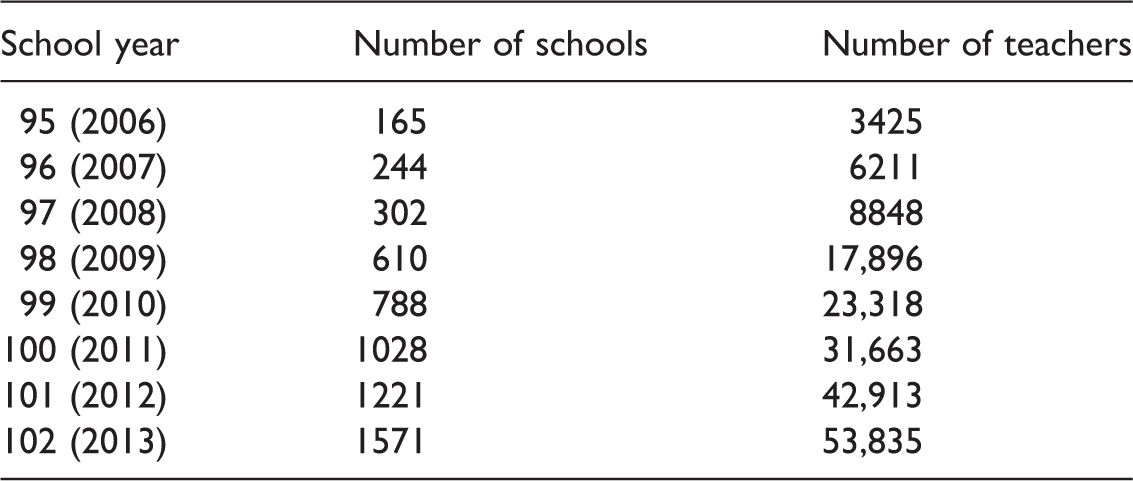
Table 1 reveals that the number of teachers and schools participating in teacher professional development evaluation increased every year. Overall, nationwide participation of schools and teachers was rather low, possibly because participation is not compulsory. In 2013, 1571 schools (approximately 40% of schools in Taiwan) and 53,835 teachers (approximately 25% of teachers in Taiwan) participated in teacher professional development evaluation. Chin et al. (2013) concluded that a high recognition level of the implementation of teacher professional development evaluation was present despite the low willingness among teachers to participate. The authors also indicated that the main factors affecting the participation of teachers in the programme were work load, uncertainties concerning the evaluation and partial implementation. Huang (2013) found differences in the nature of the index between teacher professional development evaluation and teacher licence, and reported that the standards and judgement of teacher professional development evaluation are not high because of the voluntary nature of the programme.
Yeh (2010) noted that teacher professional development evaluation merges multiple ideas of evaluation, namely school-based, formative, meta-, programme, self-, growth-focused and evidence-based evaluations. During policy formation, teacher professional development evaluation does not consider performance appraisal, dismissing incompetent teachers or the teacher grading system. Moreover, the evaluation combines different levels of resources, such as central, county and city governments; academic institutions; national and local educational groups; and non-profit and nongovernmental organisations.
Studies on teacher professional development evaluation have reviewed its implementation and effectiveness at different levels and for various stakeholders. Chin et al. (2013) investigated not only teachers but also systems, local governments, funding agencies, resources and parents. Chang (2013) investigated the programme implementation problems at the teacher, school and competent educational authority levels. The teacher professional development evaluation programme was piloted in 2006 and formally implemented between 2009 and 2013. Researchers have concluded that the lack of specific laws or regulations impacted teachers’ participation willingness and the pace of promotion (Chang, 2009, 2013; Chin et al., 2013; Pan et al., 2010).
Governance of teacher professional development
As stated in the two preceding sections, teacher professional development in Taiwan in the 20th century primarily focused on teacher in-service training activities. The state played a leading role in policy planning, implementation and enforcement. A diversified and comprehensive framework for teacher in-service training and teacher professional development evaluation was not developed until the 21st century. Traditionally, the state managed teacher professional development; however, government power was gradually decentralised to local authorities, schools and teachers.
Marketisation professionalism
Analysing the teacher professional management mechanism using professional teaching theories, Yang et al. (2005) indicated that a new professionalism—commercialised or marketisation professionalism, had emerged. This new professionalism emphasises examining professional performance through business management skills and objective accountability criteria. The trends of enterprise performance management and standards of accountability transform the teaching profession’s aims of providing knowledge, service and care into those of standard criteria, quality control, market mechanisms and social recognition.
In this context, the teaching profession has characteristic technical features. Contrary to the traditional concept of the teaching profession, the deliberative process of teacher professional development has become an essential component of management control of teachers. Therefore, to meet the requirements of management doctrines, controlling teacher professional quality is essential in teacher recruitment, curriculum planning, teacher qualifications acquired through teacher selection, appointment, treatment, establishing working conditions and teacher professional development. Studies have been conducted for developing standards and indicators of teaching ability (Chang, 2004; Pan et al., 2004). These standards comprehensively evaluate teachers’ behaviour for controlling the quality of the teaching profession.
In addition, under the policies emphasised by the market doctrine and performance management, such as the ‘White Book’ and ‘teacher professional development evaluation’, new professionals must undergo basic training, meet the capacity requirements and consumer needs and achieve the required performance standards. Under these circumstances, teachers must manage their personal information and daily lives and provide evidence of personal efficiency and quality. Li (2009) demonstrated that the implementation of teacher professional development evaluation enabled teachers to cultivate the habit of self-reflection in teaching and arrange teaching files. Chang et al. (2010) showed that the effects of conducting teacher evaluation in schools are (a) stimulation of teaching reflection, (b) improvement of teachers’ confidence, (c) discussion and sharing of knowledge among teachers and (d) presenting relevant teaching information as evidence of school evaluation. However, Chin et al. (2013) demonstrated that paperwork and file management are excessively emphasised in teacher professional development evaluation.
In brief, in the context of marketisation professionalism, teachers are considered entities who must be controlled for quality. Consequently, the learning content in teacher in-service training is classified into seven categories, which must be completed separately. Moreover, teachers are advised to complete a minimum number of training hours per year. In addition, teachers’ professional performance is evaluated on the basis of teaching, classroom management, in-service training and attitude. Thus, teachers must provide evidence for their individual profession and quality.
New social actors
The management mechanism of teacher professional development in Taiwan has marketisation features. It emphasises the establishment of specific standards and quality control of the teaching profession and aims to achieve social recognition and respond to consumer demands. The teaching profession is considered a public service on which society is dependent. However, in defining the connotation of teacher professional standards or the implementation of teacher professional development evaluation, the powers of the government are gradually decreasing; thus, various social actors will occupy crucial positions.
According to the studies discussed in the third section (Chen et al., 1996; Tzai, 1996; Xu, 2001), teacher in-service training in the earlier stages mainly focused on official training activities. After the publication of the white paper, the systematic practice-based teacher in-service training encompassed not only a growing number of private and unofficial institutions sponsoring teacher-training activities, but also teacher professional development support systems, which included central and teacher education universities, local government agencies, schools and various professional organisations at different levels.
Studies on teacher professional development evaluation have analysed connotation and implementation issues and examined the evaluation from the perspectives of the multiple stakeholders. In teacher professional development evaluation, the system is classified into school-based inspection and evaluation, teacher self-reflection and peer professional interaction. Chang (2013) reviewed the problems and issues associated with implementing teacher professional development evaluation from the perspectives of stakeholders such as teachers, schools and educational authorities. Furthermore, Chin et al. (2013) investigated and analysed the evaluation from the perspectives of such entities as teachers, schools, county and city governments, parents, experts and academics.
In-service teacher training and teacher professional development evaluation are the two axes of teacher professional development in Taiwan. Various social actors and stakeholders have increasingly critical roles in the governance of teacher professional development, and the state or government no longer occupies the principal position. In brief, in-service training activities and evaluation of teacher professional development is undergoing decentralisation, which empowers teachers, schools, parents, local governments and private organisations to participate in teacher professional development policies.
After decentralisation
In-service training support system characteristics, including practice-based teacher learning, voluntary teacher evaluation and professional development community, and other interactive activities, show that the government is just one of several actors in the governance of teacher professional development. The government, in the process of decentralisation, is connected to many other actors in policy making and implementation. However, this does not reduce the government’s influence on policies; conversely, the state and various social actors in the entire system governing teacher professional development management act together.
The government–social actors collaboration yields more implementation and promotion powers for teacher professional development policies than the state alone possesses. The state appears to have abdicated policy implementation; however, the stakeholders and social actors are absorbed in the governance of teacher professional development. In other words, according to the concept of marketisation, the management mechanism of the open government has expanded social actors’ participation and actualised decentralised governance.
However, some problems exist in decentralising the governance of teacher professional development. For the in-service teacher training system, although relevant laws and regulations clearly state ‘Teachers who intend to participate in in-service training should focus on the needs of the teaching requirement and improve teaching quality and school development’ and the minimum in-service training hours are regulated in the Teacher In-service Training Framework, they do not explicitly state how the results of in-service training or research should meet the needs of teaching and the classroom or how to specifically contribute to or be effective in in-service teacher training. This indicates that some discrepancy exists between teachers who have the right to self-education and the results and effectiveness of in-service training.
The evaluation of teacher professional development is expected to enhance student learning performance and effectiveness by guiding the leadership of school administration and through school-based evaluation. However, because of the voluntary nature of the programme, the outcomes are insignificant, not only in terms of its popularity and contribution to the teaching profession but also in terms of student learning. As Chang (2013) rightly stated, In the study of teacher professional development evaluation effectiveness, the focal points remain on teacher professional development and improving the quality of teaching. There is a lack of direct concern in enhancing the effectiveness of student learning. Therefore, the impact on student learning of teacher professional development evaluation should be studied further.
Conclusion
The concept of teacher professional development in Taiwan is traditionally mainly based on teacher in-service training and learning. With diversification of the teacher education systems and institutions, teacher professional development in Taiwan is undergoing a gradual governance shift from the model of centralised state regulation to that of new professionalism and marketisation.
The evolution of teacher professional development in Taiwan can be divided into three stages, with the first stage being from the colonial period to 1978. Irrespective of the ruling power (i.e. the Japanese empire or the Kuomintang government), this initial establishment stage witnessed measures to enhance the ability and quality of teachers. In the second stage (1979–1993), legislations strongly regulated the institutions and approaches towards teacher in-service training and education. The third stage (1994–present) witnessed the diversification of teacher education systems, and teacher professional development policies focused on professionalism and marketisation; this stage attempted to establish a comprehensive framework.
Before the 1980s, teacher in-service training and education focused on obtaining the necessary qualifications or a required university degree. The first objective was associated with the rapid development of primary and secondary education and the pressing need for teachers. Consequently, numerous teachers without appropriate qualifications were recruited into schools. Therefore, teacher in-service training and education were used as approaches for imparting qualifications. The second objective is associated with the response to a global trend; therefore, the government upgraded the minimum qualification of school teachers to a bachelor’s degree. Consequently, in-service teachers had to revisit teacher education institutions for obtaining higher degrees.
Under the formation of beneficial professionalism courses in the 1980s and 1990s, teacher professional development in Taiwan underwent a governance shift and diversification. Since the 2000s, teacher learning has been considered an active and constructive process that is problem-oriented, grounded in social settings and circumstances and occurs throughout the teachers’ lives. Consequently, researchers have emphasised the notion of ongoing and lifelong professional learning embedded in schools as a natural and expected component of teachers’ professional activities and a key component of school improvement. Both in the Programme for Primary and Secondary Teacher Quality Improvement (2009) and the Teacher Education White Paper (ROC) (2012), two focal points exist regarding teacher professional development: building a teacher in-service training system and implementing teacher professional development evaluation.
Teacher professional development approaches in Taiwan underwent a governance shift, with state power being gradually decentralised to local authorities, schools and teachers, and new methods of conceptualising teacher professional development in Taiwan are emerging.
Firstly, a gradual shift occurred from input control towards outcomes and output control. In public service production and delivery, institutional forms have become more crucial than efficiency and productivity. Under the principle of commercialised professionalism, the features of teacher professional development in Taiwan include teacher professional standard and quality control. The professional standards and teacher criteria were regulated, and teacher professional development has been evaluated since 2006.
Secondly, state–society relations and dependencies have undergone a perspectival shift. The state has nearly always been engaged in negotiations with other powerful societal elements. The state evolved as an actor that remains in control of certain unique power bases in society. However, the state is becoming increasingly dependent on other societal actors. A triple-level system has developed: the central–regional–school system. The teacher in-service education system, regional education consultants and teacher education universities are coordinated. The national teacher in-service network, internet-assessed learning and municipal in-service training centres are providing teacher training resources and excellent training environments.
Footnotes
Declaration of conflicting interests
The author(s) declared no potential conflicts of interest with respect to the research, authorship, and/or publication of this article.
Funding
The author(s) received no financial support for the research, authorship, and/or publication of this article.