




Abstract
This exploratory study responds to the criticism that non-instructional faculty or “academic professionals” at American universities are the cause of “administrative bloat.” The purpose of the study was to build from the work of Rhoades (1998) and Kane (2007) to examine whether academic professionals at an R-1 (very-high research activity university) performed core university work of research, teaching, and/or public service. A survey of 1036 academic professionals suggested that many of these individuals were routinely and directly contributing to research, teaching, and public service instead of administrative work, failing to contribute to any notions of “administrative bloat.” In addition to the three areas of core work, academic professionals often had advanced degrees, published in peer-reviewed journals, had specialized skills and bodies of knowledge, applied for grants, and engaged in entrepreneurial activities. The study concludes with a discussion of academic professionals in European countries and the role of disruptive innovation and new professionalism in compelling universities to expand the use of academic professionals in order to produce cheaper degree alternatives and generate new sources of funding .
Introduction
The contemporary American research university, which began around 1920 (Geiger, 1986), has continued to grow and evolve over the 20th century, becoming what Kerr (2001) termed the “multi-university”—an “inconsistent institution” comprising multiple communities with “fuzzy” edges (p. 14). Within this multi-university, the work that faculty members historically performed has evolved from a primary emphasis on teaching to a significant focus on research and public service (Terpstra and Honoree, 2009).
Do academic professionals conduct research? Do academic professionals teach? Do academic professionals perform public service?
Successfully answering these questions, our findings suggest many academic professionals who were hired to administrate and manage do not merely administrate or manage:
Background
Historically, from 1976 to 2009, the “faculty” category grew slightly from 34% to 38.7% of American higher education’s workforce. During the same period, the “other professional” category more than doubled in size from 9.6% to 20.7% (Snyder and Dillow, 2011: 373),
Literature review
Academic capitalism and administrative bloat
Scholars have found that as faculty focus their efforts more on research, academic professionals have absorbed other aspects of traditional faculty work, even though these academic professionals were hired to administrate or manage (Slaughter and Rhoades, 2004). These scholars have observed that the expanding university mission, which included outreach and entrepreneurship, created the need for academic professionals to administrate and manage the many new endeavors of institutions of higher education. However, traditionally, the mission of the American research university and the work of faculty is to teach, research, and serve (Birnbaum, 1988; Rosser and Tabata, 2010).
An analysis by Hurt (2012) suggested that Slaughter and Leslie “find the increasingly complex relationship between U.S. higher education and the market forces to be a cause of concern” (p. 127).
Rhoades and Kane (2007
New professionalism and administrative bloat
Akin to academic capitalism, the theory of new public management describes the corporatization of non-profit and public organizations, especially the new professionalism of social workers, teachers, doctors, school principals, police officers, and other public servants (Anderson and Herr, 2015). From here, new professionalism is the result of a “transfer of private sector logic into the public/non-profit sector and the replacement of an ethos of public service in the discipline of the market” (Anderson and Herr, 2015: 3).
Moreover, the “new philanthropists,” many of them entrepreneurs, require the embrace of neoliberal policies and practices as a stipulation for outside funding (Hurt, 2012), establishing a public–private relationship that further pushes American universities toward business-like behaviors.
Literature focused on organizational theory and the concept of core work has provided the foundation for developing a framework to describe university core work, akin to how faculty work has been traditionally seen as teaching, research, and service. For instance, Mintzberg (1979) described a hybrid organizational structure for universities with two operating cores (two places where core work is performed). One core is focused and specialized while the other is ambiguous and innovative.
Methodology
Scope
As
Site
The study is limited to one site in an effort to have tighter control over terms and definitions related to university core work of teaching, research, and public service. Lack of clarity and control over these terms relating to non-faculty professionals is a key issue cited by Rhoades (1998). We selected Southmost State University (SSU) as the site because it matches many of the descriptions of organizational structure and work discussed in other studies (Birnbaum, 1988; Johnson, 2020; Rhoades, 1998) and employs large numbers of both instructional faculty and academic professionals. The institution is a Carnegie Classification
Methodological approach
The methodological approach included a combination of case study, workforce and job analysis, and survey research. These methods contributed to the comprehensive development of a mechanism for defining terms and classifying university work as it relates to academic professionals and “administrative bloat.” Two analyses were performed to best understand the
Sample
Survey instrument
The survey had a total of 55 questions, and all participants responded to 13 questions, with an additional four being optional. The remaining 38 questions employed branch logic, which allowed us to direct respondents to different places in the survey depending upon a response. The strategy of branching, which is not visible to the participant, allowed us to focus participants on only those questions related to their current job duties and to reduce the number of irrelevant questions. Moreover, the survey had six sections. The first section asked for details about the individual’s job, job title, job purpose, and whether the individual had dual titles. These questions were asked of all participants.
The second section queried participants about teaching duties guided by the definition of instruction of a class, workshop, or program that had stated learning objectives. Teaching outcomes were curriculum development, instruction, instructional assessment and reporting, and selling instruction and curriculum on the external market. Of the 18 possible questions in the teaching section, four were considered “level-one questions,” which were asked of all participants. The responses from these four questions either opened up new questions or skipped the participant to another level-one question. The four questions were whether the individual performed teaching work, assisted in the design of college-credit courses, had chaired a graduate student research committee, and/or served as a member of a graduate student research committee. The remaining questions asked about the time participants spent performing teaching duties and the specific research activities and outcomes produced.
Section three asked questions related to research work. These questions were guided by the definition of research as work which resulted in new knowledge, either theoretical or applied. Research outcomes included publishing findings in peer-reviewed academic journals, applying for patents and trademarks, or selling new knowledge on the open market. There were 12 questions in the research section, four of which were level-one questions asked of all participants. The level-one questions asked if the individual performed research work, published in a peer-reviewed journal, submitted grant proposals, or collaborated with industry to move research to market. The remaining questions asked about the time spent performing research and the research activities and outcomes produced.
Section four asked questions related to public service, defined as non-instructional services beneficial to individuals and groups external to the university. Work outcomes focused on medical services to the community; preserving, storing, or disseminating information; preserving and promoting the arts; and stimulating participation in and educating the public on the democratic process. The public service section had 12 questions and the query about whether the participant performed public service was the only level-one question. The remaining questions asked about the time individuals spend performing public service and the research activities and outcomes produced.
The fifth section contained five questions related to the participant’s career plans. The question, “how likely are you to be performing the same work in five years?” was the only level-one question. The remaining four questions asked about the type of work the participants aspired to and if they desired a faculty position. Finally, the sixth section asked four, open-ended questions available to all participants. These questions afforded the opportunity to add insights or comments on teaching, research, or public service and any other issues not covered in the survey.
Data analysis
Two analyses were performed: the workforce data analysis and the survey data analysis, both of which employed descriptive statistics. We chose population data for the workforce analysis and computed frequencies and percentages by full-time/part-time employment status, job title, department, and educational levels. The survey analysis also calculated descriptive statistics. Cross tabulation compared multiple question responses.
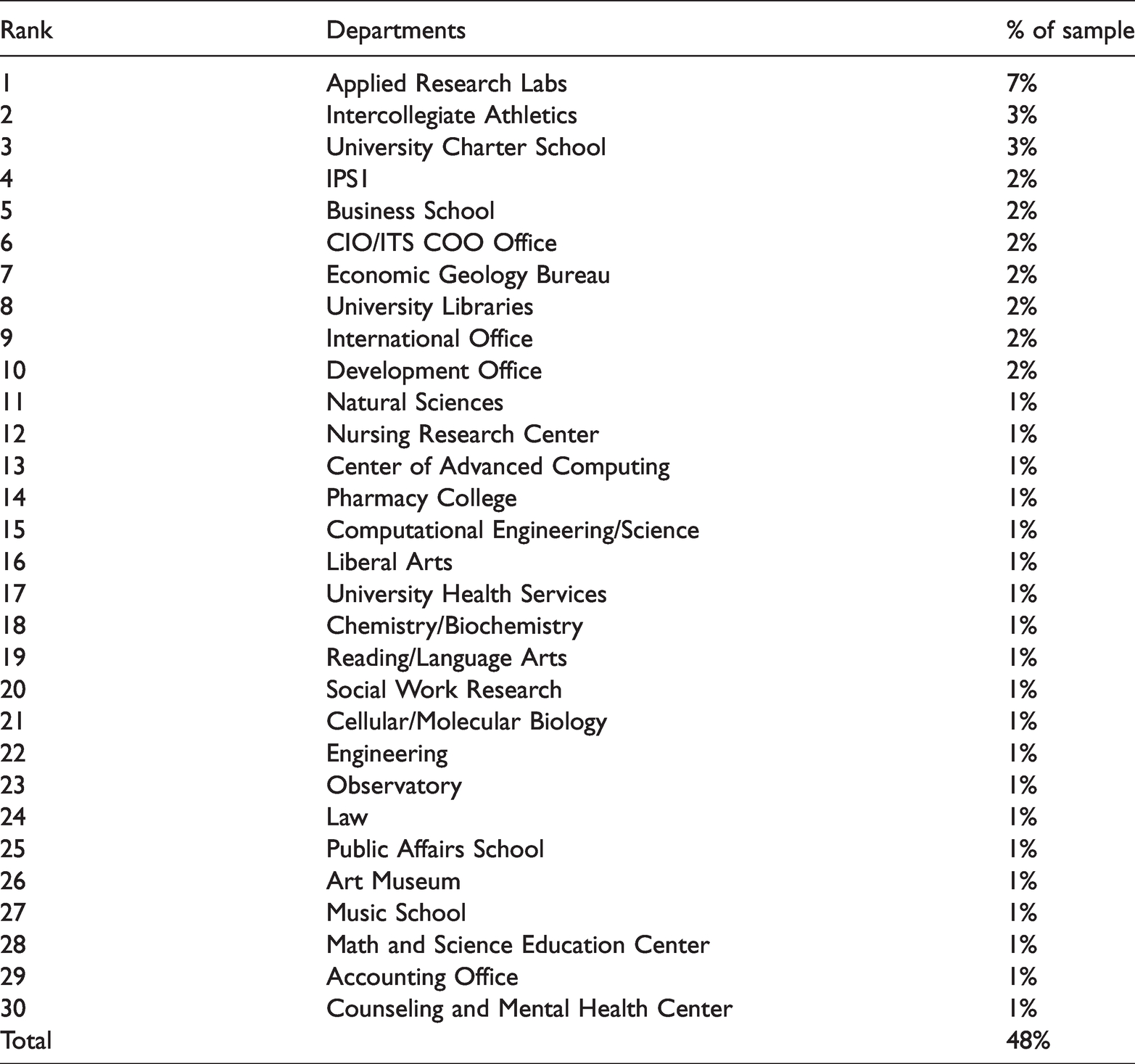
Study sample of academic professionals by top 30 departments on SSU’s campus (n=1036)
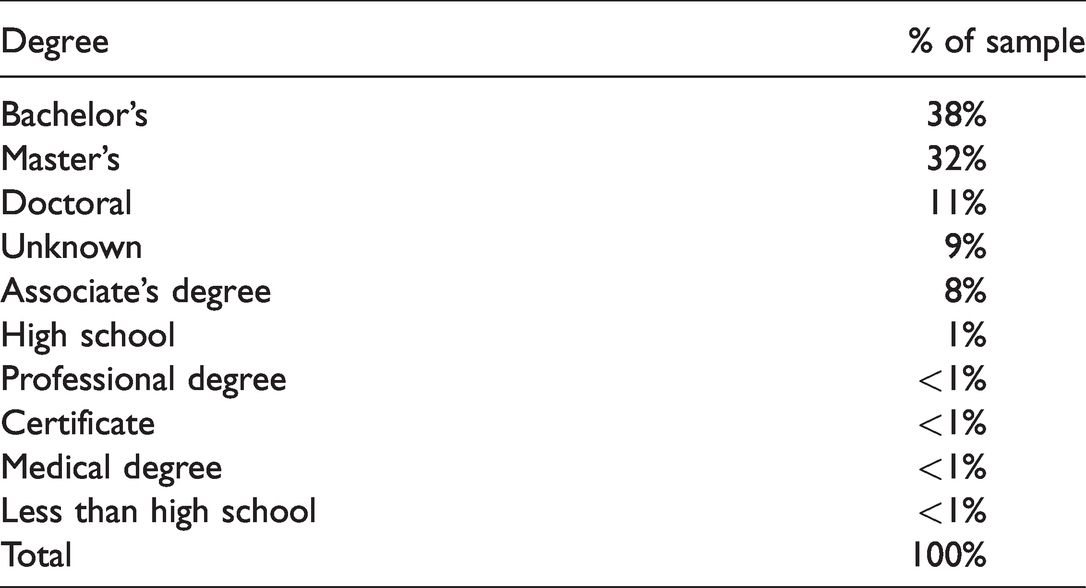
An overview of the survey sample by education level can be found in Table 2.
Study sample of academic professionals by education level (n=1036)
In 2012, the university added the Standard Occupational Classification and Coding Structure (SOC code) established by the U.S. Bureau of Labor Statistics (2010) to all jobs in the university system. Each research code was matched with the corresponding SOC codes. In case of discrepancy, we re-examined the job title’s description in the human resource system, making 52 corrections. NCES and IPEDS excluded postdoctoral fellows as “other professionals,” since postdocs were assumed to be temporary employees in a program to train new faculty members (NCES, 2021). Postdoctoral fellows held 10% of the entire “other professional” population. For this reason, we removed the 57 postdoctoral fellows who responded to the survey from the
Results
Our analysis addressed both quantitative and qualitative responses. This section includes the overall findings; faculty-like work performed by other professionals in the context of publications, committee work, curriculum design, industry collaboration, and grant applications; and the three core faculty work areas of teaching, research, and public service.
The three main questions in the survey were: (a) Do you perform work that is considered teaching? (b) Do you perform work that is considered or that contributes to scholarly research? and (c) Do you perform work that directly contributes to increasing educational opportunities to individuals? Seven hundred fifty-nine respondents (78%) answered “yes” to at least one of the three questions related to teaching, research, or public service. All who answered “yes” to each of the three core work questions reported the percentage of the job devoted to teaching, research, or public service. Moreover, data suggested the majority of the 40% (n=414) either had jobs almost entirely focused on research (62%, n=642) or had jobs with 25% or less focused on research (38%, n=393). The majority of teaching work accounted for 25% or less of the participants’ job.
Research work
Three hundred ninety-two participants performed research work, which represented 38% (N=1036) of the academic professional population. Two hundred eleven (20%) respondents had a job title from the research professional job category. Seventy percent of research professionals conducted background research, ran experiments/gathered original data, analyzed/coded data, wrote up results, and edited publication drafts as part of their job. The analysis of the qualitative data showed that these professionals participated in designing research equipment, acquiring research equipment, and maintaining labs—all duties that fall under the category or research and not administration or management.
The questions related to publications, graduate committee membership, and curriculum design served as a deeper indicator that SSU academic professionals performed duties directly aligned with faculty work.
Trademark and patent activity by research professionals was minimal at 7% (n=72). More substantially, 25% of research professionals collaborated with industry to move technology innovations into the marketplace. Close to half of research professionals applied for grants (46%) and 39% received grant funding.
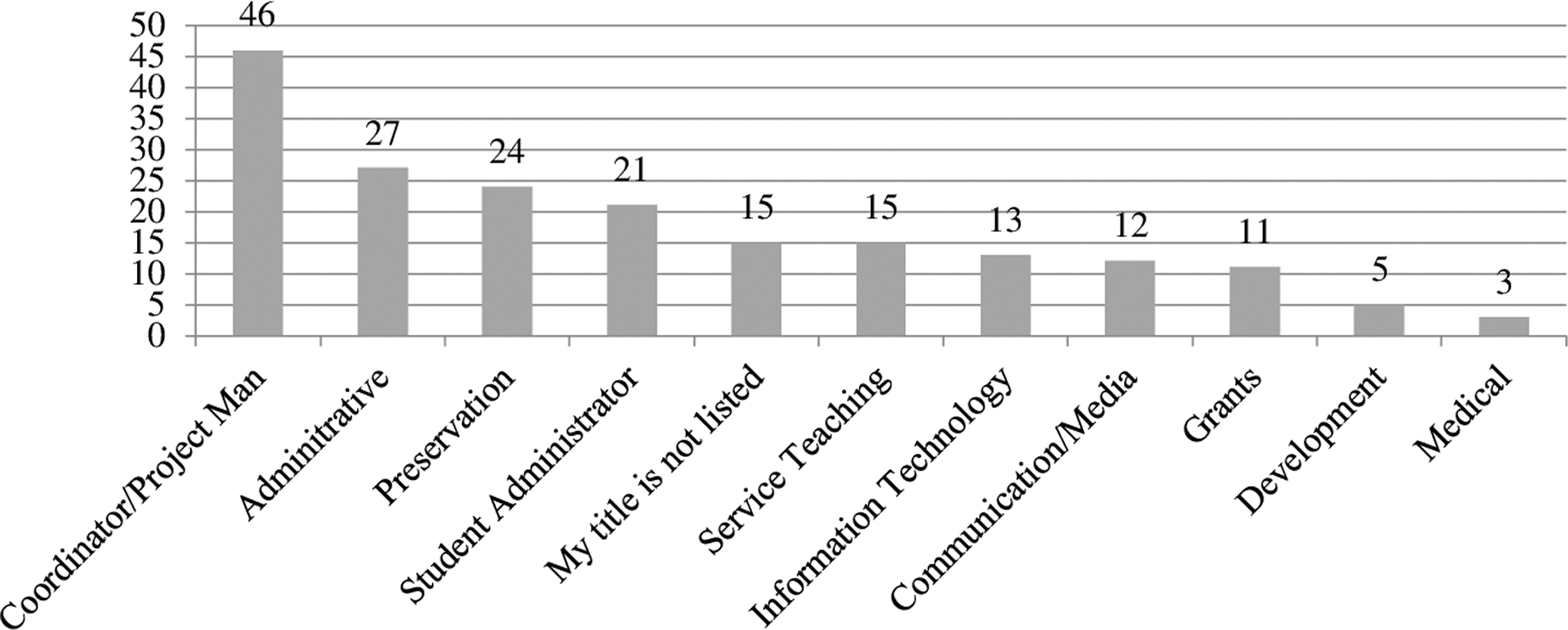
Non-research professionals who perform research work (by job category) (n=192)
Seven hundred seventy-two (75%) non-research professionals completed the survey, with 25% answering “yes” to the research question. Most non-research professionals (61%) spent 25% or less of their job performing research work. Over half (60%) of non-research professionals who answered “yes” performed background research. At least 30% ran experiments/gathered original data, analyzed/coded data, wrote up results, or edited publications. A smaller number (28%) generated research questions and 57% performed “other” research-related duties. The number of academic professionals performing research divided almost evenly between research (51%) and non-research (49%) job titles. Overall, the results narrated a story of academic professionals as highly skilled individuals, many of whom prepared to become faculty members but were hired as academic professionals.
Teaching
Three hundred eighty-nine academic professionals answered “yes” (98%) to performing teaching duties. The survey defined teaching as “instruction of a class, workshop or program that has stated learning objectives.” Most teaching work was conducted by non-research professionals (79%). For most who taught as part of their job, teaching accounted for 25% or less of the position (74%). Comparatively, 62% of academic professionals who answered “yes” to performing research said it accounted for 30% or more of their job. This suggested that teaching was not a central aspect of “other professional” work but appeared to be part of various job titles, including many research positions (Figure 2).
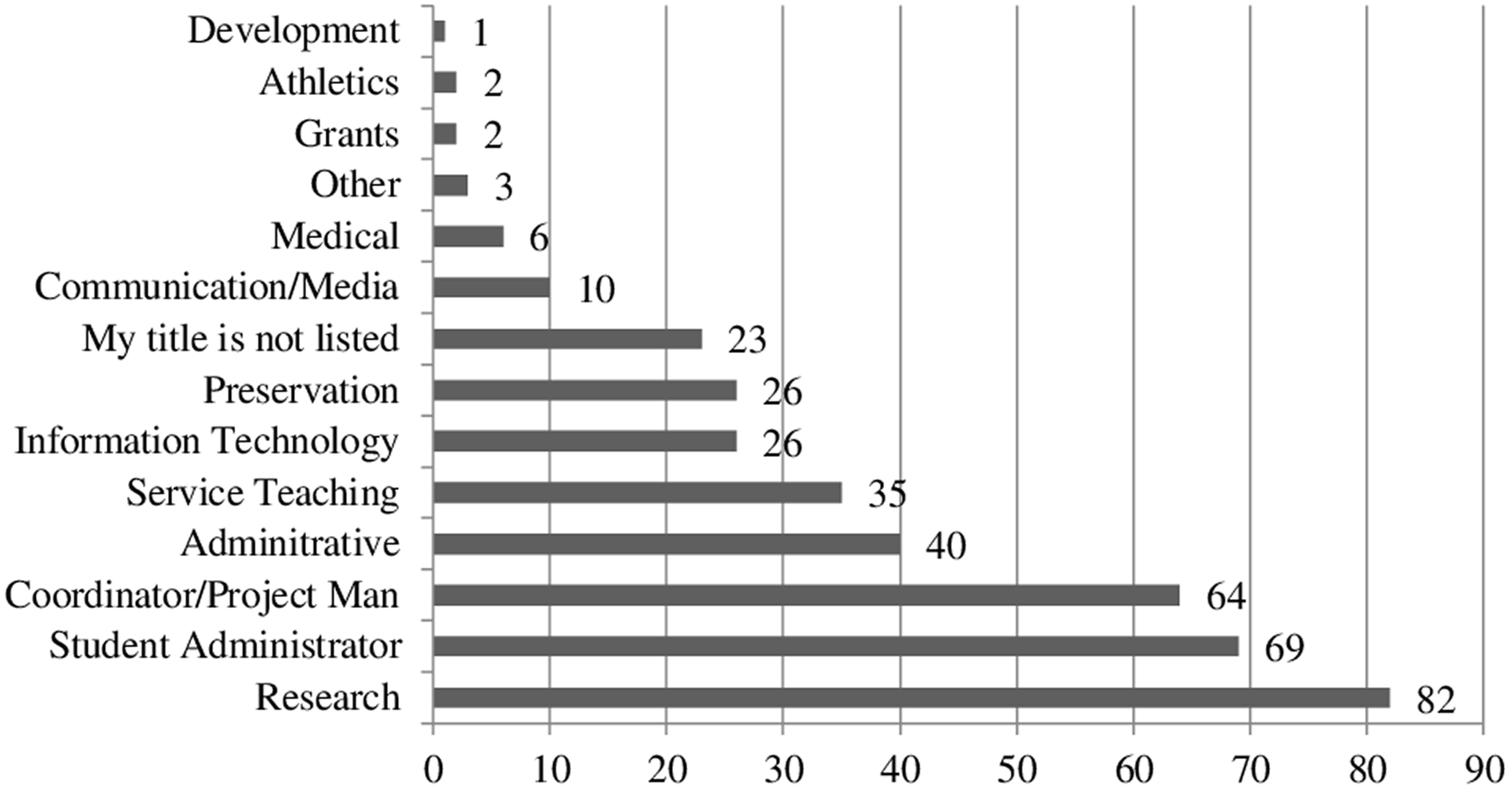
Academic professionals who perform teaching work (by job category) (n=389)
Most “other professional” employees who answered “yes” to the teaching question taught workshops (62%). The survey defined teaching as “non-college credit classes taught for skill or professional development purposes.” Most of those individuals (95%) developed their own workshop content. Almost 25% of teaching professionals indicated they taught college credit courses. Of those, 71% taught undergraduate classes and 48% taught graduate courses. Most individuals (90%) developed some content for the course with 55% creating at least half of the course. A small percentage taught K-12 classes (10%) and a handful (<1%) taught preschool students. These positions were in the various laboratory schools on campus.
Public service
Four hundred sixty-two participants performed public service, defined as “non-instructional services beneficial to individuals and groups external to the university.” The majority of individuals who did public service work were non-research professionals (79%).
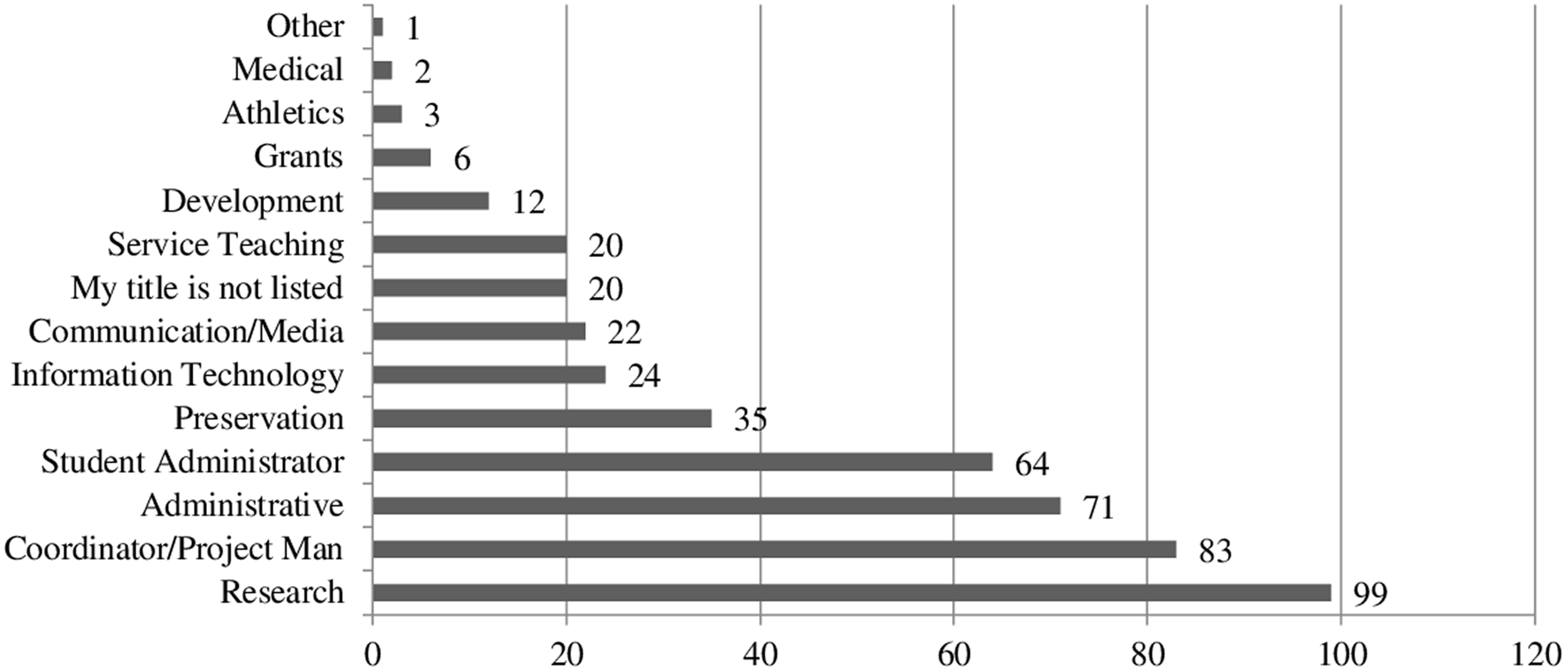
Academic professionals who perform public service work (by job category) (n=462)
The survey asked individuals the type of public service they provided. The five types of service were (a) providing educational opportunities to underserved communities, (b) providing medical services, (c) promoting the democratic process, (d) preserving and disseminating information, and (e) preserving and promoting the arts. The highest concentration of responses was preserving and disseminating information (75%) and providing educational opportunities to underserved communities (73%).
Public service had the highest response rate from academic professionals and the second highest concentration of time devoted to a job. The participants’ descriptions revealed the external populations served by university work. For instance, these descriptions included tasks focused on communicating and informing the public of research conducted by the university. Other public service activities provided access to information and the arts.
Discussion
Deeper analysis of the three areas of core university work provided some contextual information on the work activities of academic professionals. Most research professionals (73%) said that research accounted for more than 50% of their job. Conversely, most non-research professionals (61%) performing research work said that these duties accounted for 25% or less of the job. For most non-research professionals, research was but one aspect of the job, suggesting that individuals at universities may be hired as researchers, but the nature of their position trends toward the academic professional and often requires other forms of labor for the institution.
Additionally, teaching emerged as less significant than research or public service work for academic professionals. Only 15% of those who taught replied that such work accounted for more than 50% of the job. This suggested that teaching work was an aspect of academic professional jobs rather than a primary focus. Some teaching respondents (24%) taught credit-bearing courses. The job categories associated with college-credit teaching were research professional, coordinator/project manager, and student administrators. The main teaching duties performed by academic professionals was workshops (62%).
Almost a third of public service respondents indicated the duties accounted for over 50% of the job. This suggested that public service was central to the duties of academic professionals. Most public service work provided educational opportunities to underserved communities (73%), and/or preserved and disseminated information (75%). Qualitative responses showed a variety of public service activities ranging from social services, to outreach activities focused at attracting future students, to specific areas of study in science and technology, to the preservation of and access to information.
In summary, the survey data provided contextual and descriptive information about academic professionals or “other professional” employees. A large portion of these employees performed work more closely aligned with research and public service than administration, although members of the public, other organizations, and government entities may view these
Discussion
Implications for faculty members
The effect of academic capitalism, as Rhoades (2014) argued, is about the structural and political changes in U.S. colleges and universities. More managerial control over service, research, and instructional activities results in fewer permanent, tenured faculty members and reduced academic freedom. Such appointments offer academic managers substantial control. Since contingent appointments in the U.S. are for as little as one course in one quarter (10 weeks) and pay less than the equivalent wage for a tenured or tenure-track faculty member, contingent employees cost much less.
Likewise, American research professionals replace permanent faculty members by designing and performing research, writing and publishing journal articles, making presentations at academic meetings, and writing and administering grants. This activity frees up permanent faculty members to build partnerships with industry, and seek foundation, corporate, and government research contracts, contributing to academic capitalism (Slaughter and Rhoades, 2004). In other words, faculty must garner money and prestige to continue their existence. “Superstar” faculty researchers command large salaries and expensive laboratories (Burgan, 2006: 141). In return for multi-million-dollar startup funds for laboratories, superstars must generate funds yearly, usually between five and ten times their annual salaries. With these requirements, superstars spend more time chasing grants, and leaving the day-to-day research operations to the research professionals.
Another space that U.S. academic professionals occupy is student support services. American universities have two key student mandates. The first is increasing access to higher education, especially for first-generation, low-income, and minority students. Second is the legislative mandate (state and federal) to increase dramatically graduation rates, especially at public universities.
Academic professionals in other countries
The researchers conceptualize “profession” as “… linked to production and articulation of knowledge and expertise … ,” while professions have status and the power to self-regulate (p. 462). Gornitzke and Larsen (2004) asserted that unlike the research on academic professionals in the U.S., Norwegian academic administrators draw clear boundaries between themselves and faculty members (p. 465).
Enders (2005) noted the transformation of German doctoral training from a Humboltdian to a professional model, with consequences on the career choices of the graduates. Overall, 25% of graduates go to work in universities, 25% go into research outside universities, and 50% go to work in other positions in government, private industry, and not-for-profit organizations (p. 22). With only 25% of PhDs working in higher education, academic professionals play a smaller role than at U.S. universities. However, German and other European universities face some of the same issues as their counterparts in America and may face financial pressures in the future to employ doctoral graduates as academic professionals rather than as regular faculty members. In these cases, academic professionals may indeed have faculty aspirations, but these individuals may be relegated to the role of academic professional.
Technological disruption
During the current political cycle in the United States, politicians focused on the affordability of a college education, with several proposing “no-debt” or “no-frills” degrees. However, reducing either the debt load or the cost of higher education requires substantial cost-cutting, a much larger commitment of public funds, or both. The idea of technological or innovative disruption advocates cheaper options with the help of more academic professionals and fewer full-time, tenured faculty members—
Technological disruption is the latest management trend that encourages a greater use of academic professionals. Christensen and Eyring (2011) used the term “innovative disruption,” defined as “selling of a cheaper, poorer quality product that initially reaches less profitable customers but eventually takes over an entire industry” (LePore, 2014: 30). LePore (2014) described Christensen’s focus on failed companies as “… not so much a problem missed as a missed opportunity, like a plane that takes off without you except that you don’t even know there was a plane, and had wandered onto the airfield, which you thought was a meadow, and the plane ran over you during takeoff” (p. 29). Moreover, LePore described disruption as “a theory of history founded on the profound anxiety about financial collapse and an apocalyptic fear of global devastation, and shaky evidence” (p. 30
In writing about the “innovative university” Christensen and Eyring (2011) analyzed the Harvard University founded by theocrats in the 17th century to conclude that “the modern university includes a mix of face-to-face and online learning” (Christensen and Eyring, as cited in LePore, 2014: 31). For the latter they recommended Massive Open Online Courses (MOOCs). They also advocated a “heavyweight innovation team” (as cited by LePore, 2014: 31). She identified the analysis as historically flawed, the recommendations as having little reality to the current operation of the university, and the solution as more appropriate for an entrepreneurial startup company. However, startups are structurally and philosophically very different from academia, yet many universities may now resemble these startups and hefty administrative or managerial positions.
Such a system, LePore (2014) argued, is completely inappropriate for universities, yet disruptive innovation is very much in vogue in American universities. There are conferences, networks, and programs in disruption and a small army of disruptively transient disruption consultants. Further, academic professionals and contingent faculty with their transience, diminished loyalties, and lower salaries can be easily manipulated into providing the cheapest academic degrees possible by replacing tenured and tenure-track faculty.
Future research
This exploratory study of academic professionals at Southmost State University has limitations in the scope, response rates, survey questions, and statistical analysis. The study was limited to one university to define and refine how to best assess core university work and whether academic professionals contribute to “administrative bloat.” Future research could utilize the survey tool and job categories at other institutions of similar size and mission to gain a more comparative view of the “other professional” category of employees in American research universities.
A second limitation to the study was the survey response rates. Future research could offer incentives and construct targeted messages to each job category. In addition, future researchers could monitor responses by job category and send targeted reminders to job categories with a low number of responses. These strategies could improve the response rate. Moreover, while the survey tool provided meaningful information related to research, teaching, and public service work, the study could have benefited from more data on teaching work. The main teaching question was whether individuals taught classes, with no follow-up questions about other types of teaching activities. This reduced the nuance in defining teaching duties of academic professionals. The qualitative responses on employee contributions to the university’s teaching mission suggested that “other professional” employees were involved in learning outcomes design, assessment, and reporting. Future research should consider adding more questions that explore other aspects of instruction. Follow-up questions could ask about learning outcomes design, assessment, and reporting activities.
Overall, our study contributed to the discussion of the growing “other professional” category of employees—referred to as academic professionals—by providing a mechanism to catalog and categorize work. The study used job analysis techniques to build a job analysis tool. We used definitions of core university work from scholarly literature associated with faculty work.
Summary
This study of American academic professionals revealed extensive and growing use of this type of employee to meet the needs of the modern research university. The accountability demands, pressures to replace lost public revenue with outside funding, providing a relevant education to competing constituencies, increasing diversity of the faculty and student body, and cutting costs all suggest that academic professionals will continue to play a large role in accomplishing these competing objectives.
Footnotes
Declaration of Conflicting Interests
The author(s) declared no potential conflicts of interest with respect to the research, authorship, and/or publication of this article.
Funding
The author(s) received no financial support for the research, authorship, and/or publication of this article.
