




Abstract
Given the influential role that the Organisation for Economic Cooperation and Development (OECD) plays in educational governance, we believe it is timely to provide an in-depth review of its education surveys and their associated human capital discourses. By reviewing and summarizing the OECD's suite of education surveys, this paper identifies the ways in which the OECD frames these surveys and embeds them in human capital discourses. We observe that the OECD's large-scale education surveys contribute to its growing cognitive and normative governance role in the global governance of education. The significance of our analysis lies in highlighting these surveys' truth claims as objective measures of human capital while at the same time pointing to their contested and controversial role in broader educational debates. We focus on three contested terrains: student testing, educational system improvement, and the politics of educational reform. In conclusion, we suggest that there is a need for an alternative paradigm – one that values the significant role that public schools play in building socially cohesive and equitable societies.
Keywords
Introduction
Over the past 50 years, the Organisation for Economic Cooperation and Development (OECD) has expanded the scope of its mandate to include education research and policy activities. Scholars have documented how the OECD influences national education policies in primary, secondary, and tertiary sectors primarily through its international education surveys, which include the Programme for International Student Assessment (PISA), the Teaching and Learning International Survey (TALIS), the Programme for the International Assessment of Adult Competencies (PIAAC), and the Assessment of Higher Education Learning Outcomes (AHELO) (Morgan and Shahjahan, 2014; Hunter, 2012; Meyer and Benavot, 2013; Robertson, 2012; Lingard et al., 2016).
The OECD draws on a vast reservoir of data collected from its international education surveys in order to provide governments with a number of reports and briefs via its extensive online library. Policy brief series, such as PISA in Focus, Teaching in Focus, and Education Indicators in Focus, aim at identifying features and characteristics of the best performing education systems around the world. The OECD is quick to point out that it does not tell participating countries/economies how to run their education systems. It contends that its publications are designed to focus policymakers' efforts on formulating and implementing specific policies that improve equity and educational outcomes across primary, secondary, and tertiary sectors.
Despite these assertions, there is growing concern over the expanding influence of the OECD and its education surveys in national education policymaking. Scholars suggest that the OECD's international education surveys facilitate the convergence of education policies around the world – what some describe as global educational governance (see Meyer and Benavot, 2013; Munch, 2014; Sellar and Lingard, 2013a, 2013b; Sjoberg, 2015). By governance, scholars are referring to the process of governing that is not bounded by the nation-state, but involves multiple actors and scales (i.e. global, national, and local) in the policy production and implementation process (Rizvi and Lingard, 2010). While the nation-state remains key to educational policy development and implementation, regional and global forms of governance play an increasingly influential role in national policies (Grek, 2009; Meyer and Benavot, 2013). As Lingard et al. (2016: 44) point out, the growing importance of policy as numbers (i.e. the use of data and statistics to inform evidence-based policy) in governing education at local, regional, and global scales is associated with the rise of neoliberal forms of governance and the new managerialism that involves steering at a distance.
Academic condemnation of the well-established PISA survey is particularly acute, as evidenced by an open letter to Dr Andreas Schleicher, the director of the OECD program, from a group of more than 80 high-profile academics from around the world. The open letter essentially argued that PISA was damaging education worldwide by escalating testing, emphasizing a narrow range of measureable aspects of education, and shifting education policies to find “short-term fixes” designed to help a country climb in the rankings (Andrews et al., 2014). The OECD counters academic critics who suggest PISA, TALIS, PIAAC, or AHELO have created a hegemonic grip on education policymaking (Kell and Kell, 2010) by asserting a robust causal link between education skills and economic and social outcomes in a growing number of OECD countries (OECD, 2009). The OECD views its education research and policy suggestions as contributing to economic prosperity and social well-being. Overall, the OECD has successfully linked the discourse of education to economic issues and thus created public demand for education reforms (see Niemann, 2009; Trohler, 2014).
Given the influential role that the OECD plays in educational governance, we believe it is timely to provide an in-depth review of its education surveys and their associated human capital discourses. We observe that the OECD's large-scale education surveys contribute to its growing cognitive and normative governance role in the global governance of education (Lingard et al., 2016; Woodward, 2009). More specifically, the OECD has pursued a strategy of “soft” persuasion that naturalizes the idea that performance in a series of measurement exercises represents educational quality. 1 Through this strategy, the OECD has constructed educational indicators to inform the policy production process while also legitimizing the use of comparative data as a policy tool in governing education in a neoliberal era of political and economic governance (Henry et al., 2001; Lingard et al., 2016; Pereyra et al., 2011). The OECD's cognitive governance capacity is built through its network of like-minded communities of practices, while its normative governance is gained through the spread of its norms, ideas, and knowledge (Woodward, 2009).
The significance of our analysis lies in summarizing key dimensions of the OECD's education surveys while also highlighting their truth claims as objective measures of human capital. We also point to their contested and controversial role in broader educational debates. In the next section, we provide an overview of the OECD's historical evolution in governing education and the emergence of its human capital discourses. This is followed by an analysis of the rationale for the OECD's large-scale assessments. We then explore the policy debates surrounding the OECD's education surveys in terms of student testing, educational system improvement, and the politics of education reform.
The OECD's historical evolution in educational governance
The OECD's precursor, the Organisation for European Economic Cooperation, was created to assist with European economic recovery after World War II. The OEEC was reconstituted as the OECD with 20 states originally signing the Convention on the Organisation for Economic Co-operation and Development on 14 December 1960. Since then, 14 additional states have become members of the OECD with Chile, Estonia, Israel, and Slovenia joining in 2010. The OECD's mandate is to promote policies that “achieve the highest sustainable economic growth and employment and a rising standard of living” and “contribute to sound economic expansion” (OECD, 1960).
The OECD is organized into a Council, the supreme body in the OECD, committees, and directorates. Chaired by the Secretary General, the Council has two sets of members: the Ministerial Council, which meets annually; and the Council of Permanent Representatives, which meets monthly and is equivalent in its role to the “Board of Directors” of a business corporation (Carroll and Kellow, 2011: 12). The directorates of the OECD employ civil servants who service the various committees but who are expected to be loyal to the organization. The OECD Secretariat manages and administers OECD work. The OECD Secretariat is headed by the Secretary General, who is assisted by a deputy and assistant Secretary Generals.
Woodward describes the OECD as an international organization that “sows the seeds of inter-state consensus and cooperation” (2009: 5). The OECD's policy influence includes its role as a purveyor and legitimator of ideas as well as its knowledge production capacities as an international organization (Mahon and McBride, 2008; Sellar et al., 2016). It enacts soft modes of regulation, including publication of comparative data such as educational and social indicators, and peer reviews involving country and thematic reviews (Kallo, 2009; Mahon and McBride, 2008). Furthermore, its influence derives from demarcating norms and practices that further liberal, market friendly, economic policies (Henry et al., 2001; Rizvi and Lingard, 2010).
Over the years, education has come to occupy a central place in OECD economic policies, with human capital discourses informing these policies (Papadopoulos, 1994). During the 1960s and early 1970s, OECD economists and educational researchers defined educational issues in terms of manpower planning and investment in education. OECD educational activities represented a “front-end model of educational policy” (Rubenson, 1999: 11). Educational policy was governed by a Keynesian understanding that state investment in education improved the quality of human capital. However, in the 1970s, economists began to doubt their Keynesian policy prescriptions as OECD member states faced high rates of inflation, slow economic growth, high rates of unemployment, and large balance of payment deficits. Keynesian economic policies neither succeeded in stimulating growth nor in reducing unemployment rates.
The OECD altered its policy recommendations in the 1980s to a neoliberal approach. It began to recommend and support “positive adjustment policies” that relied on market mechanisms for the allocation of labor and capital. In 1980, the Secretary General advised member states not to “impede the adjustment process” and to “accept constraints on total welfare spending in order to provide increased investment” (OECD, 1980: 7, 9). The OECD, which has always promoted a free market economy, now shifted practices away from Keynesianism to neoliberalism. This shift was also accompanied by a new regime for governing the individual. Instead of the state being responsible for the individual, there was an emphasis on the entrepreneurial self within a “new individualized and privatized consumer welfare economy.” Under a neoliberal rationality, “[h]uman capital theory is rejuvenated in a privatized rather than statist or public form” (Peters, 2001: 60).
In order to turn public schools into efficiently run organizations that could do more with less, new managerial practices were adopted from the private sector. These practices came to be known as the New Public Management Theory (NPM) and included a focus on results, outputs, and performance, and the construction of accountability regimes to address government inefficiencies (Rizvi and Lingard, 2010: 119). The measurement and monitoring of quality was a NPM technique borrowed from the private sector and adopted to ensure bureaucratic educational systems became competitive and efficient organizations (Ball, 1998). The quality of basic education became central to OECD work and helped propel research into educational indicators (OECD, 1984). The OECD held several meetings in the 1980s on the quality of education, resulting in the creation of the International Indicators and Evaluation of Educational Systems (INES) project in 1988. Several OECD members agreed to work together to develop a set of international educational indicators that examined student flows, student outcomes and costs, and resources (OECD, 1988: 59). The work of the INES project produced OECD's flagship publication, Education at a Glance, and its well-known student assessment – the PISA.
The OECD's involvement in developing educational indicators and producing educational surveys contributes to its global cognitive and normative governance roles in education and its growing authority in this policy sphere (Sellar and Lingard, 2013b: 187). As we shall discuss in the next section, the OECD's human capital discourses validate an economic understanding, conceptualization, and instrumentalization of educational goals and objectives. The OECD derives its power from these discursive forms and rationalizes its educational large-scale surveys within this epistemological understanding of education.
The OECD's human capital discourses
The introduction of Trends in International Mathematics and Science Study (TIMSS) by the International Association for the Evaluation of Educational Achievement (IEA) in 1995 and later PISA by the OECD in 2000 ushered in a new accountability paradigm. Armed with comparative education data, governments around the world soon began to debate and, in many cases, assert a strong causal link between education systems, human capital, and economic prosperity. The OECD has facilitated this growing discourse through its public statements and publications that promote the importance of human capital for the 21st century. Yet, assumptions surrounding the importance of human capital rarely consider other factors that contribute to economic prosperity, such as economic development policies, industrial and trade policies, capital investment, and the availability of natural resources (Morris, 2015).
The OECD defines human capital as the “knowledge, skills, competencies and attributes embodied in individuals that facilitate the creation of personal, social and economic well-being” (Keeley, 2007: 29). It asserts that education is a key factor in forming human capital and that the impact of human capital is reflected across a range of economic and social areas. For example, OECD research suggests that human capital raises economic growth, employment prospects, health levels, and community involvement (Keeley, 2007; OECD, 2010, 2013b). Just as investments in a bank have the potential to provide long-term returns, the OECD contends that investments in education produce human capital returns with benefits to both the individual and the country/economy. Based on this narrative, Governments around the world must take active steps to improve human capital so that their citizens are ideally positioned to compete in the rapidly changing 21st century knowledge economy.
Human capital theory assumes that labor markets operate efficiently without any interference. Hence, it is up to those entering the labor market to invest in their human capital and compete for jobs. So, the more people invest in their education, the higher the economic returns manifested in improved income returns (Lauder, 2015). The theory neglects to account for economic structures that contribute to low wages, unemployment, and underemployment (Bluestone, 1977), a country's economic development policies (Morris, 2015), its skills formation policies, and global labor market mobility, which allows states to import their skilled labor (Lauder, 2015). Despite these weaknesses in the explanatory power of human capital theory, the OECD continues to use it in its discourse on education and skills.
In recent years, the OECD has intensified its human capital discourses in two ways. Firstly, it linked its education work to its Skills Strategy (Lingard et al., 2016). The OECD emphasizes the importance of skills on its OECD Skills homepage (http://skills.oecd.org/) entitled “Building the right skills and turning them into better jobs and better lives” (OECD, n.d.-a). Secondly, the OECD linked human capital discourses to economic growth through empirical analysis. It has adopted Erick Hanushek's work, which measures a nation's cognitive skills based on international test scores as a determinant of a country's economic growth (see, for example, OECD, 2015a). The conclusion is that a population's knowledge capital, or collective cognitive skills, is by far the most important determinant of a country's economic growth.
Few OECD critics would dispute the associated link between education and economic and social advantage. Indeed, most would concur that investments in education are critically important. As previously suggested, it is the perceived limitations and utilization of international surveys as well as the underlying motivations for particular policy directions that are often situated in the “eye of the storm”. Critics argue that while intelligence is a well-known determinant of economic outcomes, and schooling is an important enhancer of cognitive abilities (Rindermann, 2008), the causal link between education and economic prosperity is mediated by a number of intervening variables that reside outside of education systems. Consequently, education reforms that are primarily motivated by a desire to improve human capital may be based on unsubstantiated claims. They also have the potential of diminishing other important aspects of an educational experience or system.
The OECD's international education surveys and their rationale
Summary of Organisation for Economic Cooperation and Development (OECD) international education surveys.
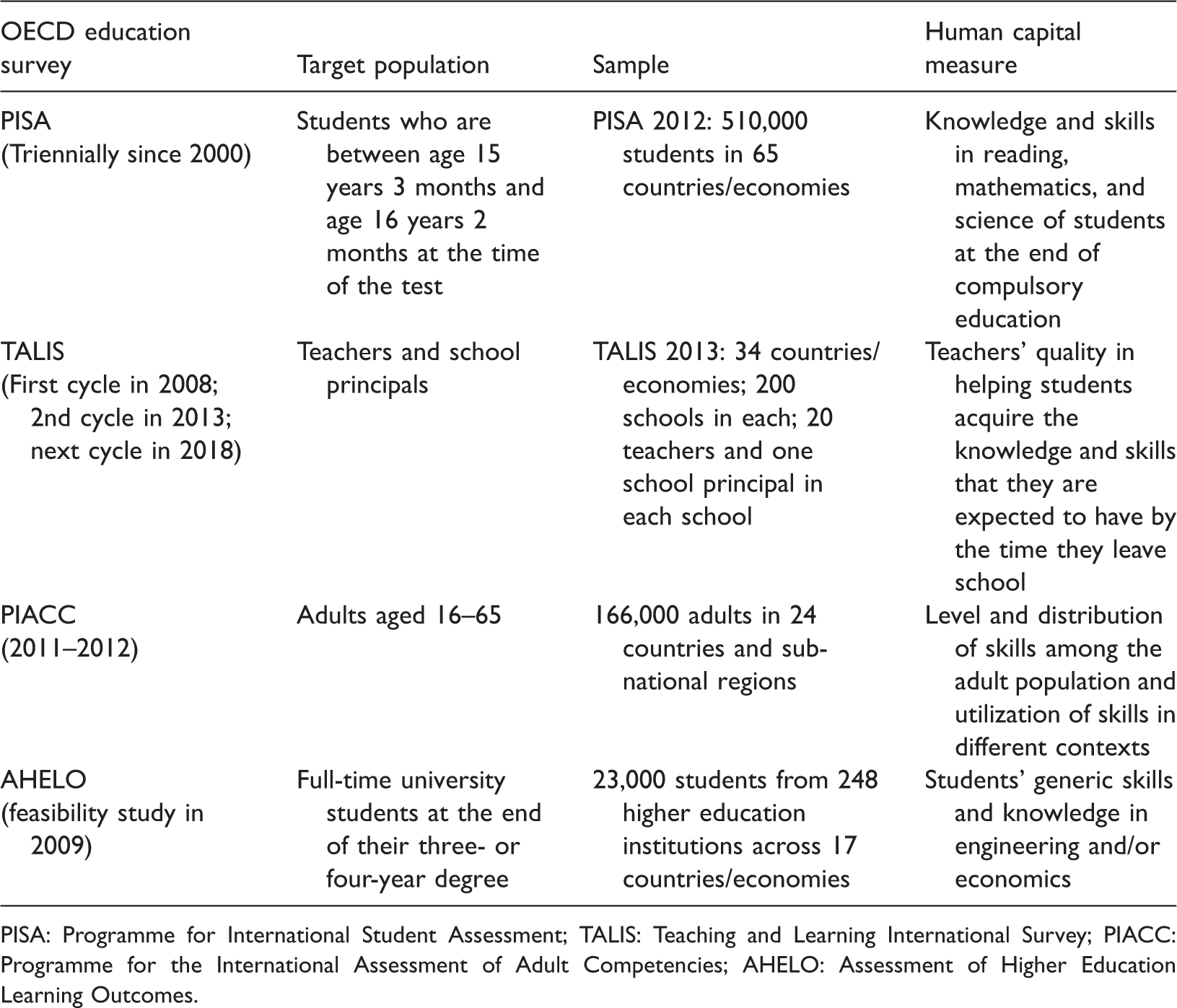
PISA: Programme for International Student Assessment; TALIS: Teaching and Learning International Survey; PIACC: Programme for the International Assessment of Adult Competencies; AHELO: Assessment of Higher Education Learning Outcomes.
Using its skills and knowledge definition of human capital, the OECD builds the rationale for its large-scale surveys and interconnects the results it derives from them to construct its policy discourses and solutions. In effect, we suggest that these education surveys serve as powerful tools for the epistemological governance of education under neoliberalism (Lingard et al., 2016).
The rationale for measuring adult skills and young people's skills
The International Adult Literacy Survey (IALS), which was implemented in 1994, represented the first clear attempt by the OECD to link literacy skills to the concept of human capital formation (Morgan, 2011). Under the IALS, literacy skills were viewed as an “element of human capital” that contributes both to “personal development” and “to aggregate economic and social performance” (OECD and Statistics Canada, 2000: 61). Instead of relying on educational attainment as a measure for human capital formation, workers could be directly assessed for their levels of functional literacy. The idea of measuring knowledge based on literacy skills was adopted by the OECD for another assessment aimed at measuring student knowledge: the PISA. When the PISA was conceived in 1997, its approach for testing students was revolutionary, since its foundation for measuring learning outcomes in reading, science, and mathematics was based on students' life skills and literacy rather than curriculum content. As the OECD likes to promote on its website, “PISA is unique because it develops tests which are not directly linked to the school curriculum” (OECD, n.d.-b). Thus, the IALS and the PISA are conceptually interconnected as measures of human capital; the first targets literacy skills of 16–65-year-olds whereas the latter targets that of 15-year-olds.
The OECD replaced the IALS with the Adult Literacy and Lifeskills Survey (ALL), which was administered first in 2003 and then again between 2006 and 2008. Today, the OECD has reincarnated the IALS as the PIAAC – also known as the Survey of Adult Skills. The PIACC builds on these previous adult literacy surveys by including reading skills in digital environments. The PIACC extends PISA but targets adults aged 16–65. According to the OECD, the PIACC measures “the current state of the skills of individuals and nations in the new information age” (OECD, 2015b). The survey assesses foundational information-processing skills in three key areas: literacy, numeracy, and problem solving. For the OECD, these core skills form the basis for the development of other higher-level skills that are essential for adults in home, school, work, and community settings. The PIACC survey also provides information on various generic skills, such as co-operation, interpersonal communication, and organizing one's time. The initial administration of the survey from 2011 to 2012 included 166,000 adults in 22 OECD countries and the partner countries Russia and Cyprus (OECD, 2013b). The OECD released the PIACC results in 2013.
The OECD notes that governments and stakeholders need to measure their citizen's adult literacy skills “in order to monitor how well prepared they are for the challenges of the modern knowledge-based society” (OECD, 2015b). Similarly, the OECD points out that the PISA “assesses the extent to which 15-year-old students have acquired key knowledge and skills that are essential for full participation in modern societies” (OECD, 2014a: 3). Thus, low scores on adult literacy surveys or on the PISA are associated with skills deficits among adult and student populations. By making connections between its surveys, the OECD reinforces its normative governance over education policy. For example, when the OECD reports on the PISA 2012 results, it emphasizes the importance of developing students' mathematics skills by stating that its adult surveys indicate that “poor mathematics skills severely limit people's access to better-paying and more-rewarding jobs” (OECD, 2014a: 4). It further notes that adults with “strong skills in mathematics are also more likely to volunteer, see themselves as actors in rather than as objects of political processes, and are even more likely to trust others” (OECD, 2014a: 4). The policy recommendations flowing from the OECD's rationale associates young people's mathematics skills levels with improved life chances when they become adults.
In its policy discourses, the OECD's recent publications link improved performance levels in its surveys to economic growth. PISA test scores levels are associated with a specific skills level. The OECD defines ‘Basic Skills’ or “modern functional literacy” as PISA Level 1 skills, which is equal to a score of 420 points (OECD, 2015a: 15). By increasing its score level or skills level, a country can achieve a higher level of economic growth. For example, in its PISA 2012 analysis, the OECD noted that “if all students attained Level 2 proficiency in mathematics the combined economic output of OECD countries would be boosted by around USD 200 trillion” (OECD, 2014a: 9).
The most recent administration of the PISA in 2015 included students from more than 70 countries/economies around the world. Given the scale of the PISA, it is not surprising that it has been referred to as “one of the largest non-experimental research exercises the world has ever seen” (Murphy, 2014: 898). Although other international achievement studies, such as the TIMSS and the Progress in International Reading and Literacy Study (PIRLS), have a longer history than the PISA, they do not attract the same attention globally. The popular media, particularly within Western nations, describe the PISA as the “Olympics of education” (see Alphonso, 2013; Petrelli and Winkler, 2008; Scardino, 2008). The OECD continues to expand its epistemological governance through the PISA. It has introduced new tests such as creative problem solving and financial literacy (introduced in 2012) and collaborative problem solving (introduced in 2015). It has also created the PISA-based Tests for Schools designed to measure individual school performance (OECD, 2012a; Rutkowski, 2014), as well as PISA for Development designed for low- and middle-income countries (Bloem, 2013, 2015).
The rationale for measuring teachers' skills
Angel Gurria, the Secretary General of the OECD, emphasizes that “beyond the influence of parents and other factors outside the school, teachers provide the most important influence on student learning” (OECD, 2014d: 5). From a human capital lens, teachers are important precisely because they prepare students to become life-long learners and provide them with the skills necessary to become active and engaged members of society (OECD, 2014d). Thus, for the OECD, improvements in teaching can lead to better student learning and more effective education systems (OECD, 2014d).
The OECD launched, in 2008, the TALIS (2008). It implemented the TALIS again in 2013. According to the OECD, the TALIS results shed light on a variety of teaching/learning issues, such as the changing demographics of the teaching profession, the types of leadership practices exercised in schools, structural barriers to teachers' professional development, the nature and scope of teacher appraisal systems, and factors associated with positive teacher self-efficacy and job satisfaction (OECD, 2008). TALIS 2013 included a PISA–TALIS link: those countries/economies that participated in PISA 2012 were provided with the option to implement the TALIS in the same schools that participated in the PISA (OECD, 2014d). This means that analysis of TALIS results can be used to link student learning outcomes from the PISA to teachers' characteristics (OECD, 2014c). Teachers' unions have resisted these efforts by the OECD to expand PISA's reach to include assessment of teaching (Lingard et al., 2016).
The rationale for measuring higher education learning outcomes
The OECD recently carried out a feasibility study of the AHELO, which was completed in December 2012, to see if it is practically and scientifically feasible to assess what higher education students know and can do upon graduation. As a human capital metric, the AHELO measures both students' subject matter knowledge as well as their above content skills – their capacity to apply and use their knowledge (OECD, 2012b). The feasibility study included a focus on generic skills, economics, and/or engineering from a sample of 23,000 students nearing the end of their three- or four-year degree. Participants were drawn from 248 higher education institutions across 17 countries/economies [Abu Dhabi, Australia, Belgium (Flanders), Canada (Ontario), Columbia, Egypt, Finland, Italy, Japan, Korea, Kuwait, Mexico, the Netherlands, Norway, Russia, Slovakia, and the USA (CT, MO, PA) OECD, 2016]. According to the OECD, the AHELO takes a similar approach to other assessments like the PISA in that it directly assesses student knowledge and skills. However, the OECD's focus was on institutions rather than comparisons at the national level that occur through the publication of league tables. In the current feasibility stage, participating institutions were provided with anonymized data to facilitate benchmarking against their peers.
Some of the key findings from the feasibility study were shared at an OECD conference in March 2013 titled “Measuring learning outcomes in Higher Education: Lessons learnt from the AHELO Feasibility Study and next steps.” Findings were also summarized in the third and final “AHELO Feasibility Study Report – Volume 3” (OECD, 2013c) that included proceedings from the March 2013 conference in Paris. Overall, one of the main conclusions of the OECD was that the “AHELO feasibility study demonstrated that it is feasible to develop instruments with reliable and valid results across different countries, languages, cultures and institutional settings” (OECD, 2012c: 31). In its reports, the OECD has indicated that member countries will decide whether they want to delve deeper into particular subjects (generic skills, economics, and/or engineering) and/or take steps towards conducting a full-scale AHELO. The OECD envisions that the AHELO will become a regular assessment (Morgan and Shahjahan, 2014). For the time being, however, the AHELO has been put on hold due to other members' priorities (Shahjahan et al., 2014).
In summary, the OECD asserts that its international education surveys should play an important role in the development and ongoing revision of national education policies. For example, it notes that the PISA survey allows educational jurisdictions to evaluate education systems worldwide and provides valuable information to participating countries/economies so they are able to “set policy targets against measurable goals achieved by other education systems, and learn from policies and practices applied elsewhere” (OECD, 2014b: 2). Similarly, the TALIS “sheds light on which [teaching] practices and policies can spur more effective teaching and learning environments (OECD, 2013a: 3). The OECD claims that TALIS results enable countries to see more clearly where imbalances might lie and also help teachers, schools, and policymakers learn from these practices at their own level and at other educational levels as well. The PIAAC survey assists governments in assessing, monitoring, and analyzing the level and distribution of skills among their adult populations, as well as the utilization of skills in different contexts (OECD, 2013b). The tools that accompany the PIAAC survey are designed to support countries/economies as they develop, implement, and evaluate the development of skills and the optimal use of existing skills (OECD, 2013b). Lastly, the AHELO offers participating institutions the opportunity to identify the main challenges, achievements, and lessons associated with the examination of higher education learning outcomes and juxtapose their results against their peers. The OECD draws on these measures of human capital to offer policymakers and analysts a one-stop location called Education GPS, branded as “the world of education at your fingertips,” which provides users with a sophisticated visual mapping of education policies (see http://gpseducation.oecd.org/). In combination, nation-states can utilize these education surveys and the OECD's online tools to manage their educational systems at a distance. However, as we shall discuss in the next section, there are important debates surrounding the use of these surveys as education policy levers.
Policy debates
Despite the OECD's efforts to legitimize the use of its international education surveys through the human capital paradigm, the use of these surveys to inform education policy and reforms remains a contested terrain. Policymakers and educators assume that these surveys provide a reliable proxy for a nation's stock of human capital (Morris, 2015), yet issues arise in the use of these surveys as policy levers by national governments. We focus on three areas that are particularly divisive: student testing, education system improvements, and the politics of educational reform. In each of these areas, there is a clear division among proponents and detractors of these surveys. For example, test scores, according to critics, are not a good measure of economic potential, and as such, PISA envy (The Economist, 2013) is an unnecessary distraction and misguided preoccupation (Bracey, 2009). Similarly, many of the education policies and associated reforms promoted by the OECD are generally viewed as contributing to system homogenization rather than system improvement across levels of education. Lastly, some critics argue that international education surveys are instruments that promote broader neoliberal political objectives, which erode teachers' professional autonomy and reduce or skew investments in public and higher education. An understanding of the debates surrounding the contested terrains of student testing, educational system improvement, and politics of educational reform is particularly important when contemplating the potential opportunities and constraints that may be associated with the OECD's international education surveys.
Student testing divide
The OECD argues, quite persuasively, that the Key Competencies (KCs) measured by the PISA, and more recently the PIACC, form the foundation for success in education and future economic and social outcomes. Students who score poorly in the areas of reading, mathematics, and science are less likely to attend post-secondary schools and more likely to secure lower-level employment. The OECD's epistemological framework combines results from the PIACC with longitudinal studies in a number of countries in order to confirm claims that the skills the PISA measures lead to educational success as well as labor market success (OECD, 2009).
Thus, it is not surprising that the human capital discourses that underpin the PISA are being adopted by supranational organizations such as the European Union and are increasingly being integrated into national and sub-national curricular policies of advanced industrial nations with the aim to improve human capital (Engel and Frizell, 2015; Grek, 2009; Takayama, 2013). There is also evidence that governments have modified their national assessment systems in an effort to mimic PISA-like competencies (see Meyer and Benavot, 2013; Morgan, 2016; Niemann, 2009).
Critics counter by noting that international testing programs such as the PISA do not celebrate differences – they are more likely to produce convergence in terms of what is seen to be valuable in educational terms (Benavot, 2013; Berliner, 2015; Kamens, 2013; Uljens, 2007). The excessive focus on reading, mathematics, and science takes attention away from the less measurable or immeasurable educational objectives such as physical, moral, civic, and artistic development, thereby dangerously narrowing our collective view regarding the purpose of education (Andrews et al., 2014; Meyer et al., 2014b). There are also growing concerns that the OECD efforts to link PISA results with TALIS findings will result in the promotion of a prescribed set of teaching and leadership practices within schools based on skewed data. The latter concern seems well founded, since the TALIS is essentially an aggregation of subjective self-report data and corresponding reports allow for observations of correlations between variables, not causal relationships (Burns and Darling-Hammond, 2014). Overall, the general sentiment is that the relationships uncovered by international education surveys and the implications often extrapolated by national policymakers far outstretch the test or surveys' predictive abilities.
Literacy theorists and researchers critique IALSs such as the PIACC for their decontextualized and reductionist approaches (see Hamilton, 2012; Hamilton and Barton, 2000; Hunter, 2012). They argue that these test forms are partial and cannot capture the complexity of workplace learning and literacies that take place among adult workers. Tests such as the PIACC focus on test takers' experience with test documents rather than their literacy competence. Critics find it problematic that the PIACC approach to measuring literacy is mimicked in national literacy initiatives, since it discounts the rich and creative literacy practices among workers that researchers have documented and on which workplace literacy programs can be built.
Although international surveys such as the PISA and the PIACC provide an important reference point to evaluate success in KCs, they are insufficient measures of education and training system performance. Few measurement experts would suggest that any international education survey, no matter how reliable and valid the data, could possibly measure the cumulative impact of education on human capital or cultural development. There are certainly examples of individuals who go on to lead very productive and affluent lives whose strengths in school lie outside the areas most commonly tested in international education surveys. Furthermore, the narrowing of the curriculum that is commonly associated with large-scale testing has a tendency to emphasize basic, rather than critical thinking skills (Berliner, 2011; Griffin et al., 2012). Psychologists also note that tests such as the PISA narrowly focus on cognitive skills and do not adequately measure non-cognitive skills, which contribute to student success at school and improve life outcomes (Kautz et al., 2014). Unfortunately, the league tables that often accompany the public release of international benchmark data are susceptible to misuse by politicians who seek to intensify national testing in core subject areas and justify contentious policies that conveniently fit their predetermined educational reforms (Bank, 2013; Takayama, 2008).
Education system improvement divide
As previously noted, the OECD does not tell participating countries/economies how to run their education systems. It contends that its policy briefs and other research publications provide governments with important starting points when deliberating system improvements and reforms. For example, the OECD states that “PISA offers policy makers and educators a way to identify the world's most effective education policies that they can then adapt to their local contexts” (OECD, 2013d: 2). Similarly, the TALIS is “useful for policy makers, principals, and teachers themselves, and many implications for policy and practice can be extrapolated from the findings” (OECD, 2013a: 27). Lastly, the PIAAC “assesses the performance of education and training systems, workplace practices and social policies … [to help] identify policy levers to reduce deficiencies in key competencies” (OECD, 2013b: 25). The preceding points suggest that according to the OECD, it ultimately charges national governments with the important task of policy translation and adaption.
The counter-argument suggests that the growing influence of the OECD in education policy may be more direct and pronounced, operating as a global “soft power.” Although the OECD recommendations and suggestions are non-binding for member states, the instruments and tools they utilize for transmitting policies and expert advice amount to a soft mode of regulation that act as a mechanism of transnational regulation and governance (Morgan and Shahjahan, 2014; Bieber and Martens, 2011; Mahon and McBride, 2008; Niemann, 2009; Pereyra et al., 2011). A number of critics further assert that national governments are often compelled to adopt policies that impoverish the diversity of innovative approaches to education – essentially promoting system homogeneity. Furthermore, the rapid progress that some countries have demonstrated in rankings is a direct result of a narrow focus on education outcomes and educational uniformity (Corbett, 2008; Goldstein, 2014; Meyer et al., 2014a). It should be noted that while the general global trend underscores the expanding influence of the OECD on education systems, there are a wide range of policy responses to international education surveys such as the PISA from highly reactive to very modest or in some cases negligible (see Volante, 2015; Baird et al., 2011; Breakspear, 2012; Pons, 2012). For example, in England, the tendency is to use international student assessment results to implement quick fixes in the educational system, whereas in Finland, these results are integrated into a lengthy and deliberative educational reform process (Chung, 2015). Such evidence points to important cross-cultural differences on the impact of the OECD's educational research and policy activities on national education systems.
Politics of educational reform divide
The underlying political motivation for the emergence and promotion of international education surveys by the OECD is highly contested by various stakeholders, particularly those in academia. As previously suggested, the OECD contends that international education surveys play a key role in assessing skills since they have become the global currency of the 21st century. The built-in assumption is that their international education surveys measure “the right skills” and governments would be wise to adopt policies and reforms that align with their published findings to optimize their human capital. Not surprisingly, the OECD avoids connecting any of their policy suggestions with a direct reference to a political orientation. Indeed, a search of the term “neo-liberal” on their skills website yields no matches (as of 5 October 2015). The overarching message is that international surveys benefit all countries/economies regardless of any particular government's political platform. However, as Bloem (2013, 2015) points out, the performance of countries/economies on the PISA varies widely, particularly when their social and economic development are taken into consideration. Not all countries/economies have the technical capacity and training to integrate the results from these surveys to inform their education reforms. More significantly, for low-income countries, these surveys are quite expensive, diverting valuable financial resources from their education budget (Bloem, 2015).
A significant number of academics are not convinced that the OECD activities in education are politically neutral. The general sentiment among critics is that international education surveys administered by the OECD are motivated by an overarching desire to promote neoliberal policies that facilitate privatization and reduced government spending in education (Meyer and Benavot, 2013; Takayama, 2013; Uljens, 2007). Robertson (2012) argues that neoliberalism is the dominant hegemonic project in many parts of the world where the discourse in education policies is tied to ideas such as the “global knowledge economy” and the framing of education problems and their desirable solutions include privatization, decentralization, and quality control. More importantly, she argues that “non-state” actors such as the OECD seek to mobilize social networks so that they can advance projects of education governance and rule via international education surveys such as the PISA and the TALIS. Overall, she considers these types of projects “scopic systems” in global education policymaking that simplify the complexity and diversity of education systems so that “one-size fits all” neoliberal policy solutions can be promoted in both member and non-member states. Overall, the political divide would appear to be the most difficult to reconcile, since it underscores the growing tensions that exist between economic and education policies as well as the human capital discourses that appear to be gaining traction and momentum as a starting point for the deliberation of large-scale educational reform.
Conclusion
The preceding discussion highlighted the inevitable tensions that exist between the research and policy activities of international organizations such as the OECD and national governments in the area of education policy. Although we do not base our analysis on any substantial empirical work, we would like to put forth some concluding remarks. Our review of international educational surveys analyzed specific areas that remain contested in the education sphere – namely, testing, system improvement, and political motivation. Undergirding each of these divides is the recognition that schools and higher education sectors fulfill a variety of roles related to economic, social, and cultural well-being.
Even though our focus has been on the OECD's role in governing education, we would like to bring the state back into our discussion since nation-states are ultimately responsible for enacting educational policies at the national scale. What we find particularly problematic is that the OECD's education surveys and their corresponding human capital discourses do not reflect the reality of governments' multiple and changing roles. For example, governments face multiple and competing roles such as developing an educated citizenship through a holistic approach that is attentive to intellectual, social, physical, civic, and cultural development while also positioning themselves to compete in the global economy. Although human capital rationales seem to dominate the overarching purposes of the OECD international education surveys, it is clear that schools are responsible for other important functions that fall outside of economic growth and prosperity. Indeed, the dominant neoliberal paradigm is oriented towards market-oriented economic growth and the erosion of the public sphere. Such a paradigm does not value the significant role that public schools play in building socially cohesive and equitable societies.
A human capital discourse is attractive to policymakers as it provides a simple solution to a country's economic prosperity: invest in your people's education and you will be rewarded with higher economic returns. Yet the human capital framework ignores the political economic realities of our times, which include underemployment and unemployment, slow economic growth, growing income inequalities, and stagnant wages for middle-class and low-wage workers (International Labour Organization, 2016; International Monetary Fund, 2016; Mishel et al., 2016). Education cannot solve the structural problems that exist in our economy but it can support the construction of an alternative future. The potential for change can be generated when our education policies are informed by a critical understanding of our present political economy and a vision for building a sustainable and equitable economic future centered on societal well-being.
Footnotes
Declaration of conflicting interests
The author(s) declared no potential conflicts of interest with respect to the research, authorship, and/or publication of this article.
Funding
The author(s) received no financial support for the research, authorship, and/or publication of this article.