




Abstract
This article reports on an investigation into the relationship between people’s perspectives and ideologies and interest groups with their respective conceptions and perceptions of higher education. The aim is to show that the contemporary understanding of purposes and quality in higher education originate, fundamentally, in the most important ideological dichotomy of our age: left versus right. By summarizing literature and documentary analyses, the author seeks primarily to demonstrate the ideological roots of two current conceptions of higher education: as a public good, and as a commercial service. It is argued that such conceptions connect two main quality views about higher education: one emphasizes the social aspect, and the other focuses on the economic aspect. Finally, the ‘middle way’ is proposed as a desirable alternative to these views.
Introduction
The specialized literature presents evidence that quality in higher education may be interpreted diversely at different times and in different places, because it depends on factors related to people’s values, beliefs and traditions as well as interest groups. In 1992, Ronald Barnett argued that the values and ideologies of different interest groups are important to the understanding of quality in higher education. He also asserted that it is impossible to form consistent opinions on quality without a reasonable conception of higher education itself. Lee Harvey and Diana Green (1993) claimed that the perception of quality varies as each interest group’s expectations of the purpose of higher education changes. Together, Barnett’s and Harvey and Green’s assertions establish an association between ideology, conception and purpose and the understanding of quality in higher education. More recently, Ourania Filippakou (2011) reinforced the ideological nature of the idea of quality in higher education. Thus, at present, the claim that the concept of quality in higher education is subjective and depends on worldviews and people’s ideologies and interest groups is considered to be true. 1
Despite the ideological ambiguity and multiple interpretations (Thompson, 2013) since the 18th century and the French Revolution, the political spectrum of Western democracies has been marked by a left–right dichotomy. Throughout this 200-year period, people, groups, political parties and governments have been classified on the basis of this differentiation, which has clearly become the main ideological dichotomy. According to Antonio Gramsci (1975), ideologies constitute the entirety of social consciousness, and they translate an objective reality that operates on life and on its concreteness when that reality applies to terrain where humans acquire consciousness about fundamental conflicts and social relations. Worldviews and ideological disputes therefore do not solely influence politics; they also affect opinions and positions on other aspects of human life and on more general societal questions about conflicts (e.g., economy, religion and education). In this sense, Ronald Barnett argued that the ‘…debate over quality in higher education should be seen for what it is: a power struggle where the use of terms reflects a jockeying for position in the attempt to impose definitions of higher education’ (Barnett, 1992: 6).
In this article, I attempt to clarify which current proposed understandings in higher education can be classified by the most important ideological dichotomy of our age: left and right. By summarizing the literature and using documentary analysis, I seek primarily to demonstrate the ideological roots of two current conceptions of higher education: as a public good and as a commercial service. I argue that these ideologies and conceptions unite two generally contradictory views of higher education’s purpose and, subsequently, different perceptions of quality in higher education: quality with a social emphasis and quality with an economic emphasis. Finally, I offer the ‘middle way’ as the most adequate and desirable in our contemporary context of important socio-economic and environmental challenges in worldwide standards. 2
The contemporary ideological dichotomy
Following the theoretical construction of Rousseau, Hobbes and Locke’s social contract during the Enlightenment, and the consolidation of modernity, nation states and economic and public reason liberalism, Western democracies have experienced constant political and economic debates between two main worldviews: left and right. In terms of social policies and economic systems, left and right are nearly always on opposite sides; for example, leftist parties support wider state intervention by implementing universalist social policies, whereas rightist parties have defended the free market and minimal state intervention.
Sometimes said to be moribund and old-fashioned (Fukuyama, 2006), the left–right dichotomy remains impressive for its resilience and its ability to continue as the foundation of the political spectrum. Even after the failure of socialism, the fall of the Berlin Wall and the collapse of the Soviet Bloc, such duality continues to make sense for sociologists and political scientists who turn to such categorizations to support their studies and research – an important example of which is the ‘third way’ theorization as an alternative to social democracy and neoliberalism models (Giddens, 1994) – and to voters who are given the opportunity to take a stand on the ideological axis. Apart from simplifying positioning and inhabiting people's imaginations for more than two centuries, the left and right are constantly described as terms that are difficult to define (Hastings, 2011).
Left and right ideas began in pre-revolutionary France, when the Estates-General (Les États-Généraux) became the National Constituent Assembly in 1789. The groups that sat to the right of the president’s seat (i.e., the nobility and the clergy) supported the conservative ideas, and those who sat to the left (i.e., the bourgeoisie) wanted change (Gauchet, 1992). Since then, the left–right dichotomy has spread and been consolidated across the globe. In almost every country, left and right parties started to appear, together with possible variations (e.g., centrism, center-right, center-left and radicalism) on both wings (Rosas, 2013). In the early 19th century, specifically in Europe, every right-wing party was conservative and supported the maintenance of a hierarchical society – inherited from the Ancien Régime – and every left-wing party was liberal, pushing for changes (e.g., potential private property rights, business ownership and social ascendance). By the mid-19th century, as a result of the emergence of socialist ideas that supported state intervention to solve social problems and the plight of the working class, leftist parties started to be associated with socialism. The right wing, in turn, continued to be the primary ally of traditional politics and started supporting private property against the socialist left’s redistributive offensive (Rosas, 2013). 3
Thus, the left–right dichotomy can be distinguished by associating the right wing with capitalism (i.e., private property and control over means of production) and the left-wing with socialism (i.e., state ownership of means of production). However, at present this distinction is clearly insufficient when there are leftist-related groups and views in countries where no market economy is asserted, where they do not aspire to ‘revolutionary’ change in the economic system (e.g., the end of property ownership as the means of production). For example, the Labour party in the United Kingdom, as well as almost every social democratic party in many countries, is generally classified as a left-wing party even though it operates within a capitalist nation.
Seeking to establish a substantive criterion that unifies the diverse definitions of left and right and that allows us to distinguish between them beyond cognitive and symbolical aspects, Norberto Bobbio (1996) uses theoretical work to assert that what differentiates this dichotomy is the attitude towards equality. 4 The left tends to be supportive of the ideal of equality: the right is generally critical of it. Nonetheless, I would claim that this ideal does not necessarily mean equality for everyone and everything. Steven Lukes (2003) is another author who proposes an analytical category to distinguish between left and right. He suggests adopting a distinctive criterion between the dichotomy and what he calls the ‘rectification principle’. Leftist parties would support this principle; and rightist parties would oppose it. The left wing would have its roots in questioning a social order based on unjustified inequality and an unregulated economic order that creates inequality. However, the right wing fears the counterproductive effects that rectifying activism would have on economic liberalism and the preservation of social maintenance that is meaningful to social life. According to Lukes (2003), leftist language varies a lot in embodying different terms, such as citizenship, justice, democracy and the fight against oppression and exploitation. Thus the left may be both reformist and revolutionary, based on parties or movements, states or labor unions, but it is essentially never willing to accept unjustified inequalities.
Positions and representations of the left–right dichotomy.
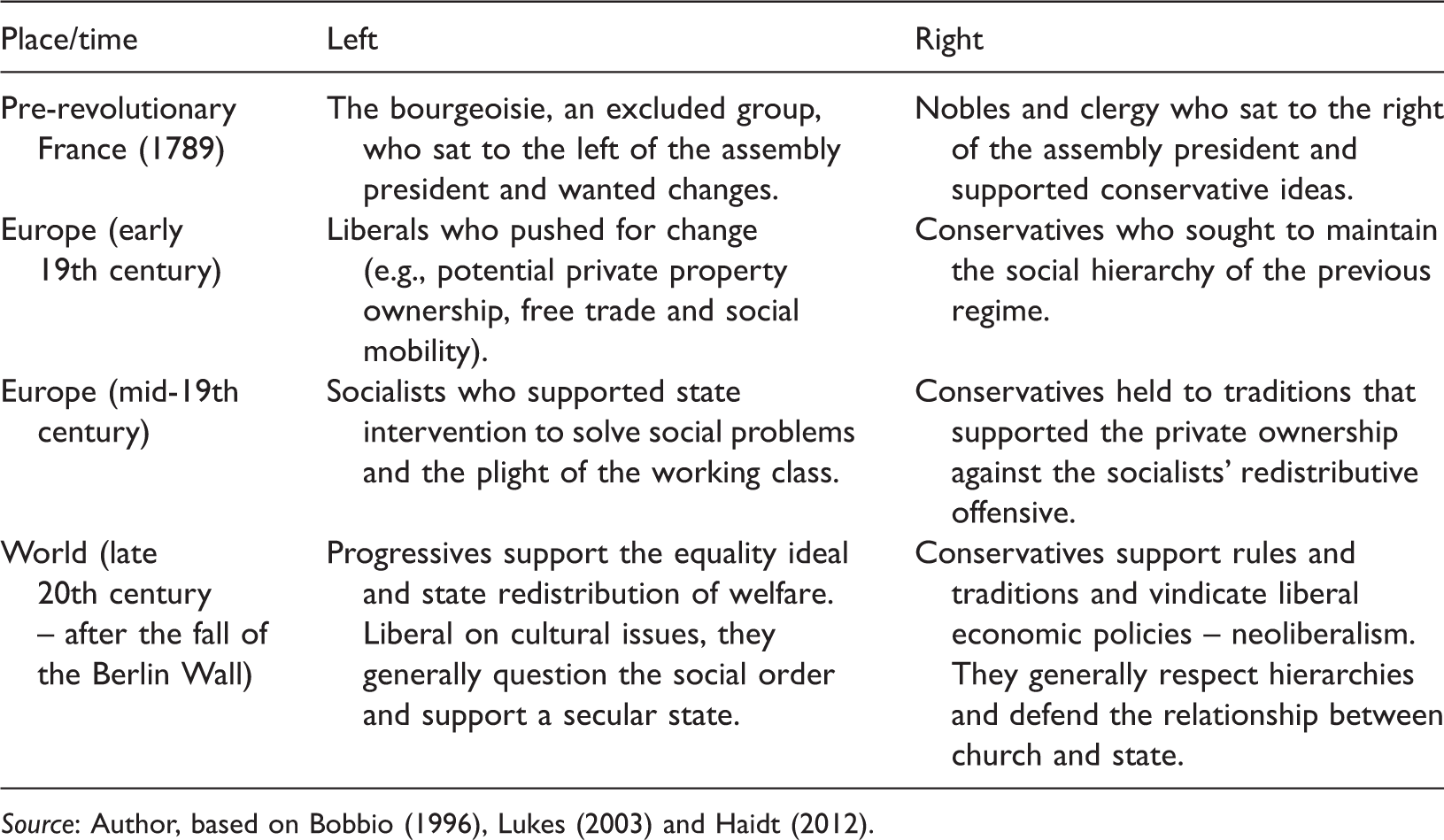
Source: Author, based on Bobbio (1996), Lukes (2003) and Haidt (2012).
Thus, although it is difficult to define and has experienced semantic shifts from the Enlightenment to the present day, the left–right dualism identifies preferences on social and economic policies. In other words, given the complexity of contemporary society, the left–right dichotomy is the cognitive, symbolic and analytical border of people’s worldviews and ideological positions. Despite questions of its continuance into the 21st century, this dichotomy continues to be – and certainly will for quite some time – an important element of common sense political identification and a relevant analytical category in academic research on politics and economy.
However, worldviews and ideologies do not solely influence the political and economic positions of people and groups; they also guide opinions on other aspects of human life and offer more general societal questions, such as culture, religion and education. For example, the ideological influence is meaningful in debates on the breadth of the oldest Western institution: the church. Being favorable to a link between church and state is clearly a right-wing association. Older than modernity itself, the university is also influenced by this current dichotomy.
From ideologies to higher education conceptions
According to Simon Marginson (2007), groups that support more state-interfering models and groups that prefer neoliberal models (i.e., worldviews whose roots are in the left–right dichotomy) have also influenced important transformations in higher education over the past two decades (Escrigas and Lobera, 2009; UNESCO, 2009). One of the main debates in 2009 during the World Conference on Higher Education in Paris emphasized education as either a social good or as a commercial service (Segrera, 2012). According to Philip Altbach the logic of this debate is as follows: if higher education is a commercial service (i.e., a business), those who use it must pay for it (Altbach, 2009). However, if higher education is a public good then society, through the State, must support it. According to this assertion, if higher education is understood as a commercial service, market logic should inform its ‘centers’: the institutions, courses, funding, system regulations and university management models.
In general, until the late 20th century, higher education as a public good was not on the agenda because financing policies had long been based on the European tradition, which entrusted education to the state. However, in the 1980s, with the erosion of the welfare state and the emergence of neoliberalism, the debate about the nature of higher education’s private goods began to gain force. Some prominent multilateral organizations, such as the World Bank, the OECD (Organisation for Economic Co-operation and Development), the IMF (International Monetary Fund) and the WTO (World Trade Organization), although using distinct political vocabularies, began frequently promoting potential reformations and supporting public education privatization programs (Ball and Youdell, 2009). In 1986 the World Bank supported the idea that investments in basic education provide better social and individual exchange than investments in higher education. Since then, many countries have started performing contingencies on state investments to diversify academic organizations and resources (e.g., the end of free public education and wider tuition collection) and thus support the expansion of private institutions in higher education (i.e., developing policies based on market logic for higher education). In its report, ‘The financing and management of higher education – a status report on worldwide reforms’, the World Bank (1998) claimed that higher education was first a private good rather than a public good. According to this assertion, many conditions that Nicholas Barr identified for private-good institutions were fulfilled: higher education has competitive conditions (i.e., limited offerings), exclusivity (i.e., via tuition requirements) and refusal (i.e., not everyone seeks it). In Doha in 2001, the WTO led the Global Agreement on Trade in Services (GATS) and promoted opening national systems to foreign providers (WTO, 2001). 5 In other words, the WTO sought to widen higher education competition worldwide.
Over the past two decades, many governments have started to use the market as a mechanism and tool for public regulation (Dill et al., 2004). Because many systems once had a consolidated state matrix, national systems began endowing hybrid regulation methods with state and market components and establishing quasi-market conditions (Teixeira et al., 2004). Generally speaking, the arguments and justifications for the commercialization of higher education are related to the liberal tenets that the competition created by the market would lead to higher productivity and efficiency of the systems, with consequent improvement in the quality and equity of the provision of educational services by the institutions. In addition, arguments of a fiscal nature have also been used with regard to the destination of the limited state budgets, since higher education would not stand as a strong competitor against more pressing social needs, such as health and social security services.
Concurrently, the traditional model of collegiate ruling institutions was criticized because of reported inefficiency and corporatism. The European Commission and multilateral organizations (e.g., the OECD and the World Bank) supported changes to business-like models in universities. Managers nominated on the basis of executive experience began replacing collegiate-elected managers to serve as the heads of many universities, because there were those who claimed that these institutions should be more flexible and autonomous to answer to organizational changes.
According to Geoff Whitty and Sally Power, in the late 20th century education started being ‘… defined more like a private good than a public issue, turning educational decision making into a matter of choosing by consumers rather than citizens’ rights’ (Whitty and Power, 2002: 17). At present, there is seemingly ubiquitous evidence that higher education has become more of a commercial service and less of a public good. According to Alberto Amaral, The changes taking place are not only structural adjustments. There are changes of ideology and of values, and significant changes in the relationship between higher education institutions and the state and society. Education is today considered more as an indispensable ingredient for economic competition and less as a social right, and it is becoming progressively a service. (Amaral, 2009: 3) The reform agenda of the 90s, and almost certainly extending well into the next century, is oriented to the market rather than to public ownership or to governmental planning and regulation. Underlying the market orientation of tertiary education is the ascendance, almost worldwide, of market capitalism and the principles of neo-liberal economics. (World Bank, 1998: 3)
However, there has been resistance to the emergence of this neoliberal conception of higher education. In addition to academic papers that have warned about the risks of commodification (Amaral, 2009; Ball and Youdell, 2009; de Sousa Santos, 2004; Olssen and Peters, 2005; Whitty and Power, 2002), some multilateral organizations have also criticized the commercial conception of higher education. There has been plenty of academic research published – for example, the recent article by Stephen J Ball (2012) – that revisits the academic subject of the welfare state and analyzes critically the neoliberal reformation of educational environments. In their book Neoliberalism, Higher Education and the Knowledge Economy: From the Free Market to Knowledge Capitalism, Mark Olssen and Michael A Peters issued this warning: The ascendancy of Neoliberalism and the associated discourses of ‘new public management’, during the 1980s and 1990s has produced a fundamental shift in the way universities and other institutions of higher education have defined and justified their institutional existence. The traditional professional culture of open intellectual enquiry and debate has been replaced with a institutional stress on performativity, as evidenced by the emergence of an emphasis on measured outputs: on strategic planning, performance indicators, quality assurance measures and academic audits. (Olssen and Peters, 2005: 313) Knowledge cannot be considered an ordinary saleable commodity. The current trend towards the privatization of higher education systems and their internationalization deserves attention from policy-makers and should be examined in the framework of the public debate on the national, regional and international levels. Knowledge is common good. The issue of its commoditization therefore should be very seriously examined. (UNESCO, 2005: 23) Higher education and research sector is witnessing a series of attacks which are threatening the principles of academic freedom and collegiality. The global trends towards commercialization and commodification threaten to compromise quality and equity. These trends must be reversed. (EI, 2013) As a public good and a strategic imperative for all levels of education and as the basis for research, innovation and creativity, higher education must be a matter of responsibility and economic support of all governments. As emphasized in the Universal Declaration of Human Rights, ‘higher education shall be equally accessible to all on the basis of merit’. (UNESCO, 2010: 1) Characteristics and ideological orientations of conceptions of higher education as a public good or commercial service. Source: Author, based on Altbach (2009), Amaral (2009) and Ball (2012).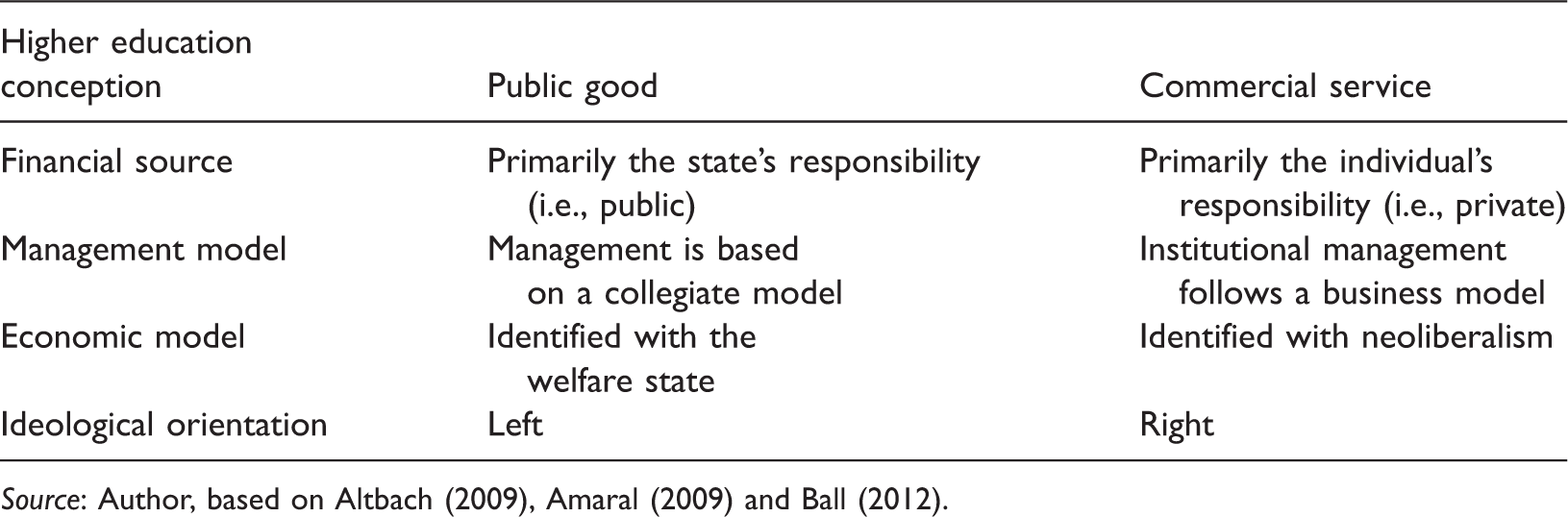
According to Julio Bertolin (2007), these recent transformations have led to a process in which the development of means and the purposes of higher education, in the public and private spheres, suffers a reorientation according to the principles and market logic by which higher education gradually and progressively loses its status as a public good and assumes its place as a commercial service. Bertolin states that the means, mission, purposes and, consequently, even the perception of quality have recently gone through market adjustments.
From the conceptions to the purposes of higher education
As asserted by Stephen J Ball and Deborah Youdell the transformation tendencies of higher education privatizations are clearly moving toward an understanding of higher education as a commercial service, serving the interests of entrepreneurs and the economy, and away from the idea of higher education as a public good that is useful to society (Ball and Youdell, 2009). As a result, to those who understand it as a public good, the objectives and purposes of higher education are essentially oriented to a humanistic formation – toward social challenges and common interests. However, to those who conceive it as a commercial service, the objectives and purposes of higher education are focused mainly on professional formation, the market, economic growth and private interests.
These different views about the objectives and purposes of higher education are to be seen, in important UN documents, originating from multilateral organizations (e.g., UNESCO and the World Bank). The final communication at the International Conference on Higher Education in 2009, The New Dynamics of Higher Education and Research for Societal Change and Development, stresses the relevance of higher education for social purposes: The past decade provides evidence that higher education and research contribute to the eradication of poverty, to sustainable development and to progress towards reaching the internationally agreed upon development goals, which include the Millennium Development Goals (MDGs) and Education for All (EFA). The global education agenda should reflect these realities. (UNESCO, 2010: 1) […] higher education should aim at the creation of a new society - non-violent and non-exploitative - consisting of highly cultivated, motivated and integrated individuals, inspired by love for humanity and guided by wisdom. (UNESCO, 1998: 24) Tertiary education institutions have a critical role in supporting knowledge-driven economic growth strategies and the construction of democratic, socially cohesive societies. Tertiary education assists the improvement of the institutional regime through the training of competent and responsible professionals needed for sound macroeconomic and public sector management. Its academic and research activities provide crucial support for the national innovation system. (World Bank, 2002: 23)
For example, in Not for Profit: Why Democracy Needs the Humanities, Martha C Nussbaum highlights the existence of a silent crisis (Nussbaum, 2012). She claims that because of national ambitions for wealth governments educate primarily to foster economic prosperity. Nussbaum notes the importance of humanistic formation, deconstructs the idea of education as a tool for economic growth and presents an education model for ‘human development’ (Nussbaum, 2012). Similarly, when broaching the crisis of the humanities and the major challenge of adapting institutions for the future, Andrew Delbanco (2013) recalls that one should not lose sight of the primary purpose of education, as formulated by Benjamin Franklin: the search for ‘true merit’, which consists of an ‘inclination joined with an ability to serve mankind, one’s country, friends, and family; which ability is…to be acquired or greatly increased by true learning; and should, indeed, be the great aim and end of all learning’. Delbanco believes that each generation must renew this aspiration. Quoting Louis Brandeis, Derek Bok (2013), in turn, warns that governments are the real ‘potent and ubiquitous’ teachers; if governments treat education solely as an intermediary to generate jobs and money, young people will most likely do the same. Bok concludes by mentioning relevant humanistic aspects for the purpose of higher education: Money helps, but so do other things, such as close human relationships, acts of kindness, absorbing interests, and the chance to live in a free, ethical, and well-governed democratic society. A stagnant economy and lack of opportunity are undoubtedly problems, but so are low voting rates, civic apathy, widespread disregard for ethical standards, and indifference to art, music, literature, and ideas. (Bok, 2013)
Different visions of the purposes of higher education are present not only in the documents of multilateral organizations or in academic works: the opinions and uncertainties of students also reflect this dichotomy. In 2012, a survey sampled nearly 200,000 first-year students at American colleges and identified two different perceptions about the purposes of higher education, with greater emphasis on economic issues and those that would grant material progress. From an economic perspective, 88% responded that ‘to get a better job’ was an important reason for taking college courses, and 81% indicated that being ‘financially well[-off]’ was an ‘essential’ or ‘very important’ objective. However, from a more humanistic perspective, 82% indicated that an important reason to attend college was to ‘learn more about things that interest me’, and 46% considered developing ‘a meaningful philosophy of life’ as either ‘essential’ or ‘very important’ (Pryor et al., 2012). However, between 1966 and 2010 the completion rate for a bachelor’s degree in the humanities decreased by half in the United States, falling from 14% to 7% of all degrees awarded (Simpson and Kelly, 2013).
Quality perceptions in higher education with its interrelated ideologies, conceptions and purposes.
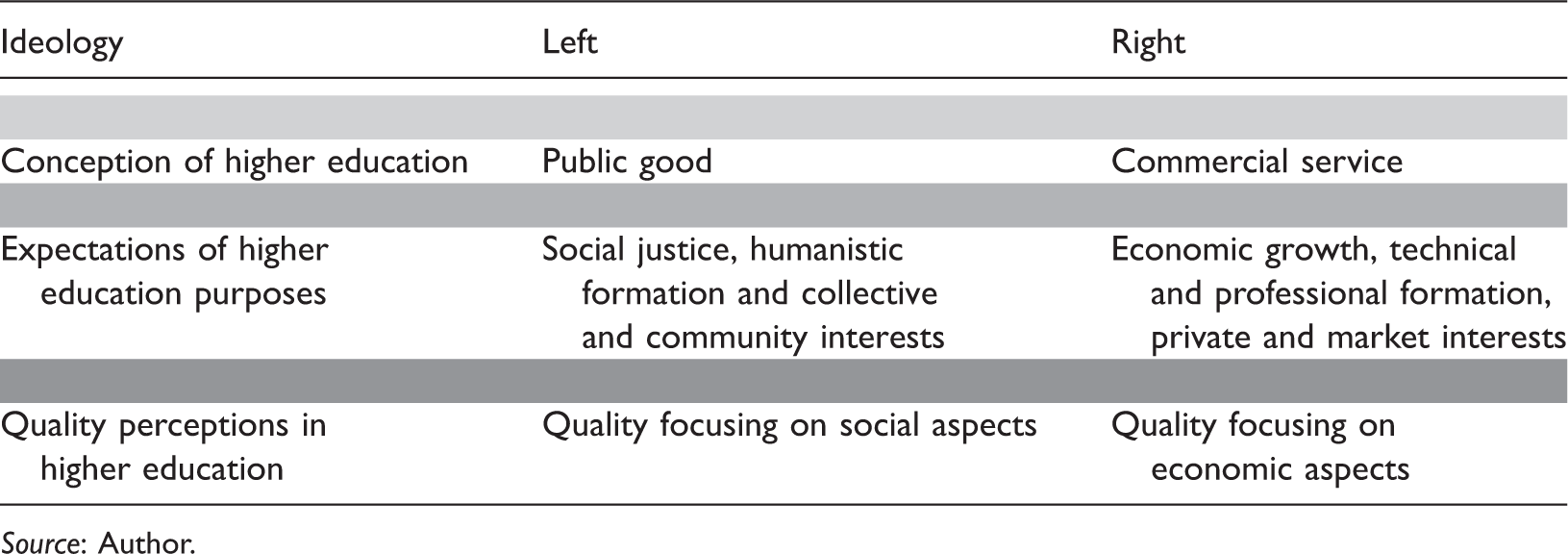
Source: Author.
In summary, the literature and documents that have been analyzed show that opinions about the aims and purposes of higher education vary, but also reveal two trends of quality perceptions. For some interest groups, quality institutions and courses primarily form and produce knowledge for social development; for other interest groups, quality institutions and courses primarily form and produce knowledge for economic growth. However, as shown earlier, the economic perspective has recently been gaining even more ground. Thus, from these findings, some questions come to mind.
In the current context, would it be appropriate to favor the economic purposes of higher education? Would it be appropriate instead to prioritize social and humanistic purposes? Do limited prospects help answer broader issues facing society all over the world?
The ‘middle way’ between social and economic aspects
To answer such questions, it is important to emphasize that higher education, while the preeminent locus of high-level training and knowledge production, must not respond solely to external demands, irrespective of their social or economic characteristics. Institutions, especially universities, are international links to science, culture and the frontiers of thought, especially in the context of crises and challenges in complex, plural and multicultural societies. The world currently faces a real emergency, characterized by a set of serious interrelated problems (Escrigas and Lobera, 2009). Higher education must therefore be a protagonist, a source of transformative and innovative ideas, for all varieties of human activities and knowledge outlines.
Studies and research that focus primarily on market interests will not contribute adequately to overcoming the main contemporary human conflicts, such as human coexistence, the crisis of representative democracy and the relationship between humans and the natural environment. The market is an important tool for organizing a productive economy, but it is not ‘almighty’ enough to regulate appropriately all spaces, such as the justice, health and education sectors (Sandel, 2012). However, higher education systems cannot overlook the economic dimension and development needs of countries seeking to bolster their strategic competitiveness. Exclusively emphasizing humanistic, cultural and social aspects in students’ formation and research would therefore also be counterproductive. With origins in dichotomies, radical positions have proven inadequate and often disastrous options throughout history. Similarly, understanding and developing higher education from Manichean conceptions and perceptions will certainly be negative. In this sense, it is reasonable to assert that the middle ground between the technical and the humanistic, the individual and the collective, the private and the public, and so on, is preferable. The ‘middle way’ between the economic and social poles arises as a relevant alternative to guide formation and research in higher education.
A university that can conduct investigations in technological sectors and consider contemporary ethical challenges is better for society than one in which research either attends excessively to market interests or which emphasizes ancient philosophical reflections. It is better to train a human being through an educational process that combines practical competence and social responsibility than to produce a technician or, alternatively, a political activist. In some professions, broader training is essential for technical competence. For example, besides having to know the international literature of micro- and macroeconomics, economists must be familiar with the history, geography and culture of the country they study, because international experience has shown that economic development is largely idiosyncratic. However, beyond technical goals, an outstanding professional might be, for example, a software developer who works with pure logic but is also an excellent citizen who defends social justice and cares about the state of the environment for future generations.
Unlike the ideological polarization of left versus right, professional and humanistic formation, as well as the applied and basic research, does not comprise irreconcilable dichotomies. The aim of a ‘middle way’ is thus to combine vocational formation with contemplative approaches in the humanities, sociology and philosophy. Without more ‘extended’ formation, there is no way to confront the major tensions of complex and plural modern societies. Although attesting that knowledge exceeded physical capital as a strategic factor in the new world order, Guillermo García (2003: 127) argued that the countries that will stand out ‘are those who, in addition to producing, mastering and applying knowledge on market economy, are able to adapt productively and criticize surroundings in transformation’. In similar vein, a recent report from Harvard University proposes that ‘[a]ppreciation and critique are both essential in a world driven by mesmerizing and often dehumanizing forces’ (Simpson and Kelly, 2013: 3). The same document states the following: The Humanities prompt a deeply satisfying, passionate pedagogic enterprise (for both teachers and students). The dynamism of that enterprise derives from the relation between the private study, the classroom and the world beyond. The need to underscore this nexus of illuminating reception and constructive evaluation by the Arts and the Humanities is all the more urgent given the historical moment we face, a moment characterized by economic, military, ecological, religious and technological challenges of mighty profile. (Simpson and Kelly, 2013: 1)
A stagnant economy and a lack of job opportunities are problems; but citizens who despise civic duties, together with ethical and moral standards, are also problematic. The development of any sector (e.g., from agriculture to the semiconductor industry) will depend increasingly on technological innovations and technical skills. This technical formation provides the foundation for facing more abstract issues, and these skills are essential in guiding the decision-making that requires a systemic view and questioning. With a ‘closed’ formation, companies will become more vulnerable to the excesses of the free market and increasingly concentrate wealth and create social injustice. In his recently published book Le Capital au XXIe Siècle, Thomas Piketty (2013) influenced the world’s economic debate by showing that in recent decades the world has experienced a considerable increase in social inequality, slow income growth for the majority of the population and more people at the top of the pyramid of income and wealth. Exposing the embarrassing concentration of wealth in 1% of the population of the USA, the author deconstructs the neo-liberal dogma which claims that we live in a meritocracy, in which great wealth is acquired deservedly through effort. In this context, to establish societies with social justice, democracy, freedom, equity and sense of community, ideals that, according to Adam Swift (2013), politicians of different ideologies refer to in their speeches, it is necessary to operate as an autonomous population, with the ability to condemn inequalities and injustices based on moral bases, which only education can develop. To this end, developing critical thinking and collective consciousness is as important to society as is developing technical and professional skills.
According to Walter McMahon, the collective benefits of higher education, including those that affect future generations, can be divided between economic and non-economic benefits (McMahon, 2009). The economic benefits would primarily be economic growth and productivity. The non-economic benefits would be the better functioning of the democratic system, civic engagement, volunteerism, capital, social cohesion, and generation and adaptation to new ideas. Accordingly, to ensure that such benefits are actually generated, the teaching process depends on a dialectic game between two fundamental dimensions: the ‘how-to-do’ – which generates an economic benefit through technical formation – and the ‘how-to-be’ – which generates a non-economic benefit through humanistic formation. They can even cross over each other in development and learning, but if one overlaps the other it will not be a complete and balanced process. If the ‘how-to-do’ dominates the ‘how-to-be’, the result is an excessively technical educational process, distanced from social and collective issues. However, if the ‘how-to-be’ overshadows the ‘how-to-do’, the result is a utopian educational process that is oblivious to economic issues and material conditions. The extremes are certainly harmful, and the balancing game is thus fundamental to both the purposes and the quality of higher education.
‘How-to-be’ enables the formation of citizens committed to social cohesion and the common good – a citizenry with a democratic spirit, autonomy and a sense of justice. ‘How-to-do’ enables the formation of professionals with technical training, who are tasked with rationality and effectiveness (i.e., efficacy and efficiency), together with individual and group productivity. In the current context, it is thus crucial for students to receive a complete formation – developing the ability to learn, think and act autonomously and independently, to articulate skills from different areas to mobilize complex capabilities and to act consciously and skillfully in the professional and social worlds. Forming in one single individual the professional and the political, higher education could thus contribute more significantly to the construction of societies that combine economic growth with environmental sustainability and social justice.
Conclusions
There is currently a substantial consensus about the importance of individuals’ and interest groups’ worldviews in establishing understandings of quality in higher education. From this premise, I have noted the existence of higher education trends in terms of concepts, purposes and quality perceptions that have their genesis in the great ideological dichotomy of modernity: left versus right. Historically, the leftists favor the ideal of equality, greater state intervention in economic affairs and the prioritization of public social policies; by contrast, the right defends social order, maintains traditions and posits the free market as an effective strategy for development.
From a review of the literature on the left–right dichotomy and its association with contemporary concepts of higher education, I have demonstrated, deductively, the plausibility of classifying opinions about the purposes, intentions and quality perceptions into two major opposing groups. On the one hand, those with origins in the ideological left defend higher education as a public good and highlight the relevance of its social purposes. On the other hand, those with origins in the ideological right defend higher education as commercial service and greatly value the economic purposes of higher education. The former group understands that higher education should prioritize the search for social justice, the humanistic education of students and collective and community interests. The latter group argues that higher education should be primarily geared toward the technical and professional formation of students, market demands and economic growth.
Despite such duality, during the last two decades, with the expansion of neoliberal policies, higher education has been better understood as a commercial service and has redirected its purposes to the interests of the market. However, this may be bad for societies. Clearly the market does not have the answers for everything. In some places, it serves the common good, in others, less so; and education is certainly included in one of those others. Thus I consider that the emphasis on education and knowledge production with regard to the economy is not appropriate, taking into account the current global challenges that require more than professionals with technical competence, having a need also for critical and reflexive individuals with enlarged vision and social responsibility. So, this is the moment to highlight the importance of developing the humanistic dimension in education and the social relevance of knowledge production. However, I advise that a totally opposed perspective – that of an ingenuous vision of humanistic education, which is focused on the social aspect, neglecting the importance of economy – would not be positive either.
As such, I suggest taking a ‘middle way’ as a suitable alternative. The civilizing process depends on the promotion of economic conditions related to freedom of initiative, as well as the social conditions of equality in opportunities. As a result, the understanding of purposes and quality perceptions linked to higher education are more relevant when they conceive the concomitant development of humanistic and technical education, the capacity of productivity with ethical attitudes, individual freedom with social responsibility; that is, the balance between the ‘how-to-do’ and the ‘how-to-be’. So, as shown in this work, higher education systems could, through achieving the balance between social and economic dimensions, educate free, responsible and independent individuals, as well as produce knowledge of social relevance. In so doing, therefore, higher education would consolidate the ‘quality’ of contributing significantly to the construction of sustainable societies, able to combine economic growth and social justice.
Footnotes
Declaration of conflicting interests
The author(s) declared no potential conflicts of interest with respect to the research, authorship, and/or publication of this article.
Funding
The author(s) disclosed receipt of the following financial support for the research, authorship, and/or publication of this article: This work reported in this paper was accomplished with the financial support of CNPq, (National Council for Scientific and Technological Development) – Brazil.