




Abstract
Integration is a commonly used term that is ubiquitous throughout research and practice with international students. This essay exposes some of the common assumptions underpinning this concept through an interdisciplinary lens, with a reflection on its conceptual history from Durkheim and Tinto. I argue that more critical and ethical approaches are urgently needed in research and practice with international students, which requires abandoning integration as the primary lens through which we view the field. The essay concludes with some questions that scholars and practitioners might consider for thinking beyond integration.
Keywords
Introduction
In recent years, there has been increasing concern about portraying international students through negative and deficit lenses (Lomer et al., 2024) which dehumanise them (Tran & Hoang, 2024). This includes calls for scholars and practitioners to interrogate the language they use to discuss international students and their experiences and treatment (e.g., Montgomery, 2024). Building on this, I evaluate in this essay the commonly used language of integration, following Yao (2015) to demonstrate how assumptions underpinning this term, particularly as it is used in English, limit our research and practice with international students. This discussion connects with the recent essay published in this journal by Hans de Wit (2024), who argues that it is time for a ‘new beginning’ for (critical) internationalisation which is informed by scholarly debates in the field.
I argue that one such new beginning involves removing integration from our working vocabularies, as a starting point for reflecting on international students differently. However, it is not my intention to identify viable alternative framings, as I am reflective of the challenges of replacing one word with another while retaining its problematic underlying sentiments. Rather, my hope is to encourage continued deconstruction of underpinning assumptions about international students’ needs and experiences through the language we use in our research and practice, using integration as one such example.
Content warning: the next few sections include references to suicide via discussion of Durkheim's theories of suicide
Integration as a Social Concept: A Brief History
Before evaluating the assumptions underpinning integration as a lens for research and practice with international students, it is important to provide a brief background about the term's origin and history in social thinking. The word origin of integration in English is the Latin word ‘integrare’, meaning to make whole. This etymology is reflected in most modern dictionary definitions (such as in the Merriam-Webster, Cambridge, or Collins Dictionaries), which point to the merging of two groups, where one group is subsumed by the other. Dictionary definitions commonly point to the secondary group ceasing to exist, as it becomes blended into the more hegemonic group.
Beyond dictionary definitions of integration, the idea of social integration has a long history within social thought, dating back to Aristotle and Confucius’ thinking about social cohesion within complex societies (Favell, 2019). However, many of our modern understandings of social integration derive from the work of Émile Durkheim (Wieviorka, 2014). In particular, Durkheim's theories of suicide (1897) was one of the first known uses of the phrase social integration, deriving from his analysis of suicide data to identify social factors influencing individuals’ decisions to end their lives. He argued a connection between suicide and individuals’ relationships with society, particularly how integrated or detached they were. Durkheim refers to a need for ‘common consciousness’ in society with a strong focus on homogeneity through the ‘ties that bind the individual to the group’ (Durkheim, 1893, p. 64). Without this, there is perceived to be a danger of societal collapse, something Durkheim calls ‘anomie’ (Durkheim, 1893, p. 304), meaning the collapse of social harmonic order through a lack of shared values.
Within Durkheimian thinking about integration, international students would be positioned as bringing about anomie in higher education by destabilising existing practices and risking collapsing institutional values. Maintaining social order in the face fo anomie was often seen by Durkheim as the role of societal institutions, where he provided examples of structures such as like religion, formal schooling, and the state as playing a role in maintaining societal cohesion (e.g., Durkheim, 1912). Following this line of thinking, universities would be positioned as serving key roles in reinforcing collective beliefs and social order by structuring international students’ integration into the host community.
The term integration, then, derives from an etymological and sociological history which assumes that ‘outsiders’ (in our case, international students) should blend in for the supposed good of society. This society is depicted through certain social imaginaries (Schinkel, 2017, borrowing from Benedict Anderson's notions of ‘imagined communities’) that represent homogeneous assumptions of who or what is ‘native’ or ‘home’, against which international students can be compared. The very construct of ‘international students’, after all, often exists as an antonym to ‘home students’ or ‘domestic students’, themselves an imagined community assumed to already belong to society and possess a collective consciousness (to borrow Durkheim's language).
It is important for us to be aware, as scholars and practitioners, of these intellectual roots of integration, because they provide a foundation which much of our work is based upon today. We need to understand where such language comes from and what it is assumed when we use it, reflecting on whether we (intentionally or unintentionally) are perpetuating the assumptions upon which it is based. In other words, if we use integration as a lens for research and practice with international students, we are accepting these depictions of international students as outsiders who threaten collective societal harmony on campus. This is a lens which I argue, as both a scholar and a practitioner, should make us feel uncomfortable.
Integration in Higher Education Research and Practice
The use of integration in higher education research and practice centres the university environment as the society in focus. Many education papers or practices using integration draw from Vincent Tinto's (1975) work on the causes of student dropout (cited over 18,000 times). Tinto's article is a conceptual piece drawing explicitly from Durkheim's theories of suicide, in which he states his intention to apply a Durkheimian lens to explain why some students leave university. He speculates here and in later work (1998, 2006) that those not socially and academically integrated are more likely to drop out.
A significant limitation of Tinto's model is that he never actually defines integration. Instead, he often uses integration interchangeably with ‘involvement’ (as also argued by Spencer-Oatey & Dauber, 2019). This conflation is often explicit, for example: “By extension, the broader process of
In doing so, Tinto borrows from the intellectual traditions of an assimilatory form of integration (explicitly through Durkheim) while also shifting the term's intended meaning by equating it with ‘being involved’. This subtle shift is significant, as the underpinning ideologies of power are altered through this chang of discourse and language, shaping our assumptions about its socially contextualised meanings (Fairclough, 1989). Scholars building upon Tinto's work have made even further shifts away from its intellectual foundations. One key example is George Kuh, who shifts Tinto's integration towards student engagement (Kuh et al., 2008). Hence, Tinto and the scholars which have followed have retained the significance of integration as a conceptual lens for research in (international) higher education, yet there is rarely reference to the significant influence of Durkheim in this line of thinking and how this assimilatory lens is embedded into its understood meaning.
Integration and Research and Practice with International Students
This history and origin of integration assists us with understanding the potential and often overlooked consequences when it is applied to research and practice with international students. Reviewing this conceptual history through a critical lens supports with shifting our thinking about international students towards new beginnings. When reflecting on this use in our own field, the examples provided in this section are not intended as a critique of individual authors or papers for how they have used the term, but rather to problematise how integration is normatively used. In good faith, I have included critiques of my own work to help demonstrate the ubiquity of integration's problematic uses and the importance of problematising this in different contexts.
Although integration holds particular meanings in social thought, it is often used in research and practice with international students in a way divorced from its social meanings. Indeed, one concern is that, like Tinto, scholars, practitioners, and policymakers in our field do not always clearly provide operational definitions for integration. For example, Australia's National Strategy for International Education 2025 seeks to ensure ‘domestic and international students are well integrated’ without defining what that actually means or looks like.
In research, integration is frequently used in passing and mentioned in select sentences without prior definition or problematisation. Here, I critique my own work where the concluding sentence states ‘questions remain about what steps can be taken to socially integrate students who primarily work at home and away from a physical campus’, despite having never mentioned integration previously (Mittelmeier et al., 2019, p. 26). There are many other examples where integration is present in titles, abstracts, or research questions of articles without being clearly defined or conceptualised. One example is Li (2015), where the title focused on ‘cross-cultural interaction, integration, and identity construction’ and the second research question asked ‘How do they [international students] manage the cultural integration and sense of belonging…?”, but the article did not otherwise define integration.
In other cases, as in Tinto's work, integration is used interchangeably with language like adjustment, belonging, or involvement. For example, Rivas et al. (2019) highlighted social and cultural integration in their paper's title and spoke to factors impacting how students ‘effectively become socially and academically integrated’ (pg. 689), only in the next sentence to refer to ‘sociocultural adaptation’ with research questions focusing on ‘sense of belonging and connectedness’ and ‘culture and social interaction’.
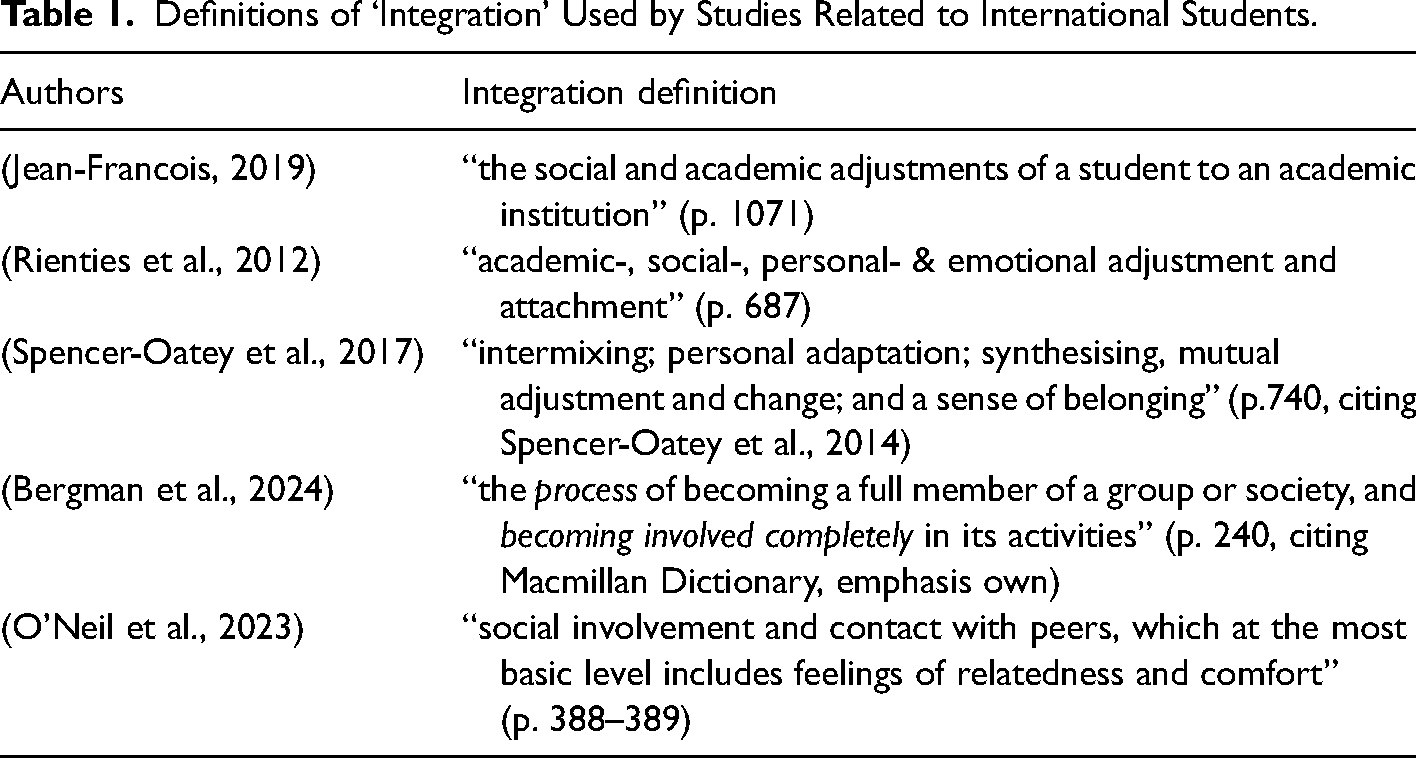
Such conflations are evident across papers which do provide an explicit definition for integration, as outlined in Table 1. In some cases (Jean-Francois, 2019; Rienties et al., 2012; Spencer-Oatey et al., 2017), integration is explicitly defined as adjustment, attachment, or adaptation. These terms are often used interchangeably within articles, such as Bergman et al. (2024), whose study ‘examined home and international engineering students’ experiences and adaptation’ but research questions asked on the same page: ‘Which factors helped or hindered home and international students’ integration into their study environment?’ (pg.244). In the case of O’Neil et al. (2023), social integration was used in the paper title and defined in terms of ‘social involvement’, specifically arguing that ‘[s]ocial integration should not be confused with assimilationist ideology’ (pg. 389) before changing to language of ‘acculturation’. If social integration is agreed to be problematically assimilatory, this raises an important question for our field to reflect upon: why do we need the term integration in the first place?
Definitions of ‘Integration’ Used by Studies Related to International Students.
Another methodological consideration is how integration is often used in research and practice with international students without clear measurement benchmarks. When scholars speak of ‘successful integration’ (e.g., Rose-Redwood & Rose-Redwood, 2018), there is a need for further elucidation of what that is assumed to be, yet this often remains undescribed. For instance, my own prior work refers to students who ‘might have advanced more in their social integration process’ (pg. 153) without defining what this process is and how ‘advancement’ might be measured (Mittelmeier et al., 2018). Therefore, I argue that integration is frequently under conceptualised and problematically used within our field.
Problematic Assumptions Underpinning Integration as a Lens for Research and Practice with International Students
So far, I have provided a brief history of integration as both a social concept and as an object of research, highlighting its variable use in research and practice with international students. I now discuss several reasons why integration remains a problematic lens for our research field, even if these issues of limited operational definitions were resolved by individual authors or more generally across the field.
Integration as a Politicised Concept
In reflecting on integration as a lens for research and practice with international students, we need to consider how this discourse is increasingly politicised, towards international students specifically but also towards migrants more broadly. Newspapers in common host countries such as the US and UK, for example, often and increasingly in recent times, frame ‘unintegrated migrants’ as national security threats (Liu, 2021). This includes the increasing politicisation of international students as threats to local communities and home students’ places at universities, seen through analyses in countries like Canada (Anderson, 2020) and Australia (Paltridge et al., 2014).
Conservative and right-wing politicians often depict the general presence of migrants as destabilising host societies, borrowing (perhaps inadvertently) from Durkheimian language. Taking the UK as one example, Conservative Party politics have consistently portrayed migrants as ‘unintegrated’: ‘We’ve allowed the weakening of our collective identity. Under the doctrine of state multiculturalism, we’ve encouraged different cultures to live separate lives apart from each other and apart from the mainstream.’ (Former UK Prime Minister David Cameron: Cabinet Office, 2011) ‘Multiculturalism makes no demand of the incomer to integrate…it has failed because it allowed people to come to our society and live parallel lives in it.’ (Former UK Home Secretary Suella Braverman, quoted in Wingate, 2023) ‘We don’t see these people as Muslim refugees. We see them as Muslim invaders. We believe that a large number of Muslims inevitably leads to parallel societies, because Christian and Muslim society will never unite’ (quoted in Agerholm, 2018).
Similarly, Donald Trump in the US has depicted migrants as un-integrate-able by claiming they are ‘destroying the blood of our country, they’re destroying the fabric of our country’ (quoted in Fingerhut & Swenson, 2023). Such examples highlight how integration is value-laden and is increasingly co-opted for politicised, xenophobic, and racist discourses within far-right movements.
Such language is not a far stretch from how we frequently refer to international students in research and practice, who are often positioned through a deficit lens as lacking connections with host communities (Kudo, 2024). The phrase ‘parallel societies’ used by Braverman and Orbán is similarly used in existing research with international students (e.g., Bethel et al., 2016; Gomes, 2021), demonstrating a direct sharing of language between scholars and anti-migrant politicians (despite very different underlying sentiments and intentions between scholars and politicians). Some scholars, such as Penninx (2019), argue for separating integration as political terminology from the conceptual lenses used in research and practice. However, there is a danger that shared language contributes to legitimisation of right-wing, anti-migrant views, raising the question: if we as scholars and practitioners are opposed to this harmful political vision, how can we use the same language?
Integration as Othering
By using the term integration, we perpetuate discourses which distinguish problematic binaries of student categories – home and international – by identifying who belongs and who does not. We assume the presence of an existing, non-migrant home population who are ‘already integrated’ (Schinkel, 2018). Such constructions perpetuate colonial categorisations of superiority (nativism) and inferiority (non-nativism) commonly referred to as ‘Othering’, as discussed in the works of decolonial scholars such as Edward Said (1978), Franz Fanon (1952), and Achille Mbembe (2017). Scholars in our community have recently argued for how international education functions within similar global imaginaries of coloniality (Stein, 2017) and whiteness (Shahjahan & Edwards, 2022). Integration discourses are indeed difficult to untangle from our sector's global colonial imaginary and the colonial histories of many common host countries (Udah, 2024). Hence, the continued use of integration raises questions about who already belongs and by whose standards they are assumed to do so.
This Othering is perpetuated within institutional and national systems and structures. Visa status, for example, delineates non-belonging by default (e.g., being ‘not from here’), acting as formal markers of differentiation despite integration's underlying attempt to erase differences (e.g., by making everyone the same) (Korteweg, 2017). This means international students as a group are Othered through the categorisation of their visa status, yet they are expected to perform as if they are not (Favell, 2019). Within our field, this is apparent in our universities’ continued distinction between ‘home’ and ‘international’ students, while also putting into place policies and practices which seek to erase this distinction.
One of the consequences of Othering is that migrants are frequently depicted as ‘lagging behind’ (Schinkel, 2018). This is present in research and practice with international students through deficit narratives were are frequently used to describe their academic knowledges, histories, and backgrounds as inferior (Lomer et al., 2024). Integration perpetuates assumptions that international students do not belong by default (Astolfo & Allsopp, 2023) and simultaneously position them as lower quality students. Arguments for international students’ integration, then, often involve interventions to address these perceived ‘problems’, further reinforcing this Othering.
Integration as Erasure
When we use the term integration, it is by definition homogenising. An underpinning assumption is that international students will need change to meet the needs and expectations of their host institutions and societies. In this context, integration functions as erasure by ignoring the experiences, histories, and cultures students bring with them in favour of the hegemonic host. Tierney (1999) refers to this as ‘cultural suicide’, arguing: ‘Tinto's notion is that college initiates must undergo a form of cultural suicide, whereby they make a clean break from the communities and cultures in which they were raised and integrate and assimilate into the dominant culture of the colleges they attend’ (pg. 82)
As a field we should also reflect on the irony of making assumptions about conformity while international students are simultaneously valued for their differences and diversity. This contradiction is particularly acute within internationalisation discourses which frequently centre international students as cultural resources who can contribute to the learning of others. Research and practice relating to curriculum internationalisation, for instance, often specifically position international students as curricular resources who are bearers of cultural knowledges and experiences which can contribute to the learning of their peers (e.g., Leask, 2009). This means that international students are often as valued for their differing knowledge in terms of academic content and discussion, but, in contradiction, are positioned through integration lenses as needing to conform to existing pedagogic processes and social communities. There is, then, a dual narrative through integration that positions international students as both resources and deficits.
Integration as Ignoring Structural Inequalities
The use of integration discourses in our research and practice assumes that host societies or institutions are worthy of integrating into in the first place. Yet, as Favell (2019) argues, we must ask: integration into what? In asking this, Favell highlights the problematic ways many of our host societies are ableist, racist, sexist, or classist, and, particularly in the so-called ‘Global North’, designed around assumptions about whiteness and modernity (among other issues). In short, many of our societies are not flawless models of equality which are worthy of amalgamating into, particularly for those from marginalised or excluded groups within those societies. Yet, by arguing for integration, we create social imaginaries of ‘host’ societies which are pristine and unproblematic, or as Schinkel calls it, ‘order with a border’ (2018).
Scholars and practitioners who use an integration lens also assume that university communities are easily, safely, and supportively accessible to international students (Yao, 2015). However, scholars have outlined for decades the existing inequalities in differentiated attainment levels and progression gaps between students of different races, genders, and class backgrounds (e.g., Richardson et al., 2020). There is also significant research about how international students encounter stereotypes (Tran & Vu, 2016), stigmatisation (Moosavi, 2022), racism (Lee et al., 2017), and xenophobia (Dominguez-Whitehead & Sing, 2015) within their host institutions. By centring integration, we often focus a burden of responsibility which rests with international students, rather than on transforming the problematic structures they live and study within (Saharso, 2019).
Moving Forward: Against Integration
I have argued throughout this essay that integration is normatively and uncritically used in research and practice with international students. In doing so, I have briefly described the term's conceptual history and exposed its underlying assumptions. I have also argued that in using an integration lens, we subscribe to a particular vision of universities which idealise the host society, position international students as inferior, and place undue burden on them to ‘fix themselves’ to be successful in their new environment. Given the politicisation of the term integration in many contexts, scholars in disciplines such as migration studies have argued that there is an ‘unacceptable risk’ in the intentions behind this work being misunderstood (Wieviorka, 2014). Language is, after all, a constructed ‘social practice’ (Fairclough, 1989, p. 22) and there is a need for us to recognise that integration ‘is too divisive a notion that errs too consistently on the side of harm to be a useful project for research or policy’ (Meissner, 2019, p. 8).
We must also recognise how the continued use of integration limits the ability of research and practice with international students to move into more critical and ethical futures, towards ‘new beginnings’ for internationalisation (de Wit, 2024). If we continue to use integration, we further perpetuate problematic deficit visions of international students (Lomer et al., 2024) and limit the available space for ongoing discussions about interactions and concepts which are more transformative (Astolfo & Allsopp, 2023). While our field continues to grapple with moving towards these more ethical and critical ‘new beginnings’ (de Wit, 2024), one thing feels clear: integration is not the way.
Moving away from integration, though, raises deeper questions about what language we might wish to use instead. Yet, my intention in this essay was to raise awareness of the need for scholars and practitioners to review their current thinking and approaches based on a critical appraisal of these underlying ideological foundations. For this reason, I do not provide a specific alternative phrase, as there is a danger in replacing language without changing the underlying problematic assumptions embedded within our thinking, as often seen by the various synonyms frequently used for integration (assimilation, acculturation, etc.). Some scholars in our community have provided alternative considerations worth reflecting on, though. Yao (2015), for example, argues that we should move towards the language of ‘sense of belonging’, giving a renewed focus to the relational aspects of campus interactions. This relates to scholars such as Ploner (2018) who writes about ‘academic hospitality’ and individuals’ roles as ‘hosts’ and ‘guests’ in higher education. In evaluating individual experiences, scholars such as Jindal-Snape (2024) argue for the lens of ‘transitions’ as a more nuanced way of exploring the changes associated with mobility. These are just a few (potentially imperfect, I personally feel) options that highlight the possibilities of thinking differently about how students experience international education. In evaluating potential alternative lenses, some questions we might consider include:
Does this lens offer possibilities to move away from deficit, homogenising discourses based on assimilatory research and practice towards more mutually transformative approaches? What opportunities does this lens provide to interrogate existing inequalities that fail to see all students as nuanced and diverse individuals? Does this lens promote the treatment of students as equals? When I say integration, how am I defining this and what do I assume it means? Am I assuming assimilation or homogenisation by using integration language? How can I identify, problematise, or critique my assumptions? How can I reframe my thinking away from individual deficiencies (i.e., seeing students as problems) towards structural inequalities (i.e., evaluating where my institution is perpetuating unequal experiences)? Is there an alternative word or concept which might more ethically and critically describe what I mean when I say integration?
When it comes to further evaluating integration in research and practice, I end with several additional questions that scholars and practitioners may wish to consider:
Footnotes
Acknowledgements
This essay is the first piece I have written after losing my dog Teddy, who was my treasured friend for 16 years. He was my dedicated research partner and co-author for my entire academic career until now and he is sorely missed.
Funding
The author received no financial support for the research, authorship, and/or publication of this article.
