



Abstract
There are many arguments about Heidegger's work Being and Time (1954). Many critics believe that Heidegger provides a new way of understanding ourselves from a philosophical perspective. However, while some critics emphasize the de-Nazification of Heidegger's thinking, other still promote the notion that Being and Time is pro-Nazi. What is more, this new way of understanding brings a new challenge to education. In this paper, the concepts of Volk (people) and its relation with Being and Time is studied. Also, education is investigated in order to bring up authentic Dasein on Heidegger's view. The exploration undertaken in this paper illustrates that the concept of Volk is not, in Heidegger's view, related to the biological features of a race, but to the mood of attunement to Being, which itself is determined by its historicity and its capacity to bring about both differentiation and order. In general, Heidegger's interpretation of work is based on his concept of Dasein in the Being and Time and, as Radloff ((2007) Heidegger and the Question of National Socialism: Disclosure and Gestalt. Toronto: University of Toronto Press) believed, this is not tactical accommodation to Nazism. In Being and Time, Heidegger tries to save Dasein from everydayness and what he calls ‘the they’ by calling attention to be authentic.
In Heidegger's (1985) view, the questioning process unlocks the essentials in things by forcing us to focus on what would seem to be simple and obvious. Also questioning Dasein’s beliefs and behaviours unfold the causes of them and is a way of bringing up an authentic Dasein and open-minded person. In order to achieve this, we need an authentic teacher who is not lost in ‘the they’. Hence, we might speculate that if schools follow Heidegger's thinking, they would be attractive places in which to provide situations for students to ask question and not be bored. Students are encouraged to learn while pursuing questions. They are active and eager learners who learn through rethinking matters, even if these matters are completely obvious. They learn about them in a manner that their thinking enters unconcealment. If this were the case, education might lead students to become more thoughtful.
Introduction
Martin Heidegger is the most important philosopher of the 20th century and, as Macquarrie (1968) affirms, many philosophers, theologians, psychotherapists and historiographers have been inspired by his inquiry. Furthermore, Heidegger is an increasingly influential philosopher on topics such ‘technology’, ‘thinking’ and ‘learning’ in philosophy of education. Heidegger (1954) not only raises the question of Being but also investigates it through the analysis of Dasein's existentialia in the Being and Time. There are many arguments about his work. Many critics believe that Heidegger provides a new way of understanding ourselves from a philosophical perspective. This said, Sheehan (1988) raises the important issue of Heidegger's thinking on ‘fate’, ‘destiny’, ‘resolve’, ‘historical process of Volk’ and ‘truth’ and how these concepts were later used by the Nazis during the formation of the Third Reich. Some authors, such as Fritsche (2012), go as far as stating that the text Being and Time is pro-Nazi. However, many defenders of Heidegger, including Young (1997), emphasize the need for a de-Nazification of Heidegger. While Being and Time was published in early 1927, Heidegger's interpretation of the concepts that he uses in this text persisted in the content of his lectures up until 1934. For example, Heidegger at an election rally hosted by German university professors at Leipzig on 12 November 1933 said: It is by virtue of this basic law of honour that the German people retain the dignity and resoluteness of its life.… labor recovers for the people its rootedness; labor places the State, as the reality of the people, into the field of action of all essential forces of human Being. ... To be knowing, however, means: to be master of things in clarity and to be resolved to action. … Our will to national self-responsibility (volfdsch) desires that each people find and preserve the greatness and truth of its destiny (Bestimmung). (Heidegger, 1988: 45)
According to above question, this paper studies the concepts of Volk on Heidegger's view and its relation with the Being and Time in order to investigate education in fostering authentic Dasein.
Volk, responsibility and authentic Dasein
In Heidegger's view, the analysis of the metaphysical determination of Volk should involve a deconstruction of the three forms of its construct. (a) Volk as ‘body’, involving the deconstruction of Volk as race or blood to retrieve corporality as a mood of attunement, as a rhythm and style of being. (b) Volk as soul that belongs to the animal-being of mankind and that refers to its instincts, urges, drives and unstable emotions and moods. The retrieval of soul implies the de-termination of a Volk by the historicity of its attunement to being. (c) Volk as spirit that is deconstructed in order to retrieve the enactment of the history of the Volk, a phenomenon that is stated in the will to articulate differentiation and orders. Therefore, in Heidegger's view, Volk gives a stable form to the order most proper to it (Radloff, 2007) and it is not related to the biological features of a race, but to a mood of attunement to Being, which, I repeat, is determined by the historicity of it causes differentiation and orders.
Volksein, or being a Volk, indicates entering into an existence where one understands one's own limits. Volks, as a people, find their limits in their encounters with beings in work. To this effect, work may be defined as a circumspective praxis and engagement with technology that takes its meaning from the world. This work is a way of absorption into the ready-to-hand and involves attunement to other beings and, therefore, a certain way of making- present ready-to-hand. Heidegger, in the Logik, declared that the threefold determination of Volk and its inclusion of attunement, work, and mission and task constitute the structure of Volk (Radloff, 2007: 180–185). A Volk has a special attunement to beings that has to do with both its historicity and its encounter with other beings in work.
In Heidegger's (1954) view, Dasein always has a previous history of involvement and commitment and, furthermore, this previous history engages the present situation in which it finds itself with a view to move into a certain kind of future. Heidegger called this essential structure of life ‘care’. 1 This care can be thought of as being ‘already-in (a world)’ while involving engagement with entities encountered within-the-world and ‘being ahead’. In this way, the structure of care can be thought to correspond with the structure of time, equivalence that Heidegger called the temporality of Dasein. The historical, in Heidegger's view, ‘is just a more concrete working out of temporality’ (Young, 1997: 59). Heidegger called Dasein's past or ‘already-inness’ of care ‘thrownness’. 2 Our fundamental commitment to do what is worth doing, in effect, constitutes a cultural ‘heritage’ into which we are ‘thrown’. Heidegger mentioned this point by saying that das Man (the they) is a necessary part of our being (Young, 1997). In other words, our fundamental sense of what we do in a given situation is not determined by choice, but by our thrownness. So in Being and Time, Heidegger believed that Dasein represented a disclosedness that means this thrownness and historicity opens the situation such that it provides certain possibilities, a special way of Being and encountering beings and, what is more, a certain way of living in the world as a Volk.
Since Dasein is contextualized in a community, its ‘authentic happening’, in Heidegger's view, is possible only in ‘co-happening’ with community. Heidegger called this ‘co-happening’ ‘destiny’:
3
‘our fates have already been guided in advance in our Being with each other in the same world and in our resoluteness for determinate possibilities’ (Guignon, 1984: 336). In Heidegger's view, Dasein’s being is being-in (the world), being-with (one another) and being able to choose possibilities. In Being and Time he tried to save Dasein from everydayness and from what he called ‘the they’ and he has done this in order to be authentic Dasein: ‘The they’ even conceals the way it has silently disburdened Dasein of the explicit choice of these possibilities … . This process can be reversed only in such a way that Dasein explicitly brings itself back to itself from its lostness in ‘the they’. (Heidegger, 1953: 248)
This reflection leads us to see why Heidegger emphasizes the importance of self-administration of the university: Self-administration means that we set ourselves our own task and determine the way and manner of its realization ourselves, so that in doing so we ourselves will be what we ought to be. … Neither awareness of the present state of the university nor acquaintance with its previous history are enough to guarantee sufficient knowledge of its essence unless we first, with clarity and severity, delimit this essence for the future, and in such self-limitation, will it, and in such willing, assert ourselves. (Heidegger, 1990: 1)
Because Heidegger states that the will to take responsibility is a fundamental law of being a Volk and that this also is the basis of a national socialistic state and, because since the will of self-responsibility is the law of being with one another as a people, such a Volk will be teachers of greatness to each other (Radloff, 2007: 208). Heidegger emphasized the importance of self-responsibility as the law of being with one another and the idea that this value can be, in Heidegger's view, the basis of ethical education. The authentic Dasein is responsible for his or her behaviour, choices and acts as a symbolic agent for the welfare of others. So education, in Heidegger's view, has to bring up authentic responsible people
Because the authentic Dasein, as a student, must be aware of the causes of his or her actions and knows why they want to be and do, they must be considered to be self-motivated, and their activities must be considered to be meaningful. The authentic Dasein can also understand the roots and causes of people's behaviour and therefore the nation's behaviour in the same way. They understand that they have their own causes for living and acting, in the way that they do things and that this evades the possibility of developing a view of the world that is too tight. Through education, the formation of authentic Daseins leads to the education of people with an open mindedness, and not to the bringing up of racists. It would seem that Heidegger's philosophy in Being and Time gifts meaningful and peaceful life to humanity.
Young (1997) adds, and I agree with him, that in not supporting the notion of there being simply one race or in not supporting the idea of there being simply one nation, furnishes humanity with a complex variety of political commitment, as can be argued within the framework of Being and Time's conception of authentic historical Dasein. I also agree with Young with respect to Heidegger's (1953) concept of authenticity, that one stands in a world situation that is historical, and can think of one's future in terms of a destiny that determined by the heritage of one's community (Young, 1997).
Work, historicity and Being in the world
Because Radloff (2007) argues that Heidegger's view of work is not one of the self-production of humanity through its encounter with nature (Marx), but that the work of a people is rooted in its native soil, work becomes present in the special historical determination. Therefore, vocation exists in the actualization of work by opening up the present through the actualization of the future of the task (Radloff, 2007). Previously, we said that on Heidegger's view, Dasein's care structure is being already in the world plus entities encountered within it and being ahead. This gives Dasein certain possibilities with respect to there being both a specific way of being with others and a specific way of engaging with both work and things. Therefore, Dasein's work and the way of engaging with things for the sake of a task (based on care structure) enables the possibility of one nation discriminating against another. Each nation reflects its historicity in its choice of tasks and missions, and in the way that it engages with things and work. To this end, in Heidegger's view, each nation's education, as a form of work, must be different from that of the education of others nations. Heidegger's interpretation of work as a concept based on his conception of Dasein in Being and Time, and as Radloff believed, is not tactical accommodation to Nazism.
According to Waikart (2004), Darwinism and eugenics smooth the way for the development of Nazism, enabling Nazism to emphasize the need for expansion, war and racism (Day, 2010). However, any of these not observed and derived from Being and Time, and as Young mentioned, far from committed Heidegger to fascism and actually forbid such commitment (Young, 1997). I think as Radloff (2007) said, Heidegger endorsed national socialism in 1933 for the hoped-for gestalt, to promote a programme of university reform and authentic form of work, scholarship and national defence and I agree with him that in Heidegger's view Volk socialism is a ‘third way’ between metaphysical socialism and capitalism and it is a nation-state projected from the care structure of authentic Dasein.
Education and bringing up authentic Dasein
Heidegger (1990) views each nation in a manner that implies that its historicity supposes it has its own educational system and brings up its own Volk. According to such a notion of nationhood, a single global education system for the entire populous of the world should, as an idea, be rejected: the rejection of which is compatible with Heidegger's (1976) critique of modernism. Furthermore, I believe this is the reason why Heidegger defines learning as involving a response to what is needed at any time, which in itself can only be determined by the situation and space of that moment. I therefore conclude that education, in Heidegger's view, is related to the historicity of its people's experience of itself, to Dasman and Dasein and, as such, that it functions in the manner illustrated in the model shown in Figure 1. Historicity affected on Dasman and Dasein. The aim of this education is bringing up authentic Dasein.
The model of education according to Heidegger.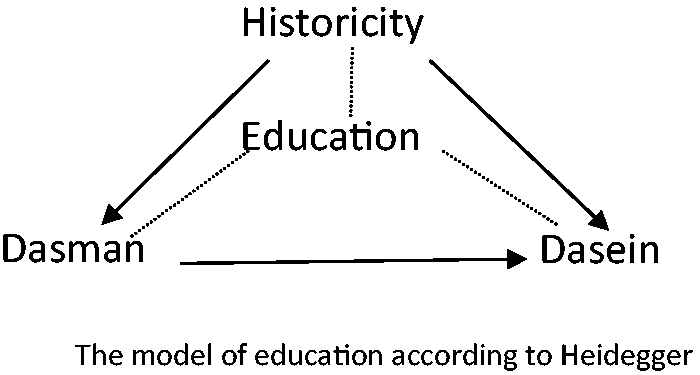
Since each nation has its own history, culture and willingness, universities and schools would need to assert themselves with respect to what they want to be. From this point of view each nation needs to bring up authentic Dasein who are opened to the history of their community and are resolute to disclose current social norms. Authentic Dasein choose life possibilities to promote the destiny of their nation and are responsible for this choosing. In this instance, responsibility, in Heidegger's view, becomes the basis of an ethical education.
Authentic Dasein are aware of the causes of their actions and know why they want to become and do. Authentic Dasein seem to be self-motivated beings. Therefore, their activities are meaningful. Also, authentic Dasein can understand the roots and causes of other people and nations' behaviours in the same way and this can lead to educate open-minded people. But how can we educate authentic Dasein who would be able to know the roots and causes of their and others' behaviours and how this projects itself in the future?
Heidegger (1985), with reference to perseverance in the process of questioning – an attribute that the Greeks believed was the preliminary step to knowing – had the following to say: Questioning then unfolds its most authentic strength to unlock the essential in all things. Questioning then forces our vision to focus, with the outmost simplicity, on the inevitable. (Heidegger, 1985: 3) Such questioning shatters the encapsulation of the sciences in separate specialities, brings them back from their boundless and aimless dispersal in individual fields and corners, and directly exposes science once again to the productivity and blessing of all world- shaping powers of human-historical existence, such as nature, history, language; people, custom, state; poetry, thought, faith; law, economy, technology. (Heidegger, 1985: 3)
It can be anticipated that schools that base their pedagogies on authentic teachers will be attractive places that will give rise to questions in students and not, as such, be boring places. Students should be encouraged to pursue their questions. Such individuals are active and eager learners who have learned to rethink everything that has already been taught them and that which might even be completely obvious to them. They should therefore come to be brought up by the education system as thoughtful students.
I believe that Socratic dialogue will be in practice as teaching method in such schools. Raising questions about the world, human beings, the way they understand each other, the way they live and behave, and what they want to become can help students to deconstruct their thinking about themselves, the world and the way they think more generally. In this way, students can intuitively project into new possibilities as they emerge. I believe teachers are able to help students to acquire this intuitive capacity such that they would learn for themselves to choose and create themselves as authentic Daseins. Heidegger calls the teacher an exalted being for the reason that this kind of education provides a context to learn and let learn, where teaching is defined as a practice involving the student and letting him learn. In this learning he/she gains new interpretation about the world and others. Then the student creates his/her being according to this interpretation (that Heidegger says projects himself/herself).
Conclusion
In conclusion, we can say that Heidegger raised the question of Being and, furthermore, that he investigated this concept through analysing Dasein's existentialia in Being and Time. There are many arguments that relate to the thinking that we find in this book. Many critics believe that Heidegger initiated a new way to understand ourselves from a philosophical perspective, but some like Sheehan (1988) and Fritsche (2012) say Being and Time is an exposition of pro-Nazi thinking. On the other hand, many of the defenders of Heidegger, including Young (1997), have emphasized the existence of a de-Nazification in Heidegger's thinking. We cannot separate Heidegger from his context. At that time German academics sought a third way between liberalism and Bolshevism, and wanted to restore German honour and pride after the German defeat in the First World War. Within this context, we must be careful to recognize the emphasis that Heidegger put on his concern for the Volk and the historical realization of Germans as being German, not forgetting the importance of responsibility and destiny. It would seem there is a challenge to education in Heidegger's Being and Time. Therefore, in this paper, the concept of Volk and its relation with the Being and Time are studied and the concept of education is investigated in order to identify nation, race and bringing up authentic Dasein from Heidegger's point of view.
The exploration undertaken in this paper illustrates that the concept of Volk is not, in Heidegger's view, related to the biological features of a race, but to the mood of attunement to Being, which itself is determined by its historicity and its capacity to bring about both differentiation and order. With respect to Heidegger's understanding of Dasein as referring to Being as being in the world and being with one another, the individual can be said to be enabled in the process of choosing possibilities. In Being and Time, Heidegger tried to save Dasein from everydayness and what he called ‘the they’ in the sense that he wished to emphasize the importance of choosing to be authentic.
Because the authentic Dasein is aware of the causes for his or her actions and knows how he or she wants to be and do things, they are self-motivated, and their activities can therefore be thought to be meaningful. The authentic Dasein can see the roots and causes of other people and nations' behaviours in the same way and they understand they have their own causes for living and acting in certain ways, so this evades them from being trapped in a tight view about the world. So education to be authentic can lead to educate open-minded people and not bringing up racists.
Dasein's work and the way of engaging with things for the sake of a task (based on care structure) can discriminate each nation from others. Each nation, according to its historicity, has its own tasks and missions, and has a certain way of engaging in things and doing work. Then in Heidegger's view (1985), each nation's education, as a form of work, is different from the form that education might take in other nations. Generally, Heidegger's interpretation of the concept of work is based on his conception of Dasein in Being and Time and, as Radloff (2007) believed, this is not tactical accommodation to Nazism.
In Heidegger's (1985) view, questioning unlocks the essentials in things and forces us to focus on what appears to be simple and inevitable. In this manner, the questioning of Dasein's beliefs and behaviours can unfold the causes regarding them and can be a way of growing up an open-minded person and authentic Dasein. Of course, this needs an authentic teacher who is not lost in ‘the they’. It would seem that schools that base their pedagogies on Heidegger's thinking will become attractive places and, as such, provide a context for questioning and therefore not be boring places. Students are encouraged to go after their questions. They are active and eager learners who learned rethinking about all things even if are completely obvious, so this will help them in learning about them. Therefore, this kind of education can lead to the creation of thoughtful students.
I think Socratic dialogue will be in practice as a teaching method in these schools. Raising questions about the world, human beings, the way they understand them, the way they live and behave, and what they want to become can help students to deconstruct their thought about themselves and about the world and the way they think. Then they can project themselves with this new intuition on new possibilities they find. I think, as teachers help students to gain new intuition and choosing and creating them as authentic Dasein, this is what Heidegger called ‘teacher exalted’, and as this kind of education provides a context for learning and letting them learn, Heidegger defined teaching as ‘let to learn’
Waikart (2004) said Darwinism and eugenics paved the way to Nazism, so we can see Nazism emphasizes expansion, war and racism (Day, 2010). However, none of these are observed in or derived from Being and Time and, as Young (1997) mentioned, Being and Time far from committing Heidegger to fascism and actually forbid such commitment (Young, 1997: 78). Lastly, as Day (2010) mentioned, Heidegger's history of Beings is a great work of historical imagination, which allows us to understand the world and ourselves in a novel way and regard education as a basis that leads to bringing up responsible authentic Dasein.
Footnotes
Funding
This research received no specific grant from any funding agency in the public, commercial or not-for-profit sectors.