



Abstract
Student awareness and selection of learning strategies are predictors of academic success. Yet, little is known about learning strategies of students in university preparation science courses, who are frequently mature-aged or underrepresented students. This lack of knowledge potentially hinders tailoring reflective learning experiences, specific to science contexts, supporting novice science students adopting effective learning strategies. A mixed-methods study examined self-reported learning strategies of 88 students in an online university preparation science course, analysed using a convergent parallel research approach and interpreted through a passive–active–interactive framework. The study found preferences for passive learning strategies with considerably less active and interactive strategies reported. The findings suggest, despite the strengths these students bring to their studies, a tendency for naïve and unexamined concepts of science learning, from time-poor students with little experience in collaborative learning. The study recommends embedding science-specific learning strategies in university preparation science courses and building capacity with interactive strategies.
Keywords
Introduction
The relationship between learning strategies and academic success has been widely reported in the literature. The nature of student learning and the strategies students draw on when studying are ongoing areas of research for higher education institutions because ‘equipping students with effective study strategies is vital to their educational success’ (Miyatsu et al., 2018, p. 390). University students draw on a range of learning strategies when studying and ‘knowing how to make the best combinations of these behaviours and learning activities could be the key to performing well academically’ (Yip, 2021, p. 1566). Current investigations have largely explored college or undergraduate university students studying on campus (Neroni, 2019). Less examined and less understood are the experiences of mature-aged students (Goeman & Deschacht, 2019), including non-traditional (mature-aged or underrepresented) students enrolled in online university preparation courses, who frequently have experience disrupted learning journeys. Such studies would offer valuable insights for higher education institutions when designing programmes and learning experiences with reflective practices, that support novice students to consider and adopt more effective study strategies, to improve student retention and attainment of academic goals.
Student self-awareness of effective study strategies
Student learning strategies (used interchangeably with study strategies) is an ‘umbrella term’, as ‘researchers have often defined learning strategies somewhat differently’ (Boström et al., 2021, p. 4). Learning strategies generally refer to cognitive processes which learners enact through behaviours such as ‘notetaking, organizing information, time scheduling, concentration capacity, self-motivation, and ways of memorizing information’ (Yip, 2019, p. 1). Understood this way, study strategies are a set of tactics a student uses to achieve a particular learning outcome. No single study strategy is consistently pertinent across a wide range of learning contexts (Gurung et al., 2010) and, although each student will have an overall study style (Hadwin et al., 2001), there is evidence that ‘students change their learning strategies depending on different factors’ (García-Pérez et al., 2021, p. 533). Student selection of learning strategies is based on ‘personal criteria of how useful those strategies are in specific learning situations’ (García-Pérez et al., 2021, p. 545). Kornell and Bjork (2007) found that when students study they make a range of decisions regarding what to study (focus), how long to study (persistence), and how to study (learning strategy), and that these decisions can support or detract from the effectiveness of their learning. Thus, student selection of learning strategies is considered important and a predictor of academic success and differentiator between students’ academic performances (Yip, 2021).
Although contextually appropriate learning strategies contribute to effective learning, research indicates a tendency for students to lack awareness of effective learning strategies. Miyatsu et al. (2018), for example, reviewed published literature that analysed five study strategies for which students have a strong preference (re-reading, highlighting, note-taking, outlining, and self-testing), concluding that students are often unaware of the pitfalls of these popular study strategies and may mistake ease and fluency of learning for effective learning. Studies investigating student reliance on re-reading notes also indicated a high preference for this strategy (Blasiman et al., 2017), even though looking over notes and highlighting important information are strategies linked to lower examination scores (Gurung et al., 2010). In exploring student use of effective learning strategies, McCabe (2011) further found students were inclined to choose strategies on the basis of interest (for eaxmple high-interest with extraneous details or animated media) and simplicity (for example re-studying and massing), and could lack awareness of more beneficial, empirically supported learning strategies. Considering the impact of effective study strategies on student success and the evidence suggesting students may lack awareness of effective study strategies, research examining students’ experiences of learning and their actual study practices is of both theoretical and practical value in higher education.
Student experiences of learning in higher education STEM (science, engineering, mathematics, and technology) programmes
Selection of learning strategies and experiences of university STEM learning environments are contributing factors to STEM students’ retention and academic success. Against a backdrop of increasing global enrolments in STEM courses, there is a ‘general consensus in the international literature that undergraduate STEM programmes pose significant challenges to students’ (Winberg et al., 2019, pp. 930–931). Students lacking learning skills and strategies essential to STEM contexts, such as scientific analytical and mathematical skills, along with the poor teaching practices and institutional support frequently attributed to STEM courses, all contribute to comparatively high attrition rates (Sithole et al., 2017). Novice science students are particularly at risk. Andrews et al. (2011) noted that in introductory science courses, students may frequently fail to learn and grasp basic scientific concepts, attributing this to student passivity in learning and traditional teaching practices, such as lectures. Deslauriers et al. (2019) explored self-reported perceptions of student learning, also noting the tendency for novice physics students to be ‘poor judges of their own competence’, leading the researchers to suggest that evaluations ‘based on students’ perceptions of learning could inadvertently promote inferior (passive) pedagogical methods’ (p. 19251).
STEM courses present particular challenges for underrepresented students. In STEM programmes, despite their individual strengths, underrepresented students are less likely than their peers to have experience with STEM activities, self-efficacy, and confidence in career pathways (Burt et al., 2023; Wong et al., 2022). There is a ‘notable lack of diversity’ in STEM courses (Winberg et al., 2019, p. 931). Theobald et al. (2020) posit that high levels of attrition for underrepresented students contribute to a lack of diversity, arguing that changes to learning and teaching environments such as active learning and ‘innovations in instructional strategies can increase equity in higher education’ (p. 6476). Underrepresented students benefit from a ‘diverse, inclusive and supportive learning environment that maximises the participation, strengths and potential of all students’ (Wong et al., 2022, p. 10). Thus, effective programme design and faculty engagement can nurture underrepresented students’ strengths, positively impacting their success and retention in STEM programmes (Burt et al., 2023).
In the Australian context, there is a lack of research examining the experiences and learning strategies of non-traditional students, including mature-aged and underrepresented students who are enrolled in university preparation science courses. A university preparation, or enabling, programme ‘is not a higher education award in and of itself; rather it prepares the student to enter a course (typically an undergraduate degree) by providing them with requisite academic skills’ (McKay et al., 2018, p. 47). Ostensibly, university preparation programmes provide access to higher education and support for underrepresented students from equity groups, including: Indigenous students, students with disabilities, students from regional and remote areas, students from to low SES families, women in non-traditional areas, and non-English speaking background (NESB) students (Koshy, 2020). However, university preparation programmes have a much broader demographic and attract students who are frequently ‘non-traditional’, mature-aged, and ‘typically occupy some position of disadvantage’ (Jarvis, 2021, p. 28).
A strengths-based approach to examining the educational experiences of students in university preparation programmes acknowledges both the abilities non-traditional students bring to their studies and the barriers these students encounter. For example, mature-aged students looking for new career opportunities or to further their qualifications (Homer, 2022) tend to be overrepresented in university preparation programmes (Jarvis, 2021). These students while possessing ‘strengths and life experiences, along with a strong sense of purpose, motivation and resilience’ (Crawford & Emery, 2021, p. 19), also experience barriers to persistence in their studies (Stephen, 2023). Barriers that limit non-traditional students’ access, persistence, and success include: distance from a university; limited family experience with tertiary education (first in family); financial pressures; the stress and time constraints of work, parenting, or carer responsibilities; being academically under-prepared; or having complex, and often negative, experiences of education (Billett et al., 2023; McKay et al., 2018). It is further recognised that, for these students, enrolling in university preparation programmes ‘entail significant risk - financial risks, health risks, relationship risks and risks to one sense of identity and self’ (Jarvis, 2021, p. 32).
Online modes of study, while offering university preparation students greater access to educational opportunities, also add further layers of complexity to student strategies learning and learning environments. Both synchronous, in-person modes of learning and teaching and asynchronous, online modes present inherent possibilities and challenges (Fiorini et al., 2022). Access to flexible, accessible online learning environments ‘can meet students where they are currently placed’ and support equity through ‘allowing participation in ways that suit the student considering their individual circumstances and the personal barriers they may have’ (Dodo-Balu, 2018, p. 35). However, recognised obstacles for students learning online include: lack of motivation, inaccessibly of teaching academics, delays in receiving feedback, and feelings of isolation and disconnection (Coman et al., 2020). Moreover, online STEM programmes face the additional obstacles in replicating traditional learning environments, such as laboratories, and developing discipline-specific skills of scientific analysis and problem-solving in teaching (Chang & Lee, 2022). Coman et al. (2020) argue that while obstacles can be overcome, solutions in online course delivery requires an understanding of both, students’ learning needs and online teaching approaches. When considering university preparation science courses, little is known about the students’ specific learning needs or their learning strategy selection when studying online. This gap in knowledge is problematic as it negates opportunities to explore online teaching approaches that build on the particular strengths of these students and challenges that they face.
Concepts of passive, active, and interactive learning
Active and interactive learning strategies offer one approach to critically examining, and improving, student learning. Active learning has been found to positively impact student performance in undergraduate STEM courses (Freeman et al., 2014), and STEM educators have ‘hailed active learning as a way to transform science education’ (Lombardi et al., 2021, p. 8, emphasis in original). Active learning is foundationally student-centred and constructivist, focussed on practices that encourage and support students in their own learning and knowledge construction, and when combined with inclusive teaching practices, active learning can improve underrepresented student achievement (Theobald et al., 2020). However, as a construct, active learning can be both ambiguous and contested, with the ‘effectiveness of active learning and the robustness of the evidence’ being questioned (Hartikainen et al., 2019, p. 1). Active learning is not a panacea for student engagement, and Deslauriers et al. (2019), for example, identified ‘an inherent student bias against active learning that can limit its effectiveness’ (p. 19251). Also, active learning constructs focused on individual learners may overlook the value of interactive constructs in which students engage in learning strategies such as collaboration and discussion. Ultimately, educator application and expertise are key determiners of the successful delivery of active learning experiences (Andrews et al., 2011).
This study used a passive–active–interactive learning strategy construct, adapted from Magana et al. (2018). In this construct, passive learning strategies encompass student learning strategies in which student learning does not produce new learning artifacts. This includes strategies ‘in which learners are not visibly doing anything, other than watching, listening, or reading’ (p. 47) and strategies with visible learning responses that simply interact with or reproduce learning materials, such as highlighting and verbatim notes. In the latter, although the students maybe ‘active’, in cognitively selecting content and physically moving a highlighter, they are arguably not actively going beyond the provided learning materials. Active learning strategies construct or produce new artifacts, ‘result(ing) in an output that goes beyond the learning material’ (p. 47), including: solving problems, answering complex questions, and creating personal notes, conceptual summaries, and maps, learning strategies representative of Bloom’s revised taxonomy cognitive process of apply, analyse, evaluate, and create (Anderson et al., 2001). This is an individualist active learning construct that aligns with reports that some online learners feel that studying alone affords better focus (Shim & Lee, 2020). Interactive learning strategies in addition to being active are collaborative learning strategies, in which ‘learners working together to create a product can lead to rich discussions that challenge each other’s preconceptions’ (Magana et al., 2018, p. 47).
Materials and methods
There is a paucity of research examining the experiences and learning strategies of students studying university preparation science courses. Blasiman et al. (2017) assert, in order to ‘make meaningful changes to student study behaviour, we must also have a firm understanding of (1) how students study and (2) why their study habits are at times ineffective’ (p. 784). Therefore, the study’s aim was to discover what learning strategies students reported using in an online university preparation science course and examine the effectiveness of these study strategies through a passive–active–interactive framework.
This study drew participants from an online, general science course that was part of a university preparation programme. Over 150 students enrol in this course each semester, and they are expected to have the equivalent of a satisfactory high school exit level in general English and mathematics. The aim of the course was to review foundational scientific concepts and skills for students entering undergraduate courses such as education, nursing, and engineering. To this end, the course covered foundational biological, chemical, and physical concepts, as well as skills such as interpreting scientific data and graphing, through the themes of: the scientific method, cellular biology, chemistry, renewable energy, and climate change. Each theme was presented in a module of study, and the 5 modules ran over a 13–teaching week semester. While the specific breakdown of each module varied, depending on positioning within and contribution to the course, the modules contained interrelated introductory and concept-specific sections that culminated in specific active learning experiences and opportunities of student interaction.
Research design
In this mixed-methods study, we investigated concepts of learning through students self-reporting of their learning strategies. A mixed-methods research approach was selected to allow combining multiple methodologies. Although drawing on methods of data collection and analysis with different epistemological and ontological foundations is not unproblematic (Timans et al., 2019), a mixed-methods approach provided greater depth and insight into the research questions, affording opportunity to analyse the data through different perspectives, by encouraging student self-expression and allowing open-end responses to capture unexpected perspectives. A convergent parallel approach to data analysis facilitated the simultaneous, comparative analysis of quantitative (SPSS) and qualitative (thematic analysis) data providing a coherent merging of the data (Creswell & Plano Clark, 2018) and the investigation of points of commonality and difference.
Data collection, sampling, and participants
Data were collected through an online survey instrument, with both open-ended and student preference survey questions. The students were invited to participate via an invitation link on their online learning platform (Moodle) to an online survey. To avoid the educator–student power differential manipulating student participation and responses, the survey clearly noted that participation was anonymous and voluntary. The survey was open to all students and returned 88 responses over 2 semesters, with 84% being non-traditional students (16% recent school-leavers) and 38.5% being low SES.
Data analysis
The quantitative data were analysed using IBM SPSS Statistics Data Editor. The qualitative data were analysed thematically using a commonly accepted iterative framework of familiarisation, generation of initial codes, searching for themes, reviewing themes, and defining and naming themes before selecting extracts for the final report (Kiger & Varpio, 2020). NVivo 12 supported coding the open-ended written responses clustering patterns of expressions of what students valued in the experience. In this way, the analysis moved beyond simply cataloguing responses to exploring meaningful references to ideas and concepts (Maguire & Delahunt, 2018). The study’s convergent parallel approach to data analysis allowed the research team to draw together the SPSS and thematic data, triangulating for coherencies and highlighting areas of difference.
Results
Quantitative results
The analysis of the qualitative data provided insights in the amount of time students committed to study and the students’ approaches to learning.
Hours of study
Although the recommended number of hours of study is 10 hours per week, the majority of respondents (76%) completed 8 hours or less, with 22% completing under 4 hours per week. In terms of time management, 27.3% of respondents worked ahead of the recommended study schedule, 53.4% kept up with the schedule, and 19.3% fell behind. Figure 1 further shows the number of hours of weekly study against a student’s ability to keep up with their studies (as a percentage chi-square significant at 1% level), showing that respondents who did not manage to complete over 8 hours of study per week fell behind in their studies and were unlikely to catch up. Students’ self-reported total average hours of study per week versus their perceived ability to keep up with the study schedule.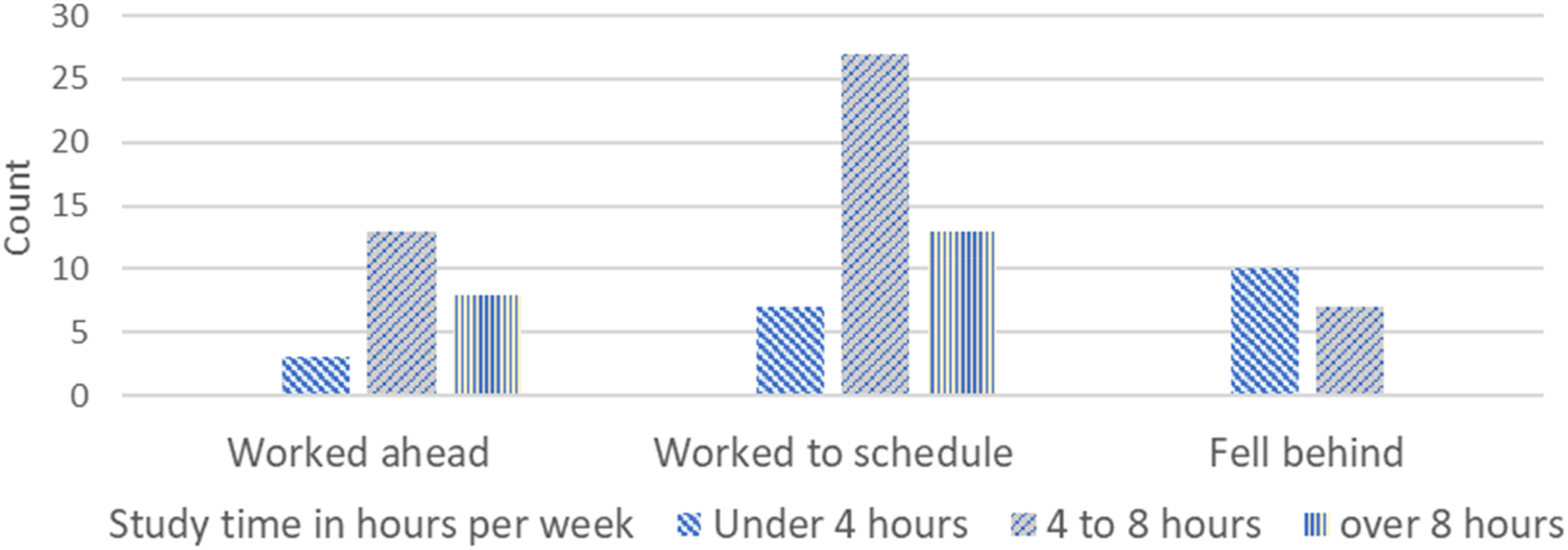
Approach to learning
Exploring students’ approaches to learning combined two data sets, the student preference survey questions and a statistical analysis of the open-ended responses. Figure 2 combines and summarises the percentage of respondents responding positively to particular learning strategies. The student preference questions permitted students to provide multiple responses, allowing students to reference multiple learning strategies. When combined, the data indicate, in order of preference, that students favour reading through the modules, followed by watching videos, taking notes, and doing the module science activities, with the least preferred study strategy being highlighting. The number of responses for highlighting may be impacted by students not having printed materials or the software to highlight electronically. It is of note that, given the opportunity to indicate multiple options, just 35% of respondents claimed to combine and use different learning strategies. Methods used to study the modules (n = 88). Note: >100% because the column total combines percentages for two data sets.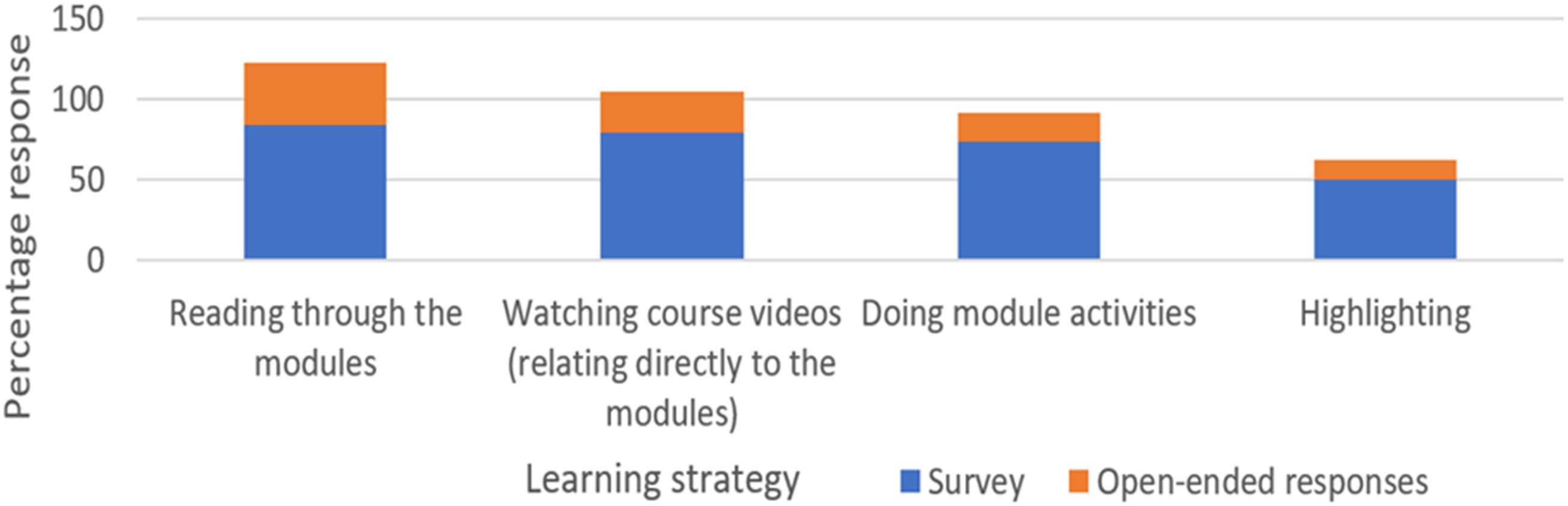
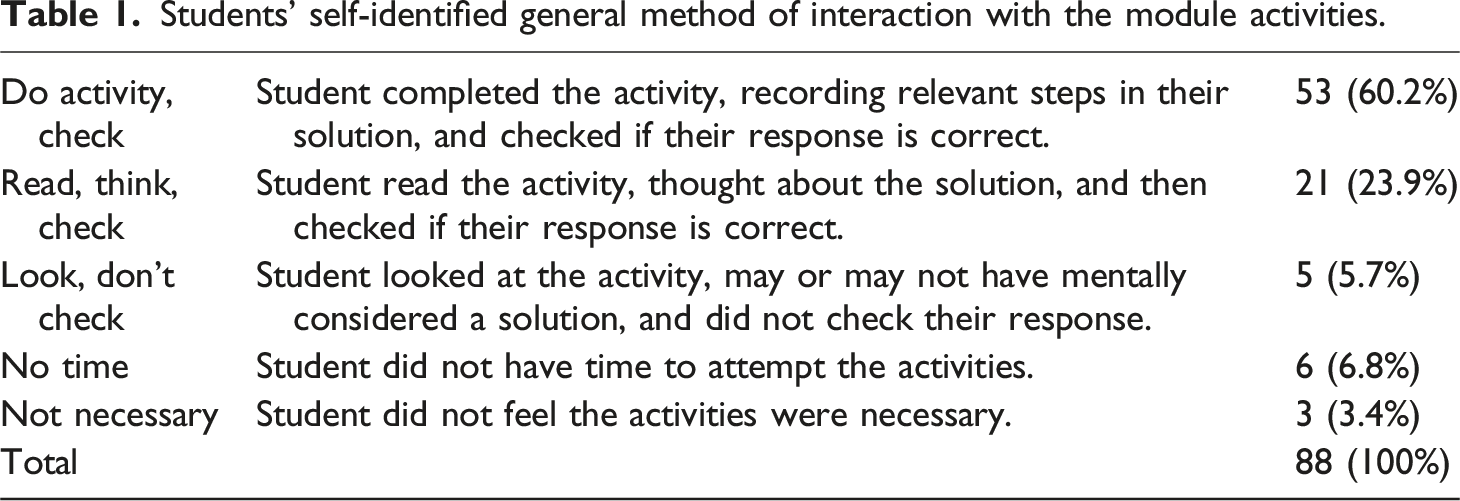
Students’ self-identified general method of interaction with the module activities.
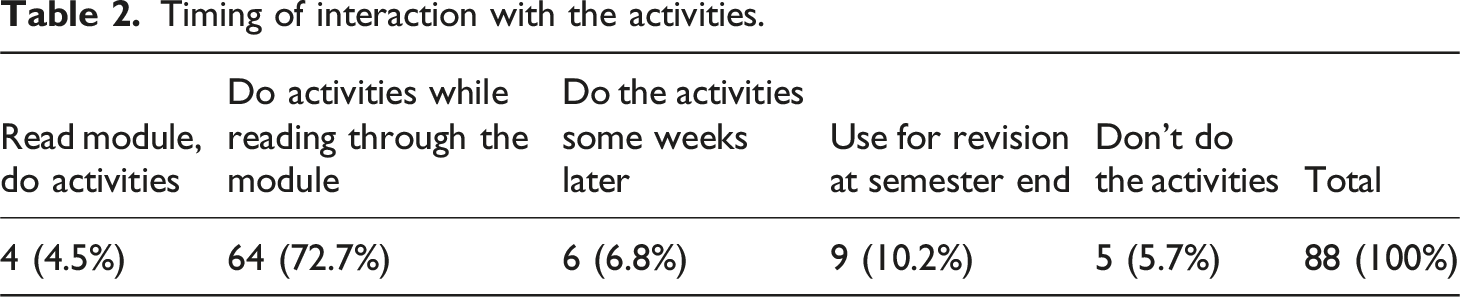
Timing of interaction with the activities.
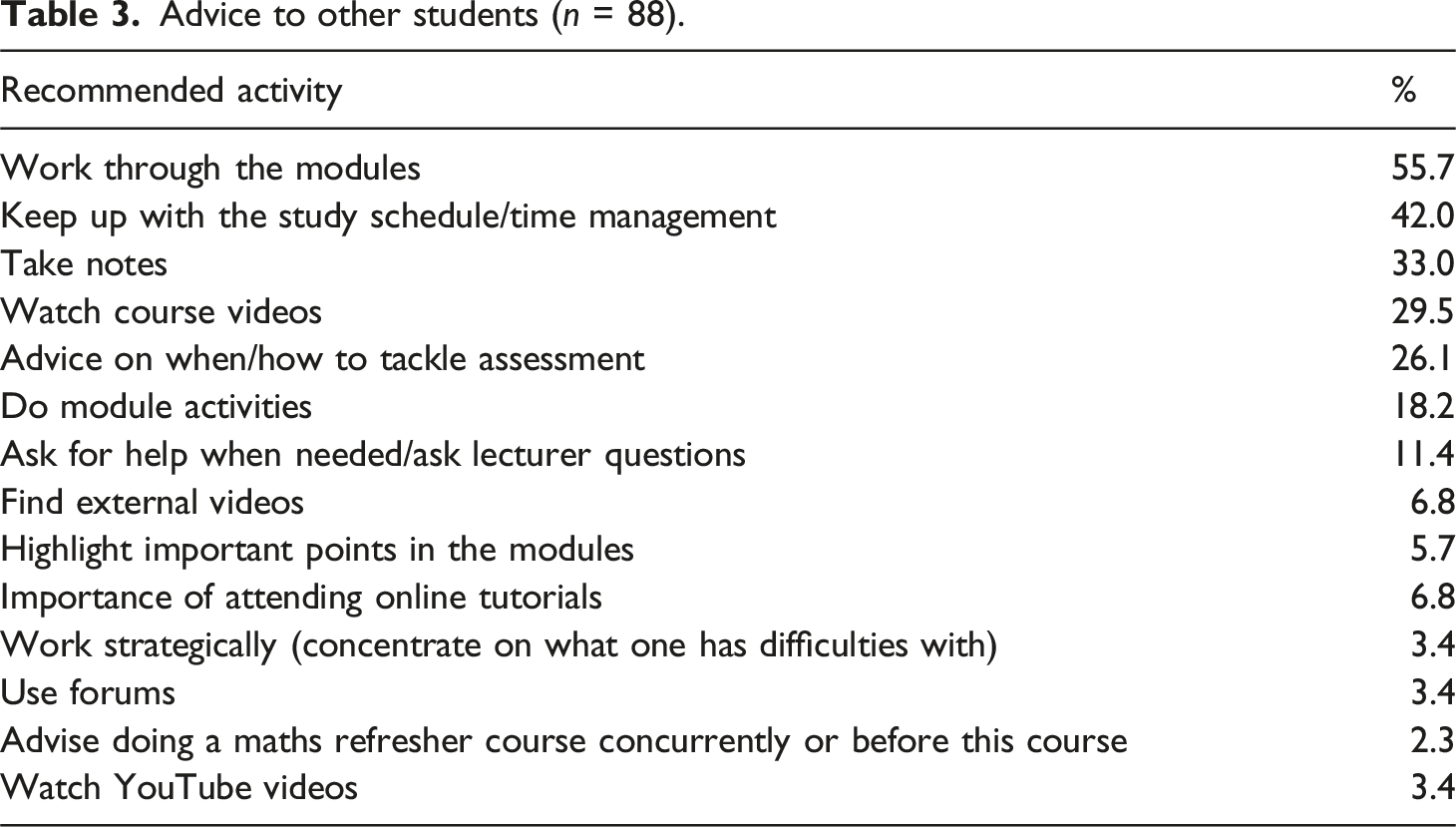
Advice to other students (n = 88).
Qualitative data
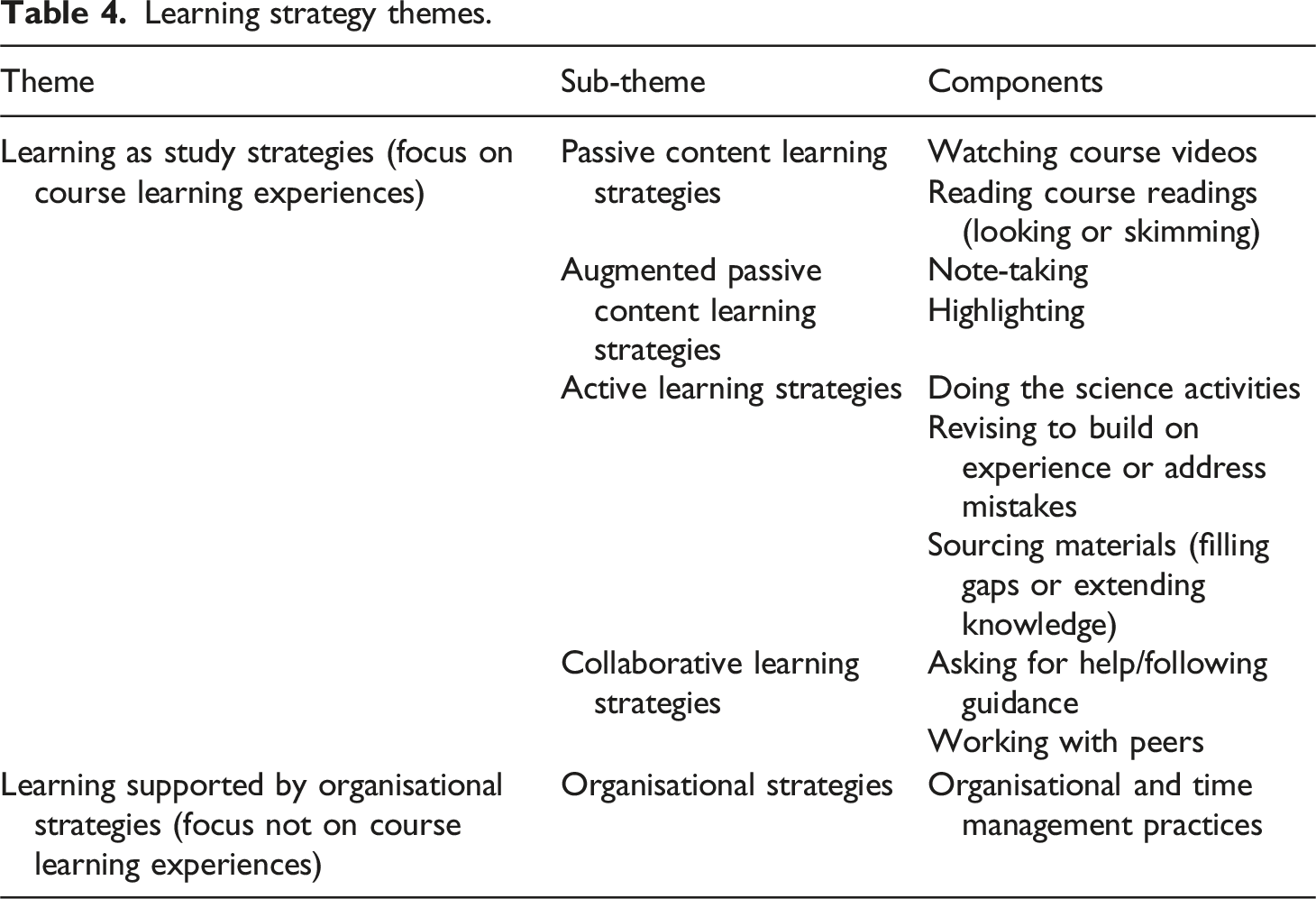
Learning strategy themes.
Theme 1: Learning as study strategies
The first theme, capturing student responses that considered engagement with the course learning experiences, was constituted from the following four sub-themes/concepts/learning strategies.
Passive content learning strategies
Students mentioned study practices that were ostensibly passive, including references to reading the course materials: ‘The most common method I use would be reading through the study materials’ and ‘Reading through the course teaching materials because this is what the teachers set out for you to learn’, as well as watching the course videos: ‘I watch videos because I tend to understand better if it is visual material’.
Augmented passive content learning strategies
In learning content, students augmented more passive strategies with responsive practices such as highlighting text and taking notes: ‘The main method I used was Highlighting material. I would then look it to the highlighted sections in further detail’ and ‘I mainly read through the learning materials and take notes as I go as I find I remember them better if I write it out’. Students associated these strategies with learning course content: ‘I also usually take notes in order to help with retention of information’ and ‘note taking (is) what I find useful … This works for me as this helps me work through the content at my own pace’.
Active learning strategies
Students also referred to study strategies that extended the course content to build on their experience, extend their learning, and address mistakes. Completing the science learning activities was a key active learning strategy: ‘They provide the building blocks for me, to learn’ and the ‘opportunity to put (learning) into practice’, as well as self-checking their own learning progress: ‘I really enjoy doing the activities as well, it’s a good indication of whether I’m actually grasping the concepts’. Students’ comments in this sub-theme include: ‘… doing activities as you come across them … I found them helpful for practicing understanding, particularly with chemistry content and cellular biology content’ and ‘Particularly for the chemistry module, … and work through as many different activities as you can … It looks complicated but with repetition and persistence, it’s quite a simple concept!’.
Collaborative learning strategies
There were a few students who indicated that learning was supported and enhanced by interacting with others. This engagement included teaching staff (‘I would recommend that they speak with an advisor … do not be afraid to ask questions, no matter if they sound stupid, they are NOT’), other students (‘don’t be afraid to use the forums to ask for clarification or question your understanding of something as other students’), and friends and family (‘having my partner ask me questions, as speaking helps me to retain information better’).
Theme 2: Learning supported by organisational practices
The second theme captured responses that represent organisational strategies that support student learning. Students associated organisational practices with learning strategies that helped them to ‘… stay on top of things and also don’t let yourself fall behind’. Such organisational practices included time management: ‘… keep a regular pattern or day a week’, ‘…. make sure that you put time aside every week to stay on track’, and ‘… get a diary and write down what you should be studying this week’.
It is of note that the students’ responses ranged from responses focused on single strategy to more comprehensive responses, such as: ‘I will be revising the chemistry module in full, including to work through all the activities and watch the tutorials. Even though I’m very comfortable with maths (and even the biology module), chemistry is an area where I feel knowledge doesn’t “stick” for me as the concepts feel quite abstract’. Also, ‘(1) Complete the module first, then do the activities. (2) Understand how to draw up graphs. (3) Brush up on your mathematics. (4) Have a short 10 minute break to refresh your mind each hour. (5) Review your notes at the end of the day’.
Discussion
The study explores students’ self-reported study strategies, with a focus on student persistence in learning and learning strategies examined through a passive–active–interactive learning strategies framework. The qualitative and quantitative data indicate that the students participating in the study routinely engaged in passive, shallow-learning strategies, with a more limited awareness and reliance on active and interactive learning strategies.
Passive learning strategies
Triangulation of the qualitative and quantitative data indicates a student preference for more minimal study time allocations and the use of passive study strategies, representing a misalignment with evidence-based, best practice. Miyatsu et al. (2018) similarly found that students can have strong preferences for ineffective study strategies. One proposed explanation for the participants’ preference for more passive study strategies is the influences of stress and time constraints. Students in university preparation programmes are known to experience demanding and complex lives (Jarvis, 2021), and this study found that few students (24%) studied for the recommended 10 hours per week. Blasiman et al. (2017) noted that students who are aware of effective study strategies still frequently rely on ‘relatively ineffective strategies’ (p. 787) due to poor time management, with their study reporting considerable discrepancy between the durations of students’ intended and actual studying times (Blasiman et al., 2017). Student perceptions of a heavy workload, although subjective, can result in increased stress and their decreased engagement (Xerri et al., 2018) and could drive undesirable learning behaviours where more expedient, but less effective, surface learning strategies are adopted. A second explanation suggested by Biwer et al. (2020) is that students often endorse and ‘rely on ineffective strategies, such as rereading’, because students can be ‘fooled by metacognitive illusions and mistakenly interpret short-term performance or ease-of-processing as reliable indicator for long-term learning’ (p. 186). Kornell and Bjork (2007) also raise the possibility of students being misled by subjective feelings of successful learning and short-term learning performance in recalling information. Many students in university preparation science courses, although experienced in other aspects of life, could be considered ‘novice students’ (Deslauriers et al., 2019, p. 19251) in the sciences, with potentially uncomplex and unexamined beliefs about the nature of scientific knowledge and the strategies required to learn in the science domains. This finding is supported by the numerous comments in the qualitative data which are indicative of perceptions that learning in science is synonymous with learning information or content: ‘I think that taking the time to read over the course materials closely and take notes is the best strategy. This allows you to take in all of the information’, ‘Writing notes, I am able to fully take in all the information being provided’, and ‘I read through the modules as I need all the help I can get to memorise the content’.
Active learning strategies
The online science course that is the focus of the study contains numerous resources and activities that covered a range of cognitive levels. The course learning design, influenced by Bloom’s revised taxonomy (Anderson et al., 2001), acknowledged that lower cognitive learning activities are necessary and foundational to higher cognitive learning activities, meaning that, as Miyatsu et al. (2018) assert, every learning strategy is useful and has a place in student learning. However, the course aim was to encourage active learning, here defined as students going beyond the provided course materials to construct personalised learning or produce new artefacts. To achieve active learning, the course design embedded in the modules interrelated concept-specific learning experiences that culminated in targeted, active learning activities. Examples of these active learning activities included: practice questions, real-life problem-solving, analysing and making predictions from data, research questions, at home experiments, opinion polling, simulations, dilemmas, and scenarios, as well as collaborative tutorials, online forums, and peer-to-peer study groups. The analysis indicated that students engaged with these learning strategies and, although student responses to the open-ended questions tended to be brief, there is some indication that active learning strategies are perceived to contribute to mastery or, at least, proactive engagement. These include student references to identifying weak points and reviewing assignment feedback to learn from, and build on, previous mistakes (mastery) as well as references to learning activities providing building blocks for learning and opportunities to put learning into practice (proactive engagement). More research would be required for confirmation, but students’ comments in the qualitative sub-theme of active learning strategies appear indicative of perceptions that learning in science is developmental and active.
Interactive learning strategies
The limited number of references to interactive learning strategies (collaborative strategies) in the qualitative data highlight both the value of collaboration in learning and the possible underutilisation of these strategies. The pedagogical value of interactive learning strategies is acknowledged and asserted in higher education. Brown (2019) notes that students who have even limited interactions, with ‘perhaps as few as two or three’ peers (p. 603) in undergraduate science and mathematics courses, ‘exhibit significant learning gains in comparison to students who work independently’ (p. 604). However, researchers note a range of student challenges to group interactions, such as organisational impediments group composition and time management, and students’ lack of the communication and collaborative experiences and skills required for interactive learning contexts (Le et al., 2018). The impact of the general science students’ potentially content-driven concepts of science learning, time-pressures, and lack of experience in online asynchronous collaboration may account for their lack of awareness of and participation in interactive learning strategies.
Recommendations
The first recommendation is for greater domain-specific research into the relationship between the learning strategies of students in university preparation general science courses and their beliefs about the conceptual nature and acquisition of scientific knowledge (epistemological beliefs). Kornell and Bjork (2007) assert that effective learning relies on students having a ‘reasonably accurate mental model of how learning works’ (p. 223). Currently, not enough is known about students’ beliefs about, and mental models of, how science learning works and the impact of these beliefs and models of their engagement with, and selection of, study strategies. Two other recommendations can be suggested, given what is already known about student preferences for minimalist study approaches (in terms of both time allocation and passive study strategies) and the novice science learning status, potential time constraints, and disrupted educational journeys of students in university preparation science courses. The second recommendation is for embedding domain-specific learning strategies into university preparation science courses. Embedded reflective learning experiences should be specifically tailored for, and contextualised in, preparatory science programmes rather than relying upon generic academic skills courses. As academics teaching into university preparation programmes are noted for the adoption of strengths-based approach to learning and teaching (Crank, 2023), the learning experiences should acknowledge and build on students’ initial understandings of the nature of science knowledge. Reflective learning experiences can engage students in examining the strengths and weaknesses of current passive strategies, optimising these strategies (Miyatsu et al., 2018), as well as introducing more effective active learning strategies. Student responses in this study raised several such science-specific learning experiences that students considered to be beneficial: basic scientific literacy, including interpreting and using information from scientific data sources, particularly graphs, writing in scientific genres (rather that generic essay forms), critically reading and using scientific journals, and reflections on the nature and applications of scientific knowledge. A third and final recommendation is to build on student interest in, and capacity for, interactive learning strategies by leveraging students’ current strengths and experiences in networking and collaborating, potentially using interactive communication formats which students find more familiar and appealing (such as Padlet or Facebook).
Limitations
A key limitation of this study is that the participants were from a single university preparation science course at a regional university and, therefore, their perceptions of science learning strategies may not be the same as other university preparation or undergraduate science courses. As the course surveyed served a wide cohort of students, there is potential for differences in learning strategies and concepts of science learning between students transitioning to science-specific domains (for example, chemistry, biology, and astronomy degrees) and those transitioning to other domains that require science skills (for example, nursing and primary education degrees). Despite the limitations, the findings of this study may be transferable and of interest to general science courses which have comparable student demographics. Beyond the STEM domain, the study may offer points of deliberation for other domains with specific disciple-specific learning strategies and student cohorts that include considerable numbers of mature-aged students and students from underrepresented higher education demographics.
Conclusion
The purpose of this study was to examine the self-reported study strategies of students in an online university preparation science course. Students learning strategies play a key role in success in their attaining academic goals. For students in university preparation programmes, who are frequently mature-aged students or from groups traditionally underrepresented at university, enrolment in a university preparation programme entails a range of personal and financial risks, and so research supporting their academic success is of significance. The students reported a range of learning strategies which, when examined through a passive–active–interactive framework, were found to favour passive, surface-level learning strategies over active learning strategies, with few reports of interactive learning strategies, a finding that is supported by previous research in STEM and wider undergraduate student cohorts.
Possible explanations of the study’s findings include the potential for students in university preparation science courses to be inexperienced with science (novices), leading to uncomplex and unexamined content-driven conceptions of science knowledge, the pressures of time constraints and stress, as well as a lack of experience with, and capacity in, interactive learning strategies in academic science contexts. The study, therefore, recommends embedding learning experiences that reflectively engage university preparation science students in science-specific learning strategies and building student awareness and capacity in interactive learning strategies that use communication formats which students find appealing and natural to use. Future work in this space will require a more clear and comprehensive understanding of general science students’ concepts of and beliefs about the nature knowledge and learning in science.
Footnotes
Declaration of Conflicting Interests
The author(s) declared no potential conflicts of interest with respect to the research, authorship, and/or publication of this article.
Funding
The author(s) received no financial support for the research, authorship, and/or publication of this article.
