



Abstract
Sustainable Development Goal (SDG) target 4.7 promotes education for sustainable development (ESD), urging higher education institutions (HEIs) to prepare students to address global sustainability challenges. Currently, the target indicators do not assess how ESD is enacted in HEIs, making ESD provision a black box in achieving SDG 4.7. This article proposes an analytical tool based on actor–network theory (ANT) to ‘unpack’ the black box of ESD pedagogies in HEIs. ANT allows a closer look at the web of human and non-human actors and their interrelations, visually mapping how ESD pedagogical practices are enacted. Drawing on public sustainability reports and ESD-related web pages of eight Scottish HEIs, we employed a hybrid data analysis approach to produce such a map. The aggregated actor–network map reveals clusters such as university sustainability bodies, ESD-related programs, curriculum elements, co-curricular training, and sustainability awards. Also, Scottish HEI reports and web pages tend to emphasise and quantify what is taught regarding sustainability issues and not elaborate on how ESD is taught. This way, ESD pedagogical practices, connecting students, educators, and curriculum to produce transformative learning, are missing in university reporting. Making those practices visible would provide further solid evidence of Scottish HEIs’ contribution to SDG 4.7.
Keywords
Introduction
Sustainable Development Goals (SDGs) adopted by the United Nations aim to promote sustainable approaches to resolving interconnected global challenges through various environmental, social, and economic activities. Target 4.7 under SDG 4, ‘Quality Education’, focuses on knowledge and skills needed to promote education for sustainable development (ESD) and global citizenship (United Nations, 2015). The global indicator 4.7.1 measures this target using (a) national education policies, (b) curricula, (c) teacher education, and (d) student assessment (United Nations, 2020). Despite the calculation of indicator 4.7.1 addressing only primary and secondary education contexts (UIL, 2020), the role of higher education institutions (HEIs) is widely recognised as key for implementing sustainability principles and leading societal change to promote and achieve SDGs (UNESCO, 2022; Žalėnienė & Pereira, 2021). At the same time, even with the recent advancements in the target 4.7 indicator development (Brockwell et al., 2022), at a higher education (HE) level, very little or no attention is given to pedagogical practices in SDG 4.7 outcome indicators or measurement strategy proposals (Sandoval-Hernández et al., 2019). Omitting how ESD provision is enacted in HE makes ESD pedagogies a black box. Indeed, embedding SDGs into pedagogical practice for HE delivery is under-recognised in favour of SDG-oriented curriculum content (Holmes et al., 2022; UNESCO, 2022). For instance, universities often mention examples of existing SDG-themed educational programs and modules when reporting their activities in addressing ‘Quality Education’; however, it often remains unclear how exactly they fulfil SDG 4.7 or how ESD teaching and learning practices are enacted in the classroom.
Therefore, focussing on pedagogy offers an alternative engagement with SDGs in HE that counteracts the ‘cherry-picking’ approach of teaching SDGs in HEIs (Alm et al., 2021), decentres the capitalist and economic underpinnings of the SDG framework (Chankseliani & McCowan, 2021), and opens the opportunity to think about pedagogy as a tool for purposes other than economic security and environmental control (Bradley, 2023; Stein et al., 2022). For instance, a practice-led approach to ESD reporting can elicit the involved university actors and qualitatively exemplify how interdisciplinarity and transformative learning occur. Additionally, this perspective implies a culturally sensitive decolonial approach to addressing SDGs that challenges universalist and progress-focused understandings of sustainable development (Bradley, 2023; Stein et al., 2022).
To ‘unpack’ the black box of ESD teaching and learning in HE, we propose an analytical tool based on actor–network theory (ANT) that allows a closer look at its specific actors, networks, and interrelations. This tool maps the landscape of human and non-human actors and their associations, showing in detail how ESD pedagogies are enacted in HE.
Building on research covering ESD in the UK HEIs (Fiselier et al., 2018), this exploratory study extends to the Scottish HE context. By drawing on publicly available university sustainability reports and ESD-related web pages, this paper develops an analytical framework that visually highlights prominent and obscured ESD pedagogical practices in HEIs. Therefore, to create such a map, the study poses the following research questions: 1. What or who is involved in ESD pedagogies in HEIs? 2. How do these actors interact or relate to enact those ESD pedagogies?
Throughout the paper, we refer to the what of ESD pedagogy, denoting ESD content and actors, and contrast this to the how of ESD pedagogy, suggesting how these actors interact with each other through teaching and learning practices employed by HEIs.
In the following sections, we first elaborate on ESD pedagogy in contemporary academic literature and briefly overview ANT concepts. Secondly, we detail the study design and the proposed analytical tool. Then, we present the findings derived from the actor–network map and contextualise them in the reviewed literature. Finally, we conclude the paper by acknowledging the limitations of our methodology and listing recommendations and directions for further research.
Literature review
Here, we review the purposes of ESD pedagogy, as well as the tools and practices that authors use to fulfil these purposes. While each conception of ESD presupposes the presence of sustainability curricular content, all authors primarily focus on how that content is delivered.
Purposes of ESD pedagogy
The purpose of ESD pedagogy is a starting point for establishing the practices that should be used (Burns, 2013; Dodd et al., 2022; Lozano et al., 2017). From an overarching perspective, ESD pedagogy aims to alleviate sustainability issues worldwide by educating students in HE. However, SDG 4.7 has the narrower purpose of ensuring ‘that all learners acquire the knowledge and skills needed to promote sustainable development’ (United Nations, 2015, p. 19). Following this, the authors explore different methods of teaching the necessary knowledge and skills.
Burns (2013) places transformation as the central purpose of ESD pedagogy. This is because teaching students about sustainability requires adopting ‘holistic, systemic, collective and ecological ways of thinking’ (p. 166), which shifts their understanding of their position in the world. The pedagogical tools must encourage students to engage in meaning-making to fulfil this purpose. This involves students recognising, questioning, and reframing the values underlying dominant discourses towards sustainability (Burns, 2015).
Scholars also focus on competency building as the purpose of ESD pedagogy (Giangrande et al., 2019; Lozano et al., 2017; Mintz & Tal, 2018). Competencies are understood as the ability, made up of networks of knowledge, skills, and motivation, to approach a given problem and solve it, producing useful outcomes and understanding (Giangrande et al., 2019). However, such perspectives frame competency building as something that aims towards an endpoint or solution, but problems such as those encapsulated by the SDGs require ongoing consideration and questioning without a clear endpoint. That said, each scholar argues that framing the purpose of pedagogy as competency development provides educators with a concrete goal in their curriculum and teaching practice, and identifies the competencies needed for ongoing sustainable development. Giangrande et al. (2019, p. 4) developed a competencies framework that distinguishes between first-order and second-order competencies: first-order competencies that relate directly to the context and subject discipline, such as subject-specific knowledge, and second-order competencies are skills that are key to sustainable development such as critical thinking. This is because first-order competencies are for stable contexts; for example, in developing a medicine to treat a bacterial disease, researchers will use compounds on the bacteria in clinically controlled environments with predictions about the outcome of their interaction. Knowledge of these compounds and bacteria, as well as lab methods, is first-order competencies for a stable lab environment. However, for unpredictable contexts, second-order competencies are flexible, allowing for thinking that is reactive to the needs of the moment. Applying the medicine to people in the real world requires the ability to work out how the compounds might interact with the person who has the disease, whether there might be complications with other medications the person may be on, and how it might impact their wider lifestyle. This requires more flexible, second-order competencies such as critical thinking, synthesising different types of information to form a conclusion, recognising the risks of the medicine, and balancing these in a cost–benefit analysis, amongst many others.
Mintz and Tal’s (2018) approach distinguishes between affective (relating to ethical and emotional thinking that creates motivation) and cognitive skills. Their framework establishes a place for knowledge and understanding, skills, and affect as learning outcomes. These outcomes reflect the nature of sustainability issues within ESD, building within students a holistic understanding of sustainability and an action-oriented disposition towards the problems of environmental degradation. This requires understanding sustainability issues and instilling students with practical approaches to addressing them, allowing students to develop perspectives motivated by ethical judgements reinforced by the emotional realities that environmental issues create.
Lozano et al. (2017, p. 3) produce a competency framework from a literature review of articles focussing on ‘competencies for sustainability’ and ‘pedagogy for sustainability’. They generate 12 competencies, including critical thinking and analysis and strategic action. They link these competencies to pedagogical approaches to analyse whether these approaches result in students developing the related competencies. While they do not justify a competency-based approach to ESD, the competencies they identify overlap with Giangrande et al. (2019) and Mintz and Tal (2018), suggesting that the grounding for these competencies is the same as those mentioned above.
The alignment of ESD pedagogy with SDG 4.7 is evident; each approach aims at outcomes that equip students with knowledge, skills, and motivation to address problems created by environmental degradation. Beyond this, the outcomes of transformative learning and competency development have applications further afield than ecological and environmental domains. Many of the outcomes of ESD pedagogy are suitable for addressing the social justice issues embedded within the wider SDG framework (Dodd et al., 2022; United Nations, 2015).
Practices of ESD pedagogy
ESD pedagogy involves a network of interrelated people, structures, and platforms contributing to a student’s learning. While they vary between understandings of ESD pedagogy and between the contexts in which it is practised, some factors are crucial to its implementation.
Firstly, educators are vital to developing successful ESD pedagogy. From the perspective of course and curriculum design, educators must engage with various learning approaches, such as interdisciplinary learning (Burns, 2013; Eilam & Trop, 2010), place-based learning (Burns, 2013; Eilam & Trop, 2010; Lozano et al., 2017), and experiential learning (Eilam & Trop, 2010; Tarrant & Thiele, 2016). Educators must stay open to many learning and teaching approaches as their relationship with students, for whom no one approach will suit them all (Lozano et al., 2017), means that they must be responsive to their needs. This allows students the flexibility necessary to be transformed and develop the competencies to address sustainability issues.
Educators can adjust the form and content of the curriculum the students will participate in. Developing a horizontal curriculum including a diversity of knowledge and contexts (Dodd wet al., 2022), using a variety of learning media (Eilam & Trop, 2010), and questioning dominant knowledge systems through the inclusion of non-dominant and indigenous knowledge (Burns, 2015) create a space for students to engage with sustainability in a multitude of ways. Through developing curricula that are non-hierarchical and include diverse expressions of knowledge and skills (Giangrande et al., 2019), educators provide their students with more chances to connect with the values and practices needed to address sustainability issues. Such efforts align with practices of decolonising the curriculum (Stein et al., 2022), which usually involves challenging and revising traditional Eurocentric perspectives, integrating indigenous and local knowledge systems, ensuring the representation of diverse voices and experiences, or more specifically, incorporating case studies from non-Western contexts, inviting guest speakers from diverse backgrounds, and using learning materials that reflect a broad range of cultural perspectives. Such practices allow students to see how sustainability issues might be approached differently and foster a more inclusive and comprehensive understanding of global sustainability challenges.
Another critical aspect was the need for affective and ethical engagements with sustainability for students. This practice instils a disposition towards action (Dodd et al., 2022) and the development of ethical and emotional competencies (Eilam & Trop, 2010; Mintz & Tal, 2018) and allows students to enfold their knowledge with curricula. Including space for affective and ethical discussion in ESD pedagogy constructs the classroom as a place that fosters the creation of ‘a supportive community of learners’ (Burns, 2015, p. 269). Such experiences are shaped by and help shape students, encouraging them to be knowledgeable about sustainability through their learning and invested in acting on real-world problems.
Connecting with local communities is also a key feature of ESD curricula through the structure of HEIs. This ensures that local stakeholders are involved in the ESD provided by universities (Dodd et al., 2022; Lozano et al., 2017; Tarrant & Thiele, 2016). This informal pedagogy sits outside the classroom and encourages one of the three primary functions that HEIs should perform: community engagement. By working with local communities, universities demonstrate a commitment to sustainability through practices indirectly tied to classroom pedagogy, showing students that community engagement is a valuable way of doing sustainability work and incorporating ESD into their functioning as an institution. Bringing communities into pedagogical practices in this way means that universities can contribute to the social, cultural, economic, and sustainability environments of their local context, incorporating ways of working associated with ‘engaged universities’ (Charles, 2023, p. 225).
Engaging local communities does not have to be local to the university but can be local to the students’ communities as students continue to engage with the global contexts and institutions they are familiar with (Burns, 2013). Such an approach enables students to resolve sustainability issues in real life, incorporating place-based and experiential learning (Eilam & Trop, 2010) and creating an environment where students invest in engaging with ESD as it is tied to their context and practices.
Finally, conceptualising ESD as a networked system was prominent throughout the literature (Burns, 2013; Dodd et al., 2022). There were multiple motivations for this approach. Burns (2015, p. 265) argues that conceiving ESD pedagogy as a network reflects the interconnected nature of the environment: ‘ecological systems teach us that relationships are essential and that interdependent relationships are primary’. Tarrant and Thiele (2016) draw on Muir (2004) to inspire an interconnected picture of pedagogy that moves beyond humans to include non-human agents, noting, ‘[w]hen you try to pick out anything by itself, you find it hitched to everything else in the universe’ (p. 57). Networked thinking reminds educators that in pedagogical practice, as in ecological systems, each element has a role in bringing about transformative learning or competency development. This widens the context of ESD pedagogy from the narrower scope of a classroom in HE and the human actors in it to the material space, social connections, and broader university structure.
What is clear from the literature is the network of ESD pedagogy that, while mainly concentrated on classroom teaching practice, has implications for the wider university and the communities it is connected to. While picking out the concrete actors present in those reports, our analysis draws on the factors articulated here – focussing on transformative learning, competencies, educators, affective and ethical engagements, community engagement, and interconnectedness – to see how universities are practising ESD pedagogy and where they might be falling short.
As a result of the characterisations of ESD that we found, there is a need for an analytical method that can draw out the people, content, and practices of ESD pedagogy in Scottish HEI reports and web pages. Below, we describe the actor–network theory, which allows us to unpack how SDG 4.7 is being practised in these universities and compare this to the practices in the pedagogical literature.
On actor–network theory
The study employs an actor–network theory (ANT) perspective to deconstruct the complexity of ESD pedagogies and examine the intricate web of its actors and associations tracing the existing practices. ANT was developed by sociologists Bruno Latour, Michel Callon, John Law, and associates (Callon, 1986; Latour, 1987; Law, 1984). It is both a way of understanding the world (an ontological orientation) and a method of study (a methodological framework) that challenges conventional human-centred views of social reality. Instead, ANT states that both human and non-human entities (material objects, institutions, technologies, or policies) actively shape existing social and technical networks (Latour, 2005). In ANT terms, an actor is an entity that acts, exerts agency, or is affected by relations with others, while a network is a dynamic, non-hierarchical group or assemblage of interconnected actors (Latour, 2005). Actors are not limited to individuals, social groups, or organisations; they may encompass material objects, ideas, technical solutions, and even abstract concepts. Most importantly, according to the concept of ‘generalised symmetry’, all actors are considered equivalent in agency and influence within a heterogeneous network and are not given a priori significance, as they gain or generate it through interactions with other actors. For example, the actors of university ESD pedagogies might be students, teaching staff, university web pages, formal curriculum elements, sustainability training, digital learning platforms, or learning and teaching strategies. They all might influence the provision of ESD, and the nature of their interrelations makes ESD initiatives accomplished (or not).
For feasibility reasons, ANT researchers intentionally focus on a specific part of the network or ‘cut the network’ (Strathern, 1996) and treat complex groups of actors as single units, ignoring irrelevant connections. Additionally, to highlight the contribution of essential actors and factors within ESD pedagogies, the study employs another ANT concept of an ‘obligatory passage point’ (OPP) – a crucial moment, location, or an actor in a network where other actors must interact with or pass through to enact change or achieve their goals (Callon, 1986). Identifying these points is essential for understanding how ESD pedagogies are shaped, implemented, and sustained within the university context.
Finally, ANT enables us to visualise the landscape and create an actor–network map of ESD actors and their interactions within a specific university. By tracing the relationships and flows of agency among these actors, we can uncover the intricate dynamics and challenge conventional power structures that underlie the provision of ESD pedagogies, eventually allowing a more nuanced understanding of how ESD pedagogies emerge and evolve. In the following chapter, we outline the ANT-informed methodology and analytical tool that helps create a map of ESD teaching and learning practices in HE.
Methodology
Data collection
Due to the study’s exploratory nature, we employed document analysis as a primary research method. Document analysis is common in ANT-informed ethnography, as documents, being more than representations of complex reality, allow researchers to focus on overlooked or taken-for-granted elements of practice, making some things visible and present and others invisible and absent (MacLeod et al., 2019). The objects of this study’s document analysis were the latest available university sustainability reports and ESD-themed university web pages, as they portray a visible image of university ESD pedagogical activities, projects, and initiatives both to the internal university audience (applicants, students, staff, etc.) and the public. Additionally, these web documents highlight and elaborate on specific actors, interactions, and networks involved in university ESD practices.
Scope and selection criteria
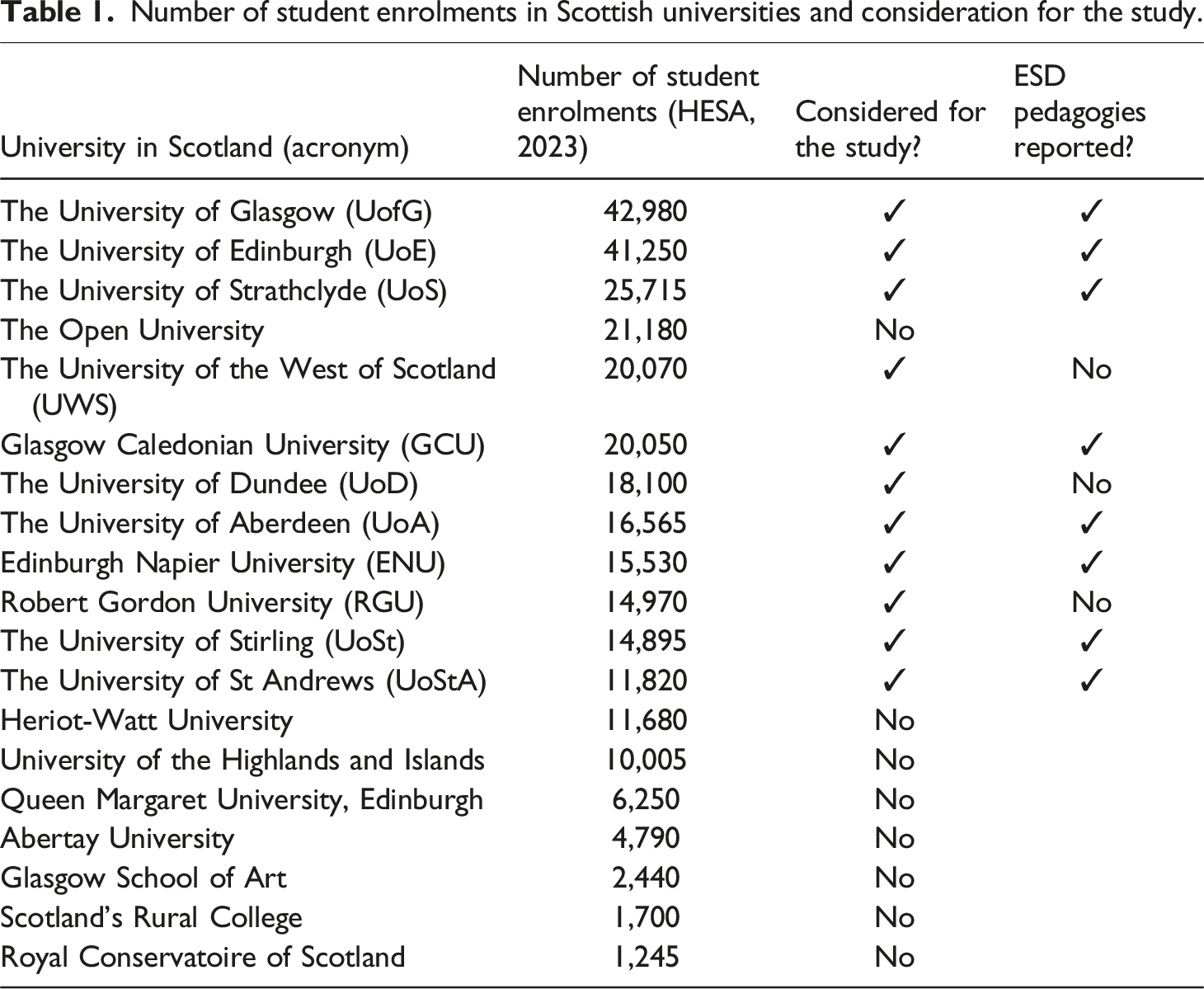
Number of student enrolments in Scottish universities and consideration for the study.
Data analysis
While there is no right ANT-informed data analysis strategy, the theory suggests that assemblages – complex and dynamic networks of social and material elements – should serve as units of analysis (MacLeod et al., 2019). Considering the scope of our study, we purposefully ‘cut the networks’ and focused only on those university assemblages of actors and interactions that were reported to take part (even potentially) in different ways of teaching and learning about (or for) sustainable development. Therefore, we followed a hybrid approach that combined elements of (1) a content analysis (Cohen et al., 2018) to identify the actors and code types of their interrelations from the reports and web pages and (2) a social network analysis (SNA) (Digital Promise, 2018; Home Office, 2016) to create an aggregated visual network representation of the studied assemblages. Despite the name, the SNA did not exclude non-human actors but, according to the principle of generalised symmetry, considered them equally important as human actors in enacting university ESD pedagogies. For each university, the process involved filtering only those university ESD web pages or sustainability report chapters related to ESD teaching and learning or university sustainability bodies, initiatives, and projects. Secondly, in those texts, we identified and coded present actors, networks, and interactions between those involved in ESD pedagogies. Following SNA, we assigned actors as nodes, interrelations as connectors, and sub-networks as clusters of actors. Instead of using specialised SNA software, we aggregated and presented the results on a digital collaboration platform, Miro (https://miro.com), for simplicity and readability.
The SNA resulted in an aggregated university actor–network map of ESD pedagogies shown in Figure 1, where individual university actor–network maps were ‘laid’ upon each other, resulting in a grouped representation of the current state of ESD pedagogies in Scottish universities. Based on nodes’ centrality and frequency in each map, the map visually highlights in bold multiple OPPs – actors or sub-networks that served as central figures or potential gatekeepers enabling university ESD pedagogical practices. Each selected university’s ESD-related initiative was colour-coded with a Miro sticky note and labelled with a text in case it had a title. Aggregated actor–network map of ESD pedagogies in Scottish universities.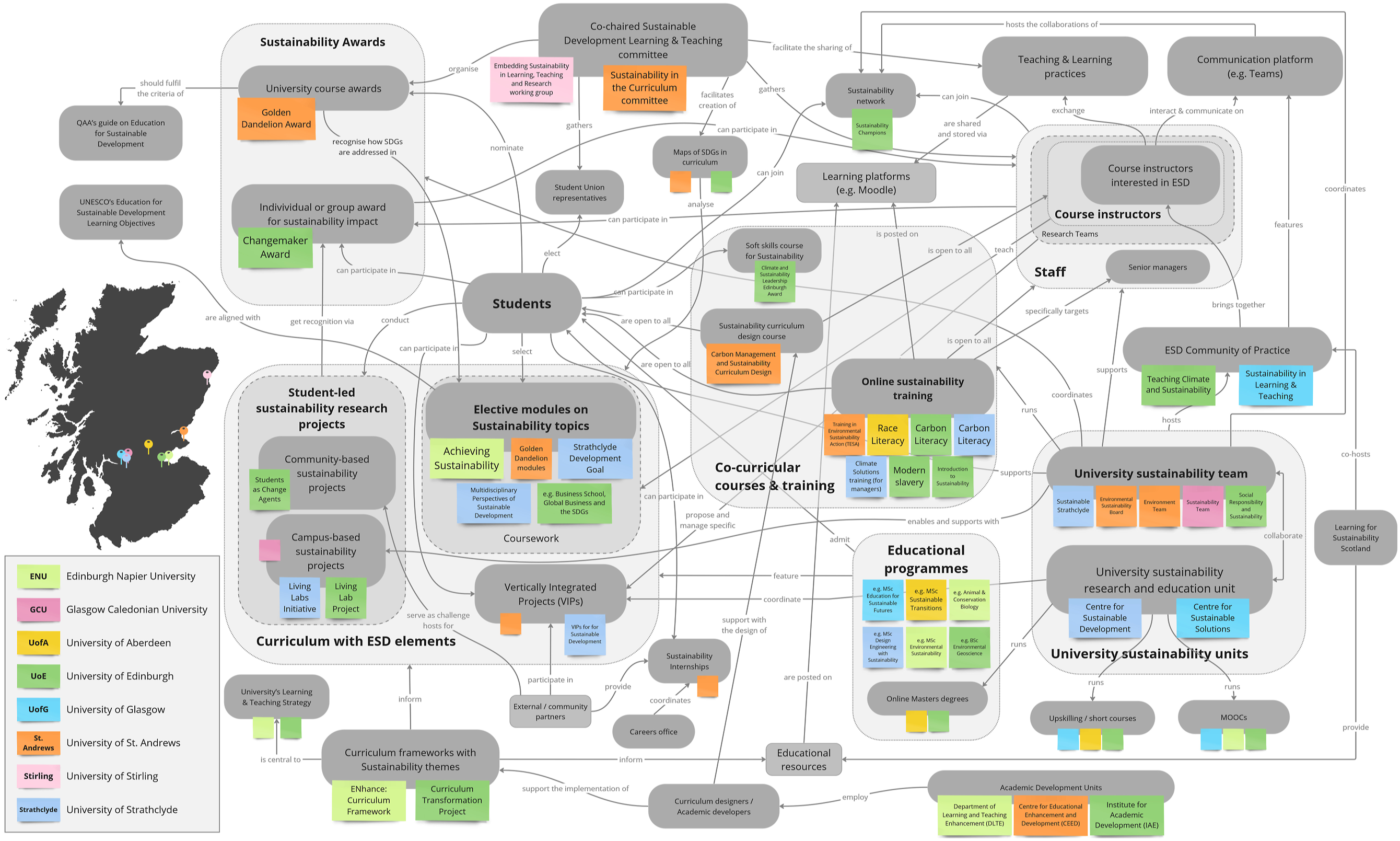
Findings
While all Scottish educational institutions, as public bodies, are required to report annually on compliance with climate change duties (Sustainable Scotland Network, 2022), only 8 out of 11 largest Scottish universities have a custom form of ESD pedagogy reporting in place (see Table 1): either as a downloadable PDF document or information web page(s). There was no such reporting for RGU and UoD, and while UWS (2019) had a 2018/2019 annual sustainability report present, it omitted information about teaching and learning about/for sustainable development.
Among the eight universities, the level of reporting on ESD pedagogies varied significantly in quality and quantity. Some universities, such as UoS, go into detail on student-led projects, educational programmes, elective modules, online training, and wider community projects they provide. On the other hand, universities like UoSt forgo reporting on this content and mention only a single aspect of ESD teaching and learning. Therefore, the HEIs contribute differently to the aggregated actor–network map, as seen from the colour labels in Figure 1.
The study results comprise five major categories of university-led sub-networks: university sustainability bodies, educational programmes, ESD curriculum elements, co-curricular ESD training, and sustainability awards and competitions. Notably, numerous universities in their reporting mention student-led sustainability teams like Glasgow University Environmental Sustainability Team, GUEST (University of Glasgow, 2022a), or extra-curricular ESD pedagogical activities, for example, Climate Fresk or Switch Off campaign in UoS (2022b). However, such actors were not considered in this study’s scope, as students’ agency, ingenuity, and extra-curricular interest in sustainability practices may emerge separately from existing forms of university-led ESD pedagogies.
University sustainability bodies
One of the key actors in promoting ESD pedagogies across students, teaching and research staff, departments, schools, and other units are university sustainability teams. While operating in half of the studied universities, some focus purely on the environmental aspect of sustainable development, for example, the Environment Team at the UofStA (2022a). At the same time, others also address social responsibility, for example, the Social Responsibility and Sustainability Team at UoE (2023e) or the Sustainability Team at GCU (2023). The functions of these teams may be diverse: running co-curricular ESD training activities, organising sustainability competitions, coordinating university-wide sustainability networks, hosting ESD Community of Practice for teaching staff, or providing resources to university staff and students in on-campus sustainability initiatives and research projects. These teams are to be differentiated with sustainability research and education units (e.g. Centre for Sustainable Development at UoS (2023a) or Centre for Sustainable Solutions at UofG (2023)) serving as umbrella entities that lead transdisciplinary research, coordinate research-based education initiatives, or run online continuing professional development (CPD) courses.
Two clear actors identified in the ESD pedagogies map are university students, as the primary audience of ESD activities, and university staff, manifested in the reports by ESD-related research groups, senior managers, and, most importantly, course lead instructors, who are essential in executing ESD-related programmes, elective modules, and teaching methods ‘in the classroom’. In UofG (2022b) and UoE (2023f), the teaching staff interested in ESD themes and promoting sustainability in their courses are invited to join a corresponding Community of Practice (sometimes co-hosted by Learning for Sustainability Scotland (2023), an expert network of educators, practitioners, and partners) to share and exchange ideas and teaching and learning practices via online communication and learning platforms.
Other university bodies integral for learning design support of ESD-enhanced (co-)curricular coursework and (co-)development of corresponding education resources are academic development units, for example, the Centre for Educational Enhancement and Development at UofStA (2023) or Department of Learning and Teaching Enhancement at ENU (2023a). Apart from working closely with course instructors and programme leaders in improving the higher education provision, academic developers and curriculum designers support the implementation of ESD-themed curriculum frameworks employed by universities, such as ‘ENhance: Curriculum Enhancement Framework’ at ENU (2022) or ‘Curriculum Transformation Programme’ at UoE (2023d). The execution of such frameworks may translate into ESD pedagogies via universities’ Learning and Teaching Strategies and enhance the quality of specific ESD elements of curricula.
The final notable actor that brings together student union officers, faculty members, and administrative personnel to audit and oversee the ESD pedagogical practices is a co-chaired sustainability learning and teaching committee, for example, Embedding Sustainability in Learning, Teaching and Research working group at the University of Stirling (2023) or Sustainability in the Curriculum committee at UofStA (2022b). These groups facilitate sharing of best ESD teaching and learning practices and SDG mapping in curricula but also organise university course awards.
ESD-related educational programmes
In its ESD reporting and showcasing, every Scottish university substantially focused on educational programmes for students, including on-campus and online, and undergraduate and postgraduate degrees. For instance, UoA (2021) dedicates two pages of its annual sustainability report to a new MSc in sustainability transitions. Also, several universities highlighted educational services for broader audiences, such as ESD-related upskilling and CPD short courses or massive open online courses (MOOCs).
ESD curriculum elements
Half of the universities in their reporting highlight specific elective modules as ESD pedagogy actors, as they allow students to engage with SDGs in a practical manner. Usually, these are credit-bearing courses (from 10 to 30 SCQF credits) on topics related to sustainable development, for example, Achieving Sustainability at ENU (2023b) or Strathclyde Development Goal (2022a) undergraduate online course designed in line with UNESCO’s Education for Sustainable Development Learning Objectives (UNESCO, 2017).
One alternative format to classroom teaching on SDGs is interdisciplinary research-based ESD encompassed by Vertically Integrated Projects (VIPs) – initiatives that bring together students from different disciplines and different years of study to work on a long-term research team tackling real-world sustainability issues. In our study, only UoS (2023c) and UofStA (2021) feature VIPs that promote how they can benefit students and external or community partners.
Lastly, UoS (2021) and UoE (2021) showcase successful student-led sustainability research projects either based on campus or completed within a local community. An example of such a research-based activity is the ‘Living Lab’ – a collaborative research opportunity for students to solve a real-life issue for the university and propose an evidence-based change or improvement of its policy or operations.
Co-curricular ESD training
In at least four Scottish universities, sustainability teams organise open and optional sustainability training for introductory purposes. For students, it may take the form of co-curricular non–credit-bearing online self-paced modules, like Training for Environmental Sustainability Action at UofStA (2022a), or semester-long courses to develop corresponding soft skills to lead future change, for example, Climate and Sustainability Leadership Edinburgh Award at UoE (2023c). For staff, the training may be self-paced (e.g. UoA’s (2021) Race Literacy) or synchronous, as the Climate Solutions training at UoS (2023b) for senior university managers. Finally, university-wide training is occasionally strongly recommended for students and staff once enrolled or employed in the university, for example, Carbon Literacy at UoE (2023b) or UoS (2023b) alongside other mandatory university courses.
Sustainability awards
While the sustainability awards might not directly affect teaching and learning about (or for) sustainable development, they can provide strong incentives for students and teaching staff to engage with sustainability projects or initiatives and inspire further action by role-modelling. Two types of university-based awards were identified: recognition of excellent educational courses and acknowledgement of noticeable positive sustainability impact. For instance, Golden Dandelion at UofStA (2021) recognises those modules that practically address SDGs through their teaching approaches and follow ESD guidance by QAA and Advance HE (2021). Alternatively, the Change Maker Award at University of Edinburgh (2023a) recognises students and staff who, individually or in a group, undertook a socially responsible or sustainable project or inspired others to act more socially or sustainably.
Discussion
In this section, we discuss what we know about the practices of SDGs in Scottish HEIs because of the actor–network map, looking at how this aligns with the principles of ESD pedagogy outlined in the literature review. Then, we discuss what is still missing from these reports from the perspective of ESD pedagogy, namely the interpersonal pedagogical practices between students, educators, curriculum, and so on, that are missing from the interrelations of actors in the network.
ESD pedagogy and HEI practice
Our findings show a focus from HEIs on showcasing how sustainability content has become embedded into the curriculum via co- or extra-curricular activities, as well as specific programmes focused on sustainability issues. Beyond this, the network demonstrates that while some HEIs provide students the space to engage in sustainability projects inside and outside campus, others organise awards to incentivise these projects.
Just these two groups of actors clearly align with the purposes and methods of ESD pedagogy. The student-led projects reflect the importance of community engagement that Lozano et al. (2017) and Tarrant and Thiele (2016) present as vital for involving communities and for students’ learning as these are experiences they will have through careers addressing sustainable development. As universities create opportunities for sustainable practice outside of the classroom, students can engage with their understanding of sustainability in a way that is not captured through classroom pedagogical approaches. Building networks and local relationships allows students to develop interpersonal and emotional skills that are key to the transformative and competency development purposes of ESD (Burns, 2013; Giangrande et al., 2019).
In addition, the projects are student-led, which means that students have greater autonomy to approach contexts that are important to them and have an emotional investment in the project’s success beyond its recognition. These are both key elements of ESD pedagogy, where place-based learning (Lozano et al., 2017) and emotional experiences in the learning process (Dodd et al., 2022) can develop motivated and practical attitudes in students towards sustainability issues.
Sustainability content expressed in HEI reports through the co- and extra-curricular modules and sustainability-focused programmes shows a meaningful point of connection with ESD pedagogy, and such a commitment is motivated by the broader SDG framework. The SDGs and ESD pedagogy purposes run parallel insofar as they ultimately want to address the sustainability problems. While for SDGs, this can be straightforward, for ESD pedagogy, it is via instilling in students a motivated and knowledgeable disposition towards sustainability action (Dodd et al., 2022). As such, covering sustainability content within the curriculum is a key factor in HEIs meeting SDGs.
These aspects capture what is brought to the surface through our ANT analysis of HEI sustainability reporting in Scotland. This sustainability content is finding itself more deeply embedded in HEI curricula, and students are having meaningful, practical engagements with the world through student-led projects, which shows how SDG 4.7 is being approached. In this sense, the network map unpacks the black box of SDG 4.7 to show how universities address the issue of quality education. However, some actors and interrelations still remain mysterious to those engaging with HEI sustainability reports and websites.
ESD pedagogy: What is left unsaid
Much of the literature on ESD pedagogy focuses on the approaches that educators can use to aid students’ learning and fulfil the purposes of ESD, that is, the how of ESD pedagogy. However, HEI sustainability reporting focuses more on the content being delivered to students or created through student-led projects, that is, the what of ESD pedagogy.
We see this as an important distinction in terms of the practices from the academic literature and SDG 4.7 itself. The fact that sustainability content is being delivered to students or is being developed is only the first step towards ensuring that students learn the tools to practice ESD and become global citizens. The next step is to understand what methods of pedagogy work well for encouraging students’ learning and knowledge creation (see Burns (2013) and Dodd et al. (2022) for examples).
We theorise that the pedagogical practices employed by educators and universities are interrelations between actors existing in our network map (students, staff, curriculum, and so on) that have not been explored. This is because pedagogy relates different aspects of the HEI network to produce learning, and the nature of these relationships impacts whether students have the best chance to develop the skills and attitudes that the curriculum content is designed to exemplify (UNESCO, 2022).
That these interrelations are not on the map constitutes another black box for how student outcomes are reached. Literature on ESD pedagogy details effective teaching approaches and the types of experiences students should have through their education to help them understand and use the knowledge in the curriculum. As such, these aspects of pedagogy relate educators and curriculum content to students in specific ways that are not reflected on our map.
Broadly, HEI reports aim to showcase how universities work towards the fulfilment of SDGs, quantitatively listing different projects and outcomes. This differs substantially from the purposes of ESD pedagogy, where the outcomes for students and how they are reached take on a more qualitative character. The literature on ESD speaks to diversity issues (in terms of curriculum and teaching practices), transformation, and meaningful experiences that help students learn and adopt critical and practical dispositions towards sustainability (Burns, 2013). However, listing outcomes or projects does not accurately evidence the fulfilment of these purposes, as the importance lies in how the teaching is done.
To understand why reports mostly omit the how of ESD, we view them as cultural objects partly constructed by the text but also by readers and the context of their authorship (Bradley, 2023). The values and practices that underlie how the reports and web pages were authored may provide some insight into why these interrelationships are not captured here. We hypothesise that either HEIs showcase their modules or student project success stories to demonstrate what sustainability content is integrated into their curriculum, or the reports’ authors do not communicate closely with ESD practitioners.
However, this does not undermine the importance of reporting on pedagogical practice. The fulfilment of SDG 4.7 and purposes of ESD pedagogy are closely related insofar as ESD pedagogy can help educators provide an education which moves towards the fulfilment of SDG 4.7. A key contention we hold in this paper is that, given the role ESD pedagogy plays in reaching SDG 4.7, reporting should cover how teaching is done if universities are to provide evidence of quality education for sustainable development and global citizenship.
Looking at what aspects of ESD pedagogy are captured within HEI sustainability reports and web pages and what aspects are not can inform future research and reporting frameworks. Given the qualitative nature of how ESD pedagogy is done, further studies to uncover this finer-grained black box must be approached from a qualitative perspective. Using qualitative inquiry at HEIs could further elucidate how they fulfil SDG 4.7 through their pedagogical practice and ensure quality education is provided through research dissemination and knowledge exchange. Additionally, further research into sustainability reporting practice could identify why the interpersonal aspects of pedagogy are not reported on and contribute towards reforms of reporting practices that incorporate pedagogy as a key part of their framework.
Conclusions
This article argues that SDG 4.7 is a black box with unknown mechanisms for nurturing students as global citizens who work towards addressing sustainability issues. UNESCO (2022) emphasises the importance of sound pedagogical practice if HEIs seek to contribute towards the SDGs, so obscuring these mechanisms clouds HEIs’ contribution and potential pedagogical improvements.
Using ANT, we built a map which details the actors and relationships that are relevant to ESD pedagogy in Scottish HEIs. The actor–network map produced unpacks this black box, making explicit the actors and relationships that make up current ESD pedagogical practice. We argue that these reports and web pages rely on the what of ESD, focussing on sustainability content in the curriculum. What is not discussed in these reports is the how of ESD – the interpersonal practices that educators employ to help their students develop critical and action-oriented dispositions towards sustainability issues.
In not discussing these practices, Scottish HEIs create another black box that is key to understanding the quality of education around sustainability issues. However, this emphasises the opportunity to explore what pedagogical practices are being employed in universities and why they are missing from sustainability reports and web pages. Pursuing these opportunities enables researchers to identify how practice aligns with the fulfilment of SDG 4.7 and how sustainability reports might incorporate how teaching and learning are done. Below, we discuss some limitations of our methodology and outline recommendations and future lines of research.
Limitations
There are a couple of limitations of our methodology. Firstly, while being an unobtrusive method, the document analysis of publicly available reports and websites may provide a biased picture of ESD pedagogies rather than what is practised in universities. This is because such documents represent reality produced by universities with vested interests in positively presenting their brand and sustainability practices.
Secondly, the reports and websites are usually shaped by reporting purposes and targets, often obscured from the public, as well as by the contributors and other material and immaterial actors, for example, report writers, administrative personnel, reporting deadlines, document accessibility, and readability.
Therefore, there is a potential gap between pedagogical practices taking place in the classroom and the instances of successful pedagogical initiatives showcased online via documents and websites.
Recommendations and further research
Firstly, university sustainability reports or corresponding web pages should showcase the teaching and learning methods used in educational programmes, taught- and research-based modules, and co-curricular activities that align with the transformative learning and competency development of ESD pedagogy. Indeed, HEIs report the what of ESD in their curricula, but how students learn in practice is missing.
Secondly, further research is required to elucidate the reporting practices and pedagogical approaches employed within the universities. For example, primary fieldwork in universities, exploring how reports and web pages are drafted, would shed light on the frameworks and values that underlie their authorship. Also, qualitative engagement with practitioners, students, or university bodies would provide insights into the pedagogical approaches used for ESD.
Footnotes
Acknowledgements
We thank Mike Osborne, Hans Schuetze, and the Higher Education Reform (HER) conference committee for accepting our academic poster that served as the basis for the paper submitted below. Also, we thank our PhD supervisors, Dr Lisa Bradley and Dr Barbara Read, for their senior advice and support throughout the process.
Declaration of conflicting interests
The author(s) declared no potential conflicts of interest with respect to the research, authorship, and/or publication of this article.
Funding
The author(s) received no financial support for the research, authorship, and/or publication of this article.
