



Abstract
Maintaining the abilities and utilizing, even developing the potential of older adults is currently one of the important issues in an aged society, and participation in education is an important method to maintain and develop the abilities of older adults. Exploring the factors that discourage older adults from participating in learning activities is important in promoting their educational participation. Therefore, this paper focuses on understanding why older adults may be reluctant to participate in learning activities. This study utilized an interview approach to gain an in-depth understanding of the perspectives of older adults, with 24 participants involved in the study. The interview data was analysed using open coding, axial coding, and selective coding for qualitative data analysis and to draw conclusions. The results indicated that older adults may be reluctant to participate in education, which may be influenced by factors such as age, physical condition, education level, economic status, lifestyle, interpersonal relationships, transportation, and the types of courses available. According to the findings, two important issues regarding older adult education were identified: personal difficulties and curriculum structure. Based on the research results, this study provides suggestions for future reference in planning older adult education.
Introduction
To cope with a changing society, lifelong learning allows individuals to meet their learning needs throughout their lives. The front-end model of education no longer meets people’s lifelong needs. Regardless of a person’s stage of life, learning is necessary to ensure people’s successful adaptation to modern science and technology. According to Chang and Lin (2011), lifelong learning is no longer merely a slogan but also a way of life. Learning is the best way to encourage older adults to keep pace with modern society. Although the human lifespan has been extended, the half-life of the knowledge people require has become shorter in the context of a fast-changing environment. In addition, older adults face physical, mental and social role changes that shape their learning needs. Learning not only allows older adults to fill knowledge gaps, engage actively in society, expand their interpersonal relationships, promote healthy ageing, and improve their quality of life, it also allows society to take advantage of older adults as manpower by enabling them to contribute continuously to an ageing society.
Therefore, in addition to a comprehensive social welfare system, modern societies encourage older adults to participate in learning activities and cultivate retired persons as manpower. For instance, the Ministry of Education of Taiwan issued the ‘White paper for implementing education for older adults in an ageing society’ in 2006, devoted major efforts to the task of developing education for older adults, and developed new learning models such as Senior Active Learning Universities and Senior Citizen Active Learning Centres. Additionally, the Taiwanese Executive Yuan has promoted ‘Friendly Care Services for Seniors’, which aims to accomplish five purposes, including the promotion of healthy ageing, active ageing, ageing in place, intelligent ageing and fun-learning ageing. Furthermore, in the ‘White Paper for an Aging Society’, the Taiwanese Executive Yuan declares that the government should combine educational resources drawn from corporations and society to assist older adults in relearning psychological adaptation, education, interest development, social participation, financial planning and preparation for life after retirement (Executive Yuan , 2015). As mentioned above, in Taiwan, encouraging older adults to participate in learning activities is an important way in which the government can promote the development of individuals in an ageing society.
Learning in Later Life
After retirement, older adults face various challenges, including changes in their social role, sources of income, mental state and physical functions as well as friends and relatives passing away and the fear of death (Hsieh, 2013). Older adults face more dramatic life changes than members of other age groups, and they usually learn to accept these changes and adjust to life. Tam (2018) noted that learning enables older adults to adjust to the transition from work to retirement and beneficial to society. McClusky (1974) classified older adults’ needs as coping needs, expressive needs, contributive needs, influence needs and transcendence needs. By engaging in elder learning, older adults can meet these five needs and achieve the new knowledge, skills and social support that can empower them to express themselves and contribute to society. Role theory has posited that participation in education can assist older adults in coping with role transitions, for example, retirement or becoming a grandparent. Activity theory has claimed that education can help older adults participate actively in social activities, develop new roles and demonstrate the meaning of existence. Withnall (2005) believed that learning is one of the key elements for older adults to actively participate and contribute to society. Continuity theory has assumed that people tend to maintain a consistent pattern of behaviour in old age, and to replace their lost social roles, they seek similar roles that can allow them to cope with those changes in the social environment; accordingly, learning can help older adults live a healthy and happy life. Continuity theory has been similar to selective optimization with compensations theory that suggests older adults can achieve successful ageing by maintaining their previous interests, behaviours, activities and social relationships, through connections to past experiences (Tam, & Chui, 2016). Many studies have also found the same result, that is, older adults’ participation in education can have a positive impact on their life and promote physical and mental health and active ageing. Gledenning (1995) and Tam (2014) considered that participating in learning activities can help older adults avoid marginalization, build social relationships and improve their quality of life. Dench and Regan (2000) and Tam (2012) all noted that older learners have positive experiences with regard to the enjoyment of life as well as their confidence, self-concept, self-satisfaction and ability to cope. Learning helps older adults lead healthy and active lives, acquire the ability to use new technology, and build confidence and self-esteem (Tam, 2012). Hsieh (2013) reported that encouraging retirees to participate in learning activities can help them engage in retirement planning, thus allowing them to avoid feelings of emptiness and loss and increasing their sense of accomplishment and meaning in life. Derksen and Denburg (2015) mentioned that by participating in learning, older adults can enhance their cognitive performance and social interaction. In conclusion, learning is an effective way of achieving successful ageing and helping older adults continue to contribute to society, thereby decreasing the shortage of manpower in the future. In other words, elderlearning is not only beneficial to older adults themselves, but also contributes to the development of society.
Possible Reasons for Older Adults’ Lack of Participation in Education
Since learning can assist individuals in maintaining their physical and mental well-being, adapting to life and engaging in social interactions during old age, why do most older adults seem reluctant to participate in learning activities? This article refers to learning activities that are organized and systematic, which take place in formal or non-formal educational institutions. The institutions providing older adult education in Taiwan include universities, welfare organizations, non-governmental organizations and community groups. The Ministry of Health and Welfare found that only 4.88% of older adults participated in learning activities in the ‘Report of the Senior Citizen Condition Survey 2017’ of Taiwan (Ministry of Health and Welfare, 2018). The report showed that worries regarding health problems and falls decrease their willingness to participate in social activities.
Cross (1981) claimed that older adults faced three categories of barriers with regard to their participation in education, which includes situational barriers, institutional barriers, and dispositional barriers. Huang (2008) assumed that older adults face various barriers that hinder their participation in education. These barriers include institutional, dispositional and situational barriers, with informational barriers being the only difference from the previously mentioned barriers. Informational barriers refer to situations in which individuals are willing to participate in educational activities, but they do not know which institutions offer courses in which they want to participate; thus, they are unable to participate, and many of these people with lower levels of education and lower incomes. The information society may cause such informational barriers to become more severe for older adults. According to Kao and Chiang (2009), the factors associated with older adults’ failure to participate in learning activities include a lack of interest, being too old, poor health, a lack of time and inconvenient transportation, which are mostly classified as dispositional barriers and situational barriers. Dispositional barriers refer to internal factors that hinder an individual’s willingness to engage in learning activities, such as lack of interest or confidence in learning. On the other hand, situational barriers typically refer to external factors that impact an individual’s willingness to learn, such as lack of time or transportation.
Stereotypes regarding older adults’ competence are another important factor affecting their participation in education, and older adults themselves are also worried about the decline in their learning ability due to ageing (Chang, & Lin, 2011). In addition, credentialism represents the primary source of pressure that discourages older adults in Taiwan from participating in learning activities (Chen, 2016). Individuals with low educational attainment are often perceived to have limited learning abilities. Credentialism is a social phenomenon that overemphasizes academic qualifications while overlooking individuals' abilities. This phenomenon is present globally but is particularly evident in East Asian countries. Older adults have high self-esteem but low learning confidence, and such stereotypes become barriers to the participation of older adults in learning. Hung (2005) reported that factors associated with the failure of older adults in Taiwan to participate in learning activities include the attitudes of society towards older adults’ learning, family attitudes, confidence, traffic, personal interest, the arrangement of their daily schedules, and the acquisition of information. Therefore, societal attitudes towards older adults may affect their participation in organized education.
Disengagement theory has proposed that as individuals age, they disengage from society, and it is beneficial for both the individual and society to separate from each other (Marshall, & Clarke, 2007). Older adults are expected to withdraw from society and that young people are expected to take over their previous social roles to promote social stability. After withdrawing from society, older adults can not only reduce the interference of individual deaths in society, but also have more time to focus on the pursuit of personal interests and hobbies (Miao, & Huang, 2000). Hsieh (2013) stated that some older adults maintain a certain degree of distance from the outside world after retirement due to the decline in their energy that occurs as they age, and so they focus more on personal development during the ageing process. Cumming (2000) also noted that withdrawal from society is better adapted to the lives of older individuals. Hsiao (2010) argued that the reasons why older adults choose to leave the crowd mostly stem from the external environment which results in a psychological and behavioural withdrawal for older adults, leading to a reduction in their connection and participation in society. Miao and Huang (2000) mentioned that many older adults withdraw from society because of the lack of opportunities to continue participating in activities. Despite the ongoing debate among scholars about whether the disengagement theory aligns with the current social context, the perspectives it offers on social attitudes and individual retirement adaptation can serve as a reference for exploring why older adults are reluctant to participate in educational activities. For example, in educational activities for older adults, this theory can provide a direction for consideration on how to create a warm and friendly environment like home, how to combine curriculum with interests to enhance learning motivation and how to assist older adults in finding their social roles.
In addition to the abovementioned factors, negative experiences at school can influence the intention of older adults to participate in learning activities, resulting in low self-esteem and the avoidance of organized learning (Árnason & Valgeirsdóttir, 2015). Árnason and Valgeirsdóttir also generalized the conclusions of Cross (1981) and Connell (1999) that people who are less likely to participate in organized learning activities tend to be unemployed and/or economically inactive, to have a limited formal education, to work for small companies and to be older. In summary, assessments of individuals' physical and mental capacity and the sociocultural context of older adult learning affect whether older adults decide to participate in learning activities. Therefore, the purpose of this study is to obtain a deeper understanding of the reasons why most older adults are reluctant to participate in learning activities.
Method
The main purpose of this study is to understand why older adults are less willing to participate in older adult education? The main reason for using qualitative research and in-depth interview method in this study is that qualitative research can obtain more in-depth information compared to quantitative research. The focus of this study is to understand the reasons why older adults may be reluctant to participate in older adult education, therefore field interviews were conducted with older adults who may be reluctant to participate in older adult education as the research subjects.
Sampling
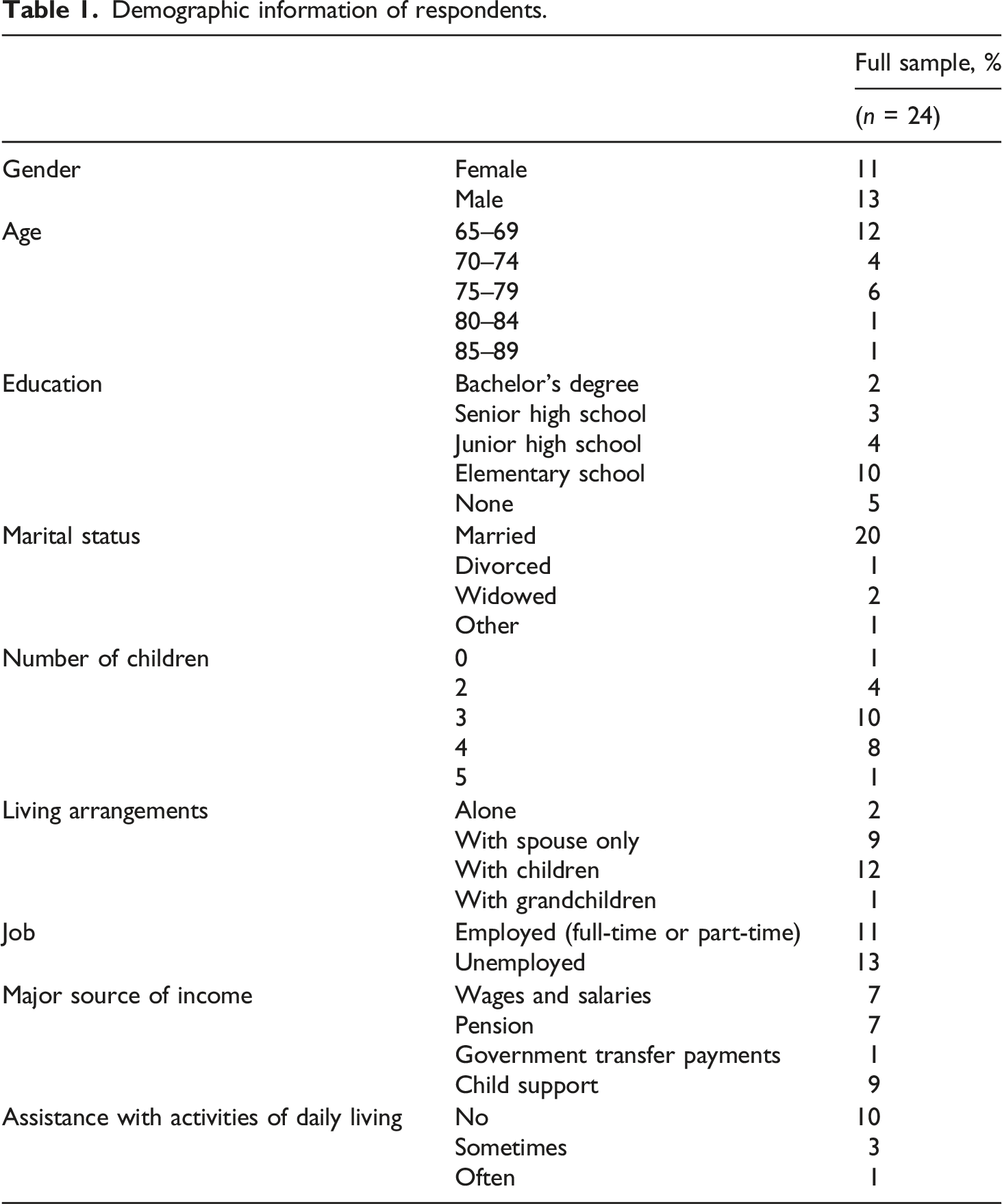
Demographic information of respondents.
Data Collection and Analysis
In-depth interviews were the main data source and the participants in this study included 24 older adults who may be reluctant to participate in learning activities. The interviewers addressed ethical issues, including informed consent and anonymity. Each interviewee was interviewed at least once or twice, and each interview session lasted for at least one to 2 hours. The interview location was chosen by the older adults themselves to ensure they felt safe and comfortable during the conversation, and this may have included their homes, community locations, activity centres and so on. The interviewers expressed their gratitude to the interviewees at the end of the interviews. After the interview, the data were transcribed into verbatim transcripts. After repeated readings of all interviewee transcripts, open coding, axial coding and selective coding were conducted. The data were systematically broken down and integrated to form several concepts, followed by result interpretation.
Results
In this study, qualitative data drawn from interviews with 24 older adults highlighted several interesting points regarding the opinions of older adults concerning their lack of participation in education. The following discussion focuses on findings regarding their reasons for non-participation.
As Older Individuals Age, Their Willingness to Participate in Educational Activities Typically Decreases
The physiological decline that occurs in old age reduces older adults’ self-confidence, which causes them to become less willing to participate in learning activities. They are afraid that they do not have sufficient energy and ability to participate in learning activities. Ageing myths such as the claim that becoming older entails becoming frail or dependent continue to be prevalent, and many older adults doubt their learning capacity. Although not all older adults experience this phenomenon, it is a common participation barrier. As Yi said, ‘I lose interest in studying. If I have free time, I like to watch TV at home, think about how to maintain good health and chat with the neighbours. I am unable to join those courses due to my health and age’. Ju concurred, noting that ‘I am too old to learn. Even if I have opportunities to go to school, I don’t want to go. I don’t feel like doing anything except chatting with friends’. Withnall et al. (2004) pointed out that the myths about elderlearning include the belief that they are too slow to learn anything new, and the saying that ‘you can’t teach an old dog new tricks’. Additionally, educational institutions that offer learning activities for older adults are usually located far away from the communities in which they live, so older adults usually consider traffic problems, and the difficulties associated with meeting new people and the environment remain major challenges for older adults. The socioemotional selectivity theory posits that older adults perceive time differently than younger people, and that they make different choices regarding the importance of life goals and the prioritization of interpersonal relationships. According to socioemotional selectivity theory, as individuals age, they perceive their time as limited, and so older adults tend to choose to interact with familiar people to meet their immediate emotional needs (Huang, & Yang, 2006; Lu, 2000; Shen, & Liao, 2012). As noted above, older adults may increase the willingness to learn if relatives, friends or neighbours participate in learning with them.
Physiological Changes Are an Important Factor for Older Adults Who Do Not Want to Participate in Learning Activities
Physiological diseases affect older adults’ activities of daily living, especially their ability to walk. That is, the main biological factors affecting older adults’ lack of participation in education include cardiovascular disease and lower limb problems. As Mei said, ‘I have asthma and heart disease and am thus unable to attend a class. I can’t even cook now, even at home to help my children to manage the store’. In addition, due to physical limitations, it is impossible for some older adults to sit for a long time, and some older persons wear diapers, which results in a decrease in their self-esteem that might affect their self-confidence in learning. Mi, Quan, Yi and Zheng all reported that walking limitations represent the main barrier to learning. Ying: The courses are so long that I can hardly sit still, which does not show respect for teachers. And I am so embarrassed about wearing diapers. Older adults with poor health do not want to go to school. De: I have bone spurs and can't sit for too long. I would like to relax and enjoy myself in retirement. When I go to school, I must follow the rules of the classroom and time schedule, which makes me feel time restrictions.
Huang (2002) overserves that the prevalence of ADL and IADL disabilities increase with age. Chen et al. (2017) in their study of health decline in elderly individuals, observed increasing trends over time for disabilities, especially regarding housework and using the toilet, thereby supporting the notion that health declines with age. Therefore, the physical health status may be one of the important factors that affect some older adults’ decision to participate in older adult education.
Lack of Accessibility of Educational Facilities Decreases Older Adults’ Motivation to Participate in Learning Activities
The communities in which older adults live do not provide learning activities that they want, and they may find some community located near them if they want to participate in those courses. Inconvenient transportation reduces the willingness of older adults to go outside. As Qiu said, ‘It’s too far for me to attend courses, especially evening classes. I have night vision problems; it is so dangerous for me to go out at night that I dare not participate in learning. Those courses I like are not offered here, but other places are too far away’. Guo noted that ‘There are no courses for older persons in my community. I usually get used to doing the housework, and playing cards, singing, making tea, and chatting with neighbours and friends’. The Taiwanese government has provided home and community-based long-term care services to older adults, but community-based programmes for older adults are restricted. Older adults must drive, use public transportation or arrange a ride to participate in learning, which can be a challenge for older people and their families. As Chou (2013) noted, the ways in which older adults can overcome distance barriers pertain to their functional abilities and social background as well as public facilities. Therefore, it is crucial for older adults to consider the accessibility of educational facilities.
Level of Education Affects Older Adults’ Willingness to Engage in Educational Activities
Árnason and Valgeirsdóttir (2015) mentioned that people with less formal education participate proportionately less frequently in organized learning activities than people with higher levels of formal education and that the former express their insecurity and distrust in their learning abilities. In this study, there were 19 participants with education levels equivalent to junior high school or below who expressed low willingness to participate in older adult education. As Ming, Qiu and Jin said, ‘I don’t know how to study without literacy. I had heard that some schools teach literacy, but now they seem to be hard to find’. Mei noted that ‘I speak Taiwanese, not speak Mandarin Chinese, so I can’t go to school’. According to the ‘Report of the Senior Citizen Condition Survey 2017’ of Taiwan (Ministry of Health and Welfare, 2018), the percentage of illiterate older adults who participate and do not participate in organized learning activities were 0.87% and 99.13%, respectively, while the corresponding percentages for older adults with a university education were 13.30% and 86.70%. This result showed that those with higher levels of education are more willing to participate in organized learning activities, and vice versa. Chang (2006), in his study of the comparison between elderly learners and older adults do not participate in formal learning, found that older people’s level of education was an important factor affecting their participation in activities and suggested that the government should encourage older adults with less education or poorer physical conditions to participate in all kinds of learning activities. Árnason, and Valgeirsdóttir (2015) reported that a large portion of non-participants in learning activities with lower levels of formal education avoid further education due to insecurity, distrust in their learning abilities and previous negative experiences in school. Tam and Chui’s research (2016) also showed that older adults with lower educational backgrounds face obstacles in their willingness to participate in education. In their study on health improvement, interpersonal relationships and life satisfaction among elderly learners in Taipei, Chen et al. (2018) suggested that it is necessary to promote learning participation among older adult learners with lower social and economic status. However, some older adults with high levels of education do not participate in learning activities because the learning institutes that host those activities do not offer courses that meet their needs. Although De has a bachelor’s degree, he does not participate in learning activities because the older adult education curriculums of nearby educational institutions do not meet his needs.
Older Adults Are Often Resistant to Changes in Lifestyle
Older adults do not like changes; they prefer a familiar environment and a stable life that can give them a sense of security. Their experience with cognitive or physical decline causes them to become more careful with regard to avoiding danger and maintaining their health. As the research results reported by Donnellan and Lucas (2008) indicated, extraversion and openness are negatively associated with age, and age often causes people to become more conservative. Lifestyle changes are not easy for anyone to make, especially with regard to older adults, which may lead to the emergence of anxious feelings. Therefore, choosing to maintain their original lifestyle seems to be a safer choice for older adults. For example, Mi noted that ‘Every morning I go to grow vegetables, fruits, and corn, take a nap at noon, then watch TV and go to bed. Although my husband did not recognize me because of dementia, he was well cared for in the nursing home. My children are married and live close to me. I am very happy; I don’t want to change my life’. Qiu and Zhen also noted that watching TV at home and exercising in the park are good for their health. Preserving their original way of life provides them with a sense of security. Kuo and Kao (2003), in their study on the effects of lifestyle on the learning needs of older adults in the Elder College of Kaohsiung City, suggested that educational institutes should develop curricula in accordance with older adults’ lifestyles and learning needs to improve their willingness to learn.
Older Adults Who Work Tend to Have Less Time to Participate in Education
Due to the cost-of-living increases, the pensions of many older adults are insufficient for them to retire, and so many older adults often continue to earn money to meet their life needs or retire more comfortably; in addition, they do not want to become a financial burden on their children. Due to their physical decline and workloads, participating in education is not a priority in their lives. I have a job. Due to a scheduling conflict, I am unable to take these courses, and on Saturday I must still go to work. In addition, I participate in Tzu Chi recycling, which makes my life meaningful. Therefore, I have no time to participate in learning activities… [Sheng, employed] I get up at three every day to go to the wholesale market to buy food and come back to sell vegetables. When I go home, it’s afternoon, I don't have enough time to study. Children now have their own families and don't like to live with their in-laws. Because of their hard work, I won't go to ask them for living expenses. [Hui, employed]
Another situation is that older adults often help their adult children take care of their grandchildren, perform housework and cook meals; these tasks occupy the majority of older adults’ time. As Yi noted, ‘I am very busy; I don’t have enough time to go to study. I must do housework, cook three meals for my family, and go to the market to buy food. I don’t have free time’. This quotation showed that many dual-earner families rely on their parents or others to care for their children and that children are safer when they are in the care of grandparents. Shih (2015) stated that in Taiwan, grandparent care is a more affordable, trusting and safe form of care than other types of childcares. Grandparents' care for their grandchildren is one of the important pillars of family caregiving.
Friends Sometimes Do Not Have the Opportunity to Participate in Learning Activities Together
Many experts have recommended that older adults should focus on the ‘Five Olds’ (in Chinese) to enhance their well-being in later life; this category includes spouses, friends, health, money and interests. Among the ‘Five Olds’, social support from friends can play a critical role with regard to the learning participation of older adults. Chun, Fu and Su all mentioned that they look forward to participating in learning activities with their friends. If they are unable to participate in learning activities jointly with their friends, they may not have the courage necessary to try new things. Because people become cautious and take fewer risks as they age, family members, friends and neighbours could enhance older adults’ sense of security and learning motivation. Yang (2002) stated that friends are important and significant resources and sources of support in one’s later life. Chiang (2017) noted that the reasons why older adults are reluctant to participate in learning include factors such as peer influence, loneliness and so on. Loneliness reduces older adults’ social participation and is a common barrier to learning. In 2022, the proportion of the aged living alone booked for caring persons aged 65 and above living alone in Taiwan is estimated to be approximately 1% (Ministry of Welfare and Health, 2023). The phenomenon of older adult living alone will become increasingly common as the ageing population progresses. How to reduce the loneliness of older adults, connect them with society and avoid social isolation is a key issue. Formosa and Galea (2020) argued that institutional learning, such as senior centres for older adults to meet with peers of the same age group, can help reduce feelings of loneliness and prevent social isolation. Therefore, how to encourage older adults to participate in organized learning activities and familiar neighbours, friends and the residential community providing support play important roles.
Often Older Adults Are Not Aware of Free Courses for Senior Citizens
The rapid development of technology makes it difficult for older adults to keep pace with information change. Information spreads in a variety of ways, such as via social media, websites and email, which are the most popular methods of communication. Many educational institutes and organizations use communication strategies that may not be used by older adults who prefer more conventional means of communication, and such older adults are thus unable to obtain all course information that they require. As Qiu said, ‘I will participate if the school and the community provide some learning activities. But I don’t use the internet, and I don’t know how to check the course online. I hope that the course locations are closer to me; then I would want to join’. This quotation showed that informational barriers are common among Baby Boomers. In addition, according to the ‘Report of the Senior Citizen Condition Survey 2017’ of Taiwan (Ministry of Health and Welfare, 2018), 73.48% of people aged 65 and above never use the internet at home including having no device to use it. Therefore, traditional forms of information are necessary for older generations in the contemporary world. Institutions should develop different educational marketing strategies for older people of different generations and socioeconomic backgrounds, so that all older persons who wish to learn can easily access information about older adult education. In addition to these information barriers, the participants also mentioned that they wanted to know which courses were free. Chun and Sheng noted that older adults do not know where they can obtain information regarding older adult learning but that if such courses were free, they would be more willing to participate. It may be the case that for many older adults, their pension is the main part of their retirement income; they spend money only on necessities and save as much as they can. Wei et al. (2022) mentioned that Taiwan’s older adult education was not economically friendly enough for disadvantaged older adults. Therefore, incorporating partially free or low-cost course planning into plans for older adult education would be beneficial for financially limited older persons to participate in learning.
Educational Institutes Do Not Provide Sufficient Programmes That Meet the Needs of Older Adults
Many educational institutes do not attempt to investigate older adults’ learning needs. These institutions plan courses mainly based on institutional leader style or government policies, following the institution-driven model. Although the institution-driven model makes the organization more effective, it may not meet older adults’ needs. Ying, Zhong and Qing noted that older adults are not interested in many of the courses offered by such institutions, and too few field learning or travel courses are offered. Institutions must figure out how to ensure that their curriculum design meets the needs of older adults and develop ways of attracting older adults to participate in learning activities. Additionally, information technology now provides all information that is necessary for life; as Chen said, ‘the course content available in older adult education is too slow for me to get the latest information. Now you can get all needed information immediately from Google search’. Guo expressed the same opinion, noting that he could acquire many things online and from websites. Therefore, education institutes should make significant updates to the course content and design courses and other factors based on information technology to provide information regarding competency demands in later life (Kuo & Kao, 2003). Due to changing times and the high demand for technology, older adult education curricula have to strengthen older people’s ability to integrate and apply scientific knowledge and skills. However, as indicated by the aforementioned ‘Report of the Senior Citizen Condition Survey 2017’ in Taiwan, despite the advancements in information technology in the current era, which enable the promotion of diverse educational courses for older adults through the internet, approximately 70% of older adults still feel unfamiliar with the internet. This could be attributed to generational differences in social development. Therefore, when promoting these courses, it is necessary to consider the variations among older individuals from different generations. Currently, traditional methods of promotion, such as printed materials, radio, and television, remain important avenues to attract older adult participation in these courses and enhance their ability to adapt to a changing society.
Conclusion and Implications
Education is a right, and learning is the best way to survive in modern society.
No matter a person’s age, there is no way to resist the progress of science, and only continuous learning can allow people to adapt to social changes. Older adults have the ability to learn, but the question of how to encourage them to participate actively in learning activities is an important issue for an ageing society. Wang (2010) noted that participation in education is the most basic form of social participation. Apparently, learning is a good way to help older adults avoid social isolation and strengthen their interpersonal networks.
The findings discussed above highlight at least two important issues pertaining to the development of older adult education. The first such issue concerns personal difficulties, including physical ageing, ill-health, personal socioeconomic status and interpersonal relationships. Assisting older adults in overcoming personal learning barriers as much as possible may increase their motivation to participate in learning. Educational institutions should establish an accessible and age-friendly learning environment to the greatest extent possible for elderly individuals, including accessibility, classrooms, desks and chairs, audio-visual aids, lighting, restrooms, and other facilities and develop assistive devices that can help older adults participate in and successfully complete learning activities more easily. Furthermore, educational institutions should try to design solutions to deliver learning at home, such as mobile learning, to enable people with disabilities or traffic barriers to study successfully at home. As the process of fourth-age population growth continues, which refers to the age when people rapidly deteriorate and may become bedridden, approaching death, it is crucial to offer affordable study-at-home courses. Considering the fact that many older adults live on pensions or meagre salaries, government incentives or subsidies for learning may enhance their willingness to learn.
In addition, to prevent isolation in older adults, educational institutions can arrange transportation to assist them in taking courses at educational institutes. This approach may not only improve the willingness of seniors to participate in learning but also promote their social participation, allow them to maintain their interpersonal relationships and strengthen the safety net for older adults. For older adults, informal social support systems such as family, friends and neighbours are often more important than formal social support system resources provided by the government. Older adults usually turn to formal social support when their informal support system is unable to meet their needs.
Related to the first issue is the second issue, which pertains to the curriculum framework of older adult education. Do older adult education programmes truly meet the needs of contemporary older adults, and what do educational institutions want? Many such institutions do not conduct needs assessment surveys before courses to identify the genuine needs of older adults in the contemporary world. Current programmes offered by older adult education institutes are highly repetitive, and most participants take such courses repeatedly. The advantage of this approach is that it can enable older learners to continue to participate in learning activities; however, the corresponding disadvantage is that this approach is less likely to attract older people who have not been involved in learning to participate in educational activities. According to the results of this study, older adults who are reluctant to participate in learning activities think that educational institutions do not provide courses in which they are interested. Perhaps because such institutions do not offer attractive courses, such older adults do not want to change their current lifestyle or feel the need to participate in learning activities. Therefore, a learning needs assessment should be undertaken before curriculum planning, and educational institutions must administer surveys to allow them to meet the rapidly changing needs of modern society. Based on the results of this investigation, educational institutes can design effective, diverse and creative programmes. The individual differences among older people are substantial. To attract various types of older adults to participate in learning activities, educational institutions may plan to offer different types of courses at different levels. In addition, to encourage older adults to invite friends and neighbours to participate in learning together, a discount can be offered on the tuition fee for those who register with a companion. In particular, educational institutions can promote free courses that are very attractive to older adults who have limited incomes.
Older adults continue to have an impact at all levels of society. Through learning, seniors can maintain their cognitive function and develop their potential to make a tremendous contribution to society. Elderlearning represent a main issue in the future of education. Governmental and educational organizations must minimize barriers to learning and adjust courses to meet older adults’ newly developed needs. This study provides some suggestions regarding the development of older adult education and hopes to increase older adults’ participation rates in educational activities.
Footnotes
Declaration of Conflicting Interests
The author(s) declared no potential conflicts of interest with respect to the research, authorship, and/or publication of this article.
Funding
The author(s) received no financial support for the research, authorship, and/or publication of this article.
