



Abstract
BACKGROUND
Active learning (AL) is recognized as a valuable learning strategy.
OBJECTIVE
Using a conceptual framework, the objective of this study was to conduct a faculty self- and needs assessment to determine the extent to which the faculty at one college of pharmacy perceived they already carried out AL, describe faculty challenges, and evaluate faculty examples of AL techniques.
METHODS
A 19-question survey was administered in July 2017 to all 50 college faculty. Survey question types included multiple-choice single- or multiple-answer questions and open-ended questions. For validity, Medina's conceptual framework of 4 key elements for the effective administration of AL was used. For reliability, the draft survey questions were reviewed multiple times and revised accordingly.
RESULTS
Thirty-five faculty members, 70%, completed the survey in full. The majority of the faculty perceived that they carried out 3 of the 4 key elements during lectures: activate prior knowledge (74%), involve the majority of students (89%), and provide feedback (91%). However, only 37% stated they promoted metacognition, another key element. Our qualitative analysis identified (1) faculty had misconceptions about most of Medina's conceptual framework elements, (2) challenges to AL implementation included: need for more technology training, perception that AL requires cutting course material, beliefs that AL does not work, and fear of poor evaluations with AL implementation, and (3) suggestions to improve AL included: faculty development, training students on the importance of AL, and integrating AL throughout the curriculum.
CONCLUSIONS
Although most faculties indicated they integrated AL in their teaching, faculty misconceptions, and beliefs suggest the need for long-term faculty and organizational development using strategies aligned with or seeking to change the beliefs of the faculty and college system.
Keywords
Introduction
Recognizing the need for a consistent use of the term active learning in higher education, Bonwell and Eison 1 offered a definition more than 30 years ago: “anything that involves students in doing things and thinking about the things they are doing.” Therefore, active learning is students purposefully thinking about the content being taught, often using higher-order thinking skills; this has been well recognized as a valuable instructional design strategy.1–3 Research has shown, if implemented correctly, active learning is beneficial and a vehicle to achieve transformational learning, but, if implemented incorrectly, the outcome can be ineffective.4–14
In 2016, our college was entrusted with introducing innovative pedagogies in the classroom, which could lead to transformational learning and student retention, especially among first-year students. The College viewed active learning for large classes as one form of innovative pedagogy. Previously, the College‘s academic dean collected data on specific active learning techniques faculty incorporated in their teaching. The most recent data set from 2013 indicated various activities are integrated into the classroom, such as problem-solving, case studies, group discussion, structured learning groups, one-minute papers, and muddiest points. From this data, the sense was that faculty member already incorporated active learning techniques. However, reflecting on this data, the question remains: were these techniques effectively integrated into the classroom using a theoretical framework?
Within pharmacy education literature, Medina proposes a theoretical conceptual framework of 4 required elements to assist faculty in making student‘s thinking visible to increase active engagement, allow for feedback to be provided on this visible learning, and close the active learning loop. Medina proposes that in an ideal learning environment, all 4 of the following key elements should be integrated into each exercise so faculty may assess student understanding and adjust their teaching accordingly: (1) activating prior knowledge; (2) involving the majority of students; (3) promoting student metacognition including reflection; (4) providing students with feedback about their learning. 8 Hereafter, we label this suggested approach Medina's conceptual framework.
Using Medina's conceptual framework for administering effective active learning, the objectives of this study were: (1) to describe the frequency of implementation of active learning using the 4 proposed components, (2) to evaluate faculty examples of AL techniques based on this framework, and (3) to describe faculty perceived challenges and preparedness to implement each component.
Methods
Design
This study followed a cross-sectional design at a 2-campus Doctor of Pharmacy (PharmD) program with approximately 120 students admitted per class. The didactic curriculum is delivered using a 2-way videoconferencing system synchronously across both campuses. Faculty members typically teach from 1 of the 2 campuses or at a clinical site.
A 19-question survey instrument was created by the Rangel College of Pharmacy Instructional Venues Advisory Ad hoc Committee (IVAC) to answer the study‘s objectives and research questions. All 50 faculties at the Rangel College of Pharmacy who taught in the pharmacy curriculum were invited to complete the survey over ten days. Faculty who had not responded received one follow-up email reminder 4 days after the initial survey distribution.
The survey consisted of 3 main parts focused on answering the study objectives: (1) questions aimed to delineate the frequency of integration of Medina's 4 key elements; (2) open-ended questions asking for specific activities carried out in class related to Medina's key elements; (3) open-ended and multiple-choice questions focused on evaluating faculty preparedness to integrate Medina's 4 key elements (answer choices included: very prepared, somewhat prepared, somewhat unprepared, very unprepared).
For the validity of the survey, we were guided by the 3 research questions plus Medina's framework. For the reliability of the questions, we defined the components of active learning as per Medina's framework within the survey. In addition, the survey was reviewed in 2 parts: first, by the committee members, and second, by the college's dean and academic dean, as both were key stakeholders in addressing the college's charge to implement innovative pedagogies in the classroom. This study was evaluated by the Institutional Review Board (IRB #2018IRB-089).
Data Analyses
A descriptive statistical analysis was used to summarize the survey results. The faculty was used as the unit of analysis. For questions where multiple responses were possible per faculty, the active learning constructs and pharmacy year cohort taught were used to stratify the results. SAS 9.4 was used for data management and descriptive statistical analysis. The responses from the open-ended questions were analyzed using Lincoln and Guba's approach to content analysis: (1) unique units of elements were identified in the responses; (2) like units were grouped into categories; (3) themes emerging from the categories were identified. 15 NVivo 12 Plus, computer-assisted qualitative data analysis software (CAQDAS), was used as a tool in the qualitative analysis process. For trustworthiness, one author carried out the analyses, and 2 additional authors separately reviewed the analyses. Consensus was formed among the 3 authors.
Results
Demographics
Of the 50 pharmacy faculty who received an invitation to the survey, 35 faculty completed the survey, resulting in a 70% response rate. The majority of faculty (85.7%) taught 2 or more different student cohorts (eg, first-year and third-year pharmacy students) during the academic year surveyed.
Active Learning Integration in the Classroom
Looking at the integration of each of the 4 elements by faculty respondents, providing feedback was implemented by the majority of faculty (91.4%) while promoting metacognition was the least (37.1%) commonly integrated element (Figure 1). When asked about the number of key elements used historically during in-class activities, approximately 37% of faculty respondents indicated they had used all 4 key elements. This number decreased to only 14% when faculty were asked more specifically about the use of all 4 elements over a span of lectures about 1 topic (Table 1).

Frequency of implementation of each key element in any classroom activity (n = 35).
Number Key Elements Used by Faculty Respondents in Any In-Class Activity or Over a Set of Lectures.

Faculty Preparedness
The majority of faculty felt somewhat prepared (62.9%) to carry out effective active learning during their lectures. A total of 11 (31.4%) faculty indicated they were very prepared to implement active learning, and 5 (5.7%) mentioned being somewhat unprepared. Faculty preparedness level compared to how many key elements were used over a lecture set is illustrated in Table 2, with a trend towards an increased level of preparedness as the number of key elements, integrated increases. Promoting metacognition was the most frequently noted element believed to be the most challenging to implement (Figure 2).
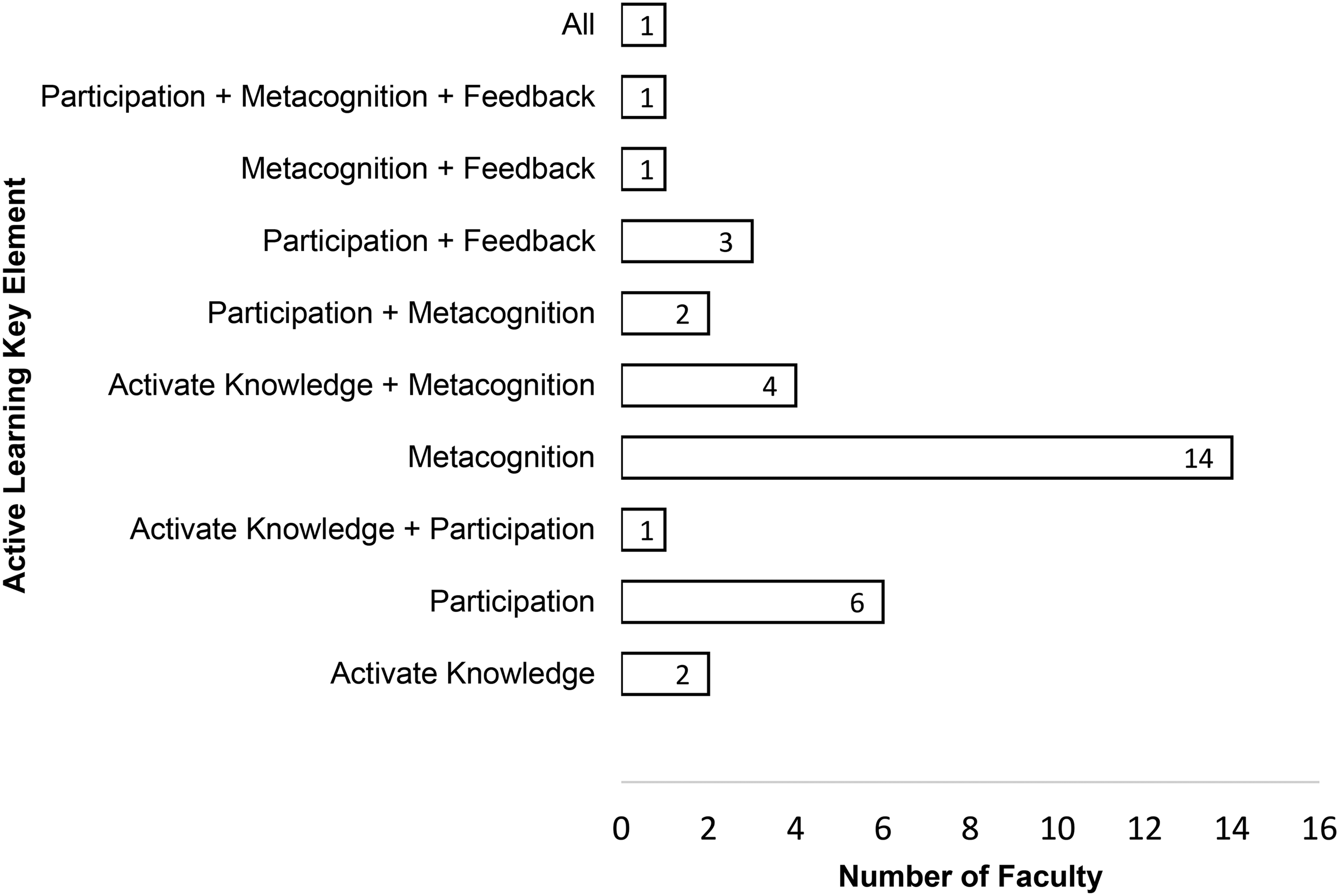
Most challenging key element to implement as perceived by faculty respondents (n = 35).
Faculty Preparedness in Implementing Active Learning Based on the Number of Key Elements Used Over an Lecture Set.

Qualitative Analysis
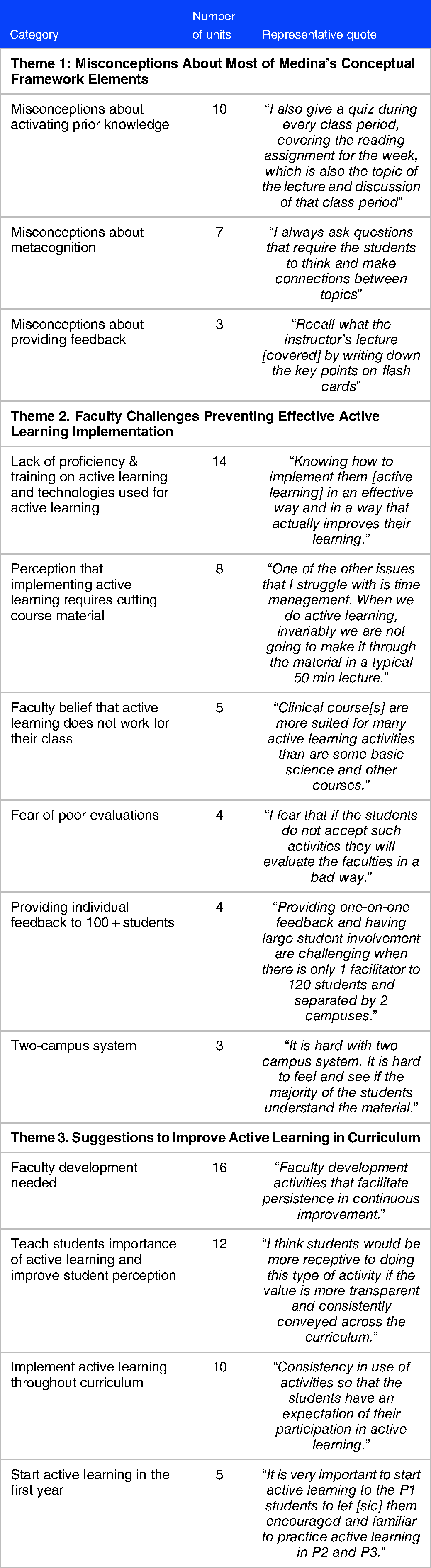
The following 3 themes emerged from the analysis of the qualitative data: (1) faculty misconceptions about most of Medina's conceptual framework elements; (2) faculty challenges preventing effective active learning implementation; and (3) faculty and student development and organizational interventions as approaches to overcoming challenges. Table 3 lists the categories that resulted in these 3 themes, the number of units in each category, and representative quotes.
Themes, Categories, and Representative Quotes.
Theme 1: Faculty Misconceptions About Most of Medina's Conceptual Framework Elements
Despite the majority of faculty indicating they implemented at least 2 key elements of active learning, their responses to open-ended questions revealed subtle misconceptions on all of the elements except involving the majority of students (Table 3).
All misconceptions around activating prior knowledge portrayed faculty mistaking it for reviewing content taught previously, rather than engaging the students in their existing knowledge. Ideally, when activating prior knowledge, students should recall foundational knowledge to learn new content. For example, for activating prior knowledge, this response, “group discussions and having individuals from each group present thoughts and ideas that have been presented before,” suggests a misconception since it does not ask students to connect their existing knowledge to the current knowledge presented in class. Overall, instructor misconceptions included: asking students questions on content presented before (n = 4), assigning readings or homework assignments (n = 4), assigning homework, and asking questions on content previously presented (n = 2).
Misconceptions were also present on how to promote metacognition. Typically, the metacognitive aspect of active learning asks students to intentionally monitor and evaluate their thinking and current level of mastery and understanding. However, faculty examples on promoting metacognition included asking quiz or problem-based questions (n = 4), assigning class projects or presentations (n = 2), or having students prepare their own exam questions (n = 1); none of these responses indicated the instructor had asked students to intentionally reflect on the students’ current level of mastery.
Finally, for providing feedback, ideally, the student would receive feedback from faculty or peers after the classroom activity. Misconceptions for providing feedback were evident in the following 3 responses: asking students to recall a lecture by writing key points (n = 1), assigning case-based questions (n = 1), and offering preexam and postexam reviews in the form of Q&A (n = 1).
Theme 2: Faculty Challenges Preventing Effective Active Learning Implementation
Faculty highlighted many challenges and barriers to implementing active learning in their classrooms, including beliefs that their classroom was not suitable for active learning, lack of proficiency in implementing active learning, fear of poor evaluations, and student-related barriers in the classroom (Table 3).
Many barriers appeared to stem from faculty belief systems. One recurring sentiment was an inadequate amount of time during the lecture hours to cover dense course materials: “The challenge of incorporating active learning is the time that‘s required in the classroom! The material in most of the P1 and IPTs [integrated pharmacotherapy] lectures is by its nature, dense. Topics with high density leave the professor with 2 options: (1) Straight lecture which ensures that all the important stuff gets mentioned—or—(2) Flip the lecture. If you do not do one or the other of these, the students have to find (on their own) the information that was sacrificed to accommodate the active learning activities.” Another thought was the lack of “evidence of effectiveness [of active learning]. I firmly believe that it is not the type of pedagogical technique employed by an instructor that results in the best learning, but more traditional factors such as instructor knowledge base of the subject, insight into translating that to a level appropriate for the audience, ability to engender engagement through communication skills, and other personal factors.” Also, faculties were concerned about possible poor student evaluations resulting from student dissatisfaction with active learning: “I fear that if the students do not accept such activities, they will evaluate the faculties in a bad way.”
On the other hand, key organizational challenges identified by faculty were student-related factors: large class sizes with 100 + students, a two-campus system, and student factors such as student discomfort in answering questions and reluctance in participating.
Theme 3: Faculty and Student Development and Organization Interventions for Overcoming Challenges
The need for faculty development was also offered as an antidote to the various challenges in carrying out active learning. One challenge was lack of faculty proficiency, as indicated by this comment: “Seminars directed to teach how to effectively implement active learning tools.” Another challenge was the faculty‘s perception that incorporating active learning absorbed valuable class time in delivering content, as in this comment, “In some courses, there is simply too much material to cover to become too involved in active learning techniques.” As a result, faculty development on time management was requested: “One of the other issues that I struggle with is time management. When we do active learning, invariably we are not going to make it through the material in a typical 50-min lecture” (Table 3).
Multiple faculty perspectives expressed the need for student development on the benefits of active learning. One perspective was to instill in students the need for preclass preparation when engaging in active learning: “I think that it's more work on the students’ part to really pick this up …. Discussing the benefits with students may help overcome this challenge.” Another perspective addressed students’ lack of buy-in: “What I actually think might be helpful is for students to learn about the benefits of active learning and how metacognition can help their long-term learning and understanding—at times I feel that some faculty try to do these activities and some students do not put in much effort because they do not understand why they are asked to do them.” Still, another perspective was a shift needed in students’ learning habits: “But if you really want it to be successful, please understand that it will require a significant change in the student's learning habits. Students will have to abandon their expectation that everything ‘important for the exam’ will be GIVEN to them in class. There must be a shift from being an undergraduate student to a self-actuated learner. That's a pretty BIG change in culture from where we are currently at.”
Finally, various organizational interventions were suggested for overcoming the challenges. One was implementing a new curriculum less dependent on lectures. Additional related suggestions included developing a roadmap for implementing active learning one course at a time and developing techniques that will work across a 2-campus synchronous delivery of teaching models.
Discussion
This study describes several elements related to the implementation of active learning techniques by examining the frequency of their integration and the accuracy of faculty in their ability to identify classroom techniques compared to descriptions of active learning elements as defined by Medina. In addition, it provides insight into the self-identified challenges and suggestions proposed by faculty to optimize their experience with these oft-touted strategies.
We discovered faculty were frequently implementing at least 3 of the 4 active learning elements, with including a majority of students and providing feedback being the most commonly implemented. Promoting metacognition was the least commonly implemented and the area where most faculty felt challenged when incorporating. Only 31% of faculty reported they were very prepared to implement active learning, indicating an opportunity for additional training in this area. Therefore, faculty at other institutions might also find promoting metacognition the most difficult to integrate and have misconceptions about implementing various components of active learning.
While the quantitative data revealed high percentages of integration for all elements except promoting metacognition, the qualitative data revealed misconceptions about what the operationalization of each element would look like in the classroom. Despite high rates of self-reported implementation of active learning elements, the presence of misconceptions with the majority of these elements indicates there may be an overestimation of how often effective active learning is taking place and how much faculty understand about certain fundamental pedagogical concepts such as activating prior knowledge, metacognition, and providing feedback. 16 Furthermore, with only 17% of respondents integrating all 4 elements over a series of related lectures, it is likely that the active learning techniques could be improved to be more effective based on Medina's framework.
When incorporating active learning into the curriculum, it is important to consider whether the individual's and organization's values, beliefs, traditions, norms, and leadership support the change. Within our qualitative analysis, we identified several faculties who thought active learning was (1) not effective, (2) did not work for their course content, or (3) would cause a decrease in course material taught. Previous studies within STEM (science, technology, engineering, and mathematics) have shown that even when faculty have progressive conceptualizations of teaching and learning, situational factors such as student attitudes/resistance, expectations of content coverage, and norms within the discipline and department lead faculty to continue with traditional lecture-based teaching styles.17,18 Furthermore, in our study, faculty cited they were worried whether active learning implementation would lead to pushback from students leading to poor evaluations. However, a previously published systematic review of STEM students identified 57 of 412 studies that reported negative responses to AL, with only 8 of the 57 studies reporting poor instructor evaluations. 19 Faculty proposed solutions such as faculty development, implementation throughout the curriculum, and training students on the importance of active learning. Faculty development is important as previous studies have (1) identified there are strategies to reduce student resistance to active learning and (2) instructor strategies when implementing AL can significantly and positively predict student value, positivity, and course evaluations.20,21 For faculty development to be effective, strategies should focus on (1) aligning with or seeking to change the beliefs of individuals involved, (2) involve long-term interventions, and (3) understanding that the university is a complex system and designing a strategy that is compatible with that system. 22
Although this study revealed important information regarding the integration of active learning strategies, several limitations exist. Medina's key elements propose a theoretical framework for the effective implementation of active learning; while these elements have individually shown to be effective, this framework has not been validated. Faculty were not trained on the 4 elements before survey administration which may have contributed to the misconceptions; surveyors attempted to limit this bias by providing definitions to each of the 4 elements within the question text. As participation in this survey was optional for faculty, selection bias was likely, with faculty who already integrate active learning more likely to respond. Thus, there may be an overestimation of the frequency of integration for these active learning strategies. Responses were also not separated by lab-based courses versus didactic courses. In addition, the data was self-reported and unverified by observation, again increasing the potential for overestimation of the frequency of integration.
This study reports the findings of one college of pharmacy, and the findings could be transferable to similar institutions. Future studies should focus on peer observation of their faculty using a more defined framework of suggested elements to include in each active learning encounter. In addition, further evaluation of faculty perceptions of how they would categorize their active learning strategies is warranted to ensure faculty have a clear understanding of these concepts and effective ways to operationalize them in the classroom.
Conclusions
This survey attempted to apply a conceptual framework to evaluate faculty implementation of active learning strategies throughout the curriculum. A majority of faculty self-reported integration of some individual active learning elements; however, faculty were not consistently applying all 4 of the elements proposed by Medina‘s conceptual framework and demonstrated misconceptions about what each element should look like when operationalized in the classroom. These issues could lead to decreased effectiveness of the active learning implementation. Our analysis identified faculty beliefs about the lack of value of active learning and fear of poor evaluations—highlighting a need for faculty development. The findings of this study demonstrate the need for a shift in faculty values in active learning and expanded education for faculty on the effective administration of active learning using a clearly defined structure.
Footnotes
Funding
The authors received no financial support for the research, authorship, and/or publication of this article.
Declaration of Conflicting Interests
The authors declared no potential conflicts of interest with respect to the research, authorship, and/or publication of this article.

Supplemental Material
Supplemental material for this article is available online.
References
Supplementary Material
Please find the following supplemental material available below.
For Open Access articles published under a Creative Commons License, all supplemental material carries the same license as the article it is associated with.
For non-Open Access articles published, all supplemental material carries a non-exclusive license, and permission requests for re-use of supplemental material or any part of supplemental material shall be sent directly to the copyright owner as specified in the copyright notice associated with the article.
