



Abstract
Lately, several key experts have proposed that well-being and flourishing ought to be the ultimate aim of education. To make this aspiration into reality, we need (1) a shared normative vision, (2) a shared understanding of key features of flourishing, and (3) shared flagship indicators to assess flourishing. Normatively, while the aim of education indeed ought to be the lifelong flourishing of the students, promoting it requires recognizing potential trade-offs between students’ current well-being and lifelong flourishing as well as each student’s individualistic flourishing and the capability of the society to promote the flourishing of all. Flourishing itself involves the following three dimensions: subjectively experienced well-being, psychological functioning, and certain foundational capacities and virtues through which human potential is realized. We need consensus around these elements and their lead indicators to transform the abstract aspiration into a trackable target pursued through evidence-based practices by education systems around the world.
Keywords
What is the goal of education? Why do nations invest billions of dollars to educate the youth? One answer, implicit in many policy-level discussions on education, is that the aim is to equip students with the skills and knowledge that will lead them to be productive workers. This technocratic approach to education, where the youth of the nation are mere tools for promoting economic growth, has been increasingly challenged by a well-being education movement that claims that the promotion of lifelong flourishing should be the overarching aim of education (Curren et al., 2024; de Ruyter et al., 2022; Kristjánsson, 2017; Ryan et al., 2023). This movement, increasingly recognized by the United Nations Educational, Scientific and Cultural Organization (UNESCO; Duraiappah et al., 2022) and the Organisation for Economic Co-operation and Development (OECD; Stevenson, 2022), does not challenge the importance of skills and knowledge that would make the students well-positioned in work-life – the ability to find meaningful and adequately compensated work is a crucial factor in a person’s ability to flourish in life. However, it challenges the idea that this would be the primary end-goal of education. The education system ought to treat students as ends in themselves, not mere means (cf., Kant, 1986), and thus any student-centered approach to education must prioritize the well-being of the students in question: both their well-being during their studies and how well the education system is able to promote optimal development to ensure their well-being in the future. It is this goal of making well-being the aim of education that this consensus article aims to promote (Curren et al., 2024).
There are three levels to this attempt: The normative, the descriptive and the practical. On the normative level, the aim is to justify why the aim of education ought to be flourishing. On the descriptive level, the aim is to find consensus around what human flourishing consists of, to make it a concrete and measurable goal of education. On the practical level, the aim is to identify – preferably through empirical evidence – the structures and practices that best support and cultivate flourishing. As Curren et al. (2024: 119) put it, ‘the appropriate methodology for defending a reorientation of education policy is value-led and evidence-informed’ – it should identify the values worth promoting and then gather the evidence on how to best promote them.
Normative level: Why should flourishing be the goal of education?
Going through the education system is a transformative experience for a person, shaping their worldview, personality, and life aspirations, while being a major investment both from a national point of view and from the point of view of the person in question. What the education system aims to accomplish is thus a crucial normative question.
The human capital theory of education has arguably been the dominant view about the aims of education since the latter half of the 20th century (Marginson, 2019; The Jubilee Centre, 2023). According to this theory, the aim of education is to cultivate various skills that make the student more productive, thus serving the double goals of making the individual more employable and better positioned in the labor market and making society more economically successful (Grant, 2012). While always controversial in academic circles, the approach has informed policy, public discourse and key decision-making around educational systems. It has also contributed to the narrow focus on OECD’s PISA (Programme for International Student Assessment) comparisons and other standardized tests driving discourse on how to develop education.
Several factors have contributed to a disillusionment with the current model of education and a renewed emphasis on flourishing as a key aim of education. First, the current ecological crisis and the realization that the current way of life is unsustainable, as humanity has transcended several planetary boundaries, has challenged economic growth as a possible and desirable end-goal of societies (O’Neill et al., 2018; Steffen et al., 2015). Second, a mental health crisis among young people currently evident in many nations has led to discussions about whether current educational choices such as high-stakes testing are harming the youth, and what the education system could do to better support the well-being of the students (Curren et al., 2024; Duraiappah et al., 2022). The challenges to the dominant paradigm have awakened a normative discussion about the fundamental aims of education.
When discussing the normative aims of education, the first thing to notice is that there is no such thing as value-free education. Education is invasive: it changes the persons it targets. And ‘how people develop makes a difference to how well they live’ (Curren et al., 2024: 135). Whatever capabilities, skills, attitudes, values, or virtues the education system comes to promote, they are what it normatively values, explicitly or implicitly. Not teaching something to the students is also a normative choice as it deprives the students of the opportunity to learn something they might have needed. Building the curriculum thus necessarily involves ethically grounded acts of commission and omission, including what is valuable and excluding what is less valuable.
The only remedy for the ‘hidden’ value agenda in education is thus not value-free education but an education system that is explicit about what values it aims to promote. Here, the well-being education movement puts its cards clearly on the table: The aim of education ought to be the lifelong flourishing of the students. Health, stress, suffering and happiness of the students ‘have ethical significance that should weigh heavily in decisions about children’s education’ (Curren et al., 2024: 133). Combined with a human rights approach of securing necessary conditions for a good life for all, it can be argued that governments have an ‘obligation to ensure that all children receive education that promotes the forms of development that are essential to a good or flourishing life’ (Curren et al., 2024: 133). This may sometimes involve trade-offs between current and future flourishing – some sacrifice of children’s present well-being is justifiable as ‘an unavoidable consequence of preparing them to live well as adults’ (Curren et al., 2024: 133). However, the trade-offs tend to be less pressing when we realize that autonomy-supportive and children’s need-affirming education also tends to yield better learning outcomes (Bureau et al., 2022; Howard et al., 2021), making student flourishing have ‘both intrinsic and instrumental value’ (Ryan et al., 2023).
Overall, it is hard to deny that the well-being and flourishing of students ought to be one of the primary goals of education. An institution that has custody of children over extended periods of time, significantly influencing their developmental trajectory, can be justified only if it has the interests of those children in mind; if it can legitimately say that it aims to promote their ability to live a good life. Accordingly, the well-being education movement is a much-needed reminder of what education ought to be fundamentally about – promoting human flourishing. It is great that currently parties ranging from OECD to UNESCO have come to highlight flourishing as a central aim of education (Duraiappah et al., 2022; Stevenson, 2022), challenging the technocratic approach to education that too easily ignores the needs of the students. Policymakers need to understand that their decisions significantly affect the potential of students to flourish in life – and thus they are morally required to give this potential to flourish serious weight in their decision-making.
That said, one can legitimately ask whether each child’s individualistic flourishing ought to be the only purpose of education. There is a tension in the well-being education movement between individual flourishing and societal flourishing. de Ruyter et al. (2022) state that the purpose of education should not only be about the ‘flourishing of an individual pupil’ but about ‘flourishing of all’, while Curren et al. (2024: 137) want education to promote potentials that are ‘desirable both for the society and for the individual students’. This raises the question of what to do when societally and individually desirable trajectories differ. Upholding of modern society – including its ability to provide high-quality education for all – is dependent on the education system successfully instilling certain skills and virtues in the students that are necessary for a functioning society. One area, already highlighted by Aristotle (1995), is civic virtues: A functioning society and a functioning democracy depend on citizens having a degree of sympathy, care, solidarity, and trust toward each other – and willingness ‘to take costly action to defend democratic institutions against potential violations’ (Weingast, 1997: 261). Another area is the labor market: Certain skills and expertise are in demand by industries and public institutions and one purpose of the education system is to ensure that society has enough people with adequate expertise to fulfill the societal needs for doctors, nurses, information and communications technology (ICT) experts, and other required professionals. How to channel the curiosity and personal interests of the students toward directions that society has most use for is one key challenge of the educational system.
Thus, while the lifelong flourishing of students ought to be one of the fundamental aims of education, optimizing individual flourishing should not be the sole aim of education, as we need to balance this with what is required to uphold a society capable of supporting the flourishing of its citizens in the long term.
Descriptive level: What is flourishing?
Establishing lifelong flourishing as a key aim of education is important. However, remembering that ‘what you measure is what you get’, the next critical step is to transform this overarching purpose into measurable indicators that can challenge current indicators as key tools for steering the future of education. Accordingly, building consensus in our understanding of flourishing is crucially important, as there currently are way too many conceptualizations and potential dimensions to human flourishing (Kristjánsson, 2017; The Jubilee Centre, 2023).
Curren et al. (2024: 123) define flourishing as ‘ongoing healthy growth and functioning involving fulfillment of potential that exhibits admirable qualities and is personally meaningful, satisfying, and enjoyable’. They see it as having both subjective components related to personal satisfaction, enjoyment, and meaningfulness as well as objective components related to ‘fulfillment of all the forms of potential that are universally essential to living well as human beings’. Although they are not too explicit about what these universally essential agentive, social, and creative potentials are, at least capacities of self-regulation, good decision-making, and social competence involving treating others well seem to be on the list. Besides, they argue that ‘living well as a human being involves satisfaction of specific needs’, referring especially to the three needs recognized by self-determination theory: autonomy, competence, and relatedness.
In this and other definitions of flourishing (de Ruyter et al., 2022; Kristjánsson, 2017), we can distinguish the following three dimensions of flourishing: Subjectively experienced well-being, psychological functioning, and certain foundational capacities and virtues through which human potential is realized (Figure 1). Behind all these definitions is an understanding that human flourishing is about the fulfillment of a specific human nature that we all share – hence, evidence-based understanding of that human nature can help us specify what the relevant potentialities are that humans objectively need.
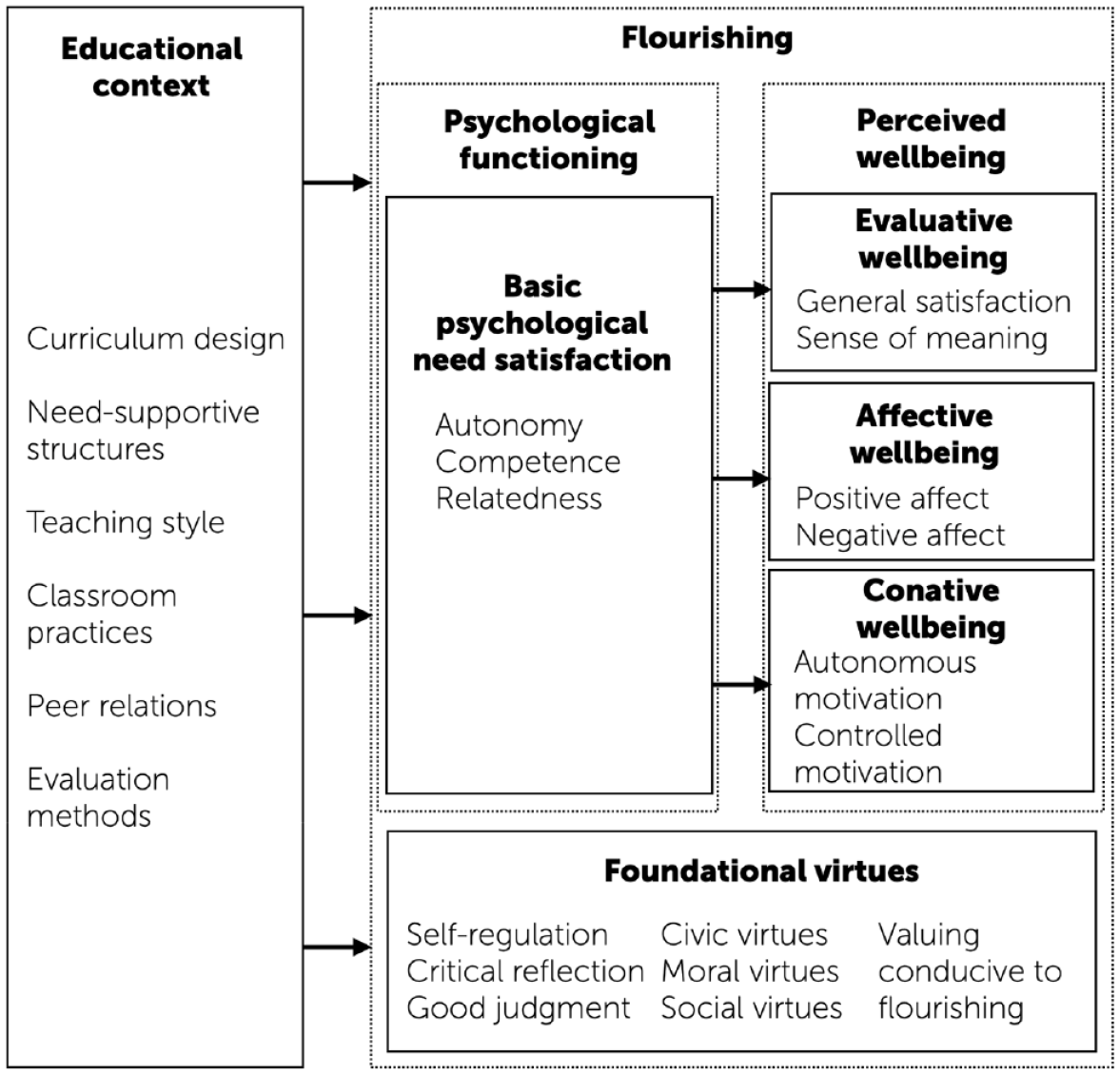
The three dimensions of flourishing in education: perceived well-being, psychological functioning, and foundational virtues.
First, one key part of flourishing is the subject’s own experience. No matter what objective indicators show, if the student feels a lack of energy or is outright depressed, they are not flourishing. Hence, experienced well-being should be a key part of flourishing. Experienced subjective well-being is typically divided into evaluative well-being, which is a cognitive assessment of one’s general situation such as general life satisfaction, and affective well-being, which is about the everyday positive and negative emotions one is experiencing (Diener, 1984; Diener et al., 1999). However, following the classical distinction into cognitive, affective, and conative dimensions of psychology (Hilgard, 1980; Mayer et al., 1997), we could also talk about conative well-being, referring to the quality of one’s motivation, most importantly whether it is more intrinsic and autonomous or more extrinsic and controlled (Howard et al., 2021; Ryan and Deci, 2020).
However, flourishing is not only about feeling well but also about being able to function well in various arenas of life; hence, psychological functioning should be seen as a key part of flourishing. In other words, focus on well-being as a subjective experience should be complemented with a focus on well-doing as how well the person is functioning in life (Huppert et al., 2009; Martela and Sheldon, 2019; Ryan et al., 2008). Psychological need satisfaction is a core part of psychological functioning, as it focuses on whether certain essential psychosocial nutrients are present in a person’s life (Martela and Ryan, 2023). Thus, examining the satisfaction of the needs for autonomy (volition, self-selection, and self-endorsement), competence (mastery, accomplishment, and growth), and relatedness (interpersonal care) should be seen as a key part of the assessment of human flourishing (Ryan and Deci, 2017).
Third, research on flourishing emphasizes that flourishing is about the actualization of human potential (Kristjánsson, 2017; Wolbert et al., 2015). To be human is to have certain foundational virtues that we need to develop and exercise for optimal development and to more fully realize the better parts of our human nature (Curren et al., 2024; de Ruyter et al., 2022; Kristjánsson, 2017). Foundational virtues include the capacity for self-regulation, critical reflection, and good judgment as without them we are unable to steer our lives toward desired directions. Civic, social, and moral virtues and competencies are also necessary as they make it possible to live together in a shared world. Furthermore, it is important to cultivate those goals and aspirations that help students to find forms of valuing ‘that can provide purpose and meaning in life’ (Curren et al., 2024: 136; see also de Ruyter et al., 2022), as research has shown that some goals and aspirations are more closely connected with personal well-being and flourishing (Bradshaw et al., 2023), and thus more beneficial for the person in question. Following Curren et al. (2024: 136; see also Grant, 2012), we can thus conclude that ‘character education is an essential aspect of education for flourishing’.
While different theorists approach flourishing from many different angles, with a number of different dimensions proposed (see Curren et al., 2024: 136; de Ruyter et al., 2022; Kristjánsson, 2017), there is a common core to be discerned, where at least the need satisfaction and experienced well-being of the person should be part of their flourishing, along with certain foundational and social virtues. The next step is to agree on a number of lead indicators for these dimensions that could be used in various research studies. While different theorists can supplement this common core with their own elements, utilizing the same lead indicators across studies would make possible comparability and a more cumulative science of flourishing in education.
Practical level: How should flourishing be promoted?
Having established the nature of flourishing as the goal of education, the next step is to identify and implement the best practices to promote it. Curren et al. (2024) make several worthwhile suggestions on how to promote flourishing in education. To cultivate flourishing, first, the curriculums of the various educational institutions need to be revised to more directly promote flourishing. This involves making the learning environment need supportive through providing choice and rationales to promote autonomy and self-determination, optimizing the level of difficulty to promote competence and growth, and showing care toward the students and building connections between peers and classmates to enhance a sense of relatedness (Ryan et al., 2023). It also involves more focus on character education, where the aim is to cultivate students’ foundational virtues for self-regulation and good judgment as well as moral and civic virtues. Furthermore, recent advances in the science of well-being could be utilized by teaching students about the science of well-being and flourishing and the evidence-based techniques and tools through which to promote one’s own well-being and flourishing. The good thing about cultivating self-regulation and well-being is that investment in promoting them tends to pay off in the long term also through better learning results. A flourishing student is better able to concentrate on learning, less distracted by inner struggles and ailments that often get in the way of education.
Conclusion
We need consensus around flourishing. If the various schools of flourishing in education concentrate efforts just on propagating their own theory to each other, they become too easy to ignore. Only by joining forces and identifying the shared common core can the proponents of flourishing transform the current agenda of education across the world by promoting this common core to the policy-makers. While there is already agreement on the broad normative agenda – promotion of flourishing ought to be one of the central aims of education (Curren et al., 2024; de Ruyter et al., 2022; Kristjánsson, 2017) – there is still much disparity in how flourishing is defined. Thus, exercises like the present that bring different thinkers together to identify the common core are urgently needed.
Building on Curren et al. (2024) and recent discussion around the nature of well-being in psychology (Martela and Ryan, 2023; Martela and Sheldon, 2019), I have argued that a comprehensive definition and assessment of student flourishing should include, at least, the following dimensions: (1) how much students experience evaluative well-being (satisfaction and meaningfulness), affective well-being (positive and negative feelings), and conative well-being (autonomous and controlled motivation); (2) how much students experience that their needs for autonomy, competence, and relatedness are satisfied, and (3) how well the system promotes their foundational virtues for self-regulation, critical thinking, and good judgment as well as social, civic, and moral virtues and aspirations conducive to flourishing.
All in all, what we need is a (1) shared normative vision of making flourishing the aim of education, combined with (2) a shared common core of key features of flourishing, and (3) shared flagship indicators to assess flourishing. Finding consensus around these allows for the effective promotion of flourishing by transforming the abstract aspiration into a trackable target pursued through evidence-based practices for education systems around the world.
Footnotes
Declaration of conflicting interests
The author(s) declared no potential conflicts of interest with respect to the research, authorship, and/or publication of this article.
Funding
The author(s) received no financial support for the research, authorship, and/or publication of this article.