



Abstract
Research on well-being and concern over the well-being of students and teachers has grown dramatically in recent years. Researchers and reformers in positive psychology and education, self-determination theory, social and emotional learning, liberal-democratic political and educational philosophy, and neo-Aristotelian theories of flourishing and character education have played formative and intersecting roles in what is now an international movement to promote the lifelong flourishing of students as an alternative to a human capital and economic growth focus for education. This article defends this flourishing-focused reorientation of education policy and practice, using a value-led and evidence-informed methodology. It sorts through the conceptual disputes and clarifies the ethical considerations that should guide efforts to advance the well-being of students and teachers, assesses key claims and arguments, and brings together compatible aspects of the leading philosophical and psychological perspectives on flourishing as an aim of education. It identifies ethically and evidentially justifiable points of consensus on well-being and flourishing in education, presents a consensus model of relationships between educational environments, learning, and flourishing, and concludes with some recommendations for educational policy and practice.
Keywords
Research on well-being and concern over the well-being of students and teachers has grown dramatically in recent years. The concern has been fueled in part by a perceived mental health crisis among students, high levels of stress experienced by students and teachers in the era of high-stakes testing, and the limitations of neoliberal educational policy predicated on alleged relationships between economic growth and high scores in science, math, and reading (Spratt, 2017; Stevenson, 2022; Tamir, 2023; The Children’s Society, 2022; UNICEF, 2013). 1 In this context, it is important to be clear about educators’ ethical responsibilities with respect to student well-being, to understand the relationships between student and teacher well-being and educational outcomes, and to rethink the purposes of education. The dominant neoliberal conception of these purposes identifies the task of education as building human capital and sustaining economic growth (Choo, 2020; Hanushek and Woessmann, 2007, 2010). The well-being education movement is a direct challenge to this human capital theory of the aims of education.
Human capital theory holds that ‘skills and knowledge are a form of capital’ that enhances employee productivity, accounts for much of the variance in earnings, and is a major factor in economic growth (Schultz, 1961: 1, 7; cf. Becker, 1964). The associated claim that countries can sustain long-term economic growth through investment in education began to influence education policy in the United States and other Organization for Economic Cooperation and Development (OECD) countries in the 1960s (Holden and Biddle, 2017; OECD, 1962) and it grounds the OECD’s Program for International Student Assessment (PISA) (Hanushek and Woessmann, 2007, 2010; Tamir, 2023: 418–419) and the World Bank’s role in ‘ensuring that the measurement of learning achievements is undertaken in a more systematic way’ (Bourguignon, 2007: vii). The human capital perspective on education is concerned to enhance students’ ability to engage in economic production, while the well-being education perspective is concerned to enhance students’ ability to live well or flourish.
While the demand to replace the human capital approach is coming primarily from educational policy makers in countries such as Finland, Singapore, and South Korea (International Commission on the Future of Education, 2021; Stevenson, 2022), the well-being education movement is also drawing strength from a growing body of research in psychology and philosophy. Researchers in social and emotional learning (SEL), positive psychology and education (PP/PosEd), self-determination theory (SDT), liberal-democratic political and educational philosophy, and neo-Aristotelian theories of flourishing and character education have been playing theoretically foundational and intersecting roles in what is now an international movement to promote the well-being or lifelong flourishing of students as an important or overarching aim of all educational endeavors (Duraiappah et al., 2022; International Commission on the Future of Education, 2021; Singh and Duraiappah, 2020). Considered as a goal of education, well-being is often equated with flourishing; as explained below, ‘well-being’ pertains to the quality of a person’s life, and ‘flourishing’ is an all-inclusive conception of how well a person’s life is going. Central to this vision is the understanding that when contexts support flourishing, higher quality learning, and educational outcomes are also facilitated, whereas the traditional focus on trying to enforce the transmission of knowledge through evaluations and accountability pressures has led to neither student wellness nor better educational outcomes.
The promotion of lifelong flourishing as an important or overarching aim of education remains controversial, however, and clarity about the nature of well-being and its role in education remains elusive. The aim of this article is to defend a flourishing-focused reorientation of education and identify points of consensus regarding the nature and promotion of flourishing that can guide educational policy and practice.
Methodology
The appropriate methodology for defending a reorientation of education policy is value-led and evidence-informed (Brighouse et al., 2018; Brighouse and Swift, 2023; Cartwright and Hardie, 2012; Joyce and Cartwright, 2023). In the present instance, a value-led approach must be first of all analytical; it must seek conceptual and ethical clarity, foregrounding the ethical considerations that justify efforts to advance the well-being of students and teachers as a vital public interest. It must also be critical; it must assess key claims and arguments, including those of critics of well-being and flourishing in education. Regarding the various schools of thought on flourishing and its educational promotion, the methodology must also be synthetic; it must bring actionable aspects of them together in a coherent way We consider four influential approaches: Aristotelian theories of flourishing and character education, liberal-democratic political and educational philosophy, SDT, and PP/PosEd.
The collaborative process leading to this article brought together an international team of coauthors who are developers and proponents of these four approaches. Collectively, this includes a practitioner-author and 10 educational researchers including 5 philosophers, 3 psychologists, and a sociologist. All four of the leading perspectives on flourishing and education are represented by coauthors who have founded or directed an institute, center, or international network aligned with their perspective. The aim has been to: (1) identify compatible aspects of these approaches; (2) define consensus on how ethically important aspects of well-being are related to key aspects of educational environments and practices, and to students’ educational progress; and (3) provide general guidance on ways to promote student well-being.
We take as given both the growing interest in well-being in education and the conceptual disarray and confusing crosstalk that educational practitioners and policymakers encounter when they wade into the voluminous and often divergent streams of well-being research. Our purpose is to provide actionable consensus, not by resolving theoretical disagreements that may be irresolvable but by considering major developments in well-being research in the context of what can be ethically and practically justified in schools. Globally, there are of course many diverse traditions of thought regarding human well-being and education. It is impossible to engage these in the context of this article, but our hope is that a statement of consensus at the intersection of the approaches we represent can serve as a useful point of reference even for educators working within other traditions.
Our approach is analytical in offering and defending a conceptual mapping of the relationships between the various concepts and theories. It is critical in arguing that the ongoing differences between philosophical theories of the nature of well-being need not be resolved in order to find consensus about well-being in education because neither well-being science nor ethical decision-making requires that the remaining differences between these theories be resolved. We hold that what is needed and can be provided by research in well-being science and education is an understanding of how different aspects of well-being are functionally, causally, or organically related to one another and to aspects of developmental and educational contexts and practices. In addition to such understanding, what is essential and can be provided by philosophical ethics is a sound understanding of educational responsibilities and aims with respect to students’ present well-being and lifelong flourishing. The relevant methods of philosophical ethics are analytical and critical in ways that often involve the construction of justifications. The ethical analysis we provide employs these methods. Finally, the points of consensus we affirm are the product of the above methods as well as a process of multi-disciplinary and multi-perspectival synthesis. Our collective aims have been to: (1) identify compatible aspects of the approaches we represent; (2) define a consensus account of how the ethically important aspects or forms of well-being are related to key aspects of educational settings and practices, and to students’ educational progress; (3) provide general guidance on ways to protect and advance student well-being.
Our pursuit of consensus across the four approaches to flourishing was simplified and focused by embedding it within a values-led and evidence-informed methodology for justifying an educational policy intervention. It allowed us to begin with questions of educational ethics and justice and identify publicly actionable aspects of the four approaches rather than search for a purely theoretical synthesis of them. Our work proceeded through multiple drafts of formulations of the questions at stake, points of consensus, and attempts to characterize the four approaches. These drafts were shared, discussed, and revised at workshops and through countless other remote and in-person communications. As the work progressed, a crucial step in identifying consensus across the four philosophical and psychological perspectives on flourishing as an aim of education (i.e., compatible aspects of them) was to spell out the nature of these perspectives and what they are and are not committed to more fully.
A fundamental premise of our methodology is that consensus regarding well-being in education must be grounded in the reasons educators and societies have for promoting students’ present and future well-being. The foundational questions to be addressed are thus:
Are there ethical reasons for educators and schools to protect and promote students’ present and future well-being as an end in itself? Is lifelong flourishing the proper overarching purpose of education?
These are primarily questions of educational ethics and justice, and we address them through critical ethical inquiry that draws on established models of ethical analysis and theories of morality and justice. Addressing these questions of educational ethics and justice will provide guidance regarding the aspects of well-being that are involved and what is and is not appropriate in how they are protected and promoted. It sets the stage for our resolution of perceived tensions between our four approaches to flourishing and for our account of well-being in education.
From these ethical starting points, the questions become more empirical and educational, and our approach is consequently multi-disciplinary and synthetic. First:
2. How are the relevant aspects of well-being related to one another, to aspects of educational settings and practices, and to educational outcomes?
The relationships between these aspects of well-being and relevant aspects of educational contexts, practices, and outcomes can be formulated as a descriptive model – a dynamic and developmental account of well-being in education – on which guidance for educational policy and practice can be based.
With these results in hand, we address some answers to basic questions of practice:
3. How can educators and schools best promote students’ well-being? What roles do curricula and disciplinary and evaluation practices play?
We begin by addressing the terminology and theories of well-being and the conceptions of flourishing associated with the four influential orientations identified above.
Conceptual preliminaries
The conceptual disarray in well-being studies is reflected in divergent uses of common terms, so it is essential that we specify how we will use these terms ourselves. The divergent uses arise in part from the existence of competing philosophical theories of the nature of well-being and reliance on these competing theories in well-being science and policy (Alexandrova, 2017; Fabian, 2022; Huppert et al., 2005). We will sidestep the debates that divide these philosophical theories by: (1) using the relevant terms in the most ordinary pre-theoretical ways possible and (2) arguing that the disagreements that divide these theories need not be resolved to find consensus on well-being in education.
In its most ordinary use, the term ‘well-being’ signifies that a person’s life is going well (Parfit, 1984; Raz, 1986, 2004; Tiberius, 2006, 2008). It signifies ‘the good life, the life which is good for the person whose life it is’ (Raz, 2004: 269). Several closely related terms are predicated on the common assumption that lives can go more and less well: the idea that some things are good for a person, and others are bad; that some things are in a person’s interest, and others are not; that there are basic needs essential to the life of any member of the species going well. Ordinary uses of these terms rest on the premise that there are objective facts about well-being, at least some of which are knowable. Note, for instance, that it is uncontroversial that secure attachment to a caregiver is good for an infant and essential to healthy growth and development. To say that secure attachment is ‘essential’ to healthy growth and development is to say that it is not just good for an infant, or in her interest, but also a basic need. The term ‘thriving’ is commonly used to describe infants whose growth and development are healthy in all respects: bodily, behavioral, emotional, social, cognitive, and verbal. These include manifestations of positive affect, pleasure, and vitality, such as smiling, laughing, and playing. Communities and adults that are doing well in a variety of respects are also commonly described as thriving. Similarly, the term ‘flourishing’ (etymologically related to ‘flowering’) usually signifies a well-rounded healthy ongoing development or expression of a person’s potential through subsequent stages of life. The open-ended variety of ways in which behavioral, social, cognitive, and other aspects of potential can be expressed or fulfilled implies that the flourishing of human beings can be manifested in endlessly diverse and individualized ways.
Further terms that are widely used in well-being studies are ‘happy’ and ‘happiness’. In their ordinary pre-theoretical uses, these commonly refer to experiencing one’s life as going well: experiencing an enjoyment of well-being, contentment, or pleasurable satisfaction. Happiness and being happy pertain to a person’s state of mind and are in that sense subjective, while also largely discernible through their outward manifestations. There are obviously also objective aspects to how well a person’s life is going, such as physical health and success in engaging with the world.
‘Thriving’ and ‘flourishing’ are the common terms that seem to be most inclusive of the totality of well-being or how people’s lives are going. The Ancient Greek term eudaimonia, which Aristotle used interchangeably with eu zên or living well (Barnes, 1984: 1730 (NE I.1–2 1095a15–20)), is currently used in well-being studies as a synonym for ‘flourishing’ or living well generally, understood as having both objective and subjective aspects. Steering a terminological path as close to ordinary pre-theoretical usage as possible, we propose and will rely on this definition:
Many other definitions have been proposed (Darwall, 1999; de Ruyter et al., 2022; Foot, 2001; Kraut, 1989, 2007; Kristjánsson, 2020; Paul et al., 1999; Vitterosø, 2016; Waterman, 2013), including by some of us, but we accept this definition as compatible with common usage and as incorporating defining aspects of flourishing common to a wide range of philosophical and psychological accounts of it. 2
Having explained how we will use the terms ‘well-being’, ‘thriving’, ‘happiness’, ‘happy’, and ‘flourishing’ throughout this article, we also acknowledge that our choices are to some extent arbitrary. Readers should be alert to the fact that some of these terms are used in conflicting ways in well-being studies: ‘eudaimonia’ is sometimes translated as ‘happiness’ (Kraut, 1979); ‘happiness’ is sometimes used in the state of mind sense (as we will use it) and sometimes to refer more inclusively to a ‘life that goes well for the person leading it’ (Vitterosø, 2016: 3); the term ‘eudaimonic well-being’ (EWB) (first used in Ryan and Deci, 2001) is sometimes used inclusively to refer to the whole of well-being (e.g., Ryan and Martela, 2016) but sometimes to refer to a qualitatively distinct form of happiness (e.g., Seligman, 2002). Lists of more than 40 different descriptions of EWB have been compiled (Martela and Sheldon, 2019; Vitterosø, 2016), reinforcing the perception that it is not a well-defined or consistently operationalized concept (Heintzelman, 2018; Huta and Waterman, 2014; Kashdan et al., 2008). There are nevertheless recurring elements in the various definitions that align with eudaimonia generally being seen as a comprehensive conception of well-being along the lines of our definition of flourishing set out above (Vitterosø, 2016: 10–11).
Well-being science seeks to understand how people’s attitudes, attributes, emotions, values, circumstances, health, and engagement with the world interact and facilitate or hinder their happiness and flourishing. It does this by defining constructs, creating related measurement instruments (i.e., operationalizing the constructs), and conducting studies to determine how the constructs are related to one another. It seeks to develop causal-explanatory models of well-being, in short. The constructs and measures are typically grounded in preexisting philosophical conceptions or theories of the nature of well-being, and philosophers have defined the nature of well-being in conflicting ways (Alexandrova, 2017). It is thus not only philosophers but also psychologists, economists, health experts, educationists, and others who define well-being in different ways.
Theories of the nature of well-being
A classic statement of the different philosophical theories of the nature of well-being frames them as universally applicable answers to the question, ‘What would be best for someone, or would be most in this person’s interests, or would make this person’s life go, for him, as well as possible?’ (Parfit, 1984: 493). Parfit equates what is ultimately good for any person, is in a person’s interest, or constitutes their life going well with ‘well-being’ or ‘welfare’. He identifies three kinds of theories of well-being: hedonistic (or mental state) theories that equate well-being with happiness, pleasure, or enjoyment; desire fulfillment (or preference satisfaction) theories that make fulfillment of desires what defines well-being or one’s life going well; and objective list theories that identify certain things as objectively good and bad for people, regardless of their desires. It bears emphasizing that the point of posing the question that Parfit poses, in the context of one of the most influential works of ethical theory of the late twentieth century, is that the impact of actions, practices, and policies on individuals’ well-being, or how their lives go for them, matters from an ethical standpoint. The way we conceive of and measure individuals’ well-being, interests, or what is good and bad for them matters ethically. Consider that if we focus on their pleasure or enjoyment, we might overlook damage to their ability to engage the world successfully. If we consider how satisfied people are, we may overlook the fact that they are misinformed or have lowered their expectations in the face of unjustly circumscribed opportunities to live well. If we focus on a person’s objectively healthy or meritorious functioning in the world, we may overlook unhappiness associated with that functioning.
Faced with such possibilities, philosophers have developed increasingly sophisticated theories of the kinds in question, with no resolution in sight (Alexandrova, 2017; Arneson, 1999, 2000: Badhwar, 2014; Bishop, 2015; Darwall, 2002; Feldman, 2004; Griffin, 1986; Hausman, 2015; Haybron, 2008, 2013; Keller, 2009; Kraut, 2007; Raz, 1986, 2004; Scanlon, 1998; Sumner, 1996; Tiberius, 2008). In addition to the ‘big three’ families of theories of well-being (Alexandrova, 2017; Parfit, 1984), there are hybrid views (Woodward, 2015), proposals for classifying the various theories differently (Woodward, 2013), unified conceptions of well-being that incorporate the various things identified as well-being by different theories – that is, the various important and interrelated aspects of a life going well (Bishop, 2015), and proposals to move beyond purely philosophical theories of the nature of well-being, on the premise that there are several irreducibly distinct well-being concepts (Alexandrova, 2017). Related to these developments in the conceptualization of well-being, there are also families of theories of happiness – as a positive emotional state, as satisfaction with one’s life, or as pleasure (Haybron, 2013). There are divergent educational incarnations of many of these well-being theories, formulated by the theorists themselves or by more practically minded educationists. Finally, a considerable literature exists on the possibilities of measuring the main variables in question, which might be desirable pre-and-post educational interventions (see, for example, VanderWeele, 2017). 3
The proliferation of philosophical theories of the nature of well-being might doom any hope of near-term consensus on well-being in education if resolution of the questions at stake were essential to the progress of well-being science or to defining proper regard for people’s well-being in the context of decision-making. Fortunately, this is not the case. Progress in the conceptualization of constructs and measures in well-being science can be achieved through interdisciplinary and collaborative research bridging philosophy, psychology, and other fields on a sector-by-sector basis (i.e., for education, health, development economics, etc.), keeping in mind all of the aspects of well-being addressed in the philosophical theories (Alexandrova, 2017). With regard to ethical decision-making, a sector-by-sector approach would naturally begin with an analysis of the ethical and practical responsibilities and considerations that make specific aspects of well-being important to decisions in a specific sector. All aspects of well-being might matter from a general ethical perspective in all contexts, while the specific ethical and practical responsibilities in educational, health care, development economics, and other contexts may differ in ways that demand focus on specific aspects of well-being. Our own methodology adopts this strategy, by identifying ethical responsibilities of educational institutions that pertain specifically to forms of learning and development foundational to flourishing, and bringing philosophers, psychologists, and education researchers together to find consensus on the ethically relevant constructs and educational practices.
We will stand by the root idea that ‘well-being’ signifies that a life is going well; it expresses an all-things-considered assessment of the quality of a life. This is consistent with there being different aspects to how a life is going or well-being having different aspects (Alexandrova, 2017). It is also consistent with findings in well-being science that point to many or all of these aspects of well-being being functionally, causally, or organically interrelated (Bishop, 2015). Living and having a life inherently involve self-maintenance and self-regulation in complex embedded contexts that present hazards and opportunities, and it would be astounding if the various dimensions of an individual’s functioning and quality of life were not interrelated. An important focus of the science of well-being is understanding how different aspects of well-being or the quality of lives are related to each other, to personal attributes, and to the contexts in which people live and develop. To carry out such research, it is essential to have measures of the distinct aspects of a person’s (overall) well-being or quality of life. In the policy sphere, there is a similar recognized need for a comprehensive set of measures and there are ongoing efforts to develop them (Ben-Arieh and Frønes, 2007; Graham et al., 2018; Hausman, 2015; Lee et al., 2021; Martela and Ryan, 2023). In an educational context, a life going well certainly includes an active, interested engagement with learning, a sense of efficacy and growth, and an experience of inclusion, community, and support. And although living a ‘good life’ of engagement within a school community is of intrinsic value, it should yield the social and cognitive skills and tools that allow individuals to pursue what matters to them as engaged adult citizens.
Influential perspectives on flourishing
Attempts to define the nature of well-being have long been a more or less explicit focus of moral theories that have foregrounded the importance of consequences of actions in distinguishing those that are right from those that are wrong. The question has been, ‘Which kinds of consequences matter?’ And the most common answer has been, ‘Consequences for the happiness of individual persons’. By contrast, Ancient Greek ethical theory, and Aristotle’s ethics in particular, was focused on the idea that all human beings desire eudaimonia or to live well, and that – given the facts of human nature – it is only possible to live well by fulfilling one’s human potential in activities that embody goodness, virtue, or excellence (aretê) and are inherently pleasant and satisfying (Charles, 2015; Kraut, 1989; Reeve, 2012). The reintroduction of the concept of eudaimonia into Anglo-American ethical theory in the second half of the twentieth century (Anscombe, 1958; Hurka, 1999; MacIntyre, 1981) led to growing interest in it in philosophy and more recently in psychology, economics, education, and other fields. There are presently four leading schools of thought on eudaimonia in the Western world, two in philosophy and two in psychology, all with significant educational ramifications. It is essential to our purposes to review their key features and identify any points of fundamental disagreement that divide them. We will consider them in historical sequence, beginning with Aristotelian ethics and then addressing liberal-democratic political theory, SDT, and PP/PosEd.
Aristotle
Aristotle holds that while all human beings desire to live well, few people grasp what living well entails. The axiom at the heart of his Nicomachean Ethics (NE) is (roughly) that the objectively best life for a human being is one that is devoted to activity that embodies the ‘best and most complete’ virtue (Barnes, 1984: 1735 (NE I.7 1098a16–18)). Aristotle’s Politics (Pol.) develops the related idea that the proper function of societies and their institutions is to facilitate a collective partnership in living well (Cooper, 2010; Curren, 2013b, 2023a; Garver, 2011; Kraut, 2002; Ober, 2015), and there is abundant textual evidence in both of these works that he has in mind a life devoted primarily to philosophical or ‘scientific’ activity (theôria; contemplation) manifesting theoretical wisdom (sophia) (Barnes, 1984: 2025, 2027, 2030 (Pol. III.3 1276a8–16, III.4 1277b8–30, III.6 1279a17–22, III.7 1279a25–39); Kraut, 1989; Reeve, 2012). Sophia is the intellectual virtue essential to success in an activity that Aristotle regarded as ‘complete’ in itself, rather than finding its completion in a product or outcome beyond itself, and as ‘best’ in the twofold sense of being both the most excellent, noble, or admirable (kalon) and the most pleasant and satisfying of the activities to which human beings can potentially devote themselves. A life devoted to ‘scientific’ activity would also exhibit moral virtue, because moral and intellectual virtues are entangled, and because human beings can only flourish as partners in societies that enable them to live well together (Barnes, 1984: 1986, 2117 (Pol. I.1, VII.15)). Lives of ordinary virtue do not qualify as eudaimonic, by Aristotle’s standards (pp. 1860–1864 (NE X.7–8)), but he posits a broad association between what is virtuous or most admirable and what is most pleasant and satisfying – an internal psychic connection between virtue and happiness (pp. 1858, 1860, 1864, 2122 (NE X.5 1175b24–29, X.6 1176b25–26, X.9 1179b14–15, 24–26; Pol. VIII.3 1338a8–12)). There is thus an empirical thesis underlying his conception of eudaimonia, a ‘supposition’ associated with the axiom on which his ethical system rests (Nielsen, 2015). His view seems to be that this empirical thesis is inductively vindicated by the firsthand experience of people who are habituated to acting well (Charles, 2015; Curren, 2019; Karbowski, 2015; Moss, 2011).
Aristotle’s ethical and political theory is perfectionistic in the twofold sense that his conception of a flourishing life has objective elements and his conception of a just state is that its laws and institutions should be designed to enable every member of society to flourish (Barnes, 1984: 2037, 2057 (Pol. III.13 1283b36–42, IV.11 1295b24–26); Kraut, 2002: 385–391). His approach is more specifically a form of human nature perfectionism, which gets its name from the idea that human nature is ‘perfectible’ (Wall, 2021). He defines human nature in a way that makes it intrinsically perfectible; human beings are rational ‘by nature’ but only rarely realize their true (i.e., best or perfected) nature – achieving the telos (i.e., end or goal) defined into their nature – by fulfilling their potential to be fully rational.
This idea of perfectibility could be set aside as an unhelpful injection of metaphysics into ethical and evidence-based inquiry about objective aspects of living well and efforts to enable people to live well. Aristotle’s positing of one uniquely best life for all human beings – the life of ‘science’ – as a psychological and ethical fact, is also unsupportable; people can evidently share the same virtues but vary in what they enjoy and find meaningful. A third concern is that, despite his endorsement of governing through consent and a limited form of democracy (Barnes, 1984: 2025, 2027, 2030 (Pol. III.3 1276a8–16, III.4 1277b8–30, III.6 1279a17–22, III.7 1279a25–39); Balot, 2015; Frank, 2005; Ober, 2005, 2015), he conceives of law as prescribing the whole of virtue and this may be objectionably perfectionistic in compelling some life choices, at the expense of individual autonomy that may be essential to those choices being good for specific people.
Contemporary proponents of an Aristotelian conception of flourishing generally share these concerns. In contemporary ethical and political philosophy, perfectionism is often contrasted with the doctrine of neutrality, which holds that states cannot justify government policies by appealing to the alleged superiority of one conception of a good life over others (Swift, 2019; Wall and Klosko, 2003). Although critics of liberalism (i.e., liberal-democratic theories of justice) often portray it as committed to state neutrality, and thus fundamentally at odds with Aristotelian eudaimonism, contemporary liberal theorists are actually divided on the question of neutrality; there are both neutralist and perfectionist forms of liberalism (Swift, 2019; Wall and Klosko, 2003). Prominent liberals have pronounced the doctrine of neutrality dead (e.g., Arneson, 2003), while others have offered non-neutral defenses of liberal values and virtues (e.g., Feinberg, 1984; Macedo, 1990; Wall, 2003) and defended forms of human nature perfectionism (Foot, 2001; Hurka, 1993; Kraut, 2007) and forms of objective goods perfectionism that make no appeal to human nature (Arneson, 1999, 2000; Griffin, 1986; Parfit, 1984; Raz, 1986, 2004; Scanlon, 1998). Contemporary forms of neo-Aristotelian eudaimonism and character education are often, though not always, also liberal (e.g., Annas, 2011; Callan, 1997; Curren, 2013a, 2013b, 2017, 2023b; Curren and Ryan, 2020).
Liberalism
The core commitment of liberalism is to protect individuals’ fundamental interest in being able to live their lives in accordance with their own conception of a good life. Liberalism considers choice necessary for individual well-being, but not sufficient (Swift, 2019: 102, 120). Liberals can thus also hold that individuals have a fundamental interest in having conceptions of a good life that involve pursuit of goods, such as objectively valuable relationships and goals, that are essential to lives that are actually good (Raz, 1986, 2004). Perfectionist liberals can thus approve a variety of means, short of compulsion, to encouraging valuable ways of life (e.g., through subsidies of marriage, tax-exemptions for religious and educational institutions, and the creation and funding of parks, libraries, and the arts) and a variety of means, short of bans, to discouraging choices that contribute little or nothing to flourishing (e.g., through taxes on luxury consumption and restrictions on gambling).
Different liberal theories of justice have different conceptions of the ways in which evidence of what is good and bad for people can inform such policies, but respect for scientific consensus figures prominently in liberal conceptions of justice and democratic governance. The relevant norms of public reason (i.e., public justification of acts of state) (Rawls, 1971, 2001), liberal (i.e., freedom promoting) institutions (Buchanan, 2004), and well-ordered science (Kitcher, 2011) are variously grounded in the value of non-coercion, value of access to truth as a prerequisite for meaningful autonomy, and value of science in enabling democratic societies to address their problems and make progress toward more rewarding forms of human existence. Different liberal theories also have different conceptions of fair access to the means to pursuing good lives (i.e., distributive justice) and the nature and distribution of educational responsibilities and authority. Distributive principles are broadly categorized as requiring equality, sufficiency, or prioritizing those who are worst off, though a case can be made that equality, sufficiency, and improving the condition of the worst off are all ethically relevant considerations in practice (Brighouse et al., 2018). Regarding educational responsibilities and authority, even neutralist liberals who would limit direct instruction in values in public (i.e., state-sponsored) schools to the rights, duties, and ideals of a liberal-democratic rule of law generally would also regard parents and private institutions as free to engage in perfectionist parenting and education. For an exception, see Clayton (2015).
Beyond its core commitment to individual autonomy, lists of the defining commitments of liberalism typically include:
1. Free and equal citizenship, and the underlying idea that individuals are bearers of rights and the sole proper objects of fundamental moral concern;
2. Tolerance of pluralism that is compatible with free and equal citizenship;
3. Accountability of political regimes to the individuals who live under them;
4. Reasoned discourse as the primary tool of legitimate governance; hence
5. Constitutional democracy (see, e.g., Brighouse, 2000; Brighouse and Swift, 2003; Levinson, 1999).
Contrary to the assumptions of many educational writers, none of these commitments involve any embrace of egoism, individualism, value subjectivism, relativism, libertarianism, economic neoliberalism, hostility to religion, or an autonomous ‘liberal self’ that somehow escapes being shaped by the world it inhabits. Liberalism does not reject the value of communities or their significance for individuals’ identities, values, and development (Brighouse and Swift, 2003; Swift, 2019).
Discussions of flourishing in liberal educational philosophy have assumed that children benefit from opportunities to encounter diverse models and conceptions of good lives and the many things of value to which good lives may be devoted while learning to think seriously about matters of value. Because a good life involves caring about and devoting oneself to other people and things of value, liberal advocates of education for flourishing typically emphasize children’s opportunities to form attachments that will contribute to living well, opportunities to find personally rewarding paths in life, development of the understanding and judgment essential to prudent self-determination, and the moral and civic virtues essential to a society having the capacity to enable its members to live well (Brighouse, 2000, 2006, 2008; Brighouse et al., 2018; Curren, 2013b, 2023b; de Ruyter, 2004, 2007; de Ruyter and Wolbert, 2020; Levinson, 1999; Reich, 2002; White, 2011). A recent presentation of these ideas for education policy-making frames the educational facilitation of flourishing in terms of six specific educational goods ‘that everyone should have in modern societies and which . . . will tend to support the flourishing of both the educated person and others: the capacities for economic productivity, personal autonomy, democratic competence, healthy personal relationships, treating others as equals, and personal fulfilment’ (Brighouse et al., 2018: 22).
From a global policy standpoint, the strand of liberal political theory that is best established as an alternative to a human capital approach to educational policy is the capability approach (CA) developed by Amartya Sen, Martha Nussbaum, and others (Nussbaum, 2003, 2006, 2011; Robeyns, 2017; Robeyns and Byskov, 2023; Sen, 1980, 1993, 1999). It is distinctively liberal in focusing on the substantial freedoms or capabilities that individuals have to function in desirable ways. While Sen leaves the list of such capabilities open for democratic debate, Nussbaum and others identify specific basic capabilities as essential to a good life and they accord those capabilities the status of universal human rights (Nussbaum, 2006, 2011). Capabilities are conceptualized as substantive abilities to function in desirable ways in the prevailing physical, institutional, legal, economic, and social contexts of individuals’ lives, and the CA is well attuned to the ways in which forms of difference (such as gender, poverty, and ability) interact with nuances of these contexts. The CA’s focus on equality, context, and opportunities to develop capabilities to function in ways essential to living well have made it an important focus of liberal educational theory in recent years (Brando, 2023; Hart and Brando, 2018; Terzi, 2008; Terzi et al., 2023; Unterhalter, 2003, 2016; Unterhalter et al., 2022; Walker, 2020; Walker and Unterhalter, 2007).
Self-determination theory
SDT is an empirically grounded organismic theory of human motivation, development, and well-being (Deci and Ryan, 1985; Ryan, 2023; Ryan and Deci, 2017). Human flourishing and the social conditions that facilitate or hinder it are central concerns of SDT, and its organismic perspective and growing constellation of sub-theories, research methods, and topical foci enable it to address the relationships between different aspects and predictors of well-being and flourishing. The sub-theories are Cognitive-Evaluation Theory (CET), Organismic Integration Theory (OIT), Causality Orientations Theory (COT), Goal Contents Theory (GCT), Relationship Motivation Theory (RMT), and Basic Psychological Needs Theory (BPNT). BPNT plays a key explanatory role in SDT’s understanding of the phenomena addressed by the other five sub-theories. The basic psychological needs identified in BPNT are to experience autonomy (self-directedness congruent with personal values and sense of self), relatedness (a cooperative social climate and affirming relationships), and competence (experiencing oneself as capable). Satisfaction of these needs is associated with active fulfillment of human potential (Curren, 2023b, 2023c; Ryan and Deci, 2001; Ryan et al., 2013). A central, cross-culturally replicated finding in SDT is that the satisfaction of all three of these basic psychological needs is essential to and predictive of well-being, measured in a variety of ways (Chirkov et al., 2011; Ryan et al., 2023a).
Agentive potential and the related need for autonomy are manifested in the innate tendencies of human beings to act, explore, socialize, and self-integrate that SDT refers to as intrinsically motivated. Development of potential is seen as occurring largely through such intrinsically motivated activity in need-supportive conditions that allow individuals to pursue what interests them, experiencing enjoyment and personal efficacy while adopting goals and values from their environments through processes of self-integration (Curren and Ryan, 2020; Ryan and Deci, 2014). Intrinsically motivated activity and the internalization and integration it entails are characteristic of a flourishing life (Curren, 2013, 2023b, 2023c; Ryan et al., 2013).
An SDT perspective on flourishing is in this respect consistent with an Aristotelian one: flourishing involves fulfilling potential well (i.e., in ways that embody goodness, excellence, or virtue) and there is inherent satisfaction and pleasure in fulfilling one’s potential well. What SDT supports is not Aristotle’s conception of a singularly best life for human beings, however, but the broader Aristotelian hypothesis of an association between happiness and fulfilling one’s potential well (in diverse ways). The founders of SDT note that ‘Aristotle’s idea that the actualization of our best potentials is also likely to be experienced as pleasant and satisfying’ has a critical and prescriptive thrust, while also being empirically testable. They regard happiness ‘as a symptom of wellness . . . because it typically accompanies or follows from eudaimonic living and is associated with basic need satisfaction and growth’ (Ryan and Deci, 2017: 240).
The development of GCT as a component of SDT in the 1990s was significantly shaped by an interest in testing Aristotle’s claim that the pursuit of status and limitless wealth are inconsistent with living well (Kasser, 2002, 2016; Kasser and Ryan, 1993, 1996; Ryan and Deci, 2017: 272–292). Using an aspirations index (AI) representing the relative importance of intrinsic life goals (such as good relationships, personal growth, and community service) versus extrinsic life goals (such as wealth, image, and fame), numerous studies have found that a predominance of intrinsic aspirations is associated with greater self-actualization and vitality, less depression and anxiety, and fewer physical symptoms, while a predominance of extrinsic aspirations is associated with less self-actualization and vitality, and more depression, anxiety, and physical symptoms (Bradshaw et al., 2023). Learned differences in life goal orientations are thus predictive of more and less flourishing lives, in much the way that Aristotle’s general hypothesis predicts: A person who engages in meaningful endeavors, actualizes potentials, and is ‘fully functioning’ – all characteristics frequently mentioned as hallmarks of eudaimonia – will typically experience considerable happiness and pleasure (Ryan et al., 2008: 141).
While there is some variation in the way flourishing is described in different SDT publications, there are endorsements of an Aristotelian conception of flourishing as ‘a good and fulfilling way of life’ involving ‘virtue and a pursuit of excellences’, and fulfillment of potential or actualization of ‘the human telos’, yielding ‘subjective happiness and positive experience’ (Ryan and Martela, 2016: 109, 111, 112). Flourishing is referred to as ‘the blossoming of capacities and wellness’ (Ryan et al., 2023a) and as more or less equivalent to being fully functioning, thriving, or engaging in autonomous, mindful pursuit of intrinsic goals and values, and thereby meeting one’s basic psychological needs for autonomy, positive relatedness, and competence (Ryan and Deci, 2017: 240–241; Ryan et al., 2008; Ryan and Martela, 2016).
A recent meta-analysis, or summary of available studies, attests to this relationship between basic psychological need satisfactions and flourishing in schools. Specifically, Howard et al. (2021) showed that basic psychological need satisfaction was associated not only with higher grades but also with higher indicators of well-being in schools, a finding that extends across student ages and cultures.
Positive psychology
The term positive psychology was popularized by Martin Seligman (Seligman, 1999; Seligman and Csikszentmihalyi, 2000) to name and stimulate progress in the growing body of psychological research focused on wellness and strengths, happiness (e.g., Seligman, 2002), flourishing (e.g., Seligman, 2011), or ‘what makes life most worth living’ (Peterson, 2006: vii, 4). In Alan Waterman’s words, the positive psychology perspective ‘brought together disparate lines of research about the nature of a life well lived and what it takes to promote the ability to live such lives’ (Waterman, 2013: 3). It is thus a growing sub-field of psychological research, rather than a specific theoretical approach with a specific conception of flourishing. As such, it builds on the prior work of psychologists across a spectrum of approaches, both hedonic (e.g., Diener, 1984; Diener et al., 1999; Kahneman et al., 1999) and eudaimonic (e.g., Deci and Ryan, 1985; Ryff, 1989; Ryff and Keyes, 1995; Waterman, 1993). It shares SDT’s interest in scientifically investigating ancient, humanistic, and other hypotheses about internal and external contributors to living well. It is thus a field of inquiry addressing: (1) positive subjective experiences (happiness, pleasure, gratification, fulfillment); (2) positive individual traits (strengths of character, talents, interests, values); and (3) positive institutions (families, schools, businesses, societies) (Peterson, 2006: 20; relying on Seligman and Csikszentmihalyi, 2000).
As a field of ongoing inquiry rather than a theory, positive psychology is (as noted previously) an arena of many overlapping conceptualizations of the nature of flourishing (Martela and Sheldon, 2019; Vitterosø, 2016), some of which are reviewed below.
The dominant approach to the study of well-being is often labeled as the hedonic or subjective well-being (SWB) paradigm. In this approach, well-being is construed as mainly positive emotional experience accompanied by life satisfaction (Diener et al., 1999). Specially, Diener et al. (1999) proposed that SWB has three components: life satisfaction (global assessment of a person’s life), positive affect, and negative affect. Thus, individuals who perceive themselves as experiencing life satisfaction, high levels of positive emotions (such as joy and optimism), and low levels of negative emotions (such as anger and sadness), are thought to have high SWB. Diener’s SWB model has been regularly used by social scientists when drawing broad comparisons between nations or understanding factors that enable people to live their lives in more fulfilling ways (Goodman et al., 2018; Huppert and So, 2013).
The alternative approach is the eudaimonic paradigm, in which well-being is typically construed as an ongoing, dynamic process of growth and flourishing through exercising one’s capacities in meaningful activity that connects one with others (Huta and Waterman, 2014). Drawing on Aristotle and scholarship on Ancient Greek ethics, Waterman has conceptualized flourishing (EWB) as self-realization involving self-discovery of one’s aptitudes and sustained effort to develop them into skills or talents; identifying life purposes that utilize these skills and talents; and seizing opportunities to pursue these life purposes using these skills and talents (Waterman, 2011). Also drawing on Aristotle, Carol Ryff defined (eudaimonic) well-being as having six core dimensions: positive relations with others, personal growth, purpose in life, environmental mastery, self-acceptance, and autonomy (Ryff, 1989, 2016: Ryff and Keyes, 1995).
However, many more perspectives on eudaimonia have been proposed, with Huta and Waterman (2014) comparing and contrasting eleven operational definitions of eudaimonia in current psychological literature. One of these accounts, Seligman’s PERMA conception of flourishing, proposes five elements: positive emotion, engagement (i.e., experience of flow; Csikszentmihalyi, 1990), meaning, accomplishment, and positive relationships (Seligman, 2011). The PERMAH model operationalized by Kern (2022) adds physical health to the previous five components. Associated with this account is an inventory of 24 ‘strengths of character’ grouped under six ‘core virtues’: wisdom, courage, humanity, justice, temperance, and transcendence (Peterson and Seligman, 2004). PERMA and PERMAH models have been the source of many positive education interventions focused on character strength development, although other well-being in education frameworks such as SEARCH (Waters and Loton, 2021) and PROSPER (Noble and McGrath, 2015) have been gaining popularity in recent years. In educational contexts, positive psychology is often referred to as ‘positive education’, defined as education for both traditional skills and skills of well-being (Seligman, 2011).
We noted in the “Methodology” section that a synthesis of actionable aspects of these philosophical and psychological approaches to flourishing would require us to spell them out in some detail. This is essential to understanding the extent to which Aristotelian and liberal approaches are compatible and how a synthesis of compatible elements of liberal, Aristotelian, and contemporary psychological approaches may be possible. Our goal is not just any such synthesis, however, but one that is actionable in the sense of being publicly defensible in the sphere of education policy. So, we must now begin in earnest the constructive ethical work of mounting a values-led defense of a reorientation of educational policy to focus on the promotion of lifelong flourishing.
Fundamental ethical considerations
All aspects of students’ well-being are ethically important, just as all aspects of adults’ well-being are ethically important. The unhappiness, stress, and absence of childhood pleasures that many students experience in their schools diminish the quality of their lives and are often damaging to their physical and mental health and longevity (Conway et al., 2013; Fredrickson, 2013). Health, happiness, and pleasures or ‘goods’ of childhood, such as carefree play, have ethical significance that should weigh heavily in decisions about children’s education (Bagattini and Macleod, 2015; Brennan, 2014; Brighouse et al., 2018; Hart and Brando, 2018; Macleod, 2018). Other aspects of children’s thriving – their healthy bodily, behavioral, emotional, social, cognitive, and verbal development – are ethically significant, and decisions that have consequences for any of these aspects of well-being should safeguard and promote well-being in all these aspects as much as possible within the practical and ethical constraints of the context. Such consequences matter ethically from the standpoint of any viable theory of normative ethics (Parfit, 1984). Consideration of consequences for any aspect of children’s well-being is especially important for any institution, such as a school, that has custody of children over extended periods of time or has a responsibility to promote children’s developmental interests. Some sacrifice of children’s present well-being may be justified as an unavoidable consequence of preparing them to live well as adults, but any such justification must count an increment of present well-being as no less important than an increment of future well-being.
Schools’ ethical responsibilities to safeguard and promote students’ well-being are thus to some extent a matter of weighing the consequences of educational decisions for well-being in all its aspects, but they do not end there. There may also be specific duties at stake, such as the common injunction to do no harm, duties of professional ethics recognized by educators’ professional organizations or employers, and ethical responsibilities of custody that are codified as legal duties to protect the welfare (i.e., well-being) and developmental interests (i.e., developmental aspects of well-being) of minor children. From a human rights perspective, governments have obligations to secure specific necessary conditions for a good life (Cruft et al., 2015), including ones in the sphere of education. While there is controversy surrounding some proposed rights, only eight countries declined to adopt the 1948 Universal Declaration of Human Rights, which provides in part that ‘education shall be directed to the full development of the human personality’ (United Nations, 1948: Art. 26, § 2). Only one country has declined to adopt the 1989 Convention on the Rights of the Child, which calls similarly for education that promotes ‘the development of the child’s personality, talents and mental and physical abilities to their fullest potential’ (United Nations, 1989: Art. 29). In adopting these provisions, representatives of nearly all countries agreed, in essence, that governments everywhere have an obligation to ensure that all children receive education that promotes the forms of learning and development that are essential to a good or flourishing life. Theories of justice focused on basic needs and capabilities to function in desirable ways (Braybrooke, 1987; Brock, 2009; Brock and Miller, 2019; Curren, 2023c; Nussbaum, 2003, 2011), reinforce a human rights perspective.
Flourishing as the overall purpose of education
Much of what harms children’s present well-being or how well their lives go while they are children also harms their future flourishing, and educators’ duties to protect the welfare and developmental interests of students may treat these as interrelated. However, this does not settle the question of whether the lifelong flourishing of students should be considered the overarching purpose of education. Recall that we have defined flourishing as ongoing healthy growth and functioning involving fulfillment of potential that exhibits admirable qualities and is personally meaningful, satisfying, and enjoyable. To defend the claim that this is the overall purpose of education or proper function of educational institutions, what is needed is an ethical justification for societies ensuring children receive education that facilitates their flourishing as a matter of justice. Conceptual and social science assertions about the nature of education or inherent function of mass education in a capitalist system cannot tell us what we should endeavor to accomplish as a society and as educators (Curren, 2023b). From a conceptual standpoint, we can agree that education inherently involves the promotion of desirable forms of learning and personal development (Hirst and Peters, 1970: 19). This implies that education inherently involves the promotion of desirable fulfillments of potential, but it cannot tell us what societies and educators should regard as desirable.
Hence, the need for an ethical argument that can serve as a public justification for the priorities set by educational institutions. There are many limited aims of education that might be suggested, but the education of individuals is far-reaching in its significance both for those who receive it and for others. Only a sufficiently comprehensive conception of the good to be achieved by education can be justified as its overall aim, and our position is that nothing short of promoting the forms of learning and development that are conducive to everyone living well can be justified. This inherently involves the educational facilitation of students fulfilling their potential in ways that are both admirable (e.g., in contributing to others having opportunities to live well) and personally meaningful, satisfying, and enjoyable.
Returning to the four approaches to flourishing reviewed above, defenders of neo-Aristotelian views of flourishing and education must concede that it will not suffice to assert that it is simply in the nature of a ‘true’ political community to have the goal or telos of enabling everyone to live well together. It is more helpful to focus on Aristotle’s claims that everyone’s ultimate goal is to live well, that legitimate governance involves mutual benefit and consent, and that education plays a key role in enabling the members of a society to live well together (Curren, 2013b, 2023a). These features of Aristotle’s approach are compatible with a liberal constructivist approach to justifying systems of ethical and constitutional principles – an approach that treats the principles as ‘constructions of reason’.
John Rawls famously defended principles of justice through a constructivist thought experiment that simulates an impartial perspective on what kind of constitutional system we would choose if we had a choice (Rawls, 1971, 2001). It asks us to imagine (behind a ‘veil of ignorance’) that we know general truths about human beings, including matters of scientific consensus, but nothing specific about ourselves or people we may represent. Adopting this methodology, we can ask not only what the principles regulating society’s major institutions should be, but also how the functions or aims of these institutions should be defined. Aristotle’s claim that everyone agrees that their ultimate aim is to live well is compatible with Rawls’s assumption that justice concerns fairness in enabling everyone to pursue a life that accords with their own reasonable conception of a good life. They could thus agree that an impartial answer regarding the purposes of major institutions is that they should provide what is essential to members of the society living well or flourishing, and that the purpose of educational institutions, in particular, is to enable individuals to develop the personal attributes that are conducive to living well. Like other liberals, Rawls would be skeptical about the existence of a single best life (of devotion to ‘science’) for all human beings, but he would allow well-being science to inform the justification and design of a constitutional system, including the ground rules for educational institutions. Contemporary neo-Aristotelians can embrace that, while recognizing that perfectionistic forms of liberalism could frame the purposes of basic institutions with reference to flourishing.
The point, for now, is that anyone who agrees that (1) the point of having institutions is to provide the conditions for living well that individuals cannot provide for themselves outside of a society and (2) how people develop makes a difference to how well they live, has reason to regard the promotion of learning and development conducive to living well or flourishing as the overall purpose or aim of educational institutions. This is a foundational consensus argument on which we shall build, after considering some possible objections.
Possible objections
There are several possible objections to promoting students’ well-being and making flourishing the overall goal of education. Regarding the promotion of well-being, critics argue that there are trade-offs between student well-being and achievement (Heller-Sahlgren, 2018) and that diverting resources from educating students to addressing a perceived mental health crisis is misguided (Ecclestone and Hayes, 2019). However, the case that Heller-Sahlgren has made for there being inherent trade-offs between student well-being and achievement is deeply flawed (Clarke, 2020). Among other things, it depends on a single-item measure of students’ current happiness at school, ignoring other aspects of well-being, and a crude contrast between ‘teacher led’ and ‘progressive’ pedagogies that ignores decades of research on the benefits – for both well-being and learning – of need-supportive learning environments and teaching practices (Howard et al., 2021; Jang et al., 2010; Reeve and Jang, 2006; Ryan et al., 2023a,b). It also ignores student emotions of enjoyment, anger, and boredom and their links to motivational, self-regulatory, and cognitive processes that are crucial for academic success (Camacho-Morles et al., 2021; Pekrun and Marsh, 2022). Regarding critiques of therapeutic interventions in schools, it is important to distinguish the therapy that may or may not be appropriately provided through educational institutions from education that promotes student well-being. The latter rightly includes SEL instruction and/or positive education provision that is focused on the development of emotional self-regulation and social competence that are indisputably foundational to children’s present and future well-being (see Chatterjee Singh and Duraiappah, 2020; Payton et al., 2000).
With respect to flourishing as the overall aim of education, there are objections that education for flourishing, (1) would be a culturally alien imposition on many children and communities, (2) involves value-laden character education that cannot be publicly justified, (3) would be an imposition on children’s autonomy (Siegel, 2015), (4) would exceed the capacity of educators, and (5) is not an ideal that provides significant guidance for educational practice (Carr, 2021). We address these in turn.
First, there are no doubt culturally specific conceptions of flourishing (OECD, 2022), but we stand by our own conception of flourishing or living well as acceptably generic. Education that enables the members of a society to live well necessarily involves the nurturing of admirable attributes as an inherent aspect of students fulfilling their potential, attributes that necessarily include virtues of self-governance and cooperation, capabilities, knowledge, understanding, and valuing things that can provide purpose and meaning in life. These are qualities that individuals need to possess for their own lives to go well and they are qualities that we all need other members of society to embody as well. Education that enables the individuals of a society to flourish is necessarily education that equips them to flourish in ways that contribute to other people having opportunities to flourish. There is no other way in which a society of individuals living good lives could work, and it requires the cultivation and embodiment of admirable qualities. This implies that character education is an essential aspect of education for flourishing, answering the second objection. By liberal standards, imposing culturally specific moral codes or conceptions of a good life would not be permissible in state-sponsored schools for culturally diverse students, but teaching that promotes ethical understanding, reflection, and virtues of social and civic cooperation would be permitted.
Harvey Siegel has pressed the third objection, that making flourishing an aim of education would violate students’ autonomy by imposing on them a ‘presupposed understanding of well-being’ that may not ‘correctly characterize[e] their well-being’ or may not be ‘worth having’ from their perspective (Siegel, 2015: 121). This overlooks the possibility of a sufficiently broad and evidence-informed conception of flourishing and how education can facilitate it. Siegel defends the educational promotion of critical rationality that enables students to envision possibilities for themselves and evaluate those possibilities ‘intelligently’ (p. 122), but in doing so, he implicitly denies the existence of other known universal educational prerequisites for living well or flourishing. These include social competence, diverse capabilities and virtues, and aspects of self-regulation and understanding that are foundational to the intelligent self-governance that he envisions. Identifying these as objective requirements for living well is consistent with recognizing that students need opportunities for self-realization involving ‘self-discovery of [their] aptitudes and sustained effort to develop them into skills or talents; identifying life purposes that utilize these skills and talents; and seizing opportunities to pursue these life purposes using these skills and talents’ (Waterman, 2011).
The fourth objection, that promoting students’ flourishing is beyond educators’ capacity, rests on the observation that the course of people’s lives depends on a lot more than their education. This observation is obviously correct, but it is compatible with our position that flourishing is the most ethically defensible overall aim for education. What we are arguing is simply that the proper task of education is to promote forms of learning and development of student potential that equip them to live well or are conducive to them living well. The fifth objection – that the goal of promoting flourishing provides little or no substantive guidance for educational practice – ignores the global context of education policy, the role of a general conception of education in orienting educational policy and practice, and the educational significance of well-established findings in the science of well-being. Schools have a demonstrable impact on mental health and wellness (Howard et al., 2021; Reeve et al., 2022). This is indeed a major finding of many literature reviews on how children deal with and recover from disasters (Gray et al., 2020; Johnson and Ronan, 2014; Unterhalter et al., 2022; Williams, 2020).
Consensus at the intersection of the four influential approaches to flourishing
Our defense of flourishing as the overarching purpose of education has relied on our prior definition of flourishing and overview of the defining features of Aristotelian, liberal, SDT, and PP/PosEd perspectives on flourishing. It identified compatible aspects of Aristotelian and liberal approaches and the logic by which a publicly justifiable form of neo-Aristotelian education for flourishing can be informed by SDT and PP/PosEd more generally. Eudaimonic psychology was shaped by Aristotelian ideas, so the result is – perhaps surprisingly – a mutually informed and mutually supporting way forward at the intersection of the approaches we have reviewed. The most significant single factor in the perceived tensions between these approaches has been the misunderstandings of liberal political thought associated with the doctrine of neutrality, which we addressed at some length.
Publicly justifiable education for flourishing promotes fulfillments of personal potential that are desirable both for the society and for the individual students whose potential is fulfilled. We explained above how this makes character education an essential aspect of education for flourishing, so a few words about character education at the intersection of Aristotelian, liberal, SDT, and PP/PosEd perspectives are in order. All of these perspectives can accept that the educable attributes conducive to flourishing include capabilities, knowledge and understanding, virtues (intellectual, moral, civic, and performance; Brown et al., 2023; Jubilee Centre for Character and Virtues (JCCV), 2022), and the kinds of valuing proper to the various human practices and endeavors in which students may engage and find meaning (such as valuing qualities of good craftsmanship, artistry, cooking writing, etc.). Aristotelian and liberal stances toward character education converge in the idea that the general goal is for students to become self-governing in a way that is appropriately responsive to the value of what is at stake in their decisions, and SDT provides insight into relevant processes of value acquisition, experience of meaning, and the importance of valuing others (and other transcendent values) to a person’s own well-being (Curren and Ryan, 2020; Heintzelman, 2018; Martela and Steger, 2016; Ryan and Martela, 2016; Weinstein et al., 2012). Numerous PP/PosEd studies provide further empirical evidence that strengths of character contribute to flourishing (Gradisek, 2021; Kumar and Mohideen, 2021; Malin et al., 2017; Matsuguma et al., 2021; Qin et al., 2022; Toner et al., 2012; Weber et al., 2016).
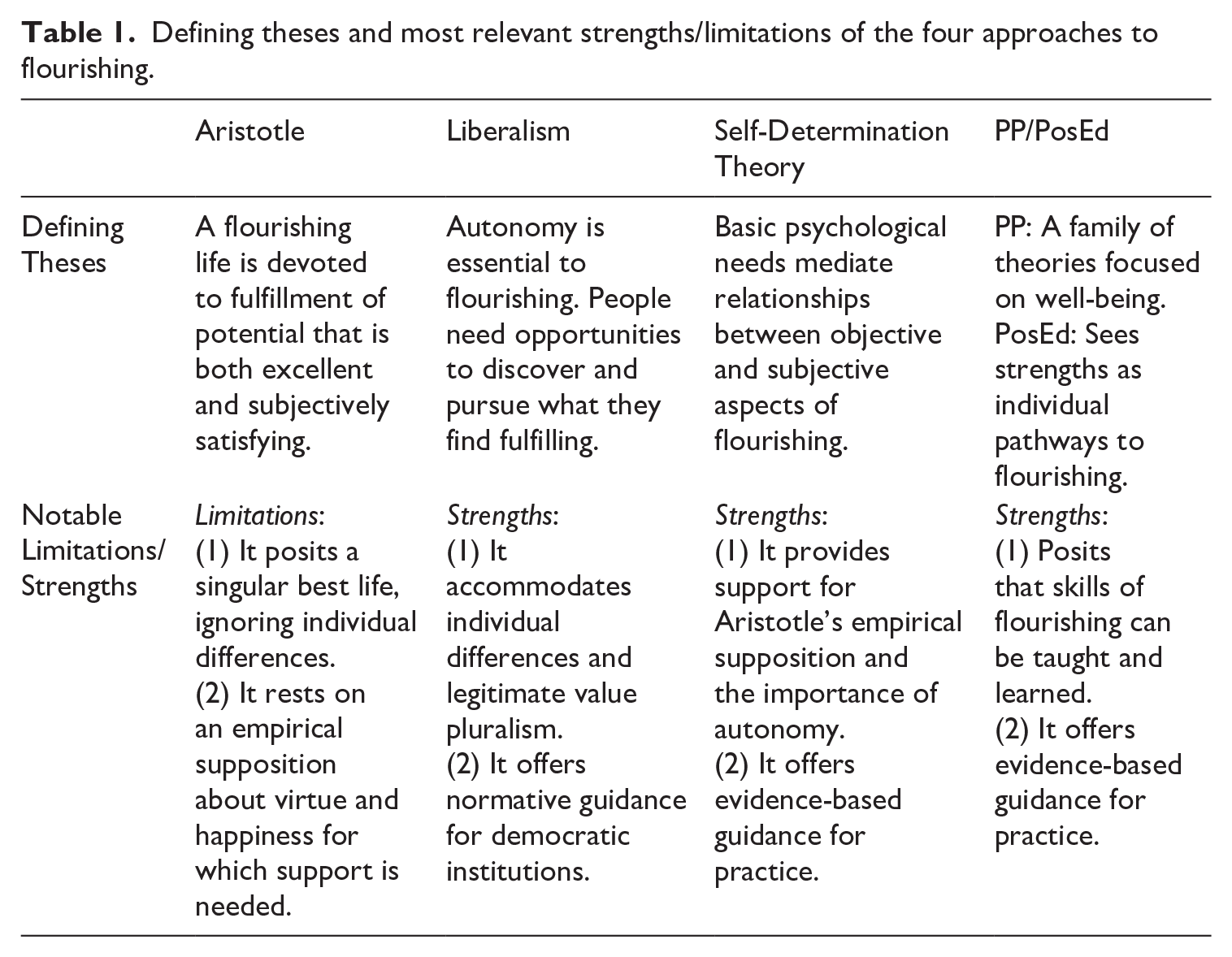
We offer Table 1 as a summary of our review of the four approaches and will then list the key points of consensus that have emerged through the process described in our methodology section.
Defining theses and most relevant strengths/limitations of the four approaches to flourishing.
Matters of consensus regarding the educational promotion of flourishing
The key points of consensus we have reached are as follows:
Promoting forms of learning and development that equip students to live flourishing lives is the appropriate overall aim of education, understanding flourishing as having both objective and subjective aspects: ongoing healthy growth and functioning involving fulfillment of potential that exhibits admirable qualities and is personally meaningful, satisfying, and (often) enjoyable.
Flourishing thus involves fulfillment of potential in acquired attributes that can be described as forms of excellence. There is an open-ended array of such forms of excellence, including capabilities, virtues, knowledge and understanding, and athletic, artistic, culinary, and other forms of talent. Many such forms of excellence involve valuing things that have significance independent of oneself.
Flourishing involves the acquisition and exercise of admirable attributes in activity that is personally meaningful, satisfying, and (often) enjoyable. In order to promote forms of development conducive to students’ flourishing, educational environments must provide opportunities for learning through activities that are meaningful to students. This requires learning environments that are psychologically need supportive.
Experience of autonomy, competence, and positive relatedness in pursuit of what one values gives rise to an experience of meaning (Martela and Steger, 2016; Ryan and Martela, 2016; Weinstein et al., 2012), and ‘intrinsic’ values or life goals (such as good relationships, personal growth, and community service) are more predictive of well-being than ‘extrinsic’ life goals (such as wealth, image, and fame) (Bradshaw et al., 2023). This is consistent with the widely held view that meaning in life is associated with devotion to things that have value independent of oneself (Wolf, 2010).
The concept of flourishing implies some degree of well-roundedness in fulfilling different basic forms of potential. A public justification of what constitutes sufficient well-roundedness or ‘full development of the human personality’ (United Nations, 1948: Art. 26, § 2) can rely on an evidence-based understanding of ‘full functioning’ that encompasses fulfillment of agentive, social, and creative potential consistent with living a good life. This implies ongoing fulfillment of all the forms of potential that are universally essential to living well as a human being because their fulfillment is essential to the satisfaction of basic psychological needs, without which a happy and flourishing life may be impossible.
Well-being researchers and educators sometimes have in mind a student’s personal potential, and they may equate this with a student’s most conspicuous emerging talent, the emerging talent most likely to lead (with enough ‘grit’) to notable success in life (e.g., a Nobel Prize), or the emerging talent that may provide the greatest life satisfaction. Important questions of educational practice hinge on this distinction. What we can agree on as a matter of consensus is that it is obviously important that education provides every child with what is universally essential to living well as a human being. If what is essential includes specific capabilities, understanding, or virtues – and it does – then those should be regarded as educational necessities. If living well as a human being involves satisfaction of specific needs – and it does – then education must be highly attuned to enabling students to satisfy all of those needs in the near term as well as the long term. If there are individual differences of inclination, culture, taste, circumstances, and nascent talent that influence what forms of activity are potentially (i.e., most likely to be) meaningful and rewarding for specific students – and there are – then educational environments must offer students diverse opportunities to fulfill their potential in ways that could be rewarding for them while also contributing to the collective enterprise of enabling everyone in the society to live well.
The flourishing that education should promote must include forms of social contribution and civic cooperation. Education in civic virtues is thus one aspect of the educational facilitation of flourishing.
Competent self-determination involves capacities of self-regulation and good decision-making. These capacities are a foundational aspect of flourishing. Social competence is also a foundational aspect of flourishing, entailing attributes of character that involve treating other people well. Basic aspects of good character or intellectual and moral virtues are thus foundational aspects of flourishing.
The concept of flourishing involves a non-subjectivist understanding of value, according to which there are things that are objectively good and bad for people, and things they objectively need. Flourishing is inherently good for people and frustration of basic needs that prevent them from flourishing is inherently bad for them.
The contributions of philosophy, social sciences, and the health sciences are all important to understanding well-being in all its aspects, including flourishing. Organismic and social ecological perspectives are important to understanding the ways in which different aspects of well-being interact with each other and with institutional contexts. With this in mind, Figure 1 provides a summary representation of these points of consensus.
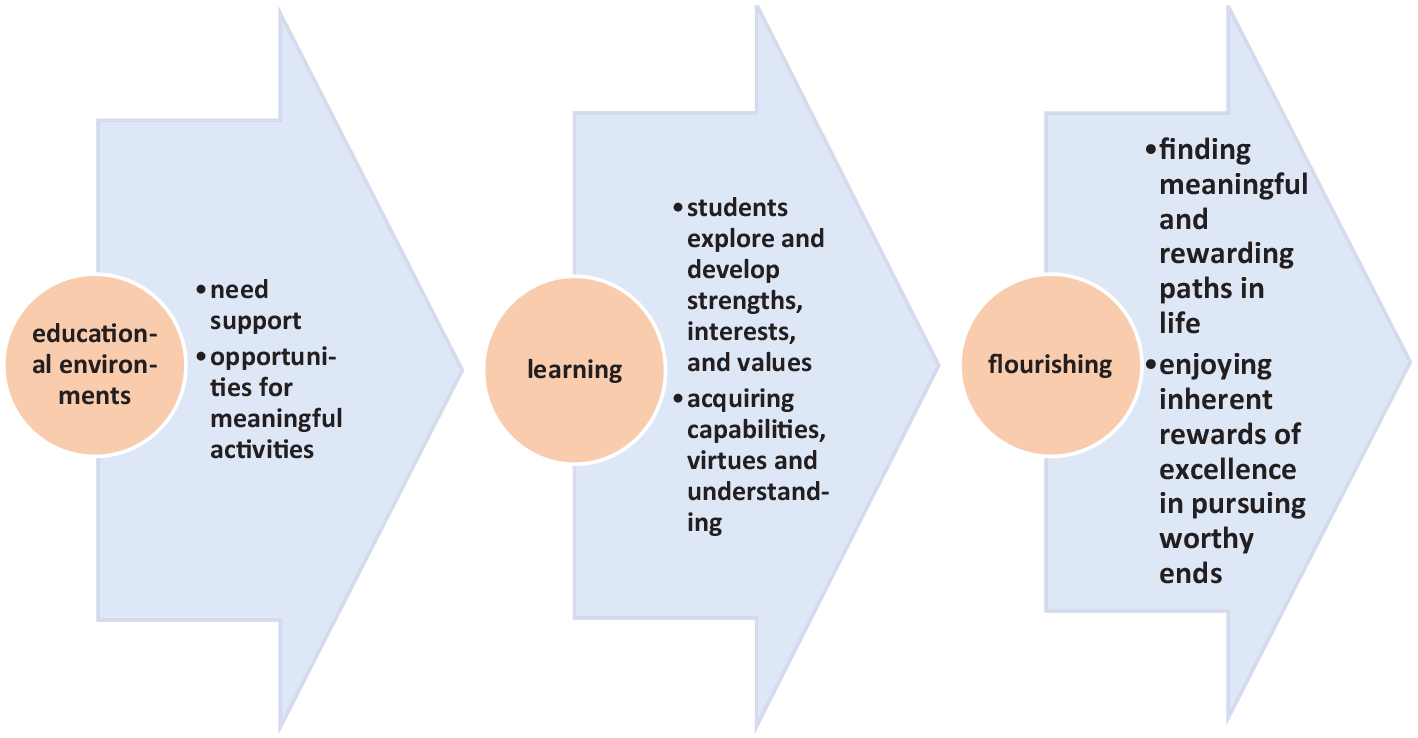
A consensus model of relationships between educational environments, learning, and flourishing.
How schools and educators should promote well-being
Before describing 12 recommendations for how schools and educators should promote well-being, there are three considerations relevant to all recommendations.
(1) As suggested by the foregoing, we regard education as a complexly embedded relational process, in which teachers and learners interact with each other in multi-dimensional contexts (Deci and Ryan, 2012; de Ruyter et al., 2022; Walker and Unterhalter, 2007). In this regard, curriculum, pedagogy, assessment, and the school community itself are contexts of teaching, learning, and development, which are themselves embedded in further historically shaped contexts.
(2) The significance of the distinction between implicit and explicit teaching and learning is evident in discussions of character education (JCCV, 2022) and positive education (Kern and Wehmeyer, 2021; Vella-Brodrick et al., 2022). Character virtues that are foundational to human flourishing, can be ‘caught’ from interactions in the school community, ‘taught’ through direct instruction as an explicit part of the curriculum, and ‘sought’ by students who identify ideals as their own and form personal aspirations. This ‘taught, caught, and sought’ schema is helpful in conceptualizing how schools and educators can promote well-being, and it necessarily considers the relational and socially embedded nature of education. Support for students’ autonomy, relatedness, and competence needs is a key aspect of the significance of the relational and social character of school communities, which is evident in such things as the value of psychologically need-supportive environments in reducing bullying and promoting friendliness and caring among students (Assor et al., 2009; Kaplan and Assor, 2012).
(3) Temporality: Immediate and near-term school experiences and the longer-term aims of education are both important. We have argued that student well-being should be both part of the school experience – an immediate or proximal concern – and that the facilitation of flourishing should be considered the overall long-term goal of education. The relationships between students’ daily educational experience and longer-term educational goals are relevant to all recommendations.
Making flourishing the overall aim of education will require progress in the way school communities are organized, subjects are taught and learned, and how learning is assessed. We have 12 recommendations.
It is important that learning environments be need-supportive with respect to basic psychological needs. This can be considered across all aspects of education including curriculum, pedagogy, assessment/evaluation, discipline, and the school community. The structuring of activities should provide choice and rationales, supporting students’ need for self-determination. It should optimize the level of difficulty to sustain growth while enabling students to experience themselves as competent most of the time. It should enable students to relate to others – teachers and peers – in ways that satisfy their need for positive connection. Structuring learning activities in these ways facilitates intrinsic motivation, which is good for learning and good for students (Gottfried et al., 2008; Howard et al., 2021; Taylor et al., 2014).
Focusing on the qualities of student engagement in activities of learning is important (Wang et al., 2019). A key aspect of this is that the rationales for learning that teachers provide students should foreground intrinsic goal framing (e.g., personal growth) rather than extrinsic goal framing (e.g., to pass the test), to support self-determination and intrinsic motivation, and to allow students to engage in activities of learning with a less instrumental mind-set (Vansteenkiste et al., 2009). This improves the odds of students valuing both the activities of learning and the goods at stake in what they are learning, without reducing their motivation to engage in learning.
A further priority would be to focus as much on character education, broadly construed, as on knowledge and skills. This involves not only intellectual, moral, and civic virtues, but foundational virtues of self-regulation and the kinds of valuing that infuse worthy life endeavors and give life meaning. An education that facilitates students’ progress in living good lives must provide them with diverse opportunities to engage in need-fulfilling activities (academic, athletic, artistic, social, civic, etc.) that could play significant roles in their lives.
A fourth focus would be to provide direct instruction in the science and philosophy of well-being and related skills of self-care – knowledge of what is actually conducive to happiness, reflectiveness about what it would mean to live a good life oneself, and self-regulative capacities (Morris, 2015). Teachers informed by positive education (Vella-Brodrick et al., 2022; White and McCallum, 2021) and SEL (Payton et al., 2000) are examples of early adopters worldwide.
A fifth focus would be reforming disciplinary practices to promote the development of capacities of self-regulation and good judgment (Bear et al., 2022; Curren, 2020; Power and Hart, 2005). A key aspect of this is to adopt a problem-solving approach that preserves psychologically need-supportive relationships while enlisting students who fail to meet behavioral expectations in diagnosing and addressing the reasons why they fail to meet expectations (Greene, 2018). Disciplinary interventions of this kind can promote skills of reflection and self-management, while restorative methods can address misconduct that affects other students or staff in ways that undermine community norms of equal respect and caring (Restorative Practices Working Group, 2014). This presupposes prior work to establish the community norms of mutual respect, cooperation, and collective flourishing that systemic well-being education entails. Failure to lay the groundwork for children’s healthy development in psychologically need-supportive just school communities (Curren, 2020; Power and Hart, 2005) can invite a more authoritarian and counterproductive mode of ‘behavior management’ that exacerbates disruptive behavior. Schools committed to promoting the development of civic and moral virtues in children and adults should consider training everyone in the skills of non-violent communication and the resolution of conflict through restorative methods and dialogue. This might in turn break the cycle of sending children into the world believing that hierarchy, authoritarianism, and domination are the only way of meeting their needs for autonomy and competence (Finnis, 2021; Rosenberg, 2003, 2015; Zehr, 2014).
In general, teaching and all the operations of a school should align with the science of flourishing and goal of facilitating students’ present and future well-being. Approaches such as ‘the whole school approach’ and ‘well-being ecosystems’ refer to the systemic nature of schools, in which the teacher-student interaction is one part of a larger system (International Commission on the Future of Education, 2021; Kern et al., 2020).
One aspect of this is recognizing the significance of educators’ well-being for student well-being. There is a significant body of research demonstrating this significance, but the experience of well-being in education advocates is that state departments of education strongly resist acknowledging that student well-being is heavily influenced by staff well-being (Reeve et al., 2022).
The success of well-being in education reforms is also dependent on reforms in teacher education. Around the world, existing teacher training does not prepare teachers well for their role as facilitators of student well-being (Higgins, 2011; White, 2021).
The success of schools as well-being ecosystems also requires attention to the language of well-being and how it influences the way well-being is conceptualized and experienced. Oades et al. (2021) have proposed a capability model of well-being literacy, defined as the intentional use of language about and for well-being, which includes knowledge and vocabulary about well-being, comprehending skills (reading, listening, and viewing), composing skills (writing, speaking, and creating), adapting to context (e.g., communicating differently to a person’s needs), and intentionality (developing the habit of evaluating intentions before communicating). Well-being literacy is used in schools to assess learning outcomes pertaining to well-being, rather than well-being per se, on the assumption that a more sophisticated command of the language of well-being is associated with greater understanding of well-being and ability to co-construct aspects of it. The related role of virtue literacy in character education is predicated on the idea that a shared vocabulary of virtue facilitates understanding, discussion, reflection, and aspirations that are important to character development (Davison et al., 2016; Lavy, 2020).
Another step is to identify, develop, and execute international, national, state, and school policy. The recent UNESCO International Science and Evidence-Based Assessment of Education is a rare example of a comprehensive international policy approach to education for human flourishing (Duraiappah et al., 2022; cf., Stevenson, 2022, for a recent OECD approach). Predicated on a perceived need to move beyond a conception of education focused on human capital formation, it posed the question, ‘How can education be reimagined to maximize human flourishing?’ (Duraiappah et al., 2022). The first of the 11 key findings on this question views education as primarily a social and relational activity that can provide a path to human flourishing. Key underlying assumptions are that education for human flourishing must reconcile individual needs and choices with advancing human flourishing as a universal and collective good, and that it must incorporate practices drawn from positive education and SEL (International Commission on the Future of Education, 2021).
Individual school policy settings also need to be explored alongside international and national policy settings (Allen et al., 2021). For example, consistent with liberalism and autonomy support, and UNESCO’s statement that personalized education is a human right, Oades and Jarden (2021) have proposed a policy template for schools for personalized well-being planning linking principles of personalization, connection, choice, and evidence-based action planning. Focused primarily on adolescent-aged students, this approach emphasizes the agency of a student actively working toward their own well-being and the well-being of others, in an educational context. The approach recommends that school reports provided to students and parents integrate such personalized approaches of actively working toward well-being alongside other academic-oriented approaches.
11. A further needed change is to integrate cultural, political, and particularly student lay conceptions of well-being and flourishing into schools’ efforts to promote well-being and flourishing. Asking students, parents, and teachers what well-being means to them, in their school and cultural context, is likely to increase understanding and collective ownership of well-being-related aspirations and changes (Huang et al., 2022).
12. Listening directly to students about their experience of well-being programs will also be helpful. Riedel et al. (2020) provided student evaluations of a positive education program, examining the student experience of programs that purportedly improve learning about well-being. ‘Student voice’ within school systems is important to understanding their subjective experience of well-being and thus to designing, assessing, and refining attempts to promote it (O’Malley et al., 2022). The evaluation of students and schools should be more broadly reformed to include a broader set of outcomes and the perspectives of all stakeholders, including those of teachers and school staff. School-based self-evaluations, measures of school climate, and observational and survey measures of student experience and need satisfaction in school can play important roles in this (Korentz, 2017; Ladd, 2010; Liu, 2022; Ryan et al., 2023a,b). Within the fields of positive psychology and self-determination theory there has been extensive work on the systematic evaluation of the effectiveness of well-being programs and initiatives for well-being, distress, and academic outcomes using controlled and randomized control studies (e.g., Reeve et al., 2022; Seligman and Adler, 2018; Tejada-Gallardo et al., 2020).
Conclusion
The aim of this article has been to defend a flourishing-focused reorientation of education and identify points of consensus regarding the nature and promotion of flourishing that can guide educational policy and practice. Our fundamental argument favoring this flourishing-focused education agenda over one predicated on human capital theory is that only a sufficiently comprehensive conception of the good to be achieved by education can be justified as its overall aim. Education is far-reaching in its significance for those who receive it and for others, and we have argued that nothing short of promoting the forms of learning and development that are conducive to everyone living well can ethically justify what we do to children in educating them. The good of enhancing students’ ability to engage in economic production is, by contrast, a far too narrow basis on which to justify the education that occupies a large and growing portion of people’s lives and has far-reaching consequences for every aspect of their well-being.
We used this foundational consensus argument and a close examination of the defining features of, and perceived tensions among, four influential schools of thought on the nature of flourishing and its educational promotion, as a basis for what followed. Resolving these tensions, setting aside aspects of an Aristotelian approach that are unhelpful, and combining strengths of a liberalized neo-Aristotelian orientation with the resources of SDT and other research in PP/PosEd has enabled us to: (1) identify important points of consensus on the educational promotion of flourishing, (2) identify a consensus model of relationships between educational environments, learning, and flourishing, and (3) offer specific recommendations for educational policy and practice. While any such consensus is inherently limited, we hope that the analysis and recommendations presented here may serve as starting points for needed changes that will only succeed if they engage the perspectives and support the self-determination in flourishing of students, educators, and their diverse communities across the world.
Footnotes
Acknowledgements
The authors wish to acknowledge that Simon Murray, the Executive Chair of
Declaration of conflicting interests
The author(s) declared no potential conflicts of interest with respect to the research, authorship, and/or publication of this article.
Funding
The author(s) received no financial support for the research, authorship, and/or publication of this article.
Notes
Author biographies
