



Abstract
Reward systems in prison are applied worldwide. In reward systems, the responsibility for behavioural reform is increasingly transferred from states to incarcerated individuals, as these individuals can earn a reward status by complying with institutional rules. The underlying assumption of such systems is that rewards promote motivation for compliance. Despite the large impact of (not) earning reward status on individual lives, it has seldomly been empirically studied which factors predict earning reward status. A further question is to what extent individuals in prison are capable of self-governing their behaviour, which is necessary to comply with institutional rules and obtain rewards. Using survey-data from the Life in Custody study (N = 777) conducted in the Netherlands, bivariate and multivariate relationships were examined between reward status and theoretically relevant predictors: motivation, self-governance ability, misconduct and compliance. Bivariate results indicate that individuals with and without reward status reported significant differences on all predictors. However, only misconduct predicted reward status in a conditional fixed effects logit model. Next to conceptualising and operationalising self-governance ability, findings question the rehabilitative value of the Dutch RSP. Findings also provide incentives to policymakers and prison staff to identify, distinguish between, and address causes of non-compliant behaviour in prison.
Reward systems in prison (RSPs) are applied worldwide, in different forms. This includes token economies (Gendreau et al., 2014), good-time credit (Johnson and Stageberg, 2014; Steiner and Cain, 2017) and different status levels with associated privileges and freedoms (Liebling et al., 1997; Morar et al., 2019). According to Khan (2022), RSPs are the penal archetype of responsibilisation, as they largely transfer the responsibility and accountability for achieving state goals to individual offenders (e.g., Bosworth, 2007; Hannah-Moffat, 2001). RSPs transfer that responsibility by distributing rewards to incarcerated individuals based on their ‘good’ behaviour, which is thought to contribute to institutional order and safety and behavioural reform (Bosworth and Liebling, 1994; Elbers et al., 2021; Gendreau et al., 2014). Although incarcerated individuals are granted relatively greater autonomy to self-govern their behaviour in RSPs, this is experienced as psychologically burdensome (Crewe, 2011; Shammas, 2014). Moreover, (not) earning rewards can have a significant impact on life in prison. In RSPs, compliance determines the amount of contact incarcerated individuals have with loved ones, their access to reentry programmes and their date of (conditional) release. Therefore, it is surprising that research on this topic is limited; existing research on RSPs is mostly dated and not generalisable (Elbers et al., 2022; but see Butler et al., 2024).
Arguably the best-known example of an RSP is the Incentives and Earned Privileges (IEP) scheme, which has been operational in England and Wales for three decades (Liebling et al., 1997). The IEP scheme has three levels. In 2024, 49.3% of individuals participating in the IEP scheme was on the highest Enhanced level, while just under half (45.5%) was on Standard level, and the remaining 5.3% was on Basic level (Her Majesty's Prison and Probation Service, 2024). In Northern Ireland, 56% of individuals participating in the RSP are on Enhanced level (Butler et al., 2024). The Netherlands has adopted a system like the IEP scheme in 2014, although it only has two levels: Plus and Basic (Elbers et al., 2021). The Basic level equates to IEP's Basic level, whilst the Plus level is similar to its Enhanced level. How many individuals are in Plus and Basic level is unknown. Recently, the Dutch government has introduced the Punishment and Protection Act (2021), in which conditional release has become dependent on RSP level. In the Dutch and English RSPs, prison staff report on individuals’ behaviour and (indirectly) determine the allocation of rewards. Both RSPs thus give substantial discretion and power to prison staff in deciding – or influencing the decision – whether reward status should be granted, maintained or revoked. Reward systems with such sizable and formalised staff discretion are less common in North American prisons (Haggerty and Bucerius, 2021). However, it is unclear which factors determine reward status allocation and how staff uses discretionary powers in that process. Our contribution aims to address this literature gap in the context of the Dutch RSP, by empirically answering two research questions:
To what extent – and in what way – do individuals with and without reward status differ in motivation, self-governance ability, and behaviour? To what extent do (a) motivation, (b) self-governance ability, and (c) behaviour of incarcerated individuals predict their reward status?
Dutch reward system in prison
The Dutch RSP was introduced in all Dutch prisons in 2014, affecting half of the 26.000 individuals annually entering Dutch prisons (Dutch Custodial Institutions Agency, 2023). Individuals without reward status (Basic level) are provided the legally required minimum amount of programming, visitation, and time out-of-cell. Individuals with reward status (Plus level) can be rewarded with more freedom and responsibilities in work (e.g., job as a unit cleaner), higher wages, better (vocational) training, more visits, as well as out-of-cell activities on weekends and two evenings. Overall, individuals with reward status spend 11 additional hours out of their cells. Rewards can be granted after behaving well for at least six consecutive weeks. ‘Good’ behaviour is defined as compliance with 10 behavioural norms: taking part in diagnostics and screening upon prison entry, cooperating in work, actively cooperating in developing and carrying out a sentence plan, keeping appointments, following institutional rules, cooperating in the daily programme, cooperating with urine tests and cooperating in conversations about oneself and personal problems (State Secretary of Safety and Justice, 2014). Although RSPs focus on rewarding ‘good’ behaviour, misconduct is seen as ‘bad’ behaviour and precludes reward status (e.g., verbal violence or drug use). Other undesirable behaviour, such as non-compliance with behavioural norms, can also affect reward status (e.g., not cooperating with urine tests). The prison governor, advised by prison staff, decides on individual reward statuses, approximately every 6 weeks. Important to note is that prison policy dictates that misconduct must be punished with immediate loss of reward status.
Today, the possibilities for Dutch prison staff to account for individual differences in reward status allocation are limited. Up until 2020, individuals who, due to impaired self-governance ability (e.g., mental health problems, intellectual disability, and/or addiction) had difficulty complying with behavioural norms, could still be granted reward status provided they were motivated to change their behaviour (Van Gent, 2013). In 2020, this clause was removed from the system guidelines. Simultaneously, the behavioural norms were simplified to promote better and more consistent staff behavioural assessments (Inspectorate of the Ministry of Justice and Safety, 2018).
Based on current Dutch RSP policy, it can be expected that behaviour, operationalised as compliance and misconduct, is the only predictor of earning reward status. Although they theoretically drive behaviour, motivation and self-governance ability are no longer (directly) considered when deciding on reward status (Elbers et al., 2021). However, the extent to which these assumptions on the role of behaviour, motivation and ability hold up in practice can be questioned. Based on theoretical and empirical literature, we will discuss the validity of these assumptions and propose (alternative) hypotheses.
Motivation
That extrinsic motivation induces compliance and prevents misconduct is an important assumption underlying the Dutch RSP – and other contemporary RSPs (Butler and Maruna, 2012; Butler et al., 2024; Liebling et al., 1997). This assumption is rooted in behaviourism and rational choice models of human behaviour (Murphy and Lupfer, 2014) and stressed in social (cognitive) learning theories (Akers and Jennings, 2016; Bandura, 2001) and the Risk-Need-Responsivity (RNR) model of correctional interventions (Bonta and Andrews, 2007). However, extrinsic motivation might not always result in compliance, for instance when it undermines pre-existing intrinsic motives to comply. We will illustrate this with both theoretical and empirical arguments.
Motivation is a complex and multifaceted concept. Bottoms (2003) conceptualised four sources of compliance in prison: (i) routine or habit, (ii) constraint (being unable to not comply), (iii) instrumentality (e.g., rewards and punishments) and (iv) normative consensus (e.g., staff legitimacy). It is likely that multiple sources of compliance interact. For example, formal and informal rewards, perceived staff legitimacy, and individual characteristics are all theorised to impact compliance in RSPs (Bosworth and Liebling, 1994; Liebling et al., 1997). Surprisingly little, however, is theorised by prison scholars on the complex relationship between intrinsic motivation and formal rewards.
According to self-determination theory (SDT; Ryan and Deci, 2000), intrinsic motivation produces the strongest and most durable effects on behaviour. Intrinsic motivation is conceptualised as the desire to engage in behaviour for the reward of engagement itself, whereas extrinsic motivation is the desire to engage in behaviour to obtain rewards or avoid punishment. Extrinsic motivation can develop into intrinsic motivation through internalisation of the goals and values associated with behavioural norms. Internalisation can be promoted by satisfying basic human needs of autonomy, competence, and relatedness (Vansteenkiste et al., 2018). These needs can be satisfied through, for instance, promoting perceptions of procedural legitimacy (Bottoms, 2003). Formal rewards can also undermine pre-existing intrinsic motivation to comply with institutional rules, specifically when formal rewards are perceived as threats to individual autonomy (Deci et al., 1999; Ryan and Deci, 2000).
Scarce empirical research on RSPs indicates that both extrinsic and intrinsic motivation can promote compliance, but in contrasting ways. Qualitative pilot studies of the Dutch RSP indicated that awareness of the possibility of losing reward status extrinsically motivated multiple individuals in prison with a reward status to continue to comply (De Jong et al., 2015; 2016). Likewise, in the IEP scheme, many individuals voiced extrinsic rather than intrinsic motives to comply (Crewe, 2011; Liebling et al., 1997). Lack of fair system application, however, was also associated with less compliance in the IEP scheme (Liebling et al., 1997) and an RSP in Northern Ireland (Butler and Maruna, 2012). Relatedly, formal rewards have been found to undermine the development of intrinsic motivation to comply in IEP scheme participants (Liebling et al., 1997).
Self-governance ability
Another implicit theoretical assumption held by Dutch policymakers is that incarcerated individuals generally possess sufficient abilities to self-govern behaviour in line with behavioural norms (Elbers et al., 2021). As described earlier, since 2020, self-governance ability can no longer be directly considered in reward allocation by Dutch prison staff. Possibly, however, self-governance is still considered within the limits of their discretionary power. Also plausible is that self-governance ability indirectly impacts reward status through behaviour. Advancements on traditional rational choice theories underline the importance of cognitive and related conceptual, practical, and social skills in initiating and maintaining behaviour. According to the well-known social cognitive learning theory (Bandura, 2001), the abilities to anticipate outcomes (forethought), to act on intent (self-reactiveness) and to monitor and adjust behaviour (self-reflectiveness) are prerequisites to engage in calculating rewards and costs and social modelling. Therefore, correctional intervention models emphasise that effective prison interventions should match the skills of its clients (Bonta and Andrews, 2007; Ward, 2012). These abilities are also conditional to complying with behavioural norms in the Dutch RSP, such as developing and carrying out a sentence plan.
Navigating social structures and self-governing behaviour is challenging for citizens in general (Bovens et al., 2017), but particularly for incarcerated individuals. Struggling with self-governance is a recognised pain of imprisonment (Crewe, 2011; Shammas, 2014). However, empirical research has left the relationship between the ability to self-govern behaviour, compliance, and reward status largely unattended. The few available quantitative North American studies on RSPs imply that individuals with intellectual impairments can be responsive to reward systems and can promote their academic achievements, provided that the RSP design suits their needs. These studies, however, are dated (1960s), have multiple methodological flaws and effects were found to wear off after system termination (Elbers et al., 2022). Effects could be very different in contemporary, large-scale RSPs. A unique quantitative study on such a large-scale RSP in Northern Ireland illustrated that participants with an extensive history of (detected) drug use were less likely to progress to higher levels. As the authors suggest, drug use may affect motivation to comply with the scheme, as well as participants’ ability to self-govern their behaviour (Butler et al., 2024).
Sparsely available qualitative studies among IEP participants concluded that, regardless of motivation, cognitive and mental impairments can frustrate RSP compliance (Crewe, 2013; Hutton, 2017; Crewe and Ievins, 2021). These observations appear to align with positive effects of higher education levels on compliance in the IEP scheme (Liebling, 2008). If self-governance ability plays a significant role in RSP progression, this could affect large parts of the prison population. Impairments in cognitive, conceptual, practical, and social skills are overrepresented in prison populations worldwide (García-Largo et al., 2020; Meijers et al., 2015), but especially in the Netherlands. Up to 45% of the Dutch prison population is estimated to have an intellectual disability, restricting their self-governance ability (Den Bak et al., 2018; Kaal et al., 2011).
Behaviour
Finally, even though motivation and self-governance ability are theoretically and empirically associated with compliance, only compliance and absence of misconduct can be rewarded according to Dutch prison policy. Policymakers also assume that prison staff consistently reward compliance and sanction misconduct (Elbers et al., 2021). Prison officers, however, can be considered street level bureaucrats, as they are at the bottom of the organisational hierarchy, have face-to-face contact with (non-voluntary) clients, enjoy considerable discretion in applying general rules in specific circumstances, operate without much direct supervision from managers or coworkers and have little influence on formal prison policy (Bosma et al., 2018; Lipsky, 1980; Maynard-Moody and Portillo, 2010). Based on street-level bureaucracy theory (Lipsky, 1980), it is unlikely that all behaviours (‘good’ and ‘bad’) are monitored and detected by prison staff, let alone consistently interpreted and rewarded or sanctioned.
Scholars have described several coping strategies which street-level bureaucrats adopt to cope with these strains, such as standardising decision-making, prioritising tasks or individuals who are ‘easy’ to manage and reducing caseload by making their services less attractive or accessible (Lehmann Nielsen, 2006; Lipsky, 1980; Tummers et al., 2015). Applied to prison officers, this means they are likely to exercise discretion and negotiate order when applying RSPs (Haggerty and Bucerius, 2021; Liebling, 2008) and sometimes fail to detect compliance (Khan, 2022). Dutch prison officers have been found to resort to such coping strategies in behaviour observation, interpretation and assessment, due to persistent understaffing and high caseloads (Inspectorate of the Ministry of Justice and Safety, 2018; Elbers, 2025).
Additionally, some behaviours in the Dutch RSP are simply easier to observe (e.g., violent altercations) than others (e.g., verbally bullying a cellmate). Even when detected, interpreting behaviour remains difficult (Inspectorate of the Ministry of Justice and Safety, 2018). Some behavioural norms are clearly defined and objectifiable (e.g., negative urine tests), while others are more open to interpretation (e.g., cooperating in conversations) (Elbers et al., 2021). Notably, the clearest of norms are those that indicate misconduct. This may position misconduct as a central criterion in decisions regarding reward status; as was found in a recent study in Northern Ireland (i.e., not taking or passing drug tests predicted RSP progression; Butler et al., 2024).
Even if detected, staff is unlikely to sanction all misconduct. This would be inefficient and could frustrate relationships between staff and people in prison (Haggerty and Bucerius, 2021). In sum, adopting coping strategies whilst detecting, interpreting, rewarding and/or sanctioning behaviour could result in a situation in which compliance does not necessarily lead to earning reward status (Liebling et al., 1997).
Hypotheses
This literature review illustrates that, on the one hand, RSPs appeal to extrinsic motivation by rewarding good behaviour. On the other, norm compliance may be desirable in itself (a function of intrinsic motivation). Moreover, policy and practice also suggest that self-governance ability can still be considered by Dutch prison staff in deciding on reward status allocation and is a prerequisite for norm compliance. Finally, Dutch prison policy dictates that behaviour should be the sole determinant of obtaining reward status. In this exploratory study, therefore, we expect to find that incarcerated individuals with reward status report greater intrinsic and extrinsic motivation, greater self-governance ability, and compliance, but less misconduct, compared to their non-rewarded counterparts. Additionally, we hypothesise that both motivation types, self-governance ability, and behaviour predict reward status, although we expect to find a smaller effect of behaviour than policymakers assume, which is skewed towards misconduct and downplays compliance. In sum, we hypothesise that: H1: The higher the motivation and self-governance ability, the greater the odds of reporting a reward status; H2: The higher the motivation and self-governance ability, the better the reported behaviour; H3: The better the behaviour, the greater the odds of reporting a reward status; H4: The effect of motivation and self-governance ability on reporting a reward status is smaller when behaviour is accounted for.
Testing these hypotheses is relevant considering the widespread and large-scale application of RSPs, their significant impact on individual lives, and a dearth of empirical research on RSP application and mechanisms explaining reward status allocation.
Methods
Life in custody study
The current study uses survey data from the Life in Custody (LIC) study (Van Ginneken et al., 2018). The current study used data collected in 2022 in a selection of eight prisons. This selection was based on number of individuals residing in a prison regime (as the Dutch RSP is formally only applied in prison regimes), size and location. Data were collected shortly after COVID-19 measures in Dutch prisons were lifted. The dataset contains self-report data on domains of prison climate (e.g., autonomy and peer relationships) and various possible outcomes (e.g., misconduct and wellbeing).
Instrument
The data were collected using the Prison Climate Questionnaire (PCQ; Bosma et al., 2020b). In this measurement wave, the PCQ was extended to contain items on self-governance ability, system procedural legitimacy, behavioural compliance, motivation to comply with behavioural norms and several background characteristics (e.g., history of substance use). An additional change compared to prior LIC data collections was that the survey was anonymised, because it was not necessary to link the survey data to administrative data. As this study set out to measure self-governance ability (including reading skills), clear, simple, and concise wording was used, without altering items’ meanings. The Dutch version of the PCQ 2022 was pilot tested among eight individuals who were incarcerated in one of the eight selected prisons. Four of these individuals were indicated by staff (not diagnosed) as having intellectual disabilities or learning difficulties. These participants evaluated the survey as clear and comprehensible. The survey was available in Dutch and English.
Procedure
Data were collected from March to July 2022 by a team of 10 research assistants (mostly graduate students), overseen by an experienced researcher. Prior to data collection, research assistants were extensively trained in approaching individuals in prison, the use of informed consent, documenting response and entering data in SPSS 29. During data collection, a prison officer navigated the researchers through the prison, guaranteeing their safety and access. The researchers approached each potential participant individually to explain the goal and anonymous nature of the survey and answered any questions on the survey or procedure. Every potential participant was given a small token of appreciation (e.g., a candy bar) and a pen, regardless of their participation. Surveys were generally collected in person on the same or the next day. Throughout data collection, response was monitored per unit (i.e., number of surveys handed out, collected, non-response). Data collection lasted approximately 5 days in each prison.
Sample
In total, 3210 individuals were housed in eight Dutch prisons for men during data collection. Of these individuals, 260 could not be invited to participate because of language difficulties, severe mental health problems, lack of Dutch or English language proficiency, or being placed in segregation during data collection. Of the 2950 men who were approached to participate, 2209 (75%) took part (reasons for non-participation were ‘don’t want to’ and a lack of trust in survey outcomes leading to real changes in prison). All participants were informed of the purpose of the study and gave their consent for participating. Only 1021 individuals were incarcerated on regular prison regimes and thus participated in the Dutch RSP, 1002 of whom reported their reward status. Of those 1002 cases, 219 were removed because they did not have any valid response on all items of one or more scales (motivation, self-governance ability, misconduct and/or compliance). 1 Of the remaining 783 cases, six were removed because these participants did not answer more than half of the items belonging to a scale. These cases had to be removed because we constructed scale scores based on this criterion. 2
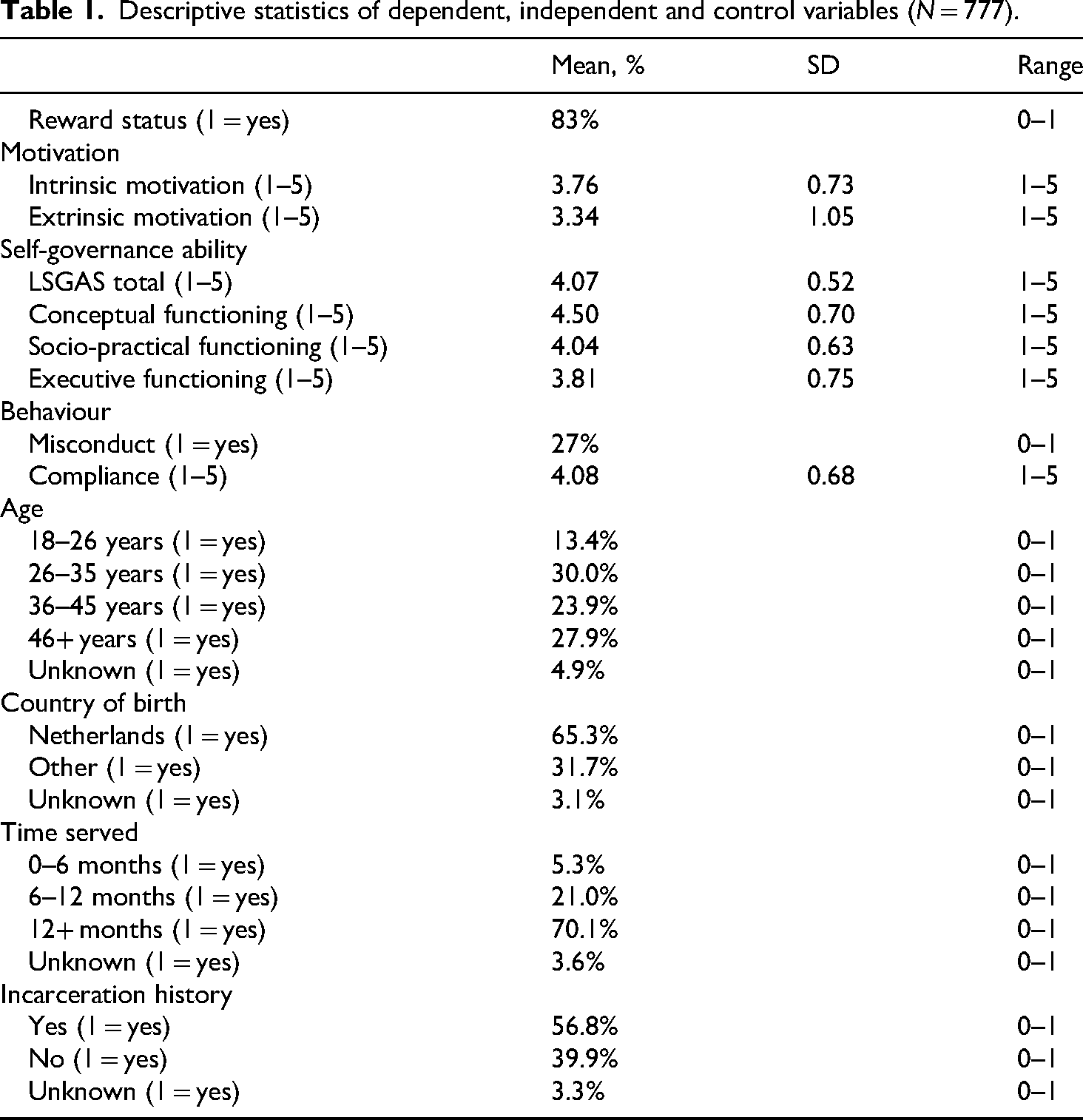
Therefore, the final sample used for our analyses consisted of 777 individuals with complete data on variables used. Of this entirely male sample, 65.3% was born in the Netherlands, 56.8% had previously been incarcerated and 26.3% had served up to 12 months of their current prison sentence, at the time of data collection. Their mean age was 39 (Med. = 37) (Table 1). Analysis of missing values did indicate that removed cases (N = 225) differed significantly from our sample on reward status, compliance, socio-practical and conceptual functioning, time served, incarceration history and country of birth, but not misconduct.
Descriptive statistics of dependent, independent and control variables (N = 777).
Measures
Reward status
The dependent variable reward status was measured using one item (‘which programme are you in now?’). Answer categories were ‘Basic’, ‘Plus’, ‘remand’, ‘don’t know’ or ‘not applicable’. This variable was recoded into a dichotomous variable, representing Basic (0) and Plus (1) level; in this paper referred to as without and with reward status. The answers ‘remand’, ‘don’t know’ and ‘not applicable’ were coded as missing, and thus excluded from analyses.
Motivation
The independent variable motivation to comply was measured using seven items. Inspired by self-determination theory (Ryan and Deci, 2000), the PCQ 2021 set out to measure both intrinsic and extrinsic motives to comply with institutional rules. These two theoretical dimensions were also found in our data, based on the Kaiser criterion (eigenvalue > 1) and visual inspection of the scree plot (Hair et al., 2019; Preacher and MaCallum, 2003) (see Table S3, Figure S2). These two dimensions explained 61% of total variance in motivation: intrinsic motivation, containing four items (e.g., ‘I try to follow the rules because … it helps keep me safe in this institution’) (α = .69) and extrinsic motivation, containing three items (e.g., ‘I try to follow the rules because … I feel like I would otherwise be punished’) (α = .82) (see Table S1).
Response categories of each original item ranged from 1 (strongly disagree) to 5 (strongly agree) on a Likert-scale. A mean score was calculated if over half of the items on each scale was answered. This was appropriate because factor loadings indicated that items contributed similarly to the scale (see Table S3), both scales were reliable and the percentage of missing values per participant on each scale was low (see Figure S8). In short, few interpretable data were lost. Higher scores on either dimension indicated higher levels of extrinsic or intrinsic motivation to comply. The correlation between extrinsic and intrinsic motivation was small (r = .12) (see Table 2).
Correlations between reward status, behaviour, self-governance ability and motivation (N = 777).
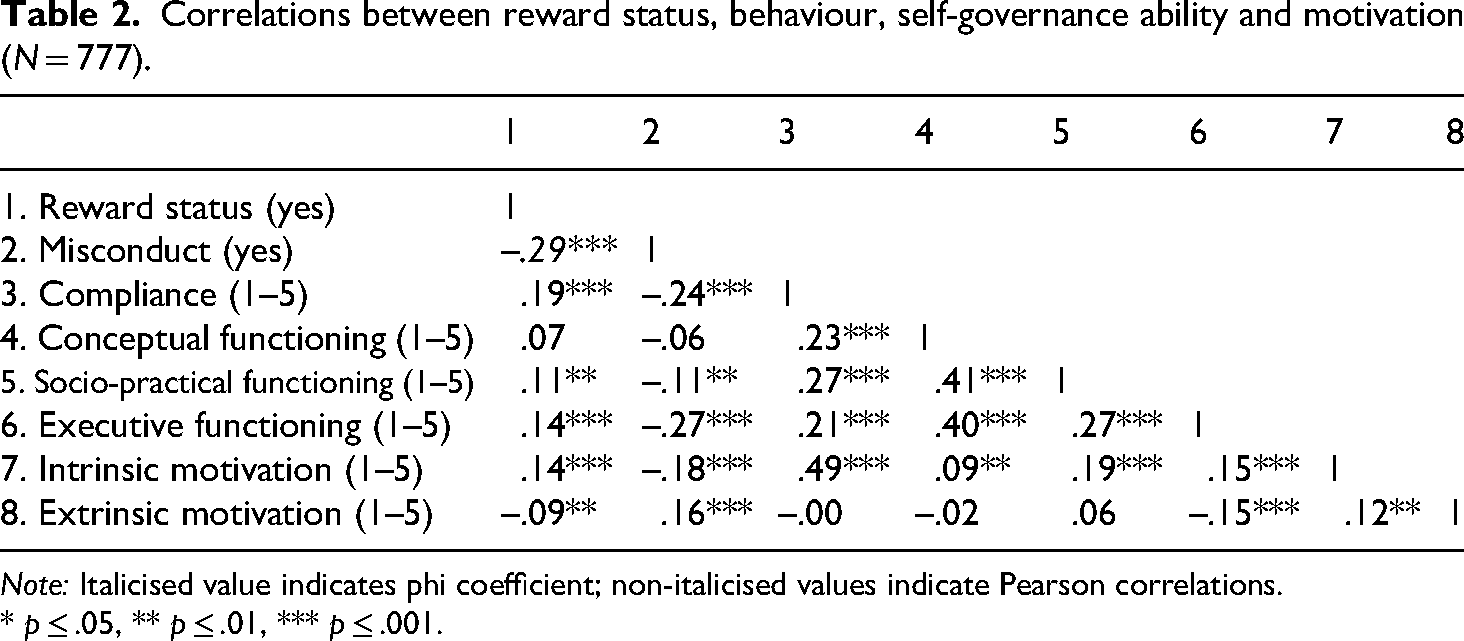
Note: Italicised value indicates phi coefficient; non-italicised values indicate Pearson correlations.
* p ≤ .05, ** p ≤ .01, *** p ≤ .001.
Self-governance ability
We used the Leiden Self-Governance Ability Scale (LSGAS) to measure self-governance. The LSGAS is a newly constructed self-report scale, derived from theories on cognition, intelligence and self-government, contemporary definitions of intellectual disability stressing both adaptive functioning and intelligence (American Psychiatric Association, 2013; Schalock et al., 2010) and existing measures of intellectual disability (e.g., Learning Disability Screening Questionnaire, McKenzie et al., 2012; Screener Intelligence and Learning Disabilities 18+, Nijman et al., 2018). The LSGAS contains 14 items on self-governance ability (α = .80) (see Tables S6 and S7). Based on theory, we expected to find three dimensions (conceptual, socio-practical, and executive functioning). These dimensions were found in our data, based on the Kaiser criterion (eigenvalue > 1) and visual inspection of the scree plot (see Table S4, Figure S5). These three factors explained 51% of total variance in self-governance ability, which is acceptable for novel instruments (Hair et al., 2019).
Conceptual functioning (α = .71) containing three items (e.g., ‘I have difficulty reading and understanding short texts (such as street signs or advertisements)’), socio-practical functioning (α = .74) containing seven items (e.g., ‘I can make appointments without help from others (such as appointments at the doctor or municipality)’) and executive functioning (α = .72) containing four items (e.g., ‘sometimes I like to do things that will get me into trouble’). Correlations between these three dimensions were all between .27 and .41 (see Table 2). 3
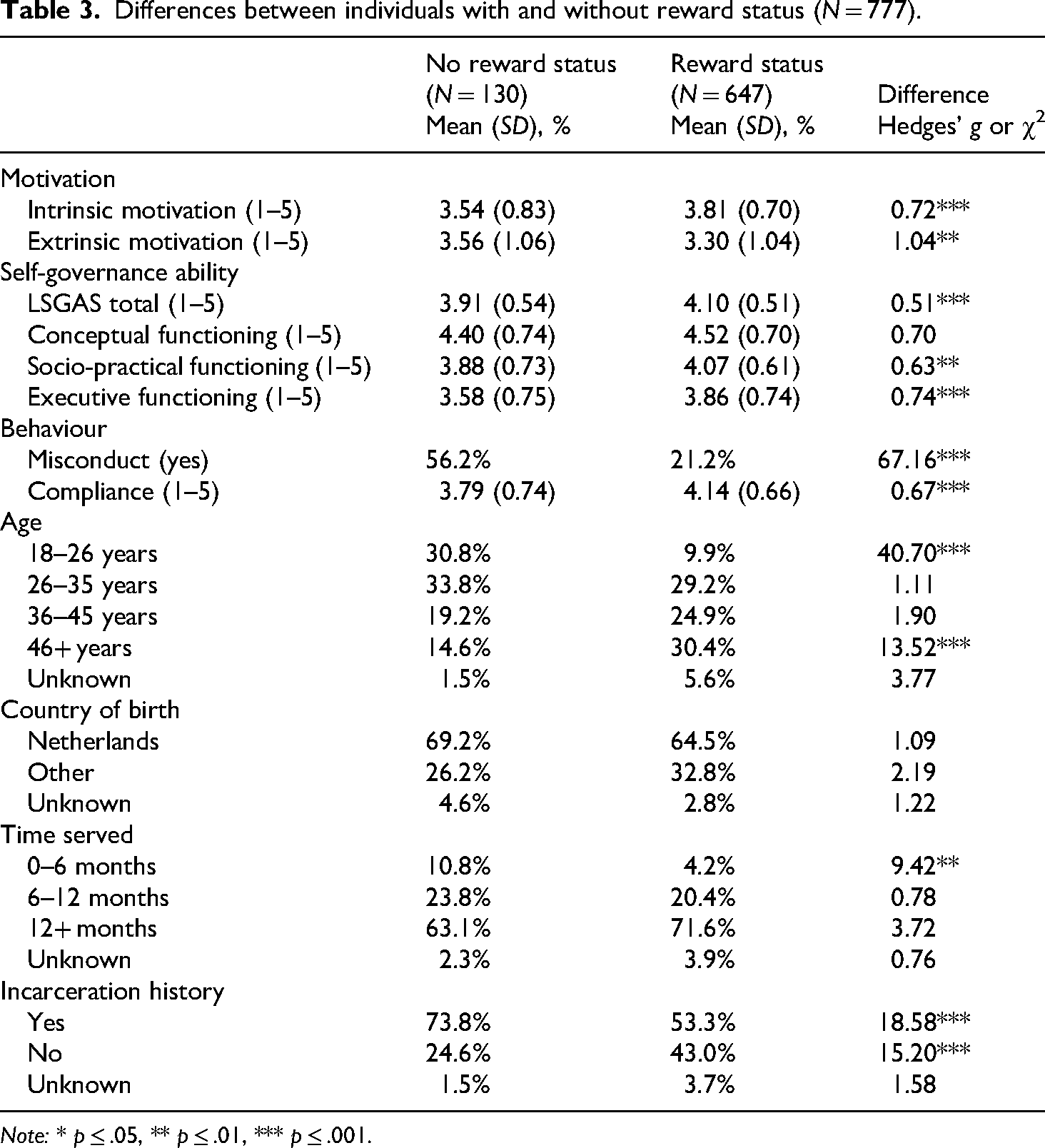
Differences between individuals with and without reward status (N = 777).
Note: * p ≤ .05, ** p ≤ .01, *** p ≤ .001.
Response categories on each original item and the dimensions ranged from 1 (strongly disagree) to 5 (strongly agree) on a Likert-scale. Several items were reversed, so a high score indicated a higher degree of self-governance ability. A mean score was calculated, for every individual dimension, if over half of the items belonging to that factor was answered. This was appropriate because factor loadings indicated that items contributed similarly to the factors (see Table S6), the factors were reliable (α = .71 to α = .74) and the percentage of missing values per participant on each scale was low (see Figure S8). These three dimensions were all used in analyses.
Behaviour
We used two different measures for the (in)dependent variable behaviour: compliance and misconduct. Compliance was measured using 10 items (e.g., ‘I comply with urine tests’) (α = .90). The 10 items directly translate to the behavioural norms that dictate granting reward status in Dutch prison policy (Elbers, 2024). Response categories ranged from 1 (strongly disagree) to 5 (strongly agree) on a Likert-scale. A mean score was calculated if over half of the items were answered. This was appropriate, as items contributed similarly to the scale score (factor loadings ranged from .63 to .87). No factors were distinguished but a composite scale was used in multivariate analyses, as our primary interest was not in the structure of the measure of compliance but in its overall predictive value. High scores indicate high degrees of compliance.
Engagement in any type of misconduct (i.e., verbal and physical violence, property violence, theft, drug or contraband possession) was measured using seven items (e.g., ‘how often, in the last two months in this facility, have you … threatened or scolded another prisoner?’). Each item originally had three response options ‘never’ (=0), once’ (=1) and ‘twice or more often’ (=2). Because of the skewed distribution of having reported misconduct on one or more misconduct subtype (‘never’ = 73%, ‘once’ = 14.9% and ‘twice or more often’ = 12.1%), each subtype was recoded into a binary format for analyses (0 = no misconduct, 1 = misconduct). These seven binary indicators were then aggregated into a single dichotomous variable indicating whether a participant had committed at least one type of misconduct (0 = none, 1 = at least one). 4 Dichotomising misconduct was sufficient to achieve our exploratory goal of analysing the effect of misconduct on reward status irrespective of type or frequency. Important to note is that self-reported misconduct has been found to better reflect true misconduct rates in prisons than registration data (Bosma et al., 2020a; Steiner and Wooldredge, 2014).
Control variables
Based on their theoretical and empirical relevance, four (ordinal) control variables were included. Age was included using five categories (‘18 to 25 years’, ‘26 to 35 years’, ‘36 to 45 years’, ‘46 years or older’ and ‘unknown’ (−99)). Country of birth distinguished between individuals born in ‘the Netherlands’, ‘other countries’ and ‘unknown’ (−99). Time served was included as an ordinal variable with four categories: ‘up to 6 months’, ‘6 to 12 months’, ‘12 months or more’ and ‘unknown’ (−99). Finally, incarceration history reflected whether a person had been previously incarcerated (0 = ‘no’, 1 = ‘yes’, −99 = ‘unknown’). Reference categories were 18–25 years of age, born in the Netherlands, having served 6–12 months and not having a history of incarceration.
Analytical strategy
Besides descriptive statistics and correlations, t-tests and Chi-square analyses were used to examine differences between individuals with and without reward status (Plus/Basic). Bivariate analyses indicated significant correlations between almost all (in)dependent variables, so multivariate analyses were relevant (see Table 2). Due to the nested structure of the data (individuals in prisons), we examined potential clustering on the prison level. A multilevel logistic regression analysis (xtmelogit) of an empty model with reward status as dependent variable indicated some clustering within prisons (B = 1.74, SE = 0.19, p < .001). The intraclass correlation coefficient was .049, corresponding to a design effect of 6.5. Therefore, we compared full multilevel random-intercept logit models (xtmelogit) with unconditional fixed effects logit models including prison dummies using log likelihood, AIC, and BIC (logit, i.prison). All included predictors in the multilevel models were on the individual level. Model comparison favoured the fixed-effects models, as both AIC and BIC were substantially lower for the fixed-effects model (see Tables 4 and S10; ΔAIC ≈ 40; ΔBIC ≈ 90), indicating that a multilevel specification would be inadequate (Burnham and Anderson, 2004).
Results of a conditional fixed effects stepwise logistic regression analysis of predictors of reward status (N = 777). 5
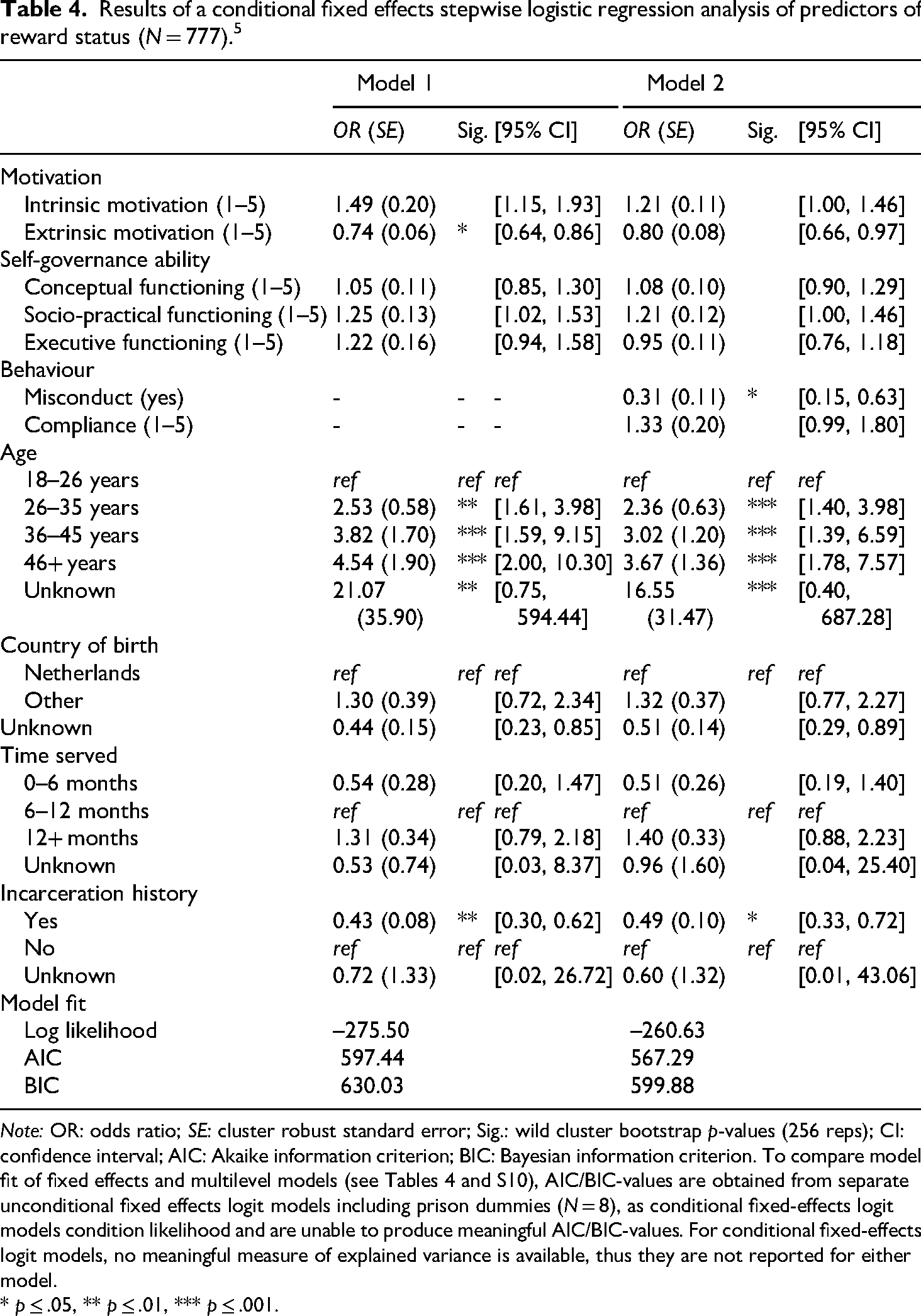
Note: OR: odds ratio; SE: cluster robust standard error; Sig.: wild cluster bootstrap p-values (256 reps); CI: confidence interval; AIC: Akaike information criterion; BIC: Bayesian information criterion. To compare model fit of fixed effects and multilevel models (see Tables 4 and S10), AIC/BIC-values are obtained from separate unconditional fixed effects logit models including prison dummies (N = 8), as conditional fixed-effects logit models condition likelihood and are unable to produce meaningful AIC/BIC-values. For conditional fixed-effects logit models, no meaningful measure of explained variance is available, thus they are not reported for either model.
* p ≤ .05, ** p ≤ .01, *** p ≤ .001.
Therefore, to test H1, H3 and H4, stepwise conditional fixed-effects logistic regression analyses were conducted (Table 4). The probability of the binary outcome (reward status) was modelled using a conditional logit link (clogit) as a function of individual-level predictors and prison-specific fixed effects. This means that all estimates reflect within-prison associations. Statistical inference is based on cluster-robust standard errors and wild cluster bootstrap p-values using Rademacher weights (256 reps), which is recommended for analyses with few clusters (Cameron and Miller, 2015). Effects in Table 4 are reported in odds ratios, which reflect within-prison changes in the odds of reporting reward status. Effects are also reported in average marginal effects (AMEs) in Table S9, for ease of interpretation (margins, dydx(*)).
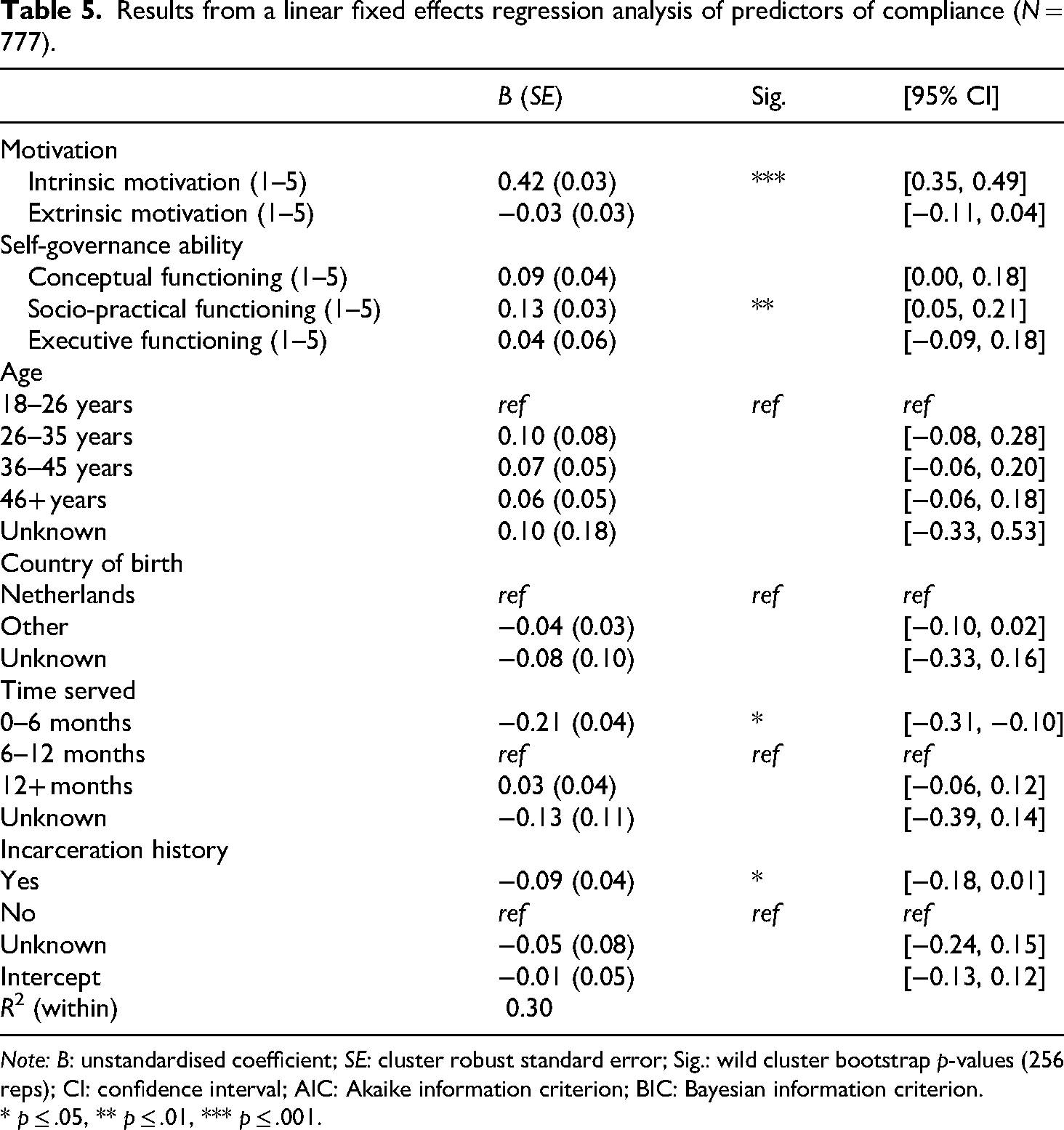
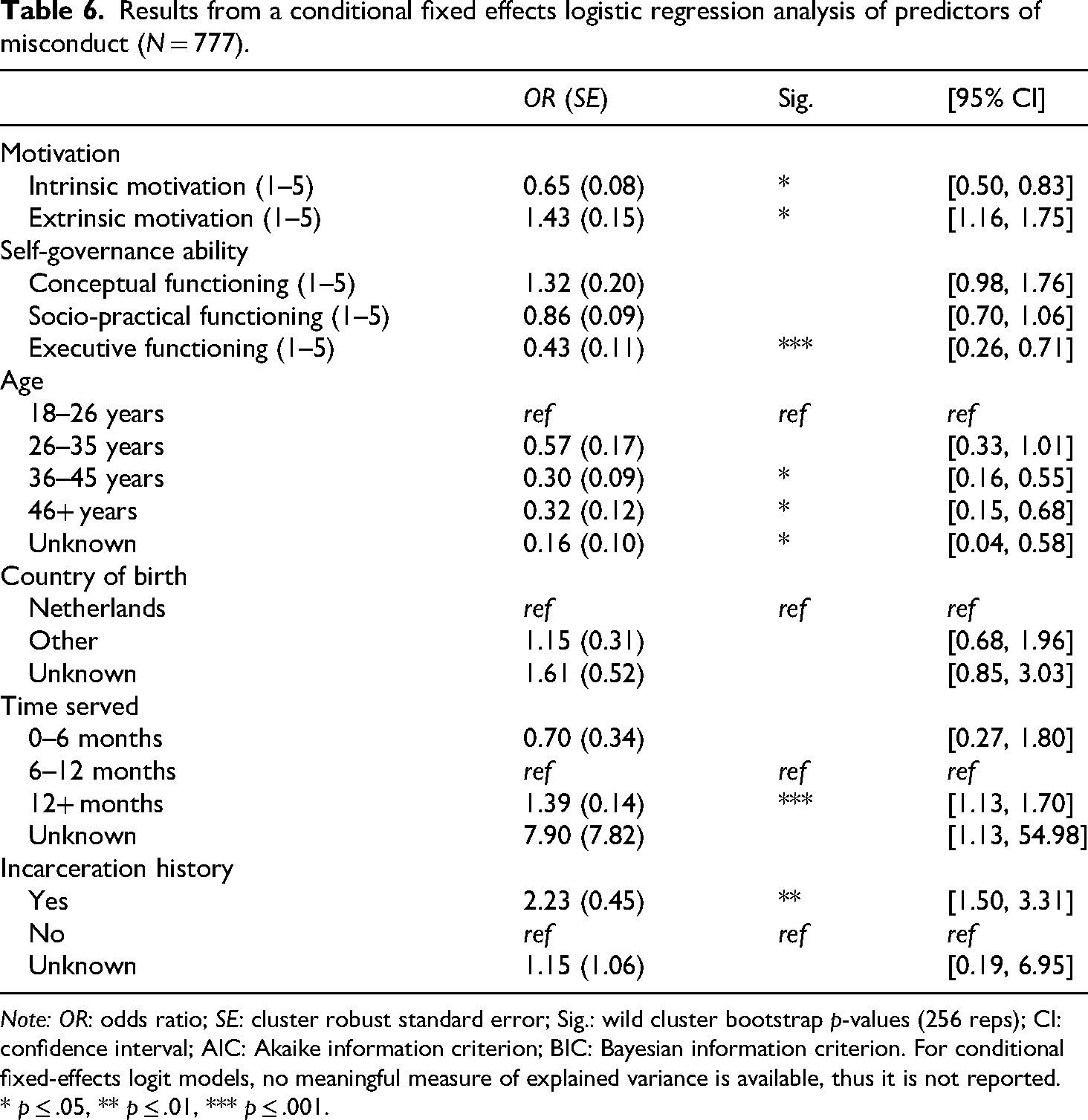
Additionally, to test H3, conditional logistic (clogit) and linear (xtreg) fixed-effects regression analyses were conducted to examine whether motivation and self-governance ability predicted compliance and misconduct (Tables 5 and 6). Assumptions for all analyses were met. All analyses were conducted using STATA 18.0.
Results from a linear fixed effects regression analysis of predictors of compliance (N = 777).
Note: B: unstandardised coefficient; SE: cluster robust standard error; Sig.: wild cluster bootstrap p-values (256 reps); CI: confidence interval; AIC: Akaike information criterion; BIC: Bayesian information criterion.
* p ≤ .05, ** p ≤ .01, *** p ≤ .001.
Results from a conditional fixed effects logistic regression analysis of predictors of misconduct (N = 777).
Note: OR: odds ratio; SE: cluster robust standard error; Sig.: wild cluster bootstrap p-values (256 reps); CI: confidence interval; AIC: Akaike information criterion; BIC: Bayesian information criterion. For conditional fixed-effects logit models, no meaningful measure of explained variance is available, thus it is not reported.
* p ≤ .05, ** p ≤ .01, *** p ≤ .001.
Results
To answer research question 1 (To what extent – and in what way – do individuals with and without reward status differ in motivation, self-governance ability, and behaviour?), bivariate analyses were conducted. Results illustrate that, among the group of 777 incarcerated individuals, 647 individuals reported reward status (83%) and 130 did not (17%). Table 3 illustrates that individuals with reward status significantly differed from individuals without reward status, in terms of compliance and misconduct, self-governance ability and motivation – as expected – as well as control variables (except country of birth).
The 647 individuals with reward status demonstrated significantly higher intrinsic motivation to comply (M = 3.81, SD = 0.70), compared to the 130 individuals without reward status (M = 3.54, SD = 0.83), t(775) = −3.44, p ≤ .001, Hedges’ g = 0.72 (see Table 3). Also, individuals with reward status (M = 3.30, SD = 1.04) demonstrated significantly lower extrinsic motivation to comply, compared to the individuals without reward status (M = 3.56, SD = 1.06), t(775) = 2.60, p < .01, Hedges’ g = 1.04).
Individuals with and without reward status also significantly differed on self-governance ability. Individuals with reward status (M = 4.10, SD = 0.51) reported significantly higher scores than their non-rewarded counterparts (M = 3.91, SD = 0.54) on the Leiden Self-Governance Ability Scale, t(775) = −4.01, p ≤ .001, Hedges’ g = 0.51. More specifically, individuals with reward status scored significantly higher on socio-practical and executive functioning, but not on conceptual functioning.
As expected, results illustrated that having a reward status (M = 4.14, SD = 0.66) is significantly related to higher rates of compliance, compared to not having reward status (M = 3.79, SD = 0.74), t(775) = −4.97, p ≤ .001, Hedges’ g = 0.67 (see Table 3). Furthermore, individuals with reward status reported significantly less misconduct, χ2(1, N = 777) = 67.16, p ≤ .001).
To answer research question 2 (To what extent do (a) motivation, (b) self-governance ability, and (c) behaviour of incarcerated individuals predict their reward status?), a stepwise conditional fixed-effects logistic regression analysis was conducted (see Table 4). This analysis contained two models. Model 1 included measures of motivation, self-governance ability and control variables regressed on reward status (testing H1). In Model 2, compliance and misconduct were added to the first model (testing H3 and H4). Adding these predictors suggests a significant improvement of within-prison fit, as shown by the conditional log pseudolikelihood (Model 1: −275.50; Model 2: −260.63) and decreases in AIC and BIC values derived from separate analyses with prison dummies (Model 1: AIC = 597.44, BIC = 630.03; Model 2: AIC = 567.29, BIC = 599.88), although formal likelihood-based tests and variance-explained measures are not applicable to conditional fixed-effects logit models. Tests of H2 are presented in Tables 5 and 6. The results from all multivariate analyses will be discussed using the four hypotheses derived from the literature.
Hypothesis 1
Results presented in Model 1 of Table 4 partially confirm H1, that higher motivation and self-governance ability predict greater odds of reporting a reward status (within a prison). Only higher extrinsic motivation was significantly associated with 26% lower odds of reporting a reward status (OR = 0.74, 95% CI [0.64, 0.86], p < .05). In other words, extrinsic motivation had a negative effect on reward status. Intrinsic motivation approached significance (OR = 1.49, 95% CI [1.15, 1.93], p = .078), but self-governance ability was convincingly unrelated to reward status. This was true for conceptual functioning (OR = 1.05, 95% CI [0.85, 1.30], p = .633), socio-practical functioning (OR = 1.25, 95% CI [1.02, 1.53], p = .211), and executive functioning (OR = 1.22, 95% CI [0.94, 1.58], p = .289).
Hypothesis 2
Results presented in Tables 5 and 6 also partially confirm H2, that higher motivation and self-governance ability predict better behaviour. Higher intrinsic motivation levels significantly predicted increases in compliance (B = 0.42, 95% CI [0.35, 0.49], p < .001), but extrinsic motivation did not (B = −0.03, 95% CI [−0.11, 0.04], p = .430). However, both extrinsic and intrinsic motivation significantly predicted misconduct, albeit in contrasting ways. Higher extrinsic motivation increased the odds of reporting misconduct (OR = 1.43, 95% CI [1.16, 1.75], p < .05), while higher intrinsic motivation decreased those odds (OR = 0.65, 95% [0.50, 0.83], p < .05).
Self-governance ability dimensions had differential effects on compliance and misconduct. Compliance was significantly increased by higher scores on socio-practical functioning (B = 0.13, 95% CI [0.05, 0.21], p < .01), but not by conceptual functioning (B = 0.09, 95% CI [0.00, 0.18], p = .055) and executive functioning (B = 0.04, 95% CI [−0.09, 0.18], p = .504). On the contrary, only executive functioning significantly decreased the odds of reporting misconduct (OR = 0.43, 95% CI [0.26, 0.71], p < .001), whilst conceptual functioning (OR = 1.32, 95% CI [0.98, 1.76], p = .086) and socio-practical functioning (OR = 0.86, 95% CI [0.70, 1.06], p = .219) were not significantly associated with misconduct.
Hypothesis 3
Results presented in Table 4 in Model 2 partially confirm H3, that better behaviour predict greater odds of reporting a reward status. As expected, especially misconduct significantly predicted reporting reward status. Participants who reported having committed misconduct once or more often had 69% lower odds of reporting reward status compared to those who did not report any misconduct (OR = 0.31, 95% CI [0.15, 0.63], p < .05). Compliance, on the other hand, did not significantly predict reward status (OR = 1.33, 95% CI [0.99, 1.80], p = .211).
Noteworthy is that compliance did significantly predict reward status when misconduct was left out of the model (OR = 1.50, 95% CI [1.19, 1.90], p < .05, unreported model), which might be due to their interrelated nature (r = −.29).
Hypothesis 4
Results presented in Model 2 in Table 4 partially confirm H4, that the effect of motivation and self-governance ability on reporting a reward status is smaller when behaviour is accounted for. After adding compliance and misconduct, the significant effect of extrinsic motivation (OR = 0.80, 95% CI [0.66, 0.97], p = .109) on reward status disappeared. Moreover, effects of all self-governance ability dimensions remained non-significant.
In sum, although bivariate analyses indicated significant relations between all dependent variables apart from conceptual functioning, in our multivariate models, only misconduct significantly predicted reward status, while accounting for theoretically relevant predictors and control variables.
Discussion and conclusion
Little prior empirical research was conducted on RSPs, despite their widespread use and large impact on individuals’ lives. As a step towards a better understanding of RSP application and their working mechanisms, this study examined to what extent motivation, self-governance ability and behaviour of incarcerated individuals predict reward status. Findings are discussed in order of research questions and hypotheses.
Differences between individuals with and without reward status ( RQ1)
Individuals with and without reward status significantly differed on motivation, self-governance ability and behaviour, as expected. Individuals with reward status (83% of our sample) not only reported significantly less misconduct, but also more compliance, compared to their non-rewarded counterparts. This implies that behaviour is determining reward status allocation, which is in line with Dutch prison policy. Remarkably, however, individuals with reward status not only reported greater intrinsic but also lower extrinsic motivation to comply, compared to non-rewarded individuals. This questions the extent to which rewards induce compliance – which is a fundamental and conditional assumption of RSP policy theories (e.g., Elbers et al., 2021; 2022; Liebling et al., 1997).
Individuals with lower levels of self-governance ability (socio-practical and executive functioning, but not conceptual functioning) were overrepresented in the lowest system level. This finding aligns with prior studies suggesting that self-governance ability impairments can be an obstacle in RSP progression, even though their exact causal relationship remains unclear (Crewe, 2013; Crewe and Ievins, 2021; De Jong et al., 2015; 2016; Hutton, 2017).
More generally, finding that 83% of incarcerated individuals in our sample were at the highest reward level, is relatively high compared to the 49% of individuals on Enhanced level in England and Wales (Her Majesty's Prison and Probation Service, 2024) and 56% in Northern Ireland (Butler et al., 2024). It must be noticed, however, that this 83% is not representative of the entire Dutch prison population. Half of the Dutch prison population is detained in pre-trial detention, which is excluded from the RSP, but in terms of privileges equals the Basic level.
Reward status predictors (RQ2)
Findings partially confirm our first hypothesis, as only extrinsic motivation significantly predicted reward status. As the effect of extrinsic motivation on reward status disappeared after adding compliance and misconduct to the model, our fourth hypothesis is also partially confirmed. Whether this is indicative of an indirect effect is unclear, as we did not conduct a formal mediation analysis. Moreover, none of the self-governance dimensions significantly predicted reward status. This suggests that self-governance ability is not directly considered by prison staff when allocating reward status. Explanations might be found in frontline staff focusing on tasks and individuals which and who are ‘easy’ to manage and focusing on behaviour instead of underlying causes. Also, impairments in self-governance ability are often disguised (Talbot, 2009) and seldomly adequately identified in (Dutch) prison (Elbers, 2025). Not adequately accounting for self-governance ability can be problematic. Non-compliance could be perceived as lack of motivation instead of ability, resulting in excluding individuals with impaired self-governance ability from rewards that can promote their rehabilitation. This frustrates the specific responsivity principle of the RNR model (Bonta and Andrews, 2007).
Findings also partially confirm our second hypothesis, indicating that intrinsic motivation is associated with an increase in compliance, whilst extrinsic motivation is associated with an increase in and intrinsic motivation with a decrease in misconduct. Oppositional behaviour such as misconduct can be a response to an external threat to personal autonomy, which an RSP might pose (Deci et al., 1999; Liebling et al., 1997; Ryan and Deci, 2000 – also see Crewe, 2011). From our cross-sectional data, it was impossible to examine whether, and if so to what extent, extrinsic motivation had developed into intrinsic motivation.
The third hypothesis was partially confirmed, as only misconduct decreased the odds of reporting reward status (69%). This aligns with a recent longitudinal study in Northern Ireland indicating that a history of not taking or passing drug tests (i.e., misconduct) frustrated RSP progression (Butler et al., 2024). Explanations could be sought both in formal policy and its application. Dutch prison governors are obliged to revoke reward status following misconduct, while no obligation exists for rewarding compliance. Moreover, Dutch prison officers could be mainly focused on preventing misconduct instead of compliance (Arnold, 2016; Khan, 2022). Not only because misconduct norms are most clearly defined (Gendreau et al., 2014), but also because frontline workers often adopt coping strategies such as standardisation, prioritising ‘easy’ tasks and individuals and caseload reduction (Lipsky, 1980; Tummers et al., 2015). Examples of such strategies have been found in prior qualitative studies on the application of the Dutch RSP. For example, Dutch prison staff sometimes refrain from revoking reward status to avoid additional administrative work, especially in times of persistent staff shortages (Elbers, 2025; Inspectorate of the Ministry of Justice and Safety, 2018).
Finding that compliance failed to significantly predict reward status, as well as finding that extrinsic motivation failed to significantly predict compliance, might indicate a deviation from Dutch prison policy. Dutch policymakers theorised that rewarding ‘good’ behaviour induces compliance (Van Gent, 2013). A possible focus on misconduct, however, would not support individuals to approach prosocial goals, merely to avoid antisocial goals. The effectiveness of pursuing avoidance goals on rehabilitation is theorised to be limited, especially when driven by instrumental motives (Bonta and Andrews, 2007; Gendreau et al., 2014; Ryan and Deci, 2000; Ward, 2012). Moreover, studies on the IEP scheme highlight that arbitrary system application – incidents of which were found in the Dutch context – could frustrate procedural legitimacy perceptions and induce misconduct (Liebling et al., 1997; Crewe, 2011). A qualitative study on the IEP scheme illustrated that compliance can also go unnoticed (Khan, 2022). These insights might explain why misconduct trumped compliance in our models.
Limitations and future research
Some methodological reflections are in place. First, selection bias may be present, as our sample differed significantly from the respondents excluded from the analyses on several variables, yet not misconduct. Our sample also reported lengthier prison sentences than the average prison sentence in the Netherlands. This limits generalisation of the findings to the larger Dutch prison population. Future research could overcome selection bias by adopting longitudinal designs (e.g., growth models) or (quasi)experimental designs, in other jurisdictions.
Second, findings confirmed our fourth hypothesis, but it remains unclear whether there exists an indirect effect of (extrinsic) motivation on reward status through behaviour. The combination of binary and ordinal variables precluded simple calculations of indirect effects (MacKinnon and Cox, 2012). More advanced statistical techniques (e.g., structural equation modelling) could address this issue in future – ideally longitudinal – studies. The current cross-sectional design obscures temporal ordering of events and causal inferences. Further exploring possible indirect effects is recommended, as motivation theoretically precedes action. Adopting the self-determination theory in future studies could also help untangle the complex relations between intrinsic and extrinsic motives to comply, as well as explore potential feedback loops (i.e., having obtained reward status predicting motivation, and motivation predicting obtaining future reward status). This could contribute to empirically testing typology of compliance (Bottoms et al., 2002, 2003)).
Third, the theoretically most relevant predictors were included in our analyses. Motivation, self-governance ability and behaviour might (in)directly determine reward status according to Dutch prison policy, scarce prior research (Butler et al., 2024; Liebling et al., 1997) and theory (Akers and Jennings, 2016; Bandura, 2001; Bonta and Andrews, 2007; Ward, 2012). Unobserved variance in reporting reward status, however, could be explained by other, unmeasured factors, possibly resulting in overestimated or underestimated effects. Examples of such factors are procedural legitimacy perceptions (Liebling et al., 1997), staff tendencies to report (or ignore) misconduct strategically to maintain good prisoner–staff relationships (Haggerty and Bucerius, 2021) and informal rewards (Bosworth and Liebling, 1994). Future research is advised to include these additional factors.
Finally, an important novel contribution of our study is the conceptualisation and operationalisation of self-governance ability, using a new self-report instrument: the Leiden Self-Governance Ability Scale. This self-report instrument is grounded in relevant theory, reliable and is suitable for large-scale application and for people with impaired intellectual abilities. However, further psychometric research is still necessary to assess the consistency of the identified dimensions, further establish its concurrent validity with other report instruments and determine its applicability in other jurisdictions. Specific attention should be given to social desirability bias, as overall high mean scores on self-governance reported in this study may be reflective of this bias.
Policy recommendations
Although this study was exploratory, multiple recommendations can be drawn from its findings. To avoid a practical focus on preventing misconduct, it is recommended to define all behavioural norms in RSPs (and institutional rules in general) precisely and unambiguously. Ambiguous rules and arbitrary rule application frustrate reward-cost calculi and RSPs effects (Gendreau et al., 2014). Also, it should be assessed whether and how focus can be shifted from punishing ‘bad’ behaviour to rewarding ‘good’ behaviour. This could contribute to extending RSP's scope from penal instruments (Khan, 2022) to rehabilitative instruments (Gendreau et al., 2014), facilitating sustainable compliance instead of short-term obedience, an important aim of imprisonment (Crewe, 2013; Elbers et al., 2021; also see Liebling et al., 1997). Leaving discretionary but regulated power to prison governors to deviate from immediate, obligatory removal of rewards (e.g., in case of relapse in a drug rehabilitation process) should also be explored. In focusing on compliance, greater attention should also be given to underlying explanations such as lack of motivation and/or capabilities, especially by actively screening for self-governance ability impairments during prison intakes (Kaal et al., 2011; Talbot, 2009).
More generally, however, the current study provides incentives for policymakers to discuss the added theoretical and practical value of RSPs. If policy and practice both focus on preventing misconduct and compliance is not consistently rewarded, this suggests that order is negotiated despite formal policy (Haggerty and Bucerius, 2021; Liebling, 2008). Moreover, it was found that not extrinsic motivation, but intrinsic motivation promoted compliance, whilst extrinsic motivation increased the odds of reporting misconduct. These findings question the extent to which the efforts to implement, apply and monitor a system that takes extrinsic motivation as its vantage point truly outweigh the benefits – and costs – it presents to individuals in prison, prison staff and society.
Supplemental Material
sj-docx-1-euc-10.1177_14773708261423838 - Supplemental material for Predictors of reward status in prison: Behaviour, motivation, and self-governance ability
Supplemental material, sj-docx-1-euc-10.1177_14773708261423838 for Predictors of reward status in prison: Behaviour, motivation, and self-governance ability by Jan Maarten Elbers, Esther FJC van Ginneken, Paul Nieuwbeerta, Miranda Boone and Hanneke Palmen in European Journal of Criminology
Footnotes

Funding
The authors disclosed receipt of the following financial support for the research, authorship, and/or publication of this article: This study is part of the Life in Custody study, which is funded by the Dutch Prison Service (DJI) and Leiden University. The opinions, findings, and conclusions expressed in this article are those of the authors and do not necessarily reflect those of the DJI.
Supplemental material
Supplemental material for this article is available online.