




Abstract
Moral self-assessment is vital to one's identity, but how does it change after committing immoral behavior like crime? We compared a sample of N = 382 men and women in prison sentenced for violent and non-violent crimes with a matched control group (N = 382). We measured their self-importance of moral identity, moral self-concept, and moral self-image. We found prisoners had lower moral self-concept and internalization but higher symbolization and moral self-image than non-prisoners. However, all the effects were small. Moreover, violent prisoners had slightly higher internalization than non-violent prisoners, but they did not differ in other moral self-assessments. Women in prison scored higher in moral self-concept and internalization than men in prison, while men in prison scored higher in symbolization than women in prison. We found no sex differences in moral self-image. In sum, committing a crime slightly impacts one's moral self-perception, and we need more studies to understand the mechanisms behind it.
Keywords
Morality is a central concern for everyone. The need to see oneself and be seen by others as moral is a fundamental psychological trait (Aquino and Reed, 2002; Prentice et al., 2019; Strohminger and Nichols, 2014). But what exactly is morality? The psychological perspective offers two ways of understanding it. In the narrow sense, morality refers to an obligatory concern for one's own well-being and the well-being of others, as well as for rights, honesty, and fairness. It includes reasoning, judgments, emotions, and actions that emerge from this concern (Dahl, 2023). In the broad sense, morality encompasses the thoughts, actions, and feelings, whether in humans or animals, regarding what each individual subjectively considers to be the moral domain (Paruzel-Czachura, 2023, 2025).
The narrow view aligns with the classical perspectives of moral psychologists, who highlight concern and fairness (Turiel, 2018). Yet, it builds on these foundational ideas by underscoring the roles of emotion instead of only reasoning (Cohen et al., 2012; Paruzel-Czachura and Białek, 2024). By contrast, the broad definition acknowledges cultural and individual diversity, aligning with relativism and research on cross-cultural variations in values (Hofstede, 2001; Lu et al., 2017). Here, we adopt a narrow understanding of morality.
Consistently with the better-than-average effect (Alicke and Govorun, 2005; Korbmacher et al., 2022; Zell et al., 2020), people perceive themselves as more moral than others and tend to fall into the illusion of moral superiority (Tappin and McKay, 2017). Using the rose-tinted spectacles to see one's own morality in a positive light is well-known in psychology (Taylor and Brown, 1988) and confirmed in research on moral hypocrisy (Batson et al., 1999) and the tendency for self-enhancement (Colvin et al., 1995; Von Hippel and Trivers, 2011). Nevertheless, do people still wear those rose-tinted spectacles after committing a crime, specifically when incarcerated? Here, we try to answer this question by comparing the moral self-assessments of men and women in prison sentenced for different crimes with the matched (by age and sex) control sample of people with no criminal record. To our knowledge, this is the first study to test the differences between prisoners and non-prisoners in moral self-assessments.
This study makes at least four unique contributions. First, we may test past results showing that people strongly need to perceive themselves as moral (Prentice et al., 2019). Second, moral self-assessment is a crucial part of a person's identity (Strohminger, 2018), and it predicts future prosocial and unethical behaviors (see Hertz and Krettenauer, 2016 for the meta-analysis) in such a way that the higher one's perceived own morality and its importance, the more prosocial behaviors and the fewer unethical behaviors will be observed. That is why we must understand how moral self-assessment works in such unique samples as prisoners. Third, more than 10 million people are incarcerated worldwide (National Institute of Corrections, 2015; Statista, 2021). Because committing a crime brings so many undesirable social, economic, and moral consequences to society (Jones et al., 2019), we need to deeply understand how persons impacted by the justice system make decisions or perceive the world, including moral self-perception, to improve their resocialization and prevent crimes. Fourth, we study women as their number in prisons grows (Augsburger et al., 2022; MacDonald, 2013; Nuytiens and Christiaens, 2016; Swavola et al., 2016), and sex differences were observed regarding moral self-assessments (Paruzel-Czachura and Blukacz, 2021). Lastly, we conducted the study in Poland, extending past related research from Great Britain (Sedikides et al., 2014).
Shades of moral self-assessment
Moral self-assessment can be measured at least in three self-descriptive ways: moral self-concept, self-importance of moral identity, and moral self-image. The moral self-concept refers to the subjective level of possessing moral traits, that is, loyal, truthful, law-abiding, faithful, trustworthy, and honest (Stake, 1994). A high moral self-concept is inferred when people declare that they possess these traits at a high level. It is considered a stable self-assessment measure (Jordan et al., 2015). Moral self-concept is related to prosocial and unethical behaviors (e.g., Stake, 1994) and moral foundations (e.g., Marzana et al., 2016).
The self-importance of moral identity is a self-conception organized around a set of moral traits, but it is not a personality characteristic (Aquino and Reed, 2002). It is an identity that informs about to which extent a person values moral characteristics (Hertz and Krettenauer, 2016). It addresses the extent to which one values moral traits and whether one's actions demonstrate a commitment to moral self-expression. Moral identity has two dimensions of self-importance, that is, private and public. The former, also known as internalization, is related to the self-importance of moral characteristics. It refers to how important it is to have moral traits such as honesty, caring, compassion, or fairness. The latter dimension, known as symbolization, is related to a more general sensitivity to the moral self as a social object whose behaviors demonstrate one's characteristics. It explains how relevant it is to show others one's moral traits.
Since a strong moral identity motivates individuals to align their behavior with their moral self-concept (Hart et al., 1998; Youniss and Yates, 1999), the importance placed on moral identity is linked to prosocial actions, such as self-reported volunteerism and donation (Aquino and Reed, 2002; Damon and Hart, 1992; Hardy and Carlo, 2011; Lee et al., 2014; Reed II et al., 2016; Shang et al., 2020; Winterich et al., 2009). A meta-analysis by Hertz and Krettenauer (2016) examined the relationship between moral identity and behavior across 111 studies from various disciplines, including business, psychology, education, marketing, sociology, and sports sciences. The analysis revealed a significant positive correlation, showing that individuals with stronger moral identities are more likely to engage in moral behaviors. This relationship held consistent across different types of moral behaviors, including prosocial actions, ethical conduct, and the avoidance of antisocial behaviors.
Considering more situational measures, the moral self-image, created by Jordan et al. (2015), tries to explain what people think about their morality at a specific moment. It is a modification of the self-importance of the moral identity concept (Aquino and Reed, 2002) and reflects self-assessment of how close people are to their ideal moral self (today, now, etc.). The moral self-image provides insight into moral self-perceptions, but unlike moral identity, it is assumed to be susceptible to events with a moral component, such as social and situational factors. Therefore, it is not expected to be stable over time (Jordan et al., 2015) but dynamic and malleable. In sum, the moral self-concept provides information on how people see their moral traits. The self-importance of moral identity shows how relevant it is for them to possess moral traits and show them to the outside world. Finally, the moral self-image informs how close people are to their ideal moral self at a specific moment.
Lastly, it is important to note that women and men differ in their moral self-assessments. In most previous studies, women tended to view themselves more positively than men in terms of moral identity. A meta-analysis found that women generally scored higher on internalization—the extent to which moral traits are central to their self-concept—compared to men (Kennedy et al., 2017), although sex differences in symbolization were not tested. The evidence regarding symbolization is mixed (Aquino et al., 2011; Aquino and Reed, 2002; Barclay et al., 2014; McFerran et al., 2010; Reed and Aquino, 2003; Skarlicki et al., 2008; Winterich et al., 2013). However, a recent cross-cultural study in 67 countries showed that in most countries, women scored higher in both internalization and symbolization than men (Paruzel-Czachura and McHugh, 2024). That is why we expected to see higher moral self-assessments among women than men.
Moral self-assessment after wrongdoing
Do people perceive themselves as bad after wrongdoing? On the one hand, we may expect people to adjust to the situation, and moral self-assessment should fluctuate depending on life situations (Conway, 2018; Jordan et al., 2015; Monin and Jordan, 2009). This means that moral self-assessments should go up and down accordingly; for example, moral self-assessment should go down after committing a crime (Festinger, 1957; Gino et al., 2015). On the other hand, empirical research shows the opposite, that is, that people can feel moral regardless of past unethical behavior (Blasi, 1983, 2005; Mazar et al., 2008; Merritt et al., 2010; Monin and Jordan, 2009; Tappin and McKay, 2017). This is because being moral is one of the most fundamental psychological needs (Prentice et al., 2019). Even if people behave immorally, they still wear rose-tinted spectacles and see themselves as moral, thinking that ‘I am a good person. I just did bad things’ (Stets and McCaffree, 2019), which is an example of moral decoupling, a moral reasoning process by which judgments of performance are separated from judgments of morality (Bhattacharjee et al., 2013). This tendency appears not only after wrongdoing like cheating or lying (Mulder and Aquino, 2013) but even after more serious wrongdoing like violence against their partners.
Specifically, a series of studies examined the moral self-concepts of men convicted of intimate partner violence (IPV) undergoing court-mandated therapy (Marzana et al., 2016; Vecina, 2014, 2018; Vecina et al., 2016; Vecina and Chacón, 2016, 2019; Vecina and Marzana, 2016). They consistently show that men perceived themselves as highly moral despite their violent actions. In one study, men sacralized moral foundations more intensely than non-violent men, suggesting that sacred moral values, which refer to moral principles deemed absolute and inviolable, might contribute to their justification of violent behavior (Vecina, 2014). Another study (Vecina et al., 2016) revealed that self-deception mediated the relationship between moral absolutism (a rigid moral worldview) and a heightened moral self-concept. Men who engaged in IPV deceived themselves about the morality of their actions, maintaining a strong moral self-concept despite their behavior. Vecina and Marzana (2016) explored the moral licensing effect, showing that men convicted of IPV used their strong moral self-concept to recall past prosocial behaviors, which allowed them to ‘license’ future immoral behaviors. A later study (Vecina, 2018) proposed a homeostatic moral model to explain how men convicted of IPV maintain a strong moral identity despite their violent and sexist attitudes, showing that self-deception played a critical role. This body of work highlights how men with rigid moral views and high self-perceptions of morality sustain a positive moral self-image, even in the face of behaviors that contradict societal moral standards.
Additionally, even if people are extraordinarily diverse about what is right and wrong, they also do not perceive themselves negatively when their reactions are inconsistent with their preferred moralized attitudes (Ekstrom and Lai, 2022). Nevertheless, among some people (i.e., high moral identity internalizers), their rosy picture of their morality is weakened after engaging in cheating behaviors (Xu et al., 2019). All the studies mentioned above have focused on the general population, not individuals involved in the justice system, making it difficult to draw conclusions about specific groups like prisoners. Does committing a serious offense, such as a crime, lead to changes in moral self-assessment? Studying prisoners offers a valuable way to explore this question.
Moral self-assessment in prison
Criminological theories highlighted the role of morality in understanding criminality. For instance, the concepts of neutralization and moral disengagement describe how individuals cognitively separate their moral standards from actions (Cardwell and Copes, 2021; Ribeaud and Eisner, 2010). Situational Action Theory (SAT) explains crime as a moral action resulting from the interaction between personal and environmental factors (Wikström, 2010, 2020). An individual's crime propensity is shaped by personal morality and the ability to self-control, while the criminogenic potential of an environment depends on the moral rules of that setting and their level of enforcement through deterrence (Wikström et al., 2024). Although individuals remain the source of their own actions, SAT emphasizes that the causes of these actions are situational, arising from how a person perceives and responds to the opportunities within a given environment. While a detailed exploration of criminological theories is beyond the scope of our paper, we acknowledge their relevance as an important backdrop to moral self-assessment.
Being in prison can affect an individual's self-concept and identity (Paterline and Orr, 2016), largely through the process of prisonization—an adaptive mechanism for coping with the prison environment (Clemmer, 1940; Crewe, 2009; Paterline and Orr, 2016; Sykes, 1958). Prisonization involves internalizing the norms and values of the inmate social system. During this process, individuals learn the behaviors and values necessary for survival (Alpert, 1979; Sykes and Messinger, 1960; Wright, 1991). Prisons cultivate their own social culture, complete with gangs and unique forms of communication, even in high-security institutions like supermax prisons (Crewe and Laws, 2016; Hartman, 2008).
Life in prison leads to social degradation and exclusion, where inmates may face alienation, stigmatization, depersonalization, powerlessness, and violence (Gruninger, 1975; Paterline and Orr, 2016; Rameriz, 1984; Smith and Hepburn, 1979). The degree of these effects can vary depending on factors such as the prison's goals and culture, its security level, its focus on custody, retribution, or rehabilitation, staff behavior, and the country in which the prison is located (Crewe and Laws, 2016). These experiences may impact self-evaluation, leading to lower self-esteem, reduced self-efficacy, and shifts in identity (Paterline and Orr, 2016). While self-concept has not been shown to significantly contribute to our understanding of prisonization (Paterline and Orr, 2016), it is still reasonable to suspect that incarceration may alter inmates’ moral self-concept. Do individuals in prison change the way they perceive their own morality?
We identified only one study in which researchers asked prisoners to assess their own morality (Sedikides et al., 2014). The study involved 85 young men from Great Britain (with data from 79 participants analyzed) who had been convicted of various crimes: 36.7% for violent offenses, 25.3% for robbery, 5.1% for drug-related crimes, 5.1% for burglary, and 17.7% who preferred not to disclose their offense. Participants evaluated how strongly they embodied moral traits (being moral, kind, trustworthy, honest, dependable, compassionate, generous, law-abiding, and self-controlled) comparing themselves to two groups: other prisoners and the average person in the community. When comparing themselves to fellow inmates, the prisoners rated themselves as more moral in all traits except for being law-abiding, where they saw themselves as average. Surprisingly, the same pattern emerged when they compared themselves to the average community member. This suggests that prisoners consciously view themselves as morally superior not only to other offenders but also to people outside of prison. However, this study primarily examined social comparisons (the better-than-average effect) rather than delving into the prisoners’ moral identity. Therefore, it is difficult to draw conclusions about how prisoners perceive their own morality independent of external comparisons. Our goal was to investigate this issue.
We wished to build on past work in four ways. First, we expanded the psychological mechanisms beyond the better-than-average effect to include three key moral assessments: moral self-concept (Stake, 1994), internalized and symbolized moral identity (Aquino and Reed, 2002), and moral self-image (Jordan et al., 2015). Second, we examined additional variables that can allow more general conclusions about the moral self-assessment of prisoners (e.g., both male and female participants) and across different types of crimes (violent vs. non-violent). Including the distinction between violent and non-violent prisoners allows us to compare our findings to previous research. For example, Vecina et al. (2016) focused exclusively on violent individuals, whereas Sedikides et al. (2014) found no significant differences between prisoners based on the types of crimes they committed. This categorization helps us place our results within the broader context of these studies. Third, we included a control sample to get a closer causality assessment of the variables of interest. Our control sample was matched by age and sex, a popular procedure in clinical studies (Austin, 2011; Li et al., 2020) or social sciences (Stuart, 2019).
The current research
We aimed to provide deeper insights into the moral self-assessments of men and women in prison. We asked them to assess their morality (Aquino and Reed, 2002; Jordan et al., 2015; Stake, 1994), and we compared their scores to a matched control sample from the general population with no criminal record (see details in the method section). As moral self-assessments have many facets, we used three well-known measures to analyze how prisoners see their morality: the moral self-concept (Stake, 1994), the self-importance of moral identity (Aquino and Reed, 2002), and the moral self-image (Jordan et al., 2015).
Because past psychological findings showed that people constantly see themselves as moral (Blasi, 1983, 2005; Mazar et al., 2008; Merritt et al., 2010; Monin and Jordan, 2009; Sedikides et al., 2014; Tappin and McKay, 2017; Vecina and Chacón, 2016; Vecina and Marzana, 2016), we expected prisoners to perceive themselves as moral. However, thanks to using three scales, we could study the nuances in moral self-assessments in such a unique sample.
Additionally, considering the type of crime (violent vs. non-violent), we hypothesized that there would be no differences among the prisoner sample, especially since Sedikides et al. (2014) did not observe such differences. While violent and non-violent crimes differ significantly, including variations in the length of sentences based on the level of violence involved, previous research has shown that individuals tend to perceive themselves as moral even after committing violent acts (e.g., Vecina and Chacón, 2016; Vecina and Marzana, 2016). Lastly, we tested sex differences and expected women to score higher than men following past research (Paruzel-Czachura and McHugh, 2024).
In summary, we posed the following research questions and hypotheses:
Method
Approval of the study was obtained from the Ethical Committee of the University of Silesia in Katowice. All data are available at https://osf.io/ht9eb/?view_only=None. This study was not pre-registered.
Procedure
After obtaining official approval from the prison service director, the first author entered five prisons with a similar security medium level in Poland. Each prisoner, irrespective of the crime, was individually invited to participate in the anonymous study voluntarily. No monetary or other compensation was offered to the participants. The participants were informed about the aim of the study, anonymity, and the right to withdraw from the study at any point. Pen-and-paper questionnaires were completed. To maintain anonymity, prisoners were asked to give back the surveys in non-transparent envelopes. The survey response rate was 10% among men (we invited N = 2460 men in prison) and 30% among women (we invited N = 453 women in prison); men and women were in different prisons.
After collecting the prisoner sample, we gathered the control sample of non-prisoners through an anonymous online survey. Informed consent was obtained from all participants. Control participants were recruited via our center's website: www.mojamoralnosc.pl/en. They were informed about the study's purpose. Participation was voluntary, with no monetary compensation. However, participants received automatic feedback interpreting their questionnaire scores. The survey was designed to calculate mean scores automatically, providing participants with a brief description of their results. This feedback mechanism was used to increase the likelihood of honest responses by appealing to participants’ curiosity about their results. The total sample size was N = 1435. Using the nearest-neighbor propensity score matching method, an equal-sized age- and sex-matched control group of non-prisoners (N = 382) was selected to compare the sample of prisoners. Before the matching, the average age of the control sample was 24.98 (SD = 7.38; age range 19–70), and after matching 30.45 years (SD = 9.94; age range 19–70). See Supplementary Table S1 for more details about the control group before matching. The mean scores were compared between groups using standard analysis of variance (ANOVA). Estimated sensitivity yielded a statistical power of .80 to detect a small effect (f = .1) and power over .95 to detect effects larger than f ≥ .15. G*Power 3.1.9.4 and Stata 14.2 SE software were used.
Participants
Prisoners
N = 382 (n = 136 women) agreed to participate in the study and completed all the questionnaires. The mean age was 38.26 years (SD = 10.8; age range 19–71). Participants were Caucasians and from Poland. Prisoners reported the type(s) of crime for which they had served their sentence. The most commonly committed crimes included stealing (19%, n = 74), fraud (19%, n = 71), robbery (9%, n = 36), and fighting or beating (9%, n = 35). Crime-related details, including sex differences, are in Table 1. Forty-nine prisoners (13%) did not provide information about the type of crime, and some of them reported more than one crime. The frequency of violent and non-violent crimes related to sex was not significant (χ2(1) = 3.75, p = .053). Women committed less violent crimes than men.
Crime frequencies depending on sex (N = 382).
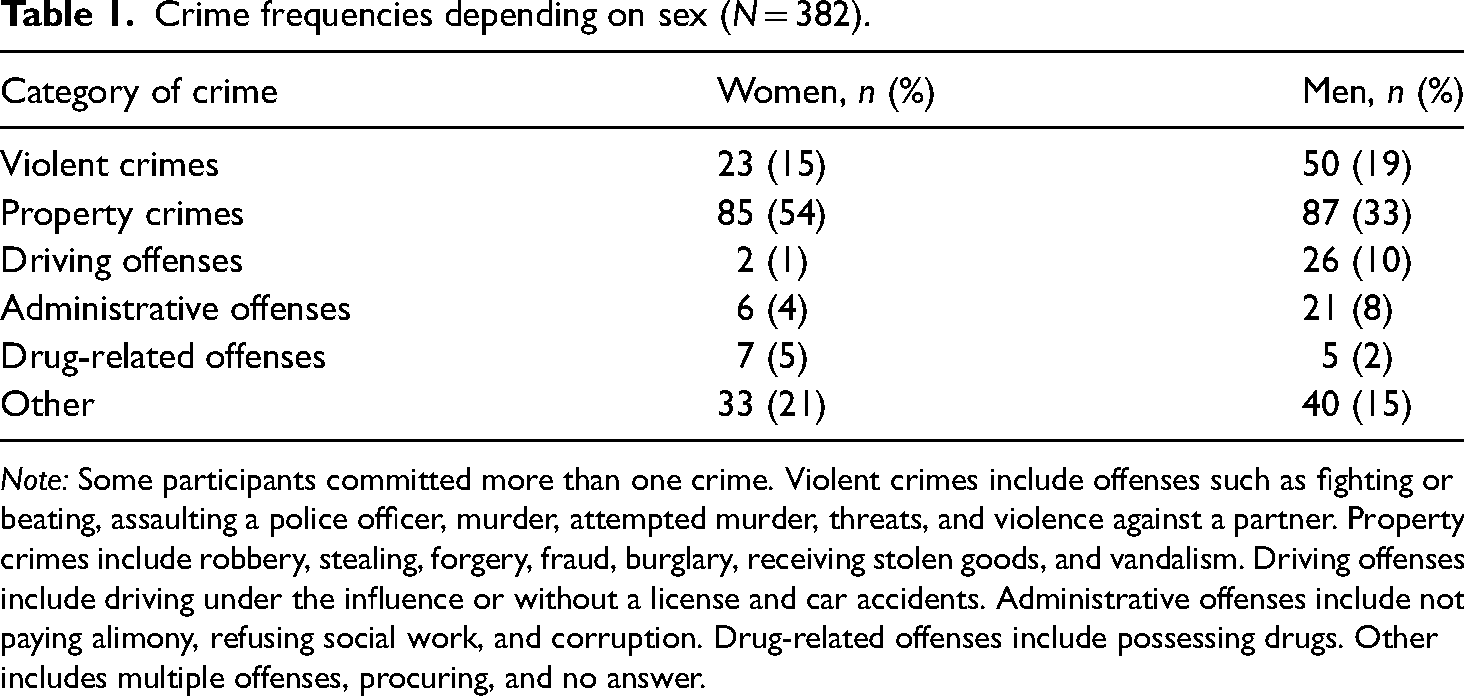
Note: Some participants committed more than one crime. Violent crimes include offenses such as fighting or beating, assaulting a police officer, murder, attempted murder, threats, and violence against a partner. Property crimes include robbery, stealing, forgery, fraud, burglary, receiving stolen goods, and vandalism. Driving offenses include driving under the influence or without a license and car accidents. Administrative offenses include not paying alimony, refusing social work, and corruption. Drug-related offenses include possessing drugs. Other includes multiple offenses, procuring, and no answer.
Non-prisoners
The age- and sex-matched control sample included 382 participants (n = 136 women) from the non-prisoner population. They had not committed any crime or were not accused of a crime at the moment of taking the survey. The mean age of participants was 30.45 years (SD = 9.94; age range 19–70). Participants were Caucasians and from Poland.
Measures
Moral self-concept
The Moral Self-Concept Scale is a subscale of the Six-Factor Self-Concept Scale (Stake, 1994) in which people indicate how accurately six adjectives (loyal, truthful, law-abiding, faithful, trustworthy, and honest) describe themselves on a 7-point scale from 1 (never or almost never true of me) to 7 (always or almost always true of me).
Self-importance of moral identity
The Self-Importance of Moral Identity Scale (Aquino and Reed, 2002) is comprised of two five-item dimensions, that is, internalization subscale, which addresses the extent to which one values moral traits (e.g., ‘I strongly desire to have these characteristics’), and symbolization subscale, which seeks to identify whether one's actions demonstrate a commitment to moral self-expression (e.g., ‘The fact that I have these characteristics is communicated to others by my membership in certain organizations’). Before evaluating 10 statements, participants are asked to imagine how a person with given traits (caring, compassionate, fair, friendly, generous, helpful, hardworking, honest, and kind) would feel, act, and think. The responses are measured on a 5-point scale from 1 (strongly disagree) to 5 (strongly agree).
Moral self-image
The Moral Self-Image Scale has nine items consisting of the same traits as the Self-Importance of Moral Identity Scale (Jordan et al., 2015). Participants are asked to indicate their relative position to their ideal self for each trait separately. The responses are measured on a 9-point scale (e.g., 1 ‘much less than the caring person I want to be’ and 9 ‘much more than the caring person I want to be’).
Additionally, we asked participants about their age, sex, race, and type of crime (prison sample), committing a crime in the past, or being accused of a crime at the moment of taking the survey (non-prisoner sample).
Results
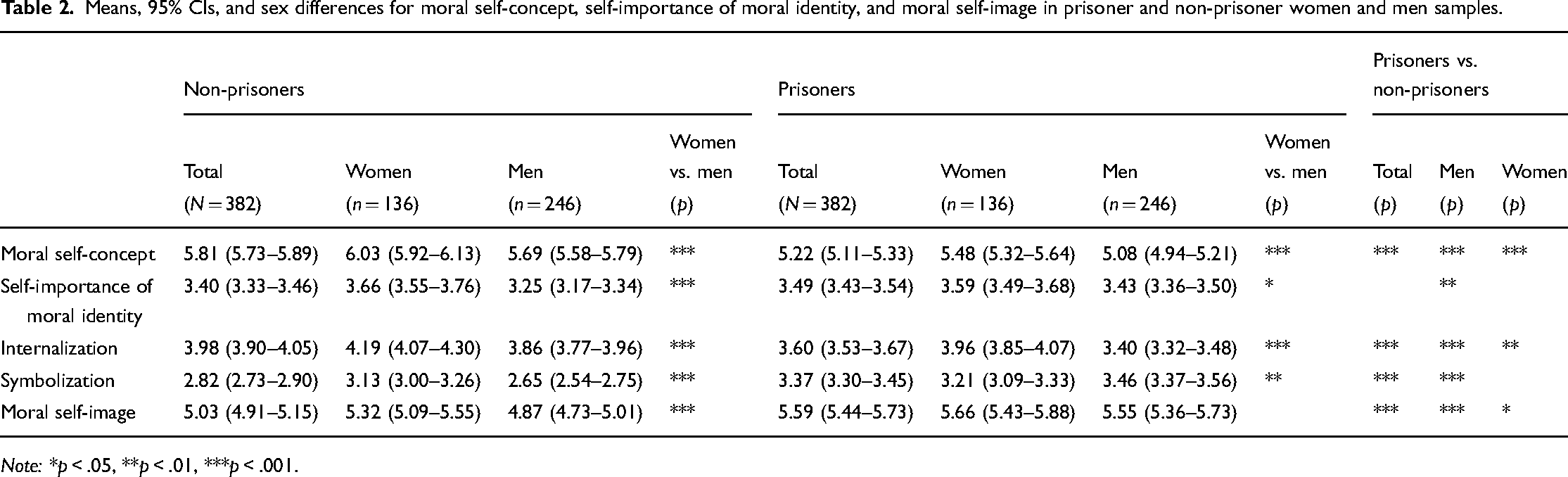
Descriptive statistics for all measured variables, including sex differences, are in Table 2, whereas ANOVA test results are in Table 3. Regarding moral self-concept, results showed that prisoners had a statistically significant but small difference in moral self-concept compared to non-prisoners (F(1, 760) = 70.88, p < .0001, ω2 = .08). Prisoners rated their moral traits at a mean level of M = 5.22 (SD = 1.06), whereas non-prisoners rated them at M = 5.81 (SD = 0.78) on a 7-point scale. While this represents a significant difference, the magnitude of the effect was modest, with prisoners rating their moral traits only 8.4% lower than non-prisoners. This relatively small difference suggests that, although prisoners viewed themselves less morally, the gap between the two groups was not as large as one might expect.
Means, 95% CIs, and sex differences for moral self-concept, self-importance of moral identity, and moral self-image in prisoner and non-prisoner women and men samples.
Note: *p < .05, **p < .01, ***p < .001.
Comparisons of scales according to status (prisoners vs. non-prisoners) and sex in the total sample (N = 764).
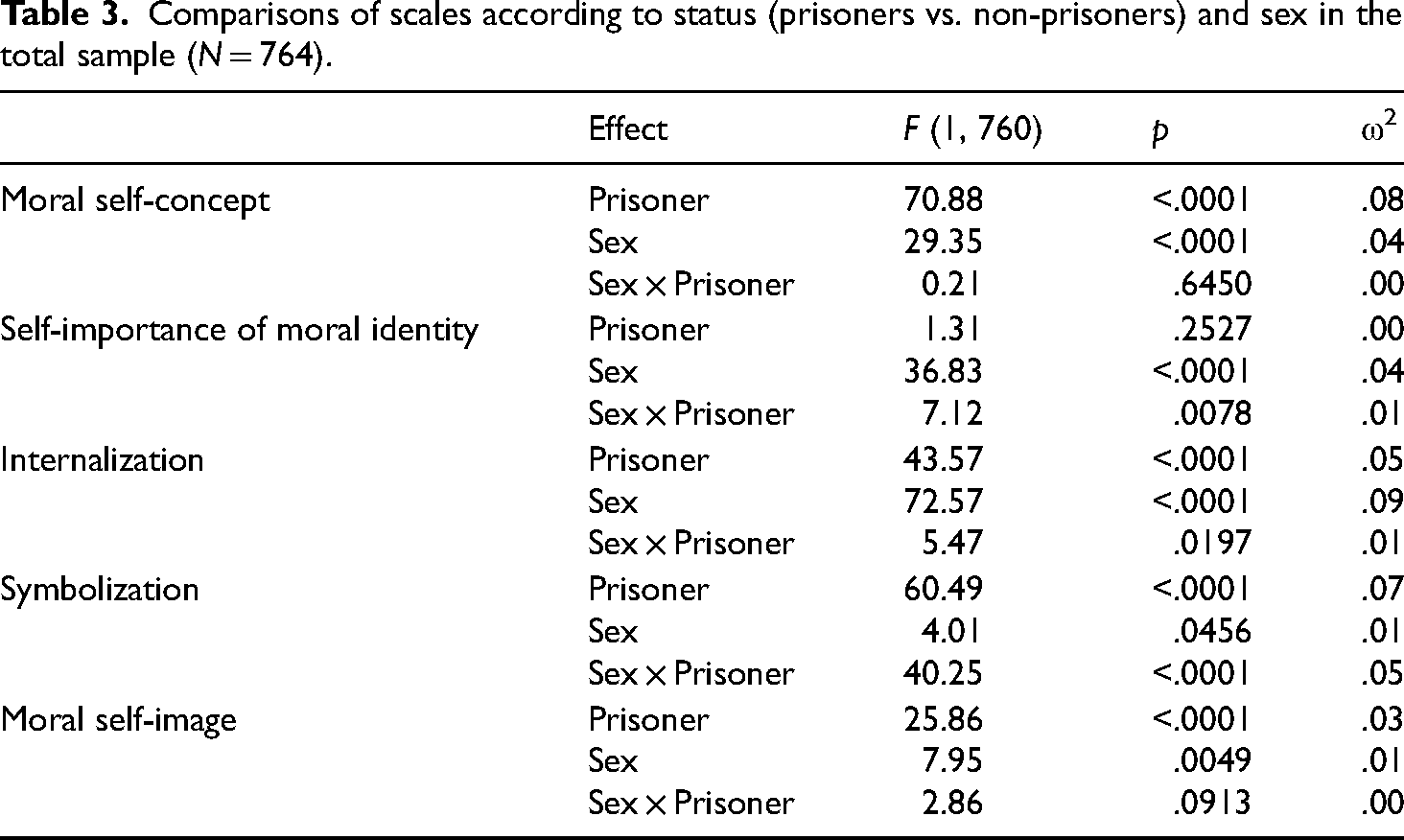
Regarding the self-importance of moral identity, prisoners had lower internalization of moral traits than non-prisoners (F(1, 760) = 43.57, p < .0001, ω2 = .05), but higher symbolization (F(1, 760) = 60.49, p < .0001, ω2 = .07). Prisoners found it less relevant to possess moral traits (M = 3.60, SD = 0.70 on a 1–5 scale) than non-prisoners (M = 3.98, SD = 0.75), with a difference of 5.4%, which, while statistically significant, reflects a modest effect. Conversely, it was more important for prisoners to show moral traits to the outside world (M = 3.37, SD = 0.74) compared to non-prisoners (M = 2.82, SD = 0.84), with a difference of 11%, a more noticeable but still moderate effect.
Regarding moral self-image, prisoners assessed themselves closer to their ideal moral self than non-prisoners (F(1, 760) = 25.86, p < .0001, ω2 = .03), with prisoners rating themselves at a higher mean level (M = 5.59, SD = 1.42 on a 9-point scale) compared to non-prisoners (M = 5.03, SD = 1.23). This represents a difference of approximately 8%, suggesting that prisoners, on average, perceived themselves to be somewhat closer to their ideal moral self-image, but again, the magnitude of this difference was relatively small.
This pattern of results was consistent across both male and female prisoners and non-prisoners, as detailed in the Supplementary Materials.
Moral self-assessments in violent and non-violent prisoners
First, the five competent judges coded the crimes (as violent or non-violent). We followed procedures from past research (e.g., Paruzel-Czachura et al., 2023). When a prisoner committed more crimes, of which at least one was considered violent, the participant was coded as violent. We compared prisoners who committed violent offenses (e.g., murder, beating) (n = 224) with those who committed non-violent offenses (e.g., stealing, car accident) (n = 109) based on the information they provided. As hypothesized, violent and non-violent prisoners showed no differences in most measures of moral self-assessment. For moral self-concept, both groups reported similar levels (F(1, 331) = 0.56, p = .4539, ω2 = .00), indicating no meaningful distinction in how they perceive their moral traits. Similarly, there was no difference in the symbolization of moral traits, or the importance of displaying these traits to others (F(1, 331) = 0.22, p = .6430, ω2 = .00), nor in their moral self-image (F(1, 331) = 1.43, p = .2329, ω2 = .00), suggesting that violent and non-violent prisoners felt equally close to their ideal moral self.
However, contrary to our hypothesis, a difference was found in internalization (F(1, 331) = 4.48, p = .0351, ω2 = .01), where violent prisoners placed greater importance on possessing moral traits (M = 3.68, SD = 0.71) than non-violent prisoners (M = 3.51, SD = 0.65). Although the effect size was small (ω2 = .01), this finding indicates that violence may slightly increase the relevance of possessing moral traits among prisoners. While the overall differences between the groups were minimal, this nuanced result suggests that violent prisoners might place more value on internal moral traits than previously expected.
Moral self-assessments in men and women
As hypothesized, women scored higher in moral self-concept and internalization than men in the prison population. Moreover, women in prison and men in prison did not differ in their moral self-image, so they seemed equally sensitive to their specific moment, which was a prison situation. However, regarding symbolization, men in prison scored higher than women in prison. While possessing moral traits (internalization) was more important for women in prison, showing those traits to the outside world (symbolization) was more relevant for men in prison. Regarding the control sample, women scored higher in all measures than men.
Discussion
We examined the moral self-assessments of prisoners compared to non-prisoners, investigating whether incarceration impacts moral self-concept, self-importance of moral identity, and self-image. Findings indicate that prisoners viewed themselves as somewhat less moral than non-prisoners but did not consider themselves entirely immoral, likely reflecting complex moral adaptations to the prison environment. Moral identity appeared less internalized yet more symbolized in prisoners, suggesting that reputation management was important in prison settings. Violent offenders placed slightly higher importance on moral traits than non-violent offenders, while women in prison held a higher moral self-concept than men. The prison environment influenced moral self-assessment but not to an extreme degree, highlighting areas where resocialization efforts may benefit. Although limitations affect the study's generalizability, further research could illuminate additional factors influencing prisoners’ moral self-assessments. Below we elaborate on each of these aspects in detail.
Self-assessment after wrongdoing
Although it could be expected that moral self-assessments should be lower after wrongdoing (Gino et al., 2015; Jordan et al., 2015; Monin and Jordan, 2009), previous research showed that men assessed themselves as moral despite committing a crime or violent behavior (Sedikides et al., 2014; Vecina and Chacón, 2016; Vecina and Marzana, 2016). We aimed to understand moral self-assessment after wrongdoing more deeply by (1) studying how both men and women in prison perceive their morality; (2) using three scales to measure moral self-assessments; (3) and having a control and matched by age and sex sample of participants from the general population with no criminal record.
Moral self-concept
Regarding moral self-concept, our results showed that prisoners rated their moral traits lower than non-prisoners, but the effect size was modest (ω2 = .08). We did not confirm our first hypothesis. However, this result aligns with the broader literature on the impact of incarceration on self-concept, which highlights that prisonization—a process through which prisoners internalize prison norms—can alter self-perceptions (Paterline and Orr, 2016). Despite the lower moral self-concept among prisoners, they did not see themselves as entirely immoral, which could reflect the complexity of moral identity in prison settings where social degradation, alienation, and stigmatization are prevalent (Crewe, 2009; Sykes, 1958). This suggests that while imprisonment might affect self-evaluation, inmates still may maintain a certain level of moral self-regard, potentially as a coping mechanism or due to self-deception (e.g., Blasi, 1983, 2005; Mazar et al., 2008; Merritt et al., 2010; Monin and Jordan, 2009; Sedikides et al., 2014; Vecina et al., 2016; Vecina and Marzana, 2016).
Self-importance of moral identity
Regarding the self-importance of moral identity, we also did not confirm our hypothesis. Interestingly, prisoners showed lower internalization, but higher symbolization of moral traits compared to non-prisoners. The effect sizes were small, but this indicates that while prisoners found it less important to possess moral traits, they placed greater emphasis on displaying them to others. This pattern could be interpreted as an adaptive response to their social context, where reputation management may be crucial for survival. The prison environment fosters its own subculture, where the need to signal certain traits to peers or staff might take precedence over internal moral standards (Alpert, 1979; Crewe and Laws, 2016). These findings align with research showing that self-presentation strategies, including the symbolization of moral traits, can serve as a form of compensation (Sedikides et al., 2014).
Moral self-image
Regarding moral self-image, we also did not confirm our hypothesis. We found that prisoners reported being closer to their ideal moral self compared to non-prisoners, though this difference was again small. This suggests that prisoners may lower their ideal moral standards, making it easier to align with their perceived self-image. This may reflect a self-protective bias (Sedikides et al., 2014) or an adaptation to their environment, where setting more modest moral goals helps them maintain a positive self-image despite their incarceration.
Violent vs. non-violent offenders
Comparing violent and non-violent prisoners, we confirmed our hypothesis that they did not differ in moral self-concept, symbolization, and moral self-image, which is in line with previous study (Sedikides et al., 2014). However, contrary to our expectations, violent prisoners had higher moral standards than non-violent (internalization). However, the effect size was small (ω2 = .01). This might lead us to the conclusion that the offenders who commit violent crimes tend to give a little higher importance to possessing moral traits in comparison to non-violent offenders. More studies are needed to replicate this, but it can be anticipated that some kind of self-deception may play a role here, as pointed out by some authors (Vecina et al., 2015, 2016). Based on the above results, it can be concluded that violent and non-violent prisoners did not differ strongly in assessing their morality. However, violent prisoners declared slightly higher importance on possessing moral traits than non-violent ones.
Gender differences in prison
Comparing women and men in prison, we confirmed our hypothesis that women in prison had a higher moral self-concept than men in prison, consistent with recent studies (e.g., Paruzel-Czachura and McHugh, 2024). We also found a similar low discrepancy in their ideal moral self. Moreover, men and women differed in internalization and symbolization: while possessing moral traits was more important for women in prison, showing those traits to the outside world was more relevant for men in prison. We need more studies to assess the replicability of this finding and explain this unexpected result by looking at many possible variables like narcissism (see Grijalva et al., 2015 for the review) or deceptive self-presentation (Kolesnyk et al., 2021). Based on the above results, we conclude that women in prison have higher moral self-assessments than men in prison, with one exception: men cared more about their external morality in such a way that men preferred to show others that they possess moral traits to a greater extent than women.
Implications for resocialization
Overall, our findings provide a nuanced view of moral self-assessment among prisoners, showing that while their self-assessments differ from those of non-prisoners, the differences are not as large as one might expect. The prison context plays a significant role in shaping these assessments, with both violent and non-violent prisoners showing relatively similar patterns, except for higher internalization among violent offenders. Sex differences further highlight the complexity of moral self-perception in prison. It is also worth mentioning that in our sample prisoners did not assess themselves as totally immoral, which in some cases might support the idea that people generally see themselves as rather moral than immoral.
The descriptive picture of women and men in prison may help researchers better understand the moral self-assessments of people who committed crimes and provide insights for practitioners to improve resocialization programs. While prisoners in this study showed some sensitivity to their moral standing by perceiving themselves as slightly less moral, the difference was small. This sensitivity could still be considered a useful starting point for interventions, focusing on fostering responsibility and the recognition of wrongdoing. However, further research is needed to determine whether this awareness can significantly impact rehabilitation efforts.
Important limitations of this study
Although our findings provide more compelling evidence regarding moral self-assessment than previous studies, we want to acknowledge a few limitations. Most of the study limitations result from the legal specificity of the prisoner sample. The study was based on voluntary participation and declarative answers to the questionnaires. Thus, we could not verify the obtained information, nor were we able to rule out that it might be biased due to unwillingness to provide some answers or lying, even though anonymity was maintained. However, it is a standard procedure in such studies, and we aimed to study subjective self-perception. In addition, the sample prisoners who agreed to participate in the study might not have represented the general population of prisoners. However, according to the American Psychological Association's ethical principles, all prison studies should be based on voluntary participation. Second, because we used different sample sizes for prisoners sentenced for a specific crime, we cannot be very specific about possible differences related to crimes (e.g., murder or theft). We could only analyze the differences between violent and non-violent crimes because those sample sizes had statistical power. We need future studies to test if a crime may be a relevant predictor of moral self-assessment. Third, we did not control the time of being in prison, and this could also impact moral self-assessments. There is a possibility that with time, prisoners try to fight with the so-called cognitive dissonance, in which incongruent beliefs and behaviors lead to discomfort (Harmon-Jones and Mills, 2019), or they may neutralize and rationalize their behaviors (Sykes and Matza, 1957), which may lead to changes in moral self-assessment. Fourth, while we matched our samples based on sex and age, this approach may be limited, particularly concerning education level. Research indicates that incarcerated individuals often have lower levels of education (Coley and Barton, 2006; Hetland et al., 2007) and weaker math and English skills (Creese, 2016) compared to those without criminal records. Future studies should account for additional sociodemographic factors such as education, religion, income, and political orientation to improve the accuracy of matching. Fifth, a significant limitation of our prisoner sample is the lack of data on criminal history, a crucial factor in predicting reoffending risk, institutional misconduct, and antisocial attitudes (Halsey, 2018). Addressing this gap in future studies by collecting detailed information on participants’ criminal histories would be essential.
Future research directions and issues
Work that builds on this study could continue studying the moral self by focusing on different samples and understanding the mechanism behind our results, including the time spent in prison. There is a possibility that both cognitive (Moore et al., 2008) and emotional deficits (Cohen et al., 2012; Effron, 2014; Kouchaki and Desai, 2015; Zaki, 2018) might influence moral self-assessments. Moreover, we still need to answer how moral identity is related to group identity and if it is based on the desire to fit in the groups inside prison (Ellemers et al., 2019; Ellemers and van den Bos, 2012). Also, studying more homogenous samples of prisoners (e.g., only murderers) might be more informative. As in the previous study (Sedikides et al., 2014), the type of crime did not play a role in moral self-assessments in our study. However, we think it is still relevant to study subtypes of wrongdoers. Moreover, it is also reasonable to study the stability of moral self-assessment from the moment of being accused of committing an offense through a period of incarceration until being released from prison (Bonta and Andrews, 2016). Lastly, studying morality in a more contextual and complex way (Herman and Pogarsky, 2023; Paruzel-Czachura et al., 2023; Silver and Silver, 2021) could bring a new insight to answer more deeply the questions of how and when people see themselves as moral and immoral? Furthermore, how may we use this knowledge to lower crime frequency and recidivism? To answer them, we need more studies on moral self-assessments on such a unique sample as prisoners.
Supplemental Material
sj-docx-1-euc-10.1177_14773708251324992 - Supplemental material for Moral self-assessment after committing a crime: A study on men and women in prison with a control group
Supplemental material, sj-docx-1-euc-10.1177_14773708251324992 for Moral self-assessment after committing a crime: A study on men and women in prison with a control group by Mariola Paruzel-Czachura, Mateusz Blukacz, Maria Luisa Vecina and Americus Reed in European Journal of Criminology
Footnotes

Declaration of conflicting interests
The author(s) declared no potential conflicts of interest with respect to the research, authorship, and/or publication of this article.
Funding
The author(s) disclosed receipt of the following financial support for the research, authorship, and/or publication of this article: This research was supported by grants ‘Moral thinking and unethical behavior’ (number PN/BEK/2020/1/00058/DEC/1) from the NAWA Bekker Programme (prisoner sample) and ‘Moral Coherence: the relationship between people's behavior and their moral views and emotions’ (number 2017/01/X/HS6/01332) from NCN Miniatura 1 (non-prisoner sample).
Supplemental material
Supplemental material for this article is available online.
References
Supplementary Material
Please find the following supplemental material available below.
For Open Access articles published under a Creative Commons License, all supplemental material carries the same license as the article it is associated with.
For non-Open Access articles published, all supplemental material carries a non-exclusive license, and permission requests for re-use of supplemental material or any part of supplemental material shall be sent directly to the copyright owner as specified in the copyright notice associated with the article.
