



Abstract
This paper combines archival data and statistical analysis to investigate the context-specific ways that prisons expanded and affected communities in the UK, focusing closely on the role of the UK's political economy. We present evidence of a significant increase of prisons in the counties where the coal-mining industry was dismantled during the 1980s and 1990s. We identify former coal-mining areas based on Coal Mining Reporting Areas and the methodology used by Beatty and Fothergill (1996) and test if more prisons were opened in former coal-mining areas than non-coal-mining areas per capita post-closures. Using Poisson regression analyses and controlling for population changes, we found that coal-mining counties were significantly more likely to acquire a new prison between 1981 and 2001 than those areas which were not affected by de-industrialisation. We apply Derrida's thinking on hauntology to reexamine the spatial legacy of Thatcherism in these communities as a means to understand history and culture, and the unraveling of the past, present, and future.
Introduction
Whilst the study of the processes associated with prisons and imprisonment has a long lineage in European and N American criminology (with recent extensions to S American criminology, Darke, 2018), the geographical location of these key institutions has not received very much attention. Where prisons are located and the reasons why they are located in those communities has started to attract some attention in N America (see, for example, Norton, 2016; Schept, 2022), but has received scant attention within European criminology. Herein, and using Britain as a case study, we start the process of unpicking both the locations of prisons built since the year 1901 and the economic processes which underlay their location (chiefly de-industrialisation). Whilst drawing upon the experiences of countries in just one state (Britain), our approach has lessons for those studying the development of prisons in other countries, both in Europe and further afield.
This paper is constructed along the following lines. We commence with a discussion of de-industrialisation, and how this has affected various European countries. Following this, we focus in on the experiences of the UK, and most notably England, Scotland, and Wales in the period since the 1970s. Following this we describe the methodology we employed, before describing both general trends within the data and more sophisticated spatial regressions analyses. We close with a discussion of the implications of our findings both for criminal justice policy and criminological thinking in this area, drawing on Derrida's work on hauntology (1994).
De-industrialisation: The European experience
De-industrialisation is the process by which the output from core industrial sectors (mining, heavy manufacturing, steel-production, ship-building, and allied trades, such as railways and transportation systems) is reduced over time, and, with this, an associated loss of employment in those sectors of the economy. Whilst this is most-commonly associated with ‘industrially-developed’ nations, there is evidence that de-industrialisation can (and does) affect developing nations too (Škuflić and Družić, 2016), including post-communist nations (Kandžija et al., 2017). As Clark et al. note (2019: 15): From 1970 to 2020, several phases in economic change and transition among EU members can be observed. Although not all countries have de-industrialised, there is a long-term trend towards the loss of jobs in manufacturing, coupled with the rise of the service economy, and more recently the creative, knowledge, and innovation economies.
This process was partly driven by the 1973 Oil Crisis, which saw job losses in manufacturing coupled with the rise of Asian industrial centres. As Clark et al. note (2019: 16), de-industrialisation had the effect of increasing inter-regional inequalities in European societies during the 1980s, with some cities losing 30–80% of their manufacturing jobs in this decade. They note that: This was particularly the case where industry was concentrated in certain parts of the country, such as in Italy, the United Kingdom or Germany, and where entire city regions de-industrialised at once, such as in the Rhine-Ruhr valley (2019: 17), … de-industrialisation also affected Central and Eastern European socialist countries. As the Soviet economy grew increasingly complex throughout the 1970s and 1980s, it required more and more complex disaggregation of control figures and factory inputs. As the number of enterprises, trusts and ministries multiplied, the economy began to stagnate, and was increasingly sluggish in response to change or in providing incentives to improve growth. (2019:17)
The UK's experience of de-industrialisation since 1979
The reverberations of industrial closures and high levels of unemployment in the UK after 1979 have been charted by numerous scholars (Beatty and Fothergill, 1997; Dorling, 2014; Goodman and Webb, 1994; Hay, 1996; Jennings et al., 2012; Showler and Sinfield, 1981). Shipyards, steel, and coal-mining industries and parts of the British automotive industry were heavily affected by de-industrialisation (measured as the relative decline of manufacturing or the decline of manufacturing employment, Kitson and Michie, 2000).
Whilst this development began in many advanced economies during the 1960s, it accelerated rapidly in the UK following the pursuit of monetarist economic policies by Margaret Thatcher's administrations. These conditions hit the UK manufacturing sector particularly hard in the 1980s (Kitson and Michie, 2000). High interest rates and an over-valued currency rendered UK manufacturing exports uncompetitive domestically and internationally (Kitson and Michie, 2000). By 1995 nearly 90 per cent of the coal-mining workforce had been lost, and the impact of this unprecedented destruction of jobs was geographically concentrated.
In areas of the English midlands, South Wales and central Scotland, mining had been the dominant source of employment for men for generations, so the consequences for these communities were especially pronounced. Indeed, Britain's miners launched one of the longest and fiercest industrial disputes (1984–85) in modern times. At its peak, 142,000 miners went on strike over pit closures and pay (Office of National Statistics, 2015) and a violent conflict, dubbed the ‘Battle of Orgreave’ when a mass picket was charged by police, remains a controversial event some 35 years later. Such de-industrialisation is strongly associated with increasing rates of unemployment (Clark et al., 2019: 15), and in the case of the UK, this was centred upon former-coal-mining areas.
De-industrialisation in Britain continued throughout the 1980s as the economy shifted from manufacturing to services. Notably, such was the impact of this economic transformation that Beatty et al. (2007) found evidence that by 2004 (more than 20 years after the miners’ strike had ended) former coal–mining areas had still not fully recovered, and that many had amongst the highest rates of unemployment in the UK. Substantial job losses in ‘heavy’ industries were not matched with new jobs, and many former miners registered as ‘inactive’ or ‘permanently sick’ (rather than unemployed), suggesting that official estimates of unemployment may have been significantly underestimated (Green, 1997). Dorling described how this process transformed the British economic and social landscape: The recession of the early 1980s was like a social storm which swept south from the north of the UK and which, in particular, reduced men's chances of gaining employment and of living into old age. It blew southwards, round the coasts, into inner London and the cores of some other southern cities but it was a social wind which went strangely still over the more rural parts of the Home Counties – places that never felt the economic cold. The 1980s recession had begun earlier, in the late 1970s along the Clyde and a little later on the Tyne and Mersey, but Thatcherism allowed its progress to be both encouraged and exacerbated. (Dorling, 2014: 242)
Processes associated with de-industrialisation (most notably unemployment and other economic and social indicators, such as economic inequality, GDP growth, child poverty, adult suicide, teen pregnancy and housing repossessions), have been found to be related to increases in crime (see Farrall and Jennings, 2012, Jennings et al., 2012 and Farrall et al., 2017). In this paper, we explore what happened to those regions which experienced the highest levels of de-industrialisation with regards to the location of prisons in the years since the 1980s. We look specifically at the places in those areas that were once economically dependent on coal-mining, assessing the extent to which prisons were located in them relative to non-coal-mining areas. We do this by examining the prison building programme that took place in England, Scotland and Wales during the 1980s and in the period since. Notably, a number of studies have linked the uneven process of de-industrialisation with crime (Matthews et al., 2001), deprivation (Beatty and Fothergill, 1997), and more recently – albeit in the USA – prison building (Beale, 1998; Eason, 2017; Huling, 2002; Schept, 2022; Taft, 2018) and we contribute to those literatures. We also reflect on why prisons in Britain have become spatially concentrated in former-industrial areas, and what this means for other countries in terms of the processes of de-industrialisation and prison-building.
The growth of British prisons after 1990
From the 1990s, there was a substantial expansion of the prison population and the criminal justice system (Jennings et al., 2012; Ministry of Justice, 2013). Between June 1993 and June 2012, the prison population in England and Wales increased by 41,800 prisoners to over 86,000 as a result of new sentences and recalls to prison. During the Thatcher and Major administrations (1979–1997), 26 new prisons were built. Others were extended to manage the mounting pressure on inmate places as crime and punitive attitudes increased, resulting in a ‘tougher’ criminal justice system (Farrall et al., 2016a, 2016b) and ultimately more inmates.
Older prisons also underwent refurbishment to improve conditions and security following disturbances, of which there were 46 in 1986, as well as a 25-day riot in HMP Strangeways in 1990 (Brodie et al., 1999). The privatisation of prisons also introduced an ‘enterprise culture’ into public services in the early-1990s; HMP Wolds was the first contracted prison in the UK run by Group 4 in 1992 (Grimwood, 2014). We assess if it is possible to detect a patterning in the location in time and space of new British prisons. Did they appear evenly spread across British counties, or did the building of such establishments mirror other trends that were taking place historically?
We consider this hypothesis in two steps. First, we examine the number and former uses of the sites where prisons were built 1901–2017, categorising key developments. Second, we compare the number of prisons in former coal-mining areas to non-mining areas (controlling for population change).
Identifying previous usage
Methodology
Using a number of publicly available data sources (i.e. HM Prisons Inspectorate; each prison's own web pages, Wikipedia, local history web sites, maps and information from researchers at the Scottish Prison Service) we have recorded what (if anything) occupied the site of each prison prior to its use in the secure estate. This required careful investigation and cross-checking with local historians and those with relevant knowledge. For example, Belmarsh Prison was built on the site of the former Royal Woolwich Arsenal, which was not clear from the available maps, but confirmed by researchers at Royal Arsenal History. In all, there were 115 prisons built after 1901 in Scotland, and England and Wales (some of which have now been closed).
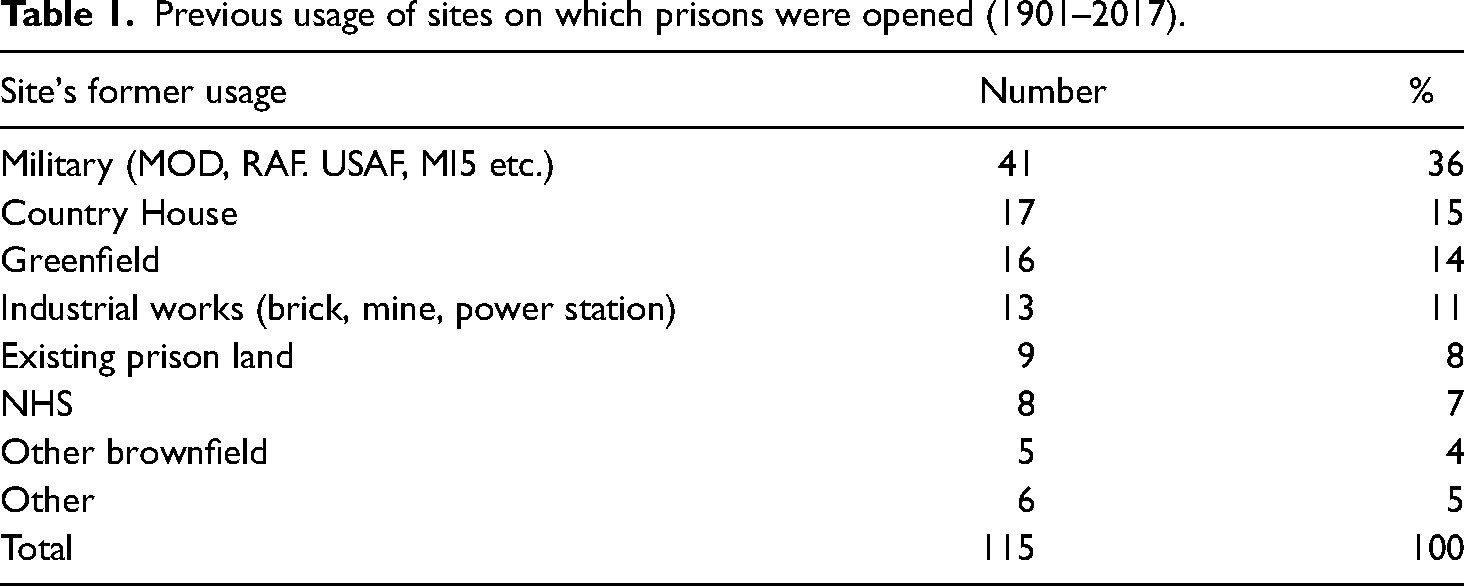
Following this we geocoded all prisons that were already in existence in 1901, and all of those prisons that were built after 1901. For the purposes of our analyses, the dates for the prisons built before 1901 was taken to be 1901 so we could focus on the period we are interested in. All prisons built since 1901 had their start date (or date of conversion) recorded, and all prisons which closed similarly had their date of closure recorded. For those establishments constructed after 1901, we recorded the previous use in one of nine categories (see Table 1). The categories are mostly self-explanatory; however, the military locations included Royal Air Force sites (such as HMP Bure, built on the site of RAF Coltishall), former Ministry of Defence sites, (i.e. HMP Bullingdon, built on the site of MOD Bicester), former US Air Force sites (i.e. HMP Guys Marsh which used to be an USAF military hospital), or sites such as HMP Ranby which used to be a British Army camp. Former industrial sites included, for example, HMP Peterborough (built on the site of Barker Perkins Engineering Works), HMP Whitemoor (built on the site of a much-reduced railway marshalling yard) and HMP Addiewell (built on Addiewell chemical works). NHS refers to the National Health Service. The ‘other’ category included prisons built on former orphanages, (HMP Styal), holiday camps (HMYOI Finnamore Wood), or on the site of a poultry farm (HMP Warren Hill).
Previous usage of sites on which prisons were opened (1901–2017).
Analyses
In all, our data set contains some 115 prisons that were opened in England, Wales and Scotland between 1901 and 2017 (see Figure 1 which shows the prisons open in 1981). The peak years for openings were during the 1960s when a flurry of prisons opened; seventeen of these were purpose-built prisons that were conceived and constructed to replace dilapidated Victorian local prisons. However, due to the rise of the prison population, none of the proposed closures in the Victorian-era secure estate actually took place (Brodie et al., 1999).
Table 1 summarises the role the site had before it operated as a prison. There were 17 which were converted from or built on the grounds of former-country houses. Eight were former hospitals (or similar institutions, such as HMP Longriggend which was a TB sanatorium). In all, there were 41 former military installations which were re-purposed or converted into prisons. Five brownfield sites and 16 greenfield sites were also utilised (it was not possible to identify precisely what had been on the brownfield sites), whilst 13 prisons were built on the site of former-industrial complexes. These include railway works, collieries and mines, brick works and power stations. Nine prisons were built within the grounds of existing prisons, whilst six we classified as having had ‘other’ uses (e.g. HMP Finnamore Wood was a wartime evacuation ‘camp school’).
Linking previous site usage and historical period
We sought to explore the opening of new establishments against the prior usage of the sites over the historical and political period since 1901. For the purposes of this study we have divided the period into historical categories based on key shifts in political direction from 1901 to 2017. Specifically, we distinguish between ‘pre-war consensus’ (1901–1945) and ‘post-war consensus’ (1946–1960) categories, given the end of World War II marked a transformation in social and political arrangements in the UK with the wide extension and consolidation of the welfare state (Paterson, 2008).
As Butler and Kavanagh (1997) note, the popular vote was evenly split between the two major parties (Labour and the Conservatives) in this era, emphasising what is known as the ‘post-war consensus’. From the mid-1960s this consensus began to be challenged (Paterson, 2008), hence our third category ‘the Wilson/Callaghan’ period (1961–1979). At this time, alternative political parties began to gain support, such as the Liberals and nationalist parties in Scotland and Wales, and a growing dissatisfaction with Keynesian economics grew.
The Conservative governments (1979–1997) are our fourth category (the Thatcher/Major period). These embarked on a project to ‘roll back’ the state and (ostensibly) give citizens greater choice, whilst reducing benefits for the poor and vulnerable in society (Paterson, 2008). Moreover, these Conservative administrations marked a key change in how crime and criminal justice was framed politically, with a greater emphasis on ‘law and order’ (Farrall et al., 2009; Hay, 1996).
Two decades of New Right dominance eventually ended with the election of ‘New Labour’ in 1997. New Labour endorsed market economics and sought to synthesise capitalism and socialism. This period covers 1997–2010, whilst the final category is the more recent era of low-crime and a decreasing emphasis on criminal justice populism via the Conservative-led coalitions of 2010–2017.
Table 2 presents a cross-tabulation of the above periodisation and type of institution that was repurposed as a new prison. Overall, we can see a small number of new prisons (nine) were opened in the first period from 1901 up to the end of World War II. During the ‘post-consensus’ period, 24 new prisons were opened. We then have an 18-year period from 1961 to the election in 1979 of the first Thatcher administration when 39 prisons were opened. The Thatcher and Major governments opened 26 new prisons.
Political period and previous usage of sites on which prisons were built (1901–2017).
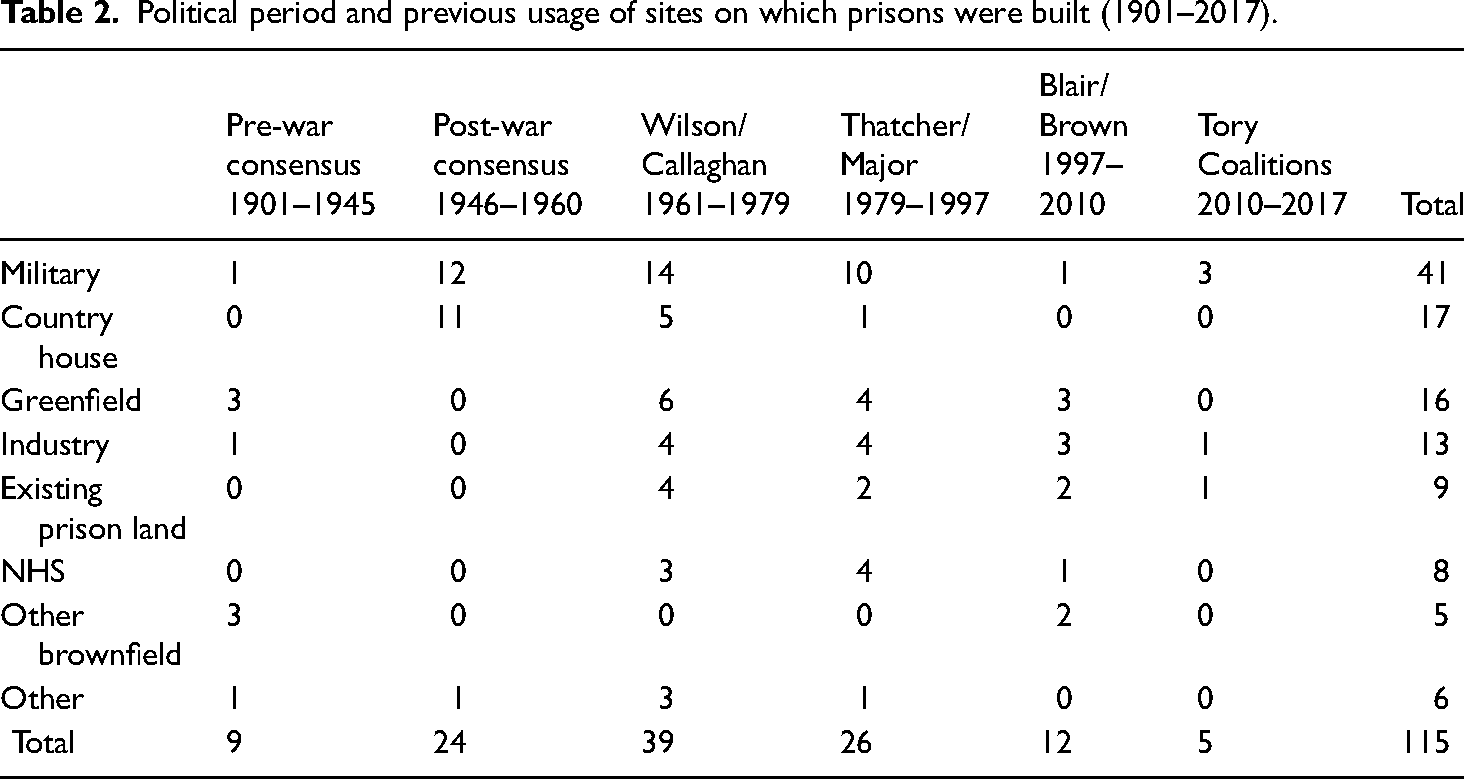
There are three trends which require further elaboration:
The use of former-country houses (which peaked during the 1946–1960 period, and saw a steady decline since). Demilitarisation (i.e. the use of former-military camps etc.), which has a presence in each period but is especially prevalent between 1952 and 1997. De-industrialisation (i.e. the use of former-works that appears markedly since 1961).
Let us take each of these in turn.
Country houses
Country houses are a reminder of the wealth associated with landowners that can be traced back to the seventeenth and eighteenth centuries (Girouard, 1978). Many country houses were still in use as full-time or occasional private residences until the 1870s, after which the agricultural depression forced some landowners into financial hardship. The demise of the privately owned country house increased during World War I. Large numbers of staff left the estates to join the war effort, many of whom never returned. Others found better-paid employment in towns and cities. However, it was not until World War II that the real death knell for the country house sounded. Many country houses were requisitioned during the war and were returned to their owners in poor states of repair. The costs of repairing the houses (coupled with lower incomes from agricultural produce and higher rates of taxation), and the loss of heirs during the two World Wars, left numerous owners unable to maintain their buildings. Faced with a ‘perfect storm’, many country house owners elected to sell either the contents of the houses, or parts of them (fireplaces or staircases), or to demolish them and sell the stone (Girouard, 1978). Others donated their houses to the State. It was in this way that Chequers was donated in 1921 for the use of the Prime Minister, whilst Chevening House was donated in the late-1950s.
In the late-1930s and the early-1950s, the government made it easier for country houses (and other objects) to be given in lieu of taxes owed. Other country houses had different trajectories of ownership. For example, in 1948 Keele Hall was purchased from Colonel Ralph Sneyd for the establishment of the University College of North Staffordshire, which opened in 1950 and in 1962 became Keele University. Similarly, Heslington Hall was used during World War II by the RAF, before becoming part of the University of York in the mid-1960s. In similar ways, a number of county houses became available for use as prisons after the end of World War II. Looking at Table 2, we see that of the 17 former-country houses used as prisons, nearly two thirds (11, 65 per cent) were converted during the 1946–1960 period, with a further five in the 1961–1979 period. No prisons with this background were opened between 1901 and 1945, or after 1998.
Change in number of prisons in former mining and non-mining areas (1981–2001).

Demilitarisation
The early part of the twentieth century saw a huge fluctuation in the number of service personnel. In 1901, 530,000 people were employed in the armed forces, which quickly rose to 2.49 million in 1915 as World War I entered its early phases. In 1921, three years after the war had ended, the figure had dropped to 491,000. By the end of World War II, 5.13 million service personnel were employed before the figure fell to just under 1 million by the end of the decade. Nevertheless, it was not until 1952 that the numbers employed in military services declined substantially to less than half a million for the first time since 1939, after which numbers remained reasonably consistent. In effect, the main period of sustained demilitarisation started in 1952.
Table 2 shows that of the 41 former-military sites repurposed as prisons since 1901, 26 (63 per cent) were established between 1946 and 1979. We can conclude therefore, that the main period during which new prisons were opened on the sites of former-military establishments took place after a significant phase of demilitarisation (measured as a reduction of state armed service personnel).
De-industrialisation and the location of prisons
‘De-industrialisation’ is generally considered as a substantial reduction in industrial capacity in the manufacturing and heavy industry sectors. Taking this definition, one can trace a major decline of such work in the UK from 1973 (Kitson and Michie, 2000). Fieldhouse and Hollywood (1999: 483) note that the 1980s and early-1990s witnessed an ‘unprecedented transformation leading to the virtual destruction of the mining industry in Britain’. From Table 2 we see the first real signs of the reuse of former-industrial sites as prisons was in the 1960s. The one prison in the 1901–1945 period that was built on a former industrial site was HMP New Hall in West Yorkshire, which was the first open prison, and constructed on the site of a former colliery in 1933. The prisons repurposed from industrial sites after 1960 were: HMP Hindley near Wigan (1961), which was built on the site of a colliery; HMP Low Newton in County Durham (1965), which was built on the site of a brick works; and HMP Glenochil near Stirling (1966), which was built on National Coal Board land, having first opened as a detention centre, before being extended into a Young Offenders Institution in 1975.
In the period between 1979 and 1997, five more prisons were built on sites formerly occupied by industrial institutions. HMP Wymott near Leyland (1979), HMP Frankland in County Durham (1980) and HMP Garth in Leyland (1988) were built on the sites of former brick works. HMP Whitemoor in Cambridgeshire (1991) was constructed on part of a railway yard. Meanwhile, HMP Doncaster (1994) was built on the site of a former power station and in a former-coal-mining area. Since 1997, a further four prisons with a post-industrial history have been opened: HMP Forrest Bank in Manchester (2000) was built on the site of a power station; HMP Peterborough (2005), built on the site of Barker Perkins Engineering Works; HMP Addiewell in West Lothian (2008) took over the site of a chemical works; and HMP Grampian in Aberdeenshire (2014) is located on the site of a former railway yard.
Of the 13 prisons built on former industrial sites, ten are located in the former industrial heartlands of central England or central belt Scotland (the three exceptions were HMP Grampian in North East Scotland and HMP Peterborough and HMP Whitemoor, both in the more rural Cambridgeshire).
Charting the opening of prisons and de-industrialisation: A spatial analysis
As part of a wider and longitudinal investigation into the impacts of Thatcherite social and economic policies on UK society, we have documented the unfolding relationships between economic restructuring and truancy from school (Farrall et al., 2020a), engagement in crime between ages 10 and 30 (Farrall et al., 2020b) and housing, homelessness, and crime (Farrall et al., 2016a, 2016b, 2019). Underpinning this work is a strong relationship between radical economic restructuring and the UK's geography during the Conservative administrations 1979–1997 (Dorling, 2014; Hudson, 2013).
Briefly, the economic restructuring that was felt most strongly in the 1980s was concentrated in a number of specific areas in the UK. These included the South Wales valleys (where coal-mining had been a major employer); Central belt Scotland (where mining, steel-making and shipbuilding dominated); the North East shoulder of England (a region with steel-making and mining) and what might be referred to as ‘Central belt’ England (stretching from Merseyside in the west to Humberside in the east, and where shipbuilding, mining, and steel-making were again amongst the largest employers).
We know from the above analyses that several of the new prisons built after 1961 were on former industrial sites. This begged the question: to what extent was the establishment of new prisons related to the uneven geography of de-industrialisation that accelerated in the later part of the twentieth century? How closely associated are these new prisons with the geographical areas in which coal-mines (a key marker of the industrial base) were located?
Materials and methods
To answer this question, we examined whether the number of prisons in former-coal-mining areas increased as the mines closed during the 1980s and 1990s. Our hypothesis was that more prisons opened in former-coal-mining areas between 1981 and 2001 than in non–coal-mining areas.
We define coal-mining areas as counties that overlap with Coal Mining Reporting Areas. The Coal Mining Reporting Area, formally known as CON29M (Coal and Brine Consultation Areas) is used to determine whether a coal-mining report is required for a property transaction in that location. These reports identify the areas potentially affected by nearby coal extraction, and serve as a proxy for coal seams. These include areas in (from north to south) the Scottish central belt, North East England, the Midlands (Yorkshire and The Humber, Nottinghamshire, Derbyshire, Warwickshire), South Wales, and Kent. We use 1974–1996 county areas (with 2001 data geocoded back to these boundaries) as they were consistent for the longest continuous period of time for our study period.
Population change must, of course, be taken into account within these analyses; we cannot simply compare the number of prisons (or number of new prisons) in the respective locations because the population increases in these areas differ in size over time. Tables 3 and 4 demonstrate the changes in the number of prisons and the working–age male population, respectively, over twenty years (population figures are taken from the 1981 and 2001 censuses).
Change in working-age male population in former mining and non-mining areas.

Results
The growth in the working–age male population between 1981 and 2001 is about ten times greater in non–coal mining areas than in former-coal-mining areas, so we would expect to see about ten times as much prison capacity in these areas too, all things being equal. In fact, the raw number of new prisons in both former coal-mining and non-coal-mining areas is about equal, suggesting there are approximately ten times as many prisoners in former-coal–mining areas as would be expected. Figures 1 and 2 show the location of prisons open in 1981 and 2001 respectively, overlaid on to a map of coal-mining counties. We have studied working–age males in our analyses rather than all ages as this captures the peak in offending between late teens and early twenties. We have also limited the analysis to males only, as the majority of the prison population is male, and the vast majority of coal miners were also male. As we focus on males, we have removed female-only prisons from this part of the analyses; however, this accounts for only ten prisons in 1961, 11 prisons in 1981, and 14 in 2001. We also removed prisons with only maximum security accommodation, that is, exclusively Category A prisons, which account for six prisons up to 2001. These tend to hold only those prisoners who pose the greatest risk to society should they escape and therefore do not represent the majority of those in the general prison population.
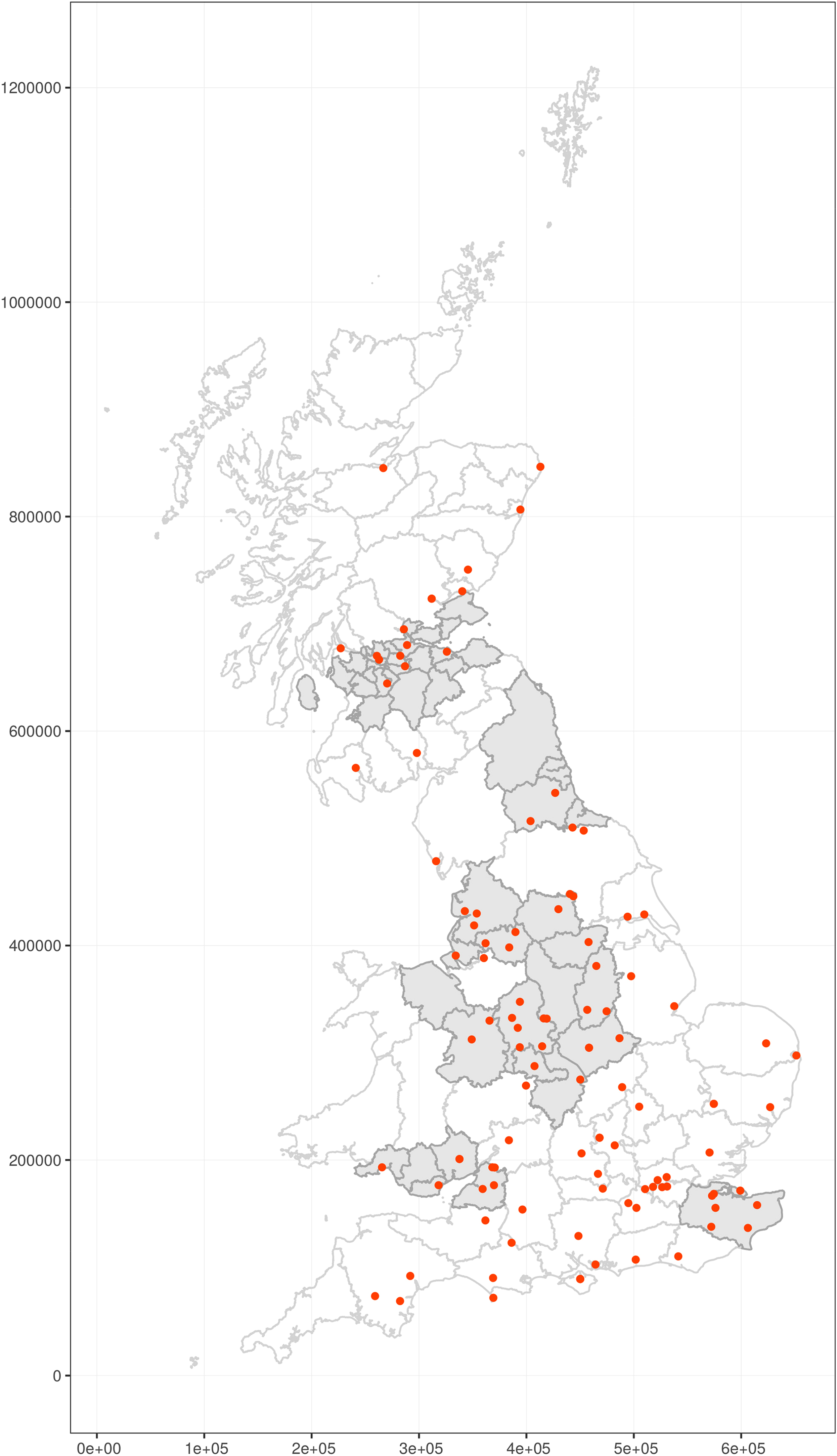
Coal mining counties (grey) and prison locations (orange) in 1981.
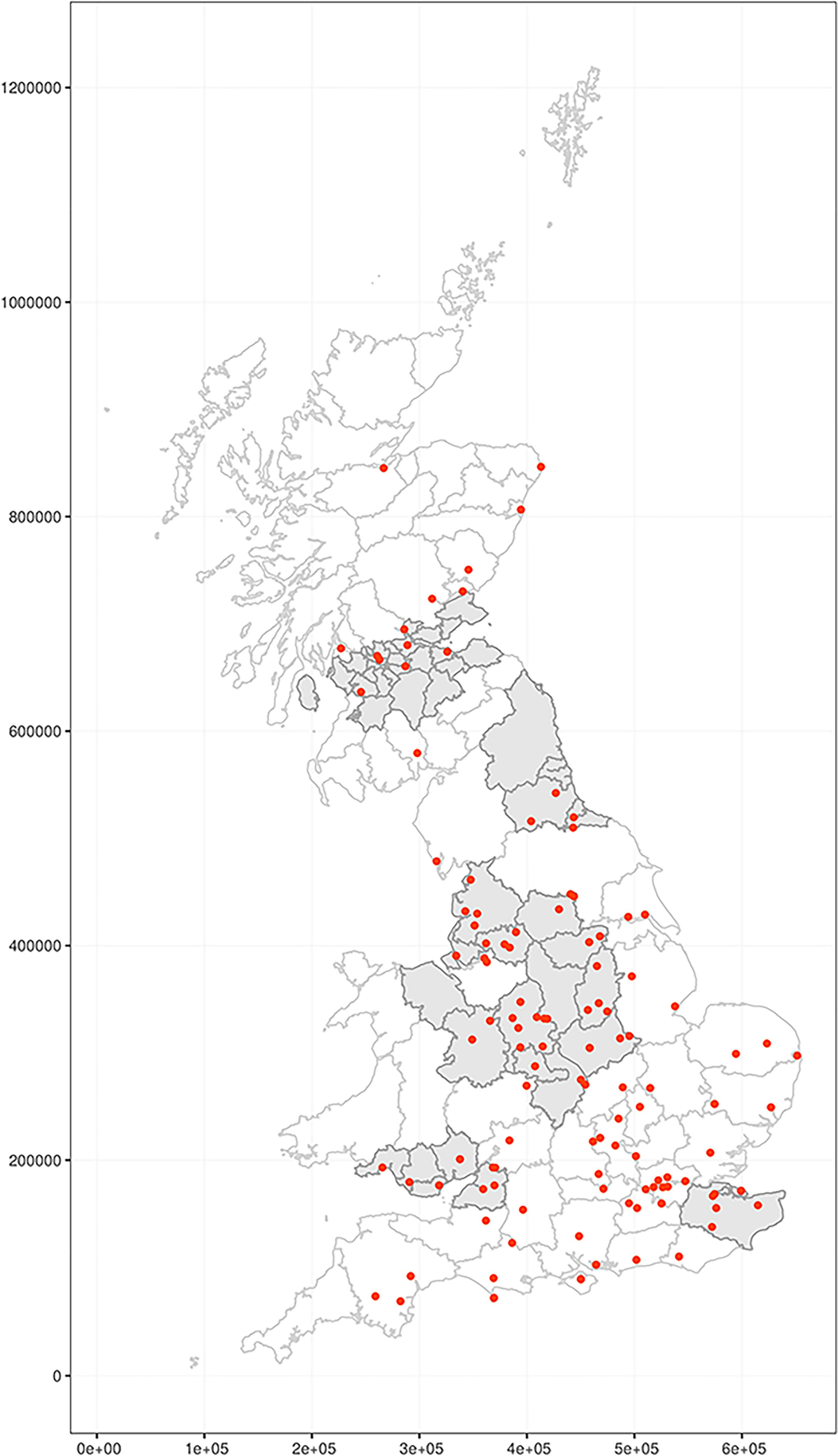
Coal mining counties (grey) and prisons (orange) in 2001.
First a Chi-square test was applied, finding a significant difference in the number of prisons built between coal-mining and non–coal-mining areas between 1981 and 2001 (p < .000). All things being equal, there were about ten times as many prisons opened in coal-mining areas than in non–coal-mining areas per capita. London, however, is an outlier as it had significantly higher population growth than other areas. To also ensure this did not impact the association between population change and prison openings, the test comparing coal-mining and non–coal-mining areas was repeated excluding London. The result was still statistically significant, suggesting there was a greater number of prisons per capita in coal-mining areas than non–coal-mining areas, even accounting for the higher population growth in London.
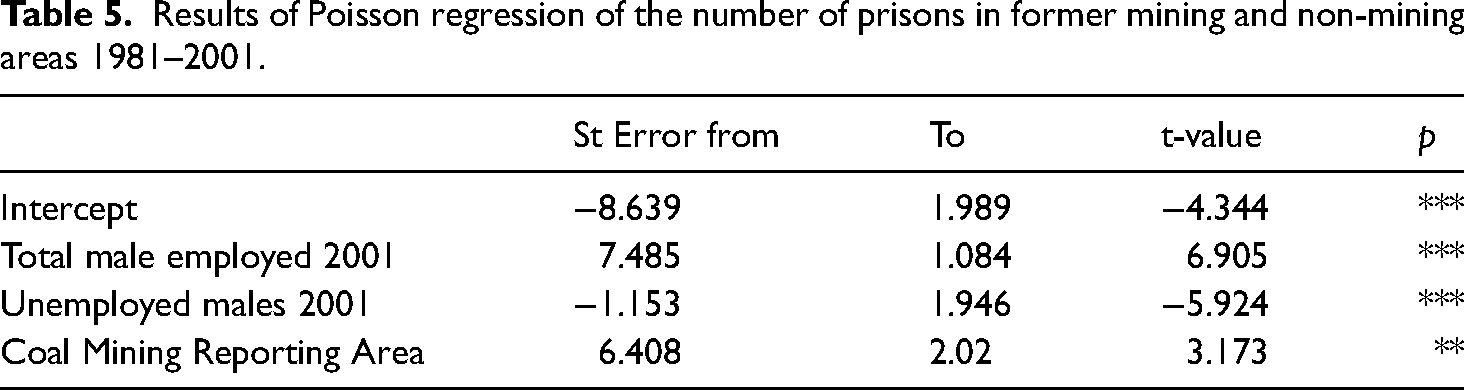
To apply a more sophisticated test, we next fitted a regression model to the data. The number of prisons in each county in 2001 (yi) forms a Poisson distribution, that is, yi ∼ Poisson (μi). The mean number of prisons per county in 2001 was 1.2, and the variance was 2.5. Therefore, the parameter λ is (at most) 2.5, meaning linear regression is unsuitable for modeling this dependent variable but Poisson regression is. There were 110 counties and 127 prisons (excluding female-only and maximum security prisons) in 2001. The parameters of Poisson regression are estimated by maximum likelihood estimation (MLE), so a sufficiently large data set is necessary. Specifically, we have more than 100 observations and more than ten observations per coefficient estimated (we estimate 2–3). The coefficients are estimated and tested against the null hypothesis that the coefficients are not statistically significantly different from zero. In a Poisson model, we predict the number of prisons in county i as the dependent variable, whilst our explanatory variables are the number of working–age males in county i and a dummy to indicate if county i is a former-coal–mining county. In addition, we control for unemployment, so add the number of unemployed males in county i as an additional independent variable. The linear predictor for our initial model is therefore:

Results of Poisson regression of the number of prisons in former mining and non-mining areas 1981–2001.
Discussion
This paper began by asking what happened to the landscapes affected by the de-industrialisation that accelerated during the 1970s and 1980s. To answer this question (in part) we looked at the prison-building programme that occurred around the same time, and found two points of interest.
First, using historical sources of the prior use of the land where prisons were established (1901–2017), we found that since 1901 prison-building followed a series of trends. These included the utilisation of country houses in the immediate period after World War II (many of which had been left neglected and unoccupied and provided convenient accommodation). There was also a pattern of using former-military sites that became vacant as the numbers of armed service personnel reduced.
Second, additional data highlighted the repurposing of land that had been affected by de-industrialisation to build new prisons. This result prompted a second statistical procedure that estimated and compared the number of prisons in former-coal-mining areas compared to non-coal-mining areas, controlling for population growth. Our analysis identified that between 1981 and 2001 a coal-mining county was approximately 90 per cent more likely to have a prison built in it than a non–coal-mining county. In short, as the coalfields closed more prisons began to be built in these former-coal-mining counties than elsewhere, after controlling for population growth.
We have used archival and statistical data to investigate the context-specific ways that prison growth occurred in, and affected communities in the England, Wales and Scotland, casting a close eye on the role of the political economy. Our contribution highlights what can happen to areas when rapid, unregulated de-industrialisation takes place. Regions where industrial employment was concentrated may expect to see economic restructuring, but if economic recovery is weak, the prison complex may come to replace the industrial complex. Indeed, scholarship has begun to carefully examine the complex dimensions of prison growth in rural post-industrial areas (Beale, 1998; Eason, 2017; Huling, 2002).
Eason's contribution set in the rural communities of America found that local residents largely accepted the building of prisons, as they felt that jobs might accompany them (2017). However, he argues that areas affected by de-industrialisation and long-term poverty experience ‘stigmatization’ by hosting a new prison, and the economic boost provided by one is often short-lived. He concluded that prison-building was the ‘best of the worst’ options available to disadvantaged communities in precarious economic circumstances (Eason, 2017).
Similarly, Armstrong (2014), focusing on the Scottish context and using document and discourse analysis, articulates the struggles local communities faced to have their opinions recognised by the prison planning process, and thus identifies some of the processes whereby prisons come to be sited on former industrial land. This paper does not touch on how groups or individuals felt about the growth of local prisons or the social and economic repercussions of prison proliferation, but such routes of enquiry are clearly a worthy focus of future research. We also do not touch on the rationalisation of privatising prisons (Andrew and Cahill, 2017; Crewe et al., 2011) but this is another important dimension of neo-liberalism very much in keeping with the Thatcher ethos and worthy of further attention.
Historically, as imprisonment rates in Britain have increased, it has been necessary for the government to locate new areas in which to accommodate prisons. Such decisions were often taken under pressure (e.g., in 1996 the prison population increased quickly and an emergency accommodation programme was prompted, Brodie et al., 1999), and newly available sites became an attractive option, be they vacant country-houses, disused military property or post-industrial land. Crucially, once prisons are built, they are very likely to remain there, since closures are rare. As previously noted, when new prisons were designed and built in the 1960s to provide a modern regime, none of the planned closures of old-style prisons took place.
The rising number of inmates and the need to increase capacity eclipsed the optimism of the new building programme. Interestingly, an analogous pattern is currently taking place; in 2016, the Prison Estates Transformation Programme (PETP) was announced. It aimed to create 10,000 new prison places to replace old unsuitable accommodation, renovate existing properties and reorganise the estate to better meet the needs of the prison population (Brown, 2018). It committed £1.3 billion to do so (Guiney, 2019).
Since then, one new prison has been built (HMP Berwyn in North Wales) which is the second largest prison in Europe and was built on a disused Firestone tyre factory that closed in the 1970s. The factory was part of the Wrexham Industrial estate, which had its origins as a Royal Ordnances Factory (ROF Wrexham) during World War II. Meanwhile four existing sites have been earmarked for expansion (HMP Rochester, HMP Hindley, HMP Wellingborough, and HMP Glen Parva) whilst HMP Full Sutton and HMP Stocken were to get additional buildings (Brown, 2018). It is expected that the inmate capacity of these institutions will expand significantly and consolidate a new generation of ‘supersize’ prisons. Notably, six of these seven enterprises launched under PETP are in coal-mine reporting areas.
Whilst prison expansion may appear to be a common-sense response to an increasing prison population, it appears in the UK it has disproportionally taken place in the regions affected by the crises of de-industrialisation and urban decline. These areas may be further affected as plans to ‘supersize’ existing prisons becomes customary, compounding the ‘legacy’ of de-industrialisation even further.
What can this tell us about why prisons become spatially concentrated and what lessons might there be for policies in other countries? It is hard to provide any definition answers to the first question. Prisons were concentrated in former-coal-mining/industrial counties, and several are geographically close to one another. Partly this could reflect the availability of brownfield sites and the desire to provide jobs in places where jobs have become scant (and crime rates possibly elevated). Pragmatically it could reflect the difficulty of a local community opposing a new prison when one already exists locally. What might this mean for other countries? Few other countries, except perhaps the USA, have de-industrialised on the scale which the UK did, or with the speed and absence of social welfare supports. In this sense, the UK may be an outlier. Nevertheless, if de-industrialisation does take hold in a country, there may be both pragmatic and political pressures placed on administrations to tackle rising crime rates (if these emerge). If (and it is a ‘big’ ‘if’) those countries were to follow the example of the UK, we might expect to see prisons concentrated alongside similar lines. That, however, would require both an unwillingness to invest in social welfare and a concurrent willingness to respond to crime punitively, and this may not always be the case.
As a means of wider reflection, we have endeavored to question how radical socio-political events evolve spatially. Expanding Derrida's (1994) framework of ‘hauntology’, Fiddler (2019) has encouraged the idea that urban spaces can be ‘haunted’ by past traumas where geographic locations have a collective memory and deep connection to their past Haunting in this respect is not concerned with the detectable presence of ‘ghosts’. Rather, it points to the impermanence of foundations we may have considered solid, where the past remains ‘alive and at work’ (Davis, 2005: 373). Similarly, for Buse and Stott (1999), hauntology speaks to a dissolving of past and present, as well as imaginations of the future. Using the perspective of hauntology one is drawn to consider how spectral undercurrents can open up institutions to a new type of analysis. Indeed, Rand (1994: 169) sees the value of hauntology in its ‘potential to illuminate the genesis of social institutions [as well as] a new perspective … into the psychological roots of cultural patterns and political ideology’. This angle is a particularly interesting one to apply to the twofold history of prison building and de-industrialisation in parts of Britain, whereby coalfields were eventually replaced (in some instances) by prisons. Around 200 years earlier the country had begun to rely on coal to fuel the industrial revolution; after it was produced, it created plentiful opportunities, gave birth to mining communities with strong cultural bonds. Shaw (2012) observed how the identity of the miners became skewed after the 1980s when they were associated in popular culture with the strike of 1984–1985, the conflict with Margaret Thatcher's governments, and subsequently dislocated from their longer social history. Nonetheless, as mines closed, these regions continued to suffer as economic regeneration proved faltering, even with the passage of many years. In some places of industrial decline, prisons occupied the land where once a different type of institution had stood. Prisons, of course, bring with them a different type of architecture, culture and meaning. Fiddler (2007) remarks that even newly built prisons (without their gothic architecture) remain associated as an ‘uncanny’ site of punishment, myth and projection, noting that the prison: is a liminal space where conventional distinctions are disrupted and where the incarcerated are expected to change in order to return to the social body. What is key is that the uncanny informs how we see the inside of the prison. These dramatic representations of the prison therefore impact on our understanding of the people contained within its walls. (2007: 196)
The radical transition from a traditional mining community to prison location cannot have taken place without some considerable turbulence. Not just economically, but culturally and spatially. There is little doubt that the complex geography of British coalfields remains subject to a kind of social haunting that draws the present gaze to its unsettling past. Indeed, in 2013, at the time of the funeral of Baroness Thatcher, in Goldthorpe, a Yorkshire village scarred by pit closures, approximately 1000 former pit workers started a procession through the streets. An effigy of the former-Prime Minister was placed in an open coffin with the word ‘SCAB’ (a term of abuse for non-striking miners during the 1984–1985 strike) written in flowers on the side. Accompanied by a bag-piper, it was taken by a horse-drawn carriage to the site of the former Goldthorpe Colliery, which closed in 1994, and burnt (Shute, 2013). Notably, Goldthorpe is approximately eight miles from HMP Doncaster, which was built in 1994 on the site of a former power station. Using a hauntological framework, it is possible to explore how the ‘haunting’ effects of past trauma might impact our understandings of space, how the present is shaped by the past and how the future is anticipated. There is considerable scope, we now believe, to take the work of spatial theory and prison building in the UK further, and cast a lingering eye at the determinates of prison building and the impacts on community dynamics.
Indeed, the vestiges of neo-liberal economic policy in former-coal-mining areas has been a far-reaching expansion of criminal justice infrastructure. Whilst de-industrialisation in the 1980s could be described as a dramatic and hard-hitting process, with time, we can also recognise it as a ‘slow-moving’ process, the consequences of which may not become fully realised for several decades (Farrall et al., 2020a, 2020b, 2020c; Pierson, 2004). Our analysis points towards the value of thinking geographically and theoretically about the rise of the carceral state and the context of where prisons are built, how they came to be built in those locations and what this says about both those locations and their histories, and the people who live there now.
Footnotes
Acknowledgements
We would like to extend our thanks to the late Roger Hood, Jim Carnie of the Scottish Prisons Service, Fergus McNeill and Steven Peterson (of the Royal Arsenal History Society) for their help in identifying the former uses of prisons. We would also like to thank Richard Garside and his colleagues at the Centre for Crime and Justice Studies for organising a seminar on an earlier version of this paper, and to Tom Guiney and Helen Johnston for their comments on the paper on the day. Richard Sparks deserves a special word of thanks for suggesting to Stephen that he consider what had occupied the sites of current prisons during an early phase of the latter's investigation into the impact of Thatcherism on UK society and the criminal justice system, and which led (some 15 or so years later) to this paper.
Authors' note
Stephen Farrall, University of Nottingham, UK.
Declaration of conflicting interests
The author(s) declared no potential conflicts of interest with respect to the research, authorship and/or publication of this article.
Funding
The author(s) disclosed receipt of the following financial support for the research, authorship and/or publication of this article: This work was supported by the Economic and Social Research Council (grant number ES/P002862/1).
