



Abstract
Open prisons are portrayed as less harmful custodial institutions than closed prisons, and prison systems that rely more heavily on low security imprisonment are typically considered to have a more humane and less punitive approach to punishment. However, few studies have systematically compared the subjective experiences of prisoners held in open and closed prisons, and no study has yet compared the role and function of open prisons across jurisdictions. Drawing on a survey conducted with prisoners (N = 1082) in 13 prisons in England and Wales and Norway, we provide the first comparative analysis of experiences of imprisonment in closed and open prisons, conducted in countries with diverging penal philosophies (‘neoliberal’ vs. ‘social democratic’). The article documents that open prisons play a much more significant role in Norway than in England and Wales; that prisoners in both countries rate their experience significantly more positively in open compared to closed prisons; and that while imprisonment seems to produce similar kinds of pains in both types of prisons, they are perceived as less severe and more manageable in open prisons. These findings suggest important implications for comparative penology, penal policy, and prison reform.
Introduction
In the introduction to his seminal book The Society of Captives, Gresham Sykes (1958: xxxi) made the observation that prisons, despite holding different populations of prisoners and offering a great variety of services and regimes, share a set of ‘basic similarities’: ‘prisons appear to form a group of social systems differing in detail but alike in their fundamental processes, a genus or family of sociological phenomena’. One of these shared ‘fundamental processes’ is the capacity for prisons to produce pain, of which ‘none is more immediately obvious than the loss of liberty’ (Sykes, 1958: 65). Subsequent studies have confirmed the significance of the loss of liberty to the ‘pains of imprisonment’ and broadened our understanding of the prisoner experience (e.g. Crewe, 2009; Mathiesen, 1965; Ugelvik, 2014). However, the overwhelming majority of these studies have been conducted in high security prisons, where the deprivation of liberty is most acute. The exploration of low-security imprisonment – the so called ‘open prisons’ – has been absent in the literature on prisons and their effects with some notable exceptions (Abrahamsen, 2017; Lundeberg, Mjåland and Rye, 2018; Mjåland and Laursen, 2021; Neumann, 2012; Nielsen, 2012; Pakes, 2020; Pettersson, 2017; Shammas, 2014; Statham et al., 2020). While this skewed interest in high security prisons (‘closed prisons’) is understandable, given the dominance of this type of prison globally, it nonetheless reveals a missed opportunity to empirically explore the degree to which open and closed prisons share the ‘basic similarities’ and ‘fundamental processes’ Sykes alluded to. Indeed, one would expect that open prisons, with their minimum-security arrangements and freer environment would alleviate at least some of the pains resulting from the loss of liberty. However, as Shammas (2015a: 9) has noted based on a review of the sparse literature in this area, ‘[t]he fact is […] that we simply do not know whether open prisons ‘work’, that is, […], whether they rehabilitate more effectively and cause less damage’.
The aim of this article is to address this shortcoming. It does so by comparing the experiences of imprisonment between prisoners held in closed and open prisons, in England and Wales and Norway, based on a survey with responses from 1082 individuals held in 13 establishments. The survey was designed to measure the subjective experience of imprisonment, including the most pressing pains and problems of being incarcerated. The article aims to answer the following questions: What is the role and functions of open prisons in England and Wales and Norway? What are the similarities and differences in subjective experiences of imprisonment between those held in open and closed prisons in the two jurisdictions? What are the pains of open confinement, and how do these pains compare to closed confinement? To our knowledge, this article is the first to offer a systematic comparison of the prisoner experience in closed and open prisons (but see Pettersson (2017) on youth custody).
Comparing the subjective experiences of imprisonment in closed and open prisons is important for several reasons. Firstly, open prisons were established in countries such as England and Wales and the US in the 20th century, whereas it was only after the Second World War that open prisons got a foothold in the Nordic countries (Fransen, 2017; Jones and Cornes, 1977). However, today open prisons play a much more significant role in the penal policies of ‘social democratic’ and ‘inclusionary’ prison systems, like the Nordics, than they do in ‘neo-liberal’ and ‘exclusionary’ systems, such as England and Wales. Revisiting the history of the open prison may therefore serve an imaginative purpose, which can allow us to explore the potential use of open prisons in current and future penal policies. Secondly, the comparison of closed and open prisons is relevant to the literature on the political economy of punishment. Much of this literature covers differences in penal harshness and punitiveness between countries, or clusters of countries, by drawing on measures such as imprisonment rates or welfare spending (Cavadino and Dignan, 2006; Lacey, 2008; Nelken, 2009). However, as the article will demonstrate, attending to type of imprisonment (closed vs. open) is highly significant if we want to understand and compare the relative harshness or humanity of prison systems. Thirdly, our sociological understanding of closed prisons is much more elaborate than of open prisons. While some ethnographic studies find that open prisons produce a distinct set of pains – most notably related to pressures to self-govern and build ‘inner bars’ (Neumann, 2012) – we should try to catalogue the pains of open prisons more systematically. Furthermore, we should also try to interrogate whether open prisons, relative to closed prisons, are less harmful places of confinement.
The open prison in context
A brief history of the open prison in England and Wales and the Nordic countries
England's first open prison, New Hall Camp, opened as a satellite of high-security Wakefield Prison in 1934. After the Second World War the prison population increased which led to a repurposing of wartime military bases as open prisons to meet demand (Bottoms, 2020, personal communication; Fransen, 2017). In the 1960s, during a peak for open prisons in England and Wales, a series of high-profile escapes from closed prisons combined with absconds from open prisons resulted in something akin to a short-term moral panic (Bottoms, 2020, personal communication). Following this crisis in the system, the Mountbatten Report suggested a new type of prisoner classification (ABCD 1 ), which entailed a repurposing of open prisons (Klare, 1968) as well as a serious limitation in their use. The decline of open prisons in England and Wales is, then, reflective of the move away from ‘penal-welfarism’ in the latter decades of the 20th century.
In contrast to the situation in the UK, the development of penal policies in Nordic countries helped establish a strong foundation for open prisons. Although they were originally a solution to overcrowding following the Second World War, they were eventually considered to be ‘a superior form of imprisonment that is reintegrative rather than exclusionary’ (Maier, 2020: 383). The latter point is key to understanding the continued use of open prisons in the Nordic countries where the ‘normality principle’ since 1946 has dictated that imprisonment should only mean a deprivation of freedom while all other rights remain intact (Fransen, 2017; Pratt, 2008). The most up-to-date figures, based on comparable data from four Nordic countries, show that, in 2015, approximately 30% of prisoners were held in open prisons in Norway, Denmark, Iceland and Finland (Lappi-Seppälä, 2020). Since 2015, six open prisons have been closed down in Norway, while new high security prisons have been built, and from 2015 to 2020 the open prison capacity declined from 36% to 28% of the overall prison capacity (The Prison Service, 2021: 31). 2 Notwithstanding this recent decline, the historical development and current purposes of open prisons in England and Wales and Norway tell us a great deal about the shared origins and later divergence in penal philosophies and policies in the two jurisdictions. The open prison is arguably an ‘old penology’ intervention par excellence – a low-cost, high-trust form of confinement with rehabilitative purposes – which survived the penal transformations of the 1970–80's and onwards to a much more significant degree in the Nordic countries than in England and Wales.
Open prisons and comparative penology
Exploring and comparing penal severity within and between countries has been a key concern in the field of comparative penology (Cavadino and Dignan, 2006; Lacey, 2008; Pratt and Eriksson, 2013). The most commonly used variable to measure penal severity has been imprisonment rates (Lappi-Seppälä, 2018). While the imprisonment rate undoubtedly ‘tells us something’ (Garland, 2013: 489, italics in the original) about how strict or lenient punishment levels are in different places, it is increasingly acknowledged that imprisonment rates are a rather ‘crude’ and ‘imperfect’ (Cavadino and Dignan, 2006: 5; see also Garland, 2013) indicator of penal severity. Most significantly, imprisonment rates are an imperfect measure of penal severity because they say little about the prison experience (Crewe, 2015: 51). Hence, Garland (2013: 489) argues that what is needed are ‘careful, qualitative and quantitative comparisons, […] using in-depth analysis of a few comparable jurisdictions’, producing more detailed and nuanced accounts on how and why states punish their citizens so differently.
One route to a more nuanced measurement of penal severity is to examine the types of imprisonment across countries and regions. More specifically, differences between countries in the use and effects of closed and open prisons may get us closer in describing the relative harshness or humanity of their punishment practises. Prisoners held in open prisons are, at least on paper, deprived of their liberty and autonomy to a lesser extent than those held in closed establishments. This point is integral to John Pratt's comparative work on ‘Nordic exceptionalism’ – the idea that the Nordic countries punish their citizens less and under more humane conditions than Anglophone countries (Pratt, 2008; Pratt and Eriksson, 2011, 2013). In his analysis, Pratt treats the number of open prisons, the freedom of their regimes, and their material conditions as key indicators of the more humane and modest approach to punishment in the Nordic countries. However, and as noted by several researchers engaging with the Nordic exceptionalism thesis (e.g. Smith and Ugelvik, 2017; Ugelvik and Dullum, 2012), Pratt's argument is mainly concerned with prison policies and conditions, and thus says relatively little about how these shape prisoners’ subjective experiences. While there are good reasons to suppose that the Nordic countries are less punitive because they incarcerate more offenders in open conditions, this is ultimately an empirical question that can only be properly answered through careful and comparative study, taking into effect how imprisonment is experienced. 3 Thus, in order to assess whether low-security imprisonment tells us something meaningful about a country's punitiveness, we need to document the role and function of low security imprisonment in different prison systems, and then study how it is experienced relative to high-security imprisonment.
‘The pains of freedom’
The sociological literature on open prisons is therefore of particular relevance, detailing prisoners’ adaptative strategies, staff-prisoner relationships, and the ‘pains of freedom’ (Abrahamsen, 2017; Lundeberg et al., 2018; Maier, 2020; Mjåland and Laursen, 2021; Neumann, 2012; Nielsen, 2012; Pakes, 2020; Pettersson, 2017; Shammas, 2014, 2015a, 2015b; Statham et al., 2020). A few studies in this area explore the potential for rehabilitation in open prisons. In their examination of a small, open institution in Norway that focuses on drug rehabilitating, Lundeberg et al. (2018) found that prisoners were exceptionally pleased with the prison's efforts in preparing them for release. A mixed-methods study of youth custody in Sweden, found that ‘custodial openness is important both for making the life of incarcerated children more humane, and for the chances of things going better for them following their release’ (Pettersson, 2017: 153). In his study of two open prisons in Iceland, Pakes (2020) argues that the defining social features of these prisons are conviviality and familiarity, which were aided by freedom of movement and trust. He also found close-knit and positive relationships between staff and prisoners (2020: 122). However, Pakes highlights that this form of confinement represents ‘a rather inward focussed version of Nordic exceptionalism’ (2020: 126) explaining that the open prison works like a sanctuary (Pratt and Eriksson, 2013) or a ‘vacuum’, in which the prison is less of ‘a springboard back into a competitive world’ as much as peaceful containment (Pakes, 2020: 126).
In his ethnographic study of a Norwegian open prison, Shammas (2014) argues that even though open prisons are less restrictive than their closed counterparts, they are still very much experienced as liberty-depriving institutions, which produce pain. Through the concept of ‘the pains of freedom’, he catalogues five distinctive frustrations experienced by prisoners: Firstly, confusion, most notably over roles and ambiguous boundaries between the prison and the outside world; secondly, anxiety and boundlessness, manifested in prisoners being in a permanent state of ‘pre-release’ situation, and the constant confrontations with life as it ought to be; thirdly, ambiguity towards privileges that are experienced as ‘bitter-sweet’ (Shammas, 2014: 13) and a partial decarceration that is never fully realised; fourthly, relative deprivation, because prisoners measure their experiences against their immediate surroundings (freedom), not a (worse, higher-security) past; and, finally, individual responsibility, which is used as a management strategy in which self-improvement is a constant project. Similar findings are reported by Abrahamsen (2017) based on research in Danish open prisons, and by Neumann (2012), who conducted a study of an open women's prison in Norway where she found that the women were forced to build ‘inner bars’ to remind themselves to be compliant and governable (see also Maier, 2020). Neumann regards this as a heightened form of Foucauldian panopticism: open prisons incarcerate the soul and lead to internalised governmentality.
Despite the scarce attention towards open prisons and their effects in the literature, the studies reviewed here point to some common themes: On the one hand, open prisons seem to be experienced as less oppressive and ‘heavy’, with more relaxed staff-prisoner relationships; they are less restrictive and allow for freer movement within and outside of the prisons; and they seem to offer prisoners more autonomy and trust. On the other hand, open prisons seem to produce their own pains, mainly related to ambiguity and ambivalence of being neither free nor securely confined, and the pressures to self-govern and self-regulate one's conduct. In the analysis which follows we explore these themes in greater detail, describing the key similarities and differences in the experience of closed compared to open confinement, and outline the types and severity of pains experienced in both types of prisons.
Data and methods
As part of a comparative study of penal policymaking and prisoner experiences, we conducted 728 qualitative in-depth interviews with, and obtained 1082 surveys from, prisoners in England and Wales and Norway between 2016–2019 (see Crewe et al., under review) for more information on the study and its sub-studies). This article draws on the survey data.
One of the central goals of the project was to engage with ongoing debates about the relative quality and humanity of prisons systems in countries with different kinds of political economies: in this case, ‘inclusionary’, welfare-oriented and ‘social-democratic’ (Norway) and ‘exclusionary’ and ‘neo-liberal’ (England and Wales). Since the Nordic countries, including Norway, rely more heavily on open prisons than England and Wales, exploring the role of these institutions, and how they are perceived by prisoners, was integral to our research design.
The conceptual framework for the research programme was established prior to the outset of the research and provided the scaffold for the development of the survey. Based on insight from a number of previous research projects, and from the wider literature, its key concepts were the ‘depth’, ‘weight’, ‘tightness’ and ‘breadth’ of imprisonment (Crewe et al., under review), plus issues of shame and ‘penal consciousness’ (Sexton, 2015). Most of these concepts are described in much greater detail elsewhere (e.g. Crewe, 2011, 2015; Crewe et al., 2014).
Our survey had two main parts. The first part of the survey was developed based on a process and spirit that was in many ways similar to the well-established Measuring the Quality of Prison Life (MQPL) survey (see Liebling and Arnold, 2004; Liebling et al., 2011), aiming to develop ‘a quantitative measure [with] strong qualitative foundations’ (Liebling et al., 2011: 361). Our first step was to devise a set of statements or ‘items’ which captured the underlying constructs in our conceptual framework and could be answered based on a Likert-scale ranging from ‘strongly agree’ to ‘strongly disagree’. Following data collection, we undertook confirmatory factor analysis in order to assess the internal reliability of each ‘dimension’, but we were keen not to rely excessively on this more formal analysis. Our final list of dimensions or factor structure therefore resulted from an iterative dialogue between our theoretically- and empirically-informed understanding of each construct and our statistical analysis: some dimensions were sub-divided, and several items were moved from one dimension to another where it was conceptually defensible to do so, and reliability remained high. Ten items did not load onto any dimension in a way that was conceptually or statistically defensible and remained in the analysis only as standalone items. 4
Dimension scores open and closed prisons, in England and Wales and Norway.
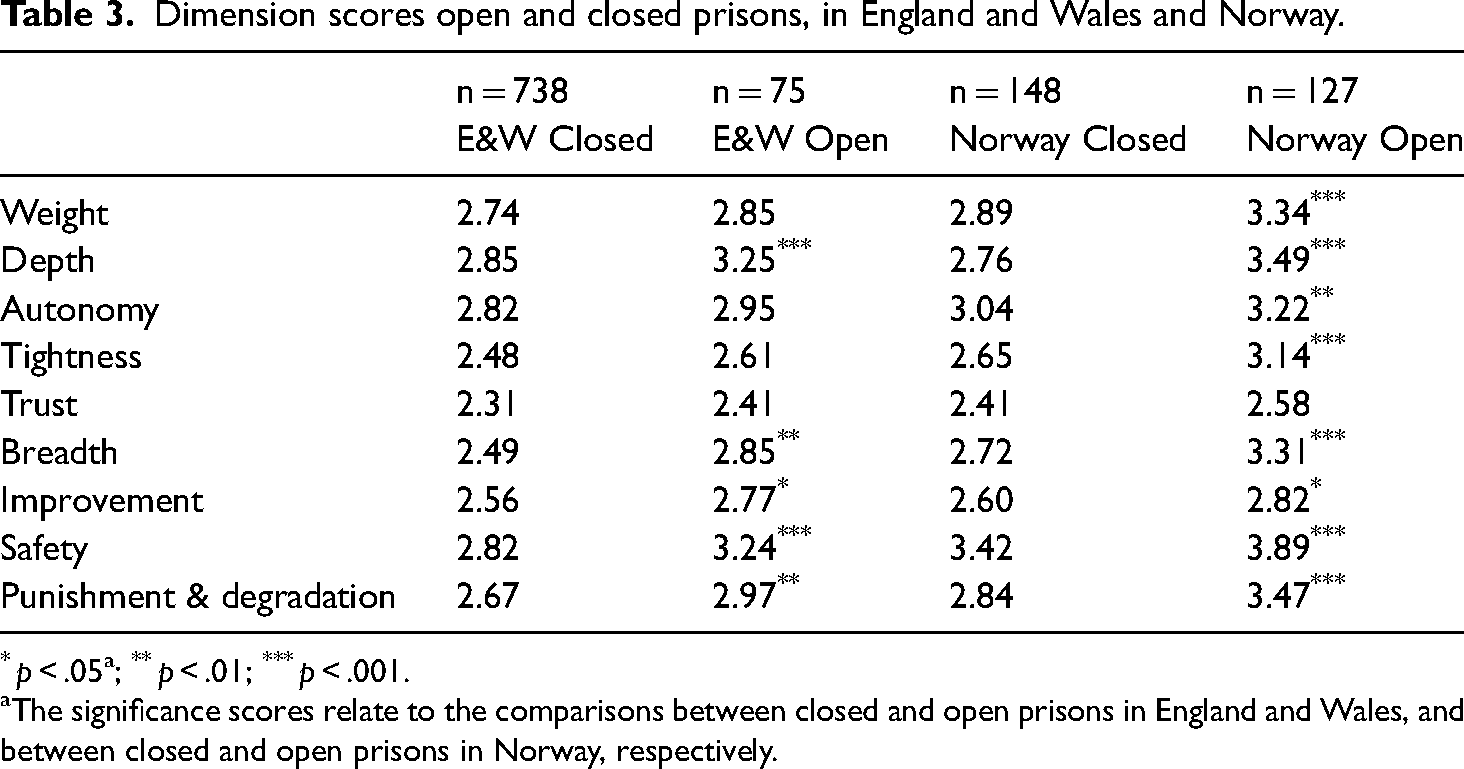
* p < .05a; ** p < .01; *** p < .001.
aThe significance scores relate to the comparisons between closed and open prisons in England and Wales, and between closed and open prisons in Norway, respectively.
The second part of the survey comprised a list of 45 problem statements, inspired by Richards (1978) study on the experience of long-term imprisonment, and later adaptations of the instrument (Hulley et al., 2016). These items, informed by previous research and qualitative studies, aim to measure the most pressing problems and frustrations of imprisonment. More specifically, prisoners were asked to specify how often they experienced each problem and how easy or difficult they found it to deal with each problem. As described by Crewe et al. (2017: 1362), a ‘severity’ score was then calculated for each problem by multiplying the scores for these two measures (‘frequency’ and ‘solubility’). Furthermore, following the same process as for the ‘conceptual’ part of our survey described above, we constructed a set of dimensions (e.g. ‘Deprivation’, ‘Outside relationships’, ‘Mental and physical wellbeing’) which sought to highlight the underlying construct of this part of the survey. In the analysis which follows, we draw on both the ranking of the individual problem statements, and the mean severity scores for these dimensions.
Survey exercises took place towards the end of the qualitative fieldwork period in each establishment and prisoners were sampled randomly, within each relevant unit in each prison, to ensure even and representative coverage. 5 In most prisons, response rates were high. However, our aim was not to have the highest possible response rate in each of the prisons, but rather to ensure that we had sufficient responses from each section of the prisons included in our study.
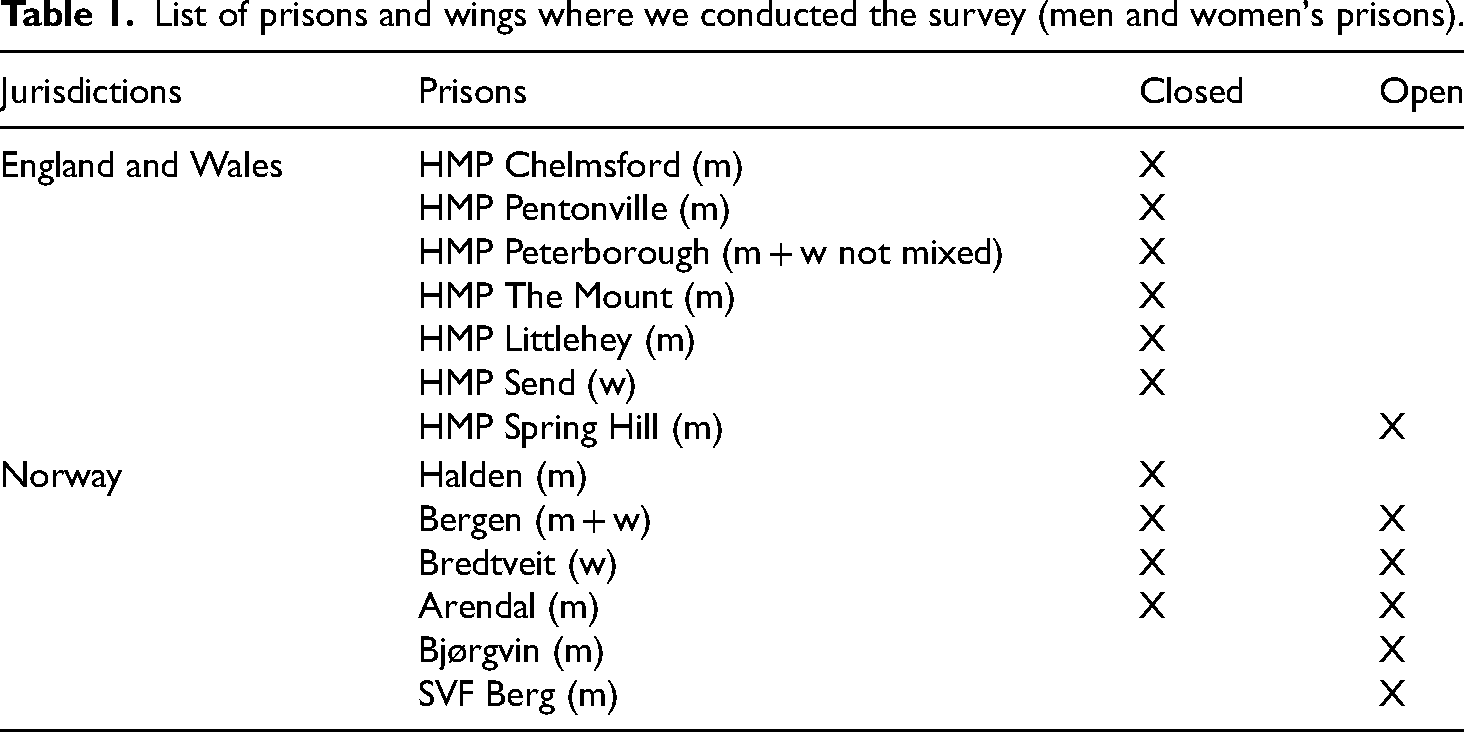
The selection of prisons to be included in the study was challenging. Our decision-making was shaped by our ambition to assess the typical experiences of particular prisoner groups. This meant that we did not try to include prisons of similar sizes, for instance, in the two countries, but rather to include prisons that were of a typical size, and had typical functions, within each jurisdiction. Because open prisons are used much more frequently in Norway than in England and Wales, it made sense to include more open prisons in Norway. We conducted the survey in seven prisons in England and Wales, and six in Norway. In England and Wales, this included six closed prisons (security levels B and C), and one open prison (security level D). In Norway, this included four high security prisons, of which three had open wings or units, and two open prisons. The open prison in England and Wales had a capacity of 335 prisoners and held men only. The two open prisons in Norway were also male facilities, with a capacity of 90 and 48 prisoners. One of the high security prisons in Norway was a women's prison with an open wing. One of the other high security prisons in Norway where we conducted the study had a mixed-gender open wing.
List of prisons and wings where we conducted the survey (men and women's prisons).
Findings
The findings of our study are presented in three sections. First, we offer a description of the role and function of open prisons in England and Wales and Norway based on legal guidelines and unpublished statistics provided to us from the prison services in the two countries. Secondly, we explore prisoners’ subjective experiences of imprisonment in open and closed prisons in the two jurisdictions, by drawing on the conceptual part of our survey. Finally, we document and compare the pains of imprisonment in open and closed prisons – distinguishing between types and severity of pains.
The role and function of open prisons in England and Wales and Norway
Open prisons play a much more significant role in the prison system in Norway than in England and Wales. However, they do share some similarities in both countries, such as serving a resettlement function, catering for prisoners on longer sentences who after having spent time in high-security prisons can serve the last part of their sentences in less restricted environments as a preparation for release. In both jurisdictions the rationale is that a more gradual progression towards freedom will ease the reintegration of prisoners into the community upon release (Ministry of Justice, 2020; White paper no. 37, 2007–2008). In both countries, prisoners held in open establishments may leave the prison during the day to work or study in the community. Eligibility criteria and selection processes are, however, somewhat different between the two countries. In England and Wales, prisoners need to undergo a risk assessment to be eligible for a transfer to an open prison, they need to present a low risk and show that they can be reasonably trusted in open conditions and be regarded as prisoners for whom open conditions are appropriate (Ministry of Justice, 2020: 5). Open prisons (Category D) can only admit prisoners who have a category D security rating and have less than two years left to serve. However, holding a category D security rating does not guarantee a transfer to open prison: prisoners who are ‘D’-classified may nonetheless be held in more secure conditions.
In Norway, prisoners in high security establishments can be transferred to open prisons after having served part of their sentence, unless ‘the purpose of the sentence or security reasons contraindicate this, or there is reason to assume that the inmates will evade execution of the sentence’ (The Execution of Sentences Act, § 15). It is not specified how long prisoners will have to serve in high security prisons before they are eligible for open prisons, but prisoners with more than five years left to serve before reaching 2/3 of their sentence will normally not be considered (White paper no. 12, 2014–2015: 14). Furthermore, the law mandates the prison service to consider transfer to open prison when a year remains until the prisoner can apply for early release (The Execution of Sentences Act, § 15).
While open prisons serve a resettlement-function in both jurisdictions, the main difference between the role of open prisons in the two countries concerns their status as entry-points. In England and Wales, all new prison entries are to closed local establishments, mostly at Category B security level. In Norway, on the other hand, open prisons are extensively used to hold men and women on shorter sentences: As a main rule, offenders with a sentence of two years or less will be directly placed in low-security prisons (White paper no. 12, 2014–2015: 14). 6 The justification is that ‘no one should serve under stricter conditions than necessary – the documented risks for harm caused by the deprivation of liberty should be reduced as much as possible’ (White paper no. 37, 2007–2008: 8). Norwegian prison sentences are relatively short compared to many other jurisdictions – of all released prisoners in 2018, 55% had served 90 days or less in prison (The Prison Service, 2019: 5). Thus, the majority of prisoners receiving an unconditional custodial sentence are eligible to serve in open prisons. Table 2 below summarises some of the key characteristics and differences in the role and uses of open prisons in England and Wales and Norway.
Summary of key characteristics of open prisons.a
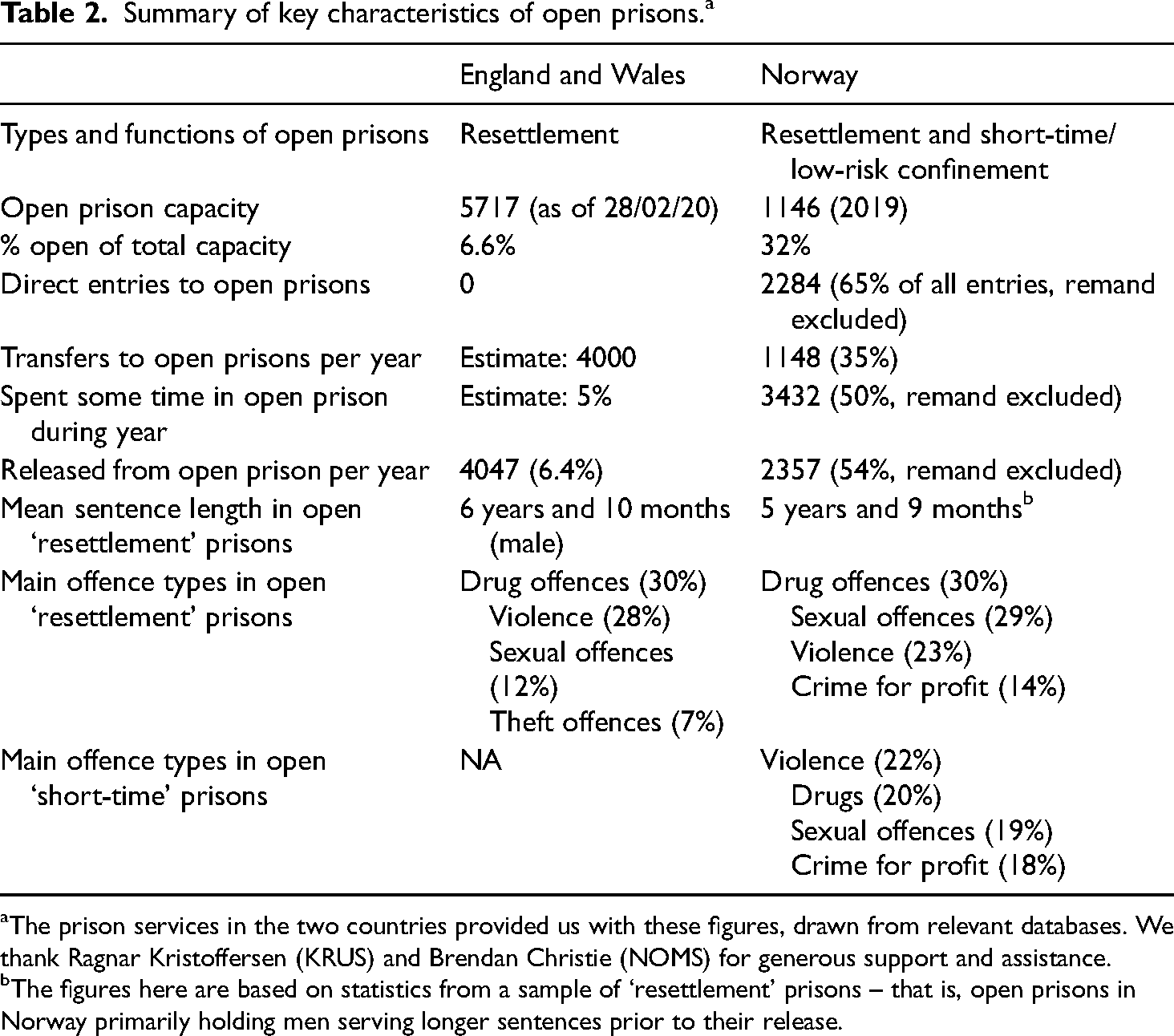
aThe prison services in the two countries provided us with these figures, drawn from relevant databases. We thank Ragnar Kristoffersen (KRUS) and Brendan Christie (NOMS) for generous support and assistance.
bThe figures here are based on statistics from a sample of ‘resettlement’ prisons - that is, open prisons in Norway primarily holding men serving longer sentences prior to their release.
The differences in the role and use of open prisons between England and Wales and Norway, as set out in Table 2, are stark. As the figures show, Norway's open prison capacity is 32%, compared to 6.5% in England and Wales. While no one is placed directly in open prisons in England and Wales, 65% of all entries in Norway are to open establishments. 7 The prisoners who are directly placed in Norwegian open prisons are predominantly prisoners who have received shorter sentences. While only an estimated 5% of the total prison population spent at least some time in open prisons in England and Wales in 2019, 50% of the sentenced prison population did so in Norway. This figure includes those who serve short sentences and those who serve the last part of longer sentences in the open ‘resettlement’ prisons. The advantages of being released from open prisons for resettlement reasons are stressed in policy documents in both countries. In England and Wales, a minority of releases (6.6%) were from open prisons, whereas in Norway, this occurred to the majority of released prisoners (54%). The table shows that the demographic profile of prisoners being held in open ‘resettlement’ prisons in England and Wales and Norway are roughly similar. In both countries they hold men and women on longer sentences, and these sentences are issued for the same kind of offences across jurisdictions.
The figures reported here not only show that Norway has more open facilities than England and Wales, but they also demonstrate the very different role and function these establishments have in the two prison systems. While the resettlement function of open prisons is fairly similar in the two systems – though the eligibility criteria are stricter in England and Wales – the key difference is that prisoners serving short sentences mainly do so in open prisons in Norway, and in closed prisons in England and Wales. As we will see shortly, this has significant implications for how prisoners experience their imprisonment, for the degree of harm inflicted on prisoners, and for how we should evaluate penal severity.
Comparing open and closed prisons – The experiential dimension
Having described the different use and function of open prisons in England and Wales and Norway, it remains to be explored how prisoners experience their imprisonment in open and closed prisons. Based on analysis of the conceptual part of our survey, the table below shows the mean dimension scores for open and closed prisons, in both jurisdictions, for nine out of our thirteen dimensions. 8 The data are coded so that a higher score is always better (i.e. a higher score for ‘weight’ means a less oppressive environment). A score of three is regarded as neutral, in the sense that it represents prisoners on average neither agreeing nor disagreeing with the set of statements that make up each factor (Table 3).
The results prompt three main comments: Firstly, the main conclusion is that in both countries all nine dimension scores are higher – and more positive – for those in open compared to closed prisons. Prisoners held in open prisons experience their imprisonment as less ‘heavy’, ‘deep’ and ‘tight’, they enjoy more autonomy and trust, they express less worry about life post-release (‘breadth’), they feel safer, they are slightly more positive about the help and services they receive (‘improvement’), and, finally, they experience their imprisonment as less punishing and degrading.
Secondly, although the direction is uniform, the scores are significantly higher for those held in open conditions for ‘only’ five of the dimensions in England and Wales (‘depth’, ‘breadth’, ‘improvement’, ‘safety’ and ‘punishment & degradation’). In Norway, the scores are significantly more positive for open prisons on all dimensions apart from ‘trust’. 9 Thus, in evaluative terms, the contrast between closed and open confinement is more pronounced in Norway. This contrast is mainly caused by the significantly more positive scores among those held in Norwegian open prisons, compared to those held in open prison in England and Wales. 10 In fact, the scores for those held in closed conditions are relatively and remarkably similar in both countries (with the scores on ‘safety’ as the clear exception), and the scores are actually more positive for closed Norwegian prisons compared to open prisons in England and Wales on four of the dimensions (though not statistically significant).
Lastly, the table also offers some indications on what it is that prisoners value the most about open prisons. In both countries, the dimensions with the highest scores among those held in open prisons are ‘safety’, ‘depth’ and ‘punishment & degradation’, which means that these prisons are experienced as less restrictive, safer, and less harmful. A few examples from individual items under these dimensions, expressed as percentage scores, may be instructive. Notably, around half of prisoners in closed prisons in England and Wales (56.9%) and Norway (46.1%) agreed or strongly agreed on the item ‘I am being held in conditions that are too restrictive’, compared to only 16% (E&W) and 18.1% (N) among those in open prisons. Similarly, 43.8% (E&W) and 56.5% (N) of prisoners in closed conditions agreed to the statement ‘The level of security and control in this prison is oppressive’, compared to 29.3% (E&W) and 18.1% (N) among those held in open prisons. In terms of safety, every fourth (27.1%) prisoner in closed conditions in England and Wales agreed or strongly agreed to the statement ‘Generally I fear for my physical safety’. A much smaller proportion (12%) agreed to the same statement among those in open prisons. Perhaps most tellingly, 42.2% of prisoners in closed Norwegian prisons agreed to the item ‘This prison is doing harm to me’, compared to 18.9% of prisoners in open establishments. It seems clear, then, that open prisons are capable of alleviating at least some of the pains of imprisonment. We will expand on this theme in the section below.
The pains of open prisons
Having established our main finding – prisoners held in open conditions rate their experiences more positively than those held in closed conditions in both countries – we now move on to a more detailed analysis of what kind of pains and problems prisoners report in open and closed prisons. As noted in the literature review above, a key theme in the qualitative studies on open prisons is that they produce a distinct set of pains (Abrahamsen, 2017; Maier, 2020; Neumann, 2012; Shammas, 2014). However insightful these studies are, they are based on case-study design and do not lend themselves easily to direct comparison. Exploiting the ‘problem & frustrations’ part of our survey, we therefore try to answer the following question: What are the pains of open confinement, and how do these pains compare to closed confinement?
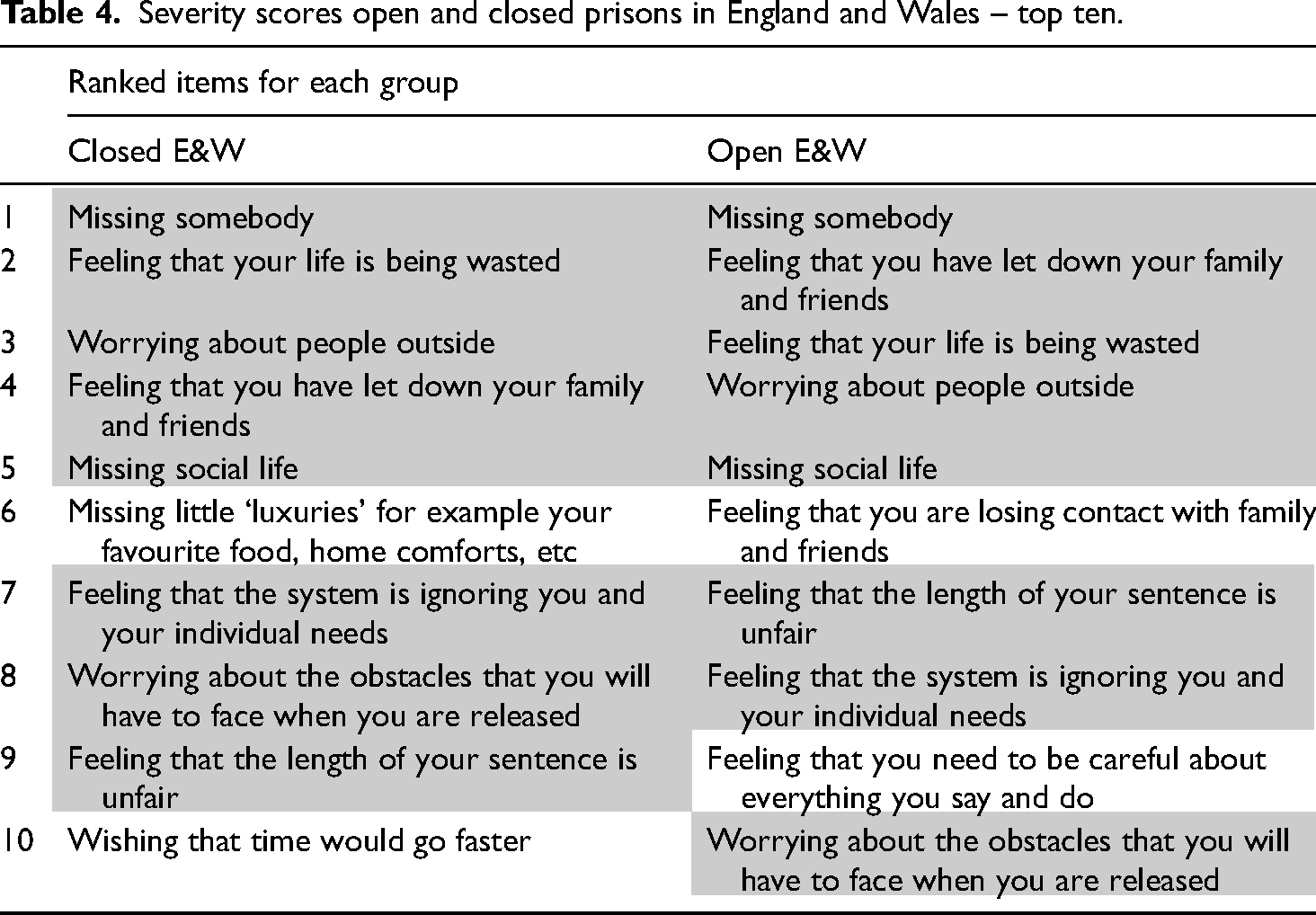
This part of the survey was designed to provide a measurement of what kinds of problems and frustrations prisoners find particularly painful, as well as how painful each of these problems are experienced. In the two tables below, we have listed the ten highest scoring problem statements for those held in closed and open prions in England and Wales (Table 4) and Norway (Table 5). Thus, the tables show what it is that prisoners held in closed and open prisons find particularly painful and frustrating. The problem statements which feature in both closed and open prisons are shaded in the tables.
Severity scores open and closed prisons in England and Wales – top ten.
Severity scores open and closed prisons in Norway – top ten.
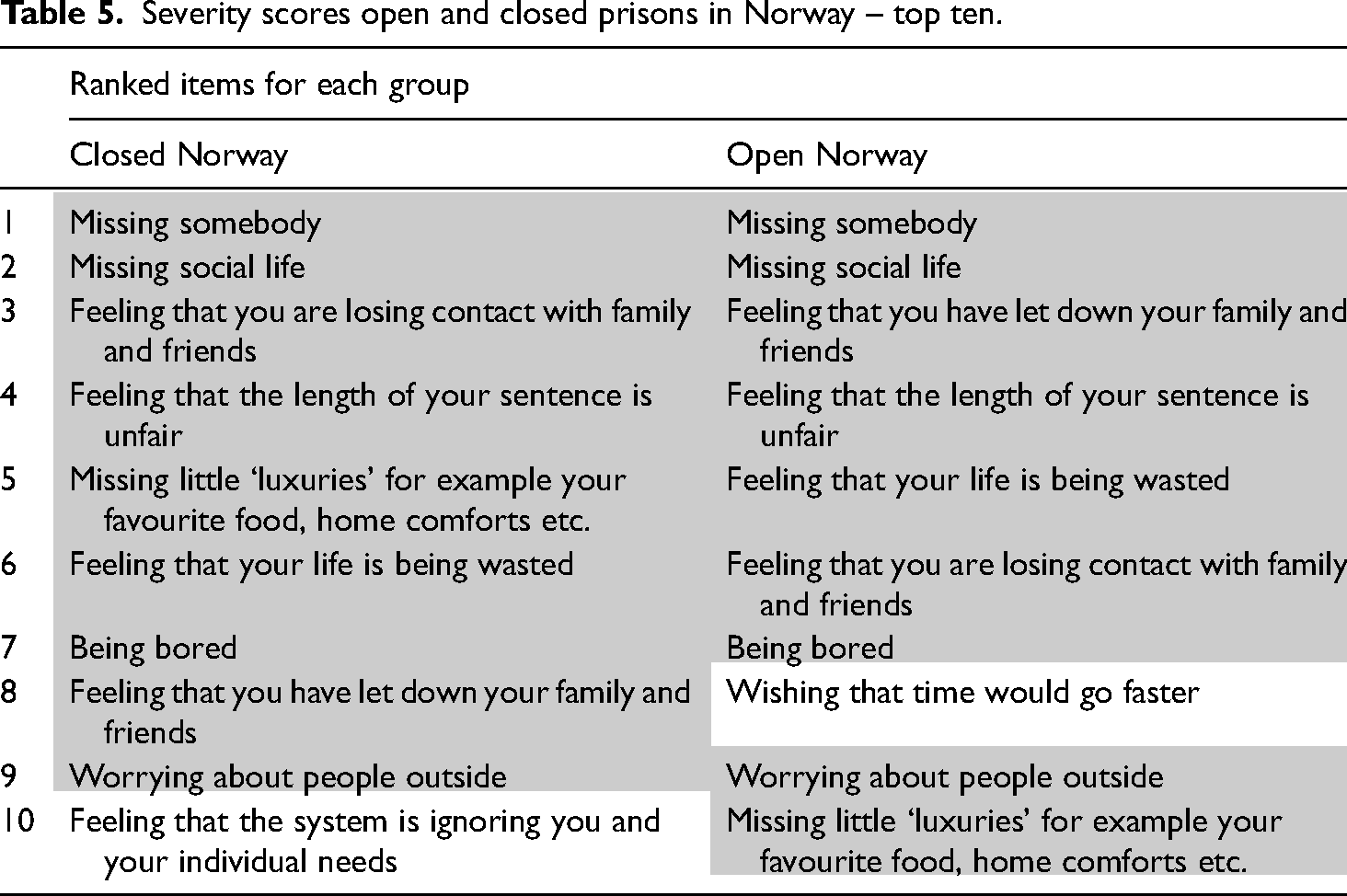
With remarkable consistency, the tables show that the most severe problems of imprisonment are almost identical in closed and open prisons. For England and Wales, the top five problems are the same in closed and open prisons (albeit with a slightly different ranking). The only items ranked high in closed prisons but not in open prisons are ‘Missing little ‘luxuries’’ and ‘Wishing that time would go faster’. And the only problem items ranked high in open prisons but not in closed prisons are ‘Feeling that you are losing contact with family and friends’ and ‘Feeling that you need to be careful about everything you say and do’. For Norway, nine out of the ten problem statements with the highest scores are similar among those being held in closed and open prisons (the exception is ‘Feeling that the system is ignoring you and your individual needs’ (missing from the list in open prisons) and ‘Wishing that time would go faster’ (missing from the list in closed prisons)). The most severe problems identified by our respondents, in both closed and open prisons in both countries, centre around the deprivation of contact and connection with the outside world (social life, family and friends), unfairness, meaninglessness and boredom, and guilt. Contrary to the qualitative literature that documents the specific pains experienced by prisoners in open prisons (Abrahamsen, 2017; Neumann, 2012; Shammas, 2014), these results suggest that the most pressing pains of imprisonment are similar in both closed and open establishments.
However, the fact that the most prominent problems are the same masks considerable differences in absolute severity scores between those held in closed and open prisons. In Figure 1 we show these differences, where the 45 problem statements are organised into nine thematic dimensions (and one stand-alone item ‘Thinking about the crime that you committed’). 11 Figure 1 demonstrates that the lines follow the same pattern, further strengthening our finding that prisoners experience the same kind of problems and frustrations in both closed and open prisons, and across the two countries in our sample. Problems related to ‘deprivation’ and ‘outside relationships’ are rated as significantly more severe than problems related to ‘mental and physical wellbeing’ and ‘social frustration’. The figure suggests that the pains of imprisonment have a certain generic pattern, largely unaffected by national context and type of prison (‘closed vs. open’): Problems such as ‘missing social life’, ‘missing somebody’ (‘deprivation’) and ‘worrying about people outside’, ‘feeling that you are losing contact with family and friends’ (‘outside relationships’) represent the most pressing pains, whereas issues such as ‘getting annoyed or irritated with other prisoners’, ‘not fitting in with other prisoners here’ (‘social frustrations’) and ‘feeling sorry for yourself’, ‘worrying about my physical health’ (‘mental and physical wellbeing’) represent pains that are less acute. Importantly, however, Figure 1 also demonstrates that the absolute severity scores for each of the dimensions are higher for those held in closed conditions. While imprisonment seems to produce similar kinds of problems and frustrations, they are perceived as less severe and more manageable among those in open prisons.
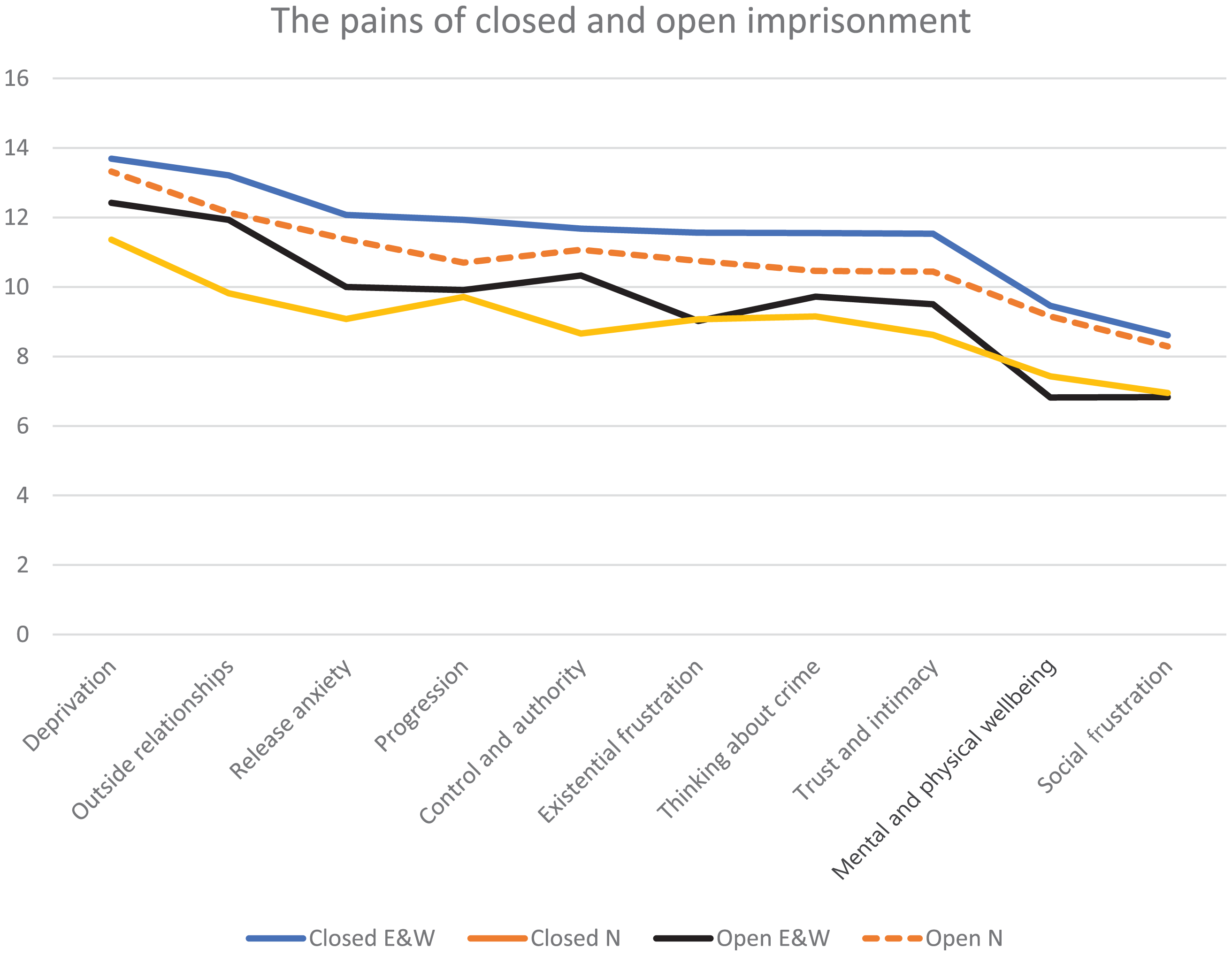
Severity scores for dimensions, plotted against open and closed prisons, in England and Wales and Norway.
Although the overall pattern is similar in the types of problems experienced by prisoners in closed and open prisons, there are some interesting differences. We explore these by identifying the individual problem statements where the differences in absolute severity scores are the greatest between open and closed prisons. In Tables 6 and 7 below, we have listed these problem statements in ranked order for England and Wales and Norway, respectively.
Absolute severity scores: Greatest difference between closed and open prisons: England and Wales.
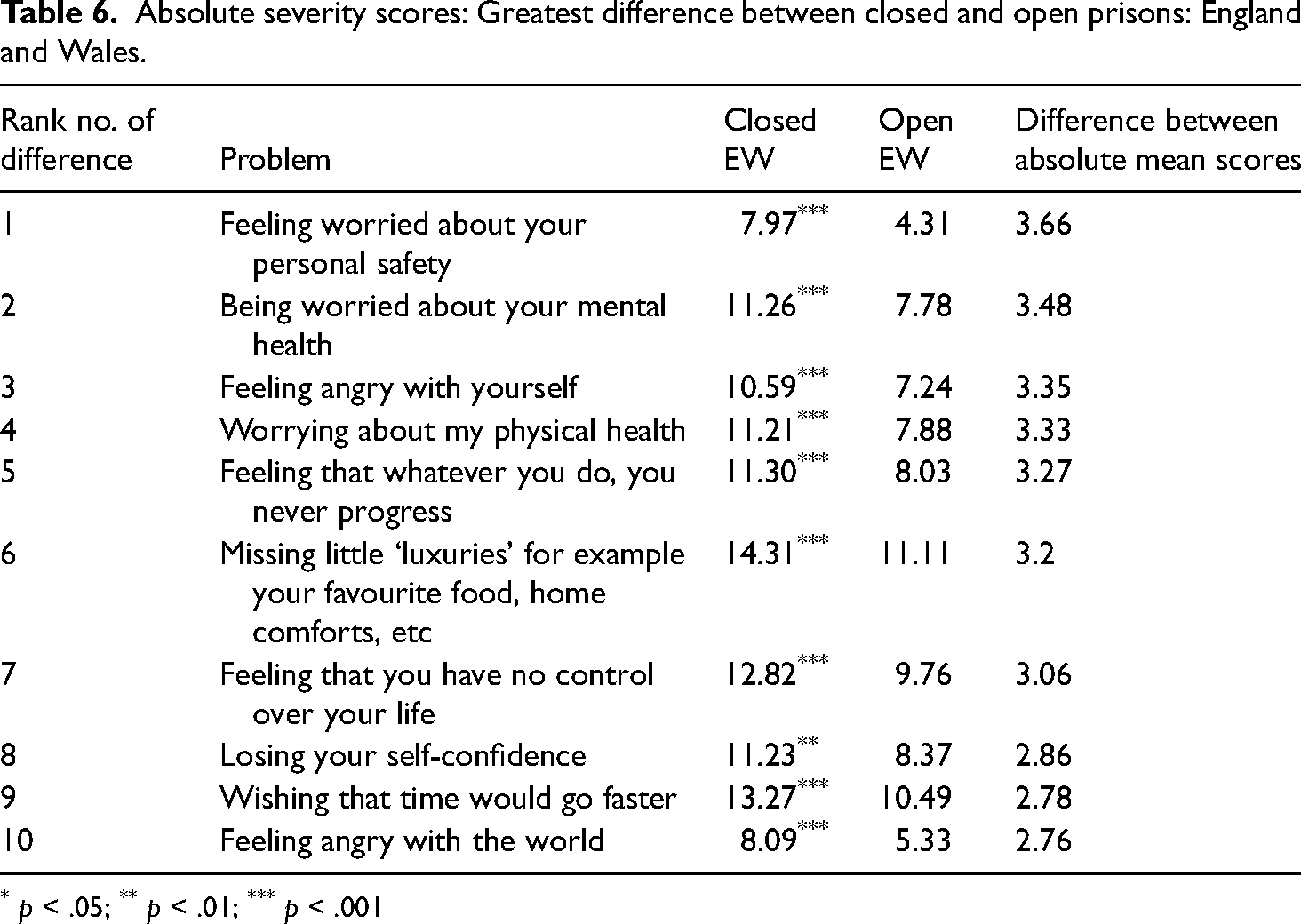
* p < .05; ** p < .01; *** p < .001
Absolute severity scores: Greatest difference between closed and open prisons: Norway.
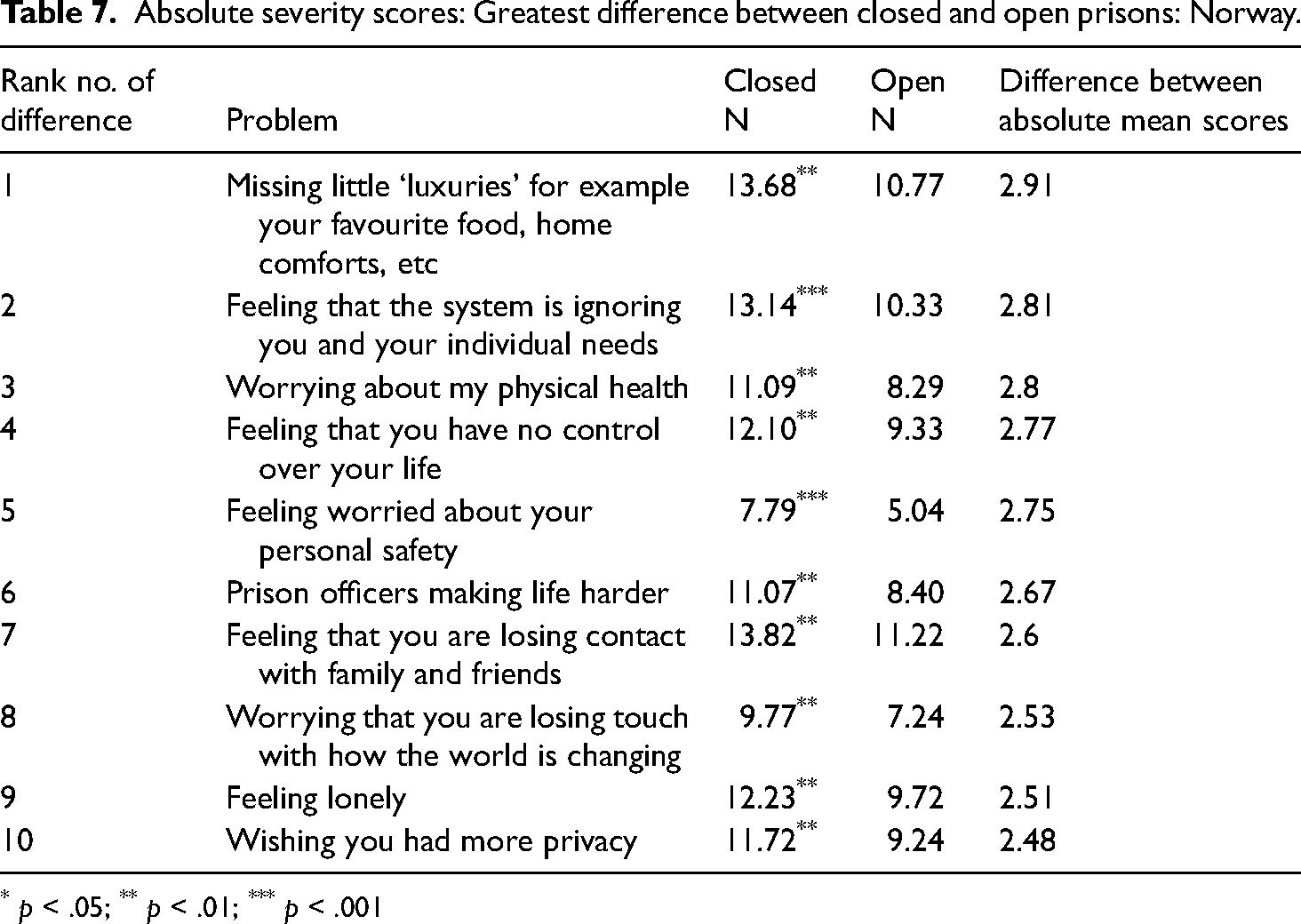
* p < .05; ** p < .01; *** p < .001
Organising the data this way allows us to identify some of the most significant differences between closed and open prisons, in terms of problem severity. In England and Wales, the areas where the differences in problem severity is greatest concern safety and wellbeing (items 1, 2, 4), resentment and anger (items 3, 8, 10) and control and progression (items 5, 7). In these areas those held in open prisons rate their experience as particularly less painful.
In Norway, the areas where the differences in problem severity is greatest concern material conditions and prisoner treatment (items 1, 2, 6), safety and well-being (items 3, 5) and control and isolation items (4, 7, 8, 9). In these areas, those held in open prisons rate their experience as significantly less painful than those in closed prisons.
The areas where the problem severity scores differ the most between open and closed prisons vary somewhat between England and Wales and Norway. But in both countries, issues such as safety, health and control are key ‘differential areas’. While prisoners in open prisons in both countries certainly worry about their health, safety, and lack of control, they do so to a significantly lesser degree than those in closed prisons.
Concluding discussion
To what degree do closed and open prisons share the ‘basic similarities’ that Sykes (1958) alluded to? Does Sykes' (1958: xxxi) observation that penal institutions differ in detail but are alike in ‘their fundamental processes’ hold up when comparing closed and open prisons? The findings presented in this article both support and challenge Sykes’ original claim. Our findings support the claim because they demonstrate that prisoners experience the same kinds of problems and frustrations in both prison categories. Furthermore, prisoners in both England and Wales and Norway are remarkably consistent when they rate what it is they find particularly painful about imprisonment. The deprivation of liberty, and the loss of contact with family and friends, is what hurts the most in both types of prisons and in both countries. This finding is slightly at odds with the qualitative research on open prisons, highlighting that open prisons produce a distinct set of pains, related to ambiguity, ambivalence and self-regulation (Abrahamsen, 2017; Maier, 2020; Neumann, 2012; Shammas, 2014). There is little in our survey data that supports the idea that open prisons produce a distinct set of pains.
However, the findings presented in this article also challenge Sykes’ claim. Our results show that open prisons are, on average, experienced as safer, less restrictive and less degrading institutions than closed prisons. Furthermore, while it is true that prisoners experience the same kinds of problems and frustrations in both types of prisons, those problems are, on average, experienced as significantly less severe and acute in the open prisons. The nature of these differences should not be considered as a matter of ‘detail’. As Liebling et al. (2011; see also Auty and Liebling, 2019) has argued, such differences in the evaluation of prison life are highly significant, and can, ultimately, make the difference between whether imprisonment is, or is not, survivable.
These results add flesh and nuance to our understanding of punishment in ‘social democratic’ and ‘neoliberal’ jurisdictions. According to Pratt (2008) and Pratt and Eriksson (2013), the extensive use of open prisons in the Nordic countries is one of the key indicators of their more humane approach to punishment. The results presented in this article validate this claim. In fact, considering the more positive experiences of imprisonment in open institutions, our study lends support to a slightly bolder claim than the one originally put forward by Pratt (2008): The extensive use of open prisons, and the harm reduction they produce, is the single most important contributor to Norway's more humane punishment practises. This claim is supported by the results demonstrating the significantly more positive experiences for open prisons in Norway compared to in England and Wales; as well as the significantly more positive experiences for open compared to closed prisons in Norway. Intriguingly, when we compare the experiences of prisoners held in closed prisons, the results are only marginally more positive in Norway than in England and Wales. 12 Hence, Norwegian ‘exceptionalism’, it could be argued, is mainly to be found in the size and quality of the open prison estate.
More generally, the findings presented in this article suggest that attending to type of imprisonment is important in comparisons of penal severity between countries and regions. At the most fundamental level, imprisonment concerns the deprivation of liberty (Sykes, 1958). Distinguishing between closed and open prisons therefore provides an avenue to explore how much liberty is taken away from captives by the state, and with what effects. Downes (1988), in his comparative study of penal policies and practises in England and Wales and The Netherlands, described the key contrast between the two countries in terms of their level of tolerance. Based on the results reported in this article, the key contrast between punishment practises in Norway and England and Wales is related to freedom. The Norwegian state, compared to England and Wales, is less active in depriving prisoners of their liberty. Not only is the imprisonment rate lower, and the sentences issued by the courts shorter, but more prisoners are also serving their sentences in prisons where less freedom is taken away.
Study limitations
This article has reported findings from a survey intended to measure the subjective experience and the most pressing problems and frustrations of imprisonment in closed and open prisons. While the survey was informed by in-depth qualitative fieldwork, it has some notable limitations. Firstly, it does not, in any straightforward way, measure outcomes directly related to rehabilitation, re-settlement or reconviction. It could be argued, then, that Shammas (2015a, 2015b: 9) observation that we ‘simply do not know whether open prisons ‘work’’, is still valid (but see Pettersson, 2017 on youth custody). That said, recent research has emphasised that prisons that are experienced as safe, decent, and supportive of change contribute to more positive post-release outcomes (Auty and Liebling, 2019). Secondly, our study involved one open prison in England and Wales, and two in Norway (though we did include open wings in three more prisons in Norway), and we do not know whether our sample of prisons are representative for the open prison estate overall. However, we have no reason to believe that the open prisons in our sample were particularly ill- or well-performing. Furthermore, the pattern was similar for all the open prisons and units included in our study, in both jurisdictions, suggesting that the more positive evaluations of open prisons are related to their status as less restrictive institutions. Thirdly, while we have argued above that prisoners in closed and open prisons experience the same kinds of problems and frustrations, our conclusion is not that this finding refutes the previous qualitative work documenting the ‘pains of freedom’ (Abrahamsen, 2017; Neumann, 2012; Shammas, 2014). Rather, in our view, these contrasting findings should encourage further research, as well as (methodological) debate. On the one hand, it is possible that our survey items were not specific and sensitive enough to capture the distinct frustrations of low-security imprisonment. If that is the case, we should be very careful to dismiss the qualitative work on how open prisons produce a distinct set of pains. On the other hand, it is also possible that our survey, despite its imperfections, is a relatively sound way of measuring what matters most to prisoners, including the most pressing pains of imprisonment. If this is the case, the implication is that although serving time in open prisons might involve frustrations relating to ambiguity, ambivalence and the pressure to self-govern, these frustrations are less severe and more manageable – they matter less, to put it bluntly – than the pains described in the sections above (e.g. ‘deprivations’, ‘outside relationships’, ‘release anxiety’). Finally, it could be argued that the more positive results in open prisons are mainly the result of selection processes, that is, that open prisons primarily admit prisoners who are more resourceful and compliant, and who have demonstrated ‘good-behavior’ prior to being transferred there. While we cannot rule this out, it is worth noting that approximately half of the Norwegian prison population spend at least some time in an open prison each year, indicating that open prisons, at least in Norway, are far from establishments for the selected few.
Policy implications
The study has several implications for penal policy. For those who are sympathetic to the ‘normality principle’, stating that the deprivation of liberty should be the only punishment inflicted on offenders while other rights remain intact (Fransen, 2017; Pratt, 2008), open prisons seem to have many advantages. Most notably, they seem to produce less pain. For those concerned with costs and resources, open prisons are considerably cheaper to fund: a placement in open prisons costs 37% less than a placement in closed prisons in Norway. For those concerned with rehabilitation, resettlement and reform, open prisons seem to be safer, more decent, and less degrading institutions, which is, it could be argued, both a good in its own right, and may make other positive outcomes more achievable. Finally, for those worrying that open prisons are, or will be considered by the public to be, too ‘soft’ or lenient, our study documents that despite the greater freedoms they offer, open prisons are still very much experienced as ‘prisons’. Prisoners held there experience the same kinds of problems and frustrations as in closed prisons. The main difference is that these pains are experienced as less acute.
The first open prisons developed in countries such as the US and England and Wales, jurisdictions which are now characterised as ‘neoliberal’ and ‘exclusionary’ in their approach to punishment (Cavadino and Dignan, 2006), and are struggling with overcrowding as a result of comparatively very high incarceration rates (Wacquant, 2009). One of the initial purposes and functions of open establishments was to deal with the increased demand to incarcerate a high number of low-risk prisoners after the Second World War. It remains to be seen whether the open prison will serve a similar function in the current era of overcrowding and mass-incarceration.
Footnotes
Acknowledgments
The authors would like to thank Ragnar Kristoffersen (KRUS) and Brendan Christie (HMPPS) for providing figures about the use of open prisons in Norway and England and Wales. Thanks also to Ben Crewe and Alice Ievins for their contributions to fieldwork and conceptual discussions. Borah Kant, Bjørnar Blaalid, Martha Morey and Ben Laws assisted the research team with parts of the fieldwork, for which we are grateful. We would also like to thank the two anonymous reviewers for encouraging and stimulating comments on the first draft of this article.
Declaration of conflicting interests
The author(s) declared no potential conflicts of interest with respect to the research, authorship, and/or publication of this article.
Funding
The author(s) disclosed receipt of the following financial support for the research, authorship, and/or publication of this article: This work was supported by the European Research Council (Consolidator grant number 648691).
