



Abstract
This article examines how life imprisonment was introduced, implemented and then ultimately abolished in Norway, with little controversy or debate, in 1981. We place this story of life imprisonment within the context of broader theoretical and empirical debates on Nordic penal exceptionalism and the abolition of life sentences, both nationally and internationally. The article is the first to engage theoretically with how two forms of exceptionalism can combine to obscure harsher policies and practices. Specifically, it highlights how praise for penal exceptionalism may align with a ‘global champion’ exceptionalism rooted in Norway's self-image as a stronghold of social democracy and welfare. In the broader context of punitive policy discussions across many Western jurisdictions, the abolition of life sentences without provoking tabloid hysteria stands out as a notable example of penal exceptionalism. Yet when analysed in the context of an evolving punitive geography, a more complex narrative emerges. Norway might have abolished formal life sentences, but its growing population of people serving indefinite post-conviction detention indicates that it now relies on a type of informal life imprisonment as its ultimate penalty.
Keywords
Introduction
In August 1981, a Norwegian newspaper reported on the retrial of a man convicted of murdering his wife using dynamite placed in her car. Two journalists claimed one of the jurors had fallen asleep during the trial. The retrial led the newspaper to ask whether the man, who had been sentenced to 15 years in prison, plus 10 years of ‘sikring’ (preventive safeguarding, a form of preventive detention imposed after imprisonment), might become ‘the last to receive a life sentence in this country’ (Haugesunds Avis, 1981: 1). Earlier the same year, the life sentence had been abolished without major controversy (Endringslov til straffeloven, 1981). However, it remained a possible sanction for cases tried before that date. The Supreme Court took on the case because the defence and the prosecution appealed both the verdict and the sentence. The defence sought a reduced sentence, while the prosecution argued for a life sentence. Ultimately, the Supreme Court rejected both parties’ appeals and found the journalists’ claims to be speculative (Rt-1981-961). Consequently, the original sentence stood: 15 years in prison, plus 10 years of ‘sikring’. 1 The convicted man did not become the last to receive a formal life sentence in Norway. The final life sentence was, then, imposed in 1977, on a man who had killed his wife by electrocuting her in the bathtub (Rt-1977-182).
This account appears a curious juxtaposition of two contrasting takes on crime and punishment in Norway. On the one hand, it is reminiscent of the macabre of Nordic noir. On the other, it seems to align with progressive and humanistic understandings of criminal justice in Nordic and Scandinavian countries. Indeed, the abolition of life imprisonment without major political debate or media hue-and-cry appears to fit neatly within the penal exceptionalism thesis (Pratt, 2008): that Nordic jurisdictions tend to punish less and more humanely compared to other parts of the world. Whilst not a central component of the exceptionalism thesis, Pratt (2008: 129) observed ‘comparatively little use’ was made of life sentences in the post-war period, and Pratt and Eriksson (2014: 186) mention briefly Norway's abolition of life sentences. However, the story of life imprisonment in Norway is more than a simple demonstration of penal exceptionalism. As the ongoing scholarly debate around the nature and extent of exceptionalism has revealed, matters become considerably more nuanced when examined closely (e.g. Smith and Ugelvik, 2017; Todd-Kvam, 2022; Ugelvik and Dullum, 2012).
The story of life imprisonment in Norway – how it was introduced, implemented and ultimately abolished, as well as its alternatives – has received surprisingly little scholarly attention. This article aims to address this lack of knowledge whilst positioning the story within the broader context of penal exceptionalism and the abolition of life imprisonment, both nationally and internationally. In so doing we argue that, whilst Norway might have abolished formal life sentences, its growing use of indefinite post-conviction detention indicates it has in fact opted to impose a type of informal life sentence as its ultimate penalty.
When analysing the abolition of life imprisonment in Norway, we aim to achieve two things. First, we want to add empirical knowledge about how and why this sanction was abolished there. Second, we aim to use this knowledge to further our understanding of Norway's penal culture more broadly. Specifically, our empirical assessment integrates socio-legal and documentary analysis of relevant historical legal and policy documents, official statistics and archived political and media debates. We thereby situate the process of abolishing formal life imprisonment – and the growth of an informal life sentence – within both a domestic and global framework.
Context: An international perspective on life imprisonment
Norway is by no means unique in abolishing formal life sentences. In their global study of life imprisonment, Van Zyl Smit and Appleton (2019) found that 33 jurisdictions did not have formal life or death sentences as their ultimate penal sanction, and 13 of them even specifically prohibit life imprisonment in their national constitutions. 2 Most European countries, however, impose life imprisonment with the possibility of release as their ultimate penalty. Moreover, in certain jurisdictions, the most severe form of life imprisonment – life imprisonment without the possibility of parole – can be imposed for certain serious crimes (e.g. Bulgaria, Malta, Poland, Turkey and the United Kingdom). Only a minority of European jurisdictions have, like Norway, opted to abolish formal life imprisonment. 3 However, the stories of abolition vary significantly.
Portugal, pioneering in its abolition of the death penalty in 1867, abolished life imprisonment as long ago as 1884, and its Constitution has prohibited life imprisonment and other forms of indefinite detention since 1911. Article 30(1) of the Portuguese Penal Code clearly states: ‘punishment which involves deprivation or restriction of liberty may not be for life, nor be of unlimited or indeterminate duration’. The maximum fixed-term sentence of imprisonment in Portugal is capped at 25 years, and exceptions for the indefinite detention of convicted persons with severe mental illness are tightly restricted and monitored. Portugal's rejection of life imprisonment is rooted in Enlightenment values and ideals, including ‘the dignity of the human being, equality before the law … humanity in punishment, and rejection of cruel, inhuman and degrading punishments’ (Pinto, 2016: 290). According to this perspective, everyone in prison should have the opportunity to demonstrate their rehabilitation and resocialisation in free society.
By contrast, Eastern European and former Soviet Union jurisdictions present a very different story of abolition. Following the Soviet Union's dissolution, countries in Eastern Europe and the Balkans were left with penal codes that allowed for the death penalty but without provisions for life imprisonment. European institutions focused on human rights, such as the Council of Europe, exerted pressure on them to abolish the death penalty. Consequently, some countries in the region introduced fixed-term prison sentences as their ultimate penal sanction and not life imprisonment (Van Zyl Smit and Appleton, 2016). Member states of the Council of Europe that do not have life sentences in their penal codes but instead impose fixed-term determinate sentences include Croatia, Bosnia and Herzegovina, Andorra, Montenegro, San Marino, and the Vatican City, though the maximum terms of imprisonment vary, as set out in Figure 1. The largest of these jurisdictions is Portugal, with roughly 10 million inhabitants, and the smallest is the Vatican City, with roughly 500. 4 In addition, three jurisdictions in Europe have, at time of writing, yet to impose a life sentence, despite having the provision for imposing life imprisonment on their statute books (Iceland, Liechtenstein and Monaco) (Van Zyl Smit and Appleton, 2019).
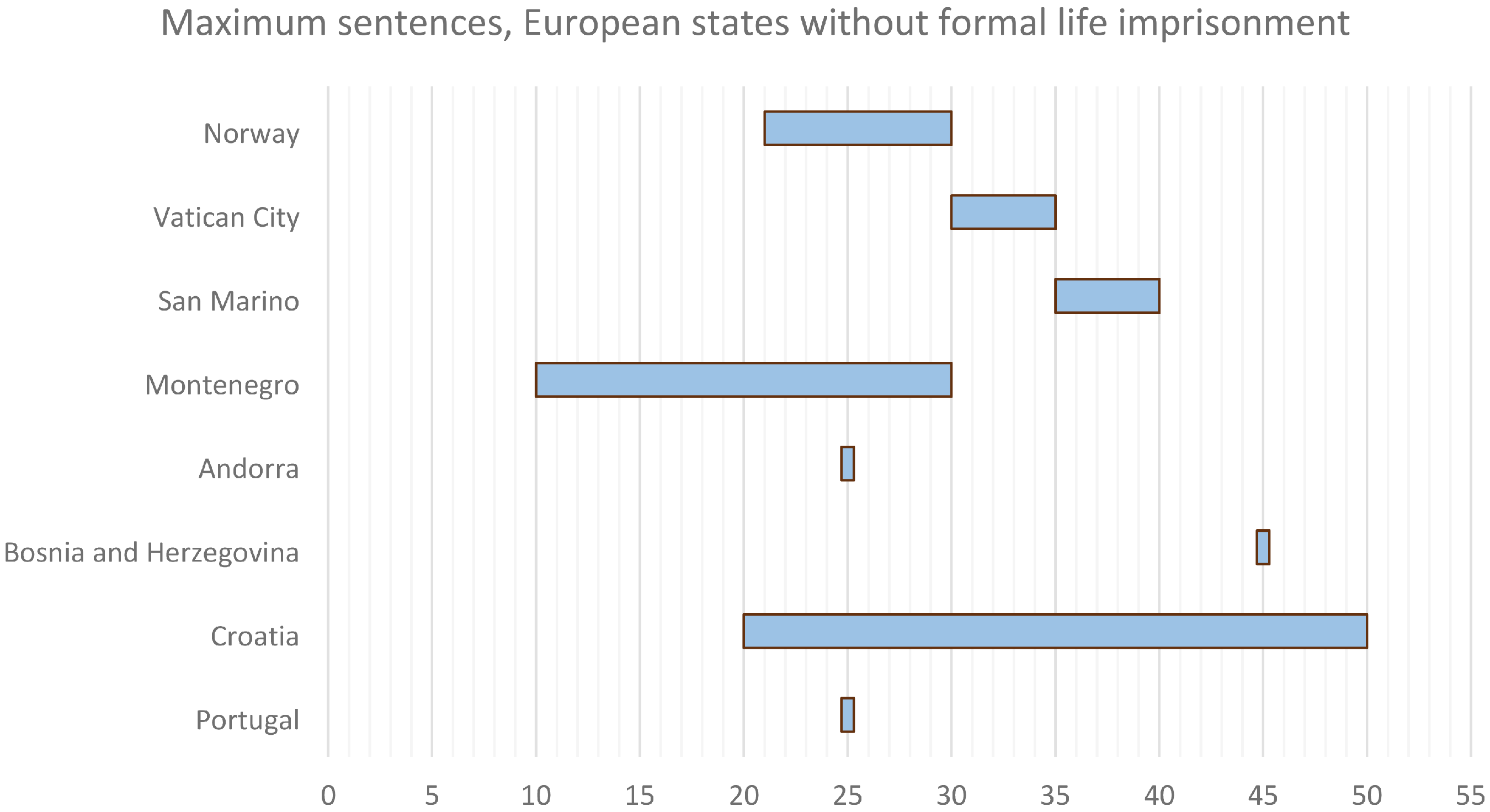
Maximum sentences in European jurisdictions without formal life sentences.
Outside of Europe, several countries, including Brazil, Bolivia, Cape Verde, Colombia, Costa Rica, East Timor, El Salvador, Mozambique, Nicaragua, São Tomé and Príncipe, and Venezuela, have, like Portugal, constitutional prohibitions against the imposition of formal life imprisonment. 5 Instead, for the most serious crimes, these nations have lengthy determinate sentences, spanning from 25 to 75 years. While the state of Alaska in the United States is the only state with no formal life imprisonment, a sentence of 99 years – a de facto life sentence – can be imposed for certain serious crimes. Furthermore, in Mexico, the federal system and all but five of the 31 individual states do not impose life imprisonment as a formal punishment (Van Zyl Smit and Appleton, 2019). 6
Of significance, at the International Criminal Court (ICC), there is a growing scepticism about the acceptability of life sentences and the extent to which they can be implemented fairly. Although the Rome Statute of the ICC provides for life imprisonment with the possibility of release being considered after 25 years as its ultimate penalty, the Court has hitherto never imposed life imprisonment. Indeed, it has expressed considerable scepticism about the imposition of life imprisonment for persons convicted of the serious atrocity crimes that fall within its jurisdiction (Van Zyl Smit, 2024). In a similar vein, the abolition of life imprisonment has sparked a debate at the highest level of the European Court of Human Rights regarding the compatibility of life imprisonment with Article 3 of the European Convention on Human Rights (ECHR). In the case of Öcalan v. Turkey (no. 2) in 2014, for example, Judge Pinto de Albuquerque concurred with the majority in striking down a sentence of life imprisonment without parole (LWOP). However, he dissented in part, casting doubt on the compatibility of all life sentences with ECHR principles, and with international law generally. He argued life imprisonment had worked historically, ‘as a privileged instrument of abuse of civil liberties’ (para. 7) and that life sentences were ‘an unrestrained, unnecessary and disproportionate State reaction to crime’ (para. 9). Moreover, he contended that the principle of resocialisation necessitates ‘a categorical rule against life imprisonment’ (para. 10).
In a later opinion Judge Pinto de Albuquerque argued, similarly, that life imprisonment ‘destroys any prospect of social reintegration’ (Khamtokhu and Aksenchik v. Russia, 2017: para. 27). He also asserted ‘the emergence of an international trend’ (para. 32) in favour of abolishing life imprisonment, although global trends on life imprisonment show little empirical support for this claim. Indeed, an estimated half a million people serve formal life sentences worldwide, and an unknown number in prison under de facto or indefinite preventive detention sentences, which, although not referred to as a life sentence, can result in imprisonment until death (Van Zyl Smit and Appleton, 2019). Furthermore, in his 2014 dissent, Judge Pinto de Albuquerque specifically addressed the issue of abolishing life imprisonment in Norway, arguing in fact that Norway ‘cannot be counted’ among the countries that have abolished life sentences ( Öcalan v. Turkey (no. 2) ). This might seem surprising given that we have just stated that formal life sentences were abolished over 40 years ago. But as Judge Pinto de Albuquerque explained, whilst formal life imprisonment has been abolished, certain persons considered to be dangerous can be sentenced to indefinite preventive detention, a type of informal life sentence, that can be prolonged by up to 5 years at a time for as long as the person is still considered to be dangerous, which may be for the remainder of a person's life. This article therefore addresses both the abolition of formal life sentences and what has happened since, positioning our theoretical framework within the context of abolitionism and exceptionalism.
Theoretical foundations: From abolitionism to exceptionalism
Given that we are discussing the issue of abolition, we will first discuss the abolitionist tradition in Norway, which was arguably enjoying its high-water mark at the time formal life sentences were abolished.
7
We will then move to address more recent theoretical developments on penal exceptionalism, not least since the relationship between abolitionist research and penal exceptionalism verges on paradoxical. Commendable elements of Norwegian penal policy and practices identified by John Pratt and colleagues (Pratt, 2008; e.g. Pratt and Eriksson, 2014) flowed in part from the activism and policy lobbying of abolitionist scholars (e.g. Christie, 1981; Mathiesen, 1974). Indeed, abolitionists were, at the same time as the exceptionalism thesis was emerging, highlighting successes achieved in the 1970s, including the abolition of youth prisons and borstals, the abolition of forced labour and reductions in the use of indefinite preventive safeguarding (Mathiesen, 2008; Papendorf, 2006). However, some of the strongest criticisms of the penal exceptionalism thesis were made by abolitionist scholars, including Mathiesen (2012), who argued that pre-trial detention and isolation, suicides in prison, unlawful sharing of data on persons in prison and long sentences for drug crimes were aspects of the Norwegian system that contradicted the exceptionalism thesis. When we add to this Mathiesen's contemporaneous critiques, made at the time when life imprisonment was in the process of being abolished, the picture becomes even more complicated: Life imprisonment is proposed to be abolished, so that isolation [solitary confinement] as punishment for life-sentenced prisoners can also be eliminated: those life-term prisoners who are currently sentenced to isolation as punishment if they commit offences within the walls, with this change, could be sentenced to additional prison time instead. However, this reform will naturally concern a very small number, and what is harshest between isolation-punishment and additional prison time is indeed an open question. (Mathiesen, 1978) The proposal is to abolish life imprisonment, in line with the White Paper on Crime, along with isolation as a possible additional punishment for life-sentenced individuals. However, it is evident from the report itself how limited in scope these proposals are. (Mathiesen, 1980: 134)
As these excerpts demonstrate, abolitionists did not actively seek credit for this particular abolition, nor did they particularly praise it. Their main interest was in the impact of abolition on the use of solitary confinement as a disciplinary measure used on those serving life sentences.
In terms of contemporary theorising about Norwegian/Nordic penality, such work has almost universally been seen through the lens of penal exceptionalism (Pratt, 2008; Pratt and Eriksson, 2014). Brangan (2020) though cautions that this lens may distort, because its point of reference is the Anglosphere, and therefore exceptionalism ultimately serves Anglocentric concerns regarding punitiveness. As Robert Cox (1981: 128) argues: ‘Theory is always for someone and for some purpose’. Crewe et al. (2022: 440), whilst concluding that ‘the typical experience of imprisonment is more humane and less damaging in Norway than in England & Wales’, affirm that exceptionalism is perhaps best suited for making relative rather than absolute claims about Nordic penality.
In addition to these more principled discussions about who exceptionalism is for and whose purpose it serves, the exceptionalism debate has produced important findings on the structures and experiences of punishment in Norway and the Nordics. Whilst we agree with the exceptionalist argument that Norway retains penal-welfare ambitions regarding humane and rehabilitative approaches (see Todd-Kvam, 2022), a body of research challenges aspects of the exceptionalism thesis, addressing issues including pre-trial detention (e.g. Smith, 2012), use of isolation (e.g. Reiter et al., 2018), the treatment of non-citizens (e.g. Todd-Kvam, 2018; Ugelvik and Damsa, 2017), debt as a barrier to resettlement and reintegration (e.g. Gålnander, 2023; Todd-Kvam, 2019), and a decreasing capacity to deliver opportunities for rehabilitation and resettlement (e.g. Anderson and Gröning, 2017, Koffeld-Hamidane et al., 2024). At a more overarching level, Victor Shammas (2016a, 2018) has argued that an increasing emphasis on law and order means that exceptionalism is attenuating, whilst also cautioning that the technocratic impulses of penal elitism undermine democratic engagement with policymaking (Shammas, 2016b, 2020). Vanessa Barker (2012: 11) meanwhile has shed light on the penal-welfare state's Janus-faced nature, in that individual freedom is constructed through the state, and that therefore: The State maintains ultimate power and authority to determine the public good and decides under what conditions the public good can override individual rights. As Arnáson (2008: 155) describes the Nordic model: ‘it can be described as a strong social democratic state, based on the idea of a sovereign parliament with little or no limitation of its power’.
Bernt (2016: 80–81) enters a similar terrain with respect to Norway, albeit emphasising the role of the executive, rather than parliament: [T]he civil service in many areas act as autonomous legislators who produce the largest part of our regulatory material by virtue of fairly broad mandates from the Norwegian Parliament, with limited political oversight, minimal general political control, and to some extent also inadequate legal quality assurance.
These observations take on increased salience when we introduce a second conceptualisation of exceptionalism, which is a more immanent account of Nordic identity – an exceptionalism bound up in ‘a national imaginary of Norway as a global champion of democracy and social welfare’ (Eriksen and Stein, 2022: 210; see also Browning, 2007; Loftsdóttir and Jensen, 2016). Returning to Brangan's (2020: 601) point, her concern that the optimistic perspective of exceptionalism, ‘may efface from view the pains of imprisonment and contribute to “national myth making” (Franke, 1990: 81)', seems particularly relevant when praise for penal exceptionalism aligns with ‘global champion’ identity narratives. The abolition of formal life sentences would appear, based on these theoretical observations, to rest comfortably in the middle of a Venn diagram of Nordic penal and Nordic identity exceptionalism. This convergence of exceptionalism presents two key risks: the possibility of blind spots where the penal system falls short of Norway's exceptional reputation and identity and the potential pressure to performatively emphasise progressiveness (Buchan and McNeill, 2023) in order to maintain the narrative.
Methods: Studying policy change
Policymaking is inherently political, with understandings of penal policy discussed in terms of political systems (e.g. Tonry, 2007), political cultures (e.g. Brangan, 2021; Green, 2009; Hamilton, 2013) and political economies (e.g. Cavadino and Dignan, 2006; Lacey, 2008). All these overlapping concepts can help us understand both the ‘how’ and the ‘what’ of penal policy. Penal policy can help us understand the political too. The penal and the political are in both ontological and epistemological dialogue. When discussing penal policy, actors in the penal field (Page, 2013; see also Todd-Kvam, 2023) make identity constructions – policies are argued for on the basis of identity representations, but in doing so these identities are reinforced and reintroduced (Campbell, 1998; Todd-Kvam, 2018). We are therefore interested in identifying both the logic of abolishing life and how policy actors frame themselves when debating abolition. This chimes with Annison's (2022) thinking on storylines, in that we are taking an interest in the stories actors tell about themselves.
The sources we employ in our analysis are set out in the table below. These sources were all in Norwegian, and the material presented below contains our own translation.
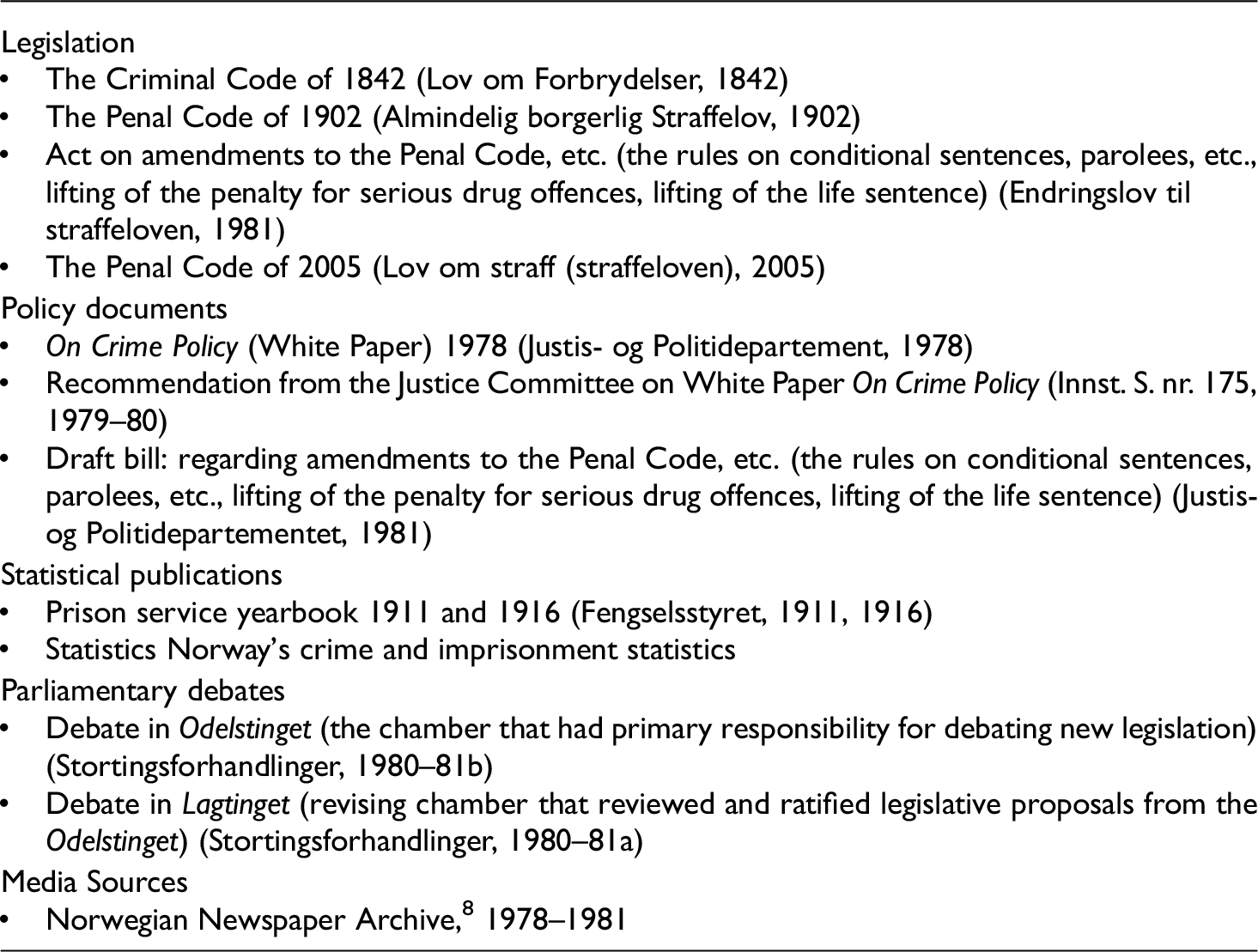
Analysis
The ‘modern’ life sentence
Whilst formal life imprisonment in Norway was originally introduced in the Criminal Code of 1842,
9
it was the Penal Code of 1902 that formed the legislative bedrock of Norwegian penality for much of the 20th century. The late 1800s had witnessed significant penal policy developments, including the introduction of a new Code of Criminal Procedure, a new military Penal Code, the Act on Vagrancy, Begging, and Drunkenness and the Act on Counteracting Venereal Disease and Public Indecency (Hagerup, 1901: 3). A contemporary account noted the Code's proposals: ...attracted a lot of attention far beyond our country's borders, and the general consensus seems to be that it's a reform effort so grand in its design and so solid in its implementation that no contemporary equivalent from any other country can be identified. (Hagerup, 1901: 4; see also Andenæs et al., 1954)
In a similar vein, the American Series of Foreign Penal Codes heralded it as follows: ‘There is unanimous agreement among comparative criminal lawyers that the modern era of Criminal law began with the promulgation of the Norwegian Penal Code of May 22, 1902’ (quoted in Flaatten and Heivoll, 2014: 15). This is arguably the original ‘exceptionalist’ perspective on Norwegian penal practices.
Following the implementation of the 1902 Penal Code, life sentences became even more infrequent, largely reserved for grave crimes such as premeditated murder, with sentences typically equating to approximately 11 years of actual imprisonment (Justis- og Politidepartementet, 1981: 31–32). There are no official statistics on life sentences from that period, but two publications provide insight: between 1906–1910 and 1911–1915, only one life sentence was imposed in each 5-year period (Fengselsstyret, 1911, 1916). Furthermore, a 1956 article discussing people who commit murder indicates that between 1930 and 1954, only six out of 99 homicide convictions resulted in a life sentence (Christensen, 1956: 311–312). Historical data from 1955 to 1982 show 17 out of 560 (3%) homicide convictions led to life sentences (Dahl, 2021).
Post-World War II, there was a notable variety in the served duration of life sentences, from under 10 to over 20 years. The shorter durations included cases where foreign citizenship led to swift extraditions (N = 2) and where individuals were transferred to psychiatric facilities (N = 1). The two longest sentences were imposed for especially notorious crimes. Based on available information, it appears that average imprisonment ranged from 14 to 16 years, albeit with some uncertainty given the lack of official statistics. 10
Of the 17 individuals sentenced to life imprisonment between 1955 and 1982, 13 of them had an additional sikring (preventive safeguarding) provision (Appleton et al., forthcoming). This sanction could include both extra time in prison and supervision in the community, indicating that in certain cases, judges anticipated the eventual release of those sentenced to ‘life’. Judges included the supplementary sikring sanction when they assessed a high risk of reoffending, thus opening the possibility for prolonged imprisonment and post-release supervision.
An exceptional development or business as usual? How life sentences were abolished
The policy debate
The 1970s in Norway were arguably the high-water mark for abolitionist activism, with abolitionists themselves highlighting this period when reflecting on their work (e.g. Papendorf, 2006). In 1978, a White Paper published by the Ministry of Justice proposed a range of policy measures, including the key proposal to abolish life sentences (Justis- og Politidepartement, 1978). The White Paper (page 6) argued that Norwegian crime policy should aim to achieve three overall goals:
To prevent and limit criminality, To develop a penal system that is and appears to be just and which must be viewed as coherent with our humane and cultural traditions, and Which involves an appropriate and reasonable use of resources.
The White Paper emphasised that the term ‘life’ held no practical significance, given Norway's life sentence prisoners would invariably be released (there was no form of lifelong parole conditions). The White Paper concluded that life sentences should be abolished and ‘replaced with a fixed-term prison sentence’ (Justis- og Politidepartement, 1978). The Justice Committee of the Norwegian Parliament expressed agreement, noting, ‘…life imprisonment is somewhat of an outdated concept which, in practice, has no real substance’ (Innst. S. nr. 175, 1979–80: 45). Thomas Mathiesen (2020: 264) described the ensuing debate as ‘a valuable approach to new [penal] policies’. He praised its connection of crime to social reality, arguing that analysing penal policies through the lens of the sociology of law expanded and enriched the debate.
In 1981, draft legislation followed the White Paper's proposal to abolish life sentences in Norway. The introductory remarks argued abolition was motivated in part because the threat of life imprisonment was not real, and would be very inhumane if it was, in part because this form of punishment seems to involve elements of indeterminacy, [and] in part because new offences [in prison] can no longer be met with sanctions of any significance or deterrence. (Justis- og Politidepartementet, 1981)
11
The life sentence was to be replaced by a maximum prison sentence of up to 21 years, accompanied by specific guidelines regarding the practice of release on probation for those sentenced to more than 18 years in prison.
The debates surrounding the draft legislation primarily focused on other issues, particularly whether to impose a 15- or 21-year maximum sentence for certain drug offences. The Ministry of Justice representative did remark though, ‘I believe posterity will regard the abolition of life imprisonment as the most important change in the proposal that Odelstinget [a now-defunct chamber of the Norwegian parliament] is addressing today’ (Stortingsforhandlinger, 1980–1981b: 567). Despite this appeal to posterity, abolishing life imprisonment received so little (exceptionally little, even) attention in parliamentary debate; it is possible to reproduce all three of the remaining political statements here: The committee agrees that life imprisonment is an outdated form of punishment that should be replaced by a time-limited maximum sentence. Even if one cannot overlook that the term life imprisonment is known and signifies a particularly strict sanction, the committee agrees with the department's assessments that the abolition of life imprisonment is practical in terms of being able to increase the punishment if new crimes are committed during the sentence period. The abolition of life imprisonment is not intended to give a reduced sentence compared to the usual sentence length when the law's strictest punishment is applied. (Stortingsforhandlinger, 1980–1981b: 560)
This passage exemplifies Lappi-Seppälä’s (2007: 285) ‘pragmatic and nonmoralistic approach’, and shows the representative framing the abolition of life imprisonment as a rational decision, as ‘practical’ and arguing that, in effect, prison sentence lengths will not actually decrease (see also Lappi-Seppälä, 2016). It also helps explain why abolitionists in Norway were lukewarm about the abolition of life sentences, in that people would still be serving similar sentences in the same prisons. The Labour Party adopted a similar perspective. Finally, a few words about the abolition of life imprisonment. Several currently applicable rules in the Penal Code allow for the imposition of life imprisonment. These rules apply to many different offences, e.g. breaches of national security, serious forms of endangerment, and forms of bodily harm. Judicial practice in the post-war period has reserved life imprisonment for premeditated murder. As life imprisonment is now only an expression, it is right for it to be abolished. Instead, a maximum sentence of 21 years is proposed, which is a high maximum penalty. The Storting (Norwegian parliament) addressed some time ago the last remnants of the death penalty in our legislation. Abolishing life imprisonment is similarly a way of adapting our penal provisions to our wider governance system. Life imprisonment today only has symbolic significance, as in reality, no one serves a life sentence in our country. So that the fixed-term sentence of 21 years does not represent a stricter reaction than current practice, a special rule for release on probation for this group after 12 years is also proposed. The abolition of life imprisonment was one of the suggestions in the White Paper. The proposal was then, in the White Paper's recommendations, as it is today, supported by a unanimous justice committee. (Stortingsforhandlinger, 1980–1981b: 561)
Additional pragmatic arguments were presented, accompanied by a wider assessment of the abolition of life sentences aligning with the abolition of the death penalty, and Norway's ‘wider governance system’. In essence, this framing was again predominantly rationalistic but also included an element of broader identity-framing – harsh punishments like the death penalty and life imprisonment were framed as being incompatible with ‘our’ way of doing things. This speaks to a different conceptualisation of exceptionalism, that of a ‘national imaginary of Norway as a global champion of democracy and social welfare’ (Eriksen and Stein, 2022: 210; see also Browning, 2007; Loftsdóttir and Jensen, 2016). The final excerpt focuses primarily on release on probation from the determinate prison sentence that was to replace the life sentence. Life imprisonment is now proposed to be abolished and replaced with a 21-year prison sentence. There has always been a certain dread associated with life imprisonment, but there has also been the possibility of parole with life imprisonment. The new proposal for 21 years is not meant to reduce the punishment. There will now be an opportunity for parole after 12 years. However, this should not be understood as the actual sentence being 12 years, and that everyone sentenced to such punishment will be released after 12 years. As the committee has pointed out, parole must be granted after individual assessment. All cases must be carefully considered based on behaviour and conduct in general, and based on the conditions that the individual will encounter upon release. This also includes how he will affect the environment he enters, whether he might pose a danger to it, and how it will affect him. These considerations should be made when granting parole. (Stortingsforhandlinger, 1980–1981b: 566)
The brief reference to ‘danger’ here in the context of considering release on probation is noteworthy, as is the reiterated point that abolition was not intended to reduce the severity of punishment for individuals convicted of serious offences. Aside from these three comments, the debate primarily focused on the relative dangers of drug use, and whether certain drug-related offences should warrant what representatives referred to as the strongest possible punishment in Norway, a 21-year determinate sentence (see Lappi-Seppälä, 2016). After the draft bill successfully passed through Parliament, life imprisonment was no longer an available sanction in the Norwegian Penal Code. As of 29 July 1981, this legislation came into force and Norway had fully abolished formal life sentences (Endringslov til straffeloven, 1981).
The media reaction
The White Paper received significant media attention, with crime policy becoming an issue of public interest and debate where it had previously been a matter for bureaucrats and lawyers in the Ministry of Justice (Hammerlin, 2021). Initially, the White Paper faced substantial media criticism, with many concerned the proposed reforms would lead to an increase in crime (for an overview of some of early headlines, see Hirsch, 1979: 78). However, the media critique did not focus on the abolition of life sentences, instead targeting intentions to reduce the use of imprisonment, promote the use of mediation and community-based sanctions, raise the age of criminal responsibility from 14 to 15 and restrict access to imprisonment for individuals under 18 (for broader analysis of White Paper's reception, see Hammerlin, 2021: 59–146). It was believed by some commentators that shorter prison sentences would lead to an increase in criminal activity (one account of a public debate ran under the headline ‘White Paper pulled to pieces by experts’ – Aftenposten, 1979). However, many commentators welcomed the White Paper's ideas: This government report is incredibly interesting. It will no doubt raise a debate, but also perhaps some afterthought. Many have an interest in the problems tied to crime and punishment, and many feel they have a right to an opinion. The pendulum swings strongly to both sides on this subject. On one end, the archconservative will cry for harsher and longer punishment on anyone committing a crime, on the opposite side, KROM [Norwegian Association for Criminal Reform] (Mathiesen and others) will want to set all prisoners free. The report addresses the question of who we punish, what we punish and what kind of punishment we give. Some research has been done on this topic, but not enough to draw definite conclusions. (Langseth, 1979)
This analysis fits with Green's (2007) argument that in Norway there are ‘fewer incentives to politicize emotive, sensitive, and complex crime issues’ (albeit that this might not extend to groups easier to ‘other’ – see Sandbukt, 2023; Todd-Kvam, 2018). A prominent district prosecutor, Georg Riber-Mohn, and a prison director, Iver Huitfeldt, were interviewed in a national tabloid, expressing their view that life sentences should be abolished and replaced with determinate sentences (Hoff, 1978). This use of expert opinions aligns with technocratic understandings of the policy process in Norway (e.g. Shammas, 2016b, 2020; Todd-Kvam, 2023). Notably, no media headlines or reporting opposed abolition. These findings support Pratt's (2008: 135) observation that Norwegian media tend to focus on ‘objective rather than sensationalized crime knowledge’ (for a fuller discussion, see Green, 2012).
However, some aspects of the debate were less humane. A Supreme Court attorney expressed his opposition to the death penalty in principle and stated that he, ‘like the majority of Norwegians’ found it inhumane. Yet he believed that Norway should reintroduce the death penalty for ‘drug offenders’ (narkoforbryterne) (Seljesæter and Finne, 1981). Of significance, at the end of the same news article, it is mentioned in passing that life sentences have now been abolished and ‘replaced with 21 years’. It seems the attorney had no objections with life-sentence abolition, while simultaneously advocating for a measure far harsher than life imprisonment for non-violent offences. Doubtless, Norwegian penal policy has its own examples of cognitive dissonance.
The Norwegian tabloid Verdens Gang used their ‘Insight’ section to discuss the issue of life imprisonment shortly after its abolition. The column noted: ‘No debate was sparked in Parliament when it was proposed that life sentences be abolished (Ot.prp.nr.62, 1980–1981) […] it is better for all parties that the sentence be determinate’ (Verdens Gang, 1981), and that: A strong argument against longer imprisonment is consideration of the prisoner's opportunities to later be integrated into society. A so-called habilitation will be significantly more difficult if the prisoner, through the prison's isolation, is held ‘inside’ for years. Practice in this area varies from state to state, even in Western cultural environments. But there has been a clear tendency to give release on probation after a certain period, based on humanitarian principles. All experience shows that significantly prolonged institutional stays can have a lasting impact on the inmate's personality.
This newspaper column chimes with our earlier observation that abolition was met with minimal political debate. It avoids sensationalism and takes an almost pedagogical approach to explaining crime policy (albeit with a touch of Western exceptionalism). Indeed, this seems an advance of Tonry's (2007: 37) ‘expert-informed policy processes’ into expert-informed mass-media framing. This excerpt is a reasonable reflection of the tone of the media's response to the abolition of life sentences in Norway.
Overall, the abolition of life imprisonment was framed as both pragmatic and humane. There is, though, some tension between these logics, given that the pragmatic arguments were made on the basis that abolition would not, in practice, imply reduced time in prison. Whilst it would be a stretch to argue that the abolition was purely performative (c.f. Buchan and McNeill, 2023), we nonetheless wonder if abolition can be both business as usual in practice, and exceptionally humane?
Preventive detention and the rise of the informal life sentence in Norway
Both before and after the abolition of formal life sentences, Norway has retained a system of post-conviction indefinite detention, first under the label sikring (preventive safeguarding) and, since 2002, as forvaring (preventive detention). Post-conviction indefinite preventive detention may be imposed for serious crimes where a determinate sentence ‘is not considered sufficient to protect others’ lives, health, or freedom’ (Norwegian Penal Code, 2005: §40). As Figure 2 shows, the population serving such indefinite sentences has increased rapidly in recent years:
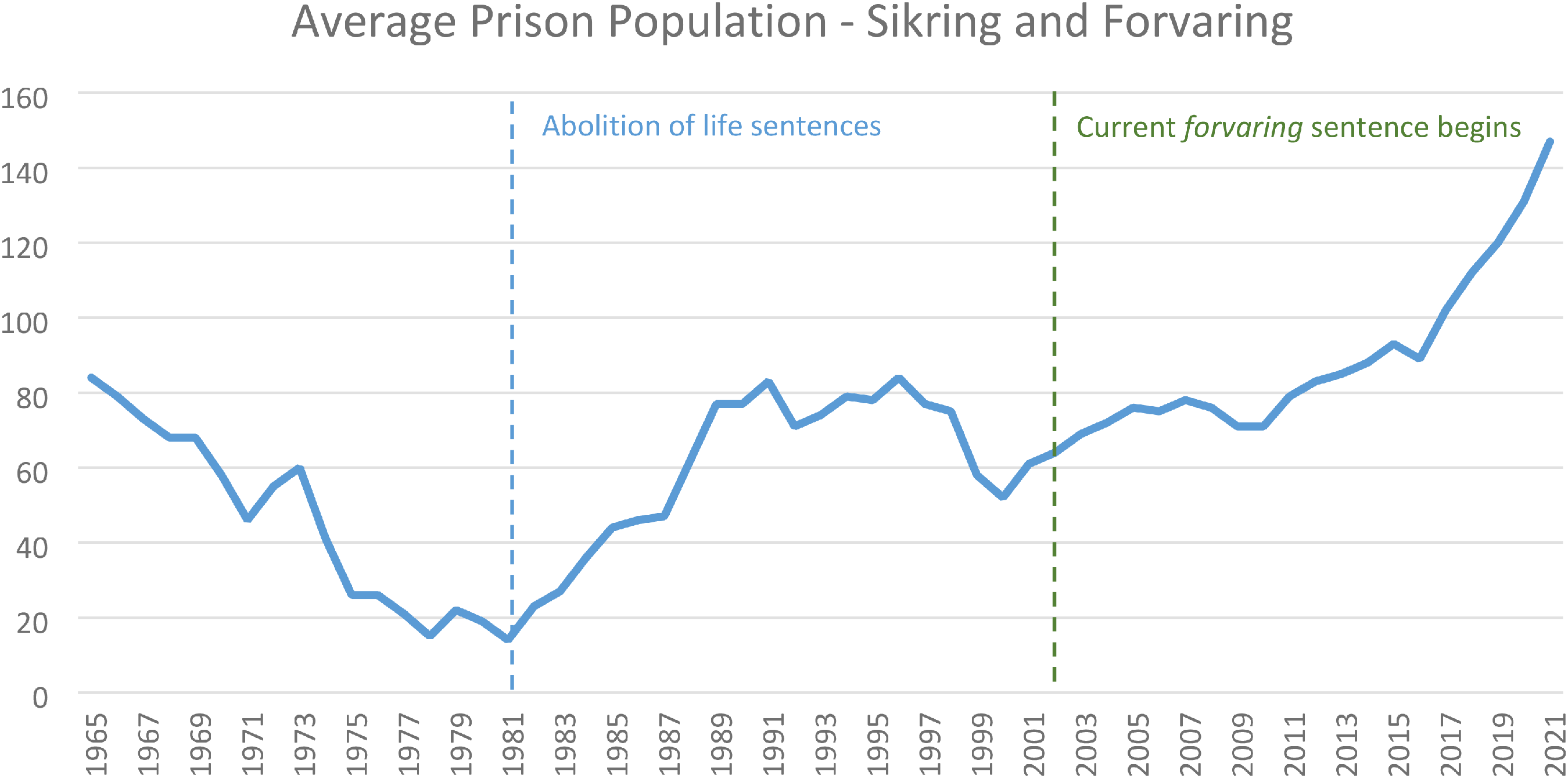
Average prison population on sikring (preventive safeguarding) and forvaring (preventive detention). Data sources: SSB 2005: 114 and Statistics Norway table 10562: Prison population, by type of imprisonment.
It is interesting that the abolitionist movement's zenith in Norway during the late 1970s occurred at a time when the number of prisoners serving indefinite sentences decreased to its lowest level. Indeed, the White Paper On Crime Policy incorrectly predicted that ‘The institution of preventive detention in its current form seems, under any circumstance, to be on its way out’ (Justis- og Politidepartement, 1978: 170). The White Paper, in reaching this prediction, described the ability to predict dangerousness as based on a ‘failing assumption’ (Justis- og Politidepartement, 1978). Whilst we cannot say for certain that indefinite punishment's weakened legitimacy in policy circles played a direct role in this drop, the potential link between practices of (de)legitimation and practices of sentencing would, we believe, be interesting for further research.
Turning to contemporary practice, the Norwegian Correctional Service describes the sentence of forvaring as follows: The purpose of forvaring is primarily to protect society from new serious criminal activity from the convicted person. Societal protection is to be ensured by the convicted person changing their behavior and being equipped for life outside of prison. This is the only type of punishment that is indefinite, but the court should still establish a [maximum] timeframe for the sentence. Usually, a minimum term is determined, and release cannot occur until the minimum term has been served. Release requires that there is no longer an imminent danger that the person will commit such a serious crime again. The person serving a custodial sentence can be reevaluated when the maximum timeframe expires. If the court concludes that the risk of reoffending is present, the timeframe can be extended for up to five years at a time.
At sentencing, the court delineates both a minimum period, marking the earliest eligibility for parole, and an upper timeframe, signalling the prosecution's deadline to request a court review should they see prolonged imprisonment as necessary. Typically, the upper timeframe should not surpass 15 years but can extend to 21 years or even up to 30 years for particularly serious crimes (Section 43 of the Norwegian Penal Code 2005). The minimum period should not go beyond 10 years but can be increased to 14 or 20 years if the upper timeframe is over 15 or 21 years, respectively (see Appleton et al., forthcoming).
As the excerpt above makes clear, a person sentenced to forvaring can theoretically be imprisoned for the rest of their life. We would agree with Judge Pinto de Albuquerque, therefore, and argue that Norway cannot be counted among true abolitionist countries but that it has, despite legislative abolition, crossed the line drawn in Van Zyl Smit and Appleton's (2019: xii) model from formal to informal life sentences (see Figure 3), which places life sentences on a spectrum between death sentences on the left and determinate sentences on the right. Above the mid-line are formal life sentences that are labelled as such in law: irreducible LWOP, LWOP, life with parole (LWP), and symbolic LWP (life sentences that are in practice commuted after a fixed period). Below the mid-line are informal life sentences: de facto life imprisonment (such as a 99-year sentence) and post-conviction indefinite preventive detention. Though labelled differently, all such sentences can ‘actually result in the persons being held in prison until they die there’ (Van Zyl Smit and Appleton, 2019: xi).
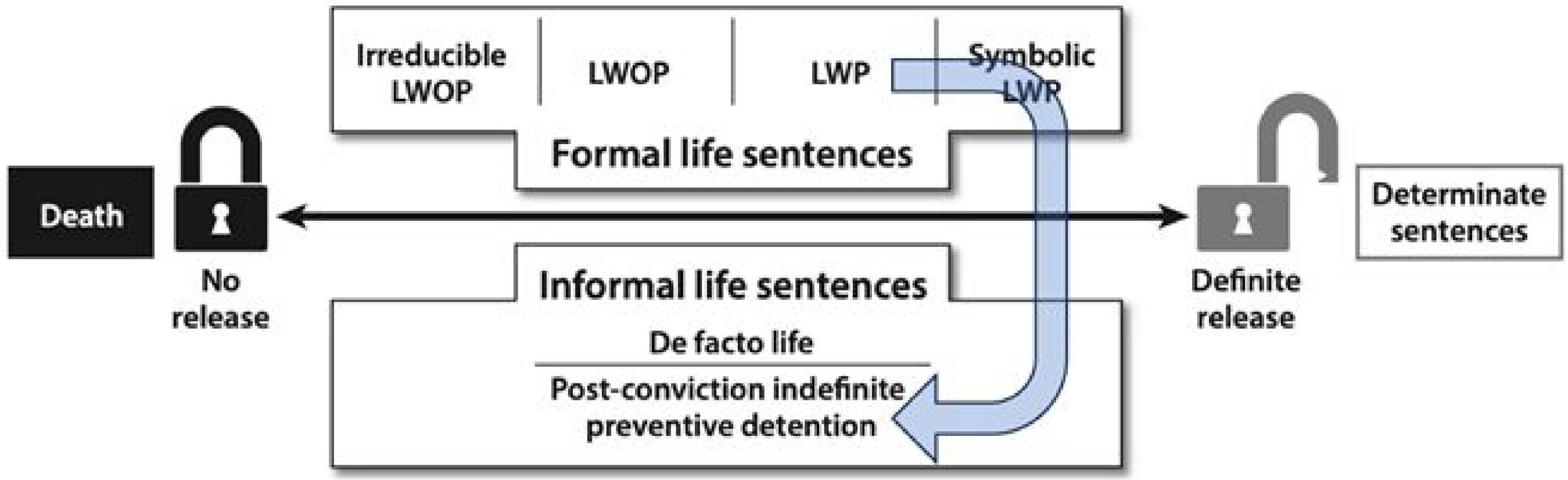
From life with parole to informal life.
Whilst the abolition of formal life sentences was a straightforward fit between the policy proposal at hand and identity constructions of Norway as humane and progressive, this comforting consonance is less obvious when the rationale for forvaring is considered. How is the punishment of indefinite preventive detention framed? According to national guidelines, the overarching purpose of forvaring is about controlling risk and is ‘to protect society against new serious crimes being committed’ (Forskrift om særreaksjonen forvaring, 2004: 21). Yet, the Norwegian Correctional Service describes the sentence's rehabilitative ambitions as follows: The aim of preventive detention is that the offender will change his or her behavior and adapt to a law-abiding life. The contents of a preventive detention sentence are designed with the offender's possibilities for development in this direction in mind and will as much as possible be adjusted to the individual's specific needs. It is based on cross-professional collaboration and wings for preventive detention that have access to more resources than general high security wings. (Kriminalomsorgen, 2012)
We can see here policy efforts to compensate for the preventive and indefinite nature of forvaring via a greater rhetorical emphasis on rehabilitation and assistance to change. However, this co-exists with the general acknowledgement, cited above, that the main aim of a forvaring sentence is to protect the public, and that it is a sentence that can last for the rest of the sentenced person's life (TOSLO-2015-107496-3, see also Johnsen and Storvik, 2020). The rise and renewal of this type of penalty in Norway aligns with Pratt's (2020: 2) recent analysis of the emergence of the so-called ‘security sanction … intended to protect the public from those who put their security at risk’ by reducing the risk of future crime, even if this means allowing for the possibility of lifelong imprisonment in a jurisdiction that has abolished formal life sentences.
Indefinite preventive detention's emphasis on public protection seems to align better with ideas from the ‘new penology’ (Feeley and Simon, 1992) than penal exceptionalism. That being said, Pratt (2008: 131) himself referred to Ila prison (where the majority of forvaring prisoners serve their sentences) when he observed the ‘unchallenged place of experts and the primacy given to collective interests above those of the individual’. When we combine this with comments regarding the lack of limitations to both parliamentary sovereignty and executive power from our theoretical discussions, we can see how, if a policy or practice is seen as serving society's general interest, its legitimacy becomes self-fulfilling and is unlikely to be contested. Penal policies and practices are not, in Norway, connected to society through political partisanship, making them unmediated (see Culpepper, 2014: on unmediated democracy). Whilst such a technocratic model of penal policymaking might appear advantageous in being less susceptible to punitive impulses and moral panics, Shammas (2016b, 2020) highlights how a combination of penal elitism and accompanying technocratic tendencies can erode meaningful democratic engagement. Technocratic biases weaken representative democracy by depoliticising certain issues (e.g. economic issues in European politics during the aftermath of the 2008 financial crisis; see Sánchez-Cuenca, 2017). Regarding technocratic modes of government, Centeno (1993: 313) identifies a key aspect as ‘faith in the applicability and superiority of professional and technological methodologies and paradigms’, which applies quite well to how forvaring's internal logic rests on the state's ability to change sentenced persons in order to protect society. Interestingly, the ‘technocratic imaginary’ has itself been described as ‘Janus-faced’, in that it can be seen as both a utopian ideal and a problematic, pathological concept (Gunnell, 1982). We can draw parallels here with proponents and critiques of exceptionalism (is Nordic penality utopian or pathological?) – and indeed a direct parallel with Barker's (2012) analysis of Janus-faced penal regimes. The technocratic aspect of the Norwegian penal culture helps then explain the ability to do ‘pragmatic’ things such as abolish formal life sentences. But it also explains the ability to implement more punitive approaches like indefinite preventive punishment when such measures are accepted as a consensus for the overall benefit of society.
Conclusion
In analysing the abolition of formal life sentences in Norway, we positioned the abolition process in a zone of tension between penal exceptionalism (which looks at Norway from an external, international perspective) and abolitionism (which has developed from within as a mainly internal, Norwegian perspective). Depending on one's perspective and level of analysis, the abolition of formal life sentences can be seen as fitting with the exceptionalism thesis or, as abolitionists argued at the time, a development with little practical meaning. In any case, it is interesting to note the rather ephemeral parliamentary debate on abolition, and that the policy change was framed in a way that combined – somewhat uncomfortably – pragmatic and more identity-based arguments. These identity-based arguments speak to a different form of exceptionalism: of Norway as a champion of democracy and social welfare. Whilst having such national self-imagery is likely to associate overall with progressive policy impulses, it may risk creating blind spots, too, whereby policies and practices that do not fit with this imaginary become more difficult to discuss and critique.
The media reaction was perhaps the most exceptional element of the abolition process, with broadsheet and tabloid newspapers alike taking a sober, near-pedagogical approach to explaining crime policy. However, when we set Norway's abolition of formal life sentences in a broader international and temporal context, a more complex picture emerges. We set out how Norway's status amongst the group of jurisdictions that have abolished life imprisonment has been questioned. The existence of indefinite post-conviction detention indicates that whilst formal life sentences have been abolished, an informal life sentence has propagated in its place. The exceptionalist claim has then been further eroded by recent temporal trends with steady (and latterly sharp) rise in application (Appleton et al., forthcoming).
We assert therefore that the story of the abolition of life imprisonment in Norway is not yet over, but instead continues via a type of informal life sentence, in the form of post-conviction indefinite preventive detention. In John Pratt's (2008: 131) early analysis of Nordic penal exceptionalism, he discussed Norway's indefinite preventive detention in the context of what he termed the welfare sanction, noting the hegemonic role of experts and that individual rights might be subordinate to collective interests. His more recent analysis of similar security sanctions, however, reveals the line between welfare and security to be thin, in that he warns similarly that such sanctions may come, ‘at the expense of the rights of individuals to be protected from arbitrary or excessive use of criminal law and penal sanctions’ (Pratt, 2020: 2; see also Pratt and Anderson, 2016). What advantage is there in abolishing life imprisonment when its replacement essentially provides the same outcome? Norway's aspirations for a humane penal system necessitate an honest and critical engagement with the development and use of informal life sentences.
Finally, we want to comment on what our analysis reveals about Norway's penal culture. Whilst ‘law and order’ discourses are a feature of politics and in the media, where politicians seek to build authority and electoral support through a focus on ‘foreign criminals’ or ‘youth crime’ (e.g. Todd-Kvam, 2018), we see an important disconnect between these debates and the process of penal policymaking. The relatively low political attention given to penal policy (compared to both earlier periods and other jurisdictions) is associated with a technocratic approach to policymaking. While this approach can enable sensible, pragmatic policies – such as commitments to rehabilitation and resettlement – it also creates room for indefinite punishment, as such measures are easily justified and legitimised in the name of protecting society.
Footnotes
Acknowledgements
The authors are very grateful to Berit Johnsen, Dirk van Zyl Smit and Richard Whittington for reading and providing useful comments on the draft manuscript. The authors are also in debt to the three anonymous reviewers, whose constructive comments helped strengthen the article considerably.
Funding
The author(s) disclosed receipt of the following financial support for the research, authorship, and/or publication of this article: This article was written as part of The Implementation and Impact of the ULTimate PENalty in Norway (ULTPEN) project, funded by the Norwegian Research Council (Grant ID 315221) and based at the Norwegian University of Science and Technology in Trondheim.
