



Abstract
This study investigated the dimensionality of the Perception of Sex Offenders scale among prison officer students in Norway, and whether the students’ perceptions of this group of prisoners changed during their theoretical education and 1-year practical training. The target sample comprised a full cohort of freshman prison officer students, and two waves of data collection were conducted. The response rate was 94 percent (n = 188) at time 1 (T1) and 64 percent (n = 112) at time 2 (T2). The originally reported three-dimensional structure of the Perception of Sex Offenders scale was replicated in our sample. Moreover, the results supported our hypothesis that prison officer students were likely to hold less punitive views about sentencing and punishment at the end (T2) than at the beginning (T1) of their education. However, their endorsement of risk did not change, while the tendency to adhere to stereotypical images of persons convicted of sex offenses increased.
Introduction
Public attitudes towards persons convicted of sexual crimes are consistently negative (Bogle and Chumney, 2006; Shackley et al., 2013). Few other crime involved groups incite as much fear and disdain (McCartan, 2004; Olver and Barlow, 2010; Spencer and Ricciardelli, 2016), and the amount of misinformation regarded as true about sex offending by the general public is staggering (Fortney et al., 2009). Professionals working with rehabilitation of persons convicted of sexual crimes may also be influenced by this general social climate of negativity, which is a potential obstacle to optimal outcomes (Willis et al., 2010). Challenging and correcting such negative attitudes might therefore be significant for improving outcomes of rehabilitation among persons convicted of sexual crimes.
A growing body of research explores the effects of interventions on the perceptions held towards persons convicted of sexual offences. The interventions involve exposure (Blagden et al., 2016; Gakhal and Brown, 2011; Hogue and Peebles, 1997; Johnson et al., 2007; Radley, 2011), training and education (Harper et al., 2016; King and Roberts, 2015; Malinen et al., 2014), and have been directed towards different professions, including psychologists (Hogue, 1993) and prison officers (Kjelsberg and Loos, 2008; Ware et al., 2012).
The instruments used to assess the perceptions in question vary too, with the Perceptions of Sex Offenders (PSO) scale as the most recent innovation (Harper and Hogue, 2014; Harper et al., 2017). It constitutes a reconceptualization of The Community Attitudes Towards Sex offenders scale (Church et al., 2008), and was designed specifically as an outcome measure against which the effectiveness of attitudinal interventions can be assessed. Harper and Hogue (2014) examined the dimensionality of the PSO in a self-selected sample of British adults and found an easily interpretable solution that reflected the following three sub-factors: Sentencing and Management (perceptions about how harsh persons in this crime category should be treated and sentenced), Stereotype Endorsement (reflecting common stereotypes about persons convicted of sexual crimes) and Risk Perception (reflecting perceptions of recidivism).
Attitudes are social constructs and may vary widely across cultures and population subgroups. However, few studies on perceptions towards persons convicted of sexual offences have been conducted in non-Anglophone settings, and few have investigated outcomes of interventions combining exposure and education.
Perceptions towards persons convicted of sexual offences: The effects of interventions and the impact of penal context
Attitudes among diverse professional groups involved in sexual abuse rehabilitation have been the subject of several empirical studies (reviewed in Brown, 2009; Harper et al., 2017; Willis et al., 2010). As summarized by Day et al. (2014), the attitudes tend to be more negative among professionals working with supervision and control tasks than among those involved with treatment and support services. Thus, police officers are likely to hold more punitive attitudes than prison officers, while prison psychologists or others involved in rehabilitative work are less punitive than prison officers (Hogue, 1993). However, attitudinal differences also appear within professional groups, calling for other explanations than differences between professional philosophies and cultures. Two such explanations have been investigated: one focussing on the impact of social interaction (exposure), the other on the influence from explicit interventions, such as education or training.
Generally, exposure to persons convicted of sexual crimes within a work environment seems to increase positive attitudes (Blagden et al., 2016; Gakhal and Brown, 2011; Hogue and Peebles, 1997; Johnson et al. 2007; Radley, 2011). The underlying mechanisms are not fully understood, but dismantling of myths and stereotypes about perpetrators of sexual abuse is assumed to play a key role (Sanghara and Wilson, 2006). Thus, attitudes can change as a consequence of social interaction, whereby preexisting perceptions are challenged and disconfirmed.
Attitudes can also change through focussed interventions such as educational programs. In the sexual abuse field, several studies have shown that education can reduce stigmatization and punitive attitudes in the general population (Harper et al., 2016; King and Roberts, 2015; Malinen et al., 2014). Jahnke et al’s (2015) study of an online intervention aimed at changing the attitudes towards people with paedophilia among psychotherapists indicated that stigmatizing attitudes, negative affective responses, and social distance regarding this client group could be positively influenced. The motivation to engage in therapeutic work with this group remained unchanged, however. Hogue’s (1994) study of treatment facilitators before and after a 3-week training program also indicated an increase in positive attitudes. Similar results were reported by Ware et al. (2012) in a study of correctional staff before and after two-day training. Specifically, attitudes generally improved, and the belief that persons convicted of sexual abuse can be rehabilitated was strengthened.
However, other studies in this field indicate that training does not affect attitudes. Craig (2005) found no attitudinal improvement among probation workers after intensive two-day training. Neither did Kjelsberg and Loos (2008) who assessed attitudes among prison staff before and after an equally long training session. Moreover, in their summary of the literature in question, Willis et al. (2010) concluded that ‘the available evidence indicates that short educational programs are ineffective, or at worst, harmful in effecting attitude change among professionals working with sex offenders’ (p. 553). They argued that such educational interventions run the risk of inadvertently perpetuating images of perpetrators of sexual abuse as qualitatively distinct from other people. Conversely, the explicit emphasis on rehabilitation more generally and the focus on perpetrators of sexual crimes as fellow human beings capable of change may potentially explain the positive results in Hogue’s (1994) study, in addition to its somewhat longer duration.
The majority of the above-mentioned studies involved correctional staff in Anglophone jurisdictions. This cluster of countries has in recent decades witnessed what criminologist John Pratt (2008) has termed ‘penal excess’ – a punitive turn characterized by rising incarceration rates, harsher sentencing, and a growing significance attached to retribution as the aim of punishment (see also Feeley and Simon 1992; Garland 2001). Persons convicted of sexual offences have been heavily affected by this punitive turn. Indeed, some commentators have argued that the ‘othering’ of this group of offenders has been a key driver in the move towards ‘penal excess’ (Spencer, 2009; Wacquant, 2009).
However, some countries and regions have not witnessed a similar increase in incarceration rates, and have maintained a commitment to humane correctional ideals. One such region is made up of the Nordic countries, where, according to Pratt (2008) and Pratt and Eriksson (2013), punishment is used more moderately and humanely. What Pratt (2008) has termed ‘Nordic exceptionalism’ is an approach to punishment which is inclusionary – aiming for the rehabilitation and reintegration of offenders in the citizenry upon completion of a sentence (but see Ugelvik and Dullum, 2012, and Smith and Ugelvik, 2017, for contributions who critique and nuance the ‘Nordic exceptionalism-thesis’). It is therefore important to explore the perceptions towards persons convicted of sexual offences among correctional staff working in less punitive penal contexts.
Arguably, the Norwegian prison service represents such a penal context. Two features of the Norwegian approach to punishment may be of particular relevance in the context of the present study. The first is the prison officer education in Norway. According to Pratt and Eriksson (2013), it is more comprehensive and of higher quality in Norway than in the Anglophone countries they included in their comparative study. Not only does the education and training last longer in Norway (2 years, compared to 6 weeks of basic training in New Zealand, and 8 weeks in England) (Pratt and Eriksson, 2013: 18), the content differs too – with key ‘importance given to the capacity of the individual officer to work productively with inmates’ (Pratt and Eriksson, 2013: 20). Rehabilitation is one of the main objectives of the Norwegian Correctional Service, and training in physical security is only one aspect of a comprehensive curriculum (Fredwall, 2017; White paper no 37, 2007–2008). Moreover, the prison staff and the students are obliged to adhere to the correctional service’s values: openness, respect, professionalism, and commitment. Prison officers are trained to be generalists and to treat inmates with equal respect, irrespective of the nature of their crimes. Whether this comprehensive training translates into less punitive and stereotypical perceptions towards persons convicted of sexual offences has not yet been explored in the research literature.
The second feature is closely related to the first: Not only are prison officers trained to be ‘generalists’, they also work in prisons with very heterogeneous prison populations. Thus, the index offence is of little significance in the placement of prisoners, and there are very few special units for prisoners who have been sentenced for similar offences. In contrast to many other jurisdictions, those convicted of sexual offences are generally not held in separate prisons or wings. 1 This group is therefore not categorized by the prison service as a ‘different type of prisoner’, who needs to be separated from ‘mainstream’ prisoners, as is the case in for instance England and Wales (Ievins, 2020). As Ievins argues, placing persons convicted of sexual offences in separate prisons or wings affects how this group is perceived by staff: ‘they often talked about how different these prisoners, and the prisons which held them, were from their mainstream equivalents, in ways that were clearly informed by stereotypical images of the “sex offender” as a weak but sinister groomer’ (2020: 4). Against the backdrop of a structurally imposed ‘crime-blindness’ in the Norwegian prison service, it is important to investigate the perceptions towards persons with sex crime convictions among students qualifying for working in prisons.
Aims
This study focuses on perceptions of persons convicted of sexual offences in a cohort of prison officer students in Norway. First, we explored the factor structure of the Perception of Sex Offenders (PSO) scale. Next, we addressed the main aims, which were to assess whether the students’ perceptions of this group of prisoners changed over the course of their education and 1-year practical training. In addition, we examined whether work experiences from prison units that housed persons convicted of sex offences made a difference.
We assumed that the humanistic and equality-oriented ethos of the prison officer education, and the students’ practical training in ‘crime-blind’ prisons would lead to less punitive and stereotypical perceptions of persons convicted of sex offences. We also anticipated that the perceptions of the risks posed by persons convicted of sexual offences would decrease as a result of the training and education.
Methods
Study context
The University College of Norwegian Correctional Service is the only educational institution that offers prison officer education in Norway, through an accredited 2-year programme. Admission requirements include a set of formal criteria: completed upper secondary education, adequate physical health, no police record, as well as holding a driver's license. In addition to this, evaluations of personal maturity and fitness are based on written assignments as well as personal interviews with each applicant conducted by the Admission Board. In 2019, the University College of Norwegian Correctional Service received 837 applications, of which 90 students were admitted. 2
The education involves both theory and practise. The theoretical part covers subjects from psychology, criminology, law, social work, human rights and ethics. Practical training takes place in the two middle terms, in one of 13 designated training prisons. These prisons cooperate closely with the university college through a full-time coordinator and four teachers contributing to the education program undertaken in the training prisons. The training prisons are all high-security establishments. It is therefore primarily prisoners with more severe sentences (>2 years) that the students get to know during their training. 3 The practical training involves intervention techniques and approaches to risk management and conflict prevention and solution, as well as practise-based reflections on the role of the prison officer, community reintegration and social work. The students are full-time paid employees at the correctional service during their education.
As evidenced by data from the Norwegian National Prison Registry, the proportion of prisoners incarcerated for sex offenses has risen considerably in the last decades and now (2018) constitutes 20 percent of the inmate population (The Prison Service, 2020: 28). Recent revisions of the Penal Code, which introduced harsher punishments for violent and sexual offences (Jacobsen, 2017), are one likely cause of this development, as is the more extensive use of electronic monitoring for non-violent and non-sexual offences.
Sample and data collection
In 2018, at the very start of the first term (January), all freshmen prison officer students at the University College of the Norwegian Correctional Service were invited to take part in an electronic survey about their perceptions of sex offenders. In the fourth and last semester (October 2019), the students in this cohort were asked to participate in a survey about the same issue once more. Participation was voluntary and based on informed consent. No personally identifying information was recorded, implying that data from time 1 (T1) and time 2 (T2) could solely be linked at the group level. The study was approved by the Norwegian Centre for Research Data and the relevant correctional agencies.
The total number of students at T1 was 201, of whom 188 took part in the study (response rate: 94%). At T2, there were 175 eligible students at the time of the data collection, and 112 participated (response rate: 64%). At T2, 18 students were no longer enrolled (left the study voluntarily, involuntarily, and due to pregnancy/parental leave), and one student entered the class after maternity leave (was not in the T1 sample). Of the 185 graduates at T2, 10 students were not present on the day of data collection. The response rate was lower at T2 because the link used for the online survey did not work on some of the students’ computers. They were asked to log in and complete the survey later that day, which some ended up not doing. We excluded a small group of students who did not respond to one or more PSO-items, reducing the study sample to 181 respondents at T1 and 110 respondents at T2.
Measures
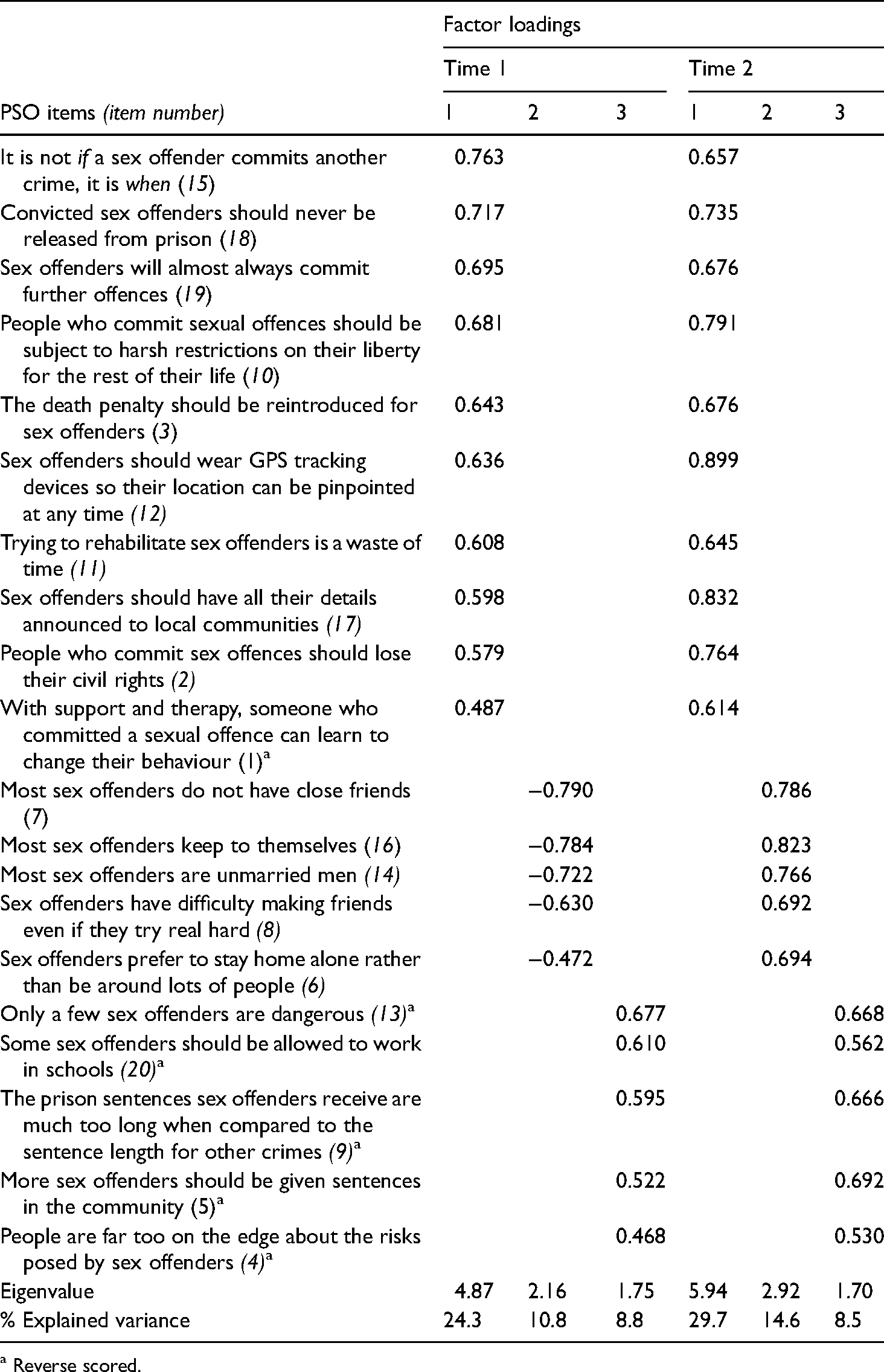
Perceptions of persons convicted of sexual crimes were assessed using the PSO scale (Harper and Hogue, 2014). The students reported to what extent they agreed or disagreed with 20 statements (see Table 1) on this 6-point Likert scale: Strongly disagree (coded 1), disagree (2), somewhat disagree (3), somewhat agree (4), agree (5) and strongly agree (6). The content of one item was slightly modified in the present study. Specifically, we asked whether ‘Sex offenders should wear GPS tracking devices so their location can be pinpointed at any time’ (item 12), yet the term ‘GPS’ was not included in the original item formulation.
Principal component analyses of the 20 Perception of Sex Offenders (PSO) items with direct oblimin rotation and fixed extraction of three factors. Display format in which factor loadings <0.25 were suppressed.
Reverse scored.
At T1, the students were asked whether they had any work experiences from the correctional service and whether they had ever worked in a prison or prison unit that housed inmates convicted of sexual offences (yes/no). At T2, when the students had finished the year of practical training, they were asked whether the training had taken place in a prison or prison unit that was specially adapted for sex offenders. The response options were ‘yes’, ‘no’ and ‘I don't know’, and we made a distinction between those who answered ‘yes’ and all others.
Demographics included gender and age.
Analyses
First, we performed principal component analyses with direct oblimin rotation to examine the factor structure of the PSO. Next, we constructed subscales by adding up the items that loaded on each of the extracted factors. The scores on the subscales were divided by the number of PSO items included, and thus ranged from 1 (strongly disagree) to 6 (strongly agree). We also dichotomized the subscales, making a distinction between students with high scores (≥4) and those with moderate or low scores (<4). We included the continuous PSO subscales in analyses of variance with F-test to examine differences between means and conducted cross-tabulations with χ2-test to assess variations in the proportion scoring high on these scales.
Results
Sample description
There was a small preponderance of males in the study sample at both T1 (55%) and T2 (53%). A solid majority was younger than 30 years of age, and unsurprisingly, this age group decreased slightly from T1 (89%) to T2 (82%). At T1, 30 percent reported that they had work experiences from the correctional service, of whom almost all (53 of 54) had worked in a prison or a prison unit that housed inmates who were incarcerated due to sexual offences. At T2, 28 percent reported that their practical training as a prison officer student had taken place in a prison or a prison unit that was specially adapted for persons convicted of sex offences.
Factor structure of the PSO
We conducted a series of principal component analyses (Eigenvalues >1) of the 20 PSO-items. At both T1 and T2, Harper and Hogue’s (2014) results were replicated when we predefined that three factors should be extracted. When we did not specify the number of factors, a five-factor solution emerged – at both T1 and T2. However, the items’ loading on each of the five factors varied across time, and some items had almost equally high loadings on two factors. Moreover, at T2, two factors consisted solely of one item each. The results of a fixed four-factor solution were equally incoherent. The three-factor solution that paralleled the results of Harper and Hogue (2014) is displayed in Table 1.
While the overall pattern of findings was identical at the two waves of data collection, the loadings of the individual items on each of the three factors showed some variation. Notably, the loadings on the second factor were negative at T1 and positive at T2. Moreover, the total variance explained by the three factors was lower at T1 (43%) than at T2 (53%).
Based on the results in Table 1, we constructed three PSO subscales with the same labels and content as those applied by Harper and Hogue (2014). Sentencing and Management included the 10 items that loaded on the first factor, with high scores indicating support for the view that persons convicted of sex offences should be treated and sentenced harshly (Cronbach's α was 0.85 at T1 and 0.90 at T2). Stereotype Endorsement included five items (cf. Factor 2), with high scores indicating stereotypical perceptions of sex offenders (Cronbach's α was 0.73 at T1 and 0.81 at T2). Risk Perception also included five items (cf. Factor 3), and high scores indicated support for the view that sex offenders are likely to commit further offences (Cronbach's α was 0.52 at T1 and 0.64 at T2). Regarding the low α-coefficients of the latter subscale, notably at T1, it may be noted that this level of internal consistency may be considered acceptable for measures consisting of few items (Perry et al., 2004).
The correlations between the three PSO subscales were generally low, and only two significant associations were found; Sentencing and Management correlated with Stereotype Endorsement at T1 (r = 0.30, p < 0.001) and with Risk Perception at T2 (r = 0.38, p < 0.001).
Students’ perceptions of persons convicted of sexual offences
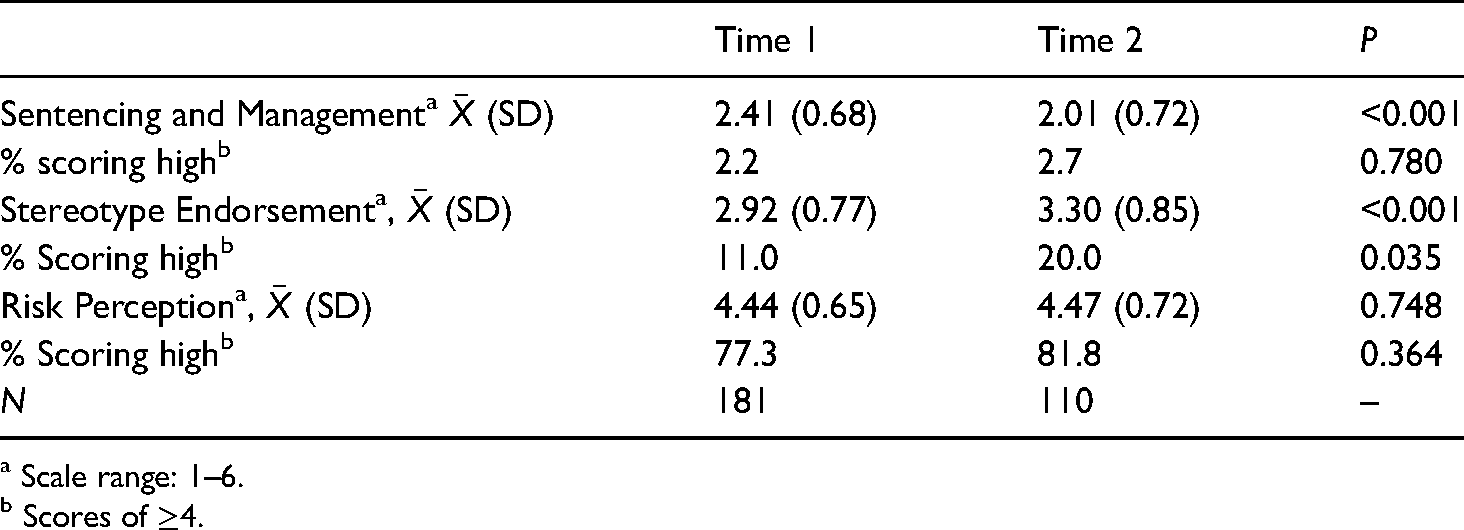
The students’ perceptions as measured by the PSO are displayed in Table 2. The mean score on the sentence and management subscale was fairly low at T1 and even lower at T2, indicating that the tendency to disagree with the view that sex offenders should be treated and sentenced harshly had grown stronger. Only a tiny fraction seemed to be supportive of such a view, and the relative size of this group showed no statistically significant change from T1 to T2.
Mean scores (SD) and the percentage scoring high on the three Perception of Sex Offenders (PSO) sub-scales at Time 1 and Time 2.
Scale range: 1–6.
Scores of ≥4.
In contrast to the Sentencing and Management subscale, the mean score on the Stereotype Endorsement subscale increased significantly from T1 to T2. Thus, the students had apparently become more likely to hold stereotypical perceptions of persons convicted of sex offences after the year of practical training. At both T1 and T2, only a minority scored high on Stereotype Endorsement, yet this proportion almost doubled from the first to the second assessment.
The students’ mean score on the Risk Perception subscale was quite high and almost identical at the two waves of data collection. A solid majority had scores ≥4, indicating that the perception that sex offenders are dangerous and likely to re-offend was widespread. The proportion scoring high did not change significantly from T1 to T2.
Next, we assessed whether the students’ perceptions of sex offenders varied by having work experiences with this group of prisoners. No such variations were found. Specifically, students with such work experiences at T1 did not differ significantly from other students with respect to any of the three continuous and the three dichotomous PSO measures. At T2, there were also no statistically significant differences between students who had practise training in a prison that was specially adapted for persons convicted of sex offences and those who had not. However, the former group had somewhat higher scores on the Risk Perception subscale (
Finally, it may be noted that none of the three PSO subscales were significantly related to age or gender. There were also no age or gender differences with respect to the proportion scoring high on these scales.
Discussion
Main findings
The three-dimensional structure reported by Harper and Hogue (2014) as underlying the PSO was replicated in our study of prison officer students in Norway. The factor structure was identical at the two waves of data collection, indicating a high level of robustness. However, the internal consistency of the Stereotype Endorsement subscale and the Risk Perception subscale was considerably lower in our study than in Harper and Hogue’s (2014) study. It seems likely that the perceptions in question were more homogeneous in our sample than in their self-selected and highly diverse sample in terms of age and educational level, and the lower the overall variance of item scores, the lower the internal consistency of a scale (Wheeler et al., 2011).
At both T1 and T2, the mean score on the three PSO subscales was lowest for Sentencing and Management and highest for Risk Perception. Regarding changes across time, only one of our initial hypotheses was supported. Specifically, the prison officer students held less punitive views about sentencing in the final term than in the first term of their education. No changes were observed in their endorsement of risk, while their tendency to adhere to stereotypical images of persons convicted of sex offenses increased. All of these findings warrant further discussion.
Our initial hypotheses were based on the existing literature. Thus, some studies indicate that educational interventions and exposure may positively affect attitudes towards persons convicted of sexual offences, notably when the interventions focus on rehabilitation more generally and emphasize sex offenders as fellow human beings who are capable of change (Willis et al., 2010).
Arguably, the comprehensive Norwegian prison officer education is such an intervention, with its emphasis on humanistic principles and equality of worth. Furthermore, the ‘crime-blind’ nature of Norwegian prisons where the students received their practical training led us to hypothesize that Stereotype Endorsement would be reduced. We also anticipated that those who had received their practical training in prisons with special units for this group of prisoners would score lower on all the three PSO sub-scales (Sentencing and Management, Stereotype Endorsement and Risk Perception) due to social interaction and exposure (Sanghara and Wilson, 2006).
The scale with the lowest mean score was Sentencing and Management. The mean score decreased over time (cf. Table 2), supporting our hypothesis that the prison officer education and training may lead to less punitive views towards persons convicted of sexual offences. Thus, the prison officer students increasingly tended to disagree with issues such as imposing sanctions beyond the prison term, and notification, monitoring and loss of civil rights. This opposition aligns well with the official Norwegian penal policy, emphasizing penal sanctions as involving a time-limited loss of liberty only, while maintaining all other civil rights, including the right to privacy. Although some vigilante groups exist arguing for sexual offender registries, they seem to represent a marginal part of the public discourse in Norway.
The results pertaining to Stereotype Endorsement clearly contradicted our hypothesis. Compared to the results at the first term of their education, the students held more rather than less stereotypical views towards persons convicted of sexual offences in their last term (cf. Table 2). Furthermore, the percentage who held highly stereotypical views almost doubled from T1 (11%) to T2 (20%). Our study thus indicated that neither theoretical education and practical training nor exposure were successful in reducing the students’ stereotypical perceptions of persons convicted of sexual offences.
To make sense of the latter finding, a closer look at the items comprising the Stereotype Endorsement factor may be warranted. All five items in question focus on social isolation, in one form or another (see Table 1). The stereotypical ‘sex offender’ according to these items, is unmarried, unable to make friends, prefers to be alone and avoids other people. Due to the stigma attached to sexual offending and the fear of being victimized by fellow prisoners if their convictions are revealed, prisoners convicted of sexual offences may try to attract as little attention as possible during their sentence (van den Berg et al., 2018). Persons convicted of sexual offenses may even be advised by staff to figure out a credible cover story to avoid negative sanctions from fellow inmates (see for instance Kruse, 2020). Hence, it is possible that the adaptive strategy of keeping a low profile and withdrawing from prison social life fuels stereotype endorsement among prison officer students. The isolating behaviour of persons convicted of sexual offences in prison might be seen to reflect personality traits rather than a situationally dependent adaptation to avoid victimization and stigma.
The PSO measure of Risk Perceptions did not change significantly from the first to the last term of the students’ education, and our hypothesis was consequently not supported. Furthermore, this factor had the highest mean score (cf. Table 2), suggesting that the prison officer students generally tended to hold the view that this group of prisoners represent a significant risk. A tendency to exaggerate the risk of recidivism posed by persons convicted of sex offences is well documented and has also been observed among Norwegian prison staff (see Kjelsberg and Loos, 2008).
One possible interpretation of the stability in risk perception is that the prison officer students may have been affected by the severity of the sex offence convictions they encountered during their practical training. Their training takes place in high-security prisons only, and the students have therefore primarily engaged with persons convicted of more serious sexual offences. Moreover, students who had worked in prisons with special units for men convicted of sexual offences scored somewhat higher on the ‘risk perception’ factor than other students (close to significant difference). Such units typically recruit men serving relatively long sentences, and who seek treatment and/or rehabilitation to reduce their risk of reoffending. Exposure to those with severe sex offence convictions may therefore have contributed to an increase in risk perceptions for some students. This, in turn, may reflect the common cognitive bias known as the availability heuristic (Tversky and Kahneman, 1974), that is, reaching general conclusions based on immediately available examples without taking their representativeness (or lack thereof) into account.
Strengths and limitations
The two waves of data collection in our study allowed us to assess the robustness of the factor structure of the PSO. Moreover, the high response rate at T1 implied that an almost full cohort of freshman prison officer students in Norway took part in the study.
We also examined whether the students’ perceptions of sex offenders had changed after their 1-year practical training in the prison service. However, by its very nature, the one-group pretest–posttest design implies that one cannot conclude that the observed changes were attributable to the prison officer theoretical education and practical training. Another limitation was that data from T1 and T2 could not be linked at the individual level, precluding the possibility to assess whether some subgroups were more likely to change their perceptions of persons convicted of sex offences than others. The response was considerably higher at T1 (94%) than at T2 (64%), yet the age and gender composition of the net sample barely changed. However, due to lack of data, we could not examine whether the respondents at the two assessments differed in other ways. This, in turn, further underscores the importance of interpreting the results of the longitudinal group-level analyses with due caution.
The PSO is explicitly developed as an outcome measure and was deemed applicable in the current study as a measure sensitive to changes in perceptions before/after a period of training. However, future studies would benefit from including also other measures, preferably ones capturing the more stable and generalized aspects of attitudes. More specifically, a study using both the PSO and ATS could be valuable in exploring a theoretical puzzle: is an intervention of the kind studied in this article – a broad and generalist prison officer education of 2 years’ duration – more likely to affect attitudes than perceptions?
Conclusions
In various ways, our study of prison officer students in Norway added to the literature. First, we examined the dimensionality of the PSO. Our results supported the only study of the factor structure of this instrument (Harper and Hogue, 2014), which was based on a different sample and conducted in a different cultural and penal context. Second, our study revealed some intriguing findings related to an increase in stereotype endorsement among prison officer students over the course of their education. On the other hand, the students’ tendency to disagree with the view that sex offenders should be treated and sentenced harshly grew stronger. The perception that this group of offenders are dangerous and likely to re-offend was widespread and did not change over time.
To our knowledge, there are no other studies with which to compare the absolute PSO scores reported in this article. Without such a comparative benchmark it is hard to evaluate how punitive the prison officer students in our sample are, how stereotypically they view persons convicted of sexual offences, and how dangerous they think this group of offenders are. We do however hope that future studies using the PSO scale will enable such comparisons. This would then allow us to interrogate more closely how perceptions towards persons convicted of sexual offences may vary not only between occupational groups and types of interventions but also between penal contexts which differ in degrees of punitiveness.
What can these results tell us about the ‘exceptional’ (Pratt, 2008; Pratt and Eriksson, 2013) character of Norwegian penal practises? The prison officer students became more ‘moderate’ in their views about how persons convicted of sex offences should be sentenced and managed over the course of the prison officer education. This aligns well with the official Norwegian penal policy, where the deprivation of liberty is meant to be the only punishment inflicted upon offenders (White Paper no 37, 2007-2008), and with Pratt's notion about the humane ethos of Nordic penality more broadly. However, the increase in stereotype endorsement among prison officer students may indicate that the ‘crime-blind’ approach to the placement of prisoners is not sufficient to avoid processes of ‘othering’ of persons convicted of sex offences.
Footnotes
Acknowledgements
The authors would like to thank Line Sørlie, who initiated the project, translated the PSO items and organized the first round of data collection. We are grateful for her permission to use the data for this article. We also wish to thank the prison officer students who responded to the survey. The three authors are listed alphabetically and contributed equally to the paper.
Funding
The authors received no financial support for the research, authorship and/or publication of this article.
