



Abstract
The countries of Central Europe are home to diverse penal cultures but rare comparative studies typically focus only on national penal codifications or on cross-country measures of public attitudes towards crime and punishment. This article compares three dimensions of punitiveness – penal legislation, actual sentencing practice of the courts, and punishment preferences of the general public – in six jurisdictions: Austria, Czechia, Germany, Hungary, Poland, and Slovakia. Punishment preferences features new data from the Central European Social Survey, in which respondents were asked to recommend suitable sentences for five hypothetical crimes. We found public preferences relate closely to the domestic judicial practice but less so to the maximum penalties provided in a country's penal code. In particular, participants based in Germany proved far less punitive than others, which echoes the penal moderation of German courts.
Introduction
Public punitive attitudes and opinions about crime and penalties have attracted criminological attention for many years. The most common analyses in the field concern the condemnation of individual behaviours in violation of social norms, and attitudes towards various types of penalties (e.g., death penalty, life without parole) and their increased severity. The last international study that attempted to compare punitive attitudes in different countries was the International Crime Victims Survey (ICVS), carried out in 2004 (van Dijk et al., 2007). One of the questions in this survey concerned the punishment respondents would inflict on a 21-year-old recidivist burglar who steals a colour TV. Undoubtedly, the findings of the ICVS project are now far outdated, therefore it was important to revisit this issue in the first wave of the Central European Social Survey.
The Central European Social Survey is the first project focused on the Central European region in a way that facilitates comparisons between countries. The first wave of the Central European Social Survey was carried out in Austria, Czechia, Germany, Hungary, Poland, and Slovakia in December 2021 and January 2022. A detailed survey methodology is described later in this article.
While there are many ways of dividing Central Europe, the main divide remains the former iron curtain – the previous ‘people’s democracies’, the East of Germany included, still lag behind Western economies and struggle with political populism, increased xenophobia, and historical grievances. For instance, while Germany is often praised for its model democracy, Poland and Hungary currently face a severe rule-of-law crisis (Fleck et al., 2022; Gómez, 2021; Woźniakowska-Fajst and Witkowska-Rozpara, 2022). Notwithstanding these differences, it is not pointless to study these jurisdictions alongside each other; all six countries are now members of the European Union following the shared experience of 20th-century totalitarianisms and, what is important for the current study, each country's legal system is influenced by German law. Although their codifications vary in content, they use similar systematic solutions, which lend themselves to comparative analysis.
We included a block of five single-choice questions with the same layout, containing the recommended punishment for a perpetrator of (1) beating a stranger in the street, which required a medical visit; (2) repeated beatings of a partner which required a medical visit; (3) rape of a stranger; (4) rape of a partner; and (5) nonpayment of child maintenance. The responses show punitiveness towards each of these acts and reveal the expected differences between these attitudes. The results can also be a source of reliable diagnoses in the field of the severity of punishment, especially regarding domestic, sexual, and economic abuse.
The main research question is: For which of the five selected crimes would the justice system and the citizens of each country impose the most severe penalties? The main hypothesis is that the severity of a country's laws and the practice of punishment by its criminal justice system are related to the punitiveness of its citizens. Indeed, scholars have highlighted both that punitive social attitudes can influence criminal justice policy (e.g., Enns, 2014; Jennings et al., 2017; Pickett, 2019) and that penal policy shapes social attitudes (e.g., Krajewski, 2002).
To answer this question and test the hypothesis, we carried out a comparison of (1) penalties in criminal codes for the listed offences in selected countries; (2) sanctions imposed for these offences in selected countries in 2020; and (3) survey results in national samples.
Macro, meso, and micro levels of punitiveness in Central Europe
Defining punitiveness
The simplest definition of ‘punitive’ would be ‘involving or inflicting punishment’ (Punitive, 2000: 1000), which is how punitiveness is generally understood in the field of criminology (Adriaenssen and Aertsen, 2015; Kury et al., 2004). It can be a feature of the legal system, a measure of the repressiveness of the state manifested in its legislative and juridical functions, influenced by social and political discourse on crime and punishment (macro-level of punitiveness). Or it can characterize the judicial enforcement of sentences (meso-level of punitiveness). It can be also understood as an general attitude within the population, a measure of the demand for harsh punishment (micro level of punitiveness) in response to legal violations (Harrendorf, 2011). It is therefore important to study variations in punitiveness across societies both in terms of popular opinion and criminal law and justice systems. Thus we will briefly discuss these three sources of punitiveness and how they influence each other. We focus mainly on micro level punitiveness, but we will return to the problem of their interconnections later in the article. Our study distinguishes between the three indicated types of punitiveness and conducts the study at three levels of analysis: penalties in criminal codes, sanctions imposed, and survey results. However, often in analyses of punitiveness, the criminal codes and sanctions are considered together. Since we have included legal regulations in the macro-level of punitiveness, it should be mentioned that these have a direct impact on the meso-level, as judges have to apply the existing legal regulations in their judgements.
Macro and meso level of punitiveness
In terms of macro- and meso-levels of punitiveness, it is worth quoting the definition of punitiveness created in the early 1970s by a distinguished Polish criminologist, Jerzy Jasiński (1976: 44): Under punitiveness, we shall understand the results of the tendency towards a broad use of instruments provided for by criminal law to limit the extent of phenomena regarded as socially undesirable and towards combating crime with measures that are more severe, more afflicting and interfere more with civic liberties.
The tool used to measure the punitiveness of the criminal justice system (specifically at the meso-level) is, among others, the imprisonment rate. Nils Christie (2004) considers the imprisonment rate to be one of the measures of the general punitive sentiments of societies expressed in criminal law and policy, but Frost (2008) argues that the imprisonment rate cannot be the only measure of punitiveness and that the length of detention is of equal importance. Christie (2004) argues that the reason for the high imprisonment rate is the harsh criminal law, restrictive court policies, the dependence of judges on political power, the authoritarianism of the state, and the lack of safeguards in the penal system to reduce the prison population. This may indeed be true for the countries which used to be under Soviet influence.
According to the SPACE I Annual Penal Statistics on Prison Populations 2020 (Aebi and Tiago, 2020), a report containing a detailed breakdown of penological trends across Europe, there is a clear difference between the German-speaking countries and their Eastern neighbours. The authors calculated the European median values for a series of selected indicators (prison population, prison density, ratio of inmates per one staff member, rate of admissions per 100,000 habitants, rate of releases per 100,000 habitants, suicide rate per 10,000 inmates, rate of escapes per 10,000 prisoners, and average length of imprisonment in months) and then compared individual country scores to these medians. Czechia, Hungary, Poland, and Slovakia are in the ‘very high’ cluster (their score exceeds the European median value by over 25%) in such categories as prison population (Austria is in the ‘medium’ cluster and Germany in the ‘very low’) and the average length of imprisonment (Austria is in the ‘high’ cluster and Germany in the ‘low’; Aebi and Tiago, 2020). The above results are germane to our considerations, since in the ICVS 2004/2005 the researchers concluded that among the participating countries there was a weak but statistically significant relationship between public opinion on sentencing and the actual imprisonment rates (van Dijk et al., 2007).
Crucially, the German criminal justice system has been deemed to have successfully resisted the penal turn of the recent decades; its moderation has attracted much research interest (Pratt, 2002; Tonry, 2004). Germany’s unique penal moderation has been explained by the high impact of expert input on the country's penal policy, deference towards the institutions of liberal penal law in force, historically conditioned reluctance towards excessive use of the state's right to punish, and a functioning social policy. Regardless of its much-discussed roots (Drenkhahn et al., 2023), the moderation of the German criminal justice system has been evidenced by consistently low imprisonment rates (see below).
In the former socialist states, though, residual harshness inherited from the Soviet system has mixed with newly ‘imported’ tough-on-crime rhetoric bearing clear similarities with developments in English-speaking countries (Krajewski, 2013). None of the above-listed protective factors established for Germany fully applies to countries such as Poland, Czechia, Slovakia, or Hungary. Chronic uncertainties experienced by their inhabitants throughout the period of economic transformation could have been translated into the fear of the criminal ‘other’, and, consequently, into punitive demands (Garland, 2001). Many of those disillusioned with democracy gravitated towards authoritarian populists (Krastev and Holmes, 2019), whose penal agenda invariably included elements of law-and-order policies (Haney, 2016). Austria, whose history and fate in the last 80 years has been closer to Germany than to the countries further east, occupies a middle ground as far as punitiveness is concerned. As the indicators discussed below show, Austria’s justice system is harsher than Germany's, but still milder than the former communist countries’.
Micro level of punitiveness
Punitive public attitudes are related to but analytically distinct from the punitiveness of the criminal justice system, be it criminal codifications or judicial practice (Kury et al., 2009). Criminologists, especially those associated with penal abolitionism, continue to ask why the public would remain ‘in favour of increasing the amount of pain delivery in the country’ (Christie, 2008: 98). While we do not attempt to answer this question within the scope of this article, it is worthwhile to review the main drivers of micro-level punitiveness. These are, amongst others: political and religious beliefs (Becker and Whitehead, 2020; Green, 2009; Pratt, 2002; Seto and Said, 2022), media influences (Intravia, 2019; Spiranovic et al., 2012), gender (Kutateladze and Crossman, 2009; Welch, 2011), race (Becker et al., 2018; Morris and LeCount, 2020), socio-economic status (Neill et al., 2015), education (Ridener and Kuehn, 2017), level of crime (Kleck and Jackson, 2017), and fear of crime (Kury, 2008; Shi, 2022).
Importantly, the bulk of research on punitiveness is concentrated in English-speaking countries – particularly the United States – whose criminal justice systems are more of an exception than a generalisable example. For instance, Unnever and Cullen (2010) found racial animus predicted punitive attitudes better than any other tested variable, including concern about moral decline or rampant crime. Arguably, this may carry less explanatory power in the Central European context, where ethnic monoliths such as Poland exhibit far higher imprisonment rates than much more diverse Germany. For our part, we examine the extent to which this difference is also reflective of micro level of punitiveness.
In this article, we focus on the criminal policy and public opinions of the six countries that participated in the Central European Social Survey. To this end, we discuss four lines of extant research into punitive attitudes in the region. First, we consider the link between crime rates – both perceived and recorded – and punitiveness as studied in Central Europe. Second, we turn to the question of individual victimisation and whether it translates into punitive demands. Third, the literature on political sources of the public's punitiveness is summarised with a focus on international differences. Last, we position our research in relation to the last major cross-country comparison conducted in the region: the ICVS.
The relationship between crime, its perception, and attitudes towards it occupies an intriguing place in criminology. Kleck and Jackson (2017), who compared the results of 18 studies on the correlation between fear of crime and exposure to crime with punitiveness, found that half of the studies analysed showed a correlation, whereas the other half did not. The conclusion of their research (conducted in the United States) was that ‘exposure to crime, regardless of how it was measured, did not show a significant association with support for punitive measures, no matter how they were measured’ (Kleck and Jackson, 2017: 1584). Exposure to crime can be measured by statistical data on registered offences (although it is not the perfect method) or by data from victimisation surveys. Contrary to Kleck and Jackson's observation, the 2004 ICVS study found that punitiveness was strongly correlated with crime rates. The higher the crime rate (in the victimisation survey, not in crime statistics), the more punitive the public attitudes in a given country. However, the ICVS also showed a surprising lack of correlation between punitiveness and fear of crime, anxiety levels did not generate repressive attitudes (Siemaszko, 2008: 190).
One may consider how the level of punitiveness is influenced by victimisation experiences, but here we lack appropriate material for comparisons. Victimisation surveys are conducted using various tools (which already makes comparisons difficult) and span only a few countries each. Among the countries we analyse, victimisation studies were conducted in 2014/2015 in Czechia, Germany, and Poland. The results of these studies are hardly conclusive. The risk of robbery is similar in all these countries, the risk of theft of personal property was the highest in the Czechia and the lowest in Poland, but the probability of domestic burglary in Czechia and Poland was four times higher than in Germany. However, the risk of bodily injury was the highest in Germany (twice as high as in Czechia and three times as high as in Poland) (Aebi et al., 2021). Thus, this way of comparing the relationship between victimisation and punitive attitudes is not ideal.
Furthermore, it is not obvious how penal populism used by politicians affects the punitiveness of the general population. Lynne Haney (2016: 348), who analysed penal policy in Czechia, Slovakia, Poland, and Hungary, maintains that politicians of these countries use tough ‘law and order’ rhetoric, which ultimately influences the penal policy of these countries. She uses the concept of penal nationalism, in which law and order rhetoric serves not necessarily populist purposes, but rather nationalist ones. Her idea is certainly true for Hungary (Boda et al., 2022: 119), although the recent analysis by Jakub Drápal (2021a) produced divergent results and suggests that for Czechia penal or national populism does not seem to be a problem. It seems that in the case of Poland penal populism may be at play, but not penal nationalism (Krajewski, 2023; Woźniakowska-Fajst and Witkowska-Rozpara, 2022).
Given the above analyses, it seems that in Central Europe, old divisions are still visible today. The states in the former Soviet sphere of influence are characterised by greater punitiveness than Austria and Germany. Krzysztof Krajewski (2014) writes that today Europe witnesses two different ‘penal climates’: one more lenient in the ‘old’ EU member states and the other harsher in Central and Eastern Europe. This is evidenced by differential imprisonment rates. Krajewski (2013) argues that the countries of the region’s east have entered the post-1989 era with the historical baggage of authoritarianism, including Soviet penal ideology. The consequences of that ideology persist and are one of the main causes why repeated attempts to reduce official punitiveness fail (Krajewski, 2016). Later in this article, we will see whether this difference in punitiveness is also visible in criminal provisions, penalties imposed, and the attitudes of the inhabitants of the analysed countries.
Lastly, the research landscape we encounter is largely defined by the comparative ICVS findings, which we repeatedly refer to throughout this article. In its 2004/05 wave – the largest thus far and the most recent one conducted – punitiveness was operationalised as the punishment that the respondent would inflict on a 21-year-old recidivist burglar who steals a colour TV. The results revealed pronounced differences in what was deemed the fit punishment by respondents based in various countries; the punitiveness of the Poles was the highest among the countries we compare in this article, placing Poland fourth highest among European countries. On the other hand, the punitiveness of Hungarian respondents oscillated around the average value for all the countries that participated in the survey. Germans showed much less punitive attitudes, while Austrians were the mildest in their judgments (only the French and the Swiss demanded lower penalties than the Austrians; van Dijk et al., 2007). Czechia and Slovakia did not participate in this study.
Given the age of these findings, it is worthwhile to ask about the current situation. The last International Crime Victims Survey was conducted in 2004. Since then, a lot has changed in terms of economic development, societies' wealth, and the level of crime (i.e., a serious decrease in the number of registered offences). These changes particularly affected the states which were under the influence of the USSR until its dissolution: Czechia, Hungary, Poland, and Slovakia. The unique value of our research resides in the re-examination of the micro level of punitiveness in selected Central European countries following a nearly 20-year research gap. Additionally, our operationalisation of punitiveness bids farewell to the obsolete question about stealing a colour TV set and replaces it with other offences, which are timelier and currently evoke heated debates.
Comparison of criminal codes
This section presents a comparison of the overall statutory threat for committing five selected offences in six central European countries. A similar comparative analysis of the selected continental European penal codes was carried out by Jakub Drápal (2021b) with respect to legislative approaches to sentencing multiple conviction offenders, and Paweł Ostaszewski (2022) for the design of the offence of child maintenance evasion and its statutory threat.
Comparing the legal regulations of different jurisdictions poses numerous difficulties, partly because there are differences in defining the characteristics of specific crimes, such as rape. This, in turn, presents another potential problem: the criminalised behaviour of the perpetrator may be described narrowly or broadly, and the criminalisation itself may encompass a basic form, an aggravated form, or even a privileged form of act, leading, for example, to changes in the statutory severity of the penalty or even the type of punishment for committing a particular act. As accurately pointed out by a reviewer, even the basic form of a crime may include various types of behaviours, and the distinction between the basic and aggravated forms may vary across jurisdictions. Additionally, if a legal system also distinguishes a privileged form of a crime, such a distinction will likely narrow the scope of behaviours attributed to the basic form; conversely, in the absence of a privileged form, the range of behaviours covered in the basic form of the crime will probably be broader. All these aspects significantly complicate the comparative analysis of legal regulations.
Furthermore, in the survey, respondents were not asked about specific crimes but rather about the penalties they would impose on individuals engaging in behaviours described generally in the question. This questioning model aligns with the European approach to measuring victimisation experiences (e.g., van Dijk, 2015). In the initial national studies in the Netherlands, for instance, respondents were asked whether they had been victims of pickpocketing, even though the then-applicable Dutch criminal code did not include the concept of pickpocketing (van Dijk, 2015; van Dijk and Vianen, 1977). This model is characterised by a less legalistic approach, and the questions posed to respondents are formulated in a colloquial manner, resembling ordinary citizens' perceptions of crime more than legal provisions (van Dijk, 2015; van Dijk and Vianen, 1977). While clear to respondents, this approach naturally introduces another challenge: attempting to translate the everyday description of the perpetrator's behaviour into a specific legal regulation and provision in the criminal code.
In light of this, for the purpose of comparison, we analysed the legal regulations contained in six criminal codes and selected those (listed in Table 1) describing behaviours most similar to those inquired about in the survey. Simultaneously, in our assessment, the chosen provisions would likely be applied by a court in a situation where the specified behaviour actually occurred. Of course, despite all analysed systems representing continental criminal codes and a certain common legal culture characterised by written law and a limited role of case law (Drápal, 2021b), we are aware that there is a possibility that a court, when analysing the described behaviours in the survey, might apply different legal regulations. Concurrently, with regard to certain behaviours covered in the study, the criminal codes of individual countries distinguish between forms of basic and aggravated crimes, which – as mentioned earlier – immediately modifies the scope of criminalised behaviours. Therefore, in selecting provisions for legal analysis, we considered those that would best fit the very general description of behaviours proposed in the study. This aspect led us to focus on basic forms of crimes, with an awareness of the reservations noted above. To further mitigate the shortcomings arising from our generalisation and simplification, we analyse both the differences in statutory threat and the penalties actually imposed by the courts of individual countries.
Statutory threats for selected crimes in six countries (legal status as of 1 May 2023).
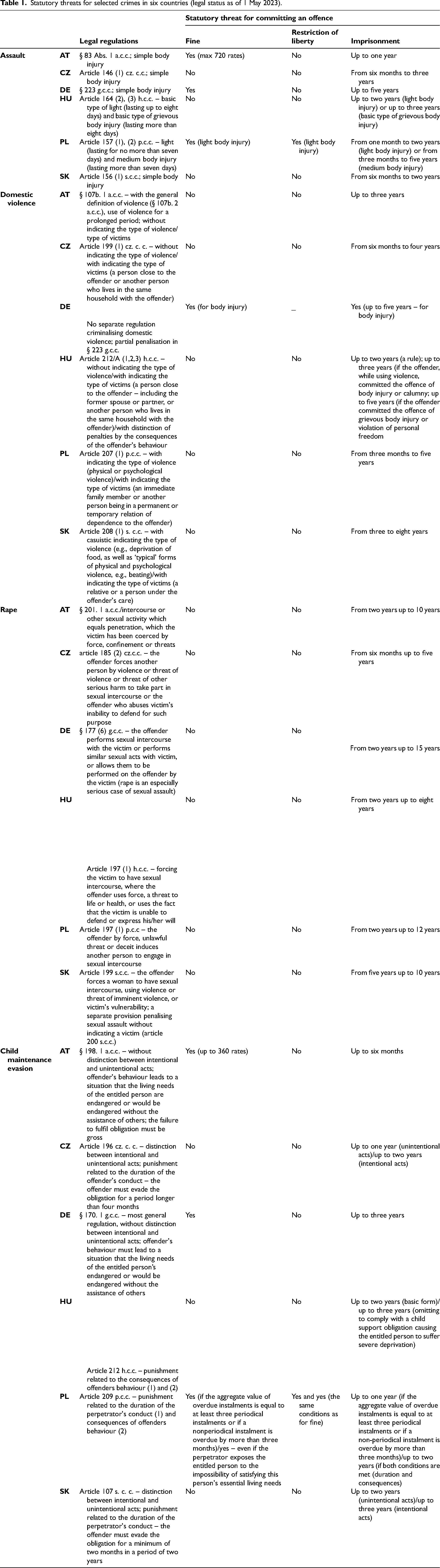
As the indicators of the punitiveness of each country's criminal code, we took the type and severity of the most severe punishment for a given offence. In general, all six countries provide in their criminal codes fines, imprisonment, and suspended imprisonment. It is worth noting that three codes also provide for specific types of imprisonment – 25 years of imprisonment (Hungary and – until 30 September 2023 – Poland) 1 or 15 to 25 years of imprisonment (Czechia). All analysed criminal codes also provide for life imprisonment. Additionally, in Czechia, Poland, and Slovakia one can be sentenced to the penalty of restriction of liberty – community service – an obligation to perform work for community purposes.
When analysing the statutory threat for the assault, it is worth noting that all six criminal codes specify different types of this offence based on different severity or duration of injury and other circumstances or consequences. For example, the Polish code distinguishes three levels of harm, and may additionally be punished more severely if supplementary conditions are met. Therefore, taking into account the question asked in the study, we considered it appropriate to include only the most general ‘simple’ form of assault from each criminal code, without additional circumstances, and the most severe form or consequences. Comparing the statutory threats, the regulations in force in Poland and Germany seem to be the strictest (up to five years of imprisonment), although it is worth noting the differences in the possible lower limits of the penalty.
The criminalisation of domestic violence is included in five out of six criminal codes. The exception is the German Code, which does not contain a separate legal regulation criminalising this offence – partial penalisation of physical violence can be found in paragraph 223 (assault). The penalty for physical violence is the same as for body injury. The most severe penalties for domestic violence are provided for in the Slovak Code.
Regarding penalties for rape, the Czech Criminal Code provides the least severe ones, whereas the most severe penalties are contained in the German regulation. Partner's rape, as an aggravated form of rape, is present only in the Hungarian Criminal Code in article 197(3), therefore a cross-country comparison for this offence has not been carried out.
In three countries child maintenance evasion is punishable by imprisonment, in two by a fine or imprisonment, and in one by a fine, restriction of liberty, or imprisonment. The legal systems of individual countries differ in the description of the perpetrator's behaviour – both in terms of determining the time of non-payment of maintenance, as well as the possible effects that the offender's behaviour causes on the victim. Some criminal codes also differentiate the type and term of the penalty, based on whether the perpetrator acted intentionally or unintentionally.
The Hungarian and Slovak criminal codes provide the most severe penalties, related in Slovakia to the intentionality of the act and in Hungary to the serious consequences for the victim. A penalty of up to three years of imprisonment is also provided for in the German Criminal Code, but this legal act also allows the judge to impose a fine (instead of imprisonment), which is not provided for in Hungarian or Slovak law.
Comparison of the sanctions imposed (sentencing statistics)
The only source of European comparative statistics on convictions and sentences imposed is the European Sourcebook of Crime and Criminal Justice Statistics (ESB). However, the latest report (published in 2021) only contains data up to 2015 (and 2016 regarding numbers of convicts), which renders it not fully up to date. In addition, in terms of the offences selected for this project, the ESB includes only the data on convictions for total criminal offences, assault, and rape. For all selected countries ESB obtained exclusively the number of convictions for total criminal offences. The data for the offence of child maintenance evasion and domestic violence is also absent from the sourcebook (Aebi et al., 2021).
As we indicated in the previous section – unlike in the ESB project – we have adopted here a narrow criminal-code-based scope of analysed offences, which is the reason why the presented numbers are different (smaller) than in ESB. In general, ESB results suggest that the most frequently imposed penalties were suspended custodial sanctions in Poland, Czechia, and Austria (with a relatively high proportion of unsuspended imprisonment and fines); a fine in Germany; and non-custodial sanctions in Hungary (e.g., community service).
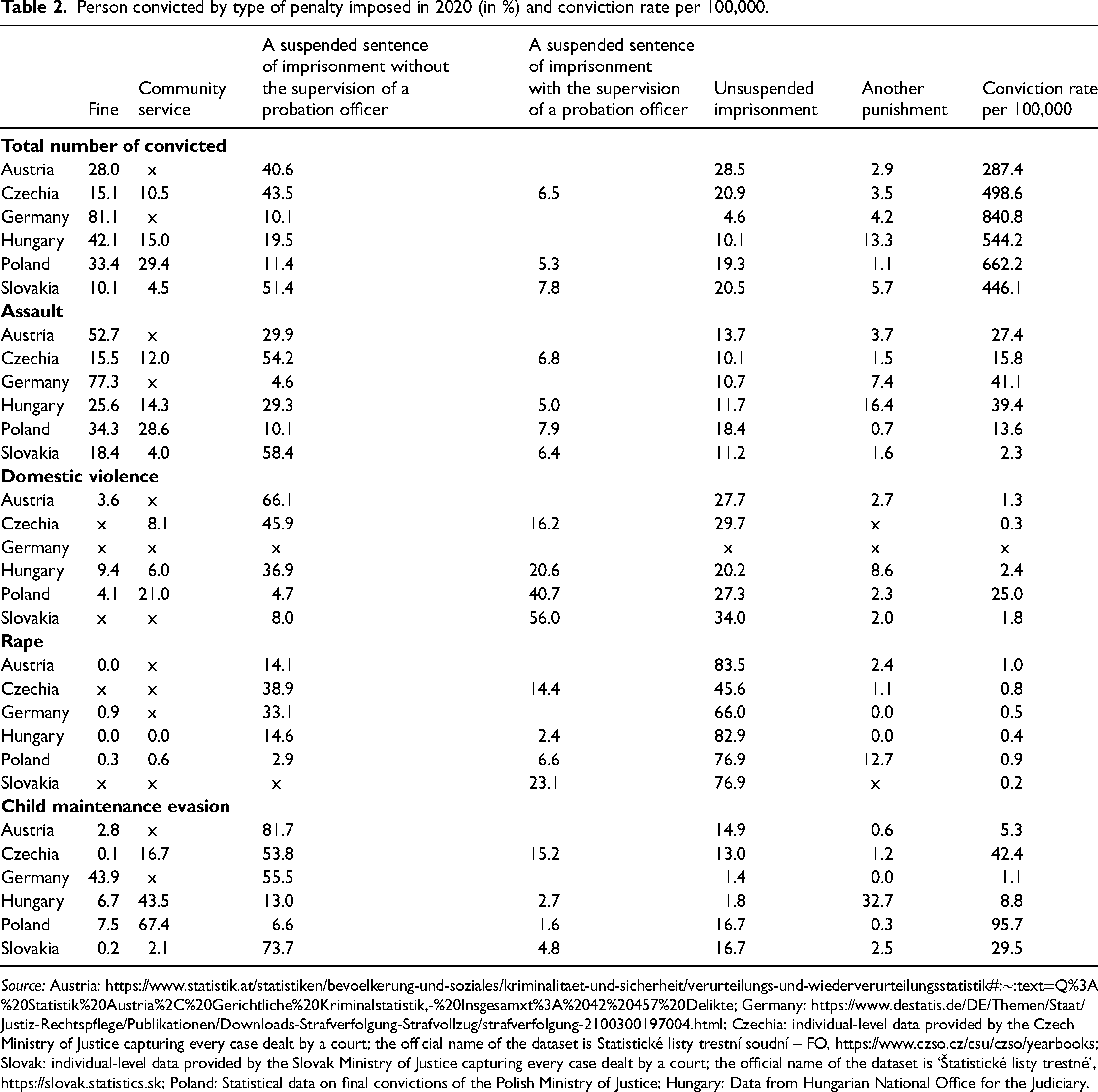
The data in Table 2 show significant differences between countries as regards the types of penalties imposed for individual offences. A comparison of the conviction rates in 2020 for the chosen offences reveals significant disparities for domestic violence and child support evasion (extremely high rates in Poland, see Ostaszewski, 2022), on the other hand, relatively similar rates for rape (except Slovakia).
Person convicted by type of penalty imposed in 2020 (in %) and conviction rate per 100,000.
Source: Austria: https://www.statistik.at/statistiken/bevoelkerung-und-soziales/kriminalitaet-und-sicherheit/verurteilungs-und-wiederverurteilungsstatistik#:∼:text=Q%3A%20Statistik%20Austria%2C%20Gerichtliche%20Kriminalstatistik,-%20Insgesamxt%3A%2042%20457%20Delikte; Germany: https://www.destatis.de/DE/Themen/Staat/Justiz-Rechtspflege/Publikationen/Downloads-Strafverfolgung-Strafvollzug/strafverfolgung-2100300197004.html; Czechia: individual-level data provided by the Czech Ministry of Justice capturing every case dealt by a court; the official name of the dataset is Statistické listy trestní soudní – FO, https://www.czso.cz/csu/czso/yearbooks; Slovak: individual-level data provided by the Slovak Ministry of Justice capturing every case dealt by a court; the official name of the dataset is ‘Štatistické listy trestné’, https://slovak.statistics.sk; Poland: Statistical data on final convictions of the Polish Ministry of Justice; Hungary: Data from Hungarian National Office for the Judiciary.
Assault was punished most severely (in terms of frequency of unsuspended imprisonment and of community service) in Poland and most leniently in Germany (in terms of frequency of fines) and in Czechia, Slovakia and Hungary. Regarding domestic violence, except in Germany where it is not a separate offence, there are rather similar and low percentages of a prison sentence (from 1/5 to 1/3) and a higher share of suspended imprisonment. Rape is punishable only by unsuspended imprisonment and suspended imprisonment (with or without the supervision of a probation officer) in all six countries. Prison sentences were most frequently imposed for this crime in Austria and Hungary, and least frequently in Czechia. A far different pattern of punishment emerged for the crime of non-payment of child support – prison sentences are rare in Germany and Hungary; in Germany there is a high proportion of fines (which, in turn, do not occur in Czechia and Slovakia). In Poland and Hungary community service is a prevalent sentence.
Survey methods
In order to investigate the cross-national differences in micro-level punitiveness, we analysed the 2021 data collected for the first wave of the Central European Social Survey. 2 The survey aims to create a unique data resource on the societies of Central Europe and the most important social factors in the region. The project consists of two two-wave online panel studies on representative national samples for Poland, Slovakia, Czechia, Germany, Austria, and Hungary scheduled for 2021–2026 and aims to understand regional differences and current social challenges. Coordinated from the University of Warsaw, the survey was conducted by commercial research firms. The first wave was carried out by computer-assisted web interview method. For each country, cross-quotas were set for gender and age categories, and simple quotas for the community size. A random sample was drawn from large national panels managed by the contractors, with the size adjusted by the assumed level of the response rate. The survey was conducted in December 2021 and January 2022. Number of completed questionnaires was as follows: Czechia – 1630, Slovakia – 1646, Hungary – 1720, Poland – 1905, Germany – 2214 and Austria – 2259. The response rate was in turn: Germany – 10 percent, Austria – 16 percent, Hungary – 44 percent, Slovakia – 45 percent, Poland – 49 percent, and Czechia – 59 percent. The average length of the interview was 33 min. The survey has been positively evaluated by the research ethics committee.
The data used in the current study originates from the criminological module of the first wave, which was developed at the University of Warsaw in cooperation with Czech and German scholars and eventually entailed five questions on punitive attitudes towards the following offences:
Beating a stranger in the street, which required a medical visit (henceforth referred to as assault) Repeated beatings of a partner which required a medical visit (henceforth referred to as domestic violence) Rape of a stranger Rape of a partner Non-payment of child maintenance
First, following a description of the offence, the respondents were asked to propose a penalty for the offender. Alongside the statutory penalties such as a fine, community service, suspended prison sentence with or without supervision by a probation officer, and an unconditional prison term, the participants could grant the offender impunity or propose another form of punishment. Then, respondents who selected the unsuspended custodial sentence were invited to determine its length, which could range from ‘1 month’ to ‘25 years or life sentence’, at intervals of one month. We believe both items provide a valid operationalisation of punitiveness towards each offence and the expected differences between these attitudes. The scenario-based approach has been considered a superior measure of punitiveness compared to the commonly employed survey questions on whether ‘criminals should be punished more harshly’. These so-called ‘global’ items not only inflate punitiveness but also render the responses contingent on the particular offender category the respondent had in mind (Adriaenssen and Aertsen, 2015; Hough and Roberts, 1999). Individual punitiveness is known to vary by type of crime and people punish different crimes for different reasons (Silver, 2017). If, as Kury et al. (2009: 67) wrote, ‘there is no punitiveness as such, but only varying aspects thereof that may take on a different significance in different areas of crime’, then this method allows us to study some of these areas separately. The raw survey data was processed and analysed utilising PS Imago statistical software.
Survey findings
The table below demonstrates the distribution of the preferred penalties by country and crime. In ascending order, the penalties were dispersed across the entire range of punishment options from total impunity to ‘another punishment’ proposed by a respondent, which sometimes involved the death penalty or severe mutilation. The severity of sentences showed the following pattern: child maintenance evasion, assault, domestic violence, partner's rape, and rape by a stranger (Table 3).
Survey results 1. Share of the proposed penalties (in %).
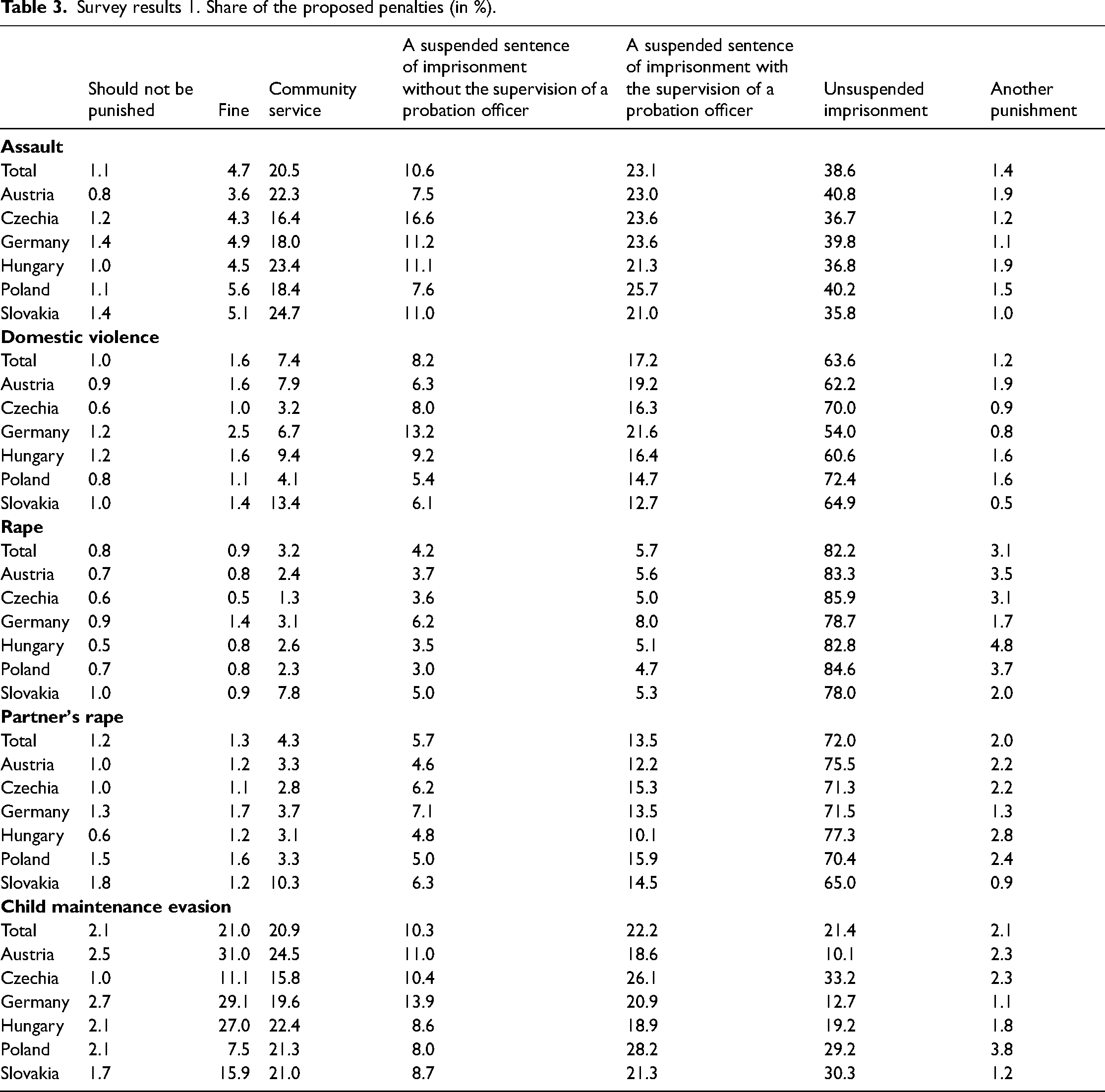
Concerning the choice of punishment, monetary sanctions were rarely proposed for offences other than child maintenance evasion (21% in total), which was the only non-violent crime (i.e., not involving physical or sexual violence) included in the survey. Community service was often proposed for assault and child maintenance evasion, with slightly over 20 percent in each case. In the middle range of severity, a suspended prison term with supervision was far more popular than a probationary sentence without supervision. Lastly, an unsuspended prison sentence was predominantly regarded as a suitable punishment for crimes other than child maintenance evasion and was proposed by the majority of each national sample for rape and domestic violence.
With respect to the use of physical violence, the severity of the proposed sentences rose drastically if the hypothetical crime was domestic violence and not a street assault. 63.6 percent of respondents from all surveyed countries would send the defendant to prison for the former and 38.6 percent for the latter. Conversely, the rape of a partner elicited more lenient punishment recommendations than the rape of a stranger. In Poland, the proportion of custodial sentences between those two scenarios fell by over 14 percentage points. Compared with punishments imposed for other crimes, sentencing preferences in case of non-payment of child support tended to relative lenience, particularly in Germany and Austria, where respectively only 12.7 percent and 10.1 percent of respondents opted for an unsuspended prison sentence for this type of offence.
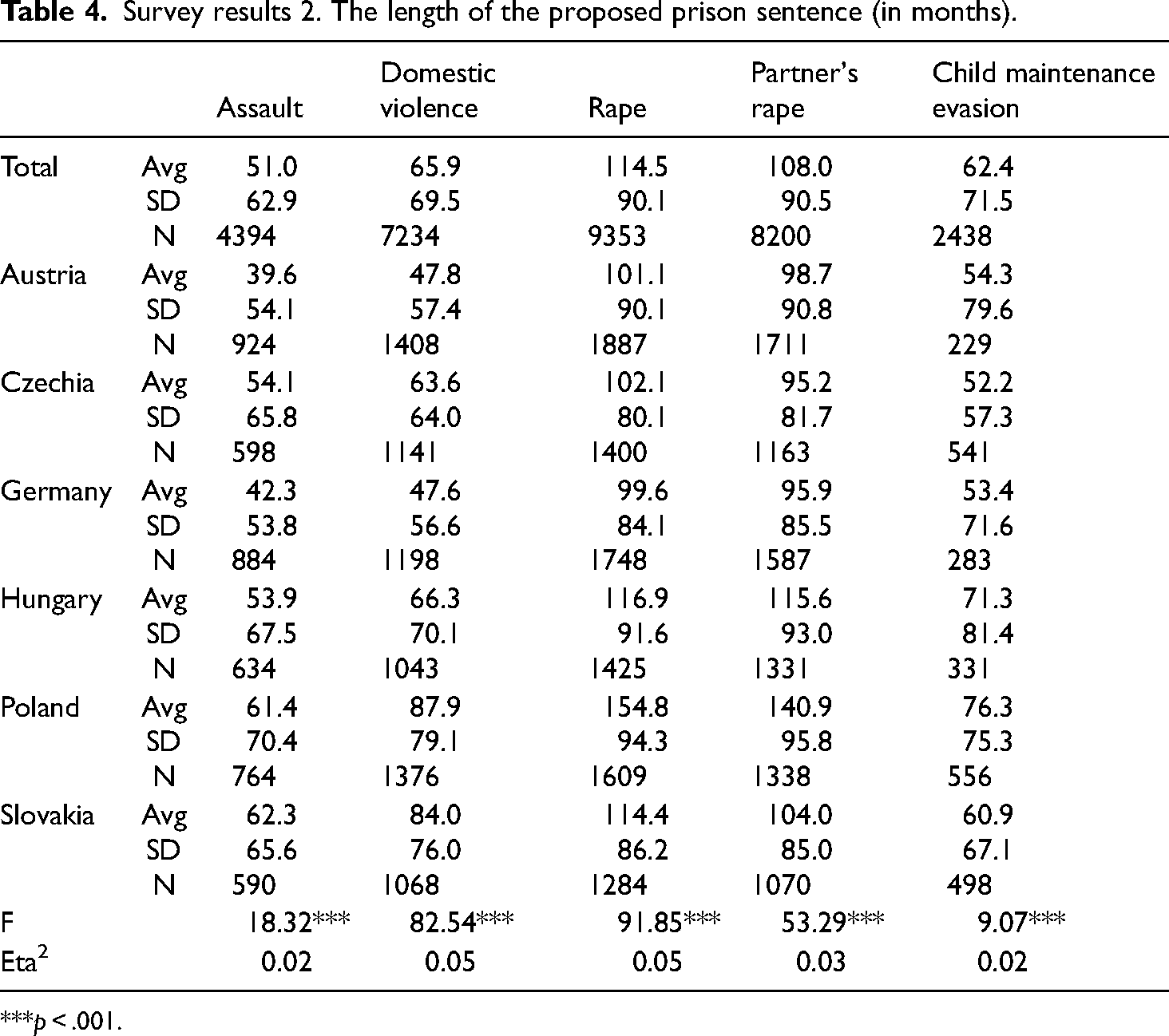
For those participants who chose a custodial penalty, its proposed length (in months) is reported in Table 4. An average prison term for each offence was relatively long and sometimes exceeded the maximum penalties as laid down in a country's penal code. The previously observed order of offence types was replicated, except for the assault, which was now treated more leniently than child maintenance evasion (51 and 62.4 months respectively). Similarly, the punishments administered for the rape of a stranger tended to be the longest with an average sentence ranging from 99.6 months in Germany to 154.8 months in Poland.
Survey results 2. The length of the proposed prison sentence (in months).
***p < .001.
Notably, the average punishments proposed by German and Austrian participants for each offence fell below the total average of the sample. The same was true for Czechs, aside from assault. Polish respondents were the most punitive across offence types. For instance, the average prison term they would impose for domestic violence almost doubled the sentence proposed by Austrians (47.8 vs 87.9 months). The differences between averages observed in the national samples were statistically significant at p < .001 but the the effect was moderate.
Concluding discussion
Almost 20 years after the last international victimisation survey, punitive attitudes in Central Europe have changed. Compared to the research conducted two decades ago, the low punitiveness of the Germans was maintained. However, Austrians, who in 2004 were one of the least punitive nations, now no longer differ significantly from Poles, Hungarians, Czechs,or Slovaks. Instead, they all are now more punitive than the Germans.
The analysis of the punitiveness of the respondents in relation to various crimes also gives us a new perspective. Our results – in particular, the relative lenience towards child support offences – resonates with Cullen et al.’s (2000: 8) literature review, which concluded that ‘violent crime is the great divide between punitiveness and nonpunitiveness’. Domestic violence was assessed more severely than violence against strangers (the comparison, however, is not quite straightforward since the domestic violence scenario specified the beating as repeated, while the street assault scenario allowed for a one-off incident). This difference was most pronounced for Czechs and Poles, and least for Germans, which may support Krajewski's (2002) thesis that penal policy can shape social attitudes (micro-level punitiveness), given that in Germany domestic violence is not distinguished as a separate crime.
The rape of a partner was seen as deserving more lenient punishment than the rape of a stranger. Here it is very interesting to note that the difference in the application of the most severe penalty of imprisonment in the cases of rape of a stranger or a partner was 10 percentage points. This can be read together with studies that found public condemnation of rape to increase with the growing social distance between perpetrator and victim (Ben-David and Schneider, 2005; Cowan, 2000; Schwarz et al., 2022). However, participants from individual countries significantly varied in how severely they would handle rape by partner. The inhabitants of Czechia, Poland, and Slovakia would punish such violence much more leniently than the inhabitants of Austria, Germany, and especially Hungary. Economic abuse in the form of child maintenance evasion was given the least severe punishment of all listed offences. Here, the Czechs would judge the criminal most severely, followed by the Slovaks and the Poles. The Austrians and the Germans were the mildest in their recommendations. In future research, it would be interesting to analyse how serious the problem of child maintenance evasion is in these countries (due to the huge dark figure it ought to be investigated through victimisation surveys, which have not yet been carried out in this area, rather than through crime statistics).
Our hypothesis suggested that the punitiveness of a society is related to the severity of the laws and the judicial sentencing practice for crimes by a country's justice system. However, the results of our research are not supportive of this hypothesis. In general, the most severe penalties for the analysed offences were provided for in the criminal codes of Germany and Poland (especially when it came to bodily injury and rape), and the lenient ones in Austria (as regards assault, domestic violence, and child maintenance evasion), Slovakia (assault), and Czechia (domestic violence and rape).
In terms of the severity of the penalties actually imposed in these countries, on the other hand, our analyses indicated that, for assault, Polish courts were the most severe, and the Czech, German, Slovak, and Hungarian courts were most lenient. For rape, the Austrian and Hungarian courts were harshest, and the Czech and German courts were most lenient. For child maintenance evasion, relatively high proportions of custodial sentences were imposed by the courts of Slovakia, Austria, Poland, and Czechia, whereas this kind of sanction was rare in Germany and Hungary for this offence.
At the same time, the punitiveness of respondents from the surveyed countries, understood as the willingness to impose a prison sentence, did not differ significantly in the case of assault or rape, but differed for domestic violence (the most punitive were Poles and Czechs; the most merciful were Germans) and child maintenance evasion (the most punitive were Czechs, Slovaks, and Poles; the most merciful Austrians and Germans). It, therefore, appears that the punitiveness of a society is, to some extent related to the severity of the country's courts but not to the maximum penalty for these offences in the respective criminal codes.
Footnotes
Declaration of Conflicting Interests
The author(s) declared no potential conflicts of interest with respect to the research, authorship, and/ or publication of this article.
Funding
The author(s) received no financial support for the research, authorship, and/or publication of this article.
