




Abstract
Sex trafficking has become established as one of the most significant (crime) problems in the Western world. This article provides a greater understanding of how the work of certain actors, that is claims-makers, established sex trafficking as a prominent problem on the political and media agendas in Sweden during the 2000s. It can help us understand how certain crimes can achieve the position of social problems. The study analyses political texts and debates, newspaper articles and reports published by the Swedish police. The sex-trafficking discourses that were particularly dominant in the material were: ‘The ideal sex slave Lilya’ (referring to the film Lilya 4-ever), ‘The foreign threat from the East’ and ‘Hidden but well-established organized crime’. By defining sex trafficking as an important problem, with the aid of these three discourses, a large number of claims-makers were given the opportunity to emphasize threatening and racialized discourses about ‘sex slaves’, immigration and organized crime. These discourses on sex trafficking create moral borders between innocence and guilt, between belonging and unbelonging, and between purity and danger.
Introduction
Sex trafficking is often referred to as a growing epidemic of social evil. This is a view held by politicians, the media, organizations and activists, and also by many academics. Weitzer (2007, 2014) has criticized the sex-trafficking debate and described it as a moral crusade based on scare stories and questionable statistics. Critical researchers argue that the sex-trafficking rhetoric is to a large extent based on gendered and racialized stereotypes. Rather than presenting a nuanced and well-substantiated problem, the sex-trafficking debate instead serves as a channel for our concerns over migration and the independence and sexuality of women (Doezema, 2010; Pickering and Ham, 2014; Segrave et al., 2009).
Borg Jansson (2016) argues that we must challenge the stereotypical images we hold of sex trafficking and of its victims and perpetrators. Our preconceptions otherwise risk leading to negative consequences, not least for the victims of sex trafficking, when cases come to court. However, the problem with established discourses is that they are extremely difficult to modify once they have achieved ‘uptake’ (Snajdr, 2013). Descriptions of crime that gain a prominent position on the political and media agendas increase news sales, influence legislation and the electoral support for politicians, and may result in the police being given more resources. People’s perceptions of crime are also affected as well as their fear of crime (Edwards and Gill 2002).
Whereas no attention at all was focused on sex trafficking in Sweden during the 1990s, the issue attracted a great deal of political, media and police attention during the 2000s, despite the fact that only around 20 suspected sex-trafficking cases were reported to the police each year, leading to a handful of convictions (Brå, 2011). This study focuses on this latter, intensive period, in the 2000s, when the sex trafficking was popularized as an engaging problem in Sweden. By revisiting Spector and Kitsuse’s (1977) understanding of social problems, this article focuses both on the content of the sex-trafficking debate and on how the issue became established. This study can help us understand why and how certain crimes can successfully achieve a position on the public agenda as important social problems.
Introducing Sweden
Sweden has been described as the welfare state ‘par excellence’ (Schall, 2016: 22). The Swedish welfare state is built on egalitarian beliefs and has low levels of inequality between classes and gender. However, neo-liberal reforms and large-scale immigration have changed both the political debate and policy in Sweden (Garland, 2017). In the Swedish public debate of the 1990s and 2000s, migration flows came increasingly to be viewed more in terms of a security risk and less in terms of a human rights phenomenon. This shift towards viewing migration as a risk was further cemented following the events of 9/11 (Abiri, 2000, 2003). Another central topic in the public debate is organized crime, which is framed in both politics and the media as constituting a major threat to Sweden (Tham, 2015).
When crime in general is discussed in the Swedish political debate, the crime victim has been the focal point of the debate and this has clearly had an effect on Swedish legislation. Men’s violence against women constitutes a central theme in the crime victim discourse (Tham et al., 2011). Violence against women is generally understood as being the consequence of a social power structure in which women are subordinate to men. Prostitution has also been framed in terms of gender inequality, which leaves little room for a debate on the issue of sex work. This led to a criminalization of the purchase, but not the sale, of sexual services in 1999. Sex trafficking has also become an increasingly central question in the crime policy debate, and the issue has largely become merged with the debate on prostitution (Brå, 2011; Dodillet and Östergren, 2011; Skilbrei and Holmström, 2011).
However, despite Sweden’s status as a welfare society with a major focus on gender equality and on crime victims, I will show how the Swedish discourses on sex trafficking are connected to stereotypical, and sometimes even misogynist and racialized, perceptions of women and foreigners.
Researching sex trafficking
The research on trafficking has traditionally directed its focus at describing and estimating the extent of the global sex-trafficking industry and its victims, and at how sex trafficking should be defined and measured. Popular claims present trafficking as a huge problem, linked to organized crime, and resulting in vast numbers of victims (Weitzer, 2014). In an analysis of peer-reviewed journal articles on sex trafficking, Zhang (2009: 184) notes that ‘surprisingly little empirical data could be found to support the claimed scale of the problem’.
It is thus not surprising that an increasing number of critical researchers have started questioning the central statements about sex trafficking and to study sex trafficking on the basis of a view that it is a socially constructed problem that can be described as a myth or a moral panic (Farrell and Fahy, 2009; Mahdavi, 2014; Sanghera, 2005; Vijeyarasa, 2015; Weitzer, 2007; Zhang, 2009). Doezema (2000, 2010) argues that the trafficking discourse in the Western world constitutes a modern revival of the myth of the white slave trade that gave rise to panic in Europe and the USA at the beginning of the 20th century.
The crime victims, particularly women and children, have a central position in modern-day descriptions of sex trafficking (Berman, 2003). The crime victims are depicted in stereotypical terms and on the basis of gender, sexuality and ethnicity (Pickering and Ham, 2014). Victims are traditionally described as weak, passive and powerless women. These stereotypical ‘ideal victims’ must also behave in the way in which the community expects a crime victim to behave. To take one example, the crime victim must have shown caution prior to the victimization incident. If the crime victim does not live up to the expectations associated with an ideal victim, she will receive less sympathy from society (Christie, 1986; Miers, 1990).
The stereotypical sex-trafficking victim usually fits into the so-called Natasha or Maria story: Maria is the Latin American narrative, while Natasha is the European equivalent. These narratives centre on a beautiful, young, but poor and naive woman, who is lured to a wealthy country with the false promise of work and a better life. Instead, she is restrained, abused and broken down by being subjected to violence and rape and forced into prostitution (Blanchette et al., 2013; Zhang, 2009). Doezema (2010: 1) argues that the Natasha story within the sex-trafficking discourse is a ‘familiar tale of the loss of female virtue’.
In the same way as organized crime, sex trafficking is portrayed as an external threat from outsiders against ‘us’, the citizens of the Western world (Edwards and Gill, 2002; Goodey, 2003; Hobbs, 2013). The threat is described as coming from groups that are characterized on the basis of their ethnic composition (Kleemans, 2011). In the US debate subsequent to the 9/11 attacks, sex trafficking and organized crime have also been linked to terrorism and Islamism, as well as to immigration and people smuggling. This contributes to sex trafficking appearing as an even greater threat to society (Farrell and Fahy, 2009; Mahdavi, 2014; Welch and Schuster, 2005). The image of the deviant immigrant is very useful as a scapegoat for the problems of the Western world (Franko Aas, 2011; Melossi, 2003, 2015). Descriptions of criminal immigrants form the basis for divisions into us/them, inclusion/exclusion, and good citizens/evil immigrants. The sex-trafficking debate thus has the potential to verbalize popular concerns about crime victims, immigrants and organized crime.
Sex trafficking on the agenda as a social problem
In this article I want to explore how the formulation of sex trafficking, developed specifically by politicians, the media and the police, achieved a prominent position on the public agenda. Certain actors have the ability to open so-called opportunity windows in which they are given a short period of time to impose specific problem formulations and solutions (; Eriksson, 2008; Hinnfors, 1995; Kingdon, 1995; McCombs, 2004; McCombs and Shaw, 1972). Sometimes the opportunities for change are not merely temporary, and a window of opportunity may remain open for a longer period of time, during so-called formative moments (Eriksson, 2008).
A great deal of activity is required on the part of influential actors for an issue to achieve a prominent position on the agenda and for the issue to be defined as a social problem. According to Spector and Kitsuse (1977), this activity constitutes the basis of how social problems are formulated. Consequently, social problems can be defined as claims-making activities. Claims-makers are defined as powerful individuals and groups that participate in the definitional process by expressing claims about a particular issue. If these claims-makers have sufficient resources and are successful, the social problem in question will then assume a dominant position in the public debate, at least for a period of time (Spector and Kitsuse, 1977). Thus, when social problems are studied on the basis of Spector and Kitsuse’s perspective, the focus is directed at the claims-making rather than at the actual social conditions to which the claims are referring (Best, 2002). By studying three important groups of claims-makers – politicians, the media and the police – I will show how their specific claims regarding sex trafficking formed discourses that became established high on the public agenda in Sweden during the period examined.
Political, media and police texts
The study is based on a large number of political texts, newspaper articles and reports produced by the Swedish police (see also the Appendix: Analysed material). By means of a quantitative search of the parliamentary website 1 and the media database Retriever, I was able to note that the focus on sex trafficking was greatest around the years 2005 and 2006. I therefore chose to study the years prior to this peak and also the subsequent year. Thus the study is focused on the period 2001–7.
The political material in this study includes all the governmental inquiries, government bills and parliamentary debates from the selected time frame, but those that were not about sex trafficking were excluded. Hence, the political material comprises a report from a governmental inquiry (SOU, 2002, approximately 300 pages), 2 three government bills (Prop, 2003a, 2003b, 2006; of approximately 100 pages each) and seven transcripts from parliamentary debates, each of which was an average of six hours in length (see the Appendix: Analysed material).
The media material consists of newspaper articles published by two broadsheets, Dagens Nyheter and Svenska Dagbladet, and two tabloids, Aftonbladet and Expressen. These account for four of the five newspapers with the highest circulation figures in Sweden. All four newspapers are printed in tabloid format, although the circulation of Dagens Nyheter and Svenska Dagbladet is largely subscription based, and these newspapers are edited in the classical broadsheet tradition. The circulation of the print versions of Aftonbladet and Expressen are edited in the tabloid tradition. They are based on single-copy sales and are partly financed through advertising revenues. This means that demands are high on the tabloids to sell copies and competition is harsh (Nord and Stúr, 2009; Nygren, 2005).
The tabloids have a greater focus than the other two newspapers on crime, adverse events, sport, entertainment and celebrities. All four newspapers also include regular political coverage, with a major focus on commentary, analysis and opinion-forming, something that is also true of the Swedish press more generally. All four newspapers have a political affiliation, which is manifested in editorials and debate articles (Nord and Stúr, 2009). The sample of newspaper articles was compiled via a search of article headlines and ingresses in the media database ‘Retriever’. The search identified a total of just over 500 articles, which were then reduced to a final sample of 152, once articles that referred to sex trafficking in only one or a few sentences had been excluded. All the remaining articles (152) were analysed.
Finally, the police’s annual reports on human trafficking for sexual purposes, from the years 2001 to 2007, were also included. These reports are compiled each year by the intelligence unit at the Swedish National Criminal Investigation Department (NCID) and are primarily based on reports submitted by police contacts at the police authorities of the Swedish counties. They also draw on information obtained from police and customs collaborations between the Nordic countries, from the public and from the Swedish Migration Agency (NCID, 2005: 29).
Analytical points of departure
Analytically, the study has drawn inspiration from Laclau and Mouffe’s (1985) discourse theory and a number of concepts that they introduced. In order to identify the discourses that are present in the field of sex trafficking, I have analysed which concepts constitute the central ones in the sex-trafficking debate. Hence, I have looked for the nodal points within the debate. A nodal point is usually described as the hub around which the discourse revolves (Jørgensen and Philips, 2002). In Laclau and Mouffe’s own words, a nodal point is ‘a particular element assuming a “universal” structuring function within a certain discursive field’ (1985: xi). I have also analysed what these nodal points are linked to by means of so-called chains of equivalence. These chains are comprised of nodal points that are grouped together with elements that are attributed meaning. The chains of equivalence give the nodal points, and consequently also the discourses, their content, while at the same time delimiting the discourses (Jørgensen and Philips, 2002). I do not intend to use the full spectrum of Laclau and Mouffe’s theoretical work. Instead, this article is inspired by their understanding of discourses, and also by Spector and Kitsuse’s theorizing about social problems. Hence, I employ some of these theorists’ concepts in order to better understand discourses on sex trafficking as they emerged in Sweden during the 2000s.
Discourses on sex trafficking
The media, politicians and the police construct sex trafficking as a social problem within the framework of at least three discourses: (1) the ideal sex slave Lilya (referring to the film Lilya 4-ever), (2) the foreign threat from the East, and (3) hidden but well-established organized crime.
The ideal sex slave Lilya
This first discourse focuses on the slavery concept and is centred on the nodal point ‘Lilya’, who is described as the ‘ideal’ sex slave. When discussing sex trafficking, the political and media texts include terms such as slave trade, slavery contract and sex slaves (for example, SOU, 2002; Prop, 2003a, 2006; Aftonbladet, 01-04-2004; Svenska Dagbladet, 07-10-2005). In the press and the political debate, sex trafficking is depicted as a massive multinational slavery industry, which is subject to a ‘substantial dark figure’. This is entirely in line with international discourses on sex trafficking (Snajdr, 2013; Weitzer, 2014). In the material examined, this sexual slavery is described as being particularly cynical, since the victims are ruthlessly exploited (SOU, 2002). The press write about ‘small hell-holes of incarcerated women in forced prostitution’ (Expressen, 26-01-2003) who are being exposed to organized torture (Svenska Dagbladet, 21-10-2003). By emphasizing the awful nature of this slavery in various ways, a feeling is conveyed of a terrible threat that must swiftly be dealt with.
The political material also includes references to the UN protocol and framework decision on human trafficking, also known as the Palermo Protocol 3 (for example, Prop, 2003a, 2003b), in which sex trafficking is equated with slavery, which seems to have influenced the way the sex-trafficking problem came to be formulated in Sweden. The formulation of the problem of sex trafficking as modern-day slavery was pursued unanimously both across party lines in the political texts and in the newspaper articles from both broadsheets and tabloids written by leader writers, journalists, lawyers and various organizations (for example, Save the Children and ECPAT – End Child Prostitution, Child Pornography and Trafficking in Children for Sexual Purposes). The material thus shows a broad coalition of claims-makers collaborating across a number of different arenas.
The politician most prominently associated with formulating and pursuing the issue of sex trafficking as slavery is Thomas Bodström, a Social Democrat, who was Sweden’s Minister of Justice between 2000 and 2006. Bodström raised the issue of sex trafficking in parliamentary debates, was quoted in the national press and also wrote debate articles on the subject, sometimes together with other politicians: Who would have believed that we in the 21st century would need laws that put an end to phenomena similar to the slavery that we read about in history books? We cannot – and must not – close our eyes to a reality in which thousands of women and children each year become the victims of this cynical treatment, which provides people traffickers with billions in income. The statistics are subject to a substantial dark figure, but several sources estimate that over a million women and children are sold each year in the world as sex slaves, half of them in Europe. (Debate article by Thomas Bodström, Social Democrat Minister of Justice, and Margareta Winberg, Social Democrat Member of Parliament, in the tabloid Aftonbladet, 01-07-2002)
At the same time as sex trafficking was established as a modern-day form of slavery, the film Lilya 4-ever entered the picture. This highly influential Swedish film, written and directed by Lukas Moodysson, presents a so-called Natasha/Maria story (see Blanchette et al., 2013; Zhang, 2009) and premiered in 2002. In this reality-based film, we get to follow how Lilya grows up in poverty in Estonia and is then abandoned by everyone, including her mother. As a 16-year-old, her boyfriend is offering her a way out, but the boyfriend deceives Lilya into travelling to Sweden under the pretence that she will get a job. On arrival, however, she is handed over to a pimp, locked up, has her passport taken from her, and is raped, beaten and forced into prostitution. In desperation, Lilya commits suicide (IMDb, 2016).
The film attracted a massive amount of attention in Sweden, primarily during the years 2002 and 2003. ECPAT implemented a ‘Lilya 4-ever campaign’ and sent 800 free tickets to Members of Parliament, border police officers, customs officers and officials responsible for refugees. The Ministry of Health and Social Affairs organized a special showing of Lilya 4-ever in the Swedish Parliament. The film was also shown to large numbers of Swedish police, including 600 officers in one of Sweden’s metropolitan counties, ‘in order to raise the competence of police staff’ (NCID, 2004: 16). The Ministry of Enterprise and Innovation subsidized cinema tickets for upper-secondary school students and national service conscripts, and followed up the showing of the film with lectures and discussions. The film was shown in the European Parliament and the Russian Duma. In addition, the Swedish Ministry of Education and Research arranged for Lilya 4-ever to be shown in the cities of Warsaw, Prague, Paris, London, Sarajevo and Kaliningrad, among others, with these showings also being followed by seminars. In addition, numerous newspaper articles referring to the film were written during this period. Thus the film served as a clear window of opportunity, in which many claims-makers exploited the moment to establish their own problem formulation (see Kingdon, 1995).
One of the most important goals of the claims-makers was that of establishing that the film Lilya 4-ever depicts the situation faced by real sex-trafficking victims. The term ‘the real-life Lilya’ was used to refer not only to the actual person on whom the film was based but also to the victims of sex trafficking in Sweden more generally. Four Social Democrat ministers, including Thomas Bodström, who at the time was Minister of Justice, wrote a debate article in which Lilya was portrayed as a typical sex-trafficking victim: The hellish portrayal in Moodysson’s film constitutes everyday life for hundreds of thousands of women and children in the world. What can Sweden do for the real-life Lilya? This question has recently been discussed in Parliament. . . . The typical victims of human trafficking, just like the 16-year-old Lilya in Lukas Moodysson’s film, have no money, no job and no hope for the future. Many see no way out other than prostitution. They are often tricked into leaving their home countries with offers of a job as a waitress or an au pair. They are then exploited and raped by the people traffickers. (Debate article by four Social Democratic ministers published in Aftonbladet [tabloid], 28-01-2003)
Journalists, politicians and non-governmental organizations (NGOs) establish Lilya as the typical sex-trafficking victim and she is ascribed certain characteristics that in many ways resemble Christie’s (1986) ideal victim. She is weak, innocent, totally powerless and subjected to violence and exploitation. Franko Aas (2013: 39) has described Lilya 4-ever as a morally charged film about a passive and helpless young woman. In this discourse, Lilya constitutes a natural part of a classic crime drama, in which a ‘damsel in distress’ is required in order to tell stories about crime (Sparks, 1992). Lilya serves as an iconic crime victim, amplifying an image of the victim that is based on stereotypes about gender and ethnicity. The negative connotations of slavery, and the focus on sex slaves such as Lilya, makes opposition to this formulation of the problem rhetorically impossible. As Lindquist (2010: 234) has critically put it, ‘How can one not be against sexual slavery?’
The narrative about Lilya can also be seen in the Swedish daily press prior to, as well as in the years after, the film’s release, with no reference being made to the film itself but with narratives that are much in line with the Lilya discourse (for example, Svenska Dagbladet, 07-06-2000; Aftonbladet, 13-01-2002; Aftonbladet, 13-08-2006).
The discourse about the ideal sex slave Lilya was essential for sex trafficking to have such a major impact in Sweden. Since the Natasha narrative was already internationally established, the narrative and the film about Lilya were a perfect fit. Since a large number of claims-makers would benefit from the Lilya discourse, it also became established without being questioned along the way. There was no room in the debate for counter-discourses. The few cases in which a more nuanced view was presented were completely buried by the avalanche of the Lilya story. The consistent repetition of the same type of ideal sex slave discourse serves to establish this stereotyped victim as the single, true victim narrative in the field of sex trafficking. With Lilya as the stereotypical sex slave, women with different experiences and stories of sex trafficking were made invisible (Jacobsen and Skilbrei, 2010; Skilbrei, 2003).
The foreign threat from the East
Within the field of sex trafficking, the discourse on the foreign threat from the East is centred on the ‘foreigner’ in two different ways, both of which have negative connotations. Women who in the previous discourse were characterized as sex slaves are in this discourse described as dishonest foreigners or as sexually ‘polluted’ East European girls (that is, women from post-Soviet states).
In the political texts, sex-trafficking victims are labelled as foreigners and discussed in relation to the possibility of these victims/foreigners being offered temporary residence permits to be able to testify at trial: One condition must in all cases be that the agencies of law enforcement judge that the person is important to the continued investigation. This need may be assessed, for example, on the basis of whether there may be other evidence of significance, whether the foreigner’s personal presence during the investigation is of major significance, the degree of credibility that may be ascribed to the foreigner and the impression given by the foreigner of wanting to cooperate throughout the entire investigation. Another important factor must be that the foreigner can be seen to have broken off the contacts he or she had with the perpetrator, and does not give the impression of still being in a relation of dependence with regard to the perpetrator, for example as a result of fear or debt. Nor it is possible to ignore the fact that one of the grounds for expulsion from Sweden is that the foreigner in Sweden, or in another Nordic country, will not support him or herself by honest means. (Governmental inquiry: SOU, 2002: 243)
In the above governmental inquiry, and in one of the government bills included in the study (Prop, 2006), we thus find a discussion of how the ‘foreigner’ is to be judged in sex-trafficking cases. The governmental inquiry also defines what is meant by such honest means: ‘“not supporting oneself by honest means” refers primarily to prostitution’ (SOU, 2002: 88). By fulfilling these criteria, the foreigner may be viewed as a crime victim in a police investigation and in a subsequent trial for sex trafficking. However, the foreigner will not be seen as a crime victim, and thus may not be given a temporary residence permit, if she continues to support herself through prostitution. Thus, sex-trafficking victims not only have to live up to certain characteristics as sex slaves (as shown in the previous discourse about Lilya), they also have to behave in specific ways in order to be seen as crime victims.
This means not only that a women who continues to engage in sex work is perceived as being dishonest and as lacking credibility, but also that her behaviour makes her unfit for the role of crime victim. The victim needs to be ‘pure’ (Douglas, 1966) to be labelled as a victim. As a sex-trafficking symbol, the victim has to appear as an innocent and unwilling sex slave, not as a self-sufficient, consenting sex worker. If the victims do not live up to these characteristics and behaviours, not only will they receive less sympathy, as Christie (1986) and Miers (1990) have pointed out, but they will also be seen as less useful and will be sent home. Ideal, and pure, sex-trafficking victims, on the other hand, may be utilized in court and provisionally included by means of a temporary residence permit.
In discussions focusing on whether the crime victims of sex trafficking should be offered permanent residence permits rather than merely temporary ones, references are made to the risk of such a possibility being exploited: There is certainly no reason to believe that the opportunity to obtain permanent residence permits would be abused, but one should nonetheless not open the door to such a possibility by [introducing] a special provision that suggests that exposure to a certain type of crime will always lead to a residence permit being issued. (Governmental inquiry: SOU, 2002: 242)
This issue is also raised in one of the government bills included in the study: ‘The foreigner may have a personal interest in providing incorrect information’ (Prop, 2006: 21). Thus deceitful foreigners may abuse the opportunity of being given a permanent residence permit and may have shady interests of their own.
Links are made in the political texts between ‘illegal’ immigration, people smuggling and sex trafficking. The NCID also makes these links both in its operational intelligence work to combat sex trafficking and in its reports on the phenomenon. This can be seen, for example, in the fact that these reports were compiled at the Illegal Immigration Unit during the years 2000–4. In this way, being able to distinguish ‘genuine crime victims’ from deceitful foreigners is emphasized as an important issue. In this discourse, women are viewed as deceitful foreigners on the basis of assumptions about their ethnicity, sexuality and (sometimes ‘illegal’) migration to the West. ‘Illegal immigration’ and people smuggling involving foreigners are formulated as central problems. Illegal immigration is described as an underlying risk if Sweden trusts the ‘foreigner’.
Sex slavery, sex trafficking and prostitution are often discussed as one and the same phenomenon, sometimes together with human trafficking and illegal smuggling. These types of crimes are seen as being the fault of foreigners, either because foreigners are the victims or perpetrators of these crimes, or because they ‘export’ these crimes to Sweden (for example, Dagens Nyheter, 11-05-2003). In an article series entitled ‘Crime as export’, Lithuania is depicted as a country associated with human trafficking, drug smuggling and theft. The Lithuanians are viewed as naive and perhaps even a little stupid, and as not being like ‘us’ (Dagens Nyheter, 11-05-2003).
Both the newspapers and the reports published by the police express concerns that the expansion of the European Union to include Lithuania (which became an EU member in 2004), and then Romania and Bulgaria (which became members in 2007), would lead to an increase in the number of ‘East European’ women involved in prostitution in Sweden (for example, NCID, 2005). Women from post-Soviet states are strongly associated with both sex trafficking and prostitution. Following a police raid on a flat used for prostitution, the head of the police surveillance squad made the following statement in a tabloid interview: Given that these are East European girls, you could say that experience tells us it’s a question of trading in women for sexual purposes. (Expressen [tabloid], 12-04-2002)
It is not only the expansion of the EU that is viewed as frightening however. Anything that makes it easier for people from post-Soviet states to make their way to Sweden is regarded as threatening. In connection with the opening of a new ferry route between Russia and Sweden, fears are raised that this could become a channel for sex trafficking (Svenska Dagbladet, 13-02-2006). Another article refers to the NCID’s annual report on sex trafficking, and states that sex trafficking is already taking place by means of ferry links to Eastern Europe: According to the police’s annual reports on [sex] trafficking, passenger ferries constitute one of the most common means of transporting trafficking victims to Sweden from East Europe. These are the same ferries that we Swedes use for weekend cruises. The victim is often accompanied by a pimp, who keeps a watchful eye on her, or there is a person waiting in Sweden when the victim steps off the boat. There are also cases where victims have already been sold to customers on the ferry itself. (Svenska Dagbladet [broadsheet], 07-10-2005)
The articles thus reflect a racialized concern over people from post-Soviet states and over borders that are no longer able to separate ‘us’ from ‘them’. Swedes described as being engaged in legitimate activities (weekend cruises) are contrasted with criminal pimps and sex-trafficking victims from Eastern Europe. Berman (2003: 54) has argued that the European sex-trafficking discourse encourages people’s worries and creates a fear that criminal immigrants will invade our countries and destroy our white, European lives. This discourse on the foreign threat from the East verbalizes the concern that the borders between us (honest Swedes) and them (criminal East Europeans) can no longer be maintained. Controlling exclusion and inclusion thus becomes central to being able to differentiate good citizens from those who constitute a threat to the moral order (Balgamwalla, 2016; Berman, 2003; Pickering and Ham, 2014; Segrave, 2009).
The distinction between sex trafficking and prostitution is often blurred in both the political and press material, as well as in the reports published by the police. In an opinion-forming newspaper article published in a newspaper of Liberal political affiliation, a journalist, who would later become a Liberal politician, equates sex trafficking with prostitution: By equating trafficking (and thus by extension prostitution) with slavery, as the Liberal Party does, two things are achieved: on the one hand, we are calling things by their correct names, and on the other, those who exploit these women are no longer able to hide behind the illusion that this is a free choice. (Maria Carlshamre, in Dagens Nyheter [broadsheet], 04-03-2003)
Further, ‘East European girls’ involved in sex trafficking/prostitution are linked to sexually transmitted diseases such as chlamydia and HIV/AIDS. Douglas (1966) has theorized that certain sexual behaviours are viewed not only as morally wrong but also as ‘dirty’ and contagious. Sexuality, and especially female sexuality, needs to be controlled, disciplined and purified in order to avoid contagion. This can be seen, for example, in a newspaper article on sex-trafficking victims who have been trafficked (and later re-trafficked) to Sweden from Moldavia: ‘They go back to their home towns and pass venereal diseases and, if it comes to the worst, HIV on to their men’ (Aftonbladet, 28-12-2002b). The same problem description is also presented in other articles, for example in a newspaper report that describes Kiev, the capital of Ukraine: Kiev is said to be the European capital of human trafficking. 250,000 people are assumed to have HIV. Prostitution is as natural as an evening of dance band music in Karlstad [Karlstad is a provincial town in Sweden]. (Aftonbladet [tabloid], 16-05-2005)
The link between sex trafficking/prostitution and sexually transmitted disease can also be seen in texts that are the result of different NGOs joining forces to work together to combat HIV/AIDS and sex trafficking (for example, Dagens Nyheter, 29-08-2004), as well as in statements made by political parties (for example, Dagens Nyheter, 09-05-2004). Women from post-Soviet states who sell sex, or who have been subjected to sex trafficking, thus symbolize the ‘threat from the East’. These women are described as deceitful immigrants who crave Swedish residence permits, and/or as ‘polluted’ prostitutes spreading disease. These immigrants and prostitutes serve as symbols of the dangerous and impure (see also Berman, 2003; Økland Jansen, 2007).
Hidden but well-established organized crime
Sex trafficking is linked not only to ideal sex slaves or deceitful or polluted immigrants, but also to the influential and well-known narrative on organized crime. Organized crime is somewhat contradictorily described both as well established in Sweden but also as hidden and difficult to detect. Claims-makers such as the police, politicians and journalists draw on old fears about dangerous, ethnic, organized criminals, and link them to the ‘new’ phenomenon of sex trafficking. The increasing intensity of the sex-trafficking debate during this period provides a formative moment (see Eriksson, 2008) to re-emphasize previously formulated claims about immigration and organized crime in a new format.
The analysed governmental inquiry on sex trafficking (and people smuggling) refers to the NCID and states that trafficking ‘is thus to a large extent suspected of being linked to organized crime’ (SOU, 2002: 147). The governmental inquiry later notes that the majority of sex-trafficking cases ‘by their nature constitute serious transnational crime’, and that ‘advanced and unscrupulous gangs’ often lie behind human trafficking (SOU, 2002: 164, 239). The distinction between sex trafficking and human trafficking is not very clear. Also, sex trafficking is viewed as being conducted by both large- and small-scale networks, as described in the following portrayal of the sex-trafficking recruitment process: The recruitment process occurs in roughly the same way irrespective of whether it takes place within a network comprised of internationally organized structures or in a more small-scale network. It has been asserted that the large-scale networks have contacts at all levels in both the country of origin and the destination country. The methods of entry into Western Europe may thus have a legitimate façade and recruitment and transportation may take place via existing channels within, for example, tourism, artist booking agencies, household work and dating agencies. (Governmental inquiry: SOU, 2002: 143)
Labels such as organized crime, transnational crime, gangs and large-scale/small-scale networks are also found in the newspaper articles, in parliamentary debates and in the NCID’s reports on sex trafficking. These are diffuse concepts that are used interchangeably and without being clarified, at the same time as they signal a threat. The organized crime concept is itself viewed by scholars as being very diffuse and ambiguous, which has made it possible for a range of different phenomena to be included within its numerous definitions, both in the news media and in political debate (Edwards and Gill, 2002; Hobbs, 2013; Van Duyne, 2004).
According to the press and political texts examined in the current study, there is a risk that transnational organized criminals who are involved in sex trafficking will become established in Sweden. These same sources also describe organized crime as already being well established in the country. Following a court case in which ‘two Lithuanian pimps’ were given stiff sentences for sex trafficking, one of the broadsheets quoted the district court judgment: Nor does the court see any reason to doubt the word of these women. In one particular digression, the oral testimony is described as follows: ‘A shocking and overwhelming documentation of the reality of today’s organized crime involving trafficking and prostitution. It is clear that large criminal organizations are involved and that we in Sweden can expect continued experiences of a similar kind.’ (Dagens Nyheter [broadsheet], 22-03-2003)
According to the newspaper article and the district court, threatening organized criminals (who are involved in sex trafficking) are something that will become common in Sweden. Police officers interviewed in the press state that ‘international gangs’ are already established in Sweden. Thus, organized crime constitutes a dangerous, future threat at the same time as it is a phenomenon that has already become well established. There are established networks across the whole of Sweden. According to the papers, they can be found even in smaller communities such as Katrineholm (with 22,000 inhabitants): Criminal networks in many small communities. On Monday, four men and four women were prosecuted in a [sex] trafficking ring in Katrineholm. ‘There are similar criminal networks in many small communities in the country,’ says Detective Inspector P O Frisk. The prosecution is a further confirmation of the picture that criminal networks, often from the Balkans, are using small Swedish communities as a base for their activities. (Dagens Nyheter [broadsheet], 13-12-2005)
Sex trafficking is thus particularly threatening as a result of being linked to international organized crime, which has become established everywhere but which is nonetheless difficult to detect. Another factor that contributes to the perceived threat is the link to dangerous, ethnic foreigners in post-Soviet states. Sex slaves are described as being governed by gangs, and these also control people’s everyday lives: In reality, a lot of the power over people’s everyday lives is held by mafia-like gangs, warlords and clans that control everything from heroin and weapons smuggling and trafficking in young women – all the way down to the little guys who try to foist a mobile phone card on you on the pavement café at the Grand Hotel Pristina. (Expressen [tabloid], 12-09-2004)
The newspaper articles further argue that more serious forms of organized crime, in the form of foreign mafias, terrorists and crime syndicates, may establish themselves in Sweden and come to take over our lives. The ethnic gangs are unscrupulous, threatening, manipulative and violent; ‘everything is governed by terrible moustachioed men with no compunction about committing murder,’ writes one journalist about Ukraine’s organized sex trafficking, drug trafficking and prostitution (Aftonbladet, 16-05-2005). This discourse reflects a notion that foreign, organized criminals will ‘pollute’ our morally good, Western lives. In combination with racialized images of organized criminals, sex trafficking is made to appear particularly frightening.
This is in line with the findings of previous research about images of organized crime in the USA and Europe. Organized crime narratives focus on external foreigners who are regarded as a threat to stability, morals and society as a whole, rather than on viewing the issue as a national responsibility and as being based on domestic demands for illegal goods and services (Edwards and Gill, 2002; Hobbs, 2013; Van Duyne, 2004; Woodiwiss, 2005; Woodiwiss and Hobbs, 2009). In portrayals of organized crime, foreigners constantly become ‘the usual suspects’ (Antonopoulos and Papanicolaou, 2013: 81). The demonization of foreigners involved in sex trafficking is achieved by describing them as significantly different from ourselves, as a form of distinct racial outsider (Lee, 2011). The sex-trafficking debate serves to remind Swedes that organized crime, via sex trafficking, can make the situation in Sweden much worse; Sweden could become like the post-Soviet states!
Conclusion
This article has empirically demonstrated how sex trafficking was formulated as a social problem within the frames of three different discourses (see Table 1). These discourses have specific centres, that is nodal points, which have been shaded grey in Table 1, while the links, that is chains of equivalence, describe the discourses’ contents and limits.
Discourses in the Swedish sex-trafficking debate during the 2000s, their links, and nodal points (shaded cells).
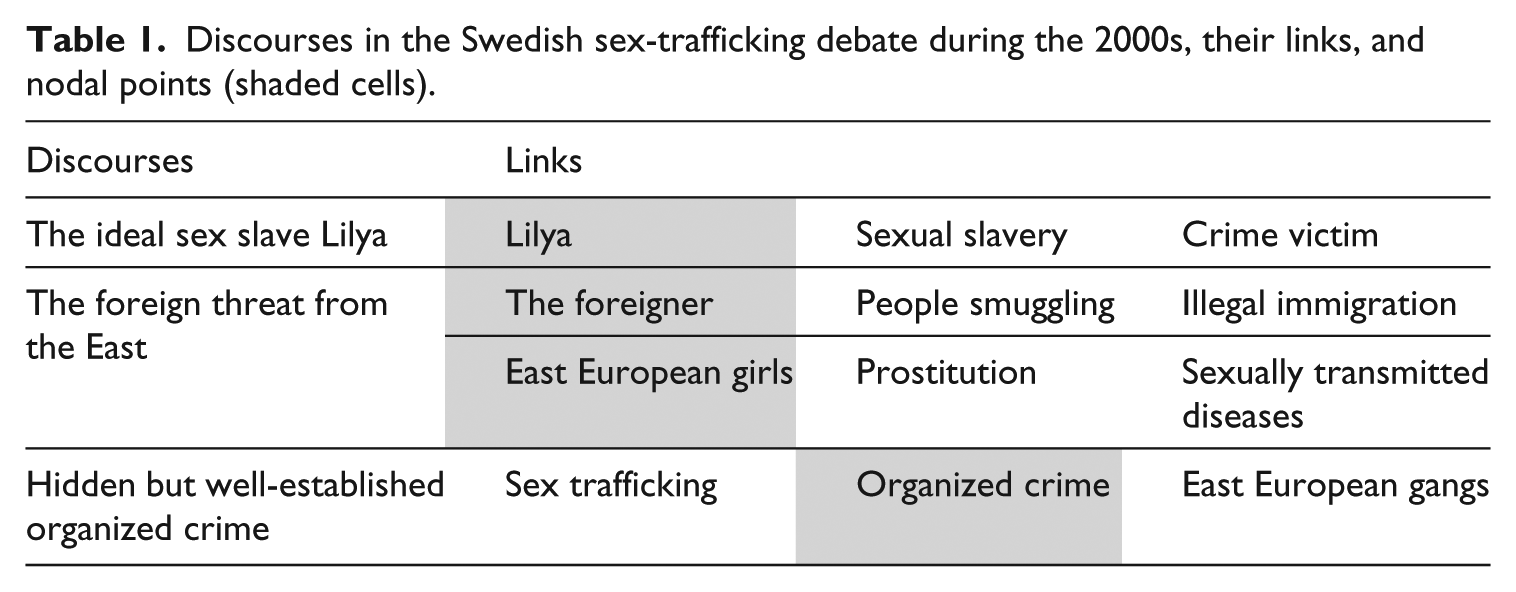
In this article, I have shown how a wide range of actors succeeded in pursuing a collective definitional process in which sex trafficking was established as modern-day slavery of the ideal sex slave Lilya, a foreign threat from the East, and as organized crime. The use of clichés of ‘sex slaves’, foreigners and organized criminals contributed to constituting sex trafficking as both a particularly important and a highly threatening problem. The sex-trafficking debate was nourished by the ongoing crime debate in Sweden during this period, which was focused on immigrants and organized crime. The influential crime victim and feminist movements in Sweden also provided an opportunity for claims-makers to create an ideal sex slave by reusing established narratives about men’s violence against women. As Table 1 shows, the three discourses have a different focus, but they are also somewhat interrelated. Lilya, from the first discourse, is associated with the East European girls found in the second. These East European girls are further linked to East European gangs in the third discourse. However, I would like to argue that, even though these three elements are related to one another, they belong to three separate discourses, as outlined in the table. Lilya is idealized and is primarily described as a sex slave and a crime victim. The East European girls are seen not as crime victims but as disease-carrying prostitutes. The East European gangs, while clearly linked to the sex trade, are described as evil, organized criminals.
Today, sex trafficking does not attract as much attention in Sweden as it did during the mid-2000s, when the problem became established. The police have continued to publish their annual reports on sex trafficking. A media database search shows that the newspapers are focusing less attention on sex trafficking today, even though a relatively large number of articles are still being written on the subject. The interest shown by parliamentary politicians in debating the subject has also declined; sex trafficking has been mentioned on only a handful of occasions over recent years and was mentioned three times as often during the 2000s. 4 At the same time, however, the successful establishment of sex trafficking as an important social problem has led to a range of proposals for countermeasures. The discourses on sex trafficking have also lived on and had an impact on the formulation of these measures. It would appear that the former interest in describing sex slaves, foreigners and organized criminals has now been supplemented, or partially replaced, by a focus on countermeasures (see, further, Heber, 2017).
During the 2000s, defining sex trafficking as a significant social problem in Sweden presented a formative moment for a large number of claims-makers working in politics, in the media and at government agencies and NGOs. With the help of sex trafficking, these claims-makers established an image of both diffuse threats (organized crime and modern-day slavery) and threats focused on clear stereotypes (Lilya and the foreigner). I would argue that these threatening images were maintained by means of dichotomies, which can be said to constitute the moral foundations (Lindgren, 1993) of the overarching sex-trafficking discourse, in that they specify the frames for the involved subjects and their actions:
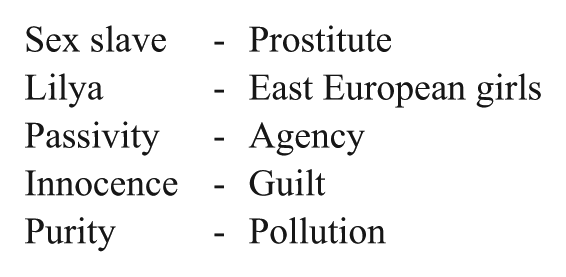
These moralizing dichotomies are based on gendered conceptions of women’s characteristics and actions as either good and pure or bad and polluted. I have also shown how women can be viewed as deceitful foreigners, which represents a challenge to the traditional Madonna/whore dichotomy.
The three discourses within the field of sex trafficking include a fear that foreigners will ‘illegally’ migrate to Sweden and establish themselves here, either as prostitutes or offenders involved in organized crime. This kind of transgression constitutes a threat to the borders between ‘us’ and ‘them’. The fear of foreigners includes both ‘East European girls’ and East European gangs, and this is expressed by means of the following dichotomies:
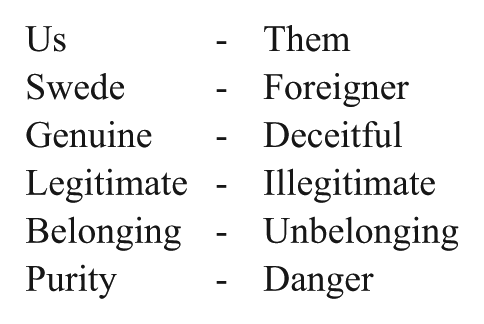
The discourses on sex trafficking give expression to a particular moral concern about boundary pollution. The bodies of foreigners become symbols for borders that are being broken and polluted, because the borders are personalized and made synonymous with the persons breaking them (see also Barker, 2013; Khosravi, 2010; Segrave, 2009; Weber, 2006). For women, who often constitute the central nodal points in the discourses on sex trafficking, moral purity appears to be the only way of presenting oneself as non-threatening. This can be achieved by behaving like an ideal sex-trafficking victim and by having the characteristics of this kind of victim. Such women may even be ‘rewarded’ with a short period of inclusion, by means of a temporary residence permit.
Thus, claims-makers in Sweden successfully constructed sex trafficking as a particularly threatening phenomenon by using stereotypes of sex slaves, foreigners and organized criminals. These clichés were further refined through the use of dichotomies. This process created a pressing social problem that achieved uptake on the political and media agendas. Sex trafficking thus seems to function as a morality tale, which verbalizes a concern about moral and bodily pollution from foreigners. The sex-trafficking discourses also serve to establish borders between innocence and guilt, between belonging and unbelonging, and between purity and danger.
Supplemental Material
Appendix_EUC – Supplemental material for Purity or danger? The establishment of sex trafficking as a social problem in Sweden
Supplemental material, Appendix_EUC for Purity or danger? The establishment of sex trafficking as a social problem in Sweden by Anita Heber in European Journal of Criminology
Footnotes
Appendix: Analysed material
Acknowledgements
I wish to kindly thank Ester Pollack, Janne Flyghed, Henrik Tham, Magnus Hörnqvist, Leandro Schclarek Mulinari and Polina Smiragina for many useful comments. Thanks also to David Shannon for translating the article and for many helpful suggestions. Finally, a warm thank-you to Monash University, the School of Social Sciences, and its staff, for allowing me to spend time in an inspiring environment as a visiting academic in 2015.
Funding
The author(s) disclosed receipt of the following financial support for the research, authorship and/or publication of this article: This work was supported by Ragnar Söderberg’s Stiftelse [grant no 1527501].
Notes

References
Supplementary Material
Please find the following supplemental material available below.
For Open Access articles published under a Creative Commons License, all supplemental material carries the same license as the article it is associated with.
For non-Open Access articles published, all supplemental material carries a non-exclusive license, and permission requests for re-use of supplemental material or any part of supplemental material shall be sent directly to the copyright owner as specified in the copyright notice associated with the article.
