




Abstract
This article comparatively analyses city-based prostitution policies and practices and their effects on sex workers in countries that have adopted a partial criminalization model of intervention towards prostitution – Belgium and Italy. The two case studies selected for this research – the cities of Antwerp (Belgium) and Catania (Italy) – were chosen for their adopted local approach towards prostitution in designated red-light districts (RLDs): whereas prostitution has been collaboratively governed in Antwerp, it has simply been tolerated in Catania. By considering the factors that have led to the development of prostitution policies and practices in these two cities, and their characteristics both within and outside the two cities’ RLDs, this article compares and analyses the effects produced on sex workers across city areas. The study revealed a number of similarities between the two local cases considered: local practices towards sex work in both cities have been shaped by urban regeneration in RLDs, and by concerns about nuisance and crime across city areas (irregular immigration and trafficking, in particular); in all instances, they have had similar exclusionary effects on sex workers – and especially on the migrant women among them. The study also identified two key differences in the practices towards prostitution adopted in these two cities: they differed in the level of access to support services offered to sex workers and in the pervasiveness of proactive police control. The article concludes by arguing that all these local practices – including the ones that are seemingly different – ultimately converge in their ethos: they reinforce the socially constructed status of migrant sex workers as either law-breakers or trafficked victims to be subject to control and, in the latter case, also protection.
Keywords
Introduction
Prostitution is a divisive social issue and, as a case of ‘morality politics’ (Wagenaar and Altink, 2012), its governance is often shaped by conflicting ideological and political positions on the problematic intersection of sex and money. Reflecting normative (and sometimes moral) views on the phenomenon and often with varying objectives, most European countries regulate prostitution according to one of the following models of intervention: some legalize it under certain conditions (strict regulations, for example, are adopted in Austria, Denmark, Germany and the Netherlands); others aim to abolish it by criminalizing clients (in countries that have adopted the abolitionist model, such as France, Norway, Iceland and Sweden); and yet others do not criminalize the selling and purchasing of sex but punitively sanction most prostitution-related activities as ‘illegal’ (for example, sex trafficking, procuring) or ‘anti-social’/‘uncivil’ (for example, loitering and public soliciting) – the latter mostly through administrative fines, which have recently witnessed a resurgence in some European countries (Di Ronco and Peršak, 2014; Peršak, 2017; Selmini, 2005, 2012; Selmini and Crawford, 2016; Villacampa and Torres, 2013; Villacampa, 2017). This last approach is often referred to as ‘partial criminalization’; it is adopted in England and Wales, Belgium, Italy and Spain, among others.
Laws ‘on the books’ often diverge from laws ‘in action’, and this is increasingly documented in the case of prostitution policies (for an example of prostitution and the public health sector, see Vorheyer, 2018). Policies as different as abolitionism, regulation and partial criminalization are variously implemented ‘on the ground’, with local authorities, administrators and enforcers adjusting their implementation according to contextual and localized factors, including the extent of the perceived type of problem(s) posed by prostitution, political interests, the organization of commercial sex and the composition of those involved in it.
The mismatch between what the formal national law on prostitution states and what is actually implemented at the local level is particularly evident in countries that have adopted partial criminalization models of intervention. Here the ‘partiality’ of the prostitution laws in place often leaves local authorities with ample room for manoeuvre in dealing with prostitution. This room for manoeuvre has often translated into the increased sanctioning of sex workers in specific city areas, with the ruling coalition using the law to its fullest extent to please the middle class and uphold its values and particular socio-spatial (heteronormative) moral order (Hubbard, 2004). More often than not, however, local authorities have also exploited legislative grey areas to tolerate sex work happening in certain parts of the city, including in socially deprived areas or informal red-light districts (RLDs) (Hubbard, 1997). This has usually translated into sex workers being allowed to work in certain areas without fear of being arrested by the police. Unfortunately, when tolerance is not accompanied by appropriately designed interventions, unsafe working environments for sex workers may be created, and tense relations between the latter and local communities may also be fuelled (for the example of Barcelona, see Sobrino Garcés, 2017).
In an attempt to provide an alternative to the development of such detrimental conditions, in the past two decades attempts have been made in a small number of European cities to develop alternative modes of governance that could be beneficial to the parties involved and affected. Local administrators, the police, residents’ groups, and third-sector and sex workers’ associations have thus come together in different contexts to establish partnerships and devise initiatives aimed at collaborating in the governance of prostitution at the local level. They have done so through the establishment of designated prostitution zones or ‘managed areas’ in non-residential parts of the city, where local stakeholders have worked together to improve sex workers’ safety as well as their physical, mental and sexual health (for examples in England and Wales, see Bellis et al., 2007; Brown and Sanders, 2017; Matthews, 2005; for examples in Belgium, see Boels and Verhage, 2016; Weitzer and Boels, 2015). These local collaborative initiatives in effect stand ‘outside the law’ in that they put in place systems of prostitution governance that contravene the terms of the national prostitution laws. Studies on these initiatives in managed areas or RLDs have tended to be critical (comparative) analyses (for example, Weitzer, 2014; Weitzer and Boels, 2015), with many of them critically examining their impact on sex workers’ safety and wellbeing (for the case of Leeds in the UK, see, for example, Brown and Sanders, 2017; Sanders and Sehmbi, 2015). What social, criminological and policy research seems to have relatively under-studied is, however, the relationship between these initiatives and the regulatory approaches to on- and off-street sex work in other city areas. The great impact that local policies and practices may have on the organization of commercial sex and on sex workers both in the RLD and across the urban territory calls for a combined and in-depth critical analysis. In this literature, moreover, there is a lack of comparative studies analysing the differences (if any) between local tolerance and collaborative governance of prostitution, in particular in terms of their produced effects on sex workers within and outside RLDs.
This article comparatively analyses city-based prostitution policies and practices and their effects on sex workers in countries that have adopted a partial criminalization model of intervention towards prostitution – Belgium and Italy. The two case studies selected for this research – that is, the cities of Antwerp (Belgium) and Catania (Italy) – were chosen for their adopted local approach towards prostitution in designated RLDs: whereas prostitution has been collaboratively governed in Antwerp, it has simply been tolerated in Catania. By considering the factors that have led to the development of prostitution policies and practices in these two cities, and their characteristics both within and outside the two cities’ RLDs, this article compares and analyses the effects produced on sex workers across city areas.
Methodology
Case studies selection
Case studies in Belgium and Italy were selected from among the local examples of prostitution governance and tolerance. 1 In Belgium, a renowned case of collaborative prostitution governance is that of Antwerp’s historical RLD, the ‘Schipperskwartier’ or Skippers’ Quarter, which was selected as a case study for this research. Since 1999, this RLD has been substantially renovated and regulated as a result of the coordinated interests of residents, social workers’ groups and the ruling coalition (Weitzer, 2014).
In Italy, there are a few and largely under-reported cases where street prostitution has been tolerated in specific city areas. Examples are provided by the city of Venice, where since 1995 street prostitution has been allowed in a particular city zone (Crowhurst et al., 2017) and by the San Berillo district of Catania, where indoor prostitution was allowed during the fascist era (when it was legal) and has since served as an RLD (Testaí, 2018). For its relatively long history as an RLD, Catania’s San Berillo district was selected as the second case study for this research.
Methods of data collection and analysis
This article is based on qualitative research involving 17 interviews with local stakeholders who have had a key role in the development or implementation of local prostitution policies and practices (see Tables 1 and 2 in the Appendix) and ethnographic observations in the two RLDs and surrounding areas. In Antwerp, five interviews were conducted: with the city prostitution officer; with the head of the special prostitution team of the police; and with three social workers from organizations supporting on- and off-street sex workers through harm reduction practices (Boysproject, FreeClinic, Ghapro). In Catania, 12 interviews were carried out: with two social workers from the city’s social services; with one civil servant from the public order unit; with six social workers from four third-sector associations (one from Trame, three from LILA, one from Penelope, one from Futura89 2 ); with two officers of the migration and prostitution unit of the police; and with one sex worker considered as a reference point for all sex workers in the RLD. Sex workers’ associations were not interviewed; at the time of the research, there were no associations locally active in Catania, and, in Antwerp, UTSOPI (a collective of sex workers mostly active in Brussels) was just starting a project with Ghapro.
The individual face-to-face interviews were semi-structured and involved the use of a list of pre-selected themes emerging from the research aim (that is, to explore the shaping factors and characteristics of local prostitution policies and practices, and their effects on sex workers within and outside the RLDs), which facilitated comparative analysis. The length of the interviews varied from 45 minutes to three hours. In two cases (one in Antwerp, one in Catania), the interviews also involved the use of the participatory research method of walking with respondents (O’Neill, 2017) in prostitution designated areas and other relevant areas. This helped the exploration in more depth of the meanings and emotions that respondents associated with the spaces of prostitution and their regulation. The anonymized interviews were recorded, transcribed and analysed through theoretical thematic analysis, which is driven by the research aims and questions.
To gain a more comprehensive understanding of the interpersonal and spatial dynamics of the chosen localities, ethnographic observations were carried out in the two RLDs for two consecutive weeks (28 January – 10 February 2019 in Antwerp; 11 – 24 March 2019 in Catania). During the observations, informal interviews were carried out with residents, businesses, sex workers, workers of third-sector associations and passers-by (28 in Catania, seven in Antwerp; total: 35); these conversations mostly addressed people’s perceptions of, and attitudes towards, the RLD and sex work. During the time of the fieldwork in Catania, stakeholders organized eight open events, seven of which explicitly focused on the history of San Berillo (three), sexuality (two) and migrants in Catania (two). I attended these events to get a better grasp of the history of San Berillo and of people’s attitudes towards sex and sexuality, the district and migrants. I decided to attend the eighth event (which was on environmental justice) because it was hosted by the association Trame in the RLD in the evening and therefore facilitated the observation of the district and the informal contact with inhabitants and passers-by during that time. As supplementary data, the research also relied on stakeholders’ websites (which proved useful, for example to gather visual material on Catania’s RLD; see Trame, 2017) and on documents provided by them (for example, annual reports by Antwerp’s police, the City of Antwerp, FreeClinic and Penelope).
The research provides original comparative empirical data on local approaches to prostitution that to varying degrees contravene the terms of the relevant national laws. However, this certainly suffers from some limitations, including the number of interviews conducted (17 in total), which was higher in Catania than in Antwerp (see Tables 1 and 2 in the Appendix), and only limitedly captured the voices of sex workers (only through interview No. 6 and informal interviews in Catania). Limitations are also present in the ethnographic part of the research. As illustrated below, Antwerp’s RLD is a single-use area devoid of communal spaces where people hang out, thus limiting the amount of time I could spend there each day. In Catania’s RLD, by contrast, observations and informal conversations were facilitated by the presence of the office and bar of an association (Trame) in the middle of the district. In Catania, moreover, I participated in a ride-along with a third-sector association, which allowed me to informally interview migrant street-based sex workers; events and ride-alongs were not made available in Antwerp.
Findings
The data gathered through interviews with stakeholders and ethnographic fieldwork in the two RLDs have been analysed through themes developed from the study’s research aims. In particular, the analysis centred on the local prostitution policies and practices adopted in Antwerp and Catania and considered the factors that led to their adoption, and their characteristics within and outside the RLDs, including their effects on sex workers.
Local prostitution policies and practices in the RLDs – shaping factors
Different factors have led to prostitution being collaboratively governed, in Antwerp’s RLD, and simply tolerated, in the RLD of Catania. In Antwerp, the redevelopment of the areas surrounding the RLD in the Skippers’ Quarter at the end of the 1990s offered the city and other stakeholders the opportunity to control the prostitution scene in its historical RLD. In that period, indeed, the Eilandje neighbourhood, which is the oldest dock area north of the Skippers’ Quarter, underwent substantial urban renovation, which included the construction of the famous Museum Aan De Stroom (or MAS). The very dilapidated Skippers’ Quarter, which is located between the city centre and the Eilandje, could not be avoided by tourists wanting to walk or bike from the centre to the MAS and vice versa, and had therefore to be renovated. As put by the city’s prostitution officer during their interview:
We knew that the MAS, the big museum, was coming so we couldn’t afford for it to be a no-go zone here, the Skippers’ Quarter; that’s why they said, ok, we will attract . . . tourists and make it a safe environment to travel through and to enjoy activities. (Interview No.1)
Before 1999, the area of the Skippers’ Quarter was, indeed, an infamous area, characterized by prostitution, run-down houses and black market stores (Loopmans and Van den Broeck, 2011). Window prostitution, in particular, was present in 17 streets and was practised in dilapidated houses with very poor hygiene conditions. At the time, in line with other studies on residents’ perceptions of nuisance in the RLD (Boels and Verhage, 2016), residents’ complaints mostly focused on the carousel of clients, who were cruising the streets and causing traffic jams, and on the aggressive soliciting practices thought to be adopted especially by migrant sex workers. 3
With the 1999 prostitution policy, sex work has been allowed in the Skippers’ Quarter only in the designated tolerance zone, which is marked by three streets: Vingerlingstraat, Schipperstraat and Verversrui. This decision was enforced through repressive police actions carried out in the early 2000s against both on- and off-street sex work, which resulted in the shutting down of all prostitution premises outside the tolerance zone. Following these repressive actions, the city began slowly to renovate public areas and also forced the owners of prostitution houses to restore their buildings. The urban renewal plan went together with the setting up by the city of enjoyable activities for tourists around the area, including a visit to De Ruien, which are the sewers and canals that have run under the city since the middle ages (Interview No. 1).
The urban upgrading ended up transforming the RLD: today, it is a pedestrian area mostly occupied by prostitution premises (interviewees Nos 1 and 2 indicated the presence of 312 windows in 69 buildings). Exceptions are the Cafè d’Anvers, a club open at weekends, and a restaurant and two pitta shops located on the fringes of the district where, under Antwerp’s policy (City of Antwerp, 2018), there cannot be windows for sex work. More bars, restaurants, hotels and clubs are found in the streets just outside the RLD. With a very few exceptions (including a few apartments rented to sex workers), there are no residential units in the RLD. One social worker (Interview No. 5) described the approach of the city in the Skippers’ Quarter as based on a ‘separation’ of the prostitution area from the rest of the neighbourhood and from its residential core in particular. Today, the RLD is ‘separated’ in the sense that it can easily be avoided by ‘respectable’ people who are not interested in purchasing sexual services or in entering the club Cafè d’Anvers at weekends. During the ethnographic fieldwork, not many residents (for example, carrying shopping bags, biking through the district or strolling in groups or couples) were observed in the RLD. The people observed were mostly men, who were identified by interviewee No. 5 as clients, ‘shopping boys’, boyfriends, managers and pimps. In addition, a few tourists (speaking different languages, biking in a group using the city bike-sharing system) were observed passing through the RLD.
Urban upgrading played a different role in Catania’s RLD, which will be illustrated later in this section. It is worth noting from the start that the reasons prostitution has been tolerated in the San Berillo district of Catania are mostly historical: during the fascist era (1922–43), prostitution in the district was legal if exercised in ‘tolerance houses’. Prostitution was also tolerated here after the adoption of the 1958 Merlin Law abolishing the previous regulation on indoor prostitution. In the past, when prostitution in the RLD had become ‘too visible’, with street sex workers soliciting outside the district, the city adopted punitive solutions, including the organization of a notorious police raid in San Berillo in the year 2000 (see below) and the issuance of administrative fines (this regulation was in force until 2018).
Urban regeneration plans were implemented in the district in the 1950s. Before then, the area of the RLD, which is currently marked by four streets (via di Prima, via Coppola, via di Sangiuliano and via Ventimiglia), was larger and also included other streets in the north of the neighbourhood, such as Corso Sicilia and Corso Martiri della Libertà (henceforth, Corso Martiri). Before the 1950s, this larger neighbourhood with Corso Sicilia and Corso Martiri was inhabited by low-income people as well as by the middle class. It was also characterized by the presence of craftsmen and various manufacturing activities (Trame, 2017). The socioeconomic configuration of the neighbourhood changed in the 1950s during its so-called ‘evisceration’ (Interview No. 8; Trame, 2017): San Berillo, which was described by politicians and the media as ‘infected’ and ‘unsafe’ (Interview No. 8), had to be restored for the purpose of making Catania the ‘Milan of the south’ (Gobbi, 2013; Testaí, 2018; Interview No. 14) – that is, more modern, with a financial district and arcades like Milan. This entailed the expropriation and demolition of buildings in Corso Sicilia and Corso Martiri, and many low-income residents were ‘deported’ (Interview No. 8; Trame, 2017) to the then newly built city’s western periphery known as San Leone. At the same time, the inner core of San Berillo – a rectangle made by the four above-mentioned streets – was left untouched by the urban regeneration plans of the 1960s. Prostitution continued to be carried on in this part of the neighbourhood, with empty buildings being occupied by, among others, sex workers from the late 1950s onwards.
Today, the district is characterized by the presence of many run-down buildings and high levels of social disorder (drug dealing, in particular). The district is a residential area for mostly migrant communities, and also accommodates a few economic activities, especially on its south-western edge. On its northern edge, Corso Sicilia showcases a number of brutalist buildings with banks and offices, and Corso Martiri is full of construction sites (it has been left unfinished since the end of the 1960s, when the area’s revitalization process was interrupted by a regional law – Interview No. 8; Gobbi, 2013). As suggested by interviewee No. 14, especially after the urban revamping in the mid-1950s, ‘San Berillo, its image has been removed from the public conscience . . . the buildings of Corso Sicilia are nice and elegant, but they hide the district, they express their contempt for the part behind’. As observed during the fieldwork, the RLD is not much visited by people from Catania, who tend still to consider it a problematic neighbourhood (for example, Interviews Nos 9 and 10 and informal interviews). However, this seems to be slowly changing, mostly thanks to the efforts of the association Trame, which organizes events to attract citizens to the district.
In summary
In both cities, prostitution has been allowed in enclosed RLDs, which are ‘separated’ from other areas visited by ‘respectable’ (white middle-class) people and are therefore easily identifiable and avoidable by them. Allowing prostitution within certain spatial confines (whether RLDs or brothels) to protect public morality is not new; it was one of the factors that led, among others, to the 19th-century French regulatory model (see, for example, Corbin, 1986).
In both the cities considered, moreover, urban regeneration of physically and socially deprived RLDs has played a key role in reducing the spatial boundaries within which prostitution has been tolerated or governed: in other words, both RLDs have been reduced in size as a result of the regeneration plans carried out. This has also happened to other vice districts, including one in Amsterdam after a recent new phase of urban regeneration (Aalbers and Deinema, 2012; Van Liempt and Chimienti, 2017).
Urban renovation in Antwerp additionally went hand in hand with the use of repressive police measures against sex workers working outside the three designated streets. The link between urban regeneration and punitive measures has been identified by previous studies, including in the research by Neville and Sanders-McDonagh (2018) on-street sex work at London’s Kings Cross and in Van Liempt and Chimienti’s (2017) analysis of Zurich’s RLD.
Along with reducing the size of the RLDs, urban renewal programmes have furthermore substantially transformed the areas surrounding the RLDs, although they did so in different ways. In Catania, the cleared spaces in Corso Sicilia were mostly occupied by offices, whereas in Antwerp they were replaced by residential units and entertainment and cultural venues (such as the MAS) that cater for the creative class (Florida, 2002) and knowledge workers – a development that is not uncommon in RLDs affected by gentrification (see, for example, Aalbers and Deinema, 2012). The architectural and aesthetic improvement of the areas surrounding the RLDs affected only Antwerp’s RLD, not that of Catania, which – not unlike other RLDs in Europe (for the example of Brussels, see, for instance, Weitzer, 2014) – is characterized by relatively high levels of physical and social deprivation.
Local prostitution policies and practices in the RLDs – characteristics
Antwerp’s 1999 prostitution policy was introduced with the two-fold aim of tackling prostitution-related crime and nuisance and of improving sex workers’ working conditions, health and wellbeing in the RLD (Interview No. 1). To address the problem of crime and nuisance, the city established a specialized prostitution team of 15 officers (at the time of the research) and an office in Villa Tinto (a brothel in the heart of the RLD). To tackle prostitution-related nuisance and ‘keep a safe and clean RLD’ (Interview No. 2), the city and the police also rely on the so-called ‘administrative approach’, which comprises a wide range of measures (as interviewee No. 1 suggested: ‘we always have a big stick in reserve so we can always do something’). The city, for example, fines house owners and managers if their facilities do not satisfy certain health and safety and hygiene requirements, and they can temporarily or permanently close prostitution houses for serious irregularities or the suspicion of sex trafficking (City of Antwerp, 2018). The police, for their part, carry out a ‘morality check’ on house owners and managers to ensure that they have no previous convictions or are suspected of being involved in illegal activities. They also record information on sex workers (including their nickname, contact details, face photo, and a photograph of their passport) in a database called pandkalender. Inspections by the police or city officials of prostitution premises can be carried out at any time, and can lead – in the event that irregularities are found – to their temporary or permanent closure (City of Antwerp, 2018).
In Antwerp in 2017, about 1513 window sex workers were recorded by the police in the pandkalender (Interview No. 2). All of them were, and needed to be, EU nationals: ‘In the windows, only nationalities of the Euro zone, Schengen, are allowed . . . they need to have the papers to work here’ (Interview No. 2). At the time of the research, sex workers were mostly from Romania and Bulgaria; only a few were from Spain, the Netherlands and Belgium (Interviews Nos 1 and 2).
There are many ways in which the police control the area, beyond the regular patrols in uniform or in plain clothes. They use CCTV cameras – including two newly installed high-performance surveillance cameras that leave no ‘blind spots’ (Interview No. 2) – to detect the presence of pimps or to investigate, for example, muggings happening within or just outside the RLD. Through the computer program FOCUS with facial recognition software, the police are also able to extract suspects’ images from footage and cross-check them with relevant databases (for example, the national ID and criminal records databases).
Antwerp’s prostitution policy is aimed not only at reducing prostitution-related crime and nuisance in the district but also at improving sex workers’ health and wellbeing. To do this, the city has partly funded three social workers’ organizations, one of which (Ghapro) is situated in the RLD and provides support services for sex workers. Social workers in these three organizations use harm-reduction practices to improve the health and the more general wellbeing of sex workers. They do outreach and organize various activities during regular drop-ins, which according to the interviewees (Nos 3, 4 and 5) tend to be relatively well attended by sex workers. The city and the police meet regularly with these three associations, mostly to discuss shared issues and aggregated data. In all the interviews, cooperation was identified as an important element of the local prostitution policy. However, social workers see the policy as dominated by the views of the police and the city, which mostly focus on a ‘safety discourse’ and are less responsive towards ‘the social situation behind it’ (Interview No. 3). This emphasis on crime and nuisance, together with the lack of political will to introduce a system that recognizes sex workers’ social security rights (pension, unemployment benefits, family benefits, healthcare, sickness, maternity, etc.), was confirmed by the city prostitution officer (Interview (No. 1). This decision was justified in the light of the national legislative framework on prostitution, which allows municipalities to regulate prostitution only insofar as it affects public order (‘yes, it’s not our problem because nuisance and public order it’s our issue’ – Interview No. 1). Notwithstanding the limited local competence on prostitution, other Belgian cities seem to have envisaged systems that recognize sex workers’ social security rights (for the example of Ghent, see Weitzer and Boels, 2015).
In contrast to Antwerp’s prostitution policy, where the city has played a pivotal role, in Catania the city has shown no interest in governing sex work or in improving sex workers’ health and safety conditions (the city is mostly ‘absent’, Interview No. 10). The city has only periodically cracked down on the nuisance of sex work, for example in 2000 to tackle the problem posed by the ‘too visible’ presence of sex workers of various nationalities outside the RLD. As the police put it, at the time ‘there was the political will to stop prostitution, which was concerning because women went out of San Berillo to solicit clients and were very visible’ (Interview No. 15). All interviewed actors suggested that sex workers went through police checks, with many of non-EU sex workers being arrested and deported if found without a regular visa. As a result, only ‘sex workers with a tenancy agreement or property stayed’ (Interview No. 9). Consider, for example, the following quote:
Then we had the famous raid of 2000. The police came with the army, the soldiers . . . there were even helicopters. But the situation was unmanageable, prostitutes
4
were everywhere, also outside [the district], they were too visible. Then they took it out especially on non-Europeans. Many of them ran away, many were deported if they did not have all their papers in good order. (Interview No. 6)
After this raid, some buildings were seized and others were boarded up or locked to prevent sex workers and homeless people from accessing unsafe buildings. After the raid in the early 2000s and for four consecutive years, the association LILA established a drop-in office in San Berillo to provide mostly health support to sex workers. At that time, they recorded the presence of around 50 sex workers (mostly Italians and Colombians with regular visas) in the district (Interviews Nos 9 and 10). This pilot project, which was funded for four years, did not obtain additional funding: according to one of the social workers interviewed (No. 10), this has to do with the more recent emphasis in funding schemes on sex trafficking, rather than harm reduction, which has ‘disappeared from the language of these schemes’.
The association Penelope currently organizes outreach activities for sex workers; however, it does so only in the city centre outside the RLD and on the main highways (Catania – Lentini/Catania – Gela) where potential victims of trafficking/exploitation are thought to be present. This association is, indeed, funded mainly to facilitate the identification and protection of victims of sex trafficking. Outreach social workers working with Penelope have reported making attempts to reach out to sex workers in the RLD; because these had not been well received by sex workers, the decision was made to avoid the RLD during outreach activities. As a result, health checks are no longer freely available in San Berillo; it is now up to the individual sex worker to get health checks at the hospital, if they want to (Interview No. 6).
Currently, the number of sex workers in the neighbourhood is thought to be around 50: they are all Italian and mostly middle-aged, some are transgender; they all have a regular tenancy agreement or own property in the district (Interviews Nos 6, 7, 15 and 16). According to the interviewed sex worker and third-sector associations, the police presence in the district is very high. Consider for example the following:
The police are always here. To make themselves seen, to control. . . . Today they have entered [the district] with horses. . . . The local police also control, they’re always there. They speak to the prostitutes, but do nothing. . . . Now they undertake raids against drug dealing. (Interview No. 7)
Also, according to the police officers from the migration and prostitution unit (Interviews Nos 15 and 16), the police carry out regular patrols in the district, mostly to check on a group of Gambian men dealing drugs and on squatters in occupied buildings, rather than on sex workers, who no longer represent a problem for them. During fieldwork, local and mounted police were seen in the area on three different days.
In summary
Local policies and practices in the two RLDs of Antwerp and Catania differ substantially. Whereas Antwerp has designed a prostitution policy aimed at tackling crime and nuisance and at improving sex workers’ health and wellbeing, Catania simply tolerates sex work happening in its historic RLD and tends to offer limited health support to sex workers working there. In Catania, in particular, support services are mostly offered outside the RLD, where trafficked victims are thought to be present (see also the next section).
Similarly to other RLDs in Europe (Aalbers and Deinema, 2012; Van Liempt and Chimienti, 2017; Weitzer, 2014; Weitzer and Boels, 2015), only sex workers of European nationality or with a regular visa have been tolerated in the two RLDs. This has been the result of repressive police actions carried out around the year 2000 to facilitate urban regeneration (in Antwerp) and to deal with ‘too visible’ sex workers (in Catania). The findings of this study also indicate the presence of regular police patrols in both RLDs: whereas in Antwerp they aim at controlling commercial sex and its related crime and nuisance, in Catania they mostly target drug dealing. The very intrusive control strategies implemented by Antwerp’s police are worth noting here: they encompass not only sex workers’ mandatory registration in police databases (also targeted in other RLDs such as those in Ghent,– see Weitzer and Boels, 2015, – and in other cities in Europe – see, for example, Chimienti and Bugnon, 2017) but also tight surveillance in the RLD through high-performance CCTV cameras and facial recognition technology.
Local prostitution policies and practices citywide – characteristics
Outside Antwerp’s RLD, prostitution tends to be tolerated in non-public spaces such as hotels, apartments and erotic premises – at least as long as sex workers are 18 or over and are EU nationals or holders of a valid visa. Off-street sex workers are mostly identified by Antwerp’s police thanks to, for example, neighbours’ complaints or a computer program that identifies the online profiles of ‘vulnerable’ migrant women, who are considered more likely to be trafficked victims (such as ‘young Nigerian or Chinese’ women ‘who cannot speak Dutch or English but [publish an] advertisement . . .written in perfect English and . . . [who do not] have a phone’, Interview No. 1).
Identified sex workers are approached by the police pretending to be clients and are then recorded in the police database during an administrative inspection carried out in tandem with the city. During these administrative inspections, the regular status of migrant sex workers is also carefully checked by the police (for example: ‘sometimes when they are illegal – we are still police so we have to do our job – . . . it has to be investigated whether they can stay in Belgium or not’, Interview No. 2). If these inspections of sex work taking place in hotels, massage parlours or other erotic premises reveal the presence of minors or suspected victims of sex trafficking (such as ‘Chinese women . . . in Asiatic massage parlours’, Interview No. 1), then the administrative approach adopted by the police may be rather repressive and lead to the closing down of the private premises in question. As the police and the city put it (Interviews Nos 1 and 2), prostitution premises outside the RLD are mostly shut down on suspicion of trafficking or for financial irregularities – rather than for sex trafficking, which is a very difficult offence to prove (it requires victims’ cooperation, which is often lacking). Actions against sex trafficking have been carried out by a task force set up by the city, the police and the financial investigation unit (often in addition to the prosecutor’s office, the youth investigation team and labour inspectors). According to one social worker (Interview No. 5), the strong controls on erotic businesses, the high risk of their being charged with the offence of procuring and the impossibility of getting a bank loan and getting their premises insured have likely led these businesses to leave the city – with the result that social workers are losing their contact with sex workers.
In Catania, the focus of the police is on tackling irregular immigration and sex trafficking/exploitation. According to the interviewed police officers:
Checks on-street-based prostitutes are carried out especially by the immigration unit of the police. If there are irregularities, then these are investigated. For instance, the fact that they have the right documents etc. . . . We are an investigative police body so the objective of our actions is the eradication of big criminal incidents, such as sex trafficking and exploitation. Therefore the two areas of our interest, when we talk about the phenomenon of prostitution, are trafficking and irregular immigration. (Interview No. 15)
When dealing with cases of trafficking, the police coordinate their actions with the members of a multi-agency counter-trafficking network, which is made up of law enforcement bodies (including the public prosecutor’s office, the police, the juvenile courts and the Territorial Commissions for the Recognition of International Protection), international associations (such as the International Organization for Migration) and third-sector associations supporting victims (including Penelope and Futura89). The interviewed actors who were also members of this network (Nos 13, 15, 16 and 17, and one leading public prosecutor informally interviewed during fieldwork) stressed the key role played by this network in allowing for the successful identification, investigation and prosecution of organized networks and for the protection of victims.
Street-based sex work in Antwerp (and in Catania until 2018) is prohibited by the local police regulation, as is prostitution in bars, which for them creates a public nuisance (City of Antwerp, 2018). According to the city and the police (Interviews Nos 1 and 2), street sex workers tend to be female Belgian addicts working around the train station, and Bulgarian and Romanian women. Street-based sex workers, and, more recently, their clients, have been targeted with repressive actions by the police, which include administrative fines, administrative detention and place bans issued after the fifth fine, and the use of immigration law when found without a regular visa (Interview No. 2). The police seem to be more lenient towards mostly Belgian street sex workers who have a serious drug addiction. In these cases, fines are cancelled if they agree to go on a rehabilitation programme (zorgprogramma), although this very rarely works according to one of the social workers (Interview No. 4). The practice of encouraging sex workers’ self-governance through techniques of responsibilization, which further excludes – through penalization – the ‘irresponsible’ ones who do not adopt ‘normal’ lifestyles, obviously resembles Scoular and O’Neill’s (2007) critical analysis of New Labour’s multi-agency partnerships to extricate women from prostitution in England (see also Sanders, 2009; Neville and Sanders-McDonagh, 2018).
Because of the repressive actions carried out by the police from the early 2000s, street sex workers in Antwerp are thought to have decreased (they currently number about 50 and mostly work around the central station). Yet they have not disappeared – they are only more difficult to identify by social workers (Interview No. 4). In addition, as suggested by one social worker (Interview No. 4), for sex workers ‘it’s more dangerous now, because [the situation] is not controlled, nobody is watching over them’. The higher risk of being caught by the police, coupled with the addiction problems many of them have, makes them work at cut prices (often for €10), engage in unprotected sex, and be exposed to violence from clients (Interview No. 4). Repressive police actions on the streets have also led sex workers, especially non-EU migrant sex workers without a visa, to move indoors and use online websites and apps, thus making it much harder for social workers to reach out to them. When commenting on Antwerp’s prostitution policy, one social worker suggested:
[I]t pushed some sex workers to the margins, and even with the best intentions . . . . Trying to control too much is always pushing people more to invisible spaces, like rooms, apartments, the Internet, where of course for us as a social organization it is more difficult to reach them. (Interview No. 3)
In Catania, on-street sex workers are mostly thought to be migrant women exploited by organized networks: they are thought to be Bulgarians and Romanians in the city centre and mainly Nigerians along the two main highways (Interviews Nos 13, 15 and 16). All these areas are subject to police patrols and outreach activities by the association Penelope. Informal interviews conducted during a ride-along with a third-sector association on the Catania–Lentini highway revealed the perceived high presence of the police in all prostitution areas by sex workers and their great fear of being arrested and deported.
In summary
Outside the two cities’ RLDs, sex work is tightly controlled through a combination of public order regulations, immigration laws and multi-agency networks tackling sex trafficking and exploitation. As emerged from both formal and informal interviews, and in line with the existing literature on the local implementation of different prostitution policies (Hubbard et al., 2008; Scoular, 2010), police controls have displaced sex workers into less visible and less safe places, where they are more difficult to identify and to be accessed by support services.
In Antwerp, for example, tight proactive police controls over the indoor prostitution market have been based on the identification of ‘vulnerable’ profiles of migrant women through an automated screening of online advertisements and checks on their identity during on-site administrative inspections (for similar police strategies in some of the Nordic countries, see Jahnsen and Skilbrei, 2017; Vuolajärvi, 2019). Police inspections of migrants working in erotic businesses in Antwerp have often led to the closure of the latter on suspicion of sex trafficking or financial irregularities (see van Liempt and Chimienti 2017 for similar practices in Amsterdam’s RLD). This has been deemed to have caused the substantial reduction in the number of erotic businesses in Antwerp and the displacement of sex workers working in them to other cities (Interview No. 5).
Street-based sex work in Antwerp, and until 2018 also in Catania (see above), is tackled through fines to protect the public against public nuisance. In both cities, moreover, on-street sex work has been addressed by the police through identity checks and the application of immigration laws (for similar practices in some of the Nordic countries, see Jahnsen and Skilbrei, 2017; Vuolajärvi, 2019). These police strategies against street-based sex work are said to have decreased the safety of sex workers (Interview No. 4) and motivated some to move online and indoors (Interview No. 3). In addition, according to street-based migrant sex workers informally interviewed in Catania, these practices have also increased their fears of being checked by the police, and of being arrested and deported when found without a regular visa. A similar effect was also noted by sex workers in Spain after the adoption by many cities of punitive civic ordinances (see Villacampa and Torres, 2013; Villacampa, 2017) and in Finland, Sweden and Norway for the police use of immigration law (Vuolajärvi, 2019).
Among the sex workers who seem to bear the brunt of such punitive policing practices, there are migrant women working both on- and off-street in both cities who are subject to intense surveillance. Similarly to other European contexts identified in the literature (Hubbard, 2004; Jahnsen and Skilbrei, 2017; Vuolajärvi, 2019), tight police surveillance of migrant sex workers has been justified in the light of the need to protect victims of organized networks and the public from nuisance and crime – where the latter category also includes irregular immigration. In essence, migrant sex workers are closely scrutinized both for their (possibly irregular) migrant status and for being considered likely victims of trafficking. By embodying the potential law-breaker and/or the victim of organized crime, migrants have come to represent a threat to core national moral values (Hubbard, 2004; Kulick, 2003); as such, they have been considered to be in need of special monitoring. The focus on trafficked victims is also evidenced in the offer of support services in Catania, where harm reduction practices have mostly targeted areas with suspected victims of trafficking – not, for example, the RLD with mostly domestic sex workers. This is an interesting and rather unusual practice for support services, which can be explained by the specific aim of the funding awarded to the association Penelope in Catania: that of supporting trafficked victims.
Discussion
The results of the comparative analysis revealed very similar practices in relation to sex work across Antwerp and Catania and similar negative effects on sex workers. Not unlike the findings of previous research on the local implementation of different national prostitution policies (Hubbard et al., 2008; Scoular, 2010), local prostitution practices in these two cities have also resulted in the displacement of sex workers – and especially of migrants among them – to less controlled and thus riskier spaces, less accessible to support workers.
In particular, the comparative analysis allowed for the identification of two factors that have played a role in shaping local prostitution policies and practices, which have also been highlighted in previous literature (for a review, see, for example, Laing and Cook, 2014). These factors are: urban regeneration and police controls carried out on three legal grounds: public order, immigration laws, and suspicion of sex trafficking/exploitation.
Urban renewal programmes have, for example, reduced the size of both RLDs, making them avoidable and inclusive only for domestic sex workers and those holding a valid visa. In addition, as shown by the case of Antwerp, tight police control is accomplished through sophisticated surveillance technologies.
Visible prostitution outside the RLDs has also been viewed as a problem, because it creates a nuisance for ‘respectable’ groups. The police regulated the nuisance of on-street sex work through administrative fines and place bans (especially in Antwerp), as well as through the use of immigration law. Immigration laws have been employed not only against on-street sex workers, but also against migrant women working indoor. It is worth noting that off-street migrant women holding a regular visa have also been subject to tight police supervision. This is shown, for instance, by the case of Antwerp, where massage parlours and other private premises have been shut down on suspicion of trafficking or financial irregularities. In line with previous studies (Chimienti and Bugnon, 2017; Hubbard, 2004; Jahnsen and Skilbrei, 2017; Vuolajärvi, 2019), although the police seem to be more tolerant towards domestic sex workers (especially when working discretely and independently indoors), they heavily scrutinize on- and off-street migrant women both for their migrant status and to protect them from organized crime.
Although local prostitution practices have significant similarities, they differ in the access provided to support services for sex workers and in the level of pervasiveness of proactive police controls. These differences are, however, nothing more than an uneven expression of an idea that is seemingly deeply embedded in local prostitution practices: migrant women sex workers – either as victims of trafficking (who need protection and support) or as law-breakers (when irregularly present on the national territory) – deserve special attention and regulation by the relevant local authorities. In Antwerp, for example, support services have been offered to sex workers throughout the city space, not only in the areas outside the RLD where suspected victims of trafficking have been thought to be present, as happened in Catania. The limited offer of support services in Catania has to do with the nature of the funding awarded to the relevant third-sector association, which focuses on protecting trafficked victims (not sex workers in general). In Antwerp, support for sex workers across city areas is, however, also accompanied by very pervasive proactive police control, which is tighter here than in Catania. As illustrated above, among the police practices that have taken a heavy toll on migrant women sex workers in particular, there are mandatory registrations, computational searches through online advertisements to identify ‘vulnerable’ women, and controls on erotic premises run by ethnic groups, often leading to their closure. These tight police controls evidence the key role played by the police (in addition to the city) in Antwerp’s governance of prostitution across city areas, which has resulted in the prioritization of prostitution-related crime and nuisance over sex workers’ safety. This is quite unusual if compared with other local examples of collaborative prostitution governance in RLDs, where police control tends to be less harsh and mostly aimed at ensuring sex workers’ safety (see, for example, Bellis et al., 2007; Brown and Sanders, 2017).
Concluding thoughts
The study presented here comparatively analysed local prostitution policies and practices in the cities of Antwerp and Catania, where prostitution has been, respectively, collaboratively governed and simply tolerated in RLDs. The research analysed the prostitution policies and practices adopted both within and outside the prostitution designated areas, and considered their effects on sex workers.
In spite of the different policy approaches adopted towards prostitution in the RLDs, the study revealed a number of similarities between the two local cases considered here: local practices towards sex work have been shaped by urban regeneration in RLDs, and by concerns about nuisance and crime across city areas (irregular immigration and trafficking, in particular). In all instances, they have resulted in similar exclusionary effects on sex workers – and especially on migrant women among them.
The study also identified two key differences: the two cities provided different levels of access to support services for sex workers and showed different levels of pervasiveness of proactive police controls. Access to support services was more limited in Catania, where it was guaranteed only in outdoor spaces thought to be attended by migrant sex workers. Proactive police controls were especially present in Antwerp, with the police carefully checking on sex workers (including their passport and visa) both in the RLD and in other indoor premises across all city areas.
These differences nonetheless reflect an uneven expression of the same idea: that migrant sex workers need to be carefully monitored because they may potentially be law-breakers (by being irregularly present on the national territory) or be victims of trafficking (in which case they must also be supported). Following this and other recent studies (Jahnsen and Skilbrei, 2017;Vuolajärvi, 2019), future criminological research should extend this line of enquiry and account for the differing ways in which local policies and practices are implicated in reproducing borders at the local level, thus further marginalizing and endangering migrant sex workers.
Footnotes
Appendix
List of interviewees in Catania.
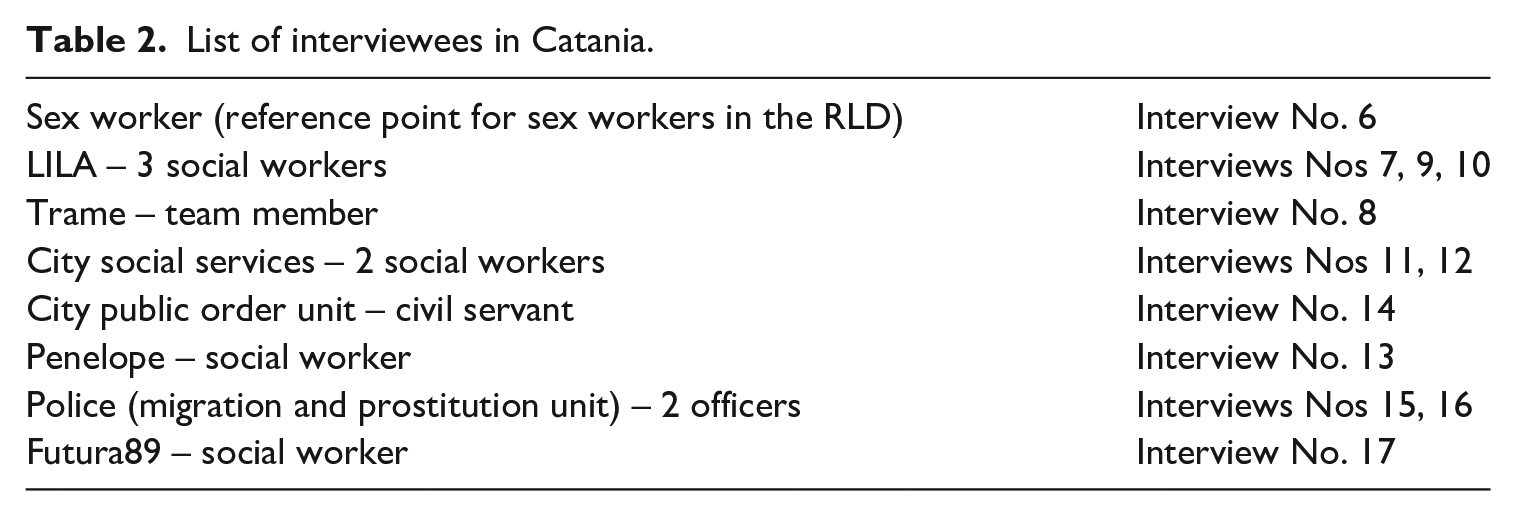
| Sex worker (reference point for sex workers in the RLD) | Interview No. 6 |
| LILA – 3 social workers | Interviews Nos 7, 9, 10 |
| Trame – team member | Interview No. 8 |
| City social services – 2 social workers | Interviews Nos 11, 12 |
| City public order unit – civil servant | Interview No. 14 |
| Penelope – social worker | Interview No. 13 |
| Police (migration and prostitution unit) – 2 officers | Interviews Nos 15, 16 |
| Futura89 – social worker | Interview No. 17 |
Acknowledgements
I would like to thank the two anonymous reviewers for their constructive feedback on the manuscript. A special thanks goes to my colleague Isabel Crowhurst for her feedback on the project’s early versions, and to Teresa Consoli, Deborah De Felice, Maarten Loopmans, Carlo Pennisi, Magaly Rodriguez Garcia, Fiamma Terenghi and Patrizia Testai for our insightful conversations on Antwerp or Catania and their help in contacting relevant third-sector associations in these two cities.
Funding
The author(s) disclosed receipt of the following financial support for the research, authorship, and/or publication of this article: This research was funded by The Sociological Review Foundation Kick Start Grant.
