




Abstract
This article discusses findings from a project funded by the European Commission’s DAPHNE III programme that sought to enhance the provision of relationship education and domestic abuse prevention in European schools and other educational facilities: the REaDAPt (Relationship Education and Domestic Abuse Prevention tuition) project. It summarizes what is known about effective prevention from the research literature before explaining what the REaDAPt project revealed about changing attitudes, about implementing and evaluating domestic abuse prevention programmes in educational settings, and about being responsive to young people’s perspectives in the delivery of interventions. The article concludes by highlighting the iterative nature of the research needed to help develop relationship education and domestic abuse prevention tuition on a Europe-wide scale.
Introduction
This article discusses findings from a project funded by the European Commission’s DAPHNE III programme that sought to enhance the provision of relationship education and domestic abuse prevention tuition in European schools and other educational facilities. It begins by outlining the policy context in which preventative interventions have come, recently, to be regarded as integral parts of national strategies to eliminate violence against women and children – the issue having hitherto been conceived principally as a criminal justice problem in most European countries. It then summarizes what is known about effective prevention from the research literature before setting out what was found in the REaDAPt (Relationship Education and Domestic Abuse Prevention tuition) project. As we will explain, these findings pertain not only to what works in terms of changing attitudes, but also to discoveries about: the challenges involved in implementing and evaluating domestic abuse prevention programmes in educational settings; conceptualizing the nature of attitudinal change; and being responsive to young people’s perspectives in the delivery of interventions.
The last five years have seen the launch of a proliferation of policy initiatives aimed at ‘eliminating’ violence against women and children in Europe and delivering on Articles 23 and 24 of the EU Charter of Fundamental Rights (European Parliament, 2000) and earlier commitments under the United Nations’ Convention on the Rights of the Child (United Nations, 1989) and Declaration on the Elimination of Violence against Women (United Nations, 1993). In advancing ‘Dignity, integrity and an end to gender-based violence’, the European Commission’s 2010–15 Strategy for Equality between Women and Men is one such example (European Commission, 2011: 23). Others include: the European Commission’s Women’s Charter, which advocates ‘a comprehensive and effective policy framework to combat gender-based violence’ (European Commission, 2010: 5); the New European Pact for Equality between Men and Women, which stresses the role men and boys should play in prioritizing action to combat violence against women (Council of the European Union, 2011); and the European Parliament’s Resolution of 29 November 2009 on the elimination of violence against women (European Parliament, 2009).
In most, if not all, of the countries of the European Union, the primary response to these commitments has been a twin track one. On the one hand, measures have been taken to bring perpetrators to justice through, for example, the creation of new laws, improved police responses to reported incidents, changing the ways in which courts handle domestic violence cases, and developing specialist perpetrator programmes. On the other hand, services have developed to protect victims, not only through the provision of refuges and other forms of secure accommodation, but also through safety planning, risk management, civil remedies that prohibit suspected perpetrators from contacting victims, and the provision of counselling, support and confidential advice that assists adult victims to cope with the process of going to court and to rebuild their lives.
Although the viability of effective criminal justice responses appears to vary from place to place (Fábián, 2010), there is no denying the need to do more to prevent the onset of abusive behaviours and/or relationships in the future. Arrest, prosecution and attendance at perpetrator programmes, for example, may help some reduce their offending (Buzawa and Buzawa, 1996; Gilchrist, 2012; Gondolf, 2000; Westmarland and Kelly, 2012), but they do nothing to stop some young people from becoming abusive in their first relationships. The European Parliament’s Resolution of 29 November 2009 on the elimination of violence against women acknowledges this limitation by calling not only for improved ‘national laws and policies’ to tackle perpetrators and ‘assistance . . . to voluntary bodies and organisations which offer shelter and psychological support to female victims of violence’, but also for ‘measures to prevent gender-based violence among young people by providing for targeted education campaigns’ (European Parliament, 2009: 4–5).
Investments made in targeted education campaigns have the potential to reduce the incidence of domestic violence among subsequent generations of adults and to enhance the effectiveness of existing measures designed to safeguard victims and deter perpetrators. Most existing measures rely, to greater or lesser degrees, on the capacity to mobilize communities to support victims, call the police and provide evidence against perpetrators. And yet, despite increasing condemnation of domestic violence, most Europeans remain ill informed about the remedies available in their countries for victims. A recent Eurobarometer survey reveals that a substantial minority still think victims are sometimes to blame for their victimization (TNS Opinion & Social, 2010). One-third of the British, French and Spanish wrongly believe their countries to have no laws whatsoever pertaining to domestic abuse. Even higher proportions of the population hold this view in Germany, the Netherlands and Italy. Nine out of 10 Europeans think that domestic violence is caused by alcoholism or drug addiction. Half regard the ‘provocative behaviour of women’ as part of the aetiology of domestic abuse (TNS Opinion & Social, 2010: 68–71). In Britain, at least, tolerance of domestic violence appears to be greater among young people than among adults (Scottish Executive, 2002). Studies conducted in the US underline the importance of intervening in the early teens, before attitudes become crystallized, stable beliefs about aggression often predicting bullying forms of behaviour (Foshee and Reyes, 2009; Huesmann and Guerra, 1997).
One of the most consistent findings about domestic abuse prevalence in Europe is that younger groups of women face enhanced risks of victimization relative to older women. Research in the UK, Malta, Sweden and Spain shows that women in their late teens are typically twice as likely as women in their fifties to have suffered a partner assault in the past year (Lundgren et al., 2001; Smith et al., 2011; Fsadni and Associates, 2011; Walby and Allen, 2004; Zorilla et al., 2010). Research in Germany and Lithuania finds women in their twenties to be at four times greater risk than women in their fifties (Schröttle et al., 2006). Studies specifically of teenagers in the UK suggest the peak age of victimization may well pre-date adulthood. Barter et al. (2009), for example, found that 88 percent of young people aged 13–17 had been in some form of intimate relationship. Of these, a quarter of girls and 18 percent of boys reported some form of physical partner violence being used against them.
Evaluations conducted in the US show that schools-based interventions can change both attitudes and even behaviour, as measured by self-reported victimization and offending (Foshee et al., 1998; Jaycox et al., 2006; Whitaker et al., 2006). Such research, however, is incredibly difficult to replicate, especially with regard to measuring behaviour after intervention. Hence, most of the European studies – most of which are UK based – on this subject focus less on whether attitudinal change was secured and more on whether young people enjoyed taking part or retained key pieces of factual knowledge (Bell and Stanley, 2005; CRG Research, 2009; Hester and Westmarland, 2005; Scottish Executive, 2002; Stanley et al., 2011). Results gauged in these terms are usually positive, but suggest that boys are less readily engaged than girls – a significant shortcoming given the greater likelihood of boys becoming perpetrators in the future (Mullender et al., 2002)
For researchers, the problem is that certain conditions need to be met before it is worth investing in tightly controlled experimental or randomized controlled designs; that is, there needs to be a well-established, properly manualized programme; good reason to think that the programme is having desired effects and is as good as it can be; a significant commitment from teachers, headteachers and government officials to ensure that the intervention will continue to run as intended; and a strong possibility of the intervention being rolled out more widely if found to be effective (Strang and Sherman, 2012). Unfortunately, in many European countries domestic abuse education programmes are currently delivered too inconsistently, with litle guarantee of continuity to justify experimental research designs. In the UK, contracting in from a market of ‘packages’ is commonplace (Ellis, 2004). This, unfortunately, can encourage a short-term approach to intervention development and may discourage teachers from developing the skills needed to deliver domestic abuse education themselves.
The REaDAPt project
It was within this unstable context that the REaDAPt (Relationship Education and Domestic Abuse Prevention tuition) project was formed. Intially, we were approached by a charity called ARCH, which is contracted to deliver a ‘healthy relationships’ programme called Relationships without Fear (RwF) in Staffordshire, England. Using one-hour sessions delivered once a week over a six-week period, RwF teaches primary and secondary school students about different forms of abuse, how to identify power and control within a relationship, the difficulties victims face when trying to leave abusive relationships, and strategies for seeking help and support. When ARCH approached us about developing an evaluation of this intervention, the RwF programme was in its sixth year of implementation. An attempt had been made to assess whether the programme changed students’ attitudes, but the questionnaire the programme facilitators had developed themselves was too rudimentary to answer this question, leaving the programme vulnerable to closure once its contract was put back out to tender.
As we began to develop a proposal for European Commission funding to evaluate the RwF programme, we were approached by other projects in a similar position. We formed a partnership with the Directorate General for Gender-based Violence Prevention, Youth Affairs and Juvenile Crime in Murcia, Spain, who were attempting to consolidate their schools-based programme La Máscara del Amor (LMdA) – The Mask of Love. This programme was typically delivered to students aged 13–21 (though the majority are 15–17) by school teachers who are provided with a two-day training course. Its focus is explicitly on ‘gender-based violence’, as is required by law in Spain, and addresses: the different types of abuse, how to recognize a perpetrator, and what people mean when they talk about ‘jealousy’ and being ‘in love’. Prior to participating in the programme, students have to read the book The Private Hell of Marta (Alapont and Garrido, 2011), which tells the story of a female university student who experiences domestic abuse from a controlling male partner. The story is discussed over six one-hour sessions, alongside presentations and short films that depict domestic violence situations. This programme too was in need of a more robust evaluation than had hitherto been provided.
As our application took shape we were joined by three further partners: the Malta Regional Development and Dialogue Foundation, which had an interest in developing domestic abuse prevention for the very first time in Maltese schools; 1 academics in the University of Linköping who had an interest in exploring the challenges of delivering evidence-based practice as it applies to responses to violence; and a regional branch of the French Women’s Federation, Association Du Côté des Femmes de Haute-Garonne, which delivers a programme called Filles et Garçons, en route pour l’égalité (FeG) – Girls and Boys, Let’s Go for Equality. Like the Spanish programme, this intervention adopts an explicitly ‘gender-based’ perspective, but is much more constricted in terms of the time spent with young people. The national curriculum in France is prescribed by central government and does not require schools to provide domestic violence or healthy relationship education. Consequently, FeG workers were confined to delivering one or two 60–90 minute sessions either in secondary schools, where teachers permitted it, or in vocational training centres, where the curriculum is less heavily regulated. Students watch and discuss a short animation about a boy living with a father who abuses his mother. They are also asked to respond to a letter written by a schoolgirl who is struggling to make sense of the controlling behaviour of an older boyfriend.
In order to meet the competing needs of those organizations, we applied for, and were later awarded, an EU DAPHNE III grant. Our aim was not simply to assess whether these intereventions worked, but to foster a cycle of implementation, evaluation and intervention development that would enable those delivering interventions to develop their practice in sustainable ways informed by continuous evaluation, something more akin to an action-oriented model of research. Critical to these efforts was the development of a methodology that practitioners could apply themselves once the project had ended.
Method
The REaDAPt project used two research methods: (1) the Attitudes towards Domestic Violence questionnaire (ADV) was administered pre- and post-test, i.e. before and after the interventions were delivered; (2) focus group discussions were held with a sample of students who had received the interventions.
Pre- and post-test comparisons
The ADV
The ADV was developed to provide preventative education programmes with a simple and quick to administer self-completion questionnaire that could be used in educational settings to gather evidence of attitudinal change measured by a scale that could be scrutinized statistically. In developing this measure we drew inspiration from the Normative Beliefs about Aggression Scale (NOBAGS), developed for US elementary age children (Huesmann and Guerra, 1997). There are six situations outlined in the ADV. For each situation respondents are asked, first, about the acceptability of a man hitting the woman, and, second, about the acceptability of a woman hitting a man. For example:
‘Suppose a woman really embarrasses her partner/husband, do you think it is wrong for HIM to hit HER?
‘Suppose a man really embarrasses his partner/wife, do you think it is wrong for HER to hit HIM?’
Each item on the ADV has four response options (‘It’s really wrong’, ‘It’s sort of wrong’, ‘It’s sort of OK’, and ‘It’s perfectly OK’) scored 1 to 4. To prevent response bias, half of the items are worded so that the participants are asked if this situation is ‘wrong’ (as above). The remaining items are worded so that respondents are asked if this situation is ‘OK’ (for example ‘Do you think it is OK for a man to hit his partner/wife if HE is drunk?’) and the response options are presented in reverse order and re-coded for analysis. A mean score (for all 12 items) was calculated for each participant.
The ADV was originally piloted as a 20-item questionnaire. For the pilot study, 542 children and young people from 11 primary and 2 secondary schools undertook the RwF programme and also completed the ADV questionnaire before and after the test. The reliability statistics were reviewed, as well as the facility indices, to identify items that could be deleted, improving the overall reliability of the four sub-scales. The facility index refers to the mean (and standard deviation) across respondents; an extreme score with little variation suggests that most respondents are agreeing (or disagreeing) with the item. The situations that were removed from the original questionnaire were: if a man/woman is angry with his/her partner; if a man/woman loves his/her partner; if a man/woman gets on his/her partner’s nerves; and if a man/woman shouts at his/her partner. These items were removed because they showed low variability in responses; that is, a large proportion of participants were saying ‘it is wrong’. The Flesch reading ease score for the 12 items is 83.9, which is US grade 6 (11–12 year olds) according to the Flesch Kincaid Grade Level test. For this reason the questionnaire should be used with caution with younger children.
Factor analysis, using principal components analysis, indicated a clear single factor structure explaining 35.29 percent of the variance, with an acceptable internal reliability coefficient of .85 (factor loadings ranged from .48 to .68). In a second study, the 12-item ADV questionnaire was administered to 113 pupils aged 13–15 years from two secondary schools on two occasions, two weeks apart. The test re-test correlation of .72 was deemed satisfactory, demonstrating an acceptable level of reliability over time. Factor analyses of the ADV across all three intervention sites for the REaDAPt project showed it measured a single factor, namely, young people’s attitudes towards domestic violence. For the English site, 32.27 percent of the variance was explained with factor loadings ranging from .49 to .67 (α = .80); in France, the single factor explained 31.80 percent of the variance, with factor loadings ranging from .38 to .76, (α = .80); and, in Spain, 39.58 percent of the variance was explained, with factor loadings from .54 to .74 (α = .85). In all three sites, average (mean) ADV scores were generated, with a high score indicating attitudes more accepting of domestic violence.
Participants
In total, 1463 students from across the intervention sites in England, France and Spain took part by completing at least one of the pre-test/post-test questionnaires. Unfortunately, not all of the data collected were usable. We encountered some initial problems with teachers not copying the questionnaires as requested and not ensuring that students recorded a numerical identifier that enabled pre- and post-test questionnaires to be matched. This taught us some valuable lessons about managing international research undertaken at two removes with teachers we could not brief directly. Having redressed this we secured pre- and post-test questionnaires from a sample of 1076 secondary school students. 2 Their responses were used to determine the extent of attitude change in each intervention site. This evaluation centres on 5 English secondary schools (3 intervention schools and 2 control group schools), 20 schools in the Spanish intervention site and 4 schools in the French intervention site.
Challenges remained nonetheless. It is possible that those who did not participate at post-test were in some ways different from those who did not drop out of the study; for example, they may have been those who were generally more accepting of domestic violence. We tested for this and discovered that in the English and Spanish intervention sites there were no differences between the two sub-samples. In France, however, those participants who took part at pre-test only (n = 67) had a higher mean score for attitudes to domestic violence (mean = 1.75), compared with those who took part at pre- and post-test (n = 434, mean = 1.47). The gender and age breakdown for those with complete pre- and post-test data from England, France and Spain can be seen in Table 1.
Gender and age of participants with pre- and post-test data across all three sites.
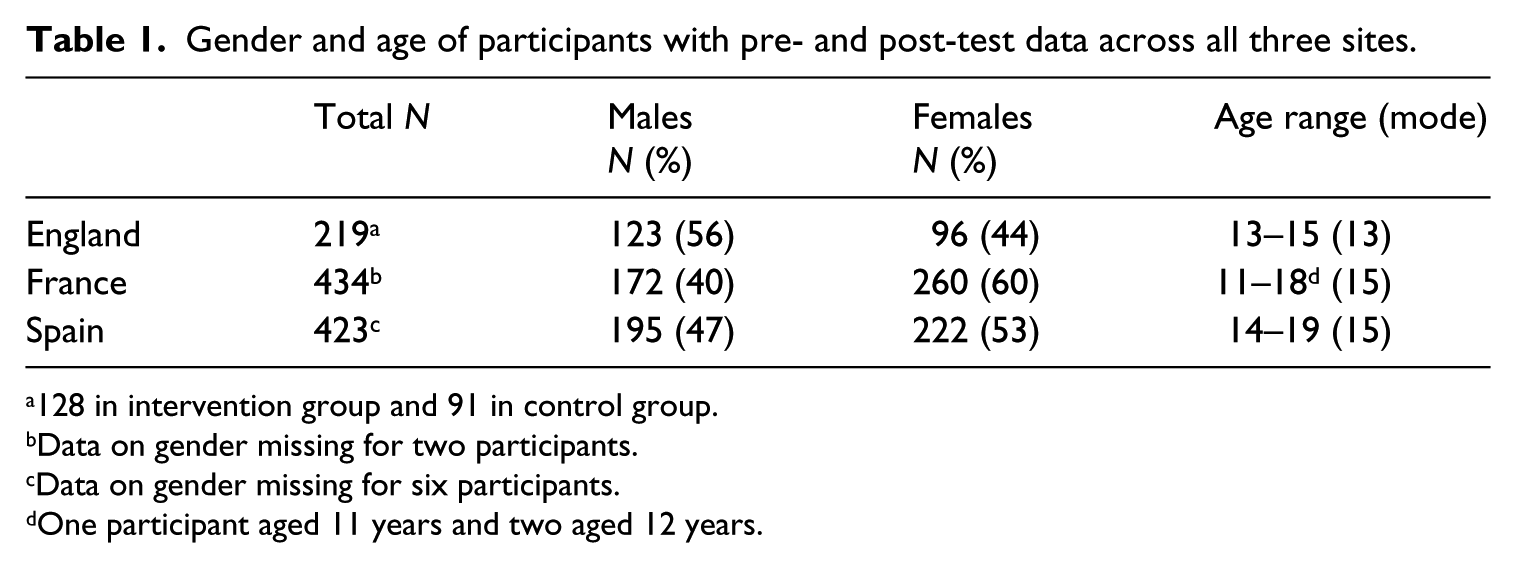
128 in intervention group and 91 in control group.
Data on gender missing for two participants.
Data on gender missing for six participants.
One participant aged 11 years and two aged 12 years.
Procedure
Participants completed the ADV questionnaire before receiving the intervention, and they completed the questionnaire again after the programme had finished.
In the English site this was in the first and final session of the programme. In France and Spain this took place one week before the programme started and one week afterwards. In the English intervention site, demographically similar control schools that were not receiving the programme also completed the ADV on two occasions at approximately the same time as their intervention group counterparts. We were unable to secure a control group school for one of the intervention schools. The intervention schools were self-selected, which in turn dictated the nature of the control schools (for matching purposes). All five schools were smaller-than-average community high schools. All schools were attended by predominantly white British students. The number of students in receipt of free school meals (FSM) is typically used as a measure of the socioeconomic status (SES) of students. One of the intervention schools had students with low levels of FSM, and this school was matched with another school with low FSM rates. One of the intervention schools had above-average numbers of students in receipt of FSM, and it was matched with a school classified as high in FSM. The remaining school not matched with a control group school was classed as ‘average’ in terms of FSM. With regard to gender, they were all mixed schools. All schools had low numbers of students with English as an additional language.
The Spanish intervention was implemented across 20 schools representing a wide range of schools in terms of urban/rural and SES profile. The French programme is typically implemented in schools in areas of high social deprivation where problems with violence in general tend to be more pervasive. The four schools involved in this evaluation are typical of the schools that the French organization usually works with. The findings reported here must be interpreted in light of these differences between the programmes and their intakes. No control groups were used in the French and Spanish sites owing to problems of capacity within the partner organizations. In addition to this, we attempted to collect three-month follow-up data from the intervention schools, but this proved logistically too difficult for some of the English schools and impossible in the French and Spanish sites. The follow-up data we did gather were too incomplete to analyse meaningfully.
Focus groups
Soon after the post-test data were collected, focus groups were conducted at all three sites. The project provided guidance to each of the intervention programme staff on how to conduct a focus group. Someone who had not been involved in delivering the intervention facilitated each of these. Inevitably, samples were quite self-selecting in that we could interview only participants who volunteered to take part and who gave their consent to be interviewed. Participants in the focus groups were asked which activities they liked and disliked and whether there were any areas of the programme they thought could be improved. In all, seven focus groups were conducted with a total of 51 young people across the three intervention sites. Recordings of each focus group discussion were transcribed verbatim, with the French and Spanish transcriptions ultimately translated into English and returned to the research team. Each transcript was read by the research team several times to ensure familiarity with the data, before thematic coding was undertaken. Initial coding established the range of responses given to the key questions asked (Braun and Clarke, 2006). Members of the research team looked again at the data once initial coding had taken place. Where our interpretations of the data differed or raised new questions, we revisited the data and refined the coding further.
Results
Pre- and post-test comparisons
Mixed ANOVAs were conducted on the English, French and Spanish data to compare the pre- and post-test scores (Time) and to see whether the effects varied by gender. The means and standard deviations and the results of the ANOVAs can be seen in Table 2. Our analyses of the questionnaire data suggested that two of the interventions were effective at changing attitudes towards domestic violence: Relationships without Fear and La Máscara del Amor. In both cases the means decreased from pre-test to post-test, indicating that students became less accepting of domestic violence during the programmes and these differences were statistically significant. In the Spanish site there were also overall differences at pre- and post-test, with boys being more accepting of domestic violence in comparison with girls. However, there were no significant interactions for Time*Gender, indicating that both boys and girls became less accepting of domestic violence from before to after the interventions. For the English site, comparisons were made between the participants in the two intervention schools and the two matched control group schools. A mixed ANOVA was used to compare the pre- and post-test scores for both groups. There was a significant effect of Time (F(1163) = 12.85, p < .01) and this was qualified by a significant Time*Group interaction (F(1163) = 2.85, p < .05). Simple effects analyses indicated a significant difference between the pre- and post-test scores for those in the intervention group only (F = 12.60, p < .001; control group, F = 2.00, p > .05). See Tables 2 and 3 for the means and standard deviations.
Means and results of ANOVAs for pre- and post-test comparisons for males and females.
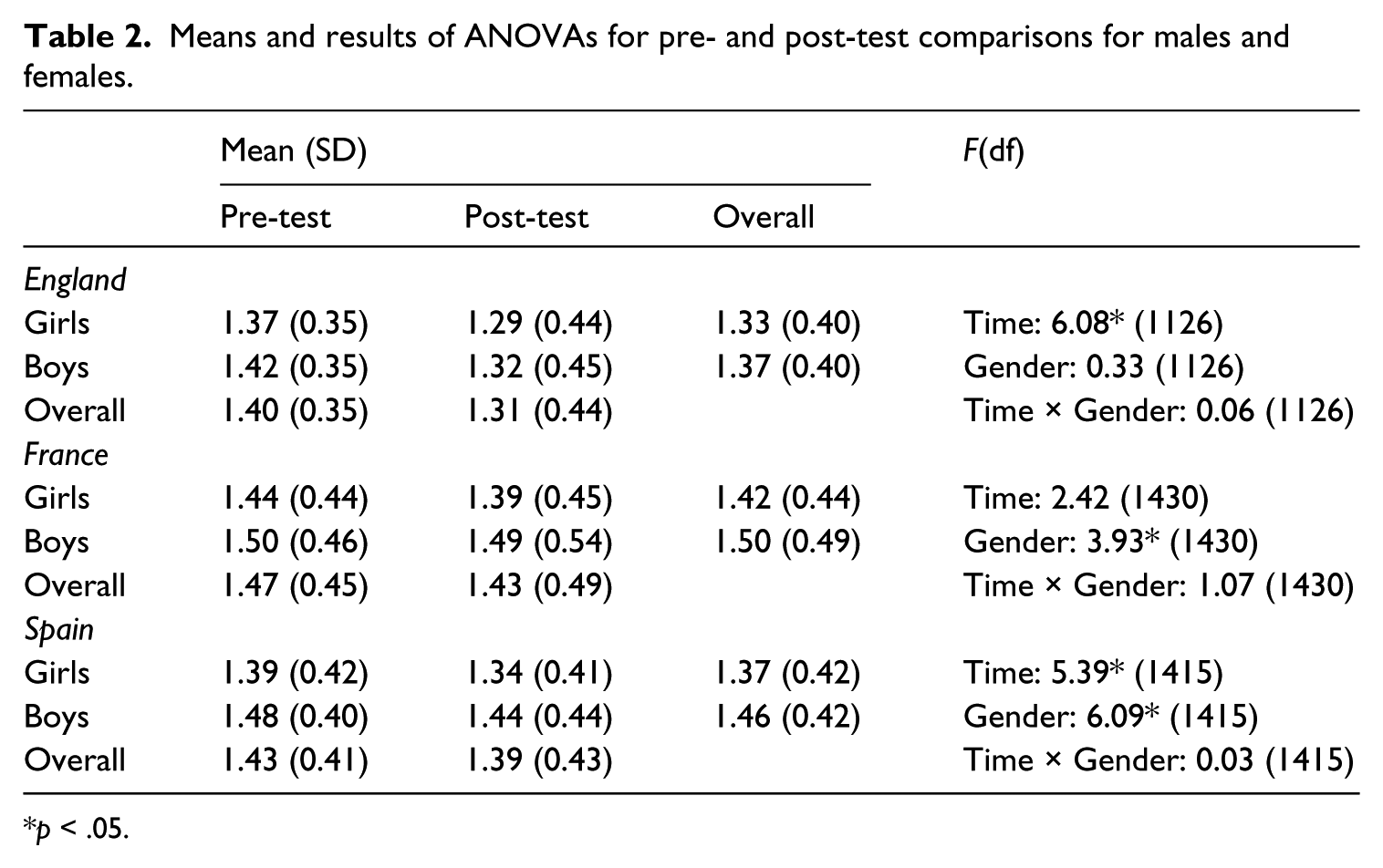
p < .05.
Means for the pre- and post-test comparisons for the control and intervention groups: England.
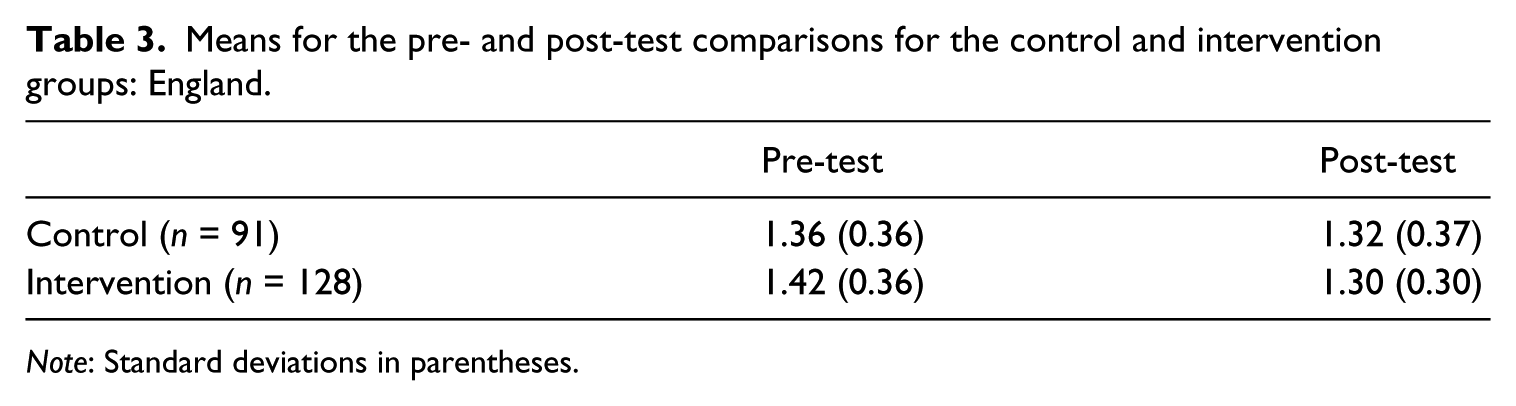
Note: Standard deviations in parentheses.
The attitude change for Filles et Garçons, en route pour l’Egalité was not statistically significant. However, as in Spain, there was a significant effect of gender. Additionally, comparisons at the school level suggested that the programme did have an impact on students’ attitudes when delivered over the course of two sessions (in one of the four schools), though we report this finding tentatively, given the increased chance of Type 1 errors when conducting multiple t-tests.
Another way of putting this is that a longer intervention with a bigger sample could have achieved desirable effects for the French programme. But the data we collected also suggested that the matter was more complex than this. First, the pre-test data suggested that there were differences in terms of levels of acceptance of domestic violence between the three samples. A noteworthy feature of the French sample was that a majority of participants began thinking that hitting a partner is okay in at least one circumstance (60 percent). In the English and Spanish sites such participants were in the minority (32.9 percent and 36.9 percent respectively).
Focus group discussions
Second, our focus group data suggested there may have been differences in the kinds of learning undertaken across the three sites and between participants undertaking the same programmes and that some students – especially in the French site – were unreceptive to engaging with the learning required. In all three sites, participants were positive about the programmes and said they liked them. But in the French site, where the ADV suggested attitudinal change was less marked, female participants suggested they were touched at a deeper level. In relation to the animation, one young woman commented that: We walk in her best friend’s shoes. We feel touched because we receive the letter, and then we can see how to reply. (FeG, Focus Group 1, Girl 1)
Another noted, more critically, how the child’s and mother’s perspectives are elided in the film.
You find yourself in the place of the mother that speaks to her child . . . I think it is up to the mother to resolve the problem with her husband . . . Do not tell the child it [violence] is ‘nothing’ because he will think it is normal. (FeG, Focus Group 1, Girl 3)
The letter-writing activity was also welcomed by most of the French focus group participants, perhaps because it required identification with the victim.
[W]e could just understand her feelings and problems . . .
. . . It is not easy to write like that, even to best friends . . . It makes us think.
The problem was, as some students suggested, that some of those who most disliked the letter-writing activity were among those who had refused to participate in the focus group discussion.
If we are here [in the focus group discussion] it’s because we almost liked everything. This [question of what was disliked] is more for people who do not come [to the focus group] . . .
One young man who did participate in the French discussion claimed, nonetheless, to represent the perspective of those who did not like the intervention.
I informed those that were not present [for the intervention] that . . . they did not need to know this because they knew what to do . . . They would not do that [abuse] to a girl. (FeG, Focus Group 1, Boy 1)
Another young man explained that disengagement with the programme occurred because the letter from a victim was written exclusively from a girl’s perspective: It was the view of the girl and it was possible that some boys did not feel it was relevant because of that . . . It may seem a bit silly, but there are also boys who have problems with girls. [Boys] may be the ones who are victims. (FeG, Focus Group 1, Boy 2)
Similar concerns about engaging boys were also articulated by both young men and women in the English site where a six-session ‘healthy relationship’ curriculum was provided by an external agency. .
I don’t think the lads liked the lessons . . . the male gender was getting the blame for abuse . . .
It was sexist. (RwF Focus Group 3)
Sometimes such concern was articulated by English participants in terms of opposition to teachers who interrupted the programme facilitators to ‘correct’ the opinions of pupils who challenged the gender-based focus.
[E]very time you said something he’d put the point against it . . . and it’d just do my head in. (RwF, Focus Group 3, Girl 2) [E]ven though it was our opinion, he . . . had to be right. (RwF, Focus Group 3, Girl 1) He’s boss. He’s our form teacher. (RwF, Focus Group 3, Boy 1)
In the Spanish site, by contrast, some participants argued that teachers should have intervened more forcefully when their classmates engaged in victim-blaming.
Sometimes it was uncomfortable when you know somebody was involved in a similar situation. (MdA, Focus Group 2, Girl 2) Some classmates made sexist comments that made me feel uncomfortable. (MdA, Focus Group 1, Boy 3)
Spanish participants also expressed concern that their teachers lacked expertise and confidence and left important practical questions unanswered.
I know that I have to report serious cases to police, but I have no information on where I can ask for help if me or a friend of mine are involved and the violence is not very severe. (MdA, Focus Group 2, Girl 2) I would like to know more on how to help a friend who is suffering violence and how to reject a friend who is a perpetrator. (MdA, Focus Group 1, Girl 1)
Discussion
Commenting on her own attempts to develop culturally sensitive youth work in some of the world’s poorer countries, Cyndi Banks (2012: 477–8) argues that: The action research process introduces . . . an iterative process of testing proposals for change until they are refined into the final implementation plan . . . [T]he production of data is not an end in itself because the knowledge produced must be incorporated into an approach that develops action strategies to improve a situation in some meaningful manner . . . Consequently, it often entails a ‘cyclical process’.
Our experiences of attempting to redress the challenges of providing educational interventions to prevent domestic abuse in Europe were somewhat similar. In working with those trying to deliver educational interventions with young people we too have found ourselves swept up in an iterative and interpretive process of knowledge production. Our study was not as methodologically sophisticated as we would have liked: it was not possible to secure control groups in the French and Spanish sites, and – in the absence of an alternative intervention – it is not possible to rule out placebo effects in the English site. It was nevertheless useful to those implementing relationship education. It helped them to recognize more fully the complexity of their goals and what was required to reach them, and to improve their practice. It raised the profile of their work inside and outside of their organizations, highlighted the skills required to undertake it, and helped secure the funding needed for its continued delivery. It also helped facilitate exchanges of ideas with wider networks of practitioners and saw the development of educational and research evaluation resources that are now freely available for others to use.
What we have learnt from this process, however, is that achieving ‘effects’, conceptualizing what they look like and demonstrating them empirically, is no easy task. It is rarely the most important priority for practitioners who are charged both with making the case for intervention in the first place and with continuously securing the resources needed to do so. Those delivering relationship education and domestic abuse prevention tuition often need their programmes to go through several iterations before they have a sense of what can meaningfully be achieved. In terms of research and evaluation, it therefore remains as critical that evaluations focus – at this early stage in the development of preventative domestic abuse education in Europe – on enabling practice to be tried, tested and developed.
Our questionnaires addressed a common concern of the programmes we evaluated, namely, whether the social acceptability of hitting could be reduced. But this is not the only measure of success such programmes can deliver upon. There need also to be measures of whether or not programmes increase young people’s understanding of the connections between violence and controlling behaviour; increase young people’s willingness to seek help should they find themselves embroiled in abusive relationships; and develop young people’s knowledge of what services are available to them, perhaps also alongside a realistic and criminologically informed grasp of how likely criminal justice interventions are to be able to deliver safety and justice. Moreover, there is a difference – or at least a complex relationship between – changing attitudes and fostering empathy and understanding. The latter might be needed to sustain the former, but it is rarely measured in evaluation research. The credibility of educators is another important ingredient in this mix but one that is difficult to get right. Teachers who are too interventionist and those who are too tentative – in a field in which there are genuinely few obvious solutions – constantly risk losing the confidence of learners.
The positive news, as we have shown in the REaDAPt project, is that short, coherent interventions delivered over a series of weeks can reduce both boys’ and girls’ acceptance of domestic violence. Significant improvements in attitudes were achieved in all three research sites, though not universally in the French site. Changes in attitudes appeared to be more incremental than radical, however, and although boys’ attitudes improved, in general they tended only to reach the same levels with which girls commenced the interventions. This, together with our focus group data, suggests that relationship education, though welcomed by many young people, needs always to be delivered in ways that are responsive to their perspectives. It is important remember that the nature and pace of learning may vary between boys and girls. Though both are likely to be sensitive to the issue of sexism, there is a danger, as we have shown, that such sensitivity can foster disengagement from programmes that appear to prejudge boys as much as they motivate interest in the subject of domestic violence.
Moreover, the role of gender in shaping attitudes can vary from place to place. In some localities, the opinions of boys and girls will not be vastly different from each other, whereas in others opinion will be more easily divided along gendered lines. Those teaching about domestic abuse and relationships therefore need to know their audiences. They need also to know that, from the perspectives of young people, violence is not always as obviously gendered as it appears to be for adults. Rates of ‘dating violence’ perpetrated by younger teenage boys and girls tend to be quite similar (Archer, 2000; Moffitt et al., 2001; Nocentini et al., 2010; Sears et al., 2007), the problem only becoming more overtly gendered in adulthood when repeat, physically injurious and sexual violence perpetrated predominantly by men against women becomes much more of an issue. From the vantage point of many teenagers, the power imbalances between young people and adults are sometimes more obvious than gender inequality.
Researchers do therefore need to be realistic in terms of what can be expected of educational interventions that last between one and six hours among students with differing levels of interest, understanding and emotional receptivity to identifying with others, including victims. They need also to work with practitioners to check that they are fully conversant with the challenges they are taking on. It was only after we presented the results of the French programme that the full scale of the issues they faced became apparent. Not only were they attempting to challenge gender-based violence in the space of a 60–90 minute session, but they also had to operate in an environment in which many schools were not prepared to accept that domestic violence was something students should be taught about. Those that permitted the intervention tended to be those more prepared to admit problems with violence. And these tended to be those serving lower socioeconomic groups and those with higher populations of immigrant children. That significant attitudinal change was not detected by our evaluation should not necessarily be taken as evidence that the intervention was not worthwhile. Rather it reveals that educators going into classrooms where the majority of students think domestic abuse is acceptable face different challenges from those where most students think it is wrong and are thus willing to engage with programme content.
Subsequent strategizing about the elimination of violence against women at the European level needs therefore to engage across this diversity of starting points. This will not be easy given the tendency for justice departments and education ministries to operate in parallel domains, both of which are prone to sensitivities around party politics. Justice departments and education ministries alike need to grasp the complexity of the challenges faced by those delivering relationship education and domestic abuse prevention tuition and the passion, skills and confidence that Europe’s teachers must acquire in order to deliver it effectively. Researchers can assist in this task by providing evaluation know-how that can be used to improve, step by step, existing practice over the longer term and by helping policymakers and educators to consider what can realistically be achieved by any intervention.
Footnotes
Acknowledgements
The authors would like to thank Margareta Hydén, Susanne Severinsson and Lucas Gottzén for their critical feedback on the project’s design, implementation and evaluation throughout its two year duration. The authors kindly acknowledge the support of the European Commission’s DAPHNE III programme, which part-funded the REaDAPt project.
Funding
The REaDAPt project was part-funded by the European Commission’s DAPHNE III programme (Grant Code: READAPT- JUST/2009/DAP3/AG/0988).