




Abstract
When stakeholders in participatory action research [PAR] projects live in poverty, practices sometimes fail to recognize and draw on their capacity for critical reflection. This constitutes epistemic (knowledge-based) injustice. It is problematic for approaches rooted in covenantal ethics and beliefs that PAR should empower participants as ‘actors of knowledge.’ This paper reflects on a research project carried out by All Together in Dignity Fourth World [ATD]. To ensure co-production of knowledge, ATD made unconventional decisions about methodology, allocating resources, and interacting with academics. In many ways, these choices created conditions for epistemic justice. However ATD faced important challenges around North-South power dynamics, engagement with academia, and the comprehensibility of deeply personal conclusions reached by project participants. More positively, a dogged effort to invent conditions for epistemic justice transformed ATD’s governance, the ways some institutions address poverty, and the way participants addressed inter-generational traumas.
Discourse often individualizes poverty as a personal failing. The words of people in poverty are twisted against them to reinforce this stereotype—for instance in court or by educators. Systematic denial of voice due to prejudice diminishes their credibility and constitutes testimonial injustice. ‘When a person’s testimony is repeatedly […] ignored this way, […] epistemic silencing is psychologically pernicious, in effect even leading to someone doubting themselves as a knower or self-censoring to avoid the humiliation of having their testimony rejected’ (Croft et al., 2021, p. 78–79).
In addition, people in poverty live in constant crisis, from eviction to health emergencies to hunger. They are denied time, space, support, and peace of mind to reflect on—and conceptualize for themselves—their own experiences. This silences them and constitutes interpretive injustice. The founder of All Together in Dignity Fourth World [ATD], Joseph Wresinski (cited in Croft et al., 2021, pp. 78–83), described this silencing as psychological torture. Testimonial and interpretive injustice are what Miranda Fricker (2007) defined as epistemic injustice: undervaluing people’s knowledge because of their identity.
Speaking in 1972, Wresinski voiced concern that academics 'stole knowledge’ from people in poverty. His work to overcome this marginalization strove for what Fricker later termed epistemic justice. We authors are all active within ATD Fourth World, an anti-poverty human rights movement convinced that people in the worst situations of poverty hold the key to understanding and overcoming poverty (ATD, 2021). ATD seeks these people out to build projects with them that aim to leave no one behind. ATD’s activists are people in poverty who choose to offer support to peers in difficult circumstances. Throughout this paper, we use the term ‘activist’ in this sense. ATD also works with policy-makers, institutions, and others who can learn from people in poverty.
ATD takes people in poverty seriously as knowledge actors. Our goal is making it possible for them to develop their knowledge and ‘take it on a journey’ so others can learn from it. In 2009–12, we authors carried out a PAR project about poverty and violence (Brand & Monje Barón, 2012) with over 1000 people from 25 countries. Reflecting back now, we see the process as having enriched our practices of epistemic justice. This paper will outline our methodology for inclusive co-production of knowledge and identify some conditions for epistemic justice.
The collaborative inquiry of PAR does not always translate into practices founded on belief in the capacity for critical reflection of the participants (Brydon-Miller, 2008). Covenantal ethics, by building reciprocal relationships between researchers and participants, greatly enhance the relevance of PAR to communities where research is carried out; however, surrounding hierarchies and positions of power must be recognized to avoid potential for coercion (Stevens et al., 2016). As Walker and Boni (2020, p. 1) wrote, ‘Participation in itself does not guarantee egalitarian epistemic outcomes’. It is important for PAR to develop collaborative strategies for participation in all phases of a project, including analyzing findings (Brydon-Miller, 2009). This priority has led some community practitioners of PAR to work towards what Walker et al. (2020) call ‘(non-ideal) epistemic justice’ as a ‘response to a colonized architecture of knowledge that is […] classist’ (Hall et al., 2020, p. 38).
The ethics model governing ATD’s relationship with people living in poverty is grounded in reciprocity. As members of ATD, we authors believe in learning by doing. For us, meaningful participation includes co-production with people in poverty from a project’s conception to its analysis to co-authoring results (Croft et al., 2021, p. 82). Because marginalized people face many obstacles to participation, we try to create conditions for each activist to fully offer their contribution (Tardieu et al., 2023). For this paper, we reflected on links between PAR and our approach to draw out what we consider the conditions for epistemic justice.
In our 2009–12 project, we sought to put the above principles into place, calibrating the pace so that activists facing the most challenges could guide the process. A decade later, reflective practice interviews with the research facilitation team were carried out by Anna Lebrec and Béatrice Noyer. Drawing on these interviews, we will detail the methodology used, cite conditions for epistemic justice, and reflect on three challenges: • The North-South power dynamic affected interactions among activists on four continents. • So people in poverty could develop their thinking without interference, broad engagement with academics was delayed until the end. • The harrowing nature of the subject meant acknowledging trauma and honoring the risks involved in breaking silence.
Finally, we will make a link between epistemic justice and examples of how the research transformed activists, ATD as a whole, and some institutions. Living in poverty means systemic dis-empowerment and having one’s knowledge scarcely ever recognized (ATD Fourth World & Oxford, 2019, p. 15–22) When people in poverty have power to shape a knowledge-building project and are honored for their contributions, they often feel liberated of this dimension of poverty. This is the impact of epistemic justice on people’s lives.
None of us authors are activists living in poverty. We considered involving activists to write this article but were hampered by writing in English, a language not spoken by the vast majority of activists involved in the research. While the research was being carried out, we authors had different roles: Monje Barón was in the research facilitation team. Blunschi Ackermann, head of ATD’s research institute, prepared the dialogue with academia. Coyne joined the facilitation team in early 2011, playing a supporting role. He notes: The research team’s determination to keep the analyses of activists intact without alteration through their own ‘interpretive lens’ spoke to my training as a historian, and particularly my work on the way knowledge-building became a tool for domination within European colonial empires.
Skelton was part of ATD’s International Leadership Team. She explains: ‘Our team carried responsibility for this research, but refrained from guiding it. We spoke often with activists and felt privileged to be learning from their journey together.’ For all of us, collaborating on this article has been a chance to reflect together on our practice.
Methodology
Challenging hierarchical relationships; Understanding and allocating roles
The theme of violence was first suggested in Haiti, a place with long-running armed conflict where ATD has worked since the 1980s. Previously ATD’s research projects were intended as participatory but conceived in a top-down manner from its international center near Paris. To break this pattern, the ‘Poverty Is Violence’ research facilitators made a conscious effort to collaborate with ATD’s regional teams from the beginning, to ensure central roles for non-European regions. They also recognized the importance of preexisting long-standing relationships that ATD’s local teams had with activists. Facilitators wanted the research to enable local teams to address questions specific to their realities. This led facilitators to view local teams as key researchers playing an active role in shaping the theme.
Project Calendar.
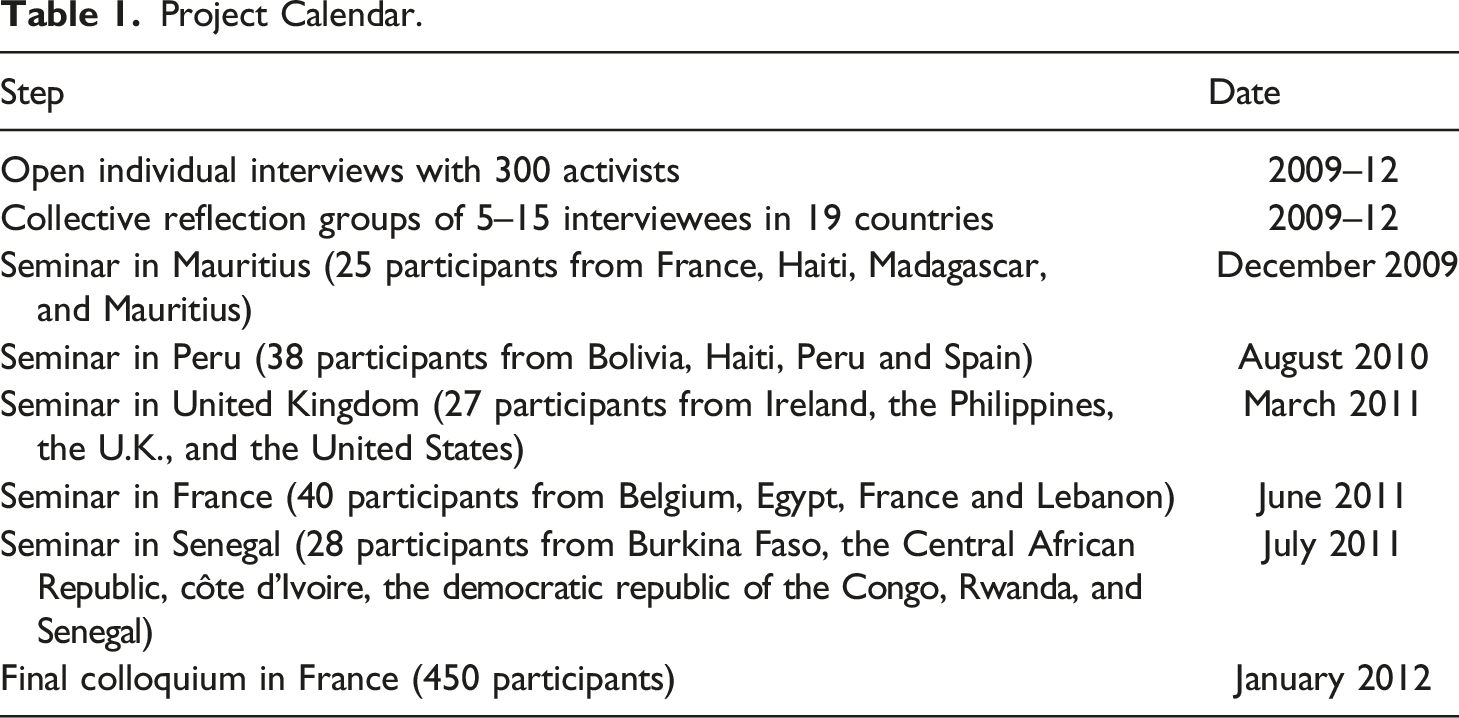
The initial facilitation team was Rosalbina Pérez, Gérard Bureau and Anne-Claire Brand. Despite diverse backgrounds, all were part of ATD’s Volunteer Corps. Given the relative stability of their positions, they agreed that their team was hamstrung by lacking someone with more immediate personal experience of poverty. Bureau says: 'We weren’t managing to allow people in poverty to express themselves without preconceived ideas of our own.’ At this point, they invited Martine Le Corre, an activist, to become a lead co-researcher on this project. Bureau says: ‘Our reflection hinged on her because, still experiencing poverty herself, her antennae were permanently open to alert us when we were off course’ (Lebrec & Noyer, 2021).
For activists to take ownership of the project to the greatest possible extent, the team starkly divided roles between activists and facilitators. The latter were mainly operational: organizing, interviewing, transcribing, encouraging dialogues, sharing information. In addition, they drafted reports and proposed quotations from activists as seminar titles. Activists, who sometimes facilitated group discussions, were all asked to share their experiences and provide analysis and synthesis—roles the facilitators avoided. As Monje Barón recalls, 'The goal was not for us to develop our own understanding of the theme but to create conditions for others to elaborate knowledge.'
From in-depth interviews to agreed contributions
While most project participants lived in poverty, some did not. To reduce inequalities, the facilitators asked each participant to speak from personal experience. Even those with no experience of poverty were asked not to analyze the experiences of others, but rather to speak about situations directly affecting them, or their own reactions to situations they observed. Starting from personal experiences gave a shared frame of reference and aimed to prevent reproduction of traditional power dynamics.
The facilitators deliberately avoided engaging with existing academic theory around poverty and violence. Opting for a loose methodological frame that could shift and change with activists' suggestions, facilitators prioritized flexible research questions that could evolve to suit local contexts. Monje Barón explains: It’s an important methodological choice to say: ‘we will build little by little.’ We began with in-depth interviews, taking great care about the words. We put words on the table carefully—and differently in each language and with different people—to get a feel for how they resonated. (Lebrec & Noyer, 2021)
The facilitators had no hard-and-fast list of initial questions. To shape each initial exchange, they instead outlined the overall research theme and then relied on each activist’s input.
To consolidate activists’ role as ‘knowledge actors,’ interviews were recorded to capture the totality of contributions and avoid any subconscious gate-keeping. Recordings were transcribed word-for-word to respect the oral nature of many activists’ knowledge. Each transcript remained verbatim, rather than flattening out accents, dialects, idioms, pauses and verbal tics. Preserving the ‘orality’ of interviews was intended to avoid the temptation to reduce interviews to easily cataloged but sterile forms of knowledge, detached from the reality that produced them.
Transcripts were also a key tool for activists. Interviewees were asked not just to verify transcripts, but also rework them in depth, taking ownership of their positions and having additional opportunities to elaborate or revise. This became an important part of the knowledge-creation process. Bureau classifies this as a final step in moving from ‘interviews’ towards ‘agreed contributions’.
During interviews, the method aimed to empower activists to become fully fledged project actors creating ‘agreed contributions’. The first principle was meeting activists on their own terms, in their neighborhoods: in an activist’s home, at an ATD center, or a community center—wherever activists felt most at ease.
The facilitators decided to carry out interviews in person, rather than via intermediaries or by telephone. Speaking face-to-face was vital for establishing trust. They also believed their style of interview required interviewers to have intimate knowledge of issues raised by activists elsewhere in the world, connecting all activists via a living link. The team made themselves available as interviewers for the duration of the project.
A crucial ground rule was the conscious decision to take activists at their word. Although interviewers requested additional detail, they avoided skepticism about interviewees' understanding of events. Recognizing that epistemic injustice prevents people in poverty from creating formal knowledge, the team chose to avoid framing anyone as unreliable witnesses without insight to analyze their experiences.
To avoid extractive testimonies, the facilitators hoped activists would progressively develop their own analyses. As Monje Barón explains, this called for an open-ended, emergent approach: Interviews weren’t just preparatory steps. We carried out personal interviews from the beginning until almost the end. The word ‘interview’ could suggest a process where someone responds without being able to interfere with the questions. But we asked deliberately open questions, simply to set out the themes. The interviews were not designed to acquire information, but instead to allow each person to go as far as they could in developing their thoughts.
Rather than a classic exchange of questions-and-answers, the facilitators opted for wide-ranging dialogues. This challenged traditional power dynamics and gave activists agency to reflect on their experiences.
Building collective knowledge and meeting face-to-face
Espousing ‘cross-pollination’ between ideas of different interviewees, facilitators actively shared contributions from earlier interviewees so activists could deepen their thinking in interaction with others. Monje Barón situates this sharing of ideas as an essential part of the methodology: There was always a moment where the interviewer introduced ideas from other activists. That's it: the interviewee became an actor because they weren't alone with their ideas. Once you think about what others say and how it resonates with you, you enter a process of understanding and exploring concepts with others. This leads to personal transformation.
Via interviews, activist-created knowledge continually circulated. With this choice, the team hoped activists would construct collective knowledge. They also aimed to lessen their own power—and increase activists' agency—by ensuring that facilitators were not in sole possession of knowledge produced during interviews.
While sharing activists' ideas during interviews helped build collective knowledge, deeper discussions were necessary to develop shared analyses. Brand describes coming to this realization at the end of an interview of Parfait Nguiningdji (who, like all those quoted here, agreed for his name to be cited): Mr. Parfait said, ‘Please, take our knowledge on a journey.’ Instantly I responded: ‘It's not us who will make your knowledge travel; it's you.’ I had suddenly made a commitment. Hearing him express so strongly the hope that his knowledge would travel made me realize that he should make it travel. For the first time in so global a project, he became an actor. This is what we wanted: no longer facilitators making knowledge ‘travel,’ but activists themselves.
The project’s over-arching values meant that international face-to-face meetings should give primacy to in-person participation of people in poverty. The idea was innovative within ATD’s practices, but the team agreed it was essential. This difficult undertaking required unconventional approaches to organization and facilitation.
Five regional seminars formed key moments of face-to-face exchange. To underscore activists’ agency, the team waited until relatively late in the project timeline before choosing the locations, titles and programs of these seminars. This made it possible to adapt to issues identified by activists, needs of local teams, and calendars in each region. The further uncertainty this introduced to an already fluid project timeline was accepted as a necessary result of trying to ensure that the greatest number of activists living in poverty could travel to these seminars.
Another inclusive choice was for activists to use their mother tongue. This was particularly important in regions where languages spoken by people in poverty are often supplanted by French, English or Spanish. Each regional seminar used two languages: one ‘local,’ like Tagalog or Malagasy, and one ‘international.’ The team limited international languages to avoid long chains of interpretation—for example, from Wolof to French to English—thereby allowing the highest possible quality of exchanges. However, they were more flexible about ‘local’ languages, arranging interpretation for more than one in several regional seminars. At the final colloquium, simultaneous interpretation was arranged in Arabic, English, French, Haitian Creole, Quechua, and Spanish, allowing many activists to interact in their own languages.
Crossing international borders is particularly challenging for people in poverty. Obstacles include: prejudice and suspicion from border officials; significant barriers to obtaining identity papers, passports and visas; and bureaucracies that can be indifferent or openly discriminatory. To overcome these obstacles for activists, ATD mobilized its international leadership, advocacy and administrative teams to support travel preparations. Considerable resources were deployed to secure travel documents and flights for activists who could not afford them.
Co-construction, rather than confrontation
Traditional antagonistic debates favor academics to the detriment of people in poverty. For face-to-face meetings about deeply traumatic instances of violence, marginalization and discrimination, mostly drawn from personal experience, a non-violent approach was needed to frame discussions. To help heal existing traumas and to ensure that activists with no experience in adversarial debate retained agency as ‘knowledge actors,’ facilitators developed a supportive in-meeting dynamic of co-construction, rather than confrontation. The ground rules discouraged aggressive interrogation. Bureau describes the basic approach: ‘Each activist made a contribution. Then other participants were asked to understand but not debate the content.’ Questions to aid comprehension were encouraged, but no space was given for aggressively unpacking or criticizing. This approach mirrored the earlier choice to take activists’ views seriously. The seminars were framed as places to deepen understanding of each person’s experience and analysis, rather than for competition between opposing explanations.
Furthermore, the facilitation team explicitly invited academics to work collaboratively. Rather than analyzing from afar, academics were encouraged to help activists equip themselves to better describe their own understanding of their experiences. Although this approach proved challenging for some academics, the team considered it essential to reverse unequal power dynamics and confirm activists as co-producers of knowledge.
The aspiration that Nguiningdji take his knowledge on a journey reinforced a progression from individual interactions to the collective construction of knowledge. For people in poverty to be key actors from the beginning to end, facilitators introduced activists to less comfortable situations in a graduated manner. The colloquium—a final step into unfamiliar territory following the regional seminars—was designed in three stages: • The first days, at ATD’s international center, were reserved for people in poverty and practitioners who had participated from the outset; • The next three days, with 25 academics and professionals in dialogue with ATD’s research center, allowed the research actors to deepen and finesse their contributions; • Finally, after the activists grew accustomed to new interlocutors, they presented their work publicly at UNESCO headquarters.
These incremental stages allowed activists to gradually widen their comfort zone.
Conditions
To ensure epistemic justice so that people in poverty can co-produce knowledge, ATD strives to create certain conditions: • Breaking silence to speak about trauma in a way that frees activists to honor their own experience and construct their own thoughts; • Recognizing activists as knowers who share ownership of every step; • Safe spaces where peers can collaborate to build knowledge together; • Ensuring that activists feel a sense of belonging to a collective effort that they identify with.
Breaking silence
Overcoming epistemic silencing is particularly challenging with an issue as traumatic as violence. Le Corre describes a constraint on people in poverty: The word ‘violence’ is so often used about us that it's not a word we use easily. How can I say I’m a victim of violence when people always told me, since I was a kid, that it's us who are violent? No one will believe us. (Lebrec & Noyer, 2021)
Le Corre’s reminder of the stereotype of 'the violent poor’—often maligned as a ‘deviant, defiant, dangerous “underclass”' (Gans, 1993)—ensured that the project advanced with utmost caution. In one early meeting, she asked people in poverty a straightforward question: ‘What do you think violence is?’ She reflects: That evening sparked everything that followed. The activists discovered—and this was upsetting, but also motivating—that we're all called ‘violent’: with our children, in our words, reactions, or gestures. We know how we're spoken of. We saw that we hadn't allowed ourselves to look at violence done to us. Suddenly one mother announced: ‘When social workers remove my children, I'm suffering from violence, not being violent.’ From there, ideas multiplied.
Reclaiming the right to speak about violence felt emancipatory, which gave the research team legitimacy to open this conversation with other activists.
Recognizing people in poverty as knowers
Knowledge is not neutral. It carries ‘class biases and values’ and favors ‘those who produce and control it’ (Gutiérrez, 2016). Researchers often interview people in poverty for their own objectives. In the World Bank’s 1999 ‘Consultations with the Poor’, quotations were systematically ‘stripped of context […and] editorialized […] to tune out discordant sounds’ (Cornwall & Fujita, 2012, p. 1761). Similar to epistemic injustice as set out by Fricker (2007), this ‘ventriloquizing’ is a misappropriation. The World Bank interviews were contorted into ‘a narrative that casts [the poor…] as abject, inert, lacking in agency’ (Cornwall & Fujita, 2012, p. 1751–1761).
In contrast, ATD’s approach is based on recognizing people in poverty as producers of knowledge whose experience of injustice gives them a uniquely insightful vantage point. The facilitators deliberately did not lead but rather created conditions for content to be steered by activists like Ricarl Pierrelouis, in Mauritius. His turn of phrase—‘poverty is injustice and violence every which way’—resonated strongly for other activists and became the title of the first seminar. Bureau, who prepared that seminar with Pierrelouis, recalls: Ricarl showed there was a reflection about violence and not just a description. Taking people’s exact words forces everyone to think differently. Underneath words, you understand their experience and way of thinking. Also, for Ricarl, seeing his words written down made him more aware of his own thinking. He realized he has an impact on others because his words became the title of a seminar. (Lebrec & Noyer, 2021)
The process was similar when activists stressed the importance of speaking about peace as well as violence. Pérez explains: ‘It took us a long time to say what peace means. It’s not dictionary definitions. Then Mr. Parfait [Nguiningdji] said peace means finding food for his family. We understood’ (Lebrec & Noyer, 2021). The meanings people in poverty give to certain words can be easily missed or set aside; hence the importance of activists defining the terms of the research. This created shared ownership.
Constructing knowledge with peers
Individual conversations were supplemented with local peer group discussions. Pérez considers this step crucial to addressing sensitive issues: It is very delicate to not aggravate suffering, and to overcome guilt and shame. We must not be ashamed of our poverty; but violence takes hold of us. […] They want to steal your humanity. How can we find strength to say: ‘we are human beings with dignity, with values’? To overcome shame, it was key to be part of a group, reflecting together. Alone in a corner, there's not the same strength. Empathy for one another was liberating. (Lebrec & Noyer, 2021)
Peer groups gave activists the opportunity for individual growth. They realized they were not alone in suffering. They recognized one another as peers enduring violence due to poverty. Feeling a strong empathetic connection, they were proud to collaborate. This satisfies another condition for epistemic justice: that 'the autonomy and independence of their thinking be recognized and respected by other partners in the process of knowledge co-production’ (Croft et al., 2021, p.83).
Belonging to a collective effort
Action research, according to Brydon-Miller (2009, p. 243) ‘is an inherently and explicitly values-imbued practice [that does not] espouse the doctrine of value neutrality and objectivity demanded in conventional, positivist-inspired research.’ Each of us has specific positional objectivity (Sen, 1993), and recognizing this can create shared ownership of research contributing to a collective goal chosen by all participants.
In ATD’s research, even before meeting internationally, activists began to feel a sense of connection. Bureau notes, ‘This research turned into a dynamic that has connected people for ten years now.’ The project was the first time activists from ATD engaged with one another on such an intercontinental scale. Despite the vast differences between the Global North and South, Bureau stressed that ‘there was no unease because of differences in conditions or means. […] People in poverty recognized each other’ (Lebrec & Noyer, 2021).
Monje Barón adds, ‘Connecting people has a crucial impact. It starts with personal discovery: “I can participate.” Alongside others, it’s a collective action: “I become a participant; I’m no longer excluded”’ (Lebrec & Noyer, 2021). This put into practice a key condition of epistemic justice: ‘for people in poverty to feel […] they belong to a collective effort to bring about a more just world’ (Croft et al., 2021, p.83). Every activist contributed to a cause larger than themselves.
Challenges
The North-South power dynamic
This theme on the violence of poverty originated in Haiti. Jacqueline Plaisir, who spent ten years as ATD’s national coordinator in Haiti, recalls: ‘Even when those with experience speak out, unless the weight of violence, trauma, slavery, colonization, racism, and misogyny are recognized by others, no transformation is possible.’ Mauritian activists—whose history has important parallels with Haiti’s—invited Haitian activists to take their first international step by joining a seminar in Mauritius. Plaisir said: It was significant to start in a place that, like Haiti, has a long history of colonization, slavery, and indentured servitude; and yet that, unlike Haiti, has the autonomy to chart its own path. Activists who felt dehumanized could speak about their resistance to violence. They found light when others recognized their dignity. (J. Plaisir, personal communication, February 24, 2022)
This resonated for Pérez, who is from Guatemala, a country also deeply scarred by armed conflict. In Bolivia, discussing physical violence sparked long-term work on violence against women, femicide, and violence against indigenous people.
In an effort to reverse the prevailing dynamic of Northern domination, this project stemmed from the Global South. In the end, however, the issue of institutional violence, brought by activists from the Global North, took precedence over discussion of physical violence. Although issues of armed conflict were not taken up outside of Latin America and Central Africa, Plaisir says that, overall, the project felt unifying: Countries like Haiti are isolated by the fact that the reality of their situation is inconceivable for people in other countries. However, when Haitians heard Europeans describe social workers removing their children, they related to the parents' suffering. Having lost children to violence, malnutrition, or illness, they saw themselves in a similar struggle against the long odds of poverty to keep families together.
The first seminar was deliberately held in the South to tackle the historic geographic imbalance in ATD. Half of the seminars took place in the South, and all of them had activists from both hemispheres. Two of the four conclusions came from the South and two from the North.
Engaging with academics
Efforts to compensate for epistemic silencing led the facilitators to reverse the traditional knowledge hierarchy by not involving academics until the project’s tail end. Many academics were perplexed by the invitation to participate without conducting the research. Only a few joined regional seminars. Others took part only in the colloquium. Bureau reflects: This was a flaw. We worked for three years with people in poverty; but only a few months with academics. It took time to convince them of our approach. By then, the colloquium was underway. Only then did academics have access to our papers, meet activists face-to-face, and begin to understand a little. It would have taken three more years to work seriously with academics.
Dr. Orna Shemer, an academic who has collaborated with ATD for a decade, says of our process: ‘It often includes dealing with vulnerability, stigmas, guilt, ego and other deep aspects that are not easy to overcome. In ATD’s approach, sometimes the people with knowledge from experience hold power that makes professionals feel powerless’ (O. Shemer, personal communication, October 13, 2022).
At the colloquium, a debate was sparked when Prof. Paul Dumouchel stressed that certain forms of violence are: ‘not perceived as violence […] sometimes also by the target of the action themselves. Instead we, and often they, tend to see it as a punishment, as something they deserved, or as just “the way things are”’ (Brand & Monje Barón, 2012, p. 74). It was painful because Dumouchel told us that we remain silent for fear of reprisals. He said that the ‘law of not snitching’ is built into our communities, so there's no way for things to get better. We activists absolutely did not agree. Then Ivanite enlightened everyone.
Ivanite Saint-Clair, a Haitian activist, explained why she chose silence: My daughter was killed by a boy I know. But if I accuse him, will it give me back my child? No. What do I wish? That he understand he’s on the wrong path and cannot continue like that. But if he’s imprisoned, how will his family manage? I live alongside his family. They are also poor. I haven’t gone to court because I don’t want to see anyone take their last breath. Violence begets violence (ATD, 2009).
Years later, this conversation is recalled as one that all participants felt deserved more time to deepen properly.
Trauma and breaking silence
In this research project, Saint-Clair expressed her convictions without making a formal accusation that would unleash painful consequences for others. Avoiding adversarial debate was important for her because no confrontation would bring her daughter back. Plaisir reflects that Saint-Clair’s silence was a moral choice: ‘She considered an accusation to be a form of vengeance that would not honor her daughter’s memory. Others saw Ivanite as a victim; but she spoke of taking responsibility so others could live in peace.’ Le Corre concludes: Only we have the right to break silence or not. It can’t be imposed on us. Breaking silence is not a choice, but a process you live with. Others who aren’t in poverty say reasonably, ‘You just have to speak out’; but activists know that’s not how it is. The answers we’re offered don’t correspond to what we consider necessary. So yes, we remain silent and deal with it until we find a solution to break silence. It can take years.
Another academic at the colloquium, Magdalena Brand, later reflected about the word ‘silence’: We academics see only one dimension: our own, that of submission [...]. Whereas people in poverty see two dimensions: ours (passivity) because they suffer the consequences of our passivity; and theirs (resistance) which allows them to stand up to poverty and to our passivity. (Blunschi Ackermann et al.)
Although Le Corre and Plaisir felt that this research respected both trauma and resistance, the reflections of the participating activists needed time to develop.
The impact of epistemic justice: Transformations
This research had long-term ramifications for individual activists and across ATD. In Bolivia today, activists—regardless of current income—say they are less in poverty because they feel transformed. Monje Barón observes: ‘The disempowering nature of poverty has been counteracted because they are recognized as creators of knowledge. Reflecting on their experiences brought a sense of meaning and hope for change. Three of them are now in the facilitation team for a new research project on violence against women in poverty.’
Inter-generational trauma and healing
One peer group was located on Reunion Island, in the Indian Ocean. Black activists there who descended from enslaved people said it was during this research that they came to see slavery as a historic injustice and not punishment for individual wrongdoing. Having been raised to bow when greeting whites and feel guilty about their ancestors’ enslavement, they gained new understanding of how history haunts their lives today.
For British activist Amanda Button, this research was the first time she spoke to others about the most traumatic events in her life. A decade later, she explained to 300 people: Poverty is about what life throws at you. You feel ashamed. People are judging you. I was convinced something was fundamentally wrong with me. You hit rock bottom, where you feel you might as well be six feet under. At ATD, I met others in the same situation. We’re all treated as equals, not ‘them’ and ‘us.’ It made me realize that it’s the situation that was so abnormal that it stripped our humanity away. When we come together with others, you feel honored in your soul. People have their soul destroyed, but ATD is where we feed our souls. (ATD, 2019)
Wresinski described the silencing of people in poverty as dehumanizing psychological torture. Button shows that healing is possible within a community of mutual support.
Institutional change
For ATD, this research was a seminal moment of organizational transformation. It reinforced the horizontal evolution of our governance by confirming the crucial role of activists in our decision-making structures. It led to new experiments in regional and international collaborations. It led us to develop new language for speaking about our knowledge and understanding of poverty, violence and peace. Some of this was expressed in Artisans of Peace Overcoming Poverty (Skelton, 2016), which told the story of the research and subsequent projects. For example, Button and other U.K. activists built on this research to design ‘The Roles We Play,’ an exhibition that challenged stereotypes about poverty.
The research also had far-reaching effects in ATD’s public advocacy at the United Nations. It gave a model for undertaking participatory evaluation of the Millennium Development Goals in 2012-14, which influenced the design of the Sustainable Development Goals.
In France, an activist who played a key role in the research, Bernard Ducrocq, met with a French Parliamentary senator to explain poverty-based discrimination. This led the senator to advocate for ‘social conditions' to be added to the law as grounds of discrimination (ATD, 2016). The French National Institute of Statistics and Economic Studies was spurred to integrate into its work measurements of institutional and social mistreatment.
Bureau sees the long-term impact of this research: ‘It’s not that people step away from daily life to do research and then return to the everyday. Once people broaden understanding of their lives, they gain tools to defend themselves and move forward.’
Conclusions
Although we didn’t use the terms covenantal ethics or epistemic justice when we began this ‘Poverty Is Violence’ PAR project in 2009, we now see common threads with ATD’s pragmatic approach. Our practice is to seek out people whose own agency has been most undermined by poverty and epistemic injustice. We design projects with them, starting where they are and trying to take into account whatever challenges they face. Our goal is to build a community of caring connections, and then to reflect critically with them so their collective analysis can produce change.
We see four conditions for working towards epistemic justice with people whose knowledge has been dismissed because of povertyism. People struggling against the daily outrages of poverty deserve: • To have their experiences honored and to have the opportunity to construct their thoughts so that they can decide when to break silence about trauma; • To be recognized as knowers and offered shared ownership to co-design each step of a project; • Opportunities to construct broader knowledge collectively in discussion with their peers; • And a sense of connection and belonging to an effort with a goal they helped to choose.
Although typical for ATD, our approach—prioritizing flexibility and tailoring the project according to the initiatives of individual activists as we went along—is uncommon. This research was the first time ATD tried to use this somewhat messy approach to co-producing knowledge on such a global scale. We see now that the North-South power imbalance made itself felt in the project, which explored more actively questions identified in the North.
We were also accustomed to delaying dialogue with academics until revealing results so that their defense of their own areas of expertise would not overshadow knowledge built by people in poverty. Now, however, we think that failing to engage broadly with academic research from the beginning made it difficult for academics to understand the analyses previously constructed among activists. It also limited time for meaningful collaboration, such that thorny subjects were not satisfactorily explored.
Initially, we thought activists deserved to have a facilitation team at their service; looking back, however, some of us wonder if having more activists in this team might have been better. We also regret not being a more diverse group co-authoring this article. We don’t always manage to live up to our ethical ideals. Nevertheless, we remain inspired today by having collaborated on this work with activists like Le Corre, Nguiningdji, Pierrelouis, Saint-Clair and Button.
Using the lens of epistemic justice now, we think that deep understanding of exclusion and poverty allowed facilitators to create the conditions necessary for activists to become empowered co-producers of knowledge. Satisfying these conditions pushed facilitators towards unorthodox, but reproducible, decisions, including: removing themselves from positions of epistemic power; taking activists at their word; sharing with activists knowledge as it was constructed; disengaging from existing academic theory; and rejecting fixed time-frames and methodologies to better reflect the needs and rhythms of activists. ATD also invested heavily in allowing activists to work face-to-face throughout the project.
Action research ‘is defined by its unapologetic ethical and political engagement and commitment to […] positive social change’ (Brydon-Miller, 2009, p.243). This project changed the way ATD conducts PAR and reinforced our commitment to a covenantal relationship with people in poverty that promotes epistemic justice. Activists, who felt strong ownership of the process, delivered unique insights into the interplay between poverty, violence and peace. The knowledge journey taken by Nguiningdji and other activists led to transformations, both in institutions and in themselves as many recognized that the process shifted the way they saw themselves and strengthened their resistance against poverty.
Footnotes
Acknowledgements
With acknowledgements for support to Marie Garrau of the regular faculty at the University of Paris 1 Panthéon-Sorbonne, Department for Teaching and Research in Philosophy.
Declaration of conflicting interests
The author(s) declared no potential conflicts of interest with respect to the research, authorship, and/or publication of this article.
Funding
The author(s) received no financial support for the research, authorship, and/or publication of this article.
