




Abstract
Reflexivity is an integral part of action research and is recognized as an important and necessary indicator of study rigour. A key goal of reflexivity is to ensure that research decisions do not replicate existing (or add new) harm to those whom the research describes or involves, however less attention has been paid to potential harms that researchers themselves may face. This paper brings attention to the vulnerabilities of researchers with lived experiences of trauma and structural violence and explicitly integrates Trauma- and Violence-Informed (TVI) principles into the reflexive process. A case example and “how to” guide are provided to assist researchers in creating safe environments not only for their study participants, but also for the researchers and community co-researchers involved, with particular focus on those conducting sensitive studies in highly (re)traumatizing topic areas.
Keywords
Introduction
Reflexivity, defined as “a set of continuous, collaborative, multifaceted practices through which researchers self-consciously critique, appraise, and evaluate how their subjectivity and context influence the research process” (Olmos-Vega et al., 2023), is an integral part of action research and is recognized as an important and necessary indicator of study rigour. Engaging in reflexivity allows researchers to document their subjective stance and articulate decisions throughout the complex process of co-constructing knowledge with participants, from question selection, study design, data collection and analysis, to interpretation of findings and knowledge mobilization strategies (Olmos-Vega et al., 2023). At its simplest, reflexivity can be thought of as continuously examining and questioning assumptions and perspectives that influence research decisions. These assumptions and perspectives relate to the researchers’ positionality, which “both describes an individual’s world view and the position they adopt about a research task and its social and political context” (Holmes, 2020). These positions, including intersecting social identities and affiliations, generate assumptions (ontological, epistemological, etc.) that influence what people choose to study, how they study it and with whom, what data they choose to collect and not collect, how they interpret and share their findings. In this paper, we bring specific attention to the vulnerabilities of researchers with lived experiences of the kinds of trauma and structural violence reflected in the topics they/we often select for study, discussing the kinds of research contexts and decisions that could lead them, and their teams, to moral, emotional and structural distress. We describe Trauma- and Violence-Informed (TVI) principles, then explain how to explicitly integrate them into the reflexive process, including providing guidance on how to articulate statements of positionality. First, we review key literature on the core concepts of reflexivity and positionality, then discuss how personal experiences of trauma can frame for individual researchers (and teams) the selection of topics that can be (re)traumatizing both to themselves and those participating. We then propose a practical Trauma- and Violence-Informed Reflexivity (TVI-R) process and provide practical examples of its application in our own work.
While keen attention to reflexivity and positionality has arisen mainly from qualitative and critical traditions, these positions - both those we adopt, and those in which we are placed through hierarchies or matrices of oppression (Collins, 2022) - equally can and do influence decisions across all research types, including quantitative and mixed-method designs (Akter et al., 2022; Jamieson et al., 2023; Massoud, 2022). However, it is generally still the case that only those undertaking qualitative research are expected to both practice reflexivity and report on its use, along with their positionality, in peer-reviewed and other products, such as dissertations (Barrett et al., 2020; Finefter-Rosenbluh, 2017; Guba & Lincoln, 1981). To support this emerging imperative in action research and beyond, there is a growing body of literature explaining reflexivity and positionality and how to successfully integrate, implement and report on them (Arias López et al., 2023; Dodgson, 2019; Johnson & Rose, 2024; Keso et al., 2009; Kinitz, 2022; Olmos-Vega et al., 2023; Vertommen et al., 2024), while avoiding common pitfalls (Dodgson, 2019; Kinitz, 2022). Additionally, a key goal of reflexivity is to ensure that such decisions do not replicate existing (or add new) harm, including stigma, discrimination, and oppression (e.g., via prioritizing researchers’ assumptions over participants’ lived experiences), to those whom the research describes or involves (“subjects” in quantitative studies; “participants” in most mixed and qualitative work; “co-researchers” in participatory and action research). But few if any of these guides explicitly integrate TVI principles into reflexivity to ensure that researchers and research teams themselves remain safe and well, both from the potential reactivation of their individual trauma, but also from the ongoing forms of oppression and structural violence in which the research, and researchers, are potentially embedded. The importance of TVI reflexivity cannot be overstated given the unique opportunities and challenges entailed in engaging in reflexivity, in particular for researchers with lived/living experience of the kinds of trauma being examined in the specific research (Vertommen et al., 2024). Unlike other components of research where the focus is on the process and participants, the reflexivity process brings in the researchers’ “self/selves” and requires them to engage in an in-depth reflection on their subjectivity and positionality, and document how this may influence the research process and outcomes (Olmos-Vega et al., 2023). While beneficial, reflexivity could lead to unintended harm if measures to safeguard researchers’ well-being are not carefully put in place. Thus, this paper builds on previous work suggesting the integration of a trauma lens in the research process (Johnson & Rose, 2024; Vertommen et al., 2024) but positions trauma- and violence-informed approaches as a way to capture the traumatic impacts of experiences of trauma and violence, especially structural and systemic violence.
Reflexivity and Positionality – A Brief Primer
While reflexivity’s origins date back to the early 20th century and the work of John Dewey in education, and later Bourdieu and then Giddens in critical social theory, recent decades have seen significant evolution in the “how to” of reflexive practice for qualitative researchers. The concept is rooted in respect for individual perspectives and the social shaping of knowledge through social/relational practices (Charmaz, 2006; Finlay & Gough, 2008; Olmos-Vega et al., 2023; Sandelowski, 1993). The fundamental premise of reflexivity is that there is and can be no true ‘objectivity’ in research – all decisions are relational, first with/within the researcher’s own perspectives and positions, then with/within those of their co-researchers, including, in action research, those with lived and living experience of the phenomenon of interest. Reflexivity prioritizes ethical conduct of research in the sense that it enables researchers to attend to the effects of research, ensuring that people or perspectives are not misrepresented or marginalized in study data and that participant voices are prioritized (Grenier, 2023; Lees et al., 2022). Practicing reflexivity means ensuring respectful, ethical, and consensual negotiations between and among research team members and participants (Grenier, 2023). Thus, the expectation in the practice of reflexivity is not to try to neutralize researcher influence on the study, but to build on their subjective experience to co-create knowledge with co-researchers/participants. When reflexivity is realized, participants’ voices will be prioritized but researchers’ voices will also be represented (Olmos-Vega et al., 2023).
As noted above, it is becoming common practice in qualitative research to document an explicit discussion of researcher positionality (Subramani, 2019), often at the outset of the research process, to clarify how their experiences, privilege/lack of privilege, and social locations may influence their research decisions and processes (Massoud, 2022). Thus, the statement of positionality is the necessary but not sufficient ‘up-front’ acknowledgement of the factors that may influence the ongoing and dynamic process of reflexivity that occurs throughout a research study, from ideation through data collection and analysis, interpretation and presentation of study findings to academic and non-academic audiences, including, in action research, back to participants and those implicated by the findings.
Reflexivity’s Impacts on Researchers
Limited literature exists regarding the potential adverse effects of the reflexive process on researchers who engage in it. Potential harms can take the form of mental distress relating to, for example, recalling painful personal experiences, discomfort in sharing/disclosing personal details, fear of social, employment or even political repercussions from making one’s experiences public, etc. (Mallon & Elliott, 2019). Here we focus on the case where the researcher(s) themselves have lived and/or living experience of the phenomenon under study when it is sensitive and potentially re-traumatizing.
Sensitive and/or Traumatic Research
There are different ways in which research topics may be considered sensitive. Mallon & Elliott (2019) describe three ‘threats’ that may make a topic or research process harmful: (1) ‘inclusive threat’ where the topic of study is private or has the potential to cause distress, (2) ‘sanction threat’ that includes data that may expose forms of stigma or deviance, and (3) ‘political threat’ that may emerge when researchers are investigating topics of social conflict. These ‘threats’ potentially place researchers as well as participants at risk of experiencing harm or vulnerability through conducting, participating in and sharing the research. Sensitive research topics also refer to those that have the potential to create highly charged emotions for the researcher, especially if the topic is considered traumatic (Band-Winterstein et al., 2014). This type of research has the potential to create feelings of vulnerability and may re-activate trauma from events that occurred in the past (Band-Winterstein et al., 2014).
Trauma is an experience and response to an event or series of events that is perceived to be intense, overwhelming, or devastating, exceeding the individual’s ability to cope and integrate the emotions that are part of the experience and/or response (Winfield, 2022). A common experience, trauma can result from a variety of situations such as a single event (e.g., an accident or natural disaster), be complex (e.g., displacement caused by war), and/or chronic (e.g., ongoing forms of abuse in childhood or intimate partner violence as an adult) (Nonomura et al., 2020). Trauma can have long-lasting health effects and be transmitted across generations (Uwizeye et al., 2021; Uwizeye et al., 2025; Wathen & Mantler, 2022). In this context, the reflexive process itself, including the initial consideration of positionality, may exacerbate traumatic activation/re-activation.
Researchers as Insiders
Insider research is a term that originated in anthropology and describes a context where the researcher is also a member of the community or culture being studied (Gupta, 2023; Kinitz, 2022). Often, those who engage in insider research bring their own lived and living experiences to the work, with many benefits, including being able to use common language and reflect on shared experiences; this rapport can foster person-centred research (Gupta, 2023; Kinitz, 2022). Research questions are more likely to address an identified need in the community and use methodologies and methods that are aligned with the culture and context being studied. Insider researchers are also better placed to recruit participants and appreciate subtleties or nuances of how shared experiences may influence reactions and responses during data collection, analysis and interpretation (Gill, 2022). This rapport, nuance and depth of knowledge enriches the reflexive process as researchers can use their insider status to position themselves within the study topic: “It situates researchers with lived/living experience in a particular context into the research process in insightful ways that outsiders might be unattuned to” (Kinitz, 2022, p. 1636).
On the other hand, insider researchers can face varying types and degrees of distress, as reflexivity requires revisiting events and experiences that may reactivate or even elicit new trauma (Kumar & Cavallaro, 2018). At times, a dual identity forms, in which researchers straddle the roles of both an academic and a person with lived experience, potentially creating difficulties with fitting into the social norms of the academic workplace (Faulkner & Thompson, 2023). Along with balancing potentially conflicting identities, researchers who share common experiences with participants may over-identify with participants and avoid or prioritize personally meaningful facets of the research topic (Gill, 2022).
In sum, researchers with lived experience of the topic under study, particularly topics that are traumatic, have been documented to experience overt emotions such as stress, anxiety or intense discomfort while practicing reflexivity (Kumar & Cavallaro, 2018). Since reflexivity makes explicit issues of power, privilege, and social or cultural factors (Kumar & Cavallaro, 2018), researchers who identify with the experiences of the participants under study may be vulnerable to experiencing additional trauma. Harms can be especially prevalent when researchers from marginalized social positions are leading studies about marginalization while working in environments that have the potential to be oppressive and oppressing (Box 1) (Machin et al., 2023). Thus, the intersections of a researcher’s (or team’s) social locations and positionings, specific to gender, racialization, class, ability, sexuality and other factors, can compound and exacerbate experiences of discrimination and harm (Gupta, 2023).
Insider researchers, and those studying sensitive/traumatizing topics, generally accept the risk of some level of emotional distress and indeed may feel empowered by bringing their personal experience to influence research in a meaningful way. Some research shows that lived experience of survivorship allows researchers to bring additional resilience to the research process (Faulkner & Thompson, 2023), however, such resilience does not exist in a vacuum; rather, it requires structural, institutional and interpersonal enablers that create conditions in which resilience can be built. As do Faulkner & Thompson (2023), we argue that there are explicit strategies, as there are for protecting participants, to consider for protecting researchers. Uwizeye (first author) studies intergenerational trauma among those prenatally exposed to the 1994 Genocide against the Tutsi in Rwanda, of which she is herself a survivor (“insider”). Genocide is a sensitive topic of extreme suffering and trauma. Over 1 million Tutsi were killed by extremist Hutu in 100 days. Approximately 350,000 women were raped as a weapon of genocide (Rwagatare & Brackelaire, 2015). Uwizeye and many of her co-researchers (both on the team and as participants) experienced genocide directly and indirectly. Uwizeye’s work looks at the ongoing effects of genocide and genocidal rape, including shame, discrimination and stigma/self-stigma in subsequent generations. Most participants born of genocidal rape in her previous study did not know their biological fathers (Uwizeye et al., 2022) - a topic difficult to discuss with a mother who was raped (Denov et al., 2020; Muhayisa et al., 2016); in most cases, the father was also involved in killing the mother’s family (Denov & Piolanti, 2020; Mukamana & Brysiewicz, 2008; Nowrojee, 1996). Uwizeye’s prior and ongoing mixed methods studies involve deep engagement with survivors, from collection of biological samples and quantitative data to in-depth interviews. The team also examines past and current political and structural/systemic factors to fully understand context effects and plan how to communicate study findings in ways that do not add new harms to a society that is focused on recovery and rebuilding. During her previous work, Uwizeye engaged with the opportunities and challenges of this in-depth reflection and this informed the writing on the present paper. For example, reflexivity afforded the opportunity to use dual identities as an insider and outsider researcher to design and execute research. Reflecting on methodology led her to revise her ways of doing research to integrate more anti-colonial methods, including community engagement, and TVI knowledge mobilization. As an insider researcher the emotional toll made her realize the need for a guide for researchers’ selfcare. In particular, as a novice researcher it can be difficult to determine when your safety may take precedence over the quality/rigor of the study, and what choices researchers may have when it comes to reflexivity practice and documentation. These questions become even more important when we start working with community members as research collaborators and engage them in reflexivity with us. How do we keep them safe as co-researchers, and extend this care to study participants?Box 1. A Traumatically Sensitive Research Context Case
Reflecting on the issues in Box 1, one can imagine how practicing reflexivity could potentially lead to not only known forms of vicarious trauma (from hearing the traumatic stories of participants) but also to emotional distress from the re-activation of trauma for Uwizeye’s research team members with direct experience of the 1994 Genocide Against the Tutsi, and its ongoing effects. In addition, as the systems and structures that allowed and even enabled this atrocity are examined, especially those that persist and have negative impacts on victim-survivors, the first author and her insider colleagues are at risk of moral and structural distress as they grapple with the enormity of the changes required to help people affected by genocide, including themselves.
An Added Layer of Safety: Trauma- and Violence-Informed Reflexivity
In this section, we provide a guide to inform safe engagement in the reflexive process by researchers studying sensitive topics. We do this by explicitly integrating the four Principles of TVIC (Wathen & Varcoe, 2023) in Olmos-Vega et al. (2023) guide to reflexivity in research.
Trauma- and Violence-Informed Care (TVIC) Principles
Trauma- and violence-informed care (TVIC) is an approach that promotes the prevention of harm by creating safe environments—physical, cultural and emotional—for individuals who have experienced (and may still be experiencing) trauma and violence (MacDonnell et al., 2025). This safety is created considering the intersecting impact of both past and ongoing individual, interpersonal, and structural violence, along with discrimination and stigma, on a person’s life, and in this case, their experiences in the context of conducting research. TVIC has the advantage of being adaptable to many situations, as its principles have broad applicability irrespective of the type and context of the incurred trauma and violence (Ferreira Gomes et al., 2025; Giles et al., 2024; Tiyyagura et al., 2024; Toke et al., 2024).
Key TVI Concepts
The addition of ‘violence’ in TVIC expands the concept of trauma as used in the literature on ‘trauma-informed practice’ (Elliott et al., 2005; Singh et al., 2020) to emphasize structural/systemic and social inequities that affect individuals’ health and behaviours (Wathen & Varcoe, 2023), while also highlighting chronic and complex interpersonal forms of violence, especially those that happen in what should be trusting relationships. This recognition of multiple forms of violence acknowledges that harms may be compounded among those in marginalized groups, particularly those experiencing intersectional trauma and violence at individual, community and sociopolitical levels, with impacts throughout the lifespan (Voith et al., 2020).
TVI approaches are guided by four principles: (1) understanding trauma and interpersonal, structural/systemic violence and their impacts on the lives and behaviours of people; (2) creating an emotionally, culturally and physically safe environment, including for those providing care, with a focus on actively countering stigma and discrimination; (3) fostering opportunities for authentic choice, collaboration and connection; and (4) providing strengths-based and capacity=building approaches to support coping and resilience (Wathen & Varcoe, 2023) (Figure 1). Principles of TVIC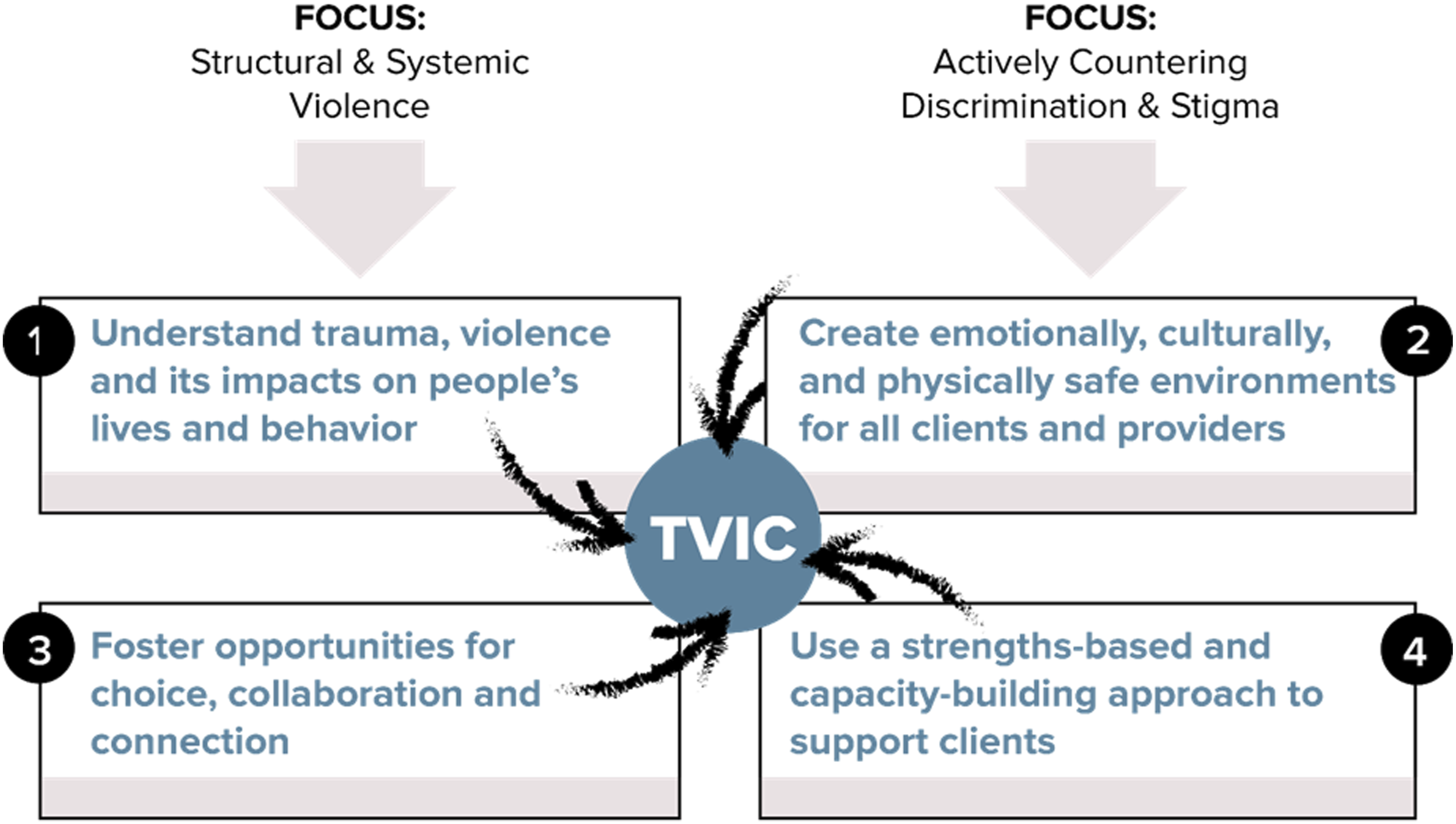
There are a myriad of recommendations, both within and outside of formal institutional research ethics board requirements, for maintaining the safety of participants, including via explicit trauma-informed approaches in action research with marginalized groups (Aldridge, 2016; Edelman, 2023; Voith et al., 2020), and guides to support the safety of action researchers, including co-researchers (Adams & Moore, 2007; Silverio et al., 2022), and students (Orr et al., 2021), that align well with the TVI principles and approaches above. However, the focus of these guides for researcher safety is generally on recognizing and addressing vicarious trauma (from hearing/seeing the trauma of others) and actively working to avoid doing harm to self or others through planful and iterative research processes. For example, Vertommen et al. (2024) discuss the principle of “First, do no harm” and propose the application of Wathen & Varcoe’s TVIC approach in research. They emphasize the importance of supporting everyone involved in research, including both participants and researchers, irrespective of whether they have direct or indirect lived experiences of trauma and violence. Similarly, Ferreira Gomes et al. (2025) documented the application of TVIC in participatory action research in sport, using reflexivity to facilitate this integration. While the authors discuss some measures used to safeguard the researchers and youth involved in the research, there is no specific guide on safety specific to reflexivity. There is therefore a key opportunity to focus on reflexivity in action research as a site for attention to various forms of safety that are embedded a priori (e.g., through consideration and reporting of positionality) and iteratively and relationally throughout the research process, as researchers consider not only their influence on the research, but the research’s influence on them.
It is important to note that many people who experience even highly traumatic events, especially when they have access to internal and external supports and resources, survive and thrive (Southwick et al., 2014), so we should not assume that re-traumatization for those with shared lived experience of the research topic is a given. Indeed, people may choose to conduct or participate in research reflective of their own experiences as a form of healing or meaning-making (Kulkarni, 2017); that said, it is reasonable to anticipate the possibility of negative impacts on people or groups who have been disproportionately exposed to adversity and/or traumatic events when these topics are closely examined, even in new contexts (Voith et al., 2020).
Four Dimensions of Reflexivity
Practical Guidelines for TVI Reflectivity (TVI-R)
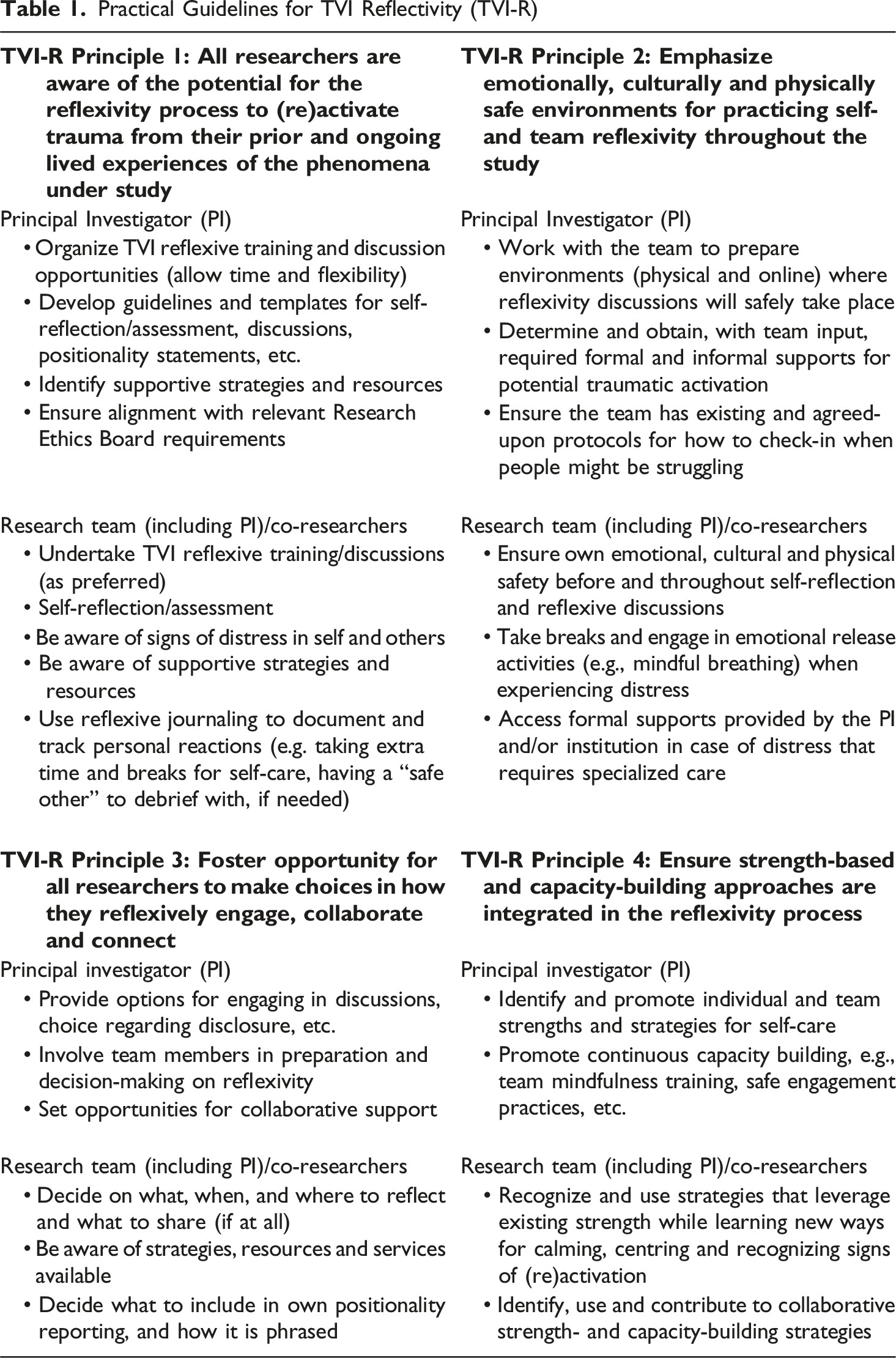
TVI-Reflexivity is an iterative process that involves overlapping and interconnected dimensions of reflexivity practiced in the context of institutional supports (or lack thereof), PI skills and expertise in these strategies, team dynamics and the broader research and social environment. We recommend that researchers consider taking TVIC training 1 before embarking on their research project to ensure optimal alignment between the TVI principles and the stages and dimensions of reflexivity work envisioned for the study.
Application of TVI-Reflexivity
In this section, we further articulate each of the TVI-R principles in Table 1 through Olmos-Vega et al. (2023) four reflexivity dimensions, then apply them to the research context described in Box 1.
TVI-R Principle 1: All researchers are aware of the potential for the reflexivity process to (re)activate trauma from their prior and ongoing lived experiences of the phenomena under study
Building awareness and acknowledging potential adverse effects of engaging in self- and team reflexivity is the first and foundational step of TVI-R, allowing proactive preparation for a safe and productive reflexivity process. Knowing how trauma can present allows the team to anticipate and recognize specific indicators, without having to prompt disclosures (Wathen & Varcoe, 2023). Thus, it is important for researchers conducting sensitive studies, in particular those who are insiders, to be aware early in the reflexivity process of what features of the research might activate/re-activate a trauma response.
This begins with personal reflexivity, and the act of recording this in the form of a positionality statement. This close examination of one’s past and ongoing social positions and experiences, while highlighting ways to improve study rigor, creates potential for emotional distress, requiring the principal investigator (PI) and (co)research team to be aware of the manifestations of such distress and address them a timely manner (Olmos-Vega et al., 2023). Importantly, different aspects of the research may be emotionally activating for researchers and as such prompts the need to integrate TVIC in reflexivity in each aspect of the research, emphasizing the ongoing application of TVI-R throughout the study. To facilitate TVI-R, the PI works with the team to develop guidelines not only for what the reflexivity process is expected to accomplish but also what individuals and the team should do to ensure safety and well-being. This could include identifying time and space for engaging in debriefing and discussion (should people choose), being aware of distress symptoms and knowing when to disengage, stop and seek support (and from whom/where).
Similarly, interpersonal reflexivity that focuses on examining and addressing the relationship dynamics between researchers and participants and within the research team itself, while promoting the recognition and appreciation of participant and co-researcher voices, can be stressful. It becomes more complex in studies in which researchers have lived experience related to that of the participants, and even more so in action research, when some participants are co-researchers. Using a TVI approach, all members of the research team need to be aware of the implications of these multilevel interpersonal relationships, and attendant power and boundary considerations, along with how various experiences of trauma and violence might present when activated (Wathen & Varcoe, 2023). This awareness can be fostered starting with TVIC education (EQUIP Healthcare, n d) and through group discussions that create safe space for the research team to share their personal and interpersonal positionalities and how these might influence the work. It would benefit the team to work together to set boundaries around these discussions to ensure they are in line with the goals of reflexivity and that each member is supported to safely participate. For example, there are explicit guidelines around what should and should not be discussed, who will facilitate the discussion, what supports are in place should a member experience distress, etc. Members should be clear on the choices available to them, for example whether they can opt out of sessions. Importantly, discussions of power and boundaries around different roles on the team (investigators, students, staff, partners, co-participants, etc.) should be clearly laid out.
Methodological and contextual reflexivity might sound less emotionally fraught, however predicting what might activate a trauma response can be difficult. Our worldviews and epistemic positions are largely shaped by personal and professional experiences, including the social, political and economic contexts of our earlier lives. In reflecting on and invoking these when making methodological decisions, harm may arise. Thus, it is important for researchers to be aware of the potential for emotional distress even during methodological reflexivity and plan measures to safeguard, should these be needed. Similarly, contextual reflexivity involves reflecting on the study’s social, cultural and historical context, how the research questions and data are embedded in that context and the potential impact of the study on this context. In some cases, contextual reflexivity might take an emotional toll on researchers, for example when insider researchers recount the cultural context in which their own historical trauma occurred. Cultural safety is embedded in the TVI framework, and it is essential to understand how both cultural context and past experiences, as they relate to trauma and violence, may influence the reflexive process (Browne et al., 2022). Cultural safety was originally developed in the 1990s in New Zealand by Māori nurse-leaders who saw the need to move the focus of attention beyond ‘cultural sensitivity’ to counteracting the harms of systemic racism and other forms of discrimination. If all research team members are not familiar with the context (e.g., cultural, political, and historical) relevant to the study topic, this can be an area of misunderstanding and vulnerability.
While reflexive dimensions are discussed separately, they are interwoven (Olmos-Vega et al., 2023), making engagement in any dimension of reflexivity a potential point of activation of traumatic distress of varying degrees. Carefully considering the risks involved in each phase of reflexivity, and throughout the research process, is essential. From a TVI lens teams should approach reflexivity without having to explicitly ask research team members whether or not they have experienced trauma or violence; awareness and care strategies should target all team members regardless of their lived experiences. As our work is rooted in a participatory approach, team members are actively involved in this process by preparing and undertaking TVI-R training/discussions (as preferred). Throughout the study and during any reflexive undertaking, researchers will continue to attend to signs of distress in self and others, and what activates this. Reflexive journaling, particularly during individual (formal and informal) reflexivity, will be used to document the process and track responses. TVI-R journaling will follow the regular process, however, researchers will be trained on and offered options in case of any emotional difficulties in journaling, such as taking breaks to disengage for a moment, discussing the difficulties with a peer or formal support person provided. This documentation can be used during the team debriefing or any other support session, and can also be used to refine the TVI-R tools. Active, choice-based participation of all members ensures that available supportive strategies align with the team’s needs, and are mechanisms through which they can advocate for any other measures/resources needed to facilitate safe reflexivity.
TVI-R Principle 2: Emphasize emotionally, culturally and physically safe environments for practicing self- and team reflexivity throughout the study
Careful attention must be paid to creating emotionally, culturally and physically safe spaces (both in-person and virtual options) for the research team to engage in reflexivity, and flexible time provided to allow for this, including self-reflexivity and writing the positionality statement. The creation of ‘safe space’ means that everyone involved feels comfortable reflecting and sharing their experiences in relation to the study without fear of judgment or adverse consequences and knows how to get support if needed (Marcellus et al., 2025). Safety is also reflected in the way the reflexive process is structured, and in attention to professional and personal boundaries, including around roles and perceptions of power, especially when teams comprise academic faculty, students and community members. For example, ordering reflexive questions/points from the most general to the most sensitive and integrating breaks and mindfulness activities into the process could help regulate any emotional responses while also being comfortable for everyone. These are strategies used in mental health care and they have been recommended for interviews used in qualitative research on sensitive topics (Westland et al., 2025). Careful and collaborative decisions on what is done individually, in small groups or in plenary sessions, and who facilitates these, contribute to feelings of inclusion and control. Each researcher should feel safe to engage in reflexivity in a way that feels socially and culturally appropriate to them while respecting others’ cultures and practices. The PI should carefully assess and plan to equip the team with the cultural safety competencies needed to ensure mutual cultural safety for all involved for all aspects of the reflexive process, and for all types of reflexive discussions. Further, the team will co-develop personal and professional boundaries around how reflexivity should be practiced (e.g., what should be reflected on, how, what should be shared within the team and what should be documented). Our team will discuss where reflexivity could take place, considering what would be needed for in-person versus online. Safety protocols co-developed with the team and continuously revised will be used to ensure each research team member understands how to keep themselves and others safe and how to check in when people might be struggling. The procedure will also outline when and how to seek help from professionals in case of distress that requires advanced care. For emotional safety, the team will use a co-created list of optional strategies for managing any distress that might occur, including, for example, strategies for self-care such as taking breaks, relaxation activities, debriefing, mindfulness practices and breathing skills for calming and centring. Our diverse team creates opportunities to choose and draw from our experience to seek and provide mutual support. Choices on what, when, how and with whom to share the information will be discussed with the team. We will also establish options for seeking professional support outside the team should anyone need it. A list of optional advanced/professional care, such as a professional therapist, will also be elaborated. We will continue to encourage researchers’ active participation in improving their safety by seeking feedback on the protocols and addressing any concerns. We plan to revise these protocols and strategies as the study evolves to allow adjustment as needed to ensure the available responses are relevant to the individual and team members, taking into consideration what is contextually and culturally appropriate.
TVI-R Principle 3: Foster opportunity for all researchers to make choices in how they reflexively engage, collaborate and connect
Fundamental to the initial and ongoing harms of traumatic and violent events is the loss of control felt in the moment, and when the trauma is reactivated. For those whose trauma included complex and chronic forms of interpersonal violence, especially from those in trusting relationships such as partners or caregivers, this can be further exacerbated by impacts on the ability to forge new trusting relationships. Thus, providing all involved in the research process authentic opportunities to consent up-front to participation (via research ethics board-approval letters of consent for participants and, by virtue of their actions, for researchers, including students and co-researchers from the study community) remains a required step in any research study. For sensitive studies that include insider researchers, ensuring that each is explicitly allowed to decide whether and how to engage in all dimensions and stages of reflexivity is also essential. For example, team members should decide which aspects they want to engage in, how that is done safely (emotionally, culturally socially) for them, and how much and what information they want to disclose. In their participatory action research, Ferreira Gomes et al. (2025) allowed youth co-researchers to opt out of some research activities. To apply this strategy specifically in TVI-R, research team members could be offered the choice to opt out or participate in some reflexivity activities. For example, if a team member is uncomfortable engaging in group reflexivity through open discussion, they can opt out and instead engage in individual reflexivity. They may start by writing down their reflexivity process and then have a one-on-one discussion with a trusted team member. This example emphasizes the importance of the team to co-create various options for the reflexivity process, from which members can choose. They must be allowed the flexibility to change their minds at any time, without explanation, judgement or adverse consequences. Working with the team, the PI should co-create a collaborative set of options around how reflexivity could be practiced, allowing each person to make choices reflecting their comfort and needs. Members should also provide anticipatory guidance around the kinds of experiences they may discuss, so that others will know and can choose to listen/participate in those discussions, keeping their own safety in mind. Alternative ways for information to be shared (synchronous, asynchronous, by voice or text, online or in-person) should be considered.
The PI must also recognize and continuously attend to any power imbalances within the team. When practiced well, various dimensions of reflexivity can facilitate informed choices, promote collaboration, and enhance connections, ultimately improving both reflexivity and the quality of the study. For instance, through personal and interpersonal reflexivity, team members can reflect on their relationships and the dynamics of power, especially when community members are part of the team. This approach enables the team to recognize and appreciate each member’s contributions, which can lead to adjustments in study methods through methodological reflexivity, keeping the study context in mind. TVI Reflexivity should also provide access to diverse resources that support researchers’ engaged reflexivity, including supports from the university/institution. This might include offering a list of training opportunities, facilitating access to self-care activities (such as exercise and relaxation), organizing peer support, and providing connections to professional services. A collaborative culture encourages connection, allowing team members to make choices while considering the project and their colleagues. In such an environment, team members can safely practice reflexivity, enhancing the study and, specifically, the quality of the reflexivity process.
TVI-R Principle 4: Ensure strength-based and capacity-building approaches are integrated in the reflexivity process
A strengths-based approach to personal reflexivity emphasizes the identification of researchers’ personal and professional strengths and how these can be utilized throughout the study. This includes recognizing and leveraging the skills, experience, relationships, and knowledge the team has regarding the study’s context and culture. Researchers choose to engage in studies for various reasons, often linked to their personal experiences that may connect directly or indirectly with the study. It is essential to first reflect on the individual and collective assets that researchers bring to their work. Relevant cultural beliefs and practices could be considered to support TVI-R, for example storytelling to share experiences, use of song, dance and other arts-based methods to alleviate stress. This reflection can be achieved through individual, interpersonal, and methodological reflexivity. During this reflexivity, the team examines their experiences, assumptions, and worldviews in relation to the research, the affected population, and the study’s context. Through methodological reflexivity the team might explore local ways of knowing and their integration in research processes. The team can build on this understanding as they design and execute the study, prioritizing the voices of participants (Olmos-Vega et al., 2023). In their work with Indigenous Peoples, Smye et al. (2023) suggest the use of a Two-Eyed Seeing approach that integrates both Indigenous and Western ways of knowing in co-creating knowledge. This approach aligns with TVI-R in that is fosters the integration of community ways of knowing into research that is primarily informed by Western perspectives. For example, in our collaboration with communities who have experienced trauma, integration of community ways of creating and sharing knowledge, including storytelling methods, not only promotes healing but also allows the use of methods that are familiar, safe and comfortable for the co-researchers from the community.
Capacity-building should equip the team with the knowledge and skills necessary for effective TVI-R. This could include training in self-care techniques, such as mindfulness practices and skills for calming and centring. It is important to identify institutional and other formal resources that can support the team and ensure they are informed about and have access to these resources when needed. Engaging team members in the planning and execution of this supportive system is crucial to ensure that it is tailored to their needs and is contextually and culturally appropriate. Different dimensions of reflexivity can provide insights into what is working and what still needs to be addressed to ensure a safe and effective reflexivity practice. It is important for the PI to plan ongoing consultation with the team to understand what needs to be improved, adjusted or made available for them to feel supported in each dimension of TVI-R.
What to Document & Report: TVI Reflexivity & Positionality Statements
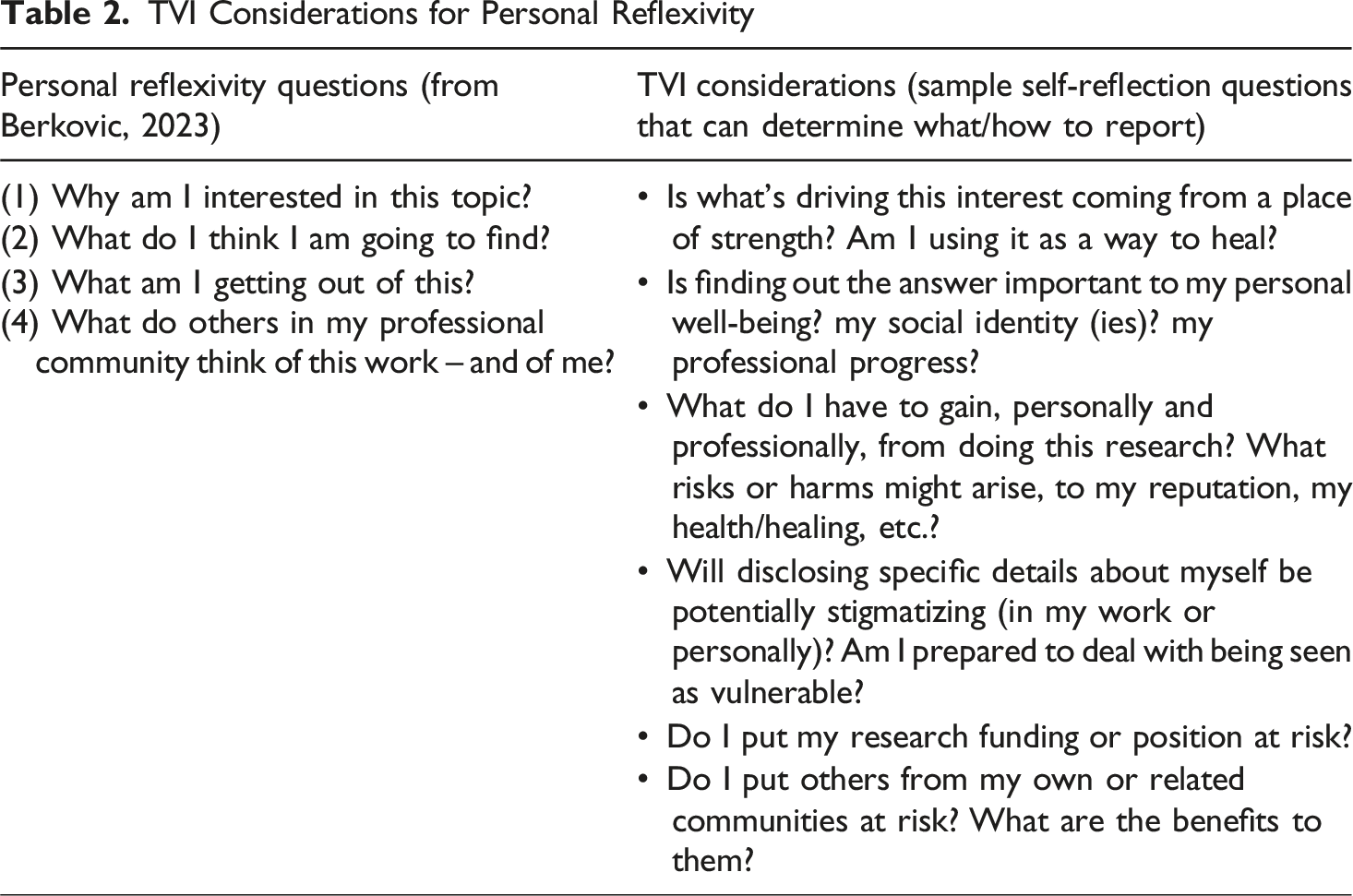
With an understanding of how reflexivity can be conducted in a TVI way, we turn now to how a TVI approach can be applied while writing positionality and reflexivity statements for a manuscript, dissertation, or other document. Often, these statements are short paragraphs that review the authors’ characteristics and how these relate to the research orientation (Olmos-Vega et al., 2023). In actuality, such statements are an opportunity to embrace how the researchers’ subjectivity and personal experiences influence the data and the study at large (Olmos-Vega et al., 2023). This inherently opens up the researcher to potentially be exposed to vulnerability when deciding which parts of their personal experiences are to be explored in the reflexivity section of their manuscript.
Implementing TVI in the positionality section of a report will require that all members of the research team are familiar with TVI principles to ensure that there is a global understanding of what is included in the document and what is not. The content to be included will need to be carefully selected and discussed with the team to ensure that researchers focus on those subjectivities that are relevant to the research at hand (Johnson & Rose, 2024), are not “performative” or “confessional” (Gani & Khan, 2024; Westland et al., 2025) and that the process is guided by TVIC principles. How TVI-R will be initiated and implemented into producing positionality statements depends on the local and perhaps broader social and political context framing the research (Olmos-Vega et al., 2023; Wathen & Varcoe, 2023), and also on the study topic within this context, those participating on the team, and whether others are involved in the reflexive process (e.g., an advisory group of people with lived/living experience). Therefore, when considering what to include in a research report, researchers should assess their own context and what the potential impact may be on themselves and other researchers when including personal experiences that may result in vulnerability (to stigma, discrimination, reputational harm, etc.) or re-traumatization.
TVI Considerations for Personal Reflexivity
Conclusion
Reflexivity is a key component of research methodology that enhances study quality. However, it is important to ensure researchers’ safety and well-being are a priority, especially in the context of sensitive research topics where researchers have lived/living experience of the traumatic topics being studied. The integration of TVI principles in the reflexive process - what we call TVI-R – creates a space for researchers to engage in reflexivity while taking care of themselves and each other. Working closely with the research team in planning, executing and revising the process as needed is crucial to ensure the success of TVI-R. The TVI-R approach has the potential to improve research practices in sensitive areas such as mental health, gender-based violence, genocide and war, homelessness, and work with varoius marginalized communities. More scholarly work is needed to refine this approach and establish best practices that prioritize the safety and well-being of both researchers and participants which is, as noted above, our next step. While the focus of this paper was on the integration of a TVI approach in the reflexivity processes, efforts to integrate TVIC in all aspects of research (MacDonnell et al., 2025; Marcellus et al., 2025) should continue, ensuring safe research practices for researchers and all involved.
Footnotes

Funding
The authors received no financial support for the research, authorship, and/or publication of this article.
Declaration of Conflicting Interests
The authors declared no potential conflicts of interest with respect to the research, authorship, and/or publication of this article.