




Abstract
Nowadays, the question no longer is whether children should participate in the decision-making process of issues that affect their lives; the focus lies, instead, on how to ensure that children can participate in a meaningful way. Participation in child protection proceedings has proved difficult to achieve. Where children indicate that the attitude and relationship with the case manager is an important barrier, case managers refer to their responsibility to protect vulnerable children. They feel they miss tools to facilitate child participation within such a complicated process. Instead of developing participation tools with case managers, we decided to start by asking children what they believed would be helpful to make themselves heard. Children, with the help of an industrial designer, developed several tools that they believe can facilitate participation in family meetings. Interestingly, the tools the children designed were all directed at who is talking when, to whom and how, and not at what they want to say. This shows that the conditions children say they need for effective participation comprise different aspects than the conditions mentioned in literature and by professionals, underpinning the value of involving children in creating solutions.
Keywords
Introduction
Within child protection and child welfare services, child participation is seen as crucial for effective intervention and to comply with the child’s rights. This has been evidenced both in scientific research as well as in the implementation of child participative approaches within child protection and welfare institutions all over the world (Healy, Darlington, & Yellowlees, 2012). Child participation has proven to be essential to deliver responsive care and as a result, more effective and sustainable interventions (Dedding, 2009; Heimer, Näsman, & Palme, 2017; Sinclair, 2004; Van Bijleveld, Dedding, & Bunders-Aelen, 2015). Additionally, child participation has proven to build empowerment, a sense of control (Bell, 2002) and a higher self-esteem, whereas a lack of participation might lead to disempowerment and a lower self-esteem (Littlechild, 2000; Vis, Strandbu, Holtan, & Thomas, 2011). Moreover, children want to have a say about the decisions that concern them and their close environment (Leeson, 2007; Sinclair, 2004; Van Bijleveld et al., 2015; Woolfson, Heffernan, Paul, & Brown, 2009), and have been proven to be capable of doing so, even in relation to complicated issues (Alderson, 1992; Dedding, 2009; Nieuwenhuizen, 2006).
Although the importance of child participation is acknowledged, the question is how to ensure that children can participate in a meaningful way. Participation in child protection proceedings has proved difficult to achieve (Gal & Duramy, 2015). Studies from the last decade show that although the intention to facilitate child participation is there, in practice, little has changed (Munro, 2011; Tregeagle & Mason, 2008; Vis & Fossum, 2015). To achieve child participation, many countries adapted their legislation, including participatory decision-making principles in local law. For instance, in the UK, local authorities are required to ensure that children’s wishes and feelings are heard in Looked After Children reviews. However, as the study of Pert, Diaz, and Thomas (2017) showed, children still experience low levels of participation, highlighting that the techniques used to engage children in this process are largely ineffective. In addition, the study of Muench et al. (2016) concluded that within child protection conferences in the UK, children and young people’s understanding of child protection meetings and their participation within them is still minimal. The study of Berrick, Dickens, Pösö, and Skivenes (2015) also showed that although England, Norway and Finland provide policy guidance regarding children’s role in child protection decision making, they did not see consistently higher indicators of children’s involvement compared to the other countries. Several studies showed that children experience a level of participation which is more in line with informing than actually contributing to the decision-making process (Bell, 2002; Cashmore, 2002; Leeson, 2007; Van Bijleveld, Dedding, & Bunders-Aelen, 2014). A former study related to this project, investigating young people’s perspectives on the levels of child participation in the Netherlands, also showed that young people felt often not heard, not taken seriously or did not understand why certain choices were made (Van Bijleveld et al., 2014).
Case managers point out that the right of children to participate is difficult to put into practice (Archard & Skivenes, 2009; Cashmore, 2002; Cossar et al., 2014; Van Bijleveld et al., 2014; Vis & Thomas, 2009). They particularly experience barriers in the tension between protection and participation. In their perspective, in order to safeguard the child, decisions have to be made quickly, interfering with the child’s right to give information on his or her own terms (Sanders & Mace, 2006). And more practically, they experience barriers in building a relationship of trust with the child and in facilitating an active role for a child in a trialogue with caregivers and children, in which the caregivers are often verbally stronger. These barriers were also found in the preliminary study in the Netherlands, in which current levels of child participation within a Child Protection Service Organization were studied. The case managers felt that their duty to protect children often requires quick decisions, whereby there is no time to invest in a relationship with the child, which they believe is necessary to facilitate participation. Furthermore, they believed that the wishes of children are not always realistic and feasible and therefore, the child’s views cannot always be taken into serious consideration. Third, they have to balance between the guidelines of the organization, the rights and opinions of the caregivers and the rights and the opinions of the child. Case managers explained that in practice, it is easier to talk to the care givers and other professionals, since they are verbally stronger and better capable to express their views, as a result of which they do not always hear the child (Van Bijleveld et al., 2014).
In short, putting children’s rights to participate into practice is rather difficult within child protection services. Extra efforts are needed to ensure that child participation is facilitated and acted upon. Normally it is the adults/professionals who develop intervention tools. However, in this study, we decided to begin with what children think could be helpful instruments for them to speak up during meetings with their case manager. By starting with the perspective of children, we hope to develop a tool that fits their competences and needs in expressing themselves in relation to adults in often difficult and sensitive circumstances. Using co-creative sessions, children were invited to develop tools that they believed would help them to share their perspectives during the family meetings. Of course, these tools can only be successful if developed in close alliance with the case managers and carefully embedded in practice (Van Bijleveld, Dedding, & Bunders-Aelen, 2020). However, the aim of this article is to describe what children believe they need to express their wishes and ideas, and to jointly convert those into a tool.
Before describing the co-creation process and the tools that were developed, we first elaborate on the definition of child participation used in this study.
Defining child participation
In existing literature, the concept of participation and its precise meaning has been and still is a subject of discussion. Arnstein (1969), one of the first to describe the concept, defined participation as ‘the redistribution of power that enables the have-not citizens, presently excluded from the political and economic processes, to be deliberately included in the future’ (p. 216); while Hart (1992) described participation as ‘the process of sharing decisions which affect one’s life and the life of the community in which one lives’ (p. 5). He refers to an active form of participation and the possibility (his emphasis) that this participation will have an effect on decision making. He emphasizes that the goal of child participation is not that children always participate to the full but, rather, that every child should have the opportunity to choose the fullest level of participation that matches his or her capabilities, with the added recognition that circumstances will offer different opportunities (Hart, 2002). Shier (2001) stressed that despite the level of participation, the degree of commitment to empowerment differs between organizations. For each level of participation, he distinguishes three stages: openings, opportunities and obligations. Thomas (2000) described that the participation right grants children more than a right to be heard, but less than a right to independent decision-making.
An important finding is that processes of child participation need to be ‘child centred/focused’ in order for children to participate effectively and that participation should be viewed as a process rather than a one-off event (Dedding, Jurrius, Moonen, & Rutjes, 2013; Leeson, 2007; Willumsen & Skivenes, 2005). For instance, Gal and Duramy (2015, p. 6) describe that ‘under de CRC children are perceived as relational human beings and, as such, their rights are imbedded within a relational approach. Therefore, adults should be sure to engage in a dialogue with children involved in the process to allow mutual exchanges of feelings and viewpoints’. Especially within the context of child protection, where it is not about one decision, but a long period in which multiple decisions are made, participation should be defined as taking part in a process of discussions in such a way as to have influence on the decisions made (Franklin & Sloper, 2005; Thomas, 2000). Therefore, within this study, following the definition of Dedding and Slager (2013), we define participation as a situational and iterative process in which all relevant actors enter into mutual dialogue. Within this process, the perceptions, knowledge and experience of each actor should be given proper weight. Proper weight means that particular attention should be paid to the perspectives of the ones most affected by the decisions within the process, in this case, the children. Furthermore, this process should lead to action and change, a practical end. Within the daily practice of child protection services, meaningful participation therefore entails an interaction/dialogue between case manager and child, in which the child feels able and free to express his needs and wishes, is taken seriously in doing so, and when the wishes and ideas are not feasible, is given a proper explanation why.
Methods
This research is a continuance of a project carried out at the Bureau of Youthcare in Amsterdam which aims to understand and to enable child participation within the context of child protection services. The aim for this action research was to develop a tool to facilitate children’s participation. Action research with children has proven to be suitable to get an understanding of, and at the same time improve patient experiences (Dedding et al., 2013; Langhout & Thomas, 2010; Schalkers, Dedding, & Bunders, 2015). Through the development of an open and creative dialogue, it is crucial that children do not feel pressured to give rapid answers, and therefore have time to reflect on what and how they would like to communicate. Furthermore, such dialogue aims to give them the opportunity to choose and control how they express themselves and assist them in talking about more complex and sensitive issues (Fargas-Malet, McSherry, Larkin, & Robinson, 2010).
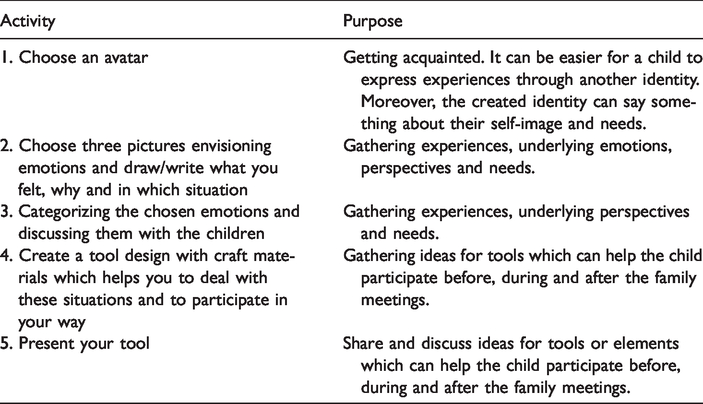
The project started with individual interviews with the children (n = 10) at their homes. Subjects of the interviews involved their experiences with youth care, their role in the family meetings, the relationship with their case manager and their ideas, wishes and feelings towards participation. Second, two creative work sessions were organized, guided by an industrial designer, specialized in user centred design, who is well known with the core values of child participation. Before introducing her to the field, we clearly explained what we expected, namely to facilitate a process in which children could develop their own ideas and translate these in tools so we could learn what they value and why. In the first session, the children were introduced to each other, shared experiences and created something that they feel would help them to express themselves during family meetings (see Table 1).
Meeting 1: Exploration of experiences and needs through craftingguided dialogue.
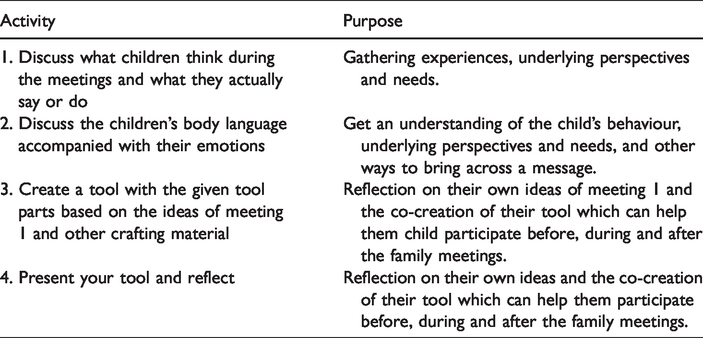
After the first session, the ideas were carefully reflected upon by the industrial designer and researcher, analysing the aim of the tools, and how the design could be strengthened. These ideas were presented in a second meeting to the children, not as final solutions, but as inputs for improving their own tool, or to create something completely different (see Table 2).
Meeting 2: Exploration, co-creation of tools and reflection.
Participants
In line with the exploratory and participatory nature of the project, we aimed for a small group of maximal 12 children, ensuring enough attention for all children and their needs. Children were invited if they were between the ages of 6 and 13, spoke Dutch, had experienced one or more family meetings and had a child protection plan. The children were recruited via their case managers. Case managers were contacted by e-mail, leaflets and a presentation campaign at the local child protection agency in Amsterdam. Of the 19 case managers who indicated interest, 10 informed families about the research through recruitment letters for the caregivers. For the children, a specific letter was developed in understandable language with illustrations supporting the message that it is about them as experts on what they need. Having received agreement from the family, the researcher accompanied the case manager to the family’s home to give further information about the project and if the family still agreed, to observe a family meeting. In two of the seven cases, an observation of the family meeting was not feasible; instead, an alternate first meeting at the child’s home was planned in which the researcher introduced herself and the research, where after the family and the children could chose to proceed or not. Subsequently, a second meeting took place at the child’s home where a semi-structured interview was carried out. This phase gave the researcher, the children and their caregivers the opportunity to get to know each other and to gather insight in the surrounding complexities regarding child participation in this context. After the second meeting, the children were asked to join the creative sessions, and permission of the caregivers was asked.
Ten children (five boys and five girls) aged 7–12 years of seven families agreed to participate (see Table 3). Eight of the 10 children lived with their mother, one lived with her father and one lived with his two uncles. The child protection cases either concerned neglect or (in)direct violence. Half of the children experienced out of house placement, either with or without their parents, at least once.
Overview of participants’ characteristics.
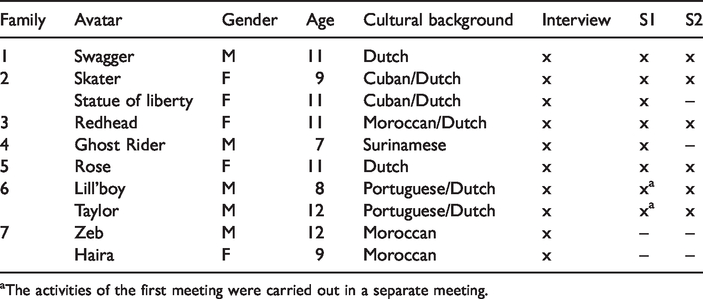
aThe activities of the first meeting were carried out in a separate meeting.
Data analysis
During the whole project, observations of family meetings, interviews and co-creative sessions were recorded in elaborate field notes where behaviour, the context, quotes and interpretations were written down. The interviews and co-creative sessions were audio recorded and transcribed. All data were transferred to the qualitative data analysis programme MAXQDA 11.0 to enable thematic analysis. Products of the co-creative sessions were summarized. Crosscutting themes were extracted while at the same time the richness of individual stories was preserved.
Ethical considerations
The research was designed to be compliant with Code of Ethics for Social Work and Social Care Research (JUC Social Work Education Committee, 2014). Prior to the data collection, informed consent was obtained from the case managers, caregivers and children. The children were informed at several moments in the project that they could revoke their consent at any time without any consequences. A code word was agreed upon to indicate situations where the child did not want to answer a question and at the same time enabled children to set their own borders. Furthermore, all children were asked to choose an avatar to make sure all information would be anonymous. Children were given information about the project in understandable language and it was explained to them who they could contact with questions and remarks. All the children who participated in the co-creative meetings were given a voucher for their time and effort.
The children participating in this project did not try their tools themselves in practice, because we did not want to put the children in a possible harmful situation for the sake of an experiment. It was explicitly discussed with the children that the tools could not be put in practice without extra guidance for the case managers, because it could put the children in a complicated situation. However, the children were informed that what they developed would definitely be tested in real practice later on, in a safe setting (see Van Bijleveld et al., 2020).
Results
Before describing the tools the children created, their experiences with participation will be described, as they are essential to understand the children’s starting point and aims.
Experiences with participating in the decision-making process
Both in the interviews and the meetings, the children shared their experiences of expressing their views during the youth care process. Half of the children participating perceived the case manager as someone who came to talk mainly with their parents. For example: Rose (F, 11Y): Well, then she comes to our house and we are present, but she is talking more with my dad. Interviewer: What do you think about that? Rose: We are part of everything as well. It is actually all about us Zeb (M, 12Y) It is important that we are heard, because it is about our lives and that when we are grown up, we won’t do the same Statue of Liberty (F, 11Y): It was like ‘(Mimicking case-manager) yes a woman is coming to see how it is going over here and her name is Lia and we are going to talk with her tomorrow’. But then it is already decided upon. I: And what do you think about that? S: Not so nice but … I: How would you like it? S: I did not mind that she was coming but they should have asked me first
Overall, the children indicated two factors that could either facilitate or hinder participation in the meetings, namely the relationship with the case manager and the presence of the caregiver(s). In the relationship with the case manager, children valued that the case manager was open, respectful, provided them with enough information and was available, while on the other hand unavailability and unreliability were mentioned as undesired traits. Further reasons why they did not feel supported by the case manager included irregular contact, ‘childish’ communication and a lack of trust related to the role of the case manager as the one who brings the ‘bad news’, which was often reflected in ‘not getting along with’ him or her. The presence of the caregiver could help the children feel comfortable to express their views and wishes, and therefore serve as a facilitator for participation. However, more than half of the children also mentioned the care givers attendance as a barrier. One explanation for this was that the caregivers answered questions for the children, leaving no opportunity for the children to form and/or express their own opinion. Furthermore, the children also mentioned that conflict of loyalty made it difficult for them to speak out. Especially in cases were the parents fought a lot (e.g. divorce cases, custody cases), children experienced that the parents could dominate the conversation and try to influence the opinion of the child in a way that served the cause of the parent, often casting the ex-partner in a bad light. But also if the care giver was not telling the truth and the case manager did not recognize this, children felt inhibited to share their own views, because it would jeopardize their parent and put them in a vulnerable position, or because they felt that the case manager would believe their parents over them.
Creating tools
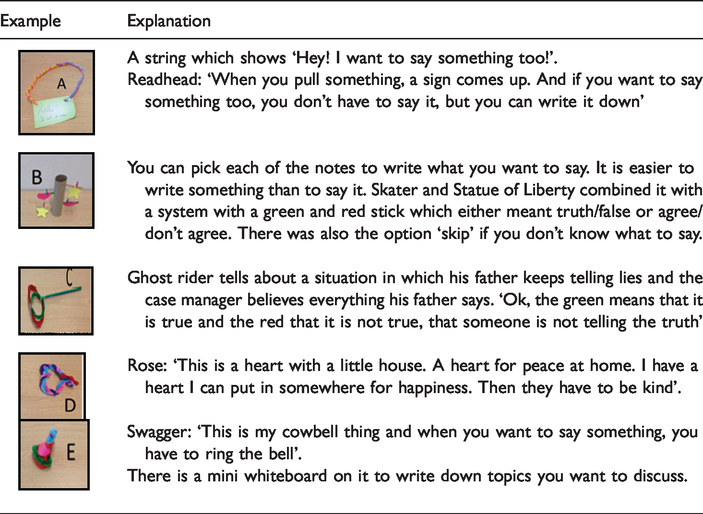
Based on the experiences of children, including barriers for participation, the first session aimed to facilitate the children to share what could help them in situations where they felt overwhelmed. The children chose three pictures envisioning emotions and drew/wrote what they felt, why and in which situation. The chosen emotions were shared with the group. The purpose of this part was to gather experiences, underlying perspectives and needs of the children. Subsequently, the children were asked to create and present a tool that could help them participate in their own way during the family meetings, and help reveal their message in situations where they felt overwhelmed, caught between conflicts or when their loyalty towards their loved ones was under strain. The created tools in this first session and the children’s explanation are shown in Table 4.
Examples and explanation of the tools the children created in the first meeting.
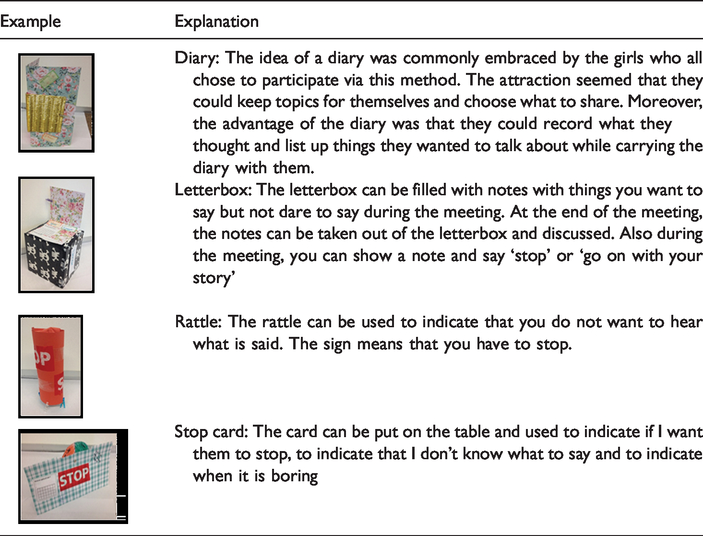
The second meeting started with a group discussion of what the children think and feel during family meetings and what they actually express verbally and through body language. The purpose of this discussion was to get a better understanding of the child’s behaviour, underlying perspectives and needs, and of the non-verbal cues used to convey a message. Thereafter, the industrial designer presented the concept tools she created, based on the examples of the children. The children were asked to create a final tool, based in part on the ideas of the industrial designer, adding or changing things, or creating something completely different. After crafting the own final tools, the children presented them to each other, reflecting on their own ideas (see Table 5).
Explanation of the tools the children created in the second meeting.
Discovering underlying themes
Although the children developed different tools, there were three underlying theme’s that recurred, namely they helped the children to (1) communicate in a non-verbal way, (2) influence the agenda of the meetings and (3) prepare for the meeting and control information-sharing.
(1) Non-verbal communication during meetings
All children experienced difficulties with responding verbally during the meetings. This could either be because they did not want to speak up or because they did not know how to express themselves: Statue of Liberty (F 11Y): Well, they ask something, but I don’t know how to say it Swagger (M 11Y): This card says: ‘attention please for my codeword’, for example if you want to end the conversation. Or If they hear the bell they also need to stop, and you can turn this showing whether something is true or not true
(2) Agenda-setting
The children felt strongly about what they did and did not want to discuss during meetings, but experienced difficulty in expressing this. For example, Rose (F, 11Y) stated:
When you talk to youth care and your parents are there, you do not always want to say things about your parents because you think you will hurt them
Redhead (F, 11Y): usually they talk about something, and then they talk about something else and then they leave and then I forget to say it
(3) Controlling information-sharing
Especially for girls, writing things down instead of telling them was a frequently recurring theme. Although the diary also served as a way of not using words during the meetings as well as agenda setting, as described above, it also gave the children the opportunity to decide for themselves who reads what and when. Skater (F, 9Y): here you can write things that are secret, you can also lock it. And here you write what makes you happy. And you can have a colour with what is for your mom or dad or the case manager to read
Discussion
In line with other studies (Cashmore, 2002; Cossar et al., 2016; Van Bijleveld et al., 2014; Van Bijleveld et al., 2015), in this study too, child participation within the child protection services has proven to be a complex process where the realization of a mutual dialogue between the children, their guardians and case managers, with proper weight given to the perspectives of the children is not yet attained. Confirming the findings of Sanders and Mace (2006) and Cashmore (2002), children are willing but often feel unable to express their views, mainly because of conflicts of loyalty towards their loved ones and the fear of negative consequences for themselves. Endorsing the findings of Van Bijleveld (2014), Cashmore (2002), Cossar et al. (2016) and Vis and Thomas (2009), most of the children experience insufficient support from the case manager to participate in the decision-making process. This is reflected in irregular contact, perceived lack of information transparency and insufficient choices to participate.
Developing a tool with the children was a very inspiring and enlightening experience for the children and the researcher. During the meetings, the children showed capable of expressing their needs and wishes. They had concrete ideas of what they miss, what would help them and how these could be translated into tools. Children found it easier and more fun to express their experiences and needs through a crafting guided dialogue compared to verbal methods, which was previously observed in a study of Leeson (2007) and in studies conducted about decision-making processes in healthcare settings (Clark, 2005; Dedding, 2009). It shows that involving children in the decision-making process, especially in the complex situations of child protection, is not simply a matter of starting a conversation. What is at stake is understanding how conversation can be possible and how meaningful dialogue can be facilitated. The children also indicated that it was worthwhile to meet other children who experienced the same kind of difficulties in life.
The tools
The children developed concrete tools that they believed would help them in the meetings with their case manager. Where initially the researchers had in mind that the outcome would be one tool, the diversity of children asks for not just one tool, but a set of tools from which a child can choose. However, despite the differences, there were three recurring themes underlying the created tools, namely, requesting attention (or explicitly not requesting attention), agenda setting and control over what information is shared with whom and when. All children created a sign to indicate that they want to say something or when they do not want to talk about a subject. They demonstrated the usefulness of such a tool, because of the difficulties involved in expressing themselves verbally before adults, and being seen as serious conversation partners within this setting. Furthermore, the tools the children created were directed at influencing what subjects were and were not discussed, indicating their need for organizing and controlling information. All five of the girls (and some of the boys) embraced the idea of a diary which enabled them to choose what to share with whom and to write down what bothered them any time of the day. These underlying themes emphasize the children’s desire to be seen as serious partners in the dialogue.
Although there were different tools developed, an interesting finding is that all tools developed are directed at how the children like to communicate within family meetings, not at what they want to say. This finding is intriguing, for most existing tools to help professionals talk with children are directed at the content of what a child might want to say, for instance how you feel, what you want to change. Many studies (Archard & Skivenes, 2009; Sanders & Mace, 2006; Van Bijleveld et al., 2015; Vis & Thomas, 2009) report that case managers believe that to facilitate child participation, investing time in building a relationship of trust and developing tools that help children to express the content of their wishes and feelings are crucial. However, the participating children insinuate that for building a relationship of trust, more important than asking how you feel, might be first discussing how to communicate with one another and understanding what is needed to be able to express oneself. Once the child has the feeling that he/she has a fair and serious opportunity to express him/herself in an appropriate way, he or she will open up and feel more invited to participate within the family meeting. Therefore, the tools the children developed are an important addition to already existing interventions for the facilitation of participation. The children’s input shows that child participation foremost means that case managers assure children feel invited to participate and are facilitated to do so. The tools developed by the children can help the case managers to make a first step towards that. However, using the tools in practice also requires that the case managers realise that facilitating child participation is a delicate process that needs preparation and eye for children’s individual needs.
Conclusion
While it is crucial to know that children experience different conditions for meaningful participation than the professionals, it is equally crucial to understand that their solutions for facilitating participation in practice differ as well. To create an actual change in practice, both the conditions from the case managers as well as the conditions of the children should be combined. Perhaps what is most important is that the case managers embrace the guidelines indicated by the children. At least, they should start with getting acquainted: who are you, who am I and how do we understand each other, what do you need to express yourself. Therefore, in the process of realizing meaningful participation in child protection practice, the next step of the project is to use the tools in practice and, together with the case managers, elaborate on what is necessary to combine the children’s insights with the professionals’ experiences and conditions (see Van Bijleveld et al., 2020).
Footnotes
Declaration of conflicting interests
The author(s) declared no potential conflicts of interest with respect to the research, authorship, and/or publication of this article.
Funding
The author(s) received no financial support for the research, authorship, and/or publication of this article.
