




Abstract
The need to shield young children from adversity is well documented, and reflected in both UK policy and the current UK Labour government’s pledge to ‘set every child up for the best start in life’. Yet, conversely, the UK operationalises a raft of measures to create a ‘hostile environment’ for asylum seekers and refugees. The hostile environment policies force asylum-seeking and refugee children to endure poverty and insecurity, associated with negative consequences for children’s physical, social, emotional and educational development. This paper employs critical phenomenology to understand the material, psychological and phenomenological effects of the ‘hostile environment’ on young asylum-seeking and refugee children in the UK. Data is drawn from semi-structured interviews with parents from 11 asylum-seeking and refugee families with young children (0–8). The findings reveal that asylum-seeking children are forced to live in conditions of material adversity and a state of limbo characterised by insecurity that pervades all aspects of their lives. Refugees have more stability than asylum seekers, but the psychological and phenomenological effects of living under hostile environment conditions continue to persist. The parents in this study expressed how they felt the cumulative effects of material adversity and insecurity negatively influenced their mental state and negatively impacted their children. As such, this paper indicates the contradiction between these negative effects of the hostile environment and the ‘best start in life’ for young children that the previous and current UK Governments ostensibly support. The paper is timely as the 2024 election of the new Labour Government presents a significant opportunity to influence policy responses to asylum seekers.
Introduction
The statutory framework ‘Early Years Foundation Stage’ (EYFS) declares ‘All children deserve the care and support they need to have the best start in life’ (Department for Education (DfE), 2024: 7). Yet, conversely, the United Kingdom operationalises a raft of measures to create a ‘hostile environment’ that has negative material and psychological consequences for asylum seekers and refugees, including children (Brittle, 2019; Fekete, 2020; Griffiths and Yeo, 2021; Mayblin, 2019; Webber, 2019). In particular, restricting asylum seekers’ access to employment prohibits self-sufficiency, and stands out from trends in other EU and OECD countries’ right to work policies. The impacts of the hostile environment are difficult to measure (Independent Chief Inspector of Borders and Immigration, 2018). To address this gap, this paper employs critical phenomenology to understand the ways that social and political structures have material, psychological and phenomenological effects on asylum seeking and refugee parents with young children in England (Gaywood et al., 2020; Willen, 2007).
The findings in this paper stem from a project that took place across 2022 and 2023. The broader aims of the project were to explore challenges asylum-seeking and refugee families experienced when trying to access early childhood education during the Covid-19 pandemic. Semi-structured interviews were conducted with 11 asylum-seeking and refugee families with children aged 0–8, members of six voluntary community organisations (VCOs), head and deputy head teachers from three schools and staff of the Health Inclusion Team which comprises specialist nurses and health visitors who support asylum seekers. This article focuses on a subtheme of this broader project by reflecting on the following question:
In what ways are the lived experiences of asylum-seeking and refugee children shaped by the UK’s socially, politically and historically constructed ‘hostile environment’?
This paper begins with an introduction to critical phenomenology and a justification for adopting this approach. Following this, the social, political, and historical construct of ‘the ‘hostile environment’ in the UK will be explained. I will then describe the methodological process that I undertook to uncover the participants’ lived experiences. Finally, anecdotes from interviews with the participants are shared and will demonstrate how the ‘hostile environment’ enforces material adversity which is compounded by multiple levels of insecurity that add a degrading psychological dimension to people’s ability to cope with living in poverty. Finally, the paper presents participant reflections on the material and psychological influences of the ‘hostile environment’ on their children’s lived experiences.
The conclusion draw attention to a contradiction between the experiences of asylum seeking and refugee children the claim that all children deserve the ‘best start in life’.
The overall impact of the ‘hostile environment’ measures is difficult to ascertain, for example, in 2018, the Independent Chief Inspector of Borders and Immigration (ICIBI) told the House of Commons Home Affairs Committee ‘the Home Office does not have in place measurements to evaluate the effectiveness of the ‘hostile environment’ provisions’ (House of Commons Home Affairs Committee, 2018: 20). That said, a critical phenomenological lens can reveal the relationship between the concrete conditions that are constructed by ‘hostile environment’ policies and the everyday lived experiences of those living within these conditions. As such, the paper sets out to understand: In what ways are the lived experiences of asylum-seeking and refugee children shaped by the UK’s socially, politically and historically constructed ‘hostile environment’?
Critical phenomenology
Phenomenology presents a methodology for exploring lived experience and is based on the premise that ‘only those that have experienced phenomena can communicate them to the outside world’ (Mapp, 2008: 308). As such, the aim of phenomenological inquiry is to understand ‘social and psychological phenomena from the perspectives of people involved’ (Groenewald, 2004: 43). A phenomenological study uses purposive sampling to select participants who have a rich understanding of a phenomenon through their lived experience (Frechette et al., 2020). The data of phenomenological studies are ‘examples’ of experiences and usually take the form of anecdotes, stories, narratives, vignettes, or concrete accounts. (van Manen, 2017). The examples are more than simple illustrations, ‘the example mediates our intuitive grasp of a singularity’ (van Manen, 2017: 815). In other words, the example elucidates what it is like to experience a particular thing through describing the participant’s experiential sense of the phenomenon. Thus, the phenomenological project can portray meaning in the ordinary, the taken-for-granted and the everyday.
In recent years, phenomenology has taken a critical turn and is ‘increasingly understood as a form of politically and ethically engaged critique capable of analyzing and illuminating contemporary socio-political phenomena’ (Oksala, 2023: 137). The critical turn has steered phenomenology away from being merely descriptive and towards understanding the complex forces constitutive of lived experience and, according to Ferrari et al. (2018) ‘The goal is not merely to describe the world, but to change it’ (p. 2). While classical phenomenology is rooted in ‘philosophical clarification’, critical phenomenology acknowledges that ‘contingent but persistent social structures influence our capacity to experience the world’ (Guenther, 2019: 13). Oksala argues that critical phenomenology must establish a ‘politicized [sic] conception of reality: reality is not simply ontologically given, but the outcome of profound historical and political constitution’ (Oksala, 2023: 141–142). Through critical phenomenology, the experiences of marginalised individuals can reveal, disrupt, and reorient the intersubjective structures and power relations of hierarchical political formations (Oksala, 2023).
This paper builds on the work of Willen (2007) that explored the lived experiences of illegal migrants in Tel Aviv. Willen’s research illuminates how policies oriented towards migrants are dynamic, are products of global, regional and national factors and have profound effects on the lived experiences of migrants. Through this work, Willen (2007) demonstrates how critical phenomenology can ‘help social scientists better understand the form, contours, texture, and dynamics of illegal migrants’ everyday lives in diverse host society settings’ (p. 28).
The ‘hostile environment’ in the UK
The ‘hostile environment’ refers to ‘a range of measures aimed at identifying and reducing the number of immigrants in the UK with no right to remain’ (UK Parliament, 2018) and their explicit intention is to deter so-called ‘illegal’ immigration. The UK’s immigration system and policies operate across all countries in the UK (England, Scotland, Wales and Northern Ireland) with all decisions made by the Home Office, though regional nuances exist in the details of how the hostile environment policies are put into practice. The term was first introduced by the Labour Government in 2010 in a white paper on immigration (UK Border Agency, 2010). Then, in 2012 Theresa May announced the introduction of ‘a really ‘hostile environment’ for illegal immigration’ (Kirkup and Winnett, 2012) and a new ministerial group- the ‘Hostile Environment Working Group’ was created, although later that year it was renamed the ‘Inter-Ministerial Group on Migrants’ Access to Benefits and Public Services’ (Independent Chief Inspector of Borders and Immigration, 2018).
Griffiths and Yeo (2021) explain how there is no Government document that sets out a clear definition or aims of the ‘hostile environment’. Instead, it can be understood as an ideological stance that is operationalised through multiple components across disparate sectors that share core characteristics and cumulatively produce an environment that is hostile towards ‘illegal’ migrants. The word ‘illegal’ is controversial: the idea that arriving in the UK through ‘irregular’ routes equates to being illegal is reflected in the Illegal Migration Act (2023) that intended ‘to prevent and deter unlawful migration, and in particular migration by unsafe and illegal routes’. Yet, the United Nations High Commissioner for Refugees contests the notion of ‘illegal’, stating the bill contravenes the UK’s asylum-related obligations (UNHCR, 2023). The following sections outline the economic rights and stability under the ‘hostile environment’ at the time of writing, in 2025.
The ‘hostile environment’ and economic rights
Regarding economic rights, asylum seekers have no recourse to public funds, which means they do not receive child benefit and cannot access Disability Living Allowance- a benefit that parents of children with Special Educational Needs in the UK can apply for to help with the costs of providing specialist support. Asylum seekers are not allowed to work in the UK except in very rare circumstances. They receive a payment of £49.18 per week if living in the community, or £8.86 per week if their accommodation provides meals. The allowance needs to cover food, clothes, travel and non-prescription medication, so there is little left for items that most people in the UK would consider essential, such as toys, digital devices, internet connexion or family excursions. This financial constraint disproportionately impacts young children, as children frequently need new sets of clothes and shoes as they grow. By limiting asylum-seekers’ economic rights, the UK systematically impoverishes them, and in doing so, knowingly exposes them to all the harms that poverty inflicts (Mayblin, 2019). According to Webber (2019), the level of support was calculated based on the assumption that asylum seekers would receive a decision on their asylum applications within 6 months. In reality, most people have to wait for much longer – in 2023, 68% of asylum seekers had been waiting for more than 6 months for a decision (House of Commons Library, 2023). Some of the families in this study had been waiting for over 6 years and were still awaiting the decision at the time of the research.
In Mayblin’s (2019) study, 30 asylum seekers in the North of England reflected on their experiences of living under the conditions placed on asylum seekers during semi-structured interviews. The participants ‘express a deep lack of self-confidence, feelings of worthlessness, and exclusion which speaks to this sense of being both poor and seen by others as undeserving’. (Mayblin, 2019: 97). Mayblin describes how the enforced impoverishment of asylum seekers is a form of ‘slow violence’ (Nixon, 2011). Mayblin explains there is a lag between policy decisions and their violent consequences: ‘The violent effects of the policy have therefore become decoupled from their causes. But they are also banal, mundane, slowly wearing, constantly straining, as quietly harmful for the mind as they are physically damaging’. (Mayblin, 2019: 97). In a similar vein, this paper will track the phenomenological impacts of living with the constraints placed on asylum-seekers, however, this study extends the work of Mayblin as the participants are parents with young children that add specific layers of complexity to the real-world effects of Home Office policies.
Economic rights for asylum seekers: The international context
The UK’s strict limitation on asylum seekers’ right to work is presented as a common-sense, logical response that would deter people from attempting to enter the UK to claim asylum. However, the UK’s veneer of legitimacy can be contested through international comparisons. The UK’s highly inflexible restrictions on asylum seeker’s access to employment are in stark contrast with the Organisation for Economic Cooperation and Development (OECD) and the European Union (EU). Other countries in the OECD allow asylum seekers to work, either immediately or after a prior waiting period (OECD/UNHCR, 2016).
In the EU, asylum seekers’ right to work is addressed through specific legal instruments. Article 15 of the Reception Conditions Directive (RCD) declares that Member States should ensure that people seeking sanctuary must have access to the labour market no later than 9 months from the date when the application for international protection was lodged (European Commission, 2025). In practice, this directive is subject to some restrictions at the local level. Portugal allows unfettered access to employment with no additional work permit requirements (UNHCR, n.d). Similarly, Sweden encourages asylum seekers to work, and indeed holds the view that people seeking sanctuary should be as self-sufficient as possible (Olsson and Novitz, 2024). Other EU member states allow asylum seekers to work, but with certain conditions in place. For example, in Germany, asylum seekers have an obligation to stay in initial reception centres for 6–18 months, and generally cannot enter employment until they have completed this step (Asylum Information Database, 2025). Belgium requires asylum seekers to hold a work permit that must be renewed annually (Zimmer, 2025).
Despite local nuances in the practical implementation of asylum seekers’ right to work, it is clear that the UK is the outlier amongst EU and OECD countries. Furthermore, the Scottish Government launched a highly critical assessment of the consequences of the UK’s restrictions on the right to work and pointed out that only Australia have tried a similar approach, and have since scrapped the policy as it held no clear benefits to either the sectors involved or the asylum seekers themselves (Scottish Government, 2023).
The ‘hostile environment’ and insecurity
The ‘hostile environment’ policies intentionally manufacture a sense of insecurity that filters into multiple dimensions of asylum-seeking people’s lives. Asylum seekers’ lives are essentially on-hold until a decision has been made on their asylum claim. If they are refused asylum, they could potentially re-apply and this process may continue for several years.
Another aspect of insecurity can be seen in housing procedures as asylum seekers are provided accommodation on a ‘no choice’ basis. This could be a flat, house, hotel, hostel, bed and breakfast, barge or former army barracks. Families are often housed in inappropriate accommodation, such as asylum hotels, despite safety concerns being raised about living conditions (Moran and McMahon, 2023). Furthermore, asylum seekers may be moved to different places at short notice, making it difficult for them to build a support network in their local area. Asylum seekers are not allowed to drive in the UK until they are granted leave to remain, so if a family is moved, it is difficult to maintain contact with their previous support network. Children are particularly affected as a move to a new area often requires the child to change school or nursery, particularly when asylum seekers are prohibited from driving. Research demonstrates that relocating schools can have detrimental impact on children’s academic progress, behaviour and social relations (Masten et al., 2015; Sorin and Iloste, 2006). Thus, moving frequently, or the spectre of possibly having to move at short notice creates a deep sense of insecurity that erodes parents’ and children’s sense of stability as this paper will reveal.
In addition to housing insecurity, asylum seekers may be required to ‘report’ to a reporting centre on a regular basis, usually by visiting a branch of the Home Office or an immigration desk at the nearest police station. At the appointment, people may be asked their name, they may be asked questions, or, they may be detained for removal, as the Home Office describes ‘Detention on Reporting. . . is an efficient and low risk way of apprehending a person who is imminently removable’ (Home Office, 2023). Children are not required to report; however, their parents may be required to do so, and Right to Remain (2024) advises all parents to arrange a plan for emergency childcare in case they are detained. In some cases, immigration and escort staff may enter a family home, carry out an arrest and transport the family to Home Office Pre-Departure Accommodation. This experience can be traumatic for children and families (HM Chief Inspector of Prisons, 2018). Concerns have also been raised by the Independent Monitoring Board as to the trauma inflicted on children by being detained in facilities such as the Pre-Departure Accommodation (IMB, 2024).
Once asylum seekers have been granted leave to remain, they become refugees and will be served a notice to evict their accommodation, usually within 28 days. Families with children will then be provided with alternative accommodation but, again, this could be a temporary arrangement such as a hotel. There is a high likelihood their new accommodation will be located in a different area, again, necessitating that children leave their friends and community and move schools or nurseries.
A final level of insecurity is that the rules and procedures around asylum applications are subject to change. As a recent example, at the time of writing, the UK Government (among other European Countries) has suspended all asylum claims for Syria in the immediate aftermath of the fall of Bashar al-Assad’s regime. This example illustrates how the rules around immigration can change overnight, with asylum seekers, including families, left in a state of limbo.
The cumulative effect of these measures is that asylum seekers are placed in a state of uncertainty, precarity and insecurity, sometimes for years, with material and psychological consequences for children.
The hostile environment and the ‘best start in life’
A global corpus of research documents the multiple risks associated with experiencing adverse events in childhood (Hughes et al., 2017). In particular, toxic stress can occur when a person’s stress response system is activated for prolonged periods as a result of living in adverse conditions, such as poverty or instability. Toxic stress in the early years can lead to a wide range of mental and physical illnesses, many that continue into adulthood (Shonkoff and Garner, 2012). Unmet basic needs have been shown to induce toxic stress in children (Krushas and Schwartz, 2022; Selvaraj et al., 2019). Basic needs include food, shelter and clothing, safety, security and stability and these basic needs must be met in order for children to thrive (McEwen and McEwen, 2017; Melchior et al., 2009; Prince and Howard, 2002). Child poverty is causally related to children’s wellbeing, cognitive development and educational outcomes (Bradshaw and Main, 2016; Chaudry and Wimer, 2016). Similarly, prolonged instability in the early years is linked to multiple negative impacts, such as poor social development and disruption of children’s academic progress (Sandstrum and Huerta, 2013).
The necessity to shield children from adversity in their early years is widely recognised. Indeed, the UK’s current Labour Government that came into power less than a year ago (Labour, 2024) has outline their ‘Plan for Change’ pledges to ‘Set every child up for the best start in life’ (Labour, 2024). Their plan for change acknowledges the impact of challenging circumstances in the early years, and underpinning these challenges, the plan for changes aims to ensure ‘every child has a safe loving home, and tackling the barriers that mean too many families struggle to afford the essentials’ (Labour, 2024). Yet, as the findings in this paper will demonstrate, hostile environment policies force children to endure poverty and insecurity in direct contradiction to these pledges. Ultimately, as Brittle (2019) indicates, ‘the hostile environment’s purpose runs contrary to the best interests of the child’ (p. 784).
Methodology
Context
This paper presents data from research that took place in Sheffield, a city that has officially welcomed a large number of dispersed asylum seekers and was the first city in the UK to announce itself a ‘City of Sanctuary’, which entails a commitment to actively welcoming refugees (City of Sanctuary, 2024). In 2023, Sheffield reaffirmed its status as a City of Sanctuary after a motion was brought to the Council by the Sheffield Green Party. The motion included a pledge to ‘work in partnership with organisations and people with lived experience of the asylum system to identify strategies for mitigating the adverse effects of government policies within Sheffield’ (Sheffield City Council, 2023). In parallel, Sheffield has a wealth of local organisations that support asylum seekers and refugees alongside statutory services.
Participant sampling and recruitment
A purposive sampling strategy is most commonly used in phenomenological research as it allows selecting participants who have rich knowledge of the phenomenon (Mapp, 2008). The location of the study is Sheffield, a northern city in the UK. Thus, all participants were based in and around Sheffield. First, I approached local voluntary and community organisations (VCOs) that support asylum seekers and refugees. These organisations were identified through internet searching and a snowballing approach as contacts I made in VCOs then recommended others. I asked the VCOs to help me to reach out to families to participate in the research. I created an invitation that contained a brief overview of the project and stated that asylum-seekers and refugees with children aged eight and under were invited to participate. I sent the invitation to the organisations who then shared this with their service users and groups of people who might be interested. I also contacted a local charity that provides English classes, and I asked them to share the invitation. In total, 11 families participated in the study. The broader project also included head and deputy head teachers from three schools and members of seven VCOs, and members of the Health Inclusion Team (a team of specialist health visitors and nurses), however, this paper will focus on the experiences of asylum seekers and refugees only.
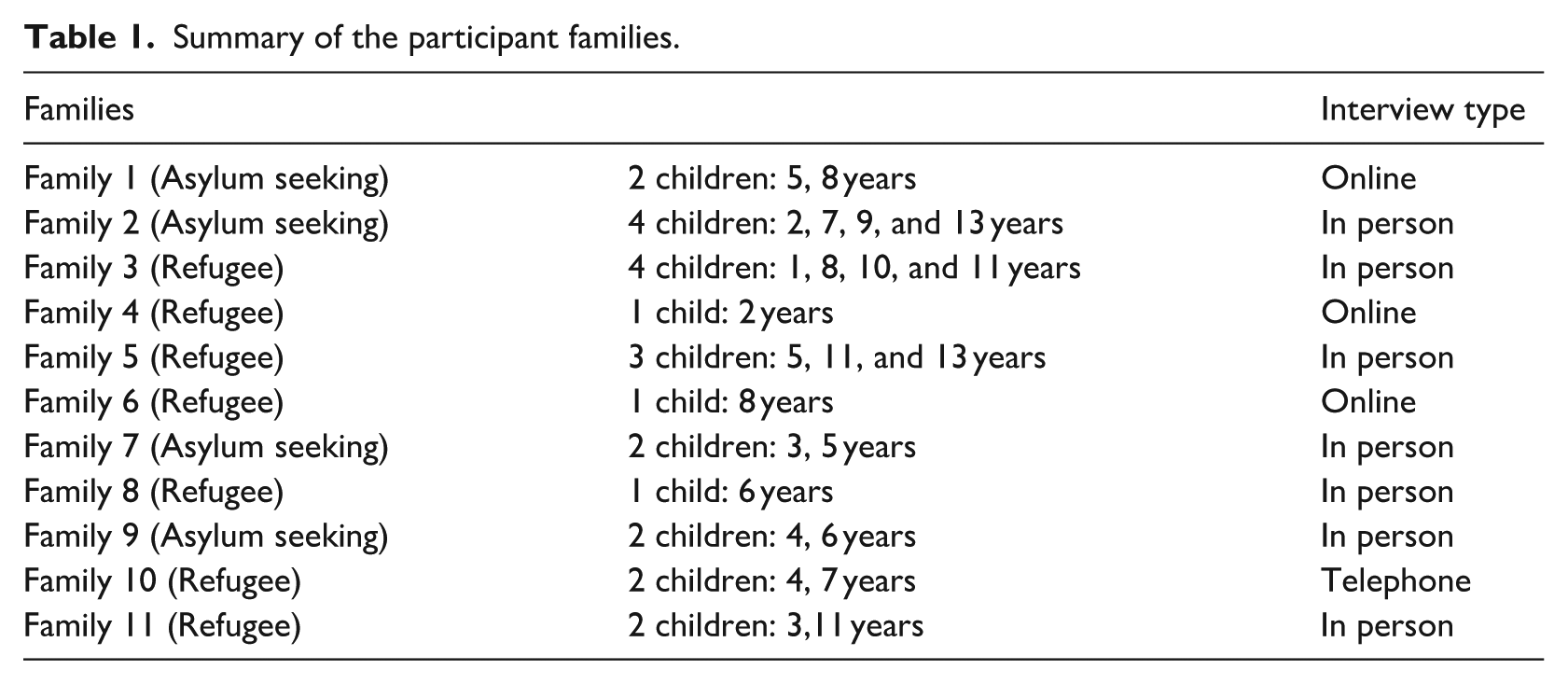
The participants hailed from many areas of the world that did not necessarily correlate to their expressed identities of being Palestinian, Kurdish, Siberian, Congolese, Indian, Pakistani, Moroccan, Lebanese, Libyan and Yemeni. Their expressed identities, nationalities, and the places they had lived were often related in complex ways and obscured by layers of being displaced multiple times or residing in a country on a temporary work visa. Details about the participating families’ backgrounds have been omitted intentionally due to the imperative to protect their identities. Table 1 summarises the participating families.
Summary of the participant families.
Theoretical paradigm
The aims of the research were to uncover asylum-seeking and refugee parents’ lived experiences of being in Sheffield and raising young children. The wider project explored their experiences during and since the periods of lockdown during the Covid-19 pandemic. As the research was concerned with understanding the views and perspectives of the participants, I designed the research within an interpretivist paradigm. Interpretivism adopts the view that reality exists in the form of multiple interpretations (Guba and Lincoln, 2005) and that people’s experiences of reality are socially constructed (Greig et al., 2007). Through an interpretivist lens, it is understood that individuals create, modify and interpret the world they perceive around them (Cohen et al., 2011). Thus, interpretivism is suited to understand the subjective, human experience of the world (Thomas, 2013). Phenomenology as a theoretical viewpoint is located within the interpretivist paradigm as it holds the significance of consciousness, recognising how people subjectively interpret events, actions and interactions that are socially and culturally situated (Cohen et al., 2011).
Semi-structured interviews
I conducted semi-structured interviews with the participants that lasted between 30 and 90 minutes each. The interviews were arranged through direct contact with the participants who chose the format of the interview. Three interviews were held online using Zoom, one interview was held over the telephone and the remaining seven interviews were held in the participants’ homes. All participants were offered the option of having an interpreter, but all participants declined. All participants were invited to include their children in the interviews, and children were present during six of the interviews. The children sometimes expanded on their parents’ descriptions, however, the majority of the responses to the interview questions came from the parents. It is acknowledged that this project could be extended through more accessible, participatory, child-friendly methods to enrich the data and elicit children’s perspectives (Tatham-Fashanu, 2023). The interviews followed a schedule that served as a guide for the conversations. The areas of the interview schedule centred on the following areas:
(1) Barriers to accessing ECEC;
(2) Barriers to accessing additional support for children (e.g. SEN support, educational support services);
(3) Barriers to supporting children’s wellbeing;
(4) How schools and nurseries supported families and their children with aspects identified in interview areas 1–3;
(5) How VCOs supported families and their children with aspects identified in interview areas 1–3;
(6) How the Covid-19 pandemic affected all the areas discussed in interview areas 1–5;
(7) How interview areas 1–5 have changed since the Covid-19 pandemic.
The interviews were semi-structured, so the conversations often went off on tangents, and I asked follow-up questions in response to what the participants were interested in talking about. Within phenomenology interviews are used frequently as they enable the interviewee to share a vivid picture of the experience, which leads to understanding of shared meanings (Mapp, 2008). While Mapp suggests that phenomenological interviews tend to be ‘unstructured’, I would argue that the interviewer will inevitably steer the conversation in a direction that will generate more data (Kvale, 2007). Thus, it would be disingenuous to say the interviews were unstructured as the power dynamics between myself as a researcher and the participants were such that the conversation was steered by me in order to achieve my agenda (Knox and Burkard, 2009).
Data analysis
Once the interviews were completed, I embarked on the process of analysing the data through inductive analysis. First, the interviews were transcribed to allow for annotations in the margins. I sent the transcriptions to the participants to check and amend if they wished to. As there were 21 hour-long interviews, the task of organising this volume of data into themes that made sense of the interrelationships, the overlapping and mutually reinforcing was immense, so I used thematic analysis (Braun and Clarke, 2006, 2021) as a process of sifting and sorting segments of interviews into coherent themes. I began by coding everything that seemed important and relevant to the research questions. I kept a record of the potential themes that I began to construct, and I used an iterative process of constant comparison to see if the nascent themes were present across all the interviews. The broader themes of the project were generated round the barriers and the support the participating families received to overcome these barriers. I then shared these findings with the participants as a Word Document and as a GoogleSite (Tatham, 2023) that could be accessed more easily by a mobile phone. The participants commented on the accuracy of my findings and were again given the opportunity to alter the text to better reflect their perspectives.
The findings in this paper were developed by focussing on the asylum-seeking and refugee families’ transcripts specifically. I identified the impacts of ‘hostile environment’ policies on their everyday lives. Through immersing myself in the data and constant comparison between nascent themes, I identified two centrally organising concepts: effects of material adversity and effects of insecurity. Cross-cutting these two themes was a third theme: perceived impacts of material adversity and insecurity on children.
Ethical reflections
As the findings will reveal, the participants were in intensely precarious situations and were noticeably concerned that if they said or did something wrong it might affect their asylum application or their refugee status. The project received ethical approval from the institution where I worked at the time, however, more importantly I prioritised ‘ethics in practice’ (Guillemin and Gillam, 2004). As such, when I conducted the interviews, I took care to be sensitive to the participants’ body language and willingness to share throughout the interviews. There were moments where the participants became visibly upset when recounting events and I would immediately interject and remind them not to feel pressured to talk about anything that they might find distressing. Furthermore, I made sure all the participants read the interview transcripts before I conducted the data analysis. I also shared the initial analysis with the participants before developing conference papers and written papers. As a result, there were some stories that the participants shared in interviews and later chose to remove from the data. In particular, stories that implicated the asylum-accommodation provider were removed from the data, which reflects the anxiety that asylum-seekers had about making complaints, even when the accommodation was below acceptable living standards. The intertwining of substandard living conditions, insecurity and fear is reflected throughout the findings.
Findings
The findings have been organised into the three key themes that were generated by the process of thematic analysis: (1) effects of material adversity, (2) effects of insecurity and (3) perceived impacts on their children. This section includes excerpts from interviews with families who had lived/are living their everyday lives under the conditions placed on them by the Home Office.
Effects of material adversity
The following excerpt is from an interview with the mother and father in family 9. In this excerpt, they reflect on the time they arrived in England and were placed in a hotel in London as a form of temporary accommodation before they were moved to a house in Sheffield: Father: Really very bad. I mean in terms of cleaning, the hotel was not clean at all, the food was very bad Mother: Very bad Father: She was pregnant. The room was really dirty, and we had some infections, it was tough. Tough days, I will be very honest with you. Mother: It was really difficult for us. Mentally, you know, we were broken. (Mother and Father, Family 9)
An interview with the mother in family 2 echoes the experiences of family 9. In this interview, the mother describes the asylum accommodation her family have been living in for several years: We have a lot of problem in the house, like rats, but cannot complain. If we complain too much then the company just say they will take us to a worse place. . .what can we do? (Mother, Family 2)
The mother explained how the issues with the house had profound effects on the wellbeing of her children, in particular, her two autistic children. For example, their boiler was broken for months and emanated a low humming noise that greatly disturbed one of the autistic children. The mother elaborated on the psychological impact of bringing up four children in such conditions: I know it is bad but sometimes I just feel like I want to run away, I need to get out, everything is just a mess and crazy and it’s like I am crazy you know. (Mother, Family 2).
The mother in family 3 recalled how, upon receiving refugee status, she and her three children were moved to a flat temporarily: It was really, really hard and we were struggling to stay in this temporary accommodation which is a flat. . . everything was small, but we are four. There is not enough space to play. (Mother, Family 3).
Following this, the family was moved to a house that was located in an area that was unfamiliar to her, and the mother related how they experienced extreme incidents of racism, including a teenager throwing a lit cigarette at her then 3-year-old child while they were at the playground. After this, she was too scared to take her children to play outside: In the house. Just in the house. Just stayed with him in the house. . .To be honest it was hard. . .. After a few minutes this way, this way, they are that way – and then sometimes you feel like yeah, you feel crazy.
Finally, when the mother was expecting her fourth child, she was moved to a more suitable location with the support of community organisations who repeatedly raised her case with the local council. The mother was elated as she described her new house and the effects of having ‘space to play’ on her children. Moreover, she expressed with great emotion her relief at now having a stable housing situation where her children felt safe and could walk to school.
In addition to issues with the conditions of accommodation, the participants spoke of the challenges of living on the £49.18 allowance. The mother from Family 3 recalled how difficult it was for her to keep three children occupied, and she relied on activities and toy donations from volunteers from community organisations. The volunteers also provided her with clothes for her children, and she became tearful when she spoke of the ‘blessings’ she had received from these organisations.
Many of the participating parents explained the challenges of not having enough food, and the fear of admitting they needed help. As asylum seekers do not generally have bank accounts, so they cannot order food online. The mother in family 5 echoed the experiences of many of the participating families as she reflected on when she was an asylum seeker. She explained her local shop was very expensive, but she also did not want to spend a lot of money on a bus pass to go shopping: I was too scared to admit to ask for food bank, I mean with kids I am scared social services will take them from me if I say I no have food. (Mother, Family 5).
Asylum seekers are not able to work and are only given a small allowance. As a result, asylum-seeking children grow up in enforced in poverty, relying on handouts from charity organisations for clothing, toys and activities. In many cases, the families were not able to afford sufficient food for their children as the remote location of their accommodation meant they had to choose between spending some of their allowance on bus fares to buy food, or making do with the expensive, limited food options from local shops.
Throughout the interviews, there was a pervasive sense of fear. The participants feared speaking out about the material deprivation, their lack of food and their inadequate accommodation for fear of repercussions. Thus, the participating families were locked into silence and, therefore, coerced into exposing their children to adverse conditions. The systematic use of fear coerced families into accepting impoverishment and inadequate living conditions, despite the physical and psychological effects of these. A plethora of research that demonstrates unequivocally that deprivation in early childhood significantly increases the risk of negative consequences for children’s wellbeing, social development and learning outcomes (Bradshaw and Main, 2016; Chaudry and Wimer, 2016), and this is recognised by the current UK Government’s own policies (Labour, 2024). Yet, asylum-seeking children exist within a parenthesis where material adversity is an acceptable form of collateral damage given the broader aims of the hostile environment policies’ ambitions to deter asylum seekers entering the UK.
Effects of insecurity
The temporal dimension of the ‘hostile environment’ conditions compounded the psychological effects of the material adversity. The participants all spoke of the challenge of being made to endure hardship for a period of unknown length.
The father in family 9 opened up about his experiences of waiting for a decision on his asylum application: We spend too much time here. We need to know our decision. . . You are like a hanging person; you don’t know whether you want to walk or whether you want to just keep standing. (Father, Family 9).
This father was very proud of his own education, and he had high ambitions for his daughters’ futures. However, his optimism was tinged with anxiety as he explained his concerns that each time the family relocated, the children would have to move schools and would experience a setback in their educational progression.
Insecurity was embedded in all the participants’ narratives as there was always uncertainty about what the next step in the journey would look like or where they would be placed, as confirmed by the mother in family 7: This is a temporary house, then they moved me to here and now hopefully they give me that house what I need (Mother, Family 7)
When asked about activities and groups she attended, the mother said she didn’t go to anything with her children because they would be moving soon, so she thought it would be better to shield her children from making connections that they would inevitably have to severe when they moved again. In a similar way, she expressed concern that she and her children didn’t have friends because they had recently moved house. Simultaneously, she explained that they would be moving house and school again soon, so there was no point in making friends. The toll of living with so much uncertainty had a clear impact on her wellbeing and motivation as she explained how she used to attend English lessons: No, now I stop, like sometimes I feel like I am so depressed to come into the group. . . Sometimes, I am tired, sometime I get mood, sometime is stressful I stop everything when I am stressed I can’t focus. . . I just try for my kids, but it is so difficult (Mother, Family 7)
Similarly, the mother from family 2 expressed that not knowing how long she would have to wait for a decision on their asylum application made it more difficult to bear living in such challenging circumstances: I don’t know how long I can do this; I just don’t know. (Mother, Family 2).
She was also greatly concerned about where they would be moved to once they received their refugee status, and in particular, whether it would be possible for her children to remain in their current schools, nurseries and engaged in their current hobbies. The children, and their parents, lived in a continual state of slow-wearing stress. The stress of not knowing if they would suddenly be deported, not knowing if or when they might get their refugee status and, if they did have their asylum claim accepted, not knowing where they would be moved to. This family had lived in this prolonged state of stress for nearly a decade.
All participants described the negative impact of not knowing how long they would have to wait, whether that be waiting for a decision on their application or waiting to be moved to another place of accommodation. This temporal uncertainty made it more difficult to cope with the adverse circumstances that they were living in. Furthermore, while all had hopes for a better future, there was a pervasive sense of anxiety around what the future would look like. This existed on several levels: first, the participants seeking asylum may not be granted leave to remain. Next, the asylum-seeking participants knew they could be moved at any point and to any place, making it difficult for them to settle into a house or an area. Finally, once participants knew that once they had received leave to remain, they knew they would need to leave their current accommodation but did not know where they would be moved to.
Research demonstrates that instability can have detrimental impacts on children’s social development and well-being (Sandstrum and Huerta, 2013). Furthermore, on a practical level, each move entails a change in school which disrupts children’s friendships and academic progress (Masten et al., 2015; Sorin and Iloste, 2006). Furthermore, the prolonged stress of uncertainly amounts to toxic stress that bares down on the parents and children, exposing children to multiple risks associated with toxic stress in the early years (Shonkoff and Garner, 2012). The psychological impact of these multiple forms of insecurity was heightened by the underlying feeling that participants had no control over their circumstances, and their lives could change dramatically overnight at any given moment.
Discussion
The participants in this study had very different backgrounds, circumstances, stories and life experiences before coming to Sheffield. Many of the participants’ lives were complicated further by intersecting factors such as domestic violence and their children having complex physical and psychological needs. However, this paper has demonstrated how, despite their individual circumstances, there were clear threads that all participants had in common. Through critical phenomenology, this paper has traced the link between a historically situated, socio-politically constructed phenomenon – the ‘hostile environment’ – and the lived experiences of parents with young children.
The findings presented in this paper are examples that elucidate the experiential sense of living under the conditions of the ‘hostile environment’ (van Manen, 2017). For the participants in this study, these are examples of the mundane, every-day experience of being an asylum seeker. The findings reveal how asylum-seeking children’s lived experiences are structured by concrete conditions and social structures that are historically situated, driven by a particular sociopolitical agenda (Ferrari et al., 2018; Oksala, 2023). These conditions influence the participating families’ experience of the world (Guenther, 2019).
Throughout the interviews, the participants described how ‘hostile environment’ policies enforce conditions of material deprivation which have tangible consequences (Brittle, 2019; Fekete, 2020). Phenomenologically, the participants shared stories of how dynamics of power manifested in a pervasive sense of fear. The participants were too afraid to speak out, to ask for help, to complain about their inadequate living conditions for fear of repercussions. As such, parents were acutely aware that their children were being put through adversity, and they were cognisant of the potential social, emotional, cognitive and educational impacts of these circumstances. However, parents were also aware that they lacked any autonomy to change circumstances and had to surrender themselves to waiting and placing hopes in the future- yet the timeline and direction of this future was unknown.
‘Hostile environment’ policies can weaponize insecurity, effectively eroding people’s sense of stability. People seeking asylum are subjected to many forms of insecurity: Uncertainty regarding the future outcome of their asylum claims is perhaps the most basic and obvious layer of uncertainty that pervades all aspects of their lives. Beyond that, not knowing when a decision might be made adds a further layer of uncertainty. Furthermore, uncertainty pertains to accommodation procedures in that asylum seekers are placed in different forms of temporary accommodation on a no-choice basis. Once leave to remain has been granted, refugee families with young children face further uncertainty as they must leave their asylum accommodation and be placed in uncertain, temporary accommodation again, potentially in an unfamiliar area.
The combination of material poverty, continuous instability and pervasive anxiety results in children’s basic needs not being met, in many cases for years. In particular, the UK’s restrictive approach to asylum seekers’ access to the labour market has pernicious consequences and is out of kilter with employment policies in other EU and OECD countries. In accordance with existing literature, living in a state of ‘unmet needs’ for an extended period of time caused all the families in this study to experience acute, prolonged stress (Krushas and Schwartz, 2022; Selvaraj et al., 2019). It is well documented that toxic stress has damaging effects on children that can last into adulthood (McEwen and McEwen, 2017; Melchior et al., 2009; Prince and Howard, 2002). The cumulative, slow-wearing, constantly straining toxic stress of deprivation and instability is a violent effect of the hostile environment policies (Mayblin, 2019) that has harmful physical and psychological effects on children. As such, policy makers are urged to rethink hostile environment policies and make changes that are commensurate with their official stance that every child has the ‘best start in life’ (Labour, 2024).
This study has some notable limitations that could be addressed in future works. Firstly, the study was conducted with asylum seekers in one city in the north of England and cannot be said to be representative of all asylum-seeking and refugee families in the UK. A larger study with participants from different regions of the United Kingdom would generate a more robust evidence base that could potentially be used to influence policy and effect change for asylum seekers. The second limitation is that the people who volunteered to participate in this study all spoke English and had a certain amount of confidence in speaking about their experiences. A noticeable omission from this study is the absence of participants who had recently arrived, who did not speak English, who were not connected to VCOs and support networks. Further studies in this area would benefit from hearing voices of these (even more) marginalised people. Finally, the paper reports on parents’ perspectives of how the UK’s hostile environment policies have affected their children. Further research that seeks the perspectives of children using appropriate methodologies to understand the perspectives of children is needed.
In conclusion, this paper highlights a contradiction that has real-world implications for asylum-seeking and refugee children. The statutory framework ‘Early Years Foundation Stage’ (EYFS) declares ‘All children deserve the care and support they need to have the best start in life’ (DfE, 2024: 7). This claim has been echoed more recently as the new Labour Government announcing investment in the early years and stating its determination to ‘deliver. . . the best start to every life’ (Labour, 2024). This paper has revealed how, in contrast, children who are asylum seekers are forced to live in conditions of material adversity and insecurity that have detrimental impacts and curtail possibilities for them to have the ‘best start in life’ that the UK Government ostensibly supports.
Footnotes

Funding
The authors disclosed receipt of the following financial support for the research, authorship, and/or publication of this article: This project was funded by Sheffield Hallam University.
Declaration of conflicting interests
The author declared no potential conflicts of interest with respect to the research, authorship, and/or publication of this article.