




Abstract
Due to the impact of the COVID-19 pandemic many restrictions were placed on primary schools. The aim of the current study was to explore the impact of the restrictions on young children’s play, an important pedagogical strategy for supporting young children’s socio-emotional development and learning. Teachers of young children aged approximately 4–8 years completed semi-structured interviews in February 2022. At this time in Ireland, COVID-19 restrictions were still in place in schools, and had been in place since September 2020 when schools reopened after closures in March 2020. The teachers (N = 5) responded to a number of questions about how they use play in school, children’s socio-emotional development, and how COVID-19 restrictions affected both play and children’s socio-emotional development. Thematic analysis indicated the importance teachers place on play within the classroom and at break times (recess), how restrictions affected the way in which they used play, and the impact restrictions had on children’s socio-emotional development, particularly the impact of mandatory small groups or ‘pods’. These findings suggest that young children’s play at school and socio-emotional development was disrupted as a result of restrictions, and findings are discussed from an ecological systems perspective. Further research is needed to determine whether nearly 2 years of school closures and hygiene restrictions during this formative period in young children’s lives has had a lasting influence on development.
Introduction
Globally, the COVID-19 pandemic caused devastating disruptions to everyday life, with many restrictions put in place worldwide to try and stop the spread of COVID-19 from early 2020 onwards (WHO, 2020). These measures to limit the spread of the disease included social distancing, mask-wearing, restrictions of movements within countries and between countries, the closure of businesses, and recreational and sporting facilities. In addition, educational settings worldwide were affected (see Hume et al., 2023). Due to school closures globally during the pandemic, the education of 95% of the world’s student population was impacted (UN, 2020). At its peak, there were disruptions for 1.6 billion students worldwide, according to a report from UNICEF (2021). These numbers highlight how children may have been affected by the pandemic and the impact it may have had on children’s education and well-being (Barlett et al., 2020; Beresin and Bishop, 2023; Imran et al., 2020).
International research on the pandemic over the last number of years demonstrates a number of effects of the pandemic on children, related to school closures and restrictions. For example, Hammerstein et al. (2021) found that school closures implemented at the beginning of the pandemic significantly disrupted primary and secondary school children’s learning and that the impact of school disruption was more severe on younger children. This is consistent with other recent findings (Di Pietro, 2023; Egan et al., 2021; Schult et al., 2022). Other research on infant and preschool children showed that the pandemic also negatively influenced aspects of their cognitive development (Deoni, 2022; Perry et al., 2023).
In addition to supporting children’s academic attainment and cognitive development, schools are important places for young children’s socioemotional development and play, as they interact with children and adults outside of the family unit. Previous research has outlined the crucial role of play for all aspects of development (Hoyne and Egan, 2024; Whitebread, 2012; Zosh et al., 2017). Play supports children to explore and make sense of the world around them, develop a sense of their own identity and learn how to interact with others (Sanderson, 2010). Play is seen as an important factor for the healthy development of a child such that ‘Through play, children learn to forge connections with others, and to share, negotiate and resolve conflicts, as well as learn self-advocacy skills’ (UNICEF, 2018). These are essential skills for children to learn as they progress in life.
School is an important place where children, especially younger children, get to express themselves through play. It gives children an opportunity to learn how to build relationships with their peers and learn essential coping mechanisms that they take into life. Many studies have shown the importance of play for helping children cope when faced with adverse situations (Capurso and Ragni, 2016), including to act out different events that they see every day. Children use play for coming to terms with the world that they live in and to understand what is happening around them. This in turn is how children can use play as a means of coping, where they see what is going on around them and they can start to come to terms with it, an important function of play during the pandemic (Beresin and Bishop, 2023).
Socio-emotional development and play
Socio-emotional development refers to a child’s ability to experience, manage and express a range of positive and negative emotions, and to develop close, emotional attachments with family members and relationships with those outside the family unit such as friends, peers, and teachers (Cohen et al., 2005). Essentially, it is the set of skills and characteristics that a child needs to effectively navigate and manage daily tasks and challenges (Cunningham et al., 2016). Learning how to build relationships with their peers is crucial for a child’s development, and especially in educational settings (Currie, 2005; Raver, 2002). There are a number of core characteristics and skills linked to socio-emotional development (Ashdown and Bernard, 2012). These include skills such as self-awareness, social awareness, self-management, relationship skills, and responsible decision-making, as well self-confidence, empathy, concentration, persistence, attentiveness, effective communication, and problem-solving (Santos et al., 2012). If some of these skills and characteristics are not acquired children may develop more challenging behavioural patterns such as aggression or struggle with substance abuse (Domitrovich et al., 2017).
Children learn so much through social interactions and play (Egan and Pope, 2024; Hoyne and Egan, 2024; Whitebread, 2012; Zosh et al., 2017). Educational settings are of major importance when it comes to children getting this social interaction, with school and other educational settings one of the first areas of socialisation outside the household (Egan and Pope, 2022). At school, children have an opportunity to observe and learn social and emotional skills, with teachers being an important influence on their student’s social and emotional development. They model socio-emotional skills within the classroom for the children to learn from, they promote student-teacher interaction while managing and organising the classroom (Jones et al., 2013).
However, during the widespread global school closures that took place due to the pandemic there were limited opportunities to play with school friends or for teachers to support play and socioemotional development (Beresin and Bishop, 2023). Other pandemic research also highlights negative social and emotional effects both for children and for families. Evidence showed that children exposed to social isolation during the pandemic were more likely to develop negative emotional consequences such as loneliness, depression, and anxiety (Loades et al., 2020). While much of this evidence comes from older children and adolescents, research also finds negative social and emotional effects for younger children too (Egan et al., 2021; Hagihara et al., 2022).
While the school closures were severely disruptive to children, families and teachers, the restrictions put in place in schools on their return (social distancing, hand sanitising) were also disruptive. In Ireland, primary schools were closed for a prolonged time (March to September 2020) and on the return to schools, health and safety restrictions were put in place which changed the way in which children experienced school before closures. These restrictions caused considerable changes in the way that teachers were interacting with their pupils and in how the children could interact with each other, and in Ireland these restrictions were in place until 28th February 2022.
Most of these restrictions and hygiene measures focussed on ensuring that children keep their distance from as many others as possible to limit the spread of COVID-19 (typically a distance of 2 m was required where possible) and to practice good hand hygiene. For example, in schools no toy sharing was permitted unless teachers sanitised it after another child used it and children were required to sanitise their hands multiple times throughout the school day, including on entry and exit of school buildings. In addition to strict ventilation requirements in schools (new air purification systems or windows open all day, including during winter), different class groups were not permitted to mix (on arrival or departure from school, or during break times which were also staggered to avoid children mixing).
Furthermore, students within one class group of typically approximately 30 students per class were also not permitted to mix freely. A ‘pod’ system was put in place and children were grouped in a ‘pod’ with 4–6 other children in the class and these were their learning partners and playmates for the school day during the restrictions, in order to facilitate ease of disease contact tracing should any child or family test positive for COVID-19 during this time. Typically, the teachers changed the members of each ‘pod’ only during school holidays, such as midterm breaks or summer holidays (see Department of Education Ireland, 2021, for a full list of measures and restrictions schools had to implement). These restrictions changed at various times between September 2020 and February 2022, depending on the level of COVID-19 in the country at the time.
Previous Irish research found (O’Keeffe and McNally, 2021a), in advance of schools reopening after the first prolonged closure in 2020, that many teachers indicated an uncertainty around their capacity to use play in the classroom given COVID-19 regulations when schools reopened. This finding suggests teachers may have anticipated difficulties with children’s play on the return to school due to the restrictions in place. International research has also found that restrictions affected children’s play in other settings too such as in hospitals, detention centres, homes and neighbourhoods (Beresin and Bishop, 2023; Egan et al., 2023; Graber et al., 2021).
The current study sought to explore teachers experiences of the changes to play due to the restrictions in place once children returned to school, and the ways COVID-19 restrictions may have affected play and socio-emotional development. Few studies to date have focussed on the way in which restrictions affected both play and socio-emotional development in schools during the COVID-19 pandemic.
Method
Design
This study adopts a discussion-based qualitative approach, using semi-structured interviews, to explore the experiences of early childhood primary school teachers on play and the socio-emotional development of young children in schools during the COVID-19 pandemic. Semi-structured interviews were identified as the most appropriate way to collect data on the topic as DeJonckheere and Vaughn (2018) note that this is an effective data collection method for open-ended qualitative data in order to explore participants beliefs, thoughts and feelings about a topic. It is also a useful method for personal and sensitive issues, addressing changes in the participants’ work places. The open ended nature of the interview questions facilitated discussion of the topic from the different teacher perspectives.
Participants
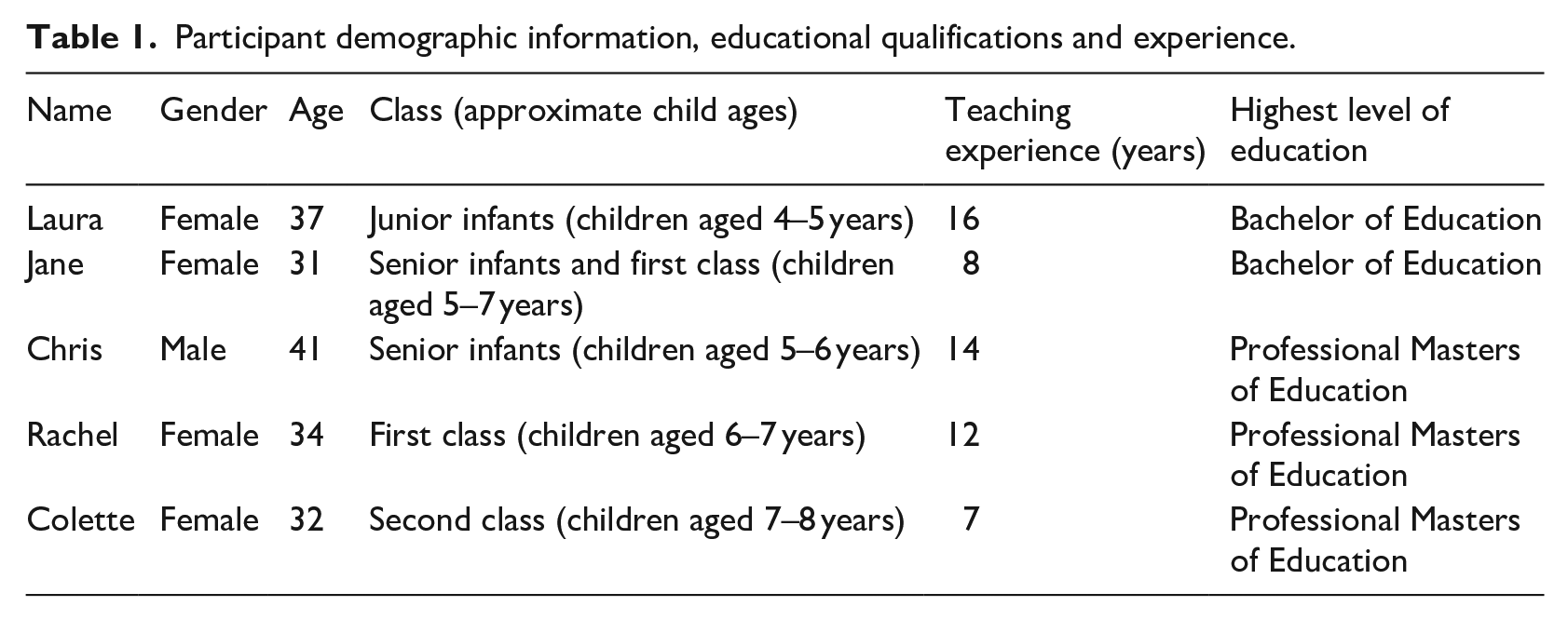
Five primary school teachers in different schools in Ireland, both rural and urban, voluntarily took part in the study and they did not receive payment for their participation. Four of the participants who took part in the study were female and one of the participants was male, with ages ranging from 31 to 42 years (Mean age = 35 years; SD = 3.63 years; see Table 1 below for additional participant information). All teachers taught children aged between 4 and 8 years old.
Participant demographic information, educational qualifications and experience.
Procedure
Ethical approval was granted by the institutional ethics committee. Participants were recruited through emails sent to the principals of the schools in which they were working, who forwarded the email to teachers in the school. Teachers interested in partaking in the study emailed the researcher and they were then provided with additional information about the study and consent forms. Due to the ongoing pandemic and restrictions at the time, the interviews were conducted online through Microsoft Teams during February 2022. Each interview lasted up to 20 minutes in duration and participants were debriefed verbally at the end of the interview and via a debriefing sheet which was subsequently emailed to them. The debriefing sheet reiterated the aims of the study and the contact information for the researchers. Data saturation was reached after interviews with five participants.
Materials
A list of initial questions was prepared for the interview based on the aim of the study to investigate the importance of play at school and the socio-emotional development of children during COVID-19 restrictions. The interview questions were adapted from different sources that had researched a similar topic previously including (Graber et al., 2021; O’Keeffe and McNally, 2021a, 2021b). Following initial questions about teaching qualifications and experience, participants were asked open ended questions to explore the study topic (e.g. In what ways do you use play in the classroom; Do you feel that restrictions have affected the way in which you use play in the classroom; In your opinion, can play help to mitigate the impact of the restrictions for children). A final open ended question asked participants if there was anything more they would like to add with regards to play in the pandemic and children’s social and emotional development.
Transcription and Analysis
Each interview was recorded for transcription and analysis purposes using the record function in Microsoft Teams. Thematic analysis was adopted in order to analyse the data, using a six step approach (Braun and Clarke, 2006). The researcher first familiarised themselves with the data from the interviews and Microsoft Excel was used to group together all the data. The data was then coded in Microsoft Excel in accordance with the research questions. Once the data was broken down into different codes, themes relevant to the research question were identified. Each theme was then reviewed and the most suitable quotes to illustrate a theme were noted. The analysis identified three main themes, described in the next section, with the concern for the child’s socio-emotional development being an integral part of each theme.
Findings
The data collected as part of this study served to highlight the importance of play for primary school children, the impact of COVID-19 restrictions on play, and children’s socio-emotional development while engaging with playful education under the health advice at the time. Each teacher interviewed described the paramount importance of play in their classrooms while also reporting the ill effects that pandemic restrictions had on the ways in which they could use play in a school setting. As one teacher summarised, ‘there hasn’t been a lot of play this year’ (Colette), due to the restrictions. Thematic analysis identified three main themes that arose in the interviews related to the limitations on play negatively affecting (i) the opportunities for natural playful peer interactions with a wide mix of children, (ii) the explicit teaching of socioemotional skills such as sharing and (iii) academic learning.
Limited opportunities for naturally playful peer interactions
As described earlier, one of the COVID-19 restrictions in place in schools in Ireland from when they first reopened in September 2020, after the closures in March 2020, was that children should be placed in a small group with other children (approximately 4–6 children called a ‘pod’). These groups within a larger class (typically 25–30 pupils per class) were the children’s learning and play mates for weeks or months at a time in order to limit the number of contacts each child had, and to be better able to trace infections in the classroom. This system remained in place until the end of February 2022, and was in place at the time of data collection. In particular, the effect pods had on everyday life in the classroom, be it while teaching or while learning, was frequently mentioned by the participants during the interviews.
The participants explained how the pods had affected the way in which they use play in the classroom. Among the many changes, the fact that the children were limited to socialising only with pod members seemed problematic. The teachers referred to the consequences that the pods had on the children’s social and emotional development, as it was difficult to build positive and rewarding relationships with children outside of their pods. The adverse effect that the groupings were having on children was predominant in one of the participant’s interview:
. . .we’re not inclined to change the pod obviously very often, whereas previous years you know you’d have seating arrangements and if something wasn’t working for whatever reason, because of behaviour or kids were anxious or upset where they were sitting for whatever reason, not getting along with kids, you might move them if it was obviously affecting their, you know, their happiness at school. (Colette).
This same teacher went on to explain how the children had a few days off for midterm and they were ‘dying’ to change pods. Children naturally want to move around, play and communicate with others and the pod system lessened the opportunities that arose when mixing and playing with many other children. The issue with pods and limiting the number of contacts extended beyond the classroom to break times. The value of play at break times, particularly outdoors in the school yard (play area), for children’s social and emotional development was echoed repeatedly throughout the interviews. Teachers mentioned how the yard is an environment of learning, and mastering conflict resolution strategies. In addition, one teacher mentioned how she felt the yard time gave children a break from pandemic restrictions within in the classroom which was positive.
However, other teachers noted how children could not mix with other classes while in the yard and the negative effect it was having on their development. The teachers were eager to stress this, especially the teachers of the younger classes who were genuinely concerned about this. One participant who was teaching 4–5 year olds discussed how her pupils had never been in the yard with another older class. She felt that there were few opportunities for ‘. . . learning from their peers’ and that this was really ‘affecting their social development’ (Laura). Children not getting the opportunity to build relationships with other children outside of their pods and their class groupings seemed to have, and could have, complex impacts on their socio-emotional development.
Additionally, due to children not being able to mix with other children, and children of different ages, children did not seem to be learning yard games as easily which would be part of their typical development as learners. Some of the teachers described that since the return to school and the commencement of staggered break times for different classes (another common COVID-19 restriction in schools to minimise the number of contacts each child had), that supervising the yard at break times required more effort on their part, to show the children games and teach them rules of the games, due to the pupils not mixing with older children.
. . . now as a teacher you are teaching them how to play on the yard. . . it’s not natural because they’re not learning from their peers (Laura).
Limitations for playful teaching of socioemotional skills
The teachers explained how play is crucial for teaching socioemotional skills to children and for learning life skills like sharing. Some of the teachers interviewed also touched on the importance of play for teaching children turn-taking, with one teacher remarking extensively on how he uses play to teach turn taking in his classroom and said, ‘turn taking is. . . a massive one’ (Chris), and that he has ‘a few only children’ (Chris) in his classroom, with no siblings, and how turn taking is of critical importance for them children in their development and is an essential social skill.
The participants also called attention to how the COVID-19 health and safety measures were causing difficulty when teaching children to share within the classroom. The teachers outlined how they were helping the children learn the importance of sharing but not being able to practice sharing properly was difficult as they felt children learn by doing:
. . .you’re trying to say, that’s so kind of you, and it’s great to share. But during COVID we can’t share, so it just goes against what you’re trying to teach, you know’ (Colette).
Each participant also commented on how they felt playful education aids children’s social and emotional development through the teaching of conflict resolution, a crucial life skill. The participants used play inside the classroom and out in the yard as a means of teaching the children conflict resolution. The teachers utilised their own observation skills and watched the children closely to see if conflict did arise. When disputes were observed, teachers watched to see if the children had the capacity to work it out themselves or if the teacher have to intervene and mediate the situation. This aspect of play was mentioned by one of the teachers,
Different conflicts with other children will always come up during that play session and it’s a great way to work around it without them knowing you’re working on their social needs or you know their emotional needs (Laura).
This was further noted by the second-class teacher,
Conflict to some level of degree definitely helps their social emotional development. . . when scenarios arise, you’d say in different situations that you would actually be able to stop and talk through it (Colette).
Many of the teachers spoke of how the main form of play to support children in the development of their conflict resolution skills is role-play. The teachers spoke of the potential in role-play to work through different conflicting scenarios and formulate resolutions with the children. The children could be explicitly taught various emotions that they could feel in certain situations and coping mechanisms. This was of even greater importance in the older classes, and one of the first-class teachers that was interviewed remarked that ‘how to deal with conflicts. . . would be massive’ and that she teaches this ‘. . . through role-play in SPHE (part of the curriculum) and drama’ (Rachel). Due to these restrictions, this teacher found that conflict resolution was ‘the biggest one this year since they came back’ due to it being her classes first ‘normal’ year in school. This teacher was acutely aware of the amount that her class had missed in terms of their socio-emotional development and conflict resolution skills.
Moreover, within the younger classes, there was less role-play situations it appeared, and there was more of a focus on seeing how children would act if conflict did arise in other types of play, again developing their coping skills and social and emotional skills. One of the junior infant teachers discussed that during play he lets the children ‘. . . naturally come upon good events and bad events’ (Chris) and lets them try work it out for themselves while keeping a close eye, he mentioned that it is very often ‘. . . [as] the adult in the classroom we step in and try to resolve it’ (Chris) but he felt as though letting the children work it out themselves really aided their social and emotional development. However, because of the restrictions there were interactions with fewer children in the classroom, and during break time, which may have limited opportunities for conflicts, and accordingly building conflict resolution skills.
Barriers to the use of play for academic learning
When participants were asked about how they use play in the classroom, each indicated that play is used as an important means of learning, ‘for learning would be the number one thing’ (Rachel). Interestingly, this had different meaning for each teacher. For the younger years, this embodied child-led play. For the older classes, it was more centred around incorporating play into learning the core subjects on the curriculum. One teacher remarked that ‘. . . Irish (language teaching) would be all play based really’ (Rachel). For maths, this teacher was using ‘numeracy games, card games. . . and puzzles and knockout games. . . we use games for English too’ (Rachel). The importance of using play as a method of teaching and learning was elucidated in each interview.
However, teachers found themselves changing their teaching styles and the way in which they used play in the classroom due to a number of limitations. The participants outlined that they had to change how they carried out most activities ‘. . . we had to come up with another system’ (Laura). The teachers interviewed found they had to make major adjustments and it became apparent that the restrictions were a heavy burden upon educators who spend years formulating their personal style of teaching, for it to be changed by the rules and regulations of an infectious virus.
Moreover, the interviewees found that they had to spend more time on planning activities in the classroom. For the younger classes this included something as simple as what toys they could give the pupils,
. . .you have to think about it beforehand what toys you can give them. . . you might be reluctant to give them out toys. . . because you know they will have to be cleaned and you won’t be able to give them to another group (Jane),
and expanded to tabletop activities for the older classes,
. . . any resources that you use, you have to consider. Can they be wiped down after and when can I use them with the next group? It’s been very hard to plan stations even (i.e., rotating activities for different groups), you know, like tabletop activities (Colette).
Throughout the interviews, it seemed that the lack of resources the teachers had access to was a considerable negative for play during the pandemic. Each participant touched on the limited resources they could use due to the restrictions and emphasised the number of resources that had to be removed from the classroom including soft toys, dressing up clothes, physical education (PE) material, and tabletop materials. This limited the types of play in the classroom.
. . . we’d limited PE material that we could use because of the transfer of COVID. . .and limited material in the classroom that we could use’ . . . ‘And they found that hard because obviously they like change and they like new things (Rachel).
Discussion
The findings in this study highlight the importance teachers place on play in school for children’s academic learning and for their social and emotional development. The study adds to the growing research on the education and development of young children and how this was impacted in the global COVID-19 pandemic (Beresin and Bishop, 2023; Egan et al., 2021; Hammerstein et al., 2021). The teachers that were interviewed emphasised the use of play in educational settings and how it helps the children build relationships, express emotions and learn coping strategies and conflict resolution skills. While previous international research shows negative socioemotional effects for children during school closures (Creswell et al., 2021; Egan et al., 2021), the current study highlights that negative socioemotional effects may also have taken place when schools were open, but with restrictions in place.
Prior to schools reopening in Ireland O’Keeffe and McNally (2021a) found 87% of teachers who responded to their survey mentioned that play would serve a major role on the return to school. The findings of the current study are consistent with this, and also with findings of how play was impacted when children did return to school (O’Keeffe and McNally, 2021b). Across the studies when teachers were asked whether play helped mitigate the impact of restrictions for children on the return to school, the response was overwhelmingly positive. On the return to school, the teachers also placed value on play facilitating the socio-emotional development for children who had been away from school for so long. However, the findings in the current study indicate that the restrictions that were in place for hygiene and health reasons negatively impacted on play opportunities for the young children.
An interesting finding that arose in the current study was the emphasis the teachers placed on break time (recess). Throughout the interviews, the teachers were quick to acknowledge the benefit of play at break times for children’s social and emotional development. However, the participants also pointed out the impact the restrictions and pods were having on the pupils ability to build relationships, and learn from others during break time in the yard. This was quite prevalent for some classes as it seemed as they had never shared a yard with an older class. They struggled to find games to play as they were not learning from their older peers. A critical aspect of the socio-emotional development of the child is the opportunity to develop positive rewarding relationships (Cohen et al., 2005) and these children were not getting the opportunity for this with other children outside of their pods and classes.
This finding in the current study (conducted in February 2022) is somewhat in contrast to findings by O’Keeffe and McNally (2021b) who interviewed teachers in October and November 2020 about play and school, approximately 2 months after schools reopened in September 2020, having been closed since March 2020. In this study teachers reported that they had a similar level of involvement in play in the yard as before the pandemic, and that there was an increased quality of play in the yard. It may be the case that as time wore on, and the restrictions carried on for a further 16 months, that the impact of the restrictions on children and their socio emotional development increased. Further research is needed to explore this however.
Out of all the restrictions placed on schools, teachers suggested that having children in pods seemed to have the biggest impact on the way in which the children could play and on their socio-emotional development. The teachers described the struggle of planning that every pod would be catered for when it came to play during the pandemic. This was due to teacher’s not being able to re-use resources with another pod unless it had been cleaned and sanitised. Participants talked a lot about how children were confined to their pods and how it was having a negative effect on their peer interactions. This finding is again somewhat in contrast to findings in the Irish context by O’Keeffe and McNally (2021b) who interviewed teachers in October and November 2020. The findings of their study at the time suggested that classes were ‘more tight-knit’ and that for some teachers the ‘pod’ was not dissimilar to the groups children would have been placed in before the pandemic. The negativity around pods in the current study did not seem as prevalent in the themes reported by O’Keeffe and McNally (2021b), again perhaps reflecting the influence of time passing and the longer term impact of the restrictions on the classroom.
It may be the case that in October and November 2020 teachers were happy to be back in school, even with restrictions in place, and focussing on the positives of the situation by comparing it with the situation during complete school closures a few months previously. In contrast, by February 2022 when the current data were collected, the teachers had been living with restrictions in schools, including pods and limited mixing during break time, for nearly 18 months. It may have been the case that as time wore on the impact of the restrictions became more negative and tiresome, and teachers may have focussed on comparing their situation in February 2022 with the way things were before the pandemic, rather than comparing it to the situation during lockdown and school closures in the Spring and Summer of 2020.
Participants in the current study were keen to mention how much children had missed out on as a result of the pandemic, consistent with other research (Egan et al., 2021). This was highlighted when teacher’s discussed their students’ social and emotional development. There was real concern among the teachers that children were finding it more difficult to express their emotions when they returned to school. There was an awareness that they may be making up for lost time when it comes to the socio-emotional development of these children. From an ecological systems theory perspective, these findings highlight the impact chronosystem influences have on children (Bronfenbrenner and Morris, 2006), that is both the socio-historical time of living through a pandemic and the timing in the young child’s life in terms of their early development. It may be that extra supports and services be put in place for these children as they had missed out on a lot as a result of the school closures due to the pandemic, and dealing with restrictions subsequently for up to nearly 2 years following the initial closure. Furthermore, in terms of the influence of the passage of time on children’s development, future research will need to determine any longer lasting impact of the nearly 2 years of limitations on play, social interactions, and teachable moments for socioemotional skills, during this formative time in a young child’s life.
The ability to manage emotions well is crucial to a child’s social and emotional development. The participants pointed out the role of play in developing this skill. In particular, play has a crucial role in learning conflict resolution. Each one of the teachers mentioned this throughout the interviews. When discussed by the junior and senior infant teachers (the first 2 years of primary school in Ireland), they described a tendency towards observing children and seeing could they work out conflict for themselves before stepping in. In contrast, with the older classes, teachers described how role-play was used a lot to develop coping strategies. It was utilised by letting children act out different conflicts and talking through how to solve them. It was clear from the findings that play and socio-emotional development were both affected by the restrictions in place in school.
Limitations, strengths, and future research
The findings from this study give insight into the experiences of teachers of young children during the COVID-19 pandemic, where restrictions were in place in schools. However, it is important to note the limitations of the study when interpreting the findings. Given the size of the sample, and the nature of the data collected, the findings presented should not to be interpreted as representing the views of all early childhood primary school teachers in Ireland. Additionally, the length of school closures in Ireland was not the same as other countries, nor were the various restrictions that were in place upon the schools reopening. This highlights the importance of adopting an ecological systems framework in interpreting research findings related to the COVID-19 pandemic (Bronfenbrenner, 1979; Egan and Pope, 2022) and the influence of macrosystem policy decisions taken by national governments or other large organisations (e.g. school districts), on the developing child.
A particularly strength of this study is that the interviews took place while COVID-19 restrictions were still in place in schools. The participants were responding to the questions in real-time when the interviews were conducted in February 2022, before restrictions were due to be lifted at the beginning of March. Due to this, the teachers were able to give their views on the current situation and their lived experiences. Future studies may have to depend on the memory of teachers. The collection of qualitative data through semi structured interviews proved to be very effective as it provided rich information into the experiences of the teachers and gave them the opportunity to expand on responses to questions.
Furthermore, future research should explore how children adapted to the full lifting of COVID-19 restrictions in schools. The timing of the current study in February 2022 was the last time point in Ireland in which such restrictions were in place, at which time citizens had been living with restrictions for nearly 2 years. While much research has focussed on the effect of lockdowns and school closures on children, it is important to examine the ongoing effect, if any, of living with restrictions for such a prolonged period on education, learning and child development. Additionally, while participants voiced that they were looking forward to the lifting of restrictions, at least one of the teachers discussed her concerns about this. Future research should examine how children adapted to the full lifting of restrictions to investigate how effectively they transitioned back to ‘normal’ school life, and whether or not there are any remaining lasting effects on children, their play and socioemotional development.
Conclusion
The emphasis placed on the role of COVID-19 restrictions in play and children’s social and emotional development in this study are reflective of the teachers individual thoughts but many similarities were found across the interviews. These similarities include how play helps to develop children’s social and emotional skills, the impact of restrictions on how teacher’s used play in school, and the influence social and emotional skills have on a child’s development holistically. The findings from this study give an insight into the impact of COVID-19 restrictions on children’s play and socio-emotional development and provide an opportunity for future research to build upon this important topic. These findings, along with other international research, suggest that only time will tell the full nature and extent of the impact on early child development and play from having lived with the effects of COVID-19 lockdowns and restrictions for 2 years, during such an early and formative part of young children’s lives.
Footnotes
Data availability statement
Data are available on reasonable from either author
Declaration of conflicting interests
The authors declared no potential conflicts of interest with respect to the research, authorship, and/or publication of this article.
Funding
The authors received no financial support for the research, authorship, and/or publication of this article.
Ethical approval and informed consent statements
The methods and procedure used in the study were approved by the Mary Immaculate College Department of Psychology Ethics Committee (No. 1221). Participants gave their written and verbal informed consent to participate in the study, and their written consent for their anonymous data to be used in publications and presentations arising from the research.
