




Abstract
The COVID-19 pandemic posed major challenges for the lives of children in terms of school closures, loss of routine, reduced social contact, bereavement and trauma. The pandemic also gave rise to a focus on play as a fundamental support for children’s wellbeing. This study examined early childhood teachers’ reported practices of using play upon returning to school in Ireland after lockdown restrictions which included a 6-month period of school closures. Building on previous research on play in early childhood education during the early stages of the pandemic, 12 primary school teachers in early childhood classrooms (children aged 3–8 years) participated in focus groups aimed at exploring teachers’ experiences of using play upon returning to in-class teaching. Through reflexive thematic analysis of the focus groups, four themes were identified that encapsulated teachers’ experiences: play in the classroom embodied similar characteristics and qualities during COVID-19 as before the pandemic; play was considered a priority in early childhood education classrooms; teachers planned carefully for facilitating play in the classroom in response to COVID-19 regulations; teachers’ noted the importance of the social and relational components of play for children in the context of COVID-19 regulations. For educational policy, these findings highlight play as a ‘go-to’ strategy by teachers for supporting children in formal education during a pandemic and suggest play is a well-established context that can be used in educational policies to support children’s learning, especially during and after times of crises.
Introduction
Play is an elusive construct and has been defined according to objective characteristics, including that the behaviour is pleasurable, actively engaging, voluntary and intrinsically motivating, process-oriented, open-ended, flexible and non-literal (Christie and Johnsen, 1983; Rubin et al., 1983) as well as in terms of inherent affective qualities of the ‘player’ (Broadhead et al., 2010). Despite ambiguity surrounding the construct of play it has a central role in many early childhood curricula (e.g. Aistear, High/Scope, Te Whãriki, Early Years Foundation Stage). Teachers’ understanding and conceptualisations of play are likely to inform classroom practice (McInnes et al., 2011; Wood and Bennett, 1998) with studies indicating that teachers view play as fun, creative and imaginative, social, and having a level of child autonomy (Rentzou et al., 2019).
During the COVID-19 pandemic children experienced monumental disruption including school closures (UNESCO, 2020), loss of routine (Bartlett et al., 2020), reduced social contacts (Dodd et al., 2020), bereavement (Weinstock et al., 2021) and trauma (Horesh and Brown, 2020). The implications of COVID-19 extend beyond physical health (Adıbelli and Sümen, 2020) with anticipated loss of learning (Kuhfeld et al., 2020) and decline in social and emotional wellbeing (Orgilés et al., 2020). Faced with these challenges, there were widespread calls to ensure children were not hidden victims of the pandemic (Fore, 2020; UNICEF, 2020; United Nations, 2020) and a corresponding move towards play as a fundamental support for children’s wellbeing (Dodd et al., 2020; OMEP, 2020; Tonkin and Whitaker, 2021). Previous research on supporting children in the aftermath of natural disasters and political violence suggests that play is fundamental in promoting young children’s resilience in the face of adversity (Chatterjee, 2018; Fearn and Howard, 2012), highlighting play as a way to help children to manage their emotions (Elkind, 1981) and provide a sense of normality during turmoil (UNICEF, 2018). In light of the importance of play for children during times of crises, this study aimed to examine teachers’ self-reported experiences of facilitating play in early childhood classrooms upon the return to in-class teaching during the COVID-19 pandemic.
Play in early childhood during the pandemic
Research has been conducted on play during COVID-19 within the home (DiYanni et al., 2021; Dodd et al., 2020; Egan et al., 2021; Moore et al., 2020; Playboard Northern Ireland, 2020; Stienwandt et al., 2020) and the community (Barron and Emmet, 2021; Perez et al., 2021; Russell and Stenning, 2020). Less is known however about play within educational contexts (O’Keeffe and McNally, 2021). In a large education survey of early childhood teachers in Ireland during the first school closures of the pandemic (12th March–30th June), teachers reported widespread commitment to using play to support children in the anticipated return to school post-lockdown (O’Keeffe and McNally, 2021). Such findings were reflected in research in the UK whereby teachers identified socialisation and play as a key priority within the classroom in anticipation of school reopening (Dodd et al., 2020; Moss et al., 2020), and aligned with recommendations to prioritise wellbeing (Dodd, 2021; Graber et al., 2021) and social connection (Capurso et al., 2020) upon children’s return to school. However, the facilitation of play in the classroom during COVID-19 is less well understood and is an important gap in the literature given missed opportunities for socialising with peers during school closures (Pascal and Bertram, 2021).
Upon reopening after extensive closures worldwide, schools adhered to a myriad of regulations in order to protect the health and safety of staff and pupils during the pandemic including the reconfiguration of spaces (Department of Education and Skills Ireland, 2021), use of protective equipment (Health Protection Surveillance Centre, 2021), physical distancing, hygiene and sanitisation as well as minimisation of social interaction through cohorting or bubbles (Centre for Disease Control, 2021). This raised an important question as to how teachers incorporated play in early childhood classrooms while adhering to safety measures (Ball et al., 2020; OMEP, 2020). Indeed, this concern was voiced by over a third of a sample of teachers in Ireland (N = 130) who indicated uncertainty regarding their capacity to return to play as normal in light of new safety regulations related to suppressing the virus in school environments (O’Keeffe and McNally, 2021). Therefore, despite increasing recognition of play as important for children in the pandemic, play in education may have been overlooked due to concerns over ‘learning loss’ during school closures (Ball et al., 2020; Lester, 2020) with teachers likely to have faced substantial challenges to include play within the classroom in the context of COVID-19 regulations.
Current study
This study aimed to contribute to the significant gap in the research literature around play in early childhood classrooms during the pandemic. It built on previous research during school closures in Ireland which showed largescale commitment to play as a paedagogical strategy and support among teachers who were, at that time, anticipating a return to school later in the year (O’Keeffe and McNally, 2021). This study followed up with teachers upon the reopening of schools, and interviewed early childhood teachers in late 2020 in an effort to gather rich data on teachers’ practices surrounding play in the classroom during the pandemic. This study therefore contributes further to our understanding of teachers’ conceptualisations of play and how this impacts practice in early childhood classrooms during a time of international crisis.
Methods
Research design
Focus groups were selected as the most appropriate method for examining individuals’ experiences as they offer ‘rich, experiential information’ (Carey and Smith, 1994:124) based on teachers’ shared experiences, responding to the need for depth and insight into this under-researched area. Online focus groups proved most suitable for this research in order to access sample teachers given current COVID-19 restrictions (Roberts et al., 2021). Unlike individual interviews, focus groups are based on the collective understanding of participants’ views (Merton et al., 1990). Thus they offer a unique advantage over individual interviews and provide ‘direct evidence about similarities and differences between participants’ opportunities and experiences’ (Morgan, 1997: 10). Within non-threatening and supportive contexts, focus groups also offer opportunities to gain insight into participants’ experiences that may not necessarily be accessible without such interaction and support (Krueger and Casey, 2000), in turn developing deeper understanding of topics. However, unlike individual interviews, focus groups present challenges in terms of planning and recruitment (Breen, 2006) alongside issues such as conformity pressures and social desirability (Hollander, 2004).
Sampling, recruitment and participants
Early childhood primary school teachers in the Republic of Ireland (ROI) were recruited through convenience and snowball sampling following ethical approval from the Research Ethics Committee at the authors’ institution on October 8th, 2020. The sole eligibility criterion was that teachers were teaching within an early childhood primary school classroom (children aged 3–8 years) at the time of interview. Participants were recruited via social media platforms and researchers’ networks to participate in online focus groups. In total, 15 teachers agreed to participate. However, three withdrew due to busy schedules, resulting in a total of 12 teachers. Groups were relatively homogenous in that participants were mostly teaching in a mainstream role, within a mainstream English-medium primary school. This homogeneity can maximise comfort and level of interaction (King et al., 2019) and was appropriate for this study given that the research focussed on the collective experiences of groups. Focus groups comprised of three to five participants, assigned to groups based on their availability.
Interview protocol
Three online focus groups were conducted by the first author, an experienced primary school teacher, in late October and early November 2020, nearly 2 months following school reopening across Ireland. Interviews were hosted on the online platform, Zoom (Zoom Video Communications Inc, 2021) due to COVID-19 social distancing guidelines. Participants were provided with a brief description of the study aims and completed a short survey of demographic information alongside their consent via the online platform Qualtrics (Qualtrics, 2021). Two warm-up activities were conducted to limit participant discomfort and enhance group rapport (Vaughn et al., 1996).
The interview questions were determined in advance and followed a semi-structured format whereby questions were flexible enough to allow the discussion of related topics whilst ensuring key questions were covered (Barbour, 2007). The interview guide was developed in consultation with Kruger et al.’s (1998) questioning framework and followed a funnel approach: questions ranged from three broad opening questions towards five key refined questions based specifically on current classroom practices surrounding play in the pandemic. Probes and clarifying questions were provided at times to garner more in-depth responses and additional information. Participants were also asked to complete several stimulating tasks to promote reflection and engagement, involving construction of key words or symbols to conceptualise play as well as outlining similarities and differences between current practices surrounding play in comparison to pre-COVID-19 restrictions as part of a virtual flipchart activity. Pilot testing of questions was completed with two researchers in order to check clarity, quantity and quality of questions before a final piloting of the overall interview guide with three primary school teachers.
Focus group sessions lasted approximately 1 hour and were recorded for accuracy with the permission of participants, with audio recordings retained, transcribed and coded by the first author who also facilitated each session and was thus familiar with the data. Trustworthiness of the data was established by providing participants with opportunities to clarify meaning and intended points of discussion (Creswell and Creswell, 2018) as well as restating the main points of discussion at the end of the interview and collating on a virtual ‘flip chart’ (Vaughn et al., 1996).
Data analysis
Analysis of focus groups is a complex process (Archibald et al., 2019) in particular surrounding the selection of the relevant unit of analysis in terms of individual, group or group interactions (Barbour, 2007). Given the focus on collective views and shared experiences (King et al., 2019), the group was identified as the primary unit of analysis. Each group was treated as an individual entity with a unique context and dynamic. Coding was initially conducted within each individual group (within-group analysis) before examining codes across groups for commonalities and differences (Vaughn et al., 1996). Within-group analysis also involved examining codes at an individual level in order to determine the degree of consensus within groups (Barbour, 2007) whilst remaining cognisant that individual perspectives could not be isolated from the group context (Carey and Smith, 1994). Group interactions were also viewed as essential in terms of identifying the level of consensus within and between groups (Plummer-D’Amato, 2008).
The three transcripts were analysed separately based on reflexive thematic analysis (Braun and Clarke, 2019) using NVivo software. Firstly, transcripts were read and re-read to gain familiarity with the dataset as a whole with preliminary impressions documented for future reference. Analysis centred primarily on the inductive method of thematic analysis, whereby construction of themes was driven by the data but this process was also deductive in the sense that existing research (O’Keeffe and McNally, 2021) and theory provided a lens through which data were analysed and interpreted. Preliminary themes were actively generated following identification of codes, which were subsequently reorganised and finalised using thematic mapping. This also involved consultations between both authors to critically reflect and discuss themes and codes in order to enhance richness and meaning (Braun and Clarke, 2019; King et al., 2019). Subsequent adjustments were made across transcripts until both authors agreed on selected codes and themes. Themes were subsequently named and clearly defined before authors selected examples from the dataset to represent each theme and sub-theme. Participant quotes which exemplify themes are reported in the findings section using pseudonyms with some edits in relation to punctuation to facilitate reading.
Findings
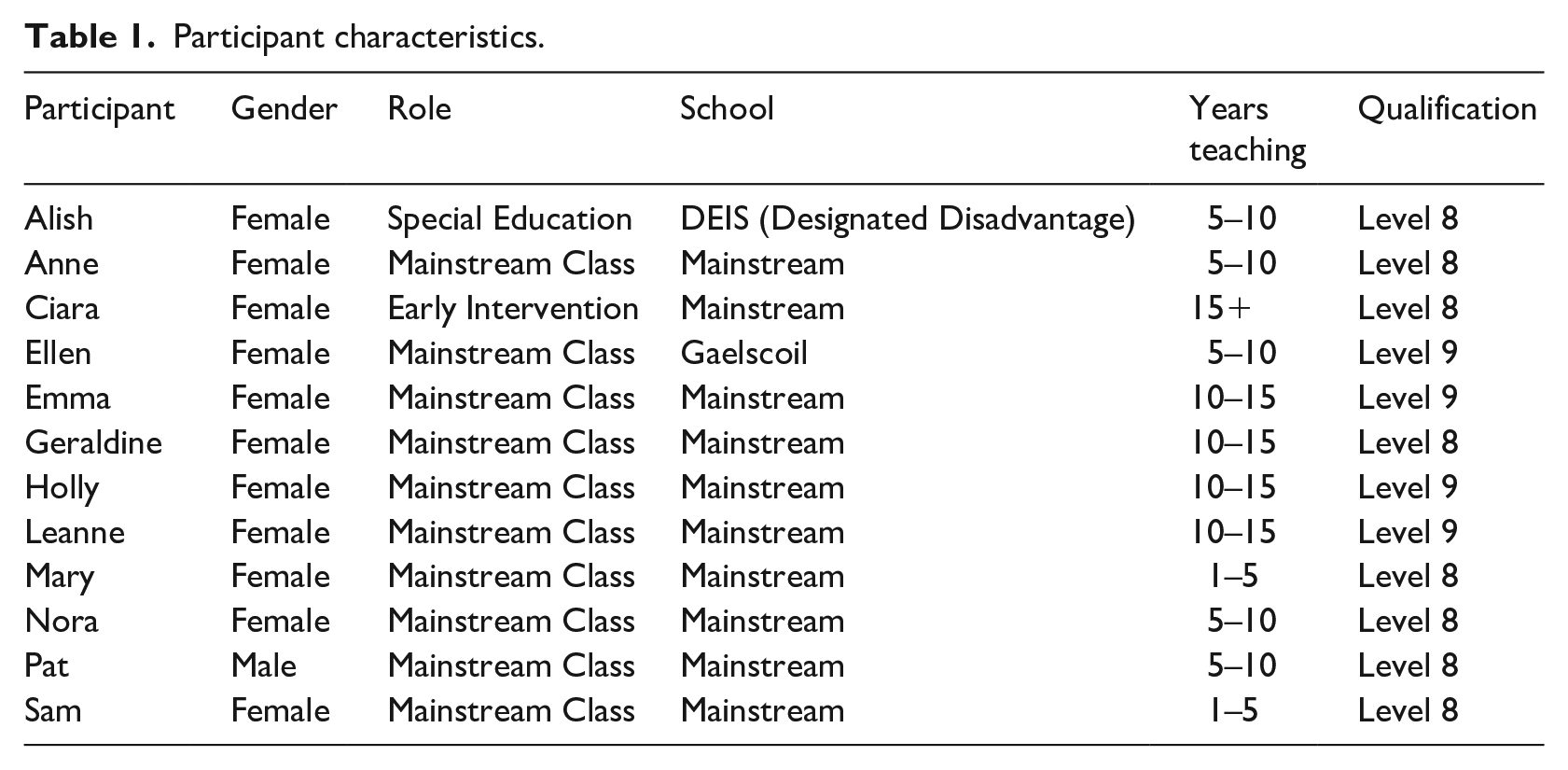
Self-reported demographic characteristics are highlighted in Table 1. The 12 participants included 10 mainstream class teachers and two special education teachers. The 11 schools from which participants were drawn included one Gaelscoil (Irish speaking medium), DEIS (designated disadvantage) school and 10 mainstream primary schools. Teachers were experienced with the majority teaching 5–10 years (n = 5) or 10–15 years (n = 4). Finally, the majority of participants were teaching Junior Infants (aged 4–6 years) (n = 8) and all participants had a minimum of level 8 degree, with four participants holding a level nine qualification.
Participant characteristics.
Teachers’ conceptualisations of play
Teachers’ conceptualisations of play incorporated six characteristics as something: (1) fun; (2) active; (3) creative and imaginative; (4) part of learning and development; (5) social activity and; (6) requiring some level of child autonomy. Teachers referred to play as ‘fun’, highlighting the sense of ‘joy’ and pleasure children experience during play and describing it as ‘exciting’ and ’adventurous’. Participants described play as ‘active’, ‘busy’, ‘loud’ and ‘very noisy’ with one participant describing ‘play is (as) physical’. Teachers also referred to the creative and imaginative nature of play, describing it as an opportunity for ‘exploring creativity’ and ‘imagination’. Play was conceptualised both as a mechanism for learning formally with one teacher describing it as ‘what we do [. . .] we have no workbooks’ and opportunities for learning ‘writing, vocabulary and maths’ and two teachers describing it as a ‘break from formal learning play’ and ‘freedom from books’. Participants also described play as a vehicle for informal learning opportunities in terms of ‘language building’ and ‘learning to communicate’. In addition, teachers referred to play as ‘social’ referencing its role in ‘building friendships’ and ‘learning to communicate, learning to share’. Participants described play in relation to the level of child autonomy and adult involvement with some describing play as solely ‘child led’ and referencing associated ‘freedom’ and ‘free choice’ and others referring to the flexible nature of play whereby it ‘can be free or sometimes it’s structured’.
Play in early childhood classrooms during Covid-19
Teachers’ reported practices surrounding play in the early childhood classroom indicated four themes: (1) play as embodying similar characteristics and qualities during COVID-19 as before the pandemic; (2) play as a priority for early childhood education in the pandemic; (3) play as something carefully planned for by teachers in response to COVID-19 regulations; and (4) an impact of COVID-19 regulations on the social and relational components of play.
Theme 1: Play as embodying the same characteristics as pre-COVID-19
Despite restrictions around sharing of resources and socialising in class, teachers emphasised that ‘play is still play regardless’. The key characteristics of play in the classroom reflected teachers’ conceptualisations of play including a sense of joy whereby teachers reported that sense of ‘enjoyment is still there’ and ‘you wouldn’t even think pandemic because they’re having, and you’re having, fun’. Teachers also discussed the inherent social element of play whereby it was ‘still as social’. This was despite implementation of restrictions: children were ‘still playing in groups, you know, even though it’s a pod, I mean, this time last year, it was just called their group’. However, others reported significant differences within the level of social interaction across class groups in response to restrictions, with ‘no mixing of groups’ and the need to ‘keep them with who they’re sitting with’. Teachers also discussed similarities in play in relation to the level of child autonomy whereby play is ‘very much kind of child-led’. Teachers referenced similarities in terms of the characteristics of play in relation to creativity and imagination whereby ‘the creativity of kids would still blow you away’ and ‘you see all the real imagination’. Others highlighted the quality of play for learning and development which remain unchanged: children are ‘all still learning, they’re all still engaged and they’re all still having a goal’ and ‘play is still used to develop skills such as the ‘language focus [..] mathematical skills, problem solving’.
Theme 2: Play as a priority for early childhood education
Play ‘was a big priority’ within the classroom since returning to school. Teachers emphasised increased time dedicated to play in the classroom and that it was ‘needed more frequently’, ‘even more so than before’ and ‘the more play you can get in the better’. Play provided a sense of enjoyment for children in terms of helping to ‘keep them happy’. The importance of play for familiarity and routine was also highlighted in terms of helping children feel ‘comfortable within the classroom and within their surroundings’. Teachers emphasised the value of play in supporting children’s resilience and creating a sense of normality whereby ‘play can almost make you forget about the pandemic [. . .] it’s so normal for them, and it’s their natural way of behaving’. Teachers referenced the importance of play for social connection and interaction since returning to school and noted that children have ‘really enjoyed sharing their play with their peers’. Others focussed on the role of play in the development of relationships between children in ‘helping them build their friendships’ but also with teachers in building ‘that good relationship then in play’. In particular, the importance of play for emotional development, wellbeing and resilience was highlighted. One teacher spoke about the potential of play to act as a means for children to ‘express themselves more, especially those quieter children (or) the children that might be a little bit more timid’ with others describing the role of play in helping ‘children to feel emotionally secure coming in, after being out so long’. Participants also referenced wider recognition of the importance of play ‘outside our classrooms’ within the wider school community, including wider recognition for play within policy documentation and ‘with the return to school documents and that they really did highlight play’. Teachers greatly valued this wider prioritisation of play in favour of a ‘go slow’ approach where ‘play was at the centre of it all’ with ‘emphasis [..] even just getting them happy to come into school’ as opposed to ‘you’ve spent 6 months now at home playing games now get them back reading and writing’. Others agreed that this broader emphasis on play ‘from the top-down’ provide much-needed reassurance whereby ‘you didn’t feel maybe a little bit guilty’.
Theme 3: Play as something planned for by teachers in response to COVID-19 regulations
Teachers highlighted COVID-19 regulations and the subsequent impact of those regulations on planning for play in relation to available spatial and material resources. Planning centred around the management of materials through the development of systems regarding hygiene and sanitisation as well as sharing of materials. This was based on the organisation of play pods whereby children ‘play in the same group’ with restrictions surrounding the sharing of materials and ‘no sharing between groups’. Teachers also spoke about reducing the number of materials for play in response to regulations with ‘less resources provided during a given session’. Participants emphasised the need for ‘more cleaning’ during play in line with COVID-19 regulations including the development of systems surrounding sanitisation of materials whereby teachers reported that they had ‘been using quarantine really as the most convenient method of disinfecting’.
Where outdoor space was available, participants planned for increased outdoor play with ‘a new appreciation for the outdoors’, whereby teachers were actively ‘trying to use the outdoor space more for play’ and to create a dedicated outdoor play area within schools: So we go outside four days a week and we have a sand pit, a mud kitchen and like an adventure area, we call it, so there’s a tunnel and a wigwam and there’s like a little woodland area and then another group, which is small world play so we bring out like different toys and things like that (Holly, mainstream class teacher of children aged 4-8 years)
Theme 4: An impact of COVID-19 regulations on the social and relational components of play
Teachers also highlighted the impact of COVID-19 regulations on the social and relational components of play within the classroom. Firstly, teachers emphasised an enhanced quality of play with one teacher describing that by ‘reducing my resources they play so much better, with less is more’. Teachers attributed this to opportunities for repetition of play and depth of engagement. Others also spoke about increased quality of play in the yard whereby ‘the kids are playing so much better’. Rather than focussing on a lack of resources, teachers reported a value in ‘the interactions’ between children and ‘actually being together [..] regardless of resources’.
Secondly, teachers emphasised increased levels of social interaction and inclusion whereby classes are ‘a lot more tight-knit’ and play ‘full-class together’ describing increased level of ‘rapport with their peers’ where children have ‘definitely built friendships quicker’ with one teacher attributing to the fact that ‘they were just craving it so much from not having it for 6 months’. Much of this centred around yard play during lunchtime and the formation of class bubbles in response to COVID-19 regulations.
The value of such structures for children with additional needs was emphasised by one of the 12 teachers in this study. Specifically, she viewed these as ‘an advantage to the kids with SEN (who) normally maybe would have wandered around the big yard’ in that ‘the bubbles made the yard smaller’. Similar views were shared by fellow teachers who highlighted the value of ‘safer bubbles’ for the inclusion of all children whereby ‘they didn’t get as overwhelmed as they would have in previous years’ and ‘helped them to settle in well to the class and build rapport with their peers’ and make ‘friendships kind of faster’. This was not a unified experience with some classes ‘not gelling’ and some children finding is hard to be ‘kept physically apart from other kids at lunch in different classes’.
Finally, there was some uncertainty surrounding teachers’ involvement in play in light of restrictions whereby some teachers wondered ‘should I be doing this’ and reported that ‘it’s hard to stand back’ or be ‘at a distance from them’ as opposed to ‘hands on’. For some children, teachers highlighted a need to model play where children may have regressed in skills, in particular for children with special educational needs or for whom English was an additional language, and whom teachers identified as needing ‘more support this year than normal’.
Discussion
This study highlights a central role of play within early childhood classrooms during the pandemic. Teachers demonstrated a commitment to play, in spite of increased complexities and demands in organising the classroom environment, with a concomitant focus on ensuring the quality of play remained largely unchanged. Teachers’ practice around play mapped onto teachers’ conceptualisations of play, highlighting an important link between how teachers perceive play and how this impacts practice, reflecting previous findings that beliefs impact practice (McInnes et al., 2011; Wood and Bennett, 1998).
Although teachers described adaptations to play within the early childhood classroom in response to COVID-19 regulations, including increased organisation and structure, teachers also emphasised that the inherent qualities of play remained unchanged. This is in line with findings reported by Graber (2021) in terms of the ‘infallibility’ of play (p. 2), based on her study of 15 children’s (aged 3–10 years) perspectives of play in the pandemic. This reflected a valuing of play where teachers were ‘willing to like move things around to make it happen’ and be ‘adaptable and flexible’. This corresponds with findings reported by O’Keeffe and McNally (2021) in anticipation of school reopening, whereby teachers in Ireland indicated strong commitment to play within the classroom upon school reopening.
Teachers viewed play as important for children’s development within the context of the pandemic as well as the inherent need for play in and of itself. This reflects an international focus on play in supporting children during a crisis such as COVID-19 (Neale, 2020; OMEP, 2020; Shonkoff, 2020). Firstly, teachers recognised the value of play to support children’s transition back to school and provide a sense of familiarity and routine. Teachers also demonstrated an awareness of the potential of play to offer emotional support to children during tumultuous times, an astute awareness in light of international guidance on the potential impact of the pandemic on children (Tonkin and Whitaker, 2021). Thirdly, teachers shared values on the importance of social play in providing much needed connection with peers. This aligns with research indicating that children’s own preferences regarding supports during their return to school during the pandemic is for social contact and playing outdoors (Playboard Northern Ireland, 2020).
In reflecting on their experiences of facilitating play during COVID-19, teachers described play’s objective and intrinsic qualities (Howard, 2019) and responses reflected culturally universal characteristics identified in the literature (e.g. Izumi-Taylor S Samuelsson and Rogers, 2010; Rentzou et al., 2019) Teachers recognised the role of play as both a vehicle for formal learning and wider development. However, four teachers described play solely in relation to development and not learning, with one teacher describing play as a break from formal learning. This lack of consensus regarding the role of play in learning reflects ambiguity within the wider literature (Pyle et al., 2017) and is an important area for further research: namely, how do teachers conceptualise play and to what extent does this impact on classroom practices?
The findings of this study provide insight into play practices in early childhood classrooms during the pandemic following an extended period of school closures. To the best of the authors’ knowledge, this is the first study to investigate educators’ experiences of play within the early childhood classroom during COVID-19. The use of qualitative research enabled the collection of in-depth responses on play practices in education during the pandemic while also contributing to our understanding of teachers’ conceptualisations of play. The study also makes an important contribution to the evolving literature on online qualitative research methods in response to the shifting landscape of qualitative methods during COVID-19 (Roberts et al., 2021) by describing carefully planned use of an online forum to collect rigorous data that would otherwise not have been achievable due to social distancing regulations. However, there are some limitations that need to be acknowledged. Firstly, one focus group involved two participants who were colleagues at the same school which may have impacted group dynamics. Secondly, as respondents self-selected into the study, it is likely that teachers who chose to take part in the focus groups were already interested in play in education. Finally, the sample was homogenous and reported findings may reflect the experiences of a predominantly female sample of experienced teachers who may have been strongly invested in play-based paedagogies. However, the homogeneity of the sample and the depth of discussion around play in small focus groups enabled reliable conclusions to be drawn around typical play practices in Ireland in mainstream early childhood classrooms during the pandemic. Finally, due to COVID-19 restrictions, this study was based solely on teachers’ reported play practices; research which includes direct observation measures may offer additional insight into teachers’ practices surrounding play in the context of COVID-19.
Implications for practice and research
This research suggests that play was deeply valued by teachers in early childhood classrooms, even in the face of health and safety regulations in light of the pandemic. Teachers expressed confidence in play as a positive means by which to support children within the classroom and to navigate new contexts due to COVID-19. Concerns around learning loss were not expressed by the teachers in this study but rather teachers showed a strong commitment to play as important for children’s development and wellbeing in the early childhood classroom. For educational policy, such findings reflect broader calls within the literature to capitalise on the growing momentum for play and ensure it remains at the forefront of education and policy development in planning for education post-pandemic (Colao et al., 2020; Poletti, 2020) as well as attempting to deal with any adverse impacts on children’s wellbeing due to the pandemic.
Although many teachers returned to ‘normal’ in-class education albeit with many new safety guidelines and regulations, the transition back to the classroom posed significant challenges for teachers in terms of ensuring physical and psychological safety after a 6-month absence. Our findings indicate that teachers felt that play had a key role in ensuring continuity and wellbeing for children in the face of these challenges, reflecting more widely perhaps teachers’ dedication to supporting children during the pandemic (Samuelsson et al., 2020). The United Nations (2020) has highlighted the need for education systems and teachers be adaptable and flexible and this qualitative study of teachers’ play practices in early childhood classrooms suggests teachers were indeed adaptable and flexible with regard to play in the return to in-class teaching as one key component of early childhood education. The finding that some teachers found the COVID-19 regulations which imposed additional structures on group interactions and dynamics (e.g. small groups or ‘pods’ in the classroom and no class mixing in the yard) helpful for students with additional needs or who had difficulties socialising, was unexpected and warrants further investigation. This unintended consequence of restricted social movement in the school environment may highlight an effective intervention to support socialising for more vulnerable groups of children for whom larger group dynamics can be challenging. Further, the findings highlighted play as a well-established context for teaching and supporting children in early childhood classrooms in Ireland, with widespread support and implementation among teachers in this study and previous larger survey data (O’Keeffe and McNally, 2021). Play may therefore offer a strong foundation and starting point for educational strategies that may need to be developed in response to future international crises and this study contributes rich data on how teachers viewed the role of play in the early childhood classroom during a new and challenging educational landscape.
