




Abstract
As school authorities strive toward inclusive models of education for children with neurodevelopmental delay and disability (NDD), many kindergarten curricula have mandated pedagogy centered on learning through play. Children with NDD tend to experience greater social isolation and lower rates of social play engagement compared to typically developing peers. Consequently, issues related to social participation and inclusion may be particularly salient in play-based kindergarten classrooms. The current qualitative study explored how eight kindergarten teachers in Ontario, Canada conceptualized and promoted inclusion in play for children with NDD. Classroom observation and teacher interviews were conducted with a focus on the teacher’s role in play. Teachers endorsed the use of several indirect (i.e., environmental) strategies to promote social participation, alongside proactive teacher support in play. Teachers who shared multiple aspects of an interventionist viewpoint toward disability, and identified the social benefits of inclusion in play for children with NDD, tended to provide more proactive support to all children in play. Teachers also provided reactive support in play to address emerging social conflict. Implications for fostering the meaningful inclusion of children with NDD in play-based learning are discussed.
Introduction
As school authorities worldwide strive for more inclusive models of education, children with neurodevelopmental delay and disability (NDD) are increasingly being placed in mainstream classroom environments (Kohen and Cartwright, 2008). Young children with NDD (autism spectrum disorder, intellectual disability, communication disorders, and other genetic disorders) are characterized by brain or nervous system dysfunction and impairments related to language, social communication, and/or cognition (Ansari et al., 2016). Children with NDD tend to experience greater social isolation than typically developing (TD) children, including lower rates of engagement in social play (Dere, 2018). Meanwhile, kindergarten curricula in Canada, Australia, China, and elsewhere have mandated play-based learning, where children’s early learning is to be fostered in play (Pyle et al., 2017). Ongoing concerns related to the social participation and inclusion of children with NDD may be especially salient within a play-based learning framework. To address these concerns, we explored how a group of kindergarten teachers conceptualized and promoted the inclusion of children with NDD in play-based classrooms.
Perspectives on inclusion
Article 24 of the United Nations’ Convention on the Rights of Persons with Disabilities promotes rights of all children to access inclusive education. This includes the right to access reasonable accommodations and individualized support measures to address children’s academic and social development, including alternative forms of communication and facilitating peer support (United Nations, 2008). Definitions of inclusion in both policy and research have highlighted promoting accessibility and participation in classroom activities (i.e., academic inclusion), and children being accepted and valued members of a classroom community (i.e., community inclusion) (Göransson and Nilholm, 2014). Although focusing here on NDD, inclusion is a broad term encapsulating the promotion of supportive and respectful classroom communities toward all children, regardless of race, language, gender, and other individual differences (Juvonen et al., 2019).
Researchers have developed different measures for exploring teacher perspectives toward disability and teaching, and how perspectives may relate to different instructional approaches. One set of identified teacher beliefs are pathognomonic versus interventionist ways of thinking about disability (Jordan and Stanovich, 2003). These beliefs involve two components: locus of responsibility and attribution of cause (Jordan, 2018). Pathognomonic beliefs place the locus of responsibility for school performance on the individual child and attribute learning or behavioral differences to internal characteristics. Alternatively, interventionist beliefs place the locus of responsibility for school success on the teacher and attribute differences to the interaction between a child and their environment (Jordan and Stanovich, 2003). These beliefs are not dichotomous, but exist on a spectrum, as teachers can endorse aspects of both and judgments can vary across contexts (Jordan et al., 2009). Notably, beliefs have been found to relate to meaningful differences in classroom practices, with teachers who shared greater interventionist beliefs tending to provide more flexible instructional practices with accommodations and adaptations than teachers who shared greater pathognomonic beliefs (Jordan et al., 2009). These beliefs have also been found to relate to teachers’ broader epistemological beliefs, including fixed versus growth mindsets (Lanterman and Applequist, 2018). However, beliefs regarding disability and teaching represent only one factor shaping instructional practices; it is also critical for teachers to learn evidence-based approaches for supporting diverse learners (Finkelstein et al., 2021).
Teaching in inclusive classrooms
Based on extensive studies of experienced teachers, Florian (2014) characterizes inclusive teaching as a distinctive shift in thinking from providing something different to students with disabilities to fostering learning opportunities available to everybody. Furthermore, they recommend teachers adopt a flexible approach driven by learners’ needs and the development of the whole child, rather than the acquisition of content-related goals (Florian, 2014). This shift in thinking is consistent with principles of Universal Design for Learning (UDL), a pedagogical approach to designing classroom environments and activities accessible to children of all abilities (Katz, 2013). UDL emphasizes providing for different means of representation, expression, and engagement in learning, alongside considerations for materials and classroom structure (Katz, 2013). While UDL is considered a scientifically valid approach to instructional practices (Lanterman and Applequist, 2018), it is also regarded as critical to fostering community inclusion through demonstrating respect for student diversity, centering opportunities for participation of children with disabilities alongside TD peers (Göransson and Nilholm, 2014). However, teachers’ knowledge and application of UDL in inclusive classrooms tends to vary (Jordan, 2018). One context where UDL principles should be considered in kindergarten, as it is central to children’s social participation and learning, is play.
Play-based learning in inclusive classrooms
Kindergarten curricula across different regions have begun mandating play-based learning, where areas of academic learning (i.e., literacy, mathematics) and developmental learning (i.e., social development, self-regulation) are to be promoted by teachers within children’s play (Pyle et al., 2017). Although definitions of play vary, it has been characterized as activity that is pleasurable, imaginative, fluid, and concerned more with means than ends (Wallerstedt and Pramling, 2012). Classifications of play activities have been proposed according to children’s interactions with toys (e.g., sensory play, symbolic play) and each other (e.g., solitary, parallel, cooperative) (Barton, 2016). Whereas play serves a range of purposes, play-based learning refers to play activities aimed at promoting learning and has been conceptualized as a continuum with varying levels of adult involvement (Pyle and Danniels, 2017). It ranges from child-directed play (e.g., dramatic play), to play designed and directed by adults (e.g., teacher-created games) (Pyle and Danniels, 2017). In the middle lies play that is co-directed by children and adults (e.g., guided play), which has been touted as an optimal context for children’s learning (Weisberg et al., 2013), although little research has included children with disabilities. Guided play can take different forms, including teacher-supported dramatic play where a play center gets converted into a preferred location (e.g., vet clinic), or a teacher observes children building with blocks and poses a challenge to make the building taller (Pyle and Danniels, 2017; Trawick-Smith et al., 2017). In this manner, teachers can infuse opportunities for academic learning in play and support social cooperation skills among children of differing abilities.
Although perspectives toward play-based learning have been positive (Wu, 2014), teachers hold differing views on the relationship between play and learning and implement play-based learning in different ways (Pyle and Danniels, 2017). For example, some teachers prioritize child-directed play, while others endorse active teacher involvement and more structured play activities (Pyle and Danniels, 2017). Other studies have found teachers endorse active involvement in play but articulate challenges with enacting it in practice, including with children with disabilities (Manwaring, 2011; Pyle et al., 2018).
Although much research has highlighted the successes of play-based programs (Nicolopoulou et al., 2015), research among children with NDD has focused on concerns that have arisen in play. For example, young children with autism spectrum disorder (ASD) have been observed to engage in less varied pretend play and more frequent solitary play than TD peers (Barton, 2016). Children with communication disorders can be more socially withdrawn and experience difficulties joining into social play (Dennis and Stockall, 2015). Children diagnosed with severe multiple disabilities may encounter challenges related to a greater dependency on others to assist with accessing preferred play activities (Hui and Dimitropoulou, 2020). In general, children with NDD represent a diverse group of children with individual strengths and needs. Despite this heterogeneity, children with NDD experience similar challenges related to positive social engagement with peers, including more solitary play, being viewed as less desirable play partners, and having fewer reported friendships (Chen et al., 2019; Normand et al., 2019). Consequently, how educators support the play of these children alongside TD peers is an important and overlooked topic in research on play-based learning.
In the current study, we explored how a group of kindergarten teachers conceptualized and supported the inclusion of children with NDD in play-based classrooms. This research was guided by a sociocultural perspective on play, situating play as a meaningful cultural activity occupying a critical role in children’s development (Rogoff, 1994). Furthermore, teachers help to develop a classroom environment that shapes participation and opportunities for learning, informed by their current knowledge and perspectives (Jordan et al., 2009). This research was guided by the following questions:
(1) How do teachers conceptualize inclusion in the play-based kindergarten classroom?
(2) How do teachers view the role of play in the promotion of inclusion in kindergarten?
(3) How do kindergarten teachers support the inclusion of children with NDD in play?
Method
Context
The current qualitative study gathered data in kindergarten classrooms in Ontario, Canada. Ontario follows a full-day, play-based program for children 4–5 years of age outlining both academic (e.g., literacy) and developmental (e.g., social skills) learning objectives to be targeted in play with appropriate teacher support (Ontario Ministry of Education (OME), 2016). The Ontario curriculum endorses a commitment to antidiscrimination principles (OME, 2016: 102) and to educating children in the least restrictive environment, with most children with disabilities now educated in mainstream classrooms (Kohen and Cartwright, 2008). UDL is briefly mentioned in the curriculum, but not discussed in reference to play. The province of Ontario recommends children complete a developmental screening by their pediatrician at 18 months of age to encourage early identification of NDD (Canadian Task Force on Preventive Health Care, 2016).
Participants
Data were collected in eight play-based kindergarten classrooms, located in one public school board and one independent school in a major urban center in Ontario. Teachers were recruited based on personal and professional contacts (convenience sampling) and recommendations from educators (snowball sampling). Ethical approval was received from the university and both school boards. Informed consent was solicited from teachers and parents of children in each classroom. Five teachers reported they had at least one child in their class with an identified or suspected NDD (see Table 1). These five teachers reported having one or two children with a NDD, including ASD (four classrooms), cerebral palsy (one classroom), and global developmental delay (one classroom). While attempts were made to purposefully sample classrooms containing children with NDD, pandemic-related school closures resulted in shifts to a convenience sample of classrooms with varying student compositions. However, all teachers reported experience teaching children with NDD in kindergarten in previous years. Reported teaching experience ranged from 10 to 30 years (5–22 years in kindergarten). Four teachers reported experience teaching in segregated special education classrooms, while seven teachers reported attending additional formal trainings on special education. All but one teacher self-identified as female.
Summary of teachers’ shared views on inclusion and observed support provided in play.
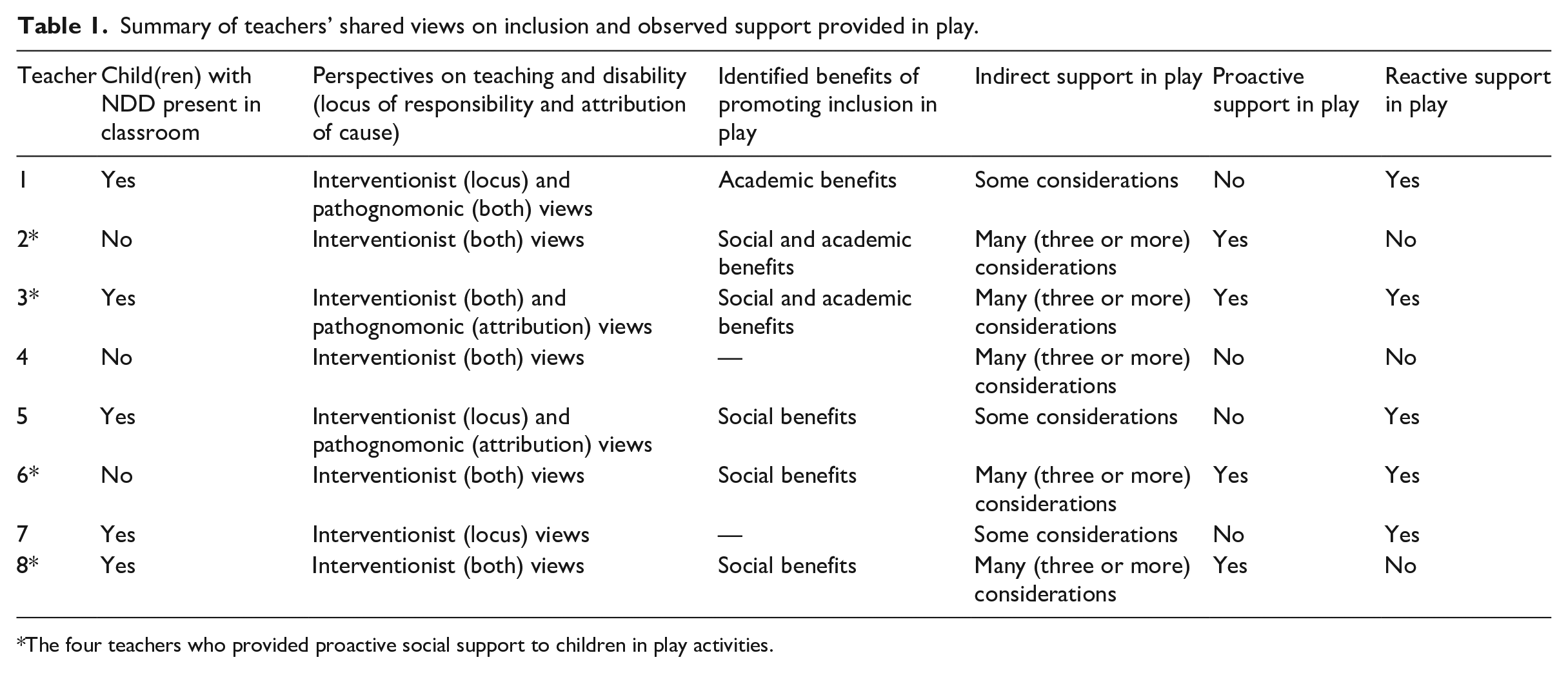
The four teachers who provided proactive social support to children in play activities.
Data collection
The current study utilized qualitative methodology comprised of direct classroom observations and semi-structured teacher interviews. A minimum of 3 hours of observation was conducted within each classroom in the fall of the school year, captured in written field notes, photos, and videos of play and learning activities. Observations were recorded across 2–4 days depending on class schedule and teacher preference, in blocks of 30–90 minutes/day. Observations captured periods of whole-group instruction, small-group instruction, children’s free play, and teacher-facilitated play. A total of 11 hours and 14 minutes of classroom video recordings were collected.
In the following spring, semi-structured interviews were conducted one-on-one with teachers through an online telecommunications platform. Interviews lasted approximately 30–90 minutes. Questions focused on classroom composition and perspectives toward promoting inclusion in play-based learning (What does inclusion look like in a kindergarten classroom? How can teachers support students with disabilities in the context of play?). Two included questions (What do you see your role with students with disabilities as being? Have you done anything special this year to accommodate students with diverse abilities?) were adapted from Jordan and Stanovich’s (2003) interview examining pathognomonic-interventionist beliefs, to consider teachers’ perspectives related to this spectrum. While initial questions were broad, follow-up questions addressed the topic of children with NDD. Interview audio recordings were downloaded and transcribed verbatim.
Data analysis
Collected data were inductively analyzed using Braun and Clarke’s (2006) thematic analysis: familiarization with data, generating initial codes, searching for themes, reviewing themes, defining themes, and producing the report. For step one, all interview and video data were reviewed and initial impressions were recorded. For steps 2 and 3, all video recordings were manually open coded by the first author. Videos from three classrooms were also open coded by a second researcher to help promote inter-rater alignment in coding. An open-ended coding chart was drafted that included a description of the context/activity, type of play (if applicable), who was present, and descriptions of interactions (actions and content of conversations). Areas of ambiguity or disagreement were resolved through open discussion and joint reviewing of video clips. Interview data were coded line-by-line by the first author, followed by organizing assigned codes into categories and themes to form a description of each teacher. Identified themes within each interview were then compared with coded video data in each classroom to look for areas of alignment or misalignment. For step four, identified themes were reviewed across classrooms to look for general commonalities and differences. For steps 5 and 6, common themes were organized into three categories guided by the research questions: perspectives on inclusion, perspectives on play, and strategies to promote inclusion in play. Examples of strategies discussed as beneficial for children with NDD are highlighted, alongside the observed implementation of these strategies with any children in each classroom.
Results
Perspectives on inclusion
When discussing inclusion in kindergarten, teachers addressed multiple considerations, and shared somewhat differing perspectives toward teaching and disability. Six of eight teachers addressed ideas related to both academic and community inclusion, including adapting classroom instruction and activities to ensure participation: “Academically, the ideas and the activities we set out have to be accessible from different levels, so inclusion for kindergarten would be that everybody should have access to the curriculum and the activities” (T1). Teachers also expressed a need to cultivate an accepting community, often in a broader sense extending beyond ability differences: “It’s also making sure the rest of the students can learn how to be not just tolerant and acceptable but open to embracing people of any color, any race, any ability” (T7). Teachers felt both academic and community facets were important considerations in an inclusive classroom.
With respect to teaching children with NDD, all eight teachers shared interventionist-leaning views with respect to the locus of responsibility for school success being placed on the teacher: I could put out word games all day long, but if kids don’t ever go or choose those activities or sit and reinforce it for themselves, I’m still obligated to figure out a different way to teach them. . .If kids aren’t getting it, what other things are you going to do to make sure that they’re still learning how to read? (T5)
Teachers spoke about a sense of responsibility to support the growth and development of every child: “[I’m] making sure we’re developing a program that will help these students move along their continuum. . . Having that growth mindset is very important” (T8).
Additionally, a subset of five teachers shared interventionist-leaning views regarding attribution of cause, attributing learning differences to the interaction between a child and their environment: I don’t think a disability really characterizes a child. I think a disability is more of an interaction between that environment and the child. . .How is this environment maybe putting up barriers for this child not to be able to learn and develop? (T6)
These teachers described identifying a disability as somewhat arbitrary as every child can encounter barriers to learning: “Indirectly, everybody in that classroom is exceptional in some way or another. And they all have barriers that prevent them from seeing the curriculum in a flourishing diverse way” (T2).
However, coupled with these interventionist viewpoints, three teachers also expressed some pathognomonic-leaning views, both in terms of locus of responsibility and attribution of cause. For example, T1 attributed responsibility for success in an after-school social skills program to the individual child: It took nine weeks before I saw a difference. It took that long. . .And the kid that started this year, in the second week, we saw THIS much [gestures a large amount] improvement. So it depends on the children. (T1)
Similarly, T3 attributed behavioral differences to internal characteristics that are difficult to change, but did not want to adopt a discouraged outlook: “[Sometimes] it’s a learned behavior, it’s innate, it’s all these things but you don’t want to have that discouraged attitude” (T3). These three teachers addressed both ways of thinking about disability and teaching, illustrating the complexity of these issues and how these views are not always mutually exclusive.
Perspectives on play
When discussing perspectives toward play-based learning, all eight teachers spoke positively about play as a context for early development. Four teachers emphasized play as a beneficial activity for children with NDD: “The language that can be coming out from sensory experiences are important for the kindergarten program. . .It’s the ideal environment for meeting the needs of children with disabilities because it’s play-based” (T4). However, these four teachers also expressed concerns related to the perceived quality of learning present in preferred play activities of children with NDD: “The first week I was so frustrated because they were at that stage of total experimentation. They would have these boxes and stack [them] and knock it down” (T4). Certain play preferences were described as a point of frustration due to being lower in perceived quality: “All they did from September to June, they smashed cars. They just smashed cars all day!. . .The lowest level of play is smashing, right?” (T1). These teachers shared both specific praise and concerns related to the engagement of children with NDD in play-based learning.
When discussing inclusion in play, teachers discussed perceived benefits from the participation of children with NDD alongside TD peers. Five teachers, four of whom had discussed both aspects of an interventionist perspective, highlighted opportunities for practicing social skills: “I think the social interaction for kids with special needs is really crucial. . . I’m not so worried about if they know their ABC’s and 123’s, it’s the social-emotional that’s going to be my focus” (T3). Play was viewed as a context where children develop positive social relationships: “What you hope in those interactions is that. . .as they engage with each other, the other kids are going ‘oh yeah, this is a fun kid to play with’, and that they might be more likely to do that” (T5).
Three teachers also discussed academic learning opportunities in play for children with NDD: Two teachers (T2 and T3) focused on social and academic benefits of play, while the third (T1) focused on the academic, aligning with their academic definition of inclusion. “In the sand, they might be matching the letters together to build the sight word. . .they might not be able to read the word, but they’re able to play with their friend who’s just working on letters” (T1). These teachers considered how children with and without NDD support each other’s academic learning through play activities accessible to differing skill levels.
Alongside perceived benefits, five teachers also discussed difficulties experienced promoting participation in social play for children with NDD. Concerns were shared in relation to the play behaviors of children with NDD, including a preference for solitary play: “It was a lot of alone play, a lot of what we call parallel play so next to someone and not necessarily engaging with another student” (T6). However, teachers also addressed exclusionary behaviors of TD peers, such as perceiving children with NDD as less favorable playmates: “As the year went on and as he [child with ASD] kind of started to stick out a little bit, kids were less likely to choose him as a playmate. . .Kids are just more likely to choose someone that interacts more” (T5). T2 saw how differing abilities can lead to social exclusion: “So-and-so’s not able to play with us because they can’t jump so high.” Teachers identified challenges related to both sides of play interactions between children with NDD and TD peers.
Supporting inclusion in play
Environment
When asked about supporting inclusion in play, all eight teachers discussed indirect strategies related to setting up environments that support inclusive play. Five of eight teachers discussed considerations for classroom layout and physical space; the same five teachers who discussed both aspects of an interventionist perspective. Shared considerations included different sensory and social aspects of the classroom: “I think you have to take things into consideration [like] the heights of chairs, heights of tables, where space is located, quiet space, space where they can be noisy, space for one-on-one or one person space, and multi-groupings” (T3). Three of these teachers also discussed the need for clear routines surrounding play. “Some children may need extra time to anticipate a transition. So having a visual schedule that we can revisit all the time, and pair up our visual with verbal, those are also ways that show inclusion” (T6). Resources to support transitions in play were observed in six classrooms, including among the five teachers who discussed considerations for the physical space. Five classrooms utilized visual schedules and three classrooms used timers or countdown clocks in play. For example, T6 would show a countdown clock with a disappearing red panel to children at play centers, demonstrating the amount of play time left.
A different subset of five teachers discussed considerations for types of materials provided to children in play, ensuring materials are safe and facilitate the participation of all children: “If you have a child who can’t lift heavy things, have softer toys” (T4). Another five teachers emphasized the importance of changing materials to follow children’s interests and promote continued engagement: “We re-designed the classroom so that it would promote more social interaction. We created different building spaces” (T6). Overall, teachers who discussed both aspects of an interventionist perspective also endorsed a greater number of environmental considerations in play (see Table 1).
Teacher involvement in play
Alongside environmental considerations, seven of eight teachers endorsed direct teacher involvement in children’s play to support inclusion. Teachers discussed supporting positive social interactions among children, including “a lot of prompting and coaching” (T1). However, teachers were observed to engage in differing levels of involvement in play.
Four teachers were observed to proactively support children’s play, all of whom discussed both aspects of an interventionist perspective and the social benefits of inclusive play. Supporting children with NDD in play was described as an important step in promoting social development: “I know that student [with NDD] is able to play in the water or play with cars or play with trains, but they need to be extended further. How can I scaffold for them in that so that their interpersonal skills develop even further?” (T2). To illustrate this involvement, T3 was observed to approach a child, Taylor,
1
drawing at a table and engaged in conversation with him and a nearby peer, Christian: T3: I see the water. What’s up here? Taylor: [points to drawing] T3: I like the way you put the different colours up here. Who’s in the car? Taylor: [points to picture of a submarine] T3: Now I know what you’re talking about! Do you know what this is, Christian? What kind of transportation goes under water? Christian: A submarine. T3: A submarine! This afternoon, maybe we can tell a story about your submarine.
In this case, T3 initiated nonverbal and verbal interactions related to the child’s drawing, extending the children’s engagement as they colored side-by-side. In Class 2, the teacher witnessed a child, Tasha, take an item from a peer and jumped in to say, “Tasha, use your words, please. Use your words.” When Tasha remained silent, T2 modeled, “Can I have it, please?” for the child to repeat. He then praised the children and stated how important it is to ask friends first.
Two of these teachers were also observed to support children’s entrance into peer play. During outdoor play in Class 6, children were drawing with sidewalk chalk. The teacher noticed John was left out, so she helped to bridge his entry into play: T6: Sometimes people have a hard time joining in. He was wondering if he could go with you? Peer: Yeah, he can make a spiderweb with us. T6: Is that okay, do you want to make a spiderweb? [John nods] T6: Okay Peer: John, get up there!
In Class 8, the teacher approached a group of children building a large structure. Marcus, a child with NDD, shared concerns that peers were not allowing him to use the blocks. The teacher replied, “okay, so let’s use our words and we can talk to him.” This led to Marcus telling the peer, “I need two blocks,” to which the peer permitted Marcus to remove the blocks and build next to him. In these incidents, the teachers helped to prompt or model how to join into a play activity.
Lastly, five teachers were observed to get involved with children in play to mediate social conflict in a reactive manner, included asking questions and prompting or modeling appropriate social behavior. In Class 3, David (a child with NDD) and a peer, Howie, were fighting over a toy and Howie scratched David. The teacher approached when they heard David crying: T3: What do we use if we need something? What do we use? Maybe you can ask him, are you okay, David? Howie: Are you okay, David? T3: I think David is very sad.
During play in Class 5, the teacher overheard a child, Troy, raise their voice at Sam (a child with NDD) after he took their toy: T5: I just heard you say “HEY.” What can you say to Sam if he’s touching your stuff? Troy: Don’t touch my stuff. T5: Thank you, “don’t touch my stuff,” that helps Sam so much more when you give him more information.
Incidents of social conflict in play served as opportunities for teachers to facilitate positive communication among children, including children with NDD. However, three teachers were only observed to get involved in play during reactive moments, including two of three teachers that discussed aspects of a pathognomonic perspective toward disability. Overall, teachers who discussed both aspects of an interventionist perspective and the social benefits of inclusion in play were observed to provide more indirect and proactive support to all children in play.
Discussion
As school boards move toward more inclusive models of education, it is important to consider how the participation of children with NDD can be promoted in play-based kindergarten classrooms. In the current study, teachers approached inclusion as a broad concept addressing the physical and social environment and teachers’ direct actions in play. With respect to the environment, teachers considered how to structure play spaces and particular play activities to ensure children of all abilities could participate, with several recommended strategies and observed practices aligning with principles of UDL (Katz, 2013). Although teachers were not asked about their knowledge of UDL, most teachers reported attending formal trainings on special education, and guidelines for additional qualifications courses set by the Ontario College of Teachers (2017) explicitly references UDL. Viewing teachers’ approaches through a UDL framework provides a way to connect naturalistic classroom practices to an empirically supported framework (Lanterman and Applequist, 2018) and illustrate classroom approaches considered both beneficial and feasible (Bolourian et al., 2022). Endorsed strategies such as the use of visual schedules to provide multiple means of representation have been effective for promoting on-task behavior and reducing anxiety surrounding transitions among children with NDD (Macdonald et al., 2018).
In addition, direct strategies were observed where teachers got involved with children in play, supporting positive social interactions, facilitating entry into play, and supporting conflict resolution. Fostering positive social engagement in play is important as this participation has been connected to children’s social and emotional development, self-regulation, academic success, and is a necessary step for promoting acceptance and belonging in the classroom (Mortier, 2020; Nicolopoulou et al., 2015).
In addition to highlighting teacher approaches to play-based learning in inclusive classrooms, the current results suggest some preliminary patterns between teachers’ shared perspectives toward play and disability and types of classroom strategies observed in play. Teachers considered both community and academic elements of inclusion, and viewed play as a key context for children’s social (and sometimes academic) participation with peers. Accordingly, play was critical to the realization of teachers’ goals for meaningful inclusion. However, teachers who discussed both aspects of an interventionist perspective and the social benefits of inclusion in play engaged in more indirect and direct strategies toward promoting inclusion in play. These teachers capitalized on opportunities to facilitate social play and supported communication challenges experienced by children with NDD and their peers. It is possible that teachers who hold more interventionist-leaning views, focusing on external factors that shape children’s experience of disability, have a stronger motivation to identify and address social and environmental barriers in play. Furthermore, if social benefits of inclusion in play are salient for teachers, they may lend greater attention to observing and supporting inclusive play opportunities for children with NDD.
Moments of conflict happen during play, and it is important for teachers to support children when conflict occurs. However, teachers who shared fewer aspects of an interventionist perspective were observed to only get involved in play during conflict, including two teachers who shared some pathognomonic-leaning views. When teachers see ability differences as stemming from internal characteristics less malleable to change, they may perceive children with NDD as lacking in play skills and unable to join in with their peers.
However, teachers hold a range of perspectives toward disability and inclusion, and the current exploration was brief. It would be overly simplistic to classify teachers using simple interventionist versus pathognomonic labels, as these views represent a spectrum and not a binary model (Jordan et al., 2009). Rather, these initial patterns begin to show how play practices vary among teachers who hold somewhat differing perspectives toward teaching and disability, and underscore the potential importance of focusing on different aspects of interventionist ways of thinking among teacher training and professional developmental programs. Shifts in viewpoints may be an important component of teacher training opportunities, particularly regarding teacher roles and responsibilities with children with NDD in inclusive classrooms, to help deepen the will to learn and apply inclusive strategies in play to foster child development and learning (Jordan, 2018). However, these views represent only one factor that shape classroom practices, and ongoing training in evidence-based approaches for inclusion remains critical.
Providing space for child-directed play where children can engage in social negotiation and problem solving independently offers important social learning opportunities (Wallerstedt and Pramling, 2012). However, it has also been framed as a challenging context due to specific impairments (e.g., difficulties entering play, cooperating and negotiating with peers) and the negative treatment of children with NDD by TD peers (Barton, 2016; Kuutti et al., 2022). These social challenges are not unique to children with NDD, and teacher guidance in play has been touted as posing important benefits for the social inclusion of all children (Dennis and Stockall, 2015). Consequently, opportunities for children to engage in both child-directed play and play with teacher guidance may provide an optimal balance consistent with an inclusive framework. Participating teachers tended to echo this stance, endorsing proactive teacher involvement in play to support the participation and needs of all children, not solely to integrate children with NDD, although teachers varied in observed play practices. Specifically, all but one teacher endorsed teacher involvement in play, yet only half of teachers were observed to get involved in children’s play outside of reactive moments of conflict. In this regard, there was a misalignment among some teachers’ desired versus current play practices in kindergarten. Teachers may find it challenging to translate pedagogical knowledge into practice to support children’s participation and learning in play contexts (Pyle et al., 2018).
Although most teachers shared positive perspectives toward inclusion in play, two teachers shared a more neutral stance, citing the necessity of promoting an inclusive classroom but without referencing benefits of inclusive play for children’s development and learning. More broadly, these teachers tended to share less elaborated responses, which may reflect a differing stance toward inclusion or lower engagement, knowledge, and/or confidence toward promoting inclusion in play. As inclusive education is a growing movement with demonstrated benefits for children with disabilities (Mortier, 2020), it is important that opportunities for continued knowledge and support on these topics, including strategies for supporting children with NDD in play, are accessible to kindergarten teachers. Pre-service teaching training centered around UDL may help to promote shifts toward more interventionist ways of thinking about disability and should be a key component of teacher preparation programs (Lanterman and Applequist, 2018).
Lastly, these results highlight perceived challenges specific to promoting inclusion in play-based learning for children with NDD, including concerns related to the learning quality of preferred activities, preferences for solitary play, and the exclusionary behavior of TD peers. It is important that all children have opportunities to exercise agency and engage in preferred activities, including solitary play. However, it is also important to structure play opportunities with peers to promote early social learning, friendships, and greater acceptance (Juvonen et al., 2019). How teachers navigate a balance between honoring children’s agency and structuring play is a topic warranting further attention.
Limitations and future directions
Some limitations need to be considered. Firstly, due to pandemic-related school closures, sampling procedures shifted and consequently not every classroom contained a child with NDD. However, each teacher reported previous experience teaching children with NDD in kindergarten and spoke directly about those experiences. Strategies discussed by teachers as beneficial for children with NDD were implemented with their current students, although future studies using more targeted sampling would be beneficial. Furthermore, the observational period was restricted to one time point during the year. Observations across multiple time points would allow for exploring how practices may change throughout the year as student-teacher relationships evolve. It would also be beneficial for studies to include children’s own perceptions related to inclusion in play, including feelings of belonging and acceptance, which serve as a critical facet of inclusion not often addressed in research (Finkelstein et al., 2021). In addition, several teachers referenced inclusion as a broader concept extending to other areas of difference, including racial diversity. Future studies should explore the promotion of acceptance toward individual differences in play contexts through this intersectional lens in kindergarten. Lastly, the current study focused on perspectives and practices in individual classrooms. It is critical for broader examinations of inclusion to consider the influence of school- and district-level factors (ecologies or norms of inclusion; Jordan, 2018) that shape inclusive practices in kindergarten (Florian, 2014).
Conclusion
The current research illuminated how kindergarten teachers are conceptualizing and facilitating inclusion for children with NDD in mainstream classrooms, identifying approaches that aligned with principles of UDL. Both indirect (i.e., environmental) and direct (i.e., adult support) strategies were endorsed and observed, most commonly by teachers who discussed both aspects of an interventionist viewpoint and endorsed social benefits of inclusive play. Moving forward, it is critical that kindergarten teachers have access to training and professional development that addresses conceptualizations of disability and inclusion, as well as the benefits of proactive and reactive teacher support in play and what this can look like for children with NDD. While we continue to develop play-based learning methods considered to pose optimal benefits for children’s development (Weisberg et al., 2013), it is critical to reflect on the meaningful inclusion of children with NDD and how needs of all learners can be met in play-based kindergarten.
Footnotes
Data availability statement
Research data are not shared.
Declaration of conflicting interests
The author(s) declared no potential conflicts of interest with respect to the research, authorship, and/or publication of this article.
Funding
The author(s) received no financial support for the research, authorship, and/or publication of this article.
