




Abstract
The Montessori philosophy and environment offers opportunities for free movement within the classroom. Physical development includes the acquisition of fundamental movement skills (FMS) which children acquire through different opportunities for movement. Previous research has shown that Montessorian pre-schoolers were more physically active during the school day compared to those attending traditional pre-schools. This led to questioning whether this noted increase in physical activity had any effect on the learning of FMS. The purpose of this study was to examine the proficiency of FMS of children aged 3–6 years in three private Montessori pre-schools. This purposive sample consisted of 105 Montessori 3–6 year olds in the Western Cape, South Africa. FMS were evaluated using the Test of Gross Motor Development Second Edition (TGMD-2). About 51.6% of the 3 year olds mastered run but scored in the poor category for five out of the six object control skills. The majority of 4 year olds (75.7%) reached mastery only in run. Most of the 5 year olds achieved mastery in run (69%) and slide (65.5%), and only 51.7% in kick. About 87.5% of the 6 year olds achieved mastery in run and slide, only half of them in leap, hop, kick and catch. No area of FMS were mastered by all the participants, but overall, the performance ranged from ‘average’ to ‘above average’. This shows potential for improvement in FMS proficiency. Therefore, children, even in a Montessori environment, require specific instruction to achieve proficiency of all FMS.
Introduction
Children between the ages of 3 and 6 years spend a substantial portion of their day attending pre-school, and it is vital that these environments provide sufficient opportunities for optimal development (True et al., 2017). Motor proficiency is an important component of children’s overall development, and participation in physical activity (PA) is not only critical for physical development and growth, but also for psychological and cognitive health (Barnett et al., 2016; Deli et al., 2006; Obrusnikova and Cavalier, 2018; Veldman et al., 2018). The pre-school years are essential for developing motor proficiency and acquiring physical skills, including fundamental movement skills (FMS), as this stage is known as the ‘window of opportunity’, due to rapid brain and neuromuscular maturation which aids the learning of new skills (Foulkes et al., 2015; Lubans et al., 2010).
The pre-school years are positioned within the fundamental movement phase of the Hourglass Model of Motor Development (Gallahue et al., 2012). The FMS developed in this phase refer to specific gross motor skills that provide a base for efficient performance of more complex motor skills later on in childhood. (Foulkes et al., 2017; Obrusnikova and Cavalier, 2018). FMS are divided into two categories, namely: locomotor and object control. Locomotor skills are whole body movements that involve movement from one point to another, such as running, galloping and hopping. Object control skills involve the use of the hands or feet in handling an object such as a bat or ball, for example, throwing, striking and kicking (Engel et al., 2018; Foulkes et al., 2017; Iivonen and Sääkslahti, 2014; Obrusnikova and Cavalier, 2018).
These FMS are important prerequisites for skilled participation in games and sport later on in childhood (Engel et al., 2018). Additionally, the development of FMS proficiency during the pre-school years has been associated with lifelong physical activity, as motor competence increases the likelihood of a physically active lifestyle (Foulkes et al., 2017; Iivonen and Sääkslahti, 2014; Obrusnikova and Cavalier, 2018; Wasenius et al., 2018). Mastery of these skills is not guaranteed as these skills are not naturally acquired during maturation (Gallahue et al., 2012). Research highlights that children acquire basic motor skills through the maturation process, however, mature forms of these motor skills may only be achieved in environments that are developmentally appropriate (Barnett et al., 2016; Deli et al., 2006; Foulkes et al., 2015; Lubans et al., 2010). Consequently, it is necessary for pre-school environments to provide opportunities, not only for physical activity, but also for skill-specific practice, allowing for the incorporation of FMS into different contexts (Iivonen and Sääkslahti, 2014). Studies have shown that with appropriate opportunity to learn and practice FMS, children have the potential to achieve competency in these skills by the age of 6 years (Foulkes et al., 2017; Obrusnikova and Cavalier, 2018). As a result, pre-school environments provide an important setting for the promotion of FMS proficiency through structured programmes (Deli et al., 2006; Hardy et al., 2010; Iivonen and Sääkslahti, 2014).
Findings of a study conducted by concluded that classroom size has a positive effect on the development of locomotor and general gross motor skills. This is due to children having adequate space for free play and movement throughout the school day, therefore leading to increased PA and more opportunities for neuromotor development, and thus promoting FMS (Hulteen et al., 2018). While various studies have described FMS of pre-schoolers in traditional school settings (teacher-centred, conventional education), to date there has been a dearth of research which examines FMS in a Montessori environment (Foulkes et al., 2017; Iivonen and Sääkslahti, 2014; Obrusnikova and Cavalier, 2018; True et al., 2017). Research performed by Byun et al. (2013) and Pate et al. (2014) demonstrated that when compared to children attending traditional pre-schools, children who attended Montessori pre-schools were more physically active during the school day and spent less time in sedentary behaviour than those attending traditional schools. With this in mind, it is worthwhile to examine the effect different educational philosophies, such as Montessori education, have on the FMS development and proficiency of pre-school children.
The Montessori method of education began in 1907 and was developed by Dr Maria Montessori, an Italian physician (Lillard, 2013). Montessori education emphasises children’s innate desire to learn in environments where they have choice and freedom. These environments include hands-on lessons which are placed around the classroom and delivered with the guidance of an instructor. Children in a Montessori school are arranged into mixed-age development planes spanning 3 years, specifically, infant to 3 years, 3–6 years, 6–9 years and 9–12 years (Lillard, 2013; Okuo, 2014). The school day is divided up into 3-hour work cycles, where children learn concepts through working with materials, rather than by direct instruction (Al et al., 2012; Ruijs, 2017).
The three main components of the Montessori Method are focussed on the interaction between the child, the prepared environment and the teacher (Marshall, 2017; Okuo, 2014; Pate et al., 2014). The ‘prepared environment’, referring to the classroom, in Montessori schools is often large providing open areas for free movement within the space. Learning materials are easily accessible to children, and often different activities are occurring simultaneously within this educational environment (Al et al., 2012). The function of the prepared environment is to allow the child to develop independence in all areas, as well as to create spaces to meet the needs of children at different ages (Al et al., 2012) Additionally, having large, open classrooms centre on the theory that active learning is best, therefore allowing children to freely perform self-chosen activities (Byun et al., 2013; Okuo, 2014). Teachers within this environment act as guides, focussing on the development of each child as an individual, through a child-centred approach. This development is supported through the child’s active exploration, choice and independent learning (Byun et al., 2013; Marshall, 2017).
As the Montessori pedagogy has grown globally, it has become increasingly clear that there is substantial variability in how Montessori education is practiced and the lack of a globally accepted regulating body (Debs et al., 2022; Murray and Daoust, 2023). Bodies which are focussed on Montessori implementation such as the Association Montessori Internationale (AMI), the American Montessori Society (AMS) and the South African Montessori Association (SAMA) were formed (Debs et al., 2022). However, with these bodies not being regulatory and universally accepted, the issue of consistency and accuracy within different Montessori schools around the world exists. Although differences are seen around the ‘authentic’ implementation of the Montessori method, there are principles that are widely accepted as fundamental criteria, namely: supporting the Montessori philosophy; mixed-age groups; Montessori trained teachers; Montessori materials; freedom of choice; and uninterrupted work cycles (Debs et al., 2022; Murray et al., 2023). These criteria allow for some consistency in the implementation of the Montessori practice, but does not safeguard against organisational variability (Murray and Daoust, 2023).
With regards to the South African context, SAMA identifies itself as a voluntary-based, independent association of members (South African Montessori Association (SAMA), 2023). Schools registered as members of SAMA are self -evaluated using a tier system that places them into three tiers, namely: initiate member; progressive member and full membership (SAMA, 2023). This system is based on the quality implementation and compliance to the Montessori principles within the school (SAMA, 2023). The fundamental principles incorporated into this tier system are: mixed age groups; the uninterrupted work cycle; absence of rewards and punishments; the prepared environment; adults within the environment applying the Montessori principles, and schools implement the SAMA curriculum (SAMA, 2023).
One should consider what effect the degree to which schools follow the Montessori programme has for research purposes. Although the central principles of Montessori education allow for some common ground between various institutions, it does not ensure programme authenticity and fidelity (Murray and Daoust, 2023). This is not purely an issue that arises in Montessori environments, as variability is found in all pre-schools regardless of the educational philosophy.
Although Montessori education does not include explicit instruction in specific FMS activities, such as throwing and catching a ball, in early childhood we would hypothesise that engaging in increased physical activity can help develop gross motor skills, including FMS. The question of whether the Montessori curriculum and prepared environment allows children enough application and practice of the FMS during this vital developmental window (3–6 years) remains. Based on this, is further focus on specific FMS teaching for these skills required as they hold such weight in the overall developmental lifespan? The current study addresses this by investigating whether a Montessori environment and the philosophies of Montessori education, in particular free movement within the classroom and self-directed activities, have an effect on the development of FMS proficiency. The purpose of this study, therefore, is to describe the FMS proficiency of children aged 3–6 years attending Montessori pre-schools using the Test of Gross Motor Development - Second Edition (TGMD-2).
Methods
Participants and study design
The study followed a quasi-experimental design and participants (N = 105) were selected using purposive sampling. Three private Montessori pre-schools situated in the Stellenbosch and Somerset West areas, Western Cape, South Africa were selected. Two of these schools are registered members of the South African Montessori Association and fall into the ‘initiate members’ category. Based on the information publicly available, one school is not currently registered. Due to the limited number of Montessori schools in the area, as well as their proximity to one another for data gathering purposes these three schools were selected. These schools accommodate children from various social backgrounds. All 3–6 years old pre-schoolers within the specific Montessori plane of development [both boys (n = 50) and girls (n = 55)] were invited to participate. Those that gave assent and parental consent were included in the data collection. Participant data was included in the study if they completed all subtests of the TGMD-2. Those included were 75.5% of the total number of children that provided consent and assent prior to the evaluation (N = 139).
Instrumentation
To evaluate the FMS of the selected participants the TGMD-2 was used. This is a process-orientated test with test-retest reliability ranging between r = 0.88 and 0.96 (Aalizadeh et al., 2014). The TGMD-2 consists of two sub-tests that measure gross motor abilities of children aged 3–10 years, namely the Locomotor and Object Control sub-tests (Ulrich, 2000). The Locomotor sub-test measures six gross motor skills that require movement in different directions using coordinated and fluid movements. The following locomotor skills were measured: run; gallop; hop; leap; horizontal jump and slide. The Object Control sub-test measures six gross motor skills that demonstrate efficacy in throwing, striking and catching movements. The following object control skills are measured: striking a stationary ball; stationary dribble; catch; kick; overhand throw and underhand roll (Ulrich, 2000).
Each gross motor skill measured has a set of 3–5 performance criteria which are scored based on the child’s performance of each skill over two trials. These criteria represent a mature pattern of the skills. For each performance criteria a child receives a score of 1 or 0 depending on whether they perform the component correctly. The total score of both trials is calculated determining the raw skill score for each skill item. The raw skill score of all six skills in the respective sub-tests add up to the sub-test raw score, namely locomotor and object control. Using the TGMD-2 manual for scoring, this score is then converted to a standard score, based on the child’s chronological age. The standard score is the clearest indication of a child’s performance. This score allows comparison to be made between subtests. These standard scores are combined and converted to an overall Gross Motor Quotient (GMQ) by adding the locomotor and object control standard scores and converting them to a quotient. The GMQ is a composite of the results of the two sub-tests and so is the most reliable measure gained from the TGMD-2 (Ulrich, 2000).
Additionally, descriptive ratings are used to categorise sub-test standard scores and GMQ. The following categories are determined in the TGMD-2 manual: very superior; superior; above average; average; below average (Ulrich, 2000).
Procedure
All evaluations were performed by qualified Kinderkineticists who were familiar with the testing procedures. Evaluations were performed in outdoor areas at the Montessori pre-schools during normal school hours, under supervision by a school staff member. All participants (N = 105) were evaluated using the TGMD-2 and their scores were determined. For each participant, their gender and chronological age were attained for scoring purposes. (Ulrich, 2000).
Data analysis
Descriptive statistics (mean, standard deviation and percentages) were used to interpret the results of all the participants. Using established procedures by other researchers, the performance of each participant will also be categorised into ‘mastery’, ‘near mastery’ and ‘poor’ (Duncan et al., 2020). A score of mastery is given when a participant shows correct performance of all performance criteria of a skill on both trials. If a participant correctly performed all performance criteria but one on both trials, they received a score of near mastery. A performance is considered poor if they received any score below the other two categories described above. The results presented below show where the majority of the participants scored for each skill, and are grouped within their age categories.
Results
The results are presented for the participants (55 girls and 50 boys) (N = 105) who completed all evaluation procedures. Participants included 3 year olds (n = 31), 4 year olds (n = 37), 5 year olds (n = 29) and 6 year olds (n = 8). The mean age of all the participants was 4 years and 5 months.
The proficiency performance of 3 and 4 years old, and 5 and 6 year olds in the locomotor and object control skills is presented in Figures 1 and 2 respectively.
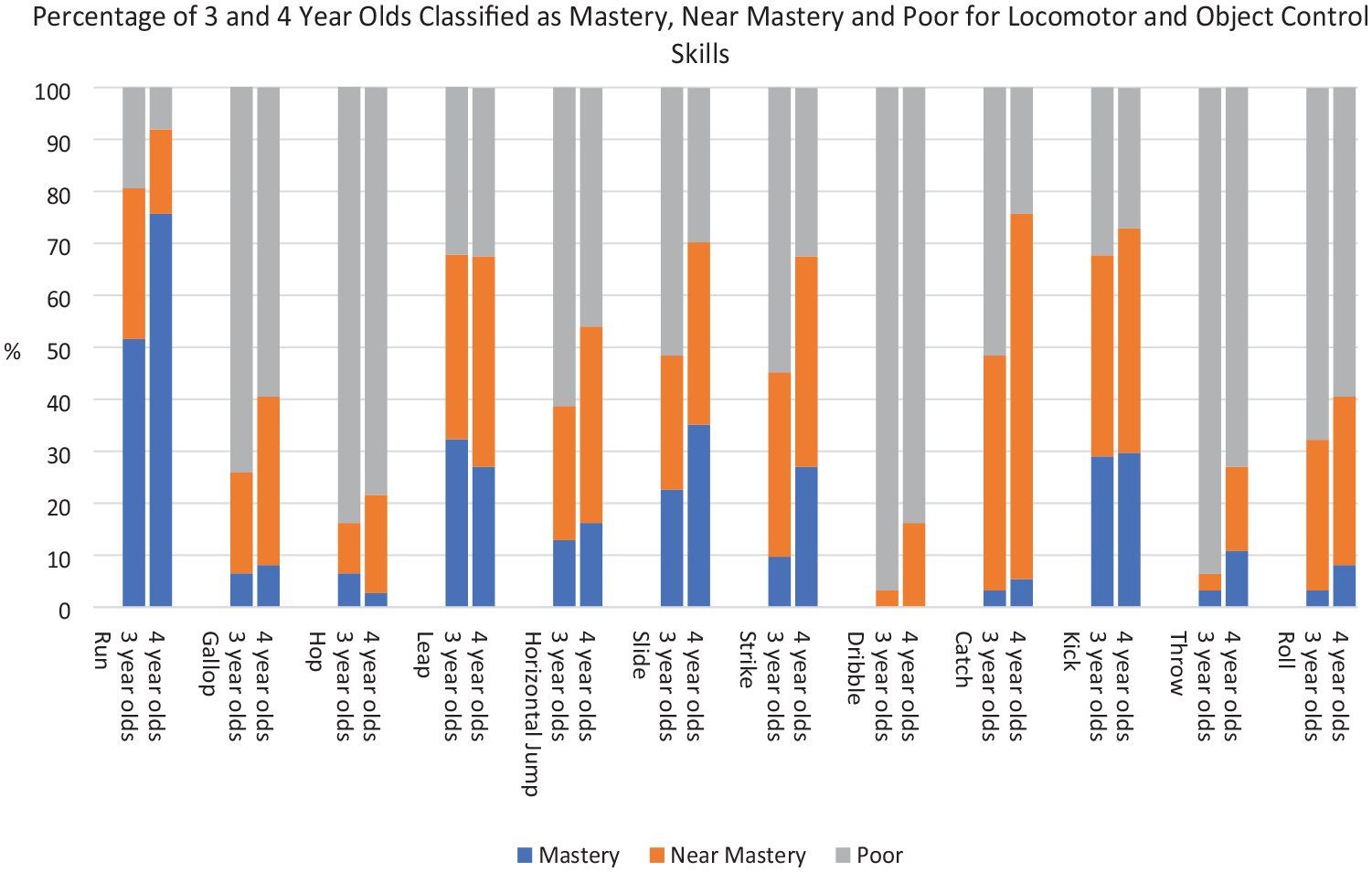
Percentage of 3 and 4 years old classified as mastery, near mastery and poor for locomotor and object control skills.
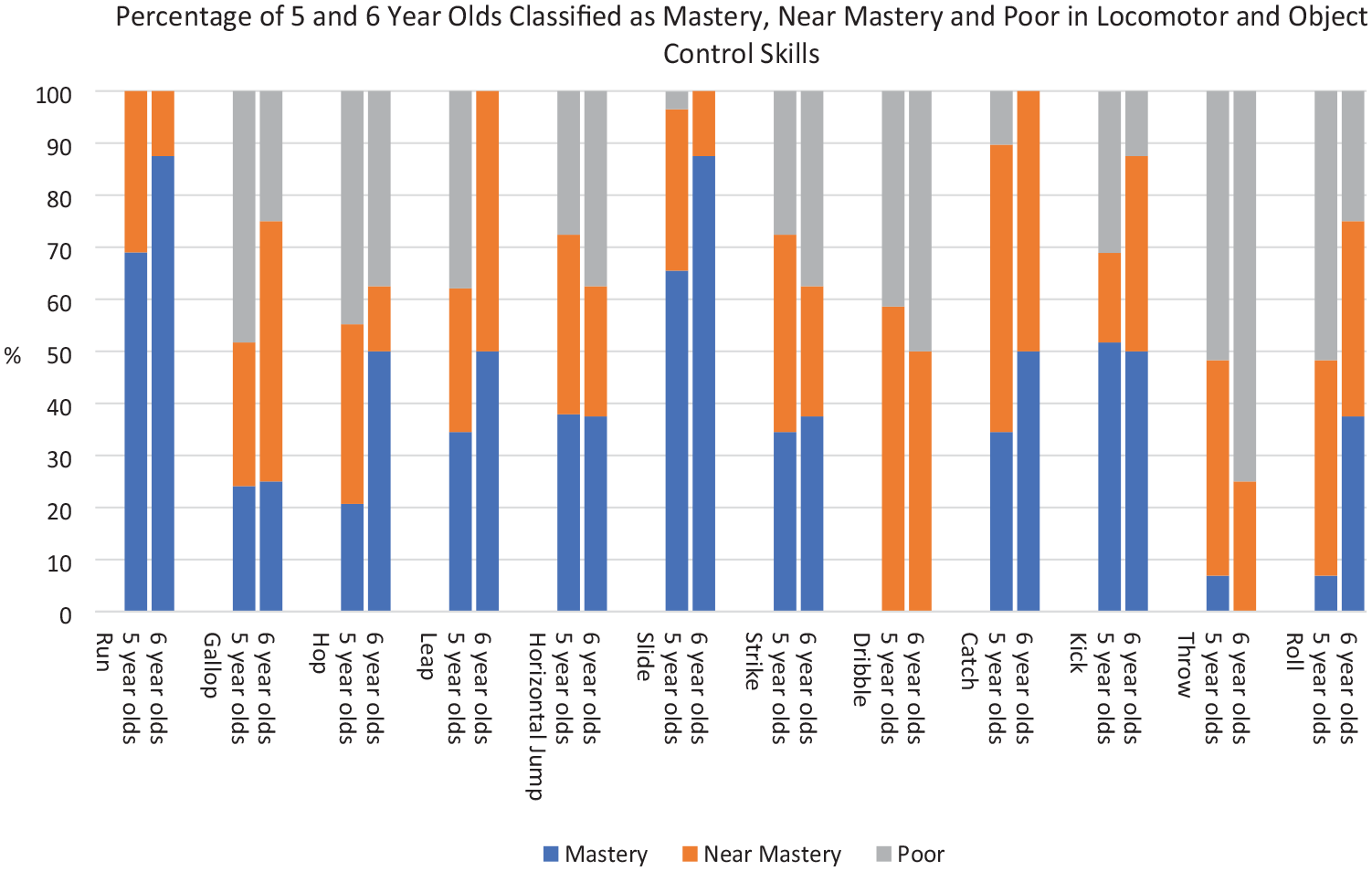
Percentage of 5- and 6-year-olds classified as mastery, near mastery and poor in locomotor and object control skills.
3 Year olds
Figure 1 shows that in this age group, run was the only locomotor skill where mastery was achieved by over half the participants (51.6%), near-mastery was achieved in leap (35.5%), and in all other locomotor skills the majority’s performance was categorised as poor (gallop [74.2%], hop [83.9%], jump [61.3%] and slide [51.6%]). For the object control skills, the majority of participants’ performance was categorised as poor (striking a stationary ball [54.8%], dribble [96.8%], catch [51.6%], throw [93.5%], roll [67.7%]). The only skill where the majority scored in the near mastery category was kick (38.7%).
4 Year olds
Results presented in Figure 1 show that, the majority of the 4 year olds (75.7%) reached mastery in run and only 35.1% in slide. Near-mastery was achieved in leap and slide by 40.5% and 35.1% of the participants respectively. For all other locomotor skills (gallop [59.5%], hop [78.4%], jump [45.9%]) the majority of the participants’ performance was categorised as poor. Mastery was not achieved by the majority of 4 year olds in any of the object control skills. Near mastery was achieved in kick (43.2%), striking a stationary ball [40.5%] and catch [70.3%]. The majority of participants for the following skills, dribble [83.8%], throw [73%] and roll [59.5%]) were all categorised as poor.
5 Year olds
Figure 2 shows that in half of the locomotor skills (run [69%], jump [37.0%], slide [65.5%]), the majority of the 5 year olds achieved mastery. All other locomotor skills (gallop [48.3%], hop [44.8%], leap [37.9%] were categorised as poor. Mastery was achieved by the majority in only one of the object control skills, namely kick (51.7%), with near mastery being achieved in striking a stationary ball [37.0%], dribble [58.6%], catch [55.2%]. Lastly, throw [51.7%] and roll [51.7%]) were categorised as poor.
6 Year olds
As demonstrated in Figure 2, for locomotor skills 87.5% of the 6 year olds achieved mastery in run and slide, half of them in leap (50%), hop (50%) and 37.5% in jump. Near-mastery was achieved by half the participants in gallop (50%) and leap (50%). Jump (37.5%) was categorised as poor. Mastery was achieved in kick (50%), striking a stationary ball (37.5%), catch (50%), roll (37.5%). Near mastery was achieved in dribble (50%), catch (50%) and roll (37.5%). Dribble (50%) and throw (75%) were categorised as poor.
The descriptive ratings, based on the TGMD-2 manual, for all age groups for the locomotor and object control subtest standard scores are presented in Table 1. In the locomotor subtest the descriptive ratings show that the greatest percentage of participants received an ‘average’ score for age groups 3–5 years. For the 6 years old age group the largest percentage received a score of ‘above average’. Similarly, most of the participants in the 3 (61.29%), 4 (59.46%) and 6 (87.5%) year old age group received an ‘average’ score for the object control subtest. On the other hand, the majority (31.03%) of the 5 years old group received an ‘above average’ score. The GMQ (composite result of both sub-tests) descriptive ratings are also presented in Table 1.
Descriptive rating percentages.
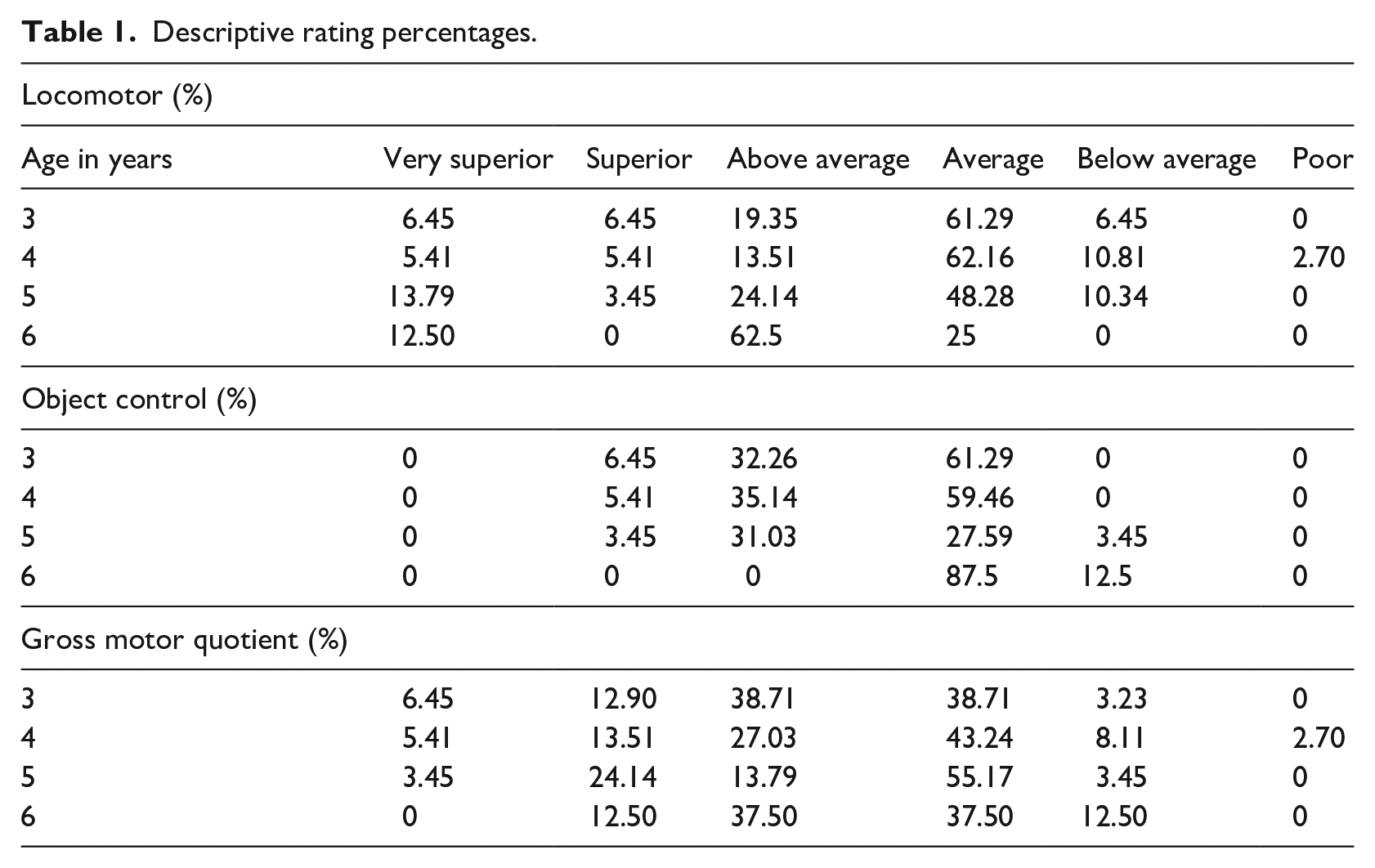
These results demonstrate that, for the 3 years old group, the majority (38.71%) of the participants’ GMQ scores were categorised as ‘above average’ and ‘average’. The descriptive rating for the 4 years old group categorised the majority of the GMQ scores as ‘average’ (43.24%). This was also true for the 5 years old group, where the majority of the GMQ scores were in the ‘average’ category (55.17%). Similar to the 3 years old group, the 6 years old group had an equal number of GMQ scores in the ‘average’ and ‘above average’ category (37.50%).
Discussion
Given longstanding research on the benefits of Montessori education, it is surprising that limited research to date has examined the FMS proficiency of children following the Montessori method. The present study addresses this issue by highlighting the FMS of 3–6 year olds in a South African Montessori pre-school setting. Understanding the level and proficiency of FMS in Montessori pre-schoolers, is necessary to determine if subsequent intervention is needed. This information can guide researchers on where, or what skills to focus on that will best impact pre-schoolers’ physical development.
Overall, the results of the current study demonstrate that the participants’ performance of FMS is adequate, receiving scores in the ‘average’ or ‘above-average’ category for their GMQ. These findings are supported by the work of Tomaz et al. (2019) who reported high gross motor skill proficiency in pre-school children in South Africa, using the TGMD-2. It was reported that according to the GMQ ranking, only a small percentage of children scored below ‘average’ (Tomaz et al., 2019). Similarly, Bolger et al. (2021) systematically reviewed the FMS levels of children worldwide, and found that compared to the normative data of TGMD-2, pre-school children demonstrate ‘average’ FMS levels. Therefore, the data presented in the current study suggests that the performance of the participants is on par or slightly better than that of pre-school children world-wide.
However, the findings of the present study demonstrate that the acquisition of FMS among 3–6 year olds differ across the two subtests and various skills. Superior performance was seen in the locomotor subtest, with run and slide being the most well-performed skill. This could be attributed to the performance criteria of the TGMD-2, for run and slide, having less specific limb movements, and mainly focussing on the movement of the lower body (Ulrich, 2000). As a result these skills are less complicated for children to master. Similarly, superior performance in locomotor skills, compared to object control skills was found in the systematic review performed by Bolger et al. (2021). Additionally, locomotor skills are more frequently practiced by children during free play as they do not require any extra equipment. It is also suggested that this increased physical activity can lead to better FMS. This is in line with the assertions made by Stodden et al. (2008), suggesting that physical activity might drive the development of motor skill competence. Furthermore, as described earlier, larger classroom sizes and teaching philosophy could have a positive effect on this specific subtest performance, by allowing for more physical movement within the classroom and less time spent in sedentary behaviours (Byun et al., 2013; Pate et al., 2014). These reasons could explain why better performance was seen in all age groups in the locomotor subtest.
When considering the performance in the object control subtest, it is clear that the participants are less proficient in these skills. This could largely be due to the lack of everyday practice, owing to the fact that object control skills involve the manipulation of certain pieces of equipment such as balls and bats. This equipment is not always readily available to children in pre-school and home environments, and so results in fewer opportunities for practice. Additionally, object control skills are seen to be more complex movements which involve varying sensory and perceptual processing, more sophisticated visual-motor requirements, greater coordination, and stability of the limbs and trunk (Hardy et al., 2010; O’Brien et al., 2016). This could suggest that children require more instruction and feedback specific to each component of the skill performance to master these complex skills. This is supported by the results which show that the most well performed skill within the object control subtest was kick. According to the TGMD-2 performance criteria for kick, there are less specific limb movements, and the skill execution mainly focuses on the movement of the lower body. This therefore makes kick a more easily achievable skill. In addition, the skill of kicking a ball is traditionally a more widely practiced skill in everyday play compared to the other object control skills in the TGMD-2.
As a whole, the descriptive ratings for all age groups in the locomotor and object control subtest are categorised as either ‘average’ or ‘above average’. These findings are consistent with the developmental progress of skill learning seen in children of these ages, where there is progression from initial and elementary skill performance to mastery (Gallahue and Donnelly, 2003). Specifically for the 3–4 year olds, they received a descriptive rating of ‘average’ for both the locomotor and object control subtests. This shows that the participants have some understanding of the FMS, but understandably could not successfully perform all the skills. Considering the 5–6 year olds, the 5 year olds received a score of ‘average’ and ‘above average’ for the locomotor and object control subtests, respectively. The 6 year olds received scores of ‘above average’ and ‘average’ in the locomotor and object control subtest, respectively. There is some cause for concern, for this age group, because between these ages, a child’s FMS performance should be either close to mastery, or proficient. One would then except the performance of the 5–6 year olds to be closer to the ‘superior’ category in terms of the descriptive ratings, meaning they are more proficient. This is especially a concern as mastery of these FMS is required for a child to develop more complex sport-specific skills for participation in various types of physical activity later on in life (Gallahue and Donnelly, 2003).
On the whole, the results of the current study show that no area of FMS were mastered by all the participants, and not one participant achieved mastery in all the locomotor and/or object control subtests. However, based on all the results presented, and considering the age of the participants, they are showing good potential for FMS proficiency. Children within this age group have the potential to master their FMS over time, and while we do not expect every child within this age range to have mastered their FMS, the data presented in the current study suggests that they are making good progress towards this mastery. Nevertheless, to ensure that all children continue this trajectory to success, there still needs to be specific emphasis on FMS in Montessori schools. The Montessori environment and philosophy alone is not enough to ensure all children reach mastery. This deduction is in line with previous research stating that children are able to reach a rudimentary level of FMS through everyday activity and play, however other external factors are required to reach mature patterns of movements (Deli et al., 2006; Hardy et al., 2010; Iivonen and Sääkslahti, 2014). These external factors include: quality instructions; modelling; availability of space and equipment; opportunity for organised practice; feedback; and structured programmes (Barnett et al., 2016; Deli et al., 2006; Foulkes et al., 2015; Hardy et al., 2010; Lubans et al., 2010). Previous research has emphasised the importance of FMS programmes focussing on the specific components or performance criteria of each skill that children consistently show weakness in Duncan et al. (2020) and O’Brien et al. (2016).
Limitations
The current study does of course have limitations which should be considered. In particular, the sample recruited in the current study represents children from three Montessori pre-schools. As a result, the results presented here should be considered representative of that sample rather than a more generalised sample of 3–6 year olds from South Africa. The intention of the current study was to provide data as a foundation for future work, understanding the levels of FMS in a given sample enables more precise targeting of interventions, either in terms of the population examined or the skills targeted. Future work that includes structured FMS programmes within Montessori environments, could be useful. Additionally, investigation into whether pre-school children maintain these adequate levels of FMS further into late childhood, either within a traditional or Montessori school setting would be interesting.
Conclusions
The pre-school environment plays an important role in the development of children’s FMS which in turn has a positive impact on academic achievement, as well as sport and physical activity participation later on in life. The current study sheds light on the Montessori philosophy and what role this plays in the acquisition and development of FMS in pre-school children. Factors in the Montessori classroom such as large, open environments and free movement throughout the day may have added to the participants’ superior locomotor performance. However, the current findings emphasise that this environment alone may not be sufficient for the acquisition of mature FMS. This therefore, highlights the need for structured FMS-focussed programmes in Montessori pre-schools that allow opportunities for practice and quality feedback. This will only benefit children in achieving mature motor patterns before they move into environments where they will use these FMS as building blocks for more complex movement sequences in a range of physical activities.
Footnotes
Funding
The authors received no financial support for the research, authorship, and/or publication of this article.
Ethics approval
The study (REC-2019-7630) was approved by the Research Ethics Committee of Stellenbosch University, South Africa. All parents completed written consent forms and all children provided assent. Permission was also obtained from the Western Cape Education Department, as well as authorisation from the three Montessori pre-schools involved.
Consent to participate
All participants who gave assent and parental/legal guardian consent were included in the study.
