



Abstract
The present study aimed to examine cross-cultural differences in fundamental movement skills (FMS) proficiency levels in children aged 9–10 years old in England and China, using a process-oriented FMS measurement. Four FMS (run, jump, throw, catch) were measured using the Test of Gross Motor Development-2 (TGMD-2). The sample consisted of 272 (58.3% boys, 41.7% girls) Chinese children and 273 (48.7% boys, 51.3% girls) English children. ANCOVA analysis for the raw FMS scores showed significant sex by country interaction (P = .022, partial η2 = .01). Chinese children scored higher than English children on total FMS, locomotor, and object control skill subsets. Additional Chi-squared analyses revealed significant differences regarding mastery levels of skills, with a higher proportion of Chinese children being classified as having advanced skill proficiency across three of four selected FMS (i.e. run, throw, and catch). The substantial cross-cultural differences found may be related to aspects such as Physical Education (PE) provision and process, educational policy, and other physical activity opportunities (e.g. extracurricular organised sports). Our findings require further examination of the contextual influences, in order to understand the optimal strategies that promote children's FMS development through PE, youth sports, or physical activity promotion.
Introduction
Fundamental movement skills (FMS) are one important construct of motor competence and considered to be the foundation for an individual to develop more advanced movement sequences and context-specific physical activity (PA) (Lubans et al., 2010). FMS are commonly defined as locomotor (e.g. run, jump), object control (e.g. throw, catch), and stability skills (Gallahue et al., 2012). The benefits of children being proficient at FMS are associated with increased PA, healthy weight status, health-related physical fitness, and cognitive and academic outcomes (see Cattuzzo et al., 2016; Jones et al., 2020; Robinson et al., 2015 for reviews). Despite these benefits, a considerable number of studies suggest FMS proficiency is low among children worldwide (Booth et al., 2006; Duncan et al., 2020; Eyre et al., 2018; Philpott et al., 2020; Zhang and Cheung, 2019). It is therefore important to investigate the reasons leading to the low level of FMS proficiency.
Although overall low proficiency has been noted widely, FMS competence also differs as a function of geographical and cultural contexts (Barnett et al., 2019; Smith et al., 2016). Given the emphasis on Physical Education (PE) curricula worldwide to develop FMS (Australian Curriculum, Assessment, and Reporting Authority, 2012; Ministry of Education, 2001; Department for Education, 2013; Society of Health and Physical Educators (SHAPE) America, 2013), understanding cross-cultural differences in FMS is of interest and importance to physical educators, as this understanding may provide directions for more effective ways in which children's FMS proficiency could be developed. As a result, there has been a growing interest in international comparison studies on children's motor competence over the last five years. For example, one study (Laukkanen et al., 2020) reported significant differences in motor competence in children aged six to nine years from central, northern, and southern European regions. Another cross-continental study (Bardid et al., 2015), compared children from Australia and Belgium and reported Australian children had lower competence levels than their Belgian counterparts. Similarly, many comparative studies presented evidence for considerable variations across different cultures (Brian et al., 2018; Haga et al., 2018; Luz et al., 2019; Tietjens et al., 2020) mainly by the use of product-oriented assessments, such as Körperkoordinationstest für Kinder (KTK). However, cross-cultural comparisons using a process-oriented assessment could be a valuable contribution (Bardid et al., 2019). For example, having qualitative information about children's FMS performance can aid teachers’ instruction and assessment regarding FMS (Lander et al., 2016). Process-oriented assessments are made in reference to an established set of qualitative criteria (e.g. arms move in opposition to legs during a run), and thus, examining cross-cultural differences in process-oriented assessments may provide better focus for PE professionals in relation to which skills are more difficult to master in what context.
A wide range of explanations has been given to offer insights into the cultural-environmental determinants of FMS development. These include differences in PE curricula (Bardid et al., 2015), PA opportunities (dos Santos et al., 2016; Haga et al., 2018), and more recently, children's perceived motor competence (Brian et al., 2018; Tietjens et al., 2020). Theoretically, FMS development is influenced by complex interactions of biological, psychological, and environmental constraints (Newell, 1986). The role of PE, in particular, is critical as the acquisition and development of children's FMS needs to be achieved through quality instruction, practice, feedback, and encouragement (Gallahue et al., 2012). However, discussions over these points have mainly been drawn from the comparison between samples in western countries. Only two recent studies included samples from China and found differences in FMS between Chinese children and those from Brazil, Portugal, and the US (Diao and Li, 2013; dos Santos et al., 2016). To date, no study has compared Chinese samples with English samples.
Compared to England and other western countries, China has a distinctive educational system, and therefore, primary PE practice, i.e. how PE is planned, taught, and assessed (Jin et al., 2020). Furthermore, the strong emphasis on academic achievement in China influences children's PA engagement (e.g. focus on core subjects such as mathematics which marginalises the status of PE; Jin, 2013). However, to address the declining fitness levels of Chinese students, the recent educational curriculum in China has promoted the status of PE (Meng et al., 2020). This includes the introduction of the PE Physical Examination (PEPE) – a standardised national assessment on students’ skill and fitness levels. In this respect, both countries have curriculum foci on FMS, but the Chinese curriculum places more emphasis on sports skills; by contrast, English and other western curricula highlight the importance of developing FMS to support lifelong physical activity (Hector and Salintri, 2020). By comparing FMS proficiency levels (one important PE outcome) between China and England, we may be able to understand cross-cultural differences in children's FMS development. Informed by the existing general cross-cultural differences regarding primary PE practice (see Table 1 for a summary of standard primary PE practice in each country), our analysis and discussion may provide insights for future curriculum proposals regarding FMS improvement (dos Santos et al., 2016). This is also in line with the notion that cultural awareness is critical in understanding programme delivery and effectiveness (McGannon and Schinke, 2018).
General differences regarding primary PE in China and England (information extracted from Ministry of Education, 2011; Department for Education, 2013).
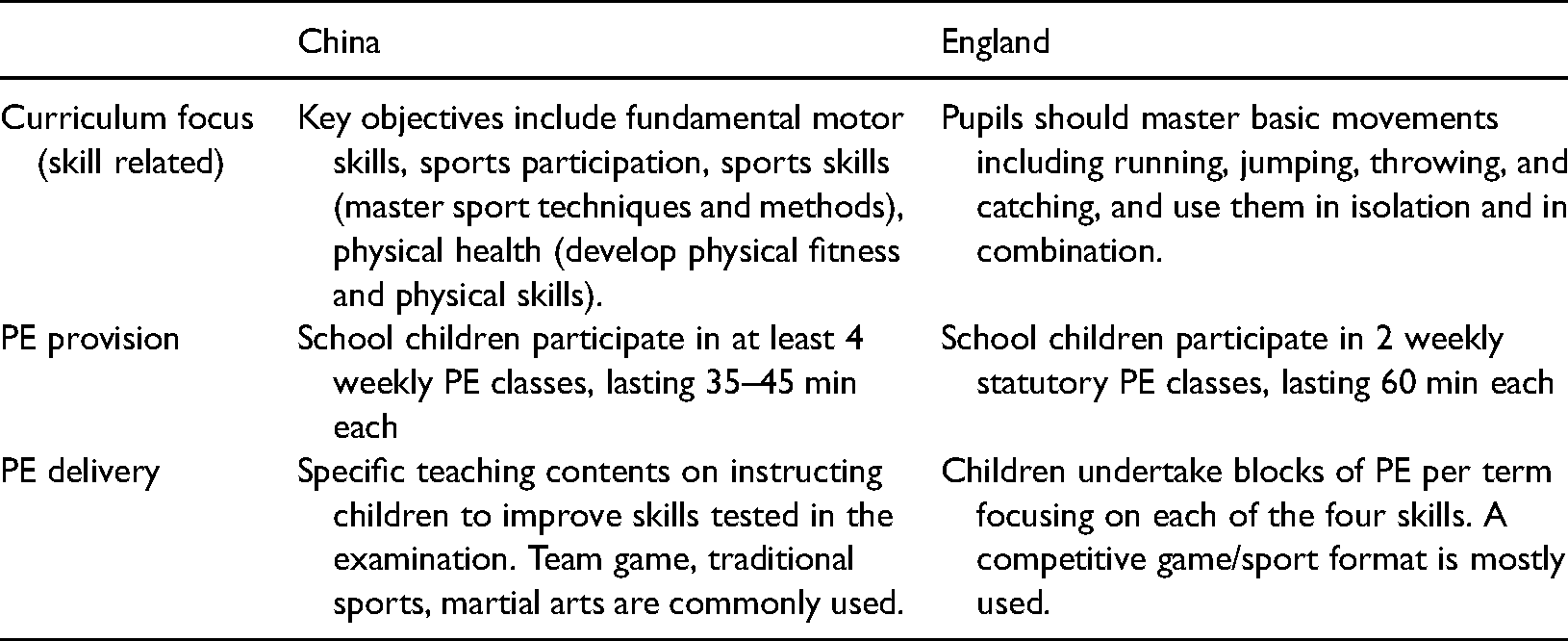
Given that FMS proficiency levels are low (Duncan et al., 2020; Zhang and Cheung, 2019), and PE practices are different (Jin et al., 2020; see also Table 1), the objective of the present study was to examine cross-cultural differences in FMS between children from England and China based on process-oriented measures.
Methods
Participants
Data were collected in Shanghai (China) from September to November 2019 and Coventry (England) from January to March 2019. A total of 545 children aged 9–10 years old (272 Chinese and 273 English children) participated. In Shanghai, one school in one district was selected. In Coventry, three schools in one borough were selected. The socioeconomic status of the two locations was broadly comparable. For the three English schools, the socioeconomic status is not meaningfully different and sits within the same quintile of deprivation for England. For each participant, written informed consent was obtained from the parents or guardians. The study was approved by the University Ethics Committee in both countries.
Measurements
All assessments were conducted by trained assessors. All assessors followed a standardized training course on the study assessment before the field testing. First, anthropometric measurements were taken. Secondly, children's FMS were assessed.
Anthropometry
In China, participants’ height and body mass were measured with an accuracy of 0.1 cm and 0.1 kg, using a portable device (China Fitness Test; Tongfang; ST - 2000 - A2Z). In England, participants’ height and body mass were measured using a SECA stadiometer and weighing scales (Seca Instruments, Hamburg, Germany). Children wore light clothes and were barefoot for anthropometric measurements. Height and mass values were used to calculate body mass index (BMI). BMI = weight (kg)/height (m2). International Standards for Anthropometric Assessments (ISAK) were followed, whereby two readings for each measure were taken and if they differed by at least 10%, a third reading was taken. The average of the readings was calculated as the final result.
Fundamental movement skills
Children's FMS were assessed using the Test for Gross Motor Development 2nd edition (TGMD-2, Ulrich, 2000) in both countries. The TGMD-2 is reliable and valid for both Chinese and English children (Duncan et al., 2020; Zhang and Cheung, 2019). Four specific movement skills (two locomotor, two object control) were assessed: run, horizontal jump, catch, overarm throw. These skills were selected because researchers have suggested that children can develop a sufficient base of competence for these FMS by age 9 years (Gallahue et al., 2012). Additionally, assessing these four skills provides a way to align the assessment of FMS in the English sample to the stated key FMS identified in the National Curriculum for PE in England (Duncan et al., 2020). Each skill comprised three to four behavioural components and the TGMD-2 assessed whether each component of the skill was correctly executed or not to determine the mastery of the skill. Participants were given a ‘1’ for correct execution of a skill component and a ‘0’ for a failure on a skill component.
All children performed a familiarisation trial of each skill followed by two performance trials, as recommended in the TGMD-2 handbook (Ulrich, 2000). Children's performances on each skill were videotaped for assessments. Assessments were done independently by two well-trained assessors in each country. Raters had been trained previously by watching videoed skills of children's skill performances and rating these against a previously rated ‘gold standard’ rating in two separate training sessions (lasting approx. 120 min). Congruent with prior research (Barnett et al., 2014), training was considered complete when each observer's scores for the two trials differed by no more than one unit from the instructor score for each skill (>80% agreement). Intra-class correlation coefficients for inter-rater reliability between the two independent raters were .93 (95% CI = .92–.95) and .925 (95% CI = .87–.95) in China and England, respectively, demonstrating good reliability.
The combination of all four skills was summed to create a total FMS score (scored 0–30). Scores from the run (0–8) and the horizontal jump (0–8) were summed to create a locomotor skill score (0–16) and the catch (0–6) and throw (0–8) summed to create an object control skill score (0–14), following the recommended manual protocol for the administration of the TGMD-2 (Ulrich, 2000).
Data analysis
Descriptive statistics and frequencies for each of the four skills were calculated. Using previously established procedures (O’Brien et al., 2016; van Beurden et al., 2002), ‘mastery’ was defined as correct execution of all skill components on both trials (i.e. execution that conforms to the behavioural components of the skill), ‘near mastery’ was defined as correct execution of all skill components, but failure on one component on both trials and ‘poor’ was defined as any score below these two categories (i.e. if the performance was incorrect in two or more of the components on both trials). A binary variable composed of mastery and near mastery was created for each skill and is reported as ‘advanced skill proficiency’. This process is consistent with previous literature to compare the prevalence of FMS levels (Booth et al., 2005; Duncan et al., 2020; O’Brien et al., 2016). Raw scores for each skill were collapsed into categorical variables with mastery/near mastery coded as ‘1’ and poor coded as ‘0’. The percentage of children from each country who achieved mastery in each of the four skills was also determined. Chi-squared analysis was used to identify if percentage skill differences in advanced skill proficiency between countries existed.
Data for total FMS, locomotor FMS, and object control FMS were subsequently analysed using a series of 2 (sex) X 2 (country) Analysis of Covariance (ANCOVA). A priori power calculation using G*Power (Faul et al., 2009) for ANOVA accounting for main effects and interaction effects looking for a small effect size, at p = .05 and 80% power indicated that 269 children were needed per country. The chi-squared analysis demonstrated that both samples had similar sex distributions (χ2 = 0.660, p = .416). Results from the independent t-test analysis indicated no difference in BMI between both samples (t = −0.609, p = .543). The Chinese sample was on average 3 months older (t = 0.28, p = .000). Therefore, age was included as a covariate in ANCOVAs. Where any significant differences were found, Bonferroni pairwise comparisons were used to examine where any differences lay and partial η2 was used as a measure of effect size. We also performed additional t-tests to explore if there were sex-related differences in the total and subsets of FMS in each country. The Statistical Package for Social Sciences (Ver 25, IBM Corp Armonk, NY, USA) was used for all analyses. Statistical significance was set at p < .05.
Results
Sample characteristics
Table 2 shows the descriptive statistics of BMI and age for both the Chinese and English samples.
Descriptive statistics (mean ± SD) of BMI and age, stratified by sex.
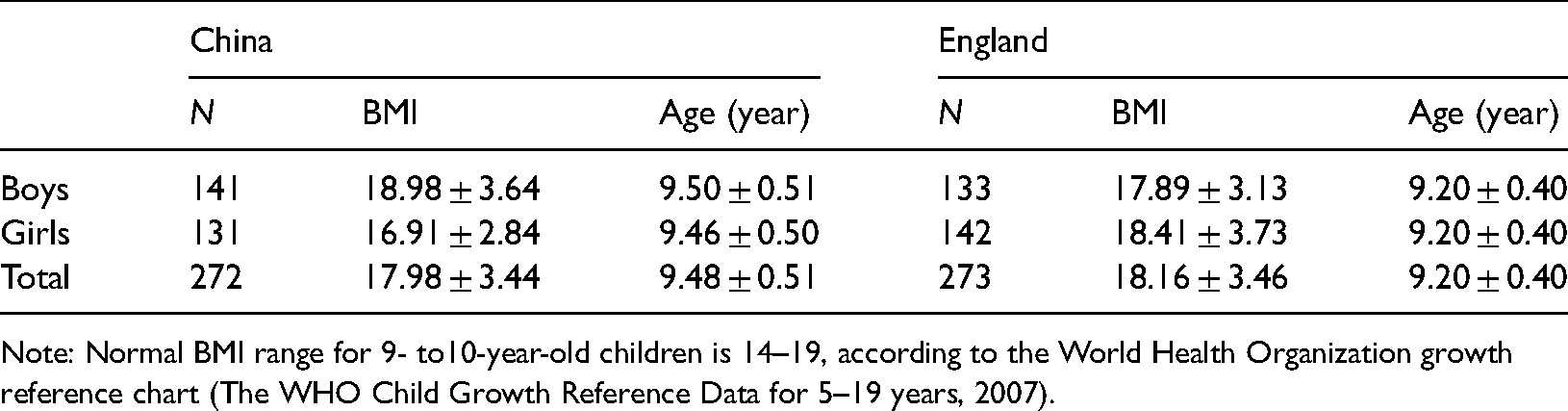
Note: Normal BMI range for 9- to10-year-old children is 14–19, according to the World Health Organization growth reference chart (The WHO Child Growth Reference Data for 5–19 years, 2007).
Comparing mastery level of skills
The distribution of Chinese and English children across mastery levels (mastery/near mastery, poor) of all four skills are shown in Figure 1. The proportions of children from China scoring ‘mastery/near mastery’ in run and throw are higher than children from England in both sexes. More than half of the children of both sexes scored ‘poor’ in jump in both countries. The percentage of children scoring ‘mastery/near mastery’ in catch were similar in both countries, except the higher percentage of English girls scoring ‘poor’ in catch. Additional chi-squared tests suggested significant differences between countries in advanced skill proficiency (mastery/near mastery) in run, throw, and catch. Boys from China displayed higher skill proficiency in run and throw than their English counterparts (83.0% vs. 37.6%, χ2run = 19.6, p < .001; 86.5% vs. 13.6%, χ2throw = 103.5, p < .001). Chinese girls displayed higher advanced skill proficiency in run, throw, and catch than English girls (87.0% vs. 33.3%, χ2run = 52.2, p < .001; 83.9% vs. 22.6%, χ2throw = 125.5, p < .001; 75.6% vs. 49.3%, χ2catch = 19.6, p < .001).
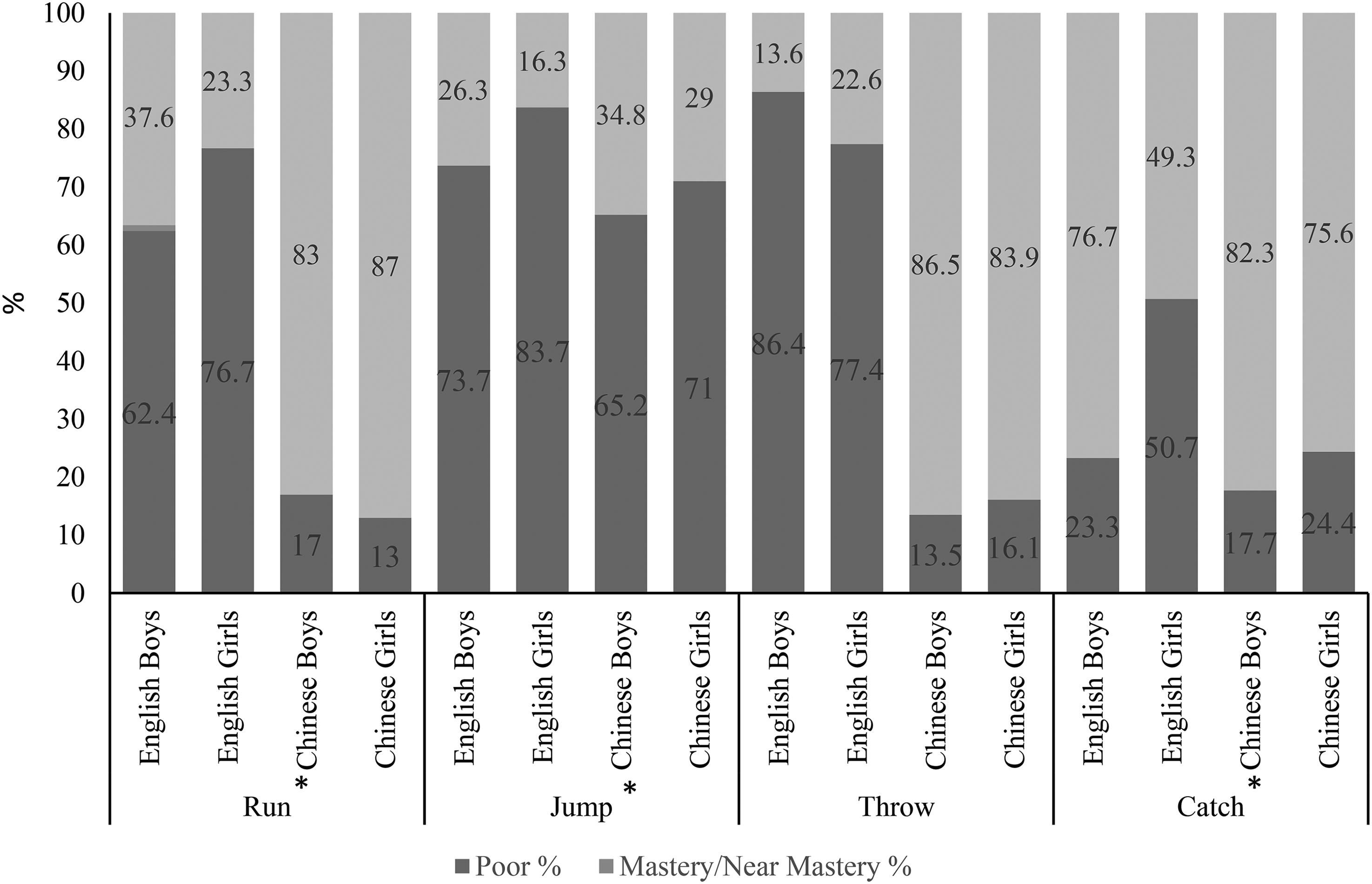
Proportion of children for each mastery level of all four skills in both countries. *Significant difference between Chinese and English children (p < .05).
Comparing raw scores
With regard to total FMS, results from the ANCOVA indicated significant sex by country interaction with a small effect size (p = .022, partial η2 = .01). Post hoc analysis indicated significantly higher total FMS scores in Chinese boys compared to English boys, Chinese girls compared to English girls, and Chinese girls compared to English boys (all p = .01, see Figure 2). Similar sex by country interactions were evident when the data were split into locomotor skills (p = .033, partial η2 = .008, See Figure 3) and object control skills (p = .05, partial η2 = .007, see Figure 3). Differences in scores for locomotor and object control FMS were similar to those found for total FMS, where in both cases, there was significantly higher locomotor and object control FMS in Chinese boys compared to English boys, Chinese girls compared to English girls, Chinese boys compared to English girls, and Chinese girls compared to English boys (all p = .001). No significant differences in scores were found in total FMS, locomotor, and object control FMS between girls and boys in China (all p > .15). English boys scored significantly higher than English girls in total FMS, locomotor, and object control FMS (all p < .001).
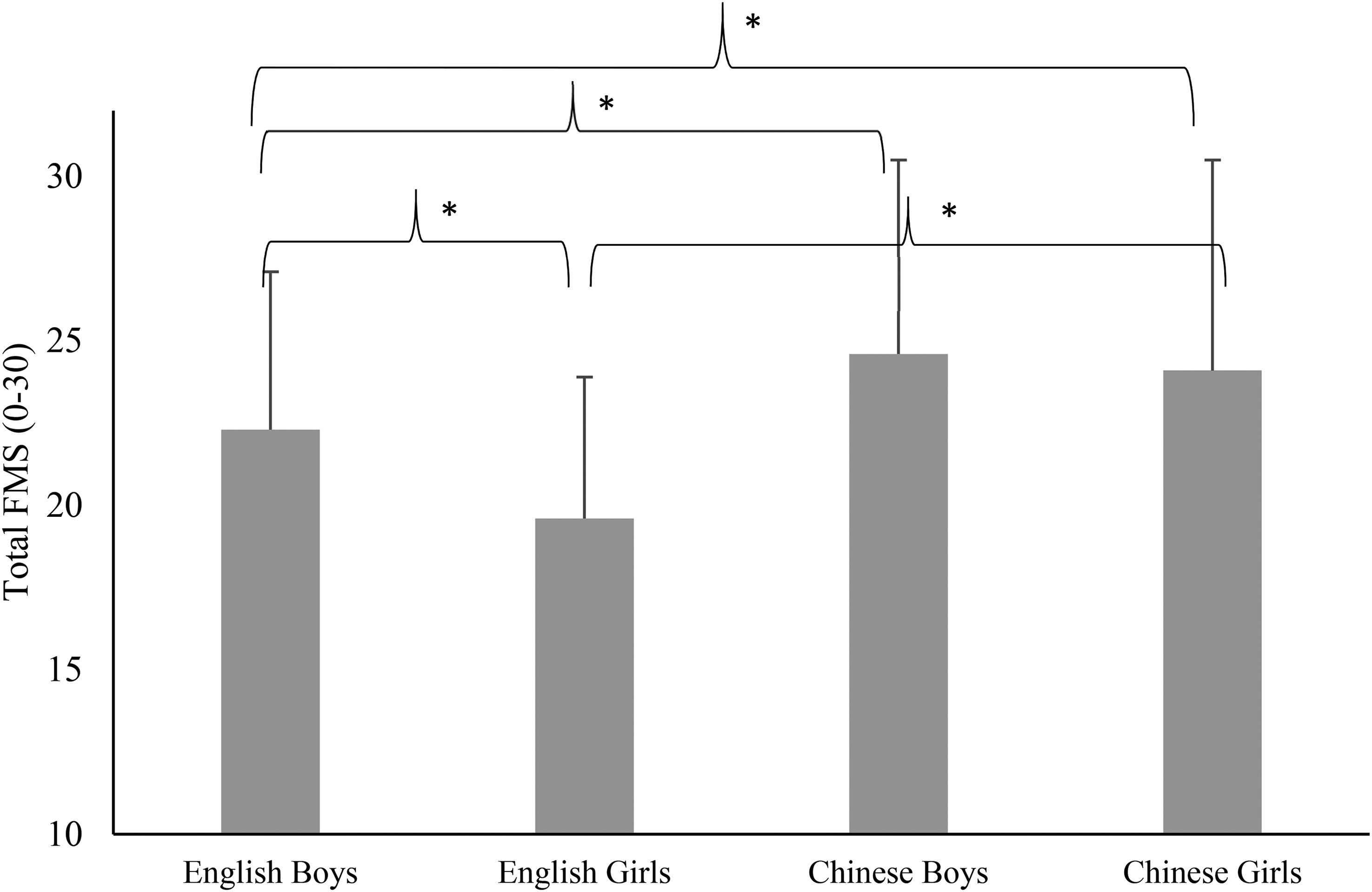
Mean ± SD of total FMS (0–30) of boys and girls from England and China. *Significant difference (p < .05).
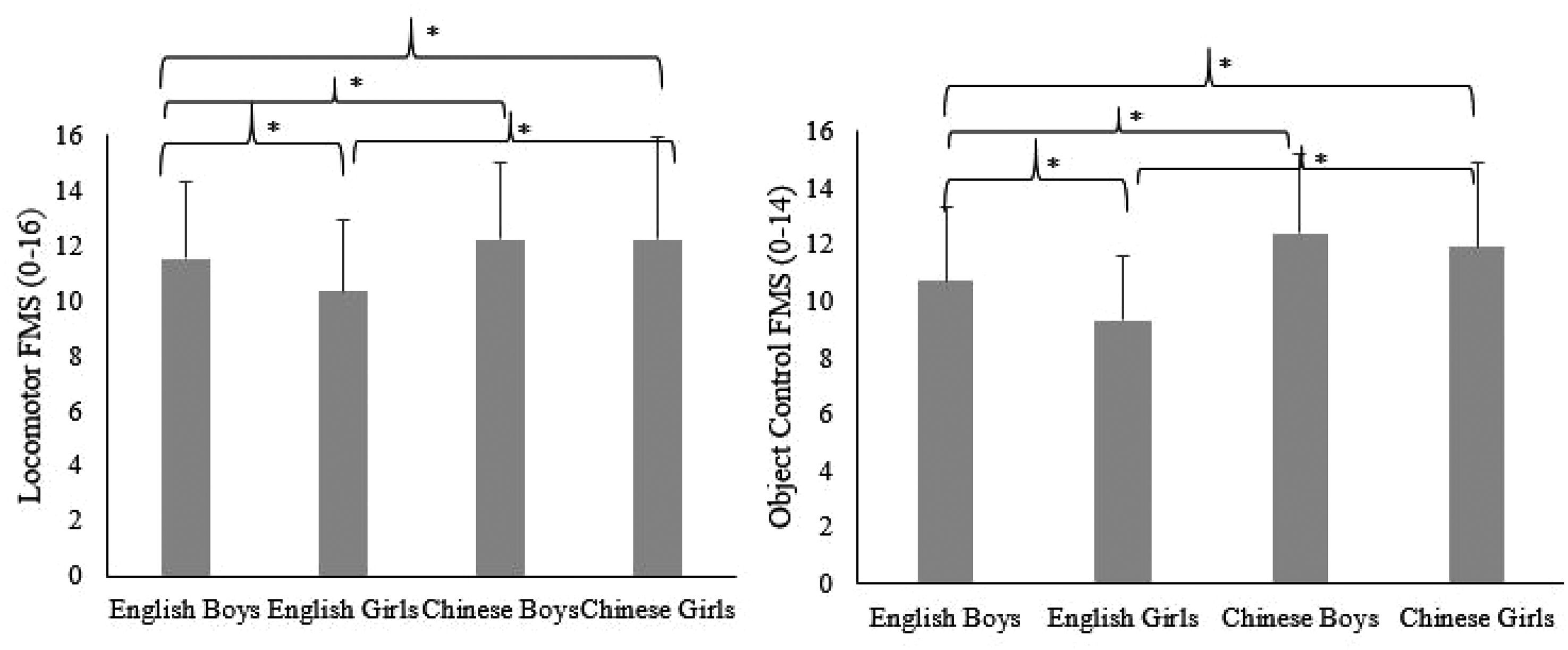
Mean ± SD of locomotor (0–16) and object control FMS (0–14) of boys and girls from England and China. *Significant difference (p < .05).
Discussion
This is the first study to examine cross-cultural differences in 9- to 10-year-old children's FMS competence between China and England. Results suggest levels of FMS proficiency significantly differ between the two countries, confirming reported differences between Chinese children and those from Brazil, Portugal, and the US (Diao and Li, 2013; dos Santos et al., 2016). To address the implications of our findings from an educational perspective, we considered curriculum and pedagogical differences between the two countries to offer potential explanations for cross-cultural differences found in the current study.
Overall, children from China demonstrated a higher level of total FMS competency, locomotor skills, and object control skills than their peers from England. Children from both countries performed poorly in the jump compared to their performance in other skills. Small effect sizes found in our analyses suggest there exists a range of potential causes for the cross-cultural differences in FMS development. One plausible explanation could be related to the PA environment. PE provides opportunities for PA among children and it is reported to be an important setting for children to acquire and master FMS (Hills et al., 2015). FMS development was identified as a key outcome in both the Chinese and English PE curriculum (Ministry of Education, 2011; Department for Education, 2013). There are, however, variabilities in how PE is structured and implemented in each country. In terms of structure, primary school children in China participate in at least four weekly PE classes, lasting 35–45 min each (Wang et al., 2017), while English children have two weekly statutory PE classes. These PE practices of the respective countries are followed by all four schools sampled in this study. The school in Shanghai, China also implements the 20 min active break in recess during a school day. Furthermore, great efforts have been undertaken in China for health promotion with the release of ‘Healthy China 2030’ (Chen et al., 2019). These include specific targets and action plans to ensure children's PA and physical fitness levels. For instance, it is a government mandate for Chinese primary schools to provide students with 60 min of PA during the school day. In England, it is recommended that students engage in moderate to vigorous PA for at least 50% of PE lesson time (Association for Physical Education, 2008). However, data consistently suggest that the time students spend being active during PE lesson time is less than recommended (Fairclough and Stratton, 2006; Hollis et al., 2017). This suggests the actual implementation of PE lessons may vary from setting to setting.
Quality PE is a key mediating mechanism for children's skill acquisition and practice. Despite the provision of FMS teaching explicitly stated in the national curriculum of England and China (Ministry of Education, 2011; Department for Education, 2013), and given PE is an ideal environment to help students master FMS (Gallahue et al., 2012), it is concerning that PE lessons are not taught to the desired and prescribed quality as outlined (Rainer and Jarvis, 2020). Some barriers were found to restrict the quality of PE, such as limited time and space, and lack of teacher confidence, competence, and training (Domville et al., 2019). These barriers were also reported to hinder teachers’ instruction and assessment practices in FMS teaching (Lander et al., 2015). Situating in the context of this study, PE in China has long been performance-oriented (Jin, 2013). The educational practice in China is framed by the rigorous accountability system; therefore, all PE assessment (including actual scores in skills and fitness tests) is tied to graduation at all school levels (Ding and Chen, 2019). This is evidenced by the recent development and implementation of the China National Assessment of Education Quality - Physical Education & Health (CNAEQ-PEH) (Wu et al., 2019). Speculatively, the resultant assessment-based teaching and learning may play a role in explaining why Chinese children outperform their English counterparts in FMS within our study. Teachers in China may spend more time providing knowledge about the skills and improved performance which holds both teachers and students accountable for skill acquisition and improvement. Such practice has direct influences on students’ learning outcomes and motivation. Some influences on teachers’ educational practice and students’ engagement with PE may also be cultural-related. For instance, in China, respect towards teachers is deep-rooted (Jin et al., 2020), resulting in Chinese teachers spending less time on behaviour management strategies. Consequently, this may be affording Chinese children more time on the task to learn and practice the skills. According to Morgan et al. (2013), if opportunities to learn and practice are maximised, children are more likely to improve their FMS.
The quality of PE is also largely dependent on teachers who are responsible for the organisation and delivery of PE (Sloan, 2010). The significance of ongoing teacher training and support on students’ FMS improvement is evident (Lander et al., 2017). There are, however, inadequacies in professional development and training in PE (Harris et al., 2012). Previous literature suggested 40% of all newly qualified primary education teachers received only six hours of PE throughout their pre-service training (Blair and Capel, 2011). Additionally, Lander et al. (2015) found that PE specialists (i.e. hold PE- or sports sciences-related degree) were preferred providers of FMS teaching. In China, PE teachers are usually specialists who were trained at specialised ‘normal’ colleges or universities for three to four years (Song and Chen, 2013). The training covers the general theory of PE and specialised courses based on their planned area of expertise (e.g. basketball, football). Compared to Chinese teachers, English teachers may not be equipped with adequate levels of confidence and competence in teaching PE and/or FMS because of inadequate training (Rainer and Jarvis, 2020).
Additionally, children's extra-curricular participation in sports activities is another factor that may explain the cross-cultural differences. For instance, Haga et al. (2018) found Norwegian children outperformed Greek and Italian children in motor competence and attributed this, partly, to Norway's higher emphasis on wider inclusions of outdoor activities than the other two countries. In the recent Global Matrix 3.0 Physical Activity Report Card (Aubert et al., 2018), the proportion of Chinese children who participate in organised sport and/or PA programmes (20%–26%) was lower than that of English children (34%–39%). Furthermore, China scored the lowest ranking in Community and Environment indicators (‘F’) whereas England scored ‘C’. It seems that the quality and/or quantity of PA opportunities offered are superior in England and it was postulated that PA opportunities are associated with the economic and development status of a given country (Haga et al., 2018). The lower proficiency observed in English children within our study may further confirm that skills must be instructed in an optimal manner and then practiced with the given PA opportunities.
Another notable finding is the sex differences in skill performance in the English sample, but not the Chinese sample. Based on the comparison of primary PE practice, we give the following two explanations. Firstly, Chinese girls may be more motivated to engage in PE than their English counterparts. Because achieving the benchmark of skills and other fitness indicators are required for all Chinese students, Chinese PE utilises more drill-based approaches to improve students’ skill levels. By contrast, in England, a competitive sport/game format is more frequently used (see Table 1), which has been reported to hinder girls’ engagement in PE (Wallace et al., 2020). Secondly, since English boys tend to be more active and engage in more community sport outside the school (e.g. rugby, football) than English girls (Sport England, 2019), it is possible that boys get more opportunities to practice FMS. More research is needed, using a combination of measures, to unpack why sex differences are apparent within English children only. For example, a more thorough examination of the process characteristics of skills could help identify the behavioural component that children tend to fail on. This is a key future direction to pinpoint cultural aspects that enable FMS learning.
Strengths and limitations
The strength of this study is the use of a reliable and valid process-oriented FMS assessment as it reflects movement quality. As a secondary data analysis, we were not able to compare skills in each behavioral component against performance criteria. Exploring the specific behavioural aspects of the skills that children perform will be an important next step to further explain the differences found in our study.
This study is not without limitations. We assessed four FMS that are identified as critical in the National Curriculum for PE in England (Department for Education, 2013). A full assessment of the TGMD-2 tests may have allowed a more holistic comparison of children's FMS competence. A further limitation that may hinder the holistic comparison is related to the analytical procedure in the current study. To compare the prevalence of FMS levels, we coded children's skill levels as mastery/near mastery/poor following a recognised procedure (Duncan et al., 2020; Lawson et al., 2021). This procedure may not fully capture information on FMS of each child. However, on a population level, this procedure determines the proportion of children who did or did not meet a recognised level to be classed as mastery, given mastery of FMS is defined as a key objective in the National Curriculum of England (Department for Education, 2013). We are also aware that TGMD-2 may be more biased towards western culture and future research should seek to examine FMS using a wider range of motor tasks in addition to TGMD-2. Another limitation is the method used for classifying and sampling of socioeconomic status. Firstly, despite matching based on socioeconomic status, each country uses its own method of classification. While it would have been advantageous to use the same system, this was not possible as no universal measures of socioeconomic status exist. Secondly, the samples were matched using regions’ socioeconomic status for each country. Individual differences in socioeconomic status within these regions may exist and knowing the child's specific socioeconomic status may have provided a more complete understanding of the child's socioeconomic status related to the FMS outcomes between countries. In addition, we are conscious that the current study employed secondary analysis of two data sets where data were collected using comparable procedures. Although we fulfilled the study aim to highlight any differences in FMS between two countries, the secondary nature of the research design did not allow for a formal analysis on possible factors that influence the cross-cultural differences, such as cultural values attributed to PA and environmental correlates associated with PA opportunities (dos Santos et al., 2016). Future research should consider these additional factors when examining cross-cultural differences regarding FMS (e.g. cultural preference for certain sports or PA). Our findings should therefore be carefully evaluated and this study should be seen as a first step in examining cross-cultural differences in FMS between the two countries. The skill difference found in our study might be a manifestation of differences in curriculum, educational policies, and practice in England and China. This opens the possibility to conduct further larger-scale studies covering more areas geographically in England and China. We suggest these studies should include variables on PA engagement and PE practice to investigate the contextual influences more in depth.
Conclusion
The present study found that the level of FMS proficiency significantly differs in children aged 9–10 years between China and England with FMS proficiency being lower in English children, compared to their Chinese peers. The results also indicate the gap between boys and girls in terms of skill performance is more prominent in English children. The substantial cross-cultural differences may be due to several individual and environmental factors, including primary PE practice, which is influenced by the educational policy in the given country. These factors require further examination to unpack the optimal means by which children's FMS can be developed.
Footnotes
Declaration of conflicting interests
The author(s) declared no potential conflicts of interest with respect to the research, authorship, and/or publication of this article.
Funding
The author(s) disclosed receipt of the following financial support for the research, authorship, and/or publication of this article: This study was supported by the National Social Science Foundation of China (grant number: 19BTY077), the Philosophy and Social Science Foundation of Shanghai (grant number: A1904) and the Shanghai Education Research Project (grant number: 2020-TechScience-04-48).
