



Abstract
There is growing concern about the mental health and resilience of today’s children and difficulties with self-regulation are implicated in educational outcomes, cognitive problems, internalizing problems such as depression and anxiety, externalizing problems such as aggression, and physical health problems. Self-regulation is a growing topic of interest in a variety of disciplines and there are 447 different interpretations of what self-regulation means in the literature, which makes it difficult for educators to interpret and apply it in their classrooms. Due to advances in neuroscience, the Ontario Ministry of Education shifted toward a neurophysiological framework for the Self-Regulation and Well-Being Frame of the Kindergarten Program. The current study examined which frameworks Ontario kindergarten educators were using by analyzing the ways they described and facilitated self-regulation in the classroom through surveys, interviews, report cards, and classroom observations. Findings revealed that educators: have little experience and training with resources aligned with the Kindergarten Program’s approach to self-regulation, describe self-regulation as self-control, and facilitate self-regulation using a learning strategies approach. Educators were observed using fewer than a third of ministry self-regulation recommendations in the classroom. Implications and recommendations for aligning educator practices with the Kindergarten Program’s framework are discussed.
Introduction
The mental health and resilience of children is critical (McCain et al., 2007); 27% of Ontario’s children are vulnerable to learning, health, or behaviour problems before entering first grade (Janus et al., 2012). Researchers have suggested that this vulnerability is implicated in educational, cognitive, mental health, and behavioural problems (McCain et al., 2007; Shanker, 2010). Forgas et al. (2009) suggest that self-regulation and its connection to well-being are increasingly prevalent in the literature. A search of ERIC, PSYCInfo, and PSYCArticles yields 817,607 peer reviewed journal articles using the term “self-regulation” or “self regulation,” with 42% coming from the last 5 years of research. Self-regulation is a quickly growing topic of interest in psychological research, but the fast growth presents a challenge.
One of the problems, Burman et al. (2015) discovered, is that there are 447 different interpretations of what self-regulation means. Burman’s study contributed to clarifying the meaning of self-regulation while preserving the connectedness of similar constructs. They discovered that willpower, focus, and grit (i.e. self-control) were the most common interpretations, but argued that self-regulation is much more complicated than self-control. The original neurophysiological definition of self-regulation (a process of responding to stressors) lies at the center of the connected interpretations, with related but distinct constructs branching out from this central definition. Over the last several decades, the predominant understanding of self-regulation has shifted away from a behavioural self-control lens in the 1950s to a cognitive approach in the 1970s, and a more contemporary approach acknowledging its original neurophysiological foundations since the 1990s (Post et al., 2006). Despite this growth in research and understanding of neurophysiological approaches, the dominant paradigms guiding early education policy and implementation often remain behavioural or cognitive in focus (Post et al., 2006). A review of the peer-reviewed kindergarten self-regulation literature from the last 5 years revealed that even after excluding articles that included self-control keywords, 49 of the remaining 75 articles still employed a self-control framework in their methodologies.
Ontario’s kindergarten program (Ontario Ministry of Education, 2016) includes four frames: Belonging and Contributing, Self-Regulation and Well-Being, Literacy and Mathematics, and Problem Solving and Innovating. Play-based interactions amongst four- and 5-year-old children are intended to be facilitated by responsive relationships with a classroom teacher and early childhood educator as co-learners, with the environment as a “third teacher.”
To develop this program, the Ministry of Education followed advances in neuroscience (Best Start Expert Panel on Early Learning, 2007; McCain, 2020; McCain et al., 2007) and shifted toward a neurophysiological framework for the Self-Regulation and Well-Being Frame (Ontario Ministry of Education, 2016) and educator understanding of these shifts is critical. Burman et al. (2015) suggested that educators who understand self-regulation through a behaviour management or self-control framework would be more likely to intervene with rewards and punishments, whereas those with an understanding of behaviour as a stress response would be more focused on constructive interactions to encourage self-regulation. Similarly, when educators believe behaviours are under the child’s conscious control, they resort to punitive and reactive responses to behaviour such as time-out and loss of privileges (Nungesser and Watkins, 2005). Furthermore, educators who believed that behaviour is under a child’s control were less likely to believe in successful intervention outcomes (Reyna and Weiner, 2001).
Understanding behaviour from a contemporary self-regulation perspective involves understanding that maladaptive behaviour is stress-based, and not under volitional control. Humans have developed adaptive neural pathways that are responsible for an integrated “social engagement system” (Porges, 2009, 2015; Porges and Furman, 2011) allowing us to use social cues to signal safety to ourselves and others. This system develops in the early years and underpins language, social and emotional development, thinking, and behaviour (Loman and Gunnar, 2010). The Kindergarten Program (Ontario Ministry of Education, 2016) discusses common misconceptions about self-regulation related to the wide array of definitional interpretations (i.e. that self-regulation is the same as compliance or self-control, and that an educator’s role is to manage children’s behaviour). The program aims to dispel these myths by providing neurophysiological evidence challenging them. The Kindergarten Program also discusses the importance of the classroom environment. Whereas a regimented classroom where children are all doing the same thing at the same time is viewed as counterproductive to self-regulation (Bronson, 2000), choice in materials and space, caring and kindness, collaborative problem solving, and reframing behaviour as stress-based, are all elements of an environment which is viewed as supporting self-regulation. The objective of the current study was to analyze, through a small-scale study in one Ontario school board, how kindergarten educators define, describe, and facilitate self-regulation in their classroom environments, using the framework of the Kindergarten Program (Ontario Ministry of Education, 2016) as well as the demographic factors that impact their understanding and facilitation.
Methods
Participants
The current study examined Ontario kindergarten educator understanding and facilitation of self-regulation through surveys, interviews, report cards, and classroom observations (each classroom includes an Ontario Certified Teacher who holds a university degree in education and an early childhood educator who holds a college diploma in early childhood development) in an Ontario school board. This board was selected for study due to its proximity to the researcher for classroom observations and due to its availability for research collaboration. Participants were recruited with the support of the school board superintendents who distributed letters to each of the kindergarten educators (teachers and ECEs) in an Ontario school board that included 29 kindergarten classrooms plus 4 Kindergarten/Grade 1 classrooms (35 kindergarten teachers and 25 ECEs).
Phase 1—Surveys
The first phase entailed analyzing survey results of demographic information and initial information about educator definitions of self-regulation (n = 29). Fifteen teachers and 14 early childhood educators responded to the survey (all female). The survey included demographic questions about role and years of experience, professional development and familiarity with key resources, and open-ended questions asking educators to describe self-regulation and how they facilitate self-regulation in their classrooms.
Educators’ professional development in self-regulation was mostly comprised of mandated in-school and board-wide professional development opportunities. Of the 29 educators, eight teachers and seven ECEs (52% of participants) had participated in required in-school and board professional development on self-regulation. Twenty-five of the 29 educators surveyed were familiar with Ontario’s Kindergarten Program (17 of these 29 were very familiar with the program). In contrast, educators were less familiar with educator self-regulation resources which align with Ontario’s self-regulation framework. For example, 13 of 29 reported having never heard of Shanker’s (2016) Self-Reg, and 17 of 29 reported never having heard of Shanker’s (2012) Calm, Alert, and Learning. Kindergarten educators were familiar with the Kindergarten Program (Ontario Ministry of Education, 2016) but not the self-regulation resources cited within it.
Surveys also included a question asking respondents if they would agree to participate in an approximately 60-minute semi-structured interview one to one with teacher and ECE separately about their beliefs and practices, and to have their classroom observed for 2–3 hours.
Phase 2—Interviews and report cards
The second phase entailed analyzing data from report card text as well as interviews to examine how educators describe and facilitate self-regulation. From the survey respondents, six classroom teaching teams (one teacher and one ECE per team) agreed to participate in a second phase of interviews and sharing of their anonymous report card data. Individual 60- to 90-minute interviews were conducted with these 12 educators. The following published resources were used to guide the development of the interview questions since they are existing tools that are relevant to the self-regulation framework referenced in the Kindergarten Program (Ontario Ministry of Education, 2016): The Kindergarten Program (Ontario Ministry of Education, 2016) and The MEHRIT Centre’s Self-Reg Rubric (Shanker, 2016). Interviews were transcribed, member checked, and then coded and analyzed using Atlas.ti. These educators also provided the anecdotal text from the Self-Regulation and Well-Being frames of their June 2020 report cards; passive parent consent was obtained (teachers removed names and identifying data prior to sharing).
Phase 3—Observations
The final phase involved analyzing classroom observation data using the checklist of educator self-regulation behaviours described below. From the 12 educators interviewed, four classrooms mutually agreed to classroom observations using Zoom for 2–3 hours per classroom. Passive parent consent was obtained for classroom observations. The physical environments were first video recorded when there were no children present to enhance observations of the physical environment as per the observation checklist. The classroom audio was recorded during each observation using a Zoom-enabled device placed in an unobtrusive location in the classroom to record the educators’ interactions with children to enabled accurate transcription and potentially reduce biased interpretation by the researcher.
During each observation, data were collected separately for each educator using the Self-Reg Classroom Environment and Implementation Checklist (SCEIC; Burgess, In Prep), which was developed based on key Ontario pedagogical resources. The SCEIC was designed to allow for the quantification of educator facilitation of self-regulation in the classroom (physical environment, educator facilitation, and relationships). It included recommendations from the following Ontario pedagogical resources:
EduGAINS: The Four Frames (Edugains Kindergarten Home, 2017)
Kindergarten Matters: Intentional Play-based Learning; It’s About Self-Regulation (Kindergarten Matters: Intentional play-based learning, 2017)
How Does Learning Happen? (Government of Ontario, 2014)
The Kindergarten Program (Ontario Ministry of Education, 2016)
Class Environment Reflection Tool. (Shanker, 2012)
Handwritten field notes were also collected during each visit to provide a richness of data to cross-reference with SCEIC. The focus was on educator behaviours versus children’s responses.
Together, survey, interview, report cards, and observation data was analyzed to examine how kindergarten educators understand and facilitate self-regulation in the classroom and what impacts their practice.
Data analysis
Quantitative data included: a demographic survey allowing for data analysis using variables such as teacher experience, professional development, role (teacher or ECE), and the SCEIC observational checklist. Qualitative data sources included observation field notes recorded on the SCEIC, educator interviews, and report card data.
Coding of qualitative survey, interview, progress report, and field note data was done inductively using an open, in vivo process whereby each line of text was named based on what was said (Friese, 2019), which resulted in over 700 emerging codes across surveys and interviews, reduced to 150 codes when overlaps were merged. Within these code groups, themes began to emerge including the common use of definitions, and descriptions of self-control. A second set of code groups was created to separate educators’ definitions into the definitional categories described by Burman et al., (2015). To do so, Jeremy Burman provided a list of the 88 controlled terms his definitions had been narrowed down to and the cluster (category) that each belonged to, based on his analysis (J. T. Burman, personal communication, July 30, 2020). Each quotation was then added to the code groups as follows:
B1: Learning Strategies
B2: Agency, self-determination, internal and external locus of control, helplessness
B3: Social Behaviour
B4: Self-monitoring (personality)
B5: Self-management (self-evaluation, behaviour modification, cognition)
B6: Self-control
In addition, a seventh group was added to represent the area where these definitions converge, per Burman (2016), which is the Ministry-adopted, original, neurophysiological definition of self-regulation:
B7: the body’s ability to respond to and recover from stressors and to recover from the energy expended in managing stressors.
Ethical considerations
Survey, interview, and report card data were analyzed separately and then examined overall for similarities and differences. To enhance qualitative and quantitative validity and reliability, relevant pedagogical documents were used to develop the SCEIC, data was triangulated across different classrooms, roles, and data collection methods, data was member checked, and any disconfirming evidence was acknowledged.
Surveys included asking for contact information of participants (not required) in case of a need for contact for interviews and observations, but responses were coded and analyzed independent of identifying information. Only classrooms where both educators consented to further study were then contacted for interviews and observations; classroom observations would involve observing both educators in the same environment, so mutual agreement was necessary.
Interviews were transcribed and shared with each participant, and after one adjustment of a word that was misheard, each interview was deemed accurate by the corresponding educator.
Passive parent consent was required for classroom observations (although I did not collect observational data for students) and individual Communication of Learning data (though data reporting was anonymous). The data collected was kept confidential and focused on educator behaviour. The students were not identified by name and any student-based data was masked or removed
This study complied with all ethical procedures outlined by Lakehead University as well as the ethical protocols of the school board.
Results
Analysis of findings involved examining themes and frequencies across survey, interview, and observation data and revealed several key themes discussed below. Mainly, educators did not consistently recognize the important distinction between self-regulation and self-control. As a result, educators were often relying on packaged programs that were themselves founded on self-control, rather than self-regulation, a construct which precedes self-control developmentally. The impacts of this self-control mindset are discussed in the sections to follow, including some of the barriers that educators face when trying to facilitate self-regulation in their classrooms.
Self-regulation versus self-control
Results illustrated that even with the provincially available tools, resources, and training, kindergarten educators, while motivated to learn more, misunderstand self-regulation, confusing it with self-control. In the survey, when educators defined self-regulation, 57 relevant definitions emerged; 59% of comments within definitions emerging referred to self-control of feelings, thoughts, or behaviours, with some educator responses including comments relevant to multiple definitions. Similarly, educators referred to self-control 61% of the time when defining and describing self-regulation in the more in-depth interviews. Furthermore, 39% of report card comments referred to behavioural self-control (completing and returning schoolwork, raising one’s hand, listening and staying focused, and following instructions. Few survey responses (14%) indicated educator understanding of the Ministry-adopted framework of self-regulation, and report card comments indicated the Ministry definition only 21% of the time.
Overall, 66% of responses across data collection points were based on seeing self-regulation through a self-control lens (i.e., adjusting one’s behaviour to be socially appropriate, controlling one’s emotions and frustrations, listening to adults trying to reason with you, completing work, being attentive and focused on schoolwork, staying in one spot, following expectations, and the absence of aggressive behaviours).
Educators rely on packaged programs based on self-control
As in the survey, interview results confirmed that there were several programs utilized by both teachers and ECEs to promote self-regulation in the classroom. Every classroom team indicated using Al’s Pals for facilitating self-regulation, and overall, 43% of all responses to this question referred to Al’s Pals. Al’s Pals is an early childhood (age 3–8) curriculum of 46 fifteen-minute lessons designed to teach children resilience skills to deal with day to day life, relate to other people, and meet their own needs in socially acceptable ways including self-control, self-discipline, and independence (Wingspan, 2004).
Four of the six classrooms also responded that Zones of Regulation was used as part of their program for including self-regulation in the classroom (18% of total responses). Zones is a structured intervention of 18 short, weekly, progressive lessons and follow up activities combining strategies such as affect awareness/identification/classification, tools for changing affect, problem solving, and theory of mind (Kuypers, 2011).
One major challenge here is that these programs are shown to be more related to self-control than self-regulation; furthermore, they are not evidence-based.
Impact of a self-control mindset on practice
Each educator was observed while teaching to determine how many of the 33 self-regulation recommendations they exhibited during the observation (see Figure 1).
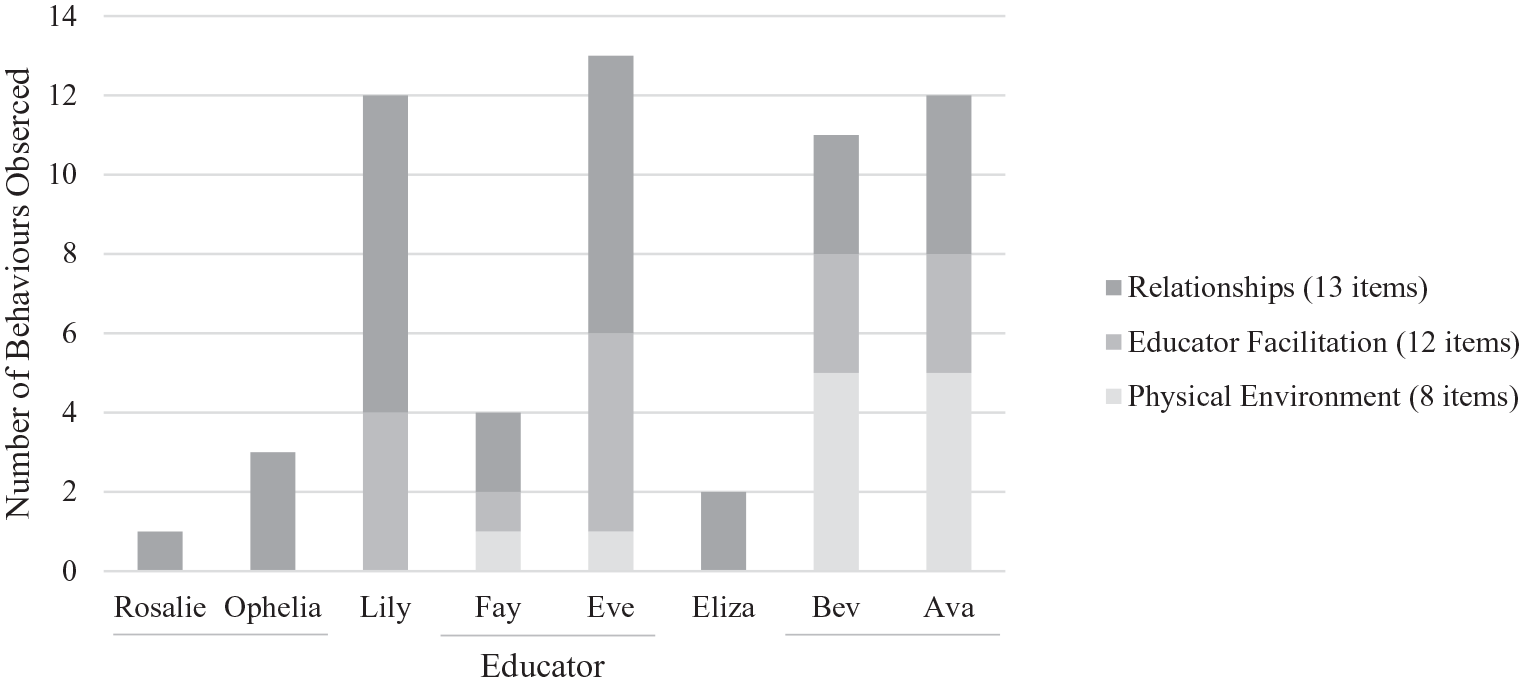
Overall educator self-regulation behaviours observed.
Data analysis of accompanying field notes uncovered that overall, educators had created environments where there was standard assigned seating for most of the time, standard fluorescent lighting, materials posted on walls that was not referenced, the use of one large space with few alternate spaces for different purposes, and some sensory materials offered for those experiencing challenges remaining still and listening. Regarding facilitation, there were no specific self-regulation lessons taught other than emotion recognition from pictures. Praise was used for complying with expected behaviours (following rules and being calm), consequences were threatened for escalation during learning centers, and physical activity was scheduled in, but not used reflexively. However, teachers spoke with a calm demeanor, verbally expressing clear instructions and trying to engage in discussions about how children were feeling when having difficulty focusing or when sad. Teachers were engaged in monitoring the entire class’ focus on the planned group instruction, frequently referring to the rules and expectations to maintain a calm and predictable environment. There was some responsiveness to child problems and encouragement of problem solving and modeling of empathy and kindness in conflict situations. Most of the time, educators were focused on academic lessons with few opportunities for one-to-one interactions. Overall, the findings here demonstrated that educators use a self-control definition of self-reg and tend to facilitate it using a learning strategies approach rather than a neurophysiological framework.
Barriers to facilitating self-regulation
Class size
The most common barrier to facilitating self-regulation mentioned by educators was class size; two teachers and five ECEs indicated an inability to connect one-on-one with each child in the classroom, impacting their child-teacher relationships, a critical foundation for co-regulation. Another educator also added that in a large class it is much more likely that one child can take stress from another and in turn give it to another child.
Curriculum focus
Having to teach foundational skills such as self-regulation prior to teaching academics was also seen as a barrier (one teacher and five ECEs). One educator was concerned that the mental health staff in the board do not realize the behaviour extremes happening in kindergarten and that the children lack preliminary self-care skills (e.g. blowing one’s nose, using the washroom). She supported others’ thoughts that the need to focus on these skills limits the academic learning that can occur in preschool and kindergarten. Her perspective was that developmentally, children are not where they should be, and therefore the children become frustrated when educators try to teach them, resulting in behaviour problems in the classroom.
Educator stress
Case studies of two classrooms that were part of this study (each including a teacher and early childhood educator) supported observations that educators are stressed. Educators’ comments in their interviews revealed that they are stressed about home/school consistency—two ECEs cited the need for parents to stop doing everything for their children at home because children get frustrated at school when things are not done for them as they are at home. One indicated that they are stressed that they are so often asked to facilitate yet another program in their classrooms (such as Al’s Pals or Zones of Regulation). Another indicated that they are sharing their stress with each other and with their children. Educator stress needs to be made a preliminary and foundational focus to facilitating self-regulation effectively in the classroom. Dysregulated educators cannot effectively facilitate self-regulation in others (Shanker, 2016).
Discussion
Findings revealed that educators tended to approach self-regulation using a self-control lens—they focused more reactively on behavioural and emotional self-control rather than proactively understanding the stressors that impact one’s ability and need to exhibit self-control. Implications of this mindset are discussed in this section, including how educators tend to focus too much on cognitive control as opposed to examining key environmental contributors to self-regulation, such as overuse of technology. Reasons for this self-control mindset are discussed, including professional development, familiarity with available resources, and school culture. Finally, recommendations are made for enhancing professional development and school cultures that are likely to contribute to better self-regulation approaches within the board’s classrooms.
Self regulation ≠ self-control
Educators’ self-control mindsets were not a surprise, given that behaviourism had been a common approach to self-regulation in the 1960s (Post et al., 2006), and Burner (2018) found that attempts at change since the 1960s have been unsuccessful.
The learning expectations of the Kindergarten Program (Ontario Ministry of Education, 2016) include some self-control components, but these components represent only three of the 34 expectations of the Self-Regulation and Well-Being (SRWB) frame. Other expectations include nonverbal interactions, empathy, solving problems within social situations, and demonstrating through play what makes children happy and unhappy and why. It may be helpful for educators to revisit the learning expectations of the SRWB frame to prioritize what is important overall for self-regulation in kindergarten.
It was expected that since educators define and describe self-regulation as self-control, that this would be the way that they facilitate it in their classrooms. Educators reported behaviour challenges in their classrooms and tried to manage these stress behaviours by focusing on compliance (e.g. reminders to sit down, praise for compliance with classroom rules). When educators asked children to stop and think before reacting, they may have been assuming that stress behaviour was under conscious control (a self-control mindset) rather than a quick unconscious limbic reaction (a neurophysiological mindset). In response, educators taught children to name their feelings without referencing arousal levels or reflecting on what impacts the way they feel. They placed demands on children to participate in activities (when they withdraw from the group) without considering their self-regulatory state or needs.
Being overly “cognitive” in approach
Overall, educators were trying to teach children cognitive strategies aimed at controlling their emotions and behaviours that are part of the Al’s Pals and Zones of Regulation curricula mandated by the board. It may be that educators were trained to think about learning using a cognitive lens and may have been overgeneralizing this lens to self-regulation and well-being. The use of scripted programs, though, conflicts with self-regulation as outlined in the Kindergarten Program.
Furthermore, when young children are developing self-regulation, a focus on self-control can impede progress by creating additional stressors rather than reducing them. As Shanker (2016) suggests, sometimes compliance or apparent self-control may even be a sign of dissociation, a reactive state that is harmful to mental well-being; programs can cause stress on the educator and child which impedes the self-regulation progress.
Educators appreciated specialists who came to the classroom to consult including behaviour specialists; however, behaviour specialists looked at specific behaviours and how to change them using prompts and consequences and rigid safety plans for children with the highest needs. Using reactive safety plans is not a proactive approach intended to prevent stress behaviours and is misaligned with the Kindergarten Program’s recommendations to proactively create calm and engaging environments. These safety plans may even serve as a hidden stressor for educators trying to navigate best practices in supporting children’s self-regulation and well-being when advice is coming from consultants who have different lenses on behaviour.
Overuse of technology
Lastly, the use of technology to teach may have been a potential barrier
One classroom used a SmartBoard to try to capture children’s attention. However, after the use of the SmartBoard for videos, movement activities, and visually based lessons, children may have been trying to self-regulate through movement and attention to different areas of the classroom, causing lack of focus on the teacher. In contrast, in another classroom, children did not have any access to screens, and appeared more engaged with the environment and people around them. The children followed the classroom routine with more ease. Greene (2007) and Carney and Parr (2014) suggest that screen time can be a stressor for children. Dunckley (2015) reports that screen time disrupts sleep and overloads the sensory system. Screen time is also known to induce stress reactions and increase cortisol, a stress hormone (Leppänen et al., 2020). Perhaps the use of the screen detracted from the educators’ ability to connect with each child individually and form relationships, an important part of self-regulation facilitation (Clinton, 2020; Schore, 2012; Tantam, 2018) where social engagement provides cues of safety (Porges, 2011).
Low familiarity with ministry resources
There was low familiarity with the resources aligned with a neurophysiological framework of self-regulation, with most educators reporting knowing nothing about the Early Years Studies, Shanker’s Calm, Alert, and Learning (2012) and Self-Reg (2016), The Explosive Child (Greene, 2007), and Mona Delahooke’s Social and Emotional Development (Delahooke, 2017) and Beyond Behaviours (Delahooke, 2019). Those adopting a self-control facilitation style (n = 2) were the least familiar with each resource. The only participant describing a predominantly Ministry-recommended facilitation style in the survey was also the participant most familiar with each resource.
In terms of observed practices, the educator with the most years of experience of the 12 educators interviewed and observed was the lowest scoring educator on the SCEIC which signifies that more experience in teaching kindergarten does not necessarily relate to better facilitation of self-regulation in the classroom. Also noteworthy is that the educator with the highest overall SCEIC score had the least professional development experience, only having attended a 2–3-hour workshop on her own time and not having participated in any board training on self-regulation. In contrast, the lowest scoring educator on the SCEIC, had the most professional development experience, having attended conferences as well as required school and board-level professional development and a completed Kindergarten Additional Qualification course with a self-regulation focus in her 7 years of experience.
Overall, these findings suggest that the less familiar educators were with the Ministry’s kindergarten-relevant resources (e.g. the Early Years Studies, Shanker Self-Reg, EduGAINS), the more likely they were to use a self-control mindset, and the more familiar they were with these resources, the more likely they were to use a neurophysiological mindset.
Professional development
The training provided to educators was not aligned with the Ministry-recommended practices of the Kindergarten Program. All educators participated in Al’s Pals training, so it is not surprising that educators think of self-regulation in self-control terms because as per its manual, Al’s Pals is a lesson-based program that is couched in self-control (Wingspan, 2004). The programs provided lack the evidence base one would expect, and consultants have provided recommendations couched in a potentially outdated behavioural framework rather than contemporary understandings of self-regulation. How has existing training impacted practice? One teaching team reported having had behaviour-based training to support their ability to facilitate self-regulation and feel that they need more training in behaviour management. Perhaps the behaviour-based training did not solve the problem of stress behaviours in the classroom. It seems that educators who are focused on behaviour management and self-control rather than neurophysiological self-regulation are also those who are seeking more help in controlling behaviours.
Developing a relationship-based school culture
An important relationship-based theme that emerged as a need was the importance of a team approach in kindergarten classrooms. Eleven of the 12 educators interviewed mentioned the desire to be able to spend more time together as a cohesive team to share ideas and support one another. One insightful ECE commented that these relationships were important not just for mutual support, but because in the classroom climate, children pick up on those relationships between teachers and ECEs. Within one school, one teaching team have worked well together for several years and both remarked at the supportive nature of having developed a good working relationship with each other, which was reflected in their higher SCEIC scores, including their ability to develop relationships with their children. In contrast, a second teaching team also worked in the same school, but not as long, so they experienced some challenges in how they work together. Despite having experienced the same training, their SCEIC results were not as high.
Recommendations
The following recommendations are made based on the emerging themes from the current study within the context of the kindergarten self-regulation literature.
Start with personal self-regulation for educators
Jennings et al. (2013) found that by decreasing teacher stress and increasing their sense of well-being, teachers became better able to establish supportive relationships with their children, promoting attachment and improving school climate. Similarly, Shanker (2016) highlights our tendency to co-regulate each other’s affective states by sharing our own—we perceive and are influenced by the states of others, and our own states affect those around us. Educators need to first be able to self-regulate themselves personally before they can effectively facilitate self-regulation in their children. If educators are dysregulated themselves (which was indicated throughout observations and self-assessments), children pick up on this stress and experience the educator’s stress themselves because experiencing other people’s stress is a known prosocial stressor (Schore, 2012). Professional development that simply trains educators how to deliver cognitively based lessons to their children does not support this co-regulatory process as part of the dynamic system of self-regulation. There are publicly available resources available to educators (e.g. EduGAINS, Early Years Studies), and the current study’s Self-Reg Checklist (SCEIC) may also be used to guide and monitor Ministry-recommended self-regulation practices. It would be ideal to see this framework for self-regulation being included in educators’ pre-service training, an area where teachers and ECEs may differ.
Shift from programs to mindsets
Boards are currently using programs to teach educators how to facilitate self-regulation. Programs can be a more concrete and cognitively simpler process than the higher-level learning of changing one’s attitudes and beliefs to affect application and synthesis (Anderson et al., 2001), but they unfortunately address only knowledge rather than application. Knowing about self-regulation is not the same as doing it, a higher-order skill that goes beyond cognition (Clinton, 2020). Programs often have limited empirical support, and the available programs for self-regulation use a self-control lens, not the same comprehensive neurophysiological framework adopted by the Kindergarten Program (Ontario Ministry of Education, 2016). Boards would do well to consider training that instead focuses on the philosophy and recommendations provided in the Kindergarten Program itself, rather than selecting external resources that do not align with the kindergarten curriculum.
Providing educators more time together as a team (which emerged as one potential reason Ava and Bev had more success in facilitating self-regulation) may enable teachers and ECEs to share the strengths of their respective pre-service training with one another to develop a cohesive approach that blends the human development expertise of ECEs with the educational expertise of teachers. Perhaps more importantly, developing strong relationships with colleagues may serve as personal self-regulation through social engagement. Shanker (2016), Clinton (2020), and Tantam (2018) reveal through their work on relationships that one’s self-regulation is grounded in feelings of safety learned through social engagement. Educators working in teams may be able to co-regulate one another to remain regulated enough to co-regulate their respective children.
Reframe existing practices with a neurophysiological mindset
Reframing is a critical aspect to moving forward with research and practice across contexts (Shanker and Burgess, 2017). Reframing is one of the five practices of Shanker Self-Reg (Shanker, 2016) and is a common theme of popular educator resources. When an educator thinks about self-regulation as connected more closely to well-being than to behaviour management, their approaches may shift toward the framework described in the Kindergarten Program as per Nungesser and Watkins (2005) findings that educators who believe that behaviour is a child’s choice turn to reactive responses to behaviour such as time-out and loss of privileges.
Some of the teacher practices may simply need reframing to align with the Kindergarten Program’s recommendations. Some practices may appear to be neurophysiological brain-body practices (e.g. meditation) but are in fact facilitated using a self-control framework such as when meditation was used as a group reward for compliant sitting rather than achieving an individualized state of calm. When taught as a group, Reddy and Roy (2019) suggest that there should ideally be ways to personalize the experience, from body positioning to length of time engaged in the process to cognitive processes employed during the experience. Reframing meditation in these ways may help educators to see meditation as an individual practice that may work for some but not others, and as a practice that children may choose to use throughout the day as they reflect on how they are feeling in the moment (neurophysiological arousal) rather than as a group activity to be used at a scheduled time, or reactively when many other children are over-aroused (a behaviour management approach).
Finally, self-regulation in the kindergarten program is directly connected to well-being as part of the Self-Regulation and Well-Being (SRWB) frame and not to behaviour management as emerged in the current study. Perhaps making this connection to well-being through reflective professional development opportunities using the neurophysiological resources mentioned above may help educators to reframe what self-regulation is all about—well-being, not behaviour management.
Use the SCEIC as a guide
There were not many Ministry-recommended practices observed during classroom observations (overall, 17% of environmental recommendations, 20% of facilitation recommendations, and 34% of relationship recommendations). The SCEIC is a summary of the recommendations of the Kindergarten Program (Ontario Ministry of Education, 2016), and relevant resources for helping educators learn how to facilitate self-regulation including EduGAINS (Edugains Kindergarten Home, 2017), The Learning Exchange (Kindergarten Matters: Intentional play-based learning, 2017), How Does Learning Happen (Government of Ontario, 2014), and the TMC Class Environment Reflection Tool (The MEHRIT Centre, 2017.). As such, the SCEIC may be a useful tool and guide to help educators increase the number of Ministry-recommended self-regulation practices occurring in their classrooms. The kindergarten curriculum document discusses the importance of the classroom environment. Choice in materials and space, activities promoting care and kindness, collaborative problem solving, and reframing behaviour as stress-based, are all elements of an environment included on the SCEIC, and with further research and development with larger sample sizes, may serve as a useful tool for adjusting classroom environments for the effective facilitation of self-regulation.
Conclusion
The findings of this study indicate that educators largely held a self-control understanding of self-regulation and used a learning strategies framework to teach self-regulation to their children, as opposed to the neurophysiological framework included in the Ontario Kindergarten Program (Ontario Ministry of Education, 2016). Facilitation was typically comprised of pre-planned group lessons, a cognitive learning strategies approach, focused on remembering what you should do to feel calm and control your behaviour and emotions (i.e. self-control). There is a need for further development of a neurophysiological framework of self-regulation in Ontario Kindergarten classrooms in order to effectively facilitate it.
Limitations and future research
Educating children during a pandemic led to many challenges for educators and for this research. Public health requirements due to the COVID-19 pandemic meant that classrooms that were observed for this research study were not necessarily representative of the typical classroom environment, and report cards were based on limited time in the classroom. The stressors of teaching during a pandemic undoubtedly impacted teacher practice as well. Furthermore, generalization based on 29 surveys and 12 interviews/observations may not be possible without further research across boards with a larger sample size.
There may be history and maturation effects between the beginning of data collection (survey) in September 2019 and the classroom observations in October 2020. The SCEIC may not be broad enough to represent self-regulation fully, and further future consultation with experts in the field as well as expanded research using a larger sample size than the current sample of 29 would be required to fully validate this tool. In addition, replication across several provincial school boards for generalizability may be beneficial.
One of the primary challenges throughout this study was that as it progressed it became apparent that it was not going to be a straightforward measurement of what worked to support child self-regulation as originally planned, because the existing measures being used in the research were varied and founded on very different philosophical frameworks like self-control (e.g. measuring impulse control and compliance). Measurement in neurophysiological self-regulation is a growing field and includes measures like heart rate variability which works in a lab setting but would not be accurate in a dynamic classroom environment. Current research in neurophysiological measures like heart rate variability are mostly focused on exercise paradigms and stress recovery, and there is a need to apply this new understanding of the stress response system to early learning contexts. Current research in self-regulation, specifically in kindergarten contexts as described in the literature review, is mostly centered around self-control, and there were no studies focused on educator understanding of self-regulation to build upon. Further exploration in neurophysiological approaches toward self-regulation in kindergarten classrooms is encouraged. Lastly, results pointed to areas of need for professional development, and this would be an interesting and important area for future exploration and study.
