




Abstract
Early childhood education (ECE) presupposes a balance between emotionally supportive interaction and pre-academic teaching instruction, and research indicates an increasing pressure on preschool teachers’ communicative competence. This study focuses on the functions of emotions in the teacher–child relationship in a situated context. Such studies are scarce in the research on ECE, which mainly concerns children’s socioemotional learning. Using a micro-sociological approach, characterized by an in-depth analysis of interaction, we explore the ways in which emotions may foster conformity in goaloriented preschool activities. Verbal and nonverbal utterances between a preschool teacher and a child in a video-recorded episode were transcribed and analyzed meticulously. The findings reveal an informal, subtle system of social sanctions within which the emotions of shame and pride have important functions, which leads to social adaptation to goal-oriented expectations. The study also discusses how emotional processes during interaction can be understood in light of the institutional context of current ECE.
Keywords
Introduction
This study focuses on the functions of emotions in social adaptation as it is played out in goal-oriented activities in a Swedish preschool context. This study aligns with international research and policies, framing early childhood education (ECE) in terms of a teacher–child relationship approach, recognized as key to children’s continued development and learning (e.g. Lippard et al., 2018; White, 2020). The study is also situated within the contemporary goal-oriented and school readiness perspective, with explicit goals to prepare children for higher academic expectations, which has become increasingly prominent in ECE (Smith and Glass, 2019; White, 2020). Thus, two rather different and sometimes even conflicting approaches frame contemporary ECE, which has implications for how teacher–child interaction is understood. In context of Sweden, which has a long-prevalent child-centered care approach, goal-oriented aspects have been introduced into the curriculum for preschool by the concepts of teaching and education (Swedish National Agency for Education, 2018). Critical voices suggest that in a narrow curriculum-based preschool, the pedagogical practice risks are reduced to adaptation to formal schooling and a focus on socializing children into current systems (Biesta, 2016; Uljens and Ylimaki, 2017). This may mean the loss of principal encounters whereby children are allowed to flourish within a process in which the outcome can neither be guaranteed nor secured (Biesta, 2016). Adaptation to formal education in ECE also places pressure on preschool teachers’ competence in communicating with children, necessitating a balance between emotionally supportive interaction and pre-academic learning instructions (Howes et al., 2013; Sheridan and Pramling Samuelsson, 2013). Studies that investigate in detail how the relationship between goal orientation and caring is manifested and managed in ECE practices are therefore needed. In this study, we suggest that a micro-sociological approach (Scheff, 1990, 1997) can contribute in this respect. Previous studies from our research group have shown how children in goal-oriented interactions adapt to teachers’ definitions of their activities (Nilfyr, 2018; Nilfyr et al., 2021). The present study advances the approach of investigating social adaptation in a goal-oriented preschool context by explicitly focusing on the functions of emotion in social interaction.
Arlie Russell Hochschild (1990) refers to three theoretical models of emotions, distinguished by their view of social influence: (i) the organismic model, in which emotions have an independent existence in relation to human consciousness, meaning that social influence is regarded as less important; (ii) the constructivist model, which understands emotions as being to a great extent determined by social influence; and (iii) the interactionist model, in which emotions are viewed as aspects of interaction, with social influence certainly being significant but emotions also having an active, dynamic function. The present study follows the interactionist approach and aims to investigate the functions of emotions in social adaptation. The study is based on Scheff’s (1990) interactionist theory of emotion, in which the emotions of shame and pride are highlighted. Scheff’s colleague Suzanne Retzinger (1991) operationalized the theory, and we will primarily adopt her model to analyze connections between social behavior and the emotion of shame. Using this analytical approach, this study aims to explore how emotions may foster conformity in goal-oriented goal-oriented preschool activities.
In addition, this paper will discuss how social adaptation and its accompanying emotional processes can be understood in light of the institutional context of current ECE. The study also has implications for future studies on emotions in ECE, illuminating how analysis on a micro-level could contribute. It also has implications for educational practice, by exemplifying the importance of preschool-teachers being able to balance between the school readiness perspective and the child-centered caring approach.
Literature review
Research exploring emotions in ECE generally does not focus explicitly on how emotion is played out in interaction. Rather, it considers the conditions for children’s socioemotional learning (Ng and Bull, 2018; Sahin Asi et al., 2019). Many of the studies highlight the importance of providing children with opportunities for socioemotional learning, positioning preschool teachers as key mediators (Ng and Bull, 2018; Sahin Asi et al., 2019; Zinsser et al., 2015). This is shown, for example, in the observation study by Ng and Bull (2018), in which the supportive strategies adopted by preschool teachers to facilitate socioemotional learning were explored. The findings revealed four strategies: (i) setting a positive tone, (ii) task allocation (action-related strategies), (iii) suggestion of solutions, and (iv) extension (oral-related strategies). The first strategy involved warm interactions, verbal engagement, and responsive feedback and was the most frequently used strategy to enhance socioemotional learning.
Preschool teachers’ socially constructed regulation skills were further examined by Sahin Asi et al. (2019) in relation to the effect they had on teacher–child relationships. The results showed that emotion-regulation skills functioned as filters that determined how children and preschool teachers perceived situations. This implies that when teachers deliberately involved social and emotional features in their communication with children, they significantly enhanced their support for the children. Conversely, when teachers had difficulties coping with emotions, it created challenging interactions (cf. Morris et al., 2013). A study by Madrid and Dunn-Kenney (2010) focused on the ways in which emotional themes were reflected by four early childhood teachers. The findings revealed that preschool teachers’ stress and concerns about failing to meet institutional and relational standards and societal expectations were central. This is in line with previous research suggesting that how preschool teachers deal with institutional school readiness expectations and at the same adopt a caring approach is crucial for their possibility to create interactions that also support children’s emotional and social development (Howes et al., 2013; Sheridan and Pramling Samuelsson, 2013; Smith and Glass, 2019; White, 2020).
Research investigating the functions of emotions in children’s social adaptation and appropriation of normative expectations—and which, more specifically, aligns with the focus of this study—has mostly been conducted in relation to schooling (e.g. Aspelin, 2017; Beaulieu, 2016; Evaldsson and Melander, 2017) and is still scarce in the context of ECE. Kuby (2014) showed that the way in which teachers and children perform their emotions within situated contexts is valuable for understanding institutional learning activities. Therefore, educational research in ECE needs to move beyond “psychological or even discourse perspectives to study the complexities of emotions as performed” (Kuby, 2014: 1286). This argument is in line with that of Klusemann (2017), who stresses that learning is primarily interaction, and since emotions comprise a central dimension of interaction, knowledge is always permeated with emotions. Therefore, research is needed that explicitly explores how preschool teachers and children perform their emotions in activities framed by institutional norms. The present study focuses on emotions in teacher–child interactions during goal-oriented activity. The study is further underpinned by a micro-sociological approach (Scheff, 1990), a perspective that few studies in ECE have adopted (Klusemann, 2017). In this way, the present study contributes to knowledge about the role of emotions in teacher–child interactions, as well as to knowledge about the ways in which institutional interaction can be framed within the field of ECE.
Theoretical framework
The process of interpreting the meanings of social interaction is always intricate, a reality that applies both to research and everyday life. Micro-analysts have some advantages in that they can study interactions repeatedly, in detail, and together with other researchers. However, “all human expressions are ambiguous and, by implication, require complex search in order to be understood” (Scheff, 1990: 38). This insight demands great humility and caution from researchers, as well as a meticulous and rigorous approach. In addition, it demands that researchers be explicit about their analytical frameworks.
An underlying principle of Scheff’s theory is Cooley’s (1992/1922) concept of the looking-glass self. Cooley states that an individual’s self-conception is usually shaped in a process containing three elements: (1) how we perceive ourselves in the eyes of others; (2) how we value ourselves in the eyes of others, and, as a result, (3) some kind of self-feeling, such as pride or shame. Another such principle is Erving Goffman’s (1982/1967) concept of embarrassment and its role in social encounters. Goffman implies that people are embarrassed when rejected by others, just as we are proud when we are accepted. Scheff combines Cooley and Goffman’s principles and argues that pride and shame are the primary social emotions because they arise in a context of “mind reading” and give immediate signals to the self about the character of relationships: “Pride is the sign of an intact bond, shame a severed or threatened bond” (Scheff, 1990: 15). Scheff (1990) does not simply categorize pride as a positive, good emotion and shame as a negative, bad emotion; rather, he defines them as functional elements in the process of building social bonds. We could say that, metaphorically, they signal a green or red light to the self in social traffic. We also note that shame and pride are umbrella terms in so far as they include several other feelings; for example, the “shame-family” contains the feeling of embarrassment (Retzinger, 1991; Scheff, 1990), and the “pride-family” contains the feeling of joy (Aspelin, 1999).
For the purpose of our study, Scheff’s (1990) concept of the deference-emotion system is particularly relevant. This refers to an informal and subtle system of social sanctions that is largely imperceptible, woven into everyday life, and constantly modified during ongoing processes of interaction. The system operates between as well as within the interactants. It mostly depends on nonverbal communication, that is, on how we communicate: gestures, body position, face movements, and so on. The emotions of shame and pride play key roles in the maintenance of the system, and Scheff (1990: 71) argues that they function as motives for social adaptation: “Members experience this system as compelling conformity to norms exterior to self by informal but pervasive rewards (outer deference and its reciprocal, inner pride) and punishments (lack of deference, and the normal shame that is its reciprocal).” He further states that the deference-emotion system has hardly been explored systematically but could be revealed “by microscopic analysis of sequences of interaction ritual in concrete episodes” (Scheff, 1990: 77). Our study contributes in this regard. Thus, in the present study, we assume that teachers and children continuously perceive, evaluate, and experience the status of the self in relation to others, and that they are engaged in a process of social adaptation and in the task of avoiding shame and experiencing pride.
Methods
The analysis in this study is based on video-documented data obtained from a previous project in which the objective was to explore interactions between preschool teachers and children in goal-oriented activities (Nilfyr, 2018). The data were generated by one of the authors in the spring of 2016 and comprised 173 minutes of video film from three different preschools, distributed across nine goal-oriented activities that varied in length from 5 to 34 minutes. Seven teachers and 35 children aged 3–6 years participated in this study. In the present study, one episode was selected for the in-depth analysis. It was selected because it highlights the interactional patterns that were identified in previous studies; for example, the interaction was largely driven by the teachers’ questions, the teachers modified the interaction processes to predetermined purposes, and the children adapted to the teachers’ definition of the activities (Nilfyr, 2018). Scheff (1997) suggests that we “put the discourse that constitutes a relationship under a microscope” (p. 69). To achieve a thorough, situated, contextualized understanding of verbal and nonverbal interaction the researcher usually need to focus on a few episodes. However, as mentioned, it is appropriate that the selected episodes shed light on patterns found in previous analyses. Below, 48 seconds of video data of interactions between a preschool teacher and a child are re-analyzed using Scheff’s (1990, 1997) theoretical underpinning and, primarily, Retzinger’s (1991) analytical approach. The study concerns a very brief event in a preschool activity, and there is no intention of assessing the teacher’s pedagogical skills, neither in the current episodes nor in a more general sense.
Video documentation
Video documentation provides opportunities to study verbal and nonverbal communication during ongoing activities (Heath et al., 2010). Video data make it possible to pay regard to facial expressions, gestures, body positions, gaze orientations, tone of voice, etc., which are all integral parts of interaction (Derry et al., 2010). Because video data enable extremely close and accurate descriptions of ongoing interactions, approaches focusing on the micro level make it possible to elucidate occurrences that are sometimes so brief and subtle that they escape the participants’ reflections (Scheff, 1990, 1997).
Analysis
The theoretical framework suggests a detailed transcription and sensitive interpretation of the interactions. For the present study, six excerpts were analyzed meticulously. These are presented sequentially below. Several analyses were performed, partly by each researcher individually and partly together as a research team.
In the results section, we present an analysis on a micro level of the interaction between a preschool teacher and a child, focusing on the functions of emotions in social adaptation. The theoretical framework suggests that the social emotions of shame and pride play important roles in social adaptation. Following Scheff (1990), we also regard emotions as processes that are related to the different positions that interactants have in a social structure (cf. Bericat, 2016); that is, human expressions are understood in an institutional context.
Scheff (1990) states that the analysis of emotions implies a careful study of the interactants’ manner, that is, the nonverbal components of their utterances. Research shows that feelings of shame are most often manifested through hiding behavior, whereas pride is manifested by an “open” appearance (Scheff, 1990). As mentioned, we adopt Retzinger’s (1991) model to analyze the emotion of shame. This model consists of both paralinguistic and visible gestures. Examples of paralinguistic markers for shame are hesitation, self-interruption, filled pauses (-uh-), long pauses, silences, tense tones, fragmented speech, rapid speech, and mumbling. Examples of visual markers for shame are the hand covering all or parts of the face, eyes lowered or averted, forehead wrinkled vertically or transversely, and different kinds of hiding behaviors (Retzinger, 1991). Aspelin (1999) constructed a corresponding model for the emotion of pride, according to which the emotion is indicated by paralinguistic cues such as clarity of speech and visual cues such as a raised gaze and no hiding of the face. This model will be adopted below on a few events. Retzinger (1991), in line with Scheff (1990), emphasizes that the mere presence of a certain gesture should not be regarded as evidence for a certain emotion. Thus, there is no automatic link between behavior and emotions, and, more generally, there is no technical manual to determine meanings from single utterances. The researcher’s task is to interpret the interaction as accurately and thoroughly as possible and present support for the interpretation. However, the more indications there are, the more plausible the interpretation is.
Ethical considerations
The project was approved by the Central Ethical Review Board of Linköping (reg. no. 2016/62-31). The re-use of high-quality, already-existing empirical data was a deliberate choice and consistent with current ethical considerations (Swedish Research Council, 2017) since the children and preschool teachers did not need to be exposed to new observations. An important aspect when reusing existing data is to have sound knowledge of the particular circumstances of the contexts studied and the phases of data collection (Derry et al., 2010), which is ensured in this case because one of the authors had previously generated the data.
Findings
The findings from the six excerpts are presented sequentially, with each excerpt organized into five-column transcripts (cf. Jordan and Henderson, 1995). The first column indicates the turn, the second the time of the recording, the third shows the participants, the fourth provides a transcript of the participants’ verbal utterances, and the fifth documents their gestures and facial expressions. This is followed by our analysis, which adopts Retzinger’s (1991) cues for shame—including feelings such as insecurity and embarrassment—according to the framework. A brief description of the course of events that took place between excerpts 2 and 3 and between excerpts 3 and 4 follows each.
The goal-oriented episode takes place in a room used as an atelier at preschool. Four children, Anna, Bill, Clara, and Elof, each aged approximately 4 years, and a teacher, Petra, sit at a square table. The reader can note that all the names are fictious. The group has been working on a tree-related theme, and the children had been instructed to draw a tree. Elof has drawn a Santa with a hat, and when the teacher asks if he is drawing his tree, he answers “No,” saying that the drawing is for his mother. The teacher tells him that the drawing is to be hung on a wall at the preschool and that his mother can have it later. The teacher has begun documenting the children’s narration of their drawings, and the children are talking to each other and to the teacher. Just before Excerpt 1, there is an 8-second pause (13.24–13.32) in which the teacher looks attentively at Elof and his drawing. Anna actively seeks the attention of the teacher and the other children. The teacher does not respond but keeps looking at Elof, while he continues to draw.
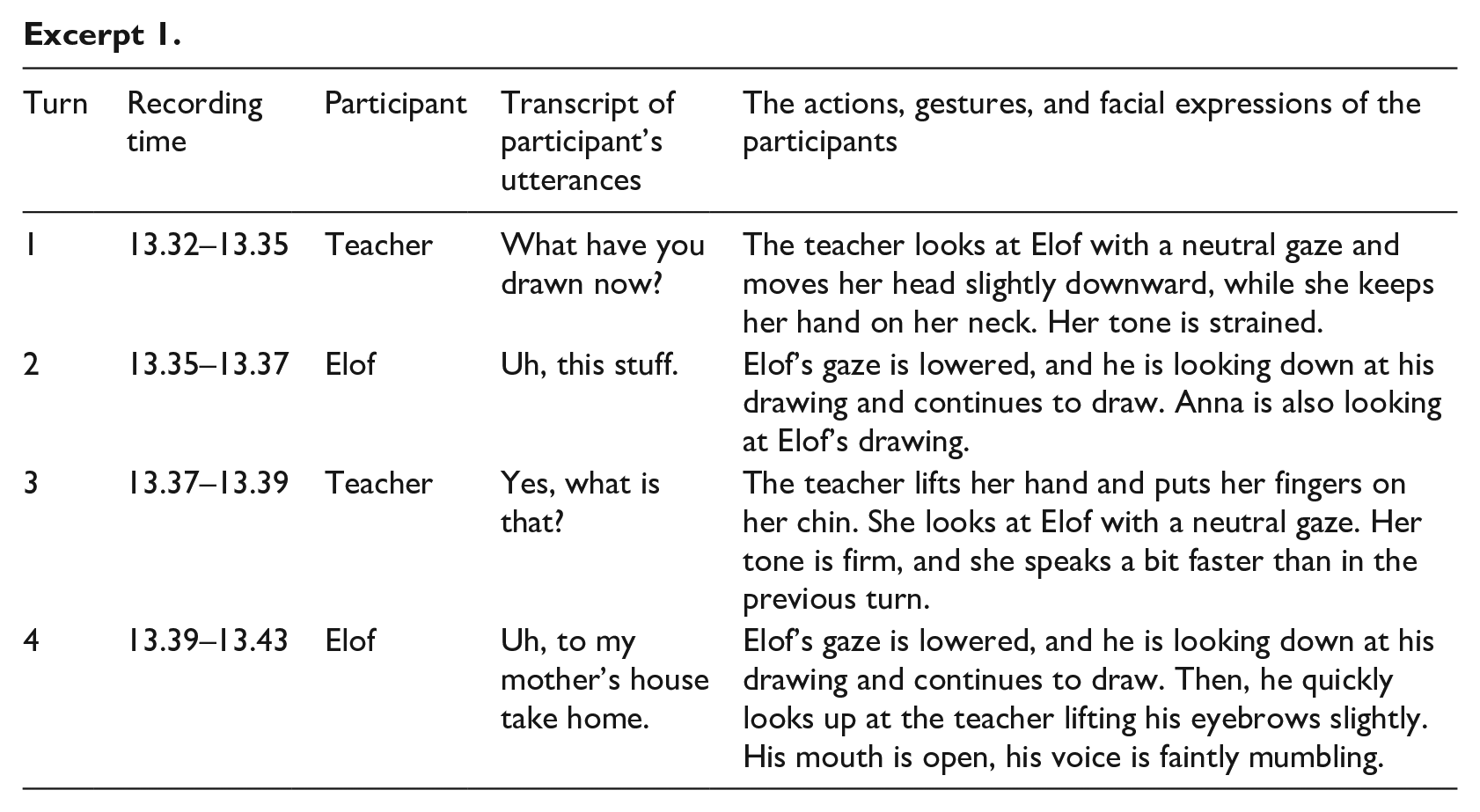
The direct question from the teacher and her firm tone in Turn 1 indicates that she is trying to ensure that Elof is fulfilling the task. The teacher’s tense voice indicates skepticism about Elof’s activity. Elof’s lowered gaze and his undefined expressions of “uh” and “this stuff” (Turn 2) are analytically interpreted as insecurity about how to respond to the question about his drawing. According to Retzinger (1991), paralinguistic signs that are expressed as hesitation and filled pauses (-uh-) indicate insecurity. Visual markers such as averted and lowered eyes support the interpretation that Elof is not sure how to respond (Retzinger, 1991). The teacher’s verbal utterance “Yes, what is that?” and her tense tone imply continued negative sanctions. However, the teacher’s faster-paced speech and the fact that she lifts her hand and places her finger on her chin (Turn 3) could also be indications of uncertainty or hesitation. The activity in Turn 4, when Elof mumbles and only directs a short glance at the teacher and then looks back to the paper, is interpreted as hiding behavior, which is a marker for shame (Retzinger, 1991). Elof does not answer the question; his verbal response contains fragmented speech. From Retzinger’s (1991) framework, this marker, together with the filled pauses (-uh-), could be understood as expressions of insecurity and embarrassment.
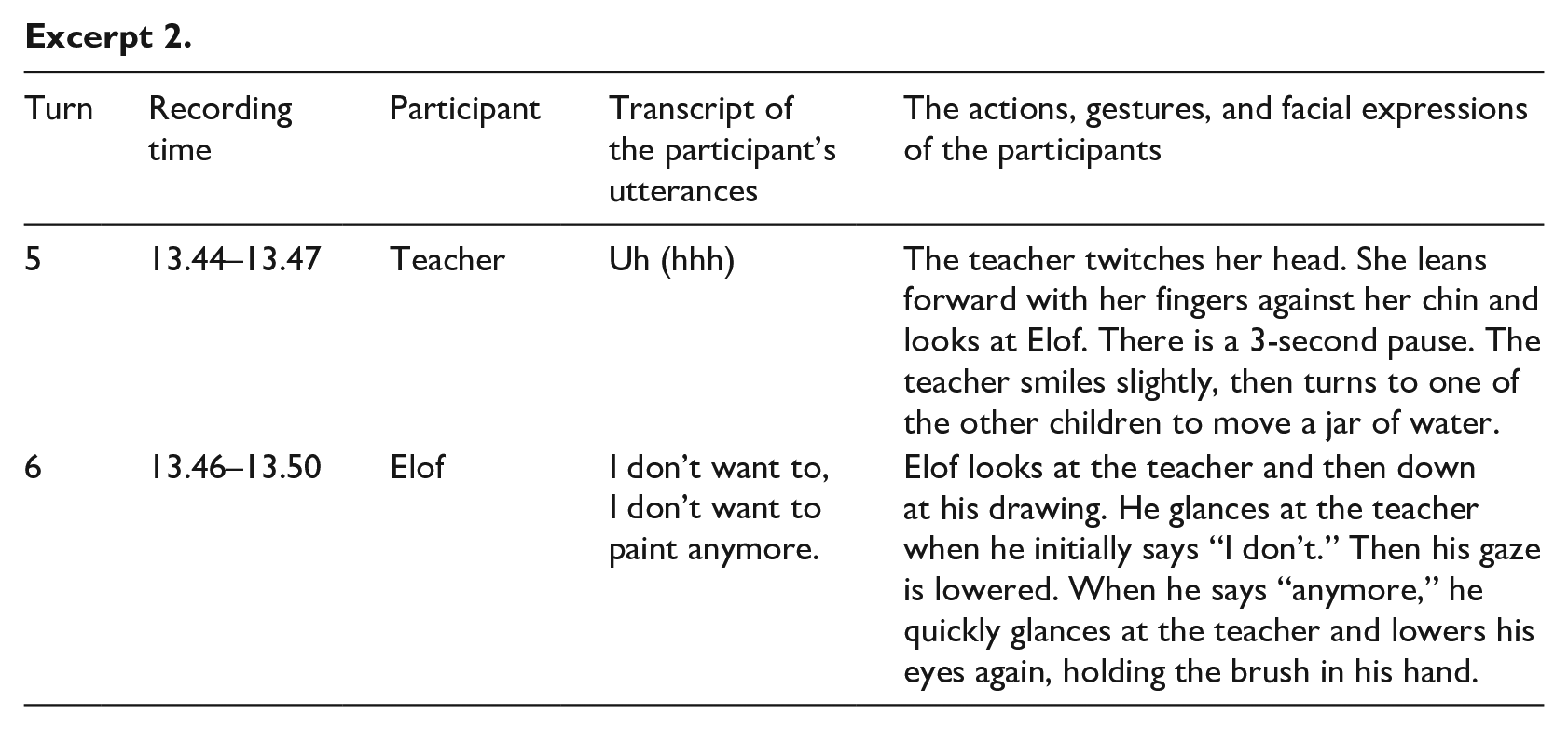
The teacher’s sudden twitch of the head in Turn 5 and the paralinguistic markers of hesitation and filled pauses are interpreted as expressions of insecurity about how to handle the situation with regard to adjusting Elof’s behavior through her interactions (Retzinger, 1991). Elof’s verbal response (Turn 6) supports the interpretation that he is affected by negative sanctions and is trying to escape from the activity. His lowered and averted eyes are interpreted as expressions of insecurity and embarrassment (Retzinger, 1991).
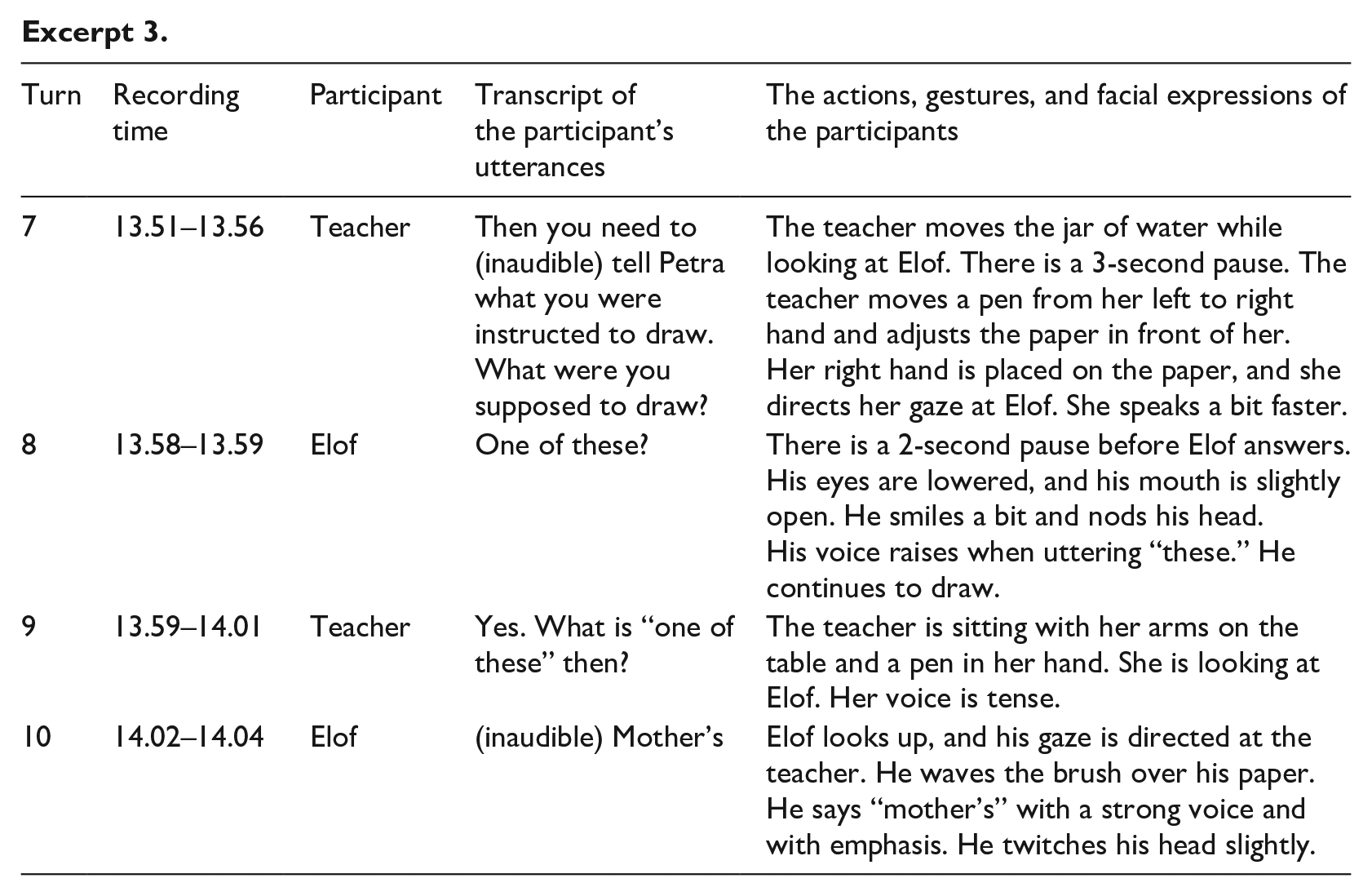
Again, the teacher tries to ensure that Elof follows the instructions. In Turn 7, the teacher reminds Elof of the task and requests that he tells her about it. Compared to previous turns, the teacher’s speech is more rapid. From our analytical framework, this can be interpreted as continued uncertainty about whether Elof is doing what he was asked. Since the teacher gets ready to document what Elof says he is drawing, her utterance involving herself in the third person (Petra) and the fact that she again draws Elof’s attention to the task are interpreted as references to the formal assignment. Elof`s lowered, averted eyes (Turn 8) and his head twitch (Turn 10) are interpreted as markers of insecurity (Retzinger, 1991). Furthermore, Elof’s utterance “One of these” and his raised voice while saying “these” are understood to be signs of defensiveness in an emotionally arousing context (Retzinger, 1991). Once again, Elof tries to escape the situation without damaging his self-esteem. In Turn 9, the teacher repeats in a tense tone what Elof has said, which can be interpreted as a way of ensuring that Elof really has completed the given task. In Turn 10, Elof avoids answering the question and instead says something incoherent, with fragmented speech. These signs are analytically interpreted as expressions of shame (Retzinger, 1991).
In the time span between 14.04 and 14.19, the activity continues with the children drawing, coloring, and making small talk. The teacher reminds Elof about the task and asks him if he is coloring his tree, while Elof and Anna discuss which parent they will give their drawings to. The teacher asks Elof to tell her what he was instructed to paint. He repeats “One of these” The teacher repeats the question, and Elof says that he has drawn Santa.
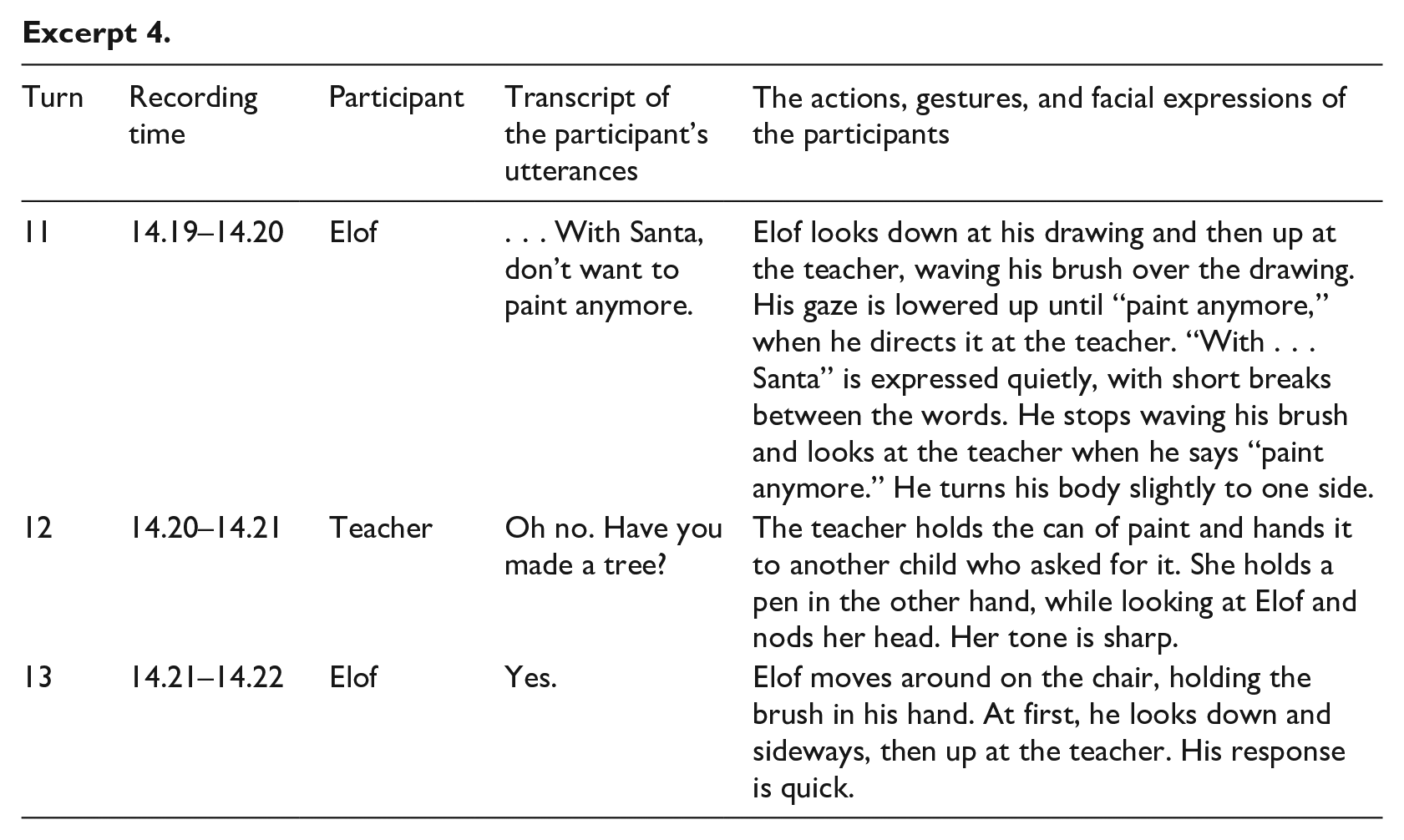
In Turn 11, Elof says “Santa” quietly and then interrupts himself, which is analytically interpreted as a sign of shame (Retzinger, 1991). Elof continues by repeating what he uttered in Turn 6, that he does not want to paint anymore. The short breaks between his words “don’t want to paint anymore” and his lowered gaze are interpreted as markers of embarrassment (Retzinger, 1991). In Turn 12, the teacher implies that Elof has created something other than what he has claimed to. Her direct question and sharp tone of voice, together with self-confirming nodding, are understood as attempts to control Elof’s behavior. Elof’s quick and prompt response, “Yes” (Turn 13), implies an explicit change in strategy. His averted gaze is interpreted as a continued expression of insecurity and embarrassment (Retzinger, 1991). Elof probably understands that to be allowed to stop painting, he needs to have fulfilled the task, which is claimed by saying that he has painted a tree.
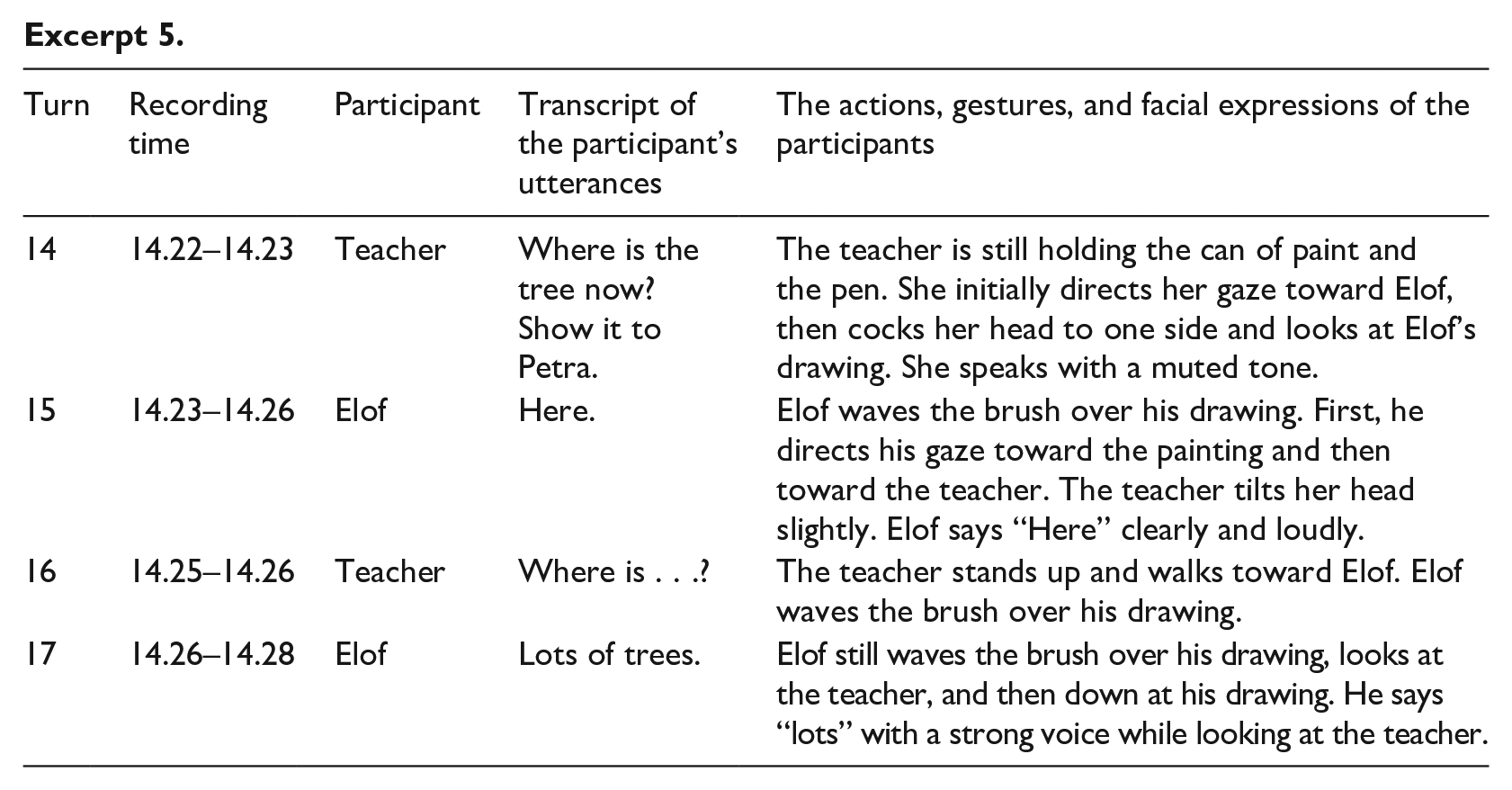
In Turn 14, the teacher’s direct question and sharp tone indicate that she is checking whether Elof has met her expectations. Just as in Turn 7, she talks about herself in the third person. Elof waves the brush over his drawing, which suggests that he is unsure about where the tree is. In Turn 15, Elof says “Here” with a clear and loud voice, which indicates pride (Aspelin, 1999). At the same time, his eyes are lowered, which is analytically interpreted as embarrassment (Retzinger, 1991). This indicates a mixture of emotions. That the teacher in Turn 16 stands up and walks toward Elof can be interpreted as a controlling approach, to determine whether Elof has understood the previous corrections, and an act intended to reinforce Elof’s impression that he has drawn a tree. The teacher also asks for clarification with the words “Where is. . .?” Elof’s expression “Lots of trees” (Turn 17), pronounced in a strong voice while looking at the teacher, is interpreted as an attempt to ensure that his drawing will finally be approved. The fact that he repeatedly looks at the teacher could be further interpreted as an expression of pride (Aspelin, 1999). However, as in Turn 15, this feeling seems to be mixed with embarrassment and could therefore be interpreted as a sort of defense. Elof has accepted the expectations of the goal-oriented activity and manages to avoid the shame associated with the teacher’s negative sanctions.
In the time span between 14.28 and 14.40, the teacher sits down next to Elof and looks at his drawing. She asks where the tree’s trunk and branches are. Elof says something inaudible. He looks down at his drawing and again waves the brush over it. He then paints a little with his brush. He opens and closes his mouth a few times but says nothing.
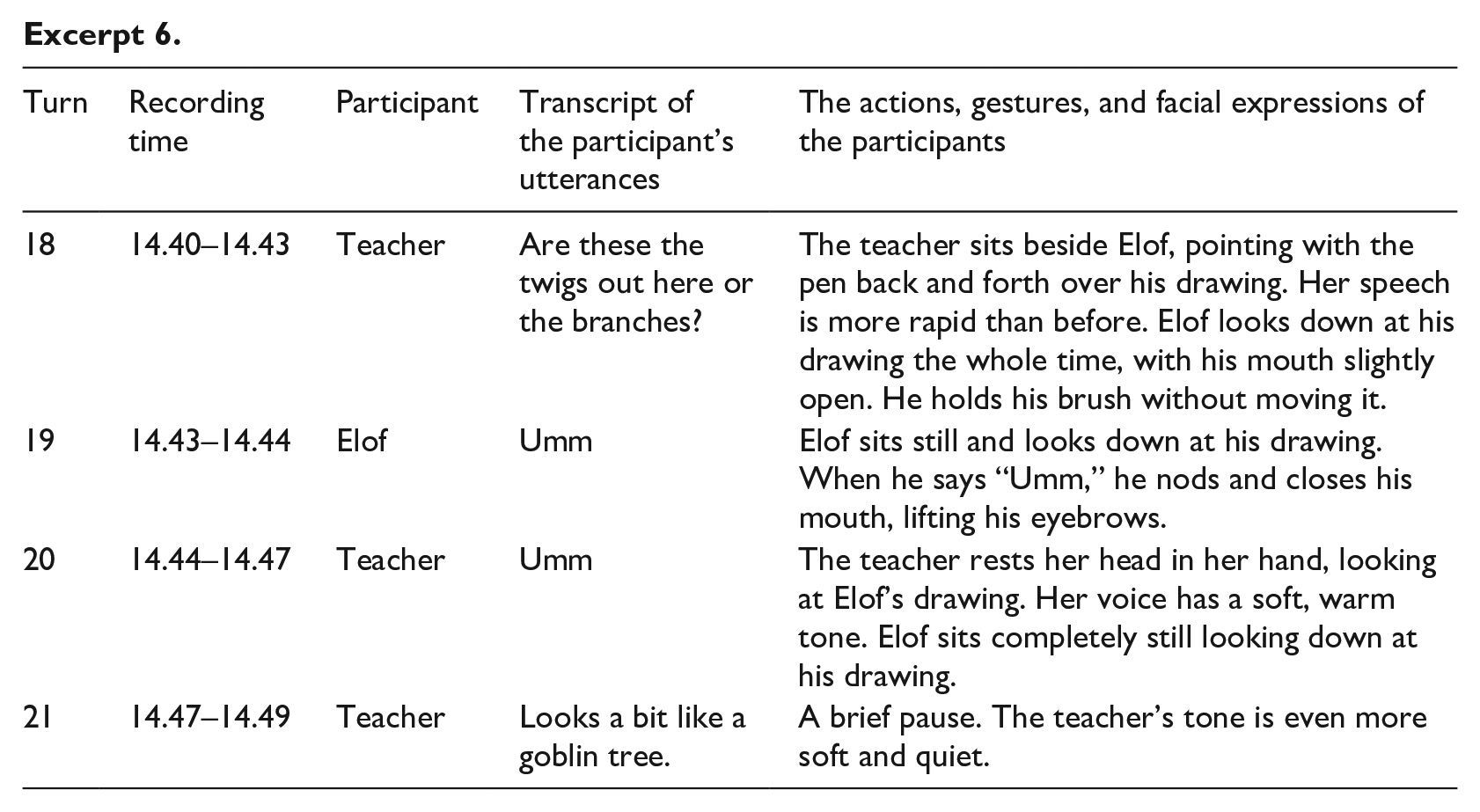
By pointing at Elof’s drawing and asking him if the “twigs” on the drawing are “branches,” the teacher establishes her definition of the activity. Elof’s lowered gaze and vague “Umm” instead of “yes” are interpreted as expressions of embarrassment (Retzinger, 1991). In earlier turns, he had stood by the fact that he had drawn a Santa, but now he has accepted the teacher’s description of his performance. In Turns 20 and 21, the teacher speaks more softly than before and sits near Elof, which we interpret as indications of pride (Aspelin, 1999); she is relieved that Elof has finally adapted to her expectations.
Concluding analysis and discussion
This study focused on social adaptation in preschool, particularly on how emotions contribute to conformity in goal-oriented activity, which will be discussed below, followed by an elaboration on how social adaptation can be understood in the light of the institutional context.
The role that emotions of shame and pride play in social adaptation in the activity
Scheff (1990) asks, “What is the process which leads us to conform, even when we do not wish to?” (p. 74). Through analysis on a micro level of a brief episode, we have explored conformity in practice, that is, how social adaptation is carried out in ongoing verbal and nonverbal interactions. On an “official” level, the goal-oriented activity is successful; the teacher and the child reach the expected result. However, beneath the surface of the interaction, they are probably left with mixed emotions.
The teacher has an explicit goal: She wants to document the activity in which the children have drawn trees. One child declares that he drew Santa. By various means, the teacher tries to make the child accept that he should draw a tree. The child defends himself and maintains that he is drawing Santa. However, step by step, the child adapts to the teacher’s agenda and finally responds positively when the teacher asks him if he has drawn a tree. The teacher does not use coercive means to make the child perform the task. Instead, a detailed analysis suggests the presence of the deference-emotion system (Scheff, 1990), an informal, subtle system of sanctions in which emotions play significant roles. This system appears to operate effectively. The analysis shows how social adaptation is achieved in practice, sequentially. The child seems to adapt to formal expectations not only in search of a cognitive consensus with the teacher but also to avoid the embarrassing feelings that follow from non-conformity. A large number of markers of shame (Retzinger, 1991) have been identified, but only a few markers of pride (Aspelin, 1999); the conversation is thus accompanied by feelings of shame rather than pride. Hypothetically, this study suggests that shame plays a significant role in promoting conformity in goal-oriented preschool activities.
The study illustrates the dilemma between the goal oriented, school readiness perspective and the care orientation that every preschool teacher confronts. The analysis has been neutral, in so far as it has not taken a position on whether the current social adaptation is motivated or not. However, the study inevitably raises questions about the extent to which teachers should pursue goal-oriented education. Where is the limit when children’s needs for care and creativity should be prioritized? This question is primarily directed toward policy. In practice, however, responsibility and pressure are placed on each individual teacher to handle the complexity of a predetermined, goal-oriented pre-academic education that will also create conditions for socioemotional development and creativity in preschool activities.
Social adaptation in light of the institutional context
As already highlighted, for the preschool teacher profession, it is challenging to navigate in a contemporary ECE that is framed by both a high-quality relationship with the children and increased academic expectations (Smith and Glass, 2019; White, 2020). The findings of this study should thus be understood as an example of how preschool teachers struggle to balance between emotionally supportive interaction and pre-academic teaching instructions in the intersection of the child-centered care approach and the school readiness perspective (Howes et al., 2013; Sheridan and Pramling Samuelsson, 2013). In line with Klusemann (2017), who argues that “what happens in the here and now of learning interactions emotionally is the key to understand successful and unsuccessful learning” (p. 13), this study illustrates how this challenging navigation is played out in interactions in situ. The analysis shows how the preschool teacher strives, by means of subtle, interwoven, and seemingly oblivious nonverbal and verbal expressions, to get the child to adapt to the institutional expectations played out in the predetermined activity. In this way, both the activity and the participants were adjusted to a goal-oriented structure. We argue that the function of the emotions of shame and pride in social adaptation needs to be understood and discussed in light of the overarching alignment with formal schooling and conformity to goal-oriented activities (Biesta, 2016; Uljens and Ylimaki, 2017). The educational discourse of conformity and the kind of socialization it entails are shown in our study and in previous literature to be challenging and stressful for both preschool teachers and children (Madrid and Dunn-Kenney, 2010; Morris et al., 2013; Sahin Asi et al., 2019; White, 2020). The tensions described in ECE between enabling academic development and creating conditions for socioemotional learning prove to be demanding in practice.
Limitations and future directions
This study uses a micro-sociological approach and is based on a small amount of data, which allows for analysis on a micro level of both verbal and nonverbal expressions. No claims are made for generalizability. We also acknowledge that expressions that occur in the social and natural world itself are ambiguous, which means that interpretations made, no matter how credibly and contextually substantiated, are approximations (Scheff, 1990). Nevertheless, studies with a micro-sociological perspective have not been pursued in the field of ECE to any great extent (Klusemann, 2017) and could contribute valuable knowledge on in situ teacher–child interactions. A few previous studies have focused on the role of emotions in interaction but have emphasized the importance of supporting children’s socioemotional development in a general sense (Ng and Bull, 2018; Sahin Asi et al., 2019; Zinsser et al., 2015). This study adds to the literature by showing the extent to which emotions are significant for understanding interactional patterns, while also pointing to an important direction for further research. We suggest that further research (i) adopt other models for analyzing emotions than the ones used above, to discuss the plausibility of Scheff’s theoretical framework in the preschool context; (ii) adopts other theoretical frameworks than Scheff’s to discuss social adaptation in preschool, for example in terms of power-relationships.
Conclusion
This study has contributed to research on ECE by discussing emotions in teacher–child interactions and how they can be understood in light of the current binary ECE discourse that frames institutional activities. Specifically, the study elucidated the functioning of an informal, subtle system of social sanctions within which the emotions of shame and pride play significant roles, leading to social adaptation to institutional goal-oriented expectations. The study also raises an important question about the way in which social adaptation is related to preschool teachers’ other assignments, such as the creation of conditions for children’s social-emotional development and learning.
In Sweden, preschool is not a mandatory school form and the children do not have goals to achieve; instead, the goal formulations are aimed at what the preschool practice should achieve (Swedish National Agency for Education, 2018). However, preschool practice is an interplay between children’s and teachers’ activities. Consequently, both children and teachers inevitably become involved in the goal management of preschools.
