



Abstract
This paper discusses self-efficacy as a key factor in children managing the transition to primary school, the threshold to formal education and further learning processes. In presenting results of a qualitative-longitudinal interview study of German preschool and primary school children’s perspectives on their self-efficacy experiences, it furnishes evidence for enhancing self-efficacy in pedagogical practice in a so-called mastery climate. Co-determined or self-determined opportunities for playing without adult intervention prove to be central in this to children’s self-efficacy. Following on from this, the discussion will make references to the pedagogical relevance of child-led or unsupervised play for the promotion of self-efficacy in both settings. In addition, based on the reflection of the concept of generational order, the study points to concrete starting points to focus on necessary didactic and methodological competences of adult educators for the appropriate design of child-oriented co-determined or self-determined learning settings.
Keywords
Introduction
Because they are structured by the national education system, transitions rate as highly standardized and normative in Germany. In particular, entering primary school from day care, which usually affects children aged five and six, represents the beginning of formal education in Germany as contrasted with the more informal preschool educational settings. This step can therefore also be regarded as foundational for further educational and learning processes in the school setting, making it a significant event in the biography of Germany’s children. Thus there is considerable interest in exploring how children can be helped to deal positively with the transition and the associated new, unfamiliar situations, making it a focus for national preschool and primary school education research from a resource-oriented perspective (e.g. Griebel and Niesel, 2011).
In this context, self-efficacy as part of personality (Haußer, 1995) plays a crucial role for children who feel empowered and able to act, have the can-do spirit to achieve and to persist and can attribute successes to their own competencies and efforts (in self-efficacy research, see e.g.Bandura, 1997; in German primary school research, see Hinz, 2011; in German childhood research, see Schneekloth and Pupeter, 2010; in resilience research see e.g. Wustmann, 2011). Since self-efficacy grows above all out of the individual’s own positively interpreted experiences of agency, knowing in which situations and contexts the children experience themselves as self-efficacious and what scope for agency they see for themselves is of particular interest for supporting self-efficacy development pedagogically. While the state of research on the transition from day care to primary school is quite good both nationally and internationally, to date the self-efficacy development aspect has not received sufficient attention. Therefore, in the present paper I set out to examine (1) which agency situations children perceive as self-efficacy experiences and how they describe them as they leave kindergarten and start their primary school years; and, (2) if and to what extent the children’s perceptions change after transitioning to primary school.
To answer these questions, the following article presents selected results from the underlying qualitative-longitudinal dissertation study, in which I collected the perspectives of preschool and primary school children on their self-efficacy experiences using a variety of methodological approaches. In this article I also present findings on the strategies children deploy for personal agency in interacting hierarchically with the adults in both types of institution and to what extent they perceive self-efficacy experiences in them. The results contribute to the international discussion on child-centred transition and institutional learning and the reflection on necessary didactic and methodological competences of adult educators for the appropriate design of child-oriented co-determined or self-determined learning settings.
The state of research
Defining self-efficacy
The assumption that experiencing efficacy has a positive impact is theoretically grounded in the self-efficacy theory developed by Bandura (1997). He explored how and to what extent the pre-action beliefs of individuals about their own planning and performance resources contribute to mastering a challenge (Bandura, 1997; first Bandura, 1977). In his efficacy beliefs–outcome expectation model, Bandura distinguished between self-efficacy beliefs and outcome expectancies. While pre-action universal outcome expectancies bring into focus the behaviour that individuals consider indispensable to achieving an outcome or that they expect to produce a specific result, self-efficacy beliefs instead relate to individual assumptions and beliefs concerning one’s own ability to behave or act in a way that achieves a personally desired result (Schwarzer and Jerusalem, 2002, 36). Bandura accordingly defines self-efficacy as ‘beliefs in one’s capabilities to organize and execute the courses of action required to produce given attainments’ (Bandura, 1997, 3). He argues that not objective competencies but subjective beliefs concerning both personal ability and possibility are decisive for a person overcoming a current or prospective challenge (Bandura, 1997, 21f.). From this perspective, the key factor to solving a complex computational task, for example, are not the actual mathematical skills, but rather the conviction that the individual’s own mathematical skills will suffice for solving the problem however complex within given parameters.
Sources and the range of self-efficacy
Subjective beliefs about one’s own abilities, personal efficacy and possibilities for developing individual potentials combine into an essential meaning horizon of self-efficacy. After Bandura, they rest in particular on the individual’s experiences of success and coping in social construction with others. Opportunities for having ‘personal mastery experiences’ (Bandura, 1977, 195) in particular exert a major influence on the development of conscious self-efficacy and sustainable self-efficacy beliefs (Bandura, 1997, 80). The huge relevance of one’s own experiences can be explained primarily by the fact that the information available for effecting a behaviour stems not only from externally observable processes but also from internal psychological ones (Mielke, 1984, 93). Self-efficacy and efficacy beliefs, besides being affected by one’s own agency experiences, are also influenced by the vicarious successes and coping of significant others (such as parents and friends; Bandura, 1997, 86), as well as (with lesser relevance) by verbal persuasion (Bandura, 1997, 101f.), and, finally, by one’s own physiological states (positive/negative arousal) while in action (Bandura, 1997, 106f.). How children link the different sources of information with each other and how exactly they then develop self-efficacy based on this needs to be considered in further research (e.g. Eccles et al., 1998).
The subjective perceptions of one’s own competence and the available agency possibilities can either refer to highly specific, limited aspects (situation- or domain-specific self-efficacy) or else denote a fundamentally optimistic stance (general self-efficacy; Schwarzer and Jerusalem, 2002, 39f.). In the school context, the self-efficacy of pupils relates, for example, to their expectations regarding school challenges (e.g. having to master certain math techniques), but general self-efficacy is all-encompassing and makes them optimistic about their personal coping skills (Schwarzer and Jerusalem, 200, 40). General self-efficacy and situational or domain-specific self-efficacy can interact in ways that, in the best case, exert a positive effect on children’s learning development (Bandura, 1997).
Influence of self-efficacy on learning and development processes
A review of the (inter)national state of research on how self-efficacy influences learning and development processes reveals that stable, positive self-efficacy beliefs contribute to survey subjects developing higher motivation, effort and persistence in learning and dealing more constructively with setbacks, regardless of their actual competencies (Schwarzer and Jerusalem, 2002, 36ff). For example, in Anglo-American studies of adolescents and young adults, self-efficacious individuals with the same ability as less efficacious individuals registered as more achievement-oriented and persistent. They were more ambitious, more effective at time management and brought greater strategic flexibility to problem solving. They also performed better, assessed their performance more realistically and were better at self-esteem enhancing causal attribution (Bandura, 1997; Schunk, 1995; Schunk and Swartz, 1993). Concerning the influence of self-efficacy on school performance, Mittag et al. (2002) in evaluating the German Self-efficacious Schools pilot project, confirmed that self-efficacy exerted a demonstrable positive influence on subsequent school performance by the surveyed secondary school pupils (Mittag et al., 2002, p. 161f.; see also Satow, 2002). Moreover, self-efficacy shaped their perception of requirements as challenges and the attribution of failures to external and labile factors instead of their own ability deficits (Schwarzer and Jerusalem, 2002, 36). These findings largely derived from surveys of young people and adults (see, e.g., the Schwarzer & Jerusalem research review paper, 2002). However, studies on the self-efficacy assessments of (older) primary school children (Frank, 2008; Schneekloth and Pupeter, 2010) also showed that those with higher self-efficacy beliefs took solution-oriented approaches to problems and exhibited less stress than children with weaker self-efficacy beliefs (Frank, 2008, 245f). They further noted similar positive effects of strong self-efficacy on confidence in the pupils’ own agency capabilities and potentials (Schneekloth and Pupeter, 2010).
Contextual conditions for self-efficacy experiences
Also, empirically documented as relevant for developing self-efficacy beliefs were mastery experiences and success as well as (context) conditions conducive to fostering self-efficacy. In particular, experiencing personal competence and efficacy as well as self-determination and social relateness 1 are instrumental in developing and stabilizing self-efficacy (Bandura et al., 1996; Krapp and Ryan, 2002; Satow, 2002). In describing the overarching construct of agency, Bandura connected conscious self-efficacy to the experience of self-determination. By agency he understands the need and the ability to experience the self as both vigorous and powerful, as well as acting in a self-determined, proactive manner (e.g. Bandura, 1997, 2001). For Bandura, both ‘the power to originate actions for given purposes [. . .]’ and ‘beliefs of personal efficacy [. . .] are the key factors of human agency’ (Bandura, 1997, 3). He also argued that individuals develop agency by having the ability and possibilities for acting in an intentional, largely self-determined way. Similarly, the forward-looking formulation of positive expectancies figures as an essential element in the development of personal agency (Bandura, 2001, 6ff.). In particular, self-efficacy is assumed to be closely interwoven with experiences of competence and autonomy in older children or adolescents, which is also reflected in the construction of scales for recording self-efficacy in adolescence (Bandura et al., 1996, p. 1210ff).
For preschool and primary school settings and the thus focused target group, the theoretical concept of generational order points out the relevance of reflexion on adult-orientated circumstances of society and adult-led interactions especially in pedagogical settings and their effects on fostering or inhibiting children’s ability and possibilities for acting in self-determined ways (e.g. Bühler-Niederberger, 2011; Christensen and Prout, 2002). On basis of empirical findings on effects of generational order on children’s self-determination it can be assumed that, in addition to experience self-determination, the perception of different degrees of co-determination, following Hart (1997) defined as range from limited to extended participation, seem to be relevant for the experienced scope of action of young children (e.g. Mayne et al., 2018). With regard to German primary school children between 6 and 11 years, the authors of the World Vision studies (2010, 2013, 2018), for example, repeatedly emphasize the importance of limited up to extended co-determination in school processes (e.g. having a say in classroom design (smaller scope) or co-determination of lesson content (wider scope)) for the promotion of self-efficacy at primary school age (Pupeter and Wolfert, 2018, S. 93f.). In terms of specifying basic psychological needs, it can be conjectured from this that satisfying what is an essential need of primary school children, subjectively experienced co-determination of different scope or degree, enhances their self-efficacy. 2 Thus, the basic psychological needs for experiencing competence and self-determination (and more specifically, co-determination as another relevant need for primary school children) as well as the experience of social relatedness can be postulated as essential sources for developing and experiencing self-efficacy.
However, the results to date do not answer the following questions: Does the self-efficacy of preschool and primary school children change in transition and, if so, to what degree? How do positive self-efficacy beliefs of children in the transition affect learning and development processes? Under what (context) conditions do children perceive agency situations as self-efficacy experiences and (co-)shape them? What is lacking here are studies on self-efficacy assessments and experiences from the perspective of the children themselves. Moreover, the few extant studies focusing on the self-efficacy of preschool and primary school age children are primarily cross-sectional and/or they survey significant adults such as parents or teachers about children’s self-efficacy (e.g. Schneider, 2005). However, this approach was considered unsuitable for the study on which this paper is based, because, for one, it can be assumed that self-related cognitions such as self-efficacy can hardly be gauged from outside (by others). For another, we can start from the premise based on research into cognitive and linguistic development that preschool and primary school children are quite capable both cognitively and linguistically of self-reporting on their competencies and capabilities (Müller et al., 2015; Piaget and Inhelder, 1973). Moreover, a survey of self-efficacy covering a longer timespan during the transition period seems particularly well-suited for gaining insights into changes in self-efficacy during this stage. This dictated taking a longitudinal perspective for studying the development of self-efficacy.
Methods and materials
In line with assumptions about the self-efficacy construct, previous empirical research findings and the formulated desiderata, the underlying dissertation project sought to investigate both the children’s self-efficacy experiences (their perceived experiences of coping and success derived from past situations) and their self-efficacy beliefs (their subjective beliefs in their ability and anticipated possibilities of future agency situations) (Velten, 2020). To this end, I devised a methodological approach based on current childhood research that enables collecting children’s perspectives using different longitudinal methods. It yielded the following study design (see Figure 1).
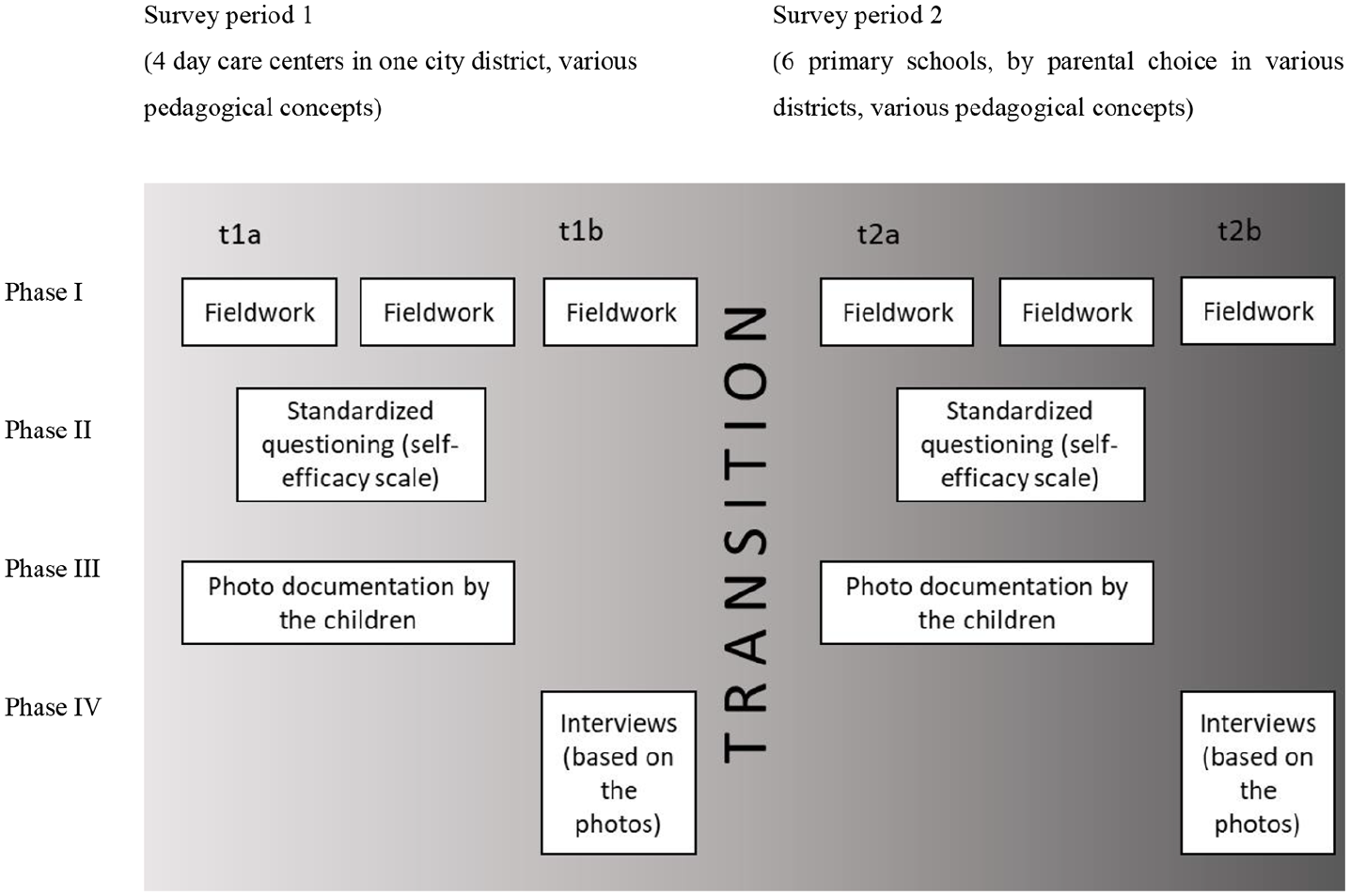
Study design (Velten, 2020, p. 115ff.).
The paper addresses agency situations experienced by the interviewed children as ones of mastery and success, that is as episodes of self-efficacy. The underlying study accordingly focused on the following research questions:
As they finish kindergarten and then enter primary school, which agency situations do children perceive as self-efficacy experiences and how do they describe these?
Do the situations described as self-efficacy experiences differ before and after the transition, and, if so, how?
To answer these questions, I relied on selected findings from analysing the interview data obtained in Phase IV of the study design. Due to this focus of the paper, other data collected, such as the standardized self-efficacy scale data and the methodological approaches to their analysis, are mentioned to give an overview of the underlying project, but are not presented in full (further information see Velten, 2020).
Sample
During two survey periods between March and November 2013, 22 3 children were asked about their self-efficacy beliefs and experiences. Convenience sampling in a North Rhine Westphalian city district, characterized according to the local statistical report 4 by diverse living conditions and population mix, yielded a sample covering a varied set of socioeconomic and cultural growing-up and living conditions. About 7 girls and 15 boys participated in both study survey periods. During the first survey 5 , their ages ranged between 5.8 and 6.7 years. Nine children (three girls and six boys) volunteered that they spoke a second language (Russian or Turkish) at home in addition to German. The day care centre records of three children (one girl, two boys) indicated a presumptive special educational need. 6
Data collection
The data was collected in four phases during both the first and second survey periods. Phase I encompassed field stays for familiarization with the day care facilities and primary schools and getting to know the children.
In Phase II, approximately 4 months before and after the start of school, the participating children were asked about their self-efficacy beliefs, using an age-group appropriate self-efficacy scale (see Supplemental Appendix 1). 7
In Phase III, using the photo-voice technique (Clark and Moss, 2011), the participating children were asked during both survey periods to record their self-efficacy experiences in photos taken with a disposable camera. The task for the children was: ‘Photograph what you think you do particularly well here in the day care centre/school and what you can (co- or self-) determine’. Pairs of participating children shared a disposable camera good for 24 shots. In this phase, the children were free to choose their subjects; they could take pictures at any time albeit in consultation with their teachers.
In Phase IV, following Fuhs (2012) at both survey dates the participating children were also queried individually about their self-efficacy experiences 8 in guided interviews to maximize the comparability of responses. The interview prompts and questions were narrative generating to facilitate individual conversations with the participating children and help them unfold the desired subjective perspectives. The photos that the children had taken earlier relating their experiences in both institutions served as entry points to the interviews and for giving them a structure. 9 So, for example, the first narrative prompt was ‘Please pick a photo that shows really well where you could (co)determine / (co)decide. Tell me exactly what happened in it’. An analogous question was posed about competency experiences that they might have photographed. Because things and situations relevant to the children as self-efficacy experiences might have been difficult to capture in a photo, the children were also asked if they remembered any such episodes. In addition, narrative prompts addressed potential sources of information that spoke to the children about their self-efficacy, feasible agency strategies, resources and a prospective or retrospective comparison of the situations in day care centres and primary school. Lastly, the surveyed children were prompted to switch to a general perspective and to give voice to their near-term goals and expectations (interview schedule see Supplemental Appendix 2).
Consistent with findings on the cognitive, linguistic and personality-related development of children in middle childhood, alternate means for communicating were employed during the interviews to help the children express their perspectives. These included supplementary materials such as wooden figures that let the children restage the situations experienced and a timeline with photos of the respective interviewed child’s day care facility or primary school designed to help them visualize the course of the transition as well as the twin contexts of day care facility and primary school.
Analysis
The SPSS statistical software was used to perform a descriptive analysis of the survey based of the self-efficacy scale, with due consideration for the limitations imposed by the sample size. The results of the descriptive analysis which includes the analysis of possible gender effects on the perceived self-efficacy of boys and girls are not presented in the current paper because of the focus on the qualitative data analysis and results. 10
In analyzing the interview data, I first performed a content-structuring analysis after Kuckartz (2014) on the main categories derived deductively from the interview guide (e.g. the top-level category ‘agency strategies’) and on the sub-categories derived inductively from the children’s statements (‘then I practice it’; Leo, 11 day care centre, cit. 172; ; e.g. the subcategory ‘training and practicing’) using the MAXQDA software. This evaluation served to identify overarching agency experiences and possibilities of most of the children surveyed. In order to reflect on the unbalanced sample the categorization was also checked for possible gender effects in the analysis and summary of the results using MAXQDA. 12
The content-structuring analysis was complemented by a sequential analysis of four selected cases following Schütz et al. (2012) that focused on the entry, exit and selected interview sequences with significance for answering the research questions. Two girls and two boys were selected in each case study in order to balance out possible imbalances in the overall sample with the in-depth view of the sequential analysis. Beyond the content level, on a methodological level, the sequential examination and analysis offered the opportunity for reflecting on the formation of the interview duet as well as the co-construction between the interviewer and the interviewed child. Neither the interviewed children’s photos nor their play with wooden figures during the interviews were subjected to a separate evaluation, being included in the contentual and sequential analyses instead.
Discussion
Self-efficacy experiences of children in day care and primary school
Based on selected results of the interview analysis, discussed below are the situations and contexts the children themselves experience as efficacious and what scope for agency they see for themselves in them. Further, the discussion delves into whether and to what extent differences and similarities between the day care and primary school contexts manifest themselves in these reported self-efficacy experiences. In order to take into account possible gender effects in the description of the self-efficacy experiences and possible differences between the two survey dates, the content analysis also looked for gender-specific differences. Although this analysis revealed differences in the concrete experiences described, these were described by the children interviewed in terms of comparable framework conditions and with comparable accounts. Thus the results of the present analysis do not provide any clear indications that the children interviewed in this study describe different self-efficacy experiences with regard to their gender. Due to this and to consider the limitations of the sample size and the specificity of the qualitative approach of content and sequential analysis the presented results were chosen to stand exemplary for most of the children’s perspectives surveyed, but do not stand any representativity of children’s perspectives on self-efficacy experiences in the transition to primary school in Germany.
Play is the key context for self-efficacy experiences
Central to the self-efficacy experiences of all children surveyed – regardless of higher or lower self-efficacy beliefs as determined by the self-efficacy scale – is the (co-)shaping of their scope for agency while playing.
In the day care centre, the children interviewed mostly named organizational aspects of playing. ‘What I play’ (Lars, day care centre, cit. 148), ‘who is allowed to play with me’ (Vitus, day care centre, cit. 117) or ‘which vehicle I would like to have’ (Michel, day care facility, cit. 205) mattered to them as situations in which to experience essential self-efficacy. Occasionally, the children also identified the scope for agency they see for (all) children: ‘And otherwise, the children in kindergarten can decide for themselves what they want to play’ (Luis, day care centre, cit. 91).
In primary school, the children surveyed also experienced self-efficacy in the cited organizational aspects of playing. In contrast to the first survey period, however, in describing their self-efficacy experiences the children focused on the order in which they (also together with other children) negotiate and bargain for the play processes – and with them, their possibilities for self- and co-determination. Key for them were justice-oriented principles such as choosing by counting off and taking turns, but also other heuristic strategies including talking it over or agreeing among themselves: ‘That is, no one tells us what to do. So, we arrange it, say, like that’. (Vitus, primary school, cit. 153). Correspondingly, during the second survey period, it emerged that negotiating and bargaining for their scope of agency is crucial to the children’s self-determination and co-determination opportunities, hence their self-efficacy experience. Within the narrative passages, the children in primary school also link their own self- and co-determination experience to the places and times for play. Luis, for example, reports on the connection between playing and recess this way: ‘Yes, during play recess, then you are free to choose what you want to play’
(Luis, primary school, cit. 233f).
Important framework conditions for self-efficacy experiences: Self-determination and absence of adults
The interviews accordingly served to identify the framework conditions that appeared decisive for whether and to what extent the children experienced themselves as self-efficacious during play. Instead of being initiated by adults, the agency situations they described as self-efficacy experiences involved a high degree of self-initiative and self-determination, both in the day care centre and in the primary school, as Vitus explained during the first survey: ‘Umm (2)
How children act in the presence of adults: Asking for and getting permission, raising your hand and getting a turn
The children interviewed described their actions in day care and primary school when adults are present against the background of how they interpret the generational and pedagogically-ordered relationship with them – because, as Arnold explained ‘in kindergarten [. . .] the teachers are the ones who decide; everyone sure knows that’ (Arnold, day care centre, cit. 192). In doing so, the children employ certain mechanisms or strategies for co-constructing the classroom hierarchy. During the first survey period, the children mostly mentioned the ‘asking for and getting permission’ mechanism: ‘Yes we are allowed to go outside, but first we must ask [. . .] if they [the teachers, KV] say no, we can't, but if they say yes we can go outside’ (Adriana, day care centre, cit. 309ff).This was Adriana’s way of saying that she knows the educators have ‘the last word’; they ultimately decide where children can be in the day care centre. From her perspective, children therefore are subordinate to the decisions that adults make (for or about them). At the same time, the first part of her statement suggests that the children (‘we’) conform to expectations in the existing hierarchical order between themselves and the adult teaching professionals (‘Yes, we are allowed to go outside, but first we must ask’; that is, the children ask the adults for permission). Hence, they act according to the socially constructed rules within the generational and pedagogically-ordered relationships inherent in the educational institutions.
Among primary school pupils interviewed, the ‘asking for and getting permission’ turned increasingly into the ‘raising your hand and taking a turn’, as exemplified by this quote: ‘You have to have to
How children stake out their own scope for agency vis a vis adult: By not listening and by acting up
Especially during the second survey period, the children interviewed also described action strategies for creating scope for agency in the presence of adults. As ‘not-listening’ or ‘acting up’ they describe, on the one hand, certain situations in which they thwart the adult agency enabled by the generationally and pedagogically ordained relationship. The stories make clear that children who refuse to listen or who act up seize and defend scope for agency independently or even in disregard of the adults either granting or withholding permission. However, some of the children surveyed also differentiate between outside (in the schoolyard) and inside (in the classroom), as Melinda makes clear: ‘There [in the classroom, KV] we don't act up so much. Umm, there we study more than goof off [. . .] outside we are allowed act up but not inside’. (Melinda, primary school, cit. 81ff). On the other hand, it also appears that both the designation of ‘acting up’ and the distinction between ‘allowed outside’ and ‘not allowed inside’ also depend on a) how the children interpret the hierarchical relationship with the educators and b) on the interpretation inherent therein of the children's self-determined actions as behaviour that does not live up to expectations (‘acting up’). By characterizing their own actions as either ‘acting up’ or ‘not listening’ the children in a sense still legitimize and manifest the hierarchical relationship (and the applicable rules that come with it).
Conclusions and implications for the reflection of didactic and methodological competences of adult educators
In answer to the central questions in the present article about the self-efficacy experiences of preschool and primary school children, the analysis of the interviews showed that situations and contexts seem to be particularly relevant when from the children’s perspective they enabled self-determined actions. The children interviewed both in day care and primary school became aware of these experiences especially in self-initiated play situations during free play or recess. Self-efficacy enhancing play, as highlighted in their accounts, seems to have taken place mainly during the day care and primary school day, whether the children acted alone or in groups. In group time or in class, however, the children interviewed saw opportunities for initiating self-determined actions but not for themselves.
Furthermore, the present results also clarify Bandura’s (2001) assumptions about the importance of self-initiative, self-determination and co-determination for experiencing self-efficacy and for developing agency: for both preschool and primary school children, not only do self-determination and co-determination as well as self-initiatives seem to be relevant for them to experience self-efficacy in both day care and primary school but also, and especially, the absence of, or independence from, (more powerful) grownups. In sum, the hierarchical relationship between adults and children in particular seems to be highly detrimental in both institutions, as perceived by the children in the mere presence of adults or, more to the point, in what they perceive as an inherent adult intervention potential. These findings complement the results of the second World Vision Study (2010) and underline the relevance of opened, open and decentralized educational settings for self-determined learning that are designated, after Satow (2002), as day care and primary school mastery climates.
But what are the pedagogical framework conditions of such a mastery climate and what didactical and methodological competences are needed by adults in their empowered position and role responsible for learning? How could we approach these questions from an ethical perspective on the adequacy of the design of child-oriented co-determined and self-determined learning settings? Further to the results presented here, it can be assumed that particularly the opportunity for (free) play and its valuation in group time and class will turn out to be a suitable key for the children’s self-efficacy experiences and subsequently for the development of educational settings oriented on (free) play criteria such as play as an end in itself, child-orientation and child-directedness and a more supportive and guiding role of the adult. These findings are in direct line with findings on the presence and absence of adults and their effect on children's metacognitive learning processes or the educators’s understandings of play and its relationship to learning (McInnes et al., 2011; Robson, 2016). In her analysis, Robson (2016) emphasizes the potential of supportive adult engagement in child-oriented and child-directed play situations in educational settings. McInnes et al. (2011) point to the potential of a clear understanding of play and learning to create ‘a range of adult-led and child-led activities, participat[ing] with children in all their activities and engag[ing] in pedagogic interactions that afford children choice and control’ (McInnes et al., 2011, 131). Following Robson (2016) and McInnes et al. (2011), the overarching focus of the results presented here is to find out exactly to what extent such adult engagement would be appropriate for play and how the pedagogical accompaniment of adults could be concretely designed against the background of their roles in educational settings and the hierarchical asymmetry of children and educators (Christensen and Prout, 2002). Furthermore, from an ethical perspective, with regard to the recognition and appreciation of play itself, it is a question of which methodological and didactic competences the adults need for this. In this context also, calling for reflection is the extent to which these educational settings can be designed without over-educationalizing play situations. In particular, reflecting on one's own adulthood and the goals set and pursued from an adult perspective in institutionally anchored and pedagogically guided learning situations could be a way to further develop the didactic and methodological competences of practitioners, but also researchers.
Supplemental Material
sj-docx-1-ecr-10.1177_1476718X211051192 – Supplemental material for Self-efficacy experiences in day care and primary school from the children’s perspective: A starting point for the reflection of didactic and methodological competences of adult educators
Supplemental material, sj-docx-1-ecr-10.1177_1476718X211051192 for Self-efficacy experiences in day care and primary school from the children’s perspective: A starting point for the reflection of didactic and methodological competences of adult educators by Katrin Velten in Journal of Early Childhood Research
Supplemental Material
sj-docx-2-ecr-10.1177_1476718X211051192 – Supplemental material for Self-efficacy experiences in day care and primary school from the children’s perspective: A starting point for the reflection of didactic and methodological competences of adult educators
Supplemental material, sj-docx-2-ecr-10.1177_1476718X211051192 for Self-efficacy experiences in day care and primary school from the children’s perspective: A starting point for the reflection of didactic and methodological competences of adult educators by Katrin Velten in Journal of Early Childhood Research
Footnotes

References
Supplementary Material
Please find the following supplemental material available below.
For Open Access articles published under a Creative Commons License, all supplemental material carries the same license as the article it is associated with.
For non-Open Access articles published, all supplemental material carries a non-exclusive license, and permission requests for re-use of supplemental material or any part of supplemental material shall be sent directly to the copyright owner as specified in the copyright notice associated with the article.
