




Abstract
It is widely accepted that play and ‘free play’ in particular, is beneficial to young children’s holistic development. However, there is a lack of evidence of the role that the natural environment can have in relation to young children’s play. This study examined the elements of ‘free play’ of children aged 4–5 years within a woodland university campus setting. The children chose to wear camera glasses which recorded both the gaze and speech of the individual. This provided a valuable insight into the ‘free play’ of the children and provided a rich data set to enable the development of an analytical framework which maps out the interactions which took place during the ‘free play’ within the woodland environment. Results showed that the children engaged in six key interactions including interactions with the natural environment as part of their play, including the use of sticks, leaves and branches as tools and props ‘as is’ (i.e. in its current form) and ‘as if’ (in conjunction with children’s imaginations). The framework highlights key aspects of their play which tended to be autonomous, child led and imaginary. Recommendations for future research include the use of the framework in alternative environments to explore the impact of different physical environments on the interactions of children within their ‘free play’.
Introduction
An increasing number of research studies have used the concept of affordances in outdoor play in natural surroundings (Gurholt and Sanderud, 2016), but there is a paucity of such work in woodland settings. Originating in ecological psychology, Gibson (1979) outlined a theory of affordances where the person and the environment are mutually linked. This idea has been adopted in many different disciplines, but we adopt Little and Sweller’s (2015) definition as ‘actionable properties between the world and an individual, in other words, features of the environment that invite us to do something or to undertake a particular action (p. 337).’ These properties are the actual or perceived properties of an object, and different people will see, or not see, different affordances, which may change as a child grows (Lerstrup and Konijnendijk van den Bosch, 2017). In this context, play allows a unique opportunity to explore the latent affordances in an environment (Stordal et al., 2015). This is, perhaps, especially true of free play in a woodland setting with the many opportunities to incorporate the affordances of many natural ‘loose parts’ (Waters and Maynard, 2010: 473) into play. Ergler, Kearns and Witten (2013) exemplify this when they state that ‘Objects, for example, may afford possibilities of throwing, hiding behind, hanging or falling from, whereas surfaces may afford running, climbing, balancing or tripping. How, and to what extent, an action is carried out depends, however, on what the individual child perceives in the environment and how they evaluate its possibilities for action’ (p. 179). Sharma-Brymer and Bland, (2016) highlight the potential benefits of recognising affordances in natural settings as this ‘may increase children’s interest in physically active behaviors’ (p. 955) and ‘provide opportunities for children to actualize active behaviors’ (p. 960). Heft (1988) highlights the intrinsic link between recognising the functionally significant properties of the environment and person-environment interactions. In this sense, play provides an ideal opportunity to test the perceived affordances of an object (e.g. a branch) by physical interactions (e.g. standing on the branch and finding it bounces). Heft also makes the helpful distinction between superordinate and subordinate functional categories, using the example of ‘climbable features that afford looking out’ being a subset of ‘climbable features’.
Such distinctions are useful in building an analytical framework for conceptualising free play in outdoor woodland settings, which is the focus of this paper. We based the study on a series of premises namely: there is ‘overwhelming’ evidence of the benefits to health and wellbeing of free play ( Sharma-Brymer and Bland, 2016); that play is an intrinsically beneficial activity, as amongst other things, it ‘helps children develop intrinsic interests and competencies, exert self-control, and follow rules, helps them to learn to regulate their emotions and make friends’ (Ionescu, 2019, no page) and, finally, that play is a right for all children (United Nations, 1989). Free play is, however, a contested label. At one extreme, Leggett and Newman (2017) contend that free play is a myth, as a child’s play always has a focus on something. Kos et al. (2015) define free play as ‘child-initiated play with as little teacher interference as possible’ (p. 28). Karlsen and Lekhal (2019) contend that free play is a good foundation for learning, and as a consequence, children need adult support during free play. We suggest, however, that free play should not be considered primarily as a support for learning, but should rather be when ‘children have power over their play and control it’ (Synodi, 2010: 186). Indeed, a key attribute of children’s free play is that ‘no-one is trying to teach anyone anything’ (Hakkarainen, 2006: 188). We suggest that any form of teacher, or other adult, interference in free play is problematic, if the play is to be described as ‘free’. Some of the interference is well-intentioned, and often driven by a culture of risk aversion, particularly in western countries (Sandseter et al., 2012: 168), particularly in outdoor settings, such as woodland (Connolly and Haughton, 2017). Nevertheless, the end result is that ‘the forms of agency that children enact in free choice and free play activities are different from those sanctioned by adults, or advocated within child-centred discourses’ (Wood, 2014b: 7).
In moving to natural settings, such as woodlands, Gomboc (2016) identifies a strong connection between free play and the Norwegian concept of friluftsliv (literally free-air-life). This involves ‘roaming and experiences of closeness to nature for pleasure, adventure and self-cultivation, ideally on nature’s own terms,’ (Gurholt and Sanderud, 2016: 319) or, more simply, ‘doing activities in nature’ (Jørgensen, 2018: 491). If one of these activities is play, it is inevitable that the affordances of the natural environment will add to the ludic nature of this play, if children are allowed the freedom to explore freely. In addition, play in the outdoors also helps to (re)connect with nature (Barrable and Booth, 2020).
In the current study, we adopt Santer et al.’s (2007) definition of free play as (p. xi): … children choosing what they want to do, how they want to do it and when to stop and try something else. Free play has no external goals set by adults and has no adult imposed curriculum. Although adults usually provide the space and resources for free play and might be involved, the child takes the lead and the adults respond to cues from the child.
This definition, however, does not exemplify what such free play may look like. The current study provides a detailed framework of the key elements of free play with young children in a woodland setting.
Methods
The research project was part of a series of seven weekly Forest School sessions facilitated by university staff. It involved 15 children (girls n = 9; boys n = 6) in reception class (aged 4–5 years) coming to a two-hectare woodland on the outskirts of a university campus. Each weekly session ended with a period of 30 minutes free play. In an attempt to capture naturalistic data from children during this free play, very small, high-definition cameras were worn by some of the children, built into glasses frames. Parental consent was gained and each child gave assent at the start of the project. In addition, each child was free to choose whether to wear a camera each week and for how long. The majority of children chose to wear the camera for the duration of the free play session. Where a child chose to stop wearing a camera during a session, this meant less data was collected but ethically, they maintained their voice in the research process (Beauchamp et al., 2020). Table 1 below shows the number of children who wore cameras each week.
Number of cameras worn each week.

It was important that the activity was repeated each week to enable children to become used to the cameras, and evidence from the video footage suggests that most children quickly ignored their presence. These cameras gave a unique child’s-eye view of their play and their interactions, with each other and with the environment. In addition, researchers made contemporaneous, free flowing fieldnotes based upon observations of children who chose to play in sight of an adult. These field notes were unique to each researcher and were written whenever ‘one muses on the process, findings, problems, patterns, and so on of the study’ (Brodsky, 2008: 342). The adults were positioned at the outskirts of the woodland area and at the log circle in the centre of the woods.
The choice of video data reflects its growing use in education research (Schuck and Kearney, 2006), including video stimulated reflective dialogues (Adams and Beauchamp, 2018); video stimulated accounts with young children (Theobald, 2012), video diaries (Jones et al., 2016), adult-child interactions in the early years classroom (Fisher and Wood, 2012) and free play in the classroom (Hall-Kenyon and Rosborough, 2017). This use of video is based on the fact that it provides ‘a temporal and sequential record, offering information about an event as it unfolds moment-by-moment whilst preserving the simultaneity and synchrony of interaction’ (Cowan, 2014, p. 6), which is particularly important in trying to capture the spontaneous play of young children. However, we acknowledge that visual researchers must ‘be wary about lapsing into naïve empiricism’ (Motzkau, 2011: 107) as ‘assuming film images contain a singular meaning is problematic’ (Elwick, 2015: 325). Therefore, the analyses of the films followed a rigorous process of thematic analysis.
Analysis
The analysis followed Braun and Clarke’s (2006) six phase approach. It is important to note, however, that this process was not strictly linear, as it was ‘an iterative and reflective process’ that developed over time and involved ‘a constant moving back and forward between phases’ (Nowell et al., 2017: 4). In order to establish ‘trustworthiness’ (Lincoln and Guba, 1985) during each phase of the thematic analysis, we maintained a ‘methodological self-consciousness’ by examining and questioning the meanings we made, and the actions we took, ‘each step along the way’ (Charmaz, 2017: 36). As no significant gender differences emerged in this analysis, the results are reported for the whole group.
As there was a significant amount of video data, it was important to allow the multiple lenses of the research team to contribute, but also to ensure rigour in the analysis. As it was important to allow children to become used to the cameras and their surroundings, the initial focus was on one week near the end of the project, before comparison with other weeks later in the analysis. Nowell et al. (2017) outline clear means of establishing trustworthiness at each stage of the thematic analysis, which were followed during the video analysis. For the first phase of Familiarisation with the data, three of the researchers each transcribed allocated video footage. This was initially done with the sound muted so that the focus was on the movements and actions of the children. The spoken language was then added to create comprehensive transcripts. To ensure consistency, all the research team then viewed a single video together and undertook independent inductive coding of what the children were doing. Following this, discussions established consistency and agreement upon preliminary codes. Researchers were then assigned different films, complete with transcripts, to view independently using the agreed preliminary codes (deductive), but also noting any new codes that emerged (inductive). Each researcher viewed the film clips multiple times to familiarise themselves with the data. Following this, during Generating initial codes phase, the researchers then discussed their analyses to enable researcher triangulation (Nowell et al., 2017). Coding was agreed and an initial coding framework was established. During the next Searching for themes phase of analysis, the wider team of researchers were assigned further films to view and analyse independently. The emerging coding framework informed, but did not dictate, the analyses as the researchers engaged in continued ‘open-coding’, allowing the possibility of seeing new patterns in the data. The team then met again to ensure triangulation, which happened throughout the process. Throughout these team meetings, diagrammatic software was used to make sense of the connections during the various iterations to categorise the codes into themes. Using continued viewings, the team continued Reviewing themes which were tested for ‘referential adequacy’ (Nowell et al., 2017) by watching the films together. Eventually, as no new codes or themes emerged, the team arrived at a consensus in the Defining and naming themes phase of the analysis, ready for the Produce the report phase below.
Results
The analysis identified six key themes, all centred on various interactions. These interactions are shown below and an overview of each will be provided leading to a final framework. They are not considered as hierarchical in nature, nor are they considered to be discrete:
Interactions: With environment With self With affordances With peers With adults With time
Key elements of each theme will be discussed with examples provided. All elements of a theme are listed in the figure accompanying it.
Interactions
Interactions with environment
The children engaged with a range of aspects of the physical environment, including trees, the undergrowth, the woodland floor, as well as branches, sticks, leaves and insects. Their interactions ranged from being those with nature ‘as is’ (e.g. a stick as a stick), to others in which nature became or was treated ‘as if’ something or somebody else (e.g. offering a stick as a ‘baby present’, pretending to eat leaves). The former represented interactions which might be described as ‘real’, whilst the latter represented interactions which occurred in conjunction with children’s imaginations.
Children’s interactions varied from those with physical contact (e.g. holding a branch, hitting a tree trunk with a stick, lying on the ground), to those without (e.g. stepping over a log, looking into undergrowth, ducking under a branch). Sometimes, travelling around the environment had an identifiable purpose (e.g. climbing on/off a branch, walking on the path in search of a stick), whilst on other occasions children’s movements represented travel per se (e.g. walking/running on the path). Similar distinctions were evident in children’s handling of woodland objects. There were instances which conveyed intention on the part of the children, (where, for example, children speared leaves with a stick or inserted a stick into the ground), whereas the frequent tendency to hold or carry sticks did not always have a detectable intention. Nevertheless, video evidence (e.g. in relation to what could be observed and from what children said and/or did) indicated that the dimensions and number of the sticks that children had or sought had some significance. For example, children talked about finding a ‘bigger’, a ‘thick’ or ‘another’ stick and they were seen to be carrying long and/or multiple sticks.
Children’s engagement and interactions with the physical environment could be characterised as: with or without force; direct or indirect contact; and small- or large-scale movements. For example, hitting a tree or throwing sticks represented forms of interactions using physical force; whereas sitting on a branch, and letting go of leaves, represented actions without force. Some of the contact with the physical environment was direct (e.g. picking up debris from the woodland floor); whereas on other occasions the contact involved using sticks as tools to make indirect contact (e.g. clearing a patch of the woodland floor). Children’s actions such as placing, pulling or picking up leaves represented small-scale movements, whereas actions such as running or falling on the woodland floor represented large-scale movements.
Children also encountered insects and mollusks, including a bee and a slug. Such encounters with living creatures prompted conversations amongst children as they commented on the types of creatures found and whether they liked them (or not). They also suggested (and fulfilled) possible actions: All three girls are looking at the ground as one girl moves soil with stick. GG says, ‘Where is it?’ PCG says, ‘We don’t like it.’ GG says, ‘We cats don’t like it, we kill it.’ . . . PCG says, ‘Where is it?’ GG says, ‘It’s dead, I killed it.’ PCG ‘Good.’ GG ‘With my hammer. . .
There seemed to be two distinct ways to be within the space and place of the woodlands. One was to be in a specific ‘place’, with associated meaning and play. This is where children remained in one place for longer durations of time and tended to repeat the same play patterns / stories within that area. Sometimes the movement of a child into, or along, a space was limited by the actions of another child barring a space, invoking responses such as: ‘No, only cameras allowed’; or ‘Only if you be a cat, you allowed’. Response ‘Meow’. The second way of using the space was to move around (running or walking), either individually to look at and/or engage with a range of others, undertaking conversations or play for short periods of time. This way of moving was often accompanied by noise or words. Some children used space in both these ways, such as being settled in a place with imaginary group play, interspersed with periods of movement through space, then coming back to the original ‘place’. An overview of the forms of `interactions with environment’ are provided in Figure 1 below.
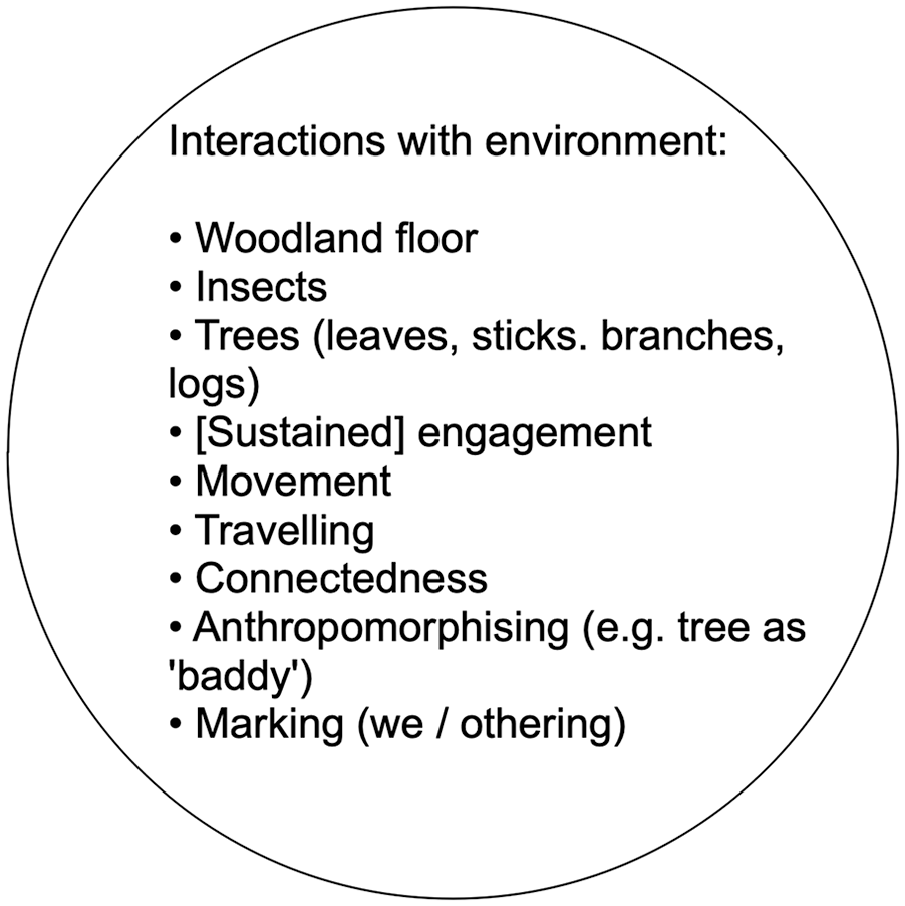
Interactions with environment.
Interactions with self
Some children spent time in their own company. These children tended to narrate to themselves relating to their ongoing play, talking around actions or thoughts. These interactions with self, tended to be either instructions or observations. Often the narrations were children telling themselves what to do for example: ‘Got to catch a fish in your [my] tummy’. There was also use of a range of vocalisations including repetition, melody, tonal manipulation, exaggeration and imitation. For example, child GC vocalises a repeated ‘Da,da,da,da,da,da,da’ and later can be heard singing a melody to herself, ‘noo beenoorob’. Child G1 vocalises ‘ner, ner ne, ner, ne’ manipulating the tone of the ‘ne’ vocalisation by changing the pitch. Later, G1 uses exaggeration in musical dynamics whilst vocalising ‘de la de la de lat’ and makes a loud ‘brrrruuumm’ vocalisation as if imitating an aeroplane noise. An overview of the forms of `interactions with self’ are provided in Figure 2.
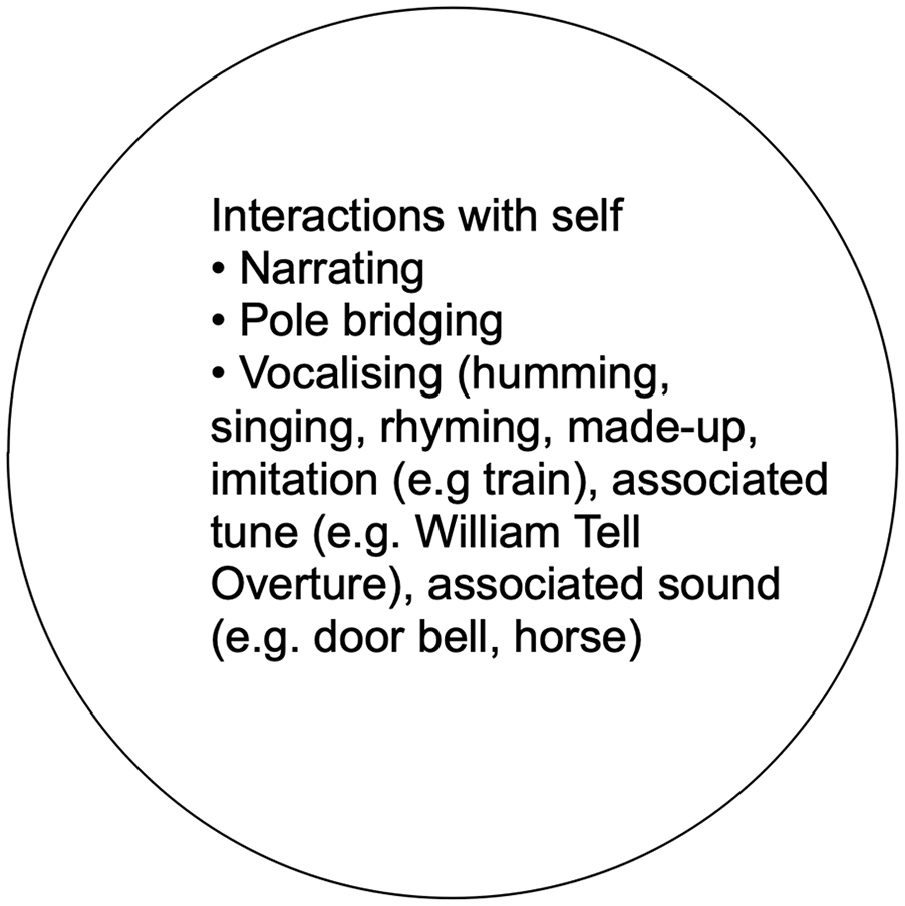
Interactions with self.
Interactions with affordances
Children had access to objects from within the natural environment (e.g. sticks, branches) and those which were man-made and transported to the woodland (e.g. cameras). Children’s interactions with these varied according to their perceived affordances. For example, children often gravitated towards, and physically interacted with, a branch on which they could ‘bounce’, regularly climbing on, off, over and under it. Such interactions engaged the whole body as the children, for example, held onto the bouncy branch with their hands, whilst swinging their legs over the top in order to be able to ‘bounce’. Sticks, on the other hand, afforded different possibilities. For the most part, children’s physical interactions with sticks involved the upper body (e.g. waving sticks in the air; hitting trees) and hand-movements (e.g. rubbing two sticks together). However, some interactions with sticks involved the whole body when, for example, children bent down to pick up sticks. In addition, there were also more tactile interactions afforded by the properties of an object, such as children manipulating leaves in their fingers, or stroking the top of a twig.
As the camera glasses allowed us to follow the actual gaze of children, we were able to follow their line of sight as they gazed at all levels of the woodland, from the floor to the sky and in-between. During imaginary play periods, gaze was often into the trees to look for materials to be used as a resource with the affordances to support play. For example, during a prolonged period of play about lighting a fire, a child gazed for a long period of time at their hands and the forest floor as they tried to use short wooden sticks to light a fire. An overview of the forms of `interactions with affordances’ are provided in Figure 3.
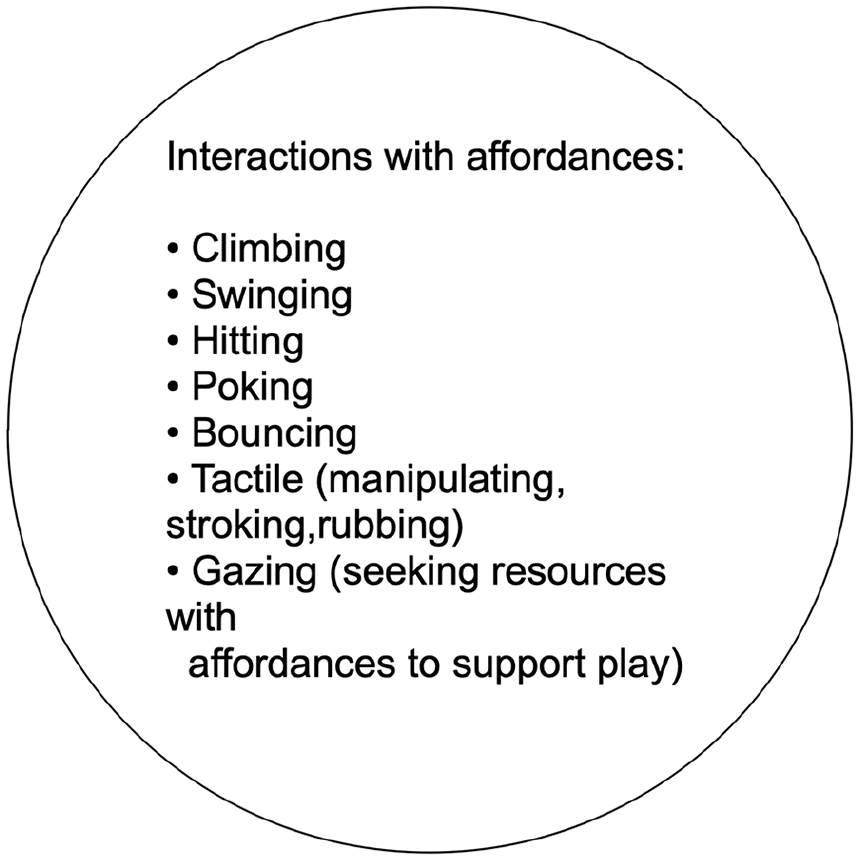
Interactions with affordances.
Interactions with peers
There are multiple examples of children engaging in verbal and non-verbal interactions (including smiling and eye contact) with peers. Some children took on more active, perhaps even dominant, roles. These include self-nomination (‘you have to ask me, coz, I’m Mr Shopkeeper’), and nominating others to specific roles (‘you’re the baby cat’). In some instances, individuals gave instructions for others, such as ‘Baby. Baby!. . .watch me, baby’ and ‘We have to build our gate’. Where instructions are queried or ignored by others, justifications for the instructions were given, such as: G1 ‘Come along my baby’; G4: ‘Why?’; G1: ‘. . .coz the cat’s keeper is going to kill us!’
Children also demonstrated an ability to reflect on the possible viewpoint of an imaginary self or others: ‘Our mum is going to be so disappointed because we’ve not finished your bedroom, we have to finish quick!’. There is also evidence of manipulation of others, such as: G4 ‘. . . can you ask your mum if you can take the cat?’ G1 ‘Mum can I take the little kitten?’ G2 ‘No you can’t’ G1 ‘Arh G4 ‘But daddy said yes, please I wanted you to say yer’ G2 ‘Okay, okay, you can’
In contrast, there is also evidence of negotiation, where the ‘threat’ of removing something valued is given: PP ‘I want to be in mummy’s bed’ GP ‘You have to share baby’ PP ‘No!’ GP ‘Yes, don’t you’ Quickly, or I won’t put your special fairy light in there’ PP ‘No’ GP ‘. . .If you don’t share, I’m going to take those two, this away’
There are also positive examples of the children assisting each other (‘I got this one, this one for you’) and of asking to join the play and to help in play activities (‘Can I help you build a house for my bed?’). In addition, children also used interactions to highlight difference (‘You are not supposed to be wearing what you like’), or of comparison (‘I’m the best because I’ve got two sticks, haven’t I?’). Where exclusionary decisions were made, justifications were sometimes sought and given: G1 ‘Why aren’t we allowed to go in there?’ G2 ‘Because only we are allowed to go in there’ G3 ‘Only if you have glasses on like us’
In relation to including or excluding children in play, the cameras occasionally become a way of including/excluding children: ‘[name of child], you need special glasses to hammer okay?’. Role play around families also became a means to exclude or include. An overview of the forms of `interactions with peers’ are provided in Figure 4.
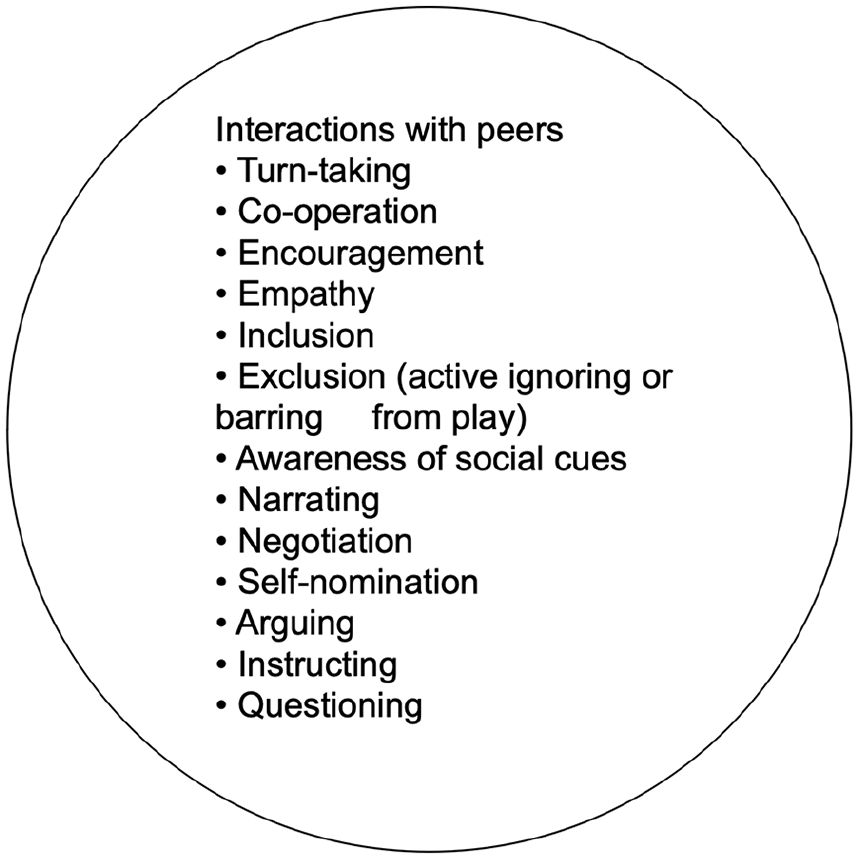
Interactions with peers.
Interactions with adults
There are examples of adults interacting sensitively with children, for example, answering a question when asked. There were also examples of children deliberately seeking out an adult and inviting her to play, or when they have hurt themselves, including seeking comfort/ reassurance. In these instances, adults tend to reduce their physical presence by crouching down to be at the same height as the child. There is also evidence of adults maintaining a distance from children whilst they are playing. Some children often move close to adults, but the adults do not initiate any form of verbal interaction. This clearly fits with purpose of the session which is to enable children to move and play freely within the defined space.
There was, however, also evidence of an adult taking a more active role and, in some instances, a more dominant stance. This is illustrated in the video transcription notes: Two girls and a boy are sitting on a low-lying branch with one of the girls pretending to fall off as she twirls underneath. The children are all smiling. The adult approaches and stands, hand on hips, says ‘Oh, be careful’ followed by ‘What have you found down there?, anything?’ To which one of the children replies ‘Mmm, this branch’ Adult repeats the question ‘Right what have you found down here, anything?’ As if discounting the response given. When no reply is made the adult says ‘Okay, shall we have a look this way?’ Children remain on the branch as another child walks towards them. The adult gives a warning, ‘If you are climbing over, watch your head’. Then one of the girls suggests moving somewhere else and starts walking along the path away from the adult. The adult and three girls follow with the adult leading and pointing to the ground ‘Watch this okay, it’s prickly’. The adult continues to influence the play by suggesting that they do not go too far and encouraging children to follow her to look what ‘stuff’ can be found. An overview of the forms of `interactions with adults’ are provided in Figure 5.
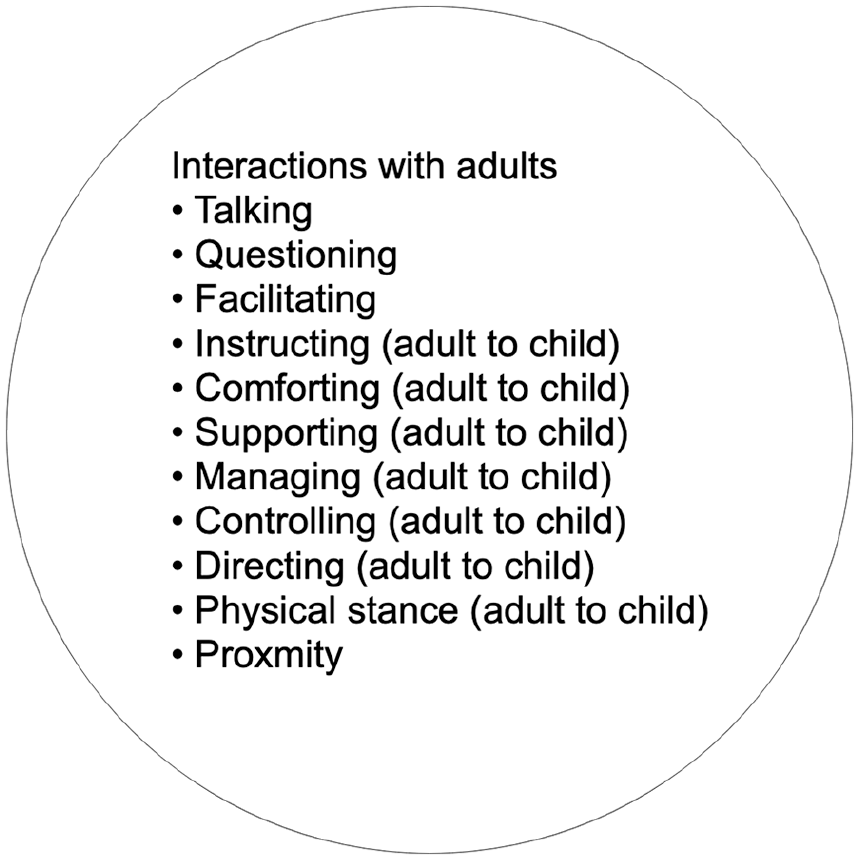
Interactions with adults.
Interactions with time
The video footage supported Relph’s (1976) contention that ‘time is usually part of our experiences of places’ (p. 33). Data showed that periods of time, both short/in-the-moment, and longer, over the duration of the project, allowed the children to explore both the physical space and the affordances of the setting. This in turn potentially affected the time that was spent with, or on, an interaction. For example, the instant of stepping on a branch and finding it moved (affordance), resulted in bouncing (another affordance), followed by extended interactions over a longer period of time. In addition, in the longer term, over the 7 weeks of the project, the majority of children moved further from the central log circle – the area where the majority of adults were located. The connectedness to the natural environment also developed over time, with sticks in particular, becoming a range of tools, props and weapons to support imaginary play situations. An overview of the forms of `interactions with time’ are provided in Figure 6.
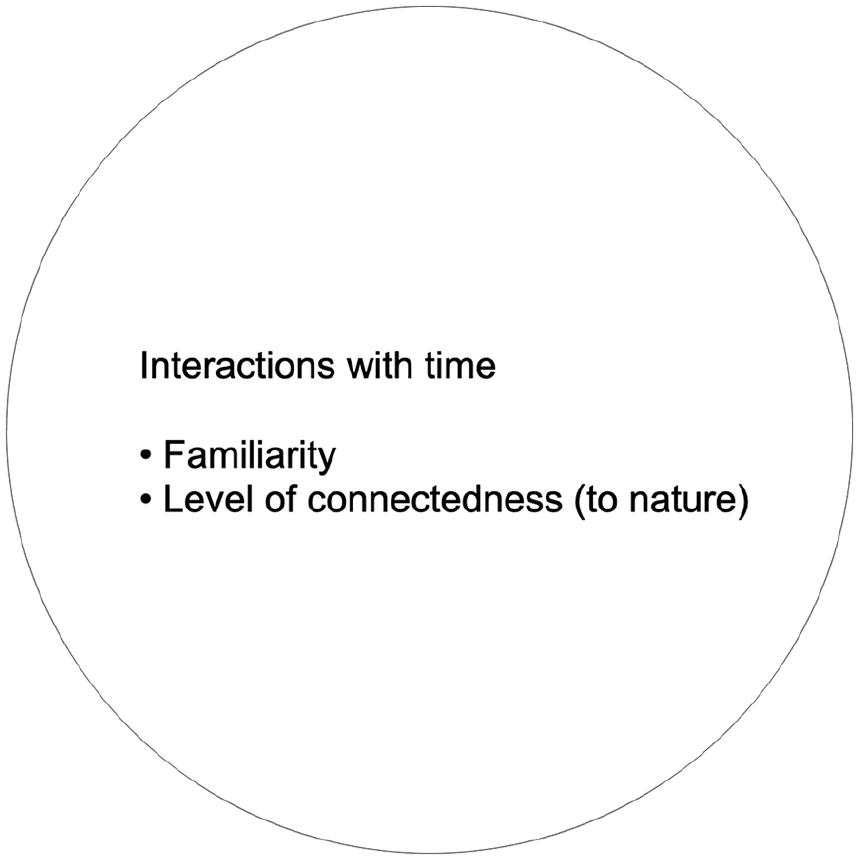
Interactions with time.
‘Free Play’ in a woodland setting
At the centre of all the interactions was children engaging in active and autonomous play during the free play session. There is evidence of children playing in pairs, small groups and alone. They demonstrate elements of life within their play, often using familiar scenarios such as going to school or going to work. However, these ‘ordinary’ life situations were sometimes developed with the use of an ‘extraordinary’ imaginary element. For example, some children took the ‘dinosaur bus’ to go to school.
G1 “This is dinosaur bus, bye mum, see you next week”
The children often engaged in pretend play, using items with new pretended functions. For example, long sticks became a horse to ride, fishing rods to fish with and weapons to defeat the ‘baddies’ with. The children often worked together, using each other’s idea to keep the story line going, as illustrated by the family of cats: G2 “Do you want fishes?” G2 mimes eating something. G1 “Meow, Meow” G1 “Do you want a fishing rod?” G2 “Yes”. G2 pretends to eat ‘fish’ and then ‘runs’ to the woods. G3 “Meow, Meow” then climbs under the big branch towards G2. G2 and G3 run towards G1. G2 “Can we have a fishing rod two of them, G3 “for me and your sister?”
The children also introduced an element of fantasy to some of their play. For example, a group of Ninja Turtles were keen to defeat the ‘baddies’, which were represented by the trees. It was evident that some children chose to take the lead on a play theme, whereas others supported and developed the theme. Some individuals were keen to assign roles to themselves and others: G ‘Can I play?’ GG ‘Yes, we’re all cats, I’m the mummy cat and you are the baby cats’
Some of the children engaged in sustained imaginary play, for example the ‘cat family’ theme involved the same core children for the length of the free play period. Other children chose to move in and out of play themes, or to observe the play themes of others. An overview of elements of `free play’ in a woodland environment are provided in Figure 7.
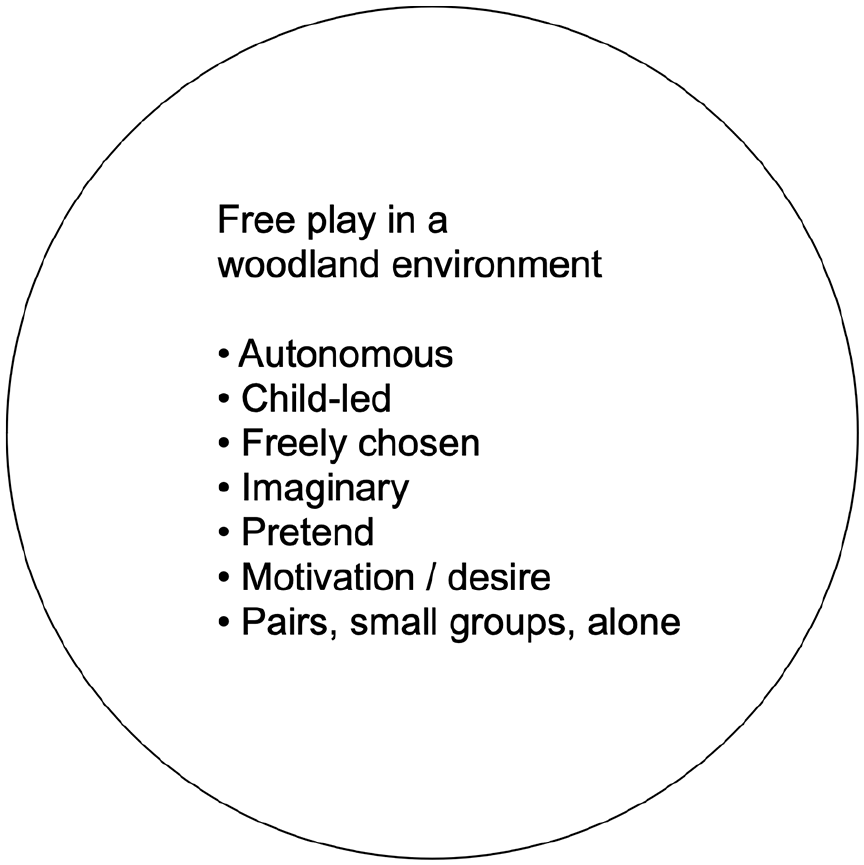
‘Free play’ in a woodland environment.
Discussion
From a ‘free play’ perspective, the data highlight that the children engaged in a range of principles, as identified in existing literature, that characterise ‘free play’. As such, they were able to move freely within the parameters of the woodland area. In most instances, except where ‘barred’ from joining play by other children, the children could choose what they wished to do, how they did it and for how long. In addition, they had the freedom to develop their play, based on their interests and needs, and as a result can become masters of their own development (Veiga et al., 2016). There was also the potential for children to enter liminal places, where they are able to ‘think and act differently from the perspective of play’ (Wood, 2014a: 53). These liminal places both derive from, and exist in, the ‘real’, physical world, yet also exist in a metaphysical or imaginary world. Whilst engaged in this ‘deep play’ (Andersen and Kampmann, 1996), the children’s play is ‘consummatory’ (Henricks, 2010) and the children are free to pursue qualities of wonder (Ferholt and Hakkarainen, 2014). In the majority of instances, there was little or no adult interference, with adults mainly taking on the role of comforter in times of upset. However, there is evidence of an adult interfering with the children’s free play and this is clearly an example of how, often without intent, adults can negatively impact upon play.
The children interact with each other throughout the play session, demonstrating culturally situated knowledge, such as an ability to create or follow the ‘rules’ of play. Veiga et al. (2016) highlight that to sustain imaginary play, children need to be able to consider others’ views and feelings, whilst communicating their own ideas and emotions. We found examples of young children embracing each other’s ideas to sustain the play scenarios. The language used by the young children shows evidence of perspective taking and negotiating skills. Whilst the children often displayed cooperation and empathy within their play, as Wood (2014b) acknowledges, play is a ‘negotiated terrain’ and issues of agency, power and control will exist between children. Whilst some children take on a lead role, others support and contribute to, or observe a play theme (p. 16). Thyssen (2003) suggests that children often bring representations from the media into their play, such as the superhero, enabling them to act out fantasy, often as a shared experience with others. This is supported in the data where the children chose to enact specific roles within the play including that of adult, baby or fantasy figure.
The natural environment provided a range of loose materials with affordances to act as play props for the children, with sticks, in particular, offering a number of affordances. The children demonstrated an ability to attribute these play props with ‘pretended meanings’, and to use them for new ‘pretended functions’ (Thyssen, 2003: 590) Therefore, the children’s ‘liminality of play’ allowed them to ‘occupy a threshold or space in which the ‘what if’ and ‘as if’ qualities of play’ influenced their ‘performance and actions’ (Wood, 2014a: 64). The natural environment provided a rich resource both in terms of space and place and enabled children to experience play opportunities that would not be available to them in other environments.
The data highlight that the young children’s play was comprised of a range of interactions, which provided a response to, and stimulus for, play and contributed to their individual and collective experiences of the ‘free play’ sessions. Whilst each individual will experience these interactions differently, the types of interactions were common across the young children’s play.
These findings are summarised in a new framework (Figure 8), which maps out these interactions in the form of an inter-connected web (a deliberate analogy), with the ability of one interaction leading to another, or even a number happening contemporaneously. In this framework, connectedness to place permeates all interactions. Whilst ‘quality’ is considered a subjective term, the perceived ‘quality’ of the available affordances, the ‘quality’ of interactions with adult and peers and the familiarity with the environment may all impact on the play experiences of individuals. As such, each form of interaction contains elements which may act as enablers or barriers to free play. For example, whilst in general, adults were observed to provide a supporting and caring role, there is some evidence of an adult directing and controlling play experiences.
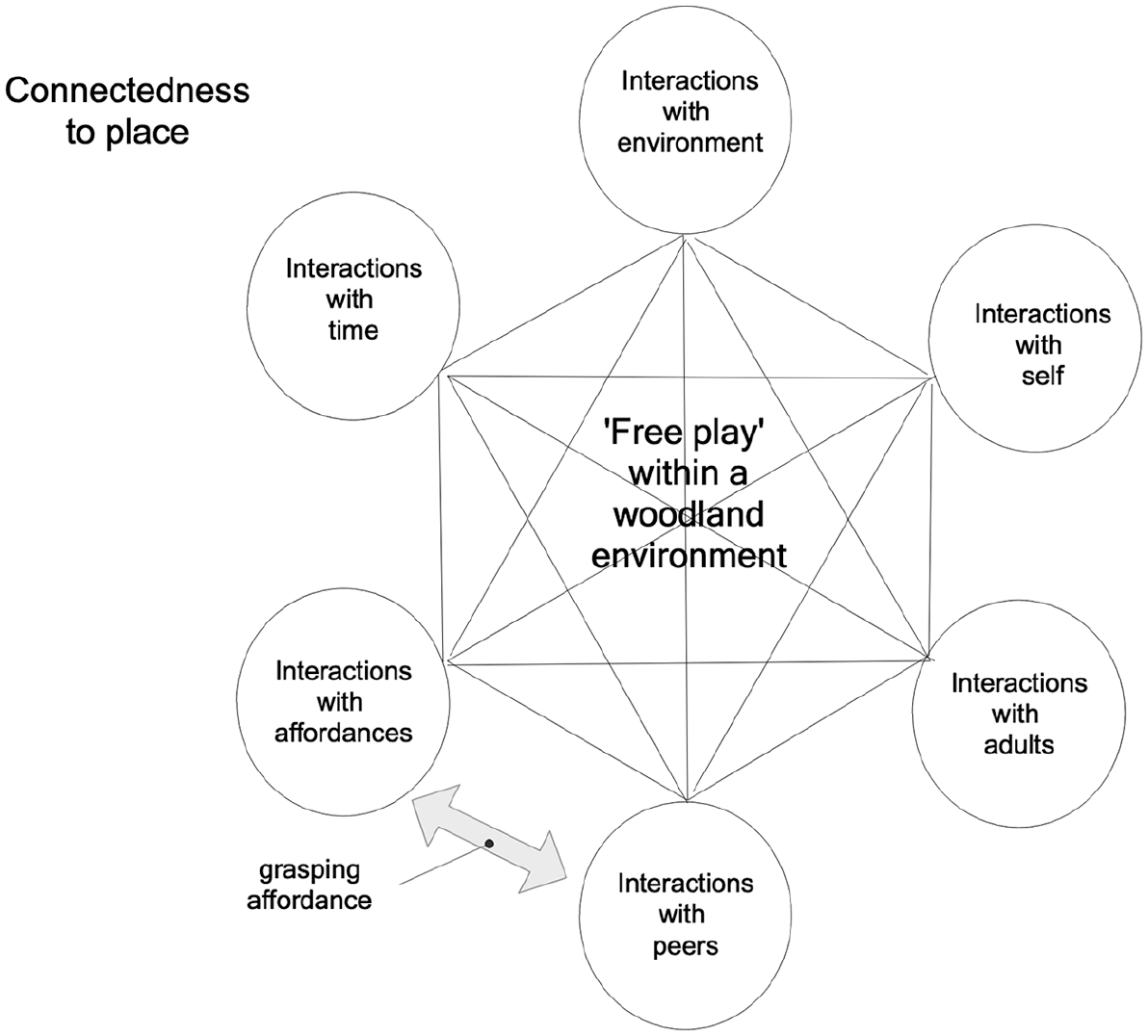
An analytical framework for conceptualising young children’s (4–5 years) free play in a woodland setting.
The data suggested a particular inter-relatedness between interactions with affordances and interactions with peers. As children, individually or with others, grasped the affordances of materials and space, their connectedness, or behaviour insideness, with place-based play evolved (Laaksoharju and Rappe, 2017). As the children were allowed agency to move freely in nature (Jørgensen, 2018), they discovered the affordances of the environment. This contributed to the ludic nature of their play, with props from the environment being used both ‘as is’ (i.e. in its current form) and ‘as if’ (in conjunction with children’s imaginations). As Laaksoharju and Rappe (2017) conclude, ‘the use of affordances deepens and becomes multifaceted after getting to know a place’ (p. 157). We are not at present suggesting any deeper emotional engagement, or ‘empathetic insideness’ (Relph, 1976: 54), with the setting, but it is apparent that an empathetic engagement with the affordances of the setting can affect the time spent on interactions.
Conclusion
This unique analytical framework can be viewed through a theoretical lens which draws upon research relating to connectedness to place, affordances and human interactions. The woodland provided the physical space and resources for play and, at times, the purpose and direction of the play. As Niklasson and Sandberg (2010) suggest, the use of the environment within play may develop as the children become more familiar with it and develop a feeling of belonging. As a result, connectedness may increase over time. Aspects of the natural environment offered a range of affordances, but, Rietveld and Kiverstein (2014) acknowledge, these can be relational and varying, depending on situational and physical circumstances, as well as individual needs and capabilities. Young children’s interactions are important for their social participation and development. Their interactions, particularly with peers, can impact upon their ability to share their pretend play with others (Coplan and Arbeau, 2009) and their development of social-emotional aspects of social exchanges. For example, their ability to self-regulate and respond appropriately to negative interactions (Coplan and Arbeau, 2009). The woodland environment provided a valuable play setting for these children to explore these interactions.
Whilst we have illustrated the interconnectedness of different interactions within the framework, we are unable to provide clarification on how they all interlink. We suggest that this is a non-linear and multi-layered process, which is in a state of flux as the child interacts with these elements. Barad (2007) hints at this complexity, asserting ‘individuals do not pre-exist their interactions, rather individuals emerge through and as part of their entangled intra-relating’ (p. ix).
Future research could use, and build on, the framework to explore further the role of context in children’s play and how interactions may differ in different environments, over different time periods and in varying play contexts. The framework could also be used to examine play in alternative environments, such as street play, to explore how different settings provide different affordances.
Footnotes
Declaration of conflicting interests
The author(s) declared no potential conflicts of interest with respect to the research, authorship, and/or publication of this article.
Funding
The author(s) received no financial support for the research, authorship, and/or publication of this article.
