




Abstract
While classroom talk has been the subject of much research, particularly with primary aged children, the study of talk in contexts outside of the classroom and with younger children is under-researched. This study examined the child-child talk of 4–5-year-olds in the context of free play within a woodland setting. Free play was chosen as it presents elements of choice and autonomy in play and the opportunity for children to engage in child-led play with no, or limited, adult involvement. The children chose to wear camera glasses which recorded both speech and gaze, providing rich data without the impact of the physical presence of adults. Results showed that free play within a woodland environment encouraged more, and different, types of talk than is evident in existing studies based in the classroom. Eight categories of talk were identified: Invitational; Competitive; Imaginative; Informational; Questioning; Inquisitive; Instructional and Self-talk, as well as cumulative and disputational from previous studies of classroom talk. Young children’s use of language within this study, displayed both nuance and imagination as they used it for a range of purposes, including to build meaning with others, to instruct, to impress and to engage in imaginative play. There were also examples of co-construction of language to develop and/or extend play scenarios. Recommendations for future research include the examination of the identified categories of talk within alternative play environments and/or within specific types of play.
Introduction
Play is important as it can support young children’s holistic development, including the refining of social skills, increased self-regulation and enhanced executive functions (Colliver et al., 2022). It has become a central part of curricula across the United Kingdom (UK), especially in the early years, but there is complexity and differentiation in the ways in which it is understood and integrated into children’s educational experiences (McInnes, 2019). Part of this complexity is the use children make of talk in their play. There has been much research into talk in the classroom, notably in primary education, especially focusing on the ‘effectiveness’ of teacher-child talk (Waters and Maynard, 2010). However, there is a paucity of studies studying talk, especially child-child talk, in outdoor experiences, including outdoor play, where it is one of the ‘less-seen’ (Horton and Kraftl, 2018) aspects of such play. This study explores new ground by extending studies of classroom talk, many of which study the primary school age group (5–11 years), to a new context outside of the classroom and indeed educational setting, with younger children (4–5 years) in a woodland setting.
Literature review
Free play
Play is a ‘multidimensional and fluid concept’ (Aras, 2016: 1173), but there is no one agreed definition (Howard and McInnes, 2013). Despite this, there is widespread agreement that, from a child’s perspective, play is considered fun, there is an element of autonomy, and it is likely to be a process rather than a product that is, play is for play’s sake (Canning, 2010; Waters, 2022). A key aspect of play is choice (Aras, 2016) and this is especially critical within the concept of free play – sometimes called pure play (Moyles, 2010), or unstructured play (Colliver et al., 2022). Whatever the term, a central tenet is the child-led nature of the play with no, or limited, adult involvement. Indeed, some studies have suggested that the presence of an adult may result in children not perceiving their play as ‘free’ (McInnes, 2019). Santer et al. (2007: xi) also suggest that ‘free play has no external goals set by adults and has no adult-imposed curriculum’.
Wood (2010) highlights the lack of free play opportunities for children within the school environment, with play often being planned and structured by adults in an effort to use it to support curriculum and learning development, rather than as an opportunity for children to be autonomous in play. In education policy, play can often focus on the effectiveness and performance of play, rather than on enabling creative free play opportunities, contrasting with contemporary views of play in the early years (Walsh et al., 2017). Feelings of fun, excitement, challenge and pride may be restricted (Sandseter et al., 2021). In addition, Sandseter et al. (2021) caution that opportunities for children to engage in free and ‘risky’ play have reduced over recent years.
Free play in an outdoor environment, such as a woodland, can offer additional opportunities and challenges for both adults and children, depending on, for example, how risk is perceived and managed by adults. Physical elements of the natural environment can become crucial elements of free play, providing an array of opportunities including places to hide, swing from and to fall off (Ergler et al., 2013).
Play and talk
Pretend play and language are known to be closely linked (Orr and Geva, 2015) and there is growing evidence that language development within the formative years has a strong association with later academic and social development (King and Dockrell, 2016). Free play in woodland environments has the potential to encourage engagement with complex communication skills, as children navigate the natural and imaginative environment, encountering potentially new situations. The woodland environment offers unique opportunities and affordances (Änggård, 2016; Baixinho et al., 2024; Lerstrup and Konijnendijk van Den Bosch, 2017) for learning through play and play ‘talk’. Pretend play, where real-life situations are acted out, is often a key component of free play (Stuart et al., 2023).
Much of the research on talk, however, has been based on talk in learning contexts, especially in the primary classroom, where it ‘is both a medium of learning and a tool for learning’ (Myhill et al., 2006: 7). Originating in the work of Mercer (1995) and Wegerif and Mercer (1997), Littleton and Mercer (2013) identify three kinds of talk:
disputational (initiation/challenge/rejection);
cumulative (initiation/acceptance/response(s)/do not build on initial idea);
exploratory (initiation/ critical, constructive challenge and counter-challenge /develop hypothesis building on initiation).
These types of talk are described as ‘social modes of thinking’ (Wegerif and Mercer, 1997: 54), and are described as ‘analytic categories’, which provide a frame of reference to understand the role of talk as children ‘think together’ in school settings. As such, they originate in classroom talk and are intended to help analyse collaborative learning. Talk studies are less common with young children and focus on talk in the classroom setting. In one small-scale study, with one class and teacher in a nursery setting in the UK, King and Dockrell (2016) identified patterns of turn-taking in informal and formal talk in small groups, but mostly between adult and child. Additionally, Peterson et al. (2018) compared the use of language by children aged 5 years from three Indigenous and two non-Indigenous Canadian communities, but only in dramatic play and construction/materials play. They do, however, extend the study of talk to play, specifically with young children, but still in the context of the classroom. From an initial coding of 36 purposes, seven broad categories of ‘language-in-action’ were identified (Peterson et al., 2018: 30): learning; imagining; own needs; directing; getting along; expressing disagreement; and ‘real-life’ – with language for learning and language for imagining being the most frequent.
These studies of talk, however, do not extend beyond the confines of the classroom, particularly into outdoor settings, creating a need for the study of this area, especially with young children.
Methods
The researchers developed and delivered a Forest School programme, comprising of a range of adult- and child-led activities for local primary school children within the two hectares of woodland space on the university campus over a 7-week period. The project focused on one local primary reception school class (age 4–5 years), consisting of 15 children (girls n = 9; boys n = 6). The study adopted a convenience sample with the school local to the university. Three of the research team visited the school before the woodland sessions began. During this visit members of the research team met with parents and teachers to explain the project and children’s involvement. The project was also explained to the children by the research team and their teachers. Ethical consent was initially gained from the university ethics committee. All participants and parents then gave consent using an age-appropriate format. Parents were provided with details in written format. Children used a child-friendly format with ‘reduced text volume, clear, simple language, and making use of colour and graphics’ (Truscott and Benton, 2024: 397).
As research consistently highlights that less time is spent in free play in school, a conscious decision was made to enable the children to spend time engaged in free play at the end of each Forest School session, before returning to the school environment. In this project, we used the premise of free play as a child-led environment, where adults (practitioners and researchers) provide the physical space, but take a back seat in the development of play activities and talk (Kos et al., 2015; Santer et al., 2007).
Data were collected in these 7 weeks of 30 minutes of free play, where the adults consciously and deliberately took a ‘step back’, encouraging children to explore and play in the area in their own way. During this time the adults were positioned around the outskirts of the woodland, as a safety net only, with an additional adults stationed in a central log circle.
To obtain authentic data, and to respond to the need for innovative methods to capture young children’s voices (Bateman, 2017), the children had the choice to wear glasses which contained a small, high-definition camera and microphone built into the frames. The majority of children chose to wear the glasses at some point during the 7 weeks, however, they could remove the glasses at any point during the 30-minute play. This supports children’s ethical rights to autonomy and participation, which was prioritised throughout the project, even if this reduced the amount of data collected as a result. Table 1 shows the number of cameras worn each week.
Number of cameras worn each week.

The use of camera glasses provided a unique lens into individual children’s free play experiences as they explored the physical space, interacted with others and engaged in their chosen play (mostly out of adult sight), without the physical presence of adults undertaking observations. The camera recordings provided a holistic and contextual view of their play by allowing the researchers to hear the children’s talk (whether to themselves or others) and to see who or what they were looking at. This provided a ‘temporal and sequential record, offering information about an event as it unfolds moment-by-moment whilst preserving the simultaneity and synchrony of interaction’ (Cowan, 2014: 6), hence enabling an insight into things which would otherwise remain hidden and unrecorded. Children appeared to find the video camera glasses ‘easy and fun’ (Bird et al., 2014: 1741) and the data captured authentic moments of spontaneous play and play talk, offering a rare insight into the children’s free play experiences and interactions in the woodland setting.
Analysis
The data analysis process focused on the recorded talk, with the visual data used to provide context for the talk, rather than a unit of analysis. A team-based approach was adopted within inductive data analysis (Nowell et al., 2017; Saunders et al., 2023). Multiple stages of inter-rater reliability took place throughout the analysis process to support the reliability and consistency of how data were interpreted (Hemmler et al., 2022). The research team were mindful of interpreting the talk from adult-centric perspectives and through personal worldviews based on their previous work as educators of young children, but acknowledged and owned these perspectives (Elliott et al., 1999). As part of this process, we used ‘analytical moves’ (Grodal et al., 2021: 592) including: asking questions; focusing on puzzles, dropping categories, splitting and merging categories; relating and/or contrasting categories; sequencing categories; developing and dropping working hypotheses.
Initially each member of the research team individually watched a sample of the video data and became familiar with the related transcript. As a starting point, each researcher coded the data based on the definitions of the three types of talk identified by Littleton and Mercer (2013). As part of this process, the definitions for disputational and cumulative talk were modified based on the free play context in which they were observed, with no exploratory talk identified. Once agreement was reached on the use of these categories of talk, additional categories of talk were identified from the transcripts as an inductive (data-driven) process but accepting that engaging with the data can never be purely inductive (Braun and Clarke, 2022). We acknowledged that ‘talk is messy stuff, and does not fit neat categorisations’ and viewed the resultant typography as a ‘a heuristic device, a way of seeing the wood from the trees, in what would otherwise be a confusing forest of data’ (Littleton and Mercer, 2013: 19) – a very appropriate analogy in this context. The team worked individually and then together to identify other categories of talk. Once all types of talk had been identified, and related definitions agreed, nominated team members carried out the coding process on the entire data set. Any points for clarification were then discussed as a team. Finally, each member of the research team individually coded a selection of different transcripts, before meeting again to verify the consistency of data analysis. Throughout this whole process the team remained reflexive and ensured consensus before continuing the analysis process (Braun and Clarke, 2022). The initial codes generated from discussions informed, but did not dictate, the analysis, allowing for ‘open coding’ and involved ‘a constant moving back and forward between phases’ (Nowell et al., 2017: 4).
Results
The analysis identified that both cumulative and disputational talk were present within the free play, but the characteristics of both were refined based on the specific outdoor context of this study. We did not find evidence of exploratory talk. In addition to cumulative and disputational talk, eight further new types of talk were identified:
Invitational
Competitive
Imaginative
Informational
Questioning
Inquisitive
Instructional
Self-talk
Key characteristics of each identified type of talk are presented in Table 2.
Categories of talk during free play in woodland setting with children aged 4–5.
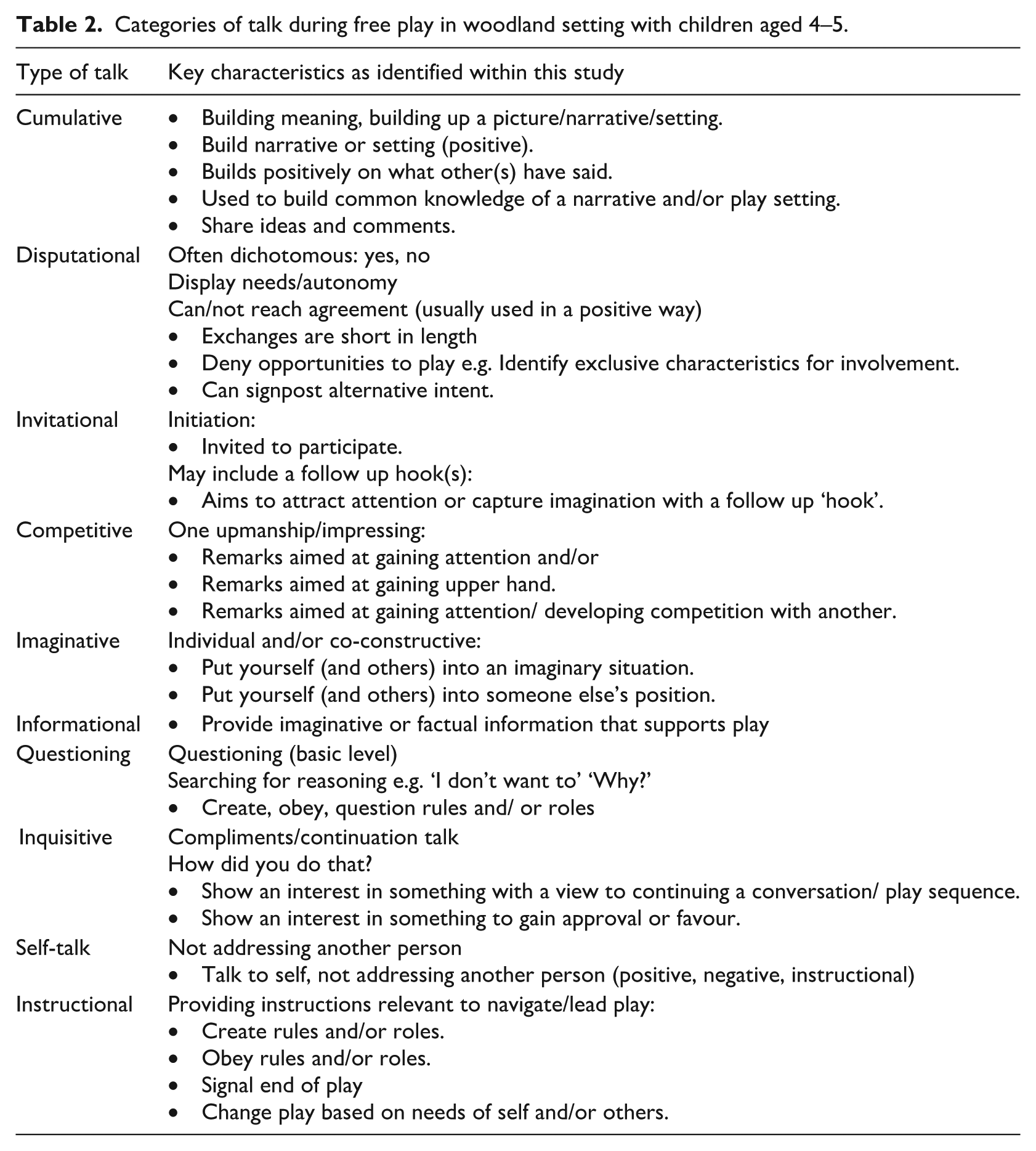
Each category is discussed in turn, with relevant example(s) from the data. All names are pseudonyms to maintain anonymity.
Cumulative talk
Children used cumulative talk to create and sustain their collaborative play environments. By sharing their thoughts and ideas, children developed scenarios that supported their free play. Cumulative talk represents children’s collaborative attempts to build upon and add meaning to a play idea:
‘Don’t worry I’ll send out my fire. I’ll light some fire out of my mouth’.
Lucy develops a pretend play role as a dragon and tells the girl with her, Soraya, that she can blow fire. Later on, during the play Soraya returns to this idea, building on it:
‘I’ll lead the way’
‘Cos you’ve got the stick that you put fire on’.
Lucy looks to floor: ‘I’ll put fire on here’ and blows fire onto the floor.
‘Pretend I’ve got powers’, and they run down the path.
Soraya is making car sounds: ‘Oh no! my car’s on fire!’
Lucy puts her arm out and says, ‘I’ve put the fire out with my thing’.
‘Thank you’.
‘No problem’.
‘I get in my car any time I need it’.
‘Okay, I’ll help you’.
Disputational
Talk was also used disputationally to deny play opportunities to others by, for example, identifying key characteristics that needed to be present to play. For example:
A boy approaches and rests his arms on a bouncy branch.
Harriett moves towards the bouncy branch and says ‘No! We’re playing cats here, only cats allowed!’
Boy turns around and moves back along path away from branch.
Children also used disputational talk to convey their needs and autonomy within play. Some dichotomous, ‘yes/no’ sequences, were much shorter:
‘There was a bee there, but we killed it’
‘No you never’
‘Yes, we did’.
Ironically, disputational talk was also used in a positive way, in more extended dialogue, to reach an agreement.
‘Your fairy house is done’
‘Oh, okay but I haven’t done my own fairy house’
‘But this is your fairy house’
‘You keep working and make it nice and I’ll do my own fairy house’
‘And do me one too, okay?’
Invitational
In order to start free play with others, some children took a more direct approach, such as ‘I am going to play now. If you want to come with me, you can’ or ‘Can I help?’. Invitations to play were not always accepted or acknowledged, so some children developed an awareness that they needed to make their ideas sound enticing. These invitations usually contained a ‘hook’, something that may capture the attention: ‘I’m going to show you a magic trick. I’m going to show you how to climb somewhere’ (Louis).
Competitive
During play, there were moments of vocalised competition. For example, children gaining the attention of other(s) by highlighting a skill or by trying to impress:
L“Hannah come here. Hannah! remember we climbed the mini bar?”
‘Yes, let’s go in the mini bar’.
‘Let’s get drunk on the mini bar!’
‘I’m climbing higher than you’.
Both children are climbing up the tree
‘I can climb up to here’ (as Louis climbs higher than Hannah).
Louis repeats ‘Mini bar, mini bar’ as he climbs.
Competitive remarks were often met with quick responsive remarks that perpetuated a competitive environment:
‘Hold onto my back, hold onto my thing as I go super-fast’.
‘No. I go faster’.
Imaginative
The children engaged in pretend play within their free play. They often used talk to communicate within their imaginary worlds and to move into and out of play. On occasion, they would signpost the start of the play sequence by saying ‘Let’s pretend’, but this was not always evident: Louis singing whilst climbing up and swinging in the tree: ‘I can’t believe I can’t fly’ (in the tune of the song ‘I believe I can fly’) Hannah joins in, singing: ‘In the sky, in the air’
‘The zombie! The zombie!’
‘Oh, oh, it’s after your legs!’
‘I need to get up!’ starts to climb higher up the tree.
‘Pretend I pulled you off’.
‘No! no!’ starts making screaming noises.
Louis makes an eating sound and Hannah says ‘No, no!’ but is laughing.
Louis says, ‘I got you, I got you!’
In other instances, the subject of the pretend play changed quickly:
‘Shall we play on the horse?’ As he moves towards a low-lying bouncy branch.
‘The unicorn!’
‘It’s not a unicorn!
‘I’m the driver. Remember we fall off? Passengers, have you got your seat belts on?’ laughing.
Children also used imaginative play talk to creatively, and diplomatically move on from, or to pause, a specific play scenario. For example, after playing house (building a house and pretending that other children were her babies), Emma in this scenario uses imaginative talk to signal a break in the play: Emma turns around, watching both girls and says ‘Okay, I’m just going to have a cup of tea for my break, okay?’
Informational
The children chose to communicate factual and/or imaginative information to each other. For example, in this conversation:
‘My mole is up there’
‘And my unicorn’ (pointing to bags hanging on tree containing stuffed toys).
‘But moles dig under the ground’.
‘I know, they dig under the mud’.
They also often communicated information, such as labels and names, that supported and developed the play narrative:
Example 1
‘My name is Spiro’.
‘My name is Rosie’ (a different name to her actual name).
Example 2
‘This is going to be your house, baby’.
Questioning
Questioning was an integral part of pretend play, either as part of the play sequence or to check that the actions taken within the play were considered acceptable by others:
‘Okay. Bye. I’ll tell you when you come home. It’s only one more minute. Do you want to talk to baby before I turn off the phone?’
Due to the lack of adult involvement, children often turned to each other for instruction, a sense of security and to check the ‘rules’ of their woodland play. Children displayed their concerns about breaking the ‘rules’ of the free play (e.g. going too far in the woodland) through questioning, despite earlier encouragement from adults that they were allowed to freely explore the area, and that there would be adults around the outside to ensure nobody went past the designated area:
‘Are we allowed up here?’
‘I’m not quite sure’.
‘Shall I ask the teacher?’
Questioning talk can appear simple, or complex in form. Although the theoretical concept of free play is based on the ability of children to act with autonomy and play without restriction, questioning talk showed children were often very aware of the power dynamics between peers that exists within play. Dialogues often highlighted a recognition of wanting and/or needing permission to join a game/play scenario. These interactions suggest children’s recognition and awareness of the complex social dynamics in play, that there may be someone ‘in charge’ of the play, and that they may have to fulfil a specific role to join. This potentially mirrors adult/child dynamics that exist outside of free play in their school setting, for example, having to ask permission to do something and recognition of a need to behave in a certain way.
Inquisitive/ingratiating
This is exemplified by a child having difficulty joining collaborative free play, with requests to join often being denied or ignored. As a result, inquisitive/ingratiating talk was used to try and gain favour or compliment other children’s play. For example, a group of children are climbing up a tree (playing zombies) when Joshua (who has been trying unsuccessfully to join in with others) arrives:
‘Oh my god, how the heck did you get up there?’
‘We climbed up there’
‘Yer, we jump up there and on there’.
‘Oh, you can jump up there?’
Self-talk
On occasions, children used self-talk when facing challenges or to soothe concerns whilst thinking through their exploration of the natural free play environment. For instance: Lucy says to herself ‘I could go down there’. Starts walking down path and then stops and says to herself ‘I don’t see Soraya no, no, I’ll go back’. She says to herself ‘Mmm, not going up there’ and turns around. Walks back to log circle and watches a group playing on a tree. Says to self ‘Where’s Soraya?’ ‘I’lI see her then I will call her’. Walks forward. ‘There she is’ says to self and runs to Soraya.
Instructional
During play children used instructional talk to create guidelines for the play. This included a range of instructions to others such as, what role someone may need to play, what elements of the natural environment are involved, and when play ends/begins. In some scenarios the children who received the instruction would shut down the request; in others, children used talk to show an understanding of the instructions and commitment to the play: Emma looks around as two girls arrive. First girl (Maria) is near to her, second girl (Mya) is further away, holding onto a bouncy branch. Emma looks at Maria and says: ‘No, this is a cat place, only if you be a cat’.
‘Meow’
‘Okay, you’re a cat’.
Emma looks to Mya and asks:
‘Are you going to be a cat?’
Mya nods.
This passage of talk also highlights key elements of imagination and invitation into play, as Emma aims to instruct and control the play through setting specific imaginative roles for other children. The rule-maker maintained instructions, even after the original passage of play had ended. For example, when another child approaches towards the end of the free play time, Emma shouted ‘Don’t come in here, this is a cat’s house!’.
Some children took a proactive leadership role by instructing other children about the ‘rules’ of the free play without being prompted: Whilst pointing to a woodland path, Mya shouts. ‘You can go all the way up there!”
“Oooh! How?”
“You’re allowed!”
In this context, the guidelines provided by the instructional talk supported structure and guidance to navigate themselves and others through the exploration of the free play woodland environment.
Discussion
While classroom talk has been the subject of much research, the study of talk in contexts outside of the classroom is under-researched, particularly with young children in free play, outside of the confines of a school altogether. Moving to a free play situation, without actual or perceived learning outcomes, does seem to encourage more, and different, types of talk than is evident in existing studies based in the classroom. The research methods in this study enabled a moment-by-moment analysis of individual talk, and talk in interactions with others, from the child’s perspective. Young children’s use of language displayed both nuance and imagination as they use it for a range of purposes, including to build meaning with others, to instruct, to impress and to engage in imaginative play. There are also examples of co-construction of language to develop and/or extend play scenarios.
The proposed types of early years talk in free play in a woodland setting are novel and, even if a few categories are similar to some from early years classroom play (Peterson et al., 2018), the stimuli (e.g. climbing the tree or referring to living things in nature) and affordances (such as bouncing on the branch of a fallen tree – ‘weeee, we’re going on the bouncy ride!’) of the woodland setting provide different examples of talk. In many types of play talk, there is evidence of the progression in talk as ‘things’ move from being a determining force, to a condition where ‘the child begins to act independently from what he sees’ (Vygotsky, 1978: 97), particularly in the Imaginative and Cumulative talk categories. In other words, what Vygotsky (1978: 97) labels a ‘divergence between the fields of meaning and vision’, where ‘action arises from ideas rather than from things: a piece of wood begins to be a doll and a stick becomes a horse’ – although it remains hard to ‘sever thought (the meaning of the word) from object’. There is also an interesting contrast between the existing concept of free play and the imposition of rules by the children themselves, especially in the Instructional category. Again, this supports Vygotsky’s (1978: 94) provocative suggestion that there is ‘no such thing as play without rules’, as ‘whenever there is an imaginary situation in play, there are rules’ (Vygotsky, 1978: 95). These rules, however, are ephemeral and not pre-formed, but are rooted in the imaginary situation – for example, the rules when a child is playing the role of a mother stem from rules of maternal behaviour. The formation of rules in real time, meant that the Questioning category was often used to create, query and hence develop rules and roles in play.
The Disputational category mirrors the key characteristics of Littleton and Mercer (2013), and also what Brand et al.’s (2024) study with toddler interactions with teachers, label ‘Rubuttal’ – in their case disagreement with negative statements. The concept of argumentation can be considered ‘contextually situated forms of social practice, in which at least two parties take alternative positions on the same issue and develop adversative positions in various ways’ (Dovigo, 2016: 820). Although the interactions are normally short, they can end in a positive outcome, even without the intervention of the teacher as mediator found in other studies in the classroom (e.g. Dovigo, 2016).
In many of the categories (including Self-talk), talk is contingent, in that it responds to the woodland environment, other children or even the child themselves. One aspect of this is in Invitational talk, where ‘hooks’ (sometimes using features of the woodland environment) are offered to directly, or indirectly, gain attention and follow-up to get others to join in. For example,
Emma has a leaf and a stick in her hand. Moves towards Maria and then starts moving towards bouncy branch as Mya runs down path towards her.
‘This is a baby present’ and hands her a chubby stick.
‘Thanks’.
‘Now you have two’ and then ducks under bouncy branch
In this situation, objects in children’s play are used as ‘a method of approaching other children and attempting to align with the ongoing activity’ (Bateman and Church, 2017: 55). The contingent nature of talk is also apparent in Imaginative and Inquisitive talk, where individual or co-constructed scenarios are developed, or by showing an interest in parts of a play sequence, in response to surroundings.
Play sequences were also examples of Cumulative talk, where meaning is built in the narrative to develop common knowledge and share ideas and comments. This category is not mutually exclusive from others, and may contain aspects of other categories, but both are positive in intent. In contrast, the use of Competitive talk could range from gaining attention to gaining the upper hand in dialogue – which could also contain elements of Disputational talk. In this context, the talk can often be termed ‘turn competition’ (Kurtić et al., 2013), in that it is not intended as a solitary statement, but rather is intended to develop a competitive response from another in an act of ongoing engagement with the activity.
In contrast to other categories which involve an interaction with others, Self-talk, is where ‘the recipient of a communicative utterance is in fact also the producer of the utterance’ (Deamer, 2021: 426). We use self-talk to mean ‘private speech’, involving ‘talking to oneself aloud’, rather than ‘inner speech’, which is internalised (Brinthaupt et al., 2009: 82). In addition, we do not infer motivation, or self-instruction, which is often found, for example, in athletes (Thibodeaux and Winsler, 2018). In school-based studies with slightly older children (aged 7–9 years) than this study, Lee (2011) and Lee and McDonough (2015) contend that self-talk is an important tool for children’s ability to regulate thinking and behaviour, but also propose that it could be an important tool in self-regulation. This also echoes Vygotsky’s concept of social speech by others, other-regulation, being internalised (Sawyer, 2017) to become self-directed speech (SDS) which is internalised as a means of self-regulation (Kuvalja et al., 2014). In our study, however, the self-talk took different forms – although we obviously cannot assess the amount of internalised talk – and was not always regulatory. It could include an element of narration, which begins between 3 and 5 years (Lake and Evangelou, 2019), or was used to reflect the child’s feelings (positive and negative). It was also self-instructional (as opposed to Instructional, which was to others) and, for example, may relate to assessing risk, decision-making, play story narration or next steps.
In all categories, talk is a mediating artefact, with language as the ‘tool of tools’ (Cole and Engeström, 1993: 6) in cultural mediation. From our constructivist viewpoint, where meaning is socially constructed, however apparently simple the actual language used, it still acts as a tool for the young children to mediate between themselves, others and objects, in all categories. In many instances, the relational nature of the talk becomes a transaction, where one party is changed by it, rather than just an interaction (Sameroff, 2009, cited in Lake and Evangelou, 2019). We suggest that if this transaction is extended, for instance in Cumulative talk, both parties may be changed by it – for instance as they develop a shared storyline or perception of a pretend place (e.g. the minibar). In addition, talk in all categories is used to develop knowledge, where it ‘is commonly socially constructed, through collaborative efforts towards shared objectives or by dialogues and challenges brought about by differences in persons’ perspectives’ (Pea, 1993: 48).
In the context of this study, knowledge is not curriculum (or other) knowledge required in the classroom or school, but knowledge of and for, the outdoors, and the collaborative efforts are play.
Limitations
Although we conducted an in-depth study of with one group of children aged 4–5 years, we acknowledge that the findings cannot be generalised to a wider population in this age group, or indeed other age groups or different demographics within this age group, without further research. We suggest that the proposed categories of talk outlined above will help in this process and encourage more work in this area.
Conclusions
In the same way that ‘classroom conversation between children is complex and used for multiple reasons’ (Fox-Turnbull, 2024: 957), our data suggest that the same applies outside of the classroom, but can easily be missed as the practitioner is not present to witness it. Talk in play seems to allow young children to give ‘form to inchoate thoughts, bringing them to a conscious level’ (Peterson and Friedrich, 2022: 107), as they explain and rehearse aspects of their play, either as self-talk or with others. The proposed new range of talk types suggests that using existing classifications of classroom talk potentially miss a sophisticated and inventive use of language as children scaffold their play outdoors, and as they develop new play ideas and scenarios. While there are some similarities with existing categories of talk, the new typography represents the first attempt to classify and exemplify young children’s talk in free play in woodland settings. It is important to note also the typography is unique, in that the talk types identified and analysed relate to what might be called ‘free talk’, insofar as it took place over a period of weeks with minimal adult interventions, both in terms of direct adult physical presence, or adult-child talk.
We suggest that although the use of language with these young children was apparently simple, the way they use it is deceptively sophisticated. As such, the talk types which were generated are authentic and may prove a useful tool for analysing the talk of young children in future research in a range of play environments and within specific types of play – such as imaginative play.
Footnotes
Acknowledgements
The authors would like to thank the school, teachers and pupils for this involvement in this project.
Data availability statement
No data is available for this project due to the ethical consent granted.
Declaration of conflicting interests
The authors declared no potential conflicts of interest with respect to the research, authorship, and/or publication of this article.
Funding
The authors received no financial support for the research, authorship, and/or publication of this article.
