




Abstract
This paper explores one child’s use of their schema to construct their knowledge and understanding within the early years curriculum for Wales – the Foundation Phase (FP). It considers how a knowledge of schemas can facilitate practitioners in supporting children along their learning continuum and inform classroom pedagogy. This paper explores and defines what schemas are and examines prior research into schemas. It examines FP practitioners’ lack of knowledge and understanding of schemas within the chosen setting, thus providing the rationale for the research. Lastly, it charts Harri’s learning journey over two terms and how a coming to know about Harri’s trajectory schema facilitated a different understanding of his actions by practitioners and helped shape classroom pedagogy. The paper highlights how an informed knowledge of schemas supported Harri’s engagement in tasks and fostered his collaboration with others. This paper is useful for policy makers, practitioners and researchers, particularly in Wales, in understanding how nurturing and nourishing a child’s schema supports knowledge construction within a play-based curriculum such as the Foundation phase.
Introduction
Although the Foundation Phase (FP) has been in Welsh schools since 2008, to date there has been very little evidence that practitioners are aware of schemas and, how schemas can provide a window into young children’s thinking. The FP curriculum espouses a pedagogy that is child led, child focussed, experiential and starts with what the child can do (Welsh Government [WG], 2015a). The necessary basis for such a pedagogy is that practitioners in the FP should have an in-depth understanding of child development and the different ways in which children construction their knowledge and understanding. Previous research within other early years curricula, has shown that for some children, schemas facilitate this construction of knowledge and understanding and their coming to know (Mairs et al (2013); Athey, 2007; Atherton and Nutbrown, 2013). Coming to know can be defined as how young children make sense of their world and it is important that practitioners understand all the unique ways children come to know – including how schemas can support this
Therefore, a lack of FP practitioner knowledge of schemas, can lead to missed opportunities in supporting children along their learning continuum of knowledge construction and in their coming to know.
This paper explores this in the context of one FP setting in South Wales, discussing one child’s learning journey and how his schemas facilitated his coming to know. This case study suggests the importance of developing FP practitioners’ recognition of children’s schemas and their understanding of how schemas can support a child’s development. It discusses how an understanding of schemas provides a different insight into a child’s actions and thinking and how this can reconceptualise classroom pedagogy.
The Foundation Phase
When Wales introduced the Foundation Phase (FP) curriculum on a rolling programme from 2008 to 2011 (Thomas and Lewis, 2016), it was a radical breakaway from 125 years of previous early years pedagogy. The FP incorporated the Early Years curriculum and Key Stage One into one learning continuum for children aged 3 to 7 years. The curriculum is delivered through a mixture of continuous, enhanced and focused provision across seven areas of learning (WG, 2015a). The continuous provision is a constant of the learning environment on offer, allowing consolidation of skills such as problem solving, decision-making, teamwork and independence through playful activities. In the enhanced provision, the practitioner adds resources to the continuous provision based on the observed interests of the children, with links to the current classroom theme.
Finally, the last part of the FP model of delivery is the focused tasks, which is the adult-led provision where new skills are taught (Maynard et al., 2012). Practitioners were given training on how to deliver the FP, with an emphasis on observing children in the continuous and enhanced provision to note their interests, ways of learning and how they constructed their knowledge and understanding. Following these observations, FP practitioners plan activities in the focused provision building on what has been observed in the continuous and enhanced provision. Thus providing children with: A well-planned curriculum(that) gives children opportunities to be creatively involved in their own learning which must build on what they already know and can do, their interests and what they understand. (WG, 2015a: 4).
However, any detailed guidance on including schemas within in this model of delivery was absent from Welsh Government (WG) policy documentation. There were brief mentions of schemas in the FP policy documents ‘Teaching and Learning Pedagogy’ (Welsh Assembly Government (WAG), 2008) and in the ‘Foundation Phase Child development Profile Guidance’ (WAG, 2009).
In the ‘Teaching and Learning Pedagogy’ policy document, schemas were mentioned on page nine under the heading, ‘The Child as a Learner’. Here it stated that, ‘By repeating a learning experience they develop schema or patterns of thoughts that are strengthened until they are able to make connections’ (WAG, 2008: 9). Then again on page 22, under the heading ‘Observation’, ‘Observation may draw attention to particular schema or patterns of thinking that predominate a child’s play’ (WAG, 2008). In the ‘Foundation Phase Child development Profile Guidance’ on page 19 under ‘Cognitive Development’-‘Developing concepts/schema’, it stated that children should develop concepts ‘through using and understanding experiences and knowledge’ (WAG, 2009). However, there was no specific training or guidance offered to FP practitioners to develop their knowledge and understanding of schemas.
By nurturing and nourishing schemas, practitioners can gain an insight into the processes children go through in their coming to know (Mairs et al (2013); Atherton and Nutbrown, 2013; Athey, 2007). This enables the practitioner to have a window into a child’s way of thinking and to shape the curriculum they provide. It facilitates the adult in being child centred, holistic and supportive of the child’s interests, all key principles that underpin the ethos of adults working in the FP (WG, 2015a). Consequently, this research sought to work with FP practitioners and children in one setting in SE Wales, to develop recognition and knowledge and understanding of schemas and how they could be used to inform pedagogy within the FP curriculum.
What are schemas?
Piaget (1972) has been hugely influential in the study of child development. He believed that knowledge must be invented or constructed by each learner through their actions. He was the first to identify and define schemas as a means of constructing knowledge by stating that children organise their knowledge and understanding of the world into cognitive structures called schemas (Piaget, 1953, 1959, 1970). Any new experiences are fitted into the existing schema (assimilation) so that equilibrium is maintained or if the experience is new or different then the child alters (adapts) their schema to accommodate this new experience. In this way, new thinking and knowledge is constructed and cognitive gains made.
Alongside Piaget’s original definition of schemas there have been many others. Neisser (1976) offered the following definition of schemas, ‘as a pattern of action as well as a pattern for action’ (p. 56). Gardner (1984) supported Neisser’s definition of the active nature of schemas by stating that ‘Individuals bring schemas to bear on objects in the environment . . . the child is involved in knowledge construction’ (p. 64).
However, it was Chris Athey’s seminal work on schemas within the Frobel Early Education Project (1973–1978) with children aged 3 to 5 years, which refined Piaget’s original definition of schemas. She defined schemas as, ‘a pattern of repeatable behaviour into which experiences are assimilated and that are gradually co-ordinated’ (Athey, 1990: 37). In her study, Athey (2013) identified that children’s repeated actions (schemas) related to different levels or stages of cognitive functioning. She identified these as motor level actions through to symbolic level, functional dependency level and finally thought level (Athey, 2007). Athey (2007) acknowledged that schemas grow from assimilation and accommodation and that schema both shape and are shaped by experience (Brierley, 2014). Through a process of detailed observation and analysis, Athey (2007) drew on the work of Piaget to label and describe the following specific dynamic schemas:
Dynamic vertical
Dynamic back and forth
Trajectory Schemas
Dynamic circular
Going over and under
Going round a boundary
Going through a boundary
Containing and enveloping space
When considering the ‘development of thinking’ Athey determined in her research that for each type of dynamic action schema ‘there is a sequential progression’ (Athey, 2007: 116; Meade and Cubey, 2008: 48). The starting point is motor behaviours through symbolic representations and functional dependencies to thought (Athey, 2007).
In Athey’s (1990) research a child’s behaviour was categorised as being at the motor level if there was no evidence of representational significance through ‘speech, product or action’ (1990, 68) (p. 68). This can be seen in this research when Harri repeatedly built a tower with the word tubs but did not vocalise the thinking behind his actions. Symbolic representations are using one symbol as another and can be evidenced through actions, marks and speech (Athey, 1990; Brierley and Nutbrown, 2017). In this research, Harri repeatedly dropped his jumper (action) into the plastic cube whilst singing ‘10 Green Bottles’ (speech). Here the jumper symbolised the ‘bottles falling from a wall’.
Following symbolic representation Athey (1990) described the stage of functional dependency which she defined as when, ‘children observe the effects of action on objects or materials’ (p. 70). Or as Brierley and Nutbrown state, Functional dependency is, ‘the dependent relationship between effect and actions’ (Brierley and Nutbrown, 2017: 15). The final stage is that of thought. Here the child is able to ‘give a verbal account of an experience in the absence of any material or situational reminder of the original experience’ (Athey, 1990: 68).
Following Athey’s work, several other researchers explored children schemas in the Early Years Foundation Stage in England (Arnold and the Pen Green Team, 2010; Atherton and Nutbrown, 2013; Constable, 2013; Grimmer 2017; Mairs et al., 2013; Nutbrown, 2011), and in the early years in New Zealand (Meade and Cubey 2008). However, there has not been any research into children schemas in the Welsh Foundation Phase curriculum and this paper seeks to redress this.
A case study
This research explores and interprets one child’s dominant trajectory schema both operationally and figuratively through qualitative observations, photographs and discussions in a school based FP setting. In parallel, it also seeks to explore and develop FP stakeholder’s perceptions of schemas through questionnaires and ongoing discussions. This can be deemed as the study of the social world or as Bryman (2012: 28) states, ‘The study of the social world requires a different logic of research procedure, one that reflects the distinctiveness of humans as against the natural order’. Proponents of such a study argue for an understanding of the lived experiences of those taking part in the research (Schwandt, 1998). Therefore, this research is conducted within naturalistic settings of a FP classroom environment, where it was possible to explore in detail, the complex learning experiences of Harri and the understandings gained by the practitioners.
The empirical data gathered in the original research were from six children aged between 3 to 5 years in one FP setting in South East Wales over two school terms. The six children were those that had parental permission to take part in the research and had exhibited repeated examples of schematic behaviours. This paper focuses on one of these children known by the pseudonym Harri, aged 5 years. Harri was chosen as the focus of this paper because very often he was on his own in the classroom and he engaged in limited interactions with the practitioners, other children or activities in the setting. Therefore, the practitioners wanted to develop a better understanding of Harri through his schemas, and to explore how nurturing and nourishing his schemas could enable them to develop a better relationship with him. They wanted to ‘come to know’ Harri through his schematic behaviours.
The research presents observations and photographs of Harri’s schemas in action and it discusses, how, when his actions are viewed schematically, new understandings of him emerge. Palaiologou (2012), states that narrative observations have the advantage of giving detailed information and allows the observer to capture persistent activities and focussed behaviours. The annotated photographs supported and supplemented the narrative observations; capturing Harri’s freely chosen spontaneous schematic behaviours in the continuous, enhanced and focused provision. Cottle (2016) postulates that photographs allow for a rich insight into the child’s world in the setting; they can provide a representation of a person’s lived experiences within a given time and environment. The observations and photographs were analysed through a schematic lens and supplemented with evidence of Harri’s speech (where evident), indicating his “threads of thinking” (Nutbrown, 2011).
The preliminary stage of data collection involved analysing questionnaires from FP practitioners across south east (SE) Wales (N = 85), including those in the chosen setting, to determine knowledge and understanding of schemas. In this study, the term practitioner denotes both teachers and support staff who worked alongside the children on a daily basis. These questionnaires were analysed before any data gathering with Harri commenced and suggested that knowledge, and understanding of schemas and opportunities for training on schemas were limited.
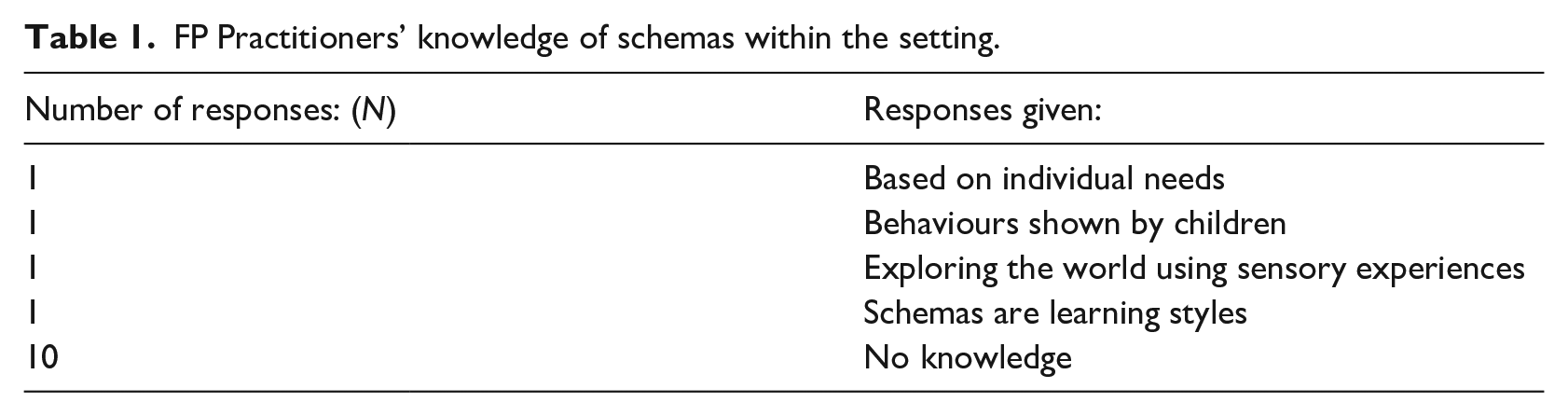
In the chosen setting (N = 14) the responses were as follows (see Table 1 and 2):
FP Practitioners’ knowledge of schemas within the setting.
Practitioners’ response to any training on schemas.
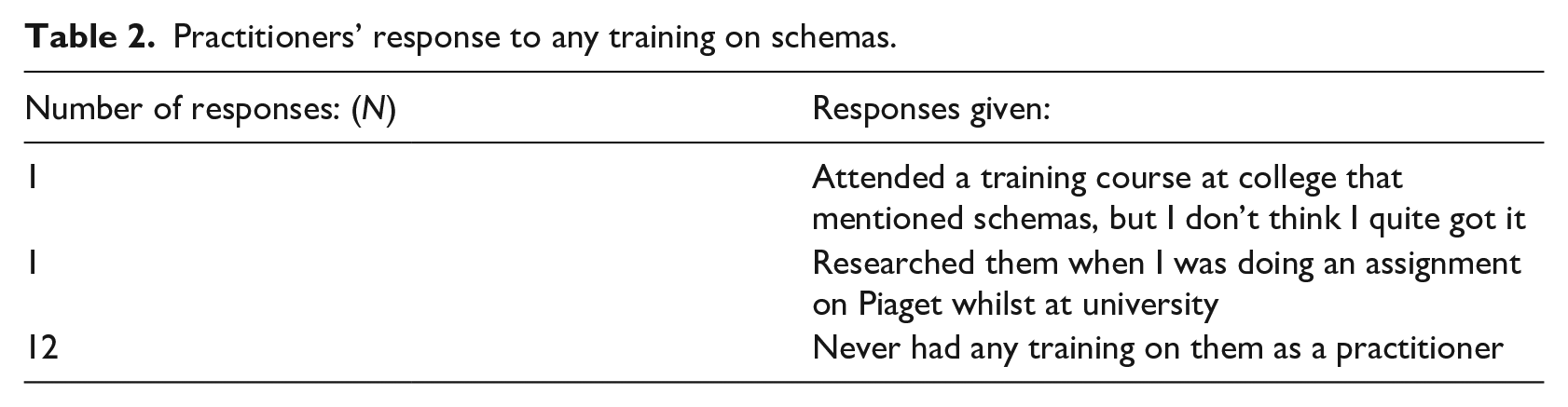
All of the practitioners (N = 14) stated that they did not currently support or plan for schemas within the setting.
Following the analysis of the questionnaires three practitioners agreed to be part of the research, the nursery teacher (Practitioner A), the reception teacher (Practitioner B) and one of the support practitioners (Practitioner C) working in reception class. These practitioners had expressed an interest in learning more about schemas and how they could be supported in the setting. Consequently, the start of this research involved an intervention element, with the deliberate intention of raising awareness of schemas and what schemas looked like in practice. This was completed in the autumn term through reading previous published material on schemas and sharing information via photographs, observations and videos of schemas in action. This allowed myself, as the researcher, and the three practitioners involved in the research to develop our understanding of schemas in preparation for undertaking research with the children in the spring and summer term.
Ethical considerations
Ethical considerations in this research focused on the sensitive use of methodological tools to explore children schemas and to gather the perspectives of the practitioners. Permission was obtained from the gatekeeper of the setting, the FP practitioners and from the children’s parents. Before any research was undertaken, it was necessary for me as an outsider, to spend time in the setting to enable the children feel comfortable with my presence. Atherton and Nutbrown (2013) talk of ‘gradualness’ where children get used to the researcher’s presence and a ‘familiarity’ develops (p. 27). Therefore, throughout the autumn term I became a familiar face in the setting playing alongside the children. In the spring term once the observations started with Harri, if at any time he indicated he did not want to be observed or have his photograph taken, then this was acknowledged and respected. Dockett and Perry (2007: 55) suggest this is an example of what researchers consider, ‘on-going opportunities’ allowing children to negotiate, continue or withdraw consent.
The following findings present an authentic account of Harri’s lived experiences in the setting. The data are examined in relation to Harris’ dynamic trajectory schema, evidenced through motor level actions, and symbolic level actions. There is also a consideration of how Harri used his trajectory schema in his mark making. It starts with background information about Harri and why the practitioners were particularly keen to gain a better understanding of Harri’s lived experiences in the setting.
Harri’s story
Initial observations determined that Harri’s preferred schema was a trajectory schema. Athey (2007) defined an interest in trajectories such as vertical ascents and descents as a ‘dynamic vertical schema’ (p. 116). Similarly she described horizontal trajectories such as back and forth or side to side as a, ‘dynamic back and forth schema’ (p.122).
Harri was in the reception class and was 5 years old when the research commenced. The practitioners reported that Harri was very much a solitary child who did not really interact with the other children. He enjoyed playing on his own and often spoke aloud to himself. It had been very difficult to engage Harri in any focused activities and when the teacher (Practitioner B) was doing whole class input Harri refused to sit on the carpet. Instead, he preferred to stand at the table and build vertical towers using tubs. Harri could also often be found alone in the book area singing nursery rhymes (usually Humpty Dumpty) to himself or one of the stuffed toys he was playing with, a toy rabbit being a particular favourite.
Consequently, the practitioners were keen to see if recognising and supporting Harri’s trajectory schema could enable them to develop a better understanding of his interests, build his self-confidence and engage him in tasks for longer periods. In addition, they wanted to know if supporting his trajectory schema throughout the learning environment, would build his confidence in interacting with other children. The data are presented through observations and photographs utilising Athey’s (1990) sequence of schemas. Each observation and photograph captured a moment in time depicting Harri using his trajectory schemas and a coming to know for both Harri and the practitioners. The observations reflect free choice activities both indoors and outdoors which are not necessarily linked to the classroom theme of ‘pirates’ and focused activities that are linked to the theme of ‘pirates’.
Motor level observations and photographs
Harri often built a vertical tower with empty tubs (used as word tins in the setting). He kept building them up and knocking them down repeatedly but did not speak as he did so (Figure 1). Practitioner C told me he did this every day whilst the rest of the class sat on the carpet listening to the reception teacher (Practitioner B). He stacked the tubs upwards into a vertical tower before knocking them down and starting again thus demonstrating what Johnson (1987) termed ‘embodied patterns’ (p. 19). This infers both bodily movements and perceptual interactions achieved through significant experiences.
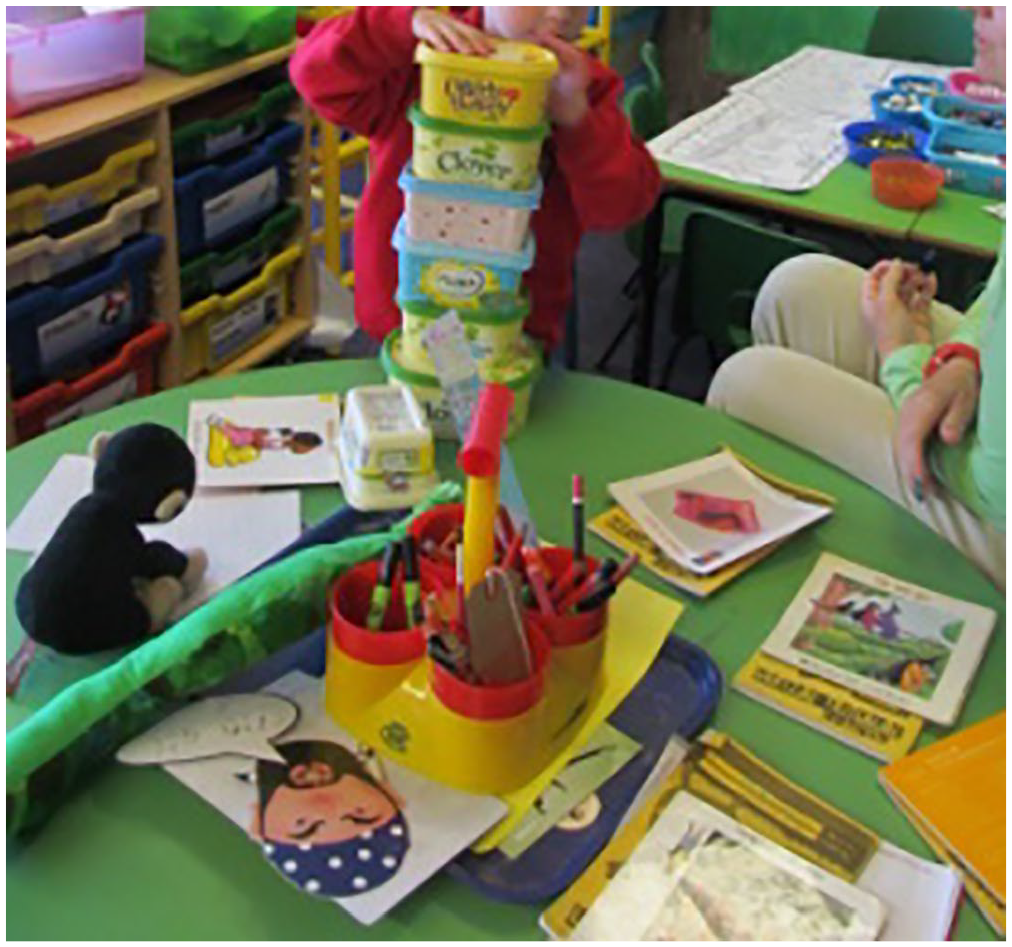
Building a vertical tower with margarine tubs.
The practitioners, now with a growing awareness of schemas understood that it was more important for Harri to build his vertical towers than insist he sit on the carpet with the other children. By facilitating Harri in building his tower, they were showing that they recognised and supported his schema. Practitioner C added that before knowing about schemas they had tried to insist Harri sat on the carpet and this had led to tantrums and tears. However now with a growing understanding of schemas, they viewed Harri’s actions through a schematic lens and had realised that for him building a vertical trajectory allowed him to remain calm and focus on what the teacher was saying. This could be considered as timeliness of intervention. The adults’ decision to not prevent Harri from building his towers, suggests being in step with a child’s thinking, a need identified by Gopnik et al. (2001).
On another occasion, Harri was observed in the classroom continually picking up a toy rabbit and dropping it onto the floor (Figure 2). As he dropped the rabbit he was singing, ‘Humpty Dumpty’. When I shared this observation with Practitioner A, she stated that in singing lessons Harri always wanted to go out the front to be ‘Humpty’ and liked to role play the bit when Humpty fell off the wall. She added:
Since we have been working with you and noting schemas we have ensured that we have songs that reflect actions like up and down. It has been clear to see that Harri really loves those type of rhymes. Before we included things like ‘Humpty Dumpty’ he would just sit on my lap in the hall and not really join in. This week we started to learn ‘Jack and Jill’ and he loved it. He was laughing when ‘Jack’ fell down and couldn’t wait to come out front and take part. Even the music teacher can’t believe how much more confident he now seems.
Practitioner A had reflected upon how she could include nursery rhymes with actions that supported Harri’s schema. Practitioner A had supported Harri on his learning continuum by becoming an attuned adult using Harri’s schema as a window into his world and to engage him in singing lessons.
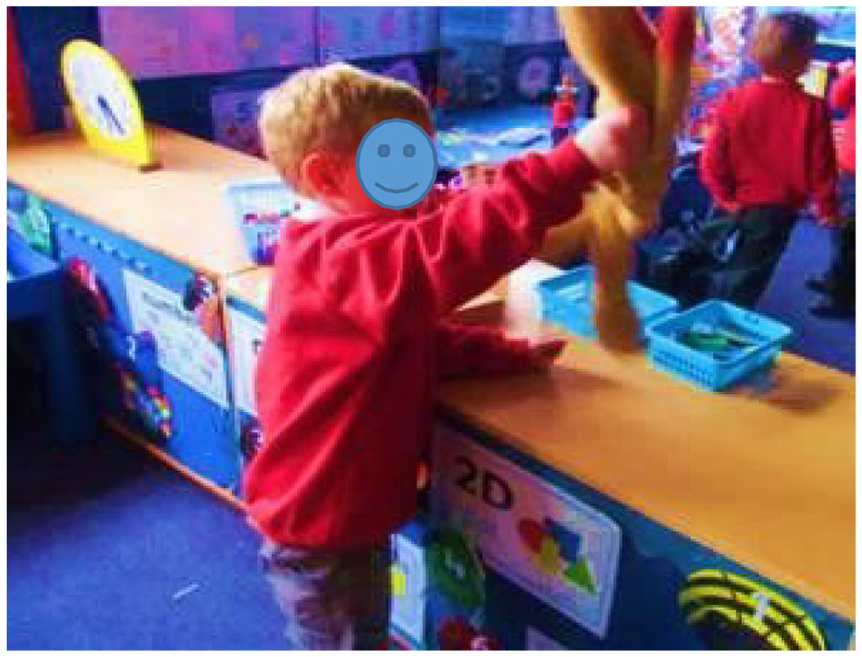
Role-playing ‘Humpty Dumpty’ with rabbit.
Symbolic level observations and photographs
Today in the sand tray, Harri tipped sand into the sieve and let it trickle out (Figure 3). He did this repeatedly from different heights. There was another child playing alongside him and he turned to this child and said, ‘This is my cake, these are the sprinkles (points to sand falling through sieve) it is a birthday cake’. The child nodded and said, ‘It is my birthday tomorrow, my cake will be chocolate’. Harri stopped and seemed to think about this before responding with, ‘I like chocolate too. This is a chocolate cake’. Harri carried on adding sand to the sieve and letting it drop into the sand tray below. Although there was no more conversation with the child next to him, Harri was content to carry on with his actions alongside the other child.
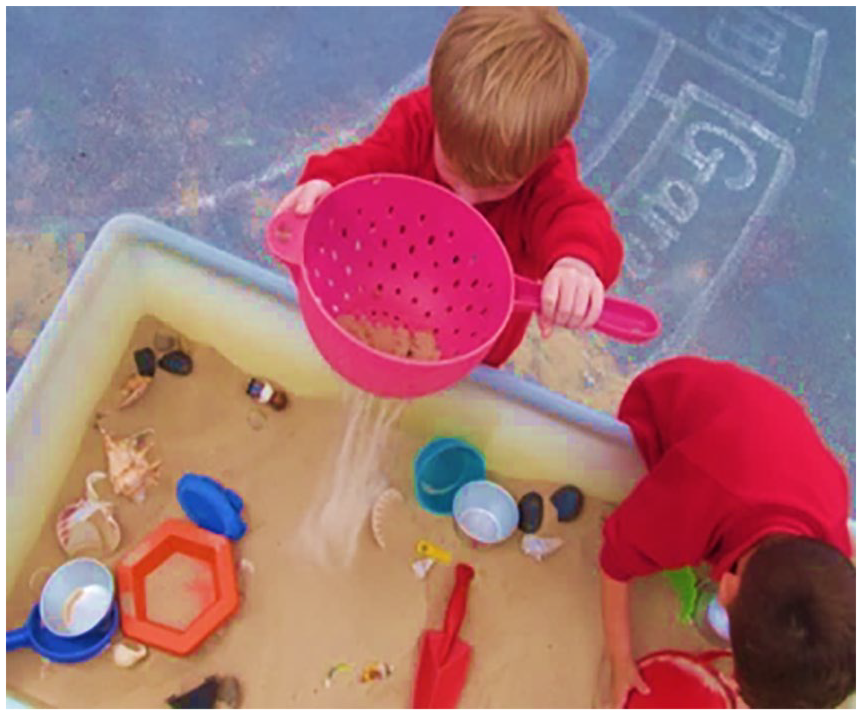
Adding ‘sand’ sprinkles to his ‘cake’.
Harri tended to spend a lot of time on his own in the setting and most of the observations reflected this. However, in the sand observation (Figure 3) Harri engaged with another child and was happy to play alongside this child. The child was able to tune into Harri’s thinking when he accepted Harri was making a cake and the sand represented the sprinkles on this cake. Here they were able to have a conversation and Harri was happy to conclude that his cake was chocolate, supporting the cake the other child talked about. Harri had assimilated the information about a chocolate cake and had accommodated his thinking to reveal the cake he was making was also chocolate. Piaget (1959) attests that children communicate in the first instance not to share thoughts but he or she ‘does so in order to play’ (p. 28). Harri was an attuned listener and adapted his thinking to enter into a collaborative dialogue with the other child. Then he listened to what the other child had said, reflected upon it and agreed that the cake was ‘chocolate’. This was regarded as real step forward for Harri in initiating a conversation and the practitioners were excited to note this exchange in Harri’s portfolio:
This is really exciting for us, we will leave the sieve in the sand tray now and I am going to add in other equipment that Harri can pour sand through. I think we should get Harri to work with other children to make a real chocolate cake-I will use his schema as the hook to get him to join in with other children. He can sift the flour and he can drop chocolate sprinkles on top. I can’t believe he is actually playing alongside another child and having a conversation. We can add it to the planning as a pirate birthday cake.
(Practitioner B)
Today Harri was observed by the big plastic cube singing ‘10 green bottles’ to himself as he dropped a cardigan down into the cube and pulled it back out repeatedly (Figure 4). Next, he dropped the cardigan completely inside the cube, peered in to look at it, and laughed. One of the practitioners (not involved in the research) said, ‘This is typical of Harri, he never really plays with others but is happy to be on his own’. I used this as an opportunity to share my thoughts of this observation with the practitioner and to explain how when this observation is viewed through a schematic lens a different perspective emerges. I explained there was a significance to him choosing a number song with bottles falling down; it supported his trajectory schema. I added that this could be a window into Harri’s thinking and a way to connect with him. If the practitioner sat alongside Harri and joined in with the song this could be an opportunity to interact with Harri and to develop his mathematical development in a way that supported his forms of thinking (Athey, 1990). The practitioner listened and replied, ‘I never would have got all that from observing him. I would have probably have just thought, there is Harri happy in his own world and left him alone. I think we all need to learn about schemas’.
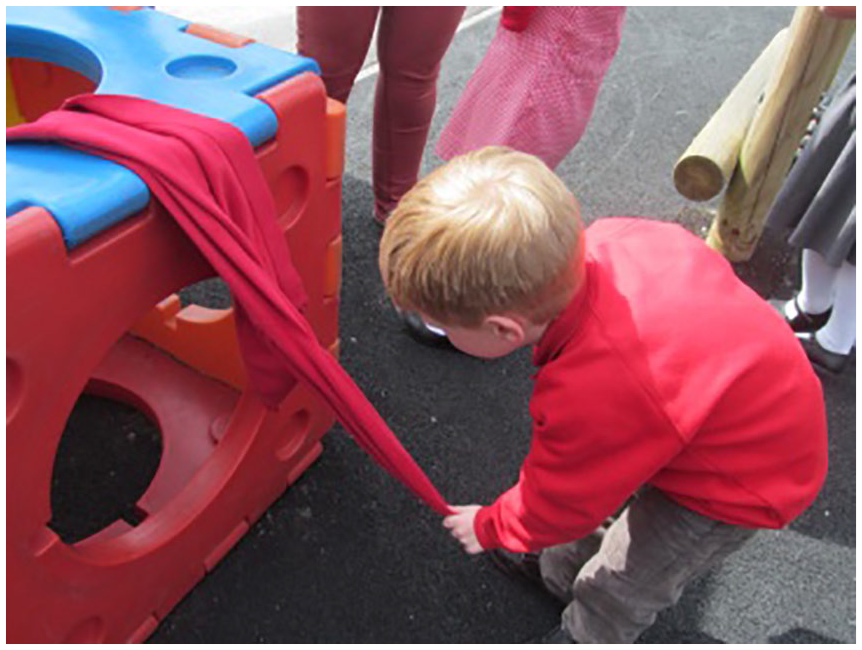
Pulling the jumper in and out of the cube singing, ‘10 Green Bottles’.
This observation highlights how a lack of knowledge and understanding of schemas can lead to practitioners missing opportunities to tune into a child’s way of thinking and dismiss actions that can support knowledge construction. Athey (2007: 152) talked of the need for ‘precise language’ and the need for ‘conceptual rather than associative’ accompaniment when responding to children (p. 55). In this observation, the practitioner focused on the fact that Harri was on his own and not how Harri was using his trajectory schema and a number rhyme to construct his knowledge of counting backwards from ten. The significance of Harri’s actions were not his propensity to play alone but his desire to assimilate relevant content (jumper and rhyme) into his prevailing forms of thought (trajectory schema) (Athey,1990, 2007).
An attuned practitioner, with a knowledge of schemas, could have played alongside Harri and used precise language that supported his schema and his growing awareness of the properties of numbers. This supports Arnold (2015: 740) when she argued that, ‘If we view actions as the basis of thinking as Piaget and Athey did, then physical actions are most important as a foundation for intellectual development’.
In the examples observed Harri was able to use his trajectory schema to represent his forms of thought symbolically through his actions, play and speech (Athey, 1990). Harri engaged his listener when he discussed adding ‘sprinkles’ to his birthday cake, reflecting what Piaget (1959) called socialised speech with the need to engage with the listener. Harri’s actions also demonstrated Atherton and Nutbrown’s (2013: 50) notion of children being ‘discriminating’ in the ‘use of content’ and the relationship between ‘forms of thought’ and ‘environmental content’. Harri chose and used equipment and objects in ways that reflected his forms of thought (dynamic vertical schema) the sand falling downwards through the sieve to form sprinkles, and a jumper being repeatedly dropped vertically into the plastic cube to reflect bottles falling off a wall (Athey, 1990, 2007). These observations refect what Nutbrown (2011: 14) meant when she stated that when a child is ‘working on a vertical schema. The form is ‘up and down’’and ‘related content’ could ‘include using’ resources that support this.
Mark making observations and photographs
The next set of observations and photographs show examples of Harri’s mark making during focused tasks linked to the theme of ‘pirates’. At the start of the research, the practitioners had stated that Harri was always very reluctant to engage with any sort of mark making. They therefore wanted to find ways to encourage Harri to concentrate and engage in mark making activities and to see how they could use his trajectory schema to facilitate this.
Harri was at the painting table and he was part of a group of children painting a pirate for a classroom display (Figure 5). He dipped the brush into the paint and made a series of vertical and horizontal marks on the paper. Practitioner C working with him encouraged Harri to tell her about his painting using attuned language. She said, ‘Well done Harri, that’s right look you have made long lines are these for his mouth and eye brows?’ Harri nodded and carried on painting in vertical lines. The practitioner continued, ‘Can you tell me what you are painting now when you go up and down and back and forth?’ Harri replied, ‘Yes, look it is his face, see there is a green nose. It’s finished now, I want to go and play’. He began to remove his apron. Practitioner C said, ‘Thank you Harri, I will put your name on it and put it to dry’. Harri spent 10 minutes completing his painting before he walked away and the practitioner said, ‘That is one of the longest times we have been able to get Harri to do any mark making at all. I tried to intervene and use words that would support his trajectory schema and that really seemed to focus his thinking’.
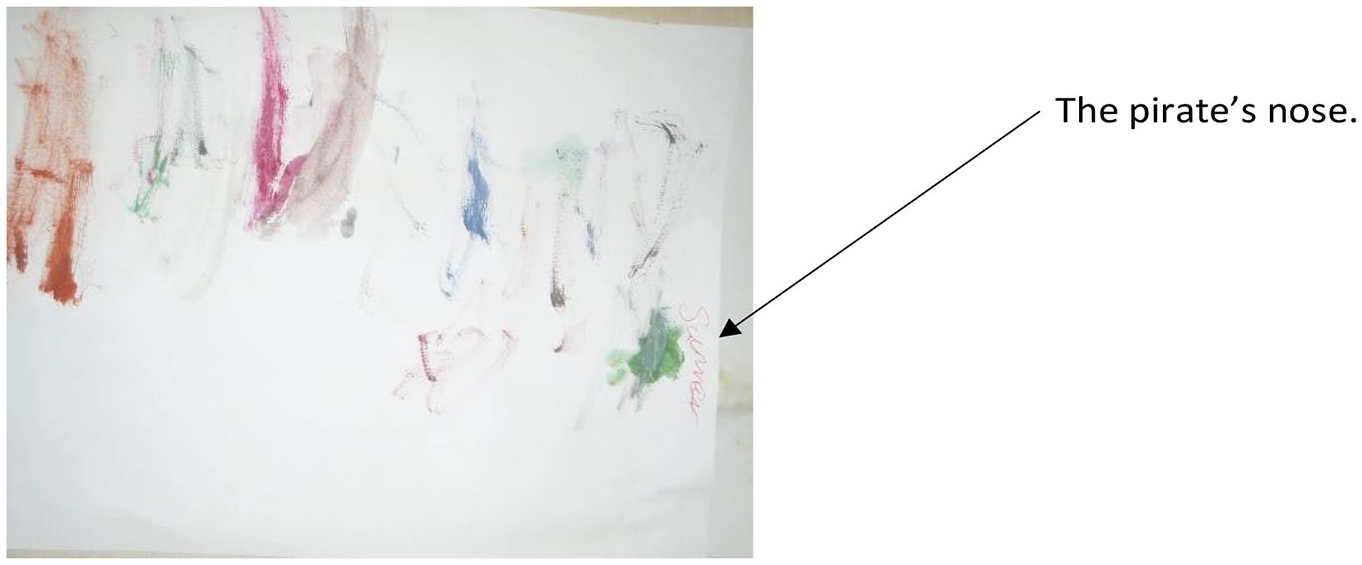
The finished ‘pirate’ picture.
On another occasion, Harri was at the writing table and the children were designing treasure maps as part of the ongoing theme of ‘Pirates’ (Figure 6). Harri had a choice of coloured pencils but he chose to use a writing pencil and he scribbled all over his map in a series of horizontal and vertical scribbles. The practitioner (not involved in the research) tried to get Harri to use another colour, she showed him the example of a treasure map, and reminded him of the book they read this week about treasure maps. Harri refused and said, ‘No I want to use this one’. He then got up and said, ‘All done, can I go now?’ The practitioner sighed and said; ‘Ok Harri off you go’ and Harri left the writing area. Harri spent a total of 3 minutes at this activity.
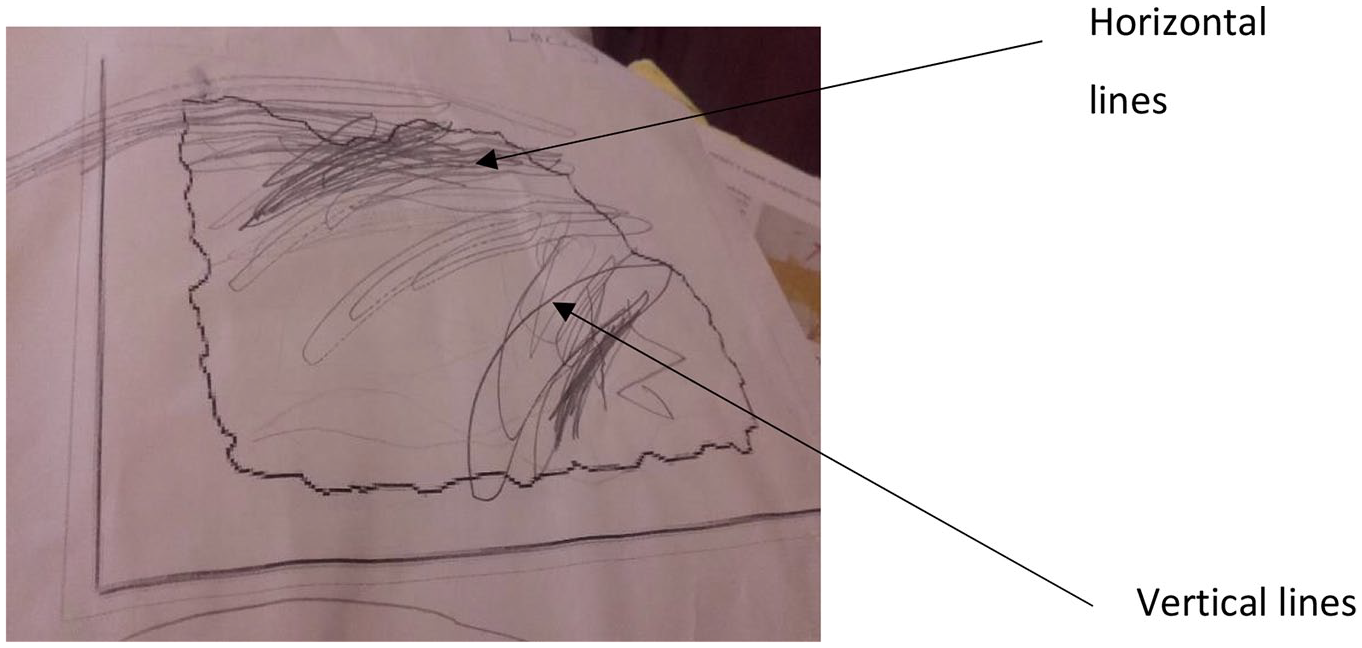
Designing a treasure map.
When Harri was painting the pirate face, the accompanying practitioner was able to intervene and support his forms of thought by using appropriate language such as “up and down, back and fro” and “long lines”. By tuning in to Harri’s forms of thought Practitioner C seemed able to engage him for longer supporting what Atherton and Nutbrown (2013) meant by, ‘a dialogue of conceptual correspondence’ (p. 64). In contrast, in the observation of the treasure map (Figure 6) this practitioner did not support Harri’s mark making with language that matched his schema and as a result he left the activity quite quickly. Athey (1990: 29) stated that when an adult articulated a child’s actions it made a child ‘more conscious of his or her own doing’. Practitioner C who was able to conceptually tune in to Harri’s schema intervened and supported Harri by asking questions about his painting that supported vertical and horizontal trajectories. This resulted in him staying on task for longer and producing a ‘pirate’ picture.
Piaget (1969) identified two types of cognitive patterning, figurative linked with perception and operative linked with action. Harri’s figurative aspects of his trajectory schema could be evidenced through his mark making. This is an acknowledgment of what Athey (2007) meant when she argued, ‘mark and model making are abstractions from the child’s own movements’ (p. 75). Harri had used his actions previously to represent trajectory movements (building vertical towers and dropping the jumper into the cube) and this-in Athey’s terms – has translated in the marks he chose to make. This resonates with Piaget and Inhelder (1956: 77) who stated that mark making was derived from physical action and was, ‘based originally upon a sensori-motor. . . action’. Other researchers have also found there to be a match between children’s dynamic schemas and their mark making and the importance of adults recognising this when playing and working alongside children (Arnold, 2019; Deguara and Nutbrown, 2018).
When examining Harri’s mark making there were a number of scribbles running both vertically and horizontally. Athey (2007) referred to these as, ‘continuous horizontal and vertical scribble’ (p. 62). Athey research distinguished 24 mark and divided them into straight lines and curves, and further sub-divided them into space orders (Athey, 2007). In Figure 6, Harri has produced a number of horizontal and vertical lines. In Athey’s (2007) space order categories these would be ‘Proximity between marks’ (p. 63). This is an example of the ‘earliest spatial organization used. . .marks and objects are placed next to each other’ (Athey, 2007: 70).
Harri has not engaged in any speech to explain what these marks mean so it is not possible to state if the horizontal or vertical lines actually represent any features of a treasure map. This type of mark making is normally associated with younger children than those of Harri’s age. However, this may be because Harri did not spend a lot of time engaged in mark making activities whilst in the setting, so he had not developed mark making skills more usually seen at his age.
If Harri’s drawings were viewed in isolation, they could very well be dismissed as scribbles with no real meaning. Viewing the finished Pirate picture there was little resemblance to a face. However, the practitioner working alongside Harri, allowed him to represent the features as he saw them and to use his trajectory schema to support this. Here, Practitioner C focused on the forms of thought rather than the content (Athey, 1990, 2007).
Final reflections
Observations over a period of two school terms have shown how 5-year-old Harri used resources in the FP continuous, enhanced and focused provision to pursue his trajectory schema at different levels. He has done this through his actions and mark making using a variety of materials and tools. Nutbrown (2011) argued, schemas provided the structure for children to learn and construct their knowledge and understanding.
The role of the adult and the importance of having an understanding of schemas as a conceptual accompaniment through language and actions, has also been considered. Working with the practitioners in the setting and observing the children through a schematic lens allowed different ways of understanding to emerge. Atherton and Nutbrown (2016: 75) argues, ‘correlations, associations and relationships in children’s thinking, revealed in their play, cannot be understood unless those observing have a conceptual awareness of what is seen’. However, it also became clear that not all practitioners working in the setting were aware of schemas. As seen in the observation with the jumper (Figure 4), the practitioner quickly dismissed Harri’s actions as him just playing by himself with no real significance attached. Yet with a knowledge of schemas, it quickly became apparent that Harri was in fact reciting numbers backwards from ten and had chosen a rhyme that fitted with his trajectory schema. Here was a missed opportunity for the practitioner to have a window into Harri’s thinking. Similarly, with the ‘Treasure Map’ observation if the practitioner had used language that supported Harri’s schema he may have stayed focused for longer at the task and engaged more with it. This reinforces the importance of recognising and supporting schemas as a window into a child’s world.
When the practitioners did support Harri’s trajectory schema through appropriate resources and language (number songs, trajectory language when drawing and appropriate nursery rhymes) his engagement with others and tasks increased. This indicates the significance of Atherton’s recommendations that children, ‘should meet with practitioners who have a preparedness to respond to individual need [and] to particular important instincts’ (Atherton and Nutbrown 2013: 149). A knowledge and understanding of schemas has allowed the practitioners to respond to Harri’s needs and to reflect upon the activities and resources available in the continuous, enhanced and focused provision.
Conclusion
This is research is particularly timely, as Wales gets ready to embark upon a new 21st century curriculum, which aims for greater practitioner autonomy (WG, 2015b). There is an opportunity for practitioners to rethink their pedagogy and to include schemas. However, as this study of one child’s schemas in a FP setting has shown, this requires a reshaping of how children’s actions are understood and viewed. Early Years practitioners need an understanding of how to recognise schemas and how children use them to construct their knowledge and understanding. There needs to be an acknowledgement of the complexity of schemas and examples provided for practitioners of how schemas can be embedded into curriculum planning and provision.
Finally this research has reinforced the importance of findings from Nutbrown (2011) who has argued that it is crucial for adults working with our youngest learners to be, ‘tuned in to young children’s thinking, open to their ideas and responsive to their ever active minds’ (p. 149). This research has demonstrated that when practitioners do nurture and nourish a child’s schema they can become that responsive adult with an insight into a child’s coming to know. They can develop children’s ideas and enrich their pedagogy to shape current and future curriculum provision providing the 21st century curriculum our youngest learners truly deserve.
Footnotes
Declaration of conflicting interests
The author declared no potential conflicts of interest with respect to the research, authorship and/or publication of this article.
Funding
The author received no financial support for the research, authorship and/or publication of this article.
