




Abstract
This paper outlines the findings from a study that examined the tablet and app use of children aged from birth to three. The aim of the study was to examine how far use of tablets and apps promoted play and creativity. A total of 954 UK parents of children aged from birth to three who had access to a tablet in the home completed an online survey that explored the children’s use of apps. Ethnographic case studies of four children aged from birth to three were undertaken in homes in order to explore in greater depth issues that emerged in the survey. The paper reports on the way in which the use of tablets promoted play and creativity across cognitive, physical social and cultural domains. The implications for policy and research are outlined.
Introduction
This paper outlines the key findings of a study developed in collaboration between academics, teachers and children’s media companies. The project was co-produced in that all project partners contributed to the development of the project aims and objectives and were involved in data collection, analysis and dissemination. The aim of the study was to identify children’s uses of and responses to apps in terms of their play and creativity. This paper focuses on the digital play with tablets of children aged from birth to three. Ofcom (2019: 4) has reported that six in 10 of 3- and 4-year-olds in the UK use any device to go online, with 49% using a tablet for this purpose. This is a large, and growing, market that deserves the attention of researchers (Kucirkova and Radesky, 2017). Given that technology is embedded in children’s lives, playing an important part in their ‘multimodal lifeworlds’ (Arnott and Yelland, 2020), it is timely to consider what value this use has in relation to play and creativity, as both are highly significant to children’s development (Broadhead et al., 2010).
The digital practices of under threes
The digital practices of under threes are not subject to extensive research, but a number of studies have identified the growing use of devices by this age group. Some studies have undertaken surveys of parents to determine children’s use of technology. Neumann (2015) conducted a survey of 69 families of 2 to 4 year olds in South-East Queensland, Australia. Televisions and tablets were the most popular device of the pre-schoolers, with children preferring the tablet over the mouse-interface of computers. Nevski and Siibak (2016) undertook an online survey of 198 parents of children under three. They found that a quarter of the children used touchscreen devices in the home daily, and they watched videos, cartoons and television programmes on YouTube. They engaged with other family members using video communication apps and also enjoyed viewing family photographs. Pempeck and McDaniel (2016) also conducted an online survey of children aged between 1 and 4 years, 46% of whom used a tablet on a daily basis for a range of purposes including reading, mathematics and simple games. A more recent study of mobile media use by under-threes, in which 326 parents of children aged under three completed an online survey, found that the children were reported most frequently to use mobile media to watch films, but also for Skyping and looking at books (Levine et al., 2019).
There are a number of studies that have examined young children’s use of tablets in the home through the use of qualitative methods. A study undertaken in six European countries, along with Russia, consisted of case studies of young children’s uses of technology in 10 families in each country (Chaudron et al., 2015). Children aged six or seven were the focal child in each family. Whilst the children in this study were of school age, some of the families included younger children, and therefore some of the data relate to their use of tablets also. The study found that tablets were the favourite device of children due to the size of the screen, its portability and its ease of use. Children used tablets for a wide range of activities, including playing games, drawing, watching videos and watching television.
Several studies offer close observations of a small number of pre-school children using digital media in the home, sometimes undertaken by the children’s parents or grandparents acting as researchers. These studies (Geist, 2012; Harrison and McTavish, 2016; O’Mara and Laidlaw, 2011; Verenikina and Kervin, 2011) offer insights into children’s use of tablets in home contexts. The researchers note the fluidity with which children engage with the technical aspects of using tablets, in addition to the playful nature in which children use them as they watch videos or look at photographs.
A recent special issue, emerging from the COST Action ‘The Digital Literacy and Multimodal Practices of Young Children’ (DigiLitEY), has focused on findings from a number of studies of children aged from birth to three in England, Finland, Japan, Norway, Portugal, Spain, Sweden and the USA (Gillen et al., 2020). The studies outline many similarities in children’s digital experiences and practices across the countries, and identify a number of shared concerns by parents, including their need for further guidance and communication on these matters from early education and care centres.
To date, therefore, there is evidence that tablets foster the play and creativity of children in general and that tablets play an important role in the lives of under threes. However, there is a need to identify the relationship between children’s tablet use and their play in more detail in order to determine how far the devices support play and in what ways. That is the focus for the study reported in this paper.
Theoretical framework
The analysis outlined in this paper used the ‘Integral Play Framework’ (IPF) developed by Else (2014) as a means of exploring play and creativity in children’s use of tablets. This framework examines play in relation to four aspects of children’s experiences: ‘My Mind; My Body; My Social World; My Cultural World’. Else mapped Hughes’ (2002) categories of play, along with other play types, onto the Integral Play Framework model. Hughes identified sixteen different types of play: Symbolic; Exploratory; Creative; Rough and Tumble; Locomotor; Object; Deep; Mastery; Socio-dramatic; Social; Dramatic; Fantasy; Imaginative; Role; Communication; Recapitulative. We have previously outlined how these play types can be mapped on to digital play (Marsh et al., 2016), so the IPF is relevant in this context. In the IPF, ‘My Mind’ includes Deep, Symbolic and Creative play, ‘My Body’ includes Mastery, Rough and Tumble, Object, Locomotor and Exploratory play, ‘My Social World’ includes Communication, Social and Socio-dramatic play and ‘My Cultural World’ includes Fantasy, imaginative, Dramatic, Creative, Role and Symbolic play. This offered the present study a means of analysing the play of under threes from the perspective of Hughes’ (2002) play types by adopting a more integrated manner. This is not to suggest that there is no overlap between these domains. Else (2014) himself acknowledges that any attempt to contain the complexity of play within rigid classification frameworks is, ultimately, doomed to fail by the very nature of play itself, fraught as it is with contradictions and ambiguities (Sutton-Smith, 1997).
Based on this theoretical framework, the research question addressed in this paper is: ‘What is the nature of under threes’ play and creativity with tablets across cognitive, physical, social and cultural domains?’
Methodology
In the first stage of the study, a random, stratified online survey of 954 parents of children aged under three in the UK was undertaken. Nine percent of respondents were parents of children aged under one, 18% were parents of children aged 1 to 1.11 and 21% were parents of children aged 2 to 2.11. Tables 1a-e outline the demographic profiles of the parents of children aged under three who completed the survey.
Ethnic group.

Social class.

Parent’s age.

Parent’s gender.

Child’s gender.

The questions focused on the types of access children had both to technologies in general, and tablets in particular, the kinds of activities the children undertook with the tablets, and how parents supported these activities.
A pool of households interested in taking part in Phase 1 was populated in order to recruit families for Phase 2 of the study. Families were chosen from this list in order to ensure a range in terms of socio-economic class and ethnicity. Four families who had children aged under three at the start of the study took part in the case studies outlined in this paper. Their details are outlined in Table 2.
Profiles of case study children.
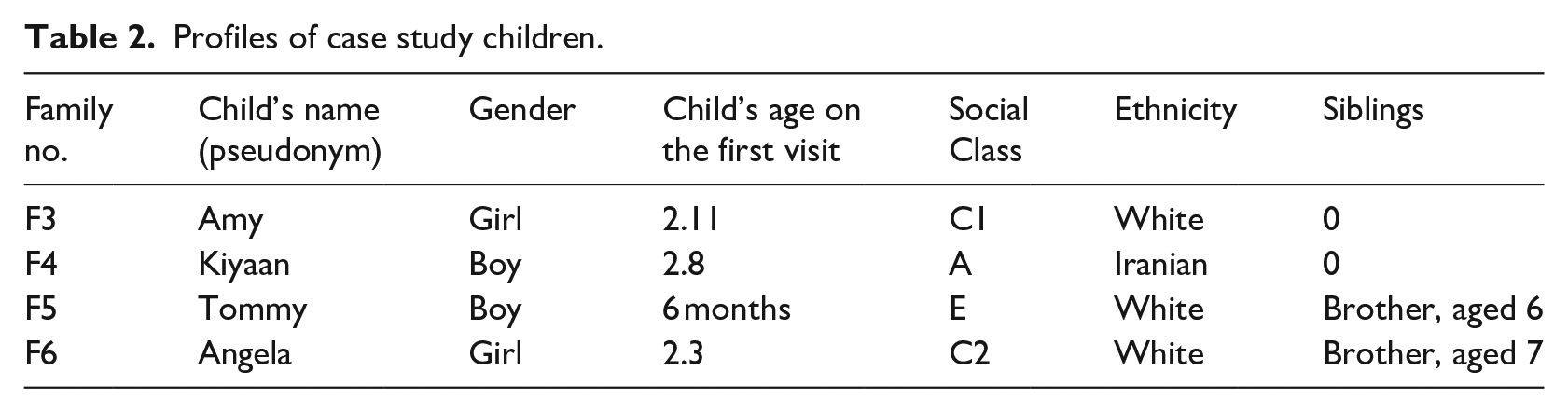
In determining social class, the UK’s National Readership Survey (NSR 1 ) classification system was used, which determines social grade by occupation.
Only the data relating to children’s experiences when aged under three are discussed here, which means that not all of the data with regard to Amy and Kiyaan are included (only the data pertaining to their activities up to their third birthday are drawn upon). Five visits were made to the first three families over a period of 3 months; the final family was visited on four occasions due to their holiday plans. The approach adopted for this study was what Knoblauch (2005) terms a ‘focused ethnography’. This approach, as Wall (2015, np) suggests, is ‘typified by short-term or absent field visits, an interest in a specific research question, a researcher with insider or background knowledge of the cultural group, and intensive methods of data collection and recording, such as video or audio-taping.’ In this study, parents took part in semi-structured interviews and children were observed in the home, with the researchers keeping field notes on each visit in which they recorded how children used tablets and how that use related to play and creativity. If they were old enough to engage in such discussion, children were asked about the apps they used. The researcher also took videos and photographs where appropriate. Parents were invited to video record and photograph their children using apps and then discuss these videos and images with the researcher. Video data included footage of children using tablets, of them talking about their use of apps, of children using objects related to tablets (such as toys) and of parents and children interacting when using tablets.
The survey data were processed and analysed using the IBM SPSS 22 statistical package. Descriptive statistics summarising the demographic features of the dataset were developed, and responses from each question in the survey were cross-tabulated against the following variables: age of child, socio-economic class, ethnicity and gender in order to identify any notable differences between groups. The interview data were transcribed, and were then analysed using thematic analysis (Braun and Clark, 2006). Data were coded both deductively (for play types, creativity and creative thinking types and types of parental mediation) and also inductively. Videos were analysed by drawing on typologies of play and creative thinking. Play behaviours were classified using the adapted Hughes’ (2002) taxonomy. Hughes’ definitions were revised to apply to play in digital environments (see Marsh et al., 2016). This allowed the way in which apps promoted different types of play to be identified. The software package Scribe 4.2 was used to document the analysis of the videos. This enables videos to be labelled in relation to codes. Codes were entered that related to Hughes’ taxonomy of play (2002). An ‘other’ category enabled an additional code to emerge, that of ‘transgressive’ play (see Marsh et al., 2016).
Various measures were undertaken to ensure validity and reliability. The survey data were analysed using the Statistical Package for the Social Sciences (SPSS). All variables in relation to the survey data were analysed using the chi-square test of association (Muijs, 2011) to indicate statistically significant relationships (e.g. between a child’s gender and their reported tablet usage). Statistically significant results were highlighted at the 1% and 0.1% level of significance to account for the large size of the dataset and repeated statistical testing. Additionally, post-test ‘Cramer’s V’ effect sizes were calculated (Muijs, 2011) in cases where statistically significant results were found. Findings at the 1% level are reported in this paper. Two researchers independently coded a selection of videos, with an inter-rater reliability score of 89.5%. The interview data were independently coded by one researcher, and the codes discussed within the team. The codes emerged from careful review and re-review of the data, and managed using NVivo.
The ethical guidelines produced by the British Educational Research Association (2011) were followed at all stages of the study. Informed consent was sought where possible with children, and assent was also verified through close observation (Dockett and Perry, 2011). Children and parents were invited to participate in dissemination activities. Families were given a small payment as recognition of their contribution of time to the project.
Findings
The survey identified that 25% of under threes who lived in a house in which a tablet was used owned their own device. Slightly more boys (27%) than girls (23%) owned their own device. There were differences in relation to socio-economic status, in that middle and upper class families were more likely to own iPads than working class families, who were more likely to own cheaper devices. Children also had access to tablets at grandparents’ and friends’ houses, thus indicating the wider ecology of use beyond the home. Children used tablets on average for 1 hour 19 minutes on a weekday and 1 hour 23 minutes on a weekend day. In the following section, the children’s play and creativity when using tablets are discussed in relation to the structure offered by the Integral Play Framework (Else, 2014), as this offers a holistic means of examining play and creativity across cognitive, physical, social and cultural aspects of children’s lives.
Tablet play and creativity in the cognitive domain
The ‘My Mind’ category of the Integral Play Framework relates to the Symbolic, Deep and Creative play types of Hughes’ (2002) typology. The data from the survey were analysed in order to identify the pattern of typical play with tablets across a day. Parents were asked to identify the times of day when children used a tablet. They were then asked to identify what children did using the tablets at those times of day, and for what purpose the tablet was being used (e.g. for play and creativity, learning, distraction). In Table 3, it can be seen children under three primarily used tablets for play and creativity, as identified by the parents.
Tablet use of under threes across a typical day.
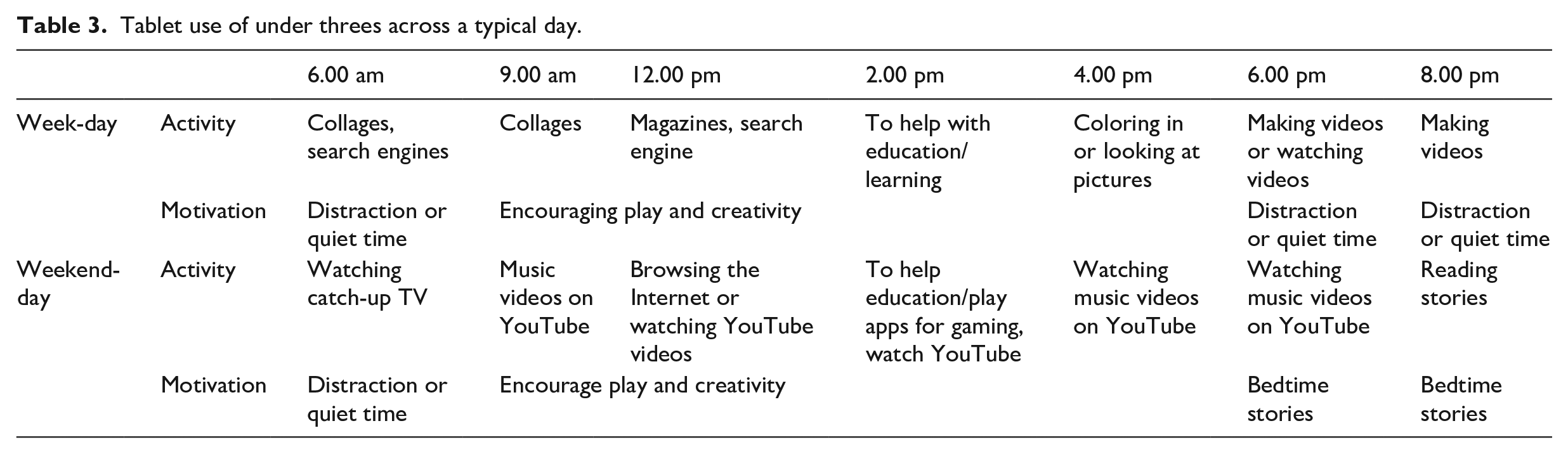
Table 3 indicates that each day offered numerous opportunities for under threes to be involved in play that afforded opportunities to develop learning. The survey identified that children of this age played games, completed jigsaws, enjoyed apps that developed recognition of shapes, numbers and letters, and familiar household objects. Table 4 provides a summary of the most popular activities using tablets for this age group, in order of popularity:
Popularity of activities on the tablet, by age.
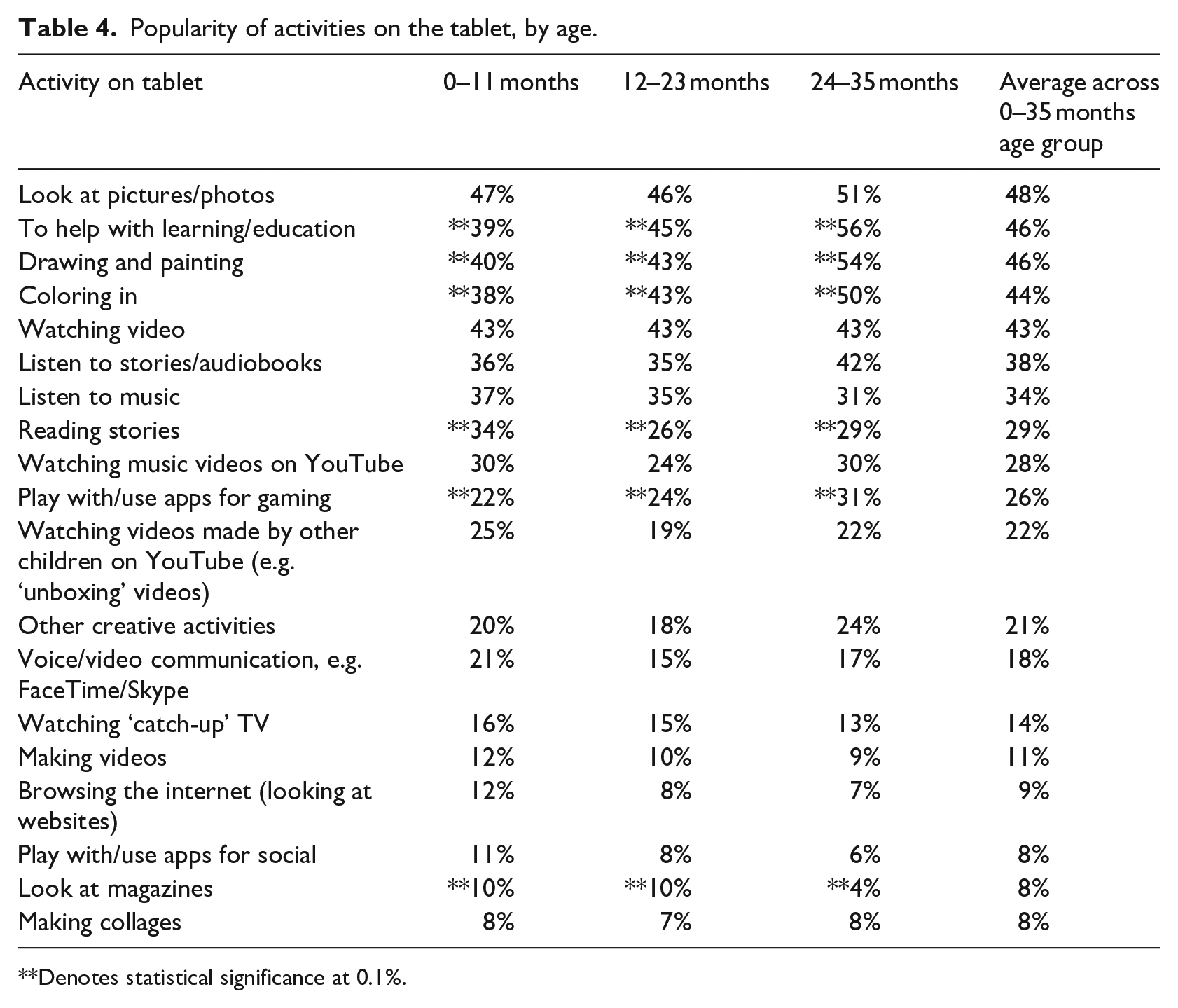
Denotes statistical significance at 0.1%.
As Table 4 indicates, the most popular use of the tablet by under threes was to look at photographs and videos. There is much research regarding young children’s emergence of self-concept, with the suggestion that when toddlers are around 18 to 24 months old, they start to recognise themselves in mirrors (Stapel et al., 2016). It was clear from parents’ reports in the case studies that the children enjoyed looking at photographs and videos of themselves on tablets and engaged in playful behaviour at times (such as taking selfies) as they did so. Parents in the survey reported that the second most popular activity after looking at photographs and videos was the use of apps for educational purposes, although they may have felt that notions of ‘good parenting’ made this a required response. Parents in the case studies commented that they used tablets to introduce their children to nursery rhymes for educational purposes from the early stages of using tablets, particularly using the YouTube app to do this.
For the parents in the case studies, the tablets offered valuable opportunities for their children to learn. Angela’s mum commented:
And I do actually believe that Zach and Angela are slightly cleverer with having these in their life. I mean if somebody would have handed us an iPhone or an iPad at the age of 2 we wouldn’t have known. . .we’d just be like, ‘What is this – what is this really?’ And no, I just think it’s amazing for their development.
And is there any particular way in which you feel they are more clever? Is it certain talents or aptitudes that you think it gives them?
I’m not sure really, it’s just being able to, like at the age of 2 she can access photos and a touchscreen. . .Yeah, it’s the touchscreen. And being able to find your own videos on YouTube at the age of 2.
Certainly, researchers captured video recordings of children in the home using a range of apps with relative ease, demonstrating a variety of skills and knowledge acquisition as they did so. Parents in the survey identified their children as having acquired a range of technical skills from using tablets. For example, 54% reported that their children aged under three could swipe a screen to turn a ‘page’, change photographs and so on, 45% could drag items across the screen, 44% could trace shapes on screen with their fingers and also open their apps, 43% could tap the screen to operate commands and draw things, and 40% could exit and enter apps and turn the devices on and off. Parents suggested that their children had learned a great deal from their interactions with technology across several subject areas. The parents made these assessments based on their observations of children’s tablet use. Specific examples of this were when Kiyaan’s mum reported that she felt using a tablet had supported his acquisition of English, Angela’s mum discussed her acquisition of letter-sound knowledge using apps and Amy’s mum reported her daughter had learned about shapes through an app. The connection between the ‘My Mind’ category in the Integral Play Framework and tablets was, therefore, a strong one for parents in the case study families. This correlated with findings from the survey, as 60% of respondents stated said they downloaded apps to support children’s learning.
Tablet play and creativity in the physical domain
The ‘My Body’ aspect of the Integral Play Framework relates to Hughes’ (2002) play types: Rough and Tumble; Exploratory; Locomotor; Object; Mastery. Rough and tumble play was not noted when children were using tablets, but other aspects of bodily play were notable. Children demonstrated a range of fine motor skills when using the tablets, as identified in other studies (e.g. Merchant, 2014; Price et al., 2015), such as tapping, swiping, grasping the edges of the tablet and so on. Object and mastery play occurred not only in relation to the tablet as an object of desire in itself, with, for example, 6-month old Tommy’s mum reporting that he tried to grab it out of her hands repeatedly, but also in relation to children’s attempts to manipulate virtual objects on the screen.
Play with tablets also fostered some gross motor skills in exploratory/locomotor play, as parents reported their children dancing to music on the tablet, or running to bring objects (usually toys) that related to the on-screen narrative. At times, parents deliberately chose to use tablets in playful ways to try and facilitate bodily or mood changes in children. For example, two of the case study families mentioned that they used an app to try and get their young children to brush their teeth. Kiyaan’s mum recounted how she had begun to use the tablet when Kiyaan was a baby to calm him down, using white noise clips. He then enjoyed listening to traditional Iranian songs, which also worked for this purpose:
Well, we used this, and at the moment the YouTube is full of stuff that parents could use for their children. He was a colic-y child, once I read on the internet that children with colic, if they’re exposed to white noise then it would help them a little bit. So we found the clip with the white noise and then we exposed him. And it worked for him, so he has slept with it. It helped a little bit and. . .of having other like songs and traditional songs from back home and. . .
For 6-month old Tommy, the tablet had become a nightly ritual:
And so you were talking about him not going to sleep at night now without watching YouTube you were saying, or something, is that right?
Yeah, I have to put. . .it’s not actually a video, it’s just like clouds and stuff on the video but it plays a lullaby to him, it’s like 2 hours’ worth of lullaby. . .And he won’t go to sleep unless that’s on. And he’ll settle, and then if I turn it off he starts screaming. . .I have to make sure that he’s properly, properly asleep before I can turn it off.
The data from the case studies identified that for these children, tablets offered a means of engaging with their own bodies and emotions, as outlined above, as well as encouraging physical play. The tapping of tablet screens by children stimulated physical play in a range of ways, for example causing them to wave their arms and hands in delight, run to get specific toys to play with that related to the apps and jump up and down in response to the app’s content.
Tablet play and creativity in the social domain
The category ‘My Social World’ of the Integral Play Framework relates to Hughes’ (2002) play types: Socio-dramatic; Social; Communication. Social play with tablets was embedded into the children’s lives from their first months. In the survey, 18% of parents of under threes reported that their children used tablets to engage in video communication. For all of the case study families, video communication software such as Skype or Facetime appeared to offer an important means of engaging in social and communication play with family members and friends, as is the case with regard to older children (Kelly, 2015). Traditional games such as ‘Peek-a-Boo’ are brought into these exchanges, and adults were also observed being playful in their virtual exchanges with young children, making noises, making funny faces, engaging in language play and so on. Six-month old Tommy engaged regularly in such activities, and his mum reported that he could already distinguish between his Aunt Katy and his grandmother on screen. On one visit, Tommy was recorded engaging in Skype call with Katy and his excitement at seeing Katy’s face and hearing her voice was evident. At one point, he grabbed hold of the tablet and brought it near to his face as if he wished to kiss the screen, which may have been an emotional response to the call, or may have been an attempt to place it is his mouth, typical object-play behaviour of young babies (Juberg et al., 2001). For the older children aged two and above, parents reported that they were able to operate the phone themselves in order to use Skype or Facetime with family members, as Amy’s mum noted:
Well she’s watched how to do it and she knows. . .at first she didn’t call it by its. . .she didn’t call it Facetime, she just called it video, ‘Let’s video grandma’ she used to say and she’d pick the phone up, didn’t you?
And you would then set it in motion. But now she can do it for herself?
Yeah, she can do it. Like the other day I’d gone into the kitchen, and I saw her the other night, just to wash up and she was sat on her own. I thought, ‘I’m sure I can hear her’, and my mum said, ‘Have you put this on for her?’ I said, ‘No, I’ve not put it on’. So she’d got on to it as well.
In the survey, 20% of parents reported that their child aged under three used social networking apps, such as ‘WhatsApp’. It is to be assumed that this use was undertaken together with parents or other family members, given that the sites are complex for children of this age to use independently. However, if the settings of social networking sites allowed for automatic upload of images, then there was evidence in the study that young children were able to make images public, unbeknown to parents, as Kiyaan’s mum reported. She commented on Kiyaan’s engagement with Wiper, which is a social media app that allows encrypted exchanges between people, which can then be wiped if the users wishes to do so:
To be honest with you, a few months ago, when he just turned 2, once we had this Wiper with the groups of friends and there was somebody from my house in the clip – actually it was my husband, perhaps. I called him, ‘Did you send this particular clip?’ It wasn’t too bad but it was a clip that, you know, perhaps wasn’t as. . .and he said, ‘No I didn’t’. And then after a time I thought it is him [Kiyaan] just clicking through. So I’ll be very cautious when. . .you know, he plays with it, because he can send the wrong stuff.
Parents in the survey also reported that 11% of under-threes had made in-app purchases by accident, indicating that parents do not always check that safety and privacy features are in operation, possibly due to assumptions made about the age of the child and what he or she can do independently (Chaudron et al., 2015).
Play with tablets, in all of the case study families, fostered the building of social relationships between children and parents. This was often achieved through joint play, but was also enhanced through parents sharing with children some of their own childhood passions; this was a form of media heritage. For example, both Tommy and Amy’s mum outlined how they accessed nursery rhymes or television programmes for their children that they themselves had encountered when young. Musical play, an important element of young children’s daily lives (Young, 2008), is also a means of fostering intergenerational play. In the survey, 72% of parents reported that their under-threes accessed musical/audio play apps, and from the case study data, it can be anticipated that some of this was co-use with parents.
Play with siblings was also a strong feature of the case study families that had more than one child. Angela’s and Tommy’s older brothers both introduced them to new apps, played with them on apps suitable for the younger children and also downloaded apps for their younger siblings, a pattern found in the study by Chaudron et al. (2015).
Tablet play and creativity in the cultural domain
The ‘My cultural world’ category of the Integral Play Framework relates to Hughes’ (2002) play types: Symbolic; Role; Creative; Socio-dramatic; Dramatic; Fantasy; Imaginative. Tablets were an integral part of children’s play in which their cultural interests were central. As studies with older children have indicated (Chaudron et al., 2015), children’s uses of technologies were very much part of their popular cultural interests, which populated their imaginations. Couldry and Hepp (2016) contend that we are in a period of ‘deep mediatisation’, in which our lifeworlds are infused with digital media. Young children aged under three are no different than older children and adults in this respect, as this study indicated.
Children’s offline play was very much influenced by their engagement with peer culture on YouTube. Parents reported, for example, children watching people making Play-Doh models on the site, then copying the actions. As the survey identified, YouTube is the favourite app of children of this age, and once the children in the case studies could interact with the YouTube interface effectively, they found videos independently by clicking on recommendations, as Amy’s mum noted:
She just. . .she loves it. And I think. . .right we’ll be on a Frozen video, so she’ll be watching a Let It Go video from Frozen, or more recently the new trailer for the new Frozen, and then she’ll scroll down the side, she’ll pick on another video and that will take her to another song but a song that somebody else has uploaded, not Disney. So it will be somebody’s own. And then it will bring up some more related videos down the side, and she’ll keep doing that until she finds the Kinder Egg Surprise toys. And we always get back to watching that. And she loves watching them open them to see what’s inside the toys. So I don’t know. And I know a couple of other people who have got children a similar age to her, and they’re the same, they’re fascinated with watching toys. She’s fascinated with watching. . .there’s a particular YouTube channel that’s Disney Channel Toy Club and all they do is reveal, open toys and look at them, and she’s like. . .but we can’t stand her looking at them, it drives us. . .it really does drive us mad, and I don’t like her watching toys. But she loves it.
Here, Amy’s mum comments on Amy’s interest in unboxing videos, which were popular with all of the case study children other than Tommy. In the survey, 22% of parents of children aged under three reported that their children watched videos made by other children on YouTube, including unboxing videos. These have also been found to be of interest to older children (Marsh, 2016). This interaction with YouTube also points to another aspect of young children’s post-digital play (Jayemanne et al., 2015; Marsh et al., 2020; Nansen, 2020), the integration of offline and online domains. For example, Amy’s mum pointed to her child’s LEGO apps, which enabled her to build ice creams using Duplo and on-screen:
And we’ve got these LEGO apps here, as a result of she got some LEGO for Christmas which was ice creams, so it was this same concept that they’ve done on the app, so she can build ice creams with the Duplo. And this is aimed at the younger age groups.
This app did not enable the direct connection between the on-screen and off-screen ice-creams, but it fostered an imaginative connection. The direct connection was afforded by AR (augmented reality) apps. In the survey, 24% of parents of 0 to 3 year-olds indicated that their children had access to AR apps. In the case study families, some of the children had AR apps that linked toys and apps, related to the Internet of Toys phenomenon (Mascheroni and Holloway, 2017). These are toys that are linked to the internet in some way, and include toys that can be controlled by apps, such as the Hasbro Furby range. This is a growing market and will inevitably feature more highly in many children’s lives in future years. The extent to which AR apps can foster play is very much shaped by their design, with apps that allow little in relation to user autonomy limiting the kinds of play that emerge in children’s interaction with them (see Marsh and Yamada-Rice, 2016).
Tablets related to the case study children’s cultural play in a number of ways. First, they offered a means of parents sharing important aspects of their cultural heritage with children (such as in the example of Kiyaan being introduced to Iranian songs, and Tommy and Amy’s mothers sharing their childhood rhymes and television programmes). Second, they fostered engagement with the children’s popular cultural interests, which were many and varied. Finally, the tablets enabled these young children to capture their own cultural worlds through the use of the camera, providing them with a means of becoming active cultural agents and not simply passive recipients of the provision offered by tablets.
Conclusion
This study makes a number of contributions to the field. Firstly, it has offered a range of empirical insights into the digital play of children aged under three as they engage with tablets and related toys, books and other objects, drawing from a larger dataset (n = 954 families) than has been the case with previous online surveys of parents of children aged under three. The study has identified the most popular activities engaged in by under threes as they use tablets, has provided a range of new information about what apps they access and how they are used, and has outlined how these foster play and creativity. Secondly, the study indicated that tablets and apps can foster play and creativity in a number of ways, as the data illustrate. All types of play (apart from recapitulative and rough and tumble play) were identified in the case studies when children used tablets. Creativity in young children’s use of tablets, as outlined in this paper, includes the use of expressive language, music and art, and the study has identified the extent to which apps that foster these areas feature in the lives of under threes. Thirdly, the study makes a contribution in terms of identifying the way in which tablets and apps engaged these young children in play holistically across cognitive (including linguistic), bodily/affective, social and cultural aspects of their development. As Else (2014) suggests, these domains cannot be separated in a simplistic fashion, and play practices in the case studies were likely to include many, if not all, of the domains simultaneously. The study thus indicates the value of the Integral Play Framework for the study of children aged from birth to three’s play with tablets. Fourthly, the paper makes a contribution to the theorisation of play in a digital age. In the case studies, the play of under threes with tablets contained most of the types of play identified in non-digital play, thus indicating that it is not appropriate in contemporary society to disregard the overlap between the digital and non-digital domains for this age group. Rather, play needs to be framed in contemporary contexts in ways which recognise its material nature, drawing on new materialist understandings of intra-actions between humans and objects, and which acknowledges that this perspective must also pay consideration to the immateriality of the digital. This has implications for the consideration of the relation of technology to the body. Whilst Else’s (2014) focus on ‘My Body’ in the Integral Play Framework’ was on the child’s physical experiences with regard to his or her body and emotions, which was entirely appropriate for the era in which the framework was developed, we would argue that this needs now to be extended in the light of posthumanist understandings of the intra-actions between humans and technology (Barad, 2007). The study thus extends the theoretical basis for the use of the IPF in current times, ensuring that it can continue to be of value as children’s play becomes ever more firmly embedded into the technological landscape of the digital age.
There are some limitations to the study. The focus was on the use of tablets; this meant that wider engagement with technologies such as television was not studied. However, this focus was necessary as under three’s use of tablets has not been studied in depth, whereas television viewing has. In addition, the study was undertaken in the UK, although the data will have international reach, given that many children of this age in other countries are now accessing tablets (Chaudron et al., 2015; Gillen et al., 2020).
The study has a number of implications for policy and practice. Given the extent to which young children engage with tablets in their early play, it is important that professionals who work with families (e.g. health visitors and early years practitioners) understand this use and use it to inform their daily work, either in raising parents’ awareness of relevant research in the area that might inform their parenting, or in helping parents to manage their children’s digital lives effectively. In addition, it is important that early years practitioners become familiar with research that outlines the digital lives of under threes so that they can build effectively on this in nurseries and early years settings, and offer digital experiences for children who may otherwise not have access to a wide range of hardware and software in the home.
The study also has implications for further research. Firstly, given the interest of under-threes in AR apps, there should be future studies that seek to examine the potential this technology has for fostering young children’s play. Secondly, the study has demonstrated the value of using well-established frameworks (such as those developed by Hughes (2002) and Else (2014), which were developed in relation to non-digital play, to explore digital play. There is potential to explore the use of these frameworks in relation to fully digital play, to examine the extent to which they can be applied to those practices, and to explore the relationship between this play and children’s learning. Finally, the data in this study indicate that children from their earliest months are developing a range of digital literacy skills through their play with tablets, yet there is a lack of research studies that trace the development of these skills longitudinally. This would be of particular value if children’s experiences were examined across time from birth, given the large developmental range across the first year of life. Given the rapid changes in this area, which can only increase in the future as technological developments accelerate, there is an urgent need to begin to study this aspect of young children’s lives in greater depth. Not to do so runs the risk of failing to grasp the opportunities and address the challenges presented by the strong presence of digital technologies in the lives of the youngest members of our society.
Footnotes
Declaration of conflicting interests
The author(s) declared no potential conflicts of interest with respect to the research, authorship and/or publication of this article.
Funding
The author(s) disclosed receipt of the following financial support for the research, authorship and/or publication of this article: This study was funded by the Economic and Science Research Council (ESRC): grant no. ES/M006409/1.
