




Abstract
What does it mean to engage in transformational learning with young children? In a time when “technology” is hallowed as all-important, how do we frame young children as empowered, critical thinkers around technologies, instead of just consumers? This article looks closely at a child-centered, emergent curricular process within an early childhood classroom. Framing the “having of ideas” as the essential technology in children’s lives, a teacher chronicles and analyzes children’s idea-having process and the pedagogies around it. Focusing on children’s talk, questioning, critique, and negotiation, this article shifts away from notions of traditional technologies, looking closely at the transformational learning inherent in children’s collective having-of-ideas.
A morning of renegade kitties
It is early in the preschool room, and the children are deep into their hour of free play in our outdoor space. We begin our mornings with an hour of open free play in the outdoors to facilitate children’s diverse ways of entering the school day. The children find themselves and each other in this way. Pirates and police-people whiz across the open space, a system of pools and rivers are dug in the sand pit, and tiny subversives sneak into the classroom for supplies and “secret meetings.” As teachers, we allow that which is “not allowed,” knowing the need for these moments without surveillance, these small acts of defiance that serve the children’s eternal process of creating, asserting, and testing.
During one of these moments, I was setting up my classroom when a cohort of “kitties” tumbled covertly into the classroom. They were “very quiet” shushing each other with the delicacy of a herd of water buffalo and giggling with glee. I stepped into the supply area to give them their privacy. Covert activity loses its fun under the eye of a teacher.
Clay, Amber, and Katie raced to the writing area of the classroom, accompanied by laughs and meows. “We can make tails!” Clay cried, grabbing the colored paper and scissors and setting to work. “Oh- yes! And we can make ears and they can go on my headband. I have extras in my cubby!” added Amber, riffing off of Amber’s enthusiasm. Their ideas climb and grow in this way, much like jazz musicians improvising together. Katie, the youngest of the group, followed and played but did not speak. Quickly, the tail and ear-making were accomplished, and the kitties raced back onto the playground. Only Katie remained in the room, her face the picture of a small, disgruntled princess.
“What’s up Katie?” I asked, finally making my entrance into the classroom space.
Katie blew a tempestuous, flustered sigh, her tight curls bouncing with her frustration. “I want to get an IDEA!” she declared. “Everyone else has so many ideas and I can’t get one!”
“I think you have some in your head,” I replied, “You might just need to think and look for them.”
“But I can NEVER find them!” Katie sputtered, then squared her shoulders, and marched back outside. If she could not find an idea, then she would follow the ideas as they streaked across the playground.
Reflecting on “technology”
I must begin by telling you, the reader, that I struggled with the idea of writing about technology and transformation in my preschool classroom. The transformation part was easy for me. We, as teachers, are transformers. We are in the business of transformation, both for the children and the teachers, from day to day, month to month, year to year. We transform each other. Technology, however, is a more challenging topic. And, as I struggled to put words to paper for this article, I wondered, why? Why was technology stopping me in my tracks?
Before you get the wrong idea, please do not mistake me; I love technology in its traditional form. We use rich technologies in our classroom, for documentation, for reflection, for understanding learning, ourselves, the children, our processes, and for making connections with the outside world. Technology, as it is traditionally defined, is “alive and well” in our classroom. But, as a classroom teacher, I get very little time to write for the outside world. When I do, I want to tell you something important, something that feels powerful from our “little world” of the classroom. The more I considered traditional notions of technology (iPads, smartboards, cameras, and the Internet), the more distant these notions felt from the essence of our learning context. For me, there is one essential “technology” that populates our classrooms, the lynchpin upon which all things turn—the having of ideas.
Narrative analysis
I began this piece with the story of The Renegade Kitties because of the glimpse it offers into the ways in which I would like to think about technology and transformation in our classroom. It is the very practical everydayness of these moments that makes them powerful in terms of children’s thinking, their work, their intentions, and their revelations. It becomes complicated because these moments are not traditionally thought of as “teaching.” In traditional pedagogies, to teach is to stand at the front of the room, to impart, to lead, and to be followed (Greene, 1973). And yet, it is so often the stepping back, the allowing something to unfold, that enables children’s deep learning. Here, let us consider the choices made in the “kitties” narrative.
Unstructured play
We begin all of our days with an hour of unstructured, outdoor play. This is a conscious choice made to support the most effective entry that children can make into the classroom day: … many American children spend the majority of their waking hours, not under the supervision of their mothers, who have the luxury of not supervising their every move, but in family home care or preschool settings with adults who feel compelled to be vigilant, ready at a moment’s notice to intervene in disputes or to break up a kissing game. (Tobin, 1997)
As teachers, we actively push back against the religion of vigilance, providing official spaces of open, yet-to-be-imagined play-time for our students. So much school time is guided by the heavy hand of teacher’s intention and expectation. With these dedicated, unstructured times, we write children’s freedom into the structure of the day’s schedule, honoring and requiring this time of them and of ourselves. It is their responsibility to write the stories, adventures, and relationships that will fill these moments. In our preschool classroom, there is a morning process, an evolution of arrival, surveying of the terrain, observing the play, before entering into action. By mid-morning, the air is crackling with connections made and ideas circulating. The children can be seen flying across the corners of our outdoor play space, racing into the classroom for necessary resources, and then rushing back out again with a sense of determination and belief in the importance of their work. They are filled with intentionality born of their process of entry, their deliberate and individual ways of entering, and the intense sense of purpose that emerges from their morning’s research. The story of the Renegade Kitties is very much a part of this process of unstructured play, as the children ignite connections and ideas, finding their way into their relationships and their school day. These choices about the flow of the school day create an environment primed for the generating of ideas, both in independent play and when we transition into the classroom setting. Through these choices, we offer children the opportunity to negotiate their ideas, to inspire themselves and others, and to be inspired, to argue, to consider, and to emerge as idea-makers in the school context.
On being “unsupervised”
There is something particularly important about “unsanctioned” play and learning in the lives of young children. These are urban children of Cambridge, Massachusetts. Their days are filled with enrichment, care, and constant observation. As a preschool in the United States, we walk a delicate line in what we “allow” the children to do, as the idea of “constant supervision” is frequently the mantra of US practice (e.g. Tobin, 1997). Yet, we know the importance of the private moment, the pushing of boundaries, the ability to make, to think, to play without adult sanction (Tobin, 1997). And so, we deliberately make space for those moments as well. Instead of stepping into the play, helping children with the scissors, asking questions, sending them back outside where they are “supposed” to be, I stepped aside, preserving their privacy. There is something important about these stolen moments and the empowerment that the children feel when taking ownership of their ideas using the technologies available to them in the classroom. This is partly explained by Duckworth (2006): And they make sense by trying out their own ideas, by explaining what they think and why, and seeing how this holds up in other people’s eyes, in their own eyes, and in the light of the phenomena they are trying to understand. (p. 181)
When I speak of “technology” in this vignette, I refer to the scissors, the paper, the tape, all of the resources that, when used in concert with great ideas, allow the children to bring their concepts into meaningful reality. They might seem mundane in comparison to the more sophisticated iPad or Smartboard, but I would like to interrogate this. How often do we allow children to use school resources unsupervised? How often are they allowed to engage with and come to feel confident with the technologies of paper, scissors, and tape without the overlay of a teacher expectation or provocation? It is in these “covert” moments that children gain control of technologies, engaging in a full evolution of the having of an idea, making an assessment of the materials and technologies necessary for developing it, conveying this process to peers, and realizing the idea through creation (Duckworth, 2006). These “unsupervised” moments allow for the fruition of children’s technological mastery, replete with curly kitty tails and pointy ears.
On “getting an idea”
There are two aspects to providing occasions for wonderful ideas. One is being willing to accept children’s ideas. The other is providing a setting that suggests wonderful ideas to children-different ideas to different children-as they are caught up in intellectual problems that are real to them. (Duckworth, 2006)
One of the most essential elements of “technology” and “transformation” that occurs to me in this vignette is Katie’s emerging thinking around “getting an idea.” We move so quickly, particularly in the United States, pressuring children to read, to play a musical instrument, a sport, to be enriched (Elkind, 2001). We cradle our nuggets of “content” our ideas of “skill” without remembering the most prized possession of all, the most powerful skill—the having of an idea.
Here, I contend that ideas are currency. They enable the making of rich play scenarios, relationships, stories, experiments, and limitless possibilities for learning. But what is an idea? How do we get an idea? Where do they live and how do we find them? This is the technology of the preschool classroom, the deep engagement around this critical process. As the youngest child in the class, Katie’s simple recognition and frustration around “ideas” is a profound step in her process of transformation, of making sense of her own thinking, and the resources that might be available to her and her peers. The processes of thinking about the concept of the “idea,” ascribing value to it, discussing and interrogating it, enable the children to begin a critical journey into making sense of their own minds, valuing their ideas, and igniting ideas in concert with others.
An absence of instructions
It is January in the preschool classroom. January is so different from the earlier months of the school year. The children come to us in the fall and slowly they become in the school setting. They become themselves, they become a group in relation to one another; they are so busy becoming. Their reentry into the classroom in January begins a new journey. The “first day back at school” recalls those first days in September so clearly, and yet reentry is quite different. They are veterans. They are steeped in knowing and being known, proud experts on every moment of our predictable yet unpredictable days.
It was on just such a January morning that a new story of ideas, technologies, and transformations waltzed into our classroom, quiet unexpectedly. Following some recent visits to the kindergarten classroom, the children noticed the absence of baby dolls in our classroom. In order to remedy this problem, we embarked on several weeks of research on “What do babies need?” in preparation for our new arrivals. Our savvy preschool veterans were avidly sharing their ideas about infants’ rights and needs, when Sam suddenly exclaimed,
“They need beds! Babies have a right to special kinds of beds!”
Well, that was clear. We would need beds.
“We can order them on Amazon! Let’s pick one out,” added Freddy.
I looked quickly at my co-teacher, a lightening check to make sure we were on the same page.
“Well, we already bought the babies,” I explained, “We don’t have any more money. So we can’t buy them.”
This stopped the conversation for a moment. How did one acquire something if not on Amazon?
Sam, always an idea man, jumped right back in. “We can just build one! With wood and paint.”
“But how?” I pressed.
“We just have to follow the instructions,” added Sarah. This seemed to answer to the problem and the kids settled back with a sense of certainty at the plan. My co-teacher and I waited, letting them sit in the moment, awaiting realization.
“But there’s no instructions! We don’t have any!” exclaimed Beth suddenly.
This statement ignited them. Here was the problem, so much more interesting that the simplicity of following instructions. Instructions were boring. Uncharted problems were fascinating.
“Well,” said Simon in his quiet, profound way, “We will just have to make our own.”
Reflections on “technology”
This is a fraction of a much longer discussion that wove its way through days, weeks, and months of our classroom practice this semester. The fascinating journey of building a set of four cribs was complex, and common ideas of technology were woven into the process, particularly through work in our Makers Space. The children’s mastery of blueprints, prototypes, tape measures, saws, and drills were all elements of this technological mastery. All of these technologies were central to the work and were deployed toward the accomplishment of the goal. But the thing that strikes me particularly in this vignette is the life of the idea, the process of getting, making, and negotiating that idea, and the ways in which these ideas and their becoming shape our transformation as a class.
Narrative analysis
The evolution of ideas
The beginning of this vignette focuses heavily on the time of year and the children’s way of being in the classroom at that time. Again, I return to the US (and my own) tendency to push, to move fast, to “achieve,” and to acquire information (Elkind, 2001; Tobin, 1997). None of these ideas can be born of that process. These moments are born of a slow becoming, of the children investing deeply in themselves, in each other, in personal identity and in collective identity. Innovation is born of classroom culture, of the “we’s” that emerge from sharing our individual stories and creating collective stories (Dynson and Genishi, 1994). It is in this fertile ground that ideas are able to grow.
If we look closely at the conversation, we witness children who are comfortable building a collective idea. They have learned to listen to one another, confident in the knowledge that they too will have a time to be heard. They are able to theorize, to offer their ideas, to critique, and to move forward in the knowledge that this is “good”—that they are doing a “good job” at school. We celebrate the question, the possibility, not the “right answer” (Duckworth, 2006). For me, as a teacher, this is the evolution of the “technology” of the idea. The children, after months of practice, are steeped in the habits of mind around ideas (Costa and Kallick, 2009). In our collective discussion on the rug, the air is full of original ideas put forth in a collaborative process. And in this moment, we see the transformation of their concepts of learning as they struggle forward with the power of an idea and the absence of instructions.
Idea versus instruction
Putting words to this story of our classroom allows me to isolate and focus on these moments and reflect on them, and on the feeling of the room—on the texture of the words and the silences that unfolded. It strikes me that these children, a “Lego-amazon.com-Is-this-correct?” population, are ignited by the absence of instructions. These are children who are used to “the rules.” They are accustomed to being informed of “the right way” to do things. They are used to precision, immediacy, and accuracy. The very absence of instructions is the antithesis to their experiences. Yet, the quiet moment following the “We will just follow the instructions” had the feeling of finality, or more precisely, a dead end. There are no questions when instructions are present. There are only answers, with their precision and finality. It was in the realization that we were without instructions, without the dictate of answers, that the staccato of the children’s critical thinking emerged. Suddenly, the moment was rich with questions, possibilities, and ideas. The technological process of theorizing, questioning, and problem-solving took hold, offering challenge and inspiration. Instructions may offer the “right” answers, but they are alarmingly devoid of ideas and play. It is in the questioning, in the absence of “rules,” “have to’s” and “instructions” that the children’s questions, their play, and their ideas come alive. It is in the genuine un-charting of the work that the having and refining of ideas can thrive.
The making of ideas
Many months later, we sit together again, in that never ending circle of the purple classroom rug, surveying our work. After months of working and planning, of theorizing and idea-making, four sturdy cribs stand guard, gently but firmly cradling our classroom babies.
There is a feeling of ending in the room, as the children survey their work and look on each other in that sure-of-you kind of way that comes in the last months of school. Diana snuggles deeper into my lap, and I am grateful, both for the comfort I can give as well as the comforting she gives to me. The ending is hard for teachers too.
We sit together, looking up at a slideshow of our Crib Project projected on the screen in our classroom. As the children watch, the story unfolds, and they call out their remembrances.
“That’s the day the babies came!”
“I’m using the glue gun. That’s the time I burned my finger!”
“Look, I’m sawing the wood for the crib. The first time Mr. Benjamin helped me, but then I could do it myself!”
“Hey- that’s us using the big drill press. I got the red goggles that time!”
After watching the slideshow several times, we came together to remember and to wonder about our work.
“How did the story of the crib project start? How did we even think of making one?” I asked.
Simon spoke out quietly, “You make an idea. You plan something and then you do what you planned. The idea comes from your brain.”
“And it’s also in your body! An idea is in your body,” added Marty, not to be left out.
“And so we thinked we could go to the Makers Space but first we had to do the blueprints a bunch of times to get them right. And we thought about making the cribs and that’s how we got the directions, from the thinking,” added Claire, always thorough.
“Yeah, you have to get those ideas out of your body and your brain. Then you can say them and you can make them with the glue guns and the wood. That’s how we got to make our cribs,” concluded Amit.
“Let’s watch our show again,” said Amalie quietly, and the class settled back into our story one more time (Figures 1–4).
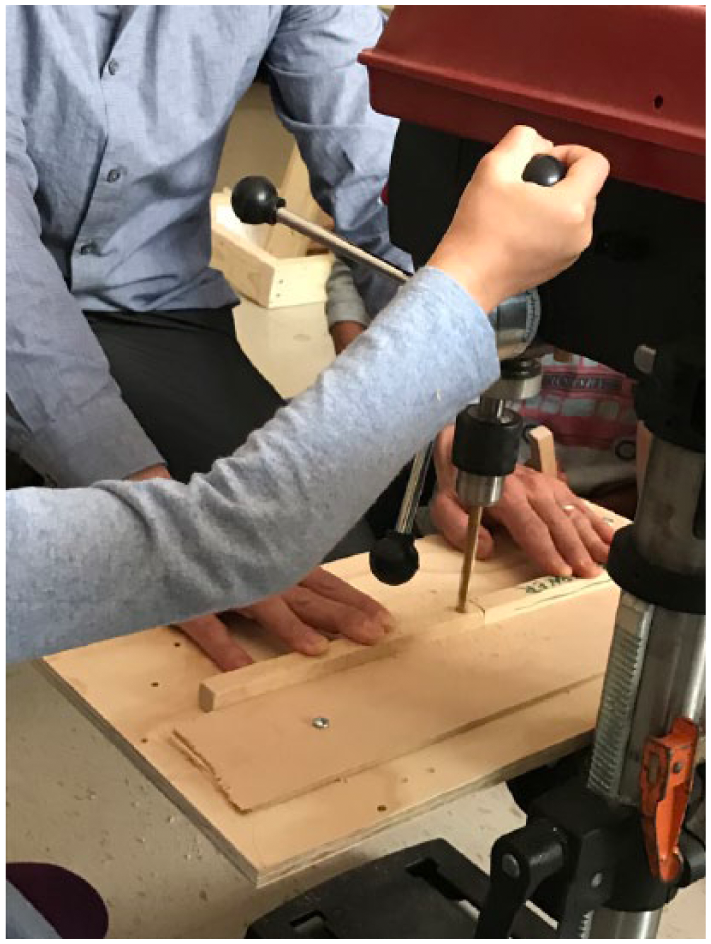
Drilling holes.
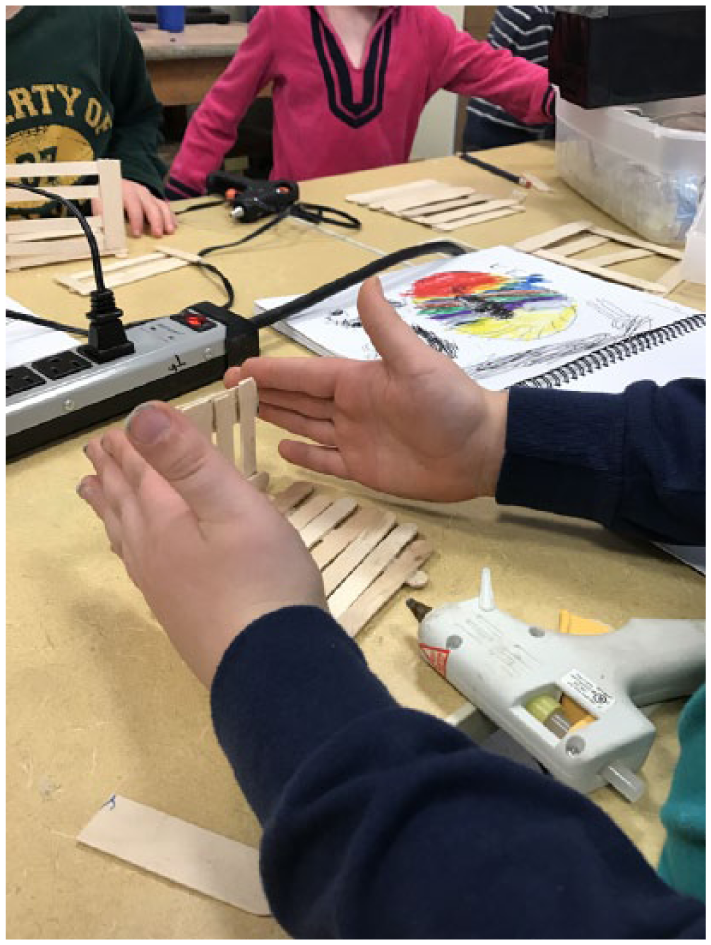
Glue guns.
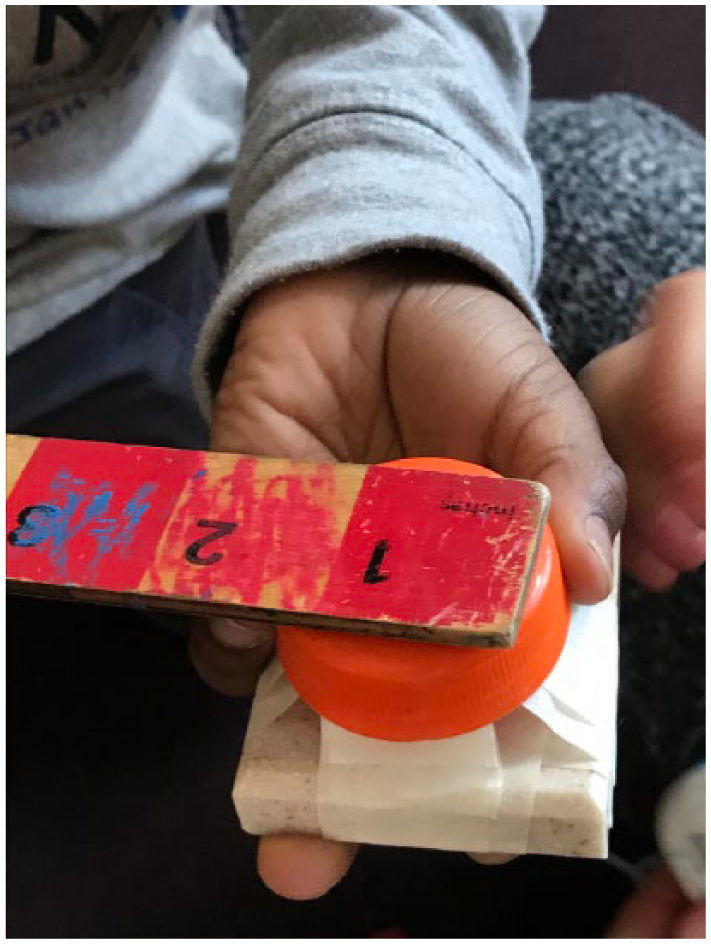
Measuring with rulers.
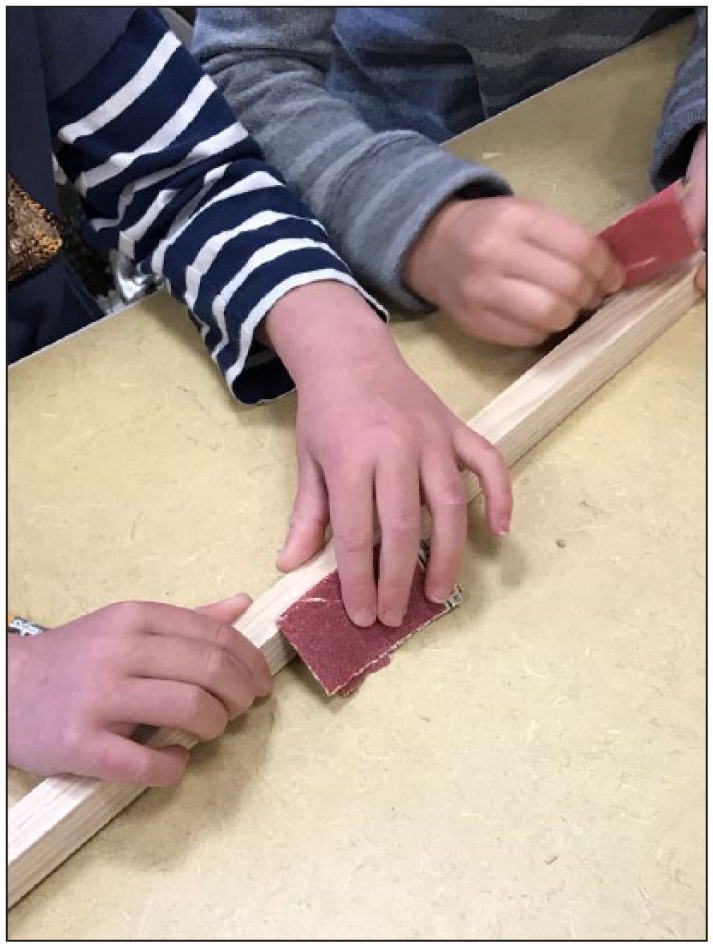
Sandpapering wood.
Reflecting on “technology”
Again, in this vignette, I am struck with what might be the more traditional discussion of technology around the work of these children. Here, we were engaged in a common practice in our classroom, reflecting on our work using slideshows and photography is a familiar part of our classroom documentation. We do this several times a week, collecting photos, setting them to music, and arranging them into shows. They allow the children to see their stories, to view their connections, and to highlight the work of all members of the community. Traditional notions of technology are alive and well here in our classroom, as we use them to navigate meaning and the processes we deployed in our creative experiences. However, I return again to the notion of “the idea” as being the pivotal technological component of the children’s transformation in their learning. Ideas are the resources that we build on. It is through the children’s experiences with the process of collaborative idea-making that deep learning is achieved.
Narrative analysis
“The idea”: an evolution
The final vignette witnesses the children coming “full circle” in their work on ideas. In the first story, Katie was on a search for ideas, frustrated by their elusive nature. Here, in the final weeks of May, it is apparent that the children have become sophisticated idea-makers, as individuals, and as part of a collaborative. They engage in the metacognitive processes of thinking about their own thinking, and locating the origins of their ideas. They note the processes in which an idea emerges from the mind of the individual, is then shared with the community, takes on the form of “a plan,” and then finally becomes “something” (Duckworth, 2006). In our case, the becoming of the idea was embodied as the four large cribs that were the product of the children’s work that semester. These structures symbolize the use of technologies in the traditional sense, from saws to drill presses, to blueprints, to liquid-crystal display (LCD) projectors, and to slideshows. But more essentially, they embody the technology of the having of ideas, the ways ideas are cultivated, take hold, and ignite the work of a community.
And so, as we move forward with our passion for technologies, our experiences require us to remember “the idea” as the essential resource found in the minds of young children. This is not to say that we ignore the many contemporary technologies that are available to us; I want our children to productively navigate and use all of the resources available to them. But, here, I contend that we must not forget the importance of having of an idea in the first place—as the catalyst for learning. That is our most powerful resource, and it is one that we can cultivate with time, care, thought, and with respect. I never cease to be amazed with the announcement, “I got an idea!” and the power of the paths down which each idea can lead.
Traces of technology
We have two days left in the school year and the children are packing up the classroom. We do this together every year; we explain that we are getting ready for the children who will come next. The children take this very seriously. They are veterans of this classroom, and they seem to grow taller as they imagine the younger children who will come, and how they can prepare the room for their arrival.
‘They won’t even know we were here!” Amit exclaimed as we packed up everyone’s journal and self-portrait.
“Hmmm …,” I said, as I carefully wrapped clay sculptures in tissue paper. “What do you think? Is there anything here that might make them remember you?”
Several children working around me stopped and surveyed the space. The warm light of the cozy corner shone into the room, and Amalie exclaimed, “The cribs! We’re leaving those behind for the kids who come next!”
“Yes, the cribs and our babies,” added Hema, who sat cross-legged on the soft rug of the cozy corner, packing up our dramatic play supplies.
“We need to tuck them in really good for the summer!” exclaimed Sam, and a group of children hurried over to start the preparations. They lined the cribs with soft blankets and picked out “the best ones” for swaddling the babies.
“Wait, wait! Let me show you,” called the once-bashful Lana, “Dana showed me so many times. I’m an expert on swaddling now.”
She carefully swaddled one baby and placed it gently into the crib. Sam followed suit, and soon all of the babies were wrapped and laid to rest, lined up in our cozy corner.
“Maybe you should keep one of our lights on,” added Simon, “So they don’t get scared in the summer when we’re all away.”
“Now they’re all ready for the new kids,” added Lana with a sigh.
As I left the classroom on our last day, the row of cribs stood watch, a wall of ideas-made-real, guarding against forgetting. A trace left behind. I reached out and switched on a lamp. We wouldn’t want the babies to be scared (Figures 5–7).
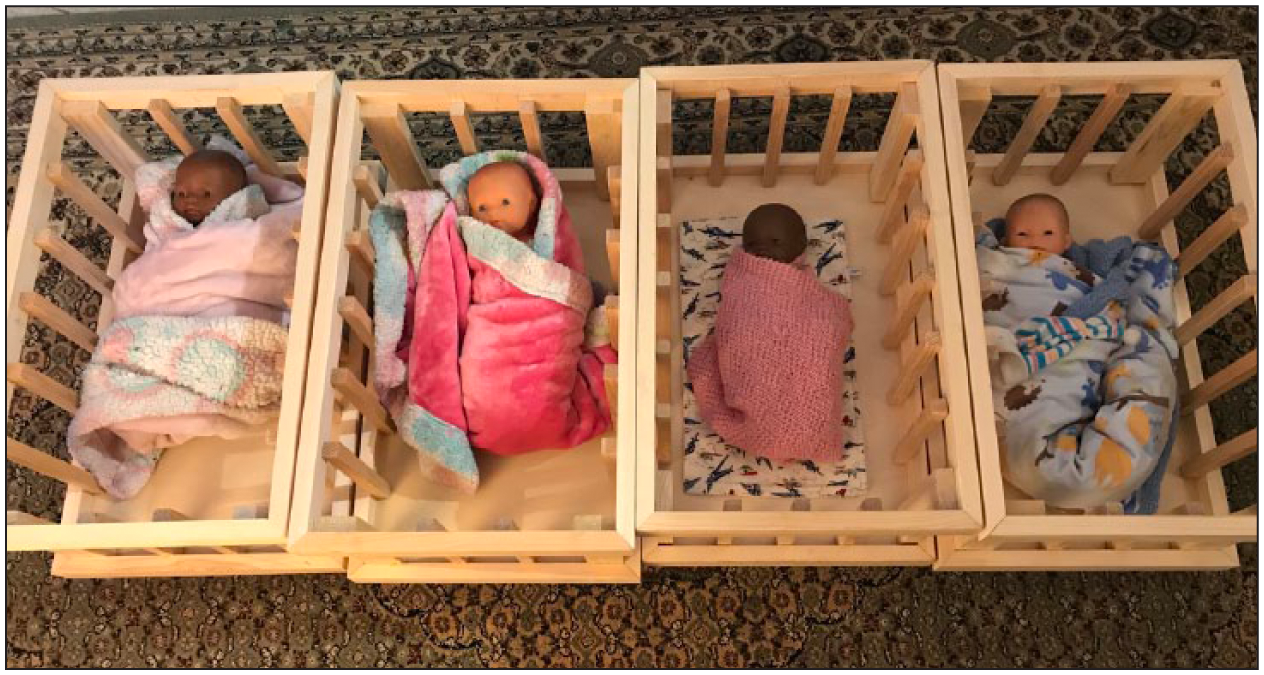
The cribs Frantz Bentley.
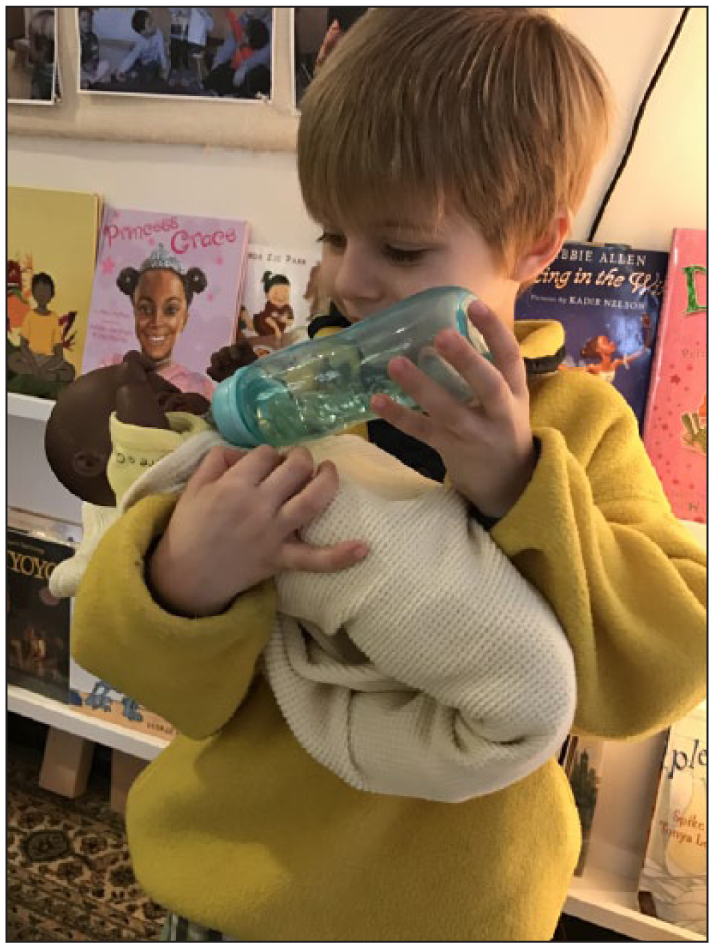
Baby play.
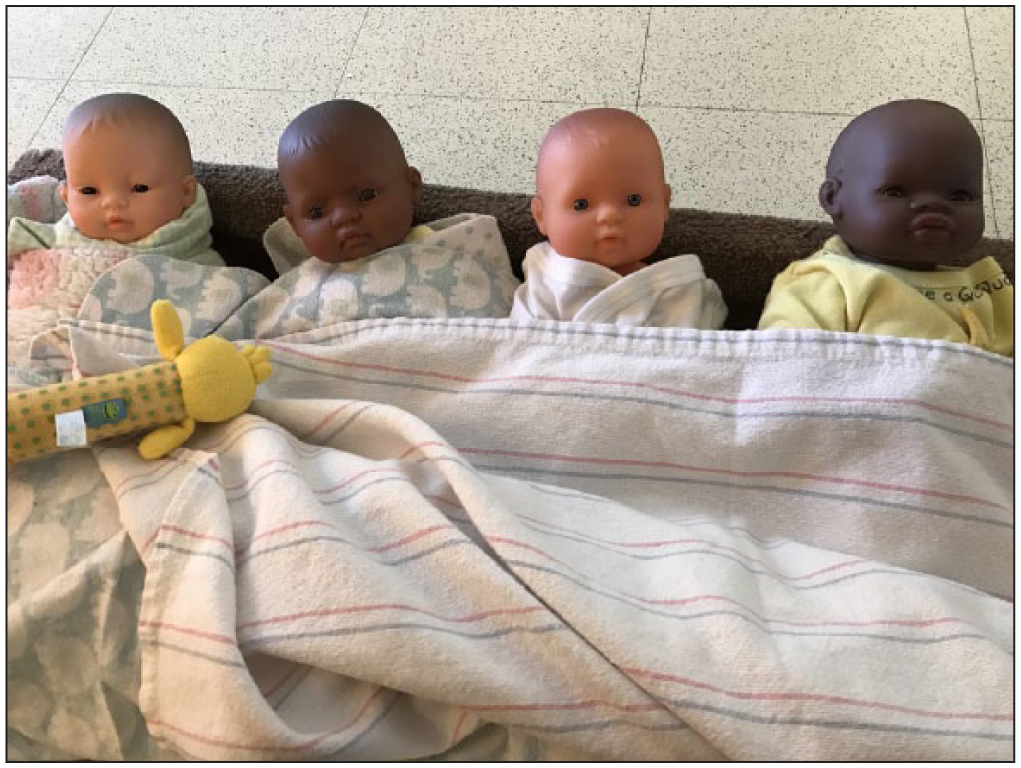
The dolls.
Footnotes
Funding
The author(s) received no financial support for the research, authorship, and/or publication of this article.