




Abstract
With the increasing use of tablets in early childhood education (ECE) services internationally, a sequential explanatory mixed-method doctoral study was undertaken to explore their use in New Zealand. The study surveyed four major service types: education and care, home-based, kindergarten, and playcentre. Qualitative data from one tablet user service and one tablet non-user service from each type were then collected. The findings revealed three main reasons for not using tablets: educational philosophy, funding, and company or service policy. The three main purposes for using tablets were for documentation and assessment, playing music, and using these devices for creative purposes. A collective case study identified that two non-users shifted from completely not using tablets to using them for specific purposes, suggesting that tablet computer adoption in ECE is not binary. The data suggest that teachers and educators play a key role in deciding when and how to use tablets in ECE services. Tablet computer use was not limited to a dichotomy of use and non-use; rather their use in New Zealand’s ECE services was spread along a spectrum that ranged from limited, to specialised, to comprehensive use. This study suggests that access to and use of tablet computers is not fixed but varies according to services’ goals and educational philosophies.
Keywords
Introduction
Young children’s access to and use of digital devices, particularly tablet computers, has been increasing globally (Ofcom, 2017; Rideout, 2017). In the early childhood education (ECE) sector, services are using tablets for teaching and learning (Neumann, 2018; Vaughan and Beers, 2017). Lu et al. (2017) in particular reported that services used tablets in a variety of ways such as one-to-one learning with a teacher, collaborative use with peers, and independent play. Conflicting perceptions have led to the debate regarding how these devices impact young children’s learning and development.
Guidelines issued by the World Health Organization (2019) suggest screen time for children under 5 years old should be less than 60 min a day, with no screen time recommended for children under the age of one. The guidelines were mainly based on sedentary screen time such as watching television. In response, the Associated Press (2019) and the Science Media Centre (2019) interviewed experts who argued that these guidelines were an oversimplification of the issue, were based on insufficient data, and merely focused on the quantity of screen time. Experts asserted that some screen time can be beneficial to young children when used to communicate with family, engage in low-energy play, and for relaxation.
In the United States (US), the National Association for the Education of Young Children (NAEYC) (1996) expressed concern that young children’s screen time could lead to health issues such as obesity (Radich, 2013), while acknowledging that digital technologies enhanced children’s learning, such as language development. The Association deemed that teachers and educators were key decision-makers in this issue. The American Academy of Pediatrics Council on Communications and Media (AAPCCM) recommended that parents should not allow children under the age of two to access and use digital technologies, including tablet computers. Older children should only have up to 2 hours of screen time daily under parental supervision. The Council has revised its guidelines numerous times in the past few years recognising that screen time is a much more complex issue which cannot apply to all instances (Chassiakos et al., 2016; Radesky et al., 2015; Strasburger and Hogan, 2013).
Empirical studies identified the disparity between children’s understanding of digital and real-world objects and social cues (Hipp et al., 2017; Spitzer, 2013). Howie et al.’s (2017) research highlighted how tablet use impacted children’s health and socialisation. On the contrary, a few studies on tablet and app use by young children specified the benefits these technologies bring to fine motor skills development (Dubé and McEwen, 2017), language and literacy learning (Neumann, 2018), and socialisation (MacCallum and Bell, 2019). Their findings on using tablets for young children’s learning and development depended on the disciplinary background of researchers and the beliefs of teachers and educators.
Ertmer (2005) theorised two orders of changes involving digital technologies and their adoption in educational settings. The first-order involved adjustments to teachers’ and educators’ current practices. In the first order, Ertmer recommended making incremental changes toward effectiveness and efficiency. Second-order changes involved teachers’ and educators’ beliefs about their practices. Changing beliefs included changing goals, structures, and roles.
Ertmer (2005) also identified extrinsic and intrinsic barriers to change, connected to the two orders of change. Extrinsic factors are first-order barriers to the adoption of technology for instance lack of access, time, and technical support. Second-order barriers involve intrinsic factors such as beliefs about computer use including educational philosophies and resistance to change. Appropriate resourcing resolves first-order barriers but second-order barriers may be challenging because teachers’ belief systems impact their practices.
Research on young children’s tablet use in educational and home settings has emphasised the important role of more knowledgeable persons, described by Vygotsky (1978) as adults or more capable peers, to support children’s use of these devices for their learning and development in the digital age (Fleer, 2013). Holloway et al. (2018) stressed the importance of supervising children’s use of these devices particularly through scaffolding. Vygotsky (1978) theorised that learning cannot be separated from socio-cultural contexts and that using signs and tools still requires a form of mediation through interaction.
As for digital divides–the gap between those who have access to digital technology and those who do not, Blackwell et al. (2013) suggested that for young children to benefit from using tablet computers, ECE services may have to provide children with access first. Selwyn (2003) pointed out that the refusal of some people to use specific digital technologies should be understood as a matter of choice, asserting the scant evidence on patterns involving the refusal to adopt or use newer technologies. Instead of seeing those who refrain from using digital technologies as impediments to progress, Selwyn (2003) suggested researching reasons why people opted out and that perhaps the uptake of digital technology was not a simple binary consideration. Despite Selwyn’s call for research to investigate why people opted out of using technologies, little attention has been paid to this issue. Keirl (2015) presented a continuum of how teachers integrated technologies into their curriculum, ranging from restrictive to comprehensive use of digital technology. Keirl’s (2015) continuum highlighted three curriculum scenarios: the disillusionist case which abandons or rejects the idea of using technology in education; the specialist case, which restricts technology use to specific learning areas; and the comprehensive case which fully integrates technology into the curriculum and in all other learning activities. Keirl’s (2015) understanding of how teachers incorporated technology into their curriculum aligns with Selwyn’s (2003) argument that even though people have opportunities to access and use technology, some choose to reject technology because of the impact it may have on the traditional patterns of their work and life. This opened up a need to investigate the extent of tablet computer acceptance or resistance in New Zealand’s ECE sector.
Within the New Zealand context, research on tablet use in ECE services has primarily been limited to case studies within kindergarten and education and care 1 settings, and mostly focused on young children’s literacy (Hatherly and Chapman, 2013), socialisation (Khoo et al., 2015), and creativity (Falloon and Khoo, 2014). Key findings in these studies revealed that tablets helped improve children’s learning and development in kindergartens and education and care services. Yet Gerritsen et al.’s (2016) study on policies and practices surrounding physical activity and devices in New Zealand ECE services revealed that specific service types chose not to use tablets. They stated that some services opted out of using digital technologies because they perceived that tablets could not provide sufficient physical activity and thus rejected using tablet computers. The limited research in New Zealand to date highlights gaps in understanding why ECE teachers and services choose to use – or not use – tablets with young children. This research sought to address this gap.
The New Zealand ECE context
New Zealand’s ECE sector offers a wide range of service types for children under 5 years of age, each of which must meet Government regulations and licensing requirements to access public funding. Services are licensed as teacher-led, whānau-led 2 , or parent-led. Teacher-led services must employ at least 50% qualified and registered teachers, with higher funding levels available for those services with a higher proportion of qualified teachers. Kindergartens predominately cater to children aged between 2-5 years in school-day length sessions while education and care services typically serve children from birth to age five, operate with all-day or flexible sessions, and include settings with a specific language and cultural emphasis (such as Pacific Language Nests) or have a distinct educational philosophy, for example, Montessori or Steiner. Home-based services provide education and care in the child’s or caregiver’s home, for groups of up to four children aged from birth to 5 years, with support from qualified, registered ECE teachers. Te Aho o Te Kura Pounamu–the correspondence school–provides distance education for children under 5 years old who are unable to attend an ECE service. In whānau-led or parent-led services, the education and care of children are undertaken by the parents, whānau, or caregivers, thereby acknowledging the importance of their involvement. Ngā Kōhanga Reo services are full Māori language nests for children and whānau while playcentres are parent-led sessional programmes for children from birth to school age (Ministry of Education, 2017).
All services licensed by the Ministry of Education are required to follow the ECE curriculum, Te Whāriki 3 (Ministry of Education, 2017). Te Whāriki draws on sociocultural theory which emphasises the importance of children’s participation in society through guidance and support provided by teachers or educators. The ECE curriculum subscribes to “Vygotsky’s ideas that learning leads to development and occurs in relationships with people, places and things, mediated by participation in valued social and cultural activities” (Ministry of Education, 2017: p. 61). These activities, which could include using tablet computers for teaching and learning, are facilitated by teachers and educators who base their teaching on the principles and strands of Te Whāriki.
An update to Te Whariki (Ministry of Education, 2017) in 2017 explicitly included digital technologies and media as one of many tools that children can use in ECE services. The curriculum emphasises children’s right to “access all learning experiences” (Ministry of Education, 2017: p. 39) and for them to have “access to sensory-rich, open-ended durable resources” (p. 48). Abiding by Te Whāriki, teachers and educators provide a wide range of resources and opportunities for children to engage in holistic learning. In consideration of these curriculum expectations, it is important to determine the reasons why some services chose not to make tablets an available resource for children’s use.
This study aimed to investigate the extent of tablet computer use in four ECE service types in New Zealand. This manuscript reports the findings from the following research question: What are the reasons for the use or non-use of tablets among teachers and educators across these four ECE service types?
Methodology
Ethical approval for the study was obtained from Victoria University of Wellington’s Human Ethics Committee on 3 December 2016 (RM 23433). This study adopted a sequential explanatory mixed-methods research design (Creswell, 2015). The first phase involved a national survey comprising 33 questions, with each service answering a maximum of 20 questions depending on their responses. The survey questions were informed by the literature, focused on questions not previously asked in research undertaken on tablets and were tailored to fit the ECE sector in New Zealand. The survey was piloted at a user and non-user service. It was distributed via email in February 2017 to 3,451 early childhood services and paper-based copies were sent to 13 services based on an online ECE directory from the Ministry of Education (Education Counts, 2017).
In the second phase, a collective case study (Stake, 1995) gathered qualitative data from seven ECE services. A user and a non-user from each service type who completed the survey were invited to participate in Phase 2. Information from each case study site was collected using semi-structured interviews to further explain the data collected from the survey (Creswell and Poth, 2017). Additional data were collected from user services using stimulated recall interviews using video-recorded episodes of how tablets were being used in their services as prompts for discussion (Gass and Mackey, 2016).
The survey data were analysed using descriptive statistics and inferential statistics through Chi-Square tests (Creswell and Creswell, 2018). Gass and Mackey’s (2016) cross-case analysis methodology identified themes and their interrelations from the qualitative data.
Collective case studies involve more than one case that shares common characteristics and are examined separately and holistically (Stake, 1995). Tesch’s (2013) coding and analysis procedures were used beginning with a selection and interpretation of each transcript. Then, key information was clustered into similar topics and then into nodes before coding and organizing into categories. The interrelationships of categories were identified and grouped into themes and descriptions using NVivo (Henderson and Tallman, 2006).
This study adhered to the ethical guidelines concerning confidentiality and privacy by using pseudonyms to replace the names of the ECE services and individual participants who were involved in the data collection. Any description or characteristic that could identify each service and its members’ identities was kept confidential and was not specified in the study.
Results
In this section, the findings from Phase 1’s survey respondents are presented first before discussing those from the collective case study. Teachers and educators from each service responded to the survey as a team and some respondents did not answer every question.
A total of 3,464 ECE services were invited to fill out the national survey. From this total, 361 responded (10.4%) with valid responses split into 176 tablet non-user services (52.1%) and 162 tablet user services (47.9%). A Chi-Square test was used to identify the relationship between service type and tablet use or non-use. Tablet user and non-user services were not distributed equally per service type, which was confirmed by a Chi-Square test result, X2 (3, N = 338, Chi-Square = 31.27, p < 0.01). Kindergartens were the highest users of tablets (68%). 50 percent of education and care services used tablets while fewer home-based services (30%) and playcentres did (16%).
Responses from tablet non-user services
Survey respondents from tablet non-user services were asked to identify nine pre-determined reasons drawn from the literature (Blackwell et al., 2013; Hipp et al., 2017; Spitzer, 2013) as to why a service did not use tablets and to indicate the degree to which each reason applied to them ranging from “almost always applies” to “never applies”. These reasons were: educational philosophy, company/service policy, funding, use of another type of technology (e.g., overhead projectors, laptop computers), initial teacher training did not cover tablets, equipment needs repair/incompatibility, lack of technical expertise, lack of professional development, and we used them before but we stopped. When the responses “almost always applies” and “sometimes applies” were combined, the two main reasons respondents did not use tablets were educational philosophy (74.0%) and funding (58.0%). Respondents were divided on company/service policy with more non-users indicating “rarely applies” and “never applies” (55.6%) than “almost always applies” and “sometimes applies” (44.5%).
The survey also asked non-users if they had used tablets in the past and what their reasons for discontinuing use were. Of the 17 services that provided specific reasons, four reported they had experienced technical issues. Two services perceived that using tablets led to “sedentary behaviour”, while six services explained that parents disapproved of using tablets. One education and care service elaborated that just because young children “can use tablets and other similar devices at this stage of their development it doesn’t mean they should”. Eight services’ responses revealed issues about teachers’ and educators’ roles, for example, supervision of children’s tablet use was required with one education and care service specifying that its teaching team had experienced issues with supervision. Another service, a kindergarten, indicated that their teachers lacked knowledge in using tablets.
Responses from tablet user services
Survey respondents who revealed that they used tablets within their service were requested to select from 11 choices on how they used these devices for teaching and learning and how frequently. The most frequent purpose was documentation and assessment with just over half of respondents (53.1%) stating it happened “almost every day”. Yet, when “almost every day” and “twice/thrice a week” were combined, the most frequent purpose became playing music (70.7%) closely followed by documentation and assessment (68.1%). The third most frequent purpose was creativity regardless of if “almost every day” and “twice/thrice a week” were combined (65.3%) or not (41.7%). Creativity referred to using apps for creative activities such as drawing and colouring or movie-making.
User services: Reasons for not using tablets in the past.
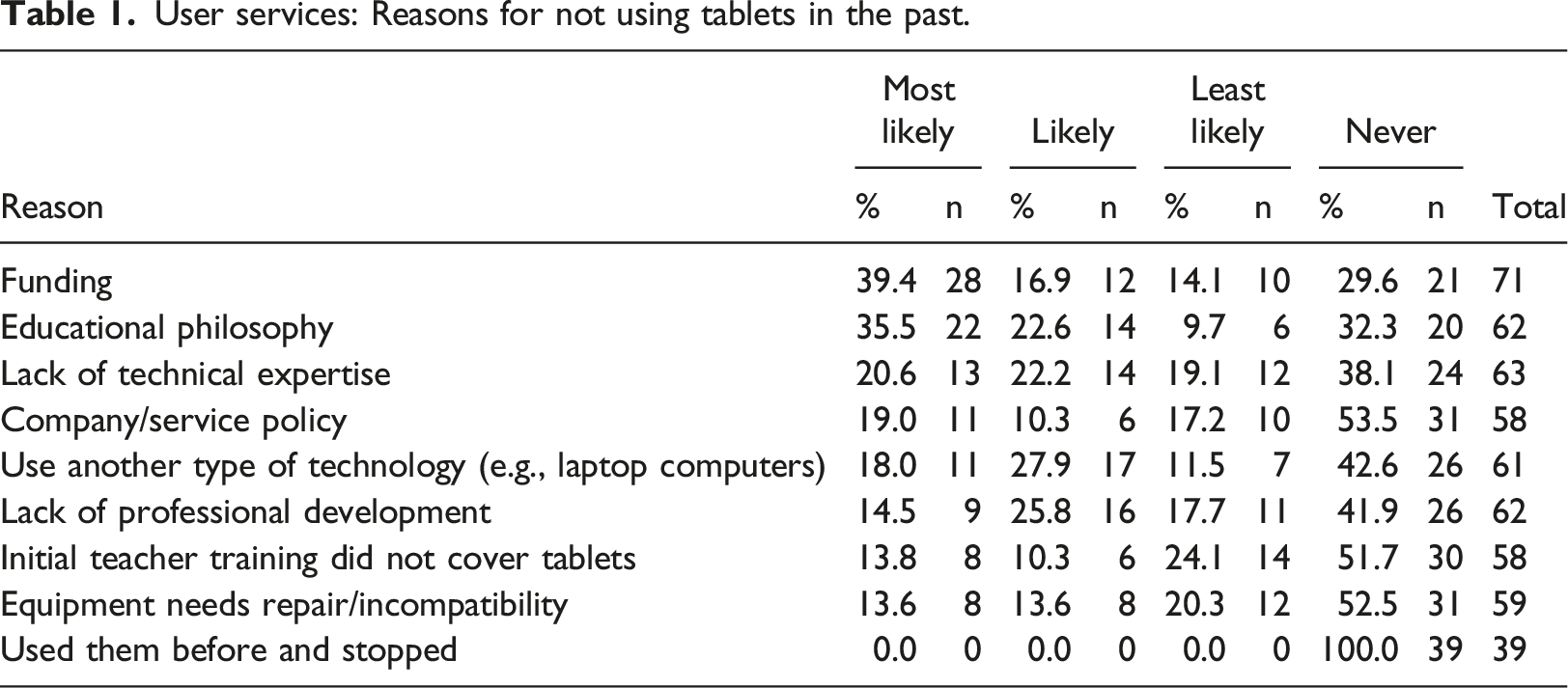
The survey also asked user services if they had formal policies or guidelines for teachers and educators on using tablets for teaching and learning. Of 152 responses, 105 services (69.0%) had such a policy or guidelines while 47 services did not (31.0%). More specifically, user services were also asked if they had a screen time policy. The 27 (17.8%) services that had a screen time policy were invited to indicate the number of minutes each day that children could engage with screen media. Five services indicated 30 min, seven noted 15 min, six reported 10 min, and eight of the services responded 0 min. The median was 10 min.
Collective case study results
Collective case study participants.
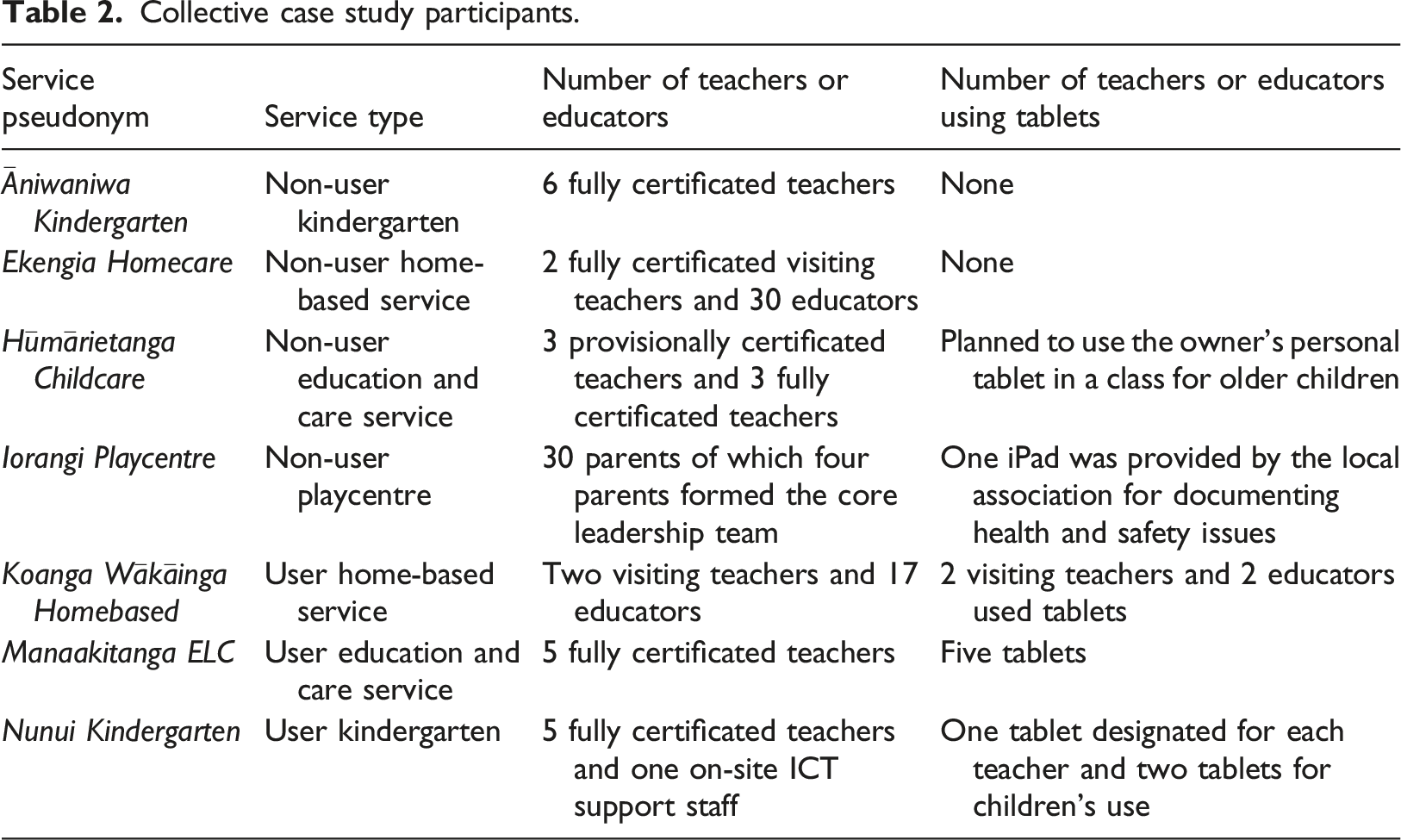
Āniwaniwa Kindergarten: A non-user kindergarten
The teachers at Āniwaniwa Kindergarten explained that their service’s special character and educational philosophy restricted children’s access to digital screen media. Āniwaniwa Kindergarten’s educational philosophy emphasised that children’s learning should focus on natural forms of play because it supports their neurological and physical development. The teaching team wanted children to be creative and more resourceful instead of “sitting with their neck down, swiping… which aren’t helpful to their development” because “putting this stuff on the children is not … free play because the adults are defining the premise of how it works … swiping and listening”.
Āniwaniwa Kindergarten’s teachers believed that children’s natural play with peers led to learning through collaboration when “young ones are learning from old ones and […] old ones are learning how to look after young ones […] and none of that belongs on a small screen” and that this helped develop their communication skills. The teaching team believed that young children’s brain development required constant physical movement and that their children were more creative and imaginative, physically active, and social because they did not use tablets.
Ekengia Homecare: A non-user home-based service
Ekengia Homecare’s educational philosophy placed children’s engagement in active outdoor play as a priority. The teaching team perceived that because children had too much access to digital technology, they frequently let children go “out to get fresh air”. In this way, they felt that their educational philosophy offered something different to parents and their children.
The service placed high importance on children’s social development with their peers, teachers, and educators. Visiting teachers and educators had observed that tablet use led to sedentary behaviours and believed that using tablets did not help children to “recognise how they feel […] so they can’t reach out and tell someone how they are feeling”. The team argued that if children could not respond exactly to the fixed way that tablets expected, they were told they were wrong. The teaching team believed that “a child is never told they’re wrong, unlike with these apps on technology”.
Hūmārietanga childcare: A non-user education and care service
As a private education and care service, Hūmārietanga Childcare could not access funding such as grants to purchase tablets. During the interview, the service owner let the teaching team use her iPad at the service because children will “definitely be using it after ECE when they go to primary school”. Teachers decided to use this iPad with “older kids. It’ll be the three-and-a-half and the four-year-olds”, and to “try it with the transition class” who are going to primary school the following year.
Having made this decision, Hūmārietanga Childcare’s teaching team planned “a set of procedures on how to use” the iPad, including making supervision by teachers a requirement as well as teachers modelling self-regulation and setting screen time limits and access to specific apps and internet websites. They decided to conduct a self-review on integrating iPad use with their transition group and to survey parents.
Iorangi Playcentre: A non-user playcentre
Initially, Iorangi Playcentre had no plans in acquiring a tablet but their playcentre association provided one. When they were asked why they did not want to use tablets, the core leadership team explained their educational philosophy focused on children’s “natural and spontaneous play” and providing children with “real-life touching and interacting as opposed to using a screen. That’s not playcentre philosophy”. They felt that digital technology distracted children’s comprehension of the story because “they’d learn a lot more and understand and get more from the story if you’re just reading it aloud and if it wasn’t moving and talking to you and having all these distractions… there are too many sounds and pop-ups”. A member of the leadership team explained that when children became used to tablets, they no longer enjoyed real sensory experiences.
During the interview, educators discussed using the iPad as a tool for documentation to both discourage the use of personal devices and because the iPad’s features were more suitable for capturing details without repetitive “rewinding and playing”. Given Iorangi Playcentre’s philosophy of not using digital technologies, the arrival of their new iPad meant that the leadership team wanted a “consensus on what’s it for and what it’s not for, who uses it, where we keep it during the session” and will reevaluate their new policy “in 4 months or 6 months” so that it could be adapted as needed.
Koanga Wākāinga homebased: A user home-based service
Koanga Wākāinga Homebased’s visiting teachers and educators used tablets because nearby primary schools expected that new entrants would know how to use digital technology. In this way, the service accommodated changes in how young children were being educated with one visiting teacher explaining that “things are changing… in education, we’re teaching all these children about apps and how to use iPads and computers”.
Although the teaching team understood why some parents were against their children using tablets, one educator reasoned that children going to primary school “is going to be exposed to it… it is the way of the world”. One of the visiting teachers emphasised that parents will “be buying a device” when their children went to primary school adding that “by the time these two-year-old children go to school, it will probably be just a compulsory component”.
Manaakitanga ELC: A user education and care service
The team of five teachers at Manaakitanga ELC worked with 49 children aged from two to 5 years. These teachers shared the use of four iPads, allowing children to use them freely when they were not used for teaching. The fifth iPad was used to play music, YouTube videos or other media. The headteacher noted that they “had laptops but we don’t use them with the children” because they found fewer issues when using iPads stating that they “had to reset the whole computer, but you don’t get that with the iPads”. The service had been providing iPads to teachers for several years.
Manaakitanga ELC’s teaching team commented that their iPads made their work easier and faster, particularly regarding documentation and assessment. Their iPads enabled them to take “quick photos” and easily upload these photos to children’s online learning portfolios. The learning portfolios allowed teachers to communicate with parents about their children’s progress even if “some [members of] families that live overseas …if you used an app like Movie Maker to make a video, they are seeing the results”. Parents appreciated how teachers used tablets for reporting evidence of learning, and similar to other earlier cases teachers addressed parents’ concerns regarding screen time.
Nunui Kindergarten: A user kindergarten
Tablets had been used at Nunui Kindergarten before the current teachers had started working there. The seven iPads were obtained “through grants”, one assigned to each teacher and two designated for children’s use. There was a mix of views within the teaching team regarding whether children could use iPads. One teacher declared that she “never [got] the iPads out for the children. Other teachers do but I never do” because she was “not a fan of the iPads because actually, at home they already get heaps. They also expressed caution when letting children use iPads for teachers reasoning that tablets “should be used as a tool to extend learning rather than be the learning tool completely”. Those teachers who used their iPads with children reasoned that it was “good that they learn how to use them because they’ll need to use iPads as a part of life”. After all, iPads “inspire different interests” and made “learning more interesting”.
Nunui Kindergarten’s teaching team reported that they used Pads for documentation and assessment because these devices helped make learning visible. Tablet computers helped teachers share children’s work with parents. A teacher commented that the tablets enabled them “to add if you’re taking photos and the child is telling you stuff… So, you write the chunkier learning story”.
Cross-case analysis
Following an in-depth analysis of each service, a cross-case analysis is necessary to better understand services’ key similarities and differences. The survey found that a service’s educational philosophy was the main influence on whether they chose to use or not use tablets. This finding was also evident in three of the four non-user services interviewed in the collective case study.
Āniwaniwa Kindergarten and Ekengia Homecare based their rationale on which resources to acquire according to their centre’s ethos. These two non-users expressed hesitation in using tablets due to the added need for supervision. Hūmārietanga Childcare and Iorangi Playcentre were hesitant in allowing children unfettered use of tablets, necessitating adult supervision. Iorangi Playcentre developed guidelines that their iPad could only be used with adults while Hūmārietanga Childcare decided to limit their iPad use to older children to prepare them for schooling. Preparation for schooling was a common aim for adopting tablet computers among user services.
Koanga Wākāinga Homebased specifically wanted to address the growing need for children to be aware of digital technologies and thus scaffolded children’s appropriate use of devices. Manaakitanga ELC and Nunui Kindergarten used a variation of real and digital activities such as outdoor play and socialisation opportunities. Monitoring tablet use at both services resulted in more expectations and responsibilities for teaching and learning. Services weighed the impacts of tablet computer adoption by first deciding if having tablets fit their educational philosophy followed by considerations of resourcing and staffing allocations.
Discussion
The purpose of this collective case study was to gain a holistic and in-depth understanding of why ECE services chose to use or not to use tablets. Phase 1 revealed that the top three reasons for non-use were educational philosophy, company or service policy, and funding constraints, and the findings from Phase 2 explained these results. Each service’s educational philosophy influenced tablet use and non-use. This aligns with Ertmer (2005) who stressed that teachers’ and educators’ beliefs are a key to their adoption of new technologies. The next few subsections discuss the influences of use and non-use; various ways of using tablets; and why the integration of tablet computers in ECE is not split merely on whether services use them or not.
What influences use and non-use
Most non-users preferred non-digital practices such as physically active play, frequently linking tablet use with sedentary activities (Gerritsen et al., 2016; Howie et al., 2017). These findings build on evidence from earlier studies that discouraged young children’s ICT use because children did not engage in physically active play and concrete activities appropriate to their neurological and social development (Howie et al., 2017; Spitzer, 2013).
In Phase 2, some non-users firmly believed that using tablets did not bring any benefits to teaching and learning in ECE. Teachers and educators held on to their perceptions by citing sedentary learning activities in line with the rationale discussed in the earlier studies (Gerritsen et al., 2016; Howie et al., 2017). About this, data from Phase 2 affirmed arguments in earlier literature as well as responses of non-users in Phase 1 that tablet use potentially led to children’s lack of physically active play. Some services in New Zealand preferred that children engage in more physically active play (Gerritsen et al., 2016). Other international studies (Howie et al., 2017) argued that tablet use could lead to overstimulated and addictive gaming among children.
As for services that used tablets, many teachers and educators acknowledged that these devices were already part of their services’ resources for teaching and learning. Two services, Nunui Kindergarten and Manaakitanga ELC provided some iPads equivalent to the number of teachers. Iorangi Playcentre’s situation is a clear example of an umbrella organisation, in this case, a local playcentre association, providing an iPad even before the service had set guidelines on its use. Services like Koanga Wākāinga Homebased and Hūmārietanga Childcare chose to acquire tablet computers to prepare young children for primary schooling. These findings align with Ertmer’s (2005) theory that, with regards to the integration of new technologies, resourcing and educational philosophy are interrelated factors considered by teachers and educators.
Different ways of using tablets
Phase 1 revealed that tablet computers were used mainly for documentation and assessment followed closely by playing music and using apps to support creative activities. This research strengthens the findings from previous literature regarding the different ways tablets could be used for teaching and learning in ECE such as documentation, creative activities, and communication (Vaughan and Beers, 2017). Earlier studies exemplified that the multifunctionality of tablets was the main reason why services used these devices (MacCallum and Bell, 2019; Vaughan and Beers, 2017). Additional findings from Phase 2 revealed that services used tablets by accessing digital media and information which is further linked to the literature (MacCallum and Bell, 2019). Evidence from earlier studies listed that the advantages of using tablets revolved around easier documentation and assessment, reasons which aligned with Phase 2 data from all of the three user services. The teachers in the user education and care service reported that their service already had iPads that they used with children. A non-user playcentre which did not want an iPad received one from their local association for documentation purposes.
One non-user who decided to begin using an iPad indicated that their main reason for not using tablets was due to a lack of funding. This aligned with the hypothetical question in the survey which asked users if they previously did not use iPads, what the main reason was and this was funding and exemplified Ertmer’s (2005) first-order barrier, resourcing.
Non-binary nature of tablets in ECE
The results from both phases of this study support the argument of digital technology educationalists (Keirl, 2015; Selwyn, 2003) against the dichotomy of digital divides. The study found that tablet use and non-use were fluid, meaning services and even their teachers and educators shifted back and forth from not using tablets at all to using them in different ways. The shifts depended on resourcing and educational philosophies which are the bases and barriers to adopting new technologies (Ertmer, 2005).
In sociocultural theory, Vygotsky (1978) emphasised that learning is enhanced through socially-mediated activities using tools and signs. Te Whāriki (Ministry of Education, 2017) is based on sociocultural interactions with teachers and educators who played a key role in scaffolding young children’s access to and use of tablet computers. A spectrum, adapted from Keirl’s (2015) scenarios, best illustrates how ECE services moved between tablet non-use and use under their teaching and learning aims. As illustrated in Figure 1 below, at the far left of the spectrum is the “limited group” adapted from Keirl’s (2015) “disillusionist case” (p. 31), a category for services that have little to no tablet use. Services or their umbrella organisations in this category limit using tablets to teachers and educators only or by strictly monitoring children’s use. The middle group was renamed from “specialist” to “specialised” to better describe services that used tablets only for specific purposes such as prescribing which apps could be used and restricting tablet use to children in older age groups. Finally, services in the “comprehensive” group integrated tablets into almost all teaching and learning activities. These services allowed children to use tablets independently. Figure 1 shows where each case in Phase 2 was located in the spectrum. A spectrum of tablet use and non-use with cases.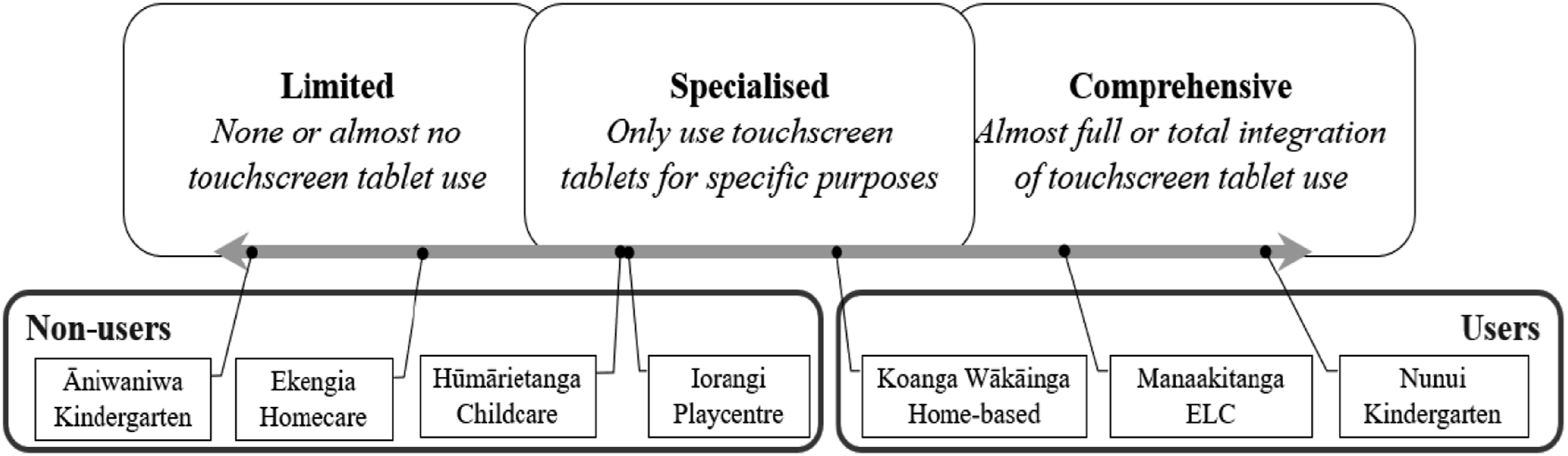
Many of the services in the “specialised” group moved to comprehensive or to limited use depending on the ways children used tablets and with what kind of activities or apps these children engaged. Their strategies aligned with the principles and strands of Te Whāriki (Ministry of Education, 2017) which laid out the foundation that teaching and learning are mediated socially. The teachers and educators in this group meet the expectations in Te Whāriki for children to “access all learning experiences” (Ministry of Education, 2017: p. 39) and for them to have “access to sensory-rich, open-ended durable resources” (p. 48) by providing access and allowing the use of tablets.
How tablet computers were used by services in the “specialised” group shows evidence of supervision through scaffolding and aligns with Holloway et al.’s (2018) recommendations. These services scaffolded children’s tablet use in various ways such as one-to-one learning or collaboration with peers similar to the findings of Lu et al. (2017). More particularly, by scaffolding tablet use, services in the “specialised” group aligned with Neumann’s (2018) findings when teachers and educators fulfilled their roles as the more knowledgeable persons.
Each service in Phase 2 was placed along a spectrum depending on how limited, specialised, or comprehensive they used or did not use tablets. Āniwaniwa Kindergarten and Ekengia Homecare did not allow children to use digital technologies, limiting their access to these devices. Ekengia Homecare allowed tablets to be used only by its teaching team for documenting children’s learning, placing the services still in the limited group but a little bit closer to the specialised group due to the special but still limited way tablets are used in the service.
Hūmārietanga Childcare was still in discussion on adopting tablets and they specified only specialised use of tablets which is for documentation. Iorangi Playcentre decided to limit use to adults for documenting health and safety issues. Unlike Ekengia Homecare, Hūmārietanga Childcare and Iorangi Playcentre allowed children tablet access and use as long as they fit the specific purposes required by the service. Koanga Wākāinga Homebased used tablets for educational games and creative apps. This service allowed more specific uses than the other two services in their group. Yet, not all home educators at Koanga Wākāinga Homebased allowed children to access and use tablets. Some educators followed specific conditions with regards to using these devices such as equating access as a reward for good behaviour and only allowing some children to use selected apps with a time limit of up to half an hour. Evidence of non-user services shifting to using tablets more comprehensively further supports this spectrum. Further studies on in-depth investigations of data revealed in the study such as teachers’ and educators’ beliefs and educational philosophies, different sized teaching teams, and the differences between individual and group-based scaffolding strategies are recommended.
Conclusion
This study identified the reasons why services used or did not use touchscreen tablets. The main reason for non-users was educational philosophy based on teachers’ and educators’ beliefs. Users decided to integrate it into their service because of expectations from primary schooling and societal change. The findings of this study helped conceptualise a spectrum wherein ECE services can locate themselves considering how they used tablets per their educational goals. Despite how earlier literature claimed opposite sides regarding the issue, tablet use by children in ECE services is not a dichotomy. New Zealand’s ECE services have shown how decisions regarding access to and use of tablets can be placed within a continuum and thus change depending on the situation. At an age when digital technology has become increasingly ubiquitous and necessary, ECE teachers and educators need to consider how and when they use tablets with young children. Ultimately the decision to use tablets must be based on the knowledge and information a service’s teaching team has rather than limited to “shoulds and should-nots”, making this study an important contribution for them to make an informed choice. More specifically, decision-making around using tablets in ECE should be considered in the planning and policy development of teaching teams and their service management. Services could plan how tablets can meet their educational philosophies and apply them to their situation.
This research adds to the existing research on tablet computers, and ICT in general, situated within the ECE context in New Zealand. Further related studies on the complexities involving tablet use and non-use at the service level such as differentiated use of scaffolding and variation among spectrum groups could support professional development for the sector.
Footnotes
Acknowledgments
The authors thank all the ECE services that participated in the study. They appreciate the support and funding provided by Victoria University of Wellington for the data collection of this research. Luke Santamaria acknowledges the support he received from Victoria University of Wellington’s School of Education and Faculty of Graduate Research.
Declaration of conflicting interests
The author(s) declared no potential conflicts of interest with respect to the research, authorship, and/or publication of this article.
Funding
The author(s) disclosed receipt of the following financial support for the research, authorship, and/or publication of this article: The author(s) received financial support for the research from Victoria University of Wellington.
