



Abstract
Strategizing involves recursive processes whereby managers constantly move between cognitively making sense of the situation they inhabit and enacting a meaningful course of action. This sensemaking effort often relies on talk: that is, the linguistic act by which managers articulate and verbalize an understanding for themselves and for others around them. Drawing on a year-long case study conducted at a UK legal firm during a major strategic change, we investigate how senior managers strategized in and through their talk in response to the increasing marketization of legal services. We found that, in their strategizing, managers made sense of changes in their business environment through different forms of talk—namely metaphors, binary oppositions and modals—each characterized by distinctive affordances and potential for meaning-making. Through the combined use of these forms of talk in the ongoing sensemaking process, managers enacted meanings that allowed them to imagine future competitive landscapes, make distinctions in relation to them, and call for future courses of action in relevant strategic domains. We aggregate these findings into an integrative theoretical model that articulates the relationship between talk, the affordances of the identified forms of talk constituting sensemaking, and strategy work.
Introduction
In their everyday strategy work, managers and decision-makers are continuously and often habitually engaged in sensemaking processes that involve turning the circumstances they encounter into verbal accounts of strategic scenarios and choices as a basis for their decision-making and actions (e.g. Seidl et al., 2024). Scholars have long recognized that these processes of verbally articulating ideas and marking them as strategic lie at the core of managers’ strategizing efforts (Jarzabkowski, 2003, 2005; Johnson et al., 2003); more broadly defined as the set of actions, interactions, negotiations, and situated practices through which they form and enact organizational strategies (Jarzabkowski et al., 2007: 8, 2021).
This general conceptualization of strategizing as in part a linguistic accomplishment (Vaara and Fritsch, 2022) has over the years shed light on the ways in which managers use multiple forms of talk to create a strategic “discourse of direction” for their organizations (Barry and Elmes, 1997) and might thereby shape the sensemaking of everyone in the organization about the firm’s new or evolving strategy (Logemann et al., 2019). In this context, the process of strategizing itself is oftentimes seen to proceed through a series of verbal tactics whereby practitioners talk their environment into existence and, while speaking to and with others, explore possible courses of action, develop and legitimate strategic directions, and shape future-oriented strategies (e.g. Augustine et al., 2020; Rindova and Martins, 2022; Vaara and Fritsch, 2022). Here, specific forms of talk, such as metaphors, analogies, and frames have been marked in prior research as important in that they enable managers to make distinctions (Seidl et al., 2024) or place the details of a situation into a wider discourse or strategic framework for understanding (Burke and Wolf, 2021; Logemann et al., 2019).
At the same time, prior work has not yet clearly differentiated these forms of talk and the different “functions” that they perform in instances of strategizing. In a recent review, Seidl et al. (2024) highlight how prior research has suggested that different forms of talk all “label” scenarios or activities as strategic—what they accordingly refer to as a “nominalist” view—but without yet clearly differentiating between the different forms and performative functions of such talk. As such, the puzzle that is highlighted by the accumulation of prior research is whether and how different forms of talk have different functions in labeling and articulating the contours of a strategic scenario. In this article, we set out to address this puzzle and ask the following research questions: what are the different forms of talk through which strategizing managers accomplish their strategy work? And how do these different forms of talk work and align as part of their strategizing?
By pursuing these questions, we aim to clarify the distinctive affordances of different forms, or genres, of strategy talk; with such affordances offering “different potentials for making meaning” (Jewitt et al., 2016: 72). In a strategizing context, this notion of affordance highlights that specific forms of talk are consequential in different ways for constructing and communicating to oneself and to others what a strategy is or is about (Balogun et al., 2014; Seidl et al., 2024). Besides different forms of talk having such distinct affordances, we also do not know yet how strategizing managers may combine such different forms of talk, and their respective affordances, to scaffold their sensemaking efforts and to shape strategic visions for themselves and for others in the organizations. In other words, while, based on prior research, we have an appreciation of the general role of talk in shaping certain aspects of managers’ sensemaking about strategy, we understand less how the different affordances served by various forms of talk concur in the construction of meaning during strategy work.
The purpose of this article, therefore, is to extend a language-based sensemaking approach to strategizing by investigating how forms of talk, through their affordances, affect the construction of meanings that inform strategy work. In service of this aim, we investigated a strategizing process that was initiated by the senior managers of a UK law firm in response to major changes in the UK legal services industry. Based on a combination of observations, interviews, and secondary data, we identified the forms of talk senior managers used as part of their strategizing; noting their reference to wider field-level change and the ways they tuned their talk to facilitate their evolving sensemaking about the change for their firm. We found that, as part of their efforts, managers made sense of changes in their business environment through three main forms of talk– namely, metaphors, binary oppositions and modals—each characterized by a different affordance. Through these forms of talk, their individual affordances as well as through their interplay in the ongoing sensemaking process, managers enacted meanings that allowed them to imagine future competitive landscapes, make distinctions in relation to them, and call for future courses of action. In sum, it was through the combined affordances of these forms of talk that managers engaged in strategy work and generated a possible future scenario for their firm. We aggregate these findings into an integrative theoretical model that articulates the relationship between forms of talk, sensemaking, and strategizing. The model extends linguistic approaches to strategizing by distinguishing between the affordances offered by different forms of talk and demonstrating how they work together in shaping the construction of meaning during strategy work.
In the next section of this article, we review relevant studies that have adopted a linguistic approach to strategizing and sensemaking with the purpose of integrating their key insights in relation to managers’ strategy work. We then outline our empirical setting by mapping the UK legal field at the time and the institutional influences underpinning the strategizing process at our case organization. Next, we focus our analysis on the interaction between managers’ accounts of environmental complexity and their strategizing efforts. We conclude by discussing the theoretical contributions of our study, before acknowledging some limitations and highlighting prospective areas for future research.
Theoretical background: strategy talk and sensemaking
The linguistic turn in the strategy literature has for more than two decades highlighted the role of discourse, rhetoric, and narrative as linguistic practices that are broadly used in strategy work (e.g. Balogun et al., 2014; Sillince et al., 2012; Vaara, 2010). From this perspective, strategizing itself is seen as in part a linguistic accomplishment whereby practitioners talk their environment into existence, make sense of it, and individually and collectively explore future courses of action (see, e.g. Vaara and Fritsch, 2022 for a recent overview). Emphasizing a strategy’s rhetorical side, Barry and Elmes (1997) notably conceptualized strategy work as a form of fictional storytelling in which managers strive to create a discourse of direction to understand strategic options and shape strategic action. Jarzabkowski and Sillince (2007) somewhat similarly explored how, through rhetoric, top managers may construct a context for commitment to multiple strategic goals. Other studies have since taken a less directed and more interactional approach, emphasizing how talk-based interaction between managers and employees and subsequent discursive struggles affect the construction of sense and the development of strategic actions (Jalonen et al., 2018; Vaara and Fritsch, 2022). For example, drawing on conversation analysis, Samra-Fredericks (2003) studied how talk-based interactions allow strategists to enact the competitive landscape and make sense of possibilities for one’s own organization. From this interactional perspective, emphasis is placed on how strategists talk with others to negotiate meanings and, on that basis, succeed (or not) in creating a shared frame of reference with others in the organization (see also Jalonen et al., 2018; Laine and Vaara, 2007; Patriotta and Spedale 2009).
Extant research thus generally recognizes that language plays a critical role in how managers make sense of strategic situations. Research has furthermore highlighted the need for a better understanding of how language use, in all its variety, shapes how managers make sense of, and “perform,” strategy work (Balogun et al., 2014; Vaara and Fritsch, 2022). In particular, the conceptualization of strategy as a linguistic accomplishment implies that “talking” is central to the “doing” of strategy. Scholars have emphasized the performative character of language and highlighted how different forms of talk, particularly metaphors (Cornelissen et al., 2011), shape managers’ understanding of strategy work. Yet, to date, we lack a full-bodied understanding of how managers combine different forms of talk, and their respective affordances, to create meaning and construct a strategic direction for themselves as well as others around them. In their recent review, Vaara and Fritsch (2022: 1475) specifically call for such in-depth research “We argue that the time is right to conduct more in-depth analyses of actual language use. This should not mean reinventing the wheel but instead drawing on advances in linguistics and related fields to be able to zoom in on the various conversational, rhetorical and discursive practices and processes.”
In this article, we heed their call, and informed by performative approaches to linguistic grammar (Kress, 2010), direct attention to what strategizing actors “do,” in the sense of “accomplishing,” when they are verbally articulating their thoughts to construct meaning. This issue has two aspects. First, we need to appreciate the distinctive affordances of specific forms of talk; that is, what is possible to express and represent through different forms or registers of language use (Jewitt et al., 2016; Kress, 2010). The concept of affordance points to the different linguistic potentials and limitations of talk for meaning-making within strategic situations, shaping the possibilities for agentic action in relation to those situations. From this standpoint, “talk” is not merely a reflection of strategy, but a performative force that shapes and “enacts” strategy itself (Seidl et al., 2024; Vaara and Fritsch, 2022). In other words, talk functions as a strategic practice in organizations. Second, we need to understand how these forms of talk, and their respective affordances, are logically connected to each other in the construction of broader representations and any meaning that ensues from them (Kress, 2010). In fact, as forms of talk have distinctive affordances, it is likely that managers will use them in combination to orchestrate complex representations of their firm’s strategy and of the strategy process. By deploying different forms of talk, strategizing actors will likely not only exploit their distinctive linguistic potentials but also link and combine them in an ongoing meaning-making process that opens up possibilities for action in their environment and shapes possible future worlds.
As part of the performative character of talk, prior strategy research has not surprisingly linked instances of strategy talk to sensemaking dynamics in an organization with the aim of understanding how managers initiate, direct and guide collective meaning-making during processes of strategic change (Balogun and Johnson, 2004; Gioia and Chittipeddi, 1991; Logemann et al., 2019; Rouleau, 2005; Rouleau and Balogun, 2011). This link to the sensemaking literature is one that we also feel is particularly helpful, as a way of understanding linkages between language and meaning (Balogun et al., 2014; Whittle et al., 2023). As a concept, sensemaking implies that strategists “enact” the situations they encounter using available forms of talk (Seidl et al., 2024; Vaara and Fritsch, 2022) that often become elaborated in a coherent way, thus shaping their thinking while speaking (Cornelissen and Clarke, 2010). This creative process of enacting, or performing, strategy in and through language, more generally follows the sequence expressed in Weick’s (1979) famous sensemaking dictum: “how can I know what I think until I see what I say? (p. 133). This sensemaking recipe conveys a form of inductive reasoning, based on soliloquy, which links processes of saying to the ongoing construction of meaning; the act of talking essentially allows the speaker to discover (see) the meaning of what he or she thinks (Cornelissen and Clarke, 2010; Patriotta, 2003). Furthermore, sensemaking, conceived as the practice of ‘seeing what one has said,” implies an organizing process as well through which words are ordered (sequentially) and given meaning. As Weick et al. (2005: 413) suggest; “the image of sensemaking as activity that talks events and organizations into existence suggests that patterns of organizing are located in the actions and conversations that occur.” This organizing process takes shape as managers are talking and progressively translating sketchy streams of experience into more focused information and, ultimately, potential actionable knowledge for themselves and for others.
Integrating linguistic approaches with strategizing and sensemaking, we thus theoretically presume that strategizing is a process by which managers engage in and through their talk in “acts of meaning” making (Bruner, 1990). Our approach aims to connect the “doing” of strategy (strategizing) with the “doing of language” (affordances) in order to unpack how managers construct what they say they do and use representational accounts to inform strategic action. A sensemaking approach which emphasizes a direct relationship among managers’ talk and meaning construction is particularly helpful to such an inquiry, allowing us to elaborate theory on how strategists combine multiple forms of talk and their affordances to address, and indeed bring forth, new strategic mandates for themselves and for the organizations in which they work.
In the remainder of this article, we empirically investigate how senior managers at Cambridge Legal (CL), a UK law firm, strategized in and through their talk in response to the increasing marketization of legal services. Our observation period coincides with a time of significant changes in the UK legal industry, because of deregulation and market reform, and where unusual and unexpected occurrences generated a need for sensemaking and strategic change.
Methodology
Research setting: the UK legal field and CL
This research is empirically set in the UK legal field, characterized as increasingly fluid, fragmented, and heterogeneous (Francis, 2011) at the time of the study (2014-2015). These dynamics were associated with a number of concomitant trends reshaping the industry, mostly relating to regulatory and technological factors. The passage of the Legal Services Act 2007 in the UK, a reshaping of the regulatory landscape, arguably signified a watershed event, shattering the once harmonious stability of the UK legal field. The most salient aspect of the Legal Services Act (2007) is the introduction of alternative business structures (ABSs) (Francis, 2011). The purpose and effect of instigating the introduction of ABSs to the UK legal market was to broaden the pre-existing regulations stating that companies offering legal services must be owned and run by qualified lawyers, to allow any individual to own and run a firm offering a select range of regulated, reserved legal activities (Solicitors Regulation Authority, 2012). Furthermore, a central purpose of the introduction of the ABS provision was to shift the focus and control within the UK legal field back to that of the consumer.
The Legal Services Act paved the way for deregulation and marked an unprecedented increase in competition (Boon, 2010; Francis, 2011). Traditionally dominated by professional legal firms (Empson et al., 2013) with a strong emphasis on self-regulation (Hinings, 2005), the UK legal services experienced significant market-entry by alternative businesses—for example, new-entrants such as the Co-Operative and other financial companies—once the Legal Service Act allowed non-lawyers to own and operate businesses offering legal services (Solicitors Regulation Authority, 2012). In conjunction with these de-regulatory trends, technological changes and the rise of Internet-based communication technologies further contributed to a complex and dynamic sector at the time of study where incumbent firms were increasingly faced with new, emerging forms of competition. Overall, the legal field, since the passage of the Legal Services Act appears to have become much more market-oriented, with a greater emphasis on the means by which organizational structures and strategies can utilize the process of deregulation in the marketplace to meet the needs of consumers who, as a result, are enjoying a newfound level of autonomy and control. Hence, while an emphasis on expert knowledge and client service remains essential in the provision of legal services, there was an increasing need for law firms to acknowledge that professionalism alone is no longer sufficient to survive in the modern-day legal business environment.
The organization at the center of our analysis is a medium-sized, UK commercial law firm codenamed CL. At the time of our study between 2014 and 2015, CL employed over 100 fee-earners across eight core departments, each dedicated to a specific area of legal services. CL’s senior management team comprised three senior board members and eight heads of business support functions.
Data collection
To investigate how CL’s managers used different forms of talk in their strategy work, we relied on a combination of observational meeting data and interview data as our primary sources, complemented by more general observational field notes and documentation to provide additional detail and context. Access to the field site was provided by CL’s Managing Partner, who acted as a key informant throughout the duration of the project. Observational data were collected by the first author through non-participant observations conducted over the course of the study period (July 2014—July 2015). Meetings were held monthly, and typically adopted the format of a Business Team Leaders meeting in the morning, followed by a Board of Directors meeting in the afternoon. Data were collected during these meetings by the first author who sat alongside participants at meeting tables taking key notes of interactions, before fleshing these out with additional details immediately afterwards on site in an informal breakout room. Overall, a total of approximately 100 hours of observations were conducted. Observations concentrated on three aspects. First, a total of 25 hours of observations were carried out in the course of the 10 board meetings held at CL during the study period. Board meetings lasted approximately 2.5 hours each and focused on key strategic issues as well as important operational matters, including financial performance. They were typically attended by the Managing Partner, the CEO, the Head of Finance, and an external consultant in an advisory capacity; they also involved the Directors of the key support functions (Operational Development, Human Resources, Information Technology, Marketing, Business Development, Facilities, Risk and Compliance), depending on the agenda for the meeting. Given the purpose of the study, particular attention was directed to recording aspects such as meeting agendas, social interactions and exchanges among board members, and discussions concerning company documents such as financial and marketing reports. Each board meeting was followed by debriefing interviews with selected participants (see below).
Second, observations for a total of approximately 8 hours were carried out during eight meetings involving CL’s Team Leaders and the heads of key functions. These meetings were primarily aimed at reporting on financial and operational data. Third, the first author spent a total of two full weeks at CL’s offices in Cambridge and London, amounting to approximately 70 hours of observations besides the board and team meetings. These observations were carried out during normal working hours (9 am–5 pm) to generate in-depth contextual understanding relating, for example, interactions with clients at CL’s headquarters, informal interactions among CL’s staff during coffee and lunch breaks, and the physical work environment at both the Cambridge and London offices. All field notes were elaborated immediately after the actual observation episodes in line with appropriate standards and techniques of qualitative inquiry.
Furthermore, a total of 26 interviews were carried out through two main channels. First, 16 semi-structured interviews were conducted with 11 key informants—some interviewed twice—including all the members of the top management team and the external consultant. Interviews were conducted with the CEO, Managing Partner, Finance Director, HR Director, Director of Operational Development, Director of IT, Head of Marketing, Marketing Manager, Business Development Manager, Facilities Manager, Quality and Risk Officer, and external consultant. Semi-structured interviews lasted 1 hour on average, were transcribed afterwards and followed the same interview protocol. After general information about CL and the interviewee’s history and current role within the company, questions focused on three main areas: (1) the overall evolution of the UK legal field, including the impact of the 2007 Legal Services Act and the present and future challenges faced by incumbents and new-entrants; (2) the impact of these dynamics for CL, in particular concerning aspects such as CL’s portfolio of core services, its business model and relationship with clients, the development of internal support services (for example, marketing and IT), and CL’s location choices (for example, the respective roles, structuring and resourcing of the Cambridge and London offices); and (3) CL’s competencies profile and identity, including aspects of staff recruitment, training, and investment in human resources.
As mentioned, ten de-briefing interviews were also conducted immediately following the board meetings, primarily with the CEO, Managing Partner and Finance Director. These more informal interviews lasted 30 minutes on average and served the specific purpose of following up and exploring with key informants some of the themes emerging from the observations. Interviews (semi-structured and de-briefing) were carried out in empty meeting rooms, with a few taking place in the participants’ own offices. These interviews were tape-recorded with the informants’ consent and transcribed verbatim. For anonymity purposes, we refer to specific members of CL’s senior management team by their role title, and which furthermore helps clarify their relation to strategy formulation.
Besides observational and interview data, a range of documentary sources—including company documents, CL’s website, internal communications, company publications such as newsletters and press-releases—were also used to complement the analysis. These allowed us to develop further background knowledge of the UK legal services industry and, more specifically, of CL as an incumbent firm operating in a dynamic and changing environment where de-regulatory pressures intersected with significant technological changes.
Data analysis
Our analytical strategy aimed at examining the linguistic elements underpinning managers’ strategy work (see (Jarzabkowski and Sillince, 2007; Phillips et al., 2008; Rouleau and Balogun, 2011; Vaara et al., 2004). Data preparation involved the combination of observational and interview data into a single dataset comprising both the expanded field-notes and the verbatim interview transcripts. Our purpose was to investigate how managers used different forms of talk and their affordances to construct meaning as part of their strategy work. To untangle the relationship between strategy talk and the doing of strategy, we focused our analysis on what managers said, how they said it, and how their linguistic practices generated meaning related to strategizing (see Nicolini, 2012).
Analysis progressed over three stages, using a grounded approach to the data analysis (Strauss and Corbin, 1998). Initially, the first author, who collected the data, constructed a within-case narrative (Langley, 1999). This narrative provided a thick description of the problems that top managers perceived in relation to changes in the competitive landscape. These included, for example, the impact of changed regulations on the legal field, the move toward a market orientation, the changing perceptions of the client, and the need to adopt a new business model.
A second stage focused on the analysis of managers’ meaning-making processes through talk. In this stage, we considered not only what managers said, but also how they said it. We initially examined managers’ utterances, conceived as individual units of speech that convey meaning and can stand alone as complete communicative acts. When reading our transcripts, we considered single words, phrases or longer stretches of talk with the purpose of examining how our informants used language to convey meaning and communicate messages. We then noticed that managers’ utterances were encapsulated in forms of talk that provided broader communication patterns characterized by specific affordances. To this end, we elicited from the dataset any forms of talk that were associated with the problems identified in the initial narrative. From this process, and drawing on the relevant literature, we identified and examined three different forms of talk—namely, metaphors, binary oppositions and modals. A metaphor is defined as a lingustic phenomenon whereby an abstract or unfamiliar domain (the target) is understood in terms of a more concrete and familiar one (Lakoff and Johnson, 1980). Following this definition, we identified instances in which managers used a word of phrase to verbalize a complex or novel experience (e.g. organizational change) in terms of a familiar category (e.g. the journey). Binary oppositions are a form of talk that organize meaning around two contrasting poles (Barthes, 1967; Levi-Strauss, 1974), each constituting a cultural code linked to a broad semantic domain: this culturally rooted opposition makes one pole desirable and the other undesirable (Weber et al., 2008). Empirically, we identified two contrasting frames, the profession and the market, and subsumed under each of them any terms that pertained to that semantic domain. Finally, modals are a form of talk that express a variety of communicative functions ranging from likelihood, ability, permission, request, capacity, suggestion, order, obligation, necessity, possibility, or advice. In our analysis, we identified modals by focusing on principal modal verbs in the English language, such as can, could, may, might, must, shall, should, will, would, ought and need. Each of these forms of talk, we found, had specific affordances in the construction of meaning by managers. Metaphors enacted the strategizing environment by providing a sketchy imagery of the strategizing situation and connecting equivocal streams of experiences to more familiar domains; binary oppositions narrowed down the focus of the strategizing situation by generating alternative action domains that worked as interpretive categories for making sense of metaphors; and modals allowed managers to explore potential and/or desirable courses of action in relation to the previously defined strategizing situation.
In a third interpretive stage, we concentrated on teasing out the connection between these forms of talk. Our purpose was to understand how, through the affordances of multiple forms of talk, managers constructed meaning while engaging in strategy work (e.g. metaphors used to represent change; oppositions linking change to the choice between professional and market orientations; modals proposing courses of action aimed to resolve tensions between these orientations). Going back to sensemaking theory (Stigliani and Ravasi, 2012; Tsoukas et al., 2020; Weick, 1979), we interpreted the identified affordances in terms of a prospective sensemaking cycle unfolding according to processes of enactment, punctuation and projection. Enactment through metaphors generates and brackets raw data on which subsequent sensemaking operates. Punctuation through binary oppositions organizes bracketed streams of experience into information that provides a more focused representation of the strategizing situations. Projection through modals takes stock of the punctuated stream of talk as something that managers momentarily “know” and feel they can, should, need or wish to act upon, thereby projecting into the future extant potential and possibilities. These sensemaking processes, therefore, progressively translated the affordances of forms of talk into data, information and potentially actionable knowledge.
Findings
Following the changes in the legal industry brought about by the Legal Services Act 2007, CL elaborated the 2009-2013 strategic plan, suggestively titled “Significant Times: CL 2009-2013.” The document opens by outlining the changed competitive landscape, its impact on clients and competitors’ behaviors, and the need for appropriate strategic response: A fast-changing market demands a positive and dynamic response. Our clients have more choice than ever before. They are more sophisticated buyers who demand demonstrable value and better service year on year. Changes in the regulation of the legal service sector and new entrants to our market will continue to test us. The pace of change will never be less than it is today. We face these challenges against the backdrop of unprecedented economic turmoil and recession. The same challenges face our competition. For those who adapt and develop there is opportunity.
These changes conjure up a new mandate, which is outlined in CL’s internal “Business development strategy summary”: We need to develop and refine our strategy because:
We are not meeting our growth aspirations
The competition is getting more intense; and
We are evolving and developing as a business
In what follows we examine how senior managers at CL articulated changes in the business environment and envisioned potential courses of action through talk. Our findings can be synthesized as follows: in their strategy work, managers made sense of changes in their business environment through different forms of talk, which we found took the form of metaphors, binary oppositions and modals. These forms of talk worked together to shape the strategizing process as a whole while, at the same time, offering distinctive affordances to the ongoing meaning-making cycle. Metaphors enacted the business environment by bracketing the managers’ equivocal stream of experiences into the raw data of strategizing, that is, into impressionistic schematizations of the strategizing situation. Oppositions punctuated the bracketed streams of experience into a more focused representation of the strategizing situation thus adding analytical details, constructing demarcations, and providing a more informative context for choice. Modals offered tentative ways of resolving oppositions by affording various shades of opportunity and limitations: they elaborated and projected analytical information into actionable knowledge, thereby playing a pivotal role in shaping the intent of the speakers/strategists toward actual choices and decisions. The analysis of how senior managers engaged in acts of meaning in their strategy work is organized in three sections, each corresponding to the three forms of talk and stages of the sensemaking cycle identified in the analysis.
Metaphors: generating raw data by enacting the strategizing environment
In their everyday strategy work practitioners need to make sense of the environment surrounding their organization and of the latter’s position within it. Our analysis shows that CL’s senior managers primarily enacted their environment by bracketing their equivocal streams of experience through metaphors, thereby generating basic raw data for their ongoing sensemaking efforts. Metaphors’ affordance, in fact, involves ways of understanding and describing abstract phenomena in terms of more familiar categories (Cornelissen et al., 2008; Lakoff and Johnson, 1980; Patriotta and Brown, 2011). In this regard, they allowed CL’s managers to construct a prima facie understanding of their fast changing and equivocal flow of experience (see Table 1).
Metaphors.
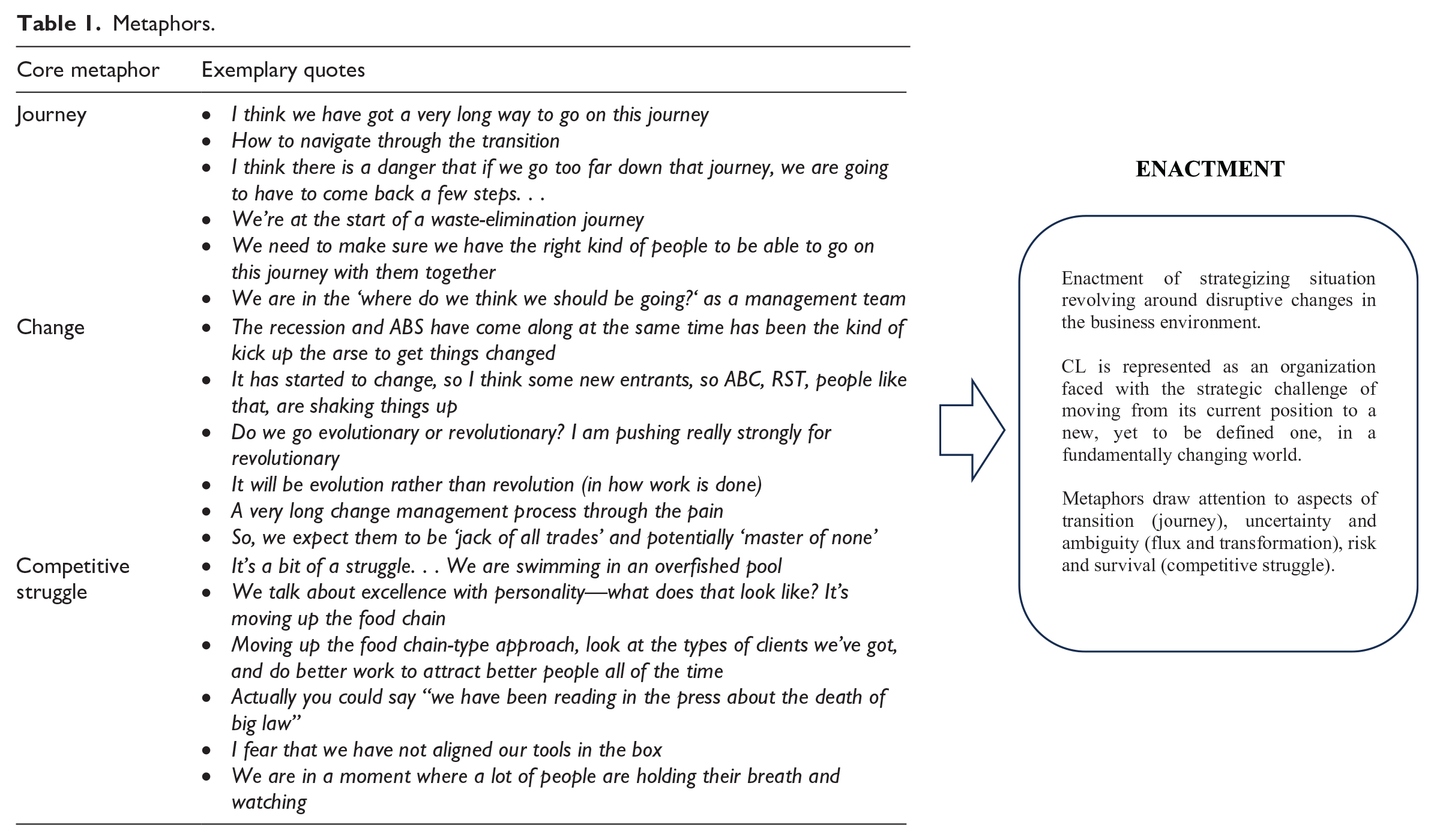
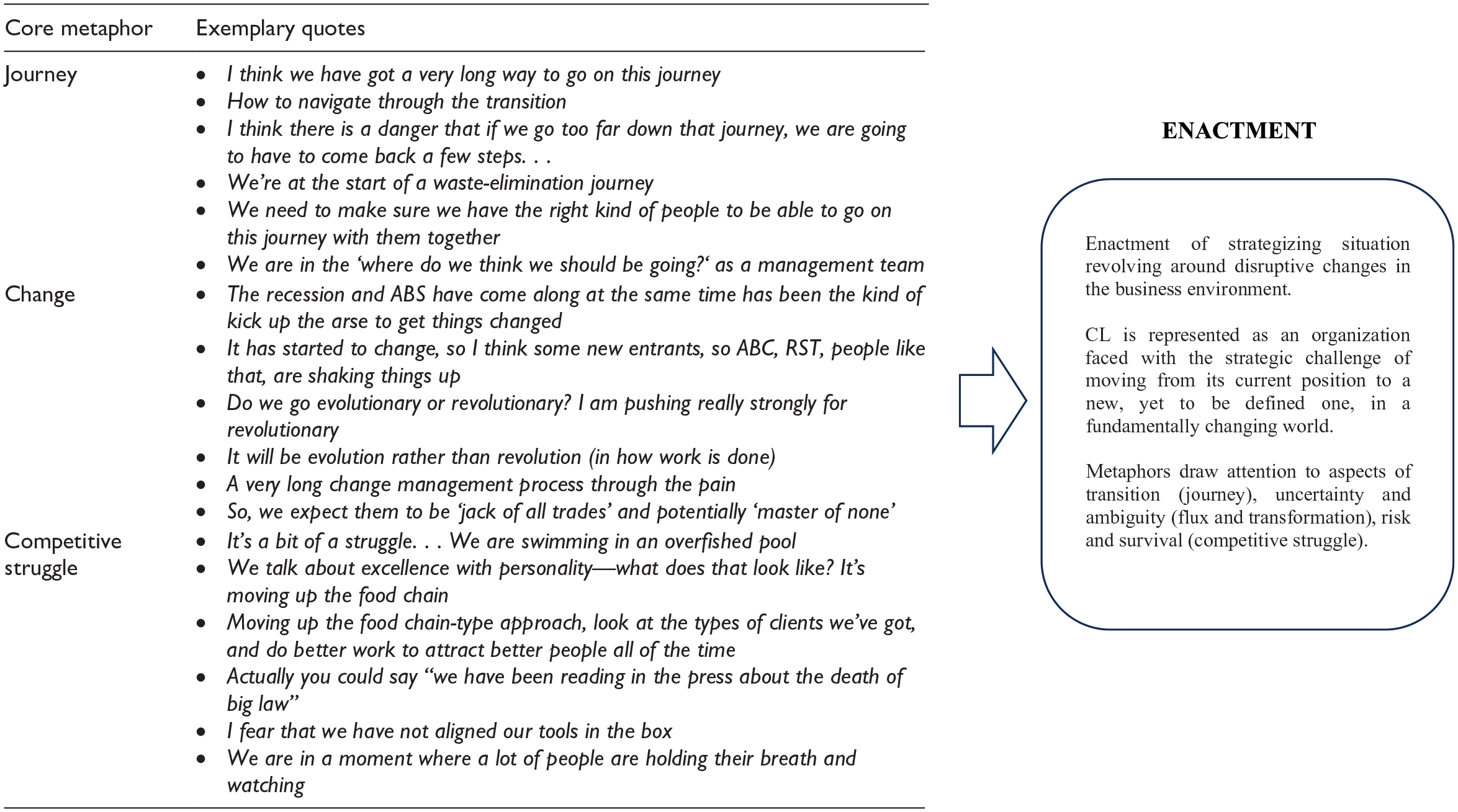
In this process, we found that they relied on three main types of metaphors. A first type of metaphor adopts the image of the journey to communicate a transition between states as part of an imminent change process. The journey conveys the idea of movement in a spatial sense, although the destination remains unclear or open. Indeed, CL’s “Significant Times: CL 2009-2013” external strategy publication in 2009 reinforces how the firm is mid-journey: In a congested market it is vital that we know where we are going and that we stick to our course. We will get jostled and confused and occasionally our way will get blocked. It is in these times that we should pull out this document and remind ourselves where we were heading and why.
Providing a more detailed insight into the specific journey undertaken by CL, the Director of Operational Development articulated his thinking about CL’s current position as follows: Where I think we are going and where I think a lot of businesses are going is embarking on a path towards new business models.
Here, the Director of Operational Development conjures up the image of CL (“we”) and the entire legal field (“a lot of businesses”) as in transit between an implicit past and an imagined future characterized by the advent of new “business models.” By deploying the vocabulary of the journey (e.g. going, embarking, path), the Director of Operational Development is metaphorically creating and bracketing the raw data upon which knowledge and understanding of CL’s current predicament can be constructed. Indeed, the following exchange from an early board meeting emphasizes a process of enactment in which managers draw a raw picture and eventually color it piece by piece:
When it comes to these big strategic decisions, I often rely on my instinct.
He (the CEO) draws the picture and I color it in piece by piece.
In a post-board meeting de-briefing interview with the Managing Partner, he conveyed the emergent nature of strategy work, in which managers focus on the journey (process) rather than the destination (goal, end result): In big decision-making, it does not help to constantly have your mindset on the goal, but rather focus on developing a process. If you have a process, then the end result will usually appear naturally and it will be the right one.
A variety of further metaphorical images were used by CL’s senior managers to picture CL’s environment as highly uncertain and ambiguous. For example, CL’s Managing Partner depicted the condition of legal businesses such as CL as being in permanent ‘beta testing’: Lawyers sit in a stratum of society which probably does not exist so much anymore. Legal businesses have to accept these days that they are basically permanently in beta-testing. You can never feel like you have “got there”; it is a continual journey and you have to keep adapting and changing.
The “beta-testing” metaphor evokes the uncertainty-laden development stage of a software where current understanding needs to be “sounded” out and tested before materializing into a marketable technology. The Managing Partner elaborates this notion further with another instantiation of the journey metaphor, characterizing it in this specific instance as never-ending (i.e. “You can never feel like you have ‘got there’; it is a continual journey”). This construal directs attention to, and therefore creates, an environment where uncertainty dominates and where CL’s route out of this predicament is open-ended.
A second category of metaphors used by CL’s senior managers focuses on flux and transformation, envisioning the nature of the changes and the challenges they face as a management team. In an interview following up a board meeting, the CEO conveyed his thinking through an analogy with the motor-car industry: If I had asked people what they wanted, they would have said faster horses. I am not entirely sure what our motor car is yet, I am not sure anyone knows, but there probably is the sense that law firms as we know them now will not exist in ten years’ time. I think law firms will be fundamentally different, and that will have been borne from a subtle but very rapid change, much more rapid than any evolution we have seen over the past few years. It may well be changed very directly by different business models where people are exerting change in the industry in different ways, whether through virtual firms or fixed pricing, I don’t know, but I think the industry is in a state of flux.
Henry Ford’s famous quote (“If I had asked people what they wanted, they would have said faster horses”) sets up a powerful metaphorical comparison between CL’s current environment and the events that characterized the evolution of the car-manufacturing industry at the turn of the 20th century. The following statement ‘I am not entirely sure what our motor car is yet’—reinforced through ‘I am not sure anyone knows’—conveys a perception of significant uncertainty. The CEO reiterates this sense of uncertainty (‘but’; “probably”) by depicting a legal field that is undergoing radical and fast transformation (“law firms as we know them now will not exist in ten years” time’; ‘subtle but very rapid change’; “more rapid of any evolution we have seen). He also suggests that ‘new business models” might be the force driving such rapid discontinuous change in legal services and that new organizational practices such as “virtual firms or fixed pricing” might play a role. All these elements provide raw data for the progressive development of a more informed understanding of the UK legal services industry and for the enactment of CL’s position in it. The CEO brings his initial metaphor to a conclusion by linking it to a second one; the “state of flux” which conjures up the image of uncertainty and ambiguity highlighted above.
A third type of metaphorical language deployed by CL’s senior managers draws from the imagery of competitive struggle and fight for survival that characterizes talk about strategy. Two such exemplars are the representations of CL as “swimming in an overfished pool” and “moving up the food chain” used in conversation exchanges during meetings of the board. This type of idiomatic metaphorical talk generates raw data about CL’s environment by focusing the senior managers’ eye on dangerous or risky features that are involved in any choice that they are called upon to make. For example, the analogy with biological death (‘you could say “we have been reading in the press about the death of big law”) depicts a highly risky context for traditional legal firms, positioning CL in a predicament where survival is by no means certain, whereas the metaphorical phrasing ‘I fear that we have not aligned our tools in the box’—inspired by the world of craftsmanship—suggests that CL and its management team might not be adequately equipped to confidently face a potentially deadly challenge.
Overall, our analysis conveys an initial connection between talk, sensemaking and strategy work. CL’s senior managers used a particular form of talk, metaphorical language, and its affordance to bracket their equivocal streams of experience, to enact their external environment and, consequently, to broadly position the strategic setting of CL. Metaphors’ affordance fueled this bracketing and enactment process by offering basic schematizations and an impressionistic understanding of the strategizing situation that revolved around disruptive changes in the business environment. These basic schematizations constituted the raw data of senior managers’ ongoing meaning-making efforts and focused CL’s management team’s attention on aspects of transition, uncertainty and ambiguity, competitive struggle, and risk. As a result of this metaphor-based enactment, CL is represented as an organization faced with the strategic challenge of moving from its current position to a new, yet to be defined one, in a fundamentally changing world. Defining what this new future might look like constituted the next stage of the managers’ sensemaking efforts—one that, as shown below—relied on the affordance of a different form of talk, binary oppositions.
Building informative frames through binary oppositions
We found that, in their everyday strategizing, CL’s senior managers used cultural binary codes (Weber et al., 2008) in their talk to add details to the metaphor-based schematizations developed in the early stages of sensemaking, to construct further demarcations, and ultimately transform raw data into more precise information. This process of punctuation—that is, the ordering of bracketed streams of experience into a more granular, informative representation of the strategizing situation—relied on the affordance of binary oppositions which is, more particularly, to infuse analytical depth into the impressionistic understanding emerging out of metaphors. Our analysis shows that CL’s managers ordered their bracketed, raw metaphorical data around the poles of four punctuated categories—namely, business model, strategy, knowledge base, and organizational culture (see Table 2). Furthermore, the analysis suggests that the poles of these four binary categories are culturally linked to two semantic domains, respectively, the domain of the profession and the domain of the market. What emerges is an increasingly ordered and more granular picture of CL’s environment where CL’s position is more sharply defined by the opposition of two competing frames: on one hand, the more familiar frame of the profession is portrayed as increasingly deficient; on the other hand, the less familiar frame of the free market appears as rapidly emerging, confronting CL with the challenge of inevitable strategic and organizational change.
Binary oppositions.
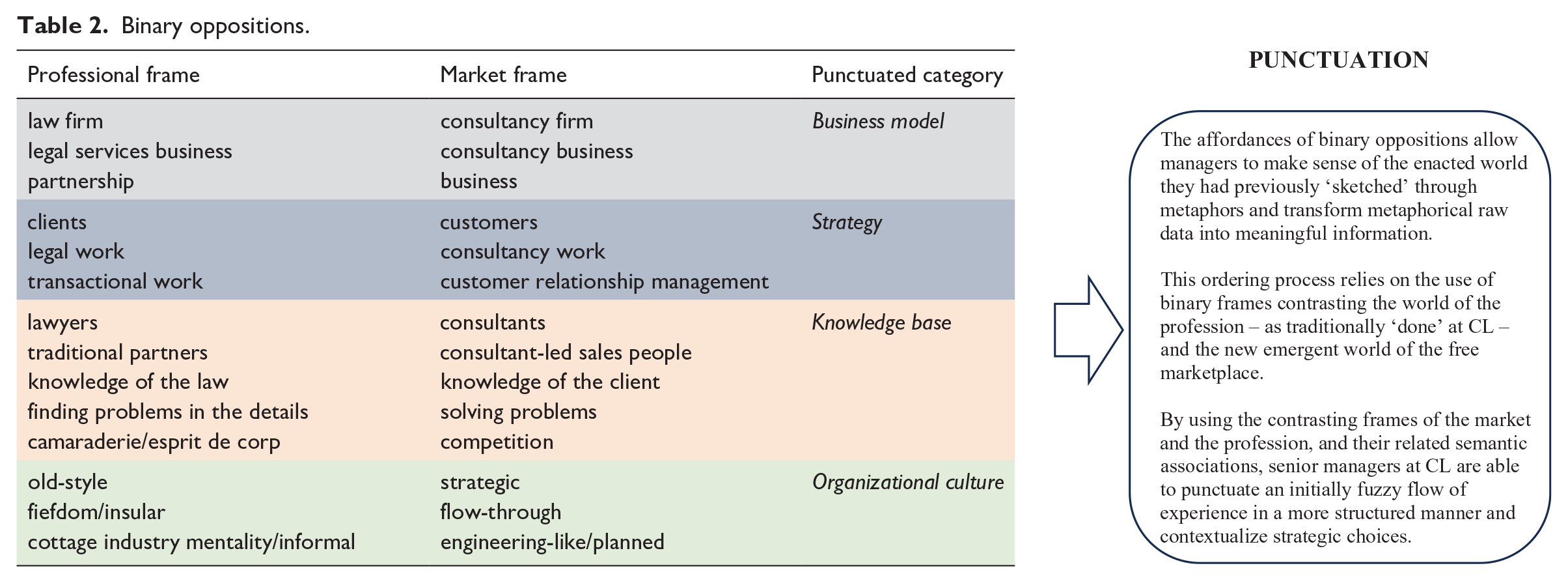
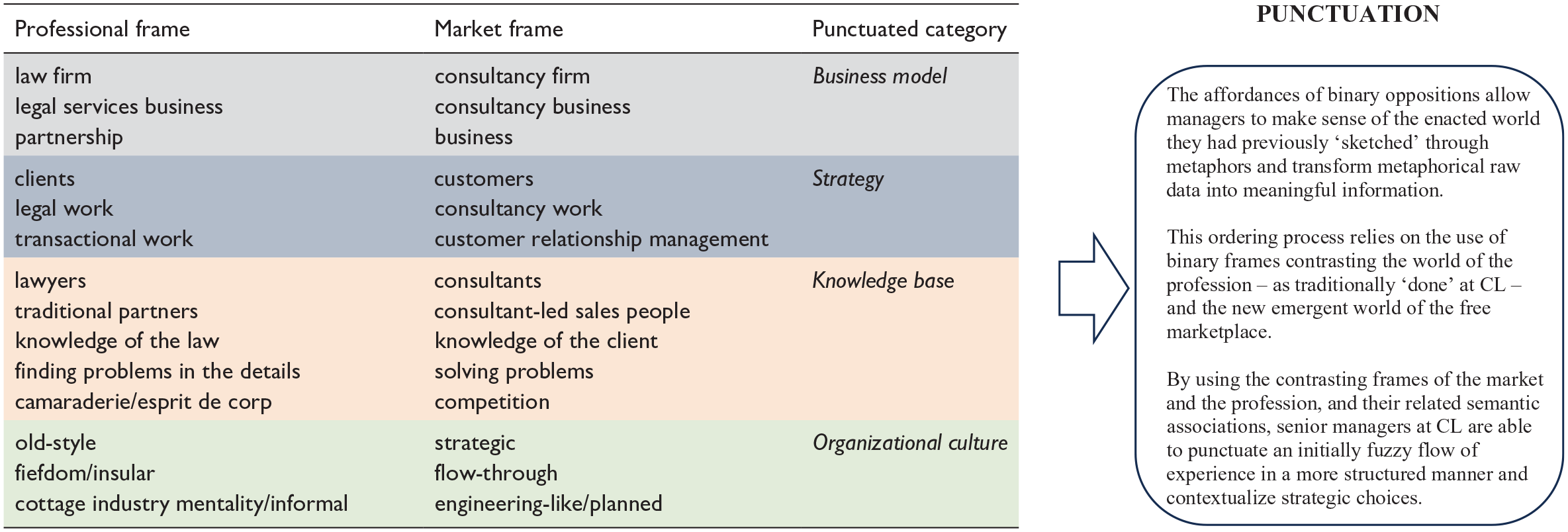
A first oppositional category distinguishes between alternative types of organization. At one end of the spectrum of this binary code, CL’s senior managers drew from the vocabulary and cultural references of the professional domain to make sense of their raw metaphorical data and positioned business models such as “law firm,” ‘legal services business’ and “partnership.” Furthermore, they typically situated CL at this end of the binary opposition, contrasting it to alternative types such as “consultancy firm” and “consultancy business”. These alternatives are consistent with the domain of the free market, where firms operate as stereotypical commercial organizations in a competitive environment. For example, a recurrent theme in our interviews was the opposition between the traditional partnership-based model and the emergent consultancy-led model. The CEO articulated his thinking on how the transition in business models would affect changes in the firm’s skillset: I think the traditional partnership model of law firms will be gone. I think we will move more towards a group of people with a broad skillset working much more closely with our clients, working in their businesses and understanding what their challenges are.
The board members’ sense of CL’s direction of travel in this new, more commercially oriented environment coalesced around the firm’s service offering and the corresponding organizational structure that might be required. For example, the Head of Marketing directed attention to increased diversification of services and its organizational implications: I think in ten years’ time we will not just be a legal services business. I think we will be doing more consultancy work, and looking at areas where we are still applying the same principles. I think the law will always underpin what we do and I think that we will still be a niche firm.
Here, a sequence of four “I think” qualifications articulates a meaning-making process that is centered around the opposition between legal and consultancy work. The Head of Marketing contrasts a past where CL—as a traditional legal firm—maintained a stable offering in a selected number of key areas with a future prospect of increasing diversification to the extent that the firm will become something more than “just a legal service business.” Through an additive process, “consultancy work” will be performed by CL alongside traditional legal work, where the ‘same principles’—that is, the principles of a professional legal firm, continue to be applied. The next sentence constructs a world where CL appears split between two cores; one as a legal firm (“the law will always underpin what we do and I think that we will still be a niche firm”) oriented toward the past and the maintenance of traditional values and principles, and one as a sleek consultancy firm oriented to the future and chasing after “different sources of revenue.”
A further type of binary opposition focused on managers’ role identity and professional knowledge. At one end of the spectrum, managers positioned themselves as “lawyers” with a distinct work identity as “traditional partners” whose reputation and authority is rooted in detailed “knowledge of the law,” and whose particular trait is a paradigmatic ability to “find problems in the details.” On this side of the binary spectrum, finding problems in details constitutes the essence of “who” a “lawyer” is and what s/he does, and this shared cultural identification brings lawyers—including those at CL—together as professional comrades on the same side of an ideal barricade. Individually and as a coherent group, these labels draw from cultural references to the domain of the profession and are typically contrasted by CL’s senior managers with a world of “consultants” and “consultant-led sales people” whose competencies lie in detailed “knowledge of the clients” and their needs, and whose paradigmatic trait is the ability to “solve” problems—instead of “finding” them. These operators do not share the same sense of camaraderie but are instead in “competition” with one another to attract and secure customers.
In one of the board meetings, we observed a discussion focused on the progressive commercialization of legal services and on new client dynamics, including new customers’ needs, increased price sensitivity and diminished loyalty. In a follow-up interview, CL’s Managing Partner reflected on these events in terms of a pending power shift that he saw: I think, fundamentally, there has been a power shift from law firm to clients. When I came into the profession, your clients respected you because of who you were. Over the course of my career that has changed fundamentally to a position where lawyers are only begrudgingly respected. You are continually having to justify your value to clients and society.
The Managing Partner focuses attention on a “power shift” whereby professional lawyers once respected for “who” they were—that is, for their professional status and competence—are now only “begrudgingly respected.” Clients have become more demanding and more attentive to “value” rather than accepting of the lawyers’ authority based on their status as professional and trained experts. This opposition between once powerful lawyers and all-powerful clients, together with the focus on value for money and on the need for legal knowledge and expertise to be “continually” justified in commercial terms, constructs an industry environment characterized by transitional dynamics between professional and market frames. The power shift toward clients implies different expectations in relation to the provision of legal services and a changed attitude toward purchasing decisions. As the CEO put it: Our clients are changing, our services are changing. In the past we sold knowledge, we owned documents and we were custodians of process. Today much of what we used to offer is available from cheaper and more accessible sources.
In a similar vein, the Facility Manager and the Human Resource Manager pointed out a shift in clients’ orientation from loyalty to cost effectiveness and value for money: . . . people these days do not always stay loyal because they are looking to get as cost-effective a deal as they possibly can, and so they shop around. customers are more sophisticated in their purchasing power. . . . and they continue to want more for less.
These framings are constructed in oppositional terms by pitting CL against the increasing power of its clients. They suggest a contrast between the traditional “legal” knowledge of CL as a professional outfit and the “commercial” awareness of individuals and buying companies alike. The reference to clients who “shop around” casts legal services into the same category as commodities and consumer goods; contrasting between a past when legal services were not price-sensitive and were reputation and expertise drove purchasing behavior against a present where cost-efficiency and value-for-money dominate the industry.
The power shift toward the client has implications for the resources and capabilities required to support a client-centered model of business. In this regard, the Business Development Manager remarked: I think it is just the way generally people are becoming more savvy because of technology; people can go on the internet and type in, you know, “how do I protect my idea” or whatever, and you get a whole list of -yeah, you can do loads of research on the internet. So, when you get to the stage of actually needing to do something, you have got to speak with someone and you have got to speak with a trusted individual.
This quote once again constructs an opposition between the categories of traditional “lawyers” and “consultants.” By emphasizing how clients are becoming increasingly “savvy” and might be able to identify and solve some of their problems by themselves, the Business Development Manager acknowledges that the traditional role of lawyers as “problem finders” is waning fast and that technological change is rebalancing power in favor of clients. At the same time, clients need someone “trusted” to speak to on a more egalitarian and personal level—something that is shared with the consultant role.
A final oppositional category identified in the analysis relates to the type of organizational culture. Here, CL’s top managers contrasted two worldviews. On the one side, they talked into existence—and identified CL with—an “old-style” way of conducting affairs predicated upon the maintenance of the monopolistic/corporate power traditionally enjoyed by lawyers over their clients and associated with a closed, informal mentality averse to change. On the other side, they spoke of an opposite world characterized by dynamism, planning and strategic forward thinking. The labels used to characterize this opposite end of the spectrum (i.e. “flow-through,” ‘engineering-like/planned’; “strategic”) suggest a more forward-driven approach to managing organizations, one that is associated with modern managerialism and with a more strategic orientation. In deploying this opposition, CL’s senior managers de facto demarcated, in and through talk, a complex environment in terms of an emergent tension between old-style management and a professional culture and new modern management techniques: the old ways are no longer a guarantee of success and competitive advantage is increasingly based on innovation, openness, and dynamism in the organization’s culture.
Overall, the analysis shows how CL’s senior managers used the affordances of binary oppositions, to make sense of the enacted world they had previously “sketched” in impressionistic fashion through metaphors, and transform metaphorical raw data into meaningful information. Thanks to their distinctive affordance as a specific form of talk, these binary oppositions functioned as ordering mechanisms by which senior managers were able to create meaning by placing stimuli in a more defined framework (Weick, 1995). This ordering process relied on systematic comparisons between alternative realities grounded in the language and cultural references of two semantic domains; that is, the world of the profession—as traditionally “done” at CL—and the new emergent world of the free marketplace. By using the contrasting frames of the market and the profession, and their related semantic associations, senior managers at CL were able to punctuate an initially fuzzy flow of experience into more structured information and contextualize strategic choices. As shown below, the next stage in their ongoing sensemaking effort involved the affordance of a third form of talk, modals, which allowed CL’s strategizing actors to transform their informed understanding of the situation into potentially actionable knowledge by projecting into the future potential, necessary, and/or desirable courses of action.
Modals: actionable knowledge and strategic courses of action
Having enacted a strategizing environment through metaphors and binary oppositions, CL’s senior managers oriented their everyday talk toward solving the tension between the professional and market frames in its varied facets (as articulated in Table 2) by identifying potential and/or desirable courses of action. They, in fact, elaborated a variety of strategic and organizational responses to potentially resolve these binary oppositions, effect change, and ultimately reposition CL in its newly enacted environment. Our analysis shows that as part of this repositioning, CL’s senior managers relied heavily on modal forms of talk. Modals fundamentally concern how talk is used to discuss possible situations as modals’ affordance is to transform structured information about an issue—in CL’s case, that developed through binary oppositions—into potentially actionable knowledge and potential alternatives for action (Golant and Sillince, 2007). Through modals different speakers express their attitudes and thinking about the world, and convey something that they deem likely, necessary, desirable, or permissible from their standpoint. A sample of representative cases of the use of modal verbs and expressions to solve binary oppositions and articulate potentially actionable knowledge is contained in Table 3.
Modals.
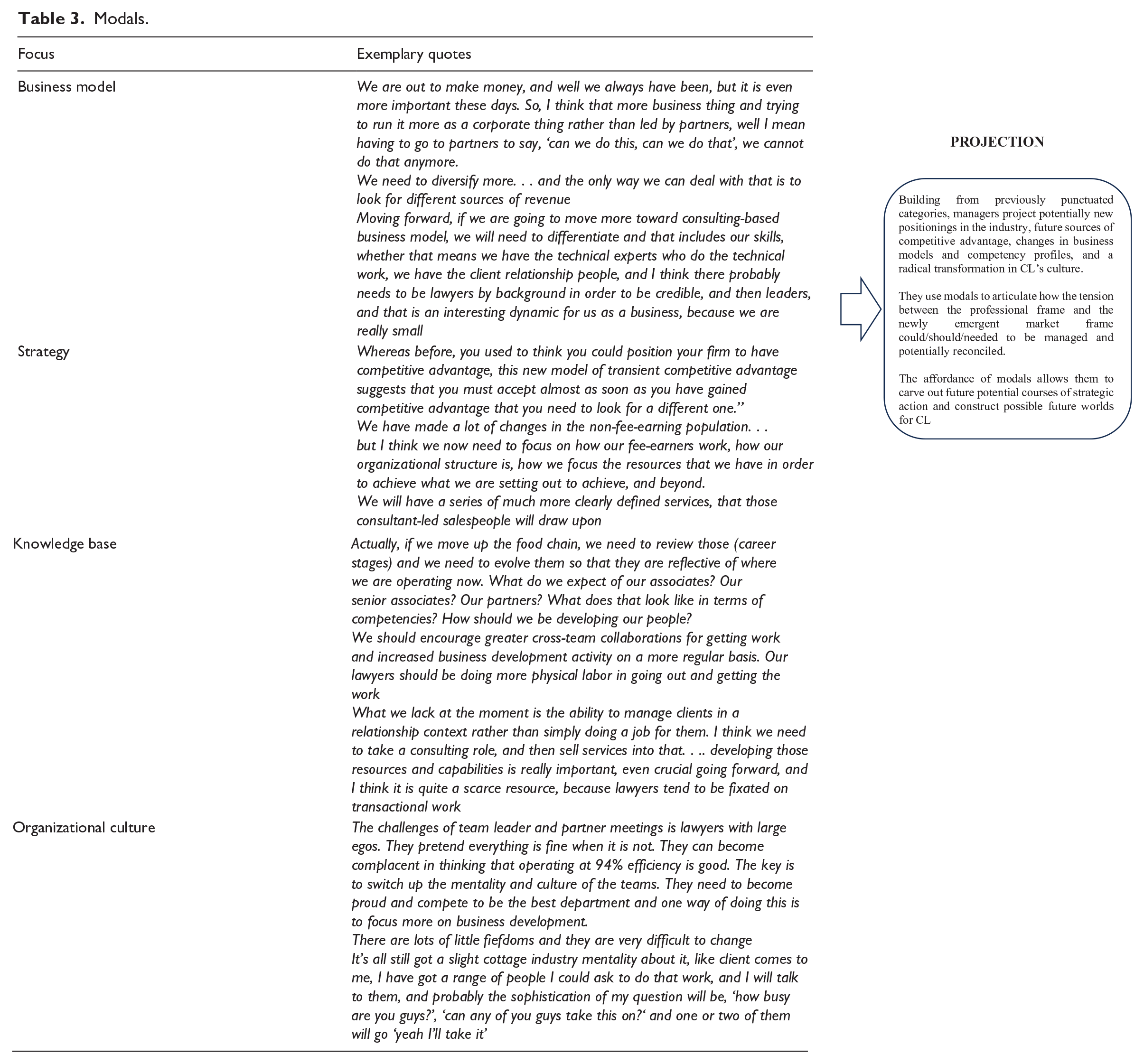
Immediately after one of the board meetings, the Director of Operational Development articulated how CL could tackle the strategic challenge posed by the tension between a broad and focused strategic positioning in the emergent business environment. His prospective solution entailed the adoption of an incremental approach to change, with CL adopting a focalization strategy built upon existing strengths and professional competences: The strategic decision for CL should be to focus on work which is of a type that is very difficult to unbundle, so the sort of high complexity-type work. . . so taking on work for big corporate and dealing with their high volume of non-disclosure agreements, that is not something that we should be bidding for. There are players who can do that a lot better than us and a lot cheaper than us, a lot more efficiently. I guess we could make the strategic decision to do that kind of thing as well, but it is all about a focus. Choosing the approach that is most similar to the existing way rather than the volume, ‘let’s grow ten times the size,’ ‘let’s go and acquire ten other firms’ type approach.
Through the use of modal verbs, this quote contrasts what competitors “can” do, by virtue of their competences and strategic positioning, with what CL “should” do instead. The emergence of a more market-oriented industry has strengthened competitors who are able to operate on a large scale at a cheaper price; this poses a dilemma for CL in terms of where to go next. Hence, a potentially desirable strategic move is to pursue a focused strategy that leverages CL’s ability to address “difficult to unbundle, high-complexity-type work” based on its traditional professional expertise and competence. This line of action builds on CL’s existing strengths and privileges an incremental approach to change over the pursuit of a more radical high-volume strategy, and which as such endorses the maintenance of a traditional professional orientation as core to CL’s future operations. The final line of this quote wraps up the proposed repositioning strategy by means of a suggestion (“choosing the approach that is most similar to the existing way”) that projects CL into a future that is not necessarily too different from its present: in this vision, CL’s traditional professional knowledge—that is, its proficiency in delivering ‘difficult to unbundle, high complexity work’—continues to underpin its position as incumbent vis-à-vis more aggressive, volume-based competitors. The emergent market frame is acknowledged as a possible strategic orientation (“we could”) but is not incorporated into CL’s technical core, which remains steadfastly anchored to its professional roots. In the words of the Director of Operational Development, the heritage of the professional past is the foundation upon which CL can build a more successful position in the marketplace through the pursuit of a high-end, low-volume position in a niche market.
Other senior managers dealt with the binary opposition between a business model rooted in the professional frame and one grounded in the market frame by proposing a different course of action whereby focalization could be achieved through a complete overhaul of CL’s modus operandi. For example, the Finance Director articulated his preferred vision of CL’s future in the following terms: It all comes back to this point of us having a strategy and not being old-style, do-it-all law firm where you are a sole-trader, banded together with a load of secretaries and people helping you to keep it all going. . . we actually need to be a business with a strategy that operates as a unit.
Taking as a given the increasing commercialization of the UK legal services industry, the Finance Director called for a new strategy to transform CL from an “old-style, do-it-all legal firm” into “a business” operating in a more efficient managerial fashion (e.g. without recurring to “a load of secretaries and people”). He rejected the traditional model of the “sole-trader” typical of legal concerns; and, instead, advocated a strategy of radical change to resolve the binary opposition of legal versus consultancy firms. This course of action, expressed through the modal “need” and conveying necessity, implies the replacement of extant practices informed by the professional frame with new, more managerial and business-like ones associated with the emergent free-market frame.
The HR Director, acknowledging the move toward a consulting-based business model, expressed the tension between professional and market orientations in terms of skill requirements: If we are going to move more towards consulting-based business model, we will need to differentiate our skills, whether that means we have the technical experts who do the technical work, we have the client relationship people, and I think there probably needs to be lawyers by background in order to be credible, and then leaders, and that is an interesting dynamic for us as a business, because we are really small.
The HR Director thus articulates for CL a future as a consultancy firm by adding newly developed “technical” and “client relationship” competences to extant legal ones. Through modals expressing possibility and necessity (‘will need’; ‘probably’; “needs to be”), a strategy of focalization through de-coupling emerges: the legal side shifts from its current core position into the “background,” where it continues to provide credibility and leadership—two qualities that are necessary for a “small” firm such as CL to operate in a competitive market environment. In this view, some of the principles of the professional frame are retained and given a different function while, at the same time, others that link to the free-market frame are introduced in parallel. The de-coupling of the two competing frames of the profession and the market in this way provides a route toward resolving the binary opposition of legal versus consultancy: professionally inspired practices will co-exist in future with new, market-based ones in slightly different areas and serving different purposes. The former will be separated out into a “background,” with the latter more prominently situated in core, front-facing areas.
Similar strategizing patterns through modals can be identified in relations to other binary oppositions in Table 2. For example, the binary opposition between knowledge of the law and knowledge of the client was addressed in different ways by the participants to a board meeting where the Managing Partner replied in direct response to a question from the HR Director: I think that knowledge of the law is less important. The crucial thing is having the knowledge of the client and of what the client is trying to achieve. I think knowledge extends beyond pure legal knowledge and even beyond the application of legal knowledge. Now, we also need to know the politics of our clients’ sector, what the trends are and what people are worried about. You can only do that through relationship management with the client.
Here, the envisaged scenario for CL is one where “knowledge of the law” remains valuable but of diminished importance against the “crucial” role attributed to “knowledge of the client” and the “need to know the politics of our clients.” Accordingly, CL’s human resource development efforts is redirected toward creating “relational management” capabilities—a practical instantiation of the market orientation—to partly replace and, as a minimum, complement and expand (e.g. “extend beyond”) traditional, “pure” legal competencies. The Head of Marketing addressed the same binary opposition by contextualizing the practice of the law in relation to a deeper knowledge of the client’s activities, expectations, and motivations: We need to do all of the things that clients want us to do, we need to be able to practise the law and advise them, but it is about understanding their sector as well. It is not good enough anymore to just turn up and draft a document for clients or advise them on a point of law, you need to be able to understand what motivates that, really understand their sector, and be passionate about what they do.
Through several iterations of the modal verb “need,” expressing necessity, the Head of Marketing articulates a potential strategy that combines together the “things that clients want” (e.g. understanding “what motivates them”) with practicing “the law” (e.g. drafting documents and advising on “a point of law”). This mixing of market and professional elements underpin an integrated solution to CL’s strategizing predicament.
This strategizing pattern through which CL’s managers use modal forms to resolve the
tension between profession and market frames at the micro-level of everyday practice can also be observed in relation to aspects of organizational culture. For example, the Managing Partner identified barriers to change in the lawyers’ cultural identity and highlighted the danger of cultural inertia and entrenched power dynamics: The challenges of team leader and partner meetings is lawyers with large egos. They pretend everything is fine when it is not. They can become complacent in thinking that operating at 94% efficiency is good. The key is to switch up the mentality and culture of the teams. They need to become proud and compete to be the best department and one way of doing this is to focus more on business development.
Here the Managing Partner contrasts a present where “lawyers with large egos” and prone to complacency (“can become”) constitute a notable obstacle to the efficient running of the business against a future where, in an increasingly competitive environment, a “switch” to a more open and diverse “mentality and culture” is paramount. This view anticipates a future where competition spills from the environment into the organization through a substitution of the professional frame with the commercially oriented market frame. The Managing Partner’s recipe for dealing with the binary opposition between CL’s traditional “cottage industry mentality” and the “culture of the teams” is to completely dismantle the former—seen as a key obstacle to efficiency—and adopt competitive practices where professionals are not afraid to compete with one another, but are proud to strive to “be the best.” The switch in mentality and cultural orientations is linguistically expressed through the contrast between what lawyers “can become” (complacent) and what they “need to become” (proud).
Oftentimes in their talk CL’s senior managers focused on more material manifestations of organizational culture. The relation between the Cambridge and London offices, for example, constituted a recurring theme in the observed board meetings, always featuring prominently in the board’s agenda. Historically, CL’s Cambridge headquarters—located in a peripheral area to provide ample parking space to employees—were conceived as a regional office providing services to local clients (e.g. horse-racing and agricultural services) and included the technical “legal” functions alongside all support services. Its layout and appearance were fairly understated and conservative, in line with CL’s professional reputation, local client-base and service-offerings. Opened in 2010 after the 2007 Legal Services Act, the London office was located at the center of London’s financial district in a distinctive location near the iconic Gerkin skyscraper and with the specific aim of catering for a London-based, international clientele. Its décor and overall appearance fit in with the modern and “flashy” offices of its surroundings, mimicking the look of dynamic, international City-based companies. This difference in orientation and outlook, encapsulated by the binary opposition between the sobriety of traditional, professional law firms and the designer-inspired look and décor of commercial organizations, was often a matter of lively debates during board meetings. The following exchange on office relocation is a case in point:
The Cambridge office is now the poor relation; we need something much swankier. I have a vision of a top floor office or space with a roof terrace in central Cambridge.
We could have a smaller Cambridge office in a more prominent location which houses only fee earners, and then move business support functions, such as document production, elsewhere to finance the more expensive Cambridge office. Business support functions could have their own office outside of Cambridge, maybe in Waterbeach, where offices are cheaper.
You need to question, “where are my clients?” London is where it’s at. . ..
This exchange shows how, in dealing with the same binary opposition contrasting sobriety against design in relation to CL’s location and décor, senior managers used modal forms (“need” and “could”) to articulate alternative courses of action. By calling for a total replacement of CL’s current premises in favor of “swankier” ones in a more fashionable and central Cambridge location, the Managing Partner suggested that the market frame would become the dominant behavioral guide for the company as a whole. The CEO, instead, offered a different solution to the same problem in both exchanges. He, in fact, proposed a potential decoupling of the physical organization with different locations and space arrangements for, respectively, the more commercially oriented “fee-earners” and the backstage employees. The former should be situated in “prominent” locations—possibly in direct contact with sophisticated customers—whereas the latter could be separated out and de facto relegated to plainer and cheaper premises, out of sight of the all-important clients. Interestingly, the External Consultant proposed an even more radical course of action than those proposed by either the Managing Partner or the CEO. By pointing out that London was where CL’s most important clients were based now and for the future, the External Consultant implied that these measures might not go far enough and hinted at the need for a complete re-orientation of resources from the provincial site at Cambridge in favor of the central City location. A complete “spatial” substitution is envisaged here, with the market frame– as materialized in the London office—completely taking over the profession frame through the physical demotion of the once central Cambridge headquarters to a marginal role.
Debate about office location—as instantiated by the contrast between the traditional Cambridge office and the swankier London office—was in agenda of several observed meetings. Indeed, the focus on a practical issue such as office location arguably became a way of “materializing” and further narrowing down the debate about change and the tension between professional and market orientations. It also conveyed some strategists’ resistance to embracing radical change. This brief excerpt from our fieldwork illustrates the point: During a mid- coffee break, the Managing Partner was approached by the Director of Operational Development by the coffee machine which was located against a backdrop of photographs emphasizing the heritage of the city of Cambridge, including university college buildings, punting and bicycles. This imagery prompted the Director of Operational Development to reignite the conversation about office location, pointing to the images and saying “in the midst of all of the excitement around the new London office, we should remain mindful of our long-standing, regional client base. If we are intent on using the traditions of Cambridge as the basis of our brand, then for as long as we have our headquarters here, we should continue offering services that meet the needs of local people and businesses.” The Managing Partner sighed while selecting his coffee from the machine options, then turned back to the Director of Operational Development, referring back to the key wording from CL’s strategic planning publication “Significant Times,” saying “when making big decisions, we have to remember our mantra –‘to be the best on our own terms.’” At this point, the Finance Director, who had been adding sugar to his coffee, turned round to join the conversation to say “yeah, we need to have the confidence to turn down work and leave clients behind if they don’t fit with the direction we want to take.” At this point, they all turned to walk back into the board room to continue the meeting where the CEO who was sat waiting asked “what have I missed?” The Managing Partner replied by saying “we were just discussing whether the branding of our breakout room reflects our desire for change,” to which the CEO replied “The Cambridge legacy on our story means that whatever changes we make, we have to go quite slowly.”
Overall, the analysis shows how CL’s senior managers used modal forms of expression in their strategy work to take stock of the world they had impressionistically generated through metaphors and successively ordered through oppositional forms of talk and to transform this body of structured information into potentially actionable knowledge—that is, a more considerate and focused understanding of CL’s alternatives and an expression of the desirability attached to different courses of action. Building from the recognition that CL’s world was being reshaped by the tension between two poles—that is, the principles of professionalism associated with CL’s past and a rapidly emergent future of free-market competition—they talked into existence potentially new positionings in the industry, future sources of competitive advantage, changes in business models and competency profiles, and a radical transformation in CL’s culture that also extended to its physical environment. More significantly, they utilized modal forms to articulate how the tension between the professional frame and the newly emergent market frame could/should/needed to be managed and potentially reconciled. The affordance of modals allowed them to construct possible future worlds for CL—for instance, as a consultancy firm—while, at the same time, delineating new ways for the organization to interact with its environment and carving out future potential courses of strategic action.
Discussion
The purpose of this article has been to investigate how managers combine different forms of talk and their respective affordances to construct meaning in everyday strategizing. We based our investigation on CL, a UK law firm that was experiencing a strategic change. We found that, in their meaning-making efforts, CL’s managers made sense of changes in their business environment and engaged in strategizing through three main forms of talk– namely, metaphors, binary oppositions and modals—each characterized by a different affordance and by a specific contribution to the ongoing sensemaking process. More specifically, metaphors afforded managers an impressionistic appreciation of the strategic issue of change by bracketing their equivocal streams of experience and by generating raw data for their ongoing strategic sensemaking efforts; binary oppositions allowed CL’s managers to progress through the punctuation stage in sensemaking as they afforded them a more structured understanding of the issues at hand and generated a wealth of analytical information that organized previously bracketed raw data into more clearly demarcated frameworks; finally, modals allowed CL’s managers to shift to the projection stage of their sensemaking cycle, as they afforded the transformation of information about the issue into potentially actionable knowledge so that they could explore future strategic courses of action in terms of opportunity, desirability, likelihood or necessity. Through these forms of talk, their individual affordances as well as their logical sequencing and interplay as part of the ongoing sensemaking process, managers constructed meanings that allowed them to imagine future competitive landscapes, make distinctions in relation to them, and call for future courses of action in relevant strategic domains.
Our findings contribute toward developing a more comprehensive understanding of the linguistic sensemaking processes at play in strategy work. While the forms of talk identified in this study are characterized by significant differences in their affordances, they form part of a unitary sensemaking process that underpins managers’ strategizing. This suggests that it is possible to link them together in an integrative conceptual model that articulates the relationship between talk, sensemaking, and strategy work, as this emerged from the findings (see Figure 1).
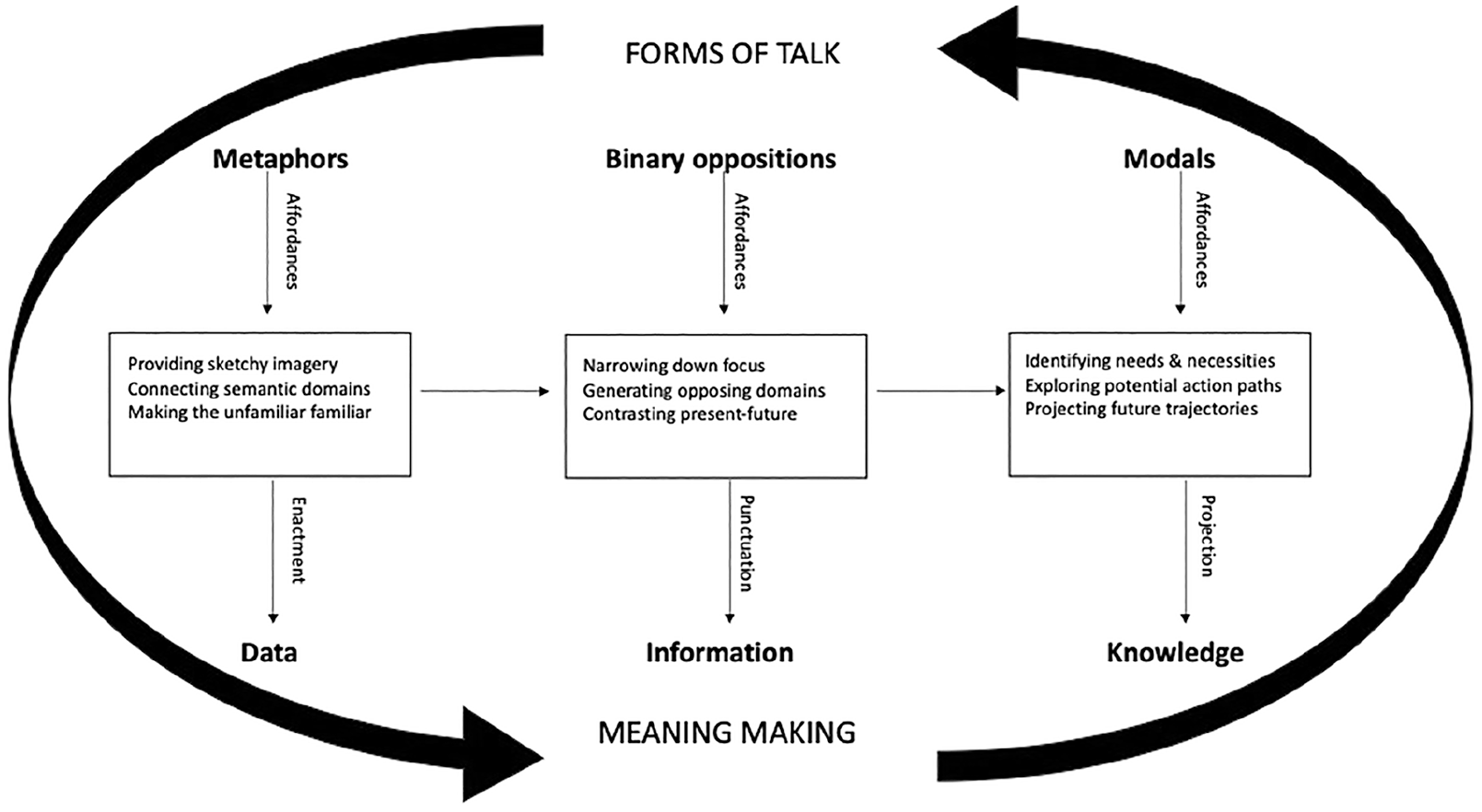
Forms of talk and meaning-making.
Bringing different forms of talk together illuminates the pathways through which language use shapes the construction of meaning and how the latter informs strategy work. The model portrays interactive processes of sensemaking and strategizing though which managers progressively connect, through talk, the details of their situation to strategic choices. This interaction follows a dual pattern. On one hand, it unfolds through forms of talk that encompass metaphors, binary oppositions and modals. This pattern conveys a progressive operationalization of a strategist’s talk that is aimed at representing the strategizing situation into more specific elaborations of possible courses of action. On the other hand, it entails the transformation of data into information and information into actionable knowledge. This pattern conveys a process of meaning-making that progressively converts raw experience into “sense” that orients managers’ strategy work. The two patterns are brought together by the sensemaking processes of enactment, selection and projection that link the affordances of forms of talk to specific outcomes of meaning-making.
Our inductively derived framework contributes to two main areas of research. First, we extend current linguistic perspectives on sensemaking and strategizing by theorizing how managers use the affordances of talk to construct representations of strategy that inform possible trajectories of action. Second, we extend research on the use of forms of talk in future-oriented strategizing by theorizing how managers logically connect different forms of talk to construct viable versions of their firm’s future during processes of strategic change.
Language, sensemaking and strategizing
Our study extends linguistic approaches to strategizing by unpacking the concept of “strategizing as a linguistic accomplishment.” The linguistic turn in strategy has established that the actual doing of strategy in organizations takes place in the form of talk (Barry and Elmes, 1997; Fenton and Langley, 2011: 1172; Vaara, 2010; Vaara and Fritsch, 2022). In other words, talking is an important part of doing. Extending this view, our study suggests that the connection between the doing of language and the doing of strategy is mediated by sensemaking processes that build on the affordances of different, but related, forms of talk (Jewitt et al., 2016; Kress, 2010). The concept of linguistic affordance is theoretically important in the context of strategy work because it emphasizes the performative role of specific registers of language in addressing the uncertainties of strategic change. While scholars have previously recognized the performativity of strategy talk in general, our study breaks it down into specific linguistic forms that perform distinct functions in strategizing. It zooms in on specific forms of talk to show how language, through sensemaking processes, shapes strategizing at a micro-level. Furthermore, whereas prior research has mainly considered individual forms of talk, primarily metaphors and analogies, we distinguish yet further forms of strategy talk and demonstrate how they work together in shaping the construction of meaning and in effectuating strategy work.
The concept of “process affordances” has been previously linked to the idea that strategy tools enable different ways of strategizing, particularly in relation to wicked problems, conceived as complex, uncertain, and evolving challenges (Burke and Wolf, 2021). From this perspective, the value of strategy tools depends on how strategists use them to make sense of uncertainty. The article extends these insights by transferring the concept of project affordances to the linguistic mechanisms of strategy talk. Specifically, metaphors afford enactment: they help strategists construct an understanding of their environment by framing complexity (e.g. “we are on a journey”). Binary oppositions afford differentiation: They enable strategists to navigate complexity by creating structured contrasts (e.g. “professionalism vs market orientation”). And, finally, modals afford projection: They allow strategists to explore possible future actions and commitments in an uncertain environment (e.g. “we must shift our approach”). These observations are theoretically important because they suggest that talk itself functions like a strategy tool, shaping how strategists make sense of uncertainty and construct strategic courses of action. In this way, our study extends the idea of process affordances to the micro-level of language use, explaining how different forms of talk create different possibilities for strategizing. Understanding the linguistic potential of affordances is furthermore theoretically important because it draws attention to the critical link between the cognitive aspect of strategizing (sensemaking) and its performative aspect (doing strategy through talk), making the connection between thought and action explicit.
Our findings also advance our understanding of how talk impinges on the progression of meaning-making and thereby shapes the process of strategizing. Previous studies have emphasized that strategizing proceeds through a series of verbal tactics whereby practitioners talk their environment into existence (Weick et al., 2005). From this standpoint, talk is consequential for constructing a sense of direction, considering strategic options and shaping strategic action (Balogun et al., 2014; Barry and Elmes, 1997). Our conceptual model extends this view by providing a more nuanced understanding of how different forms of talk, and their related affordances, contribute to various stages of the sensemaking process (enactment, punctuation, and projection) underpinning strategy work. In particular, the integrative model that we have provided highlights the interplay between different forms of talk and their combined role in scaffolding managers’ sensemaking efforts. By linking affordances to sensemaking stages, our study articulates a logical progression of meaning-making in which managers construct a sense of direction by transforming, through talk, raw data into information and actionable knowledge.
These observations are theoretically important because they show how, through the affordances of talk, managers are able to articulate and potentially reconcile the strategic tensions that inevitably underpin processes of change. Furthermore, we argue, strategizing involves not only leveraging individual linguistic tools but also integrating their affordances to construct coherent and actionable meanings. Our model provides a linguistic-based framework for how talk sequences drive sensemaking and translate uncertainty into strategic options. This process has epistemic consequences in that it transforms the raw data enacted through imagination into actionable knowledge. The progressive construction of knowledge allows managers to imagine the future through metaphors, explore its dilemmas through binary oppositions and synthesize options through modals. It is important to point out that the knowledge constructed through the affordances of talk is necessarily provisional. Echoing Weick (1979), we could say that the strategic options that managers produce through processes of enactment, punctuation and projection constitute potential constructions that they momentarily “know” and “feel they understand.” The temporary nature of this enacted knowledge means that it will eventually be used to further diagnose the strategizing situation and engage in further sensemaking cycles.
Strategizing about the future through prospective sensemaking
Our study sheds light on how forms of talk allow managers to construct and use representations of the future in relation to strategic change. Recent studies have highlighted the role of narratives in managers’ prospective sensemaking of strategy work (Bruskin and Mikkelsen, 2020; Garud et al., 2014;). From this perspective, narratives are used in “worldmaking” (Goodman, 1978; Patriotta, 2016), allowing strategists to imagine the future potential of present-day strategy (Rindova and Martins, 2022). Our study extends these insights by illuminating how forms of talk enable managers to transition from broad imaginative thinking to more structured and actionable futures. Our findings indicate that strategizing about the future follows a logical unfolding, based on sensemaking processes of enactment, punctuation and projection, in which the combined affordances of multiple forms of talk progressively transform raw data into actionable knowledge about a possible future. As a result of this process, managers make sense of strategy work by moving from coarse metaphorical images of strategizing situations to more structured representations of the business environment based on binary oppositions, which eventually provide a platform for potential and plausible courses of action expressed through modals.
In this sense, our findings help understand the sensemaking processes by which leaders develop visions of the future. Prior research has highlighted the managerial challenge of comprehending uncertain, ill-defined, and often highly contested futures. Leaders construct imaginary depictions of the future, or “futurescapes” (Rindova and Martins, 2022), when embarking on strategic change (Gioia and Chittipeddi, 1991; Patriotta, 2019; Venus et al., 2019). These futurescapes, however, reflect abstract representations that need to be translated into tangible courses of action. In this regard, future making is a process of ongoing inquiry aimed at enacting possible futures, evaluating them, and giving form to preferred ones (Comi and Whyte, 2018; Wenzel et al., 2020; Whyte et al., 2022: 2). While prior research on future making emphasizes the process of translating strategic visions into actions, our study zooms in on how strategists accomplish that translation through specific linguistic practices, or forms of talk. It identifies a structured linguistic sequence—from enactment (metaphors) to differentiation (binary oppositions) to projection (modals)— by which an initially uncertain and undefined image of the future is broken down into oppositions that provide a platform for projected choices. This linguistic sequence explains how futures emerge in strategy work. Accordingly, we add a micro-level linguistic dimension to current understandings of future making, showing how strategic visions are linguistically enacted, shaped, and projected over time. More generally, our study grounds future-making in discursive sensemaking practices, adding linguistic granularity to broad conceptualizations of future making.
Furthermore, scholars have proposed differentiated temporal representations of the future in organizing processes, distinguishing between near and distant futures. Distant and near future represent qualitatively different ways of envisioning the future and therefore entail different processes of construction and consequences for strategizing (Augustine et al., 2020). While the former is represented in practical terms, using more detailed situational features and concerned with forming expectations and goals under conditions of uncertainty, a distant future is represented in more abstract terms, using more stylized features of the situation and concerned with imagining possibilities under conditions of ambiguity (Berntsen and Bohn, 2010; Liberman and Trope, 1998; Trope and Liberman, 2003). In a similar vein, our study depicts a strategizing situation in which managers attempt to make sense of a new mandate, address the tensions associated with it, and imagine strategic directions. Extending previous studies, however, we show how managers address the tensions between distant and near futures through linguistic sensemaking. Hence, initial perceptions of a distant future—as represented in abstract terms through metaphors—are progressively detailed and demarcated through binary oppositions and eventually actioned through modals. The affordances of language allow managers to manipulate uncertain situations so that elusive and open-ended futures become more visible and manageable. Through forms of talk, managers become aware of what they think: they visualize their thoughts, identify tensions and narrow down potential courses of action. In the case observed, the future is initially visualized as an evolutionary journey where survival is at stake. This journey is fraught with tensions between ways of doing business that obey to potentially conflicting frames. Resolving these tensions requires rethinking a firm’s strategic positioning, business model, competence-base and cultural values—and in terms of a course of action that the managers of the firm believe should be followed. When taken together, the forms of talk based on metaphors, oppositions and modals align in constructing the future as a strategizing framework.
These observations extend current understandings by showing how future making, conceived as a process of inquiry, unfolds through linguistic practices. Specifically, our findings suggest that processes of meaning-making achieved through forms of talk allow managers to not only represent future scenarios but also manipulate temporality in order to bridge distant and near futures. Forms of talk translate distal into proximal views of the future and thereby allow managers to construct the future as if it had always been there (Cooper and Law, 1995). This translation is part of the very dynamism of strategizing. From this perspective, forms of talk play an active role in shaping managers’ perceptions across time.
Implications and limitations
Our findings can foster naturalistic generalization, as parallels may be drawn between the legal field and other fields that are undergoing similar transitions between professional and market orientations. Indeed, the transition observed is, or has been, quite common in fields such as accounting, higher education and health care. Future research could look at how the specific attributes of a profession—e.g. identity, expertise and sector-specific regulations –influence strategy work dynamics in a similar way to the dynamics that we uncovered in the present study. Our findings can be also analytically generalized by moving beyond the empirical phenomenon to consider the conceptual implications of the case study (Yin, 2018). Everyday strategy work proceeds through forms of talk through which managers construct strategizing situations and explore potential courses of action. Our insights stress the urgent need to revisit the way we conceptualize the linguistic construction of strategy work by focusing on micro-processes of strategy talk and meaning-making. This research provides a step in this direction.
Like any research, this study has limitations that must be acknowledged. In particular, our findings emphasize dynamics of enactment and downplay the outcomes of the strategizing process. In a sense we have focused on the “throughput” of strategy work. Indeed, we do not know how tensions between competing frames at CL were ultimately resolved and what strategic decisions where actually taken beyond the period in which we studied the case. This is because processes of strategic change unfold along relatively lengthy periods of time. In a similar vein, our study has focused on forms of talk rather than fully-fledged narratives and has privileged enactment over linguistic content and grammar over the semantics of action. By bracketing the outcomes of strategy work and focusing on how managers think through speaking, we have developed processual insights about the links between talk, sensemaking and strategizing. Future research at the interface of sensemaking and strategy work may aim to complement our focus on throughputs with outcomes, meaning-making with decisions, processes of enactment with processes of projection, and forms of talk with further narrative elaborations across the firm. Such aims could be achieved through longitudinal studies that track processes of talk and change across an organization and links these to strategic outcomes.
Conclusion
Linguistic approaches to sensemaking and strategizing have attracted a substantial amount of scholarly attention and efforts to integrate these traditions have recently been at the forefront of research on strategy and organization. Indeed, conceiving of sensemaking and strategy work as linguistic accomplishments can promote a better understanding of how managers construct strategic situations and translate ongoing understandings into projected actions. Our findings highlight how different forms of talk generate meaning-making dynamics that shape strategizing processes. We hope that our study will inspire future research in this direction.
Footnotes
Funding
The author(s) received no financial support for the research, authorship, and/or publication of this article.
