



Abstract
This essay pays tribute to Andrew H. Van de Ven’s (1945–2022) contributions to management theory and practice. We highlight Andy’s views on organizational phenomena as evolving processes and show how he applied these, as well as his own engaged scholarship, to develop novel insights on innovation, and organizational change, among other topics. His approach to scholarship, which involved working to transform existing understandings of management theory and practice even as he performed them in his own academic activities, serves as an enduring legacy for emerging and seasoned scholars in our field.
Keywords
Andrew Van de Ven (Andy henceforth), who passed away on April 30, 2022, made distinctive contributions to management scholarship. He was truly a reflective and engaged scholar, not afraid of rocking the boat, whether the boat was the Academy at large, or himself. For instance, in 1990, Andy and George Huber (Van de Ven and Huber, 1990) edited a special issue on longitudinal research methods in the very first volume of Organization Science. The articles in this special issue were by Andrew Abbott, Stephen Barley, Dorothy Leonard-Barton, Peter Monge, and Andrew Pettigrew among others. The special issue helped the new journal accomplish its aim to: Break Out of the Normal Science Straitjacket.
The notion of stepping outside the normal science straitjacket—or any straitjacket, for that matter—expresses in some sense what Andy accomplished throughout his career. His innovations as the Principal Investigator of the large-scale Minnesota Innovation Research Program (MIRP) or as the program chair and president of the journal Academy of Management or as the founding editor of the journal Academy of Management Discoveries questioned and transformed the status quo. He was always willing to challenge the institutional frameworks of the field, and, in doing so, continually changed the field itself and himself. Using a metaphor from the “Ship of Theseus,” all his professional life, Andy rebuilt the ship plank by plank even as it sailed.
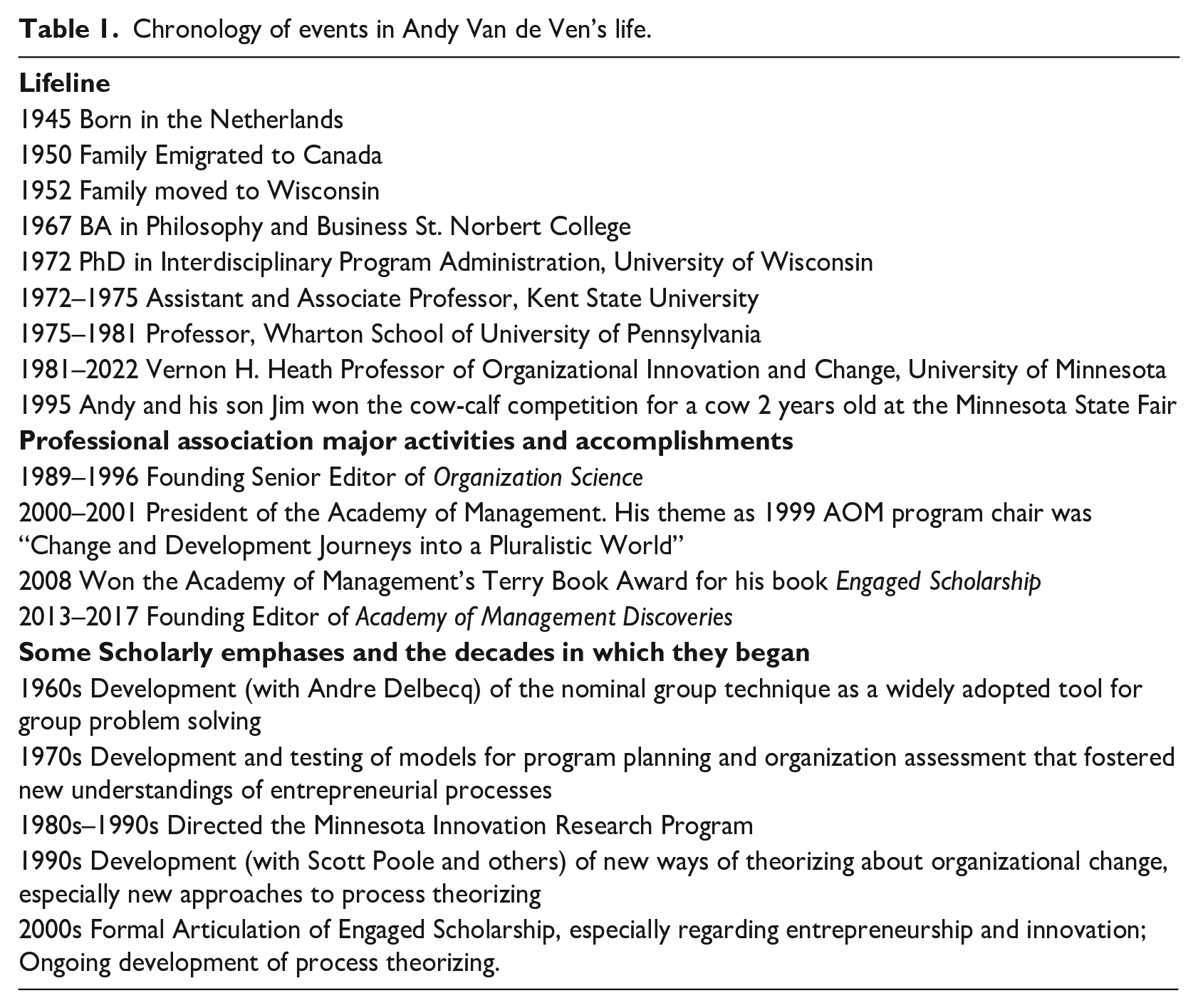
In this essay, we show how he accomplished this. Ours is not a chronological account (that is included as Table 1), but instead a thematic account, one we can all learn from as reflected in the expression “performing while transforming” in the title of this essay. In so doing, we add new dimensions to the performativity of theories (Gond et al., 2016) (see also Bartunek, 2020: for examples). Andy’s research career led him to enact and bootstrap his central ideas—namely, engaged scholarship, the importance of process, innovation, and notions of pluralism—as he went along, eventually articulating them formally as theoretical and methodological precepts that shaped his own and others’ thinking, including those of the managers and executives he collaborated with.
Chronology of events in Andy Van de Ven’s life.
Early contributions
Andy’s initial introduction to organizational scholarship took place in the 1960s as a graduate student working with his advisor, André Delbecq at the University of Wisconsin (Van de Ven, 2020). At that time, André was engaged with citizens in neighborhood meetings in a Wisconsin Dane County Community Action Program to better understand the problems that low-income residents confronted with the poverty assistance programs in place. André was puzzled about why the participants in the meetings were so silent, as the academic wisdom of the time suggested that they should have plenty to say.
André sent Andy to the library to find out. There, he found an article by Taylor et al. (1958) who noted that individuals generate more ideas if they were to work by themselves rather than in a group. This insight, which was contrary to common beliefs about brainstorming, led André to start the next neighborhood meeting by not allowing people to speak, but, instead, writing down their ideas on paper. Indeed, this approach was far more successful than the approach that had been followed before.
Intrigued, André and Andy decided to experiment with the method (i.e., not allowing people to speak), which eventually led to the development of an extraordinarily effective group process approach—the Nominal Group Technique (Delbecq et al., 1975; Delbecq and Van de Ven, 1971). In particular, they noted in a 1971 article (Delbecq and Van de Ven, 1971: 203) that
“the optimal combination of group processes for a problem-solving committee is: (1) the use of nominal group processes for fact-finding, idea generation, or initial subjective probability estimation in the first phase of a committee’s work; (2) the use of structured feedback and interacting discussion in the second phase; and (3) nominal group voting for final individual judgments in the final phase.”
We can see the introduction of process phases in this description.
Reflecting on these early experiences, Andy (Van de Ven, 2020: 485) later said: “This engaged field research experience hooked me. The stimulating challenges of addressing real problems and advancing new social scientific knowledge have continued to motivate me in subsequent studies throughout my career.” Indeed, this early experience led Andy to further explore what it meant to be an engaged scholar.
Engaged scholarship
Due at least in part to the influence of Andre Delbecq, Andy always was an “engaged scholar,” a term that he used later to describe his career’s work. Formally, he and Paul Johnson (Van de Ven and Johnson, 2006: 803) came to define engaged scholarship “as a collaborative form of inquiry in which academics and practitioners leverage their different perspectives and competencies to coproduce knowledge about a complex problem or phenomenon that exists under conditions of uncertainty found in the world.” In his George R. Terry award-winning book Engaged Scholarship: A Guide for Social and Organizational Research (Van de Ven, 2007), Andy developed a variety of means through which academics and practitioners might collaborate on different endeavors that held meaning for both scholarship and practice.
Engaged scholarship was not just something Andy himself conducted. Equally importantly, Andy was keen to have others join him in his efforts. Toward this end, he created opportunities for doctoral students to interact with practitioners throughout their studies and to see the differences between how problems are experienced in work organizations as opposed to how they are explained by academics (Van de Ven, 1999). This resulted in Andy’s doctoral students and collaborators finding ways of valuing both theory and practice.
Andy’s work on engaged scholarship continues to have a profound impact on the field of Management. It serves as a foundation for academics addressing grand challenges in our world (e.g., Hoffman, 2021). It has helped lead to an open-access journal, Engaged Management Review, https://commons.case.edu/emr/, and has been cited in discussions of engagement in many academic fields. Recognizing the importance of engaged scholarship, the Carlson School of Management at the University of Minnesota has initiated yearly conferences on the topic to bring together researchers and practitioners. 1
Process perspective
Andy’s earlier work was embedded in classic quantitative traditions of management scholarship (among other things, he wrote about organizational effectiveness and contingency theory) (Drazin and Van de Ven, 1985; Van de Ven and Ferry, 1979). From these beginnings, Andy transited to advancing longitudinal process thinking and methods for the study of strategy, innovation, and organizational change. In so doing, Andy was originally inspired by Lawrence Mohr’s (1982) ideas about the potential of process thinking for organization studies. His thinking was also influenced by other scholars such as Robert Burgelman, Henry Mintzberg, and Andrew Pettigrew who, around the same time, were also promoting longitudinal process-based studies.
In 1992, an inspiring and foundational piece of work on process thinking by Andy appeared in Strategic Management Journal (SMJ) titled “Suggestions for studying strategy process: A research note” (Van de Ven, 1992). The subtitle seems somewhat anomalous for a substantial 20-page article that has over 2500 Google Scholar citations in 2024. The piece offered several important ideas that we summarize here.
First, the article explained three different ways in which scholars use the highly polysemic term “process” in academic discourse. Specifically, some scholars use the word process to refer to action-related variables (e.g., communication frequency, workflows, and decision-making techniques, as well as strategy formulation, implementation, and corporate venturing). Others use the word process to refer to an implicit mechanism that explains causal linkages between variables. However, Andy’s preferred conceptualization, and the one that he pursued throughout most of his career, involved defining a process as a sequence of events that describe how things change over time.
A similar definition was used by the editors—including Andy—of the special issue on process studies in the Academy of Management Journal in 2013 (Langley et al., 2013: 1): “Process studies focus attention on how and why things emerge, develop, grow, or terminate over time.” Other definitions and distinctions have appeared later, but this clarification was particularly important at the time in a context where many strategy scholars were then (and indeed some still) using the notion of strategy process research to refer to correlational and causal studies of relationships between concepts like strategic planning and performance.
Second, the 1992 article elaborated on how the study of phenomena over time might involve different kinds of linkages among events—with linear or parallel tracks and sequences, perhaps with bifurcations due to probabilistic contingencies, and perhaps with feedback loops where activities might be repeated. This recognition of the possibility of different kinds of process patterns was important because it pointed out some of the non-linear complexities that process studies might imply. At the time, many process models in the management literature took the form of unified linear sequences. Typical of this were life cycle models of organizations, or prescriptive models of organizational change involving anywhere from three (Lewin, 1947) to eight (Kotter, 2012) sequential steps. Andy wanted to reach beyond such simplifications that still often frame management thinking.
Third, and perhaps most importantly, Andy noted in the article that describing sequences of events (whether linear, parallel, or recursive) was not enough to develop “process theory.” It was here that Andy first introduced ideas about four kinds of generative mechanisms underpinning process studies, which he developed from a multidisciplinary review of literature on development and change. This typology would be further elaborated in another highly cited article with Scott Poole (Van de Ven and Poole, 1995).
To summarize their article, the first generative mechanism (or “motor”) is the lifecycle model, based on the idea that things change according to a predetermined sequence based in genetics. The second is teleology, where the driving mechanism is purposeful action. This expresses the idea that people get together to establish goals and that they work to implement what they have set down, adapting it as they encounter obstacles. The third mechanism is dialectics, the idea that it is conflict and contradiction that drive processes forward and that the confrontation between a thesis and antithesis over time tends to result in some kind of synthesis, which then itself runs into conflict with something else, and so on. This was a mechanism to which Andy devoted considerable attention to in his later work (Raisch et al., 2018; Van de Ven et al., 2019). And, finally, the fourth mechanism is evolution, which involves the subprocesses of variation, selection, and retention. This is based on the idea of survival of the fittest, where variations unfold, but because there are not enough resources to support all elements, some are selected out, and others are retained. Having made these distinctions, Van de Ven and Poole (1995) argued that multiple mechanisms could be present driving specific phenomena.
Fourth, the 1992 SMJ article included means to systematically measure and quantify events in a way that would enable testing process theories using formal statistical and sequence analytical methods. This was something that Andy advocated, reflecting his grounding in mainstream positivist science. Yet, he also developed, over time, great appreciation for perspectives grounded in process philosophy, influenced by authors such as Tsoukas and Chia (2002) among others. This appreciation is also reflected in another conceptual article with Scott Poole laying out a typology for studying organizational change based on the cross classification of an ontological dimension with a methodological dimension (Van de Ven and Poole, 2005).
The ontological dimension distinguishes between research that views organization as a noun (a thing, a social actor, or an entity) from research that views organization as a verb (a process of organizing, an emergent flux). The latter (i.e., a process of organizing) implies acceptance of an ontological view of the world as constituted by processes and broadens the thinking evident in Van de Ven’s prior work, including beyond the notion of “things” as the foundation of processes. The methodological dimension distinguishes between studies adopting a variance-based approach and studies that draw on process-oriented narratives, a distinction very much aligned with and also moving beyond the differences between variance and process studies developed earlier (Mohr, 1982). Van de Ven and Poole conclude their article arguing for pluralism with this statement:
“Each approach focuses on different questions and provides a different—but partial—understanding of organizational change. We argue, in this concluding section, that coordinating the pluralistic insights from the four approaches provides a richer understanding of organization change than any one approach provides by itself” (1393–1394).
The process of innovation and innovation as process
As noted in his book Research on the Management of Innovation (Van de Ven et al., 1989), the Office of Naval Research funded Andy’s proposal in 1983 to launch a longitudinal research program on the management of innovation at the Strategic Management Research Center of the University of Minnesota (known as the Minnesota Innovation Resarch Program, or MIRP). The insight that emerged from a needs assessment Andy carried out by contacting the chief executives of over 30 public and private firms was that the management of innovation was a central concern for these executives in managing their enterprises. Andy presented the results of this analysis to Minnesota faculty and students over multiple sessions, an effort that initially attracted a small number of faculty and students. In one of the sessions, the group explored the following question—“The year is 2000. What innovations are developed during the 1980s that have made a significant impact on our society today?” The session led to the listing of multiple innovations in the fields of agriculture, electronics, health care, consumer products, education, nuclear power, government, and public- and private-sector partnerships.
The news of these meetings spread, and others began participating, which led to the formation of several study groups. The outcome of these study groups was an appreciation that studying the issues raised by the executives required interdisciplinary efforts. Through a snowballing process of participation in these study groups, many scholars expressed interest in joining the program. Eventually, 34 researchers, including 15 faculty and 19 doctoral students from 8 different academic departments and 5 schools at the University of Minnesota, participated in the program to address several process-related questions, including: How and why do innovations develop over time from concept to implemented reality? What processes lead to successful and unsuccessful outcomes? To what extent does knowledge about innovation processes generalize from one situation to another?
Besides the inputs of faculty and students from the University of Minnesota, the program also drew on the insights of scholars including Eric Trist, Chris Argyris, Robert Burgelman, Yves Doz, Edward Freeman, Joe Galaskiewicz, Don Hambrick, Paul Hirsch, George Huber, Jim March, Henry Mintzberg, Jeff Pfeffer, Karl Weick, and Oliver Williamson, among others listed in Andy’s book (Van de Ven et al., 1989). Also important to mention are the multiple companies and institutions from which Andy was able to elicit support, including 3M, IBM, Honeywell, Control Data, the Federal Reserve Bank of Minneapolis, and many others. The fact that these scholars offered their inputs and that these companies agreed to participate speaks highly of Andy’s skills as a researcher who could bridge the academic-industry divide.
If a picture is worth 1000 words, the size and scope of the program are readily evident in a photograph of the researchers taken after a major conference held at the University of Minnesota (Photograph 1) in 1985. Another photograph shows some of the leading process scholars who attended the conference (Photograph 2). Raghu, who was a doctoral student working with Andy, still remembers Donald Pelz advocating the use of “diachronic” terms such as “building,” which is both noun and verb, to understand innovation as both process and outcome.
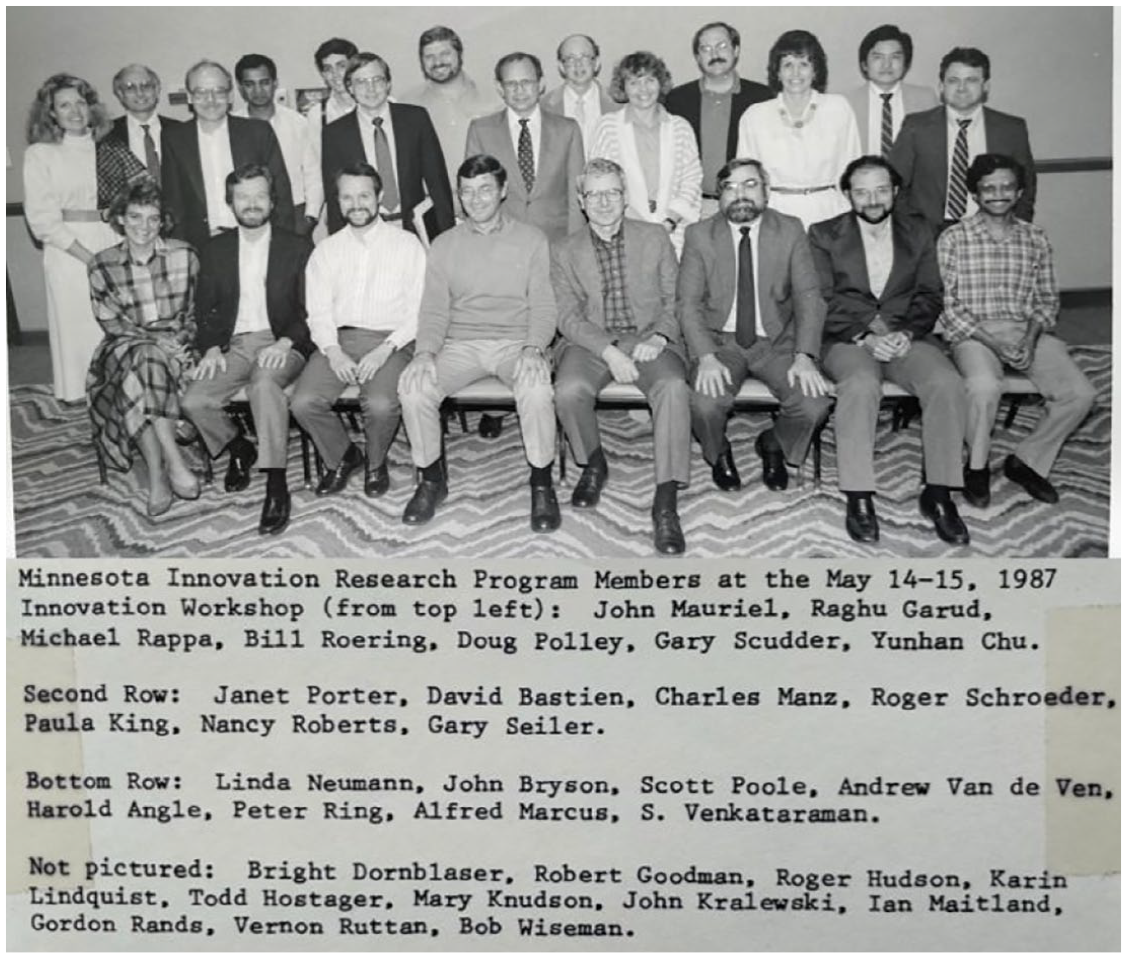
Researchers at an MIRP Conference at the University of Minnesota (photograph from Raghu Garud’s personal collection included in Van de Ven et al., 2000: xix; reprinted with permission of the publisher).
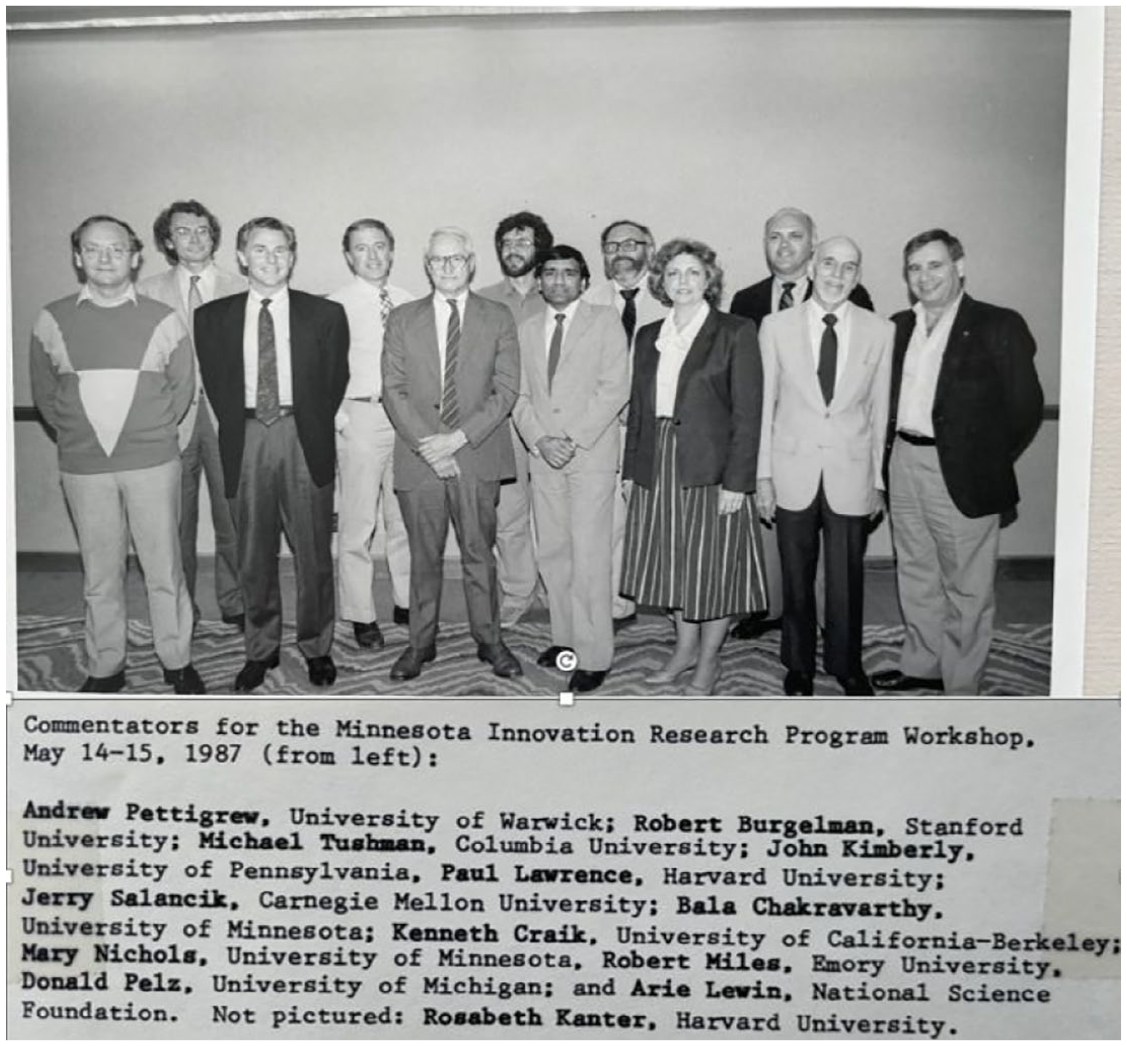
Leading process scholars at an MIRP Conference at the University of Minnesota (photograph from Raghu Garud’s personal collection).
Coordinating the efforts of such a diverse group of individuals conducting 14 studies involving technological, product, process, and administrative innovations in private, public, and not-for-profit sectors was not an easy task. After all, these scholars had their own interests, theoretical perspectives, and inquiry approaches. To undertake this challenging initiative, Andy undertook several steps, enacting and performing the precepts of engaged scholarship as well as deploying process thinking and pluralism that inspired some of his later scholarship (Van de Ven, 1999; Van de Ven et al., 2019).
First, he emphasized the importance of engaging with practitioners to gain a processual understanding of innovation unfolding in specific settings (Van de Ven, 2007). Engaged scholarship, as noted earlier, posits that inquiry must arise collaboratively with practitioners rather than solely from the literature. This philosophy guided all the innovation projects that Andy oversaw, each of which tapped into Minnesota’s business ecosystems. The process of establishing connections and trust with practitioners involved Andy reaching out to top management teams from specific settings to explain to them what he and his colleagues would be researching in collaboration with them. Reflecting on this process, Andy and his colleagues (Van de Ven et al., 1989: xvii–xviii) noted:
“The managers of the innovations being studied by MIRP have also contributed significantly. Many provided MIRP researchers unusually intimate access to their innovation activities, not after their completion but as the innovations were being developed—a degree and type of access that was essential to observing how the innovation process unfolds over time. . . . In effect, these managers tend to be research partners, rather than simply passive subjects in someone else’s research. Their comments have lent numerous insights that have pointed to new theoretical directions, as well as increasing the real-world relevance of the research.”
Second, to enable multidisciplinary collaboration between scholars and practitioners, Andy believed that a framework was required that would facilitate the comparison of findings across multiple studies. The group settled on three criteria—parsimony, significance, and generality. The first criterion, parsimony,
“was premised on the idea that each study team required sufficient slack to pursue questions unique to its individual study, in addition to those of MIRP’s overall cross study interest. Only a simple common framework would provide the requisite flexibility and headroom to permit full treatment of unique aspects without overburdening either researchers or host organizations” (Van de Ven et al., 1989: 8–9).
Yet, simplicity alone was not enough. The researchers in consultation with the practitioners concluded:
“From a managerial perspective, the process of innovation consists of motivating and coordinating people to develop and implement new ideas by engaging in transactions or relationships with others and making the adaptations needed to achieve desired outcomes within changing institutional and organizational contexts” (Van de Ven et al., 1989: 9).
Based on this, the program participants decided to focus on five basic concepts: ideas, people, transactions, context, and outcomes, and agreed to a protocol wherein a significant change in these concepts represented an event (Van de Ven et al., 1989: 8). A systematic mapping of events over time was established as a central task for all the MIRP studies (Van de Ven et al., 2008: 8) (see Figure 1).
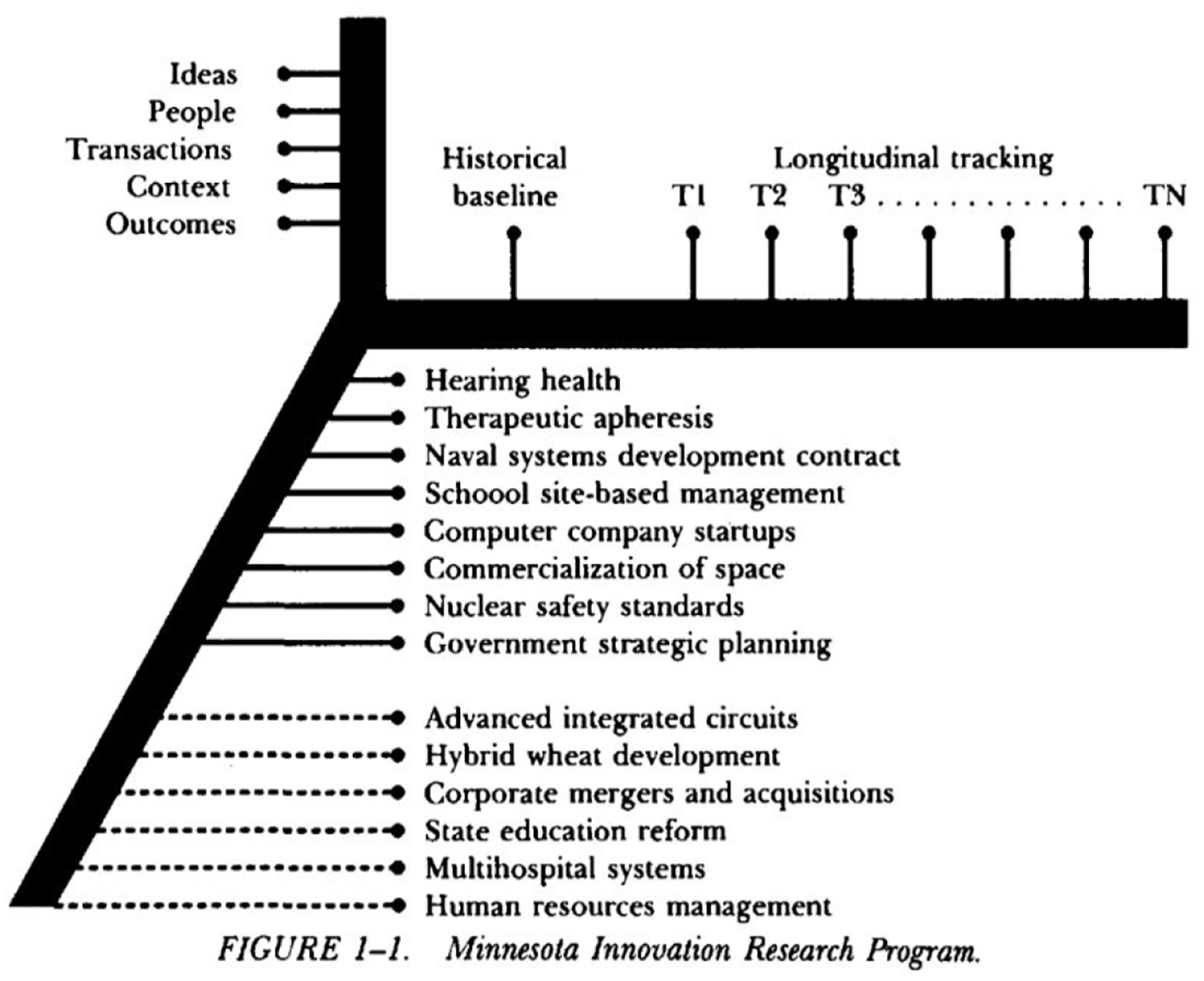
Mapping of innovation events over time (from Van de Ven et al., 2008: 8; reprinted with permission).
Third, Andy adopted an expansive view of the innovation ecosystem (Garud and Van de Ven, 1989), which included interactions between institutional actors and resource providers alongside producers and consumers. Adopting such a broad pluralistic perspective allowed researchers to explore various facets of innovation processes and identify the multiple forces and mechanisms that shape the rates and directions of innovations. For instance, in the emergence of the cochlear implant industry, Garud and Van de Ven (1989) could identify not only a life cycle motor (Federal Drug Administration approval processes) but also a dialectical motor of contestation between various cochlear implant firms whose actions were driven by teleology. In other words, the use of the expanded view of an innovation ecosystem allowed the researchers to identify the complex interactions between the different motors described above.
These two efforts (that is, a focus on events as changes in ideas, people, transactions, contexts, and a broad view of innovation ecosystem) created “boundary objects” (Star and Griesemer, 1989) offering the multiple MIRP scholars and practitioners the interpretive flexibility to meaningfully engage in their respective research endeavors. As a result, a rich set of data based on multiple inquiries began emerging. In turn, these data served as the basis for multiple publications, including books, PhD theses, and empirical studies that advanced process thinking and methods more broadly.
An important publication, the one we have cited above, was titled Research on the Management of Innovation: The Minnesota Studies (Van de Ven et al., 1989). This publication documented the multiple novel approaches for analyzing longitudinal data on innovation collected by the various investigators. One approach was to run relational time series analysis with events. A study using this approach found that under conditions of ambiguity and resource munificence, intrapreneurs escalate their commitments to courses of action associated with innovation even when there are negative cues but switch over to trial-and-error learning under conditions of uncertainty and resource paucity (Garud and Van de Ven, 1992).
A second approach involved “theorizing as rich description,” where the thick descriptions along with visual schematics provide readers with sufficient detail of the patterns that arise during innovation and the forces leading to these patterns. An example of this can be found in a second book based on the MIRP titled The Innovation Journey (Van de Ven et al., 1999), which was revised and reprinted in 2008. In this book, the overall model of innovation that emerged is captured in an iconic image reproduced below (Figure 2). As the figure shows, innovation processes are characterized by setbacks and dead ends, shifts in criteria, fluid participation of a multiplicity of actors, and terminations of some paths even as others are adopted. Speaking to innovation as process, this model departs significantly from the linear stage-gate process of innovation (Cooper, 1990) prevalent then and still used today.
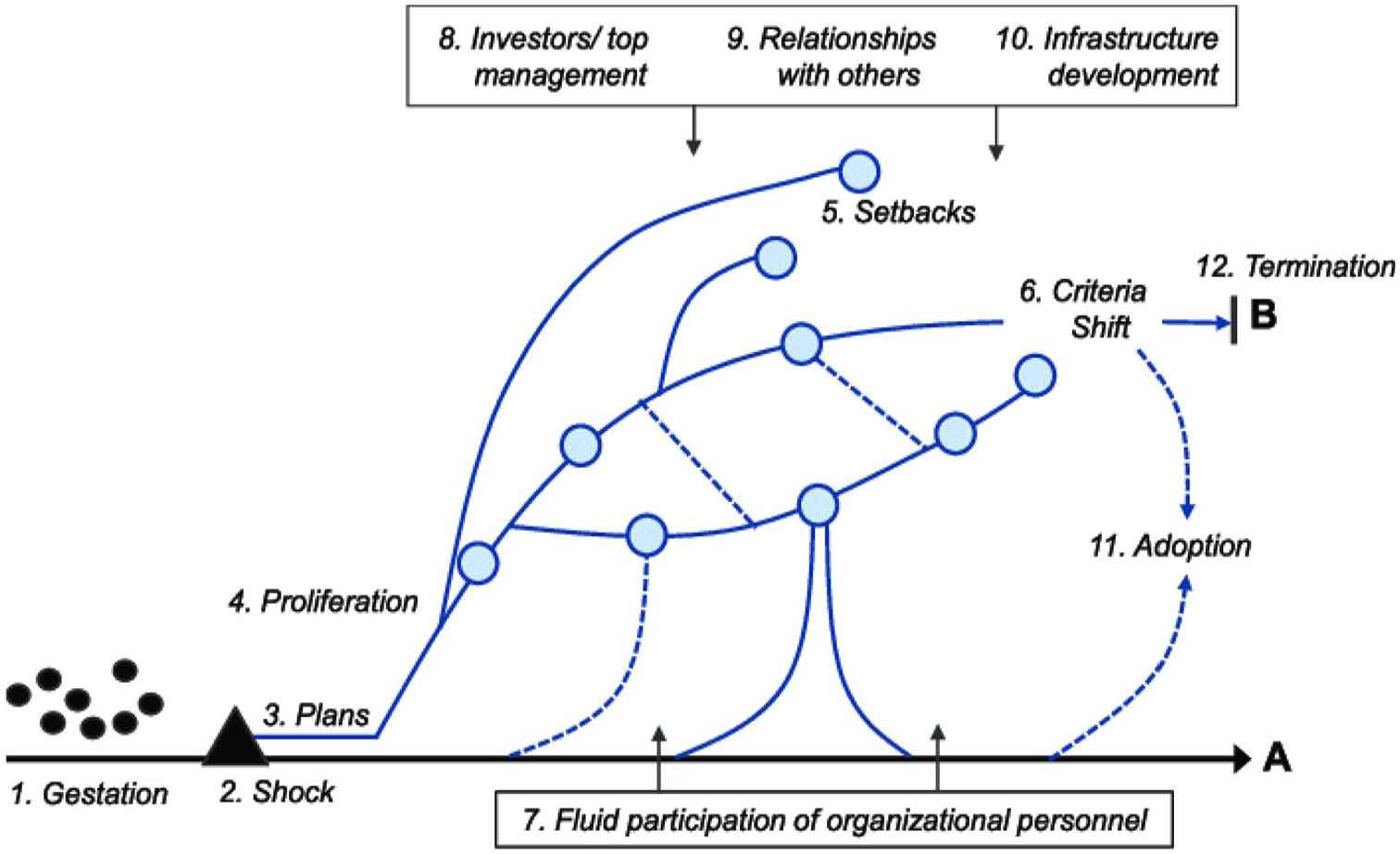
Key components of the innovation journey. (from Van de Ven et al. (2008): 25; reprinted with permission).
When these findings were presented to William Coyne (Van de Ven et al., 1999: vii–viii), then the Senior Vice President of R&D of 3M, he said:
“Our difficulty in grasping the process of innovation is vexing. Successful innovation brings us joy and confidence and well-being. It generates long-term sustainable growth. Once we’ve tasted this wonderful experience, we want to experience it again—but we are frequently confounded. The process is nonlinear, and it cannot be managed in traditional ways. At 3M, we weren’t sure that innovation lent itself to academic analysis. We participated in this effort because we were curious and because we are always eager to add another tool to our box. As one who was actively involved in two of the case studies, I was impressed by the researchers’ thoroughness. With the results of their efforts before me, I am delighted to see how accurately they have captured our way of working. This effort by Prof. Van de Ven and his colleagues is something else again; by combining scholarly research with the gritty reality of private- and public-sector innovation, they have made a unique and valuable contribution to this literature of innovation. Their careful descriptions of the unfolding of innovations evoke the emotional highs and lows, as well as the practical steps required to bring something new into the world.”
Processes of planned organizational change
Several studies of change are based on what Van de Ven and Poole labeled the teleological motor for change, which assumes that
“development of an organizational entity proceeds toward a goal or an end state. It is assumed that the entity is purposeful and adaptive; by itself or in interaction with others, the entity constructs an envisioned end state, takes action to reach it, and monitors the progress” (Van de Ven and Poole, 1995: 516).
However, Andy and his colleagues identified other motors driving change. One that captured his concerted attention in more recent years was the dialectical motor, grounded in a conception of organizations and organizing as embedded in pluralistic settings.
The use of the dialectical motor in organizational studies is particularly evident in Andy’s writings with Timothy Hargrave on both institutional (e.g., Hargrave and Van de Ven, 2006) and organizational change (Hargrave and Van de Ven, 2017; Raisch et al., 2018). In these articles, his emphasis was on bridging dialectical and paradox thinking. For example, Hargrave and Van de Ven (2017) discussed process as
“the sequence of events which includes the emergence of the contradiction as salient, sensemaking of the contradiction by the actors experiencing it, actions these actors take to address the contradiction, and the outcomes of those actions. By “outcomes” we refer . . . to the influence of actions on the contradiction itself, and specifically whether the tension between contradictory elements is reproduced, revised, or transformed” (p. 332).
This material updated Andy’s earlier descriptions of process by re-emphasizing the roles of contradictions. The process model they developed emphasized developmental ways of dealing with contradictions over time (e.g., p. 330) through different phases. The Raisch et al. (2018) article aimed at helping people and organizations to develop their capacity to deal with periods of convergence and divergence.
Further, Andy kept expanding his dialectical understandings of processes. For example, Jing and Van de Ven (2014) developed a “yin-yang model of organizational change” based on a case study of the Chengdu Bus Group. This model includes the kinds of contradictions and dialectics Andy emphasized but also put these within a Chinese indigenous context, one that added categories of change not often evoked in the West (e.g., leveraging momentum and the dialectics of nonaction). In other words, Andy’s appreciation of process became more complex and nuanced over time even while it remained focused on contradictions and phases of addressing them.
Andy never stopped developing and fostering new ideas. He and Scott Poole edited a second edition of the Oxford Handbook of Organizational Change and Innovation published in 2021, shortly before Andy became ill (Poole and Van de Ven, 2021). This second edition includes several chapters that build on and enrich the original typology of the four generative mechanisms we introduced earlier by examining issues such as time and temporality, emotions, resilience, entanglement, and yes—performativity. Photograph 3 shows the editors and authors of this volume at a workshop prior to its publication.
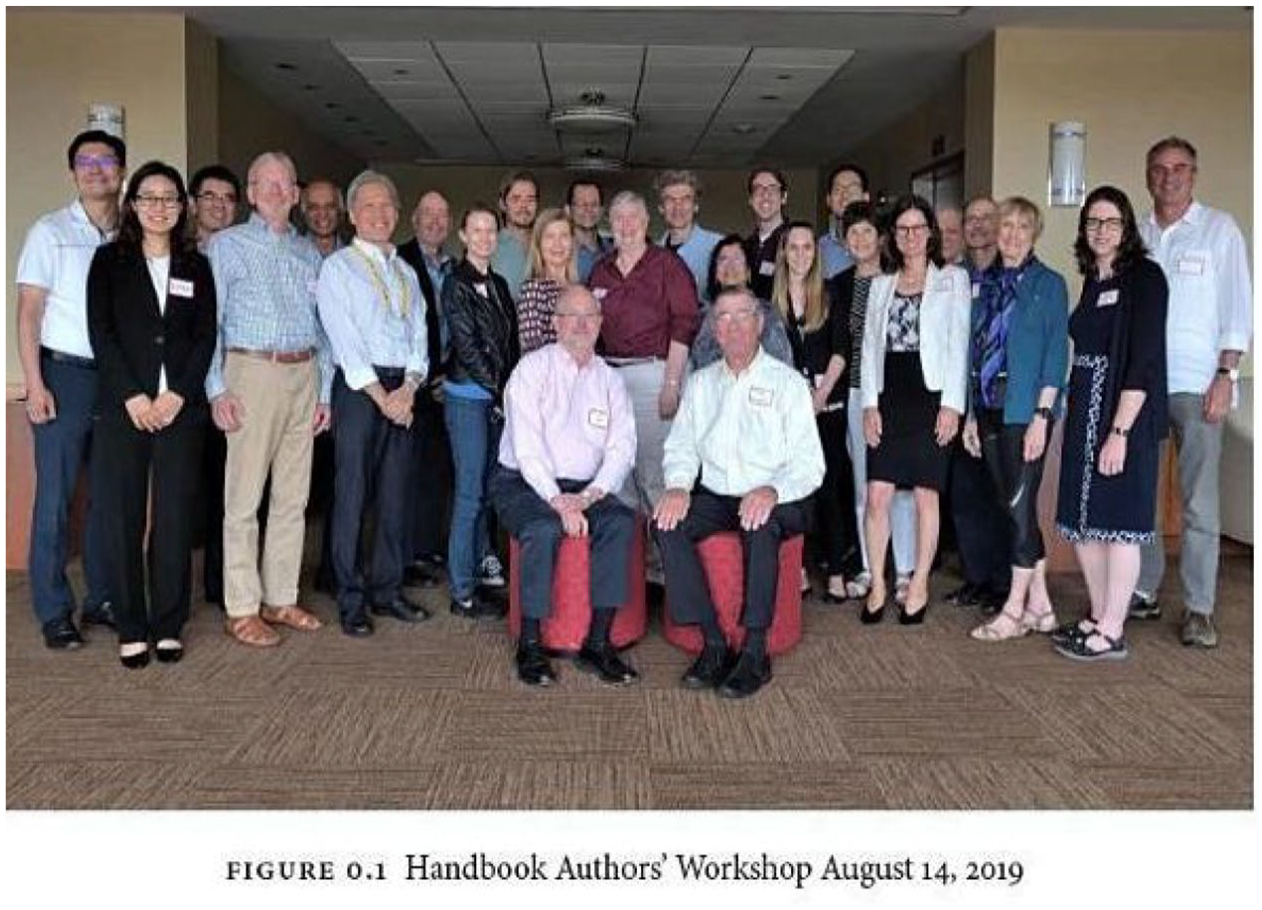
Handbook authors’ workshop participants (from Poole and Van de Ven, 2021: v; reprinted with permission).
Andy’s warm and energetic attitude touched and transformed the individuals with whom he interacted. Early-stage scholars benefited from his inclusive, empowering approach to research, teaching, and community service, motivating them to take long-term 10-year perspectives on their academic careers. With them, Andy took the time to share his knowledge beyond the classroom. For instance, he agreed to an interview with Yunchen Sun and Katharina Schilli (co-authors of the current essay) for the “Practice and Process Reading Group” (https://practice-process.space/) in conjunction with the release of the second edition of The Oxford Handbook of Organizational Change and Innovation. In true “Andy style,” he went above and beyond in preparing for the interview. Although the actual session could not take place because of his final illness, his responses to the questions sent in preparation for the interview reflect his passion for working with people. For instance, in response to a question asked—“What would be your one piece of advice that you would provide to PhD students and other early career researchers?,” Andy responded in writing, “Don’t go it alone!” To yet another question “What call for action would you like to share with our audience?” Andy responded, “Get engaged with others in studying a topic or issue that you and others are passionate about.”
Looking forward
Andy has made several contributions, including insights on pluralism, engaged scholarship, process theorization, innovation, and change. Returning to the metaphor of the Ship of Theseus, through his academic activity, Andy worked to build an engaged ship of scholarship plank by plank even as he sailed in it, setting an example for others. Colleagues continue to draw on his work in diverse domains, including organization theory (Garud and Klopp, 2023), strategy (Dattée et al., 2022), international business (Doh et al., 2023), and engineering management (Balachandran et al., 2024), among others.
Andy’s work is even more relevant today given the grand challenges we confront, challenges that are magnified by the plurality and rapidity of changes we encounter, for instance, because of digital transformation. Drawing on the insights that Andy offered, we can benefit from a reflective and abductive approach (Sætre and Van de Ven, 2021), one wherein we continually rethink our theoretical frameworks and the methods we use to address these complex dynamic phenomena.
Performing while transforming management research and practice is not straightforward. Some observers suggest that we are encountering a “crisis of relevance” (Hoffman, 2021) where important ideas are being lost in a vast sea of irrelevant content being produced because of a publish-or-perish mentality (Alvesson and Sandberg, 2013; De Rond and Miller, 2005). There is no doubt that we must enhance the practical impact of our academic work (Bartunek, 2020). How can we do so? How can we balance rigorous research in collaboration with practitioners to yield insights that are meaningful in practice?
Andy approached these challenges by fostering pluralism. For engaged scholars, the impact on practice often occurs through a transdisciplinary co-creation process (Sharma et al., 2022). Here, we can learn from Andy’s active role as a mediator between multiple communities, including academics and practitioners, to generate synergies. For Andy, distributed ownership of these initiatives was key for advancing rigorous and relevant management scholarship. We take inspiration from these principles and practices that underpin Andy’s work, which are important for both collective action and the advancement of knowledge in an ever-changing landscape. After all, people “prefer to implement plans of their own making rather than those mandated by some external party” (Van de Ven and Sun, 2011: 68).
Andy also understood the importance of sharing knowledge across boundaries, aiming to ensure that scientific research is connected with practical concerns. In that role, he and his colleagues encouraged nascent or “pre-theoretical” empirical knowledge as a basis for further development, seeing what we currently refer to as “impact” in terms of the potential for scholarly discoveries that can inspire others outside academia. Within our community, and drawing on Andy’s example, it is valuable for scholars to recognize and appreciate multiple pathways for our work to matter for consequential societal issues (Reinecke et al., 2022). As one of the reviewers
2
of this piece noted,
“Andy was interested in how real people on the ground get together to solve real problems. Although he did not work much on the nominal group technique after the early years, he was always fascinated by how people collectively make sense of the ‘buzzing, blooming, confusion’ and find a way forward together. His work was rooted in his very grounded, commonsense, humanistic disposition. One of Andy’s intellectual heroes was John C. Commons, the ‘old institutionalist’ whose work captured this idea that people come up with practical but imperfect and temporary ‘settlements’ to their problems, then do it again and again. Similarly, he loved and kept coming back to Charles Lindblom’s work on ‘mutual adjustment.’ While Andy did not really categorize himself in ‘isms,’ it seems to me that if you had to, you would call him a pragmatist. He was not explicit about this, except maybe in the work on engaged scholarship.”
Conclusion
While Andy Van de Ven’s immense scholarly legacy informs us about pluralism, process, and performativity, the core message that he leaves behind for academics and practitioners is one of ongoing reflective engagement; one where we should not be afraid to challenge the status quo by being in complex emergent worlds and by inquiring about them. The influence of his ideas across the generations is informed not simply by the notion of inheritance but more importantly a process wherein ideas are transformed even as they are performed over time.
Another reviewer of this piece noted,
“What really struck me in engaging with Andy is his role as a theorist—he brought his whole self to theorizing, believing deeply in the questions that he was asking and the ways he went about answering them. In doing so, he invited us all to be more holistic in our work—bringing our intellect alongside our passion.”
3
This invitation is to all—we as the authors writing this article, and those reading it.
Footnotes
Acknowledgements
We thank the two anonymous reviewers and the editor, Paula Jarzabkowski, for their very helpful inputs on an earlier version of this article.
Funding
The author(s) received no financial support for the research, authorship, and/or publication of this article.
