




Abstract
Digital technologies, enabled by data, algorithms, and artificial intelligence, are creating new competitive opportunities. But how does one strategize when the technologies core to organizational action is constantly changing? We suggest that for strategy scholars to answer this question, they will need to rethink the concept of technology. We begin by discussing the conceptual treatment of technology in studies of strategy and strategizing, and, in so doing, we highlight the ways in which current conceptualizations of technology are problematic for theorizing about the role of technology in the digital age. We then advance a relational perspective on technology that overcomes many of these problems. We illustrate the potential utility of this perspective for theories of strategic organization by using it to reconceptualize the boundaries of the firm, the process of innovation, and the process of organizational knowing.
As artificial intelligence (AI)-based intelligent technologies proliferate throughout organizations and firms are increasingly coping with the far-reaching effects of digital transformation, the process of making strategic decisions is becoming more complex. Recently, during an interview for a field study about digital change, Aneesh (a pseudonym), the CEO of a major industrial equipment manufacturer, shared the following dilemma with one of this article’s authors: What keeps me awake at night is that I’m not sure the goals we had five years ago are the goals we should have today. We build machines that build the world. Or do we? Maybe what we really do today is harvest and analyze data and our machines are just the devices that give us those data. Should our goal be to build the best machines, or collect the best data that we can sell to our customers? What our organization looks like and what the unique resources are that can power our distinct capabilities are changing. Digital technologies are changing what we do so quickly. What is the right strategy? (Field interview, November, 2021)
Like many executives, Aneesh recognized that the technologies around which strategizing occurs are changing rapidly. Recognition of the importance of technology in theories of strategy, strategizing, and strategic organization is not new. The resource-based view (Barney, 2001), the knowledge-based view (Grant, 1996), and the dynamic capabilities view (Eisenhardt and Martin, 2000), as just a few examples, have all underscored the point that technology, whether operationalized as knowledge, skill, or device, is a key source of competitive advantage. Similarly, perspectives that take a more processual approach to strategizing such as the strategy-as-practice approach also recognize that strategic practice is inextricably entwined with the technologies of analysis and representation (Vaara and Whittington, 2012).
Despite this general recognition, however, we suggest that the ways in technology has been conceptualized within the strategy, strategy-as-practice, and strategic organization literatures limit scholars’ abilities to theorize the antecedents and consequences of digital change (see also Adner et al., 2019). This conceptualization problem is in no way limited to strategy scholars. Even scholars like us who purportedly “study technology for a living” have had difficulty theorizing digital transformation because the way we conceptualize technology, and the way we subsequently operationalize it in our work, does not capture the dynamic and ever-evolving nature of digitalization (see, for discussion, Bailey et al., 2022).
In what follows, we provide a brief overview of how we, as occasional contributors (but mostly outsiders) to the literature on strategic organization, view the conceptual treatment of technology within the field. We then advocate for a move toward a relational conceptualization of technology that we believe is increasingly useful for understanding strategy formulation and strategizing in the digital era. Our goal is to demonstrate how a reconceptualization of technology might allow scholars to better theorize strategic organization by thinking about and operationalizing technology differently. Next, we discuss how taking a relational perspective on technology allows us to question several fundamental assumptions core to most strategy theorizing: that firms have identifiable boundaries, that innovation is the product of organizational structuring decisions, and that that knowledge can come from any one firm.
Treatments of technology in the broad organizational literature on strategy
How does the field of strategy, with its attendant foci on strategic management, strategizing, and strategic organization, approach technology? We offer two analyses that may inform the issue. First, we performed a computer-assisted interpretive analysis of how articles appearing in six leading journals (Academy of Management Journal, Administrative Science Quarterly, Organization Science, Organization Studies, Strategic Management Journal, and Strategic Organization) engaged with technology. 1 Our judgment of where strategy theorists were discussing technology guided our journal selection. Our Latent Dirichlet Allocation (Blei et al., 2003) analysis identified 52 latent topics present in a corpus of abstracts of all 5230 peer-reviewed articles published in the period from 2003 to 2019. We identified three conversations (latent topics) as relating to technology, based on the presence of variants of “technolog_,” “digital_,” and “platform_” among the top 20 “central” terms with the highest probability of term, given topic, for each topic: Pr(term| topic). We confirmed the technology-centric nature of these topics by examining the top 20 “specific” terms with the highest pr(topic| word) and by reading 10 abstracts with the highest pr(topic| abstract) for each topic. A first conversation focused on issues of competition and strategies related to platforms and products. A second conversation emphasized communication and collaboration, both within and across units. A third conversation centered on innovation strategy, including licensing patents and other ways to gain strategic advantage.
We find that across all six journals, including Strategic Organization, the topics and conversations we identified do not address technology as an element of structure as used to be the case in traditional organization theory. Instead, various technological terms are enrolled in more traditional conversations such as product strategy, communication, information sharing, and innovation processes. As seen in Figure 1, journals differ in their engagement with the three conversations. Unlike Strategic Management Journal and Organization Science where these topics have appeared with the highest consistency, Strategic Organization is more variable. Indeed, if it were not for the successful 2017 special issue on organizing crowds and innovation, the coverage in recent years would be trending downward.
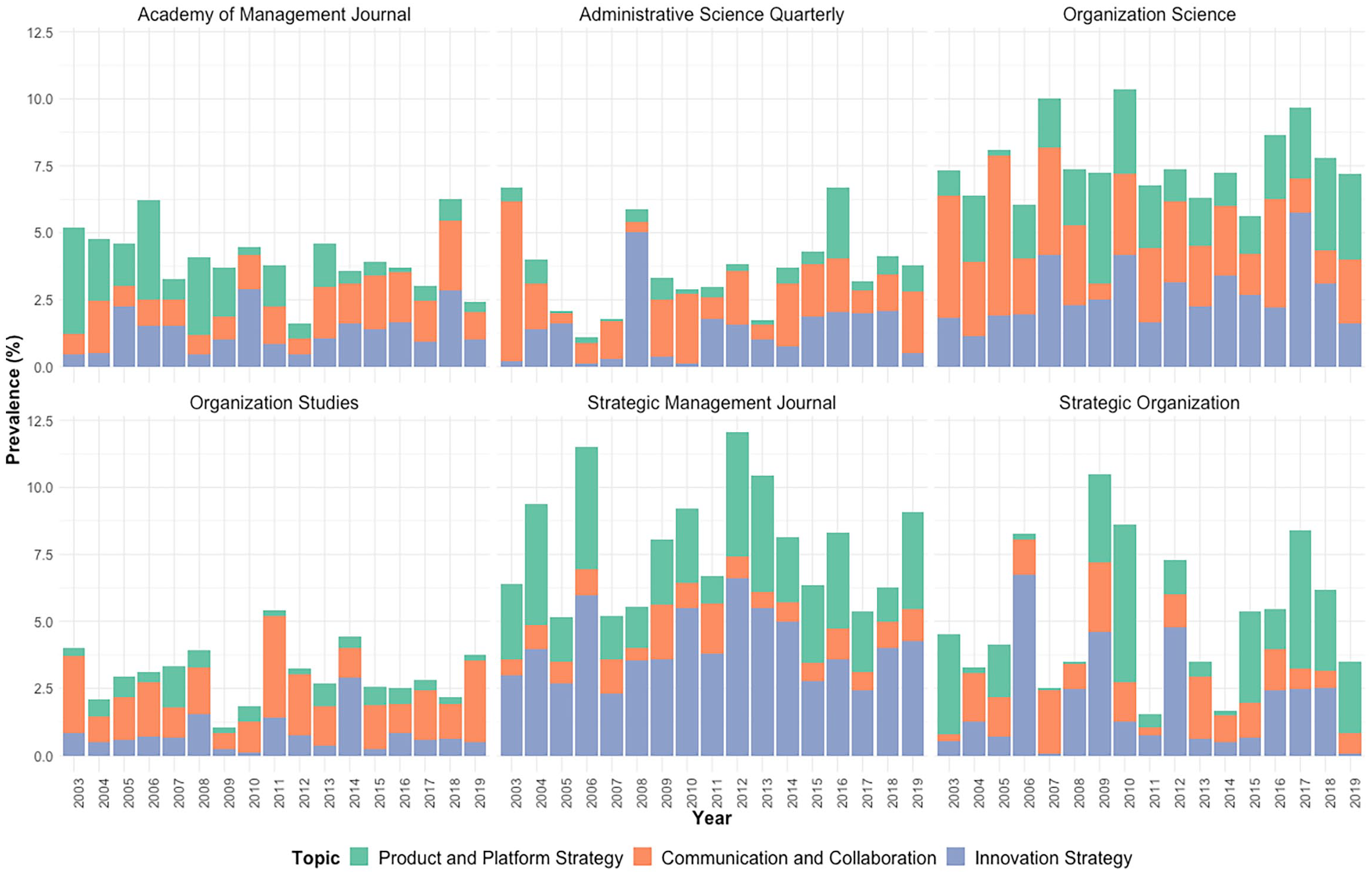
Prevalence of technology-centric topics in six management journals.
Second, we analyzed the articles published in Strategic Organization for the period 2003–2019. Only 21 articles out of 257 included any variants of “technolog_,” “digital_,” and “platform_” in the abstract. In 2018, an article emphasized value creation in big data (Zeng and Glaister, 2018), another looked at the managing universities in the age of massive online courses (Teece, 2018), and a third article suggested strategies for monetizing patents by universities (Yuan et al., 2018). Since 2020, two related articles have appeared. One looked at how technological footprint similarity (measured as in terms of patent portfolio similarity) of firms affected their performance (Martynov, 2021). The other focused on technology transfer between university and industry but with an emphasis on how collaborative activities carried out interstitially (Villani and Phillips, 2021).
From these analyses, it seems as though the conversation about technology in the research focus of scholars who study strategy, strategizing, and strategic organization has remained peripheral. Although it is present in the current discourse, technology is typically deployed as a qualifier for an existing strategy concept (e.g. technological innovation or technological skill) or as a force in the environment that may affect some of the traditional ways of deploying the strategy toolkit. Discussions of technology are evident in research on business models and open innovation, but specific theorization of the role technology plays in these phenomena is scant. Even the community around strategy as practice, one conceptually open to issues of knowledge, logics, attention, collaboration, and practices, did not seem to have developed a particularly deep or focused perspective on technology. While technology is increasingly recognized as an important, if marginal, concern for strategists, the field continues to function as if technology can be relegated to the broader environment or alternatively as an engine for innovation.
Moreover, much strategy scholarship (with studies specifically focused on product development being the notable exceptions) has adopted the point of view of technology being a force developing outside the scope of the firm in the external environment to be exploited selectively and judiciously to build up a firm’s capability or to serve as a base resource or enabler. Alternatively, innovation scholars ostensibly focus on technological innovation, but yet technology rendered with the invisibility brush. 2 For that research community, researching technology innovation requires focusing on organizational characteristics, industry composition, or intra and inter firm factors that may impact the innovation process. Alternatively, the magnitude of the digital transformation is recognized, but the theoretical work is deployed on how algorithms may affect the behavioral theory of the firm; how reduction in search costs will impact transaction cost economics, affect the scope and scale of the firm; or how AI will impact organizational work or offer possibilities for new business models and competitive advantage (e.g. Adner et al., 2019; Adner, 2017; Lanzolla et al., 2020).
A limited conceptual vocabulary
A major difficulty in weaving a strategic account of technology in organizing is the weak vocabulary that bridges between these two domains. Technology scholars, especially those from the Information Systems (IS) research community, focus on how novel information technologies (IT) are received by organizations and their members and therefore ply concepts foregrounding IT systems, features, components, design, use, diffusion, implementation, performance, resistance, and so on. Those scholars interested in digitalization and digital transformation extend this conceptual vocabulary by focusing on digital transformation, value propositions, digital channels, disruptive innovation, agility, value creation, and business models (see Vial, 2019). Strategy scholars, on the other hand, have preferred to focus on how to strategize in a digital world with their conceptual vocabulary aimed at seizing digital opportunities, winning with technology platforms, achieving efficiency gains from digitalization, deepening relations with customers, digitizing activities, and developing new business models (e.g. Baden-Fuller and Haefliger, 2013; Volberda et al., 2021). Finally, scholars focused on strategy as practice prefer a socio-theoretical vocabulary emphasizing how people sensemake, interact, narrate, communicate, engage in activities, deploy discourse and narratives, gain or lose power and authority, or collectively enact practices, engage processes, operate as groups, and inhabit institutions (see Golsorkhi et al., 2010).
In a similar vein, scholars of strategic organization interested in technology can also be said to toil within a limiting vocabulary that does not allow for a comprehensive engagement with technology. The focus remains on innovating new business models, explaining the emergence of new markets, understanding intricate alliances, gaining insight from strategy practices and processes, or leading strategic change (see Duhaime et al., 2021). Long gone are the days where the field embraced technology as the central shaper of organizational structure (Lawrence and Lorsch, 1967; Thompson, 1967; Woodward, 1965). The idea that an organization itself is technology to transform key inputs into outputs (e.g. Perrow, 1984) has given way to the conceptualization of technology as something evolving and taking shape in the global environment. Strategists today, possibly because the IT revolution was experienced as taking place outside the scope of the focal firm, have generally embraced the idea that technology is something that is brought in and deployed by organizational designers as factors to improve existing routines or develop new competencies (e.g. Adner et al., 2019; Anderson and Tushman, 1990).
The challenge presented by differing theoretical vocabularies and language is that they focus the communities that employ them on aspects of the world that are salient, interesting, or even palatable to members of the community (Mantere and Vaara, 2008). Thus, with a phenomenon as significant as the kinds of intelligent technologies emerging today, we run the risk of partial knowledge as in the parable of the six blind men and the elephant. If each community remains committed to its core epistemic values and prioritizes core concepts and preferred explanation, then the possibilities of theoretical progress are diminished (Loewenstein et al., 2012; Leone et al., 2021). Thus, we are unlikely to see progress across research communities regarding technology and strategy without significant work at developing aspects of vocabulary that “speak” to more than a single community. 3
Our essential argument is that technology has become too important and ubiquitous in the process of strategizing and can no longer be treated as a variable in the hands of IT specialists, organizational designers, and strategists. It is no longer sufficient to devise strategies that exploit openings that technological progress has created or to devise organizational or market innovations around those advances. For example, the complex data processes that feed the evolving algorithms that fall under the label of Artificial Intelligence have complex and difficult-to-predict interactions with human cognition, decision-making, organizational control, and coordination (see Faraj et al., 2018; von Krogh, 2018; Endacott and Leonardi, 2022). Rather, it is now imperative and fruitful to recognize the mutual constitution between them: technology is now constitutively entangled with all aspects of organizing and strategizing. This relational perspective has previously guided scholars focused on technology in practice (e.g. Orlikowski, 2000), technology as the imbrication of human and machine agency (e.g. Leonardi, 2011, 2012), or technology affordances (e.g. Zammuto et al., 2007). Beyond these calls, we suggest that a whole-hearted engagement with the co-constitution thesis remains rare and we are inviting strategy scholars, especially those who embrace Strategic Organization’s epistemological and ontological openness to consider it seriously.
Toward a relational perspective on technology and strategic organization
Treating technologies not as stable entities, but as evolving relations, is particularly helpful to account for the technologies that are emerging today, such as AI, robotics, data analytics, intelligent diagnosis, and autonomous vehicles. These technologies are reshaping work, organizations, and organizational boundaries. Because these technologies ubiquitously and in real time collect and analyze digital data traces via learning algorithms, they can augment or increasingly supplement work that had until now been the provenance of humans. Also, because they can mimic, augment, and increasingly exceed traditional human cognition, especially in tasks involving prediction, pattern recognition, and decision-making, understanding the how and why of their entanglement with organizing becomes ever more salient. Fundamentally, they shake up long-held assumptions about the design of organizations and division of work and upend taken for granted assumptions about decision-making, coordination, and control (e.g. Faraj et al., 2018; Kellogg et al., 2020; Leonardi, 2021 Bailey and Barley, 2020; von Krogh, 2018).
A focus on relations has long been of interest for strategy scholars interested in how strategy gets accomplished or how strategy making practices are sustained. As is seen in the pages of Strategic Organization, processes, practices, communication, temporality, and discursive constructions are all themes that are prominent in the journal and address the issue of relations and their significance. We celebrate this point of view but suggest that much can be gained from theoretically embracing an expansion of the relational perspective to include the material in general and technology in particular.
A starting point is to set aside the pre-supposition of an ontological difference between the human and the object in relata. Philosophers debate whether relationships are symmetrical, non-symmetrical, or asymmetrical (Heil, 2021) or whether embracing relationism leads to relativism (see Donati, 2010). Some prefer to exclude the material from the relational perspective (e.g. Emirbayer, 1997) while others build a resolutely human-decentered ontology (e.g. Callon and Law, 1997; Latour, 1986). While these philosophical discussions are important, we suggest that deploying a relational perspective benefits our understanding of social realities involving technology. To explain our point, we address quickly one important aspect of these sociotechnical relations: namely, whether they are characterized by interiority or exteriority given the question at hand.
Strategic organization scholars have tended to favor a view of the relation between organizing and technology as one corresponding to relations of exteriority. Modularity principles suggest that an organization should be designed based on plug-and-play principles where components can be mixed and linked to (e.g. via Application Programming Interface (API)-like interfaces or web services) and thus hide complexity and allow easy connection of components. This corresponds to relations of exteriority as the whole is simply an assembly of separate yet connected components. Indeed, many strategists of organizations advocate the building of organizations or the managing of technological relations along the principles of modularity (e.g. Arthur, 2009; Baldwin and Clark, 2000; Schilling, 2000) with the implicit goal of mastering complexity and rendering exposure to technological change less jarring. The principle at play is to actually reduce the impact on organizing complexity by reducing embeddedness and controlling it via specific points of access. Thus, modularity, and its API descendent in the age of platforms, is hailed as an organizing principle that limits exposure to the complexity of the technological environment. Thus, organizations that embrace modularity are able to substitute a module for another, add a new module, split a system into more modules, and so on based on the strategic need. Thus, an innovative organization relying on modularity can build a more complex process or system relying on smaller subsystems that are designed independently but perform together as a whole (Baldwin and Clark, 2000).
In a relation of interiority, the related components have no meaningful independent existence outside the relationship as the components constitute each other (see DeLanda 2006, 2016; Deleuze and Guattari, 1994). Effectively, these ideas broadly correspond to the difference in emphasis provided by a relational ontology versus an entitative ontology (see Emirbayer, 1997). For example, bringing into being something like an autonomous vehicle involves a myriad of relationships between people, technology, and organizing. Many relationships can get created or discarded as in using a global positioning service, an AI navigation software, or a weather monitoring service or connection to nearby charging stations. Some of these relations may be performed within the firm but many are performed involving a diverse set of external actors via constant real-time data flows. Thus, no entity within this network of relations is meaningful outside the scope of the relations that constitute it.
We suggest that a relational perspective may be useful for moving past the tendency to view technologies as either fixed substances, things, or entities that organizational actors react to, adopt, implement, or directly use. This view is too simplistic and does not correspond to the new entwined reality that these technologies are involved in. While some of our strategy colleagues may have presented modular design and the part-whole arrangement as a way for the strategist to handle this increased complexity, we claim that it is a limited and temporary kludge that is incapable of addressing the essential issue that today’s emerging technologies are constituted by other technologies that are in a complex relation to each other. Simply put, compared to previous technological waves, the set of relations in which intelligent technologies are enmeshed are larger and more fluid and increasingly involve processes or new actors external to the organization.
Following the relational approach outlined in detail by Bailey et al. (2022), we suggest that rather than treating the technologies that are so central to organizational action in the digital age as bounded entities with settled relations, it makes more sense to conceive of technologies as constituted by relations and interleaved with other relations that are always evolving. All technologies are constituted by relations. However, in the digital age, it is becoming clear that the set of entities that exist in relation to each other is expanding. Digital technologies cannot be understood or exploited without the involvement of people, groups, organizations, and boundary organizations. The previously simple relations of use or adoption have given way to a more complex entwinement, making it difficult to maintain the previously comfortable separation between technology and organizing. Increasingly, data, knowledge, routines, learning algorithms, workers, and internal and external organizational units coexist in a seemingly symbiotic state. Thus, it becomes necessary to talk about relations in flux or forming a constellation of relationships that are dynamically changing and where the potential of the relation emerges post hoc to the establishment of the relation. As is developed in Bailey et al. (2022), “the magnitude of the relational possibilities, in combination with their dynamism, means that emerging technologies are increasingly brought into constitutive relations with key organizational processes” (p. 4). In short, all the “things” that we typically call technologies, such as algorithms, AI-powered bots and robots, and 3D printers, are themselves constituted by multiple underlying technologies that exist in relation to each other, as well as co-constituting key organizational processes. That recognition has important implications for strategy and strategizing.
When technology is viewed from a relational perspective, several key concerns of strategy theorists can be productively reconceptualized. Below, we outline what such a reconceptualization might look like for three popular topics often discussed on the pages of Strategic Organization and other strategy journals: boundaries, innovation, and knowing.
Reconceptualizing boundaries
The boundaries of the firm—and the strategies a firm makes for coordination across its boundaries—have been of theoretical interest for strategy scholars for many decades (Santos and Eisenhardt, 2005). From transaction cost (Jones and Hill, 1988), to resource dependence (Hillman et al., 2009), to network approaches (Gulati et al., 2000), scholars have developed theory about how to manage the relations that firms have with suppliers, partners, and competitors. One assumption that unites these approaches is that firms have demonstrable boundaries that are known and can be adapted given the right strategic impetus (Santos and Eisenhardt, 2009). Yet, a relational perspective calls into question the nature of a firm’s boundaries themselves.
Take the case of a firm like John Deere, known for more than a century as a maker of agricultural machinery and other heavy equipment. As is well documented in the literature, John Deere managed its boundaries carefully through strategic alliances (Lorange and Roos, 1991), board interlocks (Magee, 2005), and acquisitions that enabled knowledge integration (Anderson, 1992). As John Deere sought materials and expertise to build its core technologies—the industrial machinery that powers the world’s farms—it was able to manage its boundaries in ways that assured it could deliver on its core competencies of building reliable equipment while maintaining ownership over its core technology. In recent years, John Deere has invested heavily in AI, machine learning (ML), and computer-vision applications to build smart farming machines. By outfitting a tractor with sensors, wireless transmission devices, and onboard computing capable of analyzing vast amounts of data in real time, the newest John Deere tractors are able to advise farmers on the optimal depth to plant seeds or the best width of furrows to improve crop yields. The relational view on technology makes clear that the technological infrastructure needed to execute such value-added operations does not lie solely within the boundaries of the firm. The ML algorithms used by the company are developed and updated by a third-party vendor, the data collected from farms around the world are hosted on the cloud, the cellular technology needed to position the tractors and transmit data is owned by telecom providers, and the land that provides the resources out of which data are created as well as the tractor’s sensors are owned by the farmers who are typically also the operators of the tractor.
Scholars of strategic organization have begun to write about how digitalization is making it possible for John Deere to transition from an equipment manufacturer to a farm management company that provides predictive maintenance, seed optimization, and irrigation through remote sensors (e.g. Gupta, 2018), but few have considered how the boundaries of the firm itself might change as the result of digitalization. The relational perspective calls into question where the boundaries of the firm actually are. If data are collected on the farmer’s land with a farmer driving the equipment, does that data belong to the farmer or John Deere? If data are transmitted through 5G networks owned and operated by telecoms, companies like Microsoft provide the algorithms, and companies like Amazon host the data on their cloud, where do we draw boundary lines around John Deere as a firm? The importance of answering these questions should be obvious for strategy scholars because their answers will have major implications for property rights and competitive advantage. What the relational lens allows us to see is that a company like John Deere cannot simply own and operate a core digital technology on its own because the technology is not an artifact that can be bought and stored; rather, it is a distributed set of relations that traverse what we typically think of as a firm’s boundaries. The major implication, from a relational perspective, then, is that in the digital age, a firm is not a discrete entity but an ecosystem. One direction for research then is to explore what strategic action looks like when the boundaries between firms begin to dissolve, and firms are inherently interdependent because their technological infrastructures are thoroughly intertwined.
Reconceptualizing innovation
Scholars across many disciplines seem to agree that innovation is about connection. Whether those connections channel knowledge and resources within the firm (Hansen, 1999), across firms (Ahuja, 2000), or between firms and customers (Piezunka and Dahlander, 2015), it is clear that the knowledge, expertise, and cooperation of multiple stakeholders are necessary to create products and services that produce value. A relational perspective pushes this thinking even further. If technologies are not simply artifacts that can be developed or owned by firms but sets of relations among entities that are themselves embedded in other relations, innovation begins to look less like a process of knowledge exchange and more like a process of orchestration.
Adner (2006) provides an example of an innovation process that went astray in his description of the development of Michelin’s run-flat tires. When these revolutionary tires were finally produced in 1997, few consumers would buy them. Because the tires connect to the vehicle’s complex electronics system, they are rendered useless unless the automotive original equipment manufacturers (OEMs) design the vehicle’s electronics system to be compatible with them. Of course, it takes several years for new design decisions to make it into production vehicles. And automotive repair shops need to buy these tires and train technicians on how to change them and recalibrate the sensors. Clearly, the “technology” of the tire is more than just the tire. It is a set of relations between rubber, sensors, switchboards, companies, training protocols, and so on. As Adner reminds strategy scholars about the Michelin case, “interdependence risk is assessed by multiplying probabilities to estimate delays caused by complementary innovators. Integration risk, in contrast, is assessed by adding adoption cycles to estimate delays caused by intermediaries.”
Studies of business model innovation, with their focus on how reconfiguring relations between partners, suppliers, and customers can create value or improve performance (e.g. Amit and Han, 2017; Foss and Saebi, 2017), may seem quite compatible with the relational perspective on technology we advocate. Yet, the emphasis in most existing studies remains on how to reconfigure organizational arrangements, rewards, authority arrangements, and redesigning existing organizational structures. Overall, this line of scholarship continues to be enmeshed in questions of innovation value capture, the role of complementary assets, or identifying which business model innovation is likely to be more profitable (see Massa et al., 2017). A few scholars such as Afuah (2019) insightfully recognize that “the business models and strategies of many firms in a digital economy are driven by the technological environment” (p. 181). Nonetheless, our read of business model scholarship points to a continued focus on viewing technology as a resource in the global environment and a preoccupation with reconfiguring ties between the focal form, partners, and customers in ways that maximize value.
A relational perspective pushes such thinking one step further. Innovation is not just a process of knowledge sharing, which requires assessing risks and delays caused by interdependencies, rather innovation is a process of coordinating relations among entities. This shift may seem subtle but it is important. If technology is understood as a set of relations, it becomes clear that no one firm “owns” the technology. The firms that will have power in the innovation process will be those who can orchestrate the relations among the various entities. Some of those entities will be inside the firm’s boundaries, while many others will be outside (see the previous section for a discussion of why traditional notions of boundaries are thus problematic). Viewing innovation work as a process of orchestration points to the importance of considering how strategy work in the digital age will be increasingly focused on recognizing dependencies among the relations that constitute technology and building capabilities to nurture and foster those relations, regardless of where the entities may be located.
Reconceptualizing organizational knowing
The nature of organizational knowing is changing in important but little understood ways. Prior to the era of “Big Data,” generating insight from data and getting it to the right places was associated with non-trivial human and economic costs in terms of collection, processing, and analysis. Importantly, in organizations, as elsewhere, economic considerations limited what objects in the world or areas of operation were worthy of data collection and analysis. Today, as processes have digitized and trace data are everywhere, it is commonplace to build more complex data objects than can be understood or validated (Aaltonen et al., 2021). With digital data available in unimaginable quantities and at negligible cost, two promising aspects emerge that have an impact on the strategizing process. First, as data grow increasingly more encompassing and combined into complex knowledge objects, data processes need to be scrutinized for their origin, their coverage, the motivations of those who collected or processed them, and the choice of tools to visualize, analyze, and represent them (see Leonelli, 2019). For example, strategy as practice researchers may fruitfully focus on the knowledge management practices of those who gain control over these processes or how more traditional professions lose their participation in now digitized processes (Pachidi et al., 2021).
Second, because organizations rely on detailed and specific ways to collect, organize, and transmit data, whole aspects of organizational decision-making, control, coordination, and even innovation are tightly intertwined with knowing practices. Many structures and roles are dependent on a certain knowledge flow for effective administration that cannot exist without a twinned pattern of data communication (see Chandler, 1977; Yates, 1989). Thus, a radical run to digital data and digital processes offers a departure from existing processes of knowing and operating. With the availability of new more complex knowledge objects, as in the “digital twin” that social media companies are building for every user, new possibilities of knowing can be constructed. Within the organization, these new knowledge objects have unbundled data from historically accepted sources and now include fractional data coming from different domains and sources. Thus, these new knowing practices are likely to be associated with a decentering of the organization (Alaimo and Kallinikos, 2022) as relations encapsulated in data objects take center stage.
Conclusion
The way we understand ideas, phenomena, activities, and tools affects how we operationalize them. The way we operationalize them affects how we study them. And the way we study them affects the way we build theory to guide practice. In this short essay, we have argued that the advances in digitalization—specifically, the advent and deployment of intelligent technologies—warrant a new conceptualization of technology as a set of relations that are constantly evolving. Although most research on strategy and strategizing has avoided a sharp focus on technology, we believe the time has come for strategy scholars to make the role of technology a core theoretical and empirical concern. The reason is simple: the relationship between firms and technology is not what it once was. Organizations no longer own technologies or enter into contractual agreements with other firms who can provide access to them. Today’s digital technologies are sets of relations that are distributed across many firms. Managing those relations is complex, but doing so is no doubt important for sustained competitive advantage. Senior practitioners like Aneesh, who we met at the opening of this article, are no longer even certain what business they are in because the possibilities enabled by digital technologies are changing even what it means to be a firm, to innovate, and to use data for strategic endeavors.
The relational approach sketched here should feel like somewhat familiar territory to readers of Strategic Organization who have long adopted a processual view of strategizing. To understand how relations among entities are constituted and reconfigured will require a focus on practice. It will also require treating technologies as processes unto themselves (Leonardi, 2017). Strategizing is bound up with technology, as strategy-as-practice scholars have shown in studies of how key organizational actors mobilize tools in the strategy-making process (Jarzabkowski and Kaplan, 2015). But as we have shown here, technologies are also implicated in strategizing because their changing relations reconfigure what an organization is and how an organization works. To study strategy and strategizing in the digital age will therefore require not only bringing technology into a more central role in research but a reconceptualization of what technology is. We hope that the initial steps we have taken toward that aim will be useful for moving theorizing about technology and strategy forward.
Footnotes
Acknowledgements
We would like to acknowledge the wonderful feedback and guidance provided by Chief Editor Ann Langley and two anonymous reviewers.
Funding
The author(s) received no financial support for the research, authorship, and/or publication of this article.
