



Abstract
This article explores the National Aeronautics and Space Administration’s (NASA’s) journey to strategic agility through successively shifting to three different strategic alignments over the last six decades and suggests that logical incrementalism may be an unappreciated driver of this process. Three successive alignment models exhibit important shifts in technology strategy, competencies, and values of the organization. The three phases of incremental changes in shifting from one alignment model to the next are the emergence of new approaches, the embeddedness of these approaches in particular contexts, and their expansion to other organizational contexts.
Strategic agility is defined as an organization’s capacity to make strategic commitments while staying nimble and flexible and is seen as a means by which organizations transform and reinvent themselves, adapt, and survive. 1 Discussions of agility have focused on how organizations can effectively respond to environmental changes, often with reference to the rate and magnitude of change. 2 Agile companies are said to have the “capacity to react quickly to rapidly changing circumstances.” 3 Executives report, however, that they struggle with how to build greater business agility and that their organization is at a competitive disadvantage if it is not agile enough to anticipate fundamental marketplace shifts. 4
Although there has been ample discussion of agility as adaptability and speed, there has been less attention on how strategic agility—the ability of an organization to shift and realign its business model significantly over time, even decades—must shift into new alignment configurations to sustain its competitiveness. 5 The California Management Review has perhaps been unique in providing a home for research on strategic agility. 6 Given the long timeframes involved, this type of agility is not necessarily or wholly about speed but about progressively and incrementally building longer-term competencies, culture, and strategies that are not only internally aligned but also aligned with the demands of the external environment.
Strategic agility necessitates new business models and new categories to overcome the tendency to simply rearrange old ways of doing business. However, the gravitational pull of large organizations toward exploitation and strategic inertia, rather than exploration and change, is well-documented. 7 Competency traps, focusing too much on exploitation at the expense of exploration, are a recurring threat for organizations 8 that, as a consequence, face strategic rigidity 9 or active inertia. 10 Literature on organizational change and adaptation has long argued that organizations that are well tuned to their business environment may find it even harder to adapt to changing external conditions, as continued success could lead to a lack of variation 11 and learning myopia. 12
To overcome these barriers, existing research has provided valuable insights. For example, Doz and Kosonen 13 highlight the role of three high-level capabilities that lead to strategic agility: strategic sensitivity, resource fluidity, and leadership unity. Brannen and Doz 14 argue that informal corporate languages that are both abstract and specific, but not excessively so, can allow actors to think more diversely and foster agility. Lewis, Andriopoulos, and Smith 15 suggest that paradoxical thinking, the leadership ability to deal simultaneously with competing demands, can enable leaders to deal with the contradictions of strategic agility. Yet, the process through which strategic agility may be accomplished over time is still not well understood. To address this question, our study follows National Aeronautics and Space Administration (NASA’s) journey to strategic agility through successfully shifting and realigning three business models over a period of 60 years.
Strategic Agility at NASA
Organizational agility has been closely associated with the competencies of flexibility, adaptability, and speed. Speed in particular has been suggested to be a distinguishing feature of this concept. 16 However, further studies suggest that agility involves many dimensions, some of which actually benefit from low speed. 17 In this context, how did a large, incumbent organization like NASA manage to radically realign its business model repeatedly during its six decades of existence?
In our analysis, we take a strategic alignment perspective that suggests the need for alignment between four elements: external environment, strategy, competencies, and organization. 18 The strategy has to be appropriate for the external environment, and in turn, the strategy has to be supported by the right competencies that are developed through appropriate arrangements at the organizational level, including organizational culture. Following the definition of a business model by Massa et al. as a “description of an organization and how that organization functions in achieving its goals,” we refer to a configuration of these strategic alignment elements as a business model. 19
During its history, NASA successfully managed the transition between three distinct alignments: the traditional hierarchical, intergovernmental, and commercial network alignments. 20 But how did these transitions occur in practice? Punctuated equilibrium theory posits “relatively long periods of stability (equilibrium) punctuated by compact periods of qualitative, metamorphic change.” 21 Contrary to punctuated equilibrium models, however, which argue for periods of short, disruptive changes to reach new alignments, 22 these periods of change in NASA took the form of a series of incremental evolutions that collectively amounted to a transformational change. 23
We find that agents sense external environmental impulses and take corresponding actions that emerge informally and on a small scale at first. This emergence takes place in the context of a stable organizational purpose and particular precipitating factors that may be planned, such as strategic direction or legislation. These micro-level changes are then embedded in the organization and tested for their effectiveness. In case they prove successful, they expand; they get picked up by other parts of the organization and eventually get formalized into business processes, new organizational models, and ultimately form the basis for a new strategy and associated business model. Collectively this then results in a new internal alignment among strategy, competencies, and the organization, as well as external alignment between strategy and environment.
Incremental Steps and Disruptive Changes
Faced with increasing pressure from blurred industry boundaries and rapid technological change, established organizations in almost every industry are facing the pressure for radical or transformative changes. Incremental steps are often considered inadequate to break new ground, explore new possibilities, and go against organizational orthodoxy. 24 For organizations to break free from rigidity and inertia, radical or step changes are recommended 25 to move toward a new “inflection point” or a “second growth curve,” to use the terminology by Burgelman and Grove. 26 In the case of NASA, our findings suggest that the move to transformational change occurred through a dynamic process characterized by incremental changes that over time led to transformational changes.
To shed light on and make sense of this unexpected finding, we turned to Quinn’s logical incrementalism, a perspective that suggests that large-scale change can be accomplished via incremental shifts and that these shifts are guided by a particular logic. 27 Building on our findings, we argue that incrementalism can enable strategic agility when cumulative incremental moves that challenge the status quo occur below the radar of the organizational immune system (versus a big-bang effort, for example), providing proof of concept for new ways of doing things. New processes involve emergence, embedding, and expansion of these new ways. We end by discussing the practical implications of how managers can plan and manage for strategic agility over time.
Logical Incrementalism and Strategic Agility
Quinn’s notion of logical incrementalism was proposed at a time when strategic planning was the dominant perspective in strategic management. Quinn did not doubt the relevance and usefulness of planning but argued that the way strategy was developed in practice was vastly different from the planning paradigm. He regarded planning as only one piece of the puzzle to understanding how strategy is developed and realized. Quinn’s empirical studies found that strategies were formed mostly outside formal planning processes in an incremental, piecemeal, and opportunistic fashion that took account of the prevailing political climate, power arrangements, context, and history of the organization. 28 In that sense, incremental moves were purposeful, cognizant of the prevailing context, and, over time, impactful.
Strategy research supports this perspective. Teece et al. acknowledge the path-dependent nature of strategy by noting, for example, that “where [a firm] can go will, however, be a function of where it has been”; incremental initiatives are shaped by the organization’s prevailing context. 29 Ansari et al. found that far from the idea that strategy is planned and then implemented, strategy for disruptors “requires ‘muddling through’ . . . and ‘logical incrementalism’ within an ecosystem that itself is coemerging.” 30 Moon et al. found that the greater the differences in perspective across management groups, the greater the incrementalism in investment behavior and the slower the escalation of commitment to particular projects, since such incrementalism helps to accommodate the differing perspectives of the actors involved. 31 Belderbos et al. found that internationalizing firms under market uncertainty practice incrementalism in terms of their resource commitments in foreign affiliates to avoid over-commitment to suboptimal options—thus increasing their growth option value. 32 Johnson’s longitudinal study of change demonstrated substantial evidence for incrementalism within an organizational action view of strategy that acknowledges the relevance of values and politics. 33
Quinn found that incremental moves were often fostered by “precipitating events” that demanded a response from the enterprise. 34 Despite the lack of a formal plan in guiding a series of incremental moves, Quinn argued that such moves were still purposeful and intentional and ultimately more effective at realizing strategists’ intentions. This is because incremental initiatives eschew the clear divide between formulation and implementation assumed by the planning paradigm by involving actors in the early stages of conceiving and engaging with strategic options. Scholars saw incrementalism as one of a few possible approaches to strategy, aspects of which may be jointly employed. 35
Quinn highlighted several advantages of incrementalism, such as initiatives incurring a lower risk of failure due to provoking lower resistance from actors or avoiding significant strategic errors by over-committing. 36 Such ideas had already been a part of Lindblom’s concept of “muddling through,” a precursor to incrementalism. 37 Because of these advantages, Quinn argued that incrementalism could even be seen as a normative approach to strategy making; it could show the way toward how strategists should pursue strategy, not simply how they are empirically seen to do so. 38
Despite the support of incrementalism by empirical research, it has also incurred critiques. 39 Critics suggest that incremental moves, for example, may not be sufficient to achieve radical change. 40 Also, critics have said that incrementalism lacks a goal orientation and is reactive, passive, and conservative, and so, it cannot amount to any significant change (criticisms that are challenged by our study). Furthermore, critics said that it is inadequate as an analytic method as it is unsuitable in the context of a crisis when large, rather than incremental, initiatives need to occur. Weiss and Woodhouse examined these critiques and found that they have limited merit given that incrementalism is not meant to be a sole descriptive or normative perspective but rather illuminates a part of multidimensional processes and is just one of a number of ways of exploring complex phenomena. 41 The fact that transformation change is possible does not invalidate the possibility or merits of incrementalism. Furthermore, as was shown by Quinn’s empirical studies, actors are goal-oriented when they employ incremental moves (even if these goals evolve); they are also far from passive, and over time, these moves can coalesce into significant strategic commitments. 42
In this context, we argue that far from being detrimental or simply an unplanned way to undertake strategic initiatives, logical incrementalism may be an unappreciated driver of strategic agility. We take a strategic alignment perspective based on the Environment, Strategy, Core competencies, Organization (ESCO) model that suggests that four elements need to be aligned; environment, strategy, competencies, and organization, including culture. 43 Building on this model, we argue that incrementalism can enable strategic agility when incremental moves result both in coherent internal alignment among strategy, competencies, and the organization, as well as effective external alignment between strategy and environment.
We further draw on the concept of punctuated equilibrium 44 to show how a logical incrementalist stance, as found in our work, is informed but also challenges punctuated equilibrium. Although it posits long periods of equilibrium with short periods of revolutionary change that shift the organization to new equilibrium configurations, we argue that these shifts can take place over a much longer timeframe characterized by cumulative incremental steps and a process of emerging, embedding, and expanding. This incremental process is activated following unprecedented precipitating events and leads to new internal and external alignment resulting in the next equilibrium period with a new alignment model. We suggest that this process underlies strategic agility—the ability of an organization to shift to new strategic alignments over time.
We illustrate this argument through a discussion of NASA’s strategic agility and how incremental initiatives have helped the agency move toward new alignments and tap into new sources of competitive advantage such as speed, flexibility, and resource efficiency. Following a brief overview of our methodology, we use NASA’s 60-year-long history as an applied context 45 to illustrate how the agency gradually moved from one strategic alignment model to another (exhibiting strategic agility) and discuss our findings in light of existing research before offering some managerial implications.
Methodology
To address our research question, we conducted a qualitative case study on NASA’s six decades of history to gain detailed knowledge of the changes that took place underneath the surface to understand how the agency became more strategically agile. Our interest in NASA’s change process was spurred by the initiation of a new strategic initiative called “JSC 2.0” 46 in 2012. This initiative suggested that the Johnson Space Center (JSC) should “lead through innovative technical and business management practices.” 47 We were interested in these innovative strategizing practices that the JSC wanted to develop for advancing human space exploration while operating in a novel environment characterized by a swiftly expanding commercial space sector. After a series of organization development workshops that began in April 2013, we commenced more detailed fieldwork at the JSC in August 2016 in a long-term research process that continues today. In addition to countless informal conversations, we performed 70 formal interviews, which were audio-recorded and transcribed. We also compiled more than 300 pages of observational notes during formal and informal meetings and collected more than 1,500 pages of historical and contemporary documents including reports, strategic plans, and presentations that spanned the entire history of NASA since its foundation in 1958. During the research process, we realized that the ongoing shift to a new strategic alignment was the third alignment that the agency was pursuing through its history. We, therefore, started to investigate the agency not only from a contemporary perspective but also from a historical one.
To analyze our data, we first composed a timeline of key events and temporally bracketed significant periods in the history of NASA. 48 The data were divided into the three narratives that corresponded to the three business models of NASA—the traditional, transitional, and commercial network models. 49 We were particularly interested in the transitional model and paid attention to these emerging themes from our data. 50 The themes that emerged early in the data collection and analysis process were the capability of NASA to evolve over time along the process steps of emergence, embedding, and expansion. Other themes such as the relevance of the theories of logical incrementalism and punctuated equilibrium surfaced later. 51 Our findings emerged from an iteration between our data and emerging themes until the point of theoretical saturation; 52 we also found themes in relevant literature. During this process, we frequently discussed our findings with key informants from NASA to explore the validity of our findings from the natives’ point of view. We also developed collaborative articles that combined our findings with the organizational knowledge and input of senior agency actors.
Case Illustration: NASA’s Path Toward Strategic Agility through Three Alignment Models
Context and Pressures for Change
NASA, as the successor to the National Advisory Committee on Aeronautics, has continued the tradition of being established as a distinct governmental agency directly reporting to the President of the United States since its foundation in 1958.
53
NASA’s activities are heavily shaped by political decisions. As a NASA mission planner stated,
Since NASA is a government agency, we are somewhat at the whims of the political winds. Sometimes they blow one way, sometimes they blow the other. And you only have to look at about every 8 years recently, NASA has had [its] direction changed by the new administration coming in. In the early days at NASA, it wasn’t that way.
During the Apollo era in the 1960s, NASA’s high visibility within the US government and its importance in showcasing the United States’s superiority against the Soviet Union in the space race led to generous funding that peaked at 4.5% of the federal budget. 54
Yet, after the space race was symbolically won in 1969 with the moon landings, NASA’s budget as a percentage of the federal budget began to reduce drastically, declining to 1% by 1975 and to less than 0.5% by 2021.
55
Simultaneously to the progressively dwindling budget, NASA’s mission ambitions grew larger and shifted frequently, as a senior manager from the JSC noted,
When a new administration takes power, they look at all the government programs that they oversee, and space is one that’s kind of small in terms of dollars in the United States, but very high in terms of visibility. And it’s one that they can direct. (. . .) What that means to the folks who actually work this is that there’s a no-kidding possibility that every 8 years you have to kind of set aside everything you’ve worked on and start working on something new.
As a consequence of frequent changes in direction and reduced funding, NASA has been on a path to strategic agility since its early days. By leveraging relationships with international space agencies and its public investments since the 1990s, for example, NASA led the creation of the International Space Station (ISS) much faster than it could have done on its own. Furthermore, common interfaces, standards, and protocols allowed for the integration of external international technologies, which went beyond NASA’s original proprietary and unitary engineering architecture. These broader processes underscored the move from the hierarchical traditional alignment that began in the 1960s to the intergovernmental transitional model that began with efforts to build and launch the ISS. Building on these important aspects, in the subsequent commercial network model, NASA extended its integration and partnership capabilities to commercial organizations. In addition to public investments, additional industry investments are now being leveraged, providing more resources and know-how that support research and development (R&D) and other internal processes. NASA also started to experiment with new contractual mechanisms, such as solution-oriented payments on a milestone basis to gain further speed and capability via innovative technologies (such as reusable rockets used by SpaceX for missions to the ISS on behalf of NASA) and to introduce internal change over the multiyear life of joint projects. As an example of leveraging international partners’ investments, NASA outsourced the development of the Spacelab (an orbital lab for manned scientific space research and experimentation) that was compatible with the Space Shuttle to the European Space Agency. NASA saved costs of approximately $1 billion and drastically shortened the development timeline that would have been required to develop its own lab.
By 2020, around 80% of the 446.9 billion in US dollars of global space industry revenues 56 was driven by commercial products, services, infrastructure, and support industries rather than by government entities. Reusable launch vehicles such as those developed by SpaceX and Blue Origin, the availability of lower-cost nanosatellites weighing 10 kg or less, and more efficient propulsion systems have all fueled the development of commercial space. The global space industry is expected to be worth over $1.1 trillion by 2040 given its growth trajectory. 57 These commercial sector investments have accelerated technology development cycles and driven costs down. For example, according to NASA estimates, SpaceX’s Falcon 9 would have cost $4 billion if it had been developed by NASA given its public sector constraints, while SpaceX’s commercial development approach resulted in half that cost. 58 To reap the benefits of working with the commercial sector, NASA has had to develop competencies of partnering and operating effectively within networks.
Taking a historical perspective, NASA has evolved from a traditional hierarchical model during the Apollo era 59 to the transitional partnership model fostered by the building of the ISS launched in 1998 to the commercial network model initiated by the Commercial Resupply Program from 2006 onwards. Each of these models has been characterized by an emphasis on different technology strategies, competencies, and organizational characteristics that result in strategic alignments in line with the different environmental contexts in each period exhibiting strategic agility.
Despite shifts in the political direction of which missions to pursue and consequent shifts in program funding, the agency’s purpose has remained stable. The National Aeronautics and Space Act of 1958 established NASA “to provide for research into problems of flight within and outside the earth’s atmosphere” and required that “activities in space should be devoted to peaceful purposes for the benefit of all mankind.”
60
The three strategic alignments aim to fulfill this purpose, which has inspired generations of agency actors. For example, Shana Dale, a former deputy administrator of the agency, noted that the agency’s enduring purpose in terms of its “multigenerational goals” was the reason she joined.
61
Furthermore, a senior agency leader highlighted that despite periodic mission shifts, the agency’s enduring purpose provides necessary focus and direction:
The Space Act of 1958, that set out and created the agency . . . gave us a long-term standing charter, which helps create some of that long-term strategy and focus for the agency. So, while the executable steps may change from administration to administration, the long-term goals of exploration and search for knowledge and improving solutions and life here on Earth, those all tend to continue and create some of that consistency.
Strategic Alignment 1: The Traditional, Hierarchical Model
In the 1960s, NASA served as both the prime contractor and the exclusive customer when dealing with its contractors. NASA acquired necessary technologies based on cost-plus contracts where contractors could charge allowable costs plus an agreed percentage of the total cost as profit. This model was employed because the frontier technologies that NASA needed were not available on the market, so they had to be developed by specialized contractors. Furthermore, given the political context of the cold war, NASA needed to control the resulting technology rather than allowing it to be marketed by contractors after development. Finally, this cost-plus model was the dominant procurement process of government agencies at the time.
This model predominated during the Apollo program until the early 1990s when collaborative efforts with other national agencies to design and build the ISS began. The technology strategy focused on agency-driven investments and a unitary engineering architecture. NASA developed and monitored detailed engineering specifications, effected close contractor supervision, and employed large systems integration methodologies inherited from the agency’s military roots.
The relational approach with contractors was one of positional authority and hierarchy supported by the agency’s culture that was characterized by a sense of technical superiority and exceptionalism. NASA engineers were positioned in contractor operations, with large amounts of control over what the contractors were doing, to ensure specifications set by NASA were met.
The ability of the agency to shift through the three alignments over time to sustain its competitiveness is what we refer to as strategic agility. It is also worth adding, however, that within each alignment, the agency focused its agility efforts differently. In the traditional, hierarchical model, agility was internally oriented. The agency at the time was not as externally focused in terms of partners and commercial space as in later periods, and the external environment was relatively stable. The agency focused on adapting internally and developing capabilities and processes to accomplish the needs of each mission and to deal with mission-related crises and challenges as they emerged.
Strategic Alignment 2: The Transitional, Intergovernmental Partnership Model
In 1993, NASA was formally directed by the White House to collaborate with other nations on the design and construction of the ISS, creating an impetus for NASA to learn how to collaborate effectively with international government space agencies. There were two driving forces for initiating this collaborative approach. The United States aimed to retain its global influence in spacefaring by building international collaborations. Furthermore, the ISS was too expensive to be built by any single country; to maintain public support, it would have to be a collaborative project. The space station was seen as a necessary step in terms of launching human missions in deep space, such as a journey to Mars. A round-trip human journey to Mars would take around 21 months, depending on a variety of factors. 62 NASA needed to understand what would happen to the human body during extended missions in space.
During this transitional phase, NASA learned how to function within a cluster of partners rather than being the dominant party in a supplier-buyer dyad. This demanded shifts in competencies, culture, and technology strategies. These shifts occurred incrementally as the result of learning how to operate effectively within collaborative relationships. Culturally, the sense of technological superiority developed over the Apollo program was still present. However, greater cost consciousness developed as the American public and politicians began questioning the amount of resources needed by the agency. The sense of a hierarchical pecking order dominant during the traditional model was supplemented by a cluster of international governmental organizations, with NASA acting as an orchestrator and influencer.
NASA’s technology strategy evolved from leveraging its own investments within a dyad and taking on all technical responsibilities to leveraging the investments of its state partners (and their international public investments) within a network of agencies while having distributed technical responsibility. NASA worked with its partners on developing shared technical interfaces, standards, and protocols, learning in the process how to operate within a network of state actors in intergovernmental partnerships.
Agility within this alignment model was externally oriented, as the agency had to learn how to collaborate with external stakeholders as partners rather than as simply suppliers, within an external environment characterized by moderate levels of change. Agility here is the capability of creating and adapting boundary processes and practices to work effectively with external stakeholders given the imperative of partnering with other nations on missions of extreme complexity such as building and operating the ISS.
Strategic Alignment 3: The Commercial Network Model
The network model began with the Commercial Resupply Services program that was initiated to carry cargo to the ISS after the Space Shuttle was retired. The first Space Shuttle flight took place in 1981. After 135 missions and 30 years of operation, the Space Shuttle program was terminated, and its three operational shuttles were retired in 2011. A key reason for termination was due to the program’s costs that were orders of magnitude higher than what was planned. 63 Second, the shuttle could only fly within a low earth orbit, but NASA had aspirations for deep space and needed funds to develop subsequent technologies such as Orion and the Space Launch System for manned missions to Mars. Given that the agency’s budget would not increase significantly, but its mission ambitions were growing, NASA had to prioritize and make the most of limited funds by inviting commercial participation to develop technology that could then be commercially exploited by partners.
In 2006, NASA’s strategic plan contained an explicit strategic goal for the agency to “encourage the pursuit of appropriate partnerships with the emerging commercial space sector.” 64 This would both stimulate the development of commercial space and also reduce costs for the agency. In 2008, NASA awarded contracts to SpaceX and Orbital Sciences to transport cargo to the station. SpaceX carried out its first resupply mission in 2012, and Orbital Sciences in 2013. On May 30, 2020, two astronauts were transported to the space station on a Falcon 9 SpaceX rocket. 65 What made this phase different was that by 2008, extensive spacefaring capabilities were being developed by the industry in the open market. They were no longer the province of state actors, whose spending at the time was one-third of the global space market of $257 billion, 66 a proportion that continued to decrease as the total size of the industry grew. NASA wanted to use part of its budget not only to buy services it needed, such as to resupply the station with cargo and later transport for its astronauts, but also to use the contract-award process to spur the growth of commercial space.
NASA’s technology strategy has evolved. In the traditional model, it was leveraging its own agency investments; in the transitional model, it complemented its investments with those of its international state partners (tapping into international public investments) and started to source off-the-shelf products that were suitable for its missions. In the network model, NASA additionally leveraged the investments of any commercial entity that could develop technology that offered the particular capabilities NASA needed, such as the investments of SpaceX and Blue Origin in developing reusable rockets that significantly reduced the cost of space launches.
The commercial network model involves fixed-price contracts within public-private partnerships, where NASA does not exclusively own the resulting technology. Costs are shared, with NASA paying for milestones reached. Rather than providing detailed specifications for the what and the how, NASA specifies high-level goals (the what), leaving “the how” to the commercial sector. In the commercial network model, NASA is part of an innovative network of clusters involving a multitude of actors and public-private partnerships. This new location within a network involves a shift in perspective; rather than being the only buyer who specifies exactly what technologies are needed, with detailed specifications, NASA now makes statements of the high-level capabilities needed and leaves it to the commercial partners to develop whatever technologies they believe can fulfill these capabilities. The innovators can then exploit these technologies commercially as they see fit (the how).
Culturally this model has led to a more outward-looking agency that recognizes and capitalizes on the innovative capacity of the market and is open to solutions created anywhere in the network. Dealing with commercial actors has also taught NASA greater commercial awareness and led to adjustments in its organizational structure and processes to enable better collaboration with external parties, such as the introduction of agile working methods. This involves a focus on accomplishing things as efficiently as possible and being conscious of the costs of any given activity.
As a central node in a global cluster of space actors in a more competitive environment, NASA must both become more efficient and adaptive internally and create new capabilities, as well as become better at orchestrating network-level projects and missions externally. We label this as dual agility that is both internally and externally oriented and is a work in progress as NASA learns to operate in a fast-changing environment dominated in terms of value and increasing expertise by commercial space.
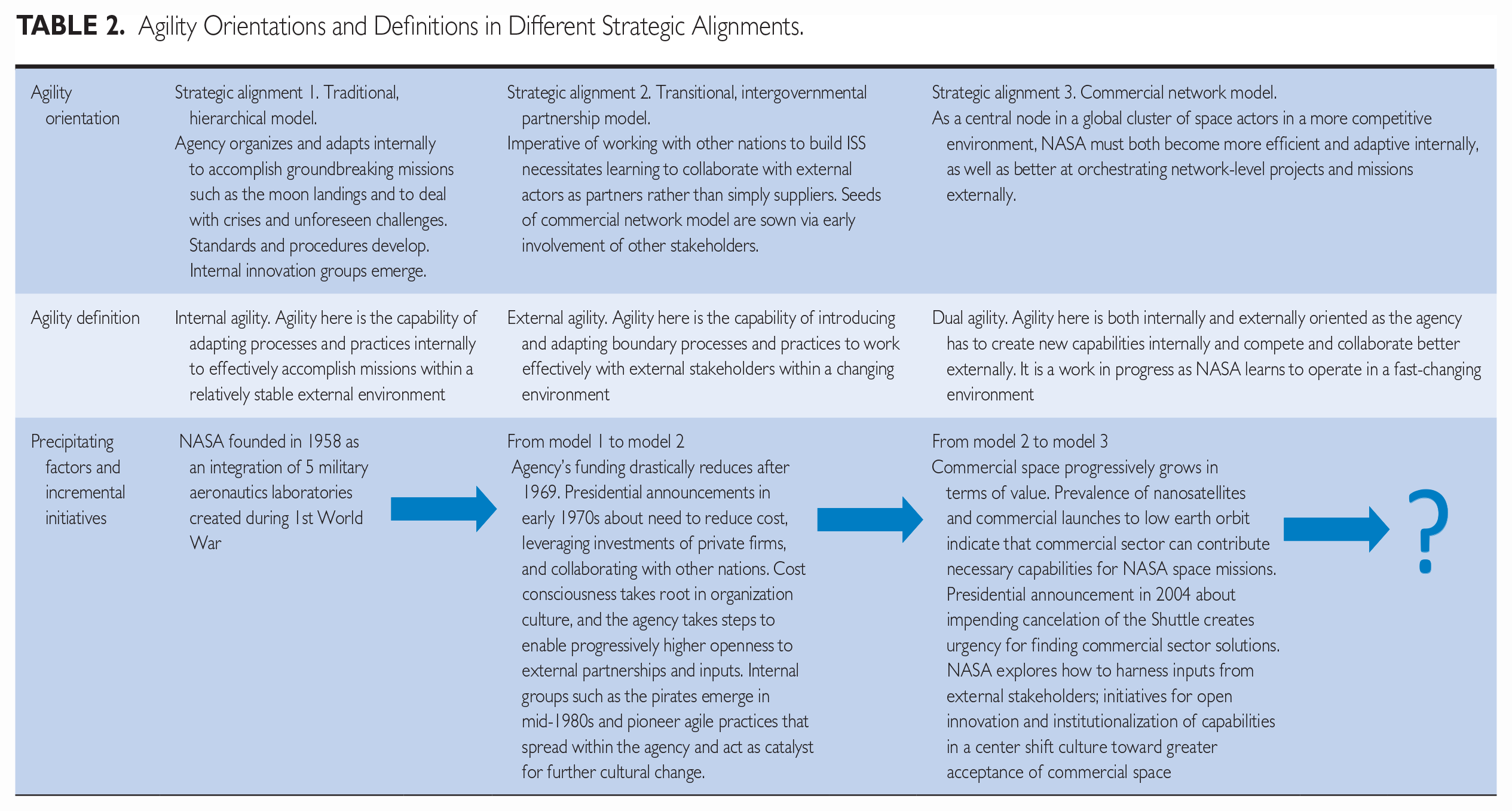
Table 2 outlines the three different agility orientations and definitions in the agency’s three different strategic alignments. In labeling agility as internal, external, or dual and framing these terms to focus on capability development, we follow the primary way agility has been defined—as a strategic capability. As Pinho et al. has shown, a view of agility as a strategic capability has provided “historical coherence” to this concept. 67 Table 2 also shows the key precipitating factors and positions the incremental initiatives of the JSC Pirates and the Center of Excellence for Collaborative Innovation (CoECI).
Taken collectively, the agency’s evolution through three alignment models and different agility orientations in each model demonstrates strategic agility—the ability to shift business models and capabilities over time to sustain competitiveness. NASA was able to do so despite budget pressures, frequent policy changes, and shifting public support for expensive spacefaring activities. Next, we delve deeper into how this process occurred.
Shifting Incrementally to New Strategic Alignments
Our findings suggest that new strategic alignments can result from periods of cumulative incremental shifts where new practices emerge, become embedded, and then expand across the organization. We also find that this process can be explained by drawing from both the logical incrementalism and punctuated equilibrium perspectives—where the periods of change that lead to new alignments are not short and radical as in punctuated equilibrium but long and incremental, as illustrated in Figure 1. We also found that periods of change tend to follow “precipitating event[s]” as logical incrementalism suggests. 68 In our case, these were, for example, the agency’s drastically reduced funding after the moon landings; the government mandate to NASA to work with other nations to build the ISS; and the emergence of commercial space that swiftly dominated the space industry in terms of value, overtaking state actors. We illustrate these findings by drawing from our analysis of NASA’s history and evolution over time.
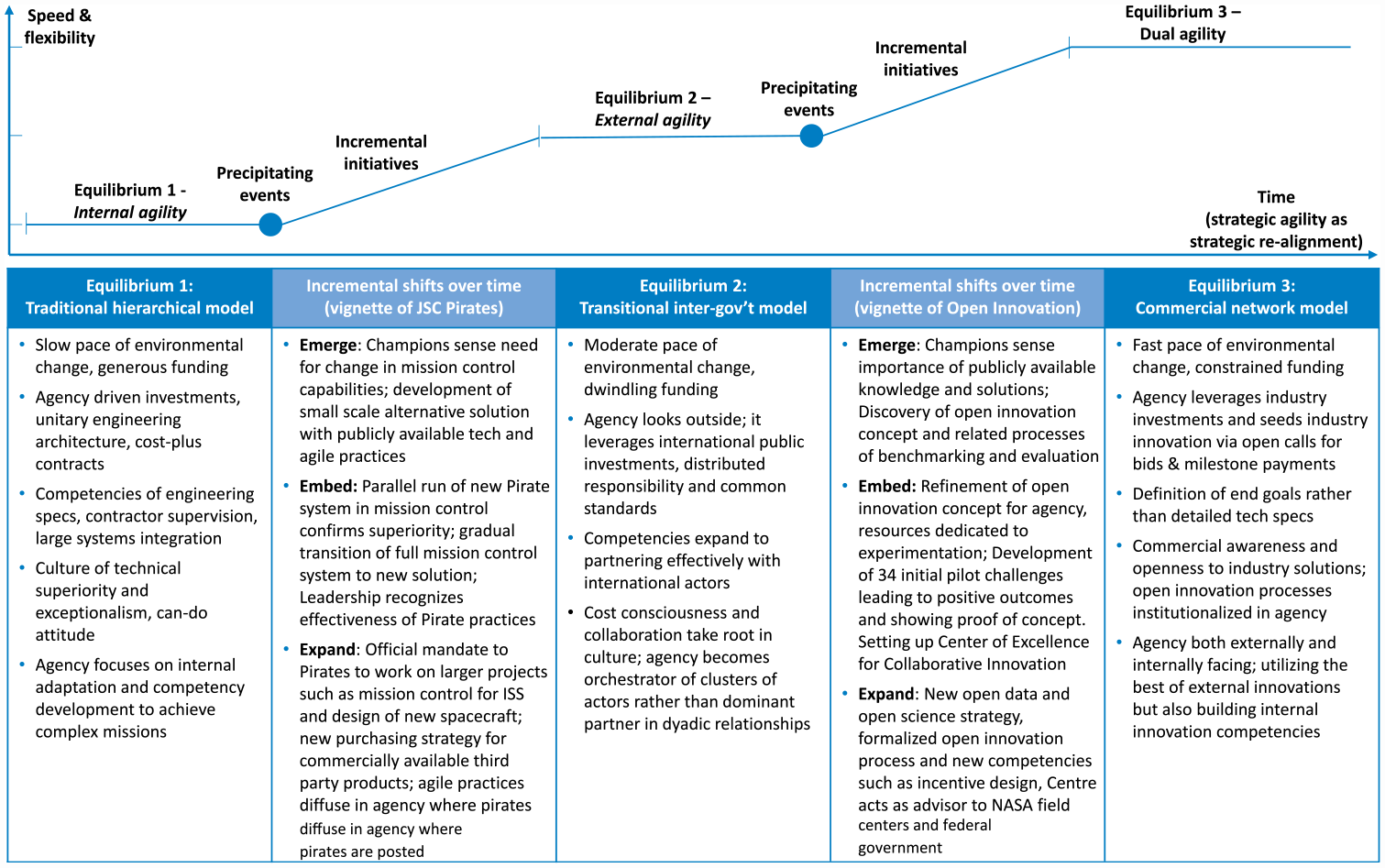
Strategic agility via incremental steps of emergence, embedding, and expanding.
Moving from the Traditional to the Transitional Model
After the first moon landing in 1969, marking a symbolic win of the cold war, public and political interest in the Apollo program began to wane, and annual budgets were steadily reduced. 69 NASA’s annual budget, totaling over $5 billion in the mid-1960s, dropped to $2 billion by 1969, even though manned flights to the moon continued until 1972 and new programs such as the Apollo Skylab and the unmanned Voyager mission to Mars were underway. 70 In the context of shrinking budgets but expanding missions, President Richard Nixon approved the development of a reusable, low-cost Space Shuttle system that would “take the astronomical costs out of astronautics.” 71 The same year, Nixon signed the “Agreement Between the United States of America and the Union of Soviet Socialist Republics Concerning Cooperation in the Exploration of the Use of Outer Space for the Peaceful Purposes.” 72 He also suggested to Congress in 1973 that he saw an opportunity for the agency to leverage private R&D investments of commercial sector firms, 73 something in stark contrast to NASA’s reliance on proprietary technologies at the time.
The early culture of NASA that perceived only technology invented “inside the fence” as good enough meant that almost no third-party commercially available technologies were used by the agency at the time. The US president’s announcements acted as precipitating events that initiated a process that shifted NASA’s role from that of the dominant party in a supplier-buyer dyad to being just one (albeit influential) actor in a cluster of partners. Furthermore, the agency was encouraged to source publicly available third-party products for which it had not a priori developed detailed technical specifications.
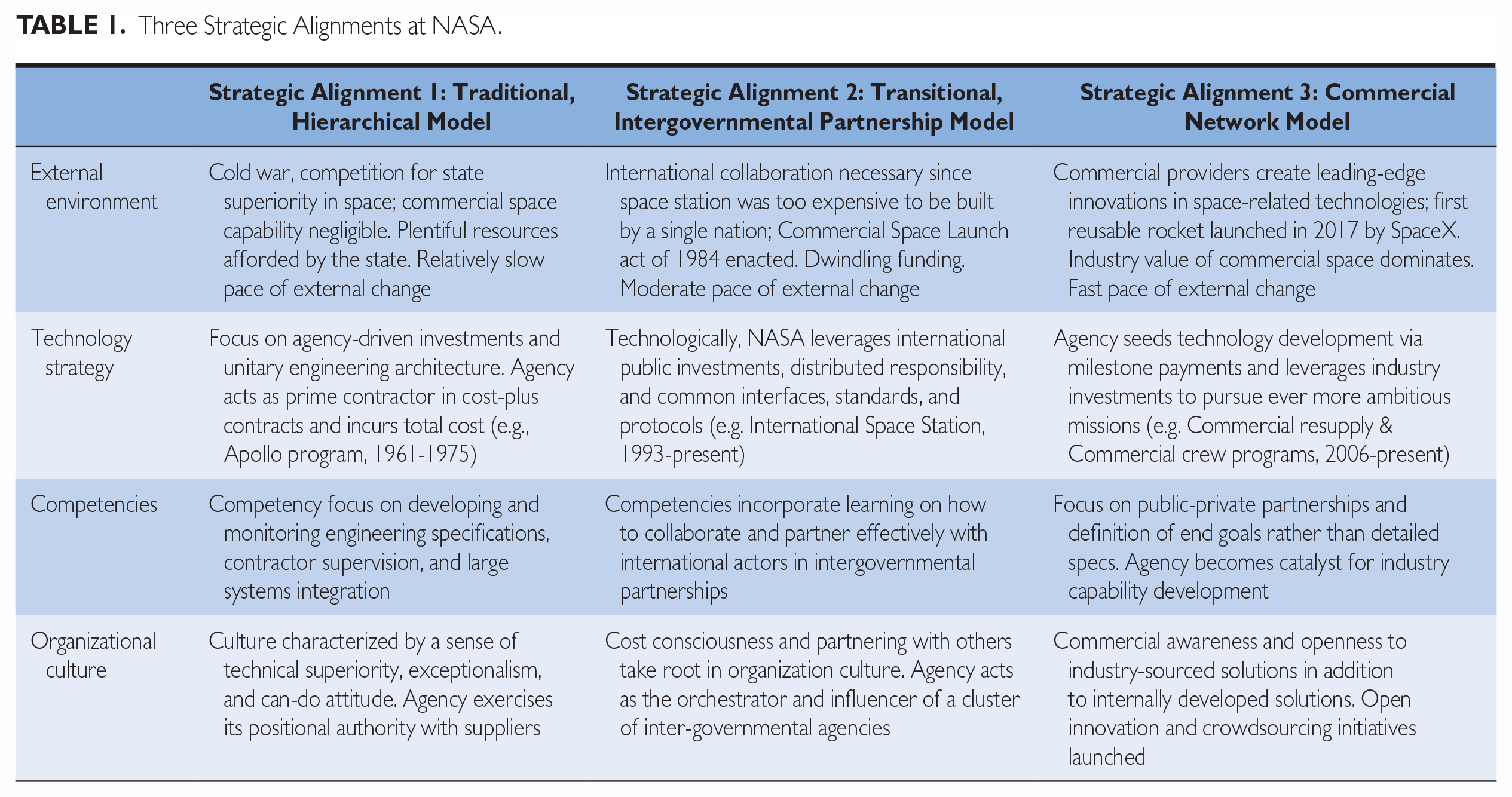
The need for increased international collaboration meant that NASA had to shift its hierarchical and insular culture toward openness to external partners and to the joint development of standardized interfaces, common standards, and protocols. In the meantime, internal champions such as the NASA Pirates were also pushing for such shifts in the agency’s culture and way of operating. Their activities constituted incremental changes that, over time, combined with other initiatives, led to a new strategic alignment—the intergovernmental transitional model (as outlined in Tables 1 and 2).
Three Strategic Alignments at NASA.
Agility Orientations and Definitions in Different Strategic Alignments.
Incremental Change Initiative: The JSC Pirates
In the 1980s, when young engineer John Muratore joined JSC, he was surprised to learn that the computer architecture in operation at the shuttle mission control was still the 1960s’ Apollo-era mainframe system and that the same technology had been selected for the mission control’s planned update. Displays were monochrome and lacked graphics; the system could handle only limited simultaneous calculations and was prone to crashing. Muratore was unsure whether the incumbent mainframe system could stand up to the burgeoning demands and complexity of the shuttle program and saw tremendous risk in its long-development cycle, as well as its extensive costs. He believed that a distributed system, a cluster of Unix-based off-the-shelf personal computers recently available on the open market, could potentially offer greater functionality, graphics, scalability, robustness, and a real-time interface.
Muratore connected with a small group of newly recruited engineers who felt the same about the old system and who also sensed the need for change. The group’s concerns initially fell on deaf ears. Mission control operators knew that the incumbent system had taken humans to the moon; it was tailored and tried and tested, and flight controllers and software engineers knew its every quirk. Muratore and his cohorts, who called themselves “the Pirates,” were undeterred. They applied for a small internal grant for “new technology,” and with those meager funds, they started putting together borrowed hardware and writing new code to create a system that could initially run parallel to the incumbent system. Their “Pirate paradigm” consisted of several values that challenged the established culture such as: “Break the rules, not the law; take risks as a rule not as the exception; cut out unnecessary timelines, schedules, processes, reviews, and bureaucracy; just get started, fix problems as you go along; build a product, not an organization; outsource as much as possible.”
Through the Pirates’ new ways of doing things, ideas emerged via experimentation and testing. According to a member of the group,
Early on when we [the Pirates] would bring new concepts, new ways of doing things, the organization was like: “Okay, well, that’s fine if you do that, but you still have to do XYZ.” After we started proving that we could be successful and that these new processes worked, and you’ve got the same results as XYZ, there was more tolerance.
At first, the Pirates borrowed commercially available computers from third-party manufacturers for 90 days, 74 since this was how long borrowing was allowed by law, and started coding on them. They pioneered agile processes in their projects even before agility entered the organizational vocabulary (the agile manifesto would be published around 15 years later in 2001). Their motto was “build a little, test a little, fix a little.” Contrary to the hierarchical organizational design of the agency, the Pirate team had a flat design, even when the team grew bigger. Their culture encouraged continuous improvement and experimentation, results orientation, cutting out bureaucracy, and personal accountability and responsibility. 75
After about a year of hard work and positive initial results, the Pirates were allowed to embed their system into mission control in a vacant part of the room despite initial protests from the mission operators. Their system started to demonstrate its worth when it continued to run seamlessly on two separate occasions when the mainframe crashed. Over time, the various technical systems that were required to fly the shuttle were transitioned from the mainframe system to the Pirates’ Unix-based computer system that relied on publicly available workstations. The effectiveness of the agile Pirate practices was symbolically recognized when senior leadership displayed public support for what they were doing. According to one of the group leaders,
The fact that the NASA administrator earmarked this and said “This is my project. We’re going to do this” and that he came down three or four times and sat in meetings (. . .), you can’t beat that kind of coverage.
Then, due to the success of the shuttle mission control, the Pirates were tasked in 1992 with officially expanding their new way of doing things to develop the capabilities of mission control for the planned ISS, launched in 1998. By that point, the Pirates grew to hundreds of members. The resulting mission control system operated at a lower cost for both the shuttle and the ISS programs, compared with what it cost previously to run just the shuttle program using the mainframe system. In 1994, the Pirates were awarded the Vice President’s Hammer Award that recognized outstanding innovations to the functioning of government. The award appreciated the Pirates’ development of the new shuttle mission control with a cost savings of $74 million in development and annual recurring savings of $22 million.
76
The rest of the organization took notice of the Pirates’ agile practices:
We made a very conscious effort to communicate what our values were and to talk about it. . . . We used symbology and other things to communicate to people what we were about. We used buttons and pins and we had a lot of all-hands meetings . . . and we always made sure that our mini milestones were up on the walls and visible to everyone.
What started as an incremental change initiative was part of a cumulative process that culminated in long-lasting changes within NASA’s organization, its competencies, and its strategies. The agency shifted toward relying heavily on commercially available third-party technologies for large parts of its missions and developed a sourcing strategy for such technologies. Entire departments developed the competencies to conduct technology searches and write Space Act Agreements with commercial partners. Several organizational processes have been simplified, such as the flight certification process for so-called “Class 1E products.” Since these are products that are not part of mission-critical functions that might compromise the safety of the crew, the space vehicle, or the launch vehicle, they do not have to go through all the rigorous and time-consuming regular approval processes—simplifications that reduce costs and increase speed. 77 This and other incremental initiatives shifted the agency toward the intergovernmental partnership model and were a precursor to the commercial network model.
Moving from the Transitional Model to the Commercial Network Model
At the turn of the century, the agency was faced with more uncertainty in terms of frequent large changes in space policy by subsequent Presidents, a progressively tighter budget, and the development of commercial space technologies that threatened to make NASA less relevant. President George W. Bush initiated the Constellation program in 2005 that had a renewed focus on manned space missions and the ultimate goal of humans reaching Mars by 2020. The global financial crisis of 2008-2009, however, eroded public support for this expensive program, and for the first time in NASA’s history, a major space initiative was canceled in its early stages. Then President Barack Obama overturned Bush’s policy directions to the agency; in turn, President Donald Trump did the same with Obama’s policies. Uncertainty became a pattern and also a threat to human space exploration with its decades-long R&D timelines.
Yet again, NASA was facing a changed external environment for new missions, characterized by the precipitating conditions of uncertainty, tighter budget, and commercial space emergence. The agency needed to adapt. It started to leverage industry investments more extensively and initiated programs that invited commercial players to transport cargo and astronauts safely to and from the ISS. The agency also started to expand its scope of partners even more to include regular citizens in open innovation processes. This was a continuation of an approach that had begun decades ago during the 1980s and that gradually grew:
The range of actors participating in NASA projects has in fact evolved and grown over time. During the Space Shuttle era, NASA began to engage with new publics as users of the vehicle and substantive contributors to its success . . . The space agency has similarly continued to broaden participation in the use of the ISS.
78
Incremental Change Initiative: The Center of Excellence for Collaborative Innovation
In 2005, the Human Health and Performance Directorate (HH&P), NASA’s organization focused on humans living and working in space, faced a 45% reduction to its R&D budget
79
due to the initiation of the Constellation program and the shifting of more resources into operations rather than R&D. The leader of this division, Jeff Davis told his leadership team,
We need to do work differently. We’ve had this budget reduction, most likely that level of budget is not coming back and we need to think about how we work differently.
At the same time, the leadership of the JSC, sensing that further changes in direction might come from above, wanted to increase strategic flexibility. According to a manager from the Exploration Technology Office,
The center directors specifically asked for a strategy that took into account the very real possibility that every four to eight years, we get a new destination. He wanted a strategy that will survive no matter what the change was.
The HH&P leadership team performed a visioning exercise using scenario planning. Through this exercise, the team noted a trend around broader outreach and the opportunity to connect with people who wanted to work with NASA differently beyond the already existing mechanisms such as grants, contracts, and small business proposals. In 2009, a benchmarking study of 20 organizations in the public domain that were recognized for effective collaboration recommended developing a “culture of collaborative innovation” in the agency. 80 Also inspired by a Harvard Business School course, the idea of open innovation emerged in the HH&P. In the beginning, the team did not expect to find workable solutions to the particular technical problems they wanted to solve but rather thought they would use open innovation as a mechanism for new ideas, to keep up with technology, and to perform environmental scans.
After roughly a year of developing the open innovation concept, the HH&P embedded the first pilot projects with small-scale early funding in available platforms such as InnoCentive, Yet2.com, and TopCoder. The first 14 challenges were communicated externally, followed by an additional 20 challenges internally. All 34 of them received such encouraging results that the Office of Science Technology Policy and the White House asked HH&P leader Davis in late 2010 to set up the competencies that the agency needed for practicing open innovation on a larger scale. This resulted in the creation of the CoECI at JSC in November 2011. By 2022, the CoECI had run over 500 challenges, establishing a formal process for the use of crowdsourcing as a new tool. It developed competencies such as implementing challenge-based initiatives, adequate problem definition, incentive design, and postsubmission evaluation of solutions, and it even assisted other federal agencies to set up similar structures and processes. Open innovation brought several benefits to the agency. Between June 2015 and March 2017, 92% of the posted challenges were closed successfully, and 90% of the solutions produced implementable results. Also during this time, 98% of the posted challenges resulted in cost savings for NASA, and approximately 90% of the challenges resulted in scheduled savings—increasing the speed, flexibility, and adaptability of NASA to new mission objectives. According to NASA leaders who implemented open innovation in the agency,
78
NASA has established a suite of initiatives, policies, funding streams, organizations, and communities aimed at facilitating the agency’s use of “open innovation” approaches to engage members of the public in lending their skills, ideas, enthusiasm, and time to advance particular goals and objectives. NASA has welcomed a diverse set of individuals to collect and analyze scientific data, make discoveries, develop technologies and data applications, and solve complex problems.
CoECI acted as a catalyst to expand open innovation capabilities and openness values through the agency. It helped shift the culture of NASA toward higher levels of experimentation with new methods and increasing tolerance to innovations from outside the agency. 81 NASA has gradually shifted from a closed culture and technology-development process to one where specific R&D strategic challenges and data are shared with the general public. CoECI now acts as an adviser and resource for all NASA field centers as well as for other parts of the federal government that would like to use these processes. 82
The shift toward more openness and collaboration has been enshrined in the agency’s strategic objectives. For example, objective 1.3 reads,
NASA’s data initiatives are focused on making actionable data accessible to other Federal agencies, relevant decision-makers, stakeholders, and the public. This will be done by investments in three key areas: 1) capabilities to enable open-source science; 2) continuous evolution of data and computing systems; and 3) community and strategic partnerships for innovation.
83
CoECI has been an important incremental step that cumulatively with other initiatives shifted the agency toward the commercial network model. 84
Incrementalism as a Path to Strategic Agility
There is no doubt that the agency changed radically over time, as outlined in the three different strategic alignments and agility orientations in the analysis in Tables 1 and 2. William Gerstenmaier, former Associate Director for Space Operations, offered his thoughts on how NASA changed through his 30 years at the agency:
85
Yeah, boy, it’s definitely changed. It’s hard to reflect on the change, because I’ve seen it come so incrementally. I’ve seen this change in the way we do business. . . . The other thing that’s changed is the technology. In the Mission Control Center today, the new computer systems and the new software they have for the Space Station Flight Control Team is dramatically different than what I had as a flight controller, which was really rudimentary . . . Now the technology and some of the meeting styles and some of the management controls, those things have changed over time. But that underlying drive, that underlying spirit has been there since throughout my career.
Our analysis shows how incremental initiatives such as the Pirates and the CoECI follow precipitating events 86 in the context of shifting external environments. Through these initiatives, new ways of doing things emerge and are gradually embedded in the local context, before expanding through the agency. These processes challenge the pre-existing strategic alignment and shift the agency toward a new alignment. The punctuated equilibrium perspective suggests that “transformations (during revolutionary periods) occur through wholesale upheaval.” 87 Yet, while we saw the move from one equilibrium to another at the agency, this did not occur through wholesale upheaval but through incremental steps over time. Revolutionary periods were not swift sprints but instead took place over longer periods and were characterized by emergence, embedding, and expansion, as outlined in Figure 1.
A key insight is that the ways organizations seek to become more strategically agile involve particular combinations of enablers, competencies, and cultural variables. During emerging, the aim is the creation of the contextual conditions for new practices to emerge, and the primary cultural value is one of experimentation, especially within local teams that are empowered to challenge established ways of thinking and acting. For strategists, a key learning is the need to create the conditions and also the teams to enable these innovations to take shape. During embedding, the culture is one of collaboration, with the primary objective being the establishment of systems and structures to enable wider adoption of the new practices. Strategists focus on structures and processes that enable the sharing of best practices across levels of divisions. Finally, during expansion, the culture is one of openness to support the fostering of networks of relationships with a wider set of stakeholders. Strategists during the expansion phase initiate and grow new collaborations within and outside the firm.
Furthermore, we discussed strategic agility as the ability of an organization to shift its strategic alignment model radically; in this case, each new alignment involves a different technology strategy, competencies, and organizational culture. As we illustrate in Figure 1, these new strategic alignments were accomplished through long-term, cumulative incremental shifts engendered by initiatives such as the Pirates and the CoECI. Yet, with each new alignment, the organizational capabilities of speed and flexibility (that is, organizational rather than strategic agility) increased, as shown through the vertical axis of Figure 1. Increased speed and flexibility were apparent in the development of new capabilities such as agile practices, rapid prototyping, and environmental scanning. This process of strategic agility at NASA can be differentiated from a process of strategic renewal. As Schmitt et al. note, strategic renewal refers to a “transformation of the firm’s core capabilities associated with competitive advantage . . . concerns the entire organization and has implications across organizational levels, and . . . is essential to break path dependence and ensure the firm’s long-term survival.” 88 Rather than a transformation of core competencies, at NASA, new competencies were developed over time to operate alongside existing ones. Engineering excellence and large systems integration, for example, operating at NASA since the founding of the agency are still very much there, alongside newer interorganizational and network-level boundary-spanning competencies developed over the alignments of embedding and expansion. Furthermore, rather than breaking path dependence, the agency’s path in terms of new alignments and its ability to carry out challenging missions is built on foundations of past learning and experience, 89 as shown in our case analysis and Figure 1.
The agency has been making concerted efforts to increase its agility and speed, while at the same time learning from and collaborating more effectively with external and internal stakeholders. In 2020, for example, the agency conducted a study of how venture capitalists make investment decisions to improve its resource-allocation processes. The report noted that “NASA must learn to adopt additional methods and harness commercial markets to turn innovative technologies into flight-ready capabilities with efficiency and speed equal to that of American business.” 90 Similarly, a 2022 internal initiative called “the Forge” aims to “meet the vision to work with greater speed and agility, communicate effectively between organizations, improve innovation and increase workforce flexibility.” 91 Finally, in December 2022, the agency published its digital transformation implementation plan that includes the goal to “transform the agility of NASA’s workplace” to accomplish “faster, more agile processes . . . at the speed of business” and to “enable agile multi-center/partner engineering teams to solve frontier problems.” 92
Despite NASA’s efforts to operate “at the speed of business” and make significant advances, it remains a government organization shaped by political winds, public sector processes, and government funding. Analyses of NASA’s Space Launch System versus SpaceX Starship maintain that the SpaceX system, when fully developed, will be significantly more efficient, implying that the agency’s commitment to its own technology owes as much to sunk costs and politics as to dispassionate costs and benefits analysis. 93 Despite calls for the agency to be allowed to compete on a more commercial basis, 94 it still has to operate within the boundaries, requirements, and constraints of key stakeholders such as the US government.
A defining feature of NASA’s current alignment, the commercial network model, is the dominance of commercial space in terms of industry value. Contrary to being adversarial, the agency’s relationship with commercial space is one of “co-opetition.” 95 It collaborates on developing and operating leading-edge space technology to achieve missions such as round trips to the ISS to transfer supplies and astronauts or building habitats on the moon and Mars. Yet, NASA must compete for public and political legitimacy—and there is also a differentiation of focus. The commercial sector focuses on low-earth-orbit markets where the investment case is stronger; the agency focuses on deep space exploration missions where investment returns are as yet nonexistent. From this perspective, NASA in the future will continue to be a central node and orchestrator in the space industry, while using the leading-edge technologies that arise from the network of actors to accomplish missions on deep space exploration.
Managerial Implications: Becoming Strategically Agile
Our study has shown that strategic agility can evolve via a series of purposeful, incremental shifts that cumulatively lead to new strategic alignments for an organization. From a managerial perspective, speed is important when it comes to being flexible, experimenting, and creating new policies and processes to respond swiftly to particular challenges. Yet, when it comes to accomplishing new strategic alignments in large, complex organizations, the process of change may be incremental and occur over long periods of time. The dual aspects of experimentation, flexibility, and speed on the one hand and long-term strategic realignment on the other are interrelated since the former provides learning and impetus for the latter. This implies that executives should encourage new initiatives and experimentation in the normal course of business as ways of learning and incrementally shifting the organization toward a new strategic alignment. As various scholars have shown, a pattern of new initiatives and incremental innovations can over time amount to radical innovations and new ways of doing business. 96 In our study, we illustrated the relevance of this insight by showing how initiatives such as the Pirates and the Center for Open Innovation shifted the agency toward new strategic alignments. Such initiatives should be encouraged even without precipitating events or a sense of crisis since the outcomes and learning can provide a healthy challenge to organizational inertia.
Being Both Stable and in Motion: How Incremental Steps Can Lead to Transformational Change
Faced with increasing pressure from blurred industry boundaries and rapid technological change, established organizations in almost every industry are facing the pressure for radical or transformative changes. In that context, incremental changes are often perceived as inadequate. However, juxtaposing the two approaches of incremental versus radical change as entirely separate strategies does not reflect the complex processes through which organizations deal with challenges in practice. Senior leaders need to identify both the radicalness of the desired outcomes and the types of actions that are necessary to achieve these outcomes. Often these actions might be a series of many incremental steps over time as “innovation becomes legitimized and embraced through a gradual change process.” 97
In this article, we challenge the notion that strategic agility as new strategic realignments can only be brought about by large-scale, disruptive approaches as the punctuated equilibrium theory suggests and argues instead that logical incrementalism may be an unappreciated driver of strategic agility. Executives may assume that transformational change can only come about by big-bang approaches. Yet in large, complex organizations, such an approach may be highly disruptive and have adverse consequences. By relying on patterns of incremental initiatives, executives can bring about new strategic alignments at lower levels of risk of organizational disruption.
Strategic agility is therefore not necessarily or always about speed but about progressively and incrementally building long-term competencies, culture, and strategies that are not only internally aligned but also consistent with the imperatives posed by the external environment. Since it is a process that occurs over extended timeframes, it is about a context-dependent, “delicate mix between action and reflection.” 98 New strategic alignments may also enable increased organizational agility and speed in relevant processes, as seen in Figure 1.
This process has both emergent and planned elements. On the one hand, we outlined incremental initiatives as involving phases of emergence, embedding, and expanding new practices and capabilities that gradually constitute new strategic alignments. However, these processes take place in the context of a stable, multigenerational agency purpose, particularly strategic planning goals, direction from leadership, and legislation. The Commercial Space Launch Act of 1984, for example, called for government agencies such as NASA to support the growth and development of a commercial space sector, a goal that was enshrined in subsequent agency planning stages. These planned elements collectively and over time support shifts to new alignments. Strategic agility can therefore be partly seen as an outcome of the interaction of planning and emergence—or the ability to deal with competing demands.
This interplay between a long-term, unchanging purpose together with simultaneous strategic agility illustrates how the paradox of stability and change (or stability and nimbleness to use the term of Girod and Králik 99 ) may play out in practice as a means of accomplishing both. Furthermore, our discussion of the increasingly higher speed needed to progress internal, external, and then dual agility (as shown in Table 2 and Figure 1), combined with a persistent slowness in the process over decades of moving to new alignments, is a further manifestation of the stability and change of paradox in practice.
This process of moving to new strategic alignments also illustrates the paradox of complexity and simplicity—a key dimension of the strategic agility canvas of Girod and Králik. 100 The commercial network model, for example, is progressively more complex than the traditional and transitional models in terms of requiring dual agility with both an internal and external focus, the need to orchestrate systemic networks of partnerships, and dealing with a faster pace of external change. Yet, the agency’s overarching long-term purpose acts as a north star. The agency is progressively building new competencies to supplement existing ones, and its decades-long missions provide a focus for effort, and simultaneously provide an undercurrent of simplicity and coherence. However, this coherence is not necessarily or solely dependent on senior actors. Rather it is an organization-level accomplishment, a part of the fabric of the agency and of how historical factors can shape and guide an organization’s trajectories to the future. 101
The organizational change literature has been dominated by planned models of change, as seen in the classic models of Lippitt, French, or Beer. 102 When emergence was studied by process researchers, it was seen as analytically distinct from planning and as the primary force for change. 103 Rather than upholding a separation between planning and emergence, or the primacy of one dimension over the other, our findings support an integrative view that suggests change can emerge within planned boundaries, as Livne-Tarandach and Bartunek have argued. 104 To this integrative perspective, we add logical incrementalism, or the taking of small steps, prompted by precipitating factors that include strategic plans, direction from the top, and legislation—all driven by a particular logic that is intended to move the organization toward new capabilities and to form new strategic alignments.
In this article, we argued toward rethinking prevailing assumptions that strategic agility should be led from the top 105 through radical or step changes since incremental changes are seen as insufficient to lead to new strategic alignments. 106 Given that organizational change efforts often fail because they are rejected by the organizational immune system as prevailing habits, resource allocations and politics play out. We show how organizations can reach new strategic alignments via incremental moves that can effectively maximize both fitness, or adaptation to the current environment, and evolvability, the ability to adapt to a changing environment or to seek out new viable environments. 107
Footnotes
Notes
Author Biographies
Loizos Heracleous is a Professor of Strategy and Organization at Warwick Business School and an Associate Fellow at the University of Oxford (email:
Christina Wawarta is the Head of Corporate Strategy (Markets & Portfolio Acceleration) at BSH Home Appliances Group and an Associate Fellow at Warwick Business School (email:
Angeliki Papachroni is a Lecturer in Strategy and Innovation at ESMT Berlin and an Associate Fellow at Warwick Business School (email:
Sotirios Paroutis is a Professor of Strategy and Organization and the Head of the Strategy and International Business Group at Warwick Business School (email: