



Abstract
In seeking concrete and meaningful practical impact on addressing grand challenges, some management scholars have demonstrated the possibility of researchers convening multi-stakeholder dialogue. But this has not been explored in much detail, and furthermore scholars have pointed to important constraints and tensions that may discourage such engagement. We thus ask, what are the affordances and tensions associated with researchers convening multi-stakeholder dialogue processes? We address this question by critically reflecting on our roles and experiences as we convened a 15-year dialogue initiative focused on addressing hunger and malnutrition in South Africa. As affordances, we identify researchers’ convening power as especially salient in the context of the evaluative and contested nature of grand challenges, and we highlight researcher-convenors’ staying power as important for bridging periods of resource scarcity between propaedeutic and institutionally generative dialogue processes. We also identify convening tensions based on opposing expectations regarding our role as convenors and regarding our orientation towards social change, yet these tensions may be ameliorated as part of a conceptual and embodied shift from shallow to deep dialogue.
Keywords
Introduction
Diverse prescriptions have been proposed in response to the concern that management research seems to have limited impact on practice (e.g. Bansal et al., 2012; Bartunek, 2007; Sharma and Bansal, 2020). For example, ‘action research’ approaches suggest that researchers become directly involved in organizational change initiatives and engage in reflection processes to develop insights based on this experience (e.g. Eden and Huxham, 1996; Lüscher and Lewis, 2008). The notion of ‘engaged scholarship’, meanwhile, recommends a structured process of interaction between researchers and practitioners to allow for arbitrage between their different knowledge domains in addressing ‘complex problems in the world’ (Van De Ven and Johnson, 2006: 803). When such collaboration emphasizes working with marginalized or vulnerable groups and has a social justice ambition, it has been spoken of as ‘activist scholarship’ (Gray, 2023; Hale, 2008).
As management researchers become more interested in not only studying but also positively addressing ‘grand challenges’, the problem complexity highlighted by Van de Ven and Johnson (2006) becomes magnified and elevated to the societal level, implicating a broader array of organizations and perspectives (Ferraro et al., 2015; George et al., 2016; Howard-Grenville and Spengler, 2022). The ambiguity and scope of such grand challenges mean that they give rise to hazy issue fields with no predefined ‘spaces for experimentation’ (Zietsma and Lawrence, 2010), and so scholars have identified a need for ‘convening’ (Dorado, 2003, 2005) or bringing together and facilitating repeated interactions among relevant actors in multi-stakeholder dialogue processes to help create shared or at least commensurate understandings of the problem and possible responses (e.g. Dorado, 2005; Huxham and Vangen, 2000; Koschmann et al., 2012; Lawrence et al., 2002). It has been shown how researchers can participate in such multi-stakeholder dialogue processes, contributing their scholarly insights in discussion with other stakeholders and then also using this experience for scholarly research and publication (Bednarek et al., 2023; Huxham and Vangen, 2000, 2003; Jarzabkowski et al., 2022).
Management researchers may also be involved in not just participating in, but actually convening such multi-stakeholder dialogue as a form of ‘deep engagement’ that responds to the urgency of grand challenges (Williams and Whiteman, 2021). In the extant literature on research impact, this possibility has been hinted at but not much explored. For example, Jarzabkowski et al. (2023) chaired an industry forum as part of their long-term project on disaster insurance, but this role is not included in their discussion of ‘impact’ ambitions in this project (Bednarek et al., 2023; Jarzabkowski et al., 2024). In another example, Williams and Whiteman (2021) describe how one of them convened scientists and other stakeholders with the goal of ‘speaking science to power’ (p. 530) on climate change. They imply that this is an opportunity to ‘leverage our academic skills’ (Williams and Whiteman, 2021: 532), but such affordances of the researcher role in convening dialogue are not discussed further.
However, there are notable reasons why researchers might not be suitable for such forms of engagement. Williams and Whiteman (2021: 532) suggest that the deep engagement necessary for convening multi-stakeholder dialogue demands a lot of resources, including time, networks, and funding, and furthermore, the ‘concrete impacts’ of such efforts are difficult to measure and reconcile with academic performance evaluation systems (see also Gray, 2023). Meanwhile, scholars of multi-stakeholder interaction emphasize the significance of power imbalances and the resulting challenges in convening and facilitating dialogue, which may overwhelm researchers who have little dedicated training in such processes. Gray et al. (2022) ask, ‘what is the potential for well-intended but naive academics to competently understand and address the power dynamics of the field in which the partnership is embedded?’ In addition, being part of the convening team might distract researchers from contributing their specialized knowledge resources in an arbitrage process (Van De Ven and Johnson, 2006). Playing a dialogue convening role may thus give rise to a particular form of researcher–practitioner identity tensions (Empson, 2012; Gulati, 2007; Hamann and Faccer, 2017).
Against this backdrop, we ask, what are the affordances and tensions associated with researchers convening multi-stakeholder dialogue processes? We address this question by critically reflecting on our roles, activities, and interactions with others as we convened and facilitated a 15-year ‘dialogic action research’ initiative (Shotter, 2010), focused on addressing problems of hunger and malnutrition in South Africa. 1 Food security is truly a grand challenge, with an estimated one in seven people globally suffering from undernutrition (and a similar number from obesity), and climate change already creating increasing difficulties for food production and distribution (Godfray et al., 2010a; IPCC, 2022; Vermeulen et al., 2012). The food production and distribution system are in turn one of the most important contributors to biodiversity loss and climate change (Vermeulen et al., 2012). These challenges are made more difficult to address due to the wide disparity of interests and perspectives regarding the root causes and corresponding prescriptions (Holt Giménez and Shattuck, 2011). The dysfunctional nature of the food system is especially evident in South Africa, given the legacies of a history of racist institutionalized exclusion and the resulting disparities in land ownership, wealth, and health. For instance, 27% of children in South Africa are stunted, with devastating consequences for their life chances as well as their communities and society more broadly (May et al., 2020). As we grappled with these issues from a scholarly perspective in the South African context, we concluded that multi-stakeholder dialogue would be one mechanism (among others) to enhance the effects and coherence of different actors’ responses to the hunger problem (Hamann et al., 2011) – and because we saw no one else making such efforts, we decided to convene such dialogue ourselves.
We find that there are two affordances that enabled us to play this role consistently over the ensuing 15 years: convening power based on perceived neutrality and credibility, and staying power based on relative low-cost and professional flexibility. We also identify two convening tensions: the convenor role tension between expectations that we would provide content expertise versus process custodianship, and the change orientation tension between expectations for us to advance either a functional innovation or a radical advocacy orientation to food system change. Initially, these tensions gave rise to what we experienced as contrasting and non-compatible convening postures. But over the years, this experienced severity of the tensions diminished as we came to understand and embody a ‘deeper’ conception of dialogue, in which the intent is not for representatives of institutional categories to reach consensus, but rather for ‘whole persons’ to engage in agonistic (Mouffe, 1999) yet authentic intersubjective engagement and inquiry (Buber, 1958; Nilsson, 2015). We refer to this emphasis on whole person actorhood as actor complexification and role fluidity, and it went hand-in-hand with radical inclusion, proactively involving marginalized actors and diverse knowledge claims.
Based on these findings, our first contribution is to point to researchers’ institutional field position as potentially offering a degree of convening power that is especially salient in the context of the ‘evaluative’ and contested character of grand challenges (Ferraro et al., 2015). Second, we suggest that researcher-convenors can, in some contexts, have the staying power necessary to bridge periods of resource scarcity between propaedeutic and generative dialogue processes. And third, we identify two convening tensions that confront and challenge researcher-convenors, yet they may be ameliorated or even transcended (Jarzabkowski et al., 2013) as part of a conceptual and embodied shift from shallow to deep dialogue. This includes but goes beyond a cognitive reframing and the adoption of specific practices or rhetorical devices (Bednarek et al., 2017; Parola et al., 2022), involving a slowly emergent and sometimes awkwardly embodied capacity.
Theoretical background
Multi-stakeholder dialogue in addressing grand challenges
The idea that dialogue between groups with different interests and perspectives can help address complex social problems has become axiomatic for some. Its proponents argue that such dialogue can identify opportunities for collaborative action and shift the institutional structures underlying complex social problems (e.g. Cajaiba-Santana, 2014; Hassan, 2014; Murray et al., 2010; Westley and Antadze, 2010). This view is also prominent in recommendations on how to address grand challenges, which call for diverse stakeholders to cooperate in creating joint solutions (Berrone et al., 2016; Brammer et al., 2019), based on a ‘participatory architecture’ allowing for ‘multivocal inscription’ (Ferraro et al., 2015: 373) and ‘dialogue and mutual understanding’ (George et al., 2016: 19). Dialogue processes are arguably a foundation for making ‘multi-stakeholder governance . . . the modus operandi for addressing grand challenges’ (Couture et al., 2023: 1653).
Gergen et al. (2004) define dialogue as ‘discursive coordination in the service of social ends’ (p. 42), and they suggest that generative dialogue – that is, the kind that creates positive, mutually satisfying outcomes – relies on some key components. Participants in a generative dialogue affirm ‘the validity of the other’s subjectivity’ (though this need not involve agreement); and there are ‘productive differences’ in participants’ utterances, to facilitate the creation of shared meaning that challenges taken-for granted views (Gergen et al., 2004: 45–46). Moreover, to avoid dialogue degenerating into polarized debate, much depends on participants’ ability to avoid positioning themselves ‘as unified egos . . . constructed as singular, coherent selves’, and instead to simultaneously engage with multiple perspectives (Gergen et al., 2004: 54).
Multi-stakeholder dialogue has been identified as a ‘potentially powerful form of institutional work’ (Lawrence and Suddaby, 2006: 241), if certain characteristics of participants and the dialogue process pertain (Gergen et al., 2004; Mair and Hehenberger, 2014; Markova et al., 1995; Zietsma and Lawrence, 2010). This is important because grand challenges are institutionally embedded (Howard-Grenville and Spengler, 2022; Lawrence, 2017). Lawrence et al. (2002) show how ‘normative networks’ are established in interorganizational collaborations focused on child nutrition, and if such collaboration is characterized by high levels of involvement among the partners and if it is deeply embedded in its institutional field, it can create ‘proto-institutions’, or new practices, technologies or rules that the collaborating organizations take beyond the collaboration and hence, become available for broader adoption. In another study, Zietsma and Lawrence (2010) describe the formation of protected ‘spaces of experimentation’ within a longer arc of conflict between the forest industry and indigenous and environmental activists in British Columbia. These spaces allowed particular actors to ‘engage in dialogue around the creation of new practices’ (Zietsma and Lawrence, 2010: 207), which were then promoted and legitimated among a broader array of actors.
Dialogue beyond consensus
Yet, the call for more and better multi-stakeholder dialogue in addressing complex social problems has received stringent criticism. Critics argue that proponents of dialogue are overly optimistic or naïve, given the incommensurability of different groups’ interests and differences in their power and worldviews (e.g. Banerjee, 2010; Ehrnström-Fuentes, 2016; Fougère and Solitander, 2019; Whelan, 2012). They have been especially concerned about the nature of the relationship between corporations and less powerful actors, arguing that dialogue processes can produce a kind of ‘fabricated consent’ (Ehrnström-Fuentes, 2016: 435) that masks (Fougère and Solitander, 2019) or even exacerbates (Maher, 2019) adversarial relations and social fragmentation.
Such critics often associate calls for dialogue with a quest for consensus that ‘suppresses the political’ (Rancière, 2007: 11): ‘Every consensus exists as a temporary result of a provisional hegemony, as a stabilization of power and that always entails some form of exclusion’ (Mouffe, 1999: 756). Consensus seeking cannot overcome the incommensurable differences between groups (Banerjee, 2010; Ehrnström-Fuentes, 2016), given their divergent experiences, values, material realities, and ways of making sense of the world. It cannot merge these divergent forms into a single new and inclusive form; it can only sublate certain forms (usually the historically marginalized ones) into others (usually the historically dominant ones).
However, consensus is not a necessary outcome of dialogue, and processes that centre on consensus-building are arguably a shallow form of dialogue. In the work of philosophers like Buber (1958), Bakhtin (1990) and Gadamer (1977), dialogue is unrelated to consensus. It begins with recognizing the fundamental incommensurability not only of different social groups but of every single human being. Each self is embodied, situated in a particular body in a particular time in a particular place, and dialogue is the never-ending ethical work of responding to the other (Bakhtin, 1990). It cannot rest on consensus, on the sublation of our experiences into one viewpoint. It offers instead the possibility of Gadamer’s ‘fusion of horizons’ (Gill, 2015) or Bakhtin’s (1984) ‘polyphony’, a fresh intersubjective reality where individuated experiences connect and interact but do not disappear. Practice scholars like Freire (2005), Bohm (1996) and Isaacs (1999) agree that the result of deep dialogue is shared meaning and not one meaning. Most importantly from a social change perspective, this shared meaning can be generative. It disrupts old thought patterns and creates possibilities for action that were not there in any actor prior to the dialogue.
Theoretically speaking, we thus agree with Whelan (2012) and others that a shallow conception of dialogue focused on consensus-seeking deserves critical treatment (see also Van de Kerkhof, 2006). Instead, a deep conception of dialogue is not directed towards consensus, but rather seeks an intersubjective encounter between participants that surfaces tension and disagreement, but within a field of mutual respect and pursuit of collective benefit. This has profound implications and challenges for practice and specifically for convenors and facilitators. Convenors of such dialogue – whether they be researchers or others – must invite and surface tensions for constructive agonistic engagement (Mouffe, 1999), where participants remain committed to dialogue despite potential disagreement. And crucially, they must go beyond a contest or debating dynamic to allow participants and their interactions sufficient time and support in fostering intersubjective authenticity (Buber, 1958) and inquiry-based relational resources (Nilsson, 2015). This potential for generative, authentic dialogue is not easily or often fulfilled, as is evident also in our own experience.
Convening dialogue processes
The points above imply enabling conditions for generative dialogue, but relatively less scholarly attention has been given to the actual convening process and the necessary ‘work done to build and leverage relationships’ that allow for effective dialogue (Lawrence and Phillips, 2019: 203). There are, however, guides for practitioners on this theme (e.g. Kahane, 2009; Scharmer, 2009), which have been important in our own efforts, not least to provide a framework to clarify expectations for participants. For example, ‘Theory U’ identifies important phases for such a dialogue process, including ‘co-sensing’ (when participants jointly explore the problem domain and each other’s perspectives), ‘co-presencing’ (when participants jointly explore novel responses), and ‘co-creating’ (when participants jointly engage in experimental action to advance specific innovations; Scharmer, 2009).
Additional guidance may be sought in the literature on cross-sector collaboration, even though not all multi-stakeholder dialogue involves or results in collaboration, per se. For example, Vangen and Huxham (2003a) find that partnership managers enact numerous leadership activities, such as continuously involving and ‘embracing the “right” kind of members’ (pp. S65, S69); empowering all members to play an active role in the collaboration, especially if they have less power or influence; and motivating and mobilizing all members to contribute by, for example, ensuring members see benefits from the collaboration and engage in ‘effective interfaces’ enabled by skillful facilitators. Yet, these partnership managers not only support the dialogue process but may play a more substantive role in shaping its content or outcomes, for example, through the texts that they create and disseminate as a basis for discussion (Lawrence et al., 1999). Vangen and Huxham (2003a) thus point to an important potential tension between convenors and facilitators managing the process of multi-stakeholder dialogue as quasi-neutral process custodians, on one hand, and exploiting opportunities for substantively shaping the direction and outcome of such dialogue, on the other hand (see also Van Hille et al., 2019).
Researchers as convenors
In the extant literature on research impact, the possibility that researchers convene multi-stakeholder dialogue has been hinted at but not much explored. For example, Jarzabkowski et al. (2023: 10) mention that in their long-term research project on disaster insurance, they chaired an international forum of industry stakeholders for 2 years. This is likely to have given them not only remarkable access to data and industry insight, but also an opportunity to ‘contribute concretely’ (Williams and Whiteman, 2021: 526) to addressing the insurance protection gap grand challenge. However, when discussing the research impact associated with this project, the authors highlight aspects like teaching, contributions to policy documents, and practitioner reports or books (Bednarek et al., 2023; Jarzabkowski et al., 2024), but intriguingly their convening role is hardly mentioned.
In another example, Williams and Whiteman (2021) describe how one of them convened scientists with the goal of ‘speaking science to power’ (p. 530) on climate change. This evolved into an organization, ‘Arctic Basecamp’, that convenes not just scientists but a wide variety of ‘organizations, celebrities, and individuals’ (Williams and Whiteman, 2021: 531). However, the fact that this convening function is an unusual and underexposed role for researchers is not much explored, even though the researcher identity may be associated with both the strengths and limitations highlighted for this particular convening initiative. For instance, the authors’ prior scholarly work on ecological sensemaking in the arctic (Whiteman and Cooper, 2011), on inter-disciplinary analysis of planetary boundaries (Whiteman et al., 2013), and on deep engagement with a prominent sustainability-focused business association (Williams et al., 2019) likely gave them substantive insight, contextual knowledge, and networks that could be drawn upon in establishing the Arctic Basecamp initiative. The authors do suggest that, as researchers, we need to ‘leverage our academic skills’ (Williams and Whiteman, 2021: 532), but this is not explicated in connection to the specific opportunity of convening.
The researcher role does appear more prominently in these authors’ consideration of the limitations and challenges they faced when convening multiple stakeholders:
Scientific activism like that which is done by Arctic Basecamp requires a tremendous amount of resources (including social networks and funding) and does not easily fit within academic performance evaluation systems particularly during the trial-and-error years where ‘failure’ is common. (Williams and Whiteman, 2021: 532)
The challenge of aligning such efforts with academic performance expectations and evaluation also arise because their outcomes and impacts are often difficult to measure, especially if we go beyond organizational outcomes (e.g. Burchell and Cook, 2006; Van Huijstee and Glasbergen, 2008) and seek to assess institutional effects (Lawrence et al., 2002): ‘what are the concrete impacts of such activities aside from changing narratives?’ (Williams and Whiteman, 2021: 532).
Scholars focused on cross-sector interactions have also cautioned against researchers playing a convening or facilitating role. Gray et al. (2022) explain how power imbalances among participants challenge such cross-sector interactions, and for convenors and facilitators to respond effectively to these challenges requires much skill, as well as focused training and experience, neither of which researchers are likely to have. In addition, the tension between substantive inputs and process stewardship (Vangen and Huxham, 2003a), noted earlier, may be especially salient for researchers, given that their ‘day-job’ expertise is likely more about the substantive aspects of the grand challenge in question than the process expertise required for facilitation. Hence, Gray et al. (2022) wonder whether researchers ‘possess substantive influence or process expertise (or both) before presuming to step into a convening or mediating role’ (p. 17).
In sum, therefore, we have a rich tradition of scholarship on dialogue that emphasizes its generative potential in addressing grand challenges. There are also critiques of this notion that invite us to consider different ways of thinking about dialogue, which we have labelled a ‘shallow’ view focused on consensus-seeking and a ‘deep’ view focused on authentic intersubjective encounters. There is some limited guidance on what it takes to convene dialogue processes, but very little prior research focuses on researchers playing this convening role. Even though researchers have evidently acted as convenors, the associated affordances and tensions have not been explicitly addressed. This is our ambition in this article.
The Food Lab and our action research approach
Since 2009, three of us in the author team – Ralph, Scott and Rebecca (insider authors) – have been involved in establishing, convening and facilitating the Southern Africa Food Lab. The Food Lab is a social innovation action research initiative to address problems of hunger and malnutrition, with a focus on South Africa. Its stated purpose has been to ‘facilitate the interaction, communication, and collaboration between different stakeholders, including those with conflicting interests, to highlight the need for and to design and implement coherent, systemic responses to the [hunger crisis] through collaborative learning and experimental action’ (Food Lab website, October 2023). Our objective here is to use this long-term ‘dialogic action research’ initiative (Shotter, 2010) to conduct ‘a detailed analysis of a dialogical process over time . . . [focusing] on the practices through which participants accomplish (or fail to accomplish) the production of generative dialogue’ (Lawrence and Suddaby, 2006: 241–242) – with a particular focus on our role as researchers playing a convening function.
The Food Lab is an example of social innovation labs that have institutional change ambitions, which they pursue through dialogic practices (Gryszkiewicz et al., 2016; Hassan, 2014; Westley et al., 2015). We wanted to address the situation, in which the dominant ‘meta-narrative’ (Zilber, 2009) around food security underplayed its importance and transversal character, and we aimed to support the emergence of new, durable and ‘self-policing’ conventions (Phillips et al., 2004) in the food system. We were not certain whether or how such dialogue would ‘work’, so we engaged in continuous reflection and discussion not just about the substantive focus of the Food Lab on addressing hunger, but also on whether or how the dialogic practices we were engaging in were having any substantive impact. Our action research intent (Chisholm and Elden, 1993) was thus both to achieve practical impacts in the national and regional ‘food system’ (Dentoni et al., 2017; Godfray et al., 2010b) and to gain a better understanding of whether or how such dialogue processes can be generative.
As insider authors, our initial role and contribution was to prepare and convene a large, multi-stakeholder workshop in 2009 that established the Food Lab. We then helped establish a Board responsible for strategic governance of the Food Lab. The Board has had between 10 and 14 members (its size varied over the years), and two of us (Ralph and Scott) have been working as part of this group over the last 15 years to identify and continuously revisit the thematic focus and practical elements of the various Food Lab programmes, events and activities. One of us (Scott) was also director of the Food Lab for about 7 years, which included more direct, day-to-day involvement in managing Food Lab structures and processes. We complement our insiders’ role and self-reflection with the second author’s (i.e. Warren’s) role as a critical outsider (Gioia et al., 2012).
Following the advice of action researchers (Eden and Huxham, 1996; Reason and Bradbury, 2001), we engaged in iterative cycles of action and reflection, relying on the insider authors’ direct involvement in the ‘action’. As insider authors, we are making use of our immersion in the operations of the Food Lab, as well as continuous reflection and discussion on how these activities transpired and their effects. Hence our experiences, reflections, and discussions represent both data and analysis in our action research process (Coghlan and Shani, 2021; Eden and Huxham, 1996; Lüscher and Lewis, 2008). The Food Lab Board played a particularly important role in this cycle. It met two to four times each year, and depending on circumstances, its meetings ranged from 2-hour online discussions to 3-day retreat workshops in an isolated wilderness setting. Significant attention in these meetings would generally be given to reflection and discussion on the activities and experiences of the previous months, and how these ought to shape the initiative’s strategy and projects in the ensuing months and years. The Board meetings thus provided regular, important occasions for collaborative reflection (Lüscher and Lewis, 2008). From 2015 onwards, as we started working as an author team on the research leading to this article, the action-reflection cycle created by the Board meetings was complemented by our meetings and discussions as an author team, thus creating a second ‘layer’ of reflection as part of the action-reflection cycle (Eden and Huxham, 1996).
Reports and notes associated with the Board meetings thus constitute an important data source for our analysis but, additionally, there are many data sources linked to the more specific dialogue processes implemented as part of the initiative over the years. That is, for the purpose of this article, we focus on our role in convening the Food Lab, as a whole, as well as five more discrete dialogue processes that focused on more specific themes and objectives (as listed in Table 1). These processes were temporally bound and lasted between 12 and 24 months, and their design built on dialogue process frameworks and principles such as those recommended by Scharmer (2009). In each of the processes, a ‘convening team’ (which included at least one of us) enrolled a group of diverse stakeholders from government, business, and civil society sectors in a temporally bounded dialogue process around a particular problem in the South African food system, such as, for example, the exclusion of small-scale, black farmers from formal supply chains and markets. The size of the groups varied between 10 and 40 people, counting only those that regularly participated in associated events and activities.
Overview of focal dialogue processes and their outcomes.

The dialogue processes involved a number of events and interactions, including ‘dialogue interviews’, in which each of the participants was engaged in an open-ended discussion by one of the convening team members, based on ‘appreciative inquiry’ principles (Cooperrider and Whitney, 2005; Gergen et al., 2004); ‘learning journeys’, in which participants went on field trips lasting between 1 and 4 days, visiting and engaging with diverse sites and people in different parts of the food system; and meetings and workshops lasting between 2 hours and 3 days. Most of these events and interactions gave rise to transcripts or reports that we could use as data for our analysis. A second source of data consists of documents prepared by others, including, for example, op-ed articles written by dialogue participants or other actors, such as academics or journalists writing about related themes. Finally, between 2016 and 2019, we conducted 17 interviews as part of a broader attempt to better understand the processes and outcomes of the initiative. Table 1 provides an overview of the five dialogue processes that we focused on in our analysis, and Table 2 provides an overview of our data sources.
Overview of data sources.

Throughout these interactions and data collection efforts, we continuously sought out especially those perspectives – of participants and others – that seemed surprising, contrary, or critical of the Food Lab’s practices or our own understanding of its purpose and approach. This was to ensure that our efforts in convening the Food Lab were not constrained by our own ‘accepted interpretive schemes’ (Bartunek, 1984: 364) or the ‘unifying myths’ (Ebaugh, 1977, cited in Bartunek, 1984: 358) that were part of establishing and maintaining the initiative. Such triangulation is a crucial aspect of action research as it proactively seeks to address concerns surrounding our own biases as actors in the case study (Eden and Huxham, 1996). It becomes even more important in this specific case, where our role is not just as participating actors but is a ‘central focus of the research’ (Langley and Klag, 2019: 520). The above-mentioned opportunities for collaborative reflection in the Board meetings and in our author team discussions became, at least in part, opportunities for collectively engendering, informing, and challenging reflexivity upon ourselves and our roles. The second author’s critical outsider position played an important role in that process of guarding against biases and fostering reflexivity, and this included his proclivity to ask detailed questions of our experiences, challenge our assumptions, seek clarifications and justifications, and help enfold our emerging argument into the literature on dialogue.
Finally, our ambition to enhance reliability and validity in our study included ongoing respondent validation efforts (e.g. Locke and Ramakrishna Velamuri, 2009). Given the abductive character of our analysis, described below, we were developing preliminary arguments or conjectures early on in our research process. In our interviews conducted between 2016 and 2019, we would generally start with open-ended questions about the respondent’s experience of participating in the Food Lab. But later in the interview, we would mention some of our preliminary arguments and invite the respondent’s feedback. Then, in an in-person Board meeting in November 2019, we presented an early version of this article for discussion, which was at the time focused on the relationship between dialogue and dialectic contestation. This resulted in a discussion about how the Board can better address power imbalances among participants in the Food Lab processes (Minutes of Board meeting, 1 November 2019), and the draft paper was distributed among Board members for comment. We also hosted a 90-minute online meeting of Board members focused on this article on 25 July 2024, in which 10 people participated, eight of whom were Board members. Over and above feedback received during the call itself, which essentially corroborated our findings, we received a two-page written submission from one of the members and two emails from others.
Analysis approach
Our analysis responded to action research guidance by Coghlan and Shani (2021) to use abductive reasoning to integrate our ‘first-person’ reflections on our subjective experiences and our ‘second-person’ insights based on conversations among ourselves in the co-author team and the many discussions and interviews we held over the 15 years of the Food Lab, so as to develop more generally relevant ‘third-person’ arguments. Broadly, this followed a cyclical sequence of ‘surprise, doubt, and inquiry’ (Golden-Biddle, 2021). The surprise element arose as we came across experiences, participant behaviours or comments, or interviews that somehow challenged our assumptions about why and how we were seeking to convene the dialogue processes. This fostered doubt that triggered iterative cycles of conversation among ourselves and with other participants in the Food Lab, as well as broad reading in the literature on multi-stakeholder dialogue and related fields.
This cyclical process included many iterative rounds of coding our interview transcripts, workshop reports, and other data as listed in Table 2, as well as many conversations among ourselves in the author team. These cycles of coding also needed to respond to the shifting focus of our analysis. Our initial analytical focus was broadly on what made some dialogue processes apparently more generative than others. We thus gave attention in our initial analysis to the temporal unfolding of each of the five dialogue processes (following guidance by Eisenhardt, 2021; Langley, 1999) and how this contributed, or not, to specific institutional accomplishments (Lawrence et al., 2002). Our methodological challenge was to address the difficulty highlighted also by Williams and Whiteman (2021) when they ask, ‘what are the concrete impacts of such activities aside from changing narratives?’ (p. 532). Our response was to categorize the outcomes of each of the five dialogue processes as simply and clearly as possible. This resulted in two categories. Three of the five processes resulted in what we call ‘restricted’ outcomes; that is, they may have influenced participants in their own practices or in how they sought to influence their organizations, but these changes were not visible or influential beyond those participants or their organizations. For example, the ‘Supporting smallholder farmers 1’ dialogue process did lead to important outcomes for some of the participants, who described an increased understanding and agreement on the importance of recognizing the diversity of smallholder farmers and their place-specific needs for support. As one participant noted, we needed to revisit our assumptions about scaling because ‘the determinants of success in smallholder farming are often enormously local and context specific’ (quoted in ‘Learning History’ report, September 2014, page ix). But these outcomes were restricted to the participants themselves and did not reflect or influence shared meanings at the field level as yet.
However, two of the processes had ‘proto-institutional’ outcomes, building on Lawrence et al. (2002) definition of proto-institutions as ‘new practices, rules, and technologies that transcend a particular collaborative relationship and may become new institutions if they diffuse sufficiently’ (p. 281). For example, the ‘Supporting smallholder farmers 2’ dialogue process led to a number of interconnected initiatives, in which dialogue participants worked with diverse other actors to effect changes in organizational strategies and interorganizational coordination at the field level. This included the development of a more integrated and participatory approach in the state’s extension policy, through which the government provides training and material support to smallholder farmers. As noted by a government official:
Our work in the Food Lab has influenced our approach. We are now creating forums at different levels, local to national, in which we try to bring these various providers [e.g., of extension services] together to agree on priorities and shared issues . . . working with the farmers. (Notes on Board retreat workshop, 6–8 September 2015)
Table 1 summarizes the outcomes of each of the five focal dialogue processes.
We initially developed a complicated theory to explain why two of the five cases were more generative than the earlier three, but eventually realized that there was a simpler and more compelling explanation. The initial three processes had relatively more limited outcomes, but two of them did provide important ‘groundwork’ that enabled the subsequent dialogue processes to have greater impact. We thus amended the coding of these two processes to ‘restricted but propaedeutic’, making use of a word kindly recommended to us by an anonymous reviewer. This had implications for our emerging focus on our role as researcher–convenors because it allowed us to develop a finding about the importance of our ‘staying power’ in keeping the initiative going during periods of resource scarcity, thus enabling a link between the initial, propaedeutic processes and the subsequent, generative ones. This became one of the two affordances in our analysis. The other affordance focused on convening power. This already emerged in the interview research that we undertook that helped prepare the 2009 workshop, which launched the Food Lab (Hamann et al., 2011). Our analysis explored how these affordances evolved over time in our experience and in our data in subsequent years.
The second part of our research question focuses on tensions and challenges. Already in our 2009 workshop, we witnessed some confusion among participants – and ourselves! – around whether we, as researchers, were neutral convenors of the discussions or active participants with substantive interests and inputs. In our analysis, we thus attended to how our experience of this convening tension and our responses evolved over the 15-year period under consideration. Late in this process, we also came across pointers in the literature to this tension (Gray et al., 2022; Vangen and Huxham, 2003a; Van Hille et al., 2019), so we sought to identify similarities or differences between our experiences and what had been written previously. This contributed to more emphasis on the change over time in our experience of this tension, as we describe in more detail below.
The second tension was between expectations that we advance either functional innovation or radical advocacy for food system change. This had emerged already in our preparatory research that helped motivate the establishment of the Food Lab, as we encountered strongly diverging diagnoses and prescriptions for the ailing food system (Hamann et al., 2011). As we commenced with the convening process, it was often unclear to us how we should respond as convenors to these opposing perspectives and the associated, contrasting expectations regarding both content and process of the dialogue. This became an explicit focus in many discussions over the years among ourselves and other Board members. For instance, in a 3-day Board retreat in September 2015, we engaged in an intensive role-play to understand the implications of the ‘food regime trends’ identified by Holt Giménez and Shattuck (2011). This shaped subsequent decisions and discussions – in the Board and in our author team – on the Food Lab strategies, processes, and outcomes. For instance, as the Board, we became more committed to engaging with and inviting participation from stakeholders who were critical of the Food Lab’s strategy, and this led to, for example, the events we describe as the ‘burning house’ episode in our findings below.
With the benefit of hindsight, we could see how our experience of these tensions diminished over time, and we identified a tentative transition in around 2015. One of the indicators was a Board resolution that we led (initiated in a memo from the Chair, 24 June 2013), which moved away from Board members representing institutional categories or perspectives, instead emphasizing members’ ‘whole person’ contribution to Board discussions. We linked our reflections and sensemaking discussions among the author team to the philosophical literature on dialogue outlined earlier (Bakhtin, 1990; Buber, 1958; Gadamer, 1977), and this helped us realize that over time we had shifted our cognitive and embodied approach as convenors from a ‘shallow’ to a ‘deep’ form of dialogue. We could then characterize this shift by identifying two concepts related to how we conceived of actorhood and inclusion in the dialogue.
As we explored these tensions and the changes over time in how they manifested, we noted that there were particular events or interactions between dialogue participants and ourselves that seemed to be particularly expressive of them. Such moments were frequently highlighted by our interviewees, and we labelled them as ‘hot moments’, following one of our interviewees (see description of ‘burning house’ episode in the findings below). This seemed appropriate to capture the intensity of interactions and associated emotions that we witnessed in ourselves and also in other participants during such occasions. As we enfolded this emerging analysis with the literature, we realized that these hot moments are akin to what dialogue scholars have referred to as ‘dialogical’ or ‘arresting’ moments (Cunliffe and Scaratti, 2017; Shotter, 2010), ‘in which we are struck, oriented or moved to respond to each other or our surroundings in different ways’ (Cunliffe and Scaratti, 2017: 34). They are also similar to ‘critical tension points’ (Jarzabkowski et al., 2013: 253), or ‘moments in which paradox is more salient’ (Parola et al., 2022: 372). We identified such hot moments in our recollections and the data, and we discussed and jointly developed narrative accounts or vignettes on each in order to develop more nuanced insights into the affordances and tensions that we had begun to focus on. That is, our focus on hot moments was to use them as an analytical device (as in, for example, Jarzabkowski et al., 2013; Parola et al., 2022), rather than as a substantive research focus in and of themselves (as in, for example, Cunliffe and Scaratti, 2017). 2 We will make use of some of these vignettes below to illustrate our findings.
Findings
In responding to our research question, our analysis resulted in two affordances and two convening tensions. We also describe how the felt intensity of these tensions diminished over time as we shifted from a shallow to a deep conception of dialogue, based on two mechanisms. In the following, we describe these three aggregate themes and the corresponding concepts with supporting evidence and illustrative experiences and vignettes, and they are also outlined in Table 3.
Overview of themes and concepts.

Affordances
Based on our 15 years’ experience in convening the Food Lab, we identity a number of opportunities afforded to us that were at least in part linked to our identities as university-based researchers. These relate to convening power based on perceived neutrality and credibility, as well as our staying power based on the relatively low-cost nature of our involvement and the relative flexibility of our occupational roles. These affordances were evident from the beginning and remained constant throughout.
Convening power
By ‘convening power’, we are referring to our ability, as researcher-convenors, to bring together diverse actors because of our perceived credibility and neutrality. This was evident from the very beginning of the initiate. We were involved in organizing the first 1-day workshop that catalysed the establishment of the Food Lab as an ongoing initiative in 2009. Our invitation to participants drew on research we had undertaken, which identified the need and opportunity for multi-stakeholder dialogue focused on food security (Drimie and McLachlan, 2013; Hamann et al., 2011). This research allowed us to identify the key issues, areas of agreement and contention, and stakeholders in the food system, and we could use this analysis to motivate and invite participants to our inception workshop. During some of those initial interviews, as well as the ‘dialogue interviews’ undertaken as part of the ‘change lab’ process during 2010, respondents often highlighted the need for more scientific rigour in developing diagnoses and prescriptions on food security issues. One interviewee argued, ‘Food is a sensitive issue and is often political, it needs to be driven more by academic research’, and another suggested with more specific reference to the Food Lab: ‘We’d need a good academic-oriented R&D team to document everything [about this process] . . . then people will start to take it seriously’ (quoted in interview synthesis document, 12 March 2010, pages 30–31). In addition, in comparison to other actors in the food system, we (i.e. as university researchers) were seen as representing a more neutral position, as we had no obvious vested interests or competitive relationships with other actors.
This perceived credibility and neutrality were a form of ‘identity-based’ trust (Vangen and Huxham, 2003b: 11) based on universities’ position in the institutional field. It became a significant topic also in subsequent years in numerous discussions of the Board focused on where the Food Lab should be ‘housed’ institutionally (e.g. MBA students’ analysis report, 2013; Notes on Board Retreat Workshop, 6–8 September 2015). It was initially administered from one of our universities, but we raised concerns about the significant bureaucracy that, for example, made payments to service providers or venues laborious. Even so, the other Board members, who were from civil society, government, and business sectors, repeatedly emphasized the benefits of having the Food Lab hosted by a university, because of the perceived neutrality and credibility this offered. In a discussion focused on the Board chair position in a Board retreat, 6–8 September 2015, Thabo, 3 one of the Board members, argued, ‘the university background gives you credibility, we’re not ready to let go of that’. There were recurring concerns that the Food Lab might be seen as either too business-friendly or too activist in its orientation or sympathies, so a university was ostensibly more neutral ground. Note that in this finding, we are not referring to our actual neutrality as university researchers – and this theme will feature again below – but rather about other actors’ perceptions of our structural position in the institutional field. That is, university researchers were seen to be sufficiently ‘independent from government’ and other key actors, while maintaining some degree of legitimacy, as argued by other researchers studying initiatives of the Food Lab (Haysom and Battersby, 2023: 203).
Staying power
This refers to researchers’ ability to maintain momentum of the dialogue initiative in intermittent periods of resource scarcity, because of the relatively low-cost nature of our involvement and the relative flexibility in our professional roles. The importance of this needs to be seen in the context of the ebb and flow of resource availability in a multi-year series of dialogue processes.
In the first year of the Food Lab as a named initiative, in 2010, we had funding from an international development organization to pay for venues and other logistical expenses, as well as for expert facilitators who helped with the process design and implementation, including the facilitation of workshops and learning journeys. Their experience and expertise helped significantly in ensuring that the 1-year ‘change lab’ process (Hassan, 2014; Westley et al., 2015) resulted in three more focused multi-stakeholder innovation teams, each of which focused on a specific domain of the food insecurity problem. These are the first three dialogue processes listed in Table 1. However, after the initial flurry of activity in 2010, we had to make do without dedicated funding between 2011 and 2013. This resource trough constrained the extent and manner, in which we could continue to encourage and support participants in the ongoing dialogue processes. We could no longer pay professional facilitators for this (though they did continue with some limited pro bono contributions).
During this period, our ongoing involvement as researcher-convenors was important to maintain at least some momentum in the Food Lab. We were able to do this because we could continue to offer some of our time and attention without the need for payment. We could also use university venues, when necessary (though some participants in the dialogue processes also offered this sort of in-kind support). This allowed us to organize and host Board meetings, as well as some regular events such as speaker breakfasts that focused on one of the three ongoing dialogue processes or on cross-cutting themes. These efforts were important to keep the Food Lab ‘alive’ as an initiative, despite the absence of dedicated funding and hence a number of occasions, when the option of closing the initiative was considered by the Board. For instance, a Chair’s memo to the Board (24 June 2013) highlighted that ‘the Lab is vulnerable . . . [given that it is] difficult to raise funds for a dedicated secretariat’. It emphasized,
We have also been fortunate in that Milla [McLachlan, a co-founder and, at the time, director of the Food Lab] has been able to spend at least some dedicated time on the Lab as part of her day-job as a Professor.
As researchers, our motivation to dedicate such time was based on the continued salience of our overarching ambition to foster multi-stakeholder dialogue to address hunger, and also because the three dialogue processes that ran from 2010 to 2011 identified what we thought were important ideas and opportunities for further development.
Indeed, even though the first ‘round’ of dialogue processes in 2010–2011 did not have obvious proto-institutional outcomes, they did provide important preparatory, propaedeutic impetus for subsequent dialogue processes. For example, the ‘Supporting smallholder farmers 1’ process had created a cohort of participants from food retail and manufacturing companies, diverse farmer associations, civil society organizations, and the government, who had come to agree that supporting small-scale farmers, including their fair inclusion in formal supply chains, was a vital national ambition. This was an accomplishment at the time, given the widespread belief, especially among economists, that there was no role for small-scale farmers in such efficiency-focused supply chains (Drimie et al., 2018; Hamann et al., 2011). After this process was completed in 2011, we struggled to maintain regular interactions among the participants, partly because of a lack of funds for events and the like. However, we were able to maintain email communication and arrange occasional meetings, including the above-mentioned breakfast speaker events. During this interregnum, ongoing discussions with funders culminated in the submission of a proposal that built upon the outcomes of the first process to motivate for a more targeted dialogue process. This proposal was successful in attracting funding, again from an international development organization. The ‘Supporting smallholder farmers 2’ dialogue process was convened from 2013 to 2014, and this resulted in a range of ‘concrete impacts’ (Williams and Whiteman, 2021: 532), as noted above and summarized more broadly in Table 1.
Similarly, the ‘National conversation’ dialogue took place during 2010–2011, focused on the need to make food security a more prominent theme in the national consciousness and more specifically in the media, government policymaking, and so on. But participants struggled to agree on specific interventions, and an initial proposal to funders failed to gain support. Some interviewees argued that the broader context was not ‘ripe’ for identifying and implementing such interventions at that point; for example, ‘I question whether the system was ready’ (interview, 30 May 2019). However, about 3 years later, circumstances seemed more aligned, and additionally, a more specific methodology for an appropriate intervention had been identified (based on Kahane, 2012). A Chair’s memo to the Board (24 June 2013) summarized Board discussion by saying,
many of us feel that the time is right for a national conversation on the future of the food system . . . and we now have a good sense of the applicability of the ‘Transformative Scenario Planning’ methodology in this context.
The outcomes of the ‘National conversation’ dialogue process in 2010–2011 were used to develop a successful funding proposal and to design and implement the ‘Scenarios process’ during 2014–2015.
This subsequent process had more apparent proto-institutional outcomes. For instance, until then, food security as a government policy issue had been relegated to a largely unknown and ineffectual office in the national agriculture department. Not only did this mean that there was weak government attention and coordination on this complex and transversal policy priority; it also meant that the government’s view of food security was narrowly constrained on issues of agricultural production, rather than a broader systemic view that included logistics, manufacturing, distribution and consumption (Drimie and Ruysenaar, 2010). In this context, the contribution of the ‘Scenarios process’ in making food security a more prominent theme for discussion in the national Presidency represents an important institutional accomplishment. A high-ranking official in the Presidency argued as follows during a national stakeholder workshop hosted by the Food Lab in 2016: ‘I am seated in the highest office in the land, the epicentre of policy and implementation . . . I come [here] because on this platform, we have a real opportunity to engage’ (Report on the Food Lab National Stakeholder Workshop, 15 November 2016).
Our 15-year experience of convening the Food Lab thus allows us to suggest that longer term multi-stakeholder dialogue processes are prone to cycles that include peaks and troughs in terms of the availability of resources and interaction intensity, and that even if ‘“failure” is common’ (Williams and Whiteman, 2021: 532) in the initial dialogue processes, such initial ‘failures’ may play important propaedeutic roles as they contribute preparatory groundwork for subsequent, more impactful dialogue processes. But this necessitated the broader initiative to be kept alive during such resource troughs. As researchers, we were in a position to maintain at least some level of interaction and momentum during the troughs because we did not need to be paid for this. Our university job descriptions were flexible enough to allow us to free up some time for such activities. As the Food Lab became more widely recognized, such convening work could even be included in our work allocations that we negotiated with our line managers.
We were hence low-cost convenors, relatively speaking, that could keep the dialogue initiative alive for long enough to make use of the propaedeutic ideas and networks generated during the initial dialogue processes to design and seek funding for more focused and comprehensive processes that would then have more significant institutional effects. This is schematically illustrated in Figure 1.
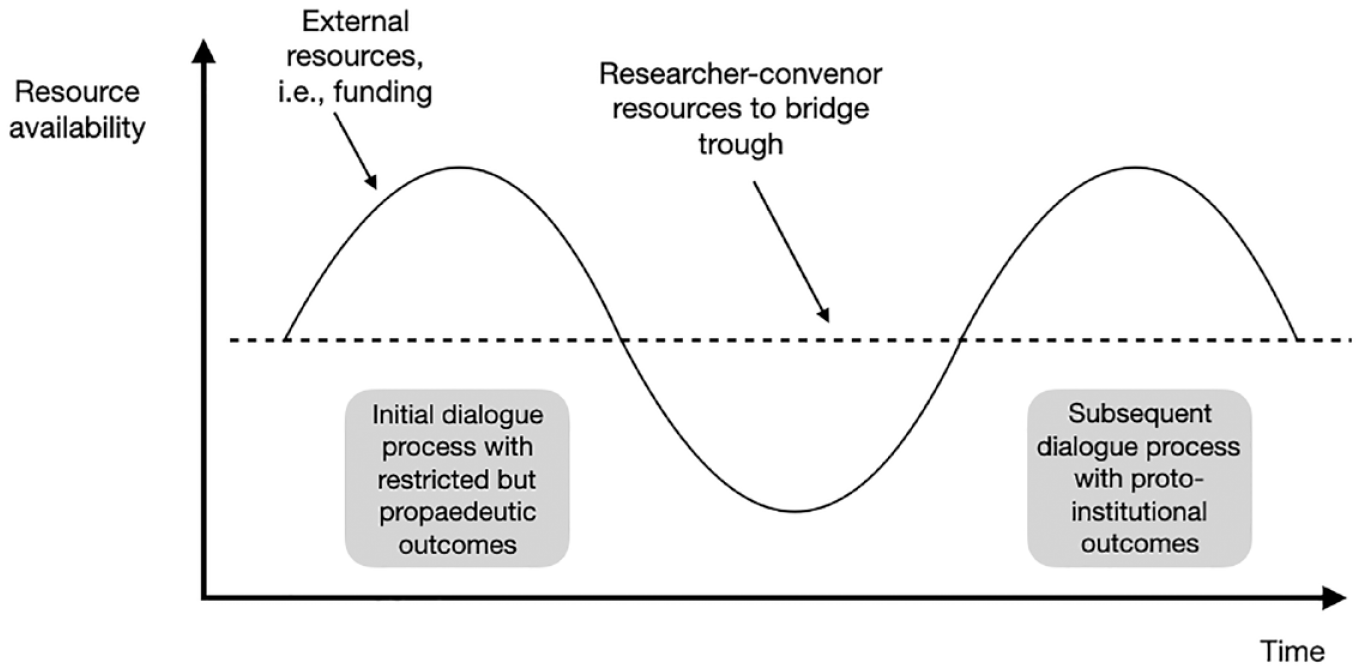
Schematic illustration of researcher–convenors bridging an intermitted period of resource scarcity between dialogue processes with propaedeutic and proto-institutional outcomes.
Convening tensions
The convenor role tension
This refers to the tension between expectations to provide content expertise versus process custodianship. It became prominent already in the first workshop that established the Food Lab in 2009, in which a key theme was the pricing of food products in various stages of the supply chain (Hamann et al., 2011). Some participants in the workshop identified this as a form of knowledge that should have been available on the basis of prior research, and they looked to us, as researchers, to provide such information and also to provide recommendations as to how to address possible inefficiencies or uncompetitive practices. One participant described this desire for ostensible objectivity as follows: ‘Everyone uses his or her own backyard researchers: You are not entitled to your own facts’ (quoted in interview synthesis document, 12 March 2010, page 31). However, although we supported the objective of bringing reliable information to bear, we saw our role quite differently as conveners in this specific setting, arguing (somewhat naively) that our ambition was to bring various supply chain actors into conversation to enable the kind of transparency that would reduce consumer prices.
This tension between content expertise and process custodianship arose repeatedly and in diverse ways. Especially in the first few years, dialogue participants frequently expressed confusion about our roles, and we experienced contradictory expectations. On one hand, participants expected us, as researchers, to bring content expertise into our discussions, and to report on research that was rigorous and defensible, as noted earlier. On the other hand, participants expected us, as convenors, to design and implement the dialogue process in a way that was inclusive, fair, and effective. We were expected to create a platform for diverse stakeholders in the food system, whether or not we personally agreed with their perspective or analysis. For instance, following one of the learning journeys in 2010, one participant noted, ‘I loved the fact that we were from different disciplines and perspectives but all looking at and concerned about hunger and poverty’ (quoted in learning journey summary report, 15 June 2010, page 5).
This emphasis on including diverse perspectives was sometimes especially difficult for other researchers to stomach. For example, in the ‘Scenarios process’ in 2014–2015, one of the participants was a well-known scientist. He vocally objected to us including in our workshop summary a perspective that he felt was misguided, and he complained that his ostensibly objective assessment was not sufficiently prioritized. Even though our own scientific training and worldview were aligned with his assessment, we nevertheless insisted on reflecting the diversity of views and experiences, guided by our broader theory of change, and this led to his (vocal) departure from the process – an outcome that we struggled to come to terms with, initially.
This tension between different expectations surrounding our convening role, between content expertise and process custodianship, was a ‘performing paradox’ because it was a ‘persistent [contradiction] between interdependent elements’ (Schad et al., 2016: 10), specifically between contradictory roles and behaviours (Jarzabkowski et al., 2013; Lüscher and Lewis, 2008). These role expectations were contradictory because we felt unable to respond to both at the same time, and they were interdependent and persistent because both elements – content and process – were inherent, necessary dimensions of dialogue.
The change orientation tension
This is the tension between expectations for us to endorse and advance either a functional innovation or a radical advocacy orientation to food system change. It emerged with regard to the convictions and associated identities related to the kind of change that should be fostered in the food system. These postures relate to each other relative to the food system’s ‘value regime’, that is, the political arena in which government actors, business, and civil society interact in a ‘war of position’ to shape economic models, cultural values, and governance structures (Levy et al., 2016). Specifically in the food system, Holt Giménez and Shattuck (2011) highlight the predominance of the ‘corporate food regime characterized by the unprecedented market power and profits of monopoly agrifood corporations . . . and growing opposition from food movements worldwide’ (p. 111). These authors identify ‘trends’ in how different actors either defend or attack this regime in ways that markedly shaped participants’ engagement in our Food Lab and their expectations of us as convenors.
Some actors in the food system, including especially business representatives and some from government, emphasized the need for what we are calling functional innovation. 4 We are using ‘functional’ in the sense developed by Parsons (1951; see also Burrell and Morgan, 1979), denoting a concern for the need to keep the food system functioning while pursuing (or perhaps even resisting) change. Consequentially, the changes that were considered feasible or desirable were generally small and incremental, suggesting shifts in rules or behaviours but not disruptions or alternatives to the prominent role of incumbent market actors.
However, those advocating for radical change argued that the structure of the food system and specifically the profiteering and overwhelming market power of large companies were the root causes of hunger (e.g. Satgar, 2015). Consequentially, incremental innovations within this structure would do little but entrench these dominant actors’ position. Instead, disruptions to the food system and the establishment of alternative food production and distribution networks were called for.
These contrasting orientations influenced our efforts to convene the Food Lab in diverse ways. For a start, those on the extreme ends of the spectrum had little interest in participating in the dialogue processes, despite our ongoing efforts to involve them. Adherents of a strong radical view considered any dialogue that included corporate actors as necessarily an accommodation exercise, buttressing a system in need of more fundamental disruption. For instance, one such activist complained in email correspondence that the Food Lab is governed by those who are ‘passionate advocates [for] supermarkets’ and other corporate actors (email, 12 June 2020). However, adherents of a strong functionalist perspective saw little point in engaging in dialogue, especially with critics of the corporate food regime. One interviewee expressed reluctance to engage in dialogue processes because government actors were seen to have a ‘punishment mindset’, and another noted that discussing innovation with others would be unlikely because ‘people refuse to share it because they think it could represent some competitive advantage’ in a system relying on competition (quoted in Hamann et al., 2011: 589).
Moreover, as convenors, we were repeatedly challenged to shift the strategy and content of the Food Lab into either a functionalist or radical orientation. For example, in 2016, Lungelo, a prominent participant in our Scenarios process and a human rights lawyer, wrote a passionately argued letter to the Board arguing that the Food Lab was doing too little to address the fundamental inequalities in the food system. His demand was that we should put much more emphasis on ‘advocacy – putting research into action!’ This was an important challenge to our role as convenors because we were concerned that if indeed we did emphasize such a substantive position, we would likely constrain our ability to convene inclusive dialogue among diverse perspectives – that is, the change orientation tension intersected with the convenor role tension described earlier, as we will discuss in more detail below.
These ideological commitments also shaped perceptions of who was considered to be legitimate participants in any meaningful dialogue. This made it difficult for us, as convenors, to bring such actors together in ways recommended by dialogue scholars, as outlined in the ‘Theoretical background’ section earlier. Such dynamics affected us, too, because we were frequently expected to ‘show our colors’, that is, to commit ourselves overtly to one or other perspective, as expressed in Lungelo’s letter mentioned earlier. The expectations associated with these contrasting change orientations were paradoxical because they were contradictory, persistent and inter-related (Schad et al., 2016), and more specifically they created a ‘belonging paradox’ because they invoked social identities and corresponding beliefs and values (Jarzabkowski et al., 2013; Smith and Lewis, 2011).
Intersecting convening tensions
The two tensions outlined earlier were orthogonal to each other and thus created four different convenor role constellations, as depicted on the left-hand side in Figure 2. In the role constellation of ‘radical expert’, we – as convenors – were expected to provide or endorse evidence-based knowledge on powerful actors’ complicity in perpetuating the deeply unjust food system. As ‘radical custodian’, we were expected to exclude such powerful actors from the dialogue process, because their inclusion would merely enhance their ability to perpetuate the system. As ‘functional expert’, we were expected to empirically underscore the importance of maintaining the functioning of the system, and as ‘functional custodian’ we were expected to exclude voices calling for radical change. Especially in the first few years of the Food Lab, we experienced these role constellations to be at odds with each other, and so we felt the corresponding, contradictory expectations and our occasional shifts from one constellation to another, to be deeply unsettling. In other words, our response to these paradoxical expectations was to engage in a kind of polarized splitting (Jarzabkowski et al., 2013; Poole and Van de Ven, 1989), awkwardly shifting and feeling torn between contradictory roles. This is depicted by the flashes of conflict on the left-hand side of Figure 2.

Convenor role constellations and the shift from shallow to deep dialogue.
The shift from shallow to deep dialogue
In more recent years, from about 2015, the severity of our embodied unease associated with the convening tensions diminished. The tensions themselves did not go away, but our felt experience of feeling pulled and torn became ameliorated. There is no specific transition point, but the overarching cause of this transformation was our emerging cognitive and embodied appreciation of a deeper form of dialogue and our corresponding role as convenors. The outlines of this deeper conception of dialogue, based on the writings of Buber (1958), Bakhtin (1990) and Gadamer (1977), were outlined in the ‘Theoretical background’ section above, though we only came to appreciate this literature and its implications later on. In essence, we shifted our view of dialogue from a shallow conception focused on consensus-oriented debate to a deep conception focused on agonistic engagement (Mouffe, 1999) and authentic intersubjective relating (Buber, 1958; Nilsson, 2015). In the following, we describe two specific mechanisms, through which the shift to deep dialogue helped ameliorate the experienced severity of convening tensions, and this is also illustrated in Figure 2.
Radical inclusion
This refers to resisting expectations to exclude any specific actor, but proactively emphasizing authentic inclusion of marginalized actors and diverse knowledge claims. We developed this posture in response to the experienced severity of the convening tensions outlined earlier. The rationale for this shift in approach began to emerge in the ‘Supporting smallholder farmers 1’ dialogue process. That process raised awareness among participants that smallholder farmers themselves were curiously absent in these discussions. For instance, a group of students noted on the basis of their interviews with diverse Food Lab participants the concern that small-scale farmers are among ‘the least represented in the Food Lab’ (MBA student report, 12 November 2012, page 40). The ‘Supporting smallholder farmers 2’ dialogue process was thus designed with much more explicit emphasis on enabling diverse groups of smallholder farmers to participate. This had substantive impact on the content, process, and outcomes of that dialogue, including for example the establishment of a bespoke training programme and peer certification system for regenerative farming practices among smallholders (for more detailed discussion of this process and its outcomes, see Drimie et al., 2018).
Radical inclusion required that especially the commonly marginalized participants were encouraged and enabled to share their perceptions and experiences in a way that would be respected and valued, even if such perspectives did not conform to criteria of rigour of mainstream science. In addition, we emphasized the need to recognize historical injustices, including epistemic injustices (Fricker, 2007), in our South African context. This meant that we needed to pay attention not only to enrolling marginalized actors into the Food Lab, as in the smallholder farmer example mentioned earlier; we also needed to proactively signal respect for indigenous knowledge systems. Relatedly, we put more effort into ensuring that the broader convening team in the Food Lab Board also became more diverse and representative of the various stakeholder groups in the South African food system.
Importantly, radical inclusion was a convening and facilitation challenge that went well beyond merely inviting commonly marginalized actors to meetings. To illustrate, consider one of the ‘hot moments’ in our analysis that arose when Rebecca was facilitating one of the workshops organized as part of the ‘Supporting smallholder farmers 2’ dialogue, as explained during an interview (11 June 2019):
5
There was this pivotal moment, in my mind, when the room seemed to re-constellate physically and there were these very engaged and very excited white men in the center of the room, taking advantage of the space for co-creation, and at the same time . . . the more rural people, poorer people, and black members were on the margins . . . and were much less engaged, their body language indicating that they were losing connection to the process. And when we named that it caused a lot of disturbance and anger. But one of the things that happened was that Scott [a white male] went straight to Lindiwe [a female black leader among smallholder farmers] and said, what am I missing here, and how can I support your leadership?
Rebecca’s quote notes some of the resistance and anger created by our willingness to surface exclusionary practices among white men accustomed to dominating discussions. One of these participants argued in an email after the above-mentioned episode, ‘“Race” is one of the great South African “fetishes.” I think that it was a bit insensitive of the facilitator to bring up the “race” issue, especially near the end of the meeting’. However, this ‘hot moment’ also showed the importance of preventing discussions from replicating long-standing patterns of exclusion and privilege, and this in turn allowed for novel collaboration responses to emerge. Scott explained his experience as follows:
I was shocked when [Rebecca] said that . . . I went straight over to Lindiwe and asked her about her experience of this group. She told me she wants to see more black leadership . . . [and she is] willing to lead such initiative. (email, 22 August 2023)
This conversation played a formative role in the development of a new training programme for smallholder farmers, as well as numerous farmer cooperatives’ adoption of agroecological farming practices. Lindiwe played a prominent leadership role in these initiatives, and she then also joined the Food Lab Board. Another leader among smallholder farmers, Ntsiki, joined the Board a few years later, and she summarized this progression on a public panel in March 2024 and in subsequent email correspondence as follows: ‘As small-scale farmers we face serious challenges, and these challenges cannot be addressed without us. Our participation in the Food Lab has given us some necessary influence to create relevant solutions’.
As indicated on the right-hand side of Figure 2, the convening principle of radical inclusion transcended the tension between the role constellations of radical custodian (expecting the exclusion of corporate actors) and functional custodian (expecting the exclusion of critical voices). No actors were to be excluded, but proactive emphasis was put on facilitating inclusion of marginalized actors. Using a paradox lens, this sometimes included the practice of ‘confrontation’ (Lewis, 2000; Lüscher and Lewis, 2008; Poole and Van de Ven, 1989) to bring latent tensions surrounding exclusion into clearer view, despite the discomfort that might create.
Actor complexification and role fluidity
This refers to conceiving actors not as representatives of institutional categories, but as complex ‘whole persons’ with multifaceted backgrounds, interests, and paradigmatic assumptions – and thereby loosening expectations of role conformance both for participants and for us as convenors. It represented an important shift from our approach in the early years of the Food Lab, when we were much concerned about ‘embracing the “right” kind of members’ (Vangen and Huxham, 2003a: S65). Our initial approach thus emphasized the need to ensure sufficient representation in our discussions from the key categories of stakeholder groups, that is, business, government, and civil society, and the diverse perspectives on the change orientation spectrum described earlier. Over the years, however, this emphasis on representation and actor categories – an important feature in ‘shallow’ conceptions of dialogue, as outlined in our theory background section – became more and more challenged and complexified.
An example of this arose in our Board, when one of the founding members of the Board, Laura, announced in 2013 that she was resigning from her day-job at a development bank. This organizational affiliation was important because the bank had played a role in supporting the establishment of the Food Lab and, more broadly, we had come to see Laura as representing development finance institutions and parastatal organizations as a category in our discussions. Hence, Laura announced that she would also be resigning from the Board. This triggered intense and long discussions that essentially centred on our conception of actorhood: Was Laura a Board member because she was representing a category of actors in the food system, or was there more to her role on the Board?
Indeed, this was a vexing issue also in subsequent discussions in the Board. It was still a topic of fervent discussion in 2018, when there was an effort to formalize the Board’s constitution and to include stronger emphasis on organizational or sectoral representation. The Board minutes include the following counterargument by one of us:
This is not a normal board. I’m concerned about introducing something quite alien into the organization . . . How do you define the point that we are representative of stakeholders? It’s a loaded topic. Who is representing whom on what basis and for what purpose? Representation, I believe, is antithetical to the type of togetherness we are trying to foster. It introduces a position-based bargaining approach to what we are doing here. Actually, we are not here to represent the interests of other organizations. That’s not to say that representativity isn’t important. But that is different. (Minutes of Board meeting, 14 September 2018)
The agreement that was eventually explicated in a document outlining rules and expectations for Board members noted that members should come from ‘across the spectrum of the food system so that a diversity of interests and perspectives will be available to inform debate and decisions’, and furthermore members are invited ‘by virtue of the skills, knowledge and/or expertise’. That is, some degree of institutional representation was required, but Board members were seen as ‘whole persons’ who brought a diverse array of experiences, insights, and questions to Board discussions. This seemed to us to reflect our experience that Board members and the participants in our dialogue processes contributed diverse and sometimes contradictory facets of their selves into dialogue – but only if the dialogue design and facilitation allowed for this.
An emphasis on ‘whole person’ participation also shaped our conception of our roles as convenors. Over the years, we became less constrained in defining ourselves as process custodians, and so we became less worried about occasionally making some substantive input in the discussions or even disagreeing with participants. We came to see such expressions not as a threat to our position as quasi-neutral convenors, but rather as a dimension of the broader dialogical intention of inclusionary, agonistic interaction between whole persons, rather than category representatives. In other words, the dialogical intent requires all participants – including the convenors – to bring in their perspectives, experiences, intuitions, and so on. In the act of deep dialogue, the intention is to move beyond participants’ formal roles and routines, and this includes our role as convenors or indeed as researchers. Participants cannot simply be there as representatives of a class or category (such as academic or convenor) – they have to be there as themselves, or it is not authentic, deep dialogue.
So, over time we came to recognize the difference between shallow dialogue, where the focus is on judging knowledge claims and seeking consensus, and deep dialogue, where the focus is on authentic intersubjective encounters. This was an experiential, embodied, and circuitous – and sometimes clumsy – process, also because only late in this process were we exposed to the resonant dialogue philosophy of Buber, Bakhtin, and others outlined in the theory section above. As our understanding of deep dialogue emerged, we began to consider it congruent that we, as researcher-convenors, would express our own understandings and insights. However, in so doing, it was important for us to model – or at least to demonstrate proactive effort towards – dialogical engagement, offering our perspectives but not asserting them or championing them in a contest or debating dynamic. As convenors, we needed to keep reminding everyone that the point is to surface many perspectives and forms of knowledge (including our own) and to let these perspectives interact, help shape each other, and provoke new understandings, without necessarily arriving at a consensus or dominant point of view.
The emergence of this embodiment of deep dialogue among both ourselves and some of our dialogue process participants was palpable in one of the ‘hot moments’ in our analysis. As convenors, we had invited a well-known critic of the corporate food regime, whom we will call Jenny, to deliver a speech at the launch of the Scenarios report in 2015. Her critique was more strident than we expected as she argued that the fact that we had included corporate managers in the dialogue process undermined any value or legitimacy its outcomes may have. She also objected to the way the final report referred to large-scale agricultural producers as being efficient. She used a metaphor from a Berthold Brecht poem, comparing the food system to a burning house. She argued that there is no point in trying to fix a burning house; whatever remains would need to be destroyed and a new house, that is, food system, would need constructing. 6 This prompted one of us, as one of the convenors, to offer an alternative metaphor: the food system more resembles a boat in need of reconstruction – but while keeping it afloat. Even though there was a strong urge to argue against Jenny’s provocative statements, we had learned that such debate could quickly deteriorate into conflict, and so the alternative perspective was given as an offer, rather than a definitive counterargument.
More importantly, we saw this conception of deep dialogue take root in participants’ interactions, even when challenged in such ‘hot moments’. This was evident also in the above-mentioned ‘burning house’ episode following Jenny’s speech, as described by one of the participants (interview, 11 June 2019):
The beautiful thing that happened, partly because of who was there and because of how we had interacted as a scenario team over the previous months, was that people like Andrew and others stood up immediately and said, ‘we know how to handle this kind of conversation, we know how to do this without polarizing; let’s take opportunity of this, you know, pretty hot moment, to stay engaged’. And so, it didn’t have this effect of excluding or closing down, it actually had the effect of engaging, and people like Peter took advantage; and he stood up and spoke strongly back to Jenny, but also not in way that dismissed her or the [activist movement].
As suggested in Figure 2, the shift from shallow to deep dialogue in our embodied understanding of our convening roles did not erase the tensions described earlier. But it diminished the felt experience and severity of the underlying tensions, and it allowed for more fluidity and movement between the different role constellations. From a paradox perspective, the conceptual and embodied shift to deep dialogue was a form of transcendence, or a ‘reframing [that] marks a dramatic change in the meaning attributed to a situation as paradoxical tensions become viewed as complementary and interwoven’ (Lewis, 2000: 764, emphasis in original). Reframing actors, including ourselves, as ‘whole persons’ with multifaceted and possibly contradictory aspects to their selves – as opposed to ‘unified egos . . . constructed as singular, coherent selves’ (Gergen et al., 2004: 54) – allowed us to move more freely and sometimes even playfully between what was previously seen as contradictory roles.
Discussion
By identifying affordances and tensions associated with researchers convening multi-stakeholder dialogue in addressing grand challenges, as well as the implications of a shift from ‘shallow’ to ‘deep’ dialogue, we contribute jointly to the scholarly conversations on research impact and multi-stakeholder dialogue. The extant literature on research impact has pointed to the possibility of researchers convening such dialogue (Jarzabkowski et al., 2023; Williams and Whiteman, 2021), but this has not been much explored. The literature on multi-stakeholder dialogue, meanwhile, has highlighted the challenges of leading such processes (Vangen and Huxham, 2003a) and voiced scepticism that researchers will have the requisite skills or training for such tasks (Gray et al., 2022). Based on our 15 years’ experience in convening and facilitating the Food Lab in South Africa, we suggest that there are some important affordances that enable researchers to play this role. We also identify challenging convening tensions, though their experienced severity may diminish with a shift in how dialogue is conceived.
The importance of researchers’ convening power in the context of grand challenges
The first affordance we identified was our convening power based on perceived neutrality and credibility. In the context of the ‘evaluative’ character of grand challenges and the multiple criteria of worth that become embroiled (Ferraro et al., 2015) – as is evident all too readily in global and national food systems (Holt Giménez and Shattuck, 2011) – the question of who might be accepted by diverse and sometimes conflicting actors as a legitimate convenor of dialogue is obviously of significant importance. It is thus notable that the literature on multi-stakeholder dialogue (and related fields, including conflict resolution) has largely focused on the functions and requisite skills of convenors or interlocuters (Fowler and Biekart, 2017; Gray et al., 2022), but has given much less attention to the institutional field positioning of such actors and specifically to other actors’ perceptions of this position. We argue that university researchers have a field position that offers them some convening power that, in some circumstances, may be as valuable as their ‘academic skills’ (Williams and Whiteman, 2021: 532) in addressing grand challenges.
Of course, perceptions of academic researchers and their credibility and relative neutrality may vary in different contexts. Our decision to commence with the Food Lab convening process was in part informed by our prior research that showed that many key stakeholders were supportive of academic researchers playing such a role in our context. A similar scoping exercise is likely useful for others thinking of embarking on such a convening process, and further research may help characterize the role of different institutional contexts in shaping who may have convening power and how it is used. Furthermore, actors’ perceptions of researchers’ suitability as dialogue convenors might change over time. We experienced this ourselves, for example, when we ‘lost’ participants such as the irate climate scientist mentioned above, who objected to our inclusionary approach in developing scenarios. Whether we, as researcher-convenors, are able to maintain momentum in a dialogue process will likely depend on the context, how we make use of our staying power, and how we respond to the convening tensions that likely emerge, as we discuss below.
Researchers’ staying power linking propaedeutic and generative dialogue
The second affordance we identified as researcher-convenors was our ‘staying power’ based on low cost and relative professional flexibility. We demonstrate the significance of this because of the way some of our initial dialogue processes struggled to achieve overt institutional outcomes but, in the longer term, offered important propaedeutic impetus; that is, they provided the necessary ‘groundwork’ in the form of shared understandings, motivations, and networks among actors for subsequent, more impactful dialogue processes some years later. There was thus an important role for us, as researchers, to keep the initiative alive during the resource-scarce periods between the propaedeutic and generative dialogues (which were 2–3 years long in our experience).
In some ways, our experience thus challenges the view that ‘deep engagement’ necessarily contradicts the demands of our academic day-job because it ‘requires a tremendous amount of resources . . . and does not easily fit within academic performance evaluation systems’ (Williams and Whiteman, 2021: 532). It is true that, over the years, the Food Lab has required significant resources, including many millions of Rands for facilitation services, administrative support, logistics and venues. But it is important to recognize the ebb and flow of both the demand and availability of such resources, so we suggest there is a particularly important role for low-cost convenors (such as researchers) to ‘carry the torch’ during the resource-scarce times.
Of course, we recognize difficulties associated with aligning this kind of engagement with academic performance evaluation systems, but they were not insurmountable in our experience. Compared to professionals in other sectors, including professional process facilitators, who account for their time on an hourly or daily basis, as researchers we have relatively more freedom in allocating our time and effort. It should be noted that this flexibility may vary, depending on the context. It is likely that academic job descriptions are not as constraining in South Africa as in some other places. We do not have a tenure system that is as regimented as in, say, competitive North American business schools, and more generally the publication demands are arguably not as strenuous. For instance, we were able to publish papers based on our work in the Food Lab in policy or sustainability science journals or as book chapters (e.g. Drimie et al., 2018; Hamann et al., 2011; Hamann and Faccer, 2017) and to have this recognized in our departments. Such publication outlets may not be much respected in the more narrowly defined performance expectations in other contexts, where this kind of scholarly engagement might fail ‘to garner university support . . . because it was not deemed real “research”’ (Gray, 2023: 182).
In other words, we were able to skirt the kind of rigid system boundaries that arguably make it difficult to collaborate with practitioners while prioritizing rigorous research outcomes (Kieser and Leiner, 2009). Future research could explore in more detail how institutionalized performance management approaches either foster or curb ‘deep engagement’ (Williams and Whiteman, 2021), including dialogue convening. Beyond representing a research opportunity in the traditional sense, we suggest it would be a fruitful avenue for ‘activist research’ itself to ‘expand academic incentive structures to encourage experimentation with activist research’ (Gray, 2023: 183).
Our finding focused on convening power also has implications for the literature on multi-stakeholder dialogue. The relative lack of success of our early dialogue processes is about more, in our analysis, than the concern that in the early ‘trial-and-error years . . . “failure” is common’ (Williams and Whiteman, 2021: 532). Rather, as researchers and/or convenors, we need to give more attention to the potential propaedeutic role played by such initial efforts, and the corresponding longer term, cyclical nature that may be an underappreciated but important and possibly generative feature of multi-stakeholder dialogue. The multi-stakeholder collaboration literature has long emphasized the need for trust to develop among participants and that this may have a cyclical, longer term dimension (Lawrence et al., 1999; Vangen and Huxham, 2003b). And scholars writing on researcher–practitioner collaboration have also recommended an analytical shift from discrete events to emergent process (Sharma and Bansal, 2020). But we extend the timeframe of such emergent and cyclical processes over many years and furthermore argue that such cycles likely involve multi-year hiatuses, where it may seem that not much is happening, but in fact there is an ongoing ‘fermenting’ of the ideas and relationships that were established in the initial dialogue process. The role of propaedeutic dialogues and the multi-year relationship between multi-stakeholder initiatives in a given institutional field deserve further research attention.
Convening tensions and the shift to deep dialogue
We identified two convening tensions between different expectations levelled upon us as convenors: the convenor role tension was between expectations to provide content expertise versus process custodianship, and the change orientation tension was between expectations to foster functional innovation versus advocating for radical system change. The first of these tensions resonates with previously identified challenges facing partnership managers as either quasi-neutral process custodians or making use of their convening role to shape substantive outcomes (Vangen and Huxham, 2003a; Van Hille et al., 2019). The second tension between fervently held social change orientations has not been described in the literature on multistakeholder dialogue or researcher impact, as far as we know.
Furthermore, the intersection between these two tensions gives rise to role constellations that we experienced in early years of the Food Lab initiative as being fundamentally at odds with each other. They created performing and belonging paradoxes (Jarzabkowski et al., 2013) that defined our experience as apprentice convenors, as we awkwardly oscillated and split ourselves between convening postures on the left-hand side of Figure 2. However, our experience and analysis showed that the felt severity of these tensions diminished over time, not because the underlying tensions disappeared, but because they could be transcended – ‘understood as complex interdependencies’ (Jarzabkowski et al., 2013: 249) – as we shifted our approach from shallow, consensus-oriented dialogue to deep, agonistic dialogue based on radical inclusion and complexified actorhood.
For the literature on multi-stakeholder dialogue and the possibility for researchers to be involved in convening such dialogue (Gray et al., 2022; Williams and Whiteman, 2021), the implication is that much depends on how we fundamentally define and approach dialogue. Our experience suggests that much is to be gained from shifting from a shallow form of dialogue, in which actors represent their institutional interests in seeking consensus, to deep dialogue, where actors are multifaceted selves engaging in agonistic yet authentic encounters (Buber, 1958; Mouffe, 1999), and where radical inclusion prioritizes the participation of the marginalized and of diverse knowledge systems (see also Gray, 2023).
But our experience suggests that cognitively embracing such a convening posture is not the same, nor does it directly lead to, actively embodying this posture. We had to learn over some years how to, for example, engage in ‘radical inclusion’ and confront powerful actors with their implicit or explicit exclusionary practice, despite the manifest discomfort or even conflict this might provoke. Relatedly, Jarzabkowski et al. (2024) caution that researcher–practitioner collaboration efforts should not ‘confuse co-creation with consensus’, and it is precisely those areas ‘where some participants vehemently oppose solutions proposed by others . . . where impact-oriented research is most needed, even if its conduct proves challenging’ (p. 13). Central to our notion of deep dialogue is that it is not about achieving consensus through debate but rather agonistic yet mutually respectful and supportive engagement, representing the intersection between the philosophy of Buber (1958) and the politics of Mouffe (1999). Given the common assumptions and associated normative behaviours that see dialogue as consensus-seeking, often based on forceful debate to identify superior positions, our experience is that embodying a shift to deep dialogue may initially meet with bafflement or even resistance, and this creates distinct challenges for researcher-convenors.
Our findings also have implications for the literature on paradox in researcher–practitioner interactions (Bartunek and Rynes, 2014; Parola et al., 2022; Sharma and Bansal, 2020). We augment this conversation by contributing the convenor role tension and the change orientation tension to the other tensions that may be salient in researcher–practitioner interactions (Bartunek and Rynes, 2014). We also underscore the importance of convenors’ and participants’ micro-practices as they respond to what we called ‘hot moments’, in which paradoxes become salient (Parola et al., 2022) – but we place these micro-practices into a broader reframing from shallow to deep dialogue, allowing for the transcendence of performing and belonging paradoxes. And again, this is not merely a matter of cognitive re-orientation or the adoption of socialization or other practices (Parola et al., 2022), or a rhetorical accomplishment (Bednarek et al., 2017). In our experience, it is both a philosophically informed conceptual reframing and a slowly emergent embodied capacity, fraught with awkward and sometimes amusing mishaps and occasionally painful lessons. Education and training will surely help in developing such understanding and capacity, but we would temper expectations that it will be a quick or easy process.
Conclusion
Some 15 years ago, we embarked on what turned out to be a surprisingly long-term action research project, in which we sought to convene dialogue between diverse stakeholders to help address the problem of hunger in South Africa. We embraced this ambition in no small measure due to some naïveté of what this would demand of us (Gray et al., 2022; Parola et al., 2022). Even so, we discovered some affordances associated with our role as researcher-convenors that helped us bring together sometimes distrustful and sceptical actors and bridge resource availability troughs between propaedeutic and institutionally impactful dialogue processes. We also identified convening tensions based on contrasting expectations of how we should ‘show up’ as convenors. Over a period of some years, we came to shift our conceptual and embodied approach to dialogue in ways that mitigated and transcended these tensions.
Would we recommend such a convening role to other researchers? Only with some circumspection. Some academic institutional contexts are probably more conducive to this kind of thing than others, and some researchers will feel a stronger proclivity than others. And the recommended shift from shallow to deep dialogue involved not only a cognitive reframing, but also a hard and slow process of coming to embody associated convening approaches and capacities. This process might be quickened by insightful education and training, but it will probably still require much commitment. All in all, it has been a worthwhile learning process, in our experience.
Footnotes
Acknowledgements
The authors are grateful to the many people who have made diverse contributions to the Southern Africa Food Lab over the years. In first instance, this includes Milla McLachlan, the founding chair of the Food Lab Board, Tatjana von Borman, the current chair, as well as past and present Board members: Mervyn Abrahams, Kenneth Carden, Andries Du Toit, Kennedy Dzama, Julia Harper, Nonhlanhla Joye, Candice Kelly, Florian Kroll, Tozamile Lukhalo, Yandiswa Mazwana, Mthetho Mkhungo, Norah Mlondobozi, Steve Mohlabi, Busiso Moyo, Dineo Ndlanzi, Tsakani Ngomane, Hlami Ngwenya, Paula Nimpuno, Kevin O’Brien, Juanita Pardesi, Lisa Ronquest, and Sasha Stevenson. Important administrative support has involved Carolyn Cramer, Rosey Downey, Abigail Harper, and Susan Marais. They also owe much to Colleen Magner, Rachel Jones, Adam Kahane, and their colleagues at Reos Partners, as well as Hal Hamilton. In its early years, the Food Lab was supported by the University of Cape Town Graduate School of Business and then the University of Stellenbosch Faculty of Medicine and Health Science. Since then, it has been hosted by the University of Stellenbosch Faculty of AgriSciences and more recently the Seriti Institute. Funding for the Lab was provided by GIZ, Ford Foundation, DG Murray Trust, Nedbank Green Trust, WWF-SA, Stellenbosch University, and many others mentioned on the Food Lab website ( ). Earlier versions of this article benefitted from discussions in an EGOS track convened by Stephanie Creary, Tom Lawrence, and Nelson Phillips, as well as from comments by Barbara Gray and others at the 2024 Cross-Sector Social Interactions symposium at the University of Cape Town Graduate School of Business. They are also grateful to three anonymous reviewers and to Amanda Williams for her sterling editorial guidance.
Funding
The author(s) disclosed receipt of the following financial support for the research, authorship, and/or publication of this article: The Southern Africa Food Lab has received funding from diverse funders over the years, as noted in the acknowledgements.