



Abstract
Adopting a flat ontology, we discuss how phenomena of societal concern are connected to organizational routines. We conceptualize grand challenges as large patterns of actions to overcome the micro-macro divide prevalent in existing research. We introduce spatial, temporal, and agentic relations as three interrelated aspects of scale that are of particular interest and demonstrate how social phenomena may be approached through these relations. Focusing on the situated enactment of routines allows us to identify weakening and strengthening between actors and their actions as important processes that reflect the continuous patterning of grand challenges. We contribute to the literature by highlighting the consequentiality of mundane actions and by questioning the dominant approach to change in research on grand challenges. Our insights offer several practical implications for intervening on grand challenges.
Keywords
Introduction
The crisis is everywhere, massive massive massive. And we are small. But emergence notices the way small actions and connections create complex systems, patterns that become ecosystems and societies. [. . .] How we are at the small scale is how we are at the large scale [. . .] what we practice at the small scale sets the pattern for the whole system. (brown, 2017: 6)
In this article, we ask how large phenomena of societal concern such as social inequality, climate change, or environmental pollution (Bapuji et al., 2018; Howard-Grenville et al., 2019) are connected to organizational routines. Defined as “repetitive, recognizable patterns of interdependent actions carried out by multiple actors” (Feldman and Pentland, 2003: 95), routines are considered central to organizational functioning (Nelson and Winter, 1982; Parmigiani and Howard-Grenville, 2011). Yet, as routines are often dismissed as mundane and small-scale practices with limited effects, existing research has paid little attention to how grand challenges are reflections of the patterns that are created through our everyday actions as suggested by the introductory quote.
As recently summarized by Seelos et al. (2023), existing research on grand challenges often embraces either a macro perspective, arguing for the need of big and structural changes that require collective action (Ferraro et al., 2015; Gioia, 2023; Grimes and Vogus, 2021), or a micro perspective, which zooms in on specific initiatives that build on local actions (Mair et al., 2016; Porter et al., 2020). While different in terms of scale, both perspectives focus on identifying barriers that prevent addressing grand challenges (e.g. Dorado et al., 2022; Gonzalez-Arcos et al., 2021; van Wijk et al., 2020; Wright and Nyberg, 2017), or strategies that can be used to tackle them (e.g. Chatterjee et al., 2023; Mair et al., 2016; Porter et al., 2020). Despite many efforts, it has been observed time and again that even the most successful policy changes and initiatives often do not have sustainable effects on the grand challenge they seek to tackle (Brough et al., 2020; Grodal and O’Mahony, 2017). Some policies and initiatives may even backfire as they have unintended and harmful effects on targeted as well as non-targeted issues of concern (Khan et al., 2007; Martí, 2018).
In this article, we suggest adopting a “flat ontology” (DeLanda, 2016; Latour, 2005; Schatzki, 2011; Seidl and Whittington, 2014) to overcome the binary distinction between the micro and the macro, and to develop a more nuanced understanding of the dynamics of grand challenges. The ontological principle of flatness emphasizes actors and their actions and helps us therefore in rethinking scale as we re-imagine the connection between routines and grand challenges. Seeing the world as flat requires us to let go of our tendency to focus on entities and ultimate solutions (Feldman and Pentland, 2022) and reasoning based on a priori characterizations (Sele, 2021). Shifting the focus to what is happening in situ enables us to disassemble social phenomena as they emerge from actions and relations (Callon and Latour, 1981; Feldman and Pentland, 2005). We, thus, suggest focusing on the following three interrelated aspects of scale—spatial, temporal, and agentic relations—as they turn out to be useful for tracing the enactment of horizontal connections instead of mapping vertical or hierarchical orders.
To trace actors and their actions, we turn to research on routines as generative systems, commonly labeled “routine dynamics” (Feldman and Pentland, 2003). This stream of research has been building on ideas of flatness (D’Adderio, 2008; Feldman et al., 2022; Sele and Grand, 2016). Rooted in practice theory, routines are seen as the fabric constituting and reproducing society (Bourdieu, 1977; Giddens, 1984). Routines may be mundane and may even appear trivial, but they are by no means inconsequential (Deken and Sele, 2021; Feldman and Orlikowski, 2011). Quite the contrary, we posit that routines play an important role in the world’s (in-)ability to address grand challenges because they “reproduce patterns of [both] social equality and inequality” (Feldman and Pentland, 2022: 846).
We build on Feldman and Pentland (2022: 847) who encourage scholars interested in grand challenges to create a deeper understanding of their dynamics in order to avoid doing “more harm than good.” Indeed, focusing on the situated enactment of routines enabled us to identify weakening and strengthening connections between actors and their actions as important processes reflecting the continuous patterning of grand challenges. Our insights resonate with Benjamin’s (2022) call that we need to orient ourselves “differently toward small-scale, often localized, [mundane and everyday] actions” (p. 19) in order to acknowledge their consequentiality. Adopting a flat ontology allows us to see how actions and their consequences vibrate through large patterns of actions and how the latter is (re)produced in action. Hence, we argue that we need to reconsider how we see change and abandon the idea “that ‘scaling up’ should always be the goal” (Benjamin, 2022: 19). Assuming flatness avoids the pitfall of seeing change as inherently positive as it allows us to understand how we make the patterns that characterize grand challenges in the first place, for example, through adopting biased hiring routines or wasteful consumption routines. Hence, by seeing grand challenges as enacted phenomena, this article demonstrates how we are all pattern makers.
The micro-macro divide in research on grand challenges
In recent years, research on grand challenges and the responsibility of businesses in addressing the UN Sustainable Development Goals (United Nations, 2015) has attracted considerable attention in management and organization research (Brammer et al., 2019; Ferraro et al., 2015; George et al., 2016; Gümüsay et al., 2022; Howard-Grenville and Spengler, 2022; Jarzabkowski et al., 2019; Nyberg and Wright, 2022). Grand challenges are commonly defined as “massive social and environmental issues that transcend national borders [. . .] and that have potential or actual negative effects on large numbers of people, communities, and the planet as a whole” (Voegtlin et al., 2022: 1-2). Scholars have also described them as evaluative phenomena characterized by high complexity and uncertainty (Ferraro et al., 2015), which makes it difficult to address grand challenges and determine the effects of interventions (Feldman and Sengupta, 2020).
Prior research on grand challenges can be roughly divided into two different perspectives (Dittrich, 2022; Seelos et al., 2023). The “macro perspective” strives to understand how big initiatives, such as governmental regulations or international treaties designed to address grand challenges, can achieve the set goals. Schüssler et al. (2014), for instance, examine how United Nations climate conferences can be seen as events that strive to tackle climate change, and how the organization of these events has different effects on the configuration of the climate policy field. Gonzalez-Arcos et al. (2021) study how a nationwide ban on plastic bags in Chilean supermarkets failed to reduce the use of plastic as intended. While consumers adjusted to the ban by bringing their own bags to the supermarket, they now needed to start buying plastic bags for their waste bins for which they had previously used the store-provided bags. Grodal and O’Mahony (2017) examine how the grand challenge of fighting cancer through developing molecular manufacturing was displaced over time. As Markman et al. (2019) summarize, “a prevalent view is that either big governments or multinational corporations tackle such challenges—sometimes with financial support from endowments” (p. 371).
The “micro perspective,” by contrast, gives ontological priority to local events and processes. These studies zoom in on specific initiatives, either initiated by non-governmental organizations (NGOs) or corporations. They start with local actions and examine how these actions may or may not have wider impacts (Chatterjee et al., 2023; van Wijk et al., 2020). Mair et al. (2016: 2037), for example, focus on inequality in India and show that this grand challenge is locally enacted through “[p]ersistent patterns of interaction and behavior reinforcing social divides.” Their study suggests that inequality can be addressed through designing small-scale interventions in specific villages, a strategy that they label “scaffolding.” Building on the notion of robust action strategies (Ferraro et al., 2015; Gehman et al., 2022), Porter et al. (2020) study the environmental initiative “Save Our Oceans.” They suggest that changes can be scaled up by sustaining engagement and generating novelty over time. In their study of corporate efforts to tackle climate change, Wright and Nyberg (2017) show how environmental initiatives are often off to a good start but fall flat as other priorities take over. But whereas the observed companies were motivated to engage in climate change initiatives, they eventually bounced back to business as usual. As stressed by Berrone et al. (2016: 1941), even if “grand challenges [. . .] are global in nature, they are instantiated in local [. . .] contexts.”
Ultimately, both perspectives seek to examine how initiatives can have a larger impact and argue for the “need to deepen our understanding of the connection between organizational action and field-level changes” (Ferraro et al., 2015: 364). However, no matter whether they apply a micro or a macro perspective, the accounts mainly focus on identifying barriers that prevent addressing grand challenges and strategies to tackle them. While we agree that understanding such linkages is important, we argue that the prevailing fixation on scale in a hierarchical or linear sense is not particularly helpful. Scholars have, for example, highlighted the importance of considering local contexts within the macro perspective to better understand how interventions are (not) taken up locally (Mitrano and Wohlleben, 2020), and of overcoming barriers to ensure that local initiatives are scaled up within the micro perspective (van Wijk et al., 2020). Seen this way, we seem to be caught in a “painful oscillation between two opposite poles” (Latour, 2005: 168) wherein “‘micro’ and ‘macro’ seem to be two different planets ‘influencing’ one another” (Czarniawska, 2004: 779). We argue that such a dichotomous view hampers our understanding of the continuous patterning of grand challenges and distracts us from gaining insights into how organizations can become part of a solution (Howard-Grenville et al., 2019).
Toward a flat ontology
To move beyond the distinction between the micro and the macro, we propose flatness as a well-suited ontological principle (Seidl and Whittington, 2014). A flat ontology (DeLanda, 2016) allows us to overcome the prevalent fixation on scale as level, length, or size, which juxtaposes the local against the global, the short-term against the long-term, or small actors against big actors, and thus raises the question of whether social phenomena should be studied through a micro or a macro perspective (Marston et al., 2005; Schatzki, 2011). According to Latour (2005)—a vocal critic of multi-scale models—researchers need to fundamentally rethink how they approach social phenomena and become “flat-earthers of social theory” (p. 171). In his view, considering scale as an ordering device is problematic as it assumes:
An order relation that goes from top to bottom or from bottom to up—as if society really had a top and a bottom; it implies that [. . .elements on the] macro-scale [are] of a different nature and should be studied thus differently from element[s . . . on the] micro-scale. (Latour, 1996b: 5)
We argue that adopting a flat ontology bears theoretical and methodological opportunities for overcoming the micro-macro divide. First, a flat ontology rejects the assumption of levels that are ordered in a vertical hierarchy of nested systems altogether (Buckley et al., 2017; Grewatsch et al., 2023). Instead, it emphasizes horizontal connections that stretch out sideways (Seidl and Whittington, 2014) and assumes “a world in which all [things] are on the same playing field” (Harman, 2011: 177). Schatzki (2011) argues that “social life does not admit levels” (p. 15) because the social is always constituted by actions. In other words, there is nothing above or below actions performed by actors. Second, proponents of flatness argue that small and large phenomena are composed of the same constitutive elements as they are simultaneously actors and networks (Latour, 1996b). This implies that grand challenges do not have a different composition or are different in nature than organizations or routines. In the words of Deleuze and Guattari (1987), they are all assemblages wherein heterogeneous elements are arranged and rearranged. Actors wax and wane in and through connections, which enables researchers to inquire about the “how” of such processes. As Schatzki (2011) puts it, the focus on something small or large is a methodological, not an ontological choice.
In this view, the difference between phenomena is their spatial-temporal extension and the agency they gain through the situated enactment of actions. We, therefore, introduce spatial, temporal, and agentic relations as three interrelated aspects of scale, and discuss how they enable researchers to approach social phenomena through a flat ontology.
Spatial relations: beyond the local-global divide
A flat ontology conceptualizes space as horizontal connections (Czarniawska, 2004), which implies that organizing is characterized by spatial complexity (Jensen and Sandström, 2020). Questions of where something starts or ends may hinder us from capturing relevant dynamics due to their focus on fragmentation, or what Mol (2002) calls “manyfoldedness” (p. 83). Actions happen in relation to each other, which means that “no place dominates enough to be [just] global and no place is self-contained enough to be [just] local” (Latour, 2005: 204). If we consider space as multiple, it is extremely difficult to clearly map actions into different spaces or draw fixed boundaries around phenomena because they are in constant flux and temporary in nature. The question is thus less related to how micro actions can be scaled up, or how macro initiatives can be pushed down successfully, and more to how the direct or indirect connecting of actors and their actions (re-)produces social phenomena.
Temporal relations: beyond short-term and long-term comparisons
A flat ontology questions the notion of progress as a linear concept (Benjamin, 2022). Actions rarely happen according to clear temporal trajectories as their emergence depends on many other actions. The consequences of actions can therefore not be known in advance. As we have limited knowledge about the future, we have to let go of our tendency to examine whether the long-term “beats” the short-term (Bansal and DesJardine, 2014) and instead focus on the here and now. Through this lens, we can focus on how initiatives leave marks and traces on how actors and their actions are more or less temporally related to each other.
Agentic relations: beyond small and big juxtapositions
A flat ontology emphasizes how actors of all sorts continuously gain or lose strength. However, whether they are macro-actors—understood as momentarily powerful and durable—is not a given; it is the momentary consequence of actions (Callon and Latour, 1981). As Latour (1986) explains, “society [and other concepts] is not what holds us together, it is what is held together. Social scientists have mistaken the effect for the cause, the passive for the active, what is glued for the glue” (p. 276). This implies that actors are made, and in their making, they all hold the potential to transform, distort, or modify social phenomena. A flat ontology, in turn, requires us to not assign agency a priori but to capture what is happening and what makes certain actors smaller or bigger than others.
Mobilizing routine dynamics: grand challenges as large patterns of actions
Adopting a flat ontology requires us to shift from characterizing grand challenges on different levels to capturing how they are continuously produced and reproduced. The “in the making” of grand challenges relies on a vast number of actors (Ferraro et al., 2015) and the routines they perform (Feldman and Pentland, 2022). In the words of Czarniawska (2004: 785), we can conceptualize and approach grand challenges as “interconnected acts of organizing” or, as we term it, “large patterns of actions.” The scholarly discussion on the dynamics of routines seems apt in this endeavor as this research seeks to trace actors and their actions (Pentland and Feldman, 2007) examining the “process[es] through which connecting happens and connections are achieved” (Sele, 2021: 77).
Organizational routines are commonly defined as “repetitive, recognizable patterns of interdependent actions carried out by multiple actors” (Feldman and Pentland, 2003: 95). They hold a strong task orientation, which means that patterns of actions are “enacted in order to do something” (Feldman, 2016: 24). Yet, research has shown that while the repetitive enactment of patterns of actions creates familiarity and guides future actions, these patterns are inherently dynamic as no routine persists indefinitely and completely (Feldman et al., 2016). The concept of performing and patterning is useful in understanding how routines evolve and are shaped in action (Feldman, 2016). Performing means that actors enact a routine at different points in time and in particular places. The performance of a routine thus refers to the actual pattern of actions that we can observe in practice (Feldman and Pentland, 2003). Patterning, by contrast, refers to “the mechanisms that routine participants enact to create and recreate patterns [of actions]” (Danner-Schröder and Geiger, 2016: 656).
The performing of routines can lead to anything from relatively stable to drastically changing patterns of actions, which suggests that routines are the locus of stability and change (Feldman, 2000; Feldman and Pentland, 2003). They may stay rather stable, for instance, when actors effortfully try to repeat them according to a standard (Danner-Schröder and Geiger, 2016) or existing norms (Mirc et al., 2023). While this reinforces existing patterns of actions, it does not imply that routines are always performed in exactly the same way. Indeed, actors often take additional actions to protect the established pattern of actions (Bertels et al., 2016). Hence, the stability of routines is an effortful accomplishment on behalf of those performing them (Pentland and Rueter, 1994). More often than not, routines are performed in slight variations and their patterns of actions change gradually over time (Bucher and Langley, 2016; Sonenshein, 2016). This can either happen because actors envision better ways of performing the routine (Feldman, 2000), or as actors try to enact new means and ends of a routine (Dittrich and Seidl, 2018). At times, routines may change quite drastically because organizations face a crisis (Cohendet and Simon, 2016; Zbaracki and Bergen, 2010) or attempt to restructure certain processes (Jarzabkowski et al., 2012; Rerup and Feldman, 2011). However, stability and change are not limited to the routines themselves. To the contrary, several scholars have highlighted the generative potential of routines in and for organizational outcomes such as innovation (see Deken and Sele, 2021), and thus focus on how the enactment of routines produces “the [patterned] effects that we see” (Howard-Grenville, 2021: 8).
Routine dynamics research advocates for a relational approach (Feldman et al., 2016), which is promising to understand the assembling and disassembling of large phenomena such as grand challenges (Latour, 2005, 2018). In this view, actions are related to each other without a hierarchical or linear order. As Pentland et al. (2020) argue, “[t]he actions are not self-contained or independent; the significance of each action emerges from its relationship to other actions” (p. 8). Accordingly, a flat ontology “draws our attention to the arrows and insists that we examine not just the fact (the correlation) but also the how (the process) of connecting” (Feldman, 2016: 37). Assuming flatness allows us to see the world as open-ended all the while focusing on its becoming and the role of actors’ situated actions in its dynamics. They exist in their relations but cannot be reducible to them as social phenomena always surpass what we can grasp (Harman, 2011).
In sum, the difference between routines and grand challenges lies in their horizontal connections. Building on an example by Schatzki (2011), everything (including routines) is simultaneously part and whole in such assemblages (Deleuze and Guattari, 1987). For example, a coal-based energy production routine performed within a power plant is part of the patterns of actions that constitute the operation of an energy company as such. Yet, the same patterns of actions are part of what reproduces the grand challenge of climate change as they emit CO2. In this sense, small patterns of actions cannot explain large patterns of actions or vice versa, as if one were the independent and the other the dependent variable (Seelos et al., 2023). There is no difference in the performance of the coal-based energy production routine depending on whether it is studied and conceived of as part of the smaller patterns of actions that constitute the operation of the energy company, or as the larger patterns of actions that constitute the grand challenge of climate change. Accordingly, they are the same. A flat ontology does not imply an aggregational logic (Pentland, 2011) and is best described as a horizontal network-tracing activity (Sele, 2021) wherein we “should not consider that the macro encompasses the micro [. . .] but that the small holds the big” (Latour, 2005: 243).
Pattern making in action
We have argued that we need to stop giving ontological priority to either the micro or the macro and instead adopt a flat ontology, which allows us to see grand challenges as large patterns of actions. To explore and illustrate the potential of our proposed perspective, we now elaborate on the dynamics of pattern making in action and, thus, on how grand challenges are held together through performing and patterning. To this end, we mobilize the analytically separated but empirically entwined aspects of scale—namely spatial, temporal, and agentic relations. Our insights on the waxing and waning of grand challenges are based on a reanalysis of two empirical articles with highly interesting, fine-grained, and longitudinal data. In particular, we depicted Mair et al.’s (2016) study on addressing social inequality in rural Indian villages and Khan et al.’s (2007) study on the eradication of child labor in the production of soccer balls in Pakistan.
Illustration 1: unraveling the connecting of actors
This first illustration is based on a study by Mair et al. (2016) that focuses on an initiative in India targeted at mitigating social inequality in “small-scale societies” (i.e. rural villages). The authors argue that inequality is the product of “categories (such as gender, caste, and class)” and that this order of reality is “closely tied to a complex institutional grammar of social norms, rules, and conventions” (p. 2021). Studying the rolling out of said initiative led by the NGO “Gram Vikas,” they identify scaffolding as a driver of transformation and a way to overcome barriers in addressing grand challenges such as inequality at the local level.
Assuming flatness and re-analyzing their data with a focus on the performing and patterning of routines, we find additional aspects of what is happening. We begin our analysis by reversing how we approach social phenomena (Latour, 1986). Instead of assuming social categories and their inherent power as a cause for people’s actions, as one would do in a tall and level-oriented ontology (Seidl and Whittington, 2014), we see phenomena and their situated power as a consequence of actions and relations. This requires us to trace the constitution of grand challenges and how they are upheld. Whereas Mair et al. (2016: 2015ff) stress the importance of “determining an appropriate level for analysis” and the separation of “social problems and social systems,” we approach their data with a focus on pattern making. In particular, we mobilize Callon and Latour’s (1981) notion of macro-actors (see Feldman and Pentland, 2005; Sele, 2021 for a discussion), and analyze how actors gain respectively lose strength and durability as connections are assembled and disassembled in action. We focus on the performances of routines and ask ourselves how actors (got) enrolled (Callon, 1986) and how this process ultimately affected the (re)production of the large patterns of actions of social inequality. Figure 1 visualizes a part of the large pattern of actions and how changes in routines alter spatial, temporal, and agentic relations across different points in time. In the following, we use t1–t6 to refer to these points in time.
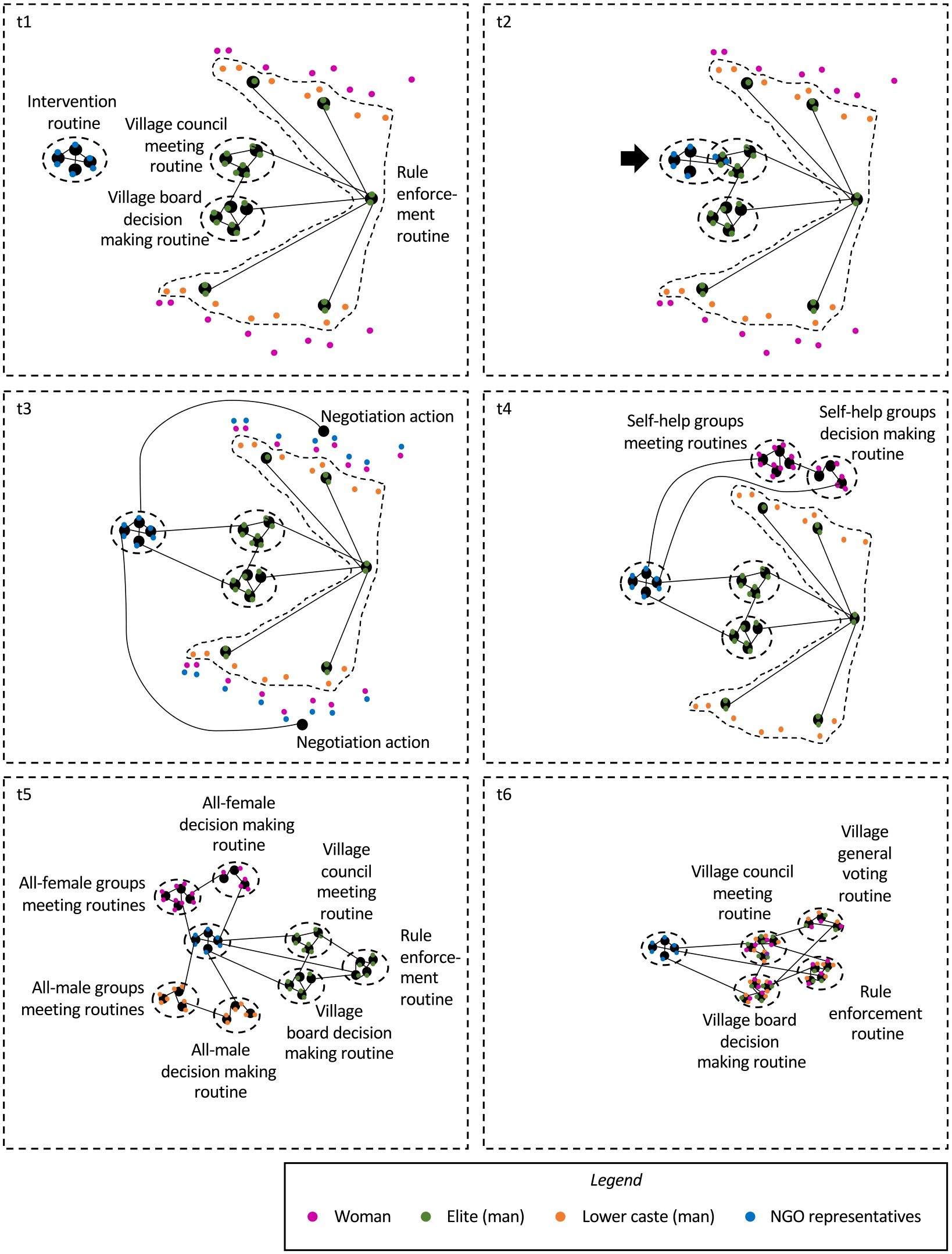
Visualization of Mair et al. (2016).
The empirical story told by Mair et al. (2016) reveals how Gram Vikas, in their attempts to create change, initially coopted established village routines. They approached village leaders and engaged with them during their village council routines to convince them of the idea of striving for sanitation and running water for the whole village (see t1 and t2 in Figure 1). As a result, the village elites (i.e. members from higher castes) enacted their regular decision and enforcement routines to support the program and subsequently influenced villagers to commit to it. Through our perspective, we can see that in these early days of the initiative, the village continued to perform its well-known patterns of actions. Thus, the routines remained relatively stable and connected to past actions. As part of these performances, representatives of Gram Vikas established agentic relations with the elites and started to jointly enact the common “goal of gaining access to water and sanitation” (Mair et al., 2016: 2035). Indeed, we start to observe first small changes in how actors connected and how this created the potential for future connections between Gram Vikas and the villagers.
Once all villagers had signed a contract with Gram Vikas, the data presented by Mair et al. (2016) points to a step-by-step process of routine changes. Representatives of Gram Vikas approached women in their private homes, which established new connections (t3 in Figure 1). Subsequently, Gram Vikas started to provide the opportunity for women to meet. For instance, they initiated self-help groups, for which women started to gather outside their homes and where a formal meeting routine emerged (t4 in Figure 1). Through our perspective, we can see that these new patterns of actions allowed women to form a public alliance, which altered agentic and spatial relations in the village. During the meetings of the self-help groups, women’s newly created routines—including decision-making—further extended their agency and thereby nurtured the growth of a new macro-actor.
In a next step, Gram Vikas suggested creating an all-female village body all the while making sure to offer a similar opportunity to all men in the village (t5 in Figure 1). Over time, both village bodies were enhanced by a general board routine that included all women and men. This changed the village council routine and later led to a quota-based election routine (t6 in Figure 1). As stated by Mair et al. (2016), “[the] interaction between members of different castes, classes, and genders became a daily routine, [and the] ways of dealing with group boundaries in daily routines also started to change” (p. 2035). What we see here through a flat ontology is that with each move, additional actions and relations emerge. These extensions, for instance, included new agentic relations, as women and men from lower castes had for the first time the possibility to discuss issues across genders and social classes.
Taken together, whereas the central finding of Mair et al. (2016) is that “scaffolding” is a mechanism for mitigating social inequality, we show how routines and relations were altered across the large patterns of actions in a way that enabled the situated redistribution of agency. While social inequality did not cease to exist, the increasingly stable and durable macro-actor consisting of elites, women, and lower caste men changed the large pattern of actions of social inequality for the better.
Illustration 2: unraveling the connecting of actions
The second illustration is based on Khan et al.’s (2007) study, which focuses on the dark side of institutional entrepreneurship. The authors show how a CBS documentary broadcasted in April 1995 led “a coalition of ‘institutional entrepreneurs’” (p. 1063) to push down a change initiative with the aim to eradicate child labor in the soccer ball stitching industry in Sialkot, Pakistan. The authors first discuss how the establishment of stitching centers and moving the stitching routine out of people’s homes largely resolved the issue of child labor but at the same time aggravated poverty and gender inequality. They then explore how the design and implementation of the initiative led to these unintended consequences.
While the study presents several interesting insights, we argue that a flat ontology can reveal additional aspects of the unfolding of this initiative, and what they call the “wider effects [. . . and] ramifications” (Kahn et al., 2007: 1067) of establishing stitching centers built and operated by different sporting goods brands. Similar to the first illustration, we base our reanalysis on a reversal moving from identifying outcomes (in this case, negative consequences) to opening up the “mysterious script” (Akrich et al., 2002: 188) that lies between the start and the end of initiatives or projects. Flatness helps us not to pre-assume “that a failed project went aground because it was badly conceived” or vice versa and not to place the cause of failure or success “at the beginning” but instead to focus on how it came to be (Latour, 1996a: 78). Similar to our first illustration, we focus on pattern making. Taking inspiration from Latour’s (1996a) investigation of “who killed project Aramis (a rapid train system)” (see Sele, 2021), we analyze the initiative’s unfolding and what led to the “unintended consequences.” Focusing again on the performances of routines, we now ask ourselves how female soccer stitching was eliminated and how this process ultimately affected the (re)production of the large patterns of actions of social inequality and poverty. Figure 2 visualizes the emergence of multiple explanations for how altered spatial, temporal, and agentic relations drove the initiative.
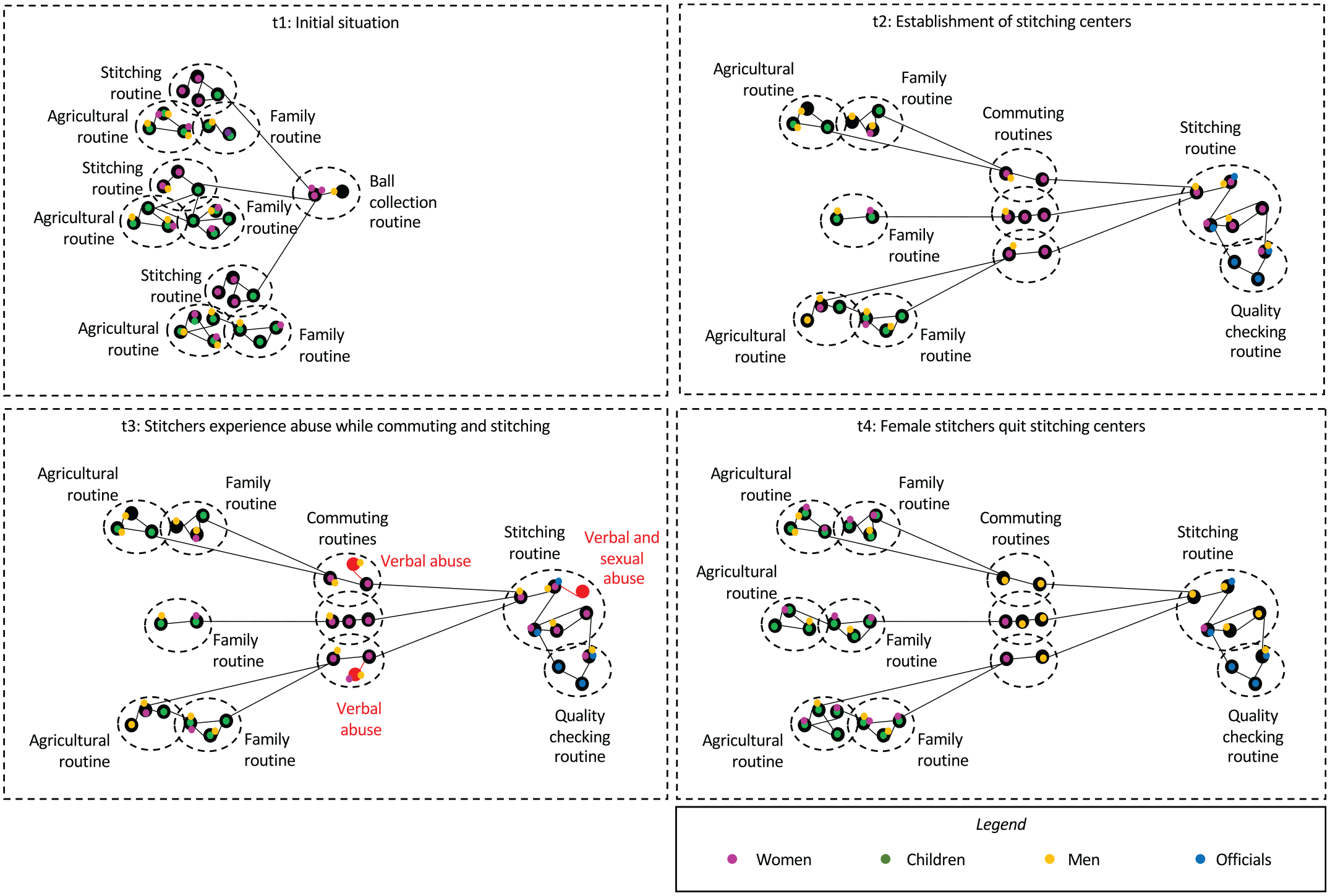
Visualization of Khan et al. (2007).
Prior to the establishment of the stitching centers, all actions of the stitching routine were performed within stitchers’ homes (t1 in Figure 2). In this setup, stitchers and their family members including young children stitched soccer balls whenever time allowed, from early morning to late at night. For most stitchers, making soccer balls was a flexible part-time occupation happening alongside agricultural routines, enabling them to increase the family income. Occasionally, subcontractors would come to collect the stitched soccer balls. Stitchers were then paid for the number of soccer balls produced. Our perspective allows us to see that the pattern of actions of the stitching routine was temporally and spatially interwoven with the patterns of actions of agricultural and family routines.
Moving the stitching routine to dedicated centers changed the patterns of actions substantially (t2 in Figure 2) as people now had to stitch full-time at the centers and commute back and forth. This implied that stitchers could no longer flexibly alternate between the stitching, agricultural, and family routines and were thus no longer able to build their lives on two sources of income (i.e. stitching and agriculture). Although they were stitching soccer balls as before, the quality of each finished ball was checked by International Labour Organization (ILO) officials in the quality checking routine, and stitchers were only allowed to continue with the next soccer ball after ILO approval. Controlling or waiting for the controls to happen created a pattern of actions that reduced the amount of soccer balls that stitchers could complete per day. Moreover, female stitchers at times experienced sexual abuse within the centers. Feeling unsafe in performing these new actions was further nurtured by verbal abuse happening during the commutes. Walking or taking public transportation to the centers meant that women were seen by other men, and they were confronted with direct verbal assaults as the stitching routine was considered of low status (t3 in Figure 2). Therefore, many female stitchers quit their jobs and could thus no longer contribute to the family income (t4 in Figure 2).
Taken together, we observe several instances of how the initiative did not just change existing routines (e.g. stitching) or create additional routines (e.g. commuting and controlling soccer balls), but also how it substantially affected the interactions with other routines. First, performing the stitching routine full-time in designated centers rendered the former patterns of actions impossible as actors could no longer uphold the spatial and temporal relations with their agricultural and family work. Second, there were new temporal relations between the stitching and controlling routine, because stitchers had to wait until their outcomes were approved before they could start with the next performance of the stitching routine. Third, we see new agentic relations such as working publicly alongside other stitchers or working under the continuous supervision of officials in the centers. These agentic relations led to actions such as abuse, reinforcing issues of gender inequality.
Whereas Khan et al. (2007) identified systemic factors as the driving force for unintended consequences in the elimination of child labor, we show how multiple changes in routines and altered relations were all part of interrelated and emerging explanations for answering the questions of why female soccer stitching was eliminated. There is no single explanation (e.g. generating less income, experiencing abuse, or leaving children alone at home) that forced women to quit soccer stitching, but multiple explanations that reinforce each other. These interactions moved the issues faced by stitchers sideways to closely related patterns of poverty and social inequality.
Discussion
Weakening and strengthening connections
Reversing our approach to social phenomena and seeing them as the consequence of performing and patterning routines rather than the cause for action (Callon and Latour, 1981) drove our reanalysis of two example cases. Building on this reanalysis, we now discuss how weakening and strengthening connections between actors and actions are important processes that reflect the continuous patterning of grand challenges. In both studies, routines were changed in a way that led women to step out of their homes and into the public sphere. However, pattern making—that is, the weakening and strengthening of connections and its effects—unfolded in very different ways.
In the Mair et al. (2016) example, we observe how performing new routines enabled women to enact new spatial relations, which horizontally extended the space of and for actions. This extension was enabled as connections among actors and their actions emerged and gradually strengthened. Women not only started to formally meet as part of the all-female meeting routines but later performed the new village board routine jointly with men. Hence, within the targeted villages, the consequences of these new actions vibrated through different routines, turning women and lower caste men into integral parts of board-meeting and decision-making routines. Eventually, connections between formerly disconnected actors and their actions were strengthened in a way that the pattern of actions (re)producing inequality changed and led to “improvement.”
The Khan et al. (2007) example tells a different story. Here, we observe how the performing of both new and changed routines extended the space but ultimately women’s ability to act was restricted. Commuting to and stitching at the centers weakened women’s connections with their families while strengthening their connections (in an undesirable way) with male co-workers and men in general. This simultaneous weakening and strengthening left women exposed to verbal and sexual abuse. Ultimately, the connections between patterns of actions of agricultural, family, and stitching routines were weakened to the extent that women could no longer perform their repertoire of routines as before. Again, the changes brought about by new actions vibrated into closely connected patterns of actions. In contrast to the first example, however, horizontal connections were weakened and strengthened in ways that the patterns of actions that (re)produce gender inequality and poverty “deteriorated.”
Consequentiality of mundane actions
Most existing studies on grand challenges adopt either a micro or a macro perspective in their search for sustainable and actionable solutions (Dittrich, 2022; Seelos et al., 2023). Major questions this literature has recurrently sought to address are how to push global initiatives including policies down to the micro-level (Gonzalez-Arcos et al., 2021; Grodal and O’Mahony, 2017; Markman et al., 2019), and how to scale up local improvements to achieve system-wide effects on the macro-level (Chatterjee et al., 2023; Mair et al., 2016; Porter et al., 2020; van Wijk et al., 2020). From the viewpoint of a flat ontology, these approaches provide us with a restricted understanding of grand challenges. We argue here that regardless of how well-designed a given initiative is (Ferraro et al., 2015), or how powerful the involved stakeholders are assumed to be (Schüssler et al., 2014), outcomes (e.g. success or failure) and attributes (e.g. power, class) are always created in action.
Adopting a reversed logic therefore enables us to see social phenomena as consequences of rather than causes for action (Callon and Latour, 1981). Through this perspective, we see how mundane actions are highly consequential for grand challenges (Deken and Sele, 2021; Feldman and Orlikowski, 2011) as the latter are (re)produced through the enactment of routines (Feldman and Pentland, 2022). In other words, the large is in the small (Latour, 2005). Focusing on the dynamic interplay between actions and their consequences provides us with the opportunity to capture how large patterns of actions constantly evolve, albeit in very different and often unintended ways, as each action is consequential in itself and for other actions. Tracing the performance of routines allows us to see how similar strategies—for example, trying to improve the conditions of disadvantaged groups by creating dedicated locations—may have very different consequences for other actions. For female stitchers, the enactment of changed actions within the stitching routine had drastic consequences as a new commuting routine became integral to the pattern of actions. This further disrupted actions with the agricultural and family routines as they could no longer be enacted (Khan et al., 2007). In Mair et al.’s (2016) study, the enactment of new actions within all-female meeting routines was consequential for introducing an all-villagers board routine and extended the pattern of actions and the possibilities for women’s actions. This insight builds on and extends recent arguments that social phenomena cannot be fully captured by means of probabilistic thinking, but need to be considered as continuously emerging possibilities (Feldman et al., 2022; Feldman and Sengupta, 2020; Pentland et al., 2020). In other words, the performing of routines and the consequentiality of mundane actions are the motor (Danner-Schröder and Geiger, 2016) of the continuous patterning of grand challenges.
Our reanalysis highlights that actions and their consequences vibrate through large patterns of actions. This implies that small actions can have consequences within and among grand challenges. For instance, the introduction of a new quota-based routine was consequential for women participating in board-meeting routines (Mair et al., 2016). This is, however, only one example and we would foresee that this change can vibrate to many other, presumably unrelated routines within the large pattern of actions, for example, to education routines when families make sure their daughters continue to go to school (Bohnet, 2016). Consequences are obviously not limited to one grand challenge but may vibrate across multiple challenges. As shown by Khan et al. (2007), attempts to address the goal of eradicating child labor unintentionally led to actions (re)producing poverty and gender inequality.
Reconsidering change
Research on grand challenges usually highlights the relevance of designing initiatives and specifying their goals. Within both the micro and the macro approach, there is a tendency to assume that it is key to set long-term goals and design interventions in such a way that these goals can be achieved (George et al., 2016). In other words, many authors consciously or unconsciously apply a teleological approach to change (Van de Ven and Poole, 1995). This is well reflected in the common understanding of the term “sustainability,” which incorporates the idea of considering future needs (i.e. long-term goals) in the present, and acting in a way that is long lasting (Bansal and DesJardine, 2014; United Nations, 2015).
However, change does not always unfold as a teleological process toward a long-term goal (Feldman et al., 2022), and thus the outcomes of initiatives cannot be determined a priori. Our reanalysis of Mair et al. (2016), for instance, suggests that it was not the goal of mitigating inequality per se that propelled the change forward, but the situated actions, such as connecting women in self-help groups or giving low-caste villagers a voice, that influenced how the grand challenge evolved. We therefore see change in grand challenges as an unfolding process that is driven by the actions of many different actors. Consequently, there is no pre-defined endpoint and every change achieved is provisional and unstable in nature (Latour, 2005). As long as actors perform routines, grand challenges may unfold indefinitely (Seelos et al., 2023).
Both research on grand challenges and routine dynamics have assumed that change is inherently “good.” One common assumption is that grand challenges tend to persist over time, and change is thus necessary to mitigate them. Similarly, research on routine dynamics has often explained how routines change over time (Feldman, 2000; Feldman and Pentland, 2003). Even though most scholars have shied away from normative statements, many empirical studies describe how things improved over time (Bucher and Langley, 2016; Cohendet and Simon, 2016; Deken et al., 2016). By contrast, as our illustrations have revealed, initiatives may have positive effects (Mair et al., 2016), but they can also have unintended and harmful side effects (Khan et al., 2007). This is because changes can involve “displacement, drift, invention, mediation, the creation of a link that didn’t exist before” (Latour, 1994: 31), which may lead to dynamics in the large pattern of actions that the initiators did not intend. The continuous patterning of grand challenges, that is, weakening and strengthening connections, influences whether change initiatives lead to intended or unintended consequences. Our argument echoes Benjamin’s (2022: 25) statement “that ‘change’ is neither inherently good nor synonymous with social progress.” In some situations, change can even be seen as simultaneously good and bad. The Khan et al. (2007) example, for instance, shows that the change achieved was good in the sense that it mitigated child labor, but it was also bad because it reinforced poverty and gender inequality.
Practical implications
American writer and civil rights activist James Baldwin (1986) claimed that “we are living in a world in which everybody and everything is related.” We believe this beautifully captures the key argument we are making in this article: when we see the world—and thus, grand challenges—as flat, we can unpack how seemingly mundane actions have far-reaching consequences. Following recent calls encouraging researchers to take on proactive roles in attempts to address grand challenges (Carton et al., 2023; Dorado et al., 2022; Howard-Grenville et al., 2019; Nyberg and Wright, 2022), we now explore how a flat ontology offers new insights around the design and evaluation of interventions to address grand challenges.
As argued in the previous section, the conventional view is that interventions to grand challenges should be designed such that they pursue long-term goals and plans (Khan et al., 2007; Mair et al., 2016; Porter et al., 2020). But regardless of how well planned such interventions are—since grand challenges are characterized by high complexity and uncertainty (Ferraro et al., 2015)—they are hardly tractable by envisioned images of impact (Howard-Grenville et al., 2019; Wright and Nyberg, 2017). The approach we advocate for shifts attention toward small actions and their performance. Instead of implementing “big action plans” (e.g. Schüssler et al., 2014; Wright and Nyberg, 2017), we suggest nudging the development of grand challenges into desired directions. Nudging in this context means that one focuses on small changes to actions and routines and how these changes vibrate through the larger patterns of actions and enable potentially more durable consequences over time. Hence, instead of thinking about interventions in terms of abstract ideas ready to be imposed on and take effect in a given context, an intervention from our viewpoint implies that actions are consequential (Klag and Langley, 2023), for example, by weakening and strengthening connections. Obviously, this implies that one must carefully trace and monitor how an intervention takes shape over time as it changes horizontal connections in the large pattern of actions. Accordingly, our approach foregrounds the question of how a given intervention produces consequences for other actions in situ (Howard-Grenville and Spengler, 2022). In the case of Khan et al. (2007), for example, one might have recognized how the intervention subjected women to higher stigmatization over time, which in turn, might have prompted important adjustments to the intervention. Along these lines, our proposal, and the three relations in particular, provide a lens to attune to and capture the dynamics that emerge after an intervention has been set (Grimes and Vogus, 2021; Howard-Grenville and Spengler, 2022; Seelos et al., 2023).
Importantly, these implications are not only relevant for us as researchers, but even more so as humans. In light of claims that organization and management scholars should be more involved in understanding and addressing grand challenges, or even act as “agents of change” (Nyberg and Wright, 2022: 962), our proposal emphasizes how we are all pattern makers. We need to recognize how we as a community are part of the larger patterns of actions, and how we might influence existing relations in any given moment as we perform routines that range from daily commuting to consuming certain products, to attending academic conferences. With our proposal, we side with Reinecke et al. (2022) who emphasize that knowledge creation is equally important as impact. In the same spirit, Howard-Grenville (2021: 13) encourages us to “show up in public debates, as we have something to contribute that might enable further discussion and inquiry.” Despite many open questions, we believe that a flat ontology provides a valuable perspective to grasp and study grand challenges. Some scholars might argue “yes, but grand challenges are a different kind of monster that cannot be tamed.” To this, we like to reply “yes, but it is a monster that stretches out sideways, and we are all a part of it.”
Footnotes
Acknowledgements
We would like to thank the Senior Editor Ann Langley and three anonymous reviewers for their excellent guidance and insightful comments throughout the process. This paper originates from the ‘Routines.Research.Community’ workshop at the University of Stuttgart held in early 2020. We express our gratitude to the participants of this workshop as well as to Katharina Dittrich, Alice Comi, Martha Feldman, Meri Jalonen, Waldemar Kremser, Emanuel Preciado, Christoph Rheinberger, Prami Sengupta, Jörg Sydow, Hanna Timonen, Frithjof Wegener, Bastian Wurm, and the participants of the 2021 EGOS Routine Dynamics sub-theme for their helpful comments and ideas.
Funding
The authors received the following financial support for the research, authorship, or publication of this article: Kathrin Sele acknowledges funding from the Academy of Finland Research Fellow Grant #321362.
