



Abstract
James Coleman’s ‘bathtub’ (or ‘boat’) model offers a multi-level account of organizations and society in which individuals’ behaviours provide the essential microfoundations of explanation. The bathtub model has become influential in strategy, organization theory, entrepreneurship studies and many other domains. This Essay warns against casual importation of Coleman’s underlying assumptions, especially its tall ontology of micro and macro levels, and proposes three tests for their analytic utility: agentive, normative and material. Microfoundational assumptions particularly jar with the flat ontology of practice theory important in Institutional Theory and Strategy as Practice. The Essay uses water as a unifying metaphor to show how the underweighting of practices in the bathtub model leads to overconfidence in management policy and truncated explanation in management research. The Essay proposes in place of the bathtub a visual model whose flat ontology implies the research importance of practice biographies, longitudinal perspectives, plurality, deep site immersions and socio-materiality.
Introduction
It’s twenty years since Felin and Foss (2005) introduced Coleman’s (1986) bathtub model to management research in the pages of this journal. Since then, the bathtub has been getting everywhere. The down-along-and-up shape of the bathtub attracts both for its visual connection of micro and macro ‘levels’ and for its depiction of individual agents as the ‘microfoundations’ of explanation. 1 For example, the editors of the Academy of Management Journal recommend the bathtub model for its linkage of micro-level theory to macro-level outcomes (Cowen et al., 2022). The bathtub’s prioritization of individuals resonates for researchers in entrepreneurship (Kim et al., 2016; Roundy and Lyons, 2023), social entrepreneurship (Faludi, 2023) and family business (Ellen et al., 2024). For the literature on knowledge management the bathtub highlights individual cognition (Distel, 2019), while the organization design literature uses it to show the effects of structures on decision-making (Piezunka and Schilke, 2023). The model is proposed for international business research, where its focus on individuals appears relevant to the personally-controlled businesses dominant in many countries (Contractor et al., 2019; Foss and Pedersen, 2019; Santangelo et al., 2024). In strategy, the bathtub locates the microfoundations of competitive advantage in individual characteristics and behaviours (Barney and Felin, 2013; Durand et al., Forthcoming; Kryscynski et al., 2021). One could go on. Measured by its range of advocates, the bathtub is a success.
I shall argue that the bathtub’s popular success is problematic for management research because its level-based ‘tall ontology’ (Seidl and Whittington, 2014) underestimates the complicating effects of social practices. Life is not Lego, with discrete bricks stacked neatly one on top of another. However, microfoundationalism creates particular problems for researchers with a practice theory sensibility, including those from Institutional Theory and Strategy as Practice. Albeit with reservations, some institutional theorists explicitly value Coleman’s bathtub for its emphasis on the recursive relationship between different ‘levels’ of phenomena, particularly micro and macro (e.g. Thornton et al., 2012; Harmon et al., 2019). Other institutional theorists keep their distance from Coleman but still make play with the language of ‘microfoundations’, even while drawing on practice theorists such as Bourdieu (e.g. Cardinale, 2018; Powell and Rerup, 2017). Similarly, Johnson et al. (2003) introduced the terms ‘micro-strategizing’ and ‘micro-strategy’ in what became one of the founding papers in the Strategy-as-Practice community, with ‘micro’ a recurring theme ever since (e.g. Kwon et al., 2014; Jalonen et al., 2018). All this is problematic for practice theory, which leans towards ‘flat’ ontologies with no distinctions between different levels of the world (Mountford and Cai, 2023; Seidl and Whittington, 2014). Flatness mixes everything together. For researchers in Institutional Theory and Strategy as Practice, echoing Coleman’s terms threatens confusion. To the extent that practice-oriented researchers appeal directly to Coleman’s bathtub, they risk legitimizing a perspective that is fundamentally inconsistent.
The problems stem from the methodological individualism of Coleman’s (1986) original model. He assumes that social phenomena are best explained by the choices and actions of individual actors, typically driven by rational self-interest. Macro-level phenomena (e.g. practices, routines and logics) start from micro-level individuals. For leading practice theorists, this methodological individualism radically underweights practices, the socio-material infrastructure that they hold as essential to individuals and their activity in the first place (Bourdieu, 2005; Schatzki, 2017). For institutional theorists with a practice sensibility, Coleman’s methodological individualism is unduly dismissive of accounts relying on direct ‘macro-to-macro’ causality (Anesa et al., 2019; Jepperson and Meyer, 2011; Steele and Hannigan, 2020). Within the Strategy-as-Practice community, Friesl et al. (2023) accuse Coleman’s model of detaching practitioners from their historical and social contexts.
Differences in underlying assumptions matter. For management policy, Coleman’s (1986) prior of rational individual choice may lead to excessive trust in formal organizational designs and systems of incentives. His basic model doesn’t seem to match the conflicts, inertia and surprises of organizational reality. For management research, the bathtub is empty of practices. Coleman’s individuals are too desiccated; empirical experience reveals them as saturated with practices, as reflected in their shared discourses, their technological usages and their stubborn patterns of action. Practices and their interrelationships are worth studying for themselves, but the individual activity prioritized by Coleman (1986) is inexplicable without reference to this fundamental socio-material infrastructure.
My proposition therefore is that Coleman’s bathtub model is radically inadequate. In explanatory terms, the bathtub simply doesn’t wash. Washing needs water – by water, I mean practices. Practice theorists differ in defining practices, but sufficient commonality can be found in Reckwitz’s (2002: 250) understanding of practices as the ways ‘in which bodies are moved, objects are treated, things are described and the world is understood’, shared and routinized within specific cultures. Water is of course a simplifying metaphor for practices, one that will be stretched here in several directions. However, the consistency of the single metaphor reflects the underlying coherence of practice theory’s contribution. Like the bathtub itself, the metaphor is playful and hopefully memorable for that. Fundamentally, though, my intent is serious: for both managers and researchers, there is a plenty at stake.
The Essay starts by introducing Coleman’s bathtub and outlining how leading practice theorists find it so empty. Working with the water metaphor, and drawing on practice theorists such as Bourdieu, Giddens, Rouse, Schatzki and Shove, I shall highlight how introducing practices alters conceptualizations of the individual, agency, choice, the empirical and materiality. In each case, I shall suggest implications for both managerial policy and research design. The argument here is relevant to all the domains of management research for which Coleman’s bathtub is advocated. There should be no place for casual microfoundationalism, the unreflexive founding of so-called macro phenomena in micro-level actions, especially those of individuals. For researchers, journal editors and reviewers, microfoundational analysis needs justifying according to three clear tests: agentive, normative and material. Otherwise, the base case is a world of practices. This has particular implications for certain strands of Institutional Theory and Strategy as Practice research, especially regarding the language of micro and macro. The so-called ‘tall’ ontological positions adopted by some practice-oriented researchers, hierarchically separating micro and macro, go against the natural flow of practice theory’s flat ontologies. Coleman’s (1986) hierarchical model is alien to a practice sensibility, even while its language insinuates itself into so much practice-oriented research. This Essay proposes, therefore, a clean break, advancing an alternative visual model that emphasizes flatness, plurality and inertia. It is the water of practices that washes. Coleman’s bathtub is just a container; it restricts explanation.
The empty bathtub
In 1992, James Coleman gave his address as incoming President of the American Sociological Association. With the title ‘The Rational Reconstruction of Society’, he described the world’s ongoing ‘transformation’ from traditional societies based on social norms, status, reputation and moral force to modern societies based on rules, laws, supervision and formal incentives (Coleman, 1993). Coleman’s address encapsulates several of the themes that are reflected in the more technical language surrounding his bathtub model. Above all, the address expresses a belief in the power of rationality in the reconstruction of society: deliberately designed incentives can generate responses on the part of rational individuals which together will transform the larger social systems that surround them. For example, Coleman (1993) proposes that governments resolve the societal challenge of educational inequality by offering parents financial ‘bounties’ motivating them to educate their children to the required standard.
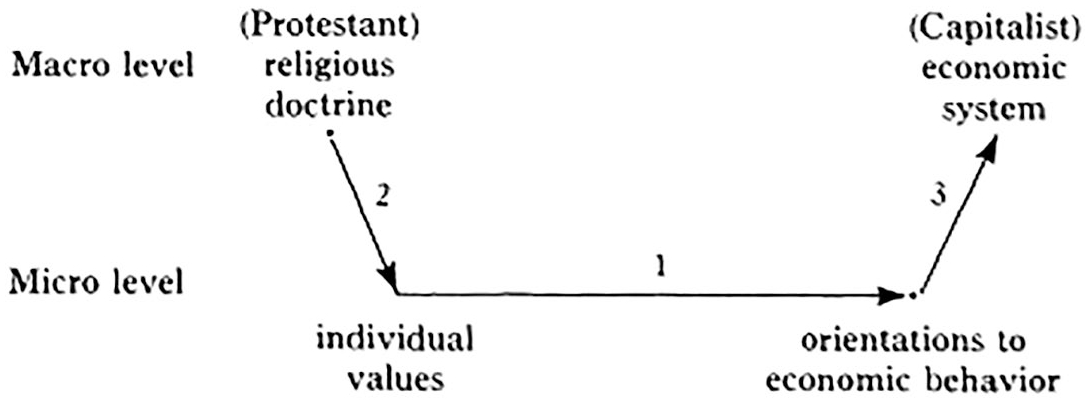
It is exactly this transformational sequence from ‘macro’ systems of incentives through the ‘micro’ behaviours of individuals and back again to ‘macro’ social systems that Coleman’s bathtub model is intended to capture. Figure 1 is Coleman’s (1986) first extended exposition of the bathtub model, reinterpreting Max Weber’s classic account of the Protestant ethic and the spirit of capitalism. Starting from the top-left, macro-level factors (i.e. Protestant religion) bear down on micro-level individuals, who then undertake micro-level behaviours that finally surge up sharply to create macro-level effects on the top-right (i.e. capitalist economies). The down-along-and-up causal sequence defines the shape of the bathtub. The bathtub’s point is that macro-level phenomena should not be explained directly by other macro-level phenomena (e.g. straight from religious change to economic change), but via the intervening micro-behaviours of the individuals at the bottom of the tub (Coleman, 1986).
The empty bathtub.
There are several features of this bathtub model to highlight. First of course there are hierarchical levels: macro and micro, though there can also be intermediate ones (e.g. meso). The fundamental purpose of the bathtub model is to explain macro-level change from the bottom. The micro can be groups of individuals, just as the macro can be any higher level–organizations or whole societies. However, individuals are the ‘prototypical case’ of the lower level and the natural ‘stopping point’ in explanation (Coleman, 1986: 4). Here Coleman is open about his methodological individualism. Individuals form the microfoundations neglected in rival theories that focus on aggregate macro variables. Coleman’s individuals are generally assumed to be rational, similar to the purposive utility-maximizing actors of economics. This follows Coleman’s (1994) avowed preference for simplicity and parsimony in explanation, but, in line with his Presidential address, he backs this up with the empirical claim about the increasingly rule-governed and incentive-driven nature of contemporary societies. Coleman is not absolutely reductionist in his individualism: at the macro level there are still social norms of behaviour. However, in contemporary societies, norms are increasingly based upon deliberately designed incentive systems which individuals are expected to respond to rationally. In an organization, such artificial norms (‘goals’) stand apart from individuals, like clothes that can simply be put on or off (Coleman, 1994: 427). This dispassionate calculatedness of norm-following behaviour supports generalization and the prediction of outcomes.
Coleman’s bathtub was an important contribution to sociology’s late twentieth century turn towards Rational Choice Theory, a general perspective emphasizing how assumptions of individual utility maximization could illuminate social phenomena far outside the usual domains of economics. At that time, Rational Choice Theory responded to sociologists’ frustration with the determinism of structural functionalism, while also reflecting cultural shifts in favour of individual responsibility and enterprise, as exemplified by the election of the free-market President Ronald Reagan (Foy et al., 2018). The bathtub was a product of its period. Felin and Foss’s (2005) careful introduction of Coleman’s microfoundational bathtub does not swallow Rational Choice Theory whole: for them, Coleman’s methodological individualism is key, rationality more variable. Since then, Coleman’s bathtub has become widely influential in management research (as of early 2025, Felin and Foss’s article has over 1,300 Google Scholar citations). Two important currents of the microfoundational approach can exemplify this wider influence: the microfoundations of strategy and the microfoundations of institutions. Both of these are also areas of practice theorizing (Nayak et al., 2020; Smets et al., 2017).
In strategy, Felin and Foss’s (2005) original contribution invoked Coleman’s bathtub to link organizational-level capabilities to the characteristics, motivations and choices of individual human actors. The origins of competitive advantage thus stem from individual-level heterogeneity. For Felin and Foss (2005), collective routines as sources of advantage have little place in such a microfoundational view and, indeed, managerial work is about handling the exceptional rather than the routine. In a similar spirit, Kryscynski et al. (2021) draw on Coleman’s bathtub to link firm-specific incentives to firm-level competitive advantage via the incentives’ impacts on individual-level commitment and motivation. Firms optimize the utility-cost ratio of incentives and individuals respond according to the attractiveness of these incentives.
With regard to Institutional Theory, Felin and Foss (2019) invoke Coleman’s bathtub to trace how macro-institutions influence individual skills and preferences, leading to micro-level behaviours that in turn shape macro-level outcomes, for example the reproduction or alteration of the original institutions. For Felin and Foss (2019), the causal mechanisms represented by Coleman’s bathtub provide a penetrating, precise and efficient explanation of institutional persistence or change, by contrast with the profusion of macro-concepts commonplace in Institutional Theory (fields, habitus, logics etc) which do not reach down to the individuals who make things happen. There are methodological implications. Drawing on Felin and Foss’s earlier work, Zilber (2020) offers various ethnographic strategies for connecting the interactions of individuals to higher-level institutional outcomes, while simultaneously recognizing how those same interactions are structured by macro-level forces.
Thus Coleman’s bathtub is making an impact on core areas of strategy and organization theory. As in the introduction, its microfoundational terminology is also widely echoed in both Institutional and Strategy-as-Practice currents of research. But there are some sharp discrepancies with practice theory. Particularly problematic are Coleman’s insistence on distinct micro and macro levels, his neglect of materiality and his depiction of individuals as rational actors detached from practices.
The bathtub’s levels reflect a ‘tall’ ontological view in which the social world is hierarchically organized with discrete downwards and upwards forces. This contrasts with a ’flat’ ontology where phenomena are laterally connected with more complex relations (Seidl and Whittington, 2014). Leading practice theorists are profoundly uncomfortable with tall ontologies that separate out the individual and the social. For example, Giddens (1993: 3) ‘rejects the dualism of “the individual” and “society”. Neither forms a proper starting-point for theoretical reflection: instead the focus is upon reproduced practices’ (emphasis in original). Schatzki (2016: 34) takes on Coleman’s micro-macro distinction as in ‘conflict with the flat ontology of practice theory in attributing two or more levels to social reality’. In a flat ontology, practices form a ‘third sort of thing’, made up of both micro and macro phenomena and actors that are both human and nonhuman. This ontological flattening implies a less heroic view of the human individual as prime actor in the world: practice theorists emphasize the material. Thus, Haslanger (2020) argues against the isolation of individuals from the materiality of the systems in which they participate. Dietary choices are a matter not just of individual tastes but reflect the cultural internalization of such material factors as climate, soil and season. The heroic rationality of Coleman and Rational Choice Theory in general is specifically targeted by Bourdieu (2005: 216): ‘by its very excess and its unconcern for experience, their narrowly intellectualist (or intellectualocentric) ultra-rationalism directly contradicts the best-established findings of the historical sciences of human practices’. Bourdieu argues for ‘dispositions’ rather than ‘decisions’, ‘reasonableness’ against ‘rationality’.
The implication is this. If we are to respect the insights of practice theory, we need to shift attention from the bathtub’s simple outline to the substance inside: socio-material practices that are constitutive, encumbering, plural, elusive and, above all, flat.
The water of practices
The bathtub is a simplifying metaphor, intended as a vivid encapsulation of a complex argument. Coleman himself emphasized the underlying theory: ‘The important issue, of course, is not what kind of diagram is used to provide visual aid but whether the appropriate theoretical structure is developed’ (Coleman, 1987: 173). This essay focuses on the appropriateness of theoretical structure too. There are points of affinity between practice theory and Coleman’s microfoundations. For example, Coleman’s concern for behaviour is echoed in the Strategy-as-Practice community by a strong focus on the detailed activities of strategizing and organizing (Whittington, 2003; cf Rouleau and Cloutier, 2022). Coleman’s assertion of agency allows for a substantial degree of consequentiality, not just the burger-flipping trivia attributed to some early studies of micro-strategizing (Jarzabkowski et al., 2021; Mantere, 2005). Fundamentally, however, I shall argue that Coleman’s theoretical structure is seriously misleading. We should pull the plug on the bathtub metaphor.
Here I shall draw on my own simplifying metaphor, introducing the water of practices. The water metaphor helps identify five important and interrelated characteristics of contemporary life which the bathtub leaves out. Each of these has implications both for management policy and for research methodology. The following section will propose an alternative, less hierarchical model.
We are water, mostly
Water makes up about 60 percent of a human’s body. In the same way, for practice theorists the individuals in Coleman’s bathtub are substantially made up of social practices. Accordingly, practice theorists often prefer the term ‘practitioner’ over ‘individual’ (Shove et al., 2012): the shared stems of practices and practitioners underline their mutual constitution. Practices do not exist apart from individuals; they are a part of individuals. Unlike Coleman’s organizational norms, practices are not put on and off like clothing. Contrary to the simple bathtub, therefore, macro factors are more than top-down pressures from above. Just as water makes up the human body, so practices become internalized into practitioners’ very beings through the course of their preceding lives. For Bourdieu (2004: 71), ‘the body is in the social world but the social world is in the body’. Coleman’s bathtub model leaves individuals waiting for downwards stimuli like practice new-borns. In reality, practitioners each have their own histories before they ever get to the tub. Every practitioner has their own biographical uniqueness, but ultimately this individuality is constructed from the diverse practices of contemporary societies (Reckwitz, 2020).
This insistence on individuals as practitioners has implications for management policy. Steeped already in the practices of their earlier lives, practitioners are unlikely to react to Coleman’s incentives with the detachment and predictability of rational calculation. Following Giddens’ (1984) insistence on unacknowledged conditions, the varied practice-endowments of practitioners are liable to baffle expectations. In strategy, competitive moves may depart from profit-maximization, following instead deeply-internalized cultural and historical norms of what is ‘right’ vis-a-vis competitors and customers. For example, in the insurance industry, where the London market is concentrated in a single building and traditions stand large, practitioners socialized into local practices will unreflexively observe ‘gentlemans’s agreements’ rather than adopting the self-serving opportunism of rational profit-maximizers (Jarzabkowski and Bednarek, 2018). These practitioner strategies are cultural in origin, inculcated by training and careers within the concentrated site of the London market.
Acknowledging how action is conditioned by the nature of individuals as practitioners has methodological implications too. Research should not assume practice-novices, entering the field unburdened by prior experience and responding simply to the stimuli immediately under the researcher’s eye. Rather, actors arrive for scrutiny drenched already with the diverse and baffling practices of their personal histories. By analogy with the notion of institutional biography (Bertels and Lawrence, 2016), understanding behaviours requires access to actors’ full ‘practice-biographies’ (Greene and Rau, 2018), the practices acquired in their life courses before they ever reach the bathtub. For example, Rouleau (2005) draws on Giddens to show how a Canadian manager explains his strategy to a client by invoking a shared Quebecois culture and common musical tastes: the manager seamlessly switches from English to French and recalls a francophone music concert that he and the client had both attended twenty years before. In a manner hard to grasp through methodological individualism, the manager’s actions were guided by experiences that were collective, prior and thoroughly absorbed. In understanding practitioners and their dispositions, therefore, a practice perspective would prescribe for the researcher analysis of the practices in which their biographies had previously immersed them: e.g. those of the Quebecois culture. Practitioners are a product of past practices. The stopping point for explanation is not the individual, but the collective practices that formed them.
Water is heavy
The individuals in Coleman’s original model are given an attractive sense of effective agency, achieving from time-to-time major transformations (the final upwards arrow of Figure 1’s bathtub). In practice theory, on the other hand, the water of practices weighs heavily on individual agency. Just as water encumbers the swimmer, most of the time the weight of practices makes actors’ movements laboured and slow. While practice theorists allow practices the fluidity of constant incremental adjustments, they generally have low expectations about transformation. For Nicolini (2012: 3), practices are ‘very resilient and often difficult to change’.
For management policy, this weight of practices implies heavy constraints on actors’ capacities for agency. Practice theory typically puts routine and reproduction before innovation and transformation. Thus, in contrast to Coleman’s (1993) optimism about the power of individual ‘bounties’ to change educational outcomes, Bourdieu and Passeron (1990) describe education systems as deeply conservative, with reforms repeatedly exploited by elites to reproduce their power within society. The water of practices imposes a lot of inertia. Whittington’s (2019) Giddensian history of changing practices in the strategy profession shows how innovations sometimes required a decade or more of iterative experimentation and gradual diffusion: new practices such as Open Strategy evolved over many years, and even then only added a layer on top of older and continuing practices such as traditional strategic planning.
This heavy weight of existing practices requires researchers to show sensitivity to inertia and incrementalism as much as to change. Practices are drag anchors on agency. To focus only on surging moments of transformational change (as implied by Figure 1) would risk neglecting more gradual change–the small, often reluctant adjustments practitioners make as they adapt their practices to accumulating pressures. In elongated processes of change, heroic entrepreneurs may be less important than compromising incrementalists (Hjorth and Reay, 2022). Opportunities for change vary, but researchers should be alert to the modest, not just the muscular. For example, Pratap and Saha (2018) apply a Bourdieusian lens to ‘daily doings’ within a large Indian steel company, showing how it took nearly a decade of hard graft on the margins of the organization for a new generation of meritocratic MBA-trained managers to displace the traditional strategy practices of the earlier socially well-connected managerial elite. The weight of practices obliges the same patience for the researcher as it requires for the manager. Practice evolution typically takes time, mandating longitudinal methods of research (Kouamé and Langley, 2018).
Water floods
Coleman’s macro forces manifest themselves just in the single verticals at the beginning and the end of his bathtub. But the bathtub of Figure 1 has no sides; water can flood in from all directions and at any time, not only from the top left. In the same way, practice theorists assume that larger forces (e.g. Protestant religion) are likely never to be singular. Giddens (1991), therefore, has a more manifold take than Coleman’s (1993) on the choices facing individuals in contemporary societies. Rather than facing unambiguous and rationally-ordered incentives, people today confront a ‘pluralisation’ of contexts of action with no single source of normative authority: ‘The more tradition loses its hold, and the more daily life is reconstituted in terms of the dialectical interplay of the local and the global, the more individuals are forced to negotiate lifestyle choices among a diversity of options’ (Giddens, 1991: 5). There is scope for agentive choice in this ongoing plurality, but the practices in which individuals bathe present many cross-cutting currents.
The bathtub’s chronic openness to different currents has managerial implications. As actors progress along the bathtub’s horizontal, they are continuously liable to be swept in surprising directions; at any moment, the floods may give them unexpected opportunities to seize. As Nicolini and Mengis (2024) suggest in their re-working of the Attention-Based View, managers are thus situated at ‘crossroads between practices’. The pluralism of their situations reverses the Attention-Based View’s imperative of sustained attentional focus and values instead an ongoing alertness to stimuli from the margins. It can pay to be easily distracted. Moreover, as Jarzabkowski et al. (2013) find in their study of restructuring in a telecoms company, practice theory suggests that it can be better for managers to learn how to work with chronically competing demands, rather than to seek their complete and final resolution. There are few clear-cut choices; coping with plurality is a matter of continuous negotiation.
For researchers, the openness of the bathtub obliges an ongoing sensitivity to new and contradictory currents. Researchers should be wise to the continuous, confused and disjointed nature of the sensemaking by which individuals muddle through the dynamic diversity of their daily lives (Alvesson and Jonsson, 2022). Rather than Colemanian prediction, the primary research mode will be retrospective, accounting for the complexity of outcomes in particular instances. Practitioners will disappoint. Practice-sensitive researchers will be more ambulance-chasers after the event than prognosticators looking forwards. But there will be positive surprises to watch out for too, as practitioners show their capacities for agile and pragmatic improvisation. When asking for what makes an effective strategist or entrepreneur, therefore, researchers should not look only to the cognitive capacity for rational analysis; researchers should be investigating how practitioners acquire the phronetic skills of coping in the moment (Tsoukas et al., 2024). Appreciating the complex pluralism of social life denies confident choices with one hand but elevates practical wisdom with the other.
Water is transparent
While the sharp black outline of the bathtub is easy to see, water lets light pass through. Similarly, individuals and activity attract the eye; practices are less obvious. Just as fish do not know they are in water, practices are often so transparent in their taken-for-grantedness that they are unrecognized even by the individuals that swim in them. Practices are barely-empirical in nature. They are ‘patterns’ of activity, not observable in perfect repetitions but rather abstracted from the episodic enactments of fallible and improvisatory actors (Rouse, 2007). Indeed, practices can be latent, existing as ‘memory traces’ of appropriate behaviours even in the absence of concrete activity (Giddens, 1984). Practices are more to be inferred than observed.
There are managerial implications of this empirical transparency. Many practices are subconscious in their effects. For example, the ordinary discourse of strategy inadvertently excludes employees uncomfortable with its variously militaristic, technological and even quasi-religious inspirations (Mantere and Vaara, 2008). For managers, therefore, encouraging greater employee participation in strategy involves not just providing more open channels for engagement but remaking an exclusionary discourse that they have previously taken entirely for granted. As expanded on in the following section, the practices associated with everyday technologies such as PowerPoint and Excel can also have unseen effects, for good or ill (Knight et al., 2018). The transparency of practices requires of managers a very sharp eye for the subtle ramifications of the ordinary and routine.
Methodologically, being serious about the transparency of practices obliges researchers to look beyond the vivid empirics of individuals and their activity to find the hidden practices behind. To accept the individual as the natural ‘stopping point’ of research is a form of premature explanation. It is not individuals but practices that are the foundations of activity. Practices are the objects of research. These are elusive, however. Practitioners themselves are not wholly-aware of the practices they rely on. Interviews may help but typically researchers will need to get in closer and stay on longer. Researchers cannot see the subtle influence of practices from a distance; they need the deep immersions of ethnography or participant observation (Vesa and Vaara, 2014), taking the time both to detect emergent patterns and to capture moments when latent practices finally show themselves. But rather than accepting Zilber’s (2020) account of ethnography as about linking microfoundations to macro-level institutions, ethnographers should recognize that their lens is capturing exactly the same phenomena whether zooming into the detail or zooming out for the larger picture (Nicolini, 2009). At whatever degree of focus, it’s always about practices. Contra Johnson et al. (2003), strategy and strategizing are never just micro.
Water lies flat
Flatness in practice theory implies a discomfort with two hierarchies implied by Coleman’s bathtub: first the super-positioning of the macro above the micro; second the prioritization of the human individual over the material. Just as water spreads out flat, practice theory distrusts hierarchical distinctions. Water’s horizontal surfaces emphasize both the collapsing of levels and equivalence between human and nonhuman actors.
Constituted by practices, practitioners lead amphibious lives, simultaneously micro and macro. For Bourdieu (1990) and Giddens (1993), the whole point of practice theory is to abolish such dualisms as that between distinct levels of social life. Schatzki proposes a flat ontology in which social life is formed from non-hierarchical bundles of practices and where it is the relative density of connections, not levels, that is the crucial distinction: micro and macro are ‘composed of the same basic ingredients’, practices (Schatzki, 2019: 47). Macro is a larger slice of the bundle; micro is a local slice. For example, Sele et al. (2024) take a flat ontological view to reconceive the macro-level Grand Challenge of inequality in India as about small changes in mundane routines, which vibrate widely through networks of everyday connections. For them, micro and macro are not separate units of analysis: ‘the large is in the small’ (Sele et al., 2024: 542).
At the same time, practice theorists challenge the hierarchical definition of human actors as prime-movers of change, with material artefacts in mere supporting roles. In a flat ontology, humans and nonhumans can both be ‘actants’, each with effects on the world: a concrete sleeping policeman across a road and an alert human policeman beside the road both slow down traffic (Callon and Latour, 1992). In contemporary societies, the practice of bathing has come to depend on a whole array of material artefacts (soap, sponges and bathtubs), the absence of which would leave the act fundamentally incomplete. Individuals are not the only actants in the bathtub, therefore, and their practices are always socio-material. Apparently individual acts of cognition typically reflect socio-material practices, technological usages that are shared and legitimate across time and space. What individuals see is shaped by the socially-approved material prisms (e.g. PowerPoint presentations) through which they view the world (Jarzabkowski and Kaplan, 2015). How they decide is shaped by the socially-approved material tools (e.g. Excel spreadsheets) by which they calculate (Bauer and Friesl, 2024). In this sense, actions are produced as much by socio-material technologies as what goes on inside the individual’s head.
Flatter ontologies have managerial implications. The Colemanian distinction between levels offers attractively simple models of change: pulling levers at the macro-level will induce changed behaviours at the micro-level; new behaviours at the micro-level will aggregate to major changes at the macro-level. This is the traditional dichotomy of bottom-up and top-down models of change (Heyden et al., 2017). Flat ontologies, on the other hand, imply horizontal networks of diffuse relationships with much less leverage than hierarchies. Change characteristically manifests itself through alterations in everyday behaviours, channelled unevenly through a tangle of connections. Embedded in these connections are socio-material actants – technologies for example – whose unexamined taken-for-grantedness introduces their own influences on change. If Coleman’s levels offer leverage, diffuse networks warn of entanglements. Consistent with the high failure rates of change initiatives (Burnes, 2011), practice theory’s flat ontology is not confident in the transformative capacity of human interventions.
A key research implication of a flat ontology is that researchers should attend to the nonhuman as well as the human. Organizing and strategizing involve material tools and artefacts, which shape what individuals can see and do (Jarzabkowski and Kaplan, 2015). As Artificial Intelligence promises ever more radical affordances, practice theory’s recognition of the nonhuman is becoming even more relevant. For researchers, this increasing technological interdependency can be accounted for by shifting from a view of individuals as discrete beings to seeing them more as socio-material networks. Callon and Law’s (1997) archetypal ‘Andrew-the-strategist’ is essentially a network that includes, in no hierarchical order, his fellow managers, his secretary, his office, his computer and his train to London (Seidl and Whittington, 2014). To separate Andrew from his technologies is to take away his actorhood: he is a hybrid of flesh, blood and socio-material practices. Even the physical spaces in which strategizing is conducted interact with how strategy work is done: in Holstein and Rantakari’s (2023) study, strategy work differs according to whether carried out in rooms that are visible to others or are specially designated. For practice scholars, materiality must be high on the agenda for empirical analysis.
A flatter model
Coleman’s bathtub is an empty vessel. Without practices, the bathtub rings hollow. For managers, it is liable to deliver over-confident advice; for scholars, it tends towards premature explanation. Microfoundationalism risks introducing misleading simplifications into management research: entrepreneurs, strategists and heads of family businesses are more than individualistic responders to the incentives of the moment. For Institutional Theory and Strategy-as-Practice scholars above all, the continued use of micro-macro terminologies (e.g. Johnson et al., 2003; Powell and Rerup, 2017), and occasional direct appeal to the bathtub model (e.g. Thornton et al., 2012), pose dangers of confusion at best, incoherence at worst. Practice theory distrusts tall ontologies of hierarchical levels. The categories of micro and macro can be no more than a simplifying analytical convenience (Li and Jarzabkowski, 2025), a provisional stand-in awaiting a more complete account. Fundamentally, there is no such thing as just micro. Practice-oriented scholars therefore need an alternative model which, following the previous section, allows for the internalization of practices within practitioners, the weight of practices on agency, the dynamic diversity of practices, the empirical elusiveness of practices and, above all, ontological flatness.
In these respects, influential existing models within Institutional Theory and Strategy as Practice research fall some way short. Ontological hierarchies are widely implied. For example, in Institutional Theory, Phillips et al. (2004) propose a saw-tooth model by which microprocesses of individual action produce higher-level institutionalized discourses which in turn work downwards to shape successive instances of action. In Strategy as Practice research, Whittington’s (2006) model connects practitioners at a lower level with practices at a higher level through upwards and downwards arrows representing the unfolding activities of praxis across time. Bridging practice and process theorizing, Kouamé and Langley’s (2018) instantiation model features a series of upwards arrows depicting the continuous and simultaneous relationship between microprocesses and macro-outcomes. Jarzabkowski et al.’s (2007) model gets closer to a flat ontology by representing strategy as produced by three interleaved circles of praxis, practices and practitioners: there are no levels. However, Jarzabkowski et al.’s (2007) interleaved circles lack a sense of movement over time, an important feature of the other models (and indeed Coleman’s). Practice theoretic scholars of strategy and institutions need a model that is both flat and temporal.
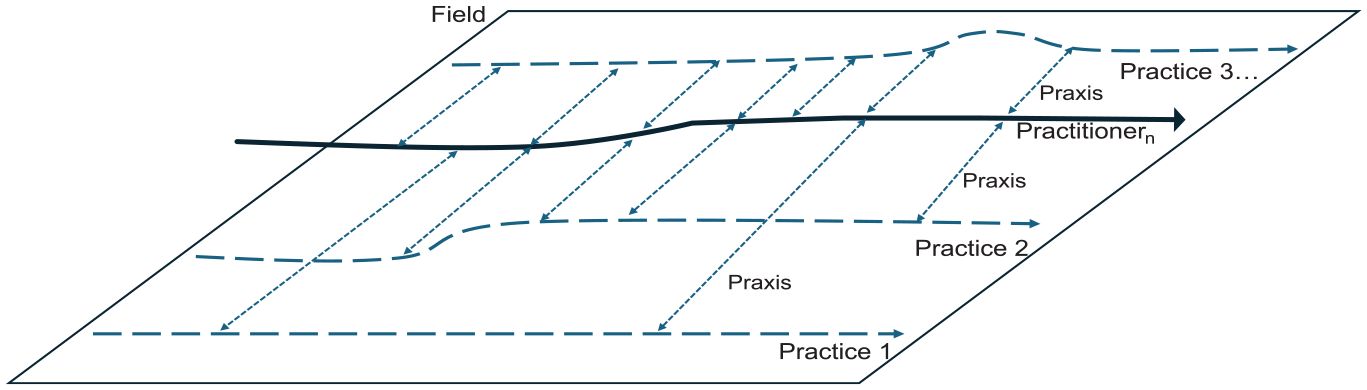
Figure 2 proposes a model in which the sloping parallelogram conveys a sense of flatness, while allowing for movement over time. The parallelogram captures a particular field of interaction–an organization, a market or a profession for instance. The Figure uses the established terms practices, praxis and practitioners, their common etymologies affirming a practice sensibility. The lateral arrows of practices 1-3. . . represent any number of socio-material practices (or other shared and persistent social phenomena such as logics or routines); the practitionern arrow represents any number of practitioners (not mere individuals); episodes of praxis (activity) are represented by the sideways slanting dotted arrows which bring practitionern together with various practices (either singly or in combination).
A flat model of praxis, practices and practitioners.
Crucially, Figure 2 does not arrange the practice and practitioner arrows in a vertical hierarchy–practitionern is in the middle, immersed in practices. These predominantly lateral arrows reflect the default case of continuity over time. The solid line of practitionern represents their continuity as the physical embodiment of thoroughly routine and internalized practices, both latent and enacted (e.g. using a phone or bicycling to work); the relative thickness of the practitionern line represents the plurality of these internalized practices; the extension of practitionern’s arrow over the edge of the parallelogram points to a history even before entry into this specific field of interactions. Turning to practices 1-3, the dashed lines represent their latent persistence even when not in action. Practices 1-3 are not thoroughly routinised by practitionern, being positioned externally, with their relative positions reflecting degrees of routineness. Some practices are relatively proximal to practitionern (e.g. an annual strategic planning exercise); others are more distal and less frequently engaged (e.g. pitching for new capital), as in the case of practice 1.
Figure 2 shows both continuity and change as brought about through episodes of praxis. While typically reproducing practices, praxis sometimes introduces and reinforces change through new combinations of practices, whose catalytic potential likely increases with their distance from more thoroughly internalized routines: early on, practitionern achieves an enduring change in practice 2 through an initially novel but then repeated combination with practice 3; later practitionern achieves a temporary adjustment of practice 3 through an unrepeated combination with practice 1. The dotted lines of praxis represent the ephemerality of its episodes, relative to the continuity of practices and practitioners. The dotted lines are double-headed, signifying instantiation but differing from Kouamé and Langley (2018) in being two-way, with practices simultaneously constituting practitionern just as practitionern instantiates practices. While the predominantly lateral line of practitionern represents continuity, occasionally practitionern does undergo some change: for example, the arrow of practitionern shifts as repeated interactions with newly altered practice 2 not only brings the practice closer to their existing routines, but influences understanding of more internalized practices.
Figure 2’s model is of course a simplification, most notably in focusing on a single, representative practitioner. As Coleman (1987) said of his own bathtub, the model is just a visual aid to highlight key features of a theoretical structure. However, Figure 2 does help in telling some explanatory stories from a practice theoretic perspective. Overall, the Figure implies similar degrees of practice inertia to those classically described in the problem of institutional embeddedness (Granovetter, 1985). Figure 2 traces this inertia to the isolation of any particular practice from novel and repeated combinations with other practices, as in the cases of practice 1 and briefly flexed practice 3. Like practitionern with their largely lateral progress, practitioners also follow consistent trajectories most of the time, reflecting partly the momentum of practices acquired before entering the field and partly the relative rarity of sustained interactions with new combinations of practices. Nonetheless, practice plurality can prompt and reinforce change, allowing some degree of practitioner agency. As Mair et al. (2015) show for institutional innovation and entrepreneurship, practitioners can change practices through the mobilization of new combinations of practices (or logics), the case with practice 2. Practitioners too can change through (sustained) engagement with new or altered practices, the more quickly the more proximal they are. In Splitter et al.’s (2024) study of an Open Strategy initiative, the relatively distal nature of strategy’s discursive practices (equivalent to practice 3) helps explain how lower-level employees required prolonged engagement before they became sufficiently competent to engage effectively with the process.
Ontologically at least, Figure 2 also implies no imperative to abandon the so-called ‘macro-to-macro’ explanations cherished by some strands of Institutional Theory (e.g. Jepperson and Meyer, 2011; Steele and Hannigan, 2020). Apparently ‘micro’ individuals are in fact practitioners, made up of ‘macro’ stuff themselves – they are at the same level, with no special status. Instead of undertaking the micro-level diversions mandated by Coleman’s (1986) bathtub, diving down to another somehow distinct world of individuals and activities, this equivalence allows us to explain a practice change by direct reference to its combination with another practice, as for the Figure’s practices 2 and 3. Practitioners are the essential carriers of practices, their inseparability acknowledged in the common stems. Thus, for example, going straight from the rise of finance-orientated managerialism in mid-twentieth century America to the spread of the multidivisional structure in the same period (Fligstein, 2002) does not dispense with practitioners, only subsumes them within the two sets of ‘macro’ practices in question. The inclusion of individual institutional entrepreneurs might add to the story, but direct explanation from macro-practice to macro-practice implicitly involves practitioners while providing a convenient short-cut. In this way, doing away with hierarchical levels can achieve considerable research economy with no fundamental disrespect to the ontological importance of human agents.
Conclusion
As at the start, Coleman’s bathtub is a popular success, infiltrating many domains of management research, including entrepreneurship, international business, management learning, strategy and more. The article by Felin and Foss (2005) in this journal has played a deservedly important part in this success. But the bathtub brings unwelcome baggage. Its privileging of individuals diminishes the collective social phenomena – practices, routines or logics–which practitioners draw continuously upon in their day-to-day activities. Its prior of rationality risks an undue faith in deliberate managerial design. As a model for management research generally (Cowen et al., 2022), and for research in any of the specialized domains for which it is advocated, the bathtub should be approached with considerable caution.
The argument so far has specific implications for researchers adopting a microfoundational approach, for instance because of the apparent salience of individual action in a particular empirical setting. The saturation of social life by practices is the base case assumption; a microfoundational approach is an analytical convenience that needs explicit contextual justification. Researchers, journal editors and reviewers should therefore satisfy themselves with regard to its utility by applying three tests–agentive, normative and material. The three fundamental questions are: what is particular about the empirical context that permits significant scope for individual agency, especially of the transformative kind that Coleman is concerned with; why in this specific context should we expect immediate incentives to shape actions more than prior social norms; and how in this context does human cognition rise so far above socio-material practices – e.g. those embedded in material technologies such as PowerPoint, Excel or Artificial Intelligence – as to render them irrelevant to the analysis? The laden language of microfoundations should not be casually invoked.
Explicit justification of microfoundational analysis is necessary because of how the metaphorical water of practices exposes what Coleman’s model neglects. We are not desiccated individuals; constituted by the water of practices, we are practitioners, typically stubborn and divergent rather than rational and detached. We do have agency, but, weighed down by the water of practices, inertia and incrementalism are the norm. Just as water floods, so too are we mostly navigating between cross-cutting currents of diverse practices, chronically compromising more than definitively choosing, and sometimes swept in unexpected directions. The water of practices lies flat, dissolving hierarchical levels of reality and absorbing materiality as a potentially equal constituent of social life. Granted, the watery transparency of practices makes them often hard to detect, but deep ethnographic immersion is likely to reveal unsuspected influences. These conditions imply for researchers attention to practice biographies, sensitivity to incremental change over extended periods of time, the search for plurality in research contexts, the preference for practices over individuals as units of analysis, and recognition of the role of the nonhuman besides the human. The natural stopping point in explanation is not Coleman’s individuals but the socio-material practices that form and surround them.
The limitations of the Coleman model have particular implications for research traditions in which collective social phenomena are important, notably here Institutional Theory and Strategy as Practice. We should mind our language. Where we reasonably can, we should replace talk of individuals with that of practitioners (Shove et al., 2012). Except in the most provisional sense (Li and Jarzabkowski, 2025), we should move beyond the terminology of levels. However much surrounded by scare marks, ‘microfoundations’ will always fit awkwardly with the flat ontology characteristic of practice theory (Seidl and Whittington, 2014). We have more consistent terms to describe different kinds of practice influence, for example in this article connective density (Schatzki, 2017), global and local (Giddens, 1991) and proximal and distal (Figure 2). We do not need a bathtub to differentiate. Figure 2 supersedes Coleman’s hierarchical model by placing praxis, practitioners and practices alongside each other within the flat ontology that is core to practice theory.
To conclude, Coleman’s bathtub seduces by its vivid visuality and its accent on agency. It is no wonder that it attracts researchers in a wide range of domains, from entrepreneurship to international business. However, its original form smuggles in assumptions that fit uncomfortably with a good deal of experience. Designs fall short, actors surprise, predictions are confounded, materiality intrudes. Practice theorists would expect all this. They add the social to the individual, the plural to the singular, the unintended to design and the nonhuman to the human. The bathtub is a container with too restricted a view; it is the water of practices that does the real work of explanation. We should think flat, not tall.
Footnotes
Acknowledgements
Sincere thanks are due to Paula Jarzabkowksi (editor), two anonymous reviewers, Thomas Cyron, Teppo Felin, Martin Friesl and Chris Steele for their very helpful comments on earlier versions of this Essay. Errors are mine.
Funding
The author(s) received no financial support for the research, authorship, and/or publication of this article.
