




Abstract
This curated debate discusses the value of practice theories in studying, understanding and tackling grand challenges. Practice theories assume that social phenomena are constituted through everyday doings and sayings. Building on this premise, the different contributions in this curated debate go beyond the assumption that grand challenges are abstract phenomena. The authors argue that grand challenges are enacted through mundane, situated actions that are often hidden in plain sight. Building on their research, they suggest that understanding grand challenges requires scholars to approach phenomena as nondualistic. Accordingly, they reveal that situated actions are not self-contained but related across space and time, requiring scholars to adopt a relational perspective. The debate concludes with a call for action as we embrace our dual role as scholars and citizens.
Keywords
Introductory Note
Anja Danner-Schröder, Christian Mahringer, and Kathrin Sele
We live in a time in which the world is shaken by social inequalities and environmental emergencies that need our attention in order to improve life for everyone (Benjamin, 2022). The urgency of grand challenges such as poverty, climate change, or pollution (see United Nations, 2015) that threaten the peaceful coexistence of people has not gone unnoticed in the field of organization and management studies. Indeed, we see a growing number of scholars calling for improving our understanding of how organizations and businesses need to and can become active and responsible actors in tackling grand challenges (Brammer et al., 2019; Ferraro et al., 2015; Gümüsay et al., 2022; Howard-Grenville & Spengler, 2022; Jarzabkowski et al., 2019; Nyberg & Wright, 2022; Seelos et al., 2023). Zooming in on the current debate, one interesting feature of this quickly emerging field of research is that we are no longer only researchers but also citizens and, as called for by several scholars, sometimes activists (Delmestri, 2023; Gray, 2023; Gümüsay, 2023). We are thus not just studying grand challenges but are an integral part of their ongoing (re-)production as we ourselves perform seemingly small and mundane actions such as taking the car to get to work, selectively talking to prominent peers at conferences, or consuming highly processed and packaged food. These actions perpetuate the status quo and keep harmful dynamics in place.
When discussing these entanglements in light of our own practice-theoretical approach to studying empirical phenomena such as rescue missions (Danner-Schröder & Geiger, 2016; Geiger et al., 2021), the COVID-19 pandemic (Sele et al., 2024a), or bushfires (Danner-Schröder & Sele, 2024), we started to ask ourselves whether there is something that we could learn from our field of research, which is mostly interested in the smaller scale, the organizational level, or even single practices (Mahringer et al., 2024). Could this research tell us something about what we see on a larger scale? Said differently, we embarked on an inquiry into what we can learn when we shift our attention from systems and their dynamics to people's everyday actions and the role these actions play in the larger patterns we see as we study grand challenges (Latour, 2018; Nicolini, 2016; Sele et al., 2024b; Shove, 2022). To advance and deepen this conversation, we decided to bring together a group of distinguished scholars for a curated debate on what practice-theoretical approaches with their concepts and tools (Feldman & Orlikowski, 2011; Gherardi, 2012, 2016; Nicolini, 2012; Seidl & Whittington, 2014) can contribute to studying, understanding, and tackling grand challenges.
Grand challenges are obviously more than practices, but it is hard to deny that practices play an important and decisive role in how they are sustained and can be addressed. In what follows, we first provide a brief overview of the grand challenges debate within organization and management research (Ferraro et al., 2015; George et al., 2016; Gümüsay et al., 2022; Kunisch et al., 2023). We then introduce common aspects of practice theories, explain how they feature in the curated debate, and briefly discuss what a focus on practices affords as we study grand challenges. This introduction is followed by five distinct contributions in which the authors build on their own research—ranging from strategy-as-practice (Paula Jarzabkowski) to extreme contexts (Linda Rouleau) to routine dynamics (Martha Feldman and Brian Pentland) and from technology-as-practice (Marleen Huysman and Anastasia Sergeeva) to posthumanism (Silvia Gherardi)—in order to show the vast potential of practice theories for understanding and tackling grand challenges. Kathleen Sutcliffe and Joel Gehman then reflect upon the different contributions and discuss how the field could move forward. We conclude the curated debate by discussing how the presented insights can be turned into actionable steps as we embrace our dual role of being researchers and citizens.
What Are Grand Challenges?
Grand challenges are defined as “massive social and environmental issues that transcend national borders […] and that have potential or actual negative effects on large numbers of people, communities, and the planet as a whole” (Voegtlin et al., 2022, pp. 1–2). The United Nations (2015) for example see the continuation of poverty and hunger in many parts of the world, the ongoing lack of access to health and education, the persistence of gender and racial inequalities, the changing climate and its consequences, or the increase of environmental pollution as grand challenges. All of these examples are large, unresolved problems that can be distinguished from other organizational phenomena because they are “matters of concern that entail complexity, evoke uncertainty, and provoke evaluativity” (Gehman et al., 2022a, p. 260).
We often seem to struggle to see and understand the many interrelated parts that constitute grand challenges (Markman et al., 2019). Indeed, since grand challenges are characterized by many interactions and non-linear connections (Sele et al., 2024b), they are complex and therefore difficult to grasp and control (George et al., 2016; Schad & Smith, 2019). We do not only lack information about the likelihood of various future states but also about the future states themselves. It also implies that there is never enough information, rendering both forecasting and decision-making difficult (Ferraro et al., 2015).
Therefore, actors need to align different viewpoints (Wright & Nyberg, 2017) as grand challenges involve many different actors, all of whom are engaged in their own discourses (Omenn, 2006) and not only value different things but value things differently (Dietz et al., 2003). Accordingly, tackling grand challenges cuts across jurisdictional boundaries, implicates multiple criteria of worth, and can reveal new concerns (Ferraro et al., 2015). As argued by Gehman et al. (2022a), there are grand challenges that are global or systemic in scope (e.g., climate change), while others are local or bound in scale (e.g., access to sanitation and clean drinking water). At the same time, grand challenges rarely appear alone and often interact with and amplify other challenges (Banerjee & Jackson, 2017). For example, while consequences of climate change such as more frequent extreme weather events affect the entire planet, these effects are most devastating for people living in poverty or suffering oppression (Thomas et al., 2019).
Accordingly, addressing grand challenges implies changes in individual, organizational, and societal behaviors and actions, and in advancing technological progress (George et al., 2016). In this vein, it has been noted that research on grand challenges requires scholars from various communities to join forces (Buckley et al., 2017). As Carr et al. (2018, p. 35) note, “real world problems rarely regard disciplinary boundaries” and “joining together knowledge and understanding from different disciplines is essential to address the challenges facing society.”
Within this wider discussion, management and organization scholars have examined how organizations contribute to the development and persistence of grand challenges (Bapuji et al., 2018; Khan et al., 2007), leading to claims that organizations must become more active in seeking solutions (Howard-Grenville, 2021). Prior research can be roughly divided into studies addressing grand challenges through either governmental regulations and transnational agreements (Schüssler et al., 2014; Wright & Nyberg, 2017) or situated local initiatives (Mair et al., 2016; Porter et al., 2020). Whereas these studies mainly focus on how grand challenges can be solved from different angles, we argue that practice theories can “provide tools for understanding the dynamics that have produced these grand challenges” (Feldman & Pentland, 2022, p. 848). Indeed, practice theories “are joined in the belief that social phenomena [e.g., grand challenges] should be analyzed by reference to practices, actions, and the organizations of and relations among practices” (Schatzki, 2016, p. 29).
What Can We Learn From or See Through a Practice Lens?
Practice theorists (Bourdieu, 1977; De Certeau, 1984; Engeström, 1999; Giddens, 1979; Latour, 2005; Schatzki, 2002) study social life as “an ongoing production [that] emerges through people's recurrent actions” (Feldman & Orlikowski, 2011, p. 1240). In other words, practice theoretical accounts focus on peoples’ everyday and often routinized behavior that includes bodily and mental activities, the use of artifacts, and various forms of knowledge (Rasche & Chia, 2009; Reckwitz, 2002). Practices are thus best described as situated yet collective and ongoing processes that unfold over time and directly impact how phenomena evolve (Feldman et al., 2022). The practice turn (Schatzki et al., 2001) has enabled organization and management scholars “getting closer to the ‘real’ work in organizations” (Geiger, 2009, p. 187). We argue that this ability to zoom in and out (see Nicolini, 2009) is what makes practice theories particularly appropriate for the study of grand challenges. We will now discuss this aspect in more detail along three key principles of practice theories (see Feldman & Orlikowski, 2011) that featured prominently in the different contributions and build the red thread in this curated debate. In particular, we show the importance of considering actions as (1) consequential, (2) nondualistic, and (3) relational when translated and mobilized for the study of grand challenges.
Actions as Consequential
Acknowledging the power and consequentiality of actions (Feldman & Orlikowski, 2011), we start to understand how people produce and reproduce not only social traditions, norms, and rules, but also large social and ecological issues through the everyday enactment of practices “that guide and enable human activity” (Whittington, 2006, p. 614; see also Feldman & Pentland, 2022). The central problem, however, is that the relevance or impact of such actions can easily go unnoticed. This is pointed out by Rouleau who encourages researchers to move beyond and beneath the massiveness of what we are seeing. Feldman and Pentland in their contribution do exactly that as they show how the grand challenge of social inequality is hidden in plain sight or, said differently, enacted through seemingly mundane practices exemplified by the introduction routine that plays out at academic conferences. Indeed, we can see its effects of perpetuating privilege as we zoom in and learn to pay attention to our own actions. Reporting on one of their recent studies, Huysman and Sergeeva share that only by looking at the everyday practices of surgeons were they able to understand that the question was not how surgeons adapted to a new technology (in their case, a surgical robot) but how the whole team had to change their way of working together. What these accounts show is that being mundane doesn’t make a practice or a set of practices irrelevant (Deken & Sele, 2021). Quite the contrary, and as Sutcliffe reminds us, practices have a taken-for-grantedness that shall not prevent us from failing to recognize their impact. Accordingly, it is important to consider that practices are inherently value laden as argued by Gehman and that they may create displacement in unforeseen ways as discussed by Gherardi. Hence, and as suggested by Jarzabkowski, we need to connect the moment and its situated actions with the flow of becoming; an approach which helps us to see “that the small holds the big” (Latour, 2005, p. 243).
Taken together, the different contributions in this curated debate reveal that being sensitive to mundane, situated actions as commonly done in practice-theoretical studies is necessary if we want to thoroughly understand grand challenges. Focusing on grand challenges as reflections of the patterns that are recreated through practices allows us to analyze enacted consequences (Feldman & Pentland, 2022). As we shift away from macro interventions and abstract descriptions, and instead focus on the spaces where organizational work is accomplished (Sele et al., 2024b), we may see how actions give rise to (new) possibilities (Feldman & Sengupta, 2020; Ferraro et al., 2015; Pentland et al., 2020).
Actions as Nondualistic
Practice theoretical accounts are connected by their rejection of dualisms in favor of dualities (Farjoun, 2010; Reckwitz, 2002). Moving away from seeing the world as dichotomous, the idea of dualities enables scholars to recognize the inherent and mutually constitutive relationship of mind and body, human and nature, objective and subjective, macro and micro, or good and evil (Feldman & Orlikowski, 2011; Reckwitz, 2002). In our field, practice theories have been particularly influential in dissolving the conceptual distinction between stability and change, which constitutes a key issue in the “how” of organizing. As said by Farjoun (2010, p. 203): stability and change both can be outcomes, objectives, and performances, as well as underlying mechanisms—processes, practices, and forms. Therefore, attaining stable, low-variance outcomes such as reliability often requires variation-including mechanisms, and attaining high-variance outcomes such as innovation often requires stable mechanisms.
Going back to Jarzabkowski's argument of better connecting moment and flow enables us to see actions as both actuality and potentiality, which may help overcome “biased” assumptions of cause and effect as we study grand challenges. Gherardi adds to this as she discusses how knowing in practice is an embodied activity that is always both the production of grand challenges and the result of this same process; a dynamic which we can see play out in Feldman and Pentland's example of the introduction routine. A look across the different contributions shows how zooming in on embodied practices is particularly important as actors are confronted with grand challenges (Sele et al., 2024a). Whereas Huysman and Sergeeva discuss how workers use their embodied knowledge as they engage with new and potentially disruptive technologies, Rouleau stresses its importance in extreme context situations during which actors act outside their own experiences. These insights also bring us back to the idea that we as scholars are always both researchers and citizens. Sutcliffe speaks to this idea as she stresses the importance of emotions, which are activated and enacted through practices. Often acting as an impetus for reflection and re-evaluation, they can change or hinder the course of action. Accordingly, and as brought forward by Gehman, it is crucial to consider the larger impact of embodied practices for which he introduces the notion of “response-ability” to emphasize that people need to see reflection and action as a duality.
In sum, as we acknowledge the importance of approaching phenomena through a logic of “both/and” (Cunha & Putnam, 2019), we are not only able to capture grand challenges in their heterogeneity and evaluativeness but we as researchers can embrace and act upon our different roles in the study of grand challenges (Gray, 2023). Indeed, the blurring boundaries between those being studied (i.e., practitioners) and those studying (i.e., researchers) shows how a turn to practice reveals that everyone and everything (including nature) is part of the puzzle and needs to be considered as it unfolds in time and space (Cozza & Gherardi, 2023; Latour, 2018).
Actions as Relational
Practice theories stress that phenomena are mutually constituted through relations (Gherardi, 2006). This means “that no phenomenon can be taken to be independent of other phenomena” (Feldman & Orlikowski, 2011, p. 1242). People, events, ideas, and materials are all related to other phenomena, and meaning is created through these relations (Feldman & Worline, 2016). Seen this way, social structures are mutually constitutive with actions and they are inherently dynamic, as they are produced and reproduced over time (Reckwitz, 2002). The different contributions speak strongly of the ideas of relationality and entanglement and their importance in understanding grand challenges.
Indeed, performed connections may refer to relations among actions, routines, or practices and as Jarzabkowski argues they may also refer to relations between people, extreme events, or different grand challenges. Using the example of massive floodings in Australia, Jarzabkowski discusses how in the case of large and temporarily distributed phenomena actors have relational presence to others through their practices even in situations in which they do not know (of) each other. Rouleau extends this thought by arguing that practical knowledge in extreme contexts allows actors to relate to each other and to form a network that is necessary in these situations. Huysman and Sergeeva add and foreground the role of technology in assemblages and discuss how technology has the power to reconfigure the constitutive elements of practices, such as surgeons’ and patients’ bodies. As these practices are reconfigured, they may reach further to trigger changes in the system of relationships, roles, and norms. However, practices may also be used to enact and regulate relations as argued by Gherardi. In her contribution, she builds on the notion of entanglement and argues that researchers should not privilege the interdependence of practices per se but should focus on how interdependencies produce action and agency. This aspect comes to light in Feldman and Pentland's contribution, where they show how the introduction routine is shaped by whether people relate to each other in a categorical (e.g., we are from the same university) or egalitarian (e.g., we are together in this moment) way and how this reverberates on and creates privilege, respectively, oppression. Focusing on relationality and entanglement enables us to recognize the “beyondness” of routines and practices that Gehman emphasizes. In light of how all actions relate to each other, Sutcliffe also stresses that actions and their relations can get interrupted or blocked, which creates a window to reflect and create new relations.
In sum, practice theories emphasize that phenomena always stand in relation to other phenomena, and their significance is produced through those relations (Emirbayer, 1997). This principle can also help shed light on grand challenges, as it reveals how the relations among actions, practices, people, and multiple grand challenges are consequential. This also affords us to focus on how those relations or connections are produced and reproduced (Sele et al., 2024a, 2024b).
Tales of the Field
Potentialities and Actualities in Grand Challenges and Extreme Events
Paula Jarzabkowski
I’d like to start by emphasizing that practice theory is a theoretical approach that explains how the social ordering of our world—those ways of being and doing that we label as “strategy” or “organization” or, for the purposes of this curated debate, “catastrophe,” “extreme event,” or “grand challenge”—are constructed within our everyday practices. While there are different practice theorists (see Nicolini, 2012), ultimately, these theories explain how social ordering and the labels that we use to denote that order, which we often take for granted, is instantiated within the mundanity of everyday practice. While these extreme events and grand challenges, such as wildfires, oil spills, or floods, capture our attention at their moment of impact, they have their origins in the mundane everyday phenomena that are the focus of practice-based research.
There are two conceptual elements of practice theory, therefore, that can help us study how these grand challenges and extreme events come about; in-the-moment and becoming. First, everyday practices take place in-the-moment. In the moment, people act, often purposively (Chia & Holt, 2006), to bring about the everyday features of their lives, such as where and how they live, eat, and commute, even as such actions may not be overly purposeful in terms of considering their energy consumption, viability of habitation, and environmental sustainability. Second, these moments are never stable but always part of a flow of becoming over time (Jarzabkowski et al., 2017; Tsoukas & Chia, 2002), and this flow involves multiple mundane actions by many people in the moment that, together, shape the social order we both experience and construct (Schatzki, 2019). This interplay between the moment and the flow of becoming over time is a key feature of how practice theory is “scalable” from everyday practices in the moment, to the social order that is becoming within those practices (Jarzabkowski et al., 2015). In that sense, when we look at large-scale “things” such as catastrophic floods that destroy homes and lives, we need to understand that they are not exceptional, random events. Rather, they are occurrences that are part of the social order people have constructed, over time, within many mundane actions that have shaped everything from where and how homes and infrastructure are built, to the types of energy we consume and what effects it brings into being on our climate (Schatzki, 2002, 2019). These mundane actions, in the moment, bring about a flow of experience in which large-scale catastrophes can occur—that we then label extreme contexts, and the flow of experience in which they came about grand challenges. Indeed, as Feldman and Pentland explain in their contribution, something as mundane as an introduction routine, which plays out in the moment, is instantiating a whole flow of social ordering about where the participants went to school, roughly what their income and life expectations might be, and other indicators of their social standing and relative privilege. The point being that the two are inseparable; the social standing is both instantiated in and shaped by the many mundane routines, including an introductory encounter.
So, how does this help us think about this issue of grand challenges and the relationship with Rouleau's explanation (in this paper) of extreme contexts? Here I want to emphasize the relationship between potentiality for an extreme event, and its actuality (Whitehead, 1978). When we focus on the moment of the extreme context—the flood, the terrorist event, the stadium collapse—as researchers we tend to understand it as an exceptional random event that has actualized in the moment. That focus disconnects the problem from the flow, viewing the extremeness precisely because it is different from, disrupted from, the preceding flow of moments.
Let me give you an example. I grew up in Brisbane, Australia, where I now live again. In 1974, I was there for catastrophic flooding that killed 16 people, injured many others, and damaged some 8000 homes. I remember the stink and devastation, and my mother helping with the cleanup. After the event, which was certainly extreme, it was, apparently, all about dams; that we didn't have the right dams to control the water flow. So, dams were built with the idea that we wouldn't have catastrophic floods again. In 2011, we had catastrophic flooding again. This time 33 people were killed and some 28,000 homes were damaged. But we did have dams. So, this time, apparently, it was a human error; they didn't release the water from the dams at the right time (Cook, 2023). In late 2021, I arrived back in Australia, and I bought a house above the flood maps. In February 2022, the extreme rain started to fall and it did not stop. I watched in horror from my balcony as a year's worth of landfill was washed down the river in front of me over about five days. The flooding was horrific. But this time, we could not blame either the dams or the human error, as we had the dams, and the water was released from them. Yet the flooding from this single rain event—which was extreme—eventually covered 1100 km of the Southeast Australian Coast; two major cities. All of a sudden, everyone was blindsided. Where did that extreme flood come from? It's so devastating!
This is the point where the relationship between potentiality and actuality comes into focus (Tsoukas & Chia, 2002; Whitehead, 1978). Each of these extreme events are actualities—events that happened—in the moment. But they are bound together, and escalate in severity, because they are moments in the becoming of a crisis arising from the practices of building in flood zones, and increasing that urbanization, while the grand challenge of climate change kept increasing the extremity of the weather that caused the flooding. If we treat each of those floods as a separate and unconnected extreme event, but we do not consider the becoming of such events—their potentiality—through the many mundane actions that have enacted urbanization in the face of climate change, we are blinded by each event. How did this become so extreme? But it was already becoming extreme before the 1974 flood.
Practice theory, with its notions of how practices construct moments, and also how those moments come together to construct a flow of experience, provides a way to think about the connections between each of those extreme events in the moment (Schatzki, 2019). I just wrote about floods in one country. But actually, those floods are connected by the same grand challenge as the one that is causing the wildfires in the USA, the fourth year of extreme drought in the Horn of Africa, the one that is washing the plastic into the oceans (Jarzabkowski et al., 2023a, 2023b). The point is, extreme events happen and, rightly, we as scholars should look at them. But they are also constructed in the moment, over many moments, and connected through flows of practice over time.
This interplay between the many moments of mundane action and the flows that these actions construct also has methodological implications. There is no one person or group of people responsible for a grand challenge. In an organization we can identify some people or roles who are supposed to address specific tasks. But when these events are being actualized through the actions of multiple groups, as with extreme weather disasters, how can we study it? A practice approach also helps us here. Scholars can follow the unfolding phenomena—the emergence of the extreme events, the responses to them, their subsidence, and what practices shift across multiple events—through those practices. Practice scholars can trace the association between extreme events, trying to understand how practices amongst these different actors come together in these sites where the extreme events occur (Schatzki, 2019; Schatzki et al., 2001). With the ability to zoom in on specific moments and to zoom out to their connections in a flow of experience over time (Nicolini, 2009), practice scholars can then understand how practices construct extreme events, and which practices exacerbate or ameliorate their potential and the severity of their actuality. As my colleagues and I showed in our study of how global markets for disasters are made, people have a relational presence through their practices, even when they do not know each other and do not interact directly (Jarzabkowski et al., 2015). And if scholars can persist in uncovering those relational practices, they may be able to contribute to adjusting those practices in ways that reconfigure the flow of experience over time; in effect, to contribute to addressing the underlying problems of the grand challenge that are giving rise to the extreme events.
Exploring Extreme Contexts Research Through a Practice Lens
Linda Rouleau
In the last few years, there has been an acceleration of extreme events that have impacted billions of people across much of the globe: COVID-19, extensive flooding, catastrophic wildfires, devastating drought, and the war in Ukraine, to name a few. This creates an escalation of interest in management and organization research in such events in order to find new ways of exploring these phenomena and provide impactful research. Alongside the Grand Challenges (GCs) community, the Extreme Contexts Research (ECR) community has recently emerged to tackle complex and uncertain issues around extreme events. Drawing on Jarzabkowski's contribution, the main distinction between these related research communities stands on the distinction between “potentiality” and “actuality.” While the former is more interested in addressing global potential issues (e.g., climate change), the latter is looking at actualized and punctual extreme events (e.g., the 2019 Australian bushfires). In this comment, I will first explain where this notion of extreme contexts comes from and I will then argue that practice theories can offer innovative possibilities to advance our knowledge of what is happening in unsettling situations.
As we all know, research on extreme contexts is far from being new. While scholars have previously researched extreme events (e.g., Weick, 1988, 1990, 1993), such knowledge has remained episodic and highly fragmented between an array of constructs in use and several interconnected domains. Through an extensive literature review of these constructs and domains, Markus Hällgren, Mark de Rond and I (2018), emerged the umbrella notion of “extreme contexts.” Our goal was to make existing studies and concepts speak to each other and enhance the cumulative potential of these works. We based our literature review on the definition proposed by Hannah et al. (2009, p. 898) who describes extreme contexts as “environments where one or more extreme events are occurring or are likely to occur that exceed the organization's capacity to prevent and result in an extensive and intolerable magnitude of physical, psychological, or material consequences to organization members.” Put simply, you have an extreme context when an extreme event has strong consequences on people. This definition allows us to recognize the necessary conditions that distinguish an extreme from a normal event.
Our contribution comprises a typology based on the context of activities and the occurrence of extreme events. The context of activities relates to the preparedness of the organization to face an extreme event while its occurrence concerns its potentiality versus its actualization. These distinctions allow us to distinguish between three kinds of extreme contexts. Risky contexts, in which the organizational activities are directed at trying to prevent an extreme event from happening (e.g., aerospace, extreme sports organization, or in a high reliability organization). Emergency contexts concern organizations that are currently dealing with emergency situations (e.g., firefighters, police, hospitals). Disruptive contexts are those where an extreme weather or other catastrophe has happened (e.g., flooding, bushfires, war). Our typology highlights contextual differences between the core activities of the organization (prepare or not prepare for an extreme event) and the organizational response to this event, in terms of its potential (likely to happen) or actual (already happened) nature. This typology couples the strategizing practices associated with the anticipation of extreme events with the organizing practices in which resilient responses to these events are constructed. At the time when we wrote this literature review, we were far from imagining that this work would resonate as much as it did until now in management and organization theories. In fact, this framework was a starting point for building the ECR community.
I will now address why practice theories matter for studying extreme contexts. Basically, any extreme event is first and foremost an “organizing crisis” (Rouleau, 2023). For example, for COVID-19, we call it a health crisis or an epidemiological crisis. But fundamentally, it was an organizing crisis in the sense that every sector of society had to reorganize to face this disruptive event: hospitals but also universities and, it was also the case of any economic and/or social organization. When an extreme event happens, we have to (re)organize ourselves. We don’t start from scratch as we have many formal management tools for responding to risky, emergency, and disruptive situations. These tools are, however, never fully applicable to what is happening when everything collapses. Impacted groups, organizations and communities have to create new ways of doing things in order to recreate some order in a disordered context. Moreover, multiple actors that are not necessarily used to working together have to deal with some coordination challenges that are key for efficiently responding to extreme events. These two aspects, recreating new ways of organizing and the strategic challenge of coordination, are central to any extreme context.
To better understand the dynamics and processes at play when individuals, groups, and communities are organizing and coordinating strategically in and through extreme contexts, I am firmly convinced that a practice perspective could prove to be particularly useful. Why? First, practice theories help us to see beneath the surface of things (Rouleau, 2022). This is what we need to do when researching in an extreme context because our crisis management frameworks, even though always useful, never fully work. In fact, researching in and through extreme contexts gives us the chance to see things that may have gone unnoticed in normal settings and therefore to contribute to advance our knowledge of organizing and more extensively on reorganizing. Second, practice theories open up our view of how people use their practical knowledge to act in a situation competently (Rouleau & Cloutier, 2022), even one that is outside their usual experience. Yet, it is the actor's practical knowledge that is the most helpful when all our habitual reference points are obsolete regarding a specific situation. Building a collective capacity to act when uncertainty, time pressure and lack of information are dominant commands that individuals, groups and organizations transcend their formal goals and competences. Practical knowledge inscribed in peoples’ bodies and experiential activity work is therefore essential for coordinating with many other managers, workers from different organizations with different objectives. Third, practice theories invite researchers to look at what is happening here and now—in the moment—in a very pragmatic way and this is our best chance to produce impactful research.
Of course, looking beneath the surface of things and trying to capture how people use their practical knowledge are not easy tasks, even in normal settings. It becomes way more difficult when you are exploring how groups, organizations and communities are trying to solve concrete and harmful issues. One thing is for sure, we need “being there” in one way or another to better understand what is happening “in practice” in such contexts (e.g., ethnographic, shadowing, observation, etc.). Of course, we can always use retrospective data, but there's been a lot of critiques about such data on research in extreme contexts as it may be difficult to really capture practices in these contexts with retrospective data (Hällgren & Rouleau, 2019). Hence, why wouldn’t we rather draw on innovative methodologies based on practice theories’ assumptions for researching extreme contexts? For example, it might be worthwhile to use biographical interviews or self-report methods such as diaries (digital, textual, or videos) as primary or secondary data with emergency and humanitarian workers. Another alternative possibility might be to become “film-ethnographers”! Documentary research design after a sinister might effectively be an excellent opportunity to gather and analyze data while producing a documentary that will help individuals, groups and communities that have been through an extreme event to socially reconstruct themselves or to give them a voice for change (Rouleau, 2024).
Whatever the methodological way we choose to “be there,” we should remain conscious that researching in and through extreme contexts involves more than neutral and external observation. Ethically speaking, there is a need to be ready to help people impacted by unexpected events. For instance, in a situation of floods, it may be important to participate in the clean up or help in the process of referring people for housing support. This will at least give back to people we are interviewing and observing. Being there and being concerned to give back to our fieldworks is humanly challenging. Therefore, we should also be prepared to deal with negative as well as positive emotions expressed by impacted people and with our own fieldwork emotions.
Last but not least, it is time that we, as academics and practice researchers, become more reflexive about the knowledge we are producing while asking ourselves for whom we are producing it. Why don’t we decide to take more seriously our role as management and organization researchers? We could find innovative ways of producing equitable and collaborative knowledge with and for individuals, groups, organizations and communities. Our observations and findings could be used to serve multiple goals: to inform policy makers, to develop training for managers and workers, to give voice to vulnerable people and communities, to support activists and humanitarian workers, and so on. By making our findings relevant to a broader variety of audiences, we could therefore contribute to create a better world together.
How Are Routines and Privileges Connected? A Routine Dynamics Story
Martha Feldman and Brian Pentland
In this contribution, we discuss the relationship between routines and privilege, with the reminder that the flip side of privilege is oppression (Feldman & Pentland, 2022). Privilege and oppression are related to the grand challenge of social inequality. Social inequality is perpetuated by privilege and oppression. Privilege and oppression are perpetuated by many things, including the idea that there are people who have more value and people who have less value and, ultimately, are expendable. The experience of privilege is associated with assumptions of belonging, value and importance and access to material resources. The experience of oppression is associated with questions about belonging, value and importance, and lack of material resources. And the experience of privilege and oppression are often based on such things as class, race, ethnicity, and gender.
Social inequality connects to other grand challenges. In public health, for example, we have seen how not sharing COVID-19 vaccines directly produces more infections and more COVID-19 variants and makes it difficult to curtail the pandemic. In relation to climate change we have also seen how inequality exacerbates both the causes and effects as some parts of the world feel entitled to produce more pollution, use more energy, and create more climate change while other parts of the world disproportionately experience the effects.
The connections between routines and social inequality are multiple and complex. We only discuss a few of the connections in this essay. There are, of course, routines that produce social inequality as a stated goal—policies like redlining or having caste requirements for certain jobs. And there are also many routines that produce social inequality though that is not the stated goal of these routines. Some of the basic principles of routine dynamics (see Feldman et al., 2021) help explain how routines reproduce inequality when it is not the stated goal. Routines produce and reproduce patterns of action. The patterns they produce and reproduce are not just the task patterns (the sequence of steps in a hiring routine, for instance). They also produce and reproduce the social and historical context that runs through these task patterns. When we reflect about the connection between routines and social inequality, we need to attend to the social and historical context that runs through these patterns of action.
In a recent article, we drew on research that showed how organizational routines such as disciplinary routines, recruitment routines and mentoring routines reproduce social privilege (Feldman & Pentland, 2022). For instance, research on a university-based job placement program showed how the assessment routines reproduced the racial, ethnic and gender biases of the employers in the surrounding community (Damaske, 2009). And research on K-12 school discipline routines showed how race-based assumptions about innocence and criminality were reproduced through the enactment of these routines (Diamond & Lewis, 2022). In this way, the routines reproduced patterns of privilege and oppression, reinforcing both privilege and oppression and making the rich get richer and the poor get poorer.
In their book, Tacit Racism, Rawls and Duck (2020), for instance, demonstrate how our interaction patterns enact and perpetuate racial stereotypes. In one chapter they focus on how people introduce themselves to a stranger. We can think of these patterns of action as introduction routines. We are all familiar with this routine, though as Rawls and Duck point out, social context may transform the routine in ways that produce confusion when people from different social contexts interact.
Routines are “repetitive, recognizable patterns of interdependent actions, carried out by multiple actors” (Feldman & Pentland, 2003, p. 95). Routines encompass performances enacted by specific people in specific times and places and patterns that are enacted through these performances. Routines can be characterized as consisting of performative and ostensive aspects or, more processually, as performing and patterning (Feldman et al., 2022). The introduction routine consists of two people taking turns sharing information (performing) in ways that create common knowledge about the other person (patterning). It's mundane, it's pervasive, and it's a quintessential example of self-presentation.
Rawls and Duck (2020) identify two distinct interaction orders that people commonly orient to when they enact the introduction routine. One interaction order they call categorical, where people present themselves in terms of categories that help establish their status vis-a-vis one another. The other interaction order is called egalitarian, where they present themselves in terms of the here and now, what they are co-present in and share, things that are local and immediate. These interaction orders reflect two different kinds of communities. The categorical style supports a community of competitive, strategic individuals who are presenting themselves in order to rank and create a status hierarchy. In contrast, the egalitarian style is how people present themselves in order to be together with others. The categorical style reproduces social privilege (and oppression) whereas the egalitarian style does not.
We once showcased this distinction during a conference asking people to introduce themselves to someone they did not know and then to share with us what they talked about. We identified what they talked about as either predominantly categorical or egalitarian. Figure 1 provides this information.
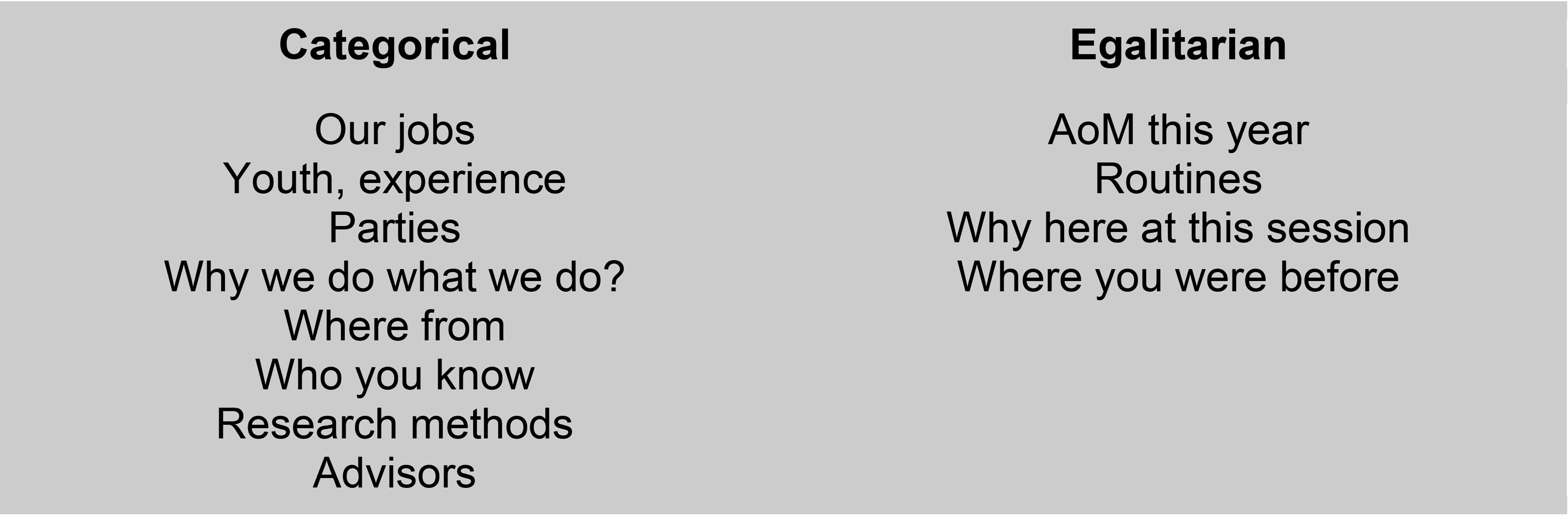
“What did you talk about?” sorted into two categories.
When we planned this exercise, we expected the categorical style to predominate. The categorical interaction order is already represented on our conference name tags. They say where we work, and there are little bars on the bottom that say more about our status. So here in the meeting, we can use the name tags to categorize each other. Participants did give many examples of the categorical interaction order. This makes sense. After all, part of why people attend the conference is to be competitive and strategic, to make connections that help advance their careers.
But the categorical style has some serious downsides. For instance, it may contribute to the phenomenon some young scholars described to Brian of the so-called mixer where the people do not mix, where groups of people who already know each other stand around in groups that are impossible to join. Joining appears to be by invitation only and these young scholars without the “right” connections feel excluded. The categorical style helps us break into such groups if we can identify the way we connect—“oh, I see you are from MIT—I got my PhD from MIT—I worked with Professor X”—and a conversation begins. You get into those little circles at the mixer. You meet the other elite people and the rich get richer and the poor get poorer. That's the way privilege and oppression works. But what about all the people who have interesting things to say and intriguing research topics that we miss because we are attending to the categorical cues? That's why we were pleasantly surprised that several people engaged in the egalitarian interaction order.
None of us should be surprised that we miss out on opportunities when our groups lack diversity. At least since Ely's and Thomas's study in 2001, studies have shown that organizations that embrace diversity are stronger and more competitive (Ely & Thomas, 2001). But we still tend to think of social inequality (as well as other grand challenges) as something that is a supplement to the core of organizational process and organizational studies rather than integral to it. This means that we are assuming that the lived experience of the privileged is a valid basis for our understanding of organizations and organizational processes. So what do we mean when we say that organizations that embrace diversity are stronger and more competitive?
The work of Rawls and Duck (2020) helps draw attention to how the assumptions embedded in social interactions not only excludes the practices and life experiences of others but also makes them sanctionable. In the introduction routine, it is easy to see that people assume they have similar life experiences to share and that they miss opportunities to learn that others have different life experiences. But Rawls and Duck also show how the routine based on the culturally privileged life experience can be seen as the right way and other ways of enacting a routine like the introduction routine can be seen as the wrong way. Routines done the wrong way may be worthy of sanction or, at the very least, are seen as off-putting and difficult to deal with. Rawls and Duck show that people who don’t engage in the introduction routine that reproduces the culturally dominant categorical interaction order are often seen as rude (Rawls & Duck, 2020). In the context of a professional conference, introducing yourself without using the competitive, strategic markers that indicate your status may result in people discounting you or thinking you are not a serious scholar. For already established scholars, playing with the introduction routine may be read as being arrogant or pulling rank.
Just to be clear—we are not just talking about introductions at conferences. It's all the other taken-for-granted routines that enact privilege. It's hiring and training and evaluating and mentoring and disciplining and allocating resources and designing organizational processes and all of those routines necessary for organizations to operate. And it's in all kinds of organizations—governmental and non-governmental, profit-making and not-for-profit businesses as well as schools, police departments, and health care facilities.
So, to summarize, routines are pervasive. And their ability to promote and sustain social inequalities is equally pervasive. And that makes understanding routines important to addressing grand challenges. It's easy to connect the dots when our actions directly contribute to grand challenges. For example, flying from all over the world so we can all be here in person has a very large carbon footprint. But it's harder to connect the dots for some of the taken-for-granted routines in our daily lives and in our work. Routines carry with them the history and the context of privilege and oppression. It's all hiding in plain sight. That's what we wanted to bring to everyone's attention.
Challenging the Grand Challenge of Digitalization: A Practice Lens on Technologies at Work
Marleen Huysman and Anastasia V. Sergeeva
There is increasing attention in the public discourse and media to what the future of work in the “age of digital technology” may look like. Economists are doing the forecasting and scenarios, big consultancy firms are publishing their predictions, and there is a growing demand from policymakers and regulators to have a better understanding of what changes in work we should prepare for and anticipate, see for example the recent reports by the World Economic Forum and the OECD (2023). The questions discussed are for example, what kind of job categories or tasks are likely to be automated or replaced, what is the percentage of employees that will need reskilling, what are the types of skills that gain importance or what are the attitudes to certain emerging technologies? Take for instance the Future of Jobs 2020 report by the World Economic Forum warning us that in contrast to previous years, “job creation is slowing, while job destruction accelerates” (World Economic Forum, 2020, p. 5). While its follow up 2023 report is less negative and expects that the impact of most technologies on jobs is a net positive over the coming years, the estimation is that 44% of worker's skills will be disrupted in the next five years. (…) Artificial intelligence, a key driver of potential algorithmic displacement, is expected to be adopted by nearly 75% of surveyed companies and is expected to lead to high churn—with 50% of organizations expecting it to create job growth by predicting that 42% of business tasks will be automated by 2027. (World Economic Forum, 2023, p. 7)
Such predictions are often followed by recommendations aimed at increasing digital literacy, accelerating training programs, issuing lifelong learning programs, and even re-introducing a universal basic income as an alternative for workers income.
What is inherent in many of these discussions is a focus on either changes of jobs and the labor market in general, or the focus is on the individual and changing of tasks and skills. At both ends of the spectrum, reskilling the workforce is seen as the grand challenge society faces when new technologies enter the workplace. We find that such focus seriously simplifies the notion of skilled action and under-appreciates the nature of the technology itself. As is quite common with technological forecasts, these societal challenges related to the deep transformations that characterize the future of work in multiple domains, are seldom supported by micro analysis of what is really happening at work (Huysman, 2020).
In fact, when using the practice lens to study how new digital technology changes work, we almost always stumble upon findings that differ drastically from the main expectations and main rhetoric around technology in wider public and societal discourse. Our ontological commitment to practice theories has led us to discover a richer picture of how people on the ground engage with technology and what reconfigurations in their collective action follow as technology becomes a part of their sociomaterial practice. Taking practices seriously also required us to approach technology not as a “macro-trend” or as a stand-alone object landing on workers from “out there,” but as inseparable from their ongoing situated action, both shaping their action and being shaped by them. Finally, our commitment to practice also led us to unpack how technology in practice is tied to embodied action. As we will show with two examples from our ethnographic research on technology at work, taking a deep dive into work practices let us see how small changes, even in bodily actions, can affect jobs, organizations, and professions. These consequences reveal quite different images of the future of work than is commonly envisioned in societal discussions.
The first example comes from a study of robotic surgery (Sergeeva et al., 2020). Robotic surgery involves using a system that provides an immersive environment for surgeons, when they sit comfortably at the console and use the pedal and joystick to manipulate the robotic arms at a distance that translate their movements into the movements of the robotic arms in the patient's body. The typical issues that are discussed related to the robot in the medical community, in medical research and in the wider public are all questions related to surgeons as focal recipients of technology and how to reskill surgeons. One often comes across studies or commentaries for example on whether surgeons are likely to adopt the robot, what are the learning curves, what are the attitudes of surgeons to the robot, and how to educate or convince surgeons to adopt the robot.
When we went to the field to study how the robot is used, we found that learning how to use the robot was by far the easiest and unproblematic question for the surgeons, so the reskilling question did not figure prominently in the field. Our commitment to practice instead helped us to draw attention to how the whole surgical team had to adapt and relearn to work and coordinate with each other in the presence of the big machine that started to occupy a large bulk of their physical space. The robot created huge disruptions for the coordination of the surgery team. More specifically, the introduction of robotic surgery affected the work practices of nurses, resident surgeons, anesthesiologists, and the surgeon, whose established roles, and tacit unarticulated embodied practices of collaborating with each other in close proximity, were seriously challenged. Now that the surgeon has moved to the corner of the room, the whole team had to figure out how to reimagine and adapt to the new configuration. Interestingly, the most important learning that had to happen was not reskilling surgeons, but the improvised emergent learning they performed on the ground in response to disruptions, adapting to the new configuration of actors, including the robot.
Another example comes from a completely different domain; the biotech industry (Karacic et al., 2023), but the lessons we draw from them regarding the technology and work, have striking parallels. The case is about a biotechnology company, a global market leader in development of novel plant varieties that implemented an AI system to sort high-quality seeds by using X-ray, light, and chlorophyll camera images. Seed sorters used to do this manually, relying on tacit, embodied expertise. Specifically, they first put their hands into the bags of seeds to feel the overall texture, then they grabbed a handful of seed, rubbed it in their hands, and then visually inspected the seeds in their palms. These practices helped them build their tacit embodied “seed-sorter expertise” allowing them to sort the “promising” high quality seeds from the low quality “non-promising” ones.
Motivated by a fierce international competition in biotech, the organization started to see these embodied judgment calls and the slow sorting process as inconsistent and inefficient, which they envision to solve by replacing humans with an AI system. The most common way to study such introduction of AI would imply studying the changes of the individual task of inspecting seeds, resulting in the finding that AI indeed leads to automation. However, the practice perspective allowed us to see the opposite happening: seed sorters became the key experts in the company. In particular, for the AI system to be able to execute the seed sorting as designers intended, it was important to have seed sorters perform new activities that now started to resemble the work of biotech scientists: they sat in clean office spaces and started working with forceps and small trays on which they carefully placed small individual seeds. They then uploaded the images into the AI system to subsequently analyze the reports that were produced by the AI. These changing work practices now enabled the seed sorters to scientifically validate and expand their deep embodied and situated knowledge that they had developed over the years. This new rich expertise was of significant importance to the organization. While the AI system produced reports on how predictions of seed growth were generated, only the seed sorters could make sense of the predictions. Moreover, they became the key actors to validate the models because they were the only ones to know when models would fail. Over time, and highly unexpectedly, seed sorters became the key experts in providing detailed scientifically validated explanations, creating a commercially viable hybrid AI system.
The empirical cases illustrate the importance of going into the field to study the consequences of introducing a new technology into existing work practices. Such in-depth analyses help to see that these consequences go much broader than the individual worker, but by reconfiguring practices eventually reach further to trigger changes in the system of relationships, roles and norms. Our broader point is that the attention to practices with technology is likely to lead us to discover changes that are less obvious and beyond the surface.
As society faces the grand challenge of a workforce that needs to be reskilled, efforts to address these challenges require to be aligned with the ongoing, situated, and unexpected sociomaterial reconfigurations of work practices on the ground. One way to create more flexibility is by organizations investing in on-the-job training, which according to the Future of Jobs 2023 report, is increasingly happening: “Workforce development is most commonly considered to be the responsibility of workers and managers” (World Economic Forum, 2023, p. 7). However, as long as the grand challenge of digitalization and the future of work is approached as a problem of jobs and skills, where technology itself is black boxed and perceived as all-encompassing, it is questionable if we will be able to address these challenges. Practice theory can help approach digitalization as not something that “lands on” organizations, but as constantly performed in situated practice. Practice theory can also help educate reflective practitioners by demystifying the notion of technology and teaching them to shift the dominant focus from petrified views of work, jobs, and skills, to seeing work and technology as an ongoing sociomaterial accomplishment.
Grand Challenges, Posthumanist Practice Theory, and the Anthropocene
Silvia Gherardi
Grand challenge(s) is a relatively new concept that has overshadowed another concept as “wicked problem” and maybe complement another one as “extreme context.” Grand challenges are framed as particularly challenging because they are complex, uncertain, and evaluative (see Gehman). However, concepts not only define and circumscribe a phenomenon, rather—following Deleuze (1995)—the role of concepts is to open our theoretical imagination to things as they might be. If we follow the Deleuzian flexibility of concepts as relational and experimental; we can say that grand challenge(s) is a concept open to the concrete objects under study, capable of stimulating the analytical and critical imagination, and also capable of stabilizing a piece of the complex and uncertain social realm under study.
In what follows, I like to focus on grand challenges as a concept and address the question—what grand challenges do?—rather than “what grand challenges are?” I contribute to the present debate on the role that practice theory can play in studying, understanding and tackling grand challenges, arguing that its main contribution is methodological and is constituted by re-imagining how to study grand challenges once we assume that grand challenges cannot be separated from the researchers’ ethico-onto-epistemological practices.
For example, when we consider plastic waste as one of the grand challenges facing the natural environment and its inhabitants, we can inquire into how plastic has displaced other materials, like cotton or wool, and at the same time consider how this change in the use of materials has changed daily practices in production, consumption and deposition. Past practices have led to the re-definition of practices of waste accumulation not only on the earth and in the ocean but to the extent that microplastic residues are also found in women’s milk. The effects of past practices on future ones are difficult to assess since plastic residues have entered many ecosystems and their effects are the outcomes of the relation between social and ecological systems (Shove, 2022). A sustainable relationship with plastic is a necessity for the Anthropocene; however, the texture of practices around the regulation of plastic waste as a single practice is complex, controversial, and dependent on how the problem around this grand challenge is framed. Microplastic hazards are uncertain, and actions are not similarly prioritized by all actors. Scientific impact assessment of primary microplastics relies on a number of factors, such as microplastic harm, existence of replacement materials and the quality, cost and hazards of alternative materials. Moreover, regulations need a precise focus and must be enforceable by these measurements. Policymakers’ evaluation of incentives should consider when the replacement of certain microplastics can stimulate innovative practices, more competitive and more environmentally conscious (Mitrano & Wohlleben, 2020).
Practice theorizing—when grounded in plastic waste as a grand challenge—directs scholars’ attention to questions of epistemology (“how grand challenges are done” and “what a grand challenge does,” i.e., its agency), and questions of connections and interdependencies within the social and ecological practices “doing” plastic waste.
I depart from the more common understanding of practices as “sayings and doings,” operated mainly if not exclusively by humans (and particular types of humans) for proposing a definition of practice as agencement of humans, more-than-humans (animals, technologies, plants, earthly matter) that achieve agency in their being connected. What is relevant in my proposal is that researchers, with their epistemic practices, are inside the research agencement in which the concept of grand challenges is used and co-produces a situated knowing of a social phenomenon.
A posthumanist epistemology of practice theory assumes that humans, nonhumans and discourses are not independent realities with well-defined properties but are constitutive entangled elements within a practice (Gherardi, 2022). If humans are not considered the standpoint (and the human is not the enlightened Man, white, male, Eurocentric and the only producing legitimate knowledge) and practice is not conceived as human practice, then its definition as an agencement leads to a changed understanding of agency and to interesting methodological implications. An agencement of entangled entities unfolds through the entities’ capacity to affect and be affected and it points to the “becoming” of practices, to practicing. An ontology of becoming takes the place of an ontology of being and it alerts the researchers’ attention to how elements within a practice and practices within a texture of practices are connected and are in a constant state of becoming (Gherardi, 2016).
In approaching grand challenges considering the agential element of practices sustaining and reproducing them, we inquire into the active process of agencement that is generated as the effect of practicing. In focusing on the texture of practices generating a grand challenge, researchers do not privilege the interdependencies per se but for how they produce particular forms of action and agency. A texture of practices is grounded on a flat ontology (Latour, 2005; Sele et al., 2024b) so that the distinction between “small phenomena” and “grand ones” is not a matter of scale and, methodologically, researchers may follow the interdependencies between practices and move like in a spiderweb, following the connection between the here and now and the elsewhere in another moment.
Different epistemologies emerge according to how researchers answer this question: “how do grand challenges come into discursive being?” Is a grand challenge a unique, objective, knowledge object, is it a plural object dependent on several researchers’ interpretations, or is it a multiple object emergent in situ from competing knowing practices? Realist, social constructivist or multiple predicaments on reality are confronted. If grand challenges are not objective phenomena, existing “out there” and waiting for the researchers to draw boundaries around them, then the researchers are not external to it, the dualism subject/object collapses and the researchers, while studying empirically how grand challenges are “done,” have to consider their own epistemic practices and also ask “how can grand challenges be done differently?” Karen Barad (2007) proposes the concept of apparatus to frame how knowing practices (including the researchers’ ones) materially compose the world and how the knowing subject does not produce knowledge on the world but produce knowledge because s/he is part of the world.
I have introduced the shift from ontological questions to onto-epistemological questions, but ethics is not foreign to a posthumanist epistemology of practice theory and therefore we can speak of an ethico-onto-epistemology as proposed by Barad (2007). This term indicates how epistemology, ontology, and ethics are inseparable and how matters of fact, matters of concern, and matters of care are intertwined. Feminist new materialism proposes to follow Deleuze (1988) and the idea of an immanent ethics whose aim is not to rediscover the universal, but to find the conditions under which something new is produced. This idea lies at the core of ethics as practice (Clegg et al., 2007), responsible management-as-practice (Gherardi & Laasch, 2022), and response ethics, based on shared vulnerability (Oliver, 2015b) and Haraway's (2016, p. 34) concept of response-ability as “an ethical capacity of cultivating collective knowing and doing” in everyday practices.
In assuming an ethico-onto-epistemology, a posthumanist practice theory participates in the conversations grouped under the umbrella term of critical posthumanism. What is under critique is humanism's anthropocentrism, essentialism, exceptionalism, and speciesism (Braidotti, 2013). The term is generally used to refer to the convergence of post-humanism and post-anthropocentrism in an economy of advanced capitalism that produces a critique of the humanist ideal of Man and a rejection of human exceptionalism that establishes a species hierarchy (Braidotti, 2013). This convergence is at the core of what Braidotti (2019) names posthuman knowledge production. Anthropocentric hierarchy is a historical construction that has legitimated the white, western, male dominion over nonhuman animals, colonized territories, women, and other differences which have been turned into inferiorities (Ferrando, 2020). Anthropocentric organizing has molded organizational practices that are no longer feasible (de Vaujany et al., 2024) and most of the so-called grand challenges—from climate change, to social inequalities, to the mis-management of natural resources (air, water, and soil) or human waste—are the effects of anthropocentric hierarchies.
Anthropocene enfolds all forms of life; however, there are evident power asymmetries, since it is not humanity as a whole that is responsible for the threats to life, but those (humans, groups, organizations, and institutions) who are more central to the circuit of power, as feminist scholars in various disciplines have denounced (Ergene et al., 2018; Gibson-Graham, 2014; Graham & Roelvink, 2010; Haraway, 2016).
In practice-based studies a research agenda for questioning fundamental knowledge production practices has been focused on the study of practices producing and reproducing the grand challenges fostering contemporary harms in the world. At the same time, it is important to imagine affirmative possibilities for a world that could become otherwise (Calás & Smircich, 2023). Thus, a posthumanist epistemology of practice theory may approach grand challenges not only in the context of the Anthropocene, inquiring about the practices conducive to extreme contexts but also in elaborating on those more-than-human and more-than-capitalist practices inducing becoming otherwise.
In other words, practice theorizing does not need to be only retrospective, it can also be prospective and make use of non-orthodox methods such as experimenting with trans/feminist speculative fabulation, a method inspired by Donna Haraway's (2013) work on SF (a polysemous acronym, in which speculative fabulation, science fiction, speculative feminism, speculative fantasy, scientific fact, and so on are grouped together). Speculative fabulation concerns the stories we tell every day, and therefore in a certain sense we are all already telling fables, where the fable is the place par excellence populated with “wild facts” that subvert reality. Gaia storytelling (Jørgensen et al., 2021) is another method that, in responding to Latour's (2018) invitation to get “down-to-earth,” produces an ecological and socially equitable approach to learning based on the citizenship of Gaia. It is an attempt to create a new language, necessary for shaping alternative practices, capable of creating an ecologically healthy planet while acknowledging that organizations are generally unsustainable because of their history and position. These are just two examples that open up the problem of how to do empirical research on such a complex topic as grand challenges approached via practice theories and ones that argue how imagination, storytelling and projecting current practices into the future, whether utopian or dystopian, can help to imagine alternative practices and be critical of the current ones.
In concluding, I argue that the main contribution that a posthumanist epistemology of practice theory offers to the study of grand challenges is a methodological reflection for re-thinking qualitative empirical research (Cozza & Gherardi, 2023) once the human subject (and the humanist predicament associated to the Man of reason) is decentered and thus anthropocentric hierarchies, and dichotomous concepts (human/nonhuman animals; human/technology, men/women, and human/earth) are questioned and dismantled.
Opportunities and Challenges
Kathie's Reflection
Kathleen M. Sutcliffe
I have shared the photograph in Figure 2, taken several years ago in a Hong Kong hotel, as a prod for reflection. Reflection is defined in many ways, but two primary meanings provide a useful frame for my comments. One way to define reflection is simply as the act of reflecting; the throwing back by a body or surface of light, heat, or sound without absorbing it. A second way to define reflection is as deep thought or consideration. My aim is to do both—to emphasize what we have heard (seen) and to provoke deeper consideration.

Pool in Hong Kong.
What Did We Hear (See)?
Drawing on reflection in the first sense we heard that grand challenges are highly significant, yet potentially solvable problems. Grand challenges, such as social inequality, affect vast numbers of people often in profound ways. They are typically complex, with unknown solutions and intertwined technical, social, political, and geographical elements. Because they cross so many boundaries, we need scholars from multiple disciplines and communities to better understand them. And because situated human activity and agency are central in shaping and resolving such problems, practice perspectives may be promising research frames that can serve as springboards for better understanding grand challenges and perhaps for solving them.
Routine dynamics, as Feldman and Pentland explained and illustrated, can potentially unearth explanations that account for the stickiness of grand challenges. But this requires, as Huysman and Sergeeva point out, micro-analyses of “what is really happening.” Analyzing our lived experiences of introducing ourselves in real time awakened many to the ways in which our practice of introducing can enact privilege and sustain social inequalities. Moreover, both Jarzabkowski and Rouleau explained that practice theorizing, particularly in studying grand challenges in extreme contexts, can potentially explain why groups of actors with good intentions struggle to arrive at joint action. That said, drawing on these perspectives is trickier than it looks. Why? Because routines and taken-for-granted activities and practices are not just action patterns/activities that accomplish tasks, they reproduce the social and historical contexts that run through these very patterns of actions/activities. In other words, we saw firsthand how routines and taken-for-granted practices reproduce the very conditions that they are trying to solve. And not only that, it is hard to discern exactly how this reproduction happens as we rarely dissect or question the assumptions that are embedded in the practices in which we are engaging. Yet even if we do, as Gherardi points out, failing to take a posthumanist approach to practice theory, may lead us astray—missing both what grand challenges do as well as opportunities for knowings and doings essential to enacting substantive change. This brings me to reflection in the second sense.
Toward Deeper Consideration: Are Grand Challenges Old Wine in New Bottles?
Although grand challenges and scholarly interest in them are sometimes described as being relatively new phenomena, as several scholars noted, they aren’t. I would be remiss if I didn’t point out that forty years ago my collaborator Karl Weick published an article in the American Psychologist titled “Small wins: Redefining the scale of social problems” (Weick, 1984). Over time we have retained ideas about “small wins,” but we seem to have forgotten ideas related to “redefining the scale of social problems.” In other words, during the past forty years, we have privileged attention to the former, but we seem to have totally lost sight of or ignored or sacrificed attention to the latter—the idea of redefining the scale of social problems. In that paper, Weick drew on studies from the 1970s describing big social problems. The social problems he discussed then are entirely consistent with the grand challenges that we read about in this essay and grapple with today. Weick argued that, regardless of how you define them, there is agreement that these are big problems and that's the problem. The massive scale on which social problems are conceived often precludes innovative action, because the limits of rationality are exceeded and arousal is raised to dysfunctionally high levels. In other words, the complexity and unstructured nature of these problems activate serious negative emotions like fear, confusion, uncertainty, doubt, or maybe just disrespect or disregard. They fuel feelings of helplessness; I don’t have the capabilities to solve that problem so I’m not going to acknowledge it or attempt to do anything about it. It is useful to consider the possibility that social problems fail to get resolved because people define these problems in ways that overwhelm their abilities to do anything about them.
Have we handicapped ourselves by using descriptors such as grand challenges and extreme contexts? As Weick (1984) suggested, changing the scale of a problem can change the quality of attention and resources that are directed toward solving it. Calling a situation a mere problem suggests a small or modest solution and doesn’t necessarily stimulate or heighten arousal. In contrast, calling something a grand challenge or extreme context highlights the necessity of a larger solution. And that may be when the problem starts. In our work on managing the unexpected, Weick and I proposed (2007) that the unexpected is becoming a larger chunk of the everyday; that things that have never happened before happen all the time. Very few challenges are truly unexpected surprises. If this is the case, and we actually have seen these things happening before, why haven’t we gotten them solved? It seems reasonable to ask whether the language we use to describe social challenges and problems in some way undermines our abilities to resolve them.
Contextual Dynamics and Emotions Need More Attention
Given all that has been said, it follows that we might need to shift our research focus. I fear that we have spent too little time exploring contextual dynamics and emotions. This curated debate suggests that we’re heading in the right direction, but more needs to be done. We know that context matters. As we have heard and read, it contains elements that promote or hinder actions. And although actions can proceed unimpeded, contexts oftentimes create disruptions and interruptions to sequences of activities/practices/actions. When routines, practices, and activities are blocked, emotions are activated as Rouleau and others in this curated debate have pointed out. When emotions are activated, they often challenge or suspend habitual ways of acting, in part because people reflect on and reframe their understanding of the situation. They ask themselves—what am I facing and what am I doing? Does my current understanding of the situation make sense? As people make sense of what they’re facing and doing they often seek new courses of action that are better suited to the context than what they were doing before.
My collaborator, Michelle Barton, and I (2009) found this pattern in our studies of wildland firefighting teams. Firefighting teams that experienced disruptions and had time to reflect on these disruptions and create a new story of what they were facing and doing were more likely to change their course of action (toward a more salutary course of action). In contrast, less successful wildland firefighting teams failed to change course and got into a situation of “dysfunctional momentum.” Since they were so embedded in what they were doing and continued uninterrupted, they were less likely to reflect, make new sense of what they were facing, and ultimately failed to make critical adjustments.
Interruptions are critical to what we’re doing, because they activate emotions and provide an impetus for reflection and re-evaluation. But we need to know more about these matters. What elements of context matter? How does intensity matter? What constitutes an interruption? What emotions emerge from interruptions? Weick's theorizing suggests that very intense reactions to grand challenges may overwhelm us and result in breakdowns and/or redirections; but they may be redirections to unpredictable and undesirable paths. Is this the case with grand challenges? Is there too much arousal and impeded action? Or is it the case that there's too little arousal? Interruptions occur, activities are blocked, people get tired, or frustrated and lose motivation. Following the invitation to reflect upon the other contributions in this curated debate, I was thinking it was going to be too much arousal. But after reflecting on all the contributions, I’m thinking maybe it's too little. We know that interruptions occur and actions/activities get blocked. And when this happens, people don’t really think much about it, or they get frustrated and lose motivation and interest, they give up and wander off, and the challenges remain unresolved.
Where Do Researchers Go From Here?
We seem to be on the right track for how we are studying routines and strategies and their role in grand challenges, privileging meso-level, processual, longitudinal, observational, and ethnographic methods that capture moments of conscious experience of the present. Yet, as the contributions in this curated debate explicitly point out, we can do more to provoke insight and reflection, we also need innovation or unconventional approaches such as small in situ experiments. We know from pragmatism theory that emotions related to uncertainty and doubt have been shown to inhibit or suspend immediate activity and alert participants that something else is required. When the underpinnings of routines, practices and activities become more visible they may be more subject to modification and consequently more essential in determining the fate of grand challenges. It may come down to reflexivity all the way down. Reflexivity on the part of people engaged in practices, and reflexivity on the part of the researchers studying these practices may hold promise for making headway on these critical challenges.
Joel's Reflection
Joel Gehman
Reflecting on the contributions in this curated debate prompts three questions. First, what are the strengths of practice theory, especially as reflected in work on strategy-as-practice and routine dynamics, when it comes to exploring grand challenges? Second, what drawbacks do practice theoretic perspectives face when exploring grand challenges? And third, what considerations would practice theoretic research benefit from taking into account when investigating grand challenges in the future?
In terms of the first question, as is evident from their preceding contributions, practice theoretic perspectives, such as strategy-as-practice and routine dynamics, have many strengths when it comes to exploring grand challenges. Indeed, collectively all contributions in this debate have made a convincing case for employing varieties of practice and routines perspectives. For instance, these approaches have clear benefits when it comes to capturing the sayings and doings, whether conceived of as mundane practices or routine dynamics—within organizations as well as collaborative efforts across organizations. Similarly, as Danner-Schröder, Mahringer, and Sele point out, practice theoretic perspectives invite a process orientation, overcome common dualisms, take considerations such as relationality and embodiment seriously, and attend to consequential impacts. Collectively, there is attention to practices, both mundane and extreme, and, there is an emphasis on routines with the ability to capture dynamics related to both stability and change. All of these are important foci when it comes to our understanding of grand challenges.
Problems Come in Different Flavors
Before I move on to answering my second and third questions, though, I want to take a short detour to remind us that not all problems are created equal. The problem on the left side of Figure 3 is actually a pretty mundane problem. It's a moonshot, and is often held up as the exemplar of mission-oriented innovation (e.g., Mazzucato, 2021). And as you know, this effort succeeded in putting a person on the moon, and it did so through conventional management techniques.
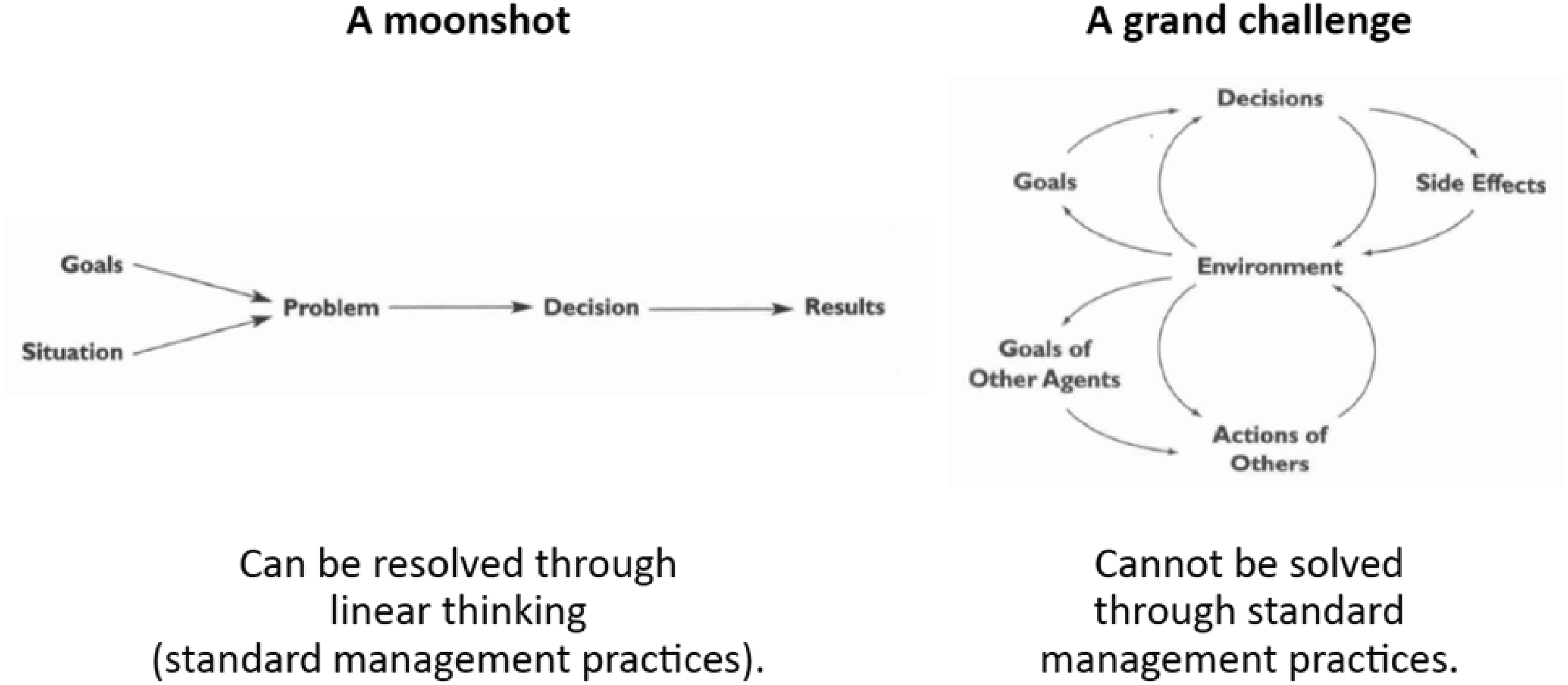
Problems come in different flavors.
On the other hand, many scholars have become interested in solving grand challenges. And as already previewed in the introduction, these are very different problems. Many scholars agree they cannot be solved using the same sort of command and control style of management that took humans to the moon. Herbert Simon (1996, pp. 139–140), in his book, The Sciences of the Artificial, captures this distinction: We ask, “If we can go to the Moon, why can't we…?” not expecting an answer, for we know that going to the Moon was a simple task indeed, compared with some others we have set for ourselves, such as creating a humane society or a peaceful world. Wherein lies the difference? Going to the Moon was a complex matter along only one dimension: it challenged our technological capabilities. Though it was no mean accomplishment, it was achieved in an exceedingly cooperative environment, employing a single new organization, NASA, that was charged with a single, highly operational goal. With enormous resources provided to it, and operating through well-developed market mechanisms, that organization could draw on the production capabilities and technological sophistication of our whole society. Although several potential side effects of the activity (notably its international political and military significance, and the possibility of technological spinoffs) played a major role in motivating the project, they did not have to enter much into the thoughts of the planners once the goal of placing human beings on the Moon had been set. Moreover these by-product benefits and costs are not what we mean when we say the project was a success. It was a success because people walked on the surface of the Moon. Nor did anyone anticipate what turned out to be one of the more important consequences of these voyages: the vivid new perspective we gained of our place in the universe when we first viewed our own pale, fragile planet from space.
There's a lot in the preceding quote, but notice especially how there is a clear goal, a dedicated organization, abundant resources and, critically, a clear finish line.
Now, compare Simon's perspective with that of Paul Polman, CEO of Unilever from 2009 to 2019:
The issues we face are so big and the targets are so challenging that we cannot do it alone, so there is a certain humility and a recognition that we need to invite other people in. When you look at any issue, such as food or water scarcity, it is very clear that no individual institution, government or company can provide the solution. (Confino, 2012)
On my reading, Polman's diagnosis echoes Simon's, while also suggesting that extant siloed modes of organization are likely ill-suited to tackling grand challenges. If you think about it in terms of the classic forms of organizing—markets, bureaucracies, clans (e.g., Ouchi, 1980)—I read Polman as advocating for what I think of as an “all of the above” strategy. There is no one preferred mechanism for tackling grand challenges. This is precisely the kind of organization theoretic question I have been working on for several years now, together with several colleagues (Etzion et al., 2017; Ferraro et al., 2015; Gehman et al., 2022a).
In the decade since I started pursuing this line of work, one thing that stands out for me is that, in terms of ontological and epistemological commitments, there are some points of contact between routine dynamics and practice theory and, for instance, the American pragmatist perspective we articulated in our articles on robust action as well as with the relational-temporal approach that we propounded in our sustainability journeys article (Garud & Gehman, 2012). In short, there are a number of family resemblances and sympathies between the ontologies undergirding these perspectives, a few of which I will highlight briefly in the next section.
Characteristics of Grand Challenges
One of the things that we outlined in our original robust action strategies article is the idea that grand challenges are particularly challenging because of three facets. Namely, they are complex, uncertain, and evaluative. And in particular, we think the evaluative dimension is a key difference between our formulation and some others (e.g., see Gehman et al., 2022a for a discussion). It is one thing for a group of people to coalesce around a particular formulation and definition of a problem; it is another thing for them to have the motivation and ambition to solve that problem; it is another matter entirely for them to agree on what counts as a credible solution to that problem.
As a stylized example, in the United States, many people would agree that alleviating poverty is an admirable ambition. But, ideologically, a “red”-state solution looks very different from a “blue”-state solution to the same problem. And that is part of what we mean when we say grand challenges are evaluative. So it is not enough to agree that poverty or inequality or some other grand challenge is a problem and we want to solve it. Candidate problem solutions are themselves contested at the level of the values at stake, and this valueladedness is, according to our theoretical account, a core part of the intransigence of grand challenges.
In view of this situation, we proposed a robust action approach (Ferraro et al., 2015). In their landmark study, Padgett and Ansell (1993) defined robust action as noncommittal actions that keep future lines of action open in contexts where opponents are trying to narrow them (see also Padgett & Powell, 2012). Clearly, this definition assumes a strategic context. However, in our work, we relaxed this assumption and considered what would happen if you took a more collaborative approach. In some ways this may be consonant with the Rawls and Duck (2020) distinction between categorical and egalitarian communities that Feldman and Pentland introduced. Very briefly, our framework proposed three strategies: participatory architecture, multivocal inscription, and distributed experimentation. Here we connect directly with the emphasis on small wins as outlined by Sutcliffe. In our original article we drew, for instance, on Weick's (1984) article. Small wins are critical, in our view, for catalyzing action and sustaining the engagement of the actors involved in tackling particular challenges (e.g., see Casasnovas & Ferraro, 2022; Mair et al., 2016). At the same time, this raises a number of questions about how you scale those activities up and how you maintain an institutional memory of what has already been tried and accomplished (e.g., see Porter et al., 2020).
Drawbacks for Practice-Theoretical Research on Grand Challenges
Coming back to the second question, the challenge I see is from a research design standpoint: as a scholar how can you attend to the complexity, the uncertainty and the evaluativity of the phenomena that you are studying? I do not have a full answer to that question but clearly this is one of the key challenges. No doubt, organizations are going to be full of routines and practices. And if you ask them, they are going to tell you a story, a rationalized story, about how the things the organization is spending time and energy doing are aimed at solving particular grand challenges. But that might not be enough. Their self-reported efforts may not be sufficient to understand, in organization theoretic terms, what is going on. And so, how do you capture the extent to which an organization's practices and routines are actually having the desired effects? To me, that shifts the question to one of results and impacts.
This implies a need to link up the practices and routines that a researcher observes to desired impacts. But this is complicated by at least two things, what we can think of as pace and scale. First, in terms of pace, when, in time, will the impacts materialize? If I study the practices today, will I see the impacts tomorrow? Or do I need to wait 10 years? And so what does that delay or latency between action and impact mean from a research design standpoint? This is of course a practical question, but more importantly it is a theoretical one. It requires that one start with some sort of theoretical model of the dynamics to be observed, and against which potential conformities and anomalies can be compared.
Second, what is the scale at which we should look for impacts? If I study organization X today, but the problem they are trying to solve is at the societal level, how do I know that organization X has contributed to resolving the problem at societal level? More generally, how does a researcher go about capturing the dimensions of pace and scale when they are not proximate to the organizations that are being studied, either in time or space? I think this is a key challenge. Although this challenge is not unique to routines and practice perspectives, because these perspectives are so focused on the sayings and doings in organizations, if you will, it foregrounds these challenges.
Some Reflections on the Contributions and Directions for Future Research
Turning now to my reflections on the other contributions in this paper, I really liked the example that Feldman and Pentland walked us through on everyday routines. It got me thinking about some classical ethical theories. In some ways, the approach they are advocating for is a very Kantian (Kant, 1895) or Rawlsian (Rawls, 1971) one. They are advocating for not seeing the interlocutor as a means to some instrumental goal. This foregrounds the question of how do you not instrumentalize the other, but see them as an end in themselves.
But there are other approaches to ethics. In particular, I want to highlight two alternative approaches to ethics, one I will call recognition ethics, and another I will call response ethics. Recognition ethics is Hegelian (e.g., Williams, 1998). The idea is that recognition of the other is the first step. And, such an impulse—i.e., the struggle for recognition by marginalized and oppressed people, groups and cultures—is the focus of wide swaths of contemporary social theory, including social movements, feminist theory, critical race theory and queer theory. All of these operate within what Oliver (2001, p. 9, 13) calls “an economy of recognition,” which privileges a “recognition model of identity.” In the example by Feldman and Pentland of tacit racism, this could entail developing the capacity to recognize the other, who is foreign to me; the other is my alter (in the ego-alter sense of that term (Oliver, 2001)) and recognizing this is the first step in bridging the ethical gap.
My understanding of response ethics comes from Oliver's (2001, 2018) work. She asserts that there are limits to what I can recognize, let alone account for (e.g., see also Murphy et al., 2017). This limit creates a different ethical obligation. And so, for her, recognition ethics is not enough. In her formulation, we need to go beyond recognizing the other. She refers to this process with a play on words she calls “response-ability.” I have an ethical obligation to respond and to cultivate the ability to respond, even to that which I do not recognize but which is in my proximity all the same. “We have an obligation not only to respond but also to respond in a way that opens up rather than closes off the possibility of response by others” (Oliver, 2001, p. 18).
This sort of thinking has multiple implications. For starters, it suggests that we, as researchers and analysts of organizations, need to foster a critical stance on the practices and routines we are studying. As social scientists, we have a responsibility to perturb our research settings beyond just the surficial meanings we recognize and encounter. We have responsibilities and response-abilities both in terms of recognition and response to that which we do not understand and yet which we encounter. “We must be vigilant in our attempts to continually open and reopen the possibility of response” (Oliver, 2001, p. 19).
The notion of response-ability also is well-equipped to handle the kind of posthumanist entanglements that Gherardi foregrounded—for instance, humans, nonhumans, and more-than-humans—the “missing masses” Latour's (1992, p. 16) term for the “complete chain” of human, artifacts, words, and things, that add up programs of action). These “chains” are the agencements of which Gherardi wrote, and agencies and actors are in these assemblages (Gehman et al., 2022b). This ethical perspective is also well-equipped to contemplate the digitalization and robotics considerations raised by Huysman and Sergeeva. Indeed, quite a bit of Oliver's (2009, 2013, 2015a) work deals with nonhumans and prostheses–from animals, nature, and biodiversity to medicine, technology, and institutions to artificial insemination, genetic engineering, and capital punishment, in the process troubling even seemingly self-evident distinctions such as between chance and choice, nature and culture, grown and made, and machine and animal.
Returning to the strategy-as-practice perspective, there is an interesting question between potential and actual that Jarzabkowski highlighted. Namely, how can we distinguish between the potential of grand challenges research and its actual manifestations. As I reflected on this question, I recalled some of my research that has looked at aspects of climate science (e.g., Garud et al., 2014). One branch of climate science involves running models that attempt to predict the world in order to prevent that world from coming to pass (e.g., Mann et al., 2021). This is not the canonical understanding of science you likely encountered in high school. Some scholars have conceptualized this as post normal science (e.g., Funtowicz & Ravetz, 1993), which goes beyond the Kuhnian distinction between normal and revolutionary science (e.g., Kuhn, 1970). It also highlights the performative aspect of theorizing (e.g., Bowden et al., 2021; Reinecke et al., 2022), and in so doing, poses a challenge. For instance, how do you study the routine or practice counterfactuals that never materialize? Because if the climate scientists “succeed,” we will not have our worst fears realized, and what kinds of practices and routines are those?
In other words, it opens up the possibility that researchers may find themselves in some actual world, but one that only arrived because of the practices or routines that prevented an alternative future. This is another facet of the kind of intertemporal problem that I pointed to earlier (e.g., Garud & Gehman, 2012). As an example, ozone was an actual problem long before we had the metrology to detect it, let alone take action on it. And so it raises for me questions such as: What do we do when ontology exceeds our awareness? The problem is located in routines and practices–think about ozone–but it also goes beyond them. So there is some kind of excess or overflow that will be difficult for a practice perspective or routine dynamics perspective to notice or capture.
Joining the Call for Action
Anja Danner-Schröder, Christian Mahringer, and Kathrin Sele
What we have learned from the different contributions and reflections is that grand challenges are not just massive but that this massiveness has a paralyzing force that often seems insurmountable. Practice theories (Bourdieu, 1977; De Certeau, 1984; Engeström, 1999; Giddens, 1979; Latour, 2005; Schatzki, 2002) cannot solve the issue of grand challenges being what they are–complex, uncertain, and evaluative (Ferraro et al., 2015). However, a turn to practices and the tracing of practices is helpful in breaking down this sheer massiveness of grand challenges by unpacking their constitution through everyday saying and doings. Put differently, situated actions are consequential for the reproduction of grand challenges. As argued by Benjamin (Benjamin, 2022, p. 18) we need to shine a light on the patterns of inequity [and other grand challenges] we perpetuate by just doing our jobs, clocking in and out, making small talk with our neighbors, avoiding uncomfortable conversations, all while the machinery of our everyday live hums along.
In what follows, we summarize what we have learned and discuss how researchers may engage with and employ practice theories in their attempts to make our research more actionable, critical, and hopefully impactful.
All authors contributing to this debate have called for methodological innovations. Jarzabkowski made clear that as we trace practices and their role in and for grand challenges, researchers should not only consider actualities such as a particular extreme event, but also the potentialities; a move that has the potential to reveal large patterns over space and time and as they unfold (Sele et al., 2024b). Therein, the turn to real-time, ethnographic methods seems more important than ever. As Latour famously said in a New York Times article (Kofman, 2018) on post-truth and climate change, as scientists we need to make the invisible visible by going where the action happens, we need to be “transparent about how science really functions—as a process in which people, politics, institutions, peer review and so forth all play their parts” in order to “convince people of [our] claims.” Rouleau discusses how organization and management studies research could be enriched by methods such as biographical interviews, self-reports such as diaries (Rauch & Ansari, 2022) as well as by learning from films (Greco et al., 2024) or documentaries (Danner-Schröder & Sele, 2024; Rouleau, 2024). Broadening our methodological repertoire requires us to leverage our theoretical and conceptual imagination as argued by Gherardi. Orienting ourselves toward the future and being prospective enables us to ask questions such as: How might these events be related? What could have happened? What are the alternatives? In fact, it is not only about what we observe here and now, but also how this could relate to other observations (or non-observations) in an entangled web of possibilities (Feldman & Sengupta, 2020; Ferraro et al., 2015; Pentland et al., 2020). At the same time and as discussed by Gehman, as we focus on practices it is important to be aware of what we might miss, what lies outside of our awareness and thus requires different perspectives and disciplines to come together. Huysman and Sergeeva show how many grand challenges are in the making and we are required to make sense of their effects as they happen or in the words of Gherardi as we study “what grand challenges do?”
This leads us to what could be captioned under the notions of reflexivity and responsibility. While clearly issues that were on everyone's mind as they engaged in this debate, the different scholars not only called on us to be more reflexive, they also shed light on our own responsibility in studying grand challenges. Providing us with an example in our own field, Feldman and Pentland showed how it is not enough to just acknowledge that there is a problem. Indeed, they urge us to pay close attention and to “search for relevant routines” or practices, which in their focus on privilege and oppression would require us to look for exploitation, marginalization, powerlessness, cultural imperialism, and violence (Feldman & Pentland, 2022, p. 853). In these attempts, however, we need to tread carefully as change or progress is not a universal answer to all problems and because we risk making things worse even if the initial intention is or was good (Sele et al., 2024b). When studying grand challenges we are often confronted with extreme contexts or settings characterized by resource-constraints and highly vulnerable actors. Accordingly, it becomes even more important that we are aware of the impact of our own actions and that we learn how to do research in a way that respects our informants and their vulnerability (see recent resources provided by the Ethnography Atelier: podcast, workshop). As discussed by Rouleau, one way of engaging is to give back. When studying extreme events, such as floods, we should not only interview and observe people, but we can also participate in the cleaning up or help people find a new home. At the same time and as reflected upon by Sutcliffe, we might also want to be much more aroused and emotional for what is happening and as we find our voices as researchers and citizens.
Not everyone needs to become an activist (Delmestri, 2023; Gray, 2023; Gümüsay, 2023) but being much more aware of our everyday actions seems to be a necessary part of the process. As this curated debate shows, practice theories can help us to see the entanglement of actions and of a large network of actors ranging from humans to non-humans and nature. In the age of the Anthropocene and in the spirit of the ongoing discussion of how organization and management scholars can become part of the solution, we can start by acknowledging that we do make the world we live in and to make it more equal and sustainable we need to start with our own actions. Engaging with what happens in close vicinity might be our best bet.
Footnotes
Acknowledgments
We thank all the participants for attending and the Strategizing Activities and Practices (SAP) Interest Group of the Academy of Management for sponsoring the original symposium together with co-sponsorship from the Organization and Management Theory and Organization Development and Change Divisions. We are grateful to Paul Olk and two anonymous reviewers for their excellent guidance and insightful comments.
Declaration of Conflicting Interests
The authors declared no potential conflicts of interest with respect to the research, authorship, and/or publication of this article.
Funding
The authors disclosed receipt of the following financial support for the research, authorship, and/or publication of this article: Kathrin Sele acknowledges funding from the Academy of Finland Research Fellow Grant #321362. Christian Mahringer acknowledges funding by the WIN program of the Heidelberg Academy of Sciences and Humanities, financed by the Ministry of Science, Research and the Arts of the State of Baden-Wurttemberg. Marleen Huysman and Anastasia Sergeeva acknowledge the funding under the Open Competition program by the Dutch Research Council (NWO), file number 406.18.EB.030.
