



Abstract
The market categories literature is reaching the adolescent stage. To ‘look forward’ and chart the next stages of this literature’s growth, we first need to ‘look back’ at what we have learned so far. We thus begin with a systematic review of the literature on market categories from the 1990s to the present. Our search of leading management and sociology journals yielded 100 empirical papers, which we group into eight themes. We then discuss in more detail the findings under the top three of these themes: category spanning, new category construction and category change. Based on our review, we then ‘look forward’ and offer suggestions for future research on market categories. Specifically, we call for more explicit attention to (1) agency, particularly in studies of category spanning, (2) market categories at the intersection of multiple institutional logics, (3) market categories as an outcome rather than antecedent and (4) construct clarity and consistency. We hope these recommendations will ensure a long and healthy future for this burgeoning literature.
Introduction
Research on market categories is reaching the adolescent stage within organizational studies. Whereas categories and categorization have long been studied by cognitive psychologists (e.g. Barsalou, 1983, 1985; Rosch and Mervis, 1975), seminal works employing a market categories lens within organization theory and strategy only appeared in the 1990s (Porac et al., 1995; Zuckerman, 1999), and it was well into the 2000s before this literature began to take shape and grow. Like an adolescent, this literature is now burgeoning and branching into a number of directions. At the same time, terminology is inconsistent and findings have yet to be cumulated. This adolescent stage of literature development is an opportune time for a systematic review of the short history of research on market categories and a charting of its future directions.
A market category is a specific kind of category, one that forms the basis of market exchange between producers and consumers, an exchange that draws the interest of and is surrounded by third-party audiences such as critics, media and regulators. 1 A market category can be defined as a shared meaning or ‘cognitive agreement’ between the actors’ party to an economic exchange about what is being exchanged (Durand and Boulongne, 2017: 647; Navis and Glynn, 2010: 441). This agreed-upon meaning represents a ‘conceptual boundary’ that orders the organizational landscape and serves as a basis for comparison, valuation and exchange (Khaire and Wadhwani, 2010; Lounsbury and Rao, 2004; Rosa et al., 1999). Empirical examples of market categories include ‘satellite radio’ (Navis and Glynn, 2010), ‘modern Indian art’ (Khaire and Wadhwani, 2010) and ‘light cigarettes’ (Hsu and Grodal, 2015).
The market category construct is closely related to similar constructs in the literature. For instance, Vergne and Wry (2014: 68) define an ‘organizational category’ as existing when ‘similar member organizations and a set of associated external audiences come to a mutual understanding of the material and symbolic resources that serve as a basis to assess membership in the category’. This construct is itself similar to that of ‘organizational form’, which refers to organizations that are grouped in terms of their social identities (Hannan et al., 2007). Another frequently used construct is ‘product category’, which is ‘recognized as such when similar sociotechnical artefacts come to be exchanged as products within a distinct market segment that serves as a basis for interaction between producers, buyers, and external audiences (e.g. critics)’ (Vergne and Wry, 2014: 68). We focus here on market categories and seek to distinguish this construct from related ones based on our review of the literature.
To ‘look forward’, we first need to ‘look back’. We begin with a review of the conceptual literature on categories within the organizational theory. Informed by this review, we then engage in a systematic review (Newbert et al., 2014) of the empirical research on market categories. Our goals are to, first, take stock of existing research and, second, to then chart some potential directions for its future.
Looking back: a systematic review
As Vergne and Wry (2014: 57) observed, category research in organizational studies has its roots in both psychology and sociology, with a ‘divide between early studies that were rooted in cognitive psychology and examined how organizations categorize themselves (Porac et al., 1989) and more recent efforts that draw on sociology and theorize categories as components of a firm’s external environment (Zuckerman, 1999)’. Definitions of the category construct emphasize cognition. Notably, categories have been defined as ‘interfaces of cognitive agreement about a considered object’ (Durand and Boulongne, 2017: 647) and as ‘socially constructed partitions that group together objects perceived to be similar (Bowker and Star, 2000)’ (Grodal et al., 2015: 424). The literature presents two approaches to categories: a prototypical approach and a goal-derived approach (Durand and Paolella, 2013). In the prototypical approach, a category represents a collective agreement by audiences on the similarities of its members (Hannan et al., 2007). An underlying assumption in this approach is that a category is defined according to a prototype (Durand and Paolella, 2013). Thus, under the prototypical approach, a market category can be defined as a set of products or services perceived ‘to be of the same type or close substitutes for each other in satisfying market demand’ (Navis and Glynn, 2010: 440). In the goal-derived approach, category membership is based on ideals rather than features. In this approach, ‘category members are items that most suit an ideal, even if they greatly differ from each other—category structure is driven more by goal pursuit than by family resemblance’ (Barsalou, 1985; Durand and Paolella, 2013: 1109). Engaging in such goal-derived categorization can result in products with heterogeneous features being part of the same category, such as various types of foods being included in the category ‘foods to eat on a diet’ (Barsalou, 1985).
Prior reviews and conceptual work on categories have highlighted two main themes: category spanning and new category construction (Durand and Khaire, 2017; Durand and Paolella, 2013; Kennedy and Fiss, 2013). Studies of spanning are based on the assumption that actors or objects benefit from membership in clearly defined categories (Durand and Paolella, 2013: 1101). When an object’s features fit clearly within an existing category, audiences can better understand and evaluate the object. Conversely, producers that audiences associate with multiple categories (i.e. category spanners) are subject to lower survival chances as they are perceived to be violating categorical norms (Hsu et al., 2009; Kovács and Hannan, 2010: 175; Zuckerman, 1999). Scholars have also suggested that the penalties associated with spanning are contingent, for example, on category stigmatization (Vergne, 2012), firm naming practices (Smith and Chae, 2016) and audience heterogeneity in income and education (Chae, 2022).
Research on category spanning has typically dealt with existing market categories, leading Kennedy and Fiss (2013: 1139) to opine that ‘category emergence remains an under-researched aspect of categories research’ and that more study is needed on ‘category structures as an outcome and an accomplishment to be explained’. Where do categories (and category systems) come from in the first place? Both Kennedy and Fiss (2013) and Durand and Khaire (2017) proposed frameworks to answer this question. For Kennedy and Fiss (2013: 1146), categories take hold ‘when a private or one-off insight applies a familiar meaning, often by analogy or translation, to a novel, unfamiliar occasion or for unusual purposes, and the situation and meaning then become widely accepted’ or ‘when a private or one-off insight is attached to a new word, or neologism, or to a new interpretation of an existing word [and] the new or reinterpreted word is then used in increasingly similar ways’. For their part, Durand and Khaire (2017) distinguish between two types of category construction: emergence and creation. They define category emergence as ‘the formation of categories that emerge from elements extraneous to an existing market’, whereas category creation refers to a case where ‘a new category consists in redesigning cognitive boundaries around a subset of elements within a preexisting category system’ (Durand and Khaire, 2017: 88). 2 The study of how new categories come into being remains nascent, with only general pathways such as these having been proposed.
With these prior insights in mind, we engaged in a systematic search for empirical work on market categories. We began with a keyword search on abstracts using ‘categor*’ in the following leading journals: Administrative Science Quarterly, Academy of Management Journal, Organization Science, Strategic Management Journal, Strategic Organization, Organization Studies, Journal of Management, Journal of Management Studies, American Journal of Sociology and American Sociological Review. 3 This yielded 477 papers, which we then reviewed manually. Removing papers not relevant to our purposes or that were non-empirical left us with 100 empirical papers, which we then grouped into themes. We began with the two themes highlighted in prior reviews: category spanning and new category construction. Five additional themes emerged inductively from our reading of our search results: category change, evaluation of category members, outcome of typicality to prototype, organizational entry and positioning into categories and adoption of category labels. Finally, a ‘hybrid’ theme of category construction and change was added to group papers that addressed both construction and change. Our results by theme are shown in Table 1, and a full list is given in Online Appendix 1. We then generated citation tables for the 10 most cited papers under our four most populous themes, to get a sense of the papers that have received the most attention to date (Online Appendix 2). Our detailed methodology is in Online Appendix 3. The appendices can be accessed as supplementary documents on the journal’s website.
Distribution of papers by theme.
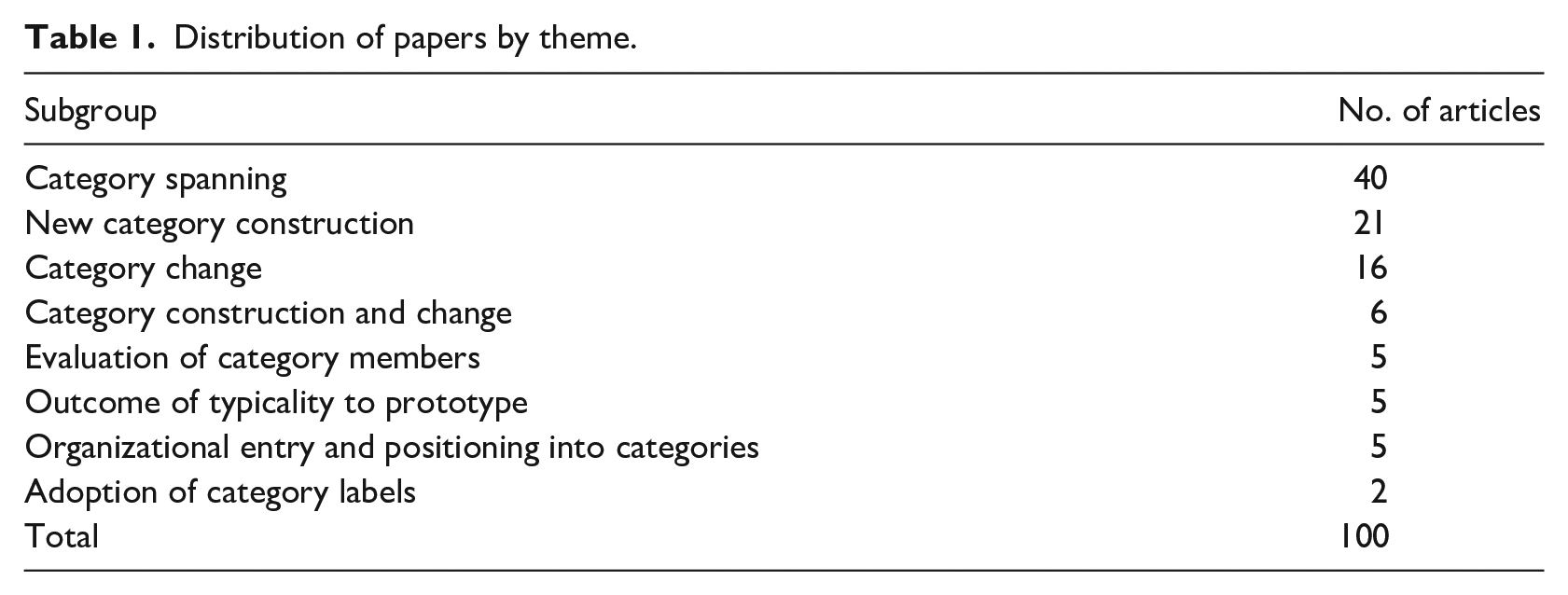
As Table 1 shows, the themes of category spanning, new category construction and category change have seen by far the most empirical research. As such, we review research under these three themes below (and integrate ‘hybrid’ studies that combine both category construction and change into our discussion).
Theme 1: category spanning
Research on category spanning was motivated by the seminal Zuckerman (1999) article, ‘The categorical imperative: Securities analysts and the illegitimacy discount’. Zuckerman’s (1999) core finding was that firms that are not categorized by securities analysts are undervalued in stock markets. His suggestion that audiences confer legitimacy to actors that fit clearly into identifiable categories sparked empirical research on the consequences of category spanning, or falling in-between categories. In a related article, Zuckerman (2000) applied these arguments to firm diversification and found that the pressure to de-diversify came from securities analysts who preferred easily categorizable firms with focused market identities rather than diversified firms straddling different categories.
Among the 40 empirical studies we found on spanning, a strong majority (35) are quantitative (two are qualitative and three are mixed-method studies). The central debate in this literature stream is whether or not, and if so how, organizations are penalized for category spanning. Early papers found significant penalties for spanning. For example, restaurants that diluted their categorical purity by borrowing elements from an oppositional category exhibited a higher hazard of a downgrade by Michelin Guide critics (Rao et al., 2005). Apart from the audience-side mechanisms of spanning penalties above, Hsu et al. (2009) pointed to a producer-side mechanism: producers who span multiple categories fail to develop capabilities to satisfy the diverse groups of audiences in each category (see also Hannan et al., 2003). An underlying assumption in these studies is that categories represent stabilized market boundaries that are ‘neatly partitioned’ (Hsu et al., 2009: 150). These boundaries are constituted based on common characteristics among category members, or prototypes (i.e. typical members) (Hannan et al., 2007; Rosch and Mervis, 1975). In this regard, a category is ‘a class about whose meaning an audience segment has reached a high level of intentional semantic consensus’ (Hannan et al., 2007: 69). Actors that exhibit commonalities with the prototype are more easily categorized by the audience. The audience uses the prototypical categorization process to assign identities (Hsu and Hannan, 2005) and give authenticity evaluations (Kovács et al., 2014). Thus, category membership is defined by the resemblance to the prototype as perceived by the audience, who processes information about the object’s features (Durand and Paolella, 2013).
More recent studies challenged the notion of penalties for spanning. In a mixed-method study of the global arms industry, Vergne (2012) explored the consequences of association with a stigmatized category and found that category spanning with a stigmatized category diluted audience attention and resulted in a more neutral evaluation. The consequences of spanning may also depend on the context of the categorical system. Ruef and Patterson (2009: 486) found that ‘organizational membership in multiple categories need not be problematic when classification systems themselves are emergent or in flux and when organizations avoid rare combinations or identities involving ambiguous components’. Finally, category spanning can be rewarded by external audiences depending on how an actor hybridizes multiple categories: When audiences clearly understand the relationship between multiple categories, they may reward firms that span multiple categories in ways that align with audiences’ understanding (Wry et al., 2014). Moreover, in markets with more complex offerings, the audience may adopt a goal-based view rather than a prototypical view when evaluating market offerings, which may result in a positive evaluation of spanning (Paolella and Durand, 2016).
In sum, early research on spanning adopted a prototypical lens, identified clear-cut categories and found penalties for spanning (e.g. Hsu et al., 2009; Zuckerman, 1999). Subsequent work has questioned the negative evaluation of spanners in situations where audiences have a schema to deal with hybrids (Wry et al., 2014), audiences prefer more complex products (Paolella and Durand, 2016), or where category systems are more fluid (Funk and Hirschman, 2014; Ruef and Patterson, 2009). Overall then, the consequences of spanning seem to be contingent on a number of factors, such as audience characteristics and whether audiences apply a prototypical or goal-derived lens to category membership.
Theme 2: new category construction
In spanning studies, the audience evaluates organizations based on an established category system, mainly by assessing whether organizations are similar to a prototype or instead ‘span’ multiple categories. This orientation treats categories as given and ignores the question of where categories (and systems of categories) come from in the first place (Durand and Khaire, 2017; Jones et al., 2012). In contrast, Porac et al. (1995: 203) were among the first to problematize category origins and argued that ‘market boundaries are socially constructed around a collective cognitive model’ (see also Rosa et al., 1999). Their ideas about the socially constructed nature of categories gave rise to a research stream on new category construction.
Among early studies, Kennedy (2008: 288) explored the role of the media in the process of new category construction, and found that media coverage made entrants to a new category ‘countable’ and led audiences to see these market entrants as a distinct category that is ‘for real’. Consistent with Kennedy’s (2008) findings, Navis and Glynn (2010: 462) showed how, in the early stages of a market category, ‘entrepreneurial organizations claimed a shared, collective identity, which helped to stabilize and fix the meaning of the category’. This collective identity ‘functioned to normalize the category, broaden its appeal, and make it coherent in its earliest periods of emergence’ (Navis and Glynn, 2010: 462). In their study of the modern Indian art category, Khaire and Wadhwani (2010) demonstrated that the birth of the market category started with market actors reinterpreting historical constructs that devalued the art of developing countries. The initiatives to carve a unique space for modern Indian art as a legitimate variety of modern art not only constructed the identity and meaning of the new category but also established ‘a collective perception of value’ (Khaire and Wadhwani, 2010: 1281).
The notion that ‘constituent members’ in a new market category possess a ‘collective identity’ that differentiates them from incumbents has been a central theme in research on category construction (e.g. Wry et al., 2011: 452). However, Hsu and Grodal (2021) found that while new market categories may be formed around producers that ideologically oppose an existing category, this may be a double-edged sword. In their study of the US e-cigarette category, oppositional positioning to traditional cigarettes initially created concrete categorical boundaries, but when these boundaries weakened, the stigma of the cigarette category spilled over to the new e-cigarette category. A trade-off may also occur between attaining legitimacy and maintaining clear cognitive boundaries for a category. In their study of the organic food product category, Lee et al. (2017: 465) showed how a standards-based certification organization played a pivotal role in fostering a collective identity among early organic producers but at the same time, ‘codification and standard setting of what was initially an esoteric set of philosophies and practices facilitated entry of producers that identified less with the holistic logic and goals that motivated the pioneers of the category’. Thus, as the certification organization engaged in legitimacy-seeking behaviours for the category, such behaviours generated tensions and trade-offs that threatened the collective identity of the category.
Recent studies of market category construction have explored the role of regulatory actors in the category construction process. Georgallis et al. (2019) found that state support for a new category (the solar photovoltaics industry, which they call an ‘industry category’) was more likely in countries where there were greater numbers of solar PV producers and where the industry was more coherent, or in other words contained fewer producers coming from industries with a contrasting identity. The role of the government in the category construction process is also demonstrated in a growing group of studies that explore both category construction and change. For example, Boghossian and David (2021) explored the construction of the Quebec terroir market category and found that the state served not only as an ‘audience’ that bestowed resources to the nascent category but was also active in the construction of the category’s meaning. This study also suggested that goal-derived categories (here, terroir foods) follow a different process of construction than prototypical categories (here, artisan cheese).
Notable about these studies of category construction is the agency accorded to market actors, whether producers or their audiences. Producers, through their discourse, construct coherent collective identities, while the media enables key audiences to cognitively place the new category within their existing classification by grouping members of the new category (Kennedy, 2008; Khaire and Wadhwani, 2010; Navis and Glynn, 2010). In some studies, non-producers have agency that goes beyond evaluating producers – their actions help the new category achieve legitimacy (Boghossian and David, 2021; Georgallis et al., 2019).
Theme 3: category change
The third most populous theme in Table 1 is category change. As Kennedy and Fiss (2013: 1141) observed, ‘challenges to existing categories [are] routine rather than rare events’ and ‘the meanings of even long-standing categories [are] both subject to challenge and vulnerable to change through reinterpretation or, in the extreme, outright rejection’. Lo et al. (2020) developed a framework to describe how, through deliberate actions or with shifting circumstances, categories change their members or positions relative to other categories and may in so doing even fall out of use. Studies of category change include a variety of papers on how existing categories persist or change over time. This group is the newest and least coherent in terms of agenda, which may stem from the fact that, unlike the first two subgroups, there is no seminal paper that acts as an anchor for the group.
That said, changes in category status and stigma figure prominently in studies of category change. In the earliest paper we identified, Anand and Jones (2008) showed how tournament rituals such as industry award ceremonies configure a field by championing a category. These authors conceptualized fields as underpinned by a set of categories and field configuration as requiring the ‘emergence, dislocation, and obsolescence of underlying categories (Lounsbury and Rao, 2004)’ (Anand and Jones, 2008: 1057). They showed how the Booker Prize for Fiction acted as a tournament ritual that raised the status of the postcolonial fiction category of literature. The industry award ceremony transformed the field of contemporary English-language literature by ‘editing macro-level categories’ (Anand and Jones, 2008:1057), a process that included bestowing symbolic value to the category of post-colonial fiction. Similarly, Delmestri and Greenwood (2016) explained the status recategorization of Italian grappa, a category of spirit. Despite grappa’s traditionally low status, producers in the 1970s refurbished the spirit’s image to symbolize the Italian lifestyle, which eventually placed grappa at the same price level as cognac and whisky in the liquor market (Delmestri and Greenwood, 2016).
More recently, Lashley and Pollock (2020) investigated the process of reducing categorical stigma. In their study of the medical cannabis industry in the United States, the authors found that, to reduce stigma, firms collectively initiated a moral agenda, created a new moral prototype and showed the public their allegiance to the prototype by infusing morality into their image. Notably, in each stage of the stigma reduction process, the firms continued to engage in stigmatized behaviours (e.g. working with the black market) for survival. In a study combining notions of category change and new category construction, Ozcan and Gurses (2018) showed how dietary supplement products began as part of the drugs category, were recategorized as food, and finally as dietary supplements, recategorization that fueled explosive category growth. Ozcan and Gurses (2018: 1808) described this ‘regulatory categorization’ to be a ‘contest against a powerful state authority’ that ‘is a critical process for firm performance and survival as it sets the legal terms and conditions under which a product is made and distributed (Funk and Hirschman, 2014)’. Producers of supplements performed advocacy work, including lobbying state actors and garnering consumer attention. These efforts were met with resistance from the FDA which engaged in maintenance work that discouraged the public from using supplements. The supplement makers devised a new solution: to create a new category where the FDA was not the sole evaluator, which required another round of category work questioning the FDA’s expertise and its relationship with the pharmaceutical industry as a source of bias.
Looking forward: directions for future research
As our discussion above suggests, scholars have accumulated knowledge under the themes of category spanning, new category construction, and category change. But the literature remains nascent overall. Based on our review, we provide a number of observations and directions for future research that can further our understanding of market categories, within the themes we identified and beyond.
First, we note an important distinction within the empirical literature between market categories as antecedent versus market categories as outcome. 4 In studies of spanning, market categories are generally conceived of as an environment (or context) in which organizations operate. In this largest of our themes, a system of market categories pre-exists and organizations experience outcomes based on where they are positioned in this categorical system. The outcome of interest – the explanandum – of such studies is typically an organizational outcome (e.g. performance, stock price, rating) and the explanatory factor – the explanans – is typically some measure of organizational position between existing market categories. Categories in these studies are an antecedent and only indirectly causal, in the sense that organizational or product positioning within the categorical system affects performance. Studies under our smaller themes of ‘evaluation of category members’ and ‘outcome of typicality to prototype’ are variations of this approach, in the sense that they predict organizational or product outcomes based on some notion of positioning (though not necessarily spanning) in the categorical landscape (e.g. Barlow et al., 2019; Kovács et al., 2021). In two of our other smaller themes — ‘organization entry and positioning into categories’ and ‘adoption of category labels’ — the question of how organizations or their executives choose their position within a category system is explored (e.g. Granqvist et al., 2013; Zunino et al., 2019). In these studies, the explanandum becomes organizational (or product) positioning into categories rather than the performance outcome of this positioning.
In contrast, in our themes ‘new market category construction’ and ‘category change’, market categories themselves become that which is being explained – the outcome of interest. Research questions take the form of ‘How does a new market category come into use?’ (e.g. Boghossian and David, 2021) or ‘How does an existing category change in status?’ (e.g. Delmestri and Greenwood, 2016). Here, interest is not typically at the organizational level, but on the category or category system itself. Whereas organizational performance is sometimes discussed as an outcome, it is not the central interest within these themes. Given these observations, future research on market categories should clearly identify whether categories are an antecedent or an outcome, as well as the level of analysis of interest – product, organization, category or category system. Furthermore, following Kennedy and Fiss (2013), we call for more research that explores categories as the outcome of interest. While a small number of recent studies have explored category construction, much remains to be learned, particularly about other periods of the category lifecycle (e.g. growth, change, decline).
A second, related observation arises from the spotty attention to agency present in the empirical literature. In most spanning studies, producers are depicted as passive ‘takers’ of the categorical system who are penalized (or not) for difficult-to-categorize products or organizations. Even studies that accord agency in the choice of category placement (e.g. Granqvist et al., 2013; Pontikes and Kim, 2017; Zunino et al., 2019) tend to take category systems as given. In contrast, some studies of categories as an outcome – as in new category construction and category change – theorize agency much more explicitly than studies of categories as antecedents. Yet, even within these themes, the role of agency is undertheorized. For example, the role of regulators and quasi-regulators, such as in the development of the standards and certifications that often accompany new category construction has received little empirical attention, as has the role of producers in influencing regulation in the category construction process more generally. There are therefore ample opportunities for the study of agency within the spanning, construction and change themes.
Notably, if we combine the insights on agency found in studies of category construction and change with the structural insights in studies of spanning, a natural question arises about the possibility of new categories arising in the ‘space between’ established categories. If producers have agency in the construction or change of market categories, how can they be only passive takers of established category systems? Whereas Pontikes and Kim (2017) argued that producers can strategically categorize themselves among existing categories, this agency is confined to selecting an existing category upon entry: producers are strategic insofar as they evaluate the level of competition in existing categories and choose accordingly. If, as research reviewed here suggests, new categories can emerge by combining elements from existing categories (Durand and Khaire, 2017; Khaire and Wadhwani, 2010; Ozcan and Gurses, 2018), how might producers in established category systems actively construct new categories in the spanned spaces of an established category system? Naturally, mature contexts would provide different impediments to agency than more fluid ones, but these contexts would certainly not be impervious to change. While spanning studies have examined the antecedents and consequences of occupying the space between categories, there is an opportunity to understand how a new market category in such spaces may be constructed and legitimated by producers or other market actors. Such a line of inquiry fits well with the original mission of Strategic Organization set out 20 years ago to combine the agentic focus of strategy with the structural focus of organizational theory.
Our third observation pertains to gaps between our reading of the conceptual and empirical literature on market categories. First, as Durand and Thornton (2018) explained, the categories literature shares ‘compatible assumptions’ with the institutional logics literature, suggesting opportunities for these literatures to mutually inform each other. However, we have not as yet witnessed this within the empirical literature. Second, despite Durand and Paolella’s (2013) elucidation of the difference between prototypical and goal-derived categories and their exhortation to study the latter, we have seen little empirical attention to goal-derived categories (for exceptions, see Boghossian and David, 2021; Glaser et al., 2020). We suggest here one way of integrating what we know about institutional logics to advance our understanding of market categories, in particular those that are goal-derived. If a goal-derived category is one where category membership is based on ideals rather than observable features (Durand and Paolella, 2013), then what might be the source of these ideals? We believe an institutional logics approach may provide an answer. If institutional logics are ‘socially constructed historical patterns of cultural symbols and material practices, assumptions, values, and beliefs’ (Thornton and Ocasio, 1999: 632), might these not provide the basis for goal-derived market categories? In other words, studying institutional logics might help us understand how market categories form, change and dissolve. While market categories could derive from a single logic, future research might consider categories that house multiple, distinct logics without combining them. Whereas prior research has shown that multiple logics can coexist within the same field (e.g. Lounsbury, 2007), we know less about the coexistence of multiple logics associated with the same market category. For example, the market category ‘local food’ encompasses the logics of environmentalism, social justice, health and community, among others (Leitzinger and David, 2022). When and how might multiple logics coexist under the same category label? What happens when these logics come into conflict?
Our fourth and final observation concerns the gallimaufry of terms that we observed across the literature on market categories. As previously observed by Vergne and Wry (2014) almost 10 years ago, prior research has used a variety of terms to describe ‘categories’, usually without clear definitions: market category, product category, organizational category, industry category or even just category. Similarly, the term ‘market’ is sometimes used interchangeably with ‘market category’. Is the ‘market for grass-fed beef’ (Weber et al., 2008) the same as ‘the market category grass-fed beef’? As a start, therefore, we call for greater construct clarity and consistency in terminology. We suggest that the term ‘market category’ be used to refer to a shared meaning between the actors' party to an economic exchange about that which is being exchanged (Durand and Boulongne, 2017: 647; Navis and Glynn, 2010: 441). In other words, the term ‘market category’ should only be used in the context of a market exchange, as opposed to the unqualified term ‘category’, which can refer to categories outside of markets (e.g. race, gender). The market category construct is narrower than that of ‘industry’ or ‘industry category’, which Georgallis et al. (2019) use interchangeably to refer to a set of producers which may in fact participate in multiple market categories. We argue further that the shared meaning of a market category can be prototypical or goal-based. A prototypical market category (i.e. whose boundaries are defined by common features) can be a ‘product category’: a set of products sharing common features and considered close substitutes for each other. For example, grass-fed beef can be viewed as a product category (all grass-fed beef shares certain prototypical features). Notably, a goal-derived market category can include multiple product categories – the market category ‘terroir foods’ includes many different product categories in a given place, from wine to cheese to jams, all sharing the same meaning of representing the unique elements of that place (Boghossian and David, 2021). Finally, we suggest that the term ‘organizational category’ be used when the organization (rather than the product or the market exchange) is the unit of analysis. This term is closest to the long-standing constructs ‘organizational form’ and ‘population’ within organization theory. For example, the thrift organizational form (Haveman and Rao, 1997), the management consulting organizational form (David et al., 2013), and the population of farm wineries (Swaminathan, 1995) could be seen as organizational categories. These organizational categories can produce multiple product categories and participate in multiple market categories. While a detailed exploration of the relationship between these related constructs is beyond the scope of this article, the proliferation of terms to describe similar (though not quite the same) underlying constructs impedes the cumulation of knowledge. Greater attention to construct clarity would aid in knowledge accumulation and contribute to a long future of research on market categories and categories more generally, a future that builds on what we have learned so far.
Supplemental Material
sj-docx-1-soq-10.1177_14761270221134287 – Supplemental material for The short history and long future of research on market categories
Supplemental material, sj-docx-1-soq-10.1177_14761270221134287 for The short history and long future of research on market categories by Robert J David and Yoojin Lee in Strategic Organization
Footnotes
Funding
The author(s) received no financial support for the research, authorship and/or publication of this article.

Supplemental material
Supplemental material for this article is available online.
Notes
Author biographies
References
Supplementary Material
Please find the following supplemental material available below.
For Open Access articles published under a Creative Commons License, all supplemental material carries the same license as the article it is associated with.
For non-Open Access articles published, all supplemental material carries a non-exclusive license, and permission requests for re-use of supplemental material or any part of supplemental material shall be sent directly to the copyright owner as specified in the copyright notice associated with the article.
