




Abstract
As cooperatives become a crucial part of our society’s repository of solutions for addressing the sustainability challenges, the very emergence of cooperatives continues to puzzle scholars. In this study we address a central concern for both organizational scholars and sustainability advocates, i.e. where and under which conditions cooperatives emerge as an alternative form to corporations. Building on organizational ecology theories, we argue that the varying organizational characteristics within local incumbent forms constitute an additional layer to explain cooperatives’ emergence, above and beyond the known effects of community characteristics and incumbents’ aggregated density (or capacity). Our analysis of a unique data set of German energy cooperatives between 2003 and 2010 support our hypotheses. Our results show that energy cooperatives are more likely to be founded where incumbent utilities have higher average age and greater size diversity, because age-related inertia and lack of competition among incumbents of diverse size limit their adaptability towards serving the new market demand for renewable energy.
Keywords
Introduction
The year 2012 was declared the International Year of Cooperatives by the United Nations, acknowledging the increasing importance of cooperatives in achieving our shared Sustainable Development Goals ranging from reduced inequalities, affordable and clean energy, to sustainable cities and communities (United Nations, 2011, 2015). Cooperatives are organizations characterized by shared equity and democratic decision making (Battilana, Fuerstein, & Lee, 2018). As the inadequacy of existing institutional and organizational arrangements to fully address the sustainability challenges becomes apparent, cooperatives as an alternative organizational form to capitalist corporations start to attract growing attention from organizational scholars (Cruz, Alves, & Delbridge, 2017; Battilana et al., 2018). While becoming a crucial part of our society’s repository of solutions for various challenges, the very emergence of cooperatives continues to puzzle scholars (Boone & Özcan, 2014; Muñoz, Kimmitt, & Dimov, 2020). In this study we address a central concern for both organizational scholars and sustainability advocates, i.e. where and under which conditions cooperatives emerge as an alternative form to corporations.
Existing studies provide two sets of explanations for where and under which conditions cooperatives emerge. The first concerns the community environment approach, largely building on institutional and social movement theories. Local communities’ characteristics such as anti-corporate sentiments and appreciation for environmental sustainability may boost the normative legitimacy of cooperatives embodying these communal values, thus stimulating the emergence of cooperatives (e.g. Schneiberg, King, & Smith, 2008; Wirth, 2014). The second explanation concerns the organizational environment approach, based on community ecology theory. Since incumbent forms comprise the organizational context and selection environment of alternative forms (Oertel & Walgenbach, 2009; Ruef, 2000), the aggregated number or capacity of incumbent forms affect the emergence of new organizational forms like cooperatives (e.g. Boone & Özcan, 2014; Dobrev, Ozdemir, & Teo, 2006; Staber, 1989).
Our study proposes an additional explanation for cooperatives’ emergence, based on investigating the emergence of German energy cooperatives (thereafter ECs) founded by sustainability conscious citizens to generate electricity using exclusively renewable sources. Embedded in the organizational environment approach and drawing on organizational ecology theories, we suggest that organizational environment does not consist of a homogeneous entity of incumbents where only the aggregated characteristics like number or capacity matter. Instead, we argue that the varying organizational characteristics within local incumbent forms constitute an additional layer to explain cooperatives’ emergence. We hypothesize that (1) higher average age, and (2) greater size diversity among incumbent utilities stimulate EC founding, above and beyond the effects of community characteristics and incumbents’ density. We found support for our hypotheses using a unique data set covering ECs’ emerging period 2003–2010, which combines data from multiple sources including the German Commercial Register, the trade association for the German electricity and water industry as well as the German Federal Statistics Office.
We make two important contributions to our understanding of where and under which conditions cooperatives emerge. First, our study provides both theoretical arguments and empirical evidence supporting a novel explanation for the emergence of cooperatives. Complementing existing explanations of community characteristics and incumbents’ aggregated characteristics (Dobrev et al., 2006; Staber, 1989), we suggest that age and size that vary considerably within the incumbent forms affect EC founding. So far, organizational scholars have focused on how age and size of incumbents affect their adaptive capabilities and competitive behaviour (Dobusch & Schüßler, 2013; Hannan & Freeman, 1977, 1984; Le Mens, Hannan, & Pólos, 2015), while largely overlooking their implications on emergence of alternative forms like cooperatives. Our study advances our understanding of cooperatives’ emergence by theorizing and testing mechanisms concerning this understudied perspective.
Relatedly, our study also contributes to a population ecology view of constitutive legitimacy. As an important type of legitimacy, constitutive legitimacy is essential for the emergence of alternative forms. Theories in community ecology argue that constitutive legitimacy can flow between organizational forms which are sufficiently related in identity space (Ruef, 2000). Existing studies have taught us that incumbents’ aggregated characteristics like density and market concentration may stimulate emergence of alternative forms through legitimacy transfer (Dobrev et al., 2006; Negro, Visentin, & Swaminathan, 2014; Verhaal, Hoskins, & Lundmark, 2017). Complementing their insights, our study shows that age and size that vary considerably within an incumbent form may also facilitate alternative organizations’ constitutive legitimacy.
Energy Cooperatives and the German Electricity Industry
Around 2003, against the backdrop of the energy transition (Energiewende in German), ECs started to gain popularity among sustainability-conscious German citizens. Like traditional cooperatives, ECs are jointly owned by members who participate in collective decision making. The typical founders and members of ECs were motivated by their worries about environmental sustainability and the lack of competition among the incumbent utilities, whose generation capacities use a high percentage of fossil and nuclear sources (Die Tageszeitung, 2010; SFV, 2009). Usually from the same local communities, these citizens contributed their personal savings (membership may start as low as 50 euros), worked voluntarily to install generation capacity using exclusively renewable sources, and educated fellow citizens about ECs as a viable solution to climate change (Die Tageszeitung, 2010). The electricity generated from solar, wind and biomass is then fed into grids and creates revenues (Klagge, Schmole, Seidl, & Schön, 2016).
Because our theoretical interest is in newly emerging alternative forms and the competitive pressure from the incumbent forms, we investigate the German EC foundings between 2003 and 2010 – the emerging phase of the ECs (Kahla, Holstenkamp, Müller, & Degenhart, 2017). We define this period as the emerging phase for two reasons. First, we started our observation in 2003 because several important regulatory changes, including the 2003 Photovoltaic Interim Act, the 2004 Amended Renewable Energy Sources Act (EEG) and the 2006 Amended German Cooperatives Law, are considered instrumental for triggering ECs’ emergence (DGRV, 2013; Volz, 2012). Second, we ended our observation in 2010 because EC had emerged as a legitimate alternative form by 2010 (Die Tageszeitung, 2010; Volz, 2012) and regulatory changes from 2011 have altered the founding incentives for ECs and their competitive interactions with incumbent forms (Wasserman, Reeg, & Nienhaus, 2015).
A total of 253 ECs were founded between 2003 and 2010. The number of EC foundings started to grow rapidly from 2006, with the pace further accelerating from 2008. For example, 42 ECs entered the market in 2008, and around 100 ECs were founded in both 2009 and 2010. In spite of their recent emergence, ECs have attracted 130,000 members in Germany, invested over 1.67 billion euros in renewable energy, and built 933 megawatt generation capacity by 2014 (Energie und Management, 2015).
As an alternative organizational form, ECs emerged in an electricity industry dominated by corporate incumbent utilities. Before the market was deregulated in 1998, the incumbents included eight supra-regional utilities (the ‘Big Eight’), around 80 regional level utilities, over 700 municipal utilities (thereafter referred as MUs), and a small number of private utilities (BDEW, 1998). From 1998 to 2002, the ‘Big Eight’ merged into the ‘Big Four’ (E.ON, RWE, EnBW and Vattenfall Europe), acquired many regional utilities as their local branches and began to operate nationwide (i.e. nationwide utilities, thereafter referred as NWUs). In contrast to the demise of the regional utilities, the smaller MUs could maintain and even expand their market position although there were few new foundings (Die Welt, 2010, Liu & Wezel, 2015).
The emerging ECs relate to incumbents in identity space along two types of identities – functional and ideological (Dobrev et al., 2006). The functional identities in the electricity industry are closely related to the industrial value chain, which consists of four stages – generation, transmission, distribution and retailing. In terms of functional identities, ECs and the incumbents overlap in electricity generation during our observation period. While the incumbents operated along several of or all of the four stages, ECs only engaged in electricity generation.
In terms of ideological identities, ECs have differentiated overlaps with different incumbent forms. Various existing surveys (e.g. DGRV, 2012; Volz, 2012) identified greenness and localness as the two dominant identity dimensions of ECs. A survey of 290 ECs by DGRV, which is the umbrella trade association of cooperatives in Germany, concluded: ‘above all, supporting renewable energy and value creation in regional/local communities motivates people to found an energy cooperative. . .’ (DGRV, 2012). In another widely cited survey, the board members of 122 ECs were asked to evaluate the importance of their identity dimensions in terms of organizational objectives along a scale of 1 to 6 with 6 indicating ‘extremely important’ (Volz, 2012). The three items related to greenness achieved the highest mean values: renewable energy production (5.18), contributions to fighting climate change (5.09) and CO2 reduction (5.02). The three items related to localness followed closely with slightly lower mean values: strengthening the ‘we-feeling’ (4.78), public awareness of our region (4.75) and value creation in our region (4.5). More details of these surveys can be found in supplement A (available as online material). Similarly, the media and the public also perceive greenness and localness as ECs’ defining identity dimensions (Die Tageszeitung, 2010; Energie und Management, 2015).
Among the incumbent forms, MUs owned by local municipalities also claim these two dimensions to some extent, but with localness ranked apparently higher than greenness. For example, a 2009 survey shows that 45% of the surveyed citizens associated MUs with ‘orientation on the common welfare of the local region’ and ‘support for the local region’ while only 8% thought that of the private utilities like the NWUs. As of greenness, 35% associated MUs with environmental friendliness while only 8% thought that of NWUs (TNS Emnid, 2009). That is, ECs and MUs overlap in ideological dimensions of greenness and localness to varying degrees. To sum up, there exist competitive overlaps in both functional and ideological identities between the aspiring ECs and the incumbent forms.
Indeed, qualitative evidence points to the consequences of such identity overlap on resource competition for suitable locations and citizens’ support. On the one hand, suitable locations for installing photovoltaic (PV) systems and wind turbines, i.e. the two dominant renewable energy sources, are limited (Klagge et al., 2016). One of the biggest challenges faced by the founders of ECs, and thus an important factor determining their founding decisions, is whether they can find suitable locations for installing PV systems and wind turbines (Volz, 2012). Founding attempts of ECs may be pre-emptied by agile incumbents who swiftly navigate the planning and permit procedures of renewable energy projects.
On the other hand, there exists fierce competition for support of local citizens, especially with MUs whose identity dimensions overlap with ECs in terms of greenness and localness. A crucial resource for a successful EC founding concerns the financial contributions from local citizens, which also depend on the goodwill of the local communities. For example, successful EC foundings are often supported by the so-called ‘promotors’ including local politicians and business representatives, who motivate and convince local citizens to an EC membership (Klagge et al., 2016; Volz, 2012). Likewise, incumbents like MUs strongly rely on local goodwill and political support (Badische Zeitung, 2010). Local support and financial resources for founding an EC may drain if incumbents speedily move to occupy the sustainability niche and cater to the needs of the environmentally conscious citizens. To summarize, qualitative evidence indicates identity overlap and resource competition between the emerging ECs and the incumbent forms, which underly the interpopulation processes we hypothesize below.
Theory and Hypotheses
A rapidly growing literature has investigated where and under which conditions cooperatives emerge. These studies can be largely divided in two research streams: the community environment approach and the organizational environment approach. Building on theories of institutionalism and social movement, the first sees community environment as an important institutional environment (Marquis, Glynn, & Davis, 2007) and investigates how the local geographic community’s characteristics influence the emergence of cooperatives.
An important mechanism underlying the effects of community characteristics on cooperatives’ emergence relates to normative legitimacy, i.e. congruence with shared norms and values held as appropriate or ‘right’ within a community (Suchman, 1995). The shared norms and values in a community serve as touchstones for legitimizing cooperatives embodying these communal values. For example, communities with strong anti-corporate sentiment were fertile ground for founding cooperatives with aligning organizational identities like bio-ethanol cooperatives (Boone & Özcan, 2014), agricultural cooperatives and insurance mutuals (Schneiberg et al., 2008; Schneiberg, 2013). In addition, local communities’ appreciation for environmental sustainability boosted entry of wind energy producers (Sine & Lee, 2009) and renewable energy cooperatives (Wirth, 2014).
The second research stream focuses on organizational environment and looks at how new forms may endogenously emerge as a result of interpopulation processes. Largely based on community ecology theory, this approach argues that incumbent forms are an important part of the organizational context and selection environment in which new organizational forms emerge (Dobrev et al., 2006; Oertel & Walgenbach, 2009; Ruef, 2000). Incumbent forms may exert direct selection pressure on founding attempts of alternative forms because the latter competes with them for scarce resources (Zietsma, Ruebottom, & Slade Shantz, 2018). Organization builders of alternative forms therefore carefully screen the competitive environment and resource availability determined by incumbent forms before undertaking founding activities (Ruef, 2005).
Most of the existing studies following the organizational environment approach have examined the effects of aggregated number (i.e. density) of incumbent forms on cooperatives. The findings are mainly twofold. On the one hand, low density of an incumbent form may trigger (constitutive) legitimacy transfer to new forms with overlapping identities and facilitate the latter’s emergence (Dobrev et al., 2006). For example, Dobrev and colleagues (2006) found that at a low level of density, legitimacy of the incumbent commercial banks transferred to the emerging financial cooperatives in Singapore, lowering the latter’s failure rate. On the other hand, high density of incumbent forms tends to impede the emergence of new forms. For instance, high density of commercial banks elevated the failure rate of financial cooperatives in Singapore (Dobrev et al., 2006), while increasing density of retail chain stores reduced the foundings of consumer coops in Canada (Staber, 1989). Similarly, higher density of capitalist organizations significantly reduced foundings of kibbutz – the agricultural cooperatives in Israel (Simons & Ingram, 2003). Looking at capacity instead of density, Boone and Özcan (2014) found that bio-ethanol cooperatives in the United States experience fewer foundings if the aggregated ethanol production capacity owned by corporations is high.
What unites the existing studies within the organizational environment approach is their focus on incumbents as a relatively homogeneous entity, where their aggregated number or capacity matter for the emergence of cooperatives. While these are important insights, we also know that incumbents vary greatly in organizational characteristics including age and size. Organizational scholars across theoretical camps agree that age and size, which vary considerably even within an organizational form, determine incumbents’ adaptive capabilities, competitive behaviour and organizational outcomes (Dobusch & Schüßler, 2013; Hannan & Freeman, 1977, 1984; Le Mens et al., 2015). Given that incumbent forms comprise the organizational environment in which alternative forms emerge, incumbents’ age and size should significantly affect the emergence of alternative forms. We propose that incumbents’ (1) age-related inertia and (2) size-related competition constitute an additional layer of explanation for cooperatives’ emergence, above and beyond the established effects of community characteristics and incumbents’ aggregated numbers. We believe insights into this overlooked mechanism will complement existing studies and help us to better understand where and under which conditions alternative forms emerge. Toward this end, we develop hypotheses concerning how incumbents’ age and size affect EC foundings.
Age-related inertia
An incumbent’s ability to adapt its conventional offering, such as energy generated using coal and gas, to meet market demand for sustainable products may be hampered by organizational inertia. Inertia is defined as an organization’s limited capabilities to change their core structures and offerings as quickly as the environment changes (Hannan & Freeman, 1984).
Researchers widely acknowledge that inertia increases with organizational age as a result of advancing institutionalization (Guenther, Oertel, & Walgenbach, 2016; Hannan & Freeman, 1984; Le Mens et al., 2015). 1 A newly founded organization lacks well-established routines and procedures. As an organization ages, an institutionalization process unfolds: relations of trust among strangers are established, new roles are invented and learned, routines and procedures for both internal action and external interaction are substantiated (Stinchcombe, 1965). As institutionalization progresses with increasing organizational age, organizational members reach consensus on how things should be done and what routines to follow (Selznick, 1957). Attempts to change highly institutionalized features will meet stiff resistance from organizational members who take them for granted. Resistance to changes in turn slows down the speed of change and increases members’ exposure to the routines and procedures. Rising exposure further confirms taken-for-granted features and reinforces institutionalization, making organizations even more inert (Le Mens et al., 2015; Liu, Pólos, & Hannan, 2021). At the same time, organizations whose structures are institutionalized and highly reproducible enjoy greater reliability and accountability. Since population-level selection processes favour organizations with high levels of reliability and accountability, inertia becomes a defining feature of surviving organizations, i.e. the incumbents (Hannan & Freeman, 1977, 1984).
As time elapses, inertia increases with incumbents’ age due to reinforcing institutionalization processes at the organizational level and the selection advantages of inert organizations at the population level. Meanwhile, the environment has drifted away from the conditions in which the incumbents were founded (Hannan & Freeman, 1984; Hannan, Carroll, Dobrev, & Han, 1998), as energy demand shifted from conventional to renewable offerings. The joint effects of incumbent’s decreasing speed of adapting and environmental drift result in a misalignment between incumbents’ offer of conventional energy and consumers’ demands for renewable energy.
Applying the individual-level reasoning to an aggregate level implies, when a group of incumbents have high average age (e.g. Wezel & Lomi, 2009), 2 they will be slower in meeting emerging market demand for sustainable products (Hannan & Freeman, 1984; Le Mens et al., 2015). The slower the incumbents are in adapting, the more likely alternative organizational forms may be created to occupy the resource space by satisfying emerging demand (Dobrev et al., 2006). Given the resource competition between the incumbent utilities and the ECs, we expect more EC foundings where the average age of incumbents is higher.
The qualitative evidence from our setting aligns with the theoretical predictions. The initiators of the bioenergy cooperative in Honigsee, a municipality in the federal state Schleswig-Holstein, first contacted the incumbent utilities in 2006 to propose a 100% renewable energy project. Their biogas power plant would use biomass from local agriculture and forestry to meet the local energy demand for heat and electricity, while feeding surplus electricity in the overland grids (DGRV, 2013). The incumbent MU Stadtwerke Kiel, which has its origin back in 1856 and has operated a coal-fired power plant for decades (Uniper, 2020), was reluctant to invest in the biogas power plant. Other incumbent utilities have shown similar inert attitudes, prompting the initiators’ decision to take the sustainable project into their own hands. Through neighbourhood chats and townhall meetings, in 2007 the initiators successfully convinced their fellow villagers of the environmental advantages of founding a bioenergy cooperative (DGRV, 2013). A founder of another EC in Saxony reported in our interview that a similar experience with the local MU has prompted them to found their own EC, calling the local MU’s half-hearted environmental engagement ‘greenwashing’.
Incumbents’ inertia is also used by aspiring ECs to facilitate founding and to claim normative legitimacy by contrasting their identity with that of the inert incumbents. Figure 1 shows a postcard using humorous colloquial language to appeal for local citizens’ support. The far horizon is dominated by coal-fired power plants owned by incumbents while the near horizon shows a scarred landscape resulting from extracting coals. Using this postcard, which was well received among citizens, the EC founders highlight the lack of environmental engagements of inert incumbents and appeals for local communities’ support for an alternative form embodying the communal values, i.e. greenness and localness. Based on the theoretical arguments and qualitative evidence, we propose:
H1. The greater the average age of incumbents, the higher the number of EC foundings.
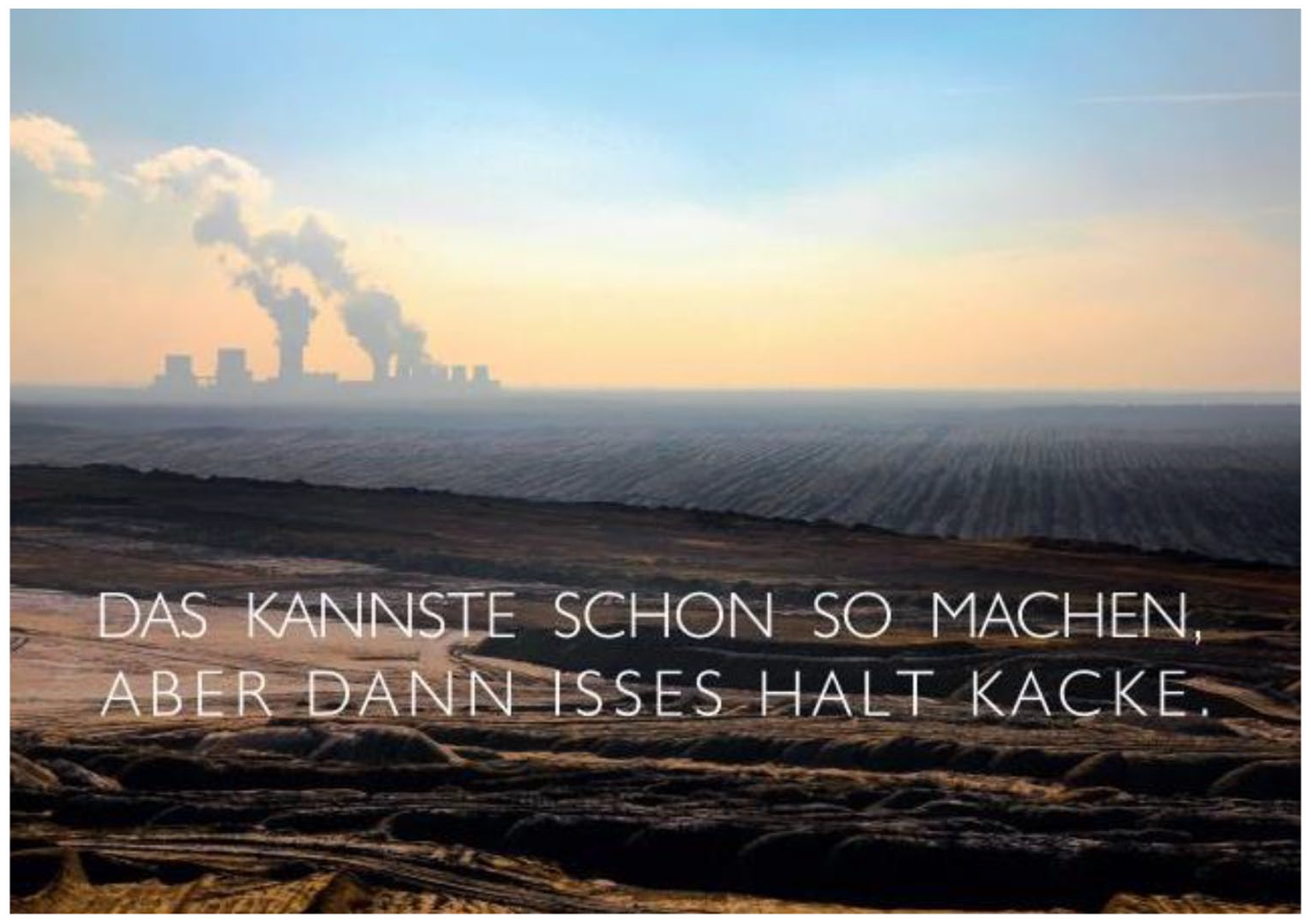
A postcard distributed by an EC in Saxony.
Size-related competition
Now we look at the effect of size, specifically the effect of incumbents’ size diversity, on EC founding. Building on the theory of size-localized competition, we argue that the intensive competitive interactions among incumbents of similar size triggers evolutionary learning which in turn increases their adaptability (Carroll & Hannan, 2000). Hannan and Freeman (1977) note that organizations of very different sizes typically employ divergent strategies and have distinct organizational structures, because they rely on different mixes of environmental resources. As a result, organizations compete most intensively with organizations of similar size, implying ‘competition between pairs of organizations in an activity will be a decreasing function of the distance separating them in the size gradient’ (Hannan & Freeman, 1977, p. 946). This size-localized competition thesis has received broad empirical support across settings including banks, credit unions, hotels and insurance companies (for a review see Carroll & Hannan, 2000, pp. 274–278).
While size-localized competition theory argues for increased competitive interactions among organizations of similar size, it does not specify the implications of such interactions on organizational learning and adaptability. We argue that intensive competitive interactions among incumbents of similar size will trigger a reinforcing feedback loop of organizational learning, similar to that of Red Queen evolution 3 (Barnett, 2008; Barnett & Hansen, 1996).
We propose the following chain of reasoning for how incumbents’ size diversity affects EC founding: (1) incumbents of similar size compete more intensively with each other; (2) the intensive competition triggers incumbents’ learning about shifting market demand and enhances their adaptability towards sustainable offerings; (3) incumbents under greater competitive pressure due to similar size are more likely to adapt to sustainability transformation and meet market demand for sustainable products; (4) we expect fewer EC foundings where the incumbents are more equal in size and better at satisfying emerging demand. The mirror image implies that we expect more EC foundings where the incumbents are involved in weaker competition as a result of their very different organizational sizes. 4
Reports from the German Monopolies Commission and the Solar Energy Association suggest that under weak market competition, incumbents which control most generation capacities often continue to invest in conventional energy and fail to cater to the growing demand for renewable energy (Monopolkommission, 2007; SFV, 2009). The founding process described by an EC founder during an interview vividly illustrated how size-localized competition affects EC founding in the federal state Saarland, where the dominant utility was a local branch of an NWU. In some communities, the smaller MUs could not compete with the NWU branch as the latter possessed technical knowhows on which the smaller MUs depended. In other communities with larger MUs independent of the NWU branch, these MUs moved into renewable energy through setting up a new department with specialized personnel.
The community where the focal EC is located has a small MU with 49% owned by a subsidiary of the NWU branch, which also owned several coal-fired power plants. As the EC founders prepared founding and recruited members by campaigning in the local inns and townhall, their greenness and localness met great resonance in the local community against the background of the NWU branch planning to build yet another coal-fired power plant. The lack of competition among incumbents of diverging sizes and the resulting incumbents’ reluctance to embrace renewable energy have facilitated the founding process and boosted the legitimacy claim of the EC, whose founding offered a clear alternative to the existing organizational solutions. Although the EC founders stopped recruiting members as the number reached 200 and did not extensively publicize, members quickly soared to 700 through word-of-mouth among citizens. Based on the theoretical arguments and qualitative evidence, we propose:
H2. The less equal the incumbents’ size (i.e. less intensive competition), the higher the number of EC foundings.
Data and Methods
Data and level of analysis
To test our hypotheses, we collected four data sets. The first data set concerns EC foundings in the period 2003–2010. Our founding data were primarily obtained from the German Commercial Register (Handelsregister) through the database Nexis, by searching for the German words ‘cooperative’ (Genossenschaft) and ‘new registrations’ (Neueintragungen). We used the information on industry classification codes and organizational objectives/activities in the new registration records to determine whether a cooperative operates in the electricity industry and generates electricity using renewable sources. We also screened the period before 2003 for earlier foundings of ECs satisfying the same criteria. We found four such cases: EWS Schönau (1994), Agrarenergie Roding eG (1998), Greenpeace Energy eG (1999) and Energiegenossenschaft Lieberhausen eG (1999). These earlier foundings were included in both measures of EC density (see Control Variables).
To test hypothesis 1 concerning the effect of incumbents’ age-related inertia on EC foundings, we gathered a second data set on the founding years of the incumbent utilities using the German Commercial Register. We have also utilized additional sources such as company web pages and newspaper articles to cross-validate the data. This data was subsequently used to calculate incumbents’ organizational age. After the German reunification in 1990, incumbent utilities in the former East Germany were refounded in the legal forms of market economy. However, these refounded firms should not be counted as new foundings because they tend to operate in the same way as under state socialism (Stark, 1996). That is, refounding is only a way to ‘create a convincing externally oriented identity. . .whilst preserving internal routines and practices’ (Dobrev, 1999, p. 575). Therefore, we coded the founding year of the incumbents in East Germany as 1958, when the structure and operation of the energy sector under state socialism was finalized (Sens, 1997).
To test hypothesis 2 predicting the effect of incumbents’ size diversity on EC foundings, we collected a third data set containing the annual electricity sales of incumbent utilities to end customers. The data were primarily from the annual data of the BDEW – the umbrella trade association for the German electricity and water industry (BDEW, 2001–2008). Our fourth data set contains the socio-demographic statistics of the German counties from the German Federal Statistics Office, which is used to construct several control variables on the characteristics of local communities.
We carried out our analysis at the county level for 295 German counties for both theoretical and empirical reasons mentioned above. First, research in institutionalism and social movement has taught us that community characteristics affect cooperative foundings. Second, ECs recruit members from the local communities and their founding decisions depend on perceived competition from the local incumbents.
Variables
Dependent variable
Our dependent variable is county-level EC foundings, counted as the number of ECs established in the focal county in a given year.
Independent variables
To test hypothesis 1, we follow Wezel and Lomi (2009) and measure incumbents’ age-related inertia as the average age of all incumbents in the focal county (incumbents’ mean age), whereby organizational age is calculated by subtracting the founding year from the current year. We expect a positive and significant effect of incumbents’ age-related inertia on EC foundings.
To test hypothesis 2 concerning size-related competition, we need to calculate the extent to which the incumbent utilities in the focal county differ in size (incumbents’ size diversity), whereby size is measured as the annual electricity sales of incumbent utilities to end customers. We opt for the Simpson index for measuring size diversity because (1) it is one of most meaningful and robust diversity measures available (Magurran, 2013) and (2) it has been widely used in organizational research (Hannan, 2010). This index, which ranges between 0 and 1, is defined as
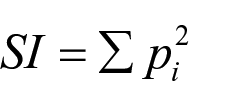
where
A numeric example should serve as an illustration. Suppose there are county A and B, each having four incumbent utilities of varying size distribution. The four utilities in county A are of equal size, i.e.
Control variables
Our control variables correspond to the known factors affecting cooperatives’ emergence, as highlighted in existing studies following the community environment approach and the organizational environment approach. Our first set of control variables concerns the community environment. Existing studies show that communities with characteristics appreciative of the ideological identities of cooperatives tend to stimulate foundings (Boone & Özcan, 2014). As explained above, various existing surveys have identified greenness and localness as ECs’ ideological identity dimensions (also see online supplement A for further details). That is, we need to control for a community’s appreciation for greenness and localness to capture normative legitimacy. Witzke and Urfei (2001) found that environmentally friendly attitudes of Germans are correlated with their voting for the German Green Party. We thus measure the local appreciation of greenness as the proportion of people in a county voting for the German Green Party in the national Bundestag election (greenness). Additional qualitative evidence based on the Green Party’s Bundestag election manifestos further justifies our greenness measure (details see online supplement B).
A community’s appreciation of localness is measured as the difference in voter turnout between county- and national-level elections in each county, which indicates the extent of local citizens’ attachment to and care for their communities (Liu & Wezel, 2015). In Germany, because electoral institutions and party systems are similar across counties, variations in socioeconomic factors should provide the main source of variation in voter turnout (Blais, 2006; Geys, 2006). Differences in turnout driven by socioeconomic factors often are a result of: (a) social pressure to participate, and (b) a genuine attachment to the local community (Geys, 2006; Henderson & McEwen, 2010). Since social pressures to participate should not differ across national and local elections, variation in the difference between local and national elections should be a reasonable proxy for the variation in voters’ attachment to their local community. As elections are held every 4 or 5 years, we filled the missing years through linear interpolation by following existing studies (e.g. Schneiberg et al., 2008; Schneiberg, 2013).
We control for further differences in community environment. We control for whether a region is located in East, because the formal German Democratic Republic accommodates fewer foundings due to its historical lack of entrepreneurial freedom (Fritsch & Wyrwich, 2014). We also control for whether a county is a city county (Kreisfreie Stadt), which consists of one major city as compared to the usual counties of more rural nature. We control for population density (in 1,000 people per square kilometre) and the average disposable income per capita (in 1,000 euros) of a county, because both affect the local availability of EC members. We have constructed the above six control variables based on the socio-demographic data of the German counties from the German Federal Statistics Office.
We also control for the availability of renewable energy sources at the federal state level. We collected data on sunshine duration (in 1,000 hours per year) from the German Climate Data Center. To account for the wind power potential (in 1,000 km2), we used data on suitable areas for wind energy conversion by Blankenhorn and Resch (2014). Such data is more appropriate than the natural resources data of high-speed wind, because it considers the effects of settlement and traffic on wind turbine installations.
EC founding may be affected by local differences in individuals and organizations with knowledge and capabilities relevant to founding cooperatives (Pacheco, York, & Hargrave, 2014; Sine & Lee, 2009). Lacking data directly measuring knowledge and capabilities, we instead control for the number of other coop founding (i.e. cooperatives founded in all industries except the energy industry) in the local county in the same year. Since local availability of knowledge and capabilities affect cooperative foundings across all industries, this control should help isolate our hypothesized effects specific to the energy industry.
Of course, availability of knowledge and capabilities may be specific to the energy industry but vary across counties. Because a surge of previous foundings suggests favourable founding conditions in the focal industry (Hannan, Carroll, Dundon, & Torres, 1995), we control for previous EC foundings (lagged EC founding).
A second set of variables controls for the organizational environment of ECs. Dobrev and colleagues (2006) argue that density of incumbents with overlapping identities affects emerging cooperatives via either legitimacy transfer or resource competition at varying density levels. Since the existing surveys described above show that ECs overlap with MUs in the identity dimensions of greenness and localness, we follow Dobrev, Kim and Hannan (2001) and control for the density of the incumbent MUs at the national level (MU nation density) and density squared at the county level (MU county density2/1000). To account for the effect of resource partitioning (Carroll & Swaminathan, 2000), we control for the county-level concentration using the aggregated size of the four largest incumbent utilities (C4 county). Organizational age and size tend to be correlated under market competition, because it takes time to grow larger and larger size buffers organizations from selection pressure (Carroll & Hannan, 2000; Hannan et al., 1998). We thus control for the average size of incumbents (in 1 million kWh) in a county (incumbents’ mean size).
We control for EC density at the national level (EC nation density) and density squared at the county level (EC county density2) by following Dobrev and colleagues (2001), because (constitutive) ‘legitimation tends to operate more broadly while competition takes place at the regional level’ (Hannan et al., 1995). We also run alternative models controlling for additional linear terms of county-level MU and EC densities (see Robustness Checks).
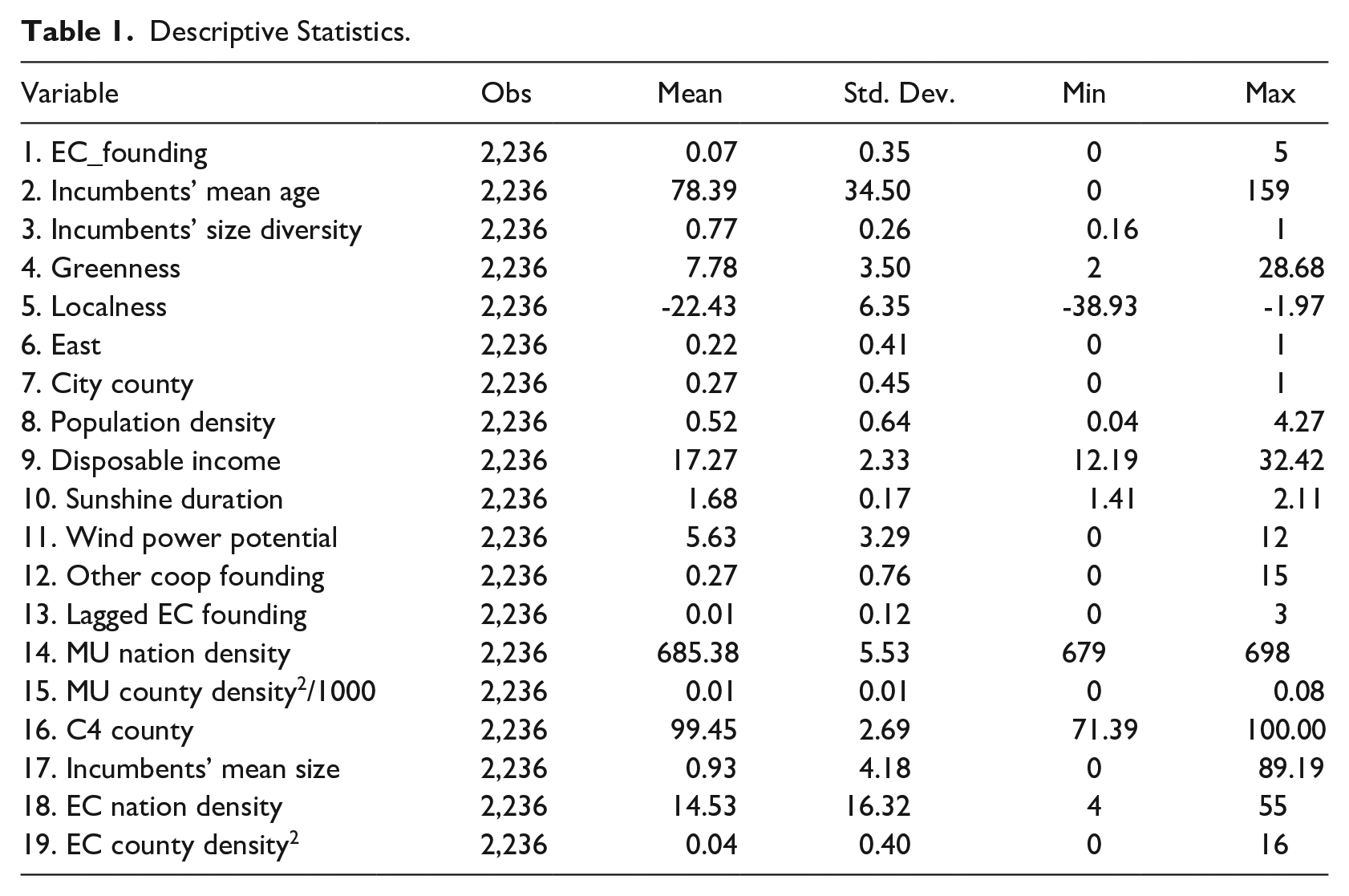
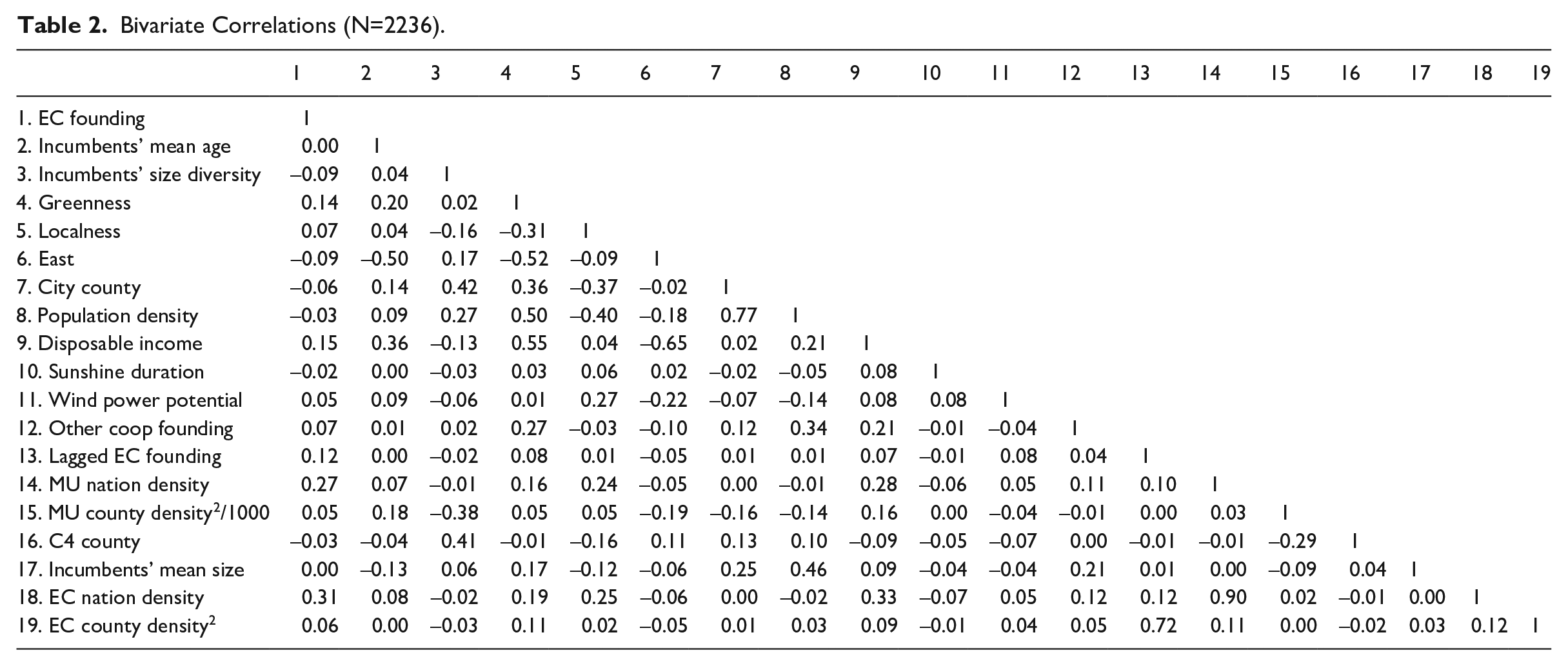
All independent variables except a few time-invariant variables are lagged for two years to avoid reverse causality and to acknowledge the substantial duration of the founding process (DGRV, 2013). Tables 1 and 2 present the descriptive statistics and the bivariate correlations of the variables. The high correlation between MU nation density and EC nation density may cause concerns which we discuss later in our Robustness Checks.
Descriptive Statistics.
Bivariate Correlations (N=2236).
Model specification
Our dependent variable EC foundings is a count variable that takes on non-negative integer values following a Poisson distribution. However, a Poisson model assumes the variance of the dependent variable to be equal to its mean. Violating this assumption would lead to biased estimates (Cameron & Trivedi, 1998). The distribution of our dependent variable shows this assumption is violated with severe overdispersion: the standard deviation greatly exceeds the mean (see Table 1). We thus use negative binomial regression models to correct for overdispersion (Long, 1997). After mean-centring our independent and control variables, we use generalized estimation equations to estimate our models with negative binomial family specifying an exchangeable correlation structure, and report robust standard errors using the sandwich estimators.
Results
Table 3 reports the GEE estimates of EC foundings between 2003 and 2010. Model 1 serves as the baseline, including only the control variables. Subsequent models 2 and 3 add the independent variables to test hypotheses 1 and 2. Here we directly interpret model 3 with the full specifications, starting with the control variables.
GEE Estimates of Energy Cooperative Founding, 2003–2010.
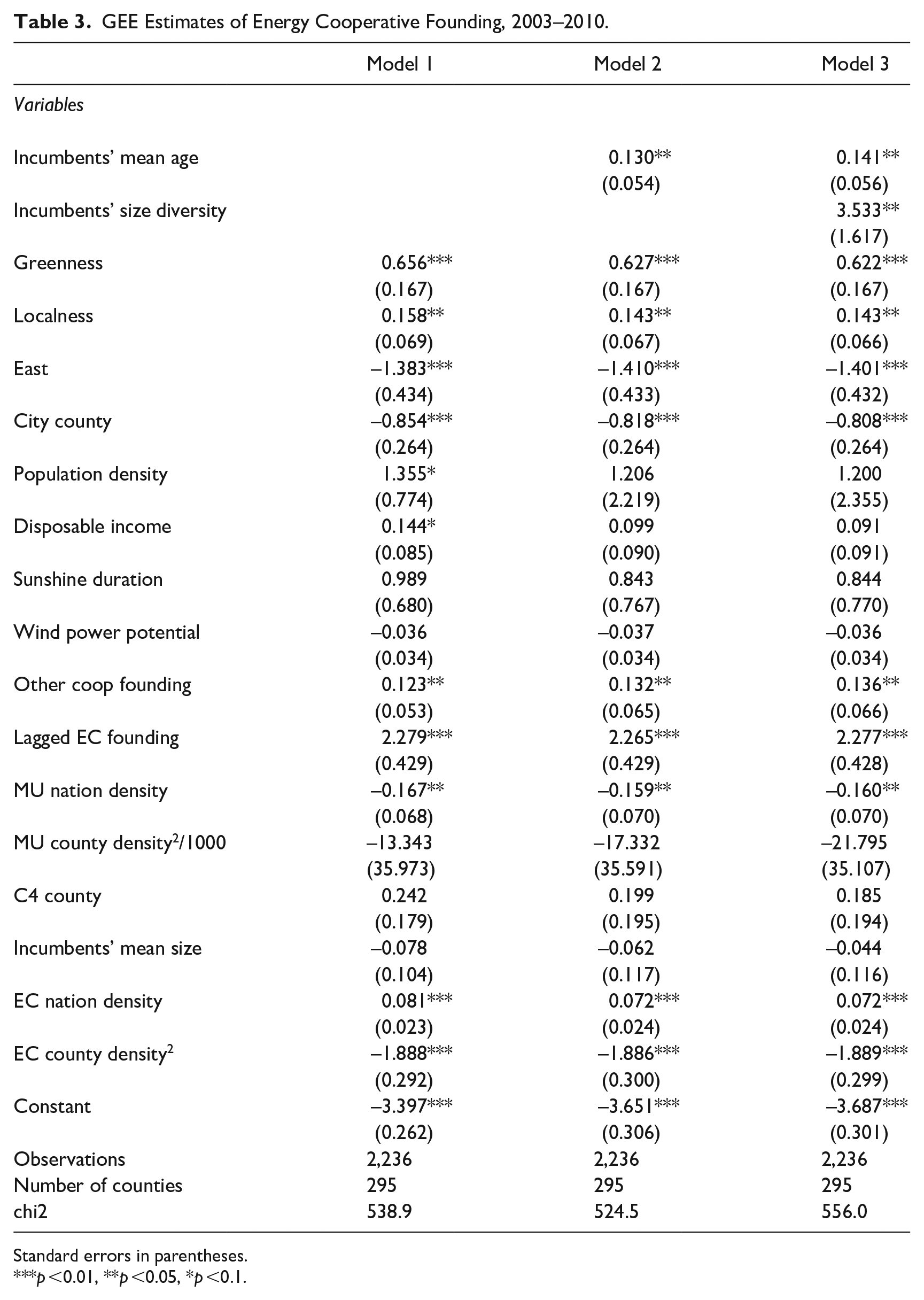
Standard errors in parentheses.
p <0.01, **p <0.05, *p <0.1.
As a county becomes more appreciative of greenness and localness – the main identity dimensions of ECs, it experiences more EC foundings. More specifically, one unit (= 1%) increase in voting for the Green Party (greenness) corresponds to an IRR (Incidence Risk Ratio) of e0.622 = 1.863 (p = 0.000), indicating an 86.3% increase in the probability of new EC founding. One unit increase in the difference in voter turnout between national and county-level elections (localness) corresponds to an IRR of e0.143 = 1.154 (p = 0.031), or a 15.4% increase in the probability of EC founding. These results confirm the significant effect of normative legitimacy, i.e. identity dimensions congruent with the norms and values held as appropriate or ‘right’ within a community (Suchman, 1995), in stimulating EC founding.
Being located in the former East Germany (East) corresponds to e-1.401 = 0.246 (p = 0.001), or a 75.4% decrease in the probability of EC founding. This strong negative effect of East aligns with the findings of Fritsch and Wyrwich (2014). Being a city county also exerts strong negative effect on EC foundings, indicating that ECs are much more likely to be founded in rural communities. Sunshine duration and wind power potential do not affect EC foundings, confirming Sine and Lee’s (2009) finding that social resources affect founding more than natural resources.
Other coop founding shows a positive effect on EC founding, potentially for two reasons. First, general knowledge and capabilities for assembling cooperatives from other industries (Pacheco et al., 2014) may stimulate founding in the energy industry. The second reason concerns legitimation transfer, i.e. the emerging ECs specializing in the energy industry may source legitimacy from more foundings of its parent form (Dobrev et al., 2006). Similarly, the positive effect of lagged EC founding suggests that a county is more likely to experience further EC foundings if there were previous EC foundings.
The negative effect of MU nation density, which is high during our study period (see Table 1), aligns with the findings of Dobrev and colleagues (2006) that high density of the incumbent form hinders the emergence of cooperatives with overlapping identities. The positive effect of EC nation density and the negative effect of EC county density2 show the expected effects of constitutive legitimation at a broader level and competition at a local level (Hannan et al., 1995; Dobrev et al., 2001). The insignificant effect of incumbents’ mean size seems to indicate the eroded age–size correlation resulting from long period of market monopoly until deregulation in 1998.
We test hypothesis 1 by introducing incumbents’ mean age, measuring incumbent’s age-related inertia. Hypothesis 1 predicts more EC foundings where the incumbents are more inert as a result of their higher average age. This is supported by the positive and significant coefficient of incumbents’ mean age. For every additional year of the incumbents’ average age in the focal county, the odds of EC founding is e0.141 = 1.153 (p = 0.011), or an increase of 15.3%.
We add incumbents’ size diversity to test hypothesis 2. We expect more ECs foundings in communities with greater size diversity among incumbents, indicating weaker competition. The positive and significant effect of incumbents’ size diversity confirms our expectation. Because the diversity measure is a number ranging between 0 and 1, we need to divide the coefficient by 100 in order to meaningfully interpret the effect of percentage change, i.e. 0.035 = 3.533/100. If incumbents’ size diversity increases by 1% (0.01), the odds of EC founding in the focal county is e0.035 = 1.036 (p = 0.029), or an increase of 3.6%. Hence, hypothesis 2 is also supported.
In summary, both hypothesis 1 on age-related inertia and hypothesis 2 on size-related competition are supported by our analysis. These results are notable because the effects of age and size of incumbent forms significantly affect EC founding, even after controlling for both community characteristics and aggregated density of incumbents, the dominant measure for organizational environment in prior studies. We interpret these results as evidence that incumbents’ competitive behaviour determined by their age and size presents a novel explanation of cooperative forms’ emergence, above and beyond the two existing explanations.
Furthermore, our results paint a complex picture of how different types of legitimacy and competition affect cooperatives’ emergence. Normative legitimacy, reflected in local communities’ appreciation for shared values embodied in ECs’ identities (greenness, localness), stimulates EC founding. Our qualitative evidence suggests that ECs’ claims for normative legitimacy resonate well in communities with incumbents characterized by high age-related inertia and weak competition due to dispersed size. Constitutive legitimacy, mirrored in ECs’ aggregated density, boosts founding to a certain extent (EC nation density) until the effect of local competition (EC county density2) starts to outweigh it. While energy cooperatives seem to receive legitimacy transfer from the parent form – the general cooperatives (other coop founding) – high density of the incumbent form with overlapping identities (MU nation density) results in competition with cooperatives.
Robustness checks
We carried out additional analyses to assess the robustness of our results. First, we reran our analysis using zero-inflated negative binomial models (Stata routine ZINB) to account for the large number of zeros in the data. Second, we noticed a high correlation (0.9) between MU nation density and EC nation density. To rule out the confounding effects, we re-estimated our models using MU density at the state level (MU state density), whose bivariate correlation with EC nation density is only 0.02. Third, we applied an alternative treatment of missing size data of incumbents. We dropped the 86 observations with missing size data at the end of our observation period and re-estimated our models, in case our assumption of stable electricity sales does not hold. Finally, we added controls for the linear terms of county densities of MUs and ECs, in addition to the linear terms of national densities and the squared terms of county densities in Table 3. The results of all these additional analyses, shown in supplements C to F (all supplements are available as online material), converge with the main results in Table 3.
Discussion
The diversity of organizational arrangements is of pivotal importance for both academics and practitioners, because it represents the repository of solutions for various sustainability challenges ranging from social inequality and ageing populations to climate change (Hannan & Freeman, 1984; Schneiberg, 2007). As existing institutional and organizational arrangements became inadequate for fully addressing these challenges, both academics and practitioners shift their attention towards novel organizational solutions carried in alternative forms such as cooperatives, social enterprises and B-Corporations (for a recent review see Cruz et al., 2017). Increasing diversity of organizational forms and expanding repository of solutions depends on the emergence (or birth) of alternative forms (Ruef, 2000), very often accompanied by fundamental changes in existing institutions (Sine & Lee, 2009).
Our study on the renewable energy cooperatives in Germany contributes to this broad discourse by offering two insights to the question of where and under which conditions alternative forms may emerge (Boone & Özcan, 2014; Liu & van Witteloostuijn, 2020; Muñoz et al., 2020; Padgett & Powell, 2012). First, our study provides both theoretical arguments and empirical evidence underlying a novel explanation for the emergence of cooperatives. We found that incumbents’ characteristics like average age and size diversity significantly stimulate cooperative founding, above and beyond the existing explanations based on community characteristics and incumbents’ density. Our study focusing on age and size is thus embedded in a research stream pioneered by studies on the effects of incumbents’ heterogeneous identities and organizational names on new form emergence (Carroll & Swaminathan, 2000; Dobrev et al., 2006; Pozner, DeSoucey, Verhaal, & Sikavica, 2022; Verhaal, Khessina, & Dobrev, 2015). By joining this debate on the interpopulation processes, we hope our study has shed more light on where and under which conditions alternative forms may emerge.
Our second contribution concerns constitutive legitimacy as a social grounding for the emergence of alternative forms. Complementing pioneering works (Dobrev et al., 2006; Negro et al., 2014; Verhaal et al., 2017), our study shows that incumbents’ age and size may facilitate constitutive legitimacy of alternative forms, besides the known effects of incumbents’ density. As a core concept in wider organizational theory, legitimacy has been at the heart of much scholarly discussion. While ecologists have devoted their attention to constitutive legitimacy mirrored in organizational density, institutionalists have focused on normative legitimacy reflected in shared communal values and norms (Deephouse & Suchman, 2008). Although the largely separate pursuit of the different types of legitimacy by institutionalism and ecology research has greatly advanced our collective understanding of legitimacy, Deephouse and Suchman (2008, p. 69) called for a broader view of ‘community ecology of legitimacy’ allowing for theoretical advancements by combining insights from both camps. Our study indicates that a complex interplay between different types of legitimacy and competition may be crucial for the emergence of alternative forms. In addition, incumbent forms seem to play a significant role in the legitimation process of an alternative form. On the one hand, incumbents constitute the organizational environment in which the legitimacy of and legitimacy transfer to new forms take place. On the other hand, the legitimacy claims of an alternative form often are formulated as competing logics in and across fields (e.g. Lounsbury, 2007) and in relation to incumbents, whose behaviour and competitive implications are in turn determined by organizational characteristics including age and size. While ‘the development of an overarching theory of legitimation remains unfinished business’ (Deephouse & Suchman, 2008, p. 69) and clearly goes beyond the scope of our study, we hope our study has moved a step in this very meaningful direction.
Our study has several limitations which may serve as fruitful avenues for future research. Given our theoretical focus on community ecology, which is the most macro level of organizational theory (Ruef, 2000), we are unable to say more about individual actors whose very actions create alternative forms. We believe research on institutional work, i.e. the ‘purposive action of individuals and organizations aimed at creating, maintaining and disrupting institutions’ (Lawrence & Suddaby, 2006, p. 215), can both benefit from our findings and help to overcome our shortcomings. On the one hand, successful disruption from newcomers may crucially depend on incumbents’ characteristics, because incumbents form the background in which institutional work takes place. For example, by strategically framing around aging incumbents with dispersed size, newcomers may achieve greater resonance and higher effectiveness in problematizing, theorizing and legitimation leading to full institutionalization (Lawrence & Suddaby, 2006).
On the other hand, age and size may bestow incumbents with better ties to regulators and government agencies as well as with greater political power (Stinchcombe, 1965; Lawrence & Suddaby, 2006). This may retard or even impede the efforts of alternative forms to organize sustainably. In the Canadian energy sector, monopolistic incumbents’ close ties to regulators and government helped to maintain current institutions and to stall cleantech firms (Zietsma et al., 2018). We speculate that the German incumbents’ political power was weakened through the recent deregulation driven at the EU level. Indeed, our results may be less pronounced in settings where incumbents’ political power and ability of institutional maintenance increase with their age and size. We encourage future studies to explore the potentially impeding effects of incumbents’ age and size on the emergence of alternative forms.
Another limitation concerns the short observation period from 2003 to 2010. This is a relatively short time for ecological processes to fully unfold and may also raise concerns of left censoring. In addition, the long monopoly before the deregulation in 1998 seems to have suppressed some natural market dynamics and eroded the age–size correlation, which may have resulted in a less pronounced effects of size on inertia. It is thus important to keep the specific context in mind while interpreting our results and the extent to which they apply to other settings. Future studies may also add more insights on the questions of legitimacy transfer and interpopulation competition, by using organizational-level data on the identities of incumbents and newcomers (e.g. the proportion of energy generated using renewable or local sources). It is our hope that future research will improve on our limitations and expose our findings to further tests.
Supplemental Material
sj-docx-1-oss-10.1177_01708406221107457 – Supplemental material for How do Incumbents Affect the Founding of Cooperatives? Evidence from the German electricity industry
Supplemental material, sj-docx-1-oss-10.1177_01708406221107457 for How do Incumbents Affect the Founding of Cooperatives? Evidence from the German electricity industry by Min Liu and Christina Guenther in Organization Studies
Footnotes
Acknowledgements
We are grateful to Guest Editors of this Special Issue and three anonymous reviewers for their excellent guidance and insightful suggestions. We thank the participants for their helpful suggestions and comments on earlier versions of this paper. Our thanks also go to Dana Sülberg for her excellent research assistance.
Author Note
Earlier versions of this paper were presented at the 2018 Meeting of the Academy of Management (Chicago), the 2018 G-Forum (Stuttgart) and the 2020 Organization Studies Summer Workshop (online).
Funding
The author(s) received no financial support for the research, authorship, and/or publication of this article.

Notes
Author biographies
References
Supplementary Material
Please find the following supplemental material available below.
For Open Access articles published under a Creative Commons License, all supplemental material carries the same license as the article it is associated with.
For non-Open Access articles published, all supplemental material carries a non-exclusive license, and permission requests for re-use of supplemental material or any part of supplemental material shall be sent directly to the copyright owner as specified in the copyright notice associated with the article.
